
Nvidia’s Jensen Huang named Marvell “the next trillion-dollar company” at Computex — MRVL +33%, chip equipment up 5-7%, S&P 500 crossed 7,600 for the first time. Alphabet’s $80B equity offering to fund AI capex sent GOOGL -4%; Berkshire took a $10B stake. FTC broadened antitrust probe into Microsoft’s cloud/AI bundling (MSFT -4%). JOLTS April surged 731K above consensus as Cleveland Fed’s Hammack warned a rate hike “may soon be appropriate,” pushing 2026 hike odds to 34% with WTI above $93.
TABLE OF CONTENTS
A. EXECUTIVE SUMMARY
B. MARKET DATA
C. HIGH-IMPACT STORIES (5)
D. MODERATE-IMPACT STORIES (5)
E. ECONOMY WATCH (5)
F. EARNINGS WATCH (1)
G. WHAT’S NEXT
H. CHART OF THE DAY
A. EXECUTIVE SUMMARY -> TOP
The S&P 500 crossed 7,600 for the first time as Jensen Huang’s crowning of Marvell as “the next trillion-dollar company” cascaded +5–7% across semiconductor equipment, while MSFT’s FTC antitrust probe (−4%) and GOOGL’s $80B dilutive equity offering (−4%) compressed the net gain to +0.13%. JOLTS April openings surged to 7.618M — 731K above consensus and the largest beat in the report’s history — as Cleveland Fed President Hammack in her final pre-blackout address warned that policy “may not be sufficiently restrictive” and “it may soon be appropriate to act,” hardening the case for a hawkish June FOMC with WTI holding above $93 and PCE tracking toward 4%. Breadth was constructive — 7 of 11 sectors advanced and the Russell 2000 outpaced the S&P by 81 bps for a third consecutive session — though violent intra-tech rotation (semiconductor equipment up 5–33% while software sold off sharply) signals bifurcating capital within AI rather than rotation away.
• MRVL +32.52% after Nvidia CEO Jensen Huang publicly declared Marvell “the next trillion-dollar company” at Computex 2026; semiconductor equipment cascade: AMAT +6.96%, LRCX +5.45%, KLAC +5.42%, CSCO +5.50%, NVDA +6.2%; HPE +27% on $5.9B AI systems backlog confirmation
• Alphabet launched an $80B equity offering — its first stock issuance since 2005 — to fund $180B in 2026 AI capex; GOOGL/GOOG both fell ~4%; Berkshire Hathaway’s $10B private placement at $351.81/$348.20 creates a structural price floor
• FTC escalated antitrust probe into Microsoft covering Azure bundling, Copilot, and the OpenAI investment (MSFT −4.17%); civil investigative demands issued to Microsoft and 8 competitors; multi-year regulatory overhang emerging despite Build 2026 conference underway
• JOLTS April surged 731K to 7.618M — largest beat in the report’s history and a 2-year high — as Hammack warned “may soon be appropriate to act” before FOMC blackout; 2026 rate-hike odds hit 34%; Friday Non-Farm Payrolls (May) is the final pre-FOMC data input
• Bitcoin −5.49% to $68,950 as Mt. Gox estate transferred $735M (10,306 BTC) to hot wallets; zero equity contagion — BTC now subject to crypto-specific supply dynamics while tech stocks simultaneously rallied sharply
• FERC cleared Constellation Energy’s Three Mile Island nuclear restart for Microsoft AI data center power delivery — first Big Tech/nuclear PPA approved at federal regulatory level; CEG +2.62%
1. AI Infrastructure Capital Formation Reaches Escape Velocity — Today crystallized a structural shift: Alphabet’s $80B equity raise to fund $180B in capex, FERC’s nuclear restart clearance for Microsoft’s AI data centers, and Huang’s semiconductor connectivity thesis collectively signal that hyperscalers and their suppliers are committing permanent capital at a scale that will shape corporate earnings cycles for years. Intra-AI bifurcation (MRVL +33% vs. DELL −7%, MSFT −4%) confirms capital is becoming increasingly selective about which layer of the AI stack it rewards — pure-play connectivity infrastructure over diversified hardware integrators and software-bundled incumbents under regulatory scrutiny.
2. The Fed’s Dual-Headwind Trap — JOLTS April’s 731K beat and Hammack’s hawkish pre-blackout warning converged with WTI above $93, transportation prices at all-time highs (LMI at 96), and PCE at 3.8% to create a genuine tightening-bias environment. The June 16–17 FOMC faces a dot plot revision decision under conditions — labor market at 2-year highs, manufacturing at 4-year highs, crude above $90 — classically associated with further tightening; yet consumer pessimism (RCM/TIPP below 50 for ten consecutive months) and a GDPNow deceleration to 3.0% signal forward growth risk that constrains the Fed’s ability to act aggressively. Friday’s NFP is the binary that resolves the ambiguity.
3. Record Equity Prices Mask Violent Internal Rotation — The S&P’s +0.13% headline and 7/11 sectors green delivers a constructive breadth narrative, but the underlying session was unusually violent: semiconductor equipment gained 5–33% while software and communication services saw multi-billion-dollar single-session losses. The valuation debate around PLTR (76x 2027 earnings, 51% downside scenario) and DELL (UBS Neutral after a 170% run) signals that easy multiple expansion in AI names is largely complete — the next leg requires fundamental execution, not sentiment re-rating. For the portfolio manager, today’s session is a warning that AI exposure requires precision: the wrong AI names could lag significantly even in an AI bull market.
 — Leading economic indicators. Accurate market forecasts. Apply for membership at join.recessionalert.com
B. MARKET DATA -> TOP
A semiconductor boom driven by Nvidia CEO Jensen Huang’s public endorsement of Marvell Technology as the “next trillion-dollar company” sent chip equipment stocks up 5–33%, lifting the S&P 500 to its first close above 7,600 — yet violent selloffs in software (MSFT −4%, PLTR −5%) and communication services (GOOGL −4% on an $80B dilutive stock sale) compressed the headline gain to +0.13%. Breadth was constructive: 7 of 11 sectors advanced and the Russell 2000 outpaced the S&P 500 by 81 basis points, its third consecutive session of small-cap outperformance. The sharpest anomaly was Bitcoin’s −5.49% plunge — $735M in Mt. Gox estate transfers to hot wallets sparked crypto-specific selling fully decoupled from the equity advance. WTI crude’s +1.38% on Middle East supply disruptions kept inflation risk visible for rate traders.
CLOSING PRICES – Tuesday, June 2, 2026:
MAJOR INDICES
Today was a tale of two tapes within indices: DJIA and Nasdaq gained 0.45% and 0.48% while the S&P 500 advanced only +0.13% — software and communication services losses offset the semiconductor surge at the index level. Dow Theory bull confirmation is in force, with DJIA hitting a new 10-session high and DJTA within 2% of its own peak. Critically, the Russell 2000 outperformed the S&P 500 by 81 basis points today, extending a sustained 3-session pattern of RUT outperforming by more than 2% over the trailing 10 sessions — a mechanical breadth signal confirming the rally is not purely mega-cap driven.
| Index | Close | Change | %Move | Why It Moved |
|---|---|---|---|---|
| S&P 500 | 7,609.94 | +9.98 | +0.13% | First close above 7,600 (record); semiconductor equipment surge offset by software/comms selloff; net narrow gain on violent internal rotation |
| Dow Jones | 51,308.46 | +229.58 | +0.45% | Blue-chip breadth; AI beneficiaries including Cisco (+5.5%) lifted index; Dow Theory bull confirmation — DJIA at new 10-session high |
| DJ Transportation | 21,470.1 | −60.2 | −0.28% | WTI crude +1.38% on Middle East disruptions pressured transport cost outlook; DJTA within 2% of 10-session high (Dow Theory intact) |
| Nasdaq 100 | 30,660.60 | +146.74 | +0.48% | Chip boom (MRVL +33%, AMAT +7%) led gains; partially offset by MSFT −4% (FTC probe) and PLTR −5% (bearish analyst call) |
| Russell 2000 | 2,933.05 | +27.29 | +0.94% | Broad market participation; 3rd consecutive session of RUT outperforming S&P 500 by >2% over trailing 10 days — sustained breadth signal |
| NYSE Composite | 23,480.92 | +145.76 | +0.63% | Broad advance; 7 of 11 S&P 500 sectors green; constructive breadth across mid- and large-caps |
VOLATILITY & TREASURIES
VIX eased to 15.78 (−1.68%) as yields declined modestly — falling vol alongside falling yields is a pure risk-on signal, not anxiety-driven repositioning. The 10Y shed 2.4 bps while the 2Y was essentially flat (−0.2 bps), leaving the yield curve marginally steeper with no inflation-fear signature. DXY was flat (+0.02%), declining to offer a dollar safe-haven premium despite Middle East crude tensions — bond and currency markets are not pricing geopolitical risk at a macro level.
| Instrument | Level | Change | Why It Moved |
|---|---|---|---|
| VIX | 15.78 | −0.27 (−1.68%) | Modest vol compression; constructive session with positive breadth; options market not pricing elevated tail risk |
| 10-Year Treasury Yield | 4.450% | −2.4 bps | Mild safe-haven bid; yields easing alongside equities advancing confirms no inflation-fear signature — risk-on tone |
| 2-Year Treasury Yield | 4.049% | −0.2 bps | Essentially flat; minimal rate path repricing; Fed policy expectations unchanged |
| US Dollar Index (DXY) | 99.22 | +0.02 (+0.02%) | Essentially flat; no macro catalyst for dollar direction; geopolitical tensions not triggering safe-haven dollar bid |
COMMODITIES
Gold (+0.26%), silver (+0.21%), and platinum (+0.49%) posted a mild safe-haven bid on Middle East geopolitics — subdued scale suggests the market views disruption risk as manageable rather than systemic. Copper’s +1.90% gain near the 2% threshold is the stronger signal: AI infrastructure demand is consuming real industrial inputs, layering a growth-demand story on top of the equity narrative. Bitcoin’s −5.49% was fully decoupled — crypto-specific Mt. Gox selling with zero equity contagion.
| Asset | Price | Change | %Move | Why It Moved |
|---|---|---|---|---|
| Gold | $4,517.95/oz | +$11.65 | +0.26% | Mild safe-haven bid on Middle East oil supply disruption; precious metals attracted modest defensive positioning |
| Silver | $75.410/oz | +$0.156 | +0.21% | Following gold modestly higher; mild precious metals bid on geopolitical tensions |
| Copper | $6.6770/lb | +$0.1245 | +1.90% | AI infrastructure demand driving industrial metals; semiconductor capex buildout consuming real-world copper inputs |
| Platinum | $1,937.90/oz | +$9.50 | +0.49% | Mild advance alongside broader precious metals bid; no independent catalyst |
| Bitcoin | $67,525.0 | −$3,922.0 | −5.49% | Mt. Gox estate transferred $735M in BTC (~10,306 coins) to hot wallets; Strategy sold holdings; rotation into AI equities; crypto-specific, no equity contagion |
ENERGY
WTI (+1.38%) and Brent (+0.91%) advanced on Middle East supply disruptions, but rising alongside equities frames this as a demand-growth story rather than a stagflationary supply shock. WTI-Brent spread compressed slightly to $2.41, consistent with US-specific supply strength. Henry Hub (−0.28%) and Dutch TTF (−3.04%) sat out the crude rally entirely — natural gas is a separate market right now, with European storage dynamics driving TTF lower independent of geopolitical crude risk.
| Asset | Price | Change | %Move | Why It Moved |
|---|---|---|---|---|
| Crude Oil (WTI) | $93.43/bbl | +$1.27 | +1.38% | Middle East supply disruptions; rising with equities = demand/growth narrative, not supply shock stagflation |
| Crude Oil (Brent) | $95.84/bbl | +$0.86 | +0.91% | Middle East supply risk; WTI-Brent spread compressed to $2.41 — globally consistent crude move, no regional premium widening |
| Natural Gas (Henry Hub) | $3.170/MMBtu | −$0.009 | −0.28% | Essentially flat; independent of crude dynamics; domestic summer storage builds in progress |
| Natural Gas (Dutch TTF) | $16.23/MMBtu | −$0.51 | −3.03% | European gas declining despite Middle East risk; comfortable EU storage levels; TTF diverging from crude — European-specific dynamics |
S&P 500 SECTORS
Communication Services’ −2.30% session collapse cuts against its +30.54% 12-month lead — Alphabet’s $80B dilution announcement made this a single-stock sector event, not a structural rotation. Utilities’ day-best +1.79% is a bounce from the month’s worst performer (−5.93% 1M): rate-sensitive relief as yields ease modestly. Technology’s +1.19% looks muted only against its own +35.86% 3-month lead — the sector’s structural dominance across every horizon remains firmly intact.
| Sector | 1-Day | 1-Week | 1-Month | 3-Month | 6-Month | YTD | 12-Month |
|---|---|---|---|---|---|---|---|
| Utilities | +1.79% | −3.15% | −5.93% | −5.43% | −1.21% | +3.99% | +11.71% |
| Basic Materials | +1.51% | +1.85% | +4.02% | −0.99% | +23.35% | +18.90% | +50.88% |
| Energy | +1.35% | +0.14% | −2.60% | +4.96% | +28.67% | +30.00% | +43.58% |
| Technology | +1.19% | +7.05% | +18.47% | +35.86% | +30.17% | +30.65% | +60.94% |
| Industrials | +1.04% | −0.23% | +1.25% | +1.36% | +16.63% | +15.28% | +27.71% |
| Real Estate | +0.43% | −2.52% | −1.61% | −0.92% | +3.06% | +6.45% | +5.28% |
| Financial | +0.36% | −0.82% | +0.18% | +2.63% | +0.62% | −2.50% | +9.59% |
| Consumer Defensive | −0.25% | −2.89% | −4.73% | −7.28% | +2.74% | +4.26% | −0.16% |
| Consumer Cyclical | −0.33% | −1.50% | −1.02% | +3.86% | −1.72% | −2.08% | +8.95% |
| Healthcare | −1.49% | −2.14% | −0.46% | −5.96% | −6.59% | −5.10% | +11.34% |
| Communication Services | −2.30% | −3.91% | −3.66% | +5.32% | +2.45% | +3.29% | +30.54% |
TOP MEGA-CAP MOVERS:
GAINERS
| Company | Ticker | Close | Change | Why It Moved |
|---|---|---|---|---|
| Marvell Technology | MRVL | $290.79 | +32.52% | Nvidia CEO Jensen Huang publicly endorsed Marvell as “next trillion-dollar company”; AI custom chip demand surging; blowout quarter implied |
| Applied Materials | AMAT | $490.05 | +6.96% | Semiconductor equipment surge; AI chip capex buildout driving orders for deposition/etch equipment; rode MRVL coattails |
| Cisco Systems | CSCO | $128.00 | +5.50% | AI data center networking demand; Cisco’s switches and routing infrastructure are critical for AI server deployments; AI infrastructure beneficiary |
| Lam Research | LRCX | $334.41 | +5.45% | Semiconductor equipment peer advanced on AI-driven capex cycle; etch equipment demand lifted on AI chip buildout momentum |
| KLA Corp | KLAC | $2,045.20 | +5.42% | Semiconductor equipment peer advanced alongside sector on AI chip demand; process control equipment critical for advanced node production |
DECLINERS
| Company | Ticker | Close | Change | Why It Moved |
|---|---|---|---|---|
| Dell Technologies | DELL | $435.31 | −6.58% | Post-earnings sell-the-news; UBS issued cautious note saying stock unlikely to advance further after touching record $467; profit-taking after +33% post-earnings surge |
| Palantir Technologies | PLTR | $152.17 | −5.28% | Bearish analyst note projecting 51% downside to $103.50 by year-end on valuation concerns; 50x projected 2027 earnings deemed unsustainable |
| Microsoft | MSFT | $441.31 | −4.17% | FTC investigating Microsoft’s cloud, AI, and software bundling practices; Copilot AI service outage Monday June 1 dented confidence despite Build 2026 conference underway |
| Alphabet (Class A) | GOOGL | $361.85 | −3.86% | Alphabet announced $80B dilutive stock sale to fund AI buildout; market penalized heavy shareholder dilution; Communication Services sector worst on day |
| Alphabet (Class C) | GOOG | $358.39 | −3.81% | Same catalyst as GOOGL — both Alphabet share classes fell on $80B AI funding stock issuance announcement |
— Institutional-grade intelligence for serious investors. Apply for membership at join.recessionalert.comC. HIGH-IMPACT STORIES -> TOP
BULLISH
1. Jensen Huang Crowns Marvell “Next Trillion-Dollar Company” at Computex — MRVL +32.52%; Semiconductor Equipment Stocks Rally 5–7%
The core facts:At Computex 2026 in Taipei on June 2, NVIDIA CEO Jensen Huang took the stage alongside Marvell Technology CEO Matt Murphy and publicly declared Marvell “the next trillion-dollar company.” Huang’s thesis: the AI bottleneck has shifted from raw compute to data center connectivity and silicon photonics — Marvell’s specialty. NVIDIA invested $2 billion in Marvell earlier in 2026. MRVL surged +32.52%, adding roughly $60+ billion in market capitalization. The endorsement triggered a broad semiconductor equipment rally: AMAT +6.96%, LRCX +5.45%, KLAC +5.42%, CSCO +5.50%. NVIDIA itself gained +6.2%. UBS raised its Marvell price target from $195 to $230. Marvell’s current market cap of approximately $192 billion would need to 5x to reach the trillion-dollar threshold Huang cited.
Why it matters:(1) Jensen Huang endorsing a specific company as the “next trillion-dollar company” at the industry’s premier conference creates an institutional permission structure for portfolio managers to size up MRVL. The directional signal is unambiguous from a credibility standpoint, and the $2 billion pre-existing NVIDIA investment aligns Huang’s financial interests with the public endorsement. (2) The semiconductor equipment cascade (AMAT, LRCX, KLAC all +5-7%) reflects a direct transmission: if MRVL’s AI connectivity thesis is correct, wafer fabrication equipment demand accelerates proportionally. This is a bullish confirmation for the entire semiconductor supply chain, not just the MRVL name. HPE’s concurrent +27% surge on AI server backlog data ($2.1B in Q2 AI orders, $5.9B AI systems backlog) confirmed from the demand side what Marvell’s endorsement confirmed from the infrastructure side. (3) The market’s interpretation of today’s Computex session is that NVIDIA is choosing winners in the AI infrastructure stack — MRVL for networking and connectivity — while AMD, Intel, and Qualcomm are structurally disadvantaged. Today’s -8.78% QCOM (from yesterday) and -6% INTC reactions still visible in the 12-month chart illustrate the divergence between AI-native and AI-transitioning semiconductor companies that Huang’s endorsement crystallized.
What to watch:Marvell’s next earnings call for concrete custom ASIC revenue numbers and hyperscaler contract wins that validate the trillion-dollar trajectory; whether AMD mounts a technical counteroffensive at its next product event given its own data center networking ambitions; OEM commitments for Marvell’s optical interconnect products as the physical proof of the connectivity bottleneck thesis.
UNCERTAIN
2. Alphabet Launches $80B Stock Offering to Fund AI Buildout — First Equity Issuance Since 2005; Berkshire Takes $10B Private Placement; GOOGL/GOOG Slide ~4%
The core facts:Alphabet announced a massive equity offering totaling $80 billion to fund AI compute infrastructure — the company’s first stock issuance since 2005. The structure: $30 billion in underwritten public offerings ($15 billion in mandatory convertible preferred stock + $15 billion in Class A and C common stock) plus a $40 billion at-the-market (ATM) offering program beginning in Q3 2026. Berkshire Hathaway entered a concurrent $10 billion private placement ($5 billion Class A at $351.81 per share, $5 billion Class C at $348.20 per share). Alphabet expects to spend over $180 billion on capex in 2026 — double the 2025 figure — to scale AI infrastructure and meet what management calls “unprecedented customer demand.” GOOGL fell -3.86% and GOOG fell -3.81%. Communication Services sector declined -2.30%, the worst-performing sector on the session.
Why it matters:(1) Alphabet choosing equity dilution over debt financing signals that management believes the competitive cost of under-investing in AI infrastructure exceeds the cost of shareholder dilution — a confidence statement that paradoxically validates the AI investment thesis even as it pressures the stock price near-term. At approximately 3.5% of Alphabet’s market capitalization, the dilution is meaningful but manageable for long-term shareholders. (2) Berkshire Hathaway’s $10 billion private placement at fixed per-share prices is the most significant institutional signal of value support: Buffett’s firm — historically conservative on technology investments — directly endorsing Alphabet’s AI thesis with its largest single tech investment creates a structural price floor at the private placement levels ($351.81/$348.20). (3) The $180 billion capex run rate makes Alphabet the largest single infrastructure customer for semiconductor equipment makers, data center suppliers, and networking hardware — the committed capital flows directly into AMAT, LRCX, Arista, and Vertiv earnings cycles. The stock dilution today funds the AI infrastructure bull case tomorrow.
What to watch:The pace at which Alphabet draws on the $40 billion ATM facility beginning Q3 2026 — rapid drawdown signals capex urgency; Alphabet’s Q2 2026 cloud revenue growth for evidence that the infrastructure spend is translating into revenue acceleration; whether Amazon, Meta, or Microsoft announce comparable equity raises, which would confirm that AI infrastructure spending has reached a scale requiring new equity capital formation across the hyperscaler cohort.
BEARISH
3. FTC Escalates Microsoft Cloud/AI Antitrust Probe — Azure, Copilot, and OpenAI Investment Under Scrutiny; MSFT -3.61% Despite Build 2026 Conference
The core facts:The Federal Trade Commission broadened its antitrust investigation into Microsoft’s cloud, AI, and software bundling practices, issuing civil investigative demands to Microsoft and at least eight competitors — including Amazon Web Services, Google Cloud Platform, and Salesforce — seeking internal documents on Azure licensing structures, Copilot AI assistant bundling across Microsoft 365 and GitHub, and the competitive implications of Microsoft’s investment in OpenAI. Regulators are examining whether bundling security, AI, and productivity features into all-in-one subscriptions forecloses rivals, and whether Microsoft’s cloud infrastructure position gives it an unfair advantage when backing AI model providers. Microsoft (~$3.3 trillion market cap) fell -3.61% despite its Build 2026 developer conference running simultaneously. A Copilot AI service outage on June 1 added to sentiment headwinds.
Why it matters:(1) An FTC antitrust probe into a $3.3 trillion company is structurally a multi-year valuation overhang. Even if Microsoft prevails on the merits, the regulatory process constrains its ability to make additional AI/cloud acquisitions, forces licensing disclosures, and could lead to structural remedies affecting Azure bundling economics — the precise revenue synergies embedded in current MSFT valuations. (2) The probe’s focus on Microsoft’s OpenAI investment is the most material angle: if regulators determine the investment constitutes an anticompetitive arrangement — proprietary model access plus cloud lock-in — the structural remedy could include divestiture or access requirements that directly undermine Microsoft’s AI moat. This risk is not priced into current estimates. (3) The EU Digital Markets Act enforcement against Microsoft’s Teams/Office bundling provides a precedent template: global coordinated regulatory action on bundling compels product separation, which reduces the cross-selling economics that justify elevated cloud ARPU assumptions. Today’s -3.61% decline is likely the beginning, not the end, of regulatory repricing.
What to watch:FTC issuance of formal charges vs. a consent decree negotiation — a formal complaint would immediately halt certain bundling practices; the EU’s parallel DMA enforcement for any coordination signals with the FTC on global remedies; MSFT’s Azure growth trajectory in Q2 2026 earnings for the competitive lock-in metrics that regulators may use as evidence of anticompetitive foreclosure.
BEARISH
4. JOLTS April Surges to 7.618M — Largest Upside Beat in Report History; Hammack Warns Rate Hike “May Soon Be Appropriate” as Final Pre-Blackout Signal
The core facts:April JOLTS job openings surged to 7.618 million — eclipsing the 6.88 million consensus by 731,000, the largest single-month upside beat in the report’s history and a two-year high for the absolute openings level. Virtually the entire gain was concentrated in professional and business services. Simultaneously, Cleveland Fed President Beth Hammack — speaking at the City Club of Cleveland — stated that current monetary policy “may not be sufficiently restrictive” to return inflation to the Fed’s 2% target and said “if recent trends continue, it may soon be appropriate to act.” Hammack’s speech represents the final major Fed communication before the FOMC blackout period begins approximately June 3. Polymarket rate-hike odds for 2026 reached 34% following the combined release and speech.
Why it matters:(1) The JOLTS 731K beat — arriving alongside ISM Manufacturing at a four-year high (54.0%), PCE at 3.8%, and WTI above $93 — eliminates any “growth is slowing” rationale for Fed patience. The cumulative data configuration now reads: labor market accelerating + manufacturing accelerating + inflation elevated + oil above $90 = the Fed’s next move is a hike, not a cut, if trends continue into the June 16-17 FOMC. (2) Hammack’s language — “may not be sufficiently restrictive,” “may soon be appropriate to act” — is the most explicitly hawkish pre-FOMC communication from a Fed official since the 2022 hiking cycle. As the last scheduled pre-blackout speech, it sets the market’s baseline expectation for the June FOMC statement at hawkish hold, with a meaningful probability that the SEP (dot plot) formally raises the median year-end rate projection. (3) The market transmission is direct: a hawkish FOMC statement on June 16-17 would push the 2Y Treasury toward 5.0% and compress rate-sensitive equities — real estate, utilities, long-duration growth — that have rallied on the assumption that the Fed’s next move remains a cut.
What to watch:FOMC blackout beginning approximately June 3 closes the window on pre-meeting Fed communications; the 2Y Treasury yield for any break above 4.80% as the real-time signal that markets are pricing a hike in 2026; Friday’s Non-Farm Payrolls (May) as the definitive labor data input before the June 16-17 decision.
UNCERTAIN
5. WTI $93.43 Holds Above $92 for Second Consecutive Session; API Crude Draw -6.8M Barrels Marks 7th Consecutive Weekly Decline; Iran MOU Binary Persists
The core facts:WTI crude closed at $93.43 per barrel, +1.38% on the session, marking the second consecutive day above the $92 threshold associated with material PCE inflation pass-through in Fed models. The American Petroleum Institute reported US crude inventories fell 6.8 million barrels for the week ending May 30 — nearly double the -3.6 million barrel consensus and the seventh consecutive weekly draw, the longest drawdown streak since 2022. President Trump stated that negotiations on a 60-day memorandum of understanding to reopen the Strait of Hormuz are moving rapidly and could be finalized “within a week,” under a framework that would remove all mines from the strait within 30 days and provide sanctions waivers for Iranian oil sales. However, Iranian media reported the government had not communicated with Washington for “a few days,” adding ambiguity to Trump’s optimistic framing. Energy sector advanced +1.35% on the session and is up +30.00% YTD.
Why it matters:(1) Crude above $90 sustained for multiple sessions is the most potent channel connecting the geopolitical situation to Federal Reserve policy. Atlanta Fed models suggest each $10-per-barrel sustained crude increase adds approximately 25-35 bps to headline PCE. With PCE already at 3.8%, a third consecutive week above $90 pushes the Fed’s internal forecast toward 4.1% — materially widening the gap from the 2% target and hardening the case for a December hike, a scenario Polymarket now prices at 34% probability. (2) The API crude draw streak (-6.8M barrels, seventh consecutive weekly draw) represents genuine supply tightening that is independent of the Iran binary. Even if Iran signs an MOU and Hormuz reopens, the 7-week inventory drawdown reflects underlying US demand strength that keeps prices structurally elevated above pre-conflict levels. (3) The binary structure remains: a signed MOU → WTI retraces toward $80-85, PCE relief path reopens, December hike probability falls; no deal → crude sustains above $90, PCE stickiness intensifies, 2Y Treasury reprices toward 5.0%, and equities face simultaneous pressure from higher rates and lower earnings quality for energy-input-heavy sectors.
What to watch:Wednesday’s EIA official crude inventory report for confirmation of the API’s -6.8M barrel draw; any formal diplomatic statement from Iran or the State Department on the MOU negotiation status; WTI’s $90 level as the structural threshold where the Fed’s inflation path decisively deteriorates and year-end hike pricing hardens above 50%.
— Quantifying recession risk so you don’t have to guess. Apply for membership at join.recessionalert.comD. MODERATE-IMPACT STORIES -> TOP
BEARISH
6. Dell -4.63% as UBS Downgrades to Neutral — “AI Optimism Already Priced In” After 170% 12-Month Run; Q1 AI Server Revenue +757% Still Not Enough to Hold the Rally
The core facts:UBS analyst David Vogt downgraded Dell Technologies from Buy to Neutral, raising the price target modestly to $243 while arguing that after a 170% 12-month rally to record levels near $467, the risk/reward is now balanced and “AI optimism is already priced in.” Dell had reported record Q1 FY2027 results on May 29 — revenue +88% YoY to $43.84 billion, AI server revenue +757% to $16.1 billion — but shares had already surged approximately 33% post-earnings to peak levels. DELL fell -4.63% today on the UBS note. Other banks maintain bullish targets: Mizuho $300, JPMorgan $280, Citi $290, Bank of America $280, creating a bifurcated analyst consensus.
Why it matters:(1) The UBS call frames the key valuation question now facing every AI infrastructure hardware name that has had a large post-earnings run: when a fundamental beat is already priced, what is the next catalyst? UBS’s argument is that AI server order growth decelerates from extreme initial levels and that DELL is priced for continued acceleration rather than normalization to “merely excellent” growth — a distinction that matters for forward-multiple compression. (2) The divergence between UBS (Neutral/$243) and the rest of the Street ($280-$300) reflects a structural debate about whether AI hardware spending is a secular multi-year cycle or a catch-up cycle approaching peak rate-of-change. This debate directly affects how portfolio managers should size AI hardware exposure heading into Q2 2026 earnings reports. (3) Today’s MRVL +32.52% and DELL -4.63% together illustrate the intra-AI-infrastructure rotation: capital is rotating toward pure-play AI connectivity infrastructure (MRVL) and away from diversified AI hardware integrators (DELL) that the market believes have already fully re-rated their AI opportunity.
What to watch:Dell’s Q2 FY2027 AI server order backlog for evidence of whether orders are accelerating or normalizing; whether JPMorgan and Mizuho defend their $280-$300 targets after UBS’s downgrade, which signals whether the debate has real institutional weight; SMCI and HPE as peer signals on AI server demand velocity in coming weeks.
BEARISH
7. Palantir -5.74% on 51% Downside Analyst Projection to $103.50 — Valuation at 76x 2027 Earnings Seen as Unsustainable Despite 85% Revenue Growth
The core facts:A bearish analyst note projected Palantir Technologies would fall 51% to $103.50 by end-2027, applying a multiple normalization argument: at an estimated $2.07 in 2027 EPS at 50x earnings — the valuation assigned to other high-growth software peers — the implied fair value is $103.50 versus PLTR’s current price of approximately $212. The analyst acknowledged Palantir’s exceptional fundamentals — 85% revenue growth in the most recent quarter, FY2026 guidance raised to $7.65-7.66 billion (+71% YoY) — but argued the company trades at approximately 76x projected 2027 earnings, demanding sustained hypergrowth indefinitely to justify the multiple. Palantir (approximately $365 billion market cap) fell -5.74% on the session.
Why it matters:(1) A single bearish analyst note generating a -5.74% decline at a $365 billion market cap quantifies the degree to which PLTR’s elevated valuation depends on retail and momentum buyers rather than institutional fundamental investors. The fragility of the valuation base at this magnitude suggests that any fundamental disappointment — even a small guidance miss — could accelerate multiple compression dramatically. (2) The 51% downside scenario at a 50x 2027 earnings multiple does not require Palantir to miss on fundamentals. It only requires sentiment normalization toward other fast-growing software peers that trade at 30-60x forward earnings — a re-rating that could happen through time compression alone as the AI hypergrowth narrative matures. The $260 billion market-cap destruction implied would rank among the largest single-company de-ratings in S&P 500 history. (3) With PLTR already down approximately 20% YTD, today’s -5.74% decline suggests the valuation normalization thesis is gaining traction among institutional sellers even as the operational growth story remains intact — a typical divergence pattern in late-stage valuation compression cycles.
What to watch:Whether PLTR holds the $200 technical level — a breakdown below signals institutional distribution rather than retail profit-taking; Palantir’s next quarterly results for revenue vs. the $7.65 billion FY2026 trajectory; Snowflake and ServiceNow multiple trends as peer anchors for whether 50x-76x forward P/E is sustainable in the AI software cohort.
BEARISH
8. Bitcoin -5.49% as Mt. Gox Moves $731M to Hot Wallets — BTC Breaks Below $70K; Zero Equity Contagion Confirms Crypto-Specific Dynamics
The core facts:Blockchain surveillance firm Arkham Intelligence tracked 10,306 BTC (approximately $731 million) moving from the Mt. Gox estate’s cold storage to operational hot wallets in Bitcoin block 952,072 at 04:47 UTC on June 2. The transfer triggered immediate distribution fears, driving BTC from $71,000 to below $69,000 within an hour. Strategy Inc. simultaneously disclosed a small sale of 32 BTC, adding negative sentiment. BTC fell -5.49% to approximately $68,950 — breaking the key $70,000 psychological support and hitting its lowest level since April 8, 2026. Total crypto liquidations exceeded $350 million. Arkham subsequently confirmed no exchange deposits and no large-scale selling activity — the drop was driven by algorithmic monitoring and leveraged long position liquidation, not actual distribution.
Why it matters:(1) The -5.49% decline on no confirmed selling illustrates BTC’s persistent sensitivity to on-chain behavioral signals, regardless of whether the feared event materializes. At $350 million+ in liquidations, the structural fragility of leveraged crypto positions creates a self-reinforcing mechanism: algorithmic alerts → stop-loss cascade → amplified price move → media confirmation → retail panic. (2) The notable market feature today is what BTC’s decline did NOT do: there was zero equity contagion. Tech stocks rallied sharply (NVDA +6.2%, MRVL +32.52%), Nasdaq crossed 27,000, and BTC fell simultaneously. This decoupling is structurally different from 2022, when crypto selloffs correlated with broad equity risk-off. BTC is now subject to supply-side dynamics specific to the crypto market (Mt. Gox estate distribution, Strategy sales) rather than functioning as a risk-appetite barometer for equities. (3) Mt. Gox’s estate retains a large portion of its original 850,000+ BTC, and any cold-to-hot wallet transfer will continue generating market fear regardless of actual selling. This recurring dynamic creates a structural ceiling on BTC’s recovery to its $126,000 all-time high without full clarity on the estate distribution timeline.
What to watch:Whether the Mt. Gox trustee confirms an exchange deposit (actual distribution) or the hot wallet remains dormant; the $65,000 level as next technical support if $70,000 is confirmed broken on a closing basis; the Clarity Act’s Senate vote timeline as a potential institutional demand catalyst that could counteract supply-side pressure.
BULLISH
9. Constellation Energy +2.62% as FERC Grants Waiver for Accelerated Three Mile Island Nuclear Restart — Microsoft AI Data Center Deal Clears Key Regulatory Hurdle
The core facts:The Federal Energy Regulatory Commission granted Constellation Energy a waiver from PJM Interconnection grid rules, allowing Constellation to transfer Capacity Interconnection Rights from its Eddystone natural gas-fired power plant to the Three Mile Island Unit 1 nuclear reactor — now renamed the Crane Clean Energy Center — in Pennsylvania. The waiver directly enables full power delivery when the reactor restarts, targeted for 2027, under a long-term power purchase agreement with Microsoft to supply electricity for its AI data centers. The waiver had been opposed by PJM’s market monitor, making FERC’s direct override a meaningful regulatory endorsement of the nuclear-AI energy nexus. CEG shares advanced +2.62%.
Why it matters:(1) FERC’s approval clears the largest regulatory obstacle in Constellation’s restart timeline. The override of PJM’s market monitor opposition signals federal regulatory support for nuclear-powered AI infrastructure at the highest level — an important precedent that removes a key bear case on the CEG thesis (regulatory delay). (2) The Microsoft/Crane deal is the first major precedent for Big Tech contracting directly with nuclear operators for AI compute power, establishing a template that other hyperscalers — Alphabet ($180B capex committed), Amazon (developing its own nuclear deals), Meta — may follow as AI data center demand overwhelms available grid capacity. The nuclear operator universe (NRG, Exelon, Entergy) benefits directly from this template. (3) The FERC decision connects directly to the AI infrastructure investment thesis visible across today’s market: from Marvell’s AI connectivity endorsement to Alphabet’s $180 billion capex commitment, the physical infrastructure for AI is being built simultaneously across electricity generation, silicon photonics, and data center networking — and nuclear energy is now an established supply-side participant.
What to watch:The Crane Clean Energy Center’s NRC regulatory approval process and construction timeline for full 2027 restart confirmation; whether Alphabet, Amazon, or Meta announce comparable nuclear power purchase agreements given their own massive AI capex commitments; other nuclear operators (Entergy, Exelon) with shuttered facilities as potential Microsoft/Google/Meta offtake agreement targets.
UNCERTAIN
10. Atlanta Fed GDPNow Slashes Q2 2026 Forecast to 3.0% from 4.3% in Ten Days — Equity Market at Record High Shrugs Off Growth Deceleration Signal
The core facts:The Atlanta Fed’s GDPNow real-time GDP tracker cut its Q2 2026 forecast to 3.0% — down 130 basis points from 4.3% on May 21 in three successive downward revisions, with no upward offset. The pace of deterioration (130 bps in 10 days) exceeds the tracker’s historical mid-quarter revision pace. The S&P 500 simultaneously sits at a record 7,609.78, Nasdaq has crossed 27,000 for the first time, and Q1 2026 blended earnings growth stands at +28.6% YoY with 97% of the index reported. (Full GDPNow component data and underlying economic indicators are in Section E.)
Why it matters:(1) The equity market is pricing record backward-looking data: 97% Q1 earnings beat rate, +28.6% blended earnings growth, 14.8% net profit margins (highest since FactSet’s tracking began in 2009). GDPNow’s 3.0% Q2 forecast, if accurate, signals meaningful deceleration from Q1’s trajectory — raising the probability that Q2 earnings growth (received in July) disappoints relative to current elevated expectations. (2) The divergence between a record-high equity market and a decelerating forward growth signal creates a risk asymmetry: the upside scenario (GDPNow recovers toward 4%+ on Friday’s NFP and next week’s CPI) is partially priced at current valuations; the downside scenario (Q2 GDP closer to 2-3%) is not. This is precisely the configuration in which equity valuation risk is highest. (3) The combination of GDPNow’s decline AND today’s JOLTS 9-sigma beat creates the Fed’s most difficult near-term calibration challenge: aggregate demand today (job openings surging) appears strong while forward growth (GDPNow) is decelerating — a mixed configuration consistent with policy mistake risk on both sides of the Fed’s mandate.
What to watch:Wednesday’s ADP Employment Change (May, consensus +110K) and ISM Services PMI (consensus 53.7) as the first real-time signals of whether Q2 momentum is recovering or still decelerating; Friday’s Non-Farm Payrolls (May) as the dominant weekly data input; whether GDPNow revises upward following this week’s data releases, which would signal the deceleration was temporary.
— Separating signal from noise since 2007. Apply for membership at join.recessionalert.comE. ECONOMY WATCH -> TOP
April’s JOLTS headline — 7.618M openings, a 9-sigma beat — looked like labor-market strength, but the underlying picture deteriorated: quits fell to a 6-year low and hires declined 419K, the hallmarks of a locked-in, not confident, workforce. Against that backdrop, Atlanta Fed GDPNow slashed its Q2 forecast from 4.3% to 3.0% in ten days, logistics costs hit all-time highs (LMI transportation prices: 96), and consumer sentiment logged its 10th straight month below the 50 neutral line. Cleveland Fed President Hammack said policy “may not be sufficiently restrictive” and flagged early action if inflation trends persist — a hawkish signal three days before the June FOMC blackout.
JOLTS Job Openings Surge to 7.618M in April — But Quits Hit 6-Year Low (BLS, June 2, 2026)
What they’re saying:The Bureau of Labor Statistics reported 7.618M job openings in April, a surge of 731K from March and a massive 9-sigma beat versus the 6.88M consensus — the biggest upside miss in the history of the JOLTS series. Openings rose sharply in professional and business services (+668K), manufacturing, and government. However, hires fell 419K (the second-largest decline since July 2020), and the quits rate dropped to its lowest level in six years — 2.977M quits versus 3.171M in March.
The context:The divergence between the headline openings figure and the underlying behavioral data tells two different stories. The openings surge reflects elevated unfilled demand — companies posting jobs — while the quits collapse signals that workers feel too economically insecure to leave. Low quits typically precede softening wage growth and slowing consumer spending. The combination of record openings and record-low voluntary turnover is a rare signal associated with labor market transitions, not health. Markets interpreted the headline as “Fed on hold for longer,” pushing rate-cut odds further out and lifting short-end yields.
What to watch:Friday’s May Non-Farm Payrolls (exp. ~185K) will confirm whether the openings surge translates to actual hiring. ADP Employment Change for May (exp. 117K) releases Wednesday, June 3.
Atlanta Fed GDPNow Q2 2026 Slashed to 3.0% From 4.3% in Ten Days (Atlanta Fed, June 1, 2026)
What they’re saying:The Atlanta Federal Reserve’s GDPNow model updated its Q2 2026 real GDP growth estimate to 3.0% on June 1, down from 3.8% on May 28 and 4.3% on May 21 — a cumulative 130-basis-point downward revision in just ten days. The revision reflects incoming data showing softer-than-expected wholesale inventories and weaker net export dynamics following April’s trade figures.
The context:The speed and magnitude of the GDPNow revision is notable — three successive downward adjustments without a single upward revision signals a broad-based data deterioration, not a one-off miss. At 3.0%, Q2 growth would represent a significant deceleration from Q1’s 1.6% annualized pace (though the absolute level remains positive). The model will continue updating through the quarter; Wednesday’s ISM Services PMI and ADP data will be key inputs.
What to watch:ISM Services PMI (May, exp. 53.8) and ADP Employment (May, exp. 117K) on Wednesday June 3; Non-Farm Payrolls (May) on Friday June 5 — each will move the GDPNow estimate materially in either direction.
Cleveland Fed’s Hammack: “Monetary Policy May Not Be Sufficiently Restrictive” to Tame Inflation (Cleveland Fed, June 2, 2026)
What they’re saying:Cleveland Fed President Beth Hammack stated that “monetary policy may not be sufficiently restrictive to bring inflation down to 2%,” adding that “the picture for inflation is not encouraging — inflation is too high and is moving higher.” She said it is “reasonable to keep rates steady given the uncertainties around the economic outlook,” but warned that “if recent trends continue, it may soon be appropriate to act” — a clear reference to a potential rate hike. She cautioned that “if we wait for definitive evidence that high inflation has become embedded, it may require larger policy adjustments, at greater cost.”
The context:Hammack’s remarks are the last material public Fed communication before the FOMC’s pre-meeting communications blackout begins approximately June 3. Her comments reinforce the hawkish shift visible in Polymarket, where Fed hike odds stand at 34%. With headline PCE at 3.8% YoY and ISM manufacturing prices paid surging, Hammack’s framing — “moving higher,” “may soon be appropriate to act” — represents an escalation from the Fed’s prior “well-positioned to wait” posture. A rate hike at the June 16-17 meeting remains unlikely, but Hammack is openly building a case for one at a future meeting.
What to watch:June 16-17 FOMC meeting — the Committee’s updated economic projections (dot plot) will indicate whether hawkish dissent is converging into official guidance. Watch Polymarket hike odds (currently 34%) for real-time sentiment.
LMI Logistics Index: Transportation Prices Hit All-Time High of 96 as Supply Chain Costs Surge (LMI Report, June 2, 2026)
What they’re saying:The May 2026 Logistics Managers’ Index (LMI) read 69.5, down slightly from April’s 69.9, and while the headline remains at its second-fastest expansion pace since March 2022, the cost sub-indices told a more alarming story: transportation prices surged to a record high of 96 (up from elevated prior levels), inventory costs hit 84.1 — the highest since May 2022 — and warehousing prices remained elevated at 70.7. Transportation capacity continued to contract sharply at 31.7.
The context:Transportation prices at a record high are a direct upstream input to goods inflation — these cost increases typically flow into retail prices with a 3-to-6 month lag. The combination of surging transportation costs and tightening capacity (31.7 = rapid contraction) is consistent with the Iran conflict’s disruption to global shipping routes and elevated oil prices (~$92 WTI). Inventory cost pressure at 84.1 signals that companies are holding expensive inventory rather than deploying it — a further brake on margin recovery. This data point reinforces Hammack’s concern that “inflation is moving higher” and complicates the Fed’s path to cutting rates.
What to watch:June CPI release (expected mid-July) for evidence that logistics cost spikes are feeding into headline goods inflation. Watch ISM Services Prices Paid (Wed Jun 3) as a cross-check on service-sector cost momentum.
RCM/TIPP Economic Optimism Misses Again at 42.5 — 10th Straight Month Below Neutral 50 (TIPPInsights/RCM, June 2, 2026)
What they’re saying:The RealClearMarkets/TIPP Economic Optimism Index edged marginally to 42.5 in June, essentially unchanged from May’s 42.6 and significantly missing the consensus expectation of 44.5. The Six-Month Economic Outlook subcomponent fell 1.9 points to 37.1 — its weakest reading since June 2024. The index has now remained below the neutral 50 threshold for ten consecutive months, reflecting persistent and broad-based pessimism about the economy among American households.
The context:A reading of 42.5 with a forward-looking component at 37.1 signals that consumers see conditions deteriorating further, not improving. This sustained pessimism is inconsistent with robust labor data — the JOLTS headline would normally buoy sentiment — and suggests the inflation and geopolitical backdrop (Middle East conflict, elevated oil/gas prices) is dominating household psychology. Consumer spending accounts for roughly 70% of US GDP; extended pessimism of this duration typically precedes a pullback in discretionary expenditure, adding downside risk to Q3 GDP and retail sector earnings.
What to watch:Conference Board Consumer Confidence for June (expected late June); University of Michigan Consumer Sentiment preliminary reading for June (expected mid-June) — if these confirm the RCM/TIPP trend, watch consumer staples and discretionary sector rotation.
— Know the probability before the market prices in the risk. Apply for membership at join.recessionalert.comF. EARNINGS WATCH -> TOP
YESTERDAY AFTER THE BELL (Markets Reacted Today)
No major earnings yesterday after the bell from companies with >$100B market cap.
TODAY BEFORE THE BELL (Markets Already Reacted)
No major earnings before the bell from companies with >$100B market cap.
TODAY AFTER THE BELL (Markets React Tomorrow)
BULLISH
11. Palo Alto Networks (PANW): +9.96% AH | EPS Beat + All Guidance Raised; AI Security Platform Consolidation Thesis Confirmed
The Numbers:Q3 FY2026 non-GAAP EPS: $0.85 vs $0.79 estimate (+7.6% beat) | Revenue: $3.002B vs $3.003B estimate (in-line; +31% YoY) | NGS ARR: $8.1B | Remaining Performance Obligations: $18.4B | FY2026 revenue guidance raised to $11.415-$11.425B (vs $11.29B consensus, +24% YoY) | FY2026 EPS guidance raised to $3.77-$3.79 (vs $3.70 consensus) | FY2026 NGS ARR guidance raised to $8.90-$8.95B (+59-60% YoY) | FY2026 RPO guidance raised to $20.9-$21.0B (+32-33% YoY) | Regular session: -1.10% (pre-earnings) | Released: AMC June 2, 2026
The Problem/Win:EPS beat of $0.06 (+7.6%) on consistent 31% revenue growth, with all four guidance categories (full-year revenue, EPS, NGS ARR, RPO) raised simultaneously. NGS ARR growth (+59-60% YoY in FY guidance) demonstrates that PANW’s platformization strategy — consolidating enterprise security spend across SASE, Cortex XSIAM, and network security — is converting into durable recurring revenue at scale. CEO Nikesh Arora: “Q3 was a standout quarter for Palo Alto Networks, with accelerating organic bookings growth as customers turn to us to secure their AI deployments at scale.”
The Ripple:PANW’s strong quarter validates enterprise security spend at a time of high IT budget scrutiny, and directly raises the bar for CrowdStrike (reporting Wednesday AMC). PANW’s platformization success — customers consolidating from point products to the full PANW suite — represents market share capture from mid-tier security vendors. The $18.4B RPO balance provides exceptional revenue visibility into FY2027, reducing estimate uncertainty for institutional holders.
What It Means:PANW’s beat + raised guidance confirms that enterprise AI deployment is a net positive for cybersecurity demand — every AI workload and cloud migration generates incremental security surface area. The +9.96% AH reaction signals the market is re-rating PANW toward a platform-security compounder with durable revenue visibility, not a cyclical IT spend proxy.
What to watch:CrowdStrike’s Q1 FY2027 results Wednesday AMC as the direct competitive read-through for platform consolidation vs. PANW; PANW’s Q4 FY2026 results (late August) for whether RPO sustains the trajectory toward the $20.9-$21.0B FY guidance; any deceleration in net new NGS ARR as the first potential signal of a platformization ceiling.
WEEK AHEAD PREVIEW:
Q1 2026 earnings season is effectively complete (97% reported, +28.6% blended growth). Attention now shifts to two high-profile AI infrastructure names reporting Wednesday that will set the tone for how the AI investment narrative is valued heading into Q2 reporting season in July.
Broadcom (AVGO) — AMC Wednesday Jun 3 — Key focus: AI semiconductor revenue guidance ($10.7B Q2 expected, +140% YoY following Q1’s $8.4B at +106%); whether the $73B AI backlog is tracking toward the $100B+ FY2027 target; custom ASIC revenue transparency (Google TPUs, Meta processors, Microsoft chips); VMware margin contribution. EPS estimate: $2.46, Revenue estimate: $22.87B. Following today’s Jensen Huang endorsement of Marvell’s AI connectivity thesis, AVGO faces elevated expectations for its own AI semiconductor trajectory. EPS estimate: $2.40, Revenue estimate: $22.13B (GIF data).
CrowdStrike (CRWD) — AMC Wednesday Jun 3 — Key focus: ARR trajectory toward the $5.50-$5.504B FY2027 Q1 guidance (from Q4 FY2026 $5.25B, +24% YoY); net new ARR (record $331M in Q4, up 47%); Next-Gen SIEM ARR (75% growth, $585M ending ARR in Q4); platform module expansion metrics after PANW’s strong platformization print tonight. EPS estimate: $1.07, Revenue estimate: $1.36B.
No additional major earnings (>$100B market cap, US-domiciled) are scheduled for Thu Jun 4 or Fri Jun 5.
— US market commentary trusted by family offices and institutions. Apply for membership at join.recessionalert.comG. WHAT’S NEXT -> TOP
UPCOMING RELEASES:
| Date | Event | Why It Matters |
|---|---|---|
| Wed, Jun 3 | ADP Employment Change — May (exp. 117K, prior 109K) | First look at May labor market momentum; consensus at 117K would confirm JOLTS surge is translating into real hiring; a miss below 100K would reintroduce soft-landing ambiguity ahead of Friday’s NFP and complicate the hawkish Fed narrative |
| Wed, Jun 3 | ISM Services PMI — May (exp. 53.8, prior 53.6) | Key GDPNow input — a beat would claw back some of the 130-bps Q2 forecast deceleration; the Prices Paid sub-index is the critical read for whether service-sector inflation is accelerating alongside transportation costs at all-time highs (LMI at 96) |
| Wed, Jun 3 | Fed Beige Book — June edition | Regional economic conditions snapshot across all 12 Fed districts; with Hammack flagging inflation “moving higher,” watch for Beige Book language on price pressures, supply chain costs, and labor market tightness — hawkish district commentary would reinforce the June FOMC dot plot revision case |
| Thu, Jun 4 | Initial Jobless Claims — week of May 30 (exp. 213K, prior 215K) | Weekly labor market pulse; consensus expects essentially flat at 213K — any print below 200K would be a second consecutive JOLTS-style upside surprise, hardening the hawkish case; a spike above 230K would reintroduce softening narrative before Friday’s NFP |
| Thu, Jun 4 | Nonfarm Productivity Q1 Final (exp. 0.8%, prior 1.6%) & Unit Labor Costs Q1 Final (exp. 2.3%, prior 4.6%) | Fed inflation metric — if Unit Labor Costs revise higher from the 4.6% prior, it adds a wage-inflation channel to the already elevated PCE (3.8%) and reinforces Hammack’s “may soon be appropriate to act” language; productivity below 0.8% signals cost-push inflation risk is not abating |
| Fri, Jun 5 | Non-Farm Payrolls — May (exp. ~185K) | The most consequential pre-FOMC data point — the final major labor input before the June 16–17 meeting. A print above 200K alongside the 7.618M JOLTS openings would close the argument for a hawkish June FOMC dot plot, pushing the 2Y Treasury toward 4.80–5.00% and compressing rate-sensitive equities; a miss below 150K reopens the soft-landing window and reduces hike probability from the current 34% |
KEY QUESTIONS:
1. Will Friday’s Non-Farm Payrolls (May) confirm the JOLTS surge and force the June 16–17 FOMC dot plot to formally signal a 2026 rate hike — and if so, how far does the 2Y Treasury reprice toward 5.0%?
2. Can Marvell sustain today’s +33% on Jensen Huang’s endorsement, or does MRVL need concrete custom ASIC revenue numbers at its next earnings to validate the trillion-dollar trajectory — and which semiconductor equipment names (AMAT, LRCX, KLAC) extend versus fade?
3. Will the Iran MOU negotiations conclude this week and send WTI back toward $80–85 — removing the single largest inflation tail risk to the Fed’s 2% path — or will crude sustain above $90 into the FOMC meeting and cement the case for year-end tightening?
— US market commentary trusted by family offices and institutions. Apply for membership at join.recessionalert.comH. CHART OF THE DAY -> TOP
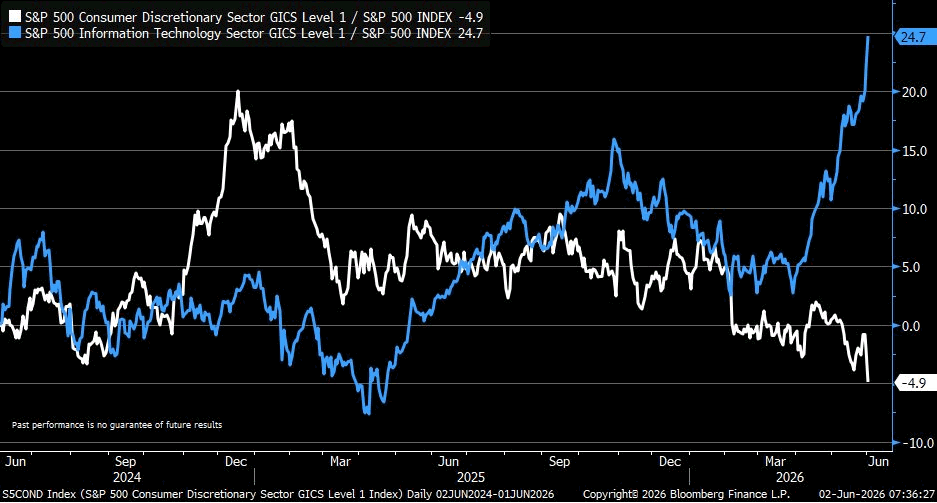
Two ratios, one circuit. The capex dollars lifting Tech to a 2-year relative high of +24.7 and the household dollars draining out of Consumer Discretionary to a 2-year relative low of −4.9 are not separate stories — they are the same dollar moving through different doors, and the entire thirty-point spread opened in roughly ten weeks of near-vertical move since late March. Textbook rotation has early-cycle Discretionary leading late-cycle Tech; that order is running backwards, which tells you this is not a cycle at all but a single capex vertical printing on the tape. Hyperscaler AI spend, ad budgets, cloud seats, software renewals — every line item funding that spread is sourced, eventually, from the household wallet now rationing under delinquency stress, softer real wages and a cooling jobs market. Tech’s earnings engine is partly powered by the very consumer it is outrunning. The vertical line eventually has to pay rent.
Market Intelligence Brief (MIB) Ver. 18.37
For professional investors only. Not investment advice.
© 2026 RecessionALERT.com

Comments are closed.