
US strikes on Iran’s Qeshm Island and IRGC retaliation on Kuwait bases ended the S&P 500’s nine-session streak; WTI hit $96. Fed’s Logan called policy “a bit loose” pre-blackout, pushing hike odds to 41%; ADP 122K and dual ISM above 54 make Friday NFP the pivot. SpaceX priced the largest US IPO in history ($1.75T, $75B raise, June 12 Nasdaq); Anthropic filed at $1T the same day. Trump proposed 10–12.5% tariffs on 60 partners including Canada, Mexico, and the EU.
TABLE OF CONTENTS
A. EXECUTIVE SUMMARY
B. MARKET DATA
C. HIGH-IMPACT STORIES (5)
D. MODERATE-IMPACT STORIES (5)
E. ECONOMY WATCH (5)
F. EARNINGS WATCH (3)
G. WHAT’S NEXT
H. CHART OF THE DAY
A. EXECUTIVE SUMMARY -> TOP
The S&P 500’s nine-session winning streak ended −0.73% as US strikes on Iran’s Qeshm Island — and IRGC retaliatory claims against US bases in Kuwait — drove WTI crude to $96.11 (+2.60%), compressing the geopolitical risk premium almost entirely into North American crude while Brent slipped. Dallas Fed President Logan’s pre-blackout declaration that policy is “neutral or perhaps even a bit loose” — against dual ISM composites above 54 for the first time since mid-2023 — pushed 2026 rate hike probability from 34% to 41%, amplifying the macro headwind. Technology’s −1.60% loss masked a sharp internal rotation: Philadelphia Semiconductor Index surged +5.9% on Jensen Huang’s Marvell endorsement while AI-infrastructure software (IBM −7.17%, Palantir −6.55%, Oracle −5.83%) led the decline — a rotation within tech, not a clean exit. Only Healthcare, Consumer Defensive, and Energy advanced of eleven sectors.
• Middle East escalation: US CENTCOM confirmed self-defense strikes on Iran’s Qeshm Island targeting radar and drone command facilities; IRGC claimed successful missile/drone strikes on US bases in Kuwait and Bahrain. WTI surged to $96.11 (+2.60%) — third consecutive session above $92 — while the EIA confirmed an −8.0M barrel inventory draw (vs. −4.0M est.), the sixth consecutive weekly decline. Dow fell 619 points (−1.21%), S&P 500 snapped its nine-session winning streak.
• Fed hawkish pivot sharpens pre-blackout: Dallas Fed’s Logan declared policy “neutral or a bit loose” — the most explicitly hawkish pre-FOMC statement this cycle — one day before the June 7 blackout. Rate hike probability for 2026 climbed to 41% (from 34%). Goolsbee warned services inflation is elevated and not oil-driven; Beige Book flagged energy-driven middle-income household stress. The Logan/Barr divide is now on the official pre-FOMC record.
• Macro data validates the hawks: ADP May employment came in at 122K (est. 117K), the broadest hiring since January. ISM Services PMI hit 54.5 (est. 53.8) — combined with ISM Manufacturing at 54.0, both ISMs are simultaneously above 54 for the first time since mid-2023. Services Prices sub-index held at 71.3 (historically consistent with services CPI above 4%). Friday’s May NFP (est. 85K) is now the pivot event for the June 17–18 FOMC.
• Historic IPO supply event: SpaceX priced its IPO at $135/share ($1.75T valuation, $75B primary raise) — the largest US IPO in history by more than 3x — targeting June 12 Nasdaq debut as SPCX. Anthropic simultaneously filed a confidential S-1 at ~$1T. Combined, ~$2.75T in enterprise value seeks public market entry in Q3, creating institutional rebalancing pressure on existing mega-cap holdings in the June 9–20 window.
• Tariff regime expands to 60 partners: Trump proposed 10–12.5% Section 301 tariffs on imports from 60 countries — including Canada, Mexico, the EU, the UK, and Taiwan — citing forced-labor violations. Public hearings July 7. Re-inclusion of USMCA partners signals willingness to re-open settled trade agreements; supply-chain contingency planning is required now.
• Tech bifurcation: Philadelphia Semiconductor Index +5.9% on Jensen Huang’s Marvell endorsement; storage hardware (SNDK +6.71%, WDC +5.51%) rallied on AI data center thesis. AI-infrastructure software sold off sharply: IBM −7.17% (no catalyst, pure 42%-one-month-rally unwind), Oracle −5.83% (Morgan Stanley OCI constraint warning), PANW −5.64%, PLTR −6.55%. META +4.24% against the risk-off tape on global Business Agent launch across WhatsApp/Instagram/Messenger.
1. Geopolitics and monetary policy have merged into a single risk vector. — Active US-Iran hostilities with WTI at $96 — where each $10 sustained increase adds approximately 25–35 basis points to PCE already running at 3.8% — have fused the geopolitical risk premium directly into the Fed path narrative. Logan’s “neutral or bit loose” declaration and 41% hike odds reflect exactly this convergence. The bond market’s non-response (10Y +0.5 bps) signals the market has not yet priced a June hike, creating asymmetric downside if Friday’s NFP beats: a print above 150K alongside crude at $96 likely pushes hike odds through 50%.
2. Tech bifurcation signals an AI value-chain layer migration, not a sector exit. — The session that crushed AI-infrastructure software 5–7% (IBM, Palantir, Oracle) simultaneously drove Philadelphia Semiconductor Index +5.9% and storage hardware +5–7% (Sandisk, WDC). Jensen Huang’s explicit endorsement of Marvell as the “next $1 trillion company” — combined with Alphabet’s $84.75B AI infrastructure equity raise — is redirecting institutional capital from software orchestration layers toward physical AI infrastructure (chips, storage, memory). For portfolio positioning, this is a layer-migration signal: hold semiconductor hardware and storage; reduce extended AI-software names where valuations priced flawless execution.
3. The IPO calendar has become a macro event requiring active portfolio management. — SpaceX at $1.75T + Anthropic at ~$1T = approximately $2.75T in enterprise value seeking public market entry in the same quarter. At $75B raised, SPCX alone absorbs roughly 0.5% of S&P 500 market cap in new equity supply, forcing index rebalancing on inclusion. Institutional investors must reduce existing positions to fund new allocations, generating sell-side pressure on current large-cap technology in the June 9–20 window. Portfolio managers should audit current mega-cap concentration for forced-selling risk ahead of the SpaceX June 12 debut.
 — Leading economic indicators. Accurate market forecasts. Apply for membership at join.recessionalert.com
B. MARKET DATA -> TOP
Middle East escalation fears — doubts surrounding US-Iran ceasefire negotiations — ended the S&P 500’s nine-session winning streak, with the Dow shedding 619 points as investors unwound risk positions. The session bifurcated sharply within technology: the Philadelphia Semiconductor Index surged 5.9% on Jensen Huang’s Marvell commentary, lifting storage hardware (Sandisk +6.7%, Western Digital +5.5%) and traditional semis (Intel +4.4%, AMD +4.0%), while AI-infrastructure software (IBM −7.2%, Palantir −6.6%, Oracle −5.8%) bore the day’s heaviest losses — a rotation within the sector, not a clean exodus from it. Three sectors gained against eight declining, with defensives (Healthcare, Consumer Defensive) topping the tape. The day’s sharpest structural anomaly: WTI crude surged 2.6% while Brent slipped 0.7%, compressing the WTI-Brent spread to roughly $1 — geopolitical risk premium being loaded almost entirely into North American crude, a potential cost-input headwind for US industrials and consumers.
CLOSING PRICES – Wednesday, June 3, 2026:
MAJOR INDICES
The Dow’s −1.21% loss against the Transports’ near-flat close (+0.05%) misses the 1.5% same-day divergence threshold, yet the directional split is telling: blue-chip industrials sold off while freight and logistics held, suggesting a valuation repricing at the top rather than a growth scare. Dow Theory bull confirmation remains entrenched: both DJIA and DJTA within 2% of their 10-session highs for the fifth consecutive session. Over 10 sessions, small caps (RUT +5.4% vs. S&P 500 +2.7%) extend their breadth-participation signal into a second session, while Nasdaq 100 (+6.1% vs. S&P 500 +2.7%) surpasses the 3% outperformance threshold for the first time today — a dumbbell structure with tech mega-caps and small caps outperforming, mid-to-large non-tech lagging.
| Index | Close | Change | %Move | Why It Moved |
|---|---|---|---|---|
| S&P 500 | 7,554.37 | −55.41 | −0.73% | Nine-session winning streak ended on Middle East escalation fears; Financials, Technology, and Basic Materials led the decline |
| Dow Jones | 50,688.43 | −619.36 | −1.21% | Largest point loss; geopolitical risk-off hit blue-chip industrials and Financials; gives back a portion of the prior week’s record-setting rally |
| DJ Transportation | 21,480.1 | +10.00 | +0.05% | Virtually flat; logistics and freight names insulated from the tech bifurcation; no deterioration in freight demand signals |
| Nasdaq 100 | 30,571.24 | −89.36 | −0.29% | Partial insulation — Philadelphia Semiconductor Index surge (+5.9%) offset AI-infrastructure software declines; narrowed losses versus the broader market |
| Russell 2000 | 2,893.67 | −38.29 | −1.31% | Small caps underperformed on broad risk-off; Financials (-1.29%) weighed disproportionately on small-cap sector exposure |
| NYSE Composite | 23,276.49 | −204.43 | −0.87% | Broad-market risk-off; 8 of 11 S&P 500 sectors declined; geopolitical selling permeated full exchange breadth |
VOLATILITY & TREASURIES
A VIX at 16 is not a panic signal — the uptick is modest and still firmly in complacent territory. The 2-year yield’s +3.1 bps move against the 10-year’s +0.5 bps is a mild front-end steepening: the bond market is not confirming a growth scare (which would send 10Y yields sharply lower) and is not pricing near-term rate cuts despite the equity selloff. The dollar’s +0.31% gain is a quiet safe-haven bid — present but not forceful, consistent with orderly risk reduction rather than a flight-to-quality panic.
| Instrument | Level | Change | Why It Moved |
|---|---|---|---|
| VIX | 16.06 | +0.29 (+1.84%) | Modest uptick on geopolitical risk-off; at 16, still in complacent territory — no panic buying of volatility protection |
| 10-Year Treasury Yield | 4.499% | +0.5 bps | Barely moved despite equity selloff — bond market not catching a risk-off safety bid; sticky inflation expectations holding the rate path |
| 2-Year Treasury Yield | 4.082% | +3.1 bps | Front-end led higher; market not pricing near-term rate cuts; Middle East oil shock added a mild inflation premium to the short end |
| US Dollar Index (DXY) | 99.52 | +0.30 (+0.31%) | Modest safe-haven bid on geopolitical tensions; dollar firm but not surging — orderly risk reduction rather than panic flight to safety |
COMMODITIES
Gold’s flat close on a risk-off, geopolitical-fear day is a notable non-confirmation — the metal is declining to price in the Middle East escalation narrative that drove stocks lower and crude higher. Precious metals broadly flat means the safe-haven bid went to Treasuries and the dollar, not hard assets. Bitcoin’s −3.24% tracked equities in classic risk-off lockstep, consistent with its correlation pattern this cycle rather than any crypto-specific catalyst.
| Asset | Price | Change | %Move | Why It Moved |
|---|---|---|---|---|
| Gold | $4,462.70/oz | $0.00 | 0.00% | Flat despite geopolitical risk-off; safe-haven flows directed to Treasuries and dollar rather than precious metals |
| Silver | $72.980/oz | +$0.012 | +0.02% | Essentially flat; industrial and safe-haven demand balanced at current levels |
| Copper | $6.484/lb | −$0.0008 | −0.01% | Flat; industrial demand signals muted on the day; China demand outlook unchanged |
| Platinum | $1,862.00/oz | $0.00 | 0.00% | No movement; no specific catalyst; precious metals complex broadly range-bound |
| Bitcoin | $65,325 | −$2,188 | −3.24% | Tracked broad equity risk-off; no crypto-specific catalyst; behaving as a risk asset in lockstep with S&P 500 direction |
ENERGY
WTI’s +2.60% versus Brent’s −0.66% compressed the WTI-Brent spread from roughly −$4 to −$1 in a single session — the Middle East geopolitical premium is being loaded almost entirely into North American crude pricing. Rising WTI alongside falling equities is stagflationary in character: cost-input pressure without the demand signal that would justify equity strength. Natural gas sat out the crude rally entirely, confirming this is a pure geopolitical supply story, not broad energy inflation.
| Asset | Price | Change | %Move | Why It Moved |
|---|---|---|---|---|
| Crude Oil (WTI) | $96.20/bbl | +$2.44 | +2.60% | US-Iran ceasefire doubts reignited geopolitical supply risk premium; third consecutive session of gains; WTI climbed above $96 |
| Crude Oil (Brent) | $97.25/bbl | −$0.65 | −0.66% | Global benchmark diverged sharply from WTI; mixed global demand signals and contract dynamics offset the geopolitical premium that lifted US crude |
| Natural Gas (Henry Hub) | $3.214/MMBtu | −$0.042 | −1.29% | Declined despite crude rally; summer storage builds offsetting any geopolitical bid; US gas supply/demand balance intact |
| Natural Gas (Dutch TTF) | $16.61/MMBtu | +$0.43 | +2.65% | European gas rose on Middle East supply uncertainty; EUR/USD firming amplified the dollar-denominated price; diverges from declining US Henry Hub |
S&P 500 SECTORS
Today inverted last week’s leaders: Technology, the 1-week frontrunner (+5.78%), became today’s second-worst sector (−1.60%), while Healthcare — the 3-month structural laggard (−5.75%) — topped the tape (+0.65%) on a classic defensive rotation. Consumer Defensive (+0.64%) joined the safety bid. Basic Materials extended its structural weakness: today’s worst sector (−1.64%) also lagged over 3 months (−2.79%), confirming persistent rather than tactical pressure. Technology’s pullback was internal — semiconductor hardware surged while AI-infrastructure software names dragged the sector lower.
| Sector | 1-Day | 1-Week | 1-Month | 3-Month | 6-Month | YTD | 12-Month |
|---|---|---|---|---|---|---|---|
| Healthcare | +0.65% | −1.74% | +0.26% | −5.75% | −4.53% | −4.48% | +11.68% |
| Consumer Defensive | +0.64% | −3.14% | −3.21% | −6.25% | +3.34% | +4.92% | −0.03% |
| Energy | +0.52% | +2.54% | −2.89% | +5.72% | +28.59% | +30.67% | +42.48% |
| Real Estate | −0.27% | −2.61% | −1.15% | −1.37% | +3.96% | +6.16% | +5.03% |
| Industrials | −0.34% | −0.71% | +2.13% | +0.51% | +17.98% | +14.88% | +27.53% |
| Communication Services | −0.61% | −5.25% | −3.77% | +3.85% | +2.72% | +2.66% | +28.93% |
| Utilities | −0.84% | −3.32% | −6.35% | −6.78% | +0.09% | +3.11% | +10.68% |
| Consumer Cyclical | −1.09% | −3.99% | −1.68% | +1.02% | −2.93% | −3.15% | +7.67% |
| Financial | −1.29% | −1.41% | −0.14% | +0.46% | +0.06% | −3.76% | +8.06% |
| Technology | −1.60% | +5.78% | +16.67% | +31.96% | +28.31% | +28.56% | +57.00% |
| Basic Materials | −1.64% | +0.73% | +4.02% | −2.79% | +21.54% | +16.94% | +46.01% |
TOP MEGA-CAP MOVERS:
GAINERS
| Company | Ticker | Close | Change | Why It Moved |
|---|---|---|---|---|
| Sandisk Corp | SNDK | $1,831.50 | +6.71% | Philadelphia Semiconductor Index surged 5.9%; Jensen Huang (Nvidia) named Marvell Technology as the “next $1 trillion company” on AI chip demand; storage hardware rallied on AI data center storage thesis |
| Western Digital Corp | WDC | $594.11 | +5.51% | Same semiconductor/storage rally catalyst; WDC benefits directly from AI data center storage demand surge; broad Philly Semi lift |
| Intel Corp | INTC | $112.71 | +4.43% | Semiconductor sector rally lifted traditional chip makers; Intel positioned as AI PC and server recovery beneficiary alongside the broader Philly Semi surge |
| Meta Platforms Inc | META | $622.98 | +4.24% | Enterprise AI product launch across WhatsApp, Instagram, and Messenger; Jensen Huang praised Meta’s AI strategy; partial favorable EU regulatory ruling; analyst upgrade |
| Advanced Micro Devices | AMD | $542.52 | +4.02% | Semiconductor sector rally; AMD positioned as beneficiary of AI-driven chip demand diversification away from NVDA; broad Philly Semi lift |
DECLINERS
| Company | Ticker | Close | Change | Why It Moved |
|---|---|---|---|---|
| International Business Machines | IBM | $305.63 | −7.17% | Profit-taking after extraordinary momentum run (up ~42% in one month, ~31% in one week); risk-off rotation accelerated the pullback; no specific negative catalyst identified |
| Palantir Technologies | PLTR | $142.20 | −6.55% | Alphabet’s $84.75B AI infrastructure equity raise raised dilution and capex-allocation concerns for AI software/analytics names; risk-off compounded the rotation |
| Oracle Corp | ORCL | $230.33 | −5.83% | AI infrastructure software selloff; investors rotating from software/cloud to semiconductor hardware on the Marvell/Jensen Huang catalyst; Alphabet equity raise concerns |
| Palo Alto Networks | PANW | $280.43 | −5.64% | Cybersecurity/software names hit in risk-off rotation; Alphabet equity raise fears about AI capex reallocation away from software; sector-wide de-risking |
| NVIDIA Corp | NVDA | $214.75 | −3.62% | Profit-taking after 9-session winning streak; despite Huang’s Marvell endorsement boosting broader semis, NVDA investors locked in gains; Alphabet equity raise raised AI capex concerns |
— Institutional-grade intelligence for serious investors. Apply for membership at join.recessionalert.comC. HIGH-IMPACT STORIES -> TOP
BEARISH
1. US Strikes Iran’s Qeshm Island; Tehran Hits Kuwait and Bahrain — WTI Surges Past $96, Dow Plunges 620 Points, S&P 500 Nine-Day Win Streak Ends
The core facts:US CENTCOM confirmed self-defense strikes on Iran’s Qeshm Island on June 3 — targeting a ground control station housing a radar installation and drone command facility used to coordinate attacks against Gulf states and commercial vessels. Iran’s IRGC claimed successful follow-on missile and drone strikes on US military bases in Kuwait; sirens sounded across Kuwait and Bahrain as Iranian ballistic missiles and drones targeted US installations. WTI crude surged to $96.11/barrel (+2.60%), marking the third consecutive session above $92 — the threshold associated with measurable PCE inflation pass-through in Federal Reserve models. The EIA’s official weekly inventory report confirmed a -8.0 million barrel draw (vs. -4.0M consensus estimate) — the sixth consecutive weekly decline, with US crude exports near a record ~5.9M bpd. The S&P 500 fell -0.74% to 7,553.68, snapping a nine-session winning streak and pulling back from June 2’s first-ever close above 7,600; the Dow shed 620 points (-1.21% to 50,687); the Nasdaq fell -0.89% to 26,854. Eight of eleven S&P 500 sectors declined; Energy (+1.35%) was the lone outperformer.
Why it matters:The escalation from MOU negotiations (reported June 2 as “moving rapidly”) to active US strikes on Iranian soil within 24 hours represents a binary risk event for global energy markets. Qeshm Island sits at the northern entrance to the Strait of Hormuz — the chokepoint handling approximately 25% of seaborne oil and 20% of global LNG trade. IRGC claiming successful strikes on US bases in Kuwait raises the prospect of multi-front escalation that could physically threaten commercial transit through the strait. The crude-to-Fed-policy transmission is direct: each $10 sustained increase in WTI adds approximately 25-35 basis points to headline PCE. With PCE already at 3.8% and WTI at $96, the Fed’s forward inflation path is approaching 4.1% — materially widening the gap from the 2% target and hardening the case for a rate hike at the June 17-18 FOMC. The EIA’s -8.0M draw — sixth consecutive weekly decline, double the expected drawdown — confirms that supply tightening is structural and independent of the geopolitical risk premium: crude does not need an active conflict to stay elevated. For equity portfolios, this combination of geopolitical uncertainty, crude above $95, and rising Fed hike probability (now 41%) represents the highest sustained macro risk configuration since the 2022 hiking cycle. Consumer discretionary, financials, and rate-sensitive technology face the sharpest headwinds; energy infrastructure and defense names are direct beneficiaries.
What to watch:EIA’s next weekly inventory report for a seventh consecutive weekly draw confirming structural supply tightening; any formal diplomatic statement from Iran or the State Department on ceasefire vs. escalation trajectory; WTI’s $100/barrel threshold as the level at which Fed inflation models signal irreversible policy tightening and year-end hike probability locks above 50%.
BEARISH
2. Dallas Fed’s Logan: Policy “Neutral or Even a Bit Loose” — Goolsbee Warns Iran Inflation Risk; FOMC Rate Hike Odds Climb to 41%
The core facts:Dallas Fed President Lorie Logan — one of four FOMC dissenters who voted to raise rates at the May 1 meeting — declared on June 3 that monetary policy is “neutral or perhaps even a bit loose,” and that the Fed may need to raise rates further this year to return inflation to 2%. She specifically noted that inflation drifting toward 2.5% would not be sufficient to satisfy the target. Chicago Fed President Austan Goolsbee added a distinct hawkish dimension: he described services inflation as “unfavorable” and explicitly not oil-driven, and warned that the Iran war risks fueling a new inflation surge that would “complicate 2026 cuts.” Fed Governor Michael Barr offered the formal dovish counterpoint — current policy is “appropriately positioned” — creating an explicit, on-the-record FOMC dissent ahead of the June 17-18 decision. Logan’s June 3 statement is the last major scheduled Fed communication before the FOMC blackout period begins June 7. Rate hike probability for 2026 rose to 41% on the session, up from 34% on Tuesday, following the combined Logan/Goolsbee commentary alongside the day’s hot ADP (122K) and ISM Services (54.5) prints. [Section E covers Fed Beige Book and economic data detail; this story covers Fed commentary market-impact layer.]
Why it matters:Logan’s June 3 statement is the most consequential pre-blackout Fed communication in the current cycle. As one of only four officials to vote for a rate hike at the May 1 FOMC — a historically rare four-dissenter vote — her public declaration that policy is “neutral or even a bit loose” provides the intellectual architecture for a formal rate hike motion at the June 17-18 meeting. The seven-point ascent in hike probability (34%→41%) in a single session signals that options markets are beginning to assign serious probability to a hike scenario that was dismissed as tail-risk just weeks ago. The on-record Logan/Barr division (“bit loose” vs. “appropriately positioned”) means the June SEP dot plot will formally reflect this split — giving the hawkish faction institutional documentation regardless of the vote outcome. Goolsbee’s warning that services inflation is both elevated and not oil-dependent is the most dangerous formulation for markets: oil-driven inflation eventually self-corrects through demand destruction, but services inflation (wages, shelter, insurance) is structural and requires direct Fed action. The cumulative data load of the session — ADP 122K, ISM Services 54.5, crude $96 — uniformly supports the Logan/hawkish narrative and leaves no credible “conditions for patience” reading available to the FOMC.
What to watch:The June 7 FOMC blackout start — no Fed speak after that date until the June 17-18 decision; Friday’s NFP (May, est. ~185K) as the final major pre-blackout data input; the 2Y Treasury yield for any break above 4.80% as the real-time signal that options markets are pricing a hike before year-end.
BEARISH
3. Trump Proposes Section 301 Tariffs of 10-12.5% on 60 Trading Partners — Canada, Mexico, EU, UK, and Taiwan All Named
The core facts:The Trump administration proposed new tariffs of 10% to 12.5% on imports from 60 countries under Section 301 of the Trade Act of 1974, citing each country’s failure to enforce bans on forced-labor goods. The rate structure is tiered: countries with a full or partial forced-labor import ban receive the 10% rate (EU, Canada, Mexico); countries without such a ban receive the 12.5% rate (China, Brazil, South Korea, Switzerland, UK). The proposal covers all of the US’s major trading partners simultaneously, including both USMCA parties — Canada and Mexico — who were previously granted protection under the 2024 USMCA revision framework. Section 301 requires country-by-country investigations, consultations, and public hearings before tariffs take effect; public hearings are scheduled for July 7. The announcement was reported by CNBC, Fortune, and UPI on June 3, 2026.
Why it matters:The simultaneous targeting of Canada, Mexico, the EU, the UK, and Taiwan — alongside China — marks a structural shift from bilateral or alliance-selective tariff strategy to a blanket multilateral tariff posture. The re-inclusion of USMCA partners Canada and Mexico is the most sensitive development: both countries believed the 2024 USMCA revision had secured stable trade access, and their re-inclusion signals the administration is willing to re-open settled agreements as a negotiating instrument. The forced-labor legal mechanism provides a durable, judicially defensible foundation: unlike Section 232 (national security) and earlier Section 301 tariffs that faced significant court challenges, forced-labor provisions under US law are broadly upheld and are explicitly embedded in USMCA’s own labor chapter — making legal reversal difficult. While the July 7 hearing schedule means tariffs are not yet in effect, the investigation initiation is itself a market risk event: companies with concentrated North American, European, or Taiwan supply chains (consumer electronics, semiconductors, automotive, apparel, industrials) must begin contingency sourcing planning immediately. The proposal also arrives on a day of maximum market stress — geopolitical escalation, rising hike probability, oil at $96 — compounding the bearish technical setup for names with global supply-chain exposure.
What to watch:July 7 public hearings for country-by-country tariff schedules, exclusion categories, and exemption frameworks; immediate retaliatory postures from Canada, Mexico, and the EU — Brussels has maintained pre-staged retaliation lists since the 2026 tariff cycles began; supply-chain-concentrated ETFs (XRT consumer, XLY discretionary, XLI industrials) for real-time forced-labor tariff exposure pricing.
UNCERTAIN
4. SpaceX Sets $135/Share IPO Price at $1.75 Trillion Valuation — $75B Raise Targets June 12 Nasdaq Debut as SPCX, Largest US IPO in History
The core facts:SpaceX locked its IPO pricing at $135 per share across 555.6 million Class A shares, targeting a $75 billion gross raise at a $1.75 trillion post-money valuation — the largest IPO in US history by more than 3x (Alibaba’s 2014 IPO raised $25 billion, the previous record). The June 3 prospectus update targets a June 12 Nasdaq debut under ticker SPCX. The offering is entirely primary — all proceeds flow to SpaceX rather than existing shareholders — with a 15% greenshoe option that could push the total raise above $75 billion. Lead underwriters include Goldman Sachs, Morgan Stanley, Bank of America, Citigroup, and JPMorgan Chase. Elon Musk will retain more than 82% voting control through a dual-class share structure. Simultaneously, Anthropic filed a confidential S-1 with the SEC on June 3 at a private-round valuation approaching $1 trillion — the second major AI/tech IPO filing of the same day.
Why it matters:A $75 billion primary IPO absorbs approximately 0.5% of the S&P 500’s total market capitalization in new equity supply in a single transaction — the largest single-day capital demand event in US market history. At the $1.75 trillion valuation, SPCX would immediately rank as approximately the fifth-largest company in the US market upon listing, forcing index fund rebalancing the moment S&P 500 inclusion eligibility is confirmed. The structural capital absorption effects extend beyond the IPO day: roadshow allocation (~$75B in demand vs. fixed supply) forces institutional buyers to reduce existing holdings to fund new positions, creating rotation pressure on current mega-cap technology names during the June 9-12 roadshow window. The dual-class voting structure — Musk retaining 82% control — eliminates near-term governance risk to the investment thesis but sets a precedent for founder-controlled mega-cap IPOs that institutional governance frameworks must accommodate. The simultaneous Anthropic filing creates a scenario where two of the most anticipated private technology companies are simultaneously competing for public market capital in Q3 2026 — a ~$2.75 trillion combined enterprise value seeking market entry that has no historical parallel. The June 12 debut will be the highest-attention market event of Q3 2026.
What to watch:June 12 Nasdaq debut pricing and first-day trading range as the market’s real-time verdict on the $1.75T valuation; SpaceX’s S&P 500 inclusion timeline — profitability confirmation and float requirements gate passive-fund forced buying; how Anthropic’s separate valuation (~$1T) prices relative to SPCX given both are AI-infrastructure beneficiaries; whether the dual-IPO capital demand pressures existing growth holdings in the June 9-20 window.
BEARISH
5. ADP 122K Beat + ISM Services 54.5 — Both Surveys Above 54 Simultaneously for First Time Since Mid-2023, Hike Thesis Amplified
The core facts:ADP’s May private-sector employment report showed 122K jobs added — above the 117K consensus, with the prior month revised upward to 105K. Hiring was broad-based across 8 of 10 sectors; wage growth for job-stayers held at 4.4%. ISM Services PMI rose to 54.5 in May (consensus: 53.8, prior: 53.6), with the Employment sub-index contracting for the third consecutive month (47.9) and the Prices sub-index holding at 71.3. Combined with ISM Manufacturing at 54.0 reported June 1 — both ISM surveys are simultaneously above 54 for the first time since mid-2023. The USD advanced +0.43% on the ISM Services beat. The 10Y Treasury yield approached 4.5% by session end, reflecting the cumulative day’s hawkish data loading. [Section E covers full data detail; this story covers market-impact and policy transmission layer only.]
Why it matters:The dual-ISM-above-54 configuration is the most significant economic signal of the session: ISM Manufacturing at a four-year high confirms industrial re-acceleration while ISM Services at 54.5 confirms the largest sector of the US economy is expanding at above-trend pace — simultaneously. This removes the “goods-services divergence” narrative that the Fed’s patient wing (Barr) has used to argue against tightening: when both manufacturing and services are simultaneously above 54, the entire economy is demonstrably running hot. The ISM Services Prices sub-index at 71.3 is the most directly Fed-relevant component: at this level, services CPI historically runs above 4%, which compounds the crude oil and shelter inflation channels that are already pushing headline PCE to 3.8%. ADP’s 122K beat, combined with wage growth at 4.4% for job-stayers, sets a cautious floor for Friday’s NFP — consensus is ~185K, and a beat above 200K would push year-end hike probability above 50%. Together, today’s data prints directly validate Logan’s “neutral or bit loose” characterization of current monetary policy and leave the FOMC’s patient wing with no credible data-based justification for continued inaction.
What to watch:Friday May NFP (est. ~185K) as the definitive pre-FOMC data input — a beat above 200K locks the hawkish baseline for the June 17-18 decision; the 10Y Treasury yield for a sustained break above 4.50% as the equity valuation inflection point; ISM Services Employment sub-index recovery as the early-warning signal that labor market softness is developing beneath the headline expansion.
— Quantifying recession risk so you don’t have to guess. Apply for membership at join.recessionalert.comD. MODERATE-IMPACT STORIES -> TOP
BEARISH
6. Oracle -5.7% on Morgan Stanley OCI Constraints Warning — Bearish Pre-Earnings Options Amplify Downside
The core facts:Morgan Stanley issued a note on June 3 flagging Oracle Cloud Infrastructure (OCI) capacity constraints and data-management margin pressure as risks to Oracle’s upcoming earnings report. Heavy bearish options positioning accumulated ahead of the release, amplifying the downward price action. Oracle fell -5.7% on the session, adding to a broader software/analytics sector rotation that has seen Palantir (-5.74% Tuesday), Oracle (-5.83% Tuesday), and now Oracle again today under sustained selling pressure. Oracle’s AI cloud business has been one of the strongest-performing large-cap cloud stories of 2026, making the MS constraint thesis a direct challenge to the core investment case.
Why it matters:Morgan Stanley’s OCI capacity constraint thesis introduces a supply-side risk to one of the year’s highest-conviction AI cloud trades: if Oracle cannot expand its data centers fast enough to capture AI workload demand, Azure, AWS, and Google Cloud directly benefit from the constraint. Oracle has been positioned as the third hyperscaler — the “disruptor” to AWS/Azure’s duopoly — and a capacity ceiling would undermine that thesis. The bearish options pile-on before earnings creates a volatility amplification dynamic: if results confirm the MS thesis even partially, the options exposure triggers a secondary selling cascade. Today’s -5.7% also continues the software/analytics sector de-rating pattern — a systematic institutional rotation out of AI software orchestration multiples (Palantir, Oracle, Palo Alto today) toward AI hardware infrastructure (Marvell +33% yesterday, semiconductor equipment +5-7%) that represents a fundamental re-ranking of who wins the AI stack.
What to watch:Oracle’s upcoming earnings report for OCI utilization rates, capacity expansion commentary, and revenue guidance language; Azure and AWS Q2 cloud growth as read-through data on whether OCI constraints have translated into competitor market-share gains.
BULLISH
7. Meta Launches Business Agent Globally on WhatsApp, Instagram, and Messenger — META +4.24% Against Broad Risk-Off Tape
The core facts:Meta unveiled the Meta Business Agent at its Conversations 2026 conference in London on June 3, launching globally across WhatsApp Business, Instagram, and Facebook Messenger. The agent automates customer service, product recommendations, appointment scheduling, lead qualification, and transaction completion — with a configurable human-handoff mechanism. One million businesses across pilot markets in India, Mexico, and Brazil had adopted the platform ahead of the global launch. Access is currently waitlist-based at no upfront cost; tiered and consumption-based pricing for enterprise customers will follow “within the next several months.” The enterprise platform will integrate with Shopify, Zendesk, and Shopee, among other commerce tools. META advanced +4.24% on the session against a broad market selloff where the Dow dropped 620 points and 8 of 11 S&P 500 sectors declined.
Why it matters:A +4.24% gain against a risk-off tape that sent the Dow -620 quantifies the market’s assessment of Meta’s enterprise AI monetization thesis as structurally independent of the broader macro headwinds. The Business Agent represents Meta’s direct monetization pathway for its 3 billion+ user messaging infrastructure — shifting WhatsApp, Instagram DMs, and Messenger from social utilities into commercial transaction infrastructure. The consumption-based enterprise pricing model (pay-per-transaction rather than flat SaaS) aligns Meta’s revenue directly with AI business outcomes, creating a high-margin revenue stream tied to commerce volume that scales automatically with platform usage. The one million pre-launch business adoptions across three pilot markets de-risk the product-market fit question — this is a proven product being scaled globally, not a beta launch. The enterprise platform’s Shopify and Zendesk integrations position Meta as an AI-first commerce-operations layer for SMBs and enterprises simultaneously, directly competing with Salesforce’s Agentforce and Google’s Business Profile AI tools in a market that hasn’t been structurally contested before.
What to watch:Meta Q2 2026 earnings for the first Business Agent revenue disclosure and enterprise adoption metrics; whether WhatsApp Business US adoption closes the gap with international markets where WhatsApp already dominates SMB commerce; Salesforce Agentforce and Google Business Profile AI adoption rates as competitive read-throughs.
UNCERTAIN
8. Fed Beige Book June 2026 — Modest Growth, Energy Inflation, K-Shaped Household Squeeze; Logan vs. Barr Division Enters FOMC Blackout
The core facts:The Federal Reserve’s June Beige Book — released June 3, the last scheduled Fed publication before the June 7 FOMC blackout — reported: 10 of 12 districts recorded slight-to-moderate economic growth; employment was “barely changed” across 11 of 12 districts; energy-driven inflation was described as moderate-to-strong; the Atlanta/Southeast district specifically flagged growing financial stress in middle-income households due to the Middle East conflict and tariff-driven price increases. The Beige Book’s anecdotal tone reflected mixed economic conditions across geographies, with no district reporting strong contraction but multiple districts citing energy cost pressures flowing through to consumer prices. Fed Vice Chair Barr’s “appropriately positioned” statement on the same day — contrasted against Logan’s “neutral or even a bit loose” — creates an explicit on-record FOMC division as the blackout begins. [Section E covers the full Beige Book data layer.]
Why it matters:The Beige Book’s structural message — “economy fine, inflation heating, consumer squeeze emerging” — paradoxically supports both the hawkish faction (inflation is real, requiring action) and the eventual dovish scenario (middle-income financial stress signals organic demand slowdown that removes the need for policy tightening). The Southeast’s explicit linkage of Middle East conflict inflation to household financial stress creates a feedback loop: crude above $96 → energy costs rise → middle-income household budgets compress → consumer spending softens → Q3 GDP deceleration materializes → Barr’s “appropriately positioned” proves correct retroactively. The Logan/Barr divergence is now part of the official pre-FOMC public record — the June SEP dot plot will formally reflect this division in the median rate forecast, with the hawkish faction holding documentation regardless of the vote outcome. The Beige Book closes the information window: the only remaining major data before the June 17-18 FOMC is Friday’s NFP.
What to watch:The June 17-18 SEP median rate projection — if the dot plot moves the 2026 year-end rate above the current median, it validates the Logan/hawkish faction without a formal vote; real-time Southeast consumer spending trackers (credit card and retail data services) for early evidence that energy pass-through is compressing household budgets.
UNCERTAIN
9. Anthropic Files Confidential IPO S-1 at ~$1 Trillion Valuation — AI Sector’s Second Historic Offering of the Day Alongside SpaceX
The core facts:Anthropic — the AI safety company and developer of the Claude model family, backed by Alphabet and Amazon Web Services — submitted a confidential S-1 registration statement to the SEC on June 3 following a private funding round that valued the company at approximately $1 trillion. The filing sets up a potential public offering on a compressed timeline, with SpaceX targeting a June 12 Nasdaq debut. Anthropic’s latest annual revenue run rate is approximately $8-10 billion, driven primarily by API subscriptions and enterprise contracts. The simultaneous filing with SpaceX creates two of the most anticipated private technology companies competing for institutional allocation in the same quarter — a combined implied enterprise value of approximately $2.75 trillion seeking public market entry.
Why it matters:A $1 trillion Anthropic valuation would make it approximately the fourth or fifth most valuable company in the US market upon listing — comparable to Amazon or Meta’s current valuations. At that scale, institutional allocation competition with SpaceX ($1.75T) creates a Q3 capital demand event unprecedented in IPO history. For existing mega-cap technology holdings, the dual-IPO pipeline creates rotation pressure: institutional investors building positions in both SPCX and Anthropic while maintaining benchmark weights must reduce existing positions, generating sell-side pressure on current large-cap technology names ahead of both listings. The Anthropic/AWS relationship — Amazon Web Services serves as Anthropic’s primary infrastructure partner — creates a strategic read-through: if Anthropic’s revenue trajectory (currently ~$8-10B annualized) continues at historical growth rates post-IPO, AWS’s AI infrastructure utilization benefits directly. For the AI sector broadly, Anthropic’s public S-1 will provide the first transparent pricing benchmark for large-scale AI safety-focused capability — informing valuation frameworks for every private AI company in the market.
What to watch:Anthropic’s public S-1 release for revenue trajectory, burn rate, and implied growth assumptions at the $1T valuation; whether the roadshow pricing range confirms or discounts the private-round valuation; institutional allocation timeline relative to SpaceX’s June 12 debut — overlap could create forced selling in existing holdings during the June 9-20 roadshow window.
BEARISH
10. IBM -7.17% — No Catalyst, Pure Momentum Unwind After 42% One-Month Rally; Risk-Off Rotation Accelerates Reversion
The core facts:IBM shares fell -7.17% on June 3 with no specific negative catalyst — no earnings release, no regulatory action, no analyst downgrade. The decline follows IBM’s extraordinary approximately 42% one-month gain and approximately 31% one-week gain in late May, driven by quantum computing program announcements and federal CHIPS Act support commitments. IBM had reached historically extended valuations by late May. Today’s broader risk-off session — S&P -0.74%, Dow -620, eight of eleven sectors declining — provided the macro catalyst for momentum unwind at technically stretched levels. IBM’s decline ranks among the largest single-day moves in recent history absent a specific fundamental trigger.
Why it matters:A -7.17% single-session decline on no news at a large-cap company reflects the structural vulnerability of momentum-driven rallies that price multi-year technological catalysts over compressed timeframes. IBM’s quantum computing and CHIPS Act narrative is not fundamentally flawed — but valuations in late May had reached levels that assumed flawless execution with no macro headwinds, leaving zero margin of safety for the kind of risk-off day that occurred June 3. The macro configuration of June 3 — geopolitical escalation, rising hike probability, crude at $96 — is precisely the environment where extended momentum names experience the sharpest mean-reversion, as leveraged long holders reduce exposure simultaneously. The sequence — Palantir -5.74% Tuesday on an analyst note, IBM -7.17% Wednesday on nothing — suggests systematic institutional rotation out of extended AI/tech positions toward defensive allocations in a rising-rate, rising-geopolitical-risk environment. The IBM/PLTR parallel is instructive: both names peaked as institutional momentum vehicles and are now de-rating on valuation normalization.
What to watch:IBM’s next quarterly earnings for quantum computing commercialization milestones and CHIPS Act grant disbursement confirmation — these are the fundamental anchors required to re-validate the re-rating; whether KLAC, AMAT, and other recent outperforming semiconductor names show similar mean-reversion on subsequent risk-off sessions.
— Separating signal from noise since 2007. Apply for membership at join.recessionalert.comE. ECONOMY WATCH -> TOP
The week’s data carries a “solid output, stubborn prices” signature: both ISM surveys hit simultaneous multi-year highs — services at 54.5 and manufacturing at 54 (four-year peak) — with ADP confirming 122K private-sector payrolls in May above consensus. But the underlying mix is less clean: services employment contracted for a third consecutive month, the Services Prices index held at 71.3, and Dallas Fed’s Logan explicitly called current policy “a bit loose,” flagging the need for mildly restrictive rates. The Fed’s June Beige Book found only modest growth in 10 of 12 districts, with energy costs squeezing middle-income households — a combination that has pushed Fed hike odds to 41% (from 34% Tuesday) and sets up Friday’s May NFP (est. 85K) as the critical pre-FOMC binary.
ISM Services PMI Beats to 54.5 in May, But Employment Contracts for Third Straight Month (ISM.org / FXStreet, June 3, 2026)
What they’re saying:The ISM Services PMI rose to 54.5% in May from 53.6% in April, topping the 53.8% consensus estimate — the sector’s strongest reading in three months. Business Activity accelerated to 57.7 (from 55.9), New Orders surged to 57.3 (from 53.5), and Inventories hit 62.5 (from 53.1), marking the 23rd consecutive month of services expansion. The US Dollar Index rose 0.43% on the print.
The context:The headline beat masks two bearish internals: the Employment sub-index contracted for a third consecutive month (47.9 vs. 48.0 prior), with respondents citing widespread hiring freezes; and the Prices sub-index held at 71.3 (prior 70.7) — well above the inflation-neutral range, signaling that services price pressures show no sign of cooling ahead of the June FOMC. A sector that keeps growing without hiring new workers while prices accelerate is precisely the stagflationary pattern the Fed fears.
What to watch:Friday’s May Nonfarm Payrolls (est. 85K, June 5) and the June FOMC (June 17–18). If NFP disappoints alongside sustained services price pressures, the Fed faces a stagflationary bind with no clean policy response.
ADP: Private Sector Adds 122,000 Jobs in May — Broadest Hiring Since January (ADP / PR Newswire, June 3, 2026)
What they’re saying:Private sector employers added 122,000 jobs in May — the strongest monthly gain since January 2025 — beating the 117,000 consensus estimate. April was revised down to 105,000 from 109,000. Gains were broad-based across 8 of 10 tracked sectors: Education & Health Services led (+57K), followed by Trade, Transportation & Utilities (+36K) and Professional & Business Services (+11K). Annual pay growth for job-stayers held at 4.4% year-over-year; job-switcher pay edged to 6.6%.
The context:The broad-sector participation contrasts sharply with April’s narrow concentration in healthcare, suggesting the labor market may be expanding beyond its late-2025 defensive configuration. ADP and the BLS figure diverged materially throughout Q1 2026, so the 122K print does not map directly to Friday’s NFP — but the sectoral breadth is constructive. Pay at 4.4% remains above the Fed’s inflation-consistent target of roughly 3–3.5%, keeping wage-driven inflation risk on the table for the FOMC.
What to watch:May BLS Nonfarm Payrolls (Friday, June 5, est. 85K). A material divergence from today’s ADP 122K print would reinforce concerns that the labor market is becoming harder to read ahead of the June FOMC.
Dallas Fed’s Logan: Fed Policy “a Bit Loose” — May Need Rate Hike to Finish Inflation Fight (Bloomberg / U.S. News, June 3, 2026)
What they’re saying:Dallas Fed President Lorie Logan said Fed monetary policy is currently “neutral or perhaps even a bit loose,” and that officials may need to raise interest rates later this year to bring inflation sustainably to 2%. With inflation running near 2.5%, Logan argued that “in order to do that, we need at least mildly restrictive policy to finish the job.” She also cautioned against overweighting a specific inflation sub-measure that has improved to 2.3%, noting that broader price pressures remain elevated.
The context:Logan’s is the most explicitly hawkish pre-FOMC communication from a Fed official since Hammack’s pre-blackout warning on June 2. She voted to hike at the May 1 FOMC — one of four dissenters. Prediction markets responded: Fed hike odds for 2026 rose to 41% today (from 34% Tuesday) — a 7-percentage-point single-session move. With the FOMC blackout beginning Saturday June 7, today’s Fed communications (Barr, Goolsbee, Beige Book, Logan) represent the last window before the June 17–18 meeting. Logan’s “a bit loose” framing directly contradicts Vice Chair Barr’s “appropriately positioned” stance issued earlier today, signaling a live FOMC division.
What to watch:June FOMC decision (June 17–18) and Friday’s May NFP (est. 85K). If payrolls come in above 100K alongside inflation above 2.5%, hike probabilities could cross 50% — the threshold at which markets typically begin pricing near-term rate action.
Fed Beige Book: Modest Growth in 10 of 12 Districts, Energy-Driven Inflation Squeezing Middle-Income Households (Federal Reserve / Atlanta Fed, June 3, 2026)
What they’re saying:The Federal Reserve’s June 2026 Beige Book found that 10 of 12 districts reported slight to moderate economic growth through late May; one posted a slight decline and one flatlined. Employment levels changed little across 11 of 12 districts, with wages at a modest-to-moderate pace. Price increases were moderate to strong across most districts, driven primarily by rising energy costs tied to ongoing Middle East geopolitical tensions. In the Southeast, energy and tariff-related price increases were specifically flagged as weighing on lower- and middle-income households — with contacts noting growing financial stress among middle-income earners who don’t qualify for public assistance.
The context:The Beige Book’s “modest growth + energy inflation + middle-income stress” combination mirrors the K-shaped risk the Fed has flagged throughout 2026: aggregate PMI data looks healthy, but household balance sheets in the bottom half of the income distribution are deteriorating. Energy-driven inflation creates a feedback loop — higher costs reduce consumer confidence, weaker spending limits growth — that holds the economy barely above stagnation. Vice Chair Barr’s “appropriately positioned” statement stands in contrast to Logan’s call for tighter policy, a division the Beige Book’s mixed picture does not resolve.
What to watch:Consumer spending data — retail sales and credit card delinquency trends — and the June FOMC statement for any signal of a shift toward tighter policy among the divided FOMC.
ISM Manufacturing PMI Surges to 54% in May — Four-Year High as New Orders and Production Accelerate (ISM / PR Newswire, June 1, 2026)
What they’re saying:The ISM Manufacturing PMI rose to 54.0% in May — 1.3 percentage points above April’s 52.7% and the highest reading since May 2022 (55.9%) — marking the 19th consecutive month of economic expansion. New Orders expanded for the fifth straight month, accelerating to 56.8% (from 54.1%). Prices Paid eased to 82.1% from April’s 84.6%, suggesting some moderation of input cost pressure — though the absolute level remains historically elevated.
The context:A Manufacturing PMI at 54 alongside a Services PMI at 54.5 marks the first time since mid-2023 that both ISM composites have simultaneously printed above 54 — historically associated with above-trend GDP growth. Five consecutive months of new-order expansion is a leading indicator of sustained manufacturing activity 3–6 months out, supporting the thesis that re-shoring and defense-related manufacturing are structurally lifting the sector. The easing in Prices Paid (82.1 vs. 84.6) offers a tentative data point for the Fed’s “inflation on a declining path” narrative, though the absolute level of 82.1 still signals significant input cost pressure.
What to watch:June ISM Manufacturing PMI (due early July) and whether the New Orders trajectory sustains through summer, supporting the case for structural manufacturing expansion tied to re-shoring and defense spending.
— Know the probability before the market prices in the risk. Apply for membership at join.recessionalert.comF. EARNINGS WATCH -> TOP
YESTERDAY AFTER THE BELL (Markets Reacted Today)
BULLISH
11. Palo Alto Networks (PANW): +9.96% AH | Q3 FY2026 Beat Across All Metrics; All Four Guidance Categories Raised
The Numbers:Q3 FY2026 (ended April 30, 2026): Non-GAAP EPS $0.85 vs. $0.79 est (+7.6% beat); Revenue $3.002B vs. $3.003B est (in-line, +31% YoY); NGS ARR $8.1B. FY2026 full-year guidance raised across all four metrics: Revenue $11.415-$11.425B, EPS $3.77-$3.79, NGS ARR $8.90-$8.95B, RPO $20.9-$21.0B. Released AMC June 2; +9.96% AH reaction. Regular-session June 3: -5.64% on software sector rotation and broader risk-off.
The Problem/Win:The win is comprehensive: EPS beat exceeded guidance, revenue came in at the high end of the estimate range despite no upside surprise, and all four guidance metrics were raised simultaneously — a rare quadruple raise that signals management confidence across every operational dimension. NGS ARR at $8.1B confirms continued enterprise platform consolidation momentum. The +9.96% AH reaction reflects institutional relief that platformization revenue is accelerating even as individual product markets grow more competitive.
The Ripple:Palo Alto’s quadruple guidance raise provides a positive read-through for the broader cybersecurity sector — confirming that enterprise security spending has not been cut despite macro uncertainty. However, today’s regular-session -5.64% reversal illustrates a critical dynamic: AI security software names are being sold alongside the broader AI software cohort (Oracle -5.7%, Palantir -6.55% Tuesday) as institutional capital rotates from AI software to AI hardware infrastructure (Marvell, Broadcom, semiconductor equipment). The fundamental beat did not protect PANW from the sector-rotation headwind.
What It Means:Palo Alto’s Q3 results validate the cybersecurity platformization thesis: large enterprises are consolidating security vendors, and PANW is winning those consolidations. The Q3 beat + quadruple raise combination should be structurally bullish, but the June 3 session demonstrates that macro risk-off and sector rotation can override strong fundamental signals in the near term — the entry opportunity is in the gap between the fundamental result and today’s price action.
What to watch:Whether PANW recovers to the +9.96% AH level once the sector rotation subsides; NGS ARR trajectory toward the $8.90-$8.95B FY2026 guidance as the quarterly check on platformization momentum; CrowdStrike’s Q1 FY2027 results (also June 3 AMC) for a read on whether the cybersecurity sector is broadly accelerating or whether PANW is gaining share at competitors’ expense.
TODAY BEFORE THE BELL (Markets Already Reacted)
No major earnings before the bell from companies with >$100B US-domiciled market cap. Medtronic (MDT) reported BMO with a slight EPS beat (+0.64% surprise) and +5.69% gain, but is incorporated in Ireland (Medtronic Plc) and excluded per MIB selection criteria.
TODAY AFTER THE BELL (Markets React Tomorrow)
UNCERTAIN
12. Broadcom (AVGO): -11.98% AH | Record AI Revenue $10.8B (+143%), Q3 Guided $29.4B — Sell-the-News Despite Massive Beat-and-Raise
The Numbers:Q2 FY2026: Revenue $22.2B vs. $22.13B est (+0.3% beat, +48% YoY); Non-GAAP EPS $2.44 vs. $2.40 est (+$0.04 beat); GAAP EPS $1.91 vs. $1.73 est (+10.4% beat). AI semiconductor revenue: $10.8B (+143% YoY, above the $10.7B consensus estimate). Semiconductor solutions segment: $15.0B (+79% YoY); Infrastructure software: $7.2B (+9% YoY). Free cash flow: $10.3B (46% of revenue, +60% YoY — record). Q3 FY2026 guidance: Revenue ~$29.4B (+84% YoY); expected AI semiconductor revenue $16.0B (>200% YoY growth projected). Regular session: -0.49%. After-hours: -11.98%.
The Problem/Win:The results are objectively exceptional — record revenue, record free cash flow, record AI semiconductor revenue, and Q3 guidance implying a 32% sequential revenue jump to $29.4B. The win is that Broadcom’s AI custom chip business ($8.4B Q1 → $10.8B Q2 actual → $16.0B Q3 guided) is accelerating faster than any prior hyperscaler AI buildout cycle. The problem is entirely one of expectation management: after AVGO’s 48% YoY Q2 run-rate and Jensen Huang’s June 2 Computex endorsements of AI infrastructure acceleration, the market had apparently priced in results even beyond a beat-and-raise at this level. The -11.98% AH reaction against record fundamentals is a textbook “sell-the-news” event at a technically extended stock in a risk-off macro environment.
The Ripple:Broadcom’s AH decline creates a read-through for AI semiconductor equipment names (AMAT, LRCX, KLAC) that had surged 5-7% on June 2 — if AVGO’s record AI revenue growth produces a sell reaction, equipment names whose bull case is predicated on AVGO customer capex growth face similar expectations compression. For hyperscalers (MSFT, META, GOOGL, AMZN) that contract with Broadcom for custom silicon, the $16.0B Q3 AI revenue guidance confirms continued massive commitment to custom chip investment — the capex cycle is intact even if AVGO’s stock is under near-term pressure.
What It Means:Broadcom’s Q2 results confirm it is the dominant custom AI chip provider for hyperscalers — the $10.8B Q2 AI revenue and $16.0B Q3 guide represent genuine secular growth at a pace that most semiconductor companies have never achieved. The -11.98% AH reaction should be interpreted as a valuation reset to a fundamentally sound but less extreme starting point, not a rejection of the AI custom chip thesis. AVGO remains the primary beneficiary of hyperscaler AI infrastructure spending.
What to watch:AVGO’s regular-session open Thursday for how much of the -11.98% AH move is sustained vs. recovered; the Q3 FY2026 report in approximately three months for confirmation that AI semiconductor revenue reaches the $16.0B guidance level; hyperscaler Q2 earnings (MSFT, META, GOOGL, AMZN) for custom ASIC capex language that validates or challenges the $16.0B trajectory.
UNCERTAIN
13. CrowdStrike (CRWD): -9% AH | Record Q1 ARR $5.51B Hits Guidance, But Revenue Miss and Billings Shortfall Overshadow
The Numbers:Q1 FY2027: ARR $5.51B (+24% YoY) — met/exceeded the $5.50-$5.504B FY2027 Q1 guidance. Net new ARR $256M (record Q1, +32% YoY). Subscription revenue $1.32B vs. $1.36B est (-$40M miss, -3%). GAAP net income $27.8M (turned profitable vs. -$104.3M loss in Q1 FY2026). Non-GAAP income from operations $325.7M (up from $201.1M prior year, +62% YoY). Record cash flow from operations $591M; record free cash flow $468M. FY27 net new ARR growth guidance raised by 520 basis points at the midpoint. 4-for-1 stock split announced. Billings: missed consensus (specific figure not disclosed; headline termed “billings miss” by multiple sources). After-hours: -9%.
The Problem/Win:The win: ARR met guidance, net new ARR set a Q1 record (+32% YoY), and CRWD turned GAAP profitable for the first time — a structural milestone for a company that historically burned cash to fund growth. Free cash flow at $468M is a record and demonstrates that the business model has reached operating leverage. The problem: a -$40M revenue miss and billings shortfall represent near-term demand softness that overshadows the ARR metrics. Billings are a leading indicator of future ARR growth — a billings miss today creates doubt about whether the $5.51B ARR trajectory can be sustained at 24% growth through FY2027. The market’s -9% AH verdict is that the leading indicators (billings) matter more than the lagging indicators (current ARR) in assessing CrowdStrike’s near-term growth durability.
The Ripple:CrowdStrike’s billings miss is a read-through for the broader enterprise cybersecurity procurement environment: if the Q1 leader in net new ARR growth is seeing billings softness, other security vendors (Zscaler, SentinelOne, Fortinet) face similar scrutiny in upcoming quarterly reports. The 4-for-1 stock split — announced alongside the results — is structurally irrelevant to fundamental value but suggests management expected a stronger market reaction, or is positioning for wider retail ownership ahead of a potential run. The PANW contrast is instructive: PANW beat and raised with no billings miss, surging +9.96% AH; CRWD had a billings miss despite ARR progress, falling -9% AH — confirming that billings remain the market’s primary CrowdStrike valuation input.
What It Means:CrowdStrike’s GAAP profitability achievement is a structural milestone that confirms the platform has reached scale — but the billings miss introduces a legitimate growth durability question that warrants monitoring through Q2 FY2027. At current ARR growth rates, CRWD remains one of the fastest-growing large enterprise software companies — but at elevated multiples, any billings shortfall removes the “growth-at-any-price” premium.
What to watch:CRWD’s regular-session Thursday open for how much of the -9% AH holds; Q2 FY2027 billings figures as the definitive test of whether Q1’s billings miss was a one-quarter anomaly or the start of a growth deceleration; Zscaler and SentinelOne upcoming results for enterprise cybersecurity procurement read-through.
WEEK AHEAD PREVIEW:
Q1 2026 earnings season is effectively complete (97% of S&P 500 reported). With no qualifying US mega-cap ($100B+) reporters scheduled Thursday June 4, the earnings calendar closes for the week — attention shifts entirely to macro.
Non-Farm Payrolls (May) — Friday June 5, 8:30 AM ET — This is the last major economic data point before the June 7 FOMC blackout and directly determines the probability of a June 17-18 rate hike. Consensus: ~185K. A print above 200K with wages above 4.0% would push year-end hike odds above 50% and force a material 2Y Treasury reprice. A miss below 150K would provide the Fed’s patient wing its only credible argument for inaction. Given ADP (122K beat), ISM Services Employment sub-index (contracting third consecutive month, 47.9), and JOLTS data (7.618M openings, two-year high), the setup is: leading employment demand is strong but the Services Employment sub-index signals actual hiring is softening — making Friday’s NFP the most data-dependent single release of the current Fed cycle.
The week’s primary focus remains the macro convergence: US-Iran escalation trajectory, crude at $96, and Friday’s NFP as the final pre-FOMC data input before the June 17-18 decision.
— US market commentary trusted by family offices and institutions. Apply for membership at join.recessionalert.comG. WHAT’S NEXT -> TOP
UPCOMING RELEASES:
| Date | Event | Why It Matters |
|---|---|---|
| Thu, Jun 4 | Initial Jobless Claims (May 30 week, exp. 213K) & Continuing Claims (exp. 1,780K) | Real-time labor market read in the final window before FOMC blackout begins Sunday. A print below 200K amplifies ADP’s 122K beat and raises NFP expectations; a spike above 230K cuts the other way and could soften hike odds heading into Friday. |
| Thu, Jun 4 | Nonfarm Productivity Q1 Final (exp. +0.8%) & Unit Labour Costs Q1 Final (exp. +2.3%) | Unit Labour Costs at 2.3% would be the first sub-3% print in four quarters — a tentative softening in the wage-driven inflation channel. Logan’s hawkish thesis rests partly on labor costs remaining elevated; a downside surprise here provides the patient camp’s only data-based counter before the blackout. |
| Fri, Jun 5 | May Nonfarm Payrolls (exp. 85K) & Unemployment Rate (exp. 4.3%) | The single most consequential pre-FOMC data print. ADP’s 122K beat raises the floor: a confirmed beat above 100K with unemployment holding at 4.3% likely pushes 2026 hike probability above 50% — converting the June 17–18 meeting into a live hike decision. A miss below 60K with unemployment rising toward 4.5% would revive the patient camp and send hike odds back below 30%. |
| Fri, Jun 5 | Average Hourly Earnings MoM (exp. +0.3%) & YoY (exp. +3.4%) | The wage inflation component of the NFP release. YoY at 3.4% would mark a deceleration from 3.6% prior — modestly encouraging for the Fed’s inflation path. But a YoY hold above 3.5% alongside job-stayer wages at 4.4% (per ADP) would sustain the structural wage-inflation pressure that Goolsbee flagged as “not oil-driven” and therefore not self-correcting. |
KEY QUESTIONS:
1. Does Friday’s May NFP confirm ADP’s 122K beat — and does a print above 100K with unemployment stable at 4.3% push hike probability past 50%, making the June 17–18 FOMC a live hike decision rather than a hold?
2. Does the WTI-Brent spread compression to ~$1 signal a durable geopolitical risk premium in North American crude, or does any movement toward ceasefire in the US-Iran conflict reverse the spread and provide relief on the inflation headwind entering the FOMC blackout?
3. With the FOMC blackout beginning Sunday June 7, does institutional positioning begin to reflect a June rate hike scenario — or does Vice Chair Barr’s “appropriately positioned” counter-signal hold enough weight to keep the probability below 50% and the first hike risk anchored to September?
— US market commentary trusted by family offices and institutions. Apply for membership at join.recessionalert.comH. CHART OF THE DAY -> TOP
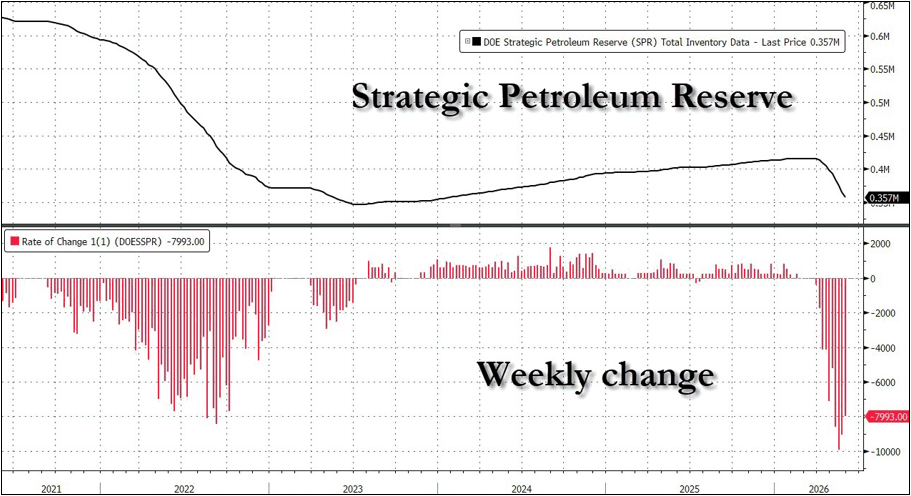
Three consecutive weekly draws of -8.6M, -9.92M, and -7.99M barrels have rewritten the EIA record book — each individually eclipsing the previous all-time high of 8.4M bbl set during the September 2022 Russia-Ukraine response. The Strategic Petroleum Reserve sits at 357M bbl, seven million above the 2023 trough that defines this chart’s five-year floor; at the current ~8.8M/week pace, next Wednesday’s print breaches it, and the August trajectory lands near 250M — the lowest level since the 1980s. Yet the structure inverts the read: this is not a sale. The 2026 SPR Exchange Program, the Trump administration’s response to the US-Iran conflict, loans crude to refiners now against in-kind repayment in 2026-2029 at a 1.20-1.25x premium — roughly 34-43M extra barrels owed back against the 172M committed through August, running at ~30x the routine NDAA pace. The 2000 hurricane and 2011 Libya exchanges, each ~30M bbl, repaid cleanly into flat-to-declining crude; at 172M this commitment is six times either precedent, into a live supply shock with no resolution priced. The asymmetry is the trade: three years of patient refill erased in six weeks, with the cushion spent mid-conflict and relief at the pump borrowed against a forward curve the Treasury does not control.
Market Intelligence Brief (MIB) Ver. 18.39
For professional investors only. Not investment advice.
© 2026 RecessionALERT.com

Comments are closed.