
Iran suspended ceasefire talks — WTI +5.5% to $92.18 adds ~35 bps to PCE at 3.8%, complicating Warsh’s June 16-17 FOMC debut. NVDA’s RTX Spark detonated enterprise tech (DELL +10.7%, ORCL +9.9%, IBM +7.6%) while QCOM -8.78% and INTC -4.69% paid the AI-transition toll. S&P crossed 7,600 on a 9-of-11-sector red session as ISM Manufacturing hit a 4-year high of 54.0%. Anthropic filed a confidential S-1 at $965B valuation. Berkshire acquired Taylor Morrison for $6.8B at a 24% premium.
TABLE OF CONTENTS
A. EXECUTIVE SUMMARY
B. MARKET DATA
C. HIGH-IMPACT STORIES (5)
D. MODERATE-IMPACT STORIES (7)
E. ECONOMY WATCH (5)
F. EARNINGS WATCH (0)
G. WHAT’S NEXT
H. CHART OF THE DAY
A. EXECUTIVE SUMMARY -> TOP
The S&P 500 crossed 7,600 for the first time and settled at a record 7,600.25 (+0.27%) — but the green headline conceals a 9-of-11-sector rout driven by Iran’s suspension of ceasefire talks with the US, which sent WTI crude surging +5.5% to $92.18 and reignited stagflation anxiety. Technology (+2.95%) was the sole structural engine; without its index weight, the S&P would have closed decisively red. The oil shock carries real inflation consequences: WTI above $92 adds an estimated 30–40 bps to headline PCE within two to three months, directly threatening the base case that Chair Warsh enters June 16–17 with inflation already stabilizing — PCE is running at 3.8% and ISM Manufacturing just printed a four-year high of 54.0%. Dow Theory bull confirmation held — both DJIA and DJTA extended to new 10-session highs — but single-session breadth was telling: the Russell 2000 fell -0.44%, Utilities shed -2.63%, and Consumer Cyclical dropped -2.04%, exposing the rate-repricing fault line beneath the record close.
• Iran ceasefire suspension sends WTI +5.5% to $92.18/bbl; VIX +4.77% to 16.05 — Strait of Hormuz supply risk reprices the S&P’s embedded peace premium; December rate-hike probability climbs to 40% as the oil shock stacks on top of PCE at 3.8%
• NVIDIA RTX Spark PC AI superchip (Computex 2026) triggers enterprise tech surge — DELL +10.7%, ORCL +9.9%, IBM +7.6%, ANET +7.0%, PANW +6.7%; rivals QCOM -8.78%, INTC -4.69%, AMD -5% absorb direct competitive losses; clearest AI intra-sector rotation signal of 2026
• ISM Manufacturing PMI 54.0% (May) — four-year high, beats 53.0% consensus; S&P 500 crosses 7,600 record on narrow breadth (Russell 2000 -0.44%, 9-of-11 sectors red); Dimon warns market risks are “underpriced”
• Anthropic files confidential S-1 at $965B valuation — revenue $47B annualized run rate (+4.7× YoY); AI IPO supply wave takes shape; rotation pressure on current AI megacaps is the hidden risk when institutional capital is deployed at this scale
• Berkshire acquires Taylor Morrison Homes (TMHC) for $6.8B at 24% premium — TMHC +22.3%; Buffett endorses the structural US housing deficit thesis, validating D.R. Horton, NVR, and Lennar peers; same-day construction spending beat (+0.4%) with single-family +1.4% confirms the data underpinning
• Powell warns “Fed cannot survive” political interference — SCOTUS case on governor removal authority is an unpriced macro tail risk; if the administration gains removal power, inflation expectations would reprice materially higher via TIPS breakevens; Warsh chairs June 16–17 under unprecedented governance uncertainty
1. AI Bifurcation at the Silicon Layer — NVDA’s RTX Spark drew the clearest line yet between AI-native silicon (NVDA, DELL, ORCL +7–10%) and AI-transitioning incumbents (QCOM -8.78%, INTC -4.69%), a valuation gap that structurally widens until production evidence closes it. Anthropic’s $965B S-1 filing simultaneously validates the compute demand projections embedded in NVDA and ORCL forward estimates: if AI model usage is growing 4.7× annually at Anthropic alone, the infrastructure cycle has years of runway — and current consensus estimates are almost certainly too conservative.
2. The Warsh Stress-Test Is Now Live — Three data inputs simultaneously landed (ISM 54.0%, PCE 3.8%, WTI +5.5%) that define the most complex inaugural FOMC environment since Volcker. The equity market’s entire post-April rally is built on the assumption that the Fed’s next move is a cut — a thesis that PCE at 3.8%, oil above $92, and a December rate-hike probability of 40% are actively dismantling. June 16–17 is the next major market risk event; any Warsh signal that December is live would reprice the 2Y toward 5.0% and compress equity multiples across the board.
3. Record Index, Hidden Fragility — The S&P 500 at 7,600 while 9 of 11 sectors close red, the Russell 2000 falls -0.44%, and Dimon warns risks are “underpriced” is not a contradiction — it is a signal that the headline index is a Technology-weighting artifact, not a broad economic endorsement. Multiple expansion in a rising-rate environment has a historically limited shelf life; the breadth deterioration at record levels, combined with VIX rising +4.77% on a nominally green equity close, is a classical precursor pattern that warrants active monitoring as a correction-risk indicator.
 — Leading economic indicators. Accurate market forecasts. Apply for membership at join.recessionalert.com
B. MARKET DATA -> TOP
The session opened June on a collision between AI optimism and geopolitical shock: NVIDIA’s Computex 2026 unveiling of the RTX Spark PC AI chip drove enterprise technology names to double-digit gains, while Iran’s suspension of ceasefire communications with the US sent WTI crude surging 5.5% and injected inflation anxiety across the broader market. The S&P 500 squeezed out a +0.27% gain only because Technology (+2.95%) dominates index weighting — beneath the surface, 9 of 11 sectors closed red. Utilities (-2.63%), Consumer Cyclical (-2.04%), and Real Estate (-1.58%) absorbed the rate-repricing fallout as VIX climbed 4.77% and the 2-year yield ticked higher. Copper’s +2.72% rise alongside gold’s -1.74% drop crystallizes the day’s tension: industrial demand optimism on one side, higher-for-longer rate fears on the other.
CLOSING PRICES – Monday, June 1, 2026:
MAJOR INDICES
Dow Theory bull confirmation is entrenched — both DJIA (51,078.94) and DJTA (21,530.3) extended to new 10-session highs today, their fifth consecutive session of joint confirmation, signaling the rally carries industrial and transportation breadth over the medium term. The daily picture, however, is dangerously narrow: S&P 500’s +0.27% gain is almost entirely a Technology artifact — Russell 2000 fell -0.44%, NYSE breadth was barely positive, and the Dow’s +0.09% confirms blue-chips did not participate meaningfully. The multi-week structure is confirmed; the single-session structure is narrow.
| Index | Close | Change | %Move | Why It Moved |
|---|---|---|---|---|
| S&P 500 | 7,600.25 | +20.19 | +0.27% | NVDA Computex AI chip announcement lifted enterprise tech; WTI oil surge (+5.5%) created broad inflation headwind — index hit 7,600 record but only on Technology’s index weight |
| Dow Jones | 51,078.94 | +46.48 | +0.09% | Blue-chip index extended Dow Theory bull confirmation to 5-session streak at new 10-session high; AI tailwinds and oil/inflation headwinds broadly offset |
| DJ Transportation | 21,530.3 | +120.0 | +0.56% | Transport index confirmed Dow Theory bull signal at new 10-session high; transport names benefiting from AI infrastructure logistics and broader economic expansion narrative |
| Nasdaq 100 | 30,513.86 | +180.68 | +0.60% | Enterprise AI names (DELL, ORCL, IBM, ANET) surged on NVDA Computex AI infrastructure theme; semiconductor declines (QCOM -8.8%, INTC -4.7%) partially offset tech gains |
| Russell 2000 | 2,906.51 | -12.83 | -0.44% | Small-caps declined as oil-driven inflation fears raised rate expectations — domestic small businesses face higher input costs and financing pressure vs mega-cap tech beneficiaries |
| NYSE Composite | 23,335.16 | +42.99 | +0.18% | Broad market marginally positive; 9 of 11 sectors in the red — NYSE breadth confirms gains were highly concentrated in Technology and Energy alone |
VOLATILITY & TREASURIES
VIX +4.77% on a nominally positive equity close is not a paradox — it is an oil-driven inflation fear signature. The 2Y yield rose 2.1 bps (outpacing the nearly flat 10Y at +0.2 bps), confirming near-term rate expectations are being repriced higher. DXY +0.29% followed, reflecting a stronger-rate/dollar environment. Bond markets declined to confirm the equity rally — a disconnect pointing to stagflationary concern rather than clean risk-on enthusiasm.
| Instrument | Level | Change | Why It Moved |
|---|---|---|---|
| VIX | 16.05 | +0.73 (+4.77%) | Oil-surge-driven inflation fear lifted implied volatility despite equities closing green; not a risk-off equity panic but a cost-pressure/rate-repricing signal |
| 10-Year Treasury Yield | 4.454% | +0.2 bps | Essentially flat; long-end held steady as inflation concerns and geopolitical flight-to-safety demand offset each other |
| 2-Year Treasury Yield | 4.035% | +2.1 bps | Near-term rate expectations ticked higher on oil/inflation data; 2Y leading the 10Y confirms market is repricing short-term inflation risk, not long-term growth collapse |
| US Dollar Index (DXY) | 99.19 | +0.29 (+0.29%) | Dollar strengthened on higher short-term rate expectations and partial safe-haven bid; DXY strength pressured gold despite geopolitical tensions |
COMMODITIES
Gold’s -1.74% decline despite geopolitical shock is the key anomaly: normally Iran tensions drive gold higher, but today the oil-driven inflation narrative strengthened the dollar and boosted rate expectations — both bearish for non-yielding bullion. Copper’s +2.72% gain tells the other side: industrial demand optimism on AI infrastructure capex lifted base metals. Bitcoin’s -2.93% tracked the macro risk-off mood in cyclicals rather than the AI equity rally, declining alongside rate-sensitive consumer names.
| Asset | Price | Change | %Move | Why It Moved |
|---|---|---|---|---|
| Gold | $4,512.87/oz | -$80.13 | -1.74% | Dollar strength and higher short-term rate expectations overwhelmed safe-haven bid; oil-driven inflation fears pushed rates higher, making non-yielding gold less attractive |
| Silver | $75.115/oz | -$0.760 | -1.00% | Followed gold lower on rate/inflation repricing; industrial component partially cushioned the decline relative to gold’s deeper drop |
| Copper | $6.5628/lb | +$0.1738 | +2.72% | AI infrastructure buildout demand narrative lifted industrial metals; NVDA Computex AI chip announcements signal continued data center and hardware capex expansion |
| Platinum | $1,932.95/oz | +$3.45 | +0.18% | Minimal move; split between precious metals headwind (rate pressure) and industrial metals tailwind (AI capex demand); largely neutral session |
| Bitcoin | $71,631 | -$2,164 | -2.93% | Tracked macro risk-off mood in consumer cyclicals rather than AI tech rally; oil-driven inflation concerns weighed on speculative risk assets |
ENERGY
WTI (+5.52%) and Brent (+4.38%) moved in near-lockstep — the WTI/Brent spread barely shifted, confirming a global supply-shock thesis rather than a regional disruption. Henry Hub (-3.13%) sat out entirely; Dutch TTF surged +6.43% in European markets — the US/EU divergence reflects American insulation from Middle East LNG exposure vs European vulnerability. Critically, oil rose while the broader equity market was flat: this is a supply-shock signature, not growth-demand optimism, with stagflationary implications for corporate input costs.
| Asset | Price | Change | %Move | Why It Moved |
|---|---|---|---|---|
| Crude Oil (WTI) | $92.18/bbl | +$4.82 | +5.52% | Iran suspended ceasefire communications with US after Israel’s military escalation in Lebanon; Strait of Hormuz supply disruption fears drove crude sharply higher |
| Crude Oil (Brent) | $95.11/bbl | +$3.99 | +4.38% | Global benchmark confirmed supply-shock thesis alongside WTI; spread barely widened, indicating disruption risk is global not regional |
| Natural Gas (Henry Hub) | $3.187/MMBtu | -$0.103 | -3.13% | US domestic gas declined on mild late-spring demand and high storage inventory; fully decoupled from oil’s geopolitical surge |
| Natural Gas (Dutch TTF) | $16.73/MMBtu | +$1.01 | +6.43% | European gas markets surged on Middle East supply disruption fears; EU more exposed to Iran-adjacent LNG supply chains vs insulated US domestic market |
S&P 500 SECTORS
Nine of 11 sectors finished red on a day the S&P 500 closed green — possible only because Technology (+2.95%) dominates index weighting. Energy (+1.74%) staged a one-day bounce on the oil spike, reversing nothing of its brutal 1-week (-3.47%) and 1-month (-5.07%) decline. Utilities (-2.63%) remain the quarter’s structural casualty — their -8.23% 1-month and -8.29% 3-month losses deepened today, a sustained rate-sensitivity rout the headline index’s green close completely obscures.
| Sector | 1-Day | 1-Week | 1-Month | 3-Month | 6-Month | YTD | 12-Month |
|---|---|---|---|---|---|---|---|
| Technology | +2.95% | +7.59% | +18.72% | +32.18% | +29.44% | +29.10% | +58.36% |
| Energy | +1.74% | -3.47% | -5.07% | +2.29% | +28.32% | +28.27% | +40.74% |
| Basic Materials | -0.29% | +2.83% | +1.94% | -7.25% | +22.76% | +17.14% | +48.32% |
| Financial | -0.42% | -0.79% | -0.55% | +1.08% | +0.94% | -2.86% | +9.39% |
| Consumer Defensive | -1.06% | -4.06% | -4.63% | -8.10% | +3.62% | +4.52% | +1.01% |
| Industrials | -1.08% | +0.39% | -0.85% | -2.05% | +15.86% | +13.87% | +26.21% |
| Communication Services | -1.22% | -0.67% | -1.33% | +7.46% | +5.66% | +5.72% | +34.27% |
| Healthcare | -1.49% | -1.33% | +0.64% | -5.84% | -5.48% | -3.66% | +13.27% |
| Real Estate | -1.58% | -2.46% | -2.24% | -2.02% | +2.93% | +5.98% | +4.79% |
| Consumer Cyclical | -2.04% | -0.83% | -0.34% | +2.71% | -0.61% | -1.76% | +8.54% |
| Utilities | -2.63% | -4.48% | -8.23% | -8.29% | -2.31% | +2.14% | +10.49% |
TOP MEGA-CAP MOVERS:
GAINERS
| Company | Ticker | Close | Change | Why It Moved |
|---|---|---|---|---|
| Dell Technologies | DELL | $465.96 | +10.70% | Record Q1 FY2027 earnings (revenue $43.8B, +88% YoY; AI server revenue +757%; $24.4B AI orders); NVDA Computex announcement confirms continued AI infrastructure buildout cycle |
| Oracle | ORCL | $248.15 | +9.91% | AI cloud compute demand surge; NVDA Computex infrastructure narrative confirms enterprise AI spending cycle; Oracle Cloud expanding to meet AI training and inference workloads |
| IBM | IBM | $320.42 | +7.60% | AI enterprise tailwinds and $10B quantum computing commitment attracting institutional flows; Computex AI cycle confirmation lifts legacy enterprise infrastructure names |
| Arista Networks | ANET | $170.68 | +7.03% | AI data center networking demand; NVDA chip expansion drives need for high-speed network infrastructure connecting AI compute clusters at hyperscale facilities |
| Palo Alto Networks | PANW | $300.48 | +6.67% | Cybersecurity beneficiary of expanding AI infrastructure; AI-specific security workloads creating new enterprise spend; lifted by broad AI infrastructure investment narrative |
DECLINERS
| Company | Ticker | Close | Change | Why It Moved |
|---|---|---|---|---|
| Qualcomm | QCOM | $228.99 | -8.78% | NVDA’s RTX Spark PC AI chip (Computex) directly threatens Snapdragon X Elite market share; QCOM’s own “Dragonfly” data center chip unveiled with no specifications — full details deferred to June 24 Investor Day — investors sold the empty reveal |
| Meta Platforms | META | $600.47 | -5.07% | Oil-surge-driven inflation fears pressure consumer spending outlook and digital ad revenue expectations; macro risk-off in cyclicals weighed on social media advertising models |
| Intel | INTC | $109.30 | -4.69% | NVDA’s Computex PC AI chip announcement threatens x86 market; Intel’s legacy PC processor business faces renewed competitive pressure from GPU-based AI PC architecture |
| Tesla | TSLA | $415.69 | -4.61% | Oil spike and inflation concerns raised rate expectations, pressuring high-ticket consumer purchases and auto financing outlook; Consumer Cyclical sector among session’s worst performers |
| Texas Instruments | TXN | $293.27 | -4.06% | Broader semiconductor sector pressure from NVDA competitive threat and supply chain realignment concerns; analog/embedded chips facing AI-era demand shift toward GPU architectures |
— Institutional-grade intelligence for serious investors. Apply for membership at join.recessionalert.comC. HIGH-IMPACT STORIES -> TOP
BEARISH
1. Iran Suspends Ceasefire Talks, Threatens “Other Fronts” — WTI Surges +5.5% to $92.18; Strait of Hormuz Supply Risk Reignites
The core facts:Iran’s semi-official Tasnim news agency — linked to the Revolutionary Guard Corps — reported Monday that the regime was suspending negotiation exchanges with the United States following Israel’s escalating military operations in Lebanon. WTI crude surged +5.52% to settle above $92.18/bbl and Brent gained +4.38% to approximately $95.11/bbl on renewed Strait of Hormuz supply disruption fears. President Trump subsequently posted on Truth Social that Iran talks were continuing at a “rapid pace” and described a “productive” call with Israeli leadership, partially walking back the headline. Separately, Israel and Lebanon agreed to a 45-day ceasefire extension, though both sides continued to trade strikes. Oil prices trimmed their worst intraday levels on the Trump post but held the bulk of the day’s gains. WTI ended with its largest single-day advance since the initial Iran conflict escalation earlier in 2026.
Why it matters:(1) Friday’s S&P close near record highs priced a world where the Iran deal was imminent and Hormuz would reopen — Monday’s talk suspension directly reprices that embedded peace premium. Energy (XLE) surged +2.5% today as the market shifted from “Iran deal certain” to “Iran deal uncertain,” a rotation that simultaneously compresses consumer discretionary and digital advertising multiples (Meta -5.07%, Amazon -2.88%, Boeing -2.56%) via the inflation-and-cost-shock channel. (2) The stagflation arithmetic deteriorates sharply at WTI >$92: PCE was already elevated at 3.8% before today’s oil surge; sustained crude above $90 adds approximately 30–40 bps to headline PCE within two to three months, materially complicating the Federal Reserve’s path even before Warsh’s June 16–17 FOMC debut. (3) The Iran situation creates a binary that is now the dominant macro catalyst for the next week: a signed framework → WTI retraces toward $80, PCE relief, S&P extends; a confirmed breakdown → oil reversal, energy sector re-rates higher, December rate-hike probability rises above 40%, and the equity market faces a simultaneous hit to growth expectations and interest-rate-sensitive multiples.
What to watch:Trump’s formal diplomatic statement on Iran’s negotiating posture and any IAEA or State Department follow-up confirming whether talks are genuinely suspended or merely paused; Monday’s overnight oil futures for whether WTI can hold above $90 as a structural ceiling-break signal; Iran’s domestic political messaging for whether the Revolutionary Guard is acting unilaterally or reflecting regime consensus.
UNCERTAIN
2. NVIDIA Launches RTX Spark Superchip at Computex 2026 — Enters Consumer PC Market; Enterprise Tech Surges, PC Chip Rivals Collapse
The core facts:NVIDIA CEO Jensen Huang unveiled the RTX Spark Superchip at Computex 2026 in Taipei — the company’s first purpose-built consumer PC processor. Co-developed with Microsoft and Taiwan’s MediaTek, RTX Spark integrates a Blackwell GPU with an Arm-based CPU and up to 128GB unified memory, delivering 1 petaflop of FP4 AI compute for on-device LLM inference without cloud dependency. The chip targets Windows AI PCs from six OEMs: Microsoft, Dell, HP, ASUS, Lenovo, and MSI, with a fall 2026 launch target. NVIDIA shares advanced +5.84% on the session. Semiconductor rivals were routed: Qualcomm -8.78% (RTX Spark directly targets the Snapdragon X Elite PC socket), Intel -6% (x86 PC market disruption), and AMD -5%. Simultaneously, enterprise AI infrastructure beneficiaries surged on the broadened AI adoption signal: Dell +10.7%, Oracle +9.9%, IBM +7.6%, Arista Networks +7.0%, Palo Alto Networks +6.7%, ServiceNow +9%, Salesforce +9%, Snowflake +9%.
Why it matters:(1) The RTX Spark announcement is the most significant competitive incursion into the PC market since Intel’s x86 monopoly was challenged by Apple Silicon in 2020. NVIDIA now addresses three silicon markets simultaneously — data center GPUs, AI inference accelerators, and consumer PC processors — a market-cap-expanding scope of competition that explains today’s multiple expansion. (2) The cascade of enterprise tech gains confirms that the market interprets NVIDIA’s PC entry as an AI adoption acceleration signal, not a distraction: if AI is pervasive enough to justify a purpose-built PC chip, enterprise software serving AI workflows (NOW, CRM, SNOW) commands higher addressable market assumptions. The enterprise software re-rating today (+9% across the board) represents a direct valuation consequence of NVIDIA’s product announcement. (3) For semiconductor portfolio managers, the two-tiered sector response (NVDA/infrastructure +5-10%, QCOM/INTC/AMD -5 to -9%) creates the clearest intra-sector rotation signal of 2026: AI-native silicon architectures are structurally replacing incumbent PC-chip incumbents, and the competitive moat of NVIDIA’s Blackwell ecosystem is now demonstrably extending beyond the data center.
What to watch:Qualcomm’s June 24 Investor Day for RTX Spark technical competitive response and Snapdragon X Elite differentiation strategy; OEM pre-order data and PC ASP trends in Q3 to test NVIDIA’s premium pricing power in the consumer segment; INTC’s Q2 earnings for quantification of x86 PC market share erosion.
BULLISH
3. ISM Manufacturing PMI Hits 54.0% in May — Highest Since May 2022, Demolishes 53.0 Consensus; S&P Tops 7,600 for First Time
The core facts:The ISM Manufacturing PMI rose to 54.0% in May 2026 — the highest reading since May 2022 and the fifth consecutive month of expansion — handily beating the 53.0% consensus estimate and the 52.7% prior reading. Sub-index details signal broad-based strength: New Orders 56.8% (vs. 54.1% prior), Production 54.3% (vs. 53.4%), and Order Backlogs 52.2% (vs. 51.4%). Prices paid eased modestly to 82.1% from April’s 84.6% but remained deeply in inflationary territory — the Iran war was cited in 42% of respondent comments, tariffs in 18%, and 57% flagged pricing volatility. The 54.0% reading corresponds to approximately 2.2% annualized real GDP growth. The S&P 500 advanced to a fresh all-time high of 7,613.03 (+0.44%) and the Nasdaq crossed 27,000 for the first time.
Why it matters:(1) The ISM confirmation of the Chicago PMI’s May 29 blowout (62.7) eliminates the “one-off regional anomaly” interpretation: US manufacturing is in genuine cyclical re-acceleration. The combination of ISM 54.0% + Chicago PMI 62.7 + S&P Global Final PMI 55.1 represents the strongest manufacturing data trifecta since 2022 and structurally re-rates industrials, basic materials, and domestic-demand proxies. (2) The market-impact arithmetic is double-edged: strong growth data supports equity earnings revisions upward, but the persistent 82.1% Prices Paid reading blocks the Fed’s inflation path to the 2% target. The simultaneous “growth accelerating + inflation sticky at 3.8% PCE + oil surging” configuration is the most complex policy environment Chair Warsh will inherit for his June 16-17 debut FOMC. (3) Today’s index milestones — S&P above 7,600 and Nasdaq above 27,000 for the first time — were built on a narrow foundation: only Technology (+1.67%) and Energy (+2.5%) sectors advanced, while the Russell 2000 fell -0.38%. Breadth deterioration at record index levels is a classical precursor pattern that warrants monitoring as a correction-risk indicator.
What to watch:Wednesday’s ISM Services PMI (May) for whether the services sector is equally accelerating; the 10Y Treasury yield around 4.45–4.50% as the threshold where the growth premium translates into rate-hike pricing pressure; the equal-weight S&P (RSP) vs. cap-weighted SPY ratio as the real-time breadth monitor at these record levels.
BEARISH
4. Powell Warns “Fed Cannot Survive” Political Interference — First Public Remarks Since Leaving Chair Post; SCOTUS Case on Governor Protections Looms
The core facts:Former Federal Reserve Chair Jerome Powell — now a sitting Fed governor with tenure through January 2028 — used his first major public address since leaving the chairmanship to deliver a pointed defense of institutional independence. Speaking at the John F. Kennedy Presidential Library on receiving the JFK Profile in Courage Award, Powell called Fed independence a “priceless asset” and warned that a single administration establishing a legal framework to remove officials over policy disagreements would “open the way for future elected officials to follow suit,” ultimately destroying the credibility the Fed has spent decades building. Without naming President Trump, Powell directly referenced the administration’s efforts to remove Governor Lisa Cook and its public pressure campaign for deep rate cuts. Powell’s decision to retain his governor seat after leaving as chair — an unusual step — has denied the Trump administration an additional Board appointment. The remarks arrive as the Supreme Court prepares to rule on a case directly addressing presidential authority to remove Federal Reserve governors.
Why it matters:(1) Fed independence is the institutional bedrock that allows the Fed to credibly commit to fighting inflation — a commitment markets price into every long-duration asset. If SCOTUS rules that the president can remove governors at will, the Fed’s ability to maintain restrictive policy when the administration prefers accommodation is structurally compromised. Inflation expectations — already elevated with PCE at 3.8% — would reprice materially higher on any credible erosion of Fed independence. The 10Y TIPS breakeven is the first-order instrument to watch for this transmission. (2) Powell’s public stance creates a live political-institutional conflict: Chair Warsh must simultaneously manage PCE at 3.8%, an ISM printing at a four-year high, and an oil shock while operating under a cloud of governance uncertainty about whether his board colleagues can be removed for policy dissent. This uncertainty creates a structural ceiling on the Fed’s credibility even before rate decisions are made. (3) The SCOTUS case represents a macro tail risk that financial markets have not priced. A ruling in the administration’s favor — granting removal authority over independent agency officials — would be structurally equivalent to a multi-notch credit rating event for US monetary institutions, with long-end yield repricing as the primary transmission channel.
What to watch:The SCOTUS ruling timeline on Fed-governor protections — a ruling before Warsh’s June 16-17 FOMC would be the most acute market-impact scenario; 10Y TIPS breakeven inflation expectations for any creep above 3.0% signaling Fed credibility erosion; Chair Warsh’s public response to Powell’s speech as the first test of the new chair’s institutional stance.
UNCERTAIN
5. Anthropic Files Confidential S-1 with SEC at $965B Valuation — Races OpenAI to Public Markets; AI IPO Supply Wave Takes Shape
The core facts:Anthropic — maker of the Claude AI model and competitor to OpenAI — confidentially submitted a draft registration statement on Form S-1 to the Securities and Exchange Commission on June 1, 2026, positioning to go public. The company has not determined the number or price of shares to be offered. Anthropic’s most recent private-market valuation reached $965 billion following its latest funding round — surpassing OpenAI’s $852 billion March 2026 valuation. Anthropic’s revenue run rate has surged to $47 billion annualized, up from $10 billion in annual revenue the prior year — an approximately 4.7× increase that ranks among the fastest large-company revenue accelerations in US corporate history. The confidential filing allows Anthropic to receive SEC review feedback before a public S-1; the company could go public as early as Q3 or Q4 2026. The filing comes ahead of OpenAI’s own anticipated confidential S-1 submission. Shares of enterprise cloud beneficiaries rose sharply on the filing: Oracle +6.0%, with software infrastructure broadly (ServiceNow +9%, Salesforce +9%, Snowflake +9%) repricing on expanded AI deployment assumptions.
Why it matters:(1) A $965 billion debut would rank Anthropic immediately among the top five or six US companies by market capitalization — above Berkshire Hathaway and potentially rivaling Alphabet. At a $1 trillion listing valuation, Anthropic would consume institutional capital at a scale that demands active portfolio rebalancing: to fund Anthropic, institutions must sell existing positions, creating rotation pressure on current AI beneficiaries (MSFT, GOOGL, AMZN, NVDA). The supply-absorption question — previously theoretical — becomes operational the moment a public S-1 is filed. (2) Anthropic’s $47B revenue run rate (vs. $10B one year ago) validates the enterprise AI adoption thesis at a scale that makes NVIDIA’s infrastructure numbers credible: if AI model usage is growing 4.7× annually at Anthropic alone, compute demand projections embedded in NVDA and ORCL forward estimates are almost certainly too conservative. (3) The AI IPO queue — Anthropic ($965B), OpenAI ($852B), SpaceX (expected 2027) — represents the largest concentrated capital market event in history. Three potential trillion-dollar offerings in a 12-18 month window creates a supply dynamic with no historical precedent for institutional absorption. Current bullish consensus on existing AI names has not priced the rotation pressure that this supply creates.
What to watch:Anthropic’s public S-1 filing date and initial pricing range for the first concrete supply-impact signal; OpenAI’s parallel confidential filing for whether the two compete for the same institutional allocation window; whether the SEC requests significant disclosure changes on AI model risks, data practices, or competitive moat sustainability in its review period.
— Quantifying recession risk so you don’t have to guess. Apply for membership at join.recessionalert.comD. MODERATE-IMPACT STORIES -> TOP
BEARISH
6. Qualcomm Falls -8.78% as Computex Dragonfly AI Chip Launches Without Specs — NVDA Threat to Snapdragon X Elite Compounds Competitive Pressure
The core facts:Qualcomm unveiled its “Dragonfly” branded AI data center chip at Computex 2026 but provided zero technical specifications and no pricing details — all information was deferred to a June 24 Investor Day. The announcement landed on the same day that NVIDIA’s RTX Spark directly targeted Qualcomm’s Snapdragon X Elite PC AI chip market, creating a two-front competitive threat: Dragonfly’s data center ambitions face NVIDIA’s Blackwell dominance, while Snapdragon X Elite’s PC AI market faces RTX Spark’s Blackwell GPU-based architecture. Qualcomm fell -8.78% — the single largest mega-cap decliner on the session — erasing more than $20 billion in market capitalization. The stock has a market cap of approximately $175 billion.
Why it matters:(1) A major chip announcement at an industry conference that defers all substantive details to a date three weeks later is structurally bearish signal — it suggests the product is not ready for technical scrutiny. In a competitive environment where NVIDIA unveiled a fully specified, OEM-committed consumer chip at the same event, Qualcomm’s vague announcement highlights the gap between the two companies’ execution pace. (2) The dual-market threat dynamic is a material re-rating risk: Qualcomm’s premium PC valuation is predicated on Snapdragon X Elite’s AI PC market leadership. If RTX Spark captures the premium AI PC socket, Qualcomm’s data center pivot via Dragonfly becomes the only growth narrative — but that pivot is now also competing against NVIDIA in its core domain. (3) Qualcomm’s -8.78% move ($20B+ market cap loss) on a single day at a conference it chose to attend illustrates the execution credibility gap between AI-native (NVIDIA) and AI-transitioning (QCOM) semiconductor companies. This credibility gap commands a persistent valuation discount until Qualcomm demonstrates competitive products in production.
What to watch:Qualcomm’s June 24 Investor Day for Dragonfly technical specifications and competitive benchmarks against NVIDIA’s Blackwell architecture; any OEM commitments announced for Dragonfly vs. RTX Spark to quantify the addressable market contest; Snapdragon X Elite market share in PC shipment data for Q3 2026.
BULLISH
7. April Construction Spending Beats at +0.4% — AI Data Center Construction +7.5% YoY; Single-Family Housing Resilient
The core facts:US construction spending rose +0.4% month-over-month in April 2026, exceeding the +0.2% consensus forecast. Single-family residential construction advanced +1.4%, reflecting continued demand for owner-occupied housing. Federal construction expenditure grew +4.8%, broadly tracking infrastructure spending programs. AI-related office and data center construction surged +7.5% year-over-year, the most significant sub-component signal in the report. The headwind: private non-residential construction declined -0.2% — its ninth consecutive quarterly contraction — reflecting corporate caution on commercial real estate and traditional office space. Published June 1, 2026.
Why it matters:(1) The AI data center construction surge (+7.5% YoY) is among the most direct economic footprints of the AI capital expenditure cycle: it confirms that the corporate sector’s AI spending commitments from Q1 2026 earnings calls are materializing in physical construction, not just procurement orders. This supports the Atlanta Fed GDPNow Q2 estimate of 3.8% via the fixed investment channel and validates the structural AI infrastructure thesis underpinning today’s enterprise tech rally. (2) Single-family residential strength (+1.4%) contradicts the “housing crash from high rates” thesis that has circulated since the Fed’s 3.75% policy rate set in late 2025. Demand for single-family construction at current borrowing costs indicates that household balance sheets remain sufficiently strong to support homebuilding — a constructive signal for homebuilder equities (NVR, DHI, LEN) and consumer confidence proxies. (3) Private non-residential’s ninth consecutive quarterly contraction marks a meaningful divergence between AI-driven construction (booming) and traditional commercial construction (contracting) — a structural shift that creates a bifurcated opportunity within the broader construction and materials sector.
What to watch:May construction spending (released late June) for whether the AI data center acceleration continues at the same pace; Vulcan Materials, Martin Marietta, and US Concrete for aggregates-demand signals from the AI buildout; any NVR or DHI guidance updates on single-family order backlogs as the housing resilience test.
UNCERTAIN
8. Warsh’s Debut FOMC Faces Perfect Storm: PCE 3.8%, ISM 4-Year High, Oil Surge, and Powell Independence Warning All Converge on June 16-17
The core facts:New Federal Reserve Chair Kevin Warsh — sworn in May 22 after Senate confirmation — will preside over his first FOMC meeting on June 16-17, 2026. The data backdrop into that meeting has deteriorated materially since Warsh’s confirmation: PCE inflation at 3.8% YoY (core 3.3%) is running at a three-year high; today’s ISM Manufacturing PMI at 54.0% rules out any “growth slowdown justifies patience” cover; WTI crude surged +5.52% today on Iran ceasefire breakdown, raising the near-term PCE trajectory; and Wall Street December rate-hike probability has reached 40%, up from near-zero entering 2026. Separately, former Chair Powell’s June 1 public remarks on Fed institutional independence add governance uncertainty to Warsh’s operating environment. Markets currently price a 97% probability of a hold at June 16-17.
Why it matters:(1) Warsh’s dilemma is structural: his stated thesis — that AI productivity would disinflationary lift potential growth, enabling a non-inflationary monetary environment — is being tested against hard data that consistently contradicts it. PCE at 3.8% is not a transitory anomaly; ISM at 54.0% eliminates the growth-fragility justification for patience; and oil above $92 adds another inflation wave before the June meeting’s data is even fully assembled. (2) The institutional dimension of Warsh’s first meeting is unusually complex: he chairs a board where Powell sits as an active governor, where Governor Lisa Cook’s removal remains under legal challenge, and where SCOTUS is preparing to rule on governor protections. No incoming Fed chair in the modern era has faced this degree of simultaneous institutional and policy pressure. (3) If Warsh signals any openness to December rate hike discussions at June 16-17 — even while holding — the 2Y Treasury yield would reprice toward 5.0% and the equity market’s multiple would compress, as the entire post-April rally has been built on the expectation that the Fed’s next move remains a cut, not a hike.
What to watch:FOMC blackout period (begins approximately June 3) as the last window for Fed governor communications before the June 16-17 meeting; the June 16-17 FOMC statement for any language shift from “patient” to “prepared to act”; 2Y Treasury yield as the real-time pricing barometer for hike probability ahead of the meeting.
BULLISH
9. Berkshire Hathaway Acquires Taylor Morrison Homes for $6.8B — Buffett Endorses US Housing; TMHC Surges +22%
The core facts:Berkshire Hathaway announced an all-cash acquisition of homebuilder Taylor Morrison Home Corporation (TMHC) for approximately $6.8 billion at $72.50 per share — a 24% premium to the pre-announcement closing price. Taylor Morrison builds homes primarily in the Sun Belt, Southeast, and Western US markets, with a focus on move-up and luxury entry-level buyers. TMHC shares surged +22.3% in premarket trading on the announcement. Berkshire already holds a Clayton Homes subsidiary (modular/manufactured housing) but this represents a significant expansion into traditional site-built homebuilding. The deal was announced June 1, 2026.
Why it matters:(1) Warren Buffett deploying $6.8 billion into homebuilding at current valuations sends an unambiguous signal about the long-term housing supply/demand imbalance: Berkshire is effectively betting that the US structural housing deficit (estimated at 3-4 million units) is durable enough to justify premium acquisition pricing even at 30-year mortgage rates near 7%. This is a value-investor endorsement of homebuilder equities that directly benefits NVR, D.R. Horton, and Lennar as peer-group validators. (2) A 24% acquisition premium at current market valuations implies Berkshire sees private-market homebuilder value materially above public market pricing — a classic Buffett “public markets are undervaluing a durable business” signal that has historically presaged sector re-rating. (3) Today’s construction spending report (+0.4%, single-family +1.4%) provides the same-day economic data validation for Berkshire’s housing thesis: construction of single-family homes is expanding despite high rates, confirming the supply-constrained demand story that makes homebuilder economics durable.
What to watch:D.R. Horton (DHI), NVR, and Lennar (LEN) share price reactions as the Berkshire premium signal reverberates through the homebuilder sector; whether Berkshire adds to its homebuilder position through open-market purchases of DHI or NVR; the regulatory approval timeline for the TMHC acquisition (expected straightforward given no competitive-overlap concerns).
UNCERTAIN
10. MGM Resorts +16% on IAC/Barry Diller $18B Buyout Offer — Second Gaming Mega-Deal in 48 Hours Signals Sector Privatization Wave
The core facts:Barry Diller’s IAC/InterActiveCorp submitted an $18 billion all-cash bid to take MGM Resorts International private at $48.30 per share — approximately an 11% premium to MGM’s prior closing price. The offer, which includes the assumption of approximately $6 billion in debt for a total enterprise value of approximately $24 billion, was accompanied by two simultaneous high-conviction analyst upgrades from JPMorgan and Truist, each with materially higher price targets. A go-shop period runs through approximately July 11, 2026, during which MGM can solicit competing offers. MGM shares surged +16% on the session. The announcement follows Fertitta Entertainment’s $17.6 billion definitive merger agreement for Caesars Entertainment announced Friday — creating back-to-back gaming mega-deals on consecutive trading days. The combined proposed transactions would privatize approximately 25-30% of US gaming floor space.
Why it matters:(1) Two gaming mega-deals in two consecutive trading sessions is not coincidence — it reflects a structural private-market-to-public-market valuation gap in gaming assets that has persisted for years. Private buyers (Fertitta, Diller) are willing to pay 11-49% premiums over public valuations for gaming cash flows, suggesting the public market persistently discounts these businesses. This creates a re-rating signal for remaining publicly traded gaming companies: Wynn Resorts and Vici Properties (gaming REIT) are both potential targets in this consolidation cycle. (2) The back-to-back deals create a leveraged loan supply event: two ~$18B-plus transactions require large committed credit facilities, and the appetite of a 10-bank syndicate (Caesars) and the announced financing for MGM tests institutional debt markets at current high-yield spreads. If credit spreads widen to absorb this supply, leveraged buyout activity in other sectors faces headwinds. (3) The combined Caesars-Fertitta and MGM-Diller entities would operate competing Las Vegas Strip properties with concentrated ownership, raising potential antitrust review questions that could delay or modify both transactions — an uncertainty that the 11% MGM premium (vs. 49% Caesars premium) may already reflect.
What to watch:The MGM go-shop period deadline (approximately July 11) for any competing bids — a rival offer from a strategic buyer (Apollo, Blackstone) would re-rate the entire gaming sector; antitrust review signals for both the Caesars and MGM deals given the combined Las Vegas Strip market share implications; Wynn Resorts share price reaction as the most likely next privatization target.
BEARISH
11. Dimon Warns US Stock Market Risks Are “Underpriced” as S&P Crosses 7,600 — Cites Geopolitical and Macro Uncertainty
The core facts:JPMorgan Chase CEO Jamie Dimon issued a public warning Monday that stock market risks appear to be underpriced, cautioning investors against an “exuberant” market stance amid what he described as significant geopolitical and macroeconomic uncertainty. The remarks arrived on the same session that the S&P 500 crossed 7,600 for the first time in history — its 10th consecutive week of gains — with the benchmark index up approximately +20% from its March 2026 lows. Dimon’s warning echoes his consistent 2026 commentary pattern of flagging gap-between-market-pricing and macro-reality, but the timing at a market milestone amplifies its signal value.
Why it matters:(1) Dimon’s institutional standing as steward of the world’s largest bank by assets gives his market warnings a different weight than those of analysts or fund managers. JPMorgan’s trading desks have real-time visibility into institutional positioning, credit flows, and derivative hedging activity — when Dimon says risks are underpriced, it carries information about what JPMorgan’s risk systems are measuring that public investors cannot directly observe. (2) The specific timing — S&P 7,600 milestone after a 10-week winning streak, with narrow leadership (two sectors positive, Russell 2000 down), oil surging, PCE at 3.8%, and rate hike probability at 40% — provides the analytical context for Dimon’s concern. The rally has been a function of multiple expansion (not earnings revision), and multiple expansion in a rising-rate environment has historically been a fragile foundation. (3) If Dimon’s warning catalyzes institutional profit-taking at the 7,600 level — consistent with round-number resistance dynamics observed at every prior index milestone — the S&P faces near-term technical resistance precisely as the macro headwinds (oil, rates, Fed independence) are escalating.
What to watch:S&P 500 price action around the 7,600 level over the next 3-5 sessions for evidence of institutional distribution vs. breakout continuation; VIX for any expansion above 18 as the first signal of real risk repricing; JPMorgan Q2 earnings in mid-July for any commentary that quantifies where Dimon sees specific mispricing.
UNCERTAIN
12. IBM +7.3% on Trump Social Media Endorsement — “Trump Trade” Dynamics Amplify Government-Adjacent Tech Premium
The core facts:IBM shares advanced +7.3% Monday following President Trump’s posting of a historical video praising IBM on his Truth Social platform. The session gain follows IBM’s +12.71% surge Friday on the $1 billion CHIPS Act quantum computing award and the company’s $10+ billion, five-year quantum investment commitment. Over two trading sessions, IBM has gained approximately +20%, adding roughly $56 billion in market capitalization. IBM ($280B+ market cap) is now up substantially year-to-date, driven by the combination of government quantum infrastructure investment and presidential social media endorsement — a new category of catalyst unique to the current political-technology environment.
Why it matters:(1) IBM’s two-day gain illustrates a structural dynamic of the 2026 market: companies at the intersection of government technology contracts and presidential approval operate with a dual-catalyst model that can deliver outsized short-term returns. Friday’s fundamental catalyst (CHIPS Act award, quantum investment) provided institutional justification; Monday’s social media endorsement extended retail and momentum buying without any new fundamental data. This dynamic — government contract as fundamental anchor, presidential endorsement as price amplifier — is relevant for every company in the AI, quantum, and defense-tech government procurement pipeline. (2) The IBM move extends the “government-validated tech = immediate multiple expansion” playbook observed in Oracle’s government cloud awards earlier in 2026 and NVIDIA’s defense/AI government contracts. Any company receiving a major government technology infrastructure award can now reasonably price in a potential presidential social media endorsement as an additional return component — a distortion of traditional valuation frameworks. (3) The sustainability of IBM’s +20% two-session gain depends entirely on whether quarterly earnings (July) can confirm that the quantum/CHIPS narrative translates into revenue. IBM’s quantitative business trajectory has historically disappointed relative to its technology narrative; investors buying the Trump-amplified momentum face the risk of a fundamental reality check in Q2 results.
What to watch:IBM Q2 2026 earnings (July) for early Anderon quantum foundry revenue and CHIPS Act contribution; whether the social media price bump fades within 3-5 sessions as momentum cools; other government-adjacent tech names (Oracle, Palantir, SAIC) for similar presidential social media amplification patterns.
— Separating signal from noise since 2007. Apply for membership at join.recessionalert.comE. ECONOMY WATCH -> TOP
Manufacturing headlined the week with ISM PMI at 54.0% — its highest since May 2022 — and S&P Global’s final print at 55.1, confirming broad-based expansion for the fifth consecutive month. The bullish output picture carries an inflationary premium: PCE rose 3.8% year-over-year in April (core 3.3%), the hottest since 2021, as real disposable income fell and the ISM Prices Index held at 82.1%. Construction spending beat estimates on AI data center buildout (+7.5% YoY) and single-family housing despite 9-month-high mortgage rates, while decelerating wholesale inventories suggest cautious restocking. The output side is firmly in expansion; the price side remains squarely in the way of any easing — Warsh’s first FOMC meeting on June 16–17 is the next inflection point.
ISM Manufacturing PMI Hits 54.0% in May — Highest Since May 2022, Fifth Consecutive Expansion Month (ISM, June 1, 2026)
What they’re saying:The ISM Manufacturing PMI rose 1.3 percentage points to 54.0% in May — its highest reading since May 2022 and the fifth consecutive month of expansion. New Orders surged to 56.8% (from 54.1%), Production climbed to 54.3%, and the Employment Index rose 2.2 points to 48.6%, though it remained in contraction for the fourth straight month. The Prices Index eased slightly to 82.1% but remains historically elevated. The PMI reading is consistent with approximately 2.2% annualized real GDP growth.
The context:The acceleration in New Orders (56.8%) — which had contracted for four straight months before this five-month recovery — is the most structurally significant sub-index, signaling genuine demand pull rather than inventory-driven output. The disconnect between strong orders/production and persistent employment contraction (48.6% for the fourth month) suggests manufacturers are first absorbing productivity gains before rehiring, a pattern that typically precedes a hiring uptick by 1–2 months. GDPNow stood at 3.8% (May 28) heading into today’s data; the ISM beat likely supports an upward revision when Atlanta Fed publishes the June 1 update. The still-elevated Prices Index (82.1%) confirms cost pressures have not abated despite five months of expansion.
What to watch:ISM Services PMI (Wednesday, June 3, exp. 53.7) for cross-sector expansion confirmation; ADP Employment Change (June 3, exp. 110K) and Non-Farm Payrolls (Friday, June 5) as the week’s highest-impact release; Atlanta Fed GDPNow update for post-ISM Q2 growth revision.
PCE Inflation Hits 3.8% YoY in April — Highest Since 2021, Core at 3.3% as Real Income Stagnates (BEA, May 28, 2026)
What they’re saying:The BEA’s April Personal Income and Outlays report showed the PCE Price Index rose 3.8% year-over-year — the highest reading since 2021 — while core PCE (excluding food and energy) came in at 3.3%. Personal spending rose 0.5% nominally, but disposable personal income fell $19.9 billion (-0.1%), effectively erasing real consumption gains. The Fed’s preferred inflation gauge now sits 180 basis points above the 2% target.
The context:The April PCE report is the first inflation benchmark under incoming Fed Chair Kevin Warsh, whose June 16–17 meeting is now the focal point for rate guidance. With core PCE at 3.3% — and the Iran conflict sustaining gasoline above $4/gallon — the conditions for easing are not in place; Wall Street’s December rate-hike probability has climbed to 40%, up from near zero at the start of the year. The income/spending squeeze — flat nominal income against rising prices — translates directly into deteriorating real household purchasing power heading into summer, a potential consumer spending headwind that could eventually weigh on the same manufacturing demand fueling today’s ISM beat.
What to watch:Warsh’s June 16–17 FOMC meeting for first formal policy guidance; Non-Farm Payrolls (June 5) as the key labor-market input; next PCE release (late June) for May trend direction.
Construction Spending +0.4% in April, Beats Forecast — AI Data Centers and Single-Family Homes Lead (Census Bureau, June 1, 2026)
What they’re saying:US construction spending rose 0.4% in April (vs. 0.2% expected), following a downwardly revised 0.2% gain in March, and is up 0.9% year-over-year. Single-family homebuilding surged 1.4%; total residential construction climbed 0.8%. Office construction — the category encompassing AI data centers — rose 1.0% for the month and is up 7.5% year-over-year. Federal government construction jumped 4.8%.
The context:The headline beat masks a persistent bifurcation: private non-residential structures (power plants, factories) fell 0.2%, marking the ninth consecutive quarterly contraction, even as AI infrastructure spending accelerates along a separate trajectory (+7.5% YoY). The federal construction surge is concentrated in immigration enforcement infrastructure rather than productivity-enhancing investment. Residential construction’s modest improvement is particularly noteworthy given 30-year mortgage rates at a 9-month high of 6.53% (Freddie Mac, May 28) — suggesting latent demand is holding despite elevated borrowing costs, but the MBA’s reported 8.5% week-over-week drop in total mortgage applications signals this resilience may be at a ceiling.
What to watch:MBA Mortgage Applications (Wednesday, June 3) for housing demand signal; 10-year Treasury yield trajectory as the direct mortgage rate driver.
S&P Global US Manufacturing PMI Final 55.1 in May — Multi-Year High Output Masks Fastest Price Inflation in Four Years (S&P Global, June 1, 2026)
What they’re saying:S&P Global’s final US Manufacturing PMI for May registered 55.1 (up from April’s 54.5, slightly below the preliminary 55.3), the strongest monthly expansion since May 2022. Production grew at its fastest pace since April 2022. However, input costs and output charges rose at the fastest rate in nearly four years, exports fell for the 11th consecutive month, and supplier delivery times worsened the most since August 2022. Companies attributed export weakness to geopolitical instability and tariffs; inventory stockpiling ahead of further cost increases contributed to the output surge.
The context:The divergence between domestic output strength (55.1) and export contraction (11th consecutive decline) reveals a manufacturing sector insulated — and in some cases benefiting — from tariff-driven import substitution, while simultaneously losing global competitiveness. The accelerating price inflation component at a 4-year high challenges the thesis that tariff costs are a one-time price adjustment; instead, they appear to be embedding into cost structures, consistent with the PCE and ISM Prices data published this week. Deteriorating supplier lead times echo Q4 2021 supply chain dynamics and are an early warning signal that should tariff escalation resume, the current output expansion carries meaningful stagflationary risk.
What to watch:ISM Services PMI Prices Paid component (June 3) for cross-sector inflation read; any Iran conflict de-escalation signals as the primary swing variable for export trajectory and input cost relief.
Wholesale Inventories Rise Just 0.5% in April — Miss vs. 0.8% Forecast, Restocking Pace Decelerates Sharply (Census Bureau, May 29, 2026)
What they’re saying:US wholesale inventories increased 0.5% in April, missing the consensus forecast of 0.8% and decelerating sharply from March’s 1.3% gain. The slower pace of inventory accumulation suggests wholesalers are pulling back on restocking amid elevated carrying costs and uncertain demand signals.
The context:The moderation follows a period of front-loading driven by tariff fears — wholesalers appear to be working through elevated stockpiles accumulated earlier in the year rather than adding to them. This has a direct GDP implication: inventory investment was a meaningful contributor to recent quarters’ growth, and a sustained deceleration in restocking could subtract from Q2 GDP estimates. With consumer confidence at 93.1 (Conference Board, May) and real disposable income declining (BEA, April), the demand visibility that would justify aggressive restocking simply isn’t there. The April miss creates a potential headwind to the bullish ISM New Orders picture if wholesaler caution translates into reduced pipeline ordering over the next 30–60 days.
What to watch:Wholesale Trade Sales data (accompanies the full monthly report) for inventories-to-sales ratio; Retail Sales (mid-June) as the most direct read on downstream consumer demand.
— Know the probability before the market prices in the risk. Apply for membership at join.recessionalert.comF. EARNINGS WATCH -> TOP
YESTERDAY AFTER THE BELL (Markets Reacted Today)
No major earnings yesterday after the bell from companies with >$100B market cap.
TODAY BEFORE THE BELL (Markets Already Reacted)
No major earnings before the bell from companies with >$100B market cap.
TODAY AFTER THE BELL (Markets React Tomorrow)
No major earnings after the bell from companies with >$100B market cap. (Hewlett Packard Enterprise reported AMC at $62.45B market cap — below the $100B threshold for MIB coverage.)
WEEK AHEAD PREVIEW:
Q1 2026 earnings season is functionally complete (~92% of S&P 500 reported) with a record +27.7% blended earnings growth YoY — the strongest quarter since Q4 2021. This week’s reporting calendar is sparse, but the two names on deck are market-signal names for the AI and enterprise spending thesis.
Palo Alto Networks (PANW) — AMC Tuesday, June 2 | PANW rallied +6.7% today as part of the enterprise AI security infrastructure surge. Key focus for Q3 FY2026 results: Next-Generation Security ARR guidance (consensus ~$7.94–7.96B, targeting 56% growth); Remaining Performance Obligations at ~$17.85–17.95B for backlog visibility; platformization deal momentum (110 net new platform deals in Q2); and early revenue contribution from the Portkey (AI gateway security) and Chronosphere ($3.35B) acquisitions. After today’s NVDA Computex enterprise tech rally, PANW’s AI security revenue acceleration is the enterprise-spending confirmation or refutation event of the week.
Broadcom (AVGO) — AMC Wednesday, June 3 | Revenue guidance at ~$22.0B (up 47% YoY), consensus at $22.11B EPS $2.40. Key focus: AI semiconductor revenue (~$10.7B, up ~140% YoY expected), AI networking as share of total AI revenue (~40% of AI vs. ~33% in Q1), and progress on the VMware integration since the $69B acquisition. As the second-largest AI semiconductor company by revenue after NVIDIA, AVGO’s Q2 results are the critical datapoint confirming or revising the AI capex super-cycle trajectory for 2026-2027. Any guidance raise above $22B for Q3 would catalyze another leg of the semiconductor rally.
Q2 2026 earnings season begins in earnest in mid-July with the major banks, followed by mega-cap tech in late July.
— US market commentary trusted by family offices and institutions. Apply for membership at join.recessionalert.comG. WHAT’S NEXT -> TOP
UPCOMING RELEASES:
| Date | Event | Why It Matters |
|---|---|---|
| Tue, Jun 2 | JOLTs Job Openings — April (exp. 6.82M, prior 6.866M) | First labor-market read of the week; a decline toward or below 6.8M would signal softening demand and reduce pressure on the Fed to hike, while a beat would confirm the labor market remains tight alongside PCE at 3.8% — reinforcing the higher-for-longer case ahead of June 16–17 |
| Tue, Jun 2 | Fed Speeches — Kashkari + Hammack (last communications before FOMC blackout begins ~Jun 3) | These are likely the final public Fed communications before the pre-FOMC blackout period; any shift in tone toward acknowledging the oil-driven inflation risk or signaling openness to a December hike would move the 2Y Treasury and reprice the June 16–17 market setup materially |
| Wed, Jun 3 | ADP Employment Change — May (exp. 110K, prior 109K) | Private payroll preview ahead of Friday’s NFP; a significant beat above 130K would confirm the labor market is re-accelerating alongside ISM’s four-year high, eliminating any remaining easing bias at June 16–17 and pushing December hike probability above 50% |
| Wed, Jun 3 | ISM Services PMI — May (exp. 53.7, prior 53.6) | Cross-sector confirmation of today’s manufacturing 54.0% beat; a Services print above 54.0% — matching manufacturing’s strength — would constitute the broadest simultaneous expansion since 2022 and directly validate the ISM trifecta thesis; the Prices Paid sub-component is the highest-priority number given today’s oil shock |
| Wed, Jun 3 | Fed Beige Book — June edition | Qualitative district-level read on economic conditions; given today’s oil shock and Iran geopolitical escalation, watch for any Beige Book language flagging price pressures or supply-chain disruption signals from energy-intensive industries — this will inform the June 16–17 FOMC statement narrative |
KEY QUESTIONS:
1. Will Iran resume ceasefire talks — or does WTI sustaining above $90 force the Fed to formally acknowledge a rate hike on the table at June 16–17, collapsing the post-April rally’s rate-cut thesis and repricing the 2Y Treasury toward 5.0%?
2. Does Wednesday’s ISM Services PMI confirm the manufacturing trifecta (ISM + Chicago PMI + S&P Global all above 54) with a Services beat — and if the Prices Paid component accelerates on top of today’s oil shock, how does the bond market reprice the inflation path before the FOMC blackout ends?
3. Can the S&P 500 hold above 7,600 on narrow Technology leadership while 9 of 11 sectors declined — or does Dimon’s risk warning, rising oil, and a 40% December hike probability catalyze institutional profit-taking at the record level, testing the breadth thesis before June 16–17?
— US market commentary trusted by family offices and institutions. Apply for membership at join.recessionalert.comH. CHART OF THE DAY -> TOP
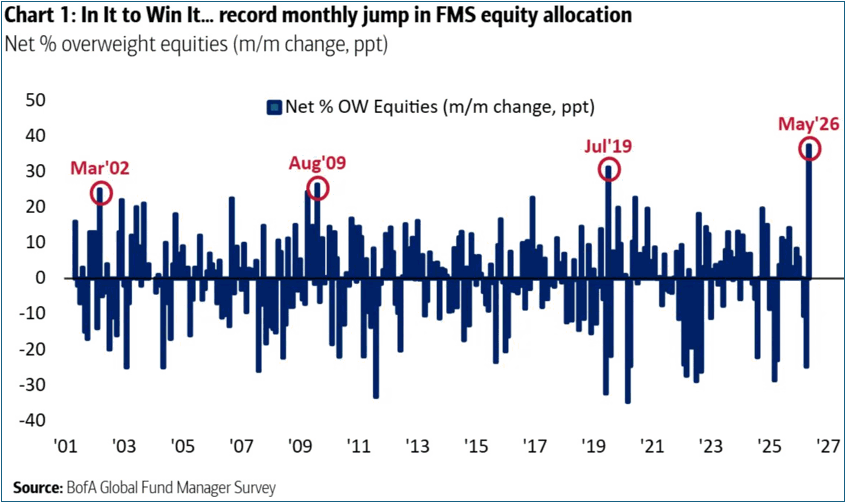
Valuation tells you the price; positioning tells you who is left to buy — and in May’26, the largest single-month vote of confidence in the 25-year history of BofA’s survey most closely resembles the moment managers were most demonstrably wrong about exactly that. Net overweight equities jumped from 13% to 50%, +37 ppt in a single month, and the move did not describe conviction — it described performance pressure folding, managers who had watched the tape from underweight deciding all at once that being wrong on the upside was the career risk. EPS optimism and Fed cuts are the rationalisation; the magnitude is the behaviour. The consequence is mechanical: cash fell to 3.9%, through the 4.0% line that arms BofA’s own contrarian sell trigger, meaning the marginal buyer that carried the S&P to 7,450 has just been put to work. Of three prior spikes, only Aug’09 confirmed — Mar’02 and Jul’19 preceded -30% and -34% drawdowns. Managers haven’t decided stocks are cheap. They’ve decided the coast is clear, afraid only of being left behind.
Market Intelligence Brief (MIB) Ver. 18.37
For professional investors only. Not investment advice.
© 2026 RecessionALERT.com

Comments are closed.