
AVGO −12.6% after AI chip guidance ($16B Q3) missed by $1.2B; SOX −2.8%, MU −7.74%. UNH +5.7% on dual BofA/MS upgrades lifted Healthcare +3.06% to drive the Dow to an ATH at 51,562. Ceasefire news cut WTI $3 to $93. Jobless claims 225K (highest since February) confirmed labor softening; Challenger’s 97K May cuts — 40% AI-driven — are a record. IMF extended the US inflation timeline to end-2027 ahead of Warsh’s first FOMC; Friday NFP consensus: 85K.
TABLE OF CONTENTS
A. EXECUTIVE SUMMARY
B. MARKET DATA
C. HIGH-IMPACT STORIES (6)
D. MODERATE-IMPACT STORIES (5)
E. ECONOMY WATCH (7)
F. EARNINGS WATCH (2)
G. WHAT’S NEXT
H. CHART OF THE DAY
A. EXECUTIVE SUMMARY -> TOP
The Dow surged 875 points to a fresh all-time high at 51,562 (+1.73%) as capital rotated decisively from the semiconductor complex into healthcare, financials, and rate-sensitive sectors — the +1.73%/−0.54% Dow/Nasdaq split capturing the bifurcation precisely. Two macro forces shaped the day: an Israel-Lebanon ceasefire unwound crude’s geopolitical risk premium by $3 (WTI to $93.02), while deteriorating labor signals — jobless claims at 225K (highest since February) and 97,006 announced May layoffs with AI driving a record 40% of cuts — pushed yields lower and reinforced the Fed-on-hold narrative ahead of Friday’s critical NFP. Healthcare (+3.06%) flipped from three-month laggard to the day’s top sector on coordinated managed care upgrades; Technology, the three-month leader, dropped to worst at −0.90% after Broadcom’s Q2 guidance miss — 8-of-11 S&P sectors were positive, confirming earnings-driven repositioning rather than deteriorating breadth.
• AVGO −12.59% after Q3 AI chip guidance of $16.0B missed the $17.2B consensus; SOX −2.8%, MU −7.74%, AMD −3.56%. Alphabet is shifting custom silicon work to MediaTek — a structurally significant hyperscaler diversification signal that goes beyond a single quarter’s guidance miss.
• UNH +5.7% on coordinated BofA (upgrade to Buy, $450 PT) and Morgan Stanley ($453 PT, Overweight) analyst actions citing a medical care ratio improving to 83.9% and AI-driven efficiency gains. Healthcare +3.06% was the day’s best sector; HUM +6%, MRK +4.85%, LLY +4.31% extended the sector-wide re-rating.
• Israel-Lebanon ceasefire triggered WTI −$3 to $93.02, partially unwinding the geopolitical risk premium from Wednesday’s Iran strikes. Each sustained $10 WTI decline removes ~25–35 bps from headline PCE — a meaningful Fed breathing room variable if the de-escalation holds.
• Jobless claims 225K — the largest miss since February and the highest weekly print since early February — sent the 10Y yield down 2 bps to 4.474% and lifted rate-sensitive equities: Real Estate +1.82%, Russell 2000 +1.46%. The claims spike arrives 18 hours before Friday’s May NFP (consensus 85K).
• Challenger: 97,006 May job cuts — 40% AI-attributed, the highest AI-driven share ever recorded. Tech led with 38,242 cuts (2-year sector high); the AI displacement wave has now surpassed DOGE-related government cuts as the dominant labor restructuring driver.
• IMF warns Fed to “proceed with caution” and extended its US inflation-to-2% timeline six months to end-2027 — the final international policy voice before Saturday’s FOMC blackout. This arrives as new Chair Warsh prepares his June 16–17 debut with a divided committee and 41% options-market probability of a 2026 rate hike.
1. AI Hardware Priced for Perfection, Not Performance — Broadcom’s Q2 results are a paradox: record AI revenue (+143% YoY, $10.8B) paired with a guidance miss that collapsed the stock 12.6%. The lesson is not that AI capex is slowing — AVGO’s own Q3 AI guidance implies 200%+ YoY growth — but that the semiconductor complex had priced in hypergrowth beyond what the actual buildout pace supports. The Alphabet-to-MediaTek market share shift is the more durable signal: hyperscalers are beginning to diversify custom silicon sourcing, ending AVGO’s near-exclusive positioning. For portfolio managers, the trade has shifted from “own AI hardware at any price” to “know which supplier captures incremental share.”
2. A Stagflationary Pre-FOMC Mosaic — Thursday’s data stack — jobless claims at 225K (labor softening), Challenger 97K cuts with 40% AI-driven (structural displacement accelerating), GDPNow trimmed to 3.0% (down 1.3 pts in two weeks), and the IMF’s extended inflation timeline — converges on a single macro theme: growth is decelerating while inflation remains sticky above 2%. The Fed cannot cut into a de-anchoring inflation environment, and it cannot hike into a softening labor market. Warsh inherits a policy paradox at his debut June 16–17 FOMC; Friday’s NFP is the last data point before the blackout that could meaningfully shift that calculus.
3. The Non-Tech US Economy Is Resilient — For Now — The Dow’s ATH at 51,562 on a day when the Nasdaq declined is a structural signal: domestic-demand sectors — Healthcare, Financials, Industrials — are outperforming as geopolitical energy headwinds ease and managed care fundamentals improve. The ceasefire-driven crude decline is the marginal tailwind enabling this rotation. But the resilience carries a caveat: the same labor data showing claims at 225K and AI-driven cuts accelerating will eventually reach NFP. When it does, the domestic-demand thesis faces its first real test.
 — Leading economic indicators. Accurate market forecasts. Apply for membership at join.recessionalert.com
B. MARKET DATA -> TOP
The Dow surged to a fresh all-time high at 51,562 as capital rotated aggressively out of mega-cap semiconductors into healthcare, financials, and industrials — the +1.73%/−0.54% Dow/Nasdaq split tells the story. Broadcom’s −12.59% collapse on a Q2 revenue miss ($22.2B vs $22.7B est) and software guidance shortfall dragged MU −7.74% and AMD −3.56% lower, while analyst upgrades on improving medical cost trends sent UNH +5.16%, MRK +4.85%, and LLY +4.31%, making Healthcare the day’s top sector at +3.06%. Crude shed −3.12% as an Israel-Lebanon ceasefire and US-Iran diplomatic progress priced out the geopolitical risk premium; natural gas countered with +4.32% on summer heat forecasts and tightening supply. Bitcoin’s −2.28% decline against a risk-on tape is crypto-specific, not a market signal.
CLOSING PRICES – Thursday, June 4, 2026:
MAJOR INDICES
Today’s +1.73%/−0.54% Dow/Nasdaq bifurcation was pure sector rotation — capital leaving mega-cap semiconductors for healthcare and financials, with 8 of 11 S&P sectors positive against a Nasdaq decline. Dow Theory bull confirmation is entrenched in its 7th consecutive session, both DJIA (+1.73%) and DJTA (+1.36%) within 1% of their 10-session highs. Small caps (RUT +1.46%) outpaced the S&P 500 for the 3rd straight session, extending broad market participation signals. Today’s bifurcation reflects earnings-driven repositioning rather than deteriorating breadth — the move beneath the surface is wider than the Nasdaq headline suggests.
| Index | Close | Change | %Move | Why It Moved |
|---|---|---|---|---|
| S&P 500 | 7,584.41 | +30.73 | +0.41% | Sector rotation balanced AVGO-led semiconductor selloff; healthcare and financial surge drove broad advance; 8 of 11 sectors positive |
| Dow Jones | 51,562.30 | +875.23 | +1.73% | Fresh all-time high; blue-chip Dow disproportionately benefited from rotation into healthcare (+3.06%), financials (+2.29%), and industrials (+1.23%) |
| DJ Transportation | 21,773.0 | +292.8 | +1.36% | Industrials broadly higher; crude oil’s −3.12% decline eased transportation fuel cost pressures; ceasefire-driven geopolitical risk reduction |
| Nasdaq 100 | 30,407.81 | −163.43 | −0.54% | Broadcom Q2 revenue miss (AVGO −12.59%) and semiconductor contagion (MU −7.74%, AMD −3.56%) dragged index lower despite broad market gains |
| Russell 2000 | 2,935.86 | +42.35 | +1.46% | Broad market participation; small caps outperformed for 3rd straight session as rotation favored non-mega-cap names |
| NYSE Composite | 23,572.77 | +296.28 | +1.27% | Broad advance on Dow ATH; healthcare, financials, and industrials led; 8 of 11 S&P sectors positive |
VOLATILITY & TREASURIES
A clean risk-on signal: VIX fell −4.17% to 15.39 while both yields declined — the 10Y by 2 bps to 4.474%, the 2Y by 3.5 bps to 4.049% — bonds are confirming the equity rally, not skeptically sitting it out. The 2Y-10Y spread widened marginally to +42.5 bps (from 41.7 bps), a mild steepening. DXY’s near-flat close (−0.07%) suggests no safe-haven dollar bid is competing with the risk-on narrative.
| Instrument | Level | Change | Why It Moved |
|---|---|---|---|
| VIX | 15.39 | −0.67 (−4.17%) | Risk-on rotation; diversified equity gains across healthcare and financials suppressed fear gauge despite tech sector selling |
| 10-Year Treasury Yield | 4.474% | −2.0 bps | Modest safe-haven demand; ceasefire-driven geopolitical risk reduction eased inflation risk premium; bonds confirmed equity rally |
| 2-Year Treasury Yield | 4.049% | −3.5 bps | Rate cut expectations firmed modestly; 2Y led the yield decline; mild curve steepening (2Y-10Y spread widened to +42.5 bps) |
| US Dollar Index (DXY) | 99.46 | −0.07 (−0.07%) | Near-flat; no safe-haven dollar bid; improving risk appetite and ceasefire backdrop balanced currency flows |
COMMODITIES
Gold rose +0.82% to $4,503/oz even as equities rallied — suggesting residual geopolitical hedging alongside the risk-on rotation; precious metals broadly confirmed (silver +0.62%, platinum +1.27%). Bitcoin’s −2.28% decline against a broadly positive tape is the key divergence: it is not tracking equities (risk-on), nor catching a safe-haven bid like gold — the move is crypto-specific and should be read in isolation from macro signals.
| Asset | Price | Change | %Move | Why It Moved |
|---|---|---|---|---|
| Gold | $4,503.70/oz | +$36.80 | +0.82% | Precious metals bid despite risk-on equities; residual geopolitical hedging persists even as ceasefire reduces immediate risk premium |
| Silver | $74.153/oz | +$0.459 | +0.62% | Precious metals complex broadly higher; industrial demand component held as broad equity rally signaled growth confidence |
| Copper | $6.5280/lb | +$0.0205 | +0.32% | Modest industrial metals gain; broad equity rally signaled demand confidence; ceasefire eased Middle East supply disruption risk |
| Platinum | $1,898.50/oz | +$23.90 | +1.27% | Precious metals rally; auto catalyst demand and industrial applications supportive; outperformed gold and silver on the day |
| Bitcoin | $63,419.00 | −$1,481.00 | −2.28% | Crypto-specific weakness; declined against a broadly risk-on equity tape; no macro correlation — treat as isolated crypto signal |
ENERGY
WTI and Brent fell in near-lockstep (−3.12%/−2.62%) as the Israel-Lebanon ceasefire and US-Iran diplomatic progress rapidly priced out the accumulated geopolitical risk premium — classic risk-premium removal, not demand destruction. Natural gas sharply diverged at +4.32%, driven by entirely different dynamics: summer heat forecasts and tightening US supply. TTF’s near-flat −0.14% confirms the gas rally is US-domestic; European energy markets are not participating.
| Asset | Price | Change | %Move | Why It Moved |
|---|---|---|---|---|
| Crude Oil (WTI) | $93.02/bbl | −$3.00 | −3.12% | Israel-Lebanon ceasefire agreement; Trump signaled positive US-Iran negotiation progress — geopolitical risk premium rapidly unwound |
| Crude Oil (Brent) | $95.25/bbl | −$2.56 | −2.62% | Same ceasefire catalyst as WTI; Brent-WTI spread at $2.23 — no divergence, confirming global risk-premium removal, not regional supply story |
| Natural Gas (Henry Hub) | $3.353/MMBtu | +$0.139 | +4.32% | Summer heat forecasts (above-normal temps through June 18); Lower-48 supply fell to 109.0 bcfd (from 109.7 bcfd in May); storage surplus erased |
| Natural Gas (Dutch TTF) | $16.59/MMBtu | −$0.02 | −0.14% | Muted; seasonal LNG maintenance dampened European demand; US summer heat rally did not extend to European gas markets |
S&P 500 SECTORS
Today’s session delivered a textbook intra-year reversal: Technology — the 3-month (+30.62%) and 1-week (+3.32%) leader — was today’s worst sector at −0.90%, after Broadcom’s earnings miss catalyzed a targeted semiconductor selloff. Healthcare flipped from 3-month laggard (−0.94%) to today’s leader (+3.06%) on a managed care analyst re-rating. Energy held marginally positive (+0.29%) despite crude’s −3.12% drop, as natural gas gains offset sector headwinds.
| Sector | 1-Day | 1-Week | 1-Month | 3-Month | 6-Month | YTD | 12-Month |
|---|---|---|---|---|---|---|---|
| Healthcare | +3.06% | 0.00% | +3.03% | −0.94% | −1.05% | −1.55% | +14.92% |
| Financial | +2.29% | +1.30% | +1.81% | +3.72% | +2.14% | −1.55% | +10.36% |
| Communication Services | +1.87% | −3.74% | −2.23% | +6.39% | +4.18% | +4.58% | +32.16% |
| Real Estate | +1.82% | −0.51% | +0.26% | +1.41% | +6.20% | +8.09% | +7.13% |
| Industrials | +1.23% | +0.54% | +2.15% | +4.12% | +18.61% | +16.29% | +27.79% |
| Utilities | +0.63% | −1.71% | −6.03% | −5.21% | +1.09% | +3.76% | +11.04% |
| Consumer Cyclical | +0.31% | −4.05% | −1.72% | +1.54% | −2.50% | −2.84% | +7.55% |
| Energy | +0.29% | +3.02% | −2.72% | +5.69% | +30.37% | +31.06% | +41.28% |
| Basic Materials | −0.07% | −0.30% | +2.43% | +0.30% | +22.11% | +16.86% | +45.28% |
| Consumer Defensive | −0.11% | −2.69% | −4.23% | −3.99% | +3.55% | +4.80% | 0.00% |
| Technology | −0.90% | +3.32% | +14.08% | +30.62% | +26.03% | +27.42% | +53.46% |
TOP MEGA-CAP MOVERS:
GAINERS
| Company | Ticker | Close | Change | Why It Moved |
|---|---|---|---|---|
| UnitedHealth Group | UNH | $396.47 | +5.16% | Morgan Stanley raised PT to $453 (Overweight); BofA upgraded to Buy ($450 PT) — improving medical cost trends, AI efficiency cited (45% managed care EPS upside); sector-wide re-rating (Humana +6%, Cigna +4%) |
| Goldman Sachs | GS | $1,092.61 | +4.96% | Broad financial sector rally on declining yields; banking stocks re-rated on improving rate outlook and strong trading environment |
| Marvell Technology | MRVL | $316.43 | +4.90% | Q1 FY2027 earnings beat (revenue $2.42B, +28% YoY, above guidance); NVIDIA announced $2B strategic investment + NVLink Fusion partnership; raised full-year outlook |
| Merck & Co | MRK | $120.26 | +4.85% | Healthcare sector re-rating; managed care analyst upgrades lifted entire pharma/biotech complex alongside UNH, HUM, and CI |
| Eli Lilly | LLY | $1,125.27 | +4.31% | Healthcare sector rally; GLP-1 and oncology market leader benefited from managed care cost trend optimism and sector-wide re-rating |
DECLINERS
| Company | Ticker | Close | Change | Why It Moved |
|---|---|---|---|---|
| Broadcom | AVGO | $418.91 | −12.59% | Q2 FY2026 revenue missed at $22.19B vs $22.72B estimate (−2.3%); infrastructure software revenue $7.18B vs $7.32B expected; guidance failed to deliver blowout AI growth despite record AI chip revenue ($10.8B, +143% YoY) |
| Micron Technology | MU | $996.00 | −7.74% | Semiconductor sector contagion from Broadcom’s Q2 miss; AI hardware spending narrative challenged; memory chip demand outlook reassessed |
| Arista Networks | ANET | $166.01 | −4.79% | Network hardware sold off in semiconductor contagion wave; data center capex narrative questioned by Broadcom’s infrastructure software miss |
| SanDisk | SNDK | $1,759.68 | −3.92% | Flash storage/semiconductor selloff; broader semiconductor risk-off sentiment extended to storage names in Broadcom contagion wave |
| Advanced Micro Devices | AMD | $523.20 | −3.56% | Semiconductor sector contagion; AI chip competitive outlook reassessed after Broadcom’s disappointing Q2 software and infrastructure guidance |
— Institutional-grade intelligence for serious investors. Apply for membership at join.recessionalert.comC. HIGH-IMPACT STORIES -> TOP
BEARISH
1. Broadcom’s AI Chip Guidance Miss Triggers Broad Semiconductor Selloff — SOX -2.8%, Nasdaq Tech -1.8%; AI Capex Cycle Narrative Under Scrutiny
The core facts:Broadcom (AVGO) reported Q2 FY2026 results after the bell June 3 — revenue $22.2B (+48% YoY), AI semiconductor revenue $10.8B (+143% YoY, a record), non-GAAP EPS $2.44, FCF $10.3B (record), and operating margin 67.3% (record). Despite headline beats, the stock collapsed 12–15% in after-hours and extended into Thursday’s session because Q3 AI semiconductor revenue guidance came in at $16.0B — below analyst expectations of $17.2B — and management disclosed that AVGO is losing some Alphabet custom AI chip market share to MediaTek. The Philadelphia Semiconductor Index (SOX) fell 2.8% on Thursday; the S&P 500 tech index fell 1.8%. Associated movers: Micron (MU) -7.74%, ARM Holdings (ARM) -4%, Arista Networks (ANET) -4.79%, AMD -3.56%.
Why it matters:Broadcom is the primary custom AI chip supplier to hyperscalers — its guidance is the closest thing the market has to a real-time read on whether the $725B combined AI capex budgets being deployed by the cloud giants are translating into accelerating chip orders. A Q3 AI chip guidance of $16B against a $17.2B consensus expectation does not mean AI capex is collapsing — AVGO’s own Q3 AI guidance implies 200%+ YoY growth — but it does mean the AI hardware buildout is expanding more slowly than the most aggressive market assumptions. The Alphabet market-share loss to MediaTek is the more structurally significant disclosure: it signals that hyperscalers are beginning to diversify custom silicon sourcing, eroding AVGO’s previously near-exclusive positioning. For the broader semiconductor complex, the -2.8% SOX and parallel -7.74% Micron move extend a de-rating of the AI hardware cycle’s priced-in perfection. Marvell Technology (+4.90%) was the notable counterpoint — its own earnings beat and NVIDIA partnership suggest the AI chip opportunity is real but redistributing across suppliers.
What to watch:Micron’s upcoming earnings call for independent AI memory demand commentary; AVGO’s Q3 results for whether the $16B AI chip guidance represents a floor or a ceiling; hyperscaler Q2 capex disclosures (Microsoft, Alphabet, Amazon, Meta) for any reduction in custom silicon allocation to AVGO vs. competing suppliers.
BULLISH
2. Israel-Lebanon Ceasefire Ignites Hopes for US-Iran Deal — WTI Gives Back ~$3, Energy Sector Retreats, Dow Rallies to Record Close
The core facts:Israel and Lebanon announced agreement to implement a ceasefire on June 4, following Wednesday’s US strikes on Iran’s Qeshm Island and Iranian countermeasures against US bases in Kuwait. The ceasefire fueled market hopes for a broader US-Iran diplomatic agreement that could remove the threat of Strait of Hormuz closure. WTI crude fell approximately $3 to ~$93.02/barrel (from $96.11 on June 3); Brent settled near $95.25. The Energy sector, which led the S&P 500 on June 3 (+1.35%), retreated. The Dow Jones Industrial Average rallied 874.86 points (+1.7%) to a record close of 51,561.93, the S&P 500 gained +0.4% to 7,584.31 — its 10th up day in the last 11 sessions — while the Nasdaq declined -0.1% to 26,830.96 as the tech complex remained weighed down by the AVGO-driven semiconductor selloff. The Russell 2000 surged +1.59%.
Why it matters:The ceasefire partially unwinds the geopolitical risk premium that drove crude to a six-month high above $96 over the prior 24 hours. Each sustained $10 decline in WTI removes approximately 25–35 basis points from headline PCE — with PCE already at 3.8%, an oil retracement toward $90 could meaningfully reduce the Fed’s near-term inflation pressures. The market rotation visible in Thursday’s session — Health Care +3.14%, Financials +2.67%, Real Estate +1.87%, while Energy lagged — reflects institutional repositioning away from geopolitical hedge trades toward domestic demand-driven sectors. The Dow record close at 51,562 is particularly notable given the mix of tailwinds (lower yields from weak jobless claims, lower oil) and headwinds (tech selloff, AI guidance disappointment) — suggesting the US economy’s non-tech, non-energy core is resilient. However, the ceasefire does not resolve the underlying US-Iran military confrontation; it represents a diplomatic opening, not a resolution.
What to watch:Any formal US-Iran diplomatic statement over the weekend before the June 7 FOMC blackout; WTI’s $90/barrel level as the threshold below which inflation models show meaningful PCE relief; Energy sector ETFs (XLE, XOP) for confirmation of risk-premium unwind vs. a temporary pullback.
BULLISH
3. Healthcare Sector Surges 3.14% — Coordinated UNH Re-Rating by BofA and Morgan Stanley Signals Managed Care Inflection Point
The core facts:Bank of America upgraded UnitedHealth Group (UNH) from Neutral to Buy, raising its price target from $420 to $450. Morgan Stanley simultaneously raised its price target from $395 to $453, maintaining Overweight. BofA analyst Ken Fischbeck cited a medical care ratio improvement to 83.9% in Q1 (down 90 basis points YoY) and estimated that UNH’s earnings power now stands approximately 50% above its own conservative 2026 guidance. Morgan Stanley noted that AI-driven efficiency gains across revenue generation and cost management could translate into roughly 45% average EPS upside for managed care organizations. UNH advanced +5.7%; the Healthcare sector rose +3.14% — Thursday’s best sector performance and a stark reversal after Healthcare’s three-month underperformance (-0.94%). The re-rating was sector-wide: Humana (HUM) +6%, Cigna (CI) +4%, Merck (MRK) +4.85%, Eli Lilly (LLY) +4.31%.
Why it matters:UnitedHealth’s +5.7% move on coordinated Buy upgrades from two of Wall Street’s top-ranked healthcare analysts is the single largest individual contribution to Thursday’s Dow record close. The simultaneous BofA and Morgan Stanley actions on the same day signal conviction — not a routine PT trim — and reflect a structural thesis shift: medical cost trends have stabilized, the overhang from elevated utilization post-COVID has faded, and AI-driven administrative efficiency is beginning to appear in margins. The “50% above guidance” framing from BofA suggests management has intentionally sandbagged — a classic setup for multiple beats through the year. For portfolio managers who have been underweight Healthcare for three months, the coordinated re-rating creates a rebalancing imperative. The Healthcare sector’s single-day +3.14% recovery after prolonged underperformance and the Dow record close it anchored represent a meaningful rotation signal — institutional money rotating from geopolitical energy hedges and crowded AI names into domestic defensives with improving fundamentals.
What to watch:UNH Q2 2026 earnings for the first read on whether the medical care ratio improvement continues below 84%; HUM and CI earnings for confirmation of the sector-wide cost trend thesis; any follow-on upgrades from JPMorgan, Goldman, or Wells Fargo that could extend the sector re-rating.
BEARISH
4. Initial Jobless Claims Surprise at 225K — Pre-NFP Labor Shock Sends 10Y Yields to 4.455%, Rate-Sensitive Sectors Rally
The core facts:Initial jobless claims for the week ending May 30 rose 13,000 to 225,000 — well above the 211,000 consensus — the largest miss since February and the highest weekly print since early February. The four-week moving average climbed 6,500 to 214,750. Continuing claims fell 8,000 to 1.777 million (week ending May 23), indicating that displaced workers are still finding new employment. The 10-year Treasury yield fell 3.8 basis points to 4.455% on the print; the Real Estate sector (+1.87%) and small-caps (Russell 2000 +1.59%) outperformed as rate-sensitive assets responded to the yield decline. The data arrived approximately 18 hours before Friday’s May Nonfarm Payrolls report (consensus ~85,000).
Why it matters:The 225K print is the most important pre-NFP data signal the market will receive before Friday’s release. In the context of Wednesday’s data — ADP 122K (+32% above prior), ISM Services 54.5, ISM Manufacturing 54.0, and the simultaneous Challenger Job Cuts report today showing 97,006 announced layoffs in May (details below) — the claims spike creates a bifurcated labor market picture: announced future cuts (Challenger, driven by AI displacement) are rising sharply even as the current flow of layoffs (initial claims) has spiked above its recent range. This tension is the key interpretive challenge for the FOMC heading into the June 16–17 meeting under new Chair Warsh: headline employment may look fine on Friday (NFP), while leading indicators suggest the labor market is beginning to soften. The 3.8 bps yield decline on the claims miss is meaningful — it suggests the Treasury market is beginning to price in a marginally higher probability that the Fed’s next move is a cut, not a hike, even as the ISM data push in the opposite direction.
What to watch:Friday’s May NFP (consensus ~85,000) as the definitive pre-FOMC labor market signal; the 10Y yield for any sustained break below 4.40% that would shift market pricing toward a July rate cut; homebuilder and REIT sector performance as proxies for rate-sensitive equity reaction.
BEARISH
5. Challenger: 97,006 Job Cuts in May — AI Cited in 40% of All Layoffs, Highest Monthly AI-Attribution Ever; Tech Posts 2-Year High in Cuts
The core facts:Challenger, Gray & Christmas reported 97,006 announced job cuts in May — up 16% from April’s 83,387 and the highest May total since 2020. AI was cited as the primary reason for 38,579 of the cuts — 40% of the May total — the highest monthly AI-attribution figure ever recorded since Challenger began tracking the category in 2023, and up sharply from 7% in January, 25% in March, and 26% in April. The technology sector led all industries with 38,242 cuts — a two-year high — bringing its 2026 YTD total to 123,653, up more than 65% vs. the same period in 2025. Despite the headline cuts, technology simultaneously led all sectors in hiring announcements with 11,250 planned new positions.
Why it matters:The 40% AI-attribution rate in May — accelerating from near-zero in early 2025 to becoming the dominant single reason for announced layoffs in only 15 months — represents the fastest documented pace of AI-driven structural displacement in any prior technology transition on record. The combination of 97K announced cuts with the Challenger tech sector figure reveals a paradox: the same sector simultaneously deploying $725B in combined annual AI capex and generating more job cuts than any other industry. This is not cyclical churn; it is structural displacement occurring faster than productivity gains are materializing in GDP or employment data. For the Fed, the combination of today’s 225K jobless claims spike and 97K announced cuts creates the argument that the labor market’s apparent strength (current NFP levels, low unemployment) is a lagging indicator, while the leading indicators (Challenger cuts, claims trend) signal a deteriorating forward trajectory. For equity markets, the AI displacement data validates the bear case for enterprise software (fewer human workers → less enterprise software seat demand) while simultaneously supporting the bull case for AI infrastructure hardware (the capex driving the displacement is real and growing).
What to watch:The AI-attribution rate in June and July Challenger reports — a continued acceleration toward 50%+ would validate the displacement thesis; Friday’s NFP for any early signal of announced cuts flowing into actual separations; enterprise software sector (CRM, SAP, ORCL, WDAY) for demand headwinds from reduced seat counts.
BEARISH
6. IMF Extends US Inflation Timeline to End-2027, Warns Fed to Proceed With Caution Ahead of Warsh’s First FOMC
The core facts:The International Monetary Fund on June 4 urged the Federal Reserve to “proceed with caution” and calibrate policy “carefully to incoming data” ahead of Chair Kevin Warsh’s first FOMC meeting (June 16–17). The IMF revised its timeline for US inflation returning to the Fed’s 2% target from mid-2027 to end-2027 — a six-month extension driven by persistent upside risks from energy price shocks (crude above $93 post-ceasefire) and increasing tariff cost pass-through. The IMF statement arrives on the final trading day before the June 7 FOMC blackout — the last window for international institutions to weigh in before the June FOMC. Context: Warsh was sworn in May 22, 2026, as the 17th Fed chair, replacing Jerome Powell; this will be his first formal FOMC decision.
Why it matters:The IMF’s six-month extension of the inflation timeline — to end-2027 — is not a dramatic revision, but its timing matters enormously: it arrives as Warsh prepares for his first FOMC meeting with a divided committee (four FOMC members voted for a rate hike at the May 1 meeting), a 41% options-market probability of a 2026 rate hike, and a data backdrop that uniformly validates the hawks. The IMF’s “proceed with caution” language is notably calibrated — it does not say “hold rates forever” but rather “be data-dependent,” which is precisely the framework that prevents a Warsh-led rate cut in June while keeping a July cut modestly on the table if Friday’s NFP misses. For markets, the IMF statement reinforces the core 2026 macro constraint: the path back to 2% inflation is longer than assumed, rate cuts are not imminent, and the global policy consensus has shifted decisively toward patience. This reduces the probability of any surprise dovish pivot from Warsh at his inaugural meeting and confirms that the June SEP will likely feature an upward revision to the 2026 inflation forecast and a downward revision to rate cut projections.
What to watch:Friday’s May NFP as the final pre-blackout data input — a miss below 50K would introduce July cut pricing; the June 17–18 SEP dot plot for Warsh’s first public rate projection signal; the 2-year Treasury yield as the most rate-sensitive instrument tracking the hike/hold/cut probability distribution.
— Quantifying recession risk so you don’t have to guess. Apply for membership at join.recessionalert.comD. MODERATE-IMPACT STORIES -> TOP
BULLISH
7. Henry Hub Natural Gas +4.32% to $3.35 — Summer Heat Forecasts and Supply Decline Drive Second Consecutive Session of Gains
The core facts:Henry Hub natural gas futures rose approximately 4.32% to $3.353/MMBtu on Thursday, marking the second consecutive session of gains. Dual drivers: above-normal temperature forecasts through at least June 18 boosting air-conditioning-driven power generation demand, and Lower-48 production declining to 109.0 bcfd from 109.7 bcfd in May — the first month-over-month supply decline of the summer season. The year-over-year storage surplus has narrowed to approximately 5.9% above normal for the week ending May 29, from 6.2% the prior week. EIA reported a natural gas storage build of +95 Bcf (week ending May 30), broadly in line with expectations. Dutch TTF (European natural gas) was muted at -0.14%, confirming this is a US-domestic demand story, not a global gas market move. Key US natural gas equities: EQT Corporation and Coterra Energy were the primary beneficiaries.
Why it matters:Henry Hub’s two-session rally from recent lows toward $3.35 represents the first sustained natural gas price recovery of the 2026 summer season, driven by fundamentally sound supply-demand dynamics rather than geopolitical noise. The erosion of the storage surplus — from >6% above normal toward the 5–6% range — is the key signal: as summer heat demand runs above seasonal norms while production ticks lower, the surplus cushion is narrowing. If the trend persists through July (typically peak power demand), the storage surplus could approach normal by late August, removing the ceiling that has kept Henry Hub below $3.50 for most of 2026. For utilities relying on gas-fired generation and industrials exposed to energy input costs, the trajectory matters for Q3 cost structures. The US-only nature of the move (TTF flat) confirms this is a domestic supply-demand imbalance, not imported volatility from European LNG competition.
What to watch:Weekly EIA natural gas storage reports through July for acceleration of the surplus-to-deficit trend; June 18 temperature forecast updates for any extension or reversal of above-normal heat through the month-end; Henry Hub $3.50/MMBtu as the first technical resistance level.
BULLISH
8. Quantinuum (QNT) Raises $1.68B in Upsized Nasdaq IPO — Quantum Computing Pure-Play Closes Flat at $60.38 After Opening at $68
The core facts:Quantinuum priced its IPO at $60 per share ($5 above the $53–$55 indicated range) on June 4, raising $1.68 billion in an upsized offering on Nasdaq under the ticker QNT. Shares opened at $68 (a +13.3% pop from the offering price), briefly hit a session high of $71.35, and closed at $60.38 — effectively flat to the offer price, implying a market capitalization of approximately $14 billion. The company was formed in 2021 through the merger of Honeywell’s quantum computing division and Cambridge Quantum, and generated approximately $31 million in revenue in its most recent fiscal year. Strong institutional demand drove the upsizing and above-range pricing ahead of the June 12 SpaceX (SPCX) Nasdaq debut.
Why it matters:Quantinuum’s successful $1.68B raise — the largest quantum computing IPO in history — establishes the first investable pure-play quantum computing benchmark for public market investors. The flat close after a strong open is a healthy technical outcome: it shows institutional interest at the offer price without the first-day buyer’s-regret dynamic that plagued some 2025 IPOs. At $14B valuation on $31M revenue, the market is pricing in a 30–50 year commercialization arc rather than near-term earnings — the same long-duration growth thesis that drove early NVIDIA and TSMC valuations. The timing is significant: Quantinuum debuts eight days before SpaceX’s $1.75T Nasdaq listing on June 12, effectively serving as an appetite test for the broader IPO market’s capacity to absorb large technology offerings. The clean institutional close suggests demand is healthy and the SpaceX roadshow is unlikely to face a supply-shock pricing environment.
What to watch:QNT’s first two weeks of trading for price stabilization above the $60 offer price; SpaceX (SPCX) June 12 debut for whether the IPO market can absorb a $75B primary offering; any institutional lock-up expiration pressure once the 180-day window opens in December 2026.
BULLISH
9. USTR Greer: “A Deal Is a Deal” — US Will Honor Tariff Caps for EU and Japan Under Bilateral Frameworks
The core facts:US Trade Representative Jamieson Greer told reporters on the sidelines of an OECD ministerial meeting in Paris on June 4 that the US will honor tariff caps negotiated under active bilateral frameworks with the European Union and Japan. Both the EU and Japan have bilateral deals in place capping US tariffs on most imports at a maximum of 15%. Greer stated: “We understand that a deal is a deal” — directly affirming that the Trump administration’s June 3 Section 301 forced-labor tariff proposal targeting 60 countries (including the EU at 10% and Japan at 12.5%) will not breach the 15% bilateral caps. However, Greer noted that an ongoing Section 301 investigation into excess manufacturing capacity could, if completed, push overall tariffs on EU and Japanese goods above the 15% cap.
Why it matters:Yesterday’s Section 301 forced-labor tariff announcement created significant market uncertainty about whether the US was unilaterally abrogating its bilateral trade deals with its two largest advanced-economy trading partners. Greer’s “a deal is a deal” statement partially removes that tail risk for US companies with EU and Japan supply chains. The practical implication: EU tariff exposure is capped at 10% (not 12.5%), Japan is covered by the 15% bilateral cap. For S&P 500 companies with concentrated European manufacturing (autos, industrials, pharmaceuticals, luxury goods importers), the bilateral cap protection limits the worst-case tariff cost scenario. However, the excess manufacturing capacity investigation remains an open vector — if completed, it could push tariffs above the bilateral caps, which Greer conspicuously did not rule out. The uncertainty-reduction is real but incomplete.
What to watch:July 7 public hearings on the Section 301 forced-labor tariffs for country-by-country exemption carve-outs; any formal EU or Japanese government response to Greer’s assurance; the status of the separate excess manufacturing capacity investigation, which is the primary remaining upside risk to tariffs above 15%.
BEARISH
10. BofA Cuts FedEx Price Target 14.5% to $376 — Freight Spin-Off Creates Near-Term Overhead; Conservative Targets Signal Sandbag Setup
The core facts:Bank of America analyst Ken Hoexter maintained a Buy rating on FedEx Corporation (FDX) while slashing the price target from $440 to $376 — a reduction of $64 (14.5%) — following the recent completion of the FedEx Freight spin-off. Hoexter simultaneously initiated coverage of the newly independent FedEx Freight Holding Company with a Buy rating and a $185 price target. The PT cut reflects the mechanical removal of FedEx Freight’s value from the FedEx Corp equity. BofA noted that FedEx set conservative FY2026–2029 targets in February — 4% revenue CAGR and 14% adjusted operating income CAGR — which the analyst believes significantly understates the potential for cost-out and margin expansion now that the Freight segment overhead has been eliminated. Morgan Stanley and BMO also lowered FDX price targets in the same period.
Why it matters:FedEx’s price target cut from multiple banks on the same day reflects the standard post-spin-off repricing process rather than a fundamental deterioration in the business. The removal of FedEx Freight from the consolidated FedEx Corp entity reduces headline revenue and earnings — hence the PT compression — but also removes the drag of lower-margin less-than-truckload operations, improving FedEx Corp’s margin profile. As a logistics bellwether, FedEx’s guidance trajectory through 2029 is a proxy for structural US goods-movement volume — a 4% revenue CAGR implies moderate but not recessionary domestic goods demand. The “conservative guidance” framing from BofA is a positive contrarian signal: management’s conservative targets against a backdrop of AI-driven operational efficiency (FedEx is deploying AI route optimization and automation across its Ground network) creates meaningful beat potential over the guidance period.
What to watch:FedEx Corp’s next earnings call for initial post-Freight spin-off margin expansion data; FedEx Freight Holding’s independent trading range in the first 60 days post-spin as a read on the LTL sector; any updated FY2029 targets that revise the 4% revenue CAGR higher.
UNCERTAIN
11. Freddie Mac: 30-Year Mortgage Falls to 6.48% as Near-Record 5.8% of April Listings Delisted — Housing Market at Structural Crossroads
The core facts:Freddie Mac’s weekly Primary Mortgage Market Survey released Thursday showed the 30-year fixed mortgage rate declining to 6.48% from 6.53% the prior week — a 5 basis point improvement driven by the yield decline following Thursday’s weak jobless claims print and Wednesday’s partial crude oil reversal. The 15-year fixed rate fell to 5.79% from 5.87%. Separately, housing market data for April showed 5.8% of active listings were delisted — tied for the highest delisting rate since the onset of COVID in 2020 and a 3.8% increase month-over-month. Delistings at near-record levels signal housing transaction volume compression, with downstream effects on home improvement retail, appliance demand, and mortgage origination volume.
Why it matters:The housing market in June 2026 presents a conflicting picture: mortgage rates are easing (a positive), but sellers are delisting at near-record rates (a negative). The delisting surge indicates that sellers who listed homes expecting buyer demand at current rate levels are retreating when offers fail to materialize — a structural supply withdrawal rather than a cyclical one. For housing-adjacent equities (homebuilders D.R. Horton, Lennar; home improvement retailers Home Depot, Lowe’s; REITs), the 6.48% mortgage rate is still well above the pandemic-era 3% threshold that historically drove volume surges, meaning the rate improvement is marginal rather than transformational. The UNCERTAIN classification reflects genuine ambiguity: lower rates are directionally positive for housing affordability and could eventually stimulate activity, but the near-record delisting rate signals that the supply side of the market is malfunctioning — sellers are neither transacting nor committing — which depresses the transaction volume that generates economic activity downstream of housing.
What to watch:Next week’s Freddie Mac survey for any sustained rate decline below 6.40% following Friday’s NFP miss scenario; May existing home sales data for whether the April delisting surge translates into volume contraction; homebuilder stocks (DHI, LEN) as leading indicators of builder confidence.
— Separating signal from noise since 2007. Apply for membership at join.recessionalert.comE. ECONOMY WATCH -> TOP
Cracks are forming in the labor market at a critical moment: initial claims rose to 225K (worst miss since February), Challenger job cuts hit their highest May total since 2020 with AI driving 40% of announced layoffs, and GDPNow trimmed Q2 tracking to 3.0% from 4.3% in two weeks. JOLTS openings beat at 7.6M, but the hiring rate fell to 3.2%, confirming a frozen “low-hire, low-fire” dynamic rather than a healthy labor market. Unit labor costs surprised lower at 1.8% (vs 2.5% expected) — a minor Fed tailwind — but Daly’s admission that AI productivity gains are “everywhere except in the data” reinforces today’s Q1 productivity miss at 0.3%. Friday’s NFP (consensus 85K, prior 115K) is the pivot event before Saturday’s FOMC blackout.
Initial Jobless Claims Surge to 225K — Biggest Miss Since February, Treasury Yields Fall (BLS / InvestingLive, June 4, 2026)
What they’re saying:Initial jobless claims for the week ending May 30 rose to 225K, well above the 213K consensus and the prior week’s revised 212K — the highest reading since early February. Continuing claims declined slightly to 1.777M vs 1.780M expected. Treasury yields fell on the miss: the 10-year dropped 3.8 bps to 4.455% and the 2-year fell 4.5 bps to 4.039%.
The context:The miss arrives 24 hours before Friday’s pivotal May NFP report (consensus 85K, prior 115K), amplifying concerns that the labor market is softening faster than expected. Elevated claims compound the Challenger data (97K cuts announced in May) and deepen labor-market anxiety heading into the June 16-17 FOMC. Markets price a 99%+ hold for June, but a weak NFP could sharply accelerate July cut expectations — the last FOMC before the fall election cycle.
What to watch:May Nonfarm Payrolls, Friday June 5 (consensus 85K, prior 115K); initial claims next week — a print at or above 230K would confirm a deteriorating trend.
Challenger: May Layoffs Hit 97,006 — Highest May Total Since 2020; AI Drives Record 40% of Cuts (Challenger Gray & Christmas, June 4, 2026)
What they’re saying:U.S. employers announced 97,006 job cuts in May, a 16% jump from April and the highest May total since 2020. Technology led with 38,242 cuts — the most since August 2024 — while transportation sector cuts year-to-date are up 449% vs. 2025 and pharma is up 753% YoY. AI was cited as the reason for 38,579 announced cuts in May — 40% of the month’s total and the highest monthly AI-related cut figure since Challenger began tracking the category in 2023.
The context:The AI-driven restructuring wave has now displaced DOGE-related government cuts (down 94% YoY) as the dominant labor market story. At 40% of all announced cuts, AI attribution is no longer a rounding error — it is the primary driver of corporate restructuring. This directly undermines the “AI-driven productivity boom” narrative: headcount is being reduced faster than productivity gains are appearing in GDP data, consistent with Daly’s remarks today that AI gains remain “everywhere except in the data.”
What to watch:Friday NFP breakdown by sector for tech and transportation payroll confirmation; June Challenger reading for trend continuity.
Atlanta Fed GDPNow Trims Q2 Growth Forecast to 3.0% — Down 1.3 Points in Two Weeks (Atlanta Fed, June 1, 2026)
What they’re saying:The Atlanta Fed’s GDPNow model lowered its Q2 2026 real GDP growth estimate to 3.0% following the release of ISM Manufacturing and construction spending data on June 1. The estimate has fallen 1.3 percentage points from 4.3% on May 21 — a rapid two-week deterioration. Today’s claims miss and downward productivity revision have not yet been incorporated and may pull the estimate lower when the model next updates.
The context:While 3.0% remains above stall speed, the trajectory matters. Q1 GDP was revised to 1.6% annualized; a Q2 nowcast that started the month above 4% and is already at 3.0% — before Friday’s NFP — signals that the post-Q1 rebound is losing steam faster than the consensus projected. If the model updates post-NFP to below 2.5%, the H1 2026 growth picture weakens materially and recession-adjacent risk re-enters institutional forecasts.
What to watch:GDPNow update post-June 4 and post-June 5 (NFP) data incorporations; Q2 GDP advance estimate in late July.
JOLTS: April Job Openings Jump to 7.618M — Highest Since November 2024, But Hiring Rate Falls to 3.2% (BLS, June 2, 2026)
What they’re saying:Job openings rose 731,000 to 7.618 million in April 2026, well above the 6.88M consensus and the highest reading since November 2024. Total hires declined to 5.1 million as the hiring rate fell 0.3 points to 3.2%. The layoff rate dipped to 1.1%, extending the “low-hire, low-fire” pattern that has characterized the labor market for the past year. Professional and business services drove nearly all of the openings increase.
The context:The openings beat flatters the headline. Strong openings with falling hires signal that employers are posting positions but not filling them — a frozen labor market, not a healthy one. The Fed watches this divergence closely: historically, openings can stay elevated while underlying demand deteriorates, with hires and quits leading payrolls lower by 2-3 months. The quits rate, a proxy for worker confidence, should be watched for any deceleration. Today’s Challenger and claims data suggest the freeze may be starting to crack.
What to watch:Friday NFP for whether the hiring gap begins to narrow; JOLTS hires rate — a sustained drop below 3.0% would signal genuine demand deterioration.
Q1 Productivity Revised Down to 0.3%; Unit Labor Costs Beat at 1.8% — Mixed Signal for Fed (BLS, June 4, 2026)
What they’re saying:Q1 2026 nonfarm business productivity growth was revised down to a 0.3% annualized rate in the final reading, below the 0.5% consensus and sharply below the 0.8% preliminary estimate. Output grew only 1.0% (from 1.5% preliminary). Unit labor costs — a key Fed inflation proxy — came in at 1.8%, better than the 2.5% expected and down from the 2.3% preliminary, as wage cost absorption outpaced output weakness.
The context:The dual read is genuinely mixed. Weak productivity (0.3%) means the economy is not becoming more efficient — each worker is producing less per hour, limiting sustainable non-inflationary growth potential. But lower unit labor costs (1.8%) provide a real inflation tailwind: businesses are absorbing wage growth rather than passing it through to prices. The net is modestly Fed-favorable on inflation but concerning on long-term growth. Combined with Daly’s comments today, the productivity stagnation reading is now a policy-relevant signal, not just a technical revision.
What to watch:Q2 productivity (September BLS release); Fed June FOMC commentary on whether unit labor cost improvement is viewed as durable or transitory.
Fed’s Daly: AI Productivity Gains “Everywhere Except in the Data” — Policy Remains Well Positioned (SF Fed / Bloomberg Technology Summit, June 4, 2026)
What they’re saying:San Francisco Fed President Mary Daly said at the Bloomberg Technology Summit that AI productivity gains are “everywhere except in the data,” explicitly citing the 1990s internet productivity paradox as a historical analogue. She noted companies themselves report they “haven’t seen the productivity yet” from AI investments and said she is “bullish, but I want to see more evidence.” On monetary policy, Daly affirmed the Fed is “well positioned,” signaling no urgency to move rates. These are among the last Fed remarks before Saturday’s FOMC blackout.
The context:Daly’s remarks land on the same day BLS revised Q1 nonfarm productivity down to 0.3% — crystallizing the paradox she described. If the 1990s internet precedent holds, the AI productivity surge may not appear in measured GDP data until 2028-2030, with a 5-10 year adoption lag. For the Fed, this means the potential productivity offset to wage inflation cannot yet be modeled into the neutral rate; policy must be set against observed data, not anticipated gains. Daly’s “well positioned” language — echoing recent Williams, Logan, and Barkin commentary — cements the June hold and leaves July as the first live meeting contingent on NFP tomorrow.
What to watch:Fed June FOMC statement (June 17) for any updated language on productivity and potential growth; Q2 productivity data for any evidence of AI-driven efficiency gains emerging.
Near-Record Home Delistings as Seller Strike Deepens; 30Y Mortgage Rate Eases to 6.48% (Redfin / Freddie Mac, June 4, 2026)
What they’re saying:Nearly 5.8% of U.S. home listings were pulled from the market in April — tied with December 2025 for the highest delisting rate since the onset of COVID-19 — as sellers balk at current buyer leverage and lengthening time-on-market. On the rate side, the 30-year fixed mortgage rate fell to 6.48% (from 6.53% prior week and 6.85% one year ago), aided by easing energy prices and the Treasury yield decline following today’s claims miss.
The context:Near-record delistings signal a genuine standoff, not a healthy market cooling. When sellers exit rather than reduce prices, transaction volume collapses — dragging down real estate’s GDP contribution, mortgage originations, and housing-adjacent consumer spending (furniture, appliances, home improvement). The marginal easing in mortgage rates (6.48%) is insufficient to meaningfully reactivate demand at current price levels. The broader consumer wealth effect and housing-adjacent spending create downstream risk for Q2 GDP, compounding the GDPNow deceleration already under way.
What to watch:May existing home sales (expected June 23); housing starts data; mortgage rate trajectory — a sustained break below 6.25% would be needed to meaningfully shift buyer demand.
— Know the probability before the market prices in the risk. Apply for membership at join.recessionalert.comF. EARNINGS WATCH -> TOP
YESTERDAY AFTER THE BELL (Markets Reacted Today)
BEARISH
12. Broadcom (AVGO): -11.98% AH | Record AI Revenue Can’t Overcome Sub-Consensus Q3 AI Chip Guidance
The Numbers:Q2 FY2026 revenue: $22.2B (+48% YoY) | AI semiconductor revenue: $10.8B (+143% YoY, record) | Non-GAAP EPS: $2.44 | Free cash flow: $10.3B (record) | Operating margin: 67.3% (record) | Q3 guidance: revenue $29.4B (+84% YoY); AI chip revenue $16.0B (+200% YoY) vs. analyst consensus $17.2B. Released: June 3, AMC.
The Problem/Win:Despite record absolute AI chip revenue and record FCF and operating margins, the Q3 AI semiconductor guidance of $16.0B came in below the analyst consensus of $17.2B — a $1.2B shortfall that the market interpreted as a signal that the AI chip spending acceleration is plateauing. Additionally, management disclosed that Broadcom has lost some Alphabet custom AI chip market share to MediaTek, ending what had been a near-exclusive supplier relationship. Infrastructure software revenue slightly missed the Street’s higher estimates. The combination of a guidance miss, competitive displacement, and “sell the news” dynamics after a +40% run produced the outsized selloff.
The Ripple:The AVGO selloff triggered a sector-wide AI hardware de-rating: Philadelphia Semiconductor Index (SOX) -2.8%, Micron (MU) -7.74%, ARM Holdings (ARM) -4%, Arista Networks (ANET) -4.79%, AMD -3.56%. Marvell (MRVL) was the notable exception — surging +4.90% on its own earnings beat, suggesting market share may be redistributing within the AI chip ecosystem rather than contracting in aggregate.
What It Means:Broadcom’s results confirm that AI chip demand is real and growing (200% YoY for Q3) but that hyperscalers are diversifying custom silicon sourcing — which reduces AVGO’s pricing power and makes the AI chip growth story more competitive and less concentrated. The AI infrastructure buildout continues; the pure-play exclusivity premium is over.
What to watch:AVGO Q4 FY2026 guidance for any restoration of Alphabet market share; hyperscaler Q2 capex disclosures for validation of the $100B+ annual AI chip run-rate thesis.
UNCERTAIN
13. CrowdStrike (CRWD): -9% AH | Record Q1 ARR and GAAP Profitability Overshadowed by Billings Miss
The Numbers:Q1 FY2027: Revenue $1.39B (+26% YoY, 4th consecutive quarter of acceleration) | Net new ARR $256M (+32% YoY, record Q1) | Ending ARR $5.51B (+24% YoY) | Billings $1.35B (+18% YoY — below analyst expectations) | FCF $468M (34% of revenue, record) | Non-GAAP operating income $326M (+62% YoY) | First quarter of GAAP profitability | FY2027 revenue guidance: $5.915B–$5.959B (23–24% growth); net new ARR guidance raised by >$50M. Additionally: 4-for-1 stock split announced, effective for shareholders of record after June 25, 2026; split-adjusted trading begins July 2. Released: June 3, AMC.
The Problem/Win:The billings miss (+18% vs. higher expectations) is the sole negative in an otherwise exceptional quarter — it suggests either elongated enterprise sales cycles or deal-timing variability rather than demand destruction. The positives are substantial: record Q1 net new ARR at $256M, Falcon Flex ARR surpassing $1.9B (+99% YoY), Next Gen SIEM crossing $600M ARR, and the first GAAP-profitable quarter in company history. The 4-for-1 stock split (July 2) reflects management confidence and broadens retail accessibility. The net new ARR guidance raise of >$50M signals forward confidence despite the near-term billings variability.
The Ripple:CrowdStrike’s billings miss pressured the broader cybersecurity sector in after-hours: Palo Alto Networks (PANW), SentinelOne (S), and Zscaler (ZS) saw sympathy declines. The GAAP profitability milestone distinguishes CRWD from most SaaS peers and may attract institutional investors with GAAP-positive mandates.
What It Means:CrowdStrike’s business is operationally excellent — the ARR, FCF, and margin metrics confirm a durable, high-quality franchise; the billings miss is a timing issue, not a structural problem. The AH selloff is a buying opportunity for long-term holders if Q2 billings reaccelerate.
What to watch:Q2 FY2027 billings for recovery from the Q1 miss; Falcon Flex adoption rate as a leading indicator of platform consolidation momentum; PANW’s upcoming earnings for independent cybersecurity demand read-through.
TODAY BEFORE THE BELL (Markets Already Reacted)
No major earnings before the bell from companies with >$100B market cap. Ciena Corporation (CIEN, $75.74B) reported a strong beat — EPS $1.64 vs. $1.46 estimate (+12.4%), revenue $1.57B vs. $1.50B estimate (+4.4%) — but falls below the market-cap threshold for coverage here.
TODAY AFTER THE BELL (Markets React Tomorrow)
No major earnings after the bell from companies with >$100B market cap.
WEEK AHEAD PREVIEW:
Q1 2026 earnings season is effectively complete (97% of S&P 500 reported). No mega-cap earnings ($100B+) are scheduled for the upcoming days per Friday Jun 05 earnings calendar — all visible reporters on the highlighted tab fall well below the $100B threshold. The macro calendar dominates the week ahead.
May Nonfarm Payrolls — Friday June 5, pre-market — Consensus ~85,000 (per yesterday’s summary; verify against current estimates). The single most important pre-FOMC data release: a miss below 50K would sharply amplify July rate-cut pricing; a beat above 150K would revive rate-hike probability above 50%. This is the definitive labor market signal before the June 7 FOMC blackout.
FOMC Blackout Period — begins Saturday June 7. No Fed speakers until after the June 16–17 decision. The June SEP and dot plot will be Chair Warsh’s first policy signal to markets.
SpaceX (SPCX) Nasdaq IPO Debut — Thursday June 12. The largest US IPO in history ($75B raise, $1.75T valuation). Index inclusion mechanics and institutional rebalancing flows will pressure existing mega-cap technology in the June 9–12 window. Key focus: first-day trading range vs. $135 offer price and order-book depth at scale.
FOMC June 17–18 Decision — Chair Warsh’s first FOMC decision. Expected: hold at current rate. Key focus: SEP dot plot for 2026 rate path, inflation projections, and any formal acknowledgment of the four-dissenter hawkish faction from the May 1 meeting.
— US market commentary trusted by family offices and institutions. Apply for membership at join.recessionalert.comG. WHAT’S NEXT -> TOP
UPCOMING RELEASES:
| Date | Event | Why It Matters |
|---|---|---|
| Fri, Jun 5 | May Nonfarm Payrolls (exp. 85K, prior 115K) & Unemployment Rate (exp. 4.3%, prior 4.3%) | The definitive pre-FOMC labor market signal. Consensus of 85K implies sharp deceleration from April’s 115K. A print below 50K would sharply accelerate July rate cut pricing; a beat above 120K would remove any near-term cut probability and potentially reintroduce hike talk ahead of Warsh’s June 16–17 debut. Thursday’s 225K claims miss and 97K Challenger cuts set a bearish bias heading in. |
| Fri, Jun 5 | May Average Hourly Earnings MoM (exp. 0.3%, prior 0.2%) & YoY (exp. 3.4%, prior 3.6%) | The wage inflation component of the jobs report. A YoY deceleration from 3.6% to 3.4% would be modestly Fed-favorable on the inflation front. A surprise beat above 3.6% — especially paired with a strong NFP — would harden the hawkish case ahead of the June FOMC and push the 2-year yield higher. |
| Fri, Jun 5 | April Consumer Credit (exp. $18.0B, prior $24.86B) | Monitors consumer borrowing appetite and financial stress. Expected deceleration from $24.86B to $18.0B would signal households are pulling back on credit-financed spending — a leading indicator of consumption softening that feeds into Q2 GDP estimates. A miss below $15B would strengthen the GDPNow deceleration narrative. |
| Tue, Jun 16 – Wed, Jun 17 | FOMC Meeting & Rate Decision — Chair Warsh’s Debut (FOMC blackout begins Sat, Jun 7) | New Chair Kevin Warsh’s first FOMC decision. The June SEP will reveal Warsh’s initial dot plot — markets expect an upward revision to the 2026 inflation forecast and a reduction in projected rate cuts. With 41% options-market probability of a 2026 hike and a divided committee (four members voted for a hike at the May 1 meeting), the post-meeting press conference language on inflation tolerance, the labor market, and AI productivity is the critical macro signal for H2 2026 positioning. |
KEY QUESTIONS:
1. Will Friday’s May NFP (consensus 85K) confirm the labor market deterioration signaled by this week’s 225K claims miss and 97K Challenger cuts — or does the headline number hold above stall speed and push back the narrative of an imminent labor market softening?
2. Does WTI hold below $93 through the weekend, or do unresolved US-Iran tensions reassert the geopolitical risk premium before Monday’s open — reversing the ceasefire-driven PCE tailwind that partially enabled Thursday’s Dow ATH?
3. How will Chair Warsh calibrate his June 16–17 debut FOMC — will the SEP show higher inflation forecasts and a delayed rate cut path consistent with the IMF’s end-2027 timeline, or will Friday’s NFP provide enough labor softening cover for a modestly dovish signal that reopens July cut pricing?
— US market commentary trusted by family offices and institutions. Apply for membership at join.recessionalert.comH. CHART OF THE DAY -> TOP
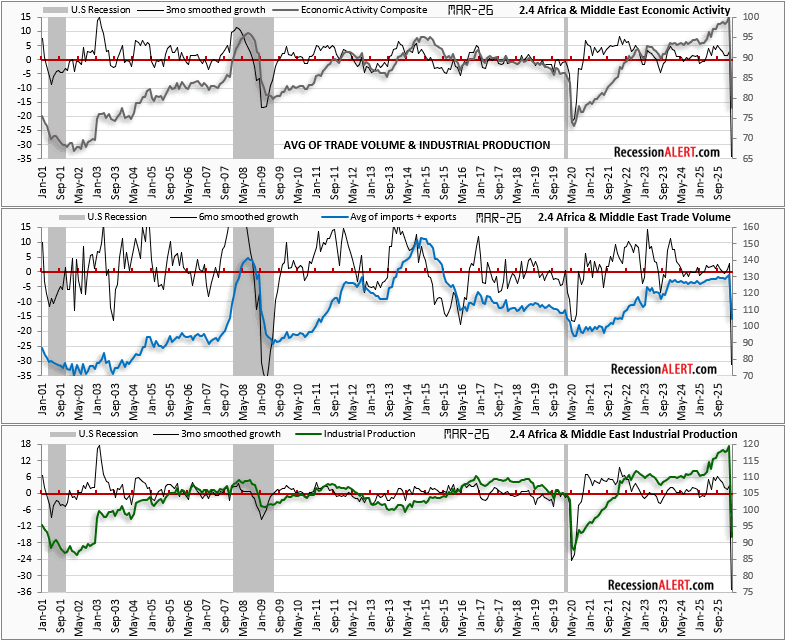
The Hormuz tanker counts, the SPR drawdown trajectory, OECD inventories, the term premium repricing — every Iran-war chart the desk has spent six weeks decoding is a buffer or a pressure gauge. This is the damage report underneath them. Middle East trade volume collapsed from a series-peak ~135 to ~95, industrial production from ~120 to the high-90s, the composite from ~99 to ~85, with 6-month growth rates printing -15 to -20% — COVID-trough magnitudes, reached in weeks, with no demand-side cause. The synchrony matters: these are not producers throttling wellheads as storage filled. Refineries, export terminals, processing trains, and pipeline infrastructure were physically destroyed in the US-Iran strikes. Every prior modern oil shock — 1973, 1979, 1990, 2014, 2022 — left capacity intact and barrels returned when politics resolved; the honest analog is the 1943-44 Ploieşti raids, which took out roughly 60% of Axis oil capacity and required years to rebuild. The buffers everyone is watching are draining against a supply curve that no longer exists at the top — and gasoline pumps inherit the difference long before policymakers do.
Market Intelligence Brief (MIB) Ver. 18.39
For professional investors only. Not investment advice.
© 2026 RecessionALERT.com

Comments are closed.