
S&P 500 hit a fresh all-time high (7,444) as the Trump-Xi summit in Beijing drove AI and semiconductor stocks to records — Nvidia reached $5.5T market cap and Trump confirmed discussing Blackwell chip exports with Xi — even as April PPI printed +6.0% YoY, the hottest since December 2022. Kevin Warsh was confirmed as Fed Chair 54-45, inheriting a policy trap. The 30-year Treasury crossed 5.046% at auction. The IEA warned of the largest oil supply deficit in history at 8.5 mb/day.
TABLE OF CONTENTS
A. EXECUTIVE SUMMARY
B. MARKET DATA
C. HIGH-IMPACT STORIES (7)
D. MODERATE-IMPACT STORIES (5)
E. ECONOMY WATCH (6)
F. EARNINGS WATCH (1)
G. WHAT’S NEXT
H. CHART OF THE DAY
A. EXECUTIVE SUMMARY -> TOP
The S&P 500 set a new all-time high of 7,444.23 despite April PPI printing at +6.0% YoY — the hottest wholesale inflation since December 2022 — as US-China summit optimism drove a concentrated AI and semiconductor rally that overwhelmed the inflation signal. The equity/bond split tells the real story: Nasdaq 100 gained +1.04% on tech enthusiasm while the 30-year Treasury crossed 5.046% at auction for the first time since July 2025, and Collins and Kashkari simultaneously put rate hikes on the table as Warsh prepares to assume the Chair. Gains were concentrated in megacap AI: Communication Services (+2.24%) and Technology (+1.07%) carried the index while Financials (-0.79%), Utilities (-1.30%), and the Dow (-0.14%) bore the full inflation burden — a majority of S&P 500 stocks closed lower. The summit outcome is the single variable separating today’s record from tomorrow’s reversal.
• PPI inflation shock absorbed: April PPI +6.0% YoY (hottest since Dec 2022), +1.4% MoM (largest monthly surge since March 2022); trade services +2.7% confirms tariff pass-through accumulating in the wholesale pipeline — arrives one day after CPI printed +3.8%. Rate hike probability reaches 39% by December; 30-year Treasury clears at 5.046% at auction, mortgage rates hit 6.77%.
• Warsh confirmed Fed Chair 54-45: Closest modern-era confirmation vote; assumes role May 15; inaugural FOMC June 16-17. Inherits CPI 3.8%, PPI 6.0%, and 39% rate-hike probability — the June meeting may be the first where a hike is formally tabled.
• Beijing summit launches: Trump arrives with Jensen Huang (Nvidia), Tim Cook (Apple), and Tesla CEO; bilateral meetings with Xi begin May 14. Markets pricing significant probability of semiconductor export flexibility and tariff pause — S&P and Nasdaq hit all-time highs despite the worst PPI in three years solely on summit optimism.
• Nvidia (NVDA +2.29%) reaches $5.5T market cap ATH: Trump confirms he and Jensen Huang will discuss “Blackwells” with Xi — first signal a Blackwell-class export could be on the table. Potential $8-15B China revenue recovery not in current consensus models. MU +4.83% on dual Street-high upgrades (BofA $950, DB $1,000); Gartner forecasts DRAM +125% YoY.
• IEA: largest oil supply deficit in history: Global inventories draining 8.5 mb/day — unprecedented; 14 mb/day Gulf production shut in. OPEC simultaneously cut 2026 demand growth to 1.17 mb/d (second consecutive 500K bpd downgrade). Oil prices fell -1-2% anyway — demand destruction outpacing the supply alarm, flagging stagflationary growth damage.
• Breadth collapse under the record: Most S&P 500 stocks fell as Nvidia, Micron, Alphabet, and Apple carried the index. Russell 2000 +0.10%; Dow -0.14%. PLTR -4.37% against the positive tape on analyst downgrade (OpenAI/Anthropic competition) plus NHS data privacy controversy. The rally is narrow enough that a single summit disappointment could flip the index negative.
1. AI Narrative vs. Inflation Reality — Two incompatible stories are running simultaneously: equity markets are pricing a summit-driven AI chip deal that could restore $8-15B in Nvidia China revenue and validate a DRAM supercycle, while the bond market is pricing the worst inflation data since 2022 and 39% odds of a rate hike by December. The equity record is entirely contingent on summit outcomes in the next 36 hours — a failed summit doesn’t just disappoint tech stocks, it removes the only narrative powerful enough to offset +6.0% PPI at today’s valuations.
2. Fed Leadership Transition at Peak Policy Uncertainty — Warsh inherits a genuine trap: CPI at 3.8%, PPI at 6.0%, and a president who wants rate cuts. Collins and Kashkari’s unified “hike possible” message in a single session — compounding Goolsbee’s May 12 pivot — completes a hawkish transformation of Fed communication in 48 hours. His first FOMC (June 16-17) may break the consensus assumption that the next move is a cut. All duration-sensitive sectors — REITs, homebuilders, utilities, leveraged balance sheets — are repricing accordingly; Financials and Utilities both fell today despite the record index close.
3. Stagflationary Energy Crossfire — The IEA and OPEC published simultaneous contradictory landmark reports: the largest supply deficit in history (8.5 mb/day drawdown) vs. the second consecutive 500K bpd demand downgrade. Both converge on the same US growth outcome — energy-driven inflation that simultaneously suppresses demand — the stagflationary scenario the Fed has no clean policy tool to address. That oil prices fell despite the IEA alarm is the bearish tell: demand destruction is accelerating fast enough to partially offset an unprecedented supply shock, signaling economic damage that tightens the Fed’s already-narrow policy window from both sides.
 — Leading economic indicators. Accurate market forecasts. Apply for membership at join.recessionalert.com
B. MARKET DATA -> TOP
The S&P 500 reached a new all-time high on May 13 even as April PPI landed at a stunning +6.0% YoY — a print that would typically rattle risk assets but was absorbed by explosive semiconductor and communication services momentum, with Alphabet (+3.94–3.97%) and Micron (+4.83%) leading after dual Street-high analyst upgrades. The session split cleanly between AI beneficiaries — Nasdaq 100 +1.04%, Communication Services +2.24% — and rate-sensitive laggards, with Financials (-0.79%) and Utilities (-1.30%) bleeding on higher-for-longer anxiety. The standout anomaly: Treasuries barely reacted to the inflation shock (10Y -0.4 bps), suggesting the PPI is a known risk rather than a new catalyst. The pending US-China summit is the next directional catalyst the market is watching.
CLOSING PRICES – Wednesday, May 13, 2026:
MAJOR INDICES
The S&P 500’s new ATH masked a bifurcated session: the Nasdaq 100 gained +1.04% on tech/AI enthusiasm while the Dow shed -0.14% and transports fell -0.37%, with blue-chip cyclicals and rate-sensitive names underperforming. The Russell 2000’s near-flat +0.10% confirms small caps remain excluded from the AI rally — the gains are concentrated, not broad. NDX has outpaced SP500 by +3.71% over the past 10 sessions, an entrenched 5-session streak of concentrated tech/growth leadership — DJTA sits 4.87% below its 10-session high, approaching but not yet triggering a classical Dow Theory non-confirmation.
| Index | Close | Change | %Move | Why It Moved |
|---|---|---|---|---|
| S&P 500 | 7,444.23 | +43.27 | +0.58% | New all-time high; tech/AI enthusiasm offset hot April PPI (+6.0% YoY); semiconductor and comm services surge drove broad index to record close |
| Dow Jones Industrial Average | 49,693.20 | -67.36 | -0.14% | Blue-chip lagged as Financials (WFC -2.19%, V -1.87%) and retail (HD -2.55%) declined on hot PPI data reviving higher-for-longer rate fears |
| DJ Transportation | 19,781.4 | -73.5 | -0.37% | Transports pressured by elevated energy cost environment (Iran war backdrop) and inflation concerns weighing on operating margins; 4.87% below 10-session high |
| Nasdaq 100 | 29,366.94 | +302.14 | +1.04% | Semiconductor surge (MU +4.83% on dual Street-high analyst upgrades; SMH +2%) and Alphabet rally (+3.97%); DRAM pricing +125% YoY per Gartner; AI capex theme accelerating |
| Russell 2000 | 2,845.67 | +2.84 | +0.10% | Near-flat; small caps in limbo between AI tailwinds and inflation headwinds; excluded from the concentrated mega-cap tech rally for the 5th consecutive session |
| NYSE Composite | 22,973.56 | N/A | N/A | Broad market breadth mixed; tech names boosted the composite while rate-sensitive sectors dragged; prior close unavailable |
VOLATILITY & TREASURIES
VIX fell -0.67% despite April PPI printing at +6.0% YoY — the options market chose to chase the tech rally rather than hedge the inflation shock. Yet bonds declined to confirm either move: 10Y barely budged (-0.4 bps), 2Y eased -1.5 bps despite the hot print. Neither spiking on inflation nor rallying in safe-haven mode, the bond market is in a deliberate wait-and-see posture — a split worth monitoring as the DXY edged up marginally (+0.19%), consistent with a mild higher-for-longer Fed repricing.
| Instrument | Level | Change | Why It Moved |
|---|---|---|---|
| VIX | 17.87 | -0.12 (-0.67%) | Declined as tech-led risk appetite dominated; PPI shock absorbed by AI momentum; options market not hedging the inflation surprise |
| 10-Year Treasury Yield | 4.461% | -0.4 bps | Minimal reaction to hot PPI; bond market appears to have pre-priced inflation overshoot; neither flight-to-safety nor inflation selloff |
| 2-Year Treasury Yield | 3.981% | -1.5 bps | Front end eased slightly; Fed rate cut expectations not materially altered by the PPI print; market not pricing in additional hikes despite the inflation data |
| US Dollar Index (DXY) | 98.48 | +0.18 (+0.19%) | Mild dollar strength consistent with hot PPI reinforcing higher-for-longer Fed narrative; modest safe-haven bid amid Iran war and geopolitical uncertainty |
COMMODITIES
Silver’s +2.99% surge against gold’s +0.25% points to industrial demand rather than pure safe-haven flight — semiconductor and tech manufacturing demand lifting silver alongside precious metals broadly. Copper’s +1.44% reinforces the AI infrastructure buildout thesis. Bitcoin’s -1.28% decline while tech equities surged confirms the risk rotation is hardware/AI-specific, not broad crypto: capital flowing into semis and comm services, not digital assets. Platinum’s +2.40% extends its recent recovery.
| Asset | Price | Change | %Move | Why It Moved |
|---|---|---|---|---|
| Gold | $4,698.37/oz | +$11.67 | +0.25% | Mild safe-haven bid sustained by Iran war backdrop and hot inflation data; gold holding gains but underperforming silver on industrial demand divergence |
| Silver | $88.15/oz | +$2.56 | +2.99% | Industrial demand surge outpacing gold; semiconductor and tech manufacturing buildout driving silver demand; precious metals broadly firm |
| Copper | $6.6253/lb | +$0.0943 | +1.44% | AI infrastructure buildout sustaining industrial metals demand; copper confirming growth signal despite inflation overhang |
| Platinum | $2,170.05/oz | +$50.95 | +2.40% | Precious metals broadly strong; supply constraints and industrial demand extending recent recovery from prior lows |
| Bitcoin | $79,631 | -$1,031 | -1.28% | Risk rotation hardware/AI-specific; capital flowing to semis and comm services rather than digital assets; crypto excluded from today’s tech rally |
ENERGY
WTI -1.09% and Brent -1.97% declined despite the ongoing Iran war context — Brent’s steeper fall signals global demand-side softness outweighing supply anxiety. Both crudes declining while equities rallied is a growth-concern read rather than a stagflationary supply shock. The WTI/Brent spread held broadly stable, confirming the move is a global rather than regional story. Natural gas decoupled entirely (+0.42%), driven by seasonal storage dynamics unrelated to the geopolitical crude narrative.
| Asset | Price | Change | %Move | Why It Moved |
|---|---|---|---|---|
| Crude Oil (WTI) | $101.07/bbl | -$1.11 | -1.09% | Demand-side concerns outweighing Iran war supply fears; OPEC+ supply expectations; declining despite geopolitical backdrop as growth outlook softens |
| Crude Oil (Brent) | $105.65/bbl | -$2.12 | -1.97% | Steeper decline than WTI reflects global demand-side softness; European demand outlook weakening; spread vs WTI largely stable — global not regional story |
| Natural Gas (Henry Hub) | $2.855/MMBtu | +$0.012 | +0.42% | Mild uptick on seasonal storage injection dynamics; decoupled from crude decline; US domestic supply/demand balance independent of Iran war |
| Natural Gas (Dutch TTF) | $16.11/MMBtu | +$0.05 | +0.29% | Marginal European gas gain; Russia-Ukraine supply uncertainty maintaining mild premium; EUR/USD decline partially offset the raw TTF price gain |
S&P 500 SECTORS
Communication Services surged +2.24% today — a sharp reversal from its +0.18% week-to-date laggard position — as Alphabet’s session gains drove the sector. Beneath the positive headline, Financials (-0.79%) and Utilities (-1.30%) both declined while the S&P closed green: a rate-pressure signal, as hot PPI data revived higher-for-longer fears. Technology’s structural dominance extends (+14.86% 1M, +17.66% 3M), while Healthcare deepens its quarterly slide (-5.31% 3M, -3.80% YTD) despite today’s modest bounce.
| Sector | 1-Day | 1-Week | 1-Month | 3-Month | 6-Month | YTD | 12-Month |
|---|---|---|---|---|---|---|---|
| Communication Services | +2.24% | +0.18% | +7.43% | +10.90% | +12.88% | +9.19% | +44.12% |
| Consumer Cyclical | +1.09% | -0.79% | +3.12% | +1.49% | -2.06% | -0.19% | +10.56% |
| Technology | +1.07% | +2.43% | +14.86% | +17.66% | +13.54% | +17.52% | +47.32% |
| Healthcare | +0.60% | +0.34% | -1.75% | -5.31% | +0.94% | -3.80% | +9.17% |
| Consumer Defensive | +0.25% | +0.49% | +3.83% | -2.75% | +12.46% | +10.34% | +8.77% |
| Basic Materials | +0.18% | +2.03% | +1.06% | -0.79% | +30.89% | +21.05% | +54.25% |
| Energy | -0.23% | +0.44% | +1.90% | +8.61% | +28.90% | +30.35% | +40.79% |
| Industrials | -0.29% | -1.99% | +0.17% | -0.06% | +15.13% | +14.22% | +28.99% |
| Real Estate | -0.73% | -1.23% | +1.60% | +2.10% | +5.75% | +8.03% | +6.26% |
| Financial | -0.79% | -1.54% | -1.09% | -3.32% | -0.03% | -3.70% | +8.44% |
| Utilities | -1.30% | -3.07% | -4.14% | -0.21% | +1.59% | +6.09% | +17.31% |
TOP MEGA-CAP MOVERS:
GAINERS
| Company | Ticker | Close | Change | Why It Moved |
|---|---|---|---|---|
| Micron Technology | MU | $803.63 | +4.83% | Dual analyst upgrades: BofA raised target to $950, Deutsche Bank raised to Street-high $1,000 (both Buy); Gartner forecasting DRAM prices +125% YoY; AI server/data center memory demand outpacing supply |
| Alphabet (Class C) | GOOG | $399.04 | +3.97% | AI-driven momentum in search and cloud; Communication Services sector led the session (+2.24%); Apple touching $300 for first time lifted broader tech sentiment |
| Alphabet (Class A) | GOOGL | $402.62 | +3.94% | Same catalyst as GOOG; dual-class structure; AI search monetisation and Google Cloud growth driving institutional accumulation |
| Texas Instruments | TXN | $306.34 | +3.78% | Broad semiconductor sector rally; Gartner DRAM pricing forecast lifted entire semis complex; AI/data center analog chip demand; SMH ETF advanced ~2% |
| Analog Devices | ADI | $432.39 | +3.04% | Semiconductor sector tailwind; AI infrastructure and industrial automation demand for analog chips; carried by sector-wide MU/DRAM pricing catalyst |
DECLINERS
| Company | Ticker | Close | Change | Why It Moved |
|---|---|---|---|---|
| Palantir Technologies | PLTR | $130.05 | -4.37% | Analyst downgrade citing AI competition from Anthropic and OpenAI; valuation concern at ~42x implied 2026 sales; NHS England data privacy controversy resurfaced (broader identifiable patient data access than disclosed) |
| Home Depot | HD | $302.55 | -2.55% | Hot PPI (+6.0% YoY) raised input cost concerns; higher-for-longer rates dampening housing activity and big-ticket home improvement spending outlook |
| Wells Fargo | WFC | $73.53 | -2.19% | Financial sector broad pressure; hot PPI reinforces higher-for-longer rate path, pressuring net interest margin expectations; Financial sector -0.79% on the day |
| IBM | IBM | $214.64 | -2.09% | IT services rotation out; legacy tech underperforming pure-play AI/semiconductor names; capital flowing from IT services into semis and comm services on AI re-rating |
| Visa | V | $320.31 | -1.87% | Financial sector decline; hot inflation data raising concerns about consumer purchasing power; higher-for-longer rate environment weighing on payment networks |
— Institutional-grade intelligence for serious investors. Apply for membership at join.recessionalert.comC. HIGH-IMPACT STORIES -> TOP
UNCERTAIN
1. April PPI +6.0% YoY, +1.4% MoM — Hottest Wholesale Inflation Since December 2022, Yet S&P 500 and Nasdaq Reach New Records as US-China Summit Overrides Inflation Fear
The core facts:The Bureau of Labor Statistics reported April 2026 Producer Price Index at +1.4% MoM — the largest monthly jump since March 2022 — lifting the annual rate to +6.0% YoY, well above the +4.9-5.0% consensus and the highest reading since December 2022. Core PPI advanced +1.0% MoM vs +0.3% consensus. Trade services surged +2.7%, a direct signal of tariff cost pass-through at the wholesale level — arriving one day after April CPI printed at +3.8% YoY. Despite the substantial overshoot, equity markets decoupled from the inflation signal: the S&P 500 rose +0.58% to a record close of 7,444.25; the Nasdaq Composite gained +1.20% to a record 26,402.34; the Dow Jones fell -0.14% to 49,693.20. Bond markets absorbed the inflation data with more severity: the 30-year Treasury crossed 5.046% at today’s bond auction — first above 5% since July 2025 — and December 2026 rate hike odds climbed to approximately 39%.
Why it matters:The equity/bond divergence on today’s PPI print is the key market signal: the S&P 500 and Nasdaq made all-time highs on the same session that wholesale inflation printed at its hottest in three years — a disconnect explained by the competing force of US-China summit optimism pulling tech stocks higher. This split creates a policy dilemma: the equity market is pricing accelerating AI revenue and potential semiconductor deal flow from Beijing, while the bond market is pricing Fed tightening risk. The trade-services +2.7% surge confirms that the tariff pass-through pipeline has not dissipated — corporate margins in consumer-facing industries face a second cost-pressure wave building from the wholesale level. At +6.0% PPI YoY with CPI at +3.8%, the spread signals further consumer-price pass-through in the pipeline for May and June CPI prints. Rate hike odds at 39% mechanically compress the forward earnings multiples of growth stocks even as those same stocks are rising today on trade deal hope.
What to watch:April Retail Sales (May 14) for evidence that the consumer is absorbing wholesale inflation pass-through; CME FedWatch December hike probability — any move above 45% would signal a meaningful tightening of financial conditions beyond current pricing; May CPI (June release) as confirmation of whether the PPI pipeline is fully translating to consumer prices.
UNCERTAIN
2. Senate Confirms Kevin Warsh as Federal Reserve Chair 54-45 — Assumes Role May 15 Inheriting CPI 3.8%, PPI 6.0%, and Rate-Hike Odds at 39%
The core facts:The US Senate confirmed Kevin Warsh as Federal Reserve Chair in a 54-45 vote on May 13 — the closest modern-era Fed Chair confirmation, with only one Democrat (Sen. John Fetterman of Pennsylvania) crossing party lines. Warsh assumes the Chair role on May 15 when Jerome Powell’s term expires, with his inaugural FOMC meeting scheduled June 16-17. Warsh has previously argued there is room to lower rates but pledged to exercise independent judgment rather than take direction from the White House. He inherits an inflation environment that has deteriorated materially since his nomination: CPI at 3.8% YoY (highest since May 2023), PPI at 6.0% YoY (highest since December 2022), and CME FedWatch pricing approximately 39% probability of a rate hike by December 2026. The 98% probability scenario for the June 16-17 meeting remains a hold.
Why it matters:Warsh’s confirmation creates a high-stakes institutional contradiction that is the defining monetary policy variable for 2026. Trump selected Warsh expecting rate cuts that would fuel growth; the inflation data Warsh inherits argues for policy tightening, not easing. Markets will spend the next four weeks attempting to read his first public communication as Chair: does he acknowledge the re-acceleration in inflation and validate the bond market’s hike pricing, or does he signal patience that the equity market interprets as dovish? Either outcome introduces volatility. The June 16-17 FOMC — his inaugural meeting — is the first where a rate hike discussion could formally be tabled, not merely acknowledged as a risk. All duration-sensitive sectors — REITs, homebuilders, utilities, infrastructure — plus leveraged-balance-sheet companies will reset discount rates based on the signal from his first communication. The 54-45 partisan vote also signals limited political consensus for Warsh’s leadership, constraining his flexibility to deviate from data-driven responses without congressional scrutiny.
What to watch:Warsh’s first public statement as Fed Chair after May 15 for language on the rate path and inflation response; the June 16-17 FOMC statement and dot plot as the first formal policy signal under new leadership; 10-year yield for a sustained break above 4.50% as the threshold that would trigger automatic repricing in rate-sensitive sectors.
BULLISH
3. Trump Arrives in Beijing with Nvidia, Tesla, and Apple CEOs — US-China Summit Launches as the Countervailing Force Driving Equities to Records Despite Hot Inflation
The core facts:President Trump arrived in Beijing on May 13 to launch the US-China Summit, with bilateral meetings with President Xi Jinping scheduled for May 14-15. The CEO delegation on Air Force One — Jensen Huang (Nvidia), along with the chief executives of Tesla and Apple (Tim Cook) — signaled the summit’s commercial agenda explicitly. Key items under negotiation: extension of the October 2025 trade truce; renewed Chinese purchases of US agricultural goods and Boeing aircraft; potential easing of US semiconductor export restrictions in exchange for Chinese rare earth and critical mineral commitments; and US pressure on China to leverage its influence over Iran regarding the Strait of Hormuz blockade. Market reaction was unambiguous: the S&P 500 and Nasdaq hit all-time highs despite PPI printing at a three-year high, with gains concentrated in AI and semiconductor names. Analysts expect the most likely outcome is a limited package — tariff pause, purchase commitments, rare earth framework — rather than a strategic breakthrough. No formal agreements were announced on Day 1; bilateral meetings commence May 14.
Why it matters:The CEO delegation composition makes the commercial intent explicit. When the CEOs of the world’s largest AI chip company, the largest EV company by market cap, and the world’s most valuable company are all on Air Force One, the market reads specific deal possibilities: Nvidia chips into China, Tesla manufacturing protections, Apple supply chain certainty. The equity market’s decision to hit all-time highs on a day with the worst PPI reading in three years is a direct statement that investors are pricing a significant probability of a trade agreement that eases AI chip export restrictions — a theme worth tens of billions in potential revenue recovery for Nvidia and the broader semis ecosystem. If substantive agreements emerge from May 14-15 on rare earth access, tariff pause, or chip export flexibility, the tech rally has fundamental support; if talks produce only symbolic commitments, the equity market’s pre-positioning implies downside risk when the summit concludes.
What to watch:Summit outcome announcements May 14-15 — specifically any language on semiconductor export restrictions, rare earth supply agreements, or tariff extension terms; Nvidia and Apple stock reactions to summit communiqué language on technology trade; any mention of Iran/Hormuz in summit discussions, which could provide indirect energy market relief.
BULLISH
4. Nvidia Hits Historic $5.5 Trillion Market Cap as Trump Signals “Speaking About Blackwells” in Beijing — Potential Export Approval Could Restore $12B+ in Lost China Revenue
The core facts:Nvidia (NVDA) reached an all-time high on May 13, pushing its market capitalization to approximately $5.5 trillion — a milestone no public company has ever reached. Shares gained +2.29% on the session. The key catalyst beyond AI momentum: President Trump confirmed to reporters that he and CEO Jensen Huang would be “speaking about Blackwells” during the Beijing summit — Nvidia’s next-generation AI chip architecture — introducing, for the first time, the possibility that a Blackwell-derived chip could receive export approval to China as part of a broader US-China trade framework. The financial context is significant: the US government’s H20 export restrictions resulted in a $4.5 billion charge against Nvidia’s Q1 FY2026 results and eliminated approximately $8 billion in expected Q2 FY2026 revenue from China. Bank of America separately described 2026 as the “Year of Accelerating AI Sales” in upgrading its outlook for Nvidia.
Why it matters:At $5.5 trillion market cap, Nvidia’s daily price movements directly affect S&P 500 index levels by 100+ basis points and touch virtually every institutional portfolio in the world. The Blackwell diplomatic signal represents a potential resolution to the largest single revenue headwind Nvidia has faced: if a Blackwell-class chip (even at restricted performance) receives export clearance to China, Nvidia could restore $8-15 billion in annual China revenue that H20 restrictions effectively eliminated — a multi-turn EPS recovery that current consensus models do not include. This is the highest-leverage single outcome from the Beijing summit for US equity markets, and markets are beginning to price it. The $5.5T milestone during a session when most stocks fell illustrates the extreme concentration of AI optimism in a single name, creating commensurate concentration risk if summit talks disappoint: a failed summit outcome on chip exports could trigger a Nvidia selloff large enough to drag the S&P 500 into negative territory even if every other stock holds flat.
What to watch:Beijing summit communiqué language on semiconductor export restriction modifications — any specific reference to Blackwell-class chips; Nvidia Q1 FY2027 earnings (May 20 AMC) for data center demand and China revenue guidance post-summit; Commerce Department follow-up on export license framework — the regulatory implementation step that would actually unlock revenue recovery.
BEARISH
5. IEA May Report: Global Oil Inventories Draining at 8.5 Million Barrels Per Day — Largest Supply Shock in History as 14mb/d Gulf Production Stays Shut
The core facts:The International Energy Agency released its May 2026 Oil Market Report on May 13, delivering the most alarming supply assessment since the organization’s founding. Global oil inventories are projected to fall at an average rate of 8.5 million barrels per day during Q2 2026 — the fastest drawdown ever recorded — driven by the ongoing Strait of Hormuz blockade. Approximately 14 million barrels per day of Gulf production remains shut in, with global supply projected to fall 3.9 mb/day across 2026. Saudi Aramco’s production dropped to its lowest since 1990. Brent crude is projected near $106/bbl through Q2. A coordinated strategic reserve release of 400 million barrels from 32 IEA member nations provides a buffer but cannot fully offset the deficit, which the IEA projects persists until Q4 2026. Simultaneously, the IEA cut its 2026 demand forecast, projecting a 420,000 bpd demand contraction YoY and a 2.4 mb/day Q2 YoY contraction as high oil prices destroy demand in aviation, petrochemicals, and consumer transportation. Despite the historic supply alarm, WTI fell -1.09% and Brent fell -1.97% on the session, as the demand destruction signal partially offset the supply warning.
Why it matters:An 8.5 mb/day inventory draw is without historical precedent — global stockpiles are being consumed at a rate that cannot be sustained, and the IEA warns the market could remain severely undersupplied through October even if the conflict ends next month. The US transmission runs through three channels: (1) Brent sustained at $106 keeps US gasoline at structurally elevated levels, adding directly to the inflation pipeline that CPI and PPI are already signaling; (2) the petrochemical sector faces feedstock shortfalls (naphtha, LPG) that downstream chemical and plastics manufacturers cannot resolve through substitution; (3) aviation gasoline constraints are driving flight cancellations and rising ticket prices, affecting consumer spending and airline earnings. The session’s oil price decline despite the IEA alarm is itself bearish: it signals that demand destruction from $106 Brent is accelerating fast enough to worry investors about economic growth, not just inflation. This is the stagflation pathway the Fed most fears — energy-driven inflation that simultaneously suppresses demand, creating a scenario where both raising and not raising rates carry severe costs.
What to watch:Any ceasefire development in the Iran war — even a partial Hormuz reopening would represent a fundamental shift in this supply outlook; EIA weekly petroleum inventory report (each Wednesday) for the US-specific drawdown; Brent sustained above $110/bbl as the threshold the IEA’s models show triggering accelerated demand destruction and heightened recession probability.
BEARISH
6. Collins and Kashkari Deliver Simultaneous Rate-Hike Warnings on May 13 — FOMC Consensus Now Unified: Tightening Is a Live Option as PPI Confirms Inflation Broadening
The core facts:Two Federal Reserve regional presidents delivered explicit rate-hike warnings on May 13 following today’s PPI overshoot. Boston Fed President Susan Collins stated: “It’s possible the Fed will need to hike rates to cool inflation pressures,” explicitly tabling tightening as a live policy option. Minneapolis Fed President Neel Kashkari, speaking at a St. Paul Area Chamber event, stated: “Inflation is too high — it’s our job to get inflation back down,” reiterating that the Fed should not move the 2% inflation goalposts. Both statements compound the hawkish turn already in motion: Goolsbee’s May 12 declaration, and the April 29 FOMC dissents by Kashkari, Hammack, and Logan, who jointly argued the Fed should explicitly acknowledge that the next move may be a hike. Rate market impact: December 2026 rate hike probability reached approximately 39%, up from ~30% after yesterday’s CPI. The dollar strengthened and financial sector stocks outperformed on the hike signal.
Why it matters:The May 13 Collins/Kashkari statements complete a hawkish transformation of Fed communication that took less than 48 hours: Goolsbee (historically the FOMC’s most recognized dove) put hikes on the table May 12; Collins and Kashkari confirmed the pivot extends across regional bank leadership on May 13. With Warsh now confirmed as Chair and three dissenters from April 29 already on record, the new Fed’s first meeting on June 16-17 enters with a hawkish composition that could — if PPI acceleration is confirmed in additional data — formally table a rate hike discussion for the first time in this cycle. The market impact runs through three channels: (1) financial sector stocks benefit from higher net interest income at elevated rates — financials outperformed today; (2) rate-sensitive growth stocks face multiple compression as discount rates revise upward; (3) the dollar strengthens on rate-differential widening, compressing earnings for S&P 500 companies with significant international revenue. The 39% hike probability means markets are spending one-third of their probability mass on a scenario where borrowing costs go higher from already-elevated levels — a material repricing from near-zero two months ago.
What to watch:Fed Chair Warsh’s first public statement after assuming the Chair on May 15 — the critical signal for whether the hawkish regional bank chorus has support at the institutional top; June FOMC statement language for explicit acknowledgment of rate-hike optionality; CME FedWatch June hike probability — any move above 5% would trigger meaningful sector repricing ahead of the meeting.
BULLISH
7. Micron Surges +4.83% on Dual Street-High Upgrades — BofA $950, Deutsche Bank $1,000; Gartner Forecasts DRAM +125%; Semiconductor Sector Rebounds from Yesterday’s Crash
The core facts:Micron Technology (MU) surged +4.83% on May 13 after receiving dual analyst upgrades with dramatically elevated price targets. Bank of America raised its MU price target to $950 (from $500), maintaining a Buy rating. Deutsche Bank raised to a new Street-high of $1,000, also Buy. Both upgrades cited the same structural thesis: AI server and data center memory demand is outpacing supply growth, and DRAM pricing is entering a sustained supercycle. Market research firm Gartner separately published a forecast for DRAM prices to increase +125% for the full year 2026, driven by insatiable HBM demand from AI GPU clusters. The VanEck Semiconductor ETF (SMH) advanced approximately +2%; Texas Instruments (TXN) gained +3.78%; Analog Devices (ADI) +3.04%. The rebound stands in sharp contrast to yesterday’s semiconductor crash — QCOM -14%, INTC -6.8%, MU -3.6% on May 12 — driven by CPI shock, South Korean dividend tax concerns, and profit-taking.
Why it matters:BofA’s $950 target and DB’s $1,000 Street-high imply 30-40% upside from institutional research desks at the time of publication — this is conviction pricing, not incremental fine-tuning. Gartner’s +125% DRAM price forecast, if realized, represents a multi-billion-dollar gross margin tailwind for Micron that feeds directly into EPS leverage far beyond current consensus. The broader sector signal: the May 12 AI semiconductor selloff was driven by macro factors (CPI/rate shock) and transient risks (South Korean tax concern) — both of which represent trading noise against the durable AI memory demand thesis. The May 13 rebound driven by fundamental analyst upgrades suggests institutional investors treated the selloff as a dip-buying entry for missed-rally catch-up. The SMH +2% sector-wide move confirms the buy signal was not Micron-specific — the entire AI infrastructure supply chain benefited from the revised memory pricing outlook, reinforcing Cisco’s AI order doubling reported tonight as independent validation of the AI capex cycle’s depth.
What to watch:Micron Q3 FY2026 earnings (June) for first real-time validation of the DRAM supercycle thesis against actual revenue and gross margin data; Applied Materials (AMAT) Q2 earnings (May 14 AMC) for semiconductor equipment demand confirmation — AMAT has the highest DRAM exposure among equipment peers at 31% of revenue; Nvidia Q1 FY2027 (May 20 AMC) for HBM demand commentary that would confirm or challenge the Gartner +125% pricing outlook.
— Quantifying recession risk so you don’t have to guess. Apply for membership at join.recessionalert.comD. MODERATE-IMPACT STORIES -> TOP
BEARISH
8. 30-Year Treasury Yields Cross 5% for First Time Since July 2025 — Bond Auction Clears at 5.046%, Mortgage Rates Hit 6.77%, REITs and Homebuilders Face Valuation Reset
The core facts:Today’s $25 billion 30-year Treasury bond auction cleared at 5.046% — approximately 17 basis points above the prior 30-year auction clearing yield of 4.876%, and the first time the 30-year has exceeded 5% since July 2025. The 10-year yield moved to 4.473%. The auction did clear — institutional demand was present at the elevated yield, indicating the market is adjusting to a higher rate environment rather than boycotting Treasury supply. Today’s PPI overshoot and rising rate-hike probability (~39% by December) drove the move. 30-year mortgage rates consequently rose to approximately 6.77% on the week, per real estate lending aggregators — a 16 basis point increase.
Why it matters:A 5% 30-year Treasury yield is the structural threshold at which borrowing costs become genuinely restrictive for the most rate-sensitive equity sectors. At 5.046%, the 30-year directly reprices: mortgage-REITs (whose business models depend on the spread between borrowing rates and mortgage yields); residential homebuilders (as 6.77% mortgage rates price 25-30% of aspiring buyers out of the market at current home prices); infrastructure and utility companies (valued as yield alternatives, whose P/E multiples compress as risk-free yields rise); and high-yield corporate issuers financing 30-year obligations. The fiscal dimension amplifies the structural problem: federal interest expense is approaching $1.1 trillion annually for FY2026, and higher 30-year auction yields increase future debt service costs — a self-reinforcing dynamic that creates persistent upward pressure on long-end rates regardless of Fed short-rate policy. Unlike a single economic data print, auction clearing yields represent institutional commitment at specific prices — they are harder to dismiss as transient.
What to watch:30-year yield sustained above 5.25% — the level at which homebuilder and REIT sector option pricing typically begins reflecting valuation distress; April Retail Sales (May 14) as the first direct read on whether elevated mortgage rates are suppressing housing-related consumer spending; next 10-year Treasury auction for continued demand signals at elevated yields.
BEARISH
9. Palantir (PLTR) Falls -4.31% Against Tech-Positive Tape — Analyst Downgrade Cites OpenAI/Anthropic Competition, NHS Data Privacy Controversy Threatens Government Contract Pipeline
The core facts:Palantir Technologies (PLTR) fell -4.31% on May 13, moving inversely to the broader tech rally (Nasdaq +1.20%) — a divergence that signals company-specific headwinds rather than sector rotation. Three converging catalysts drove the decline: (1) an analyst downgrade citing competitive erosion from Anthropic and OpenAI, both developing enterprise AI platform capabilities that directly compete with Palantir’s core data integration and analytics offering; (2) the same analyst cited Palantir’s stretched valuation at approximately 42x implied 2026 sales as inadequate compensation for the competition risk; (3) renewed controversy around Palantir’s NHS England data platform, where reports surfaced that the system provided broader access to identifiable patient records than patients and regulators had been led to expect. PLTR is down approximately 26% in 2026 year-to-date, even as major indices trade at all-time highs.
Why it matters:Palantir’s -4.31% on a tech-positive day reveals a bifurcation in AI equity sentiment: hardware and infrastructure names (Nvidia, Micron) are receiving premium bids, while pure-software AI analytics plays face the “AI commoditization discount” — the market’s acknowledgment that generative AI foundation models are increasingly capable of performing data analysis tasks that were previously the exclusive domain of specialized enterprise software. The NHS data privacy controversy is a more structural threat: Palantir’s entire growth strategy depends on expanding government and healthcare contracts globally, and any regulatory finding that the NHS platform inappropriately accessed patient data creates a compliance barrier that other governments (EU, Canada, Japan) will scrutinize before awarding contracts. For a company whose commercial thesis rests on government-sector AI adoption, reputational damage in a flagship public health contract is disproportionately impactful. With PLTR already down 26% YTD while major indices hit records, institutional patience for negative catalysts is limited — and a potential cascade of additional analyst downgrades on the same competition/valuation thesis creates further downside risk.
What to watch:UK’s Information Commissioner’s Office (ICO) or NHS England formal response to the data access allegations — an investigation would create contract renewal risk; Palantir Q2 2026 earnings (late July/August) for government contract pipeline and revenue retention; any additional analyst downgrade cascade from firms citing the same OpenAI/Anthropic competition thesis.
BULLISH
10. Apple Approaches $300 Intraday Record as Tim Cook Joins Trump Beijing Delegation — China Performance, AI Strategy Drive Valuation to Historic Levels
The core facts:Apple (AAPL) shares surged toward the $300 psychological milestone on May 13, approaching or reaching that level intraday for the first time. The primary catalyst: confirmation that CEO Tim Cook is part of President Trump’s official delegation to the US-China summit in Beijing — a direct signal that Apple’s supply chain and commercial operations in China are on the diplomatic agenda. Secondary supports include Apple’s recently reported Q1 2026 results with iPhone sales exceeding consensus, and Apple showing the strongest brand growth among the top six smartphone brands in China’s Q1 2026 market despite overall Chinese smartphone shipments declining 4% YoY. AI strategy optimism ahead of WWDC 2026 also contributed, with investors anticipating major announcements including upgraded Siri capabilities and deeper Apple Intelligence integration.
Why it matters:Cook’s presence in Beijing is a commercial statement with measurable financial stakes: Apple’s China revenue represents approximately 15-20% of total sales, and supply chain concentration in China means trade disruption has outsized operational impact. For Apple shares, approaching $300 is not merely a round number — at current prices AAPL is approaching a $3 trillion market cap, and institutional indices that use float-adjusted market cap weights could mechanically increase AAPL allocations on a sustained move above $300. The summit’s outcome on tariff extensions, supply chain security, and technology transfer restrictions directly affects Apple’s cost structure, iCloud data localization requirements in China, and App Store relationships with Chinese regulators — all financially material. Cook’s physical presence in Beijing also signals Apple’s willingness to engage directly in trade diplomacy for supply chain certainty, a posture that typically generates goodwill with both the Chinese government and US trade negotiators.
What to watch:Beijing summit outcome on technology company supply chain protections and tariff extension terms; WWDC 2026 (June) for Apple Intelligence product announcements and Siri upgrade scope; Q2 FY2026 earnings (late July) for China iPhone sell-through data in the post-summit tariff environment.
BEARISH
11. OPEC May Monthly Report Cuts 2026 Demand Growth to 1.17mb/d — Second Consecutive 500K bpd Downgrade as OECD and Asia Weakness Signal Global Economic Slowdown
The core facts:OPEC’s May 2026 Monthly Oil Market Report, published May 13, cut the 2026 global oil demand growth forecast to 1.17 million barrels per day — down from the prior month’s 1.38 mb/day and the second consecutive 500,000 bpd downward revision. Q2 2026 global demand was revised down by 500,000 bpd to 104.57 mb/day. Demand cuts are geographically concentrated: OECD demand growth is nearly flat at just +100,000 bpd; Europe is forecast to contract slightly by 30,000 bpd on weaker industrial activity; Asia-Pacific demand is projected to ease by 80,000 bpd. OPEC+ crude output averaged 33.19 mb/day in April, down 1.74 mb/day from March, as the Hormuz closure makes it impossible for OPEC members to execute the output increase schedule agreed earlier this year. Saudi Arabia’s production dropped to its lowest level since 1990.
Why it matters:OPEC’s demand cut — published the same day as the IEA’s record-supply-deficit warning — creates a paradoxical oil market signal: the world’s largest energy cartel is lowering its demand outlook at the same time the world’s energy watchdog warns of the largest supply shortfall in history. This simultaneous supply-deficit/demand-destruction dynamic explains why WTI fell on the session despite the IEA alarm — the demand side is deteriorating fast enough to partially offset the supply shock. For the US economy, the demand cut is more bearish than the supply shock is inflationary: significant downward revisions to European and Asian industrial demand signal slowing economic activity in markets where US exporters, multinationals, and financial firms have material exposure. The energy equity sector faces compression: high oil prices boost current earnings, but deteriorating demand forecasts signal peak pricing and introduce timing uncertainty about when supply returns enough to relieve price pressure on consumers and manufacturers.
What to watch:OPEC June monthly report for a potential third consecutive demand revision — a three-month pattern of cuts would signal a global demand contraction that meaningfully shifts the US growth outlook; Brent price trajectory versus the IEA’s $106 Q2 projection — sustained below $100 would indicate demand destruction is outpacing the supply shock; European and Asian PMI data over the next 4-6 weeks as the primary drivers of OPEC’s next demand revision.
UNCERTAIN
12. Record Indices Mask Breadth Collapse — Most S&P 500 Stocks Fall as Megacap AI Concentration Carries Indices While Inflation and Rate Risk Weighs on the Majority
The core facts:While the S&P 500 rose +0.58% to an all-time high of 7,444.25 and the Nasdaq Composite gained +1.20% to a record 26,402.34, the majority of individual S&P 500 stocks closed lower on the session. The Dow Jones Industrial Average — with its value and blue-chip tilt — fell -0.14% to 49,693.20, diverging sharply from the Nasdaq’s record. The Russell 2000 small-cap index gained only +0.07% — essentially flat. Gains were almost entirely concentrated in megacap AI and technology names: Nvidia (+2.29%), Micron (+4.83%), Apple (approaching $300), and US-China summit-adjacent tech. Meanwhile, rate-sensitive names — REITs, homebuilders, utilities, industrials, and small and mid-cap companies — bore the full burden of today’s PPI overshoot and rising rate-hike odds at 39%. The energy sector fell -0.23% despite historically extreme supply constraints, as demand-destruction fears dominated the sector narrative.
Why it matters:Record index levels that mask majority-stock declines are a structural caution flag for institutional investors. When a handful of mega-cap names account for the entirety of an index gain while 300+ components fall, the rally does not reflect broad economic optimism — it reflects AI narrative momentum concentrated in the five largest names in the cap-weighted index. This breadth collapse has historically been a lagging warning sign: when a rally narrows to its final small set of leaders, the marginal buyer pool for those leaders is increasingly limited, while the deteriorating majority signals that rate and inflation headwinds are already manifesting across the real economy. The Dow -0.14% / Nasdaq +1.20% divergence (215 bps spread on a single day) is institutional evidence of the rotation: pension funds and value managers are not participating in today’s record. A sustained breadth collapse over 3-5 sessions would historically signal that the index level is fragile rather than reflecting genuine economic resilience.
What to watch:NYSE Advance/Decline line over the next 3-5 sessions — sustained majority-stock declines at record index levels is the institutional early-warning signal for a broader correction; equal-weight S&P 500 ETF (RSP) performance vs. cap-weight S&P 500 as the cleanest breadth indicator; Russell 2000 relative performance vs. Nasdaq — sustained small-cap underperformance signals that rate and inflation headwinds are structural, not temporary.
— Separating signal from noise since 2007. Apply for membership at join.recessionalert.comE. ECONOMY WATCH -> TOP
April PPI surged 1.4% MoM — the largest advance since March 2022 — pushing the YoY rate to 6.0% against a 4.9% estimate, confirming that tariff-plus-Iran-shock inflation is materializing at the producer level. The 30-year Treasury yield crossed 5% for the first time since July 2025, as CME FedWatch now prices a ~30% chance of a rate hike by December — a sharp reversal from January’s three-cut consensus. Kevin Warsh’s 54-45 confirmation as the next Fed Chair (inaugural FOMC: June 16-17) adds leadership uncertainty to a policy environment where Collins and Kashkari both floated tightening today. Retail sales and jobless claims Thursday will test whether demand is absorbing or cracking under the accumulated price pressure.
April PPI Surges 1.4% MoM — Largest Monthly Jump Since March 2022, YoY Hits 6.0% (BLS, May 13, 2026)
What they’re saying:The Bureau of Labor Statistics reported that the Producer Price Index for final demand rose 1.4% MoM in April — crushing the 0.5% Dow Jones consensus and up from an upwardly revised 0.7% in March. The YoY rate jumped to 6.0%, the highest since December 2022 and well above the 4.9% estimate. Core PPI (ex food and energy) surged 1.0% MoM versus 0.3% expected, with the YoY rate climbing to 5.2% from 4.0%. Final demand goods rose 2.0% while services advanced 1.2%, the biggest monthly gain since March 2022.
The context:Trade services surged 2.7% — a pattern the Fed associates with tariff pass-through as distribution and retail margins expand to absorb import costs. Coming one day after April CPI hit 3.8% YoY, the PPI data confirms upstream price pressure is accumulating across the full supply chain. The breadth of the miss — headline, core, services, and goods all above forecast — leaves the Fed no statistical shelter and makes the case for sustained restrictive policy or outright tightening considerably stronger. This is the second consecutive month of headline PPI acceleration.
What to watch:April PCE (due end of May) — core PCE is partially derived from PPI services inputs; any upside will reset rate-cut timelines further. May CPI (June 12) will be the decisive pre-FOMC inflation read. Watch whether energy and trade-services components reverse in May as Iran peace talks continue.
30-Year Treasury Yield Breaches 5% for First Time Since July 2025 as Oil Shock and Fiscal Fears Converge (May 13, 2026)
What they’re saying:The 30-year U.S. Treasury yield crossed the psychologically critical 5% threshold for the first time since last July, with today’s bond auction clearing at 5.046% — up sharply from the prior auction’s 4.876%, a near-18bp jump in a single cycle. Oil prices remain approximately 60% above pre-Iran-conflict levels as Strait of Hormuz disruptions persist, reigniting inflation expectations at the long end of the curve. Swaps markets are now pricing a non-trivial probability of a Fed rate hike by early 2027.
The context:Two forces are converging simultaneously: a persistent energy supply shock driving goods inflation and a fiscal backdrop in which the CBO estimates the “One Big Beautiful Bill” will add $3.4 trillion to the deficit by 2034, requiring ever-larger Treasury issuance at a moment when foreign appetite is uncertain. Historically, sustained 30-year yields above 5% compress equity P/E multiples, raise corporate borrowing costs, and create refinancing stress for heavily-indebted issuers. The mortgage market is already feeling the pressure — the 30-year fixed rate hit 6.46% this week, a five-week high, with refi share at its lowest since July 2025.
What to watch:Whether the 10-year yield follows through 4.70-4.80%; the August Treasury quarterly refunding announcement for issuance signals; and whether the 30-year sustains above 5% heading into Warsh’s inaugural FOMC on June 16-17.
CME FedWatch: Markets Now Price ~30% Chance of Fed Rate Hike by Year-End After Inflation Double Miss (CME Group/CNBC, May 12, 2026)
What they’re saying:CME FedWatch data as of May 12 showed markets pricing a ~30% probability of at least one Federal Reserve rate hike by December 2026, up sharply from near-zero just two months earlier. The near-term picture remains steady — a 98% probability of a hold at the June 16-17 FOMC — but the December hike probability reflects growing conviction that the inflation data will force the Fed’s hand by year-end. Today’s PPI beat (MoM +1.4% vs +0.5% est) is likely to push these odds higher still.
The context:This marks a near-complete reversal of January’s consensus, which embedded three Fed rate cuts by year-end 2026. The Iran war’s energy shock compounding with tariff-driven goods inflation has created a dual supply-side price shock that the Fed’s traditional demand-management tools cannot easily address — cutting rates would accelerate inflation, but hiking into a slowing-growth environment risks a harder landing. Collins and Kashkari’s explicit acknowledgment today that hikes are “possible” validates the market’s pricing. The rate hike probability last reached these levels during the 2024 post-pandemic disinflation stall.
What to watch:April PCE (end of May) and May CPI (June 12) are the two decisive inflation reads before the June FOMC. If either comes in above consensus, hike probability could approach 40-50% and meaningfully compress risk-asset multiples.
Senate Confirms Kevin Warsh as Federal Reserve Chair in Closest Modern-Era Vote — Inaugural FOMC June 16-17 (CNBC/NPR, May 13, 2026)
What they’re saying:The Senate confirmed Kevin Warsh as the 11th Federal Reserve chair on Wednesday, 54-45, the closest confirmation vote in the modern era. The vote fell almost entirely along party lines, with Pennsylvania Democrat John Fetterman the sole crossover. Warsh assumes the role Friday, May 15, when Jerome Powell’s term expires, with his inaugural FOMC meeting scheduled for June 16-17. Warsh has argued publicly that there is room to lower rates, but has pledged to use independent judgment and acknowledged the Iran-driven inflation environment complicates any near-term easing.
The context:The confirmation arrives at the most complex monetary policy juncture since 2022: PPI just printed its hottest MoM since March 2022, the 30-year Treasury yield is above 5%, and markets are pricing a non-trivial chance of a rate hike by year-end. While Trump has publicly pressed for rate cuts, Warsh’s record — a hawk during the 2008-era Fed governance crisis who has called for “regime change” at the central bank — suggests he is unlikely to ease in the face of re-accelerating inflation. The partisan 54-45 margin reflects deep concern among Democrats about central bank independence under Trump.
What to watch:Warsh’s first public comments as Chair after May 15; whether he designates a vice chair; and the June 16-17 FOMC statement for any shift in the committee’s reaction function under new leadership.
Fed’s Collins and Kashkari Open Door to Rate Hikes, Cite Iran-Driven Inflation Risks (Federal Reserve, May 13, 2026)
What they’re saying:Boston Fed President Susan Collins said Wednesday that while rate hikes are “not in my most likely outlook,” she “could envision a scenario in which some policy tightening is needed to ensure that inflation returns durably to 2% in a timely manner.” Collins described current policy as “slightly restrictive” and expected it to remain so “for some time.” Minneapolis Fed President Neel Kashkari, speaking at a St. Paul Chamber event, said the Fed is “dead serious about getting inflation back down,” noting that labor markets look “a bit better” while inflation has “gotten worse” since U.S.-Iran hostilities escalated and closed the Strait of Hormuz.
The context:Two regionally and temperamentally distinct Fed presidents — the historically more moderate Collins and the reliably hawkish Kashkari — converging on the same “tightening possible” message in a single trading session amplifies the signal significantly. Both cited energy price transmission from Strait of Hormuz disruptions as the primary uncertainty driver. The Fed currently holds at 3.50-3.75% after a single 25bp cut in April 2026; today’s back-to-back CPI (+3.8% YoY) and PPI (+6.0% YoY) data confirm the dual price-shock thesis both officials articulated. A third Fed speech (Logan, 7pm) may provide additional calibration.
What to watch:Hammack (Thu), Williams (Thu), and Barr (Fri) speeches for whether the “hike openness” message is committee-wide or isolated to today’s speakers; and Warsh’s first public remarks as Chair after assuming office Friday for a definitive signal on the June FOMC’s direction.
Wall Street Sees 2026 Recession Risk at Historic Low — But 2027 Odds Surge to 41% (247 Wall St., May 11, 2026)
What they’re saying:Prediction market platform Kalshi now prices just a 17.5% chance of a U.S. recession in 2026 — the lowest on record — down from 36.9% a month earlier as Iran peace negotiations eased oil price concerns. Simultaneously, the probability of a 2027 recession has climbed to 41%, suggesting investors increasingly believe the economy avoids an immediate shock only to face a delayed reckoning. Near-term supports include 4.3% unemployment, S&P 500 at all-time highs, and Q1 2026 GDP at 2.0% annualized — a rebound from Q4 2025’s near-stall at 0.5%.
The context:The 2026/2027 divergence reflects a classic “delay and refinance” dynamic: strong earnings and tight labor markets provide near-term cover, but revolving credit balances above $1.3 trillion, consumer sentiment at a 75-year historic low, and slowing savings rates signal the household buffer is eroding. The 2027 risk timeline aligns with mass corporate bond maturities at elevated refinancing costs — a potential cliff if Iran-driven energy shocks keep rates higher for longer. J.P. Morgan maintains a 35% U.S. recession probability for 2026, above the Kalshi market, reflecting divergence between institutional forecasters and prediction markets.
What to watch:May and June consumer sentiment readings; the Fed’s G.19 consumer credit release (first Thursday of each month) for revolving balance trajectory; and corporate earnings guidance for H2 2026 cost pass-through as a leading indicator of 2027 refinancing stress.
— Know the probability before the market prices in the risk. Apply for membership at join.recessionalert.comF. EARNINGS WATCH -> TOP
YESTERDAY AFTER THE BELL (Markets Reacted Today)
No major earnings yesterday after the bell from companies with >$100B market cap.
TODAY BEFORE THE BELL (Markets Already Reacted)
No major earnings before the bell from companies with >$100B market cap.
TODAY AFTER THE BELL (Markets React Tomorrow)
BULLISH
13. Cisco Systems (CSCO): AH: n/a | Q3 FY2026 Beats Revenue and EPS — AI Infrastructure Orders Double to $9 Billion, Full-Year Guidance Raised to $62.8-63.0B
The Numbers:Released AMC May 13. Revenue: $15.8B vs est $15.56B (beat +$240M, +1.5%). Non-GAAP EPS: $1.06 vs est $1.03 (beat +$0.03, +3%). GAAP EPS: $0.85. FY2026 full-year guidance raised: revenue $62.8-63.0B, Non-GAAP EPS $4.27-4.29. Most significantly: management nearly doubled AI infrastructure order expectations from $5 billion to $9 billion. Remaining Performance Obligations (RPO): $43.5B, up +4% total; Product RPO +6%.
The Win:The doubling of AI infrastructure order expectations from $5B to $9B validates that Cisco’s enterprise networking equipment — switches, routers, Ethernet fabric — is becoming a critical layer in AI data center buildout, competing alongside InfiniBand and custom silicon for AI cluster connectivity. The Splunk integration is demonstrating measurable commercial momentum, with Cisco successfully up-selling security analytics into its existing networking customer base. Product RPO growth of +6% signals improving forward revenue visibility even as macro conditions tighten.
The Ripple:Positive for enterprise networking peers Arista Networks (ANET) and Juniper/HPE Networking, which benefit from the same AI data center buildout demand. Cisco’s AI order doubling independently confirms that hyperscaler AI capex is creating broad demand across the entire networking layer — not just GPUs and memory. Strong RPO growth reduces consensus risk for Cisco’s Q4 FY2026 and FY2027 revenue estimates.
What It Means:Cisco is demonstrating that the AI infrastructure supercycle has reached the networking layer. Doubling AI order expectations in a single quarter is a structural inflection — not a one-time upside — implying Cisco’s AI revenue mix will grow meaningfully in FY2027 and begins to re-rate the stock toward AI-adjacent multiples rather than mature-networking multiples.
What to watch:Cisco Q4 FY2026 earnings (August) for further AI order acceleration confirmation; Arista Networks Q2 2026 earnings for independent verification of AI networking demand; CSCO after-hours and next-session price action as the market digests the AI order doubling and guidance raise.
WEEK AHEAD PREVIEW:
Q1 2026 earnings season is winding down with approximately 89% of S&P 500 companies having reported. The remaining calendar is light on large-cap names, with one marquee event this week and the most-watched earnings report of the season arriving next week.
Applied Materials (AMAT) — AMC, Thursday May 14, 2026 — EPS est $2.68, Rev est $7.68B. Key focus: CFO confirmation of the stated target of more than 20% semiconductor equipment business growth in calendar 2026; HBM/DRAM equipment order traction (AMAT has the highest DRAM exposure among semiconductor equipment peers at 31% of revenue — directly tied to Gartner’s DRAM +125% pricing forecast); progress at the EPIC Center R&D facility (SK Hynix, Micron, and Samsung are founding partners); new TSMC AI chip development partnership announced May 11. Any guidance above current consensus ($7.69B rev / $2.66 EPS) would confirm sustained semiconductor equipment cycle momentum.
NVIDIA (NVDA) — AMC, Wednesday May 20, 2026 — The most-anticipated earnings report of the Q1 FY2027 season. Key focus: data center revenue guidance post-Blackwell ramp; H20 restriction impact quantification and China revenue commentary following this week’s US-China summit discussions about potential Blackwell export framework; HBM3e supply chain adequacy; any update on the path to restoring revenue lost to H20 restrictions. Nvidia’s May 20 print will either validate the $5.5 trillion market cap or trigger a significant repricing of the AI infrastructure supercycle thesis.
Beyond earnings: April Retail Sales (May 14, est +0.5% MoM) is the consumer spending test against the dual inflation shocks; and Friday May 15 is the formal transition date when Fed Chair Warsh assumes leadership and the Powell era ends.
— US market commentary trusted by family offices and institutions. Apply for membership at join.recessionalert.comG. WHAT’S NEXT -> TOP
UPCOMING RELEASES:
| Date | Event | Why It Matters |
|---|---|---|
| Thu, May 14 | Retail Sales MoM (exp +0.5%, prev +1.7%); Retail Sales Ex Autos (exp +0.6%); Retail Sales Control Group (exp +0.4%) | The most critical domestic read of the week: with PPI at +6.0% and CPI at +3.8%, April retail data will reveal whether wholesale inflation pass-through is reaching the consumer and suppressing spending. A miss vs. +0.5% consensus alongside hot PPI would confirm the stagflationary squeeze — goods costs rising while demand softens. A beat would raise rate-hike odds above 40% heading into Warsh’s inaugural June FOMC. |
| Thu, May 14 | Initial Jobless Claims (exp 205K, prev 200K); Continuing Claims (exp 1,790K, prev 1,766K) | Labor market resilience is the Fed’s primary justification for holding rates steady — any deterioration in claims toward 220K+ would introduce a conflicting signal that complicates the hawkish pivot. A second consecutive week below 205K would confirm that the labor market is not yet cracking under inflation/rate pressure, supporting the case for tightening policy. |
| Thu, May 14 | Import Prices MoM (exp +1.0%, prev +0.8%); Export Prices MoM (exp +1.1%, prev +1.6%) | Import prices are the first visible tariff pass-through signal at the border — a second consecutive month above +1.0% would confirm that tariff costs are systematically entering the supply chain and will continue feeding through to CPI/PPI in May and June. Watches alongside the PPI trade-services +2.7% surge for a consistent pattern of cost transmission. |
| Thu, May 14 | Fed: Hammack, Williams, and Barr speeches | Three Fed officials speaking on the same day following Collins and Kashkari’s rate-hike warnings on May 13 and Goolsbee’s May 12 pivot. Hammack, Williams (NY Fed President), and Barr will calibrate whether the “hike possible” message is committee-wide or was limited to today’s speakers. Any language echoing Kashkari’s “inflation is too high” framing would confirm an emerging hawkish consensus ahead of Warsh’s inaugural FOMC. |
| Fri, May 15 | Industrial Production MoM (exp +0.3%, prev -0.5%); Manufacturing Production MoM (exp +0.2%, prev -0.1%); Capacity Utilization (exp 75.8%, prev 75.7%) | April industrial production is the real-economy read on whether tariff disruption and elevated input costs are depressing US factory output — last month’s -0.5% decline was a warning sign. A second consecutive miss would signal manufacturing contraction consistent with OPEC’s demand downgrade thesis; a recovery to +0.3% would support the “soft landing” scenario that the equity record implies. |
| Fri, May 15 | NY Empire State Manufacturing Index (exp 7.5, prev 11.0) | The first May regional Fed manufacturing survey — a forward-looking signal for June PMI data. The expected deceleration from 11.0 to 7.5 would confirm industrial momentum slowing ahead of the June FOMC. Any print below 0 (contraction territory) would introduce a growth-shock narrative that complicates the hawkish policy pivot, potentially weighing on rate-hike probability despite hot inflation. |
KEY QUESTIONS:
1. Will the Beijing summit (May 14-15) produce substantive semiconductor export flexibility or rare earth commitments — specifically any language on Blackwell-class chips — or will talks yield only symbolic purchase commitments that deflate today’s AI-driven record and expose the equity market’s one-way summit bet?
2. Does Thursday’s Retail Sales print confirm that +6.0% PPI pass-through is suppressing consumer spending — and will a soft read alongside hot inflation shift December rate-hike probability above 45%, the threshold that would force meaningful repricing across growth and rate-sensitive equity sectors ahead of Warsh’s inaugural June 16-17 FOMC?
3. With the IEA warning of the largest oil supply deficit in history and OPEC simultaneously cutting demand forecasts for the second consecutive month, does Brent sustain above $110 — the level the IEA’s models identify as accelerating demand destruction — activating the stagflationary scenario where energy-driven inflation simultaneously suppresses growth and leaves the Fed with no clean policy tool in either direction?
— US market commentary trusted by family offices and institutions. Apply for membership at join.recessionalert.comH. CHART OF THE DAY -> TOP
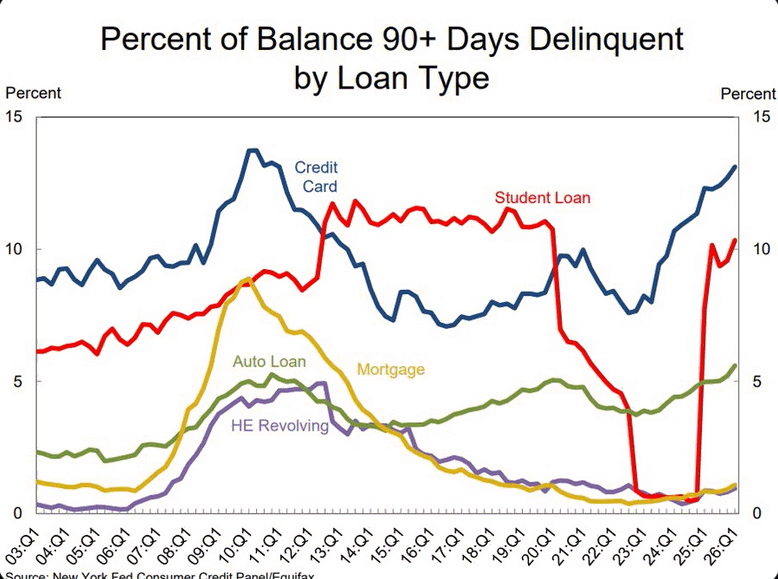
Chart of the Day: Credit card 90+ delinquencies have climbed to ~13%, matching the 2010 GFC peak — but reached in a ‘good’ economy with low unemployment, which is the alarming part. Student loans snapped from 0% back to ~10% as pandemic forbearance ended; mechanical, but reveals stress that was always there. Auto loans grind higher to 5%. Critically, mortgages and HE revolving remain near 1% — secured credit is pristine. This is the K-shaped signature: unsecured consumer cash-flow stress at the lower deciles, no asset/leverage spiral. The 2008 analogy fails because the transmission channel differs entirely. Watch card flows; mortgages will not be the canary.
Market Intelligence Brief (MIB) Ver. 17.97
For professional investors only. Not investment advice.
© 2026 RecessionALERT.com

Comments are closed.