
April CPI hit 3.8% — hottest since May 2023 — eliminating all 2026 cut bets and lifting hike odds to 30%; QCOM crashed 11.5% as Monday’s record highs evaporated. WTI settled at $102/bbl (+4.1%) with Goldman warning on downstream product shortages from naphtha to aviation fuel. Goolsbee explicitly tabled rate hikes; Warsh’s Fed Chair vote is Wednesday. UNH’s EPS beat (+9.7%) lifted Healthcare to S&P top sector. $166B in tariff refunds began flowing back to Walmart, Target, and Nike.
TABLE OF CONTENTS
A. EXECUTIVE SUMMARY
B. MARKET DATA
C. HIGH-IMPACT STORIES (5)
D. MODERATE-IMPACT STORIES (5)
E. ECONOMY WATCH (5)
F. EARNINGS WATCH (0)
G. WHAT’S NEXT
H. CHART OF THE DAY
A. EXECUTIVE SUMMARY -> TOP
The April CPI shock — 3.8% YoY, +0.6% MoM, the highest annual rate since May 2023 — triggered a decisive tech-to-defensive rotation: semiconductors were gutted (QCOM −11.5%, INTC −6.8%) while Healthcare gained 1.6% and Energy rebounded 0.9%, leaving the S&P barely negative at −0.16% and the Dow fractionally positive at +0.11%. WTI crude’s +4.1% surge to $102/bbl — while Brent added just +0.1% — compressed the WTI/Brent spread from ~$9.36 to ~$5.52, signaling US-specific supply bottlenecks that compound the stagflation read. A parallel +5 bps yield shift with the 2Y approaching 4.00% confirms markets are pricing out 2026 Fed easing and beginning to model upside rate risk — CME FedWatch now shows 30%+ hike odds and zero cut probability. VIX fell 2.1% despite the equity weakness, confirming this as orderly stagflation repricing, not panic.
• April CPI 3.8% YoY (+0.6% MoM) — hottest since May 2023, core +0.4% MoM above consensus: CME FedWatch now prices zero 2026 cuts and 30%+ hike probability by year-end; the rate-cut consensus that underpinned 2026 equity valuations has been entirely repriced in one session.
• Semiconductor complex rout — QCOM −11.5%, INTC −6.8%, SNDK −6.2%, MU −3.6%: One day after Monday’s all-time highs, the iShares Semiconductor ETF reversed sharply as CPI raised real discount rates, profit-taking accelerated, and South Korean AI dividend tax concerns cascaded into US memory names.
• WTI breaks $100, settles at $102/bbl (+4.1%) as Trump calls Iran ceasefire “garbage”: Goldman warns downstream product shortages are now acute in naphtha, LPG, and aviation gasoline — the crisis has moved from crude supply to downstream chemical feedstocks. EIA projects Brent peaking at $115/bbl this quarter.
• UNH +3.1% on Q1 EPS $7.23 (vs $6.59 est, +9.7% beat); FY guidance raised above $18.25: Lifted Healthcare sector to +1.64% — the S&P’s best day, reversing the YTD laggard (−4.11%) in a single session as institutional rotation out of tech found a defensive home.
• Fed hawkish pivot accelerates — Goolsbee explicitly tables rate hikes; Warsh confirmed to Fed board: Chicago Fed’s most dovish voice said he cannot see how only cuts “are conceivably on the table”; NY Fed’s Williams raised his 2026 inflation forecast to 3.0%. Warsh’s Fed Chair Senate confirmation vote is expected Wednesday (May 14).
• $166B tariff refund disbursements began — Walmart (~$3-5B), Target, Nike, GM among first recipients: IEEPA tariffs permanently struck down by the Supreme Court; macro complication: this liquidity injection arrives as CPI already runs at 3.8%, potentially sustaining consumer demand at an inflation-sustaining level.
1. Stagflation Is No Longer a Risk Scenario — It Is Today’s Baseline — 3.8% CPI + $102/bbl WTI + zero Fed cut probability = the textbook stagflation configuration has arrived. Every high-duration equity asset — tech, semis, REITs, homebuilders — faces simultaneous earnings multiple compression from higher real rates and demand softness from consumer purchasing power erosion. The subdued VIX (17.99) signals the market is repricing this orderly, not in panic — but orderly stagflation is a slow-burn structural headwind, not a one-session event.
2. The Fed Transition Amplifies Rate Volatility at the Worst Possible Moment — Powell exits Friday; Warsh inherits an environment where the data argues for tightening while his mandate from Trump was easing. His first communication as Fed Chair could validate 30% hike odds (triggering a second leg of rate repricing across REITs, homebuilders, and utilities) or attempt dovish signaling that risks a bond market tantrum. Either path generates volatility — and Wednesday’s Chair vote adds institutional uncertainty before markets have any clarity on the new leadership’s rate path.
3. The AI Semiconductor Rally Faces Its First Credibility Test — QCOM’s −11.5% decline the day after announcing a hyperscaler win illustrates the sector’s valuation fragility: AI revenues priced at certainty on Monday become subject to full revision when macro conditions shift on Tuesday. NVIDIA Q1 earnings (May 20) are now the line between a tactical sell-off and a structural re-rate — if data center demand commentary is strong, the semis bounce; if NVDA guides cautiously, the 77% YTD iShares Semiconductor ETF run faces a materially deeper correction.
 — Leading economic indicators. Accurate market forecasts. Apply for membership at join.recessionalert.com
B. MARKET DATA -> TOP
A hotter-than-expected CPI print — 3.8% annual rate, +0.6% monthly, the highest since May 2023 — combined with US-Iran ceasefire breakdown fears drove a sharp sector rotation: semiconductors sold off hard on profit-taking while defensive healthcare and energy surged, leaving the S&P barely negative and the Dow fractionally positive. QCOM collapsed 11.5% and INTC fell 6.8% as the semis complex absorbed the inflation repricing, while Healthcare gained 1.6% after UNH’s strong Q1 beat attracted defensive buyers. The session’s starkest anomaly was WTI crude surging 4.1% to $102/bbl while Brent barely moved (+0.1%), compressing the WTI/Brent spread from ~$9.36 to ~$5.52 — a US-specific supply signal that amplifies the stagflation picture. Yields up 5 bps alongside a falling VIX confirms this as orderly inflation repricing, not a panic-driven risk-off.
CLOSING PRICES – May 12, 2026:
MAJOR INDICES
The Dow’s fractional gain (+0.11%) vs. the Nasdaq’s −0.87% decline is the day’s sharpest index split — a blue-chip/tech divergence where the DJIA’s lower tech weighting provided insulation from the semiconductor rout. NYSE Composite’s slight gain (+0.19%) confirms the broader market was less damaged than headline indices imply, with healthcare and energy offsetting. The 10-session NDX outperformance over S&P (NDX +7.52% vs. S&P +3.67%, a 3.85pp gap) is now in its third consecutive session — concentrated tech/growth leadership remains structurally embedded even as today’s session dealt that leadership its sharpest single-day reversal in recent weeks.
| Index | Close | Change | %Move | Why It Moved |
|---|---|---|---|---|
| S&P 500 | 7,401.01 | −11.83 | −0.16% | Tech/semi selloff (QCOM −11.5%, INTC −6.8%) offset by healthcare and energy gains; CPI 3.8% triggered repositioning but broad damage was limited |
| Dow Jones | 49,760.56 | +56.09 | +0.11% | Blue-chip resilience; lower tech weighting insulated the DJIA from semiconductor selloff; energy and financial gains offset industrial losses |
| DJ Transportation | 19,856.4 | −187.3 | −0.93% | WTI crude +4.1% raised transport operating cost outlook; higher inflation print compounded economic slowdown concerns for freight-sensitive names |
| Nasdaq 100 | 29,064.80 | −255.86 | −0.87% | Semiconductor and AI stock profit-taking triggered by hot CPI; QCOM −11.5%, INTC −6.8%, SNDK −6.2% led the decline; US-Iran ceasefire uncertainty added to risk-off pressure |
| Russell 2000 | 2,843.81 | −26.83 | −0.93% | Yield surge (+5 bps on 10Y) pressured small-caps as financing cost sensitivity amplified the inflation repricing; matched DJTA as session laggards |
| NYSE Composite | 23,015.35 | +44.58 | +0.19% | Broader index gained as healthcare and energy outweighed tech losses; less-tech-concentrated composition told the most balanced story of the session |
VOLATILITY & TREASURIES
VIX fell 2.1% even as equities weakened and yields surged — the options and bond markets are sending different signals. Both 2Y and 10Y yields rose in lockstep (~5 bps each), a parallel shift that confirms inflation repricing, not a flight-to-safety bid (which would push 10Y down). The 2Y now sits at 3.994%, knocking on 4.00% — the market is pricing Fed rate cuts back out of the curve. DXY firmed on reduced cut expectations and safe-haven demand, while bonds’ non-participation in the equity decline is the clearest signal this is not a growth scare; this is a stagflation reprice.
| Instrument | Level | Change | Why It Moved |
|---|---|---|---|
| VIX | 17.99 | −0.39 (−2.12%) | Declining VIX despite equity weakness signals orderly profit-taking, not panic; options market not pricing systemic risk; selloff was sector rotation, not broad de-risking |
| 10-Year Treasury Yield | 4.467% | +5.4 bps | Hot CPI (3.8% YoY, +0.6% MoM — highest annual rate since May 2023) drove yields sharply higher as market trimmed Fed rate cut expectations for 2026 |
| 2-Year Treasury Yield | 3.994% | +4.6 bps | Front-end repriced on CPI surprise; approaching key 4.00% psychological level as near-term Fed cut odds recede; short-end inflation sensitivity fully engaged |
| US Dollar Index (DXY) | 98.30 | +0.32 (+0.32%) | Firmed on reduced rate cut expectations following hot CPI; safe-haven demand from US-Iran geopolitical uncertainty provided additional support |
COMMODITIES
Gold’s near-flat finish (−0.1%) against a 3.8% CPI print is the key puzzle: inflation shocks typically lift gold, but rising real yields and a stronger dollar suppressed the safe-haven bid. Copper’s +2.68% surge — driven by China demand and Middle East supply disruptions to copper-refining chemicals — contrasts sharply, with the market pricing industrial demand over generalized inflation fear. Silver’s +1.47% tracked copper’s industrial story over gold’s safe-haven story. Bitcoin fell −1.52% in line with the tech/risk-off tape, continuing its role as a risk-correlated asset rather than an inflation hedge.
| Asset | Price | Change | %Move | Why It Moved |
|---|---|---|---|---|
| Gold | $4,722.60/oz | −$6.10 | −0.13% | Marginally lower despite hot CPI; rising real yields and stronger dollar suppressed the inflation hedge bid; gold’s failure to rally on a 3.8% print is a signal worth monitoring |
| Silver | $87.208/oz | +$1.260 | +1.47% | Tracked copper’s industrial demand strength; outperformed gold as industrial metal characteristics dominated over safe-haven dynamics |
| Copper | $6.6335/lb | +$0.1730 | +2.68% | China demand rebound and Middle East supply disruptions to sulphur/sulphuric acid (key copper refining inputs) tightened global supply; AI datacenter construction demand sustained |
| Platinum | $2,147.00/oz | +$20.70 | +0.97% | Modest gain following broader industrial metals trend; autocatalyst demand resilient; tracking silver/copper’s industrial strength rather than gold’s safe-haven story |
| Bitcoin | $80,534 | −$1,243 | −1.52% | Declined in line with risk-off sentiment and tech sector weakness; tracking equities confirms risk-correlated behavior rather than inflation hedge or safe-haven positioning |
ENERGY
WTI’s +4.1% surge against Brent’s near-flat +0.1% is the session’s most anomalous data point — the WTI/Brent spread compressed from ~$9.36 to ~$5.52 in a single session. In a pure Hormuz closure scenario Brent typically leads; WTI’s outperformance points to US-specific supply bottlenecks as domestic refiners scramble for crude. Rising WTI against a softening equity tape is the classic stagflation signal — higher energy costs feeding directly into an already-hot CPI print. Henry Hub’s −2.6% decline on weather/oversupply confirms crude and gas are now trading entirely different stories.
| Asset | Price | Change | %Move | Why It Moved |
|---|---|---|---|---|
| Crude Oil (WTI) | $102.05/bbl | +$3.98 | +4.06% | Strait of Hormuz disruption escalating — Trump called ceasefire “on massive life support”; Saudi Aramco CEO warned of 100M bbl/week supply loss; US-specific supply bottlenecks compressed the WTI/Brent spread sharply |
| Crude Oil (Brent) | $107.57/bbl | +$0.14 | +0.13% | Already elevated from prior sessions on Hormuz disruption; geopolitical premium largely priced in; Brent/WTI spread collapsed to ~$5.52 as WTI caught up sharply |
| Natural Gas (Henry Hub) | $2.834/MMBtu | −$0.076 | −2.61% | Fell on mild weather forecasts reducing heating/cooling demand and ample US domestic supply; gas trading a completely different supply/demand story from crude |
| Natural Gas (Dutch TTF) | $16.06/MMBtu | +$0.16 | +1.00% | Modest rise as Hormuz supply anxiety lifted European gas prices; TTF/Henry Hub divergence confirms distinct European vs US natural gas dynamics |
S&P 500 SECTORS
Technology’s reversal narrates the whole session: the 1-month (+15.53%) and 3-month (+16.60%) leader finishes last today (−1.26%), while Healthcare — the 3-month laggard (−5.18%) and YTD laggard (−4.11%) — leads the day (+1.64%). That is a catalyst-driven sector flip, not noise. Consumer Cyclical extended structural weakness: near-last today (−1.05%), negative YTD (−1.27%), negative 6-month (−1.75%) — confirming the discretionary squeeze from persistent inflation and higher yields. Energy’s +0.86% rebound today snaps a −2.96% weekly slide, staging a one-day reversal as WTI surged.
| Sector | 1-Day | 1-Week | 1-Month | 3-Month | 6-Month | YTD | 12-Month |
|---|---|---|---|---|---|---|---|
| Healthcare | +1.64% | +0.33% | −1.47% | −5.18% | +1.69% | −4.11% | +13.69% |
| Consumer Defensive | +1.50% | +0.51% | +3.36% | −1.70% | +12.04% | +10.07% | +8.41% |
| Energy | +0.86% | −2.96% | +0.07% | +11.65% | +30.73% | +30.91% | +43.62% |
| Financial | +0.35% | +0.51% | +0.17% | −3.75% | +1.30% | −2.99% | +11.57% |
| Basic Materials | +0.11% | +5.84% | +1.15% | +1.08% | +33.39% | +20.84% | +54.40% |
| Communication Services | +0.03% | −0.16% | +8.10% | +7.18% | +13.03% | +6.79% | +45.17% |
| Real Estate | −0.08% | +0.93% | +3.26% | +2.45% | +6.45% | +8.82% | +7.68% |
| Utilities | −0.24% | −2.73% | −2.44% | +2.03% | +2.99% | +7.48% | +17.66% |
| Industrials | −0.62% | +0.62% | +1.07% | +0.99% | +16.14% | +14.55% | +33.02% |
| Consumer Cyclical | −1.05% | −0.12% | +4.27% | +0.09% | −1.75% | −1.27% | +15.29% |
| Technology | −1.26% | +4.29% | +15.53% | +16.60% | +15.14% | +16.28% | +52.53% |
TOP MEGA-CAP MOVERS:
GAINERS
| Company | Ticker | Close | Change | Why It Moved |
|---|---|---|---|---|
| UnitedHealth Group | UNH | $396.39 | +3.11% | Q1 2026 earnings beat: EPS $7.23 vs $6.59 est (+9.7% beat); medical benefit ratio improved to 83.9% vs 85.5% est; FY EPS guidance raised to >$18.25; JPMorgan raised PT to $420; lifted entire Healthcare sector |
| Philip Morris International | PM | $186.93 | +2.65% | Defensive rotation on CPI shock; tobacco/consumer staples as inflation-resilient income plays; sector flight out of tech into defensive high-yield names |
| Netflix | NFLX | $87.66 | +2.59% | Advertising business scaling faster than Wall Street expected; above-average volume (43M vs 36M avg) confirmed conviction; bucked flat Communication Services sector (only +0.03%) |
| AbbVie | ABBV | $207.86 | +2.51% | Healthcare sector lift from UNH earnings beat; pharma names benefiting from defensive rotation as inflation-resilient cash-generative businesses |
| Eli Lilly | LLY | $989.87 | +2.37% | Healthcare sector momentum from UNH; GLP-1 drug pipeline provides long-term demand visibility; sector rotation out of tech amplified the move |
DECLINERS
| Company | Ticker | Close | Change | Why It Moved |
|---|---|---|---|---|
| Qualcomm | QCOM | $210.31 | −11.46% | Profit-taking after 60%+ recent rally; hot CPI (3.8% YoY) and US-Iran ceasefire breakdown fears triggered broad semiconductor profit-taking; QCOM led the entire semis complex lower |
| Intel | INTC | $120.61 | −6.82% | Semiconductor sector selloff carried by QCOM’s lead; inflation data pressures tech spending outlook; dragged lower with broad chip complex |
| SanDisk Corp | SNDK | $1,452.02 | −6.17% | Computer hardware/memory sector weakness; carried lower with semiconductor complex as inflation repriced growth multiples across the tech space |
| Oracle | ORCL | $186.83 | −3.62% | Tech/software sector selloff; rising yields compress growth valuations; cloud/AI infrastructure spend concerns amplified by hot CPI and geopolitical uncertainty |
| Micron Technology | MU | $766.58 | −3.61% | Semiconductor memory selloff; profit-taking after strong AI-driven rally; inflation repricing pressures high-multiple growth names across the chip space |
— Institutional-grade intelligence for serious investors. Apply for membership at join.recessionalert.comC. HIGH-IMPACT STORIES -> TOP
BEARISH
1. April CPI Surges to 3.8% — Hottest Since May 2023, Core at +0.4% MoM — Rate Cuts Priced Out Entirely as Hike Odds Hit 30%
The core facts:The Bureau of Labor Statistics reported April 2026 CPI rose +0.6% MoM, lifting the annual rate to 3.8% — above the 3.7% consensus and the highest reading since May 2023. Core CPI (ex-food and energy) came in at +0.4% MoM and +2.8% YoY, exceeding the 0.3%/2.7% consensus on both measures. Energy prices surged +3.8% MoM, accounting for more than 40% of the headline gain as the Iran War’s Hormuz disruption reverberates through the energy complex. Food prices rose +0.5%. Market reaction was immediate: S&P 500 finished -0.16% at 7,400.96; Nasdaq Composite -0.71% at 26,088.20 (Nasdaq 100 dropped more than 2% intraday); Dow Jones +0.11% at 49,760.56 — a sharp divergence reflecting defensive rotation. The 2-year Treasury yield approached the 4.00% psychological threshold; CME FedWatch moved to zero probability of any 2026 rate cut — a complete reversal from just months ago — while pricing a better than 1-in-3 chance of a rate hike by end-2026 and greater than 70% odds of a hike by April 2027.
Why it matters:April CPI destroys the 2026 rate-cut consensus that underpinned equity valuations since the January recovery. A rising real discount rate mechanically compresses the present value of future earnings for long-duration growth assets — every technology, AI infrastructure, and high-multiple company now faces a structurally higher cost of capital. The 2-year yield approaching 4.00% is the level at which corporate refinancing costs and mortgage rates begin meaningfully constraining capital allocation: mid-cap borrowers face real funding cost increases that reduce buyback capacity, dividend sustainability, and capex; homebuilders face 30-year mortgage rates exceeding 7%. The Dow +0.11% / Nasdaq -0.71% divergence confirms institutional rotation from growth to value-defensives is executing now, not hedging futures risk. Most critically: rate hike odds at 30% mean the options market must price two-sided rate risk — not just “when do cuts arrive” but “could rates go higher?” — which structurally widens credit spreads, compresses equity risk premiums, and reprices every duration-sensitive asset class simultaneously.
What to watch:April PPI (Wednesday May 13) as confirmation of upstream pricing pipeline pressure; CME FedWatch June 16-17 FOMC implied hike probability — any pricing of a June hike would trigger immediate repricing across rate-sensitive sectors; May CPI (June release) as confirmation or reversal of the 3.8% print.
BEARISH
2. Fed Hawkish Pivot: Goolsbee Puts Rate Hikes Back on the Table, Warsh Confirmed to Fed Board — Incoming Chair Inherits a Tightening, Not Easing, Environment
The core facts:Chicago Fed President Austan Goolsbee — historically one of the most dovish FOMC members — stated in a Bloomberg interview that “I don’t see how you can look at the current situation and view that the only thing that’s conceivably on the table are rate cuts,” explicitly putting rate hikes back as a live option. He described April CPI as evidence of “pervasive price pressures” and called for the Fed to consider how to “break the chain of escalating inflation.” NY Fed President John Williams simultaneously raised his 2026 inflation forecast to 3.0%, projecting a return to 2% only in 2027. The Wall Street consensus is now uniform: BNP Paribas, HSBC, JPMorgan, RBC all forecast zero 2026 cuts; BofA projects first cut July 2027; Goldman Sachs — the most optimistic at December 2026 before today’s print — is likely to push further. CME FedWatch moved to zero 2026 cut probability and 30%+ hike odds by year-end. Separately, the Senate confirmed Kevin Warsh to the Federal Reserve Board of Governors in a 51-45 vote today (May 12), with only one Democrat supporting; the Senate approved a 30-hour countdown for his Fed Chair vote, expected Wednesday (May 14). Warsh takes over as Fed Chair upon Powell’s term expiry Friday (May 15).
Why it matters:Goolsbee’s hawkish pivot is the Fed communication inflection point that reshapes multi-quarter rate expectations. When the FOMC’s most dovish-identified member explicitly tables rate hikes as a possibility, the doves have vacated the field — and the policy distribution now spans flat-to-higher. This structural shift hits all duration-sensitive sectors simultaneously: REITs, homebuilders, and utilities face a higher cost of capital for longer than any of them modeled. The Warsh dynamic introduces a dangerous institutional contradiction: Trump selected Warsh precisely because he expected aggressive rate cuts; instead, Warsh inherits an environment where the incoming data argues for tightening, not easing. Markets will watch whether the new Fed Chair signals independence from presidential pressure or capitulates — and either outcome creates volatility. An independent Warsh who acknowledges hike risk validates the selloff; a Warsh who signals cuts despite the data risks a bond market tantrum. The 30%+ hike probability is now the highest it has been in this cycle, and every leveraged borrower — households, corporations, real estate — must model upward rate optionality.
What to watch:Warsh Fed Chair Senate vote Wednesday (May 14); Warsh’s first public communication as Fed Chair after May 15 for signals on his rate path positioning; June 16-17 FOMC as the first meeting under new leadership — the first where a formal hike discussion could be tabled.
BEARISH
3. WTI Breaks $100 Threshold, Settles at $102.18 (+4.2%) as Trump Calls Iran Ceasefire “Garbage” — Goldman Warns of Petroleum Product Shortage Across Chemicals and Aviation
The core facts:WTI crude settled at $102.18/bbl on May 12, gaining +4.2% — breaking decisively above the psychologically critical $100 threshold. Brent crude approached $107/bbl. The catalyst: President Trump called Iran’s latest ceasefire counter-proposal “garbage,” and described the state of negotiations as “unbelievably weak” — escalatory language beyond Sunday’s prior rejection. The Strait of Hormuz disruption has now persisted for 11 consecutive weeks. The EIA projects Brent crude peaking at $115/bbl this quarter given the continued closure. Goldman Sachs issued a new warning Monday that petroleum product inventories are draining at a rapid pace, with shortages most acute in naphtha and LPG (critical for chemical manufacturing) and aviation gasoline — moving the supply crisis from crude to downstream products for the first time. Saudi Aramco CEO Amin Nasser extended his normalization timeline: oil markets may not return to normal until 2027 if the Strait remains blocked past mid-June. OPEC production remains at a 26-year low. The WTI/Brent spread has compressed from approximately $9.36 to approximately $5.52 in recent sessions, signaling US-specific supply tightening beyond the global geopolitical premium.
Why it matters:WTI crossing $100 is the economic inflection point: academic and empirical research consistently identifies sustained crude above $90-100 as a US recessionary precursor through three transmission channels — consumer purchasing power erosion (gasoline at $4.52+ is running 50%+ above pre-conflict levels), input cost compression for transportation and logistics, and Fed inflation entrenchment that prevents rate relief. Goldman’s product shortage warning qualitatively escalates the crisis: the prior narrative was about crude supply restriction; now downstream chemical feedstocks (naphtha, LPG) and aviation gasoline face structural shortfalls that cannot be resolved by simply reopening Hormuz — the supply chain rebuild takes months. Chemical companies, airlines, and plastics manufacturers face margin compression from simultaneous crude and product tightness. The $102 WTI price combined with today’s 3.8% CPI print creates the worst-case stagflation setup: energy driving inflation higher while the growth outlook deteriorates. Every $10/bbl sustained above $90 compresses US consumer discretionary spending by approximately $75-100B annualized — Q2 and Q3 discretionary sector earnings consensus faces negative revision risk.
What to watch:Any new US-Iran ceasefire proposal framework; WTI sustained above $105/bbl — the level at which Goldman has modeled US recession probability increases materially; EIA weekly petroleum inventory report (Wednesday) for product draw confirmation; Trump-Xi Beijing summit (May 13-15) for any energy-for-technology trade diplomacy that could introduce indirect ceasefire pressure on Iran.
BEARISH
4. Semiconductor and AI Stocks Crash: QCOM -14%, INTC -6.8%, MU -3.6% — CPI Shock, Korean Dividend Tax Concern, and Profit-Taking Reverse Monday’s All-Time Highs
The core facts:The semiconductor sector suffered its sharpest single-day selloff in months on May 12: Qualcomm (QCOM) plunged approximately 14% — its most severe single-session decline since 2020 — erasing most of Monday’s all-time high gain. Intel (INTC) fell -6.82%, SanDisk (SNDK) -6.17%, Micron (MU) -3.61%, AMD declined materially. The Technology sector finished last on the day at -1.26% — a sharp reversal from its position as the 1-month (+15.53%) and 3-month (+16.60%) S&P 500 leader. Three converging triggers drove the decline: (1) today’s hot CPI raising real discount rates and compressing growth sector multiples systemically; (2) emerging South Korean policy concern — reports of a proposed “citizen dividend” tax on AI-driven technology profits affecting Samsung and SK Hynix, which cascaded into US memory names (SanDisk, Micron) through supply chain linkage; (3) pure profit-taking after the iShares Semiconductor ETF gained 77% year-to-date and QCOM had surged more than 60% in just weeks. KeyBanc separately reported April laptop shipments declined 27% month-over-month, adding demand softness to PC-focused chipmakers Intel and AMD.
Why it matters:The AI semiconductor rally has been the primary engine of 2026 equity gains — a 77% ETF move and multiple single-stock 60%+ surges in under four months. Today’s reversal is both mechanical and structural: mechanically, hot CPI raises real discount rates and compresses the present value of future AI revenues regardless of the underlying thesis; structurally, QCOM’s 14% decline the day after announcing a data-center hyperscaler win illustrates that execution-risk announcements that won’t convert to revenue for 6-12 months are priced at 100% certainty on the upside and subject to full revision on the downside. The South Korea dividend tax risk — if enacted — creates a regulatory precedent for taxing AI “windfall” profits that US AI companies could face through copycat legislation, particularly in an environment where fiscal authorities globally are seeking revenue sources. Most critically, the 27% MoM decline in laptop shipments per KeyBanc is the demand-reality signal the AI narrative has not yet answered: consumer and enterprise PC demand softening while data center AI capex accelerates creates a bifurcated semiconductor market where only hyperscaler-adjacent names sustain revenue growth — a much smaller universe than the broad 2026 AI rally implied.
What to watch:NVIDIA Q1 FY2027 earnings (May 20 AMC) as the sector’s confidence vote — if data center demand commentary is strong, it limits further semi sector downside; South Korea dividend tax policy vote timeline; QCOM Investor Day June 24 for data center revenue timeline confirmation against Tuesday’s momentum reversal.
BEARISH
5. 10-Year Treasury Auction Clears at 4.468% — 18.6 bps Jump from Prior Auction, Highest in Months, Pushing Mortgage and Corporate Borrowing Costs Higher
The core facts:The US Treasury’s $42B 10-year note auction on May 12 cleared at a yield of 4.468%, an increase of 18.6 basis points from the prior auction’s clearing yield of 4.282% — the largest single-auction yield jump in recent months. The spike was driven directly by the hot April CPI print released earlier the same morning. Treasury yields remained elevated across the curve through the close: the 2-year yield approached 4.00% and the 10-year yield settled near its auction clearing level. The auction did clear — demand was present at the higher yield, suggesting institutional buyers are adjusting to an elevated rate environment rather than boycotting supply. However, the bid-to-cover dynamics were not exceptional.
Why it matters:At 4.468%, the 10-year Treasury yield directly feeds into 30-year mortgage rates that are now exceeding 7%, pricing additional first-time homebuyers out of a market already stressed by the spring selling season. Corporate investment-grade borrowing costs — priced at 100-150 basis points above the 10-year — are approaching levels historically associated with capital expenditure pullbacks among mid-cap issuers. REITs, utilities, and infrastructure companies valued as yield alternatives face P/E compression as risk-free yields rise: a 10-year at 4.47% compresses the spread available to justify equity risk premium in dividend-paying defensives. The deficit feedback loop compounds the structural problem: higher auction yields increase annual federal interest expense — already approaching $1.1 trillion for FY2026 — which widens the deficit, requires even more borrowing, and creates persistent upward pressure on the long end. Unlike a single CPI print, auction clearing yields represent institutional commitment at specific prices — they are harder to dismiss as transitory.
What to watch:30-year Treasury bond auction Wednesday for demand confirmation at elevated yields; 10-year yield closing above 4.50% — the next psychological threshold that would trigger automatic repricing in mortgage REITs, homebuilders, and utilities; April Retail Sales (May 14) for consumer spending resilience against rising borrowing costs.
— Quantifying recession risk so you don’t have to guess. Apply for membership at join.recessionalert.comD. MODERATE-IMPACT STORIES -> TOP
UNCERTAIN
6. FDA Commissioner Marty Makary Fired — Kyle Diamantas Named Acting; Pharma and Biotech Face Regulatory Uncertainty Under Third FDA Leadership in Fourteen Months
The core facts:FDA Commissioner Marty Makary resigned/was removed on May 12, 2026, after President Trump signed off on his ouster. Kyle Diamantas, the FDA’s former top food official, was named acting commissioner; the administration said it would nominate a permanent replacement in coming weeks. The departure was driven by multi-directional pressure: pharma CEOs were angered by Makary’s regulatory decisions; the vaping industry pushed for flavor approvals he resisted; the Susan B. Anthony Pro-Life America organization demanded his removal over slow-walking a mifepristone safety review; internal FDA dysfunction included mass layoffs eliminating 18% of the FDA workforce during his 14-month tenure. Health and Human Services Secretary Robert F. Kennedy Jr. made the decision to replace Makary. Makary was the second FDA commissioner of the Trump administration; his tenure included significant internal restructuring and multiple high-profile approval controversies.
Why it matters:FDA commissioner transitions inject regulatory pathway uncertainty into every drug and device approval in the queue. Biotech companies with pending NDA/BLA applications face timeline variance as incoming leadership establishes priorities, staffing, and approval philosophy — particularly acute given that the agency has already lost 18% of its staff, compressing review capacity. The multi-directional political pressure that ended Makary’s tenure signals that the permanent nominee will face a complex set of competing demands simultaneously: pro-vaping policy interests, anti-abortion regulatory preferences, and pharma industry access expectations. Companies with binary FDA approval catalysts in Q3/Q4 2026 (particularly in reproductive health, tobacco-adjacent categories, and any areas where Makary was slow-tracking) face the highest regime-change uncertainty. The broader pharmaceutical sector concern: three FDA leadership changes in 14 months signals institutional instability at the world’s most important drug regulatory body, complicating drug approval timeline modeling for pipeline-heavy biotechs and large pharma alike. The potential mifepristone review resumption under new leadership is the highest-visibility near-term decision that markets will watch.
What to watch:Administration announcement of permanent FDA commissioner nominee and their prior regulatory philosophy; any early Diamantas signal on the mifepristone safety review status; large-cap pharma and biotech sector reaction to leadership priorities in the first 30 days.
BEARISH
7. NFIB April Pricing Plans Hit 30% — More Than Double the 13% Historical Average as Small Business Inflation Pipeline Signals No Relief in May or June CPI
The core facts:The National Federation of Independent Business (NFIB) April 2026 Small Business Optimism Index came in at 95.9, slightly below the 96.1 consensus, marking the fourth consecutive monthly decline in business conditions expectations. The most alarming component: a net 30% of small business owners reported raising average selling prices in April — more than double the 13% historical average. Forward pricing plans remain elevated: a net 27% of owners plan further price increases over the next three months, up 3 points from March. Inflation ranked as the third most important business problem, cited by 16% of respondents (up 2 points). Rising gasoline prices were cited as the primary cost driver, with immigration policy changes adding labor supply pressure in construction and services sectors. The overall optimism reading of 95.9 sits below the 100-point long-run average, with the fourth consecutive decline in forward business conditions expectations signaling continuing deterioration in the small business outlook.
Why it matters:NFIB pricing plans at 30% vs. 13% historical average is the most direct leading indicator of consumer-facing inflation stickiness available outside of CPI itself. Small businesses — which employ approximately half of all private sector workers — lack the pricing leverage of large corporations: when they raise prices, it reflects genuine cost pass-through, not margin expansion. The 27% forward plans pre-load May and June CPI prints with additional pressure in services, retail, and food categories that are structurally stickier than energy. Combined with today’s 3.8% CPI print, NFIB is sequential confirmation that inflation pressure is broadening from the energy shock (which can revert when Hormuz reopens) into services and general retail (which do not revert quickly). Consumer-facing companies — fast casual restaurants, specialty retailers, home improvement — face a simultaneous squeeze: rising input costs from supplier price increases while the lower-income consumer cohort is already in measurable discretionary spending contraction per the deepening K-shaped divide documented last week.
What to watch:May CPI (June release) for evidence of small business price pass-through manifesting in services categories; any NFIB forward plans reading above 30% would signal the second-wave inflation inflection markets are beginning to price; April Retail Sales (May 14) for early signs of consumer resistance to price increases.
UNCERTAIN
8. Healthcare Sector Leads S&P 500 at +1.64% — YTD Laggard Becomes Day’s Top Performer as Hot CPI Triggers Defensive Rotation Away from Growth and AI
The core facts:The Healthcare sector finished May 12 as the S&P 500’s top-performing sector at +1.64%, a notable reversal for the year’s biggest laggard (-4.11% YTD). Managed care, large pharma, and health insurance names attracted volume as rate hike fears triggered classic defensive repositioning. The rotation pattern was visible across the index: Technology sector fell -1.26% (worst sector); Communication Services were flat; Consumer Discretionary declined; Healthcare and select Defensives (Utilities modestly positive) outperformed. The Dow Jones Industrial Average (+0.11%) vs. Nasdaq Composite (-0.71%) divergence underscores the institutional character of the rotation — the Dow’s value-and-blue-chip tilt gained while the Nasdaq’s growth-and-tech weighting declined.
Why it matters:Healthcare leading on a hot CPI / rate-hike-fear day is the textbook institutional defensive playbook — but the magnitude (+1.64% when the broad market was -0.16%) and the source (from -4.11% YTD, deepest laggard to day’s leader) reflects urgent positioning, not routine rebalancing. Large institutional allocators reducing technology exposure (highest multiple, most rate-sensitive) and rotating into healthcare (lower multiples, stable cashflows, recession-resistant demand) is a deliberate risk-reduction trade, not hedging. The signal for the broader market: when the defensive rotation is from AI/semiconductors (with one-year forward P/Es of 30-40x) into healthcare (15-20x), the aggregate index P/E compresses even if individual names hold. Sustained healthcare outperformance over 3-5 sessions would signal a structural positioning shift consistent with early recession psychology, not a tactical one-day rotation. The FDA Commissioner departure adds complexity — if incoming leadership signals a more permissive approval stance, large pharma pipelines benefit further; if a restrictive signal emerges, the defensive bid could partially reverse.
What to watch:Healthcare sector relative performance over the next 3-5 sessions as a recession/risk-off positioning indicator; managed care and large pharma earnings (CIGNA, CVS, Humana, Pfizer in late May/June) for medical cost trends and pipeline guidance; VIX trajectory — sustained above 20 typically confirms defensive rotation is structural rather than tactical.
BEARISH
9. Waymo Recalls 3,800 Robotaxis After Software Glitch Drove Vehicle into Flooded Road — NHTSA Probe Deepens Autonomous Vehicle Safety Scrutiny for Alphabet and the Sector
The core facts:Waymo — the Alphabet-owned autonomous vehicle subsidiary — issued a voluntary recall of 3,791 robotaxis on May 12 to fix a software defect that allowed vehicles to drive into flooded roadways. The triggering incident: on April 20 in San Antonio, an unoccupied Waymo AV entered a flooded section of road and was swept into Salado Creek — a complete loss. The incident triggered a formal NHTSA investigation. The fix is an over-the-air software update requiring no service center visits; Waymo additionally placed operational restrictions limiting fleet deployment in areas with flash flooding risk during extreme weather. The recall affects vehicles with the latest self-driving software stack operating on higher-speed roadways where the hazard detection failure is most acute.
Why it matters:While the OTA fix limits immediate operational damage, the recall formalizes the April incident into a regulatory liability that will define the AV sector’s next chapter with NHTSA. For Alphabet — which has committed billions to Waymo’s commercialization — each safety recall delays the regulatory pathway to national expansion and validates the operational risk premium critics apply to AV valuations. The accident archetype matters: an unoccupied vehicle with no passenger swept into a creek is precisely the category of AV failure that regulators will reference when establishing liability frameworks and safety performance standards for commercial AV deployment. Competitors with active AV programs (Tesla FSD, Amazon’s Zoox, GM Cruise’s potential relaunch) face secondary regulatory risk: any NHTSA standards tightening following the Waymo probe raises validation costs and timeline risk across the entire sector. The commercial AV market was on the cusp of a second-city expansion phase in 2026 — the regulatory overhang could extend timelines for all participants by 12-18 months if NHTSA adopts new performance requirements.
What to watch:NHTSA investigation findings and whether new AV safety standards — particularly around adverse weather hazard detection — are proposed; Alphabet Q2 2026 earnings (late July) for any Waymo commercialization timeline and investment guidance revision; Tesla FSD comparative NHTSA safety filings as a sector benchmark.
BULLISH
10. Tariff Refund Disbursements Begin — $166B Flows Back to US Importers Including Walmart, Target, Nike, and GM Following Supreme Court’s IEEPA Tariff Ruling
The core facts:US Customs and Border Protection began issuing the first tariff refunds during the week of May 11-12, 2026, following the Supreme Court’s February 2026 ruling (6-3) that struck down Trump’s IEEPA-based tariffs as exceeding presidential authority. The White House estimates $166 billion in collected duties must be returned to importers. First-wave recipients include Walmart (estimated $3-5B refund), Target ($1-2B), Nike ($800M-$1.2B), General Motors ($500M-$800M), and Macy’s ($300-$500M). More than 75,000 businesses filed refund claims through CBP’s dedicated portal; approximately 15% were initially rejected for paperwork or eligibility issues. Roughly 330,000 importers paid the original tariffs. The Supreme Court ruling means any new tariff structure requires Congressional authorization — a significantly slower and more uncertain path.
Why it matters:$166 billion in refund capital flowing back to corporate importers is a meaningful Q2-Q3 2026 liquidity event for US retail and manufacturing. For mega-retailers, refunds of several billion dollars represent: (1) a direct gross margin tailwind — one-time in accounting terms but significant in cash flow; (2) improved working capital enabling inventory restocking delayed by tariff-era cost uncertainty; (3) potential consumer price relief as retailers no longer need to sustain tariff-era pricing premiums. For GM and industrial importers, the refund restores cash that was constraining capex and component procurement. The broader macro complication: this $166B liquidity injection into the private sector arrives at the exact moment when April CPI is already running at 3.8%, potentially sustaining consumer spending at a level that keeps inflation elevated — complicating the Fed’s assessment of whether demand has softened. On trade policy, the IEEPA ruling forces the administration to use Section 301 or Section 232 tariff authorities going forward — slower, more procedurally constrained mechanisms that reduce the credibility of tariff threats as negotiating leverage in ongoing US-China and US-Europe trade discussions.
What to watch:Congressional response — any legislation authorizing new tariff frameworks or the administration’s use of alternative tariff authorities; Q2 retail earnings (July) for Walmart, Target, and Nike for quantification of tariff refund gross margin impact; CBP disbursement pace — if the 15% rejection rate climbs, smaller importers face liquidity disappointment.
— Separating signal from noise since 2007. Apply for membership at join.recessionalert.comE. ECONOMY WATCH -> TOP
April CPI accelerated to 3.8% YoY — core +0.4% MoM, the hottest print since May 2023 — as Iran-war energy costs spread into shelter and food. Chicago Fed President Goolsbee called the data evidence of “pervasive price pressures” that may signal overheating, explicitly raising rate-hike language for the first time in months. Small business optimism stayed below its 52-year average for a second straight month (NFIB 95.9), with net pricing plans at 30% versus a 13% historical norm. Q2 GDPNow holds at 3.7%, leaving a stagflationary paradox: growth solid, inflation re-accelerating, markets now pricing a 28–30% chance of a Fed hike by year-end.
April CPI Surges to 3.8% YoY, Core at 0.4% MoM — Hottest Print Since May 2023 (BLS, May 12, 2026)
What they’re saying:The Consumer Price Index rose 0.6% MoM and 3.8% YoY in April — above the 3.7% consensus and the highest annual rate since May 2023. Core CPI (ex-food and energy) jumped 0.4% MoM versus a 0.3% estimate, lifting the YoY core rate to 2.8% (vs. 2.7% expected). Energy prices surged 3.8% MoM, accounting for more than 40% of the headline gain, while shelter rose 0.6% and food climbed 0.5%.
The context:The Iran conflict continues to transmit an energy shock into a broad array of goods and services. The core overshoot — both MoM and YoY — signals underlying demand-side pressure beyond the energy story and effectively closed the door on near-term Fed rate cuts. CME-based hike odds rose to ~30% following the report, while Polymarket hike probability jumped to 28% from 21% the prior session. The YoY headline rate is now a full 80 basis points above where it stood in January 2026.
What to watch:April PPI (Wed May 13, exp. +0.5% MoM / +4.9% YoY) for producer-side confirmation; Fed speakers this week — Hammack and Williams (Thu May 14) — for any hawkish pivot language ahead of the June FOMC.
Fed’s Goolsbee Warns CPI Shows “Pervasive Price Pressures” — Raises Rate-Hike Risk (Bloomberg/CBS News, May 12, 2026)
What they’re saying:Chicago Fed President Austan Goolsbee said April’s inflation readings show “pervasive price pressures” across the US economy and may indicate overheating, stating the Fed “has got to be thinking about how do we break the chain of escalating inflation.” These remarks mark his most hawkish language in months and follow earlier comments that rate cuts are no longer the only option on the table amid the Iran War energy shock.
The context:Goolsbee has historically been one of the more dovish FOMC members. His shift to overheating language signals the hot CPI is moving even dovish voices toward a prolonged hold — or beyond. With Kevin Warsh confirmed as incoming Fed Chair (Powell’s term expires May 15), Goolsbee’s hawkish turn also sets the table for a more aggressive policy posture from new leadership. NY Fed President Williams separately noted he now expects 3% inflation for 2026, returning to 2% only in 2027.
What to watch:Warsh’s first public statements as Fed Chair; June FOMC meeting (Jun 17–18) for any shift in the dot plot toward hike territory; Fed Hammack, Williams, and Barr speeches (Thu–Fri May 14–15).
NFIB Small Business Optimism Stays Below 52-Year Average in April — Pricing Plans Hit 30% (NFIB, May 12, 2026)
What they’re saying:The NFIB Small Business Optimism Index edged up 0.1 points to 95.9 in April, below both the 96.1 consensus and the 52-year average of 98.0 for the second consecutive month. The net share of owners expecting better business conditions fell 7 points to net 4% — the lowest since October 2024 and the fourth straight monthly decline. Net pricing plans hit 30%, more than double the 13% historical average. The Employment Index fell to 100.4 from 101.6, its second consecutive monthly drop.
The context:Small business optimism is a reliable early-warning indicator for broader economic stress. The combination of below-average optimism, collapsing expansion intentions (just 7% say now is a good time to expand, the lowest since October 2024), and surging pricing intentions is a classic stagflationary configuration. The Uncertainty Index at 88 remains well above its 68 historical average, reflecting ongoing Iran War and tariff volatility.
What to watch:April Retail Sales (Thu May 14, exp. +0.5% MoM) for evidence of whether small business pricing power is translating to actual consumer spending or driving demand destruction; May NFIB (release mid-June) for trend confirmation.
NY Fed: Q1 2026 Household Debt Holds at $18.8T — Credit Card Delinquencies Edge Lower, Mortgage Stress Ticks Up (NY Fed, May 12, 2026)
What they’re saying:Total US household debt held nearly flat in Q1 2026 at $18.8 trillion (+$18B / +0.1% QoQ). Aggregate delinquency was little changed, with 4.8% of outstanding debt in some stage of delinquency. Credit card early delinquency improved marginally to an 8.6% annualized transition rate (from 8.7%), and mortgage early delinquency improved to 3.8% from 3.9%. However, the share of mortgages transitioning into serious delinquency ticked up to 1.5% from 1.4%, and student loan delinquencies continue returning to pre-pandemic levels.
The context:The flat household debt trajectory and modest improvements in credit card and early mortgage delinquencies suggest the consumer credit stress that peaked in late 2025 is stabilizing rather than deteriorating — a BULLISH offset to today’s inflation print. However, the uptick in serious mortgage delinquencies, even at historically moderate absolute levels, bears watching against the backdrop of elevated rates, persistent home price pressure, and declining consumer confidence.
What to watch:Q2 2026 Household Debt report (August 2026); any acceleration in serious mortgage or auto delinquencies in Q2 would signal broader consumer distress; the May UMich Consumer Sentiment (Fri May 15) for forward-looking consumer health.
US Posts $215B April Budget Surplus — Down 17% YoY as Tariff Refunds and Tax Refunds Expand (Treasury, May 12, 2026)
What they’re saying:The US government posted a $215 billion budget surplus in April, below the $220B consensus and down 17% from $258B in April 2025. Year-to-date deficit for the first seven months of fiscal 2026 narrowed to $954B (down $95B / -9% YoY), with receipts up 7% to $3.32T and outlays up 3% to $4.27T. Net customs receipts of $22.1B in April remained well below their late-2025 peaks near $30B/month, with $166B in tariff payments subject to potential refunds and $2B in April refunds already processed.
The context:April is a historically strong budget month due to tax filing season. The below-consensus surplus signals a fiscal headwind: the growing tariff refund pipeline is eroding net customs receipts, and the YTD deficit of $954B after seven months tracks toward a $1.6T+ full-year deficit, above the official CBO baseline. For bond markets already absorbing today’s hot CPI and the resulting 10-year auction clearing at 4.468% (up from 4.282% at the prior auction), the fiscal picture adds another layer of yield pressure.
What to watch:May and June budget statements as tariff refund processing accelerates; any CBO updated baseline forecast for fiscal 2026; 30-year bond auction result (Wed May 13) for continued demand signals.
— Know the probability before the market prices in the risk. Apply for membership at join.recessionalert.comF. EARNINGS WATCH -> TOP
YESTERDAY AFTER THE BELL (Markets Reacted Today)
No major earnings yesterday after the bell from companies with >$100B market cap.
TODAY BEFORE THE BELL (Markets Already Reacted)
No major earnings before the bell from companies with >$100B market cap.
TODAY AFTER THE BELL (Markets React Tomorrow)
No major earnings after the bell from companies with >$100B market cap.
WEEK AHEAD PREVIEW:
Q1 2026 earnings season is in its final stretch with 89% of the S&P 500 reported. The remaining major events are concentrated in the next two weeks, with NVIDIA’s May 20 print serving as the definitive close of the AI capex narrative cycle.
Cisco Systems (CSCO) — AMC, Wednesday May 13 — $392B market cap. Key focus: AI infrastructure orders (Q2 hit $2.1B; full-year guidance raised to >$5B in AI orders with ~$3B converting to hyperscaler revenue), Splunk integration progress (500 new logos in H1, on track for 1,000 by year-end, though cloud subscription transition is a near-term revenue drag), and Q3 guidance against a 10% YoY revenue growth setup. Options traders are pricing approximately a 10% move in either direction — the first major networking infrastructure print since the AI capex pullback fears that accompanied today’s semi selloff.
NVIDIA (NVDA) — AMC, Wednesday May 20 — The most anticipated earnings event of the season. Key focus: Blackwell GPU shipment volumes and data center revenue trajectory (Wall Street modeling sequential acceleration), China revenue impact from US export restrictions, hyperscaler capex pull-forward confirmation from MSFT/GOOGL/META/AMZN, and whether AI inference demand commentary validates or tempers the hyperscaler capex super-cycle thesis. Following today’s broad semiconductor selloff, NVIDIA’s guidance on next-quarter demand will be the decisive signal for whether the AI chip rally resumes or extends its consolidation.
No additional >$100B US-domiciled reporters confirmed for the remainder of this week (May 13-15).
— US market commentary trusted by family offices and institutions. Apply for membership at join.recessionalert.comG. WHAT’S NEXT -> TOP
UPCOMING RELEASES:
| Date | Event | Why It Matters |
|---|---|---|
| Wed, May 13 | April PPI (exp. +0.5% MoM / +4.9% YoY); Core PPI (exp. +0.3% MoM / +4.3% YoY) | Upstream confirmation of today’s CPI shock. A PPI beat would extend the inflation repricing into producer margins, validate 30%+ hike odds, and pressure the 30-year bond auction clearing yield. A miss would provide the first evidence the energy shock is not yet broadening into the full production pipeline. |
| Wed, May 13 | Kevin Warsh Fed Chair Senate Confirmation Vote | Warsh assumes the chairmanship as Powell’s term expires Friday May 15. His first post-confirmation communication signals whether the new Fed is prepared to validate 30%+ hike odds or attempt to manage rate expectations downward — either response generates volatility across REITs, homebuilders, and utilities. |
| Wed, May 13 | 30-Year Treasury Bond Auction | Following today’s 10-year auction clearing at 4.468% (+18.6 bps from prior), the long end faces a demand test at elevated yields. A weak 30-year auction — low bid-to-cover or a high tail — would push long yields higher, steepen the curve, and amplify pressure on mortgage rates already above 7%. |
| Wed, May 13 | Fed Speeches: Collins, Kashkari, Logan | First Fed communication post-CPI from three regional presidents. Any language matching Goolsbee’s hawkish pivot — explicitly framing hikes as on the table — would broaden the committee consensus signal and price in a more aggressive June FOMC dot plot. |
| Wed–Fri, May 13–15 | Trump–Xi Beijing Summit | Any energy-for-technology trade framework that indirectly applies ceasefire pressure on Iran could shift the WTI trajectory. A summit failure or hostile communiqué compounds the geopolitical risk premium in crude and semiconductor supply chains simultaneously. |
| Thu, May 14 | April Retail Sales (exp. +0.5% MoM); Ex-Autos (exp. +0.6% MoM) | The critical demand-side read after today’s CPI print. A strong number would confirm the consumer is absorbing 3.8% inflation without pulling back — complicating the Fed’s case for any near-term easing and raising stagflation entrenchment risk. A miss would be the first evidence of demand destruction and could provide temporary relief to rate-hike expectations. |
| Thu, May 14 | Initial Jobless Claims (exp. 205K) | Labor market resilience is the Fed’s key permission structure for holding rates high. Claims sustained below 220K keep the employment mandate off the table as a reason to ease; a spike above 230K would introduce the first genuine “dual mandate tension” and soften hike probability. |
| Thu, May 14 | Fed Speeches: Hammack, Williams, Barr | NY Fed President Williams already raised his 2026 inflation forecast to 3.0% today — his Thursday remarks post-Retail Sales data will indicate whether he views hikes as the next policy move. Hammack and Barr provide additional committee width on the emerging hawkish consensus. |
KEY QUESTIONS:
1. Will Warsh signal independence from Trump’s easing mandate in his first post-confirmation communication — and does the incoming Fed Chair validate the 30%+ hike odds the market is now pricing, or attempt to manage expectations downward and risk a bond market tantrum?
2. After Wednesday’s PPI and Thursday’s Retail Sales, will the data pipeline confirm a June hike is live — or will any sign of demand softening give the Fed cover to hold and allow the semiconductor sector to stabilize after today’s sharp reversal?
3. Can the Trump–Xi Beijing summit produce any energy-for-technology trade framework that indirectly pressures Iran toward a ceasefire — or does the Hormuz disruption persist past mid-June, locking in Goldman’s $115/bbl Brent forecast and entrenching the stagflation baseline?
— US market commentary trusted by family offices and institutions. Apply for membership at join.recessionalert.comH. CHART OF THE DAY -> TOP
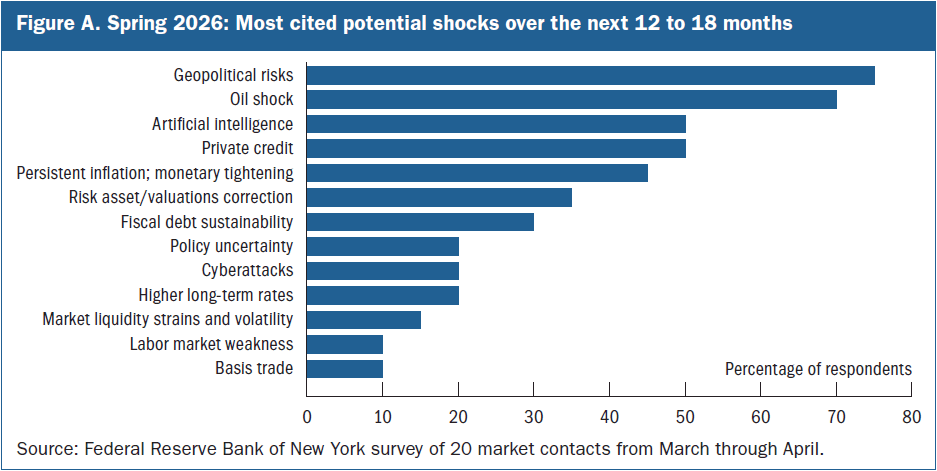
Chart of the Day: Geopolitics and oil dominate the NY Fed’s spring tail-risk survey, unsurprising after Hormuz. The illuminating signal sits one tier down: AI and private credit share 50%, both reflecting opacity-driven concern about valuations and counterparty exposure no participant can fully map. Together they edge out persistent inflation (45%) and valuations correction (35%) — meaning structural fragility now ranks above cyclical overheating in dealer minds. Classical recession markers (labor weakness, basis trade) sit at the bottom at 10%. The sample is only 20 contacts, so treat as sentiment not consensus, but the rotation from macro tightening fears toward private-market plumbing risk is real.
Market Intelligence Brief (MIB) Ver. 17.94
For professional investors only. Not investment advice.
© 2026 RecessionALERT.com

Comments are closed.