
Cisco’s AI quarter — orders raised to $9B, hyperscaler demand +217% YoY — ignited the AI complex; all major indices hit records, Dow retook 50,000. Trump-Xi’s 9-point summit (200 Boeing jets, Hormuz pact, trade board) broadened the rally; transports led at +1.40%. April import prices nearly doubled estimates (+1.9% vs +1.0%), compounding 6.0% PPI; December rate-hike odds now 39%. Warsh assumes Fed Chair tomorrow with the hottest trade inflation since 2022. Cerebras (CBRS) IPO +68% — largest tech debut of 2026.
TABLE OF CONTENTS
A. EXECUTIVE SUMMARY
B. MARKET DATA
C. HIGH-IMPACT STORIES (5)
D. MODERATE-IMPACT STORIES (5)
E. ECONOMY WATCH (5)
F. EARNINGS WATCH (2)
G. WHAT’S NEXT
H. CHART OF THE DAY
A. EXECUTIVE SUMMARY -> TOP
All major US indices advanced to record closes — Dow 50,063, S&P 7,501, Nasdaq 29,580 — driven by Cisco’s blowout AI quarter (orders raised to $9 billion, hyperscaler demand +217% YoY) and the Trump-Xi 9-point summit package, which together catalyzed broad cyclical participation. Beneath the headlines, April import prices surged +1.9% MoM — nearly double the +1.0% estimate — one day after PPI printed +6.0% YoY, pushing December 2026 rate-hike odds to 39% and flattening the 2Y/10Y spread to 47 bps; Kevin Warsh assumes the Chair tomorrow inheriting the hottest combined trade-price inflation sequence since 2022. The rally was internally bifurcated: Technology (+1.89%) dominated as the AI capex thesis broadened across NVDA (+4.39%), AVGO (+5.52%), and ORCL (+3.08%), while Transports (+1.40%) added cyclical confirmation; Basic Materials’ -1.43% collapse — the 12-month cycle leader undone by the PPI-driven precious metals rout — is the session’s sharpest warning that regime-shift risk is live inside a record-setting tape.
• Cisco (CSCO) +13.3% — Q3 AI networking orders raised to $9B from $5B; hyperscaler demand +217% YoY; ignited sector-wide rally (AVGO +5.52%, NVDA +4.39%, ORCL +3.08%); S&P 500 Technology sector +1.89%
• Trump-Xi Summit Day 1: 9-point commitment package — 200 Boeing jets (first China commercial aircraft purchase in a decade), Hormuz access agreement, joint trade board; Dow retook 50,000; S&P crossed 7,500 for the first time; Day 2 (May 15) covers semiconductors and Taiwan
• Trade Price Shock: April import prices +1.9% MoM (est. +1.0%); export prices +3.3% MoM (est. +1.1%); YoY rates +4.2% and +8.8% respectively — both highest since 2022; December rate-hike probability now 39%
• Consumer Squeeze: Retail sales +0.5% headline met, but gas stations (+2.8%) drove the entire gain; furniture -2.0%, department stores -3.2%, clothing -1.5% — energy cost pass-through is crowding out discretionary spend
• Cerebras Systems (CBRS) IPO +68% to $311/share on $5.55B raise — largest tech IPO of 2026; $95B market cap at close; institutional demand for pureplay AI infrastructure exposure beyond established mega-caps confirmed
• Labor Market & Fed Transition: Initial claims 211K vs 205K est — largest weekly jump since February; Powell era ends Friday as Warsh is sworn in, inheriting CPI 3.8%, PPI 6.0%, import prices 4.2% YoY simultaneously
1. The AI Capex Supercycle Gets Its Clearest Confirmation Yet — Cisco’s order raise from $5B to $9B is not a guidance upgrade — it is a hard order book from the most neutral vantage point in the AI infrastructure stack. Combined with AVGO’s $73B custom ASIC backlog through 2028 and Cerebras’ +68% IPO debut, the data signals a full-stack, multi-year hyperscaler commitment that market consensus has materially underpriced. The implication: AI infrastructure spending is not decelerating toward normalization — it is in a compounding acceleration.
2. A Two-Pillar Rally With a Dangerous Third Leg — Today’s advance rested on two genuine bullish pillars — AI capex confirmation and summit trade optimism — but concealed a bearish third leg: import prices nearly doubling estimates atop a 6.0% PPI. The equity market is pricing the two bullish pillars; the bond market is pricing the bearish leg — 2Y yields rising faster than 10Y, curve flattening to 47 bps, dollar firming. When equities and fixed income diverge this sharply, the bond market’s signal historically leads.
3. Warsh Inherits the Worst Possible Inflation Hand — The new Fed Chair assumes office Friday with every input price series flashing red simultaneously: CPI 3.8%, PPI 6.0%, import prices 4.2% YoY, export prices 8.8% YoY. Trump selected Warsh expecting rate cuts; the data argues for tightening. How Warsh frames his first public statement — does he acknowledge the rate-hike scenario as live, or signal patience — will be the single most important market signal of next week, setting the 10-year yield trajectory and repricing every rate-sensitive sector in the portfolio.
 — Leading economic indicators. Accurate market forecasts. Apply for membership at join.recessionalert.com
B. MARKET DATA -> TOP
Cisco Systems’ blowout Q3 print — AI networking orders +35% YoY, hyperscaler demand more than doubling — ignited a +13.3% surge that lifted the full AI infrastructure complex and drove all major indices to record closes, with the Dow retaking 50,000; Trump-Xi summit optimism added to the bid. The session was broadly positive but internally split — Technology surged +1.89% as the dominant force while Basic Materials collapsed -1.43%, reversing its own 12-month structural leadership, as April PPI data drove a precious metals rout (Silver -6.2%, Platinum -5.9%, Gold -1.1%). The most telling divergence: VIX fell 3.4% (risk-on) while the 2Y yield rose 2.3 bps more than the 10Y and the dollar firmed — the bond market is pricing rate-hike risk, not growth recovery, leaving the equity advance without a Fed-easing tailwind.
CLOSING PRICES – May 14, 2026:
MAJOR INDICES
DJIA broke to a new 10-session high (50,063) while DJTA sits 2.6% below its 10-session peak of 20,598 — below the formal Dow Theory non-confirmation threshold of 5%, but a mild divergence worth watching if transports fail to follow through. Over the past 10 sessions, NDX has compounded +6.75% vs the S&P 500’s +3.75%, sitting exactly at the 3pp boundary for concentrated tech leadership; today’s broad participation (all six indices green, transports leading at +1.4%) momentarily counters the narrative, but the structural gap between mega-cap tech and the broader market persists. No formal Dow Theory signal fires; large-cap vs small-cap spread remains within tolerance.
| Index | Close | Change | %Move | Why It Moved |
|---|---|---|---|---|
| S&P 500 | 7,501.14 | +56.89 | +0.76% | CISCO AI earnings beat lifted AI infrastructure complex; Trump-Xi summit optimism; record close |
| Dow Jones | 50,063.46 | +370.26 | +0.75% | Retook 50,000 milestone; broad blue-chip participation; AI narrative lifted broad sentiment |
| DJ Transportation | 20,057.4 | +276.1 | +1.40% | Trump-Xi summit boosted trade optimism; energy sector support; session’s best major index |
| Nasdaq 100 | 29,580.30 | +213.36 | +0.73% | AI infrastructure rally on CSCO print confirmed hyperscaler capex acceleration; record close |
| Russell 2000 | 2,862.92 | +18.99 | +0.67% | Broad risk-on participation; modest gain vs large-caps reflects rate-hike headwinds for small-caps |
| NYSE Composite | 23,101.85 | +128.29 | +0.56% | Broad market advance; narrower gain vs headline indices reflects sector bifurcation (materials/precious metals drag) |
VOLATILITY & TREASURIES
VIX fell 3.4% — risk-on is unambiguous. But fixed income disagrees: the 2Y rose 2.3 bps vs the 10Y’s 1.0 bps, gently flattening the curve to 47 bps and incrementally repricing rate-hike risk rather than growth recovery. The dollar firmed alongside the bond selloff. Together — falling VIX, rising short yields, firming dollar — this is an inflation-fear signature: equities are rallying on earnings catalysts while the bond market prices a harder Fed path. Bond non-participation in the equity rally is a warning worth tracking.
| Instrument | Level | Change | Why It Moved |
|---|---|---|---|
| VIX | 17.26 | -0.61 (-3.41%) | Risk-on following CISCO earnings beat; Trump-Xi summit reduced geopolitical uncertainty |
| 10-Year Treasury Yield | 4.484% | +1.0 bps | Mild yield rise on April PPI data; modest inflation repricing; long end contained vs short end |
| 2-Year Treasury Yield | 4.013% | +2.3 bps | Short-end rose more than 10Y on PPI data; rate-hike expectations incrementally repriced; curve flattened to 47 bps |
| US Dollar Index (DXY) | 98.82 | +0.35 (+0.35%) | Firmed on April PPI-driven rate-hike expectations; inflation data supports higher-for-longer dollar bid |
COMMODITIES
April PPI data triggered a precious metals rout: silver -6.2%, platinum -5.9%, copper -1.5%, gold -1.1% — all falling simultaneously as rate-hike expectations compressed the appeal of non-yielding assets. Bitcoin decoupled cleanly, gaining +2.0% alongside equities and tracking risk-on sentiment rather than the metals selloff — confirming its role today as a risk proxy, not an inflation hedge. The divergence (crypto up, precious metals down) is the session’s most visible internal contradiction.
| Asset | Price | Change | %Move | Why It Moved |
|---|---|---|---|---|
| Gold | $4,654.15/oz | -$52.55 | -1.12% | April PPI data reignited rate-hike expectations; rising real rates pressure non-yielding assets |
| Silver | $83.825/oz | -$5.543 | -6.20% | Industrial demand concerns compound rate pressure; precious metals complex-wide selloff |
| Copper | $6.5783/lb | -$0.1007 | -1.51% | Industrial demand caution despite Trump-Xi summit; higher-rate environment weighs on growth-sensitive metal |
| Platinum | $2,068.50/oz | -$128.80 | -5.86% | Precious metals complex selloff on rate expectations; industrial demand concerns amplify pressure |
| Bitcoin | $81,256.0 | +$1,604.0 | +2.01% | Tracked equity risk-on sentiment; decoupled from precious metals selloff; risk proxy behavior confirmed |
ENERGY
WTI (+0.91%) and Brent (+0.87%) moved in near-lockstep with no meaningful spread widening, confirming a global rather than regional supply driver — Iran war tensions sustain crude above $100 (Brent crossed $107 intraday). Energy stocks gained +0.71% alongside crude, making this a demand/supply-support trade rather than a stagflationary cost-pressure signal. Henry Hub’s +1.68% and Dutch TTF’s +1.17% tracked crude directionally, suggesting broadly tightening energy markets rather than any European-specific stress premium.
| Asset | Price | Change | %Move | Why It Moved |
|---|---|---|---|---|
| Crude Oil (WTI) | $101.94/bbl | +$0.92 | +0.91% | Iran war tensions sustain elevated prices; mild demand-side support from global growth optimism |
| Crude Oil (Brent) | $106.55/bbl | +$0.92 | +0.87% | Iran war supply risk premium; crossed $107 intraday; global supply concern keeps Brent elevated |
| Natural Gas (Henry Hub) | $2.912/MMBtu | +$0.048 | +1.68% | Summer demand build expectations; supply-demand balance tightening heading into cooling season |
| Natural Gas (Dutch TTF) | $16.30/MMBtu | +$0.19 | +1.17% | European demand recovery; tracked Henry Hub directionally; no European-specific crisis premium evident |
S&P 500 SECTORS
Technology’s +1.89% session extends a dominant structural trend — simultaneously today’s sector leader, the week’s leader (+4.69%), the month’s leader (+15.01%), and the quarter’s leader (+22.88%). The session’s most revealing signal is Basic Materials’ -1.43% collapse: the 12-month cycle leader (+51.69%) and six-month winner (+28.22%) posted the worst day, driven entirely by the precious metals rout — a reminder that structural momentum can reverse sharply when the macro regime shifts. Healthcare’s structural decline deepens: -0.21% today, -4.93% quarterly, -3.75% YTD — today’s laggard is also the cycle’s.
| Sector | 1-Day | 1-Week | 1-Month | 3-Month | 6-Month | YTD | 12-Month |
|---|---|---|---|---|---|---|---|
| Technology | +1.89% | +4.69% | +15.01% | +22.88% | +16.56% | +19.74% | +46.85% |
| Industrials | +0.75% | +0.63% | +2.28% | +2.21% | +16.18% | +15.08% | +28.99% |
| Energy | +0.71% | +2.98% | +3.27% | +11.68% | +28.30% | +31.29% | +39.49% |
| Financial | +0.64% | -0.19% | -1.02% | -1.03% | +0.22% | -3.09% | +8.57% |
| Utilities | +0.49% | -0.94% | -3.00% | -0.84% | +2.02% | +6.60% | +17.88% |
| Consumer Defensive | +0.48% | +1.43% | +4.76% | -3.68% | +11.66% | +10.87% | +10.41% |
| Communication Services | -0.14% | -0.07% | +6.00% | +12.75% | +12.34% | +9.03% | +42.20% |
| Healthcare | -0.21% | +0.95% | -1.43% | -4.93% | -1.28% | -3.75% | +14.35% |
| Consumer Cyclical | -0.34% | -0.75% | +1.45% | +3.00% | -2.39% | -0.51% | +8.69% |
| Real Estate | -0.54% | -1.11% | +0.97% | +1.86% | +4.12% | +7.46% | +6.85% |
| Basic Materials | -1.43% | +2.47% | +0.97% | +1.40% | +28.22% | +19.31% | +51.69% |
TOP MEGA-CAP MOVERS:
GAINERS
| Company | Ticker | Close | Change | Why It Moved |
|---|---|---|---|---|
| Cisco Systems | CSCO | $115.54 | +13.42% | Q3 2026 blowout: revenue +12% to $15.8B vs $15.5B est; AI networking orders +35% YoY; hyperscaler demand more than doubled; best day in ~15 years |
| Broadcom | AVGO | $439.79 | +5.52% | AI infrastructure halo from CSCO print; AI networking chip demand confirmed; hyperscaler capex acceleration |
| NVIDIA Corp | NVDA | $235.74 | +4.39% | CSCO’s doubled hyperscaler AI orders validate GPU demand outlook; AI infrastructure spend acceleration confirmed |
| Oracle Corp | ORCL | $195.61 | +3.08% | AI cloud infrastructure theme; enterprise AI buildout beneficiary; hyperscaler capex cycle confirmation |
| Palantir Technologies | PLTR | $133.73 | +2.83% | AI enterprise software demand momentum; beneficiary of confirmed AI infrastructure spending acceleration |
DECLINERS
| Company | Ticker | Close | Change | Why It Moved |
|---|---|---|---|---|
| Qualcomm | QCOM | $200.08 | -6.14% | Weak Q3 guidance (EPS $2.10-$2.30 vs $2.43 consensus); JPMorgan downgrade to Neutral; smartphone shipment declines; sector rotation away from consumer-facing semis |
| Sandisk Corp | SNDK | $1,382.72 | -4.46% | Memory chip sector rotation; legacy semiconductor pullback as capital rotates into AI infrastructure names |
| Intel Corp | INTC | $115.93 | -3.62% | Structural semiconductor headwinds continue; rotation out of legacy chip makers into AI infrastructure winners |
| Micron Technology | MU | $775.81 | -3.46% | Memory chip sector pressure; higher-for-longer rate environment weighs on capex-sensitive names; legacy semi selloff |
— Institutional-grade intelligence for serious investors. Apply for membership at join.recessionalert.comC. HIGH-IMPACT STORIES -> TOP
BULLISH
1. Trump-Xi Day 1 Produces 9-Point Commitment Package — 200 Boeing Jets, Hormuz Access Agreement, and Joint Trade Board Signal First Concrete US-China Détente in Years
The core facts:President Trump and President Xi Jinping opened Day 1 of the US-China summit in Beijing by publishing a 9-point commitment document — the most substantive joint declaration between the two governments in years. Specific agreements include: China’s purchase of 200 Boeing 737 commercial jets (the first Chinese purchase of US-made commercial aircraft in nearly a decade); a joint commitment to Strait of Hormuz freedom of navigation; a mutual statement that Iran can never acquire nuclear weapons; creation of a US-China “board of trade” to manage bilateral commercial ties on an ongoing basis; and Chinese commitments to purchase additional US agricultural goods and crude oil. The summit delegation included the CEOs of Tesla (Elon Musk) and Nvidia (Jensen Huang). Day 2 of the bilateral is scheduled for May 15, with semiconductor export restrictions and Taiwan expected to be the primary agenda items.
Why it matters:The 9-point commitment document is the clearest signal yet that both governments are prioritizing commercial de-escalation over strategic confrontation — and markets responded immediately and broadly. The Dow Jones Industrial Average reclaimed 50,000, the S&P 500 broke 7,500 for the first time in history, and the DJ Transportation Average gained +1.40% as logistics, airline, and industrial names priced in supply-chain relief from a potential tariff pause extension. Three channels matter for portfolio managers: (1) The Boeing deal removes the most visible commercial casualty of the trade war — the commitment of 200 jets at list prices represents substantial backlog value, even though Boeing shares fell on the day because institutional positioning had built in expectations of a 500-jet deal; (2) The Hormuz commitment — while not legally binding — signals China is now formally co-sponsoring stability in the world’s most critical oil shipping lane, reducing the tail risk of Chinese-enabled supply disruption; (3) The board of trade creates a structured negotiating mechanism that lowers the probability of sudden unilateral tariff escalations, the scenario most feared for multinational earnings visibility. The Transportation sector’s +1.40% outperformance against the IT sector’s +1.90% indicates the rally is attracting cyclical capital, not just AI momentum money.
What to watch:Day 2 summit outcomes on May 15 — specifically any language on semiconductor export restrictions, rare earth supply agreements, or tariff pause terms; the Hormuz practical implementation, since fresh attacks near Hormuz were reported hours after the commitment was signed, underscoring the fragility of the security framework; and formal Boeing contract documentation confirming the 200-jet order, since no contract was executed on Day 1.
UNCERTAIN
2. US Approves H200 Chip Sales to 10 Chinese Firms Including Alibaba, Tencent, ByteDance — But Beijing Instructs Companies Not to Purchase, Creating an Export Paradox as NVDA Surges +4.39%
The core facts:The US Commerce Department approved export licenses for approximately 10 major Chinese enterprises — including Alibaba, Tencent, ByteDance, JD.com, Lenovo, and Foxconn — to purchase Nvidia’s H200 AI chips, with each approved buyer permitted to acquire up to 75,000 units. The announcement came as Nvidia CEO Jensen Huang joined the Trump delegation at the Beijing summit after receiving a direct invitation from President Trump. Despite the regulatory clearance, no purchases have been made: Chinese technology companies reportedly pulled back from executing orders after receiving guidance from Beijing instructing them to hold. Nvidia shares rose +4.39% on the export approval news, pushing the company’s market capitalization toward $6 trillion.
Why it matters:The US-side clearance of H200 exports creates a paradox with direct portfolio implications. Washington has signaled it will permit sales that were previously blocked — addressing up to $12-15 billion in potential annual China revenue for Nvidia — but Beijing has made the purchase decision a bargaining chip in summit negotiations rather than accepting the regulatory approval as sufficient. This means the actual revenue recovery depends on diplomacy, not on US regulatory fiats alone. NVDA’s +4.39% move reflects the market pricing a non-trivial probability that Beijing reverses its instruction after securing additional summit concessions on Day 2. The stakes are concrete: the US government’s H20 export restrictions had already resulted in a $4.5 billion charge against Nvidia’s Q1 FY2026 results and eliminated approximately $8 billion in expected Q2 FY2026 China revenue. If Day 2 yields a Chinese commitment to permit H200 purchases, a significant revenue recovery scenario is in play. If the purchase hold persists, the approval becomes a paper exercise and the stock’s move is susceptible to reversal. The parallel US approval of H200 chips while simultaneously negotiating in Beijing represents the most direct test yet of whether technology export controls are diplomatic leverage or structural decoupling.
What to watch:Day 2 summit language on semiconductor purchases — any Chinese signal permitting its technology companies to proceed with H200 orders; Nvidia Q1 FY2027 earnings (May 20 AMC) for data center demand and the updated China revenue outlook incorporating any summit agreements; Commerce Department follow-on action on Blackwell-class chips, the longer-term prize in the US-China chip negotiation.
BULLISH
3. Cisco’s $9 Billion AI Infrastructure Order Raise Ignites Sector-Wide Rally — Broadcom +3.63%, Nvidia +4.39%, Oracle +3.08% as Hyperscaler Capex Supercycle Receives Its Clearest Data-Point Confirmation Yet
The core facts:Cisco’s blowout Q3 FY2026 earnings — reported May 13 AMC — produced a broad AI infrastructure rally on May 14. Cisco raised its expected AI infrastructure orders from hyperscalers for full fiscal year 2026 to $9 billion, up from $5 billion, after reporting Q3 hyperscaler AI orders of $1.9 billion versus $600 million in Q3 FY2025 — a +217% year-over-year acceleration. Cisco’s Acacia optical interconnect business exceeded $1 billion in orders in Q3 alone, on track for 200%+ full-year growth. CSCO shares surged approximately +15% on the session. The sector read-through drove: Broadcom (AVGO) +3.63%, Nvidia (NVDA) +4.39%, Oracle (ORCL) +3.08%, Palantir (PLTR) +2.83%. The S&P 500 Information Technology sector gained +1.9% — the day’s best-performing sector. Six Wall Street firms raised Cisco price targets on May 14, with BofA and Citi specifically noting that Cisco’s in-house silicon design provides a structural supply-chain advantage in constrained AI hardware markets.
Why it matters:Cisco’s AI networking order data is uniquely valuable because it captures what hyperscalers (Microsoft Azure, Google Cloud, Amazon AWS) are actually committing to spend — not guiding, but ordering — on AI infrastructure. A $9 billion order pace for AI networking equipment alone represents a step-function acceleration in the AI capex cycle, and the +217% year-over-year increase in a single quarter is data that forces analysts to revise not just Cisco estimates but their entire AI infrastructure investment thesis upward. The sector read-through is logical and structural: Broadcom’s custom ASIC chips feed the same hyperscaler GPU clusters that need Cisco’s networking; Oracle’s cloud infrastructure growth is explicitly AI-driven; Palantir’s government AI contracts benefit from the same budget pools. The day’s simultaneous confirmation from Cerebras Systems’ +68% IPO debut adds the capital markets dimension — institutional investors are not just bidding up existing AI infrastructure names but actively seeking new public market exposure to the theme. The AI capex thesis is no longer speculative: Cisco’s order book is a hard data point from the most neutral vantage point in the ecosystem.
What to watch:Applied Materials (AMAT) Q2 2026 results (tonight AMC) for upstream semiconductor equipment demand from the same hyperscaler AI buildout — AMAT has the highest DRAM/HBM exposure among equipment peers; Nvidia Q1 FY2027 (May 20 AMC) for whether hyperscaler capex commentary confirms or moderates the Cisco order trajectory; Cisco’s Q4 FY2026 earnings call for whether the $9 billion AI order pace continues to compound.
BEARISH
4. April Import Prices Surge 1.9% MoM — Nearly Double Estimates — Export Prices +3.3%: Tariff and Energy Pipeline Compounds PPI Into CPI as Warsh Inherits Hottest Trade Inflation Since 2022
The core facts:April import prices surged +1.9% month-over-month versus the +1.0% consensus — nearly double expectations — lifting the annual rate to +4.2% YoY, the largest since October 2022. Export prices surged +3.3% MoM versus the +1.1% estimate, with the annual rate reaching +8.8% YoY, the largest since September 2022. Fuel import prices jumped +16.3% in a single month; critically, non-fuel import categories also rose, confirming the inflation is broadening beyond energy. The release arrives one day after April PPI printed at +6.0% YoY and one day before Kevin Warsh officially assumes the Federal Reserve Chair role. (Full data detail in Section E.)
Why it matters:The import/export price pair creates a closed-loop inflation signal that forecloses the “transitory” narrative. Tariffs and energy costs entered at the import stage, compressed producer margins at the PPI stage, and the export price surge shows that US goods are simultaneously becoming more expensive for global buyers — a supply-side cost spiral, not merely a demand shock. For equity markets, the rate implications are direct: December 2026 rate hike probability had already climbed to approximately 39% after Wednesday’s PPI. Import prices nearly doubling their expected monthly pace extends the bond market’s tightening case. The three highest-risk equity sectors are: (1) duration-sensitive names — homebuilders, REITs, utilities — facing compounding headwinds from a re-accelerating Fed tightening thesis; (2) goods-dependent retailers, whose import cost structures are being reset upward just as today’s retail sales data revealed discretionary spending contracting; (3) multinationals exposed to currency effects if rate-differential widening strengthens the dollar further. The timing — one day before Warsh assumes the Chair — means his first data read as Fed Chair will be an inflation dashboard flashing red across every major input price series simultaneously.
What to watch:CME FedWatch December 2026 hike probability — any sustained move above 45% would trigger broad repricing in rate-sensitive equity sectors; May CPI (June release) as the consumer-level confirmation of whether the import/PPI pipeline is fully passing through to shelf prices; the June 16-17 FOMC as Warsh’s inaugural meeting — his response to this inflation sequence will set the market’s rate trajectory for H2 2026.
UNCERTAIN
5. Powell Era Ends as Miran Resigns and Warsh Prepares for May 15 Swearing-In — New Fed Chair Inherits CPI 3.8%, PPI 6.0%, Import Prices 4.2% YoY, and Rate-Hike Odds at 39%
The core facts:Federal Reserve Governor Stephen Miran officially submitted his resignation on May 14, vacating his Board seat effective upon Kevin Warsh’s swearing-in as Federal Reserve Chair on May 15 — a procedurally required step because there is no other vacant seat on the seven-member Board of Governors for Warsh to fill. Miran’s departure letter praised Warsh’s expected reforms in communications policy, balance sheet management, and mandate discipline, while warning that over-reliance on flawed inflation metrics risks unnecessarily spiking unemployment. Jerome Powell’s tenure formally concludes on May 15. Warsh’s inaugural FOMC meeting is scheduled for June 16-17, with a hold decision at 98% probability as of current market pricing.
Why it matters:The leadership transition is occurring at the highest-stakes inflation juncture since the post-pandemic tightening cycle of 2022. Warsh assumes the Chair with: CPI at 3.8% YoY (highest since May 2023), PPI at 6.0% YoY (highest since December 2022), April import prices at +4.2% YoY (highest since October 2022), and export prices at +8.8% YoY (highest since September 2022). Rate-hike market odds stand at approximately 39% by December 2026 — a scenario where borrowing costs increase from already-elevated levels. The institutional contradiction is acute: Trump selected Warsh expecting rate cuts; the data he inherits argues for policy tightening or at minimum an extended hold. Every rate-sensitive sector’s H2 2026 performance will be anchored to Warsh’s first public communication as Chair — does he acknowledge the rate-hike scenario as live (validating bond market hawkish pricing), or does he signal patience (which the equity market would read as dovish)? Miran’s resignation letter warning about “over-reliance on flawed data” provides political cover for a Warsh Fed that might choose to downweight lagging indicators — but at the cost of credibility with a bond market already pricing tightening.
What to watch:Warsh’s first public statement as Fed Chair after May 15 — specifically whether he explicitly acknowledges the rate-hike scenario as live or defers to data dependence; the June 16-17 FOMC statement and dot plot as the definitive signal for whether the hawkish regional bank chorus (Collins, Kashkari, Hammack dissents) reflects the full FOMC; 10-year yield for a sustained move above 4.50% as the equity market’s threshold for repricing rate-sensitive sectors.
— Quantifying recession risk so you don’t have to guess. Apply for membership at join.recessionalert.comD. MODERATE-IMPACT STORIES -> TOP
BEARISH
6. Boeing (BA): -4% Despite Landing First China Jet Order in a Decade — Market Expected 500 Jets, Got 200; April Deliveries Also Miss
The core facts:Boeing shares fell approximately 4% on May 14 despite President Trump’s announcement that China agreed to purchase 200 Boeing commercial jets — the first Chinese purchase of US-made commercial aircraft in nearly a decade. The market reversed all of Boeing’s pre-summit rally, which had been built on institutional expectations of a deal for as many as 500 Boeing 737 MAX jets and 100 wide-body aircraft — a figure Bloomberg had reported as a possible framework in March. The final announced commitment of 200 jets, while historically significant, failed to clear the pre-positioned expectation bar. Compounding the reaction: Boeing’s April delivery data revealed 47 aircraft delivered, below analyst expectations of 50+, reinforcing ongoing production execution concerns at the company’s manufacturing facilities.
Why it matters:Boeing’s “sell the news” session in a broadly positive tape reveals how completely the institutional community had pre-positioned around the 500-jet rumored deal: the commercial outcome exceeded a historical decade of zero Chinese orders, yet still disappointed. For institutional investors, two distinct risk factors emerged: (1) Deal completeness — no formal contract was signed on Day 1, meaning the 200-jet announcement is a diplomatic commitment, not a binding commercial agreement. The gap between 200 and the rumored 500 suggests either China is holding additional orders for Day 2 leverage or the deal is structurally smaller than anticipated; (2) Production execution — the April delivery miss (47 vs. 50+) arrived on the same day as the China headline, signaling that Boeing’s operational recovery remains inconsistent. BA’s -4% in a session where the Dow gained +0.7% means Boeing acted as a direct drag on the index it is a component of, partially offsetting the summit rally in the headline number.
What to watch:Day 2 summit outcomes for any additional Boeing order language or commitment to expand the 200-jet framework; Boeing’s May delivery data (released early June) as the next read on whether the production recovery is on track; formal contract execution timeline — a binding purchase agreement announcement would be the catalyst to recoup today’s losses.
BULLISH
7. Cerebras Systems (CBRS) IPO: +68% First-Day Surge on $5.55 Billion Raise — Largest Tech IPO of 2026 Signals Institutional Appetite for Pureplay AI Infrastructure Equity Beyond Established Mega-Caps
The core facts:Cerebras Systems (CBRS) debuted on the Nasdaq on May 14, raising $5.55 billion at an IPO price of $185 per share and surging 68.1% to close at $311.07. The stock opened at $350 (up 89% from IPO price) and peaked at $386 (up 108%) before closing with a market capitalization of approximately $95 billion — briefly crossing the $100 billion threshold intraday. Cerebras designs wafer-scale AI processors that compete in workloads where Nvidia’s GPU architecture faces inherent memory bandwidth limitations, specifically inference applications requiring extreme on-chip memory density. The IPO represents the largest US technology offering in months and the first significant pureplay AI infrastructure public market debut of 2026, with six underwriting firms participating and the deal priced at the high end of its marketed range.
Why it matters:Cerebras’ first-day performance is the most direct evidence yet that institutional investors are actively seeking AI infrastructure exposure beyond the established mega-cap roster. The willingness to commit $5.55 billion to an offering at ~$95 billion closing valuation — on a day when CSCO’s blowout AI orders and Nvidia’s H200 export news were also available — indicates the AI infrastructure theme is robust enough to support premium-multiple new issuance from challengers, not just incumbents. For portfolio construction, the Cerebras debut opens a structural question: if wafer-scale inference chips can attract this level of institutional appetite at IPO, how does that affect the competitive positioning of Nvidia (H100/H200 GPUs, valued at $6T) in inference-specific workloads? The competitive dynamic is not zero-sum on a 6-12 month horizon, but the market will increasingly examine whether AI inference workload growth benefits GPU architectures or specialized processors. The IPO also signals that the private-to-public pipeline for AI infrastructure companies — including Groq, SambaNova, and Tenstorrent — is now open.
What to watch:CBRS price action over the first 30 trading days — IPO pops exceeding 50% are historically followed by significant post-lockup pullbacks; Cerebras’ first public earnings call for actual revenue and gross margin data that validates or challenges the ~$95 billion closing-day valuation; Nvidia’s May 20 earnings call for any commentary on competitive dynamics from wafer-scale chip architectures in enterprise AI deployments.
BEARISH
8. April Retail Sales Headline Meets Expectations — But Gas Stations Drive the Entire +0.5% Gain While Furniture, Department Stores, Autos, and Clothing Collapse; Consumer Discretionary Squeeze Accelerating
The core facts:April retail sales rose +0.5% month-over-month, meeting the consensus estimate — but the headline masks severe internal deterioration. Gasoline station sales surged +2.8%, driven by Iran-war-elevated energy prices, accounting for the entirety of the reported monthly gain. Every core discretionary category fell: furniture and home furnishing stores -2.0%, department stores -3.2%, motor vehicle dealers -0.5%, clothing and clothing accessories -1.5%. The control group — which feeds directly into GDP calculations — rose +0.5% versus +0.4% expected, a marginal beat but well below the +0.9% average of Q4 2025. (Full data in Section E.)
Why it matters:The retail sales structure reveals a consumer being squeezed by energy costs, not spending freely. When gasoline prices inflate the headline while every discretionary category contracts, the reported growth number is a cost-push artifact, not a demand signal. For equity markets, the consumer discretionary sector faces direct headwinds: companies selling furniture, clothing, autos, and general merchandise are operating into declining traffic and ticket environments driven by energy cost pass-through. The control group’s modest +0.5% barely maintains positive territory — and arriving on the same day as import prices nearly double their monthly estimate (+1.9% MoM vs +1.0% est), the margin compression on goods-dependent retailers is intensifying from both the cost and demand sides simultaneously. The practical institutional read: consumer-facing retail names and the XLY ETF are now operating into a deteriorating demand environment at the same moment that their input cost structure is being reset upward by tariff and energy pass-through. If May’s data confirms the April pattern, the consumer retrenchment narrative could begin competing with the AI bull thesis for institutional attention.
What to watch:May retail sales (released mid-June) for confirmation of whether the discretionary contraction is accelerating; XLY vs. XLP spread (consumer discretionary vs. staples) as the real-time institutional signal on consumer health rotation; University of Michigan consumer sentiment (May 15) for whether the gasoline price squeeze is affecting forward spending intentions — a declining sentiment print would validate the internal retail sales weakness.
BULLISH
9. Dow Reclaims 50,000 — S&P Breaches 7,500, Nasdaq at 26,635 — Second Consecutive Record Session as Summit Optimism Broadens Rally Beyond Yesterday’s AI Concentration
The core facts:The Dow Jones Industrial Average surged 370 points (+0.7%) to close at 50,063 — reclaiming the 50,000 threshold for the first time since Iran-war-related volatility pulled it below that level. The S&P 500 gained +0.8% to 7,501.24, crossing 7,500 for the first time in history. The Nasdaq Composite added +0.9% to 26,635.22. Critically, the day’s advance showed meaningfully broader participation than Wednesday’s session: on May 13, the Dow fell -0.14% while the S&P and Nasdaq hit records — a 215-basis-point divergence signaling extreme AI concentration. On May 14, all three major indices advanced within a tight 20-to-90-basis-point band. The DJ Transportation Average led all major indices at +1.40%, with logistics, airline, and industrial names pricing in supply-chain relief from summit optimism, while the S&P 500 IT sector contributed the largest sector gain at +1.9%.
Why it matters:The Dow’s reclaim of 50,000 is not merely a round-number milestone — it signals that the AI-infrastructure rally is beginning to lift cyclical and value-oriented stocks, not just the Nasdaq’s mega-cap core. Wednesday’s MIB flagged the breadth collapse (most S&P 500 stocks fell even as indices hit records) as a structural caution signal. Thursday’s more balanced advance — Transportation leading, Dow keeping pace with the S&P — suggests the Trump-Xi summit’s trade optimism is creating a second pillar of support for the broader market, not just the AI theme. For portfolio managers running equal-weight or sector-diversified mandates, this is the first session in days where the “AI concentration risk” concern is partially relieved by genuine cyclical participation. The practical significance: if summit momentum and trade optimism sustain the Transports-led broadening, the Dow’s recovery toward and above 50,000 would historically be associated with expanding corporate earnings expectations, not just multiple expansion. However, the durability test comes Friday when markets assess the complete summit outcome and open under Warsh’s Federal Reserve.
What to watch:S&P 500 equal-weight ETF (RSP) vs. cap-weight S&P 500 over the next 3-5 sessions — sustained RSP outperformance confirms the rally is genuinely broadening; Russell 2000 relative performance to the Nasdaq as the primary small-cap health barometer; Friday May 15 session as the first trading day under Chair Warsh and the first post-summit session — both catalysts resolve simultaneously.
BULLISH
10. Wells Fargo Raises Broadcom Target to $545 — “Wall Street Vastly Underestimating AI Power Needs” as Custom ASIC Hyperscaler Cycle Accelerates Beyond Cisco’s $9 Billion Validation
The core facts:Wells Fargo raised its Broadcom (AVGO) price target to $545 on May 14, with analyst Aaron Rakers arguing that Wall Street is “vastly underestimating” the scale of AI infrastructure demand tied to hyperscaler data center expansion. AVGO shares rose +3.63% on the upgrade. Broadcom’s AI exposure is structurally distinct from Cisco’s networking equipment: AVGO designs custom AI accelerator chips (ASICs) specifically commissioned by Google (TPU), Meta (MTIA), and Anthropic — chips that run the actual AI training and inference workloads inside hyperscaler data centers. Broadcom management has guided AI chip revenue to surpass $100 billion in FY2027, backed by a $73 billion backlog and secured supply chain commitments through 2028. AVGO’s next earnings report is scheduled for June 3, 2026.
Why it matters:Wells Fargo’s upgrade adds institutional validation from a distinct analytical axis. Cisco’s $9 billion AI networking order raise captures what hyperscalers spend on routing and switching; AVGO’s custom ASIC business captures what they spend on compute. Both are accelerating simultaneously, which is the signal that the AI infrastructure investment wave is full-stack — not isolated to one layer. The Wells Fargo thesis — that Wall Street materially underestimates AI power needs — has compounding implications: if the model is correct, AVGO’s $100 billion FY2027 AI chip revenue target is conservative, not optimistic, and the $73 billion backlog extending through 2028 provides the kind of contracted revenue visibility that commands premium multiples. For portfolio construction, AVGO offers a strategically significant characteristic: unlike Nvidia (whose H200 export status is subject to ongoing summit diplomacy and Beijing purchase holds), AVGO’s hyperscaler ASIC business is entirely US-customer based — Google, Meta, and Anthropic operate domestically, insulating AVGO’s AI revenue from China export restriction risk.
What to watch:Broadcom June 3 earnings call — whether management revises the $100B FY2027 AI chip revenue target upward in light of Cisco’s accelerating AI order data; any additional analyst upgrades in the next 72 hours as research desks incorporate the Cisco AI networking validation into their AVGO models; AVGO vs. NVDA relative performance as a signal for whether the market is beginning to rotate within AI infrastructure toward custom ASIC architectures that avoid China export risk.
— Separating signal from noise since 2007. Apply for membership at join.recessionalert.comE. ECONOMY WATCH -> TOP
April’s data split into a stagflation signal: import prices nearly doubled estimates (+1.9% vs +1.0% est; +4.2% YoY, largest since October 2022) as Iran-linked energy disruptions pushed fuel costs up 16.3%. Retail sales met the headline (+0.5%) but only on a gas-station surge — furniture, autos, and apparel all contracted, signaling spending under price pressure rather than demand strength. Initial claims ticked to 211K (vs. 205K est), the first notable miss in weeks, though the 4-week average at 203.75K remains intact. Against this, Q2 GDPNow lifted to 4.0% and Goldman Sachs cut 12-month recession odds to 25% (from 30%) on May 11, citing financial conditions easing — leaving the incoming Warsh Fed a clear stagflation bind: strong growth tracking alongside an inflation pipeline that is not cooling.
April Trade Prices Surge — Import Prices +1.9%, Export Prices +3.3%, Both Nearly Double Estimates (BLS, May 14, 2026)
What they’re saying:U.S. import prices rose 1.9% in April versus the 1.0% consensus estimate — the third consecutive large monthly gain and the largest year-over-year increase (+4.2%) since October 2022. Export prices surged 3.3% against the 1.1% estimate, posting an 8.8% annual increase — the largest since September 2022. Fuel import prices were the primary driver, jumping 16.3% in a single month, the largest monthly increase since March 2022, reflecting the ongoing disruption to Middle East energy flows.
The context:This data arrives one day after April PPI printed its hottest reading since December 2022, forming a consistent pipeline: energy and tariff costs are feeding from import prices → PPI → and eventually CPI and PCE. Non-fuel categories — capital goods, nonfuel industrial supplies, consumer goods, and food — also contributed, suggesting price pressure is broadening beyond energy. The magnitude of the miss (import prices nearly double the estimate) signals the tariff-and-war inflation shock has not been fully anticipated by markets or the Fed.
What to watch:CPI and PCE releases for April/May — if the import price pipeline transmits as in prior cycles, headline consumer inflation could re-accelerate toward 4%+. Incoming Fed Chair Warsh assumes office May 15; his initial response to the inflation data will set the tone for the new Fed leadership.
Retail Sales Rose 0.5% in April — Met Headline, But Gas Prices Drove the Gain as Discretionary Spending Contracted (Census Bureau, May 14, 2026)
What they’re saying:U.S. retail and food services sales rose 0.5% in April to $757.1 billion, matching consensus expectations and marking the third consecutive monthly gain. Year-over-year growth was 4.9%. However, gas station sales surged 2.8% as fuel prices climbed, inflating the nominal headline figure. Discretionary categories declined sharply: furniture stores -2.0%, car dealerships -0.5%, department stores -3.2%, clothing shops -1.5%. The control group — which strips out food, autos, gas, and building materials to most closely track core PCE — rose a modest 0.5% against a 0.4% estimate.
The context:The headline number masks a meaningful deterioration in consumer discretionary demand. Since the data is not inflation-adjusted, higher gas prices are inflating nominal retail receipts while consumers simultaneously pull back on big-ticket items. University of Michigan consumer sentiment data shows elevated concern about current prices, consistent with the pattern of households spending more on necessities (fuel, groceries) and less on discretionary goods. April payrolls of 115K and an unemployment rate of 4.3% provide a floor, but wage growth may not be keeping pace with energy-driven inflation.
What to watch:May retail sales (released mid-June) — if gas prices remain elevated, nominal sales may hold while real consumer spending continues to erode. Monitor Q2 personal consumption revisions in GDPNow as more April data is incorporated.
Initial Jobless Claims Tick to 211K — First Notable Miss in Weeks as Labor Market Shows Early Strain (DOL, May 14, 2026)
What they’re saying:Initial jobless claims for the week ending May 9 rose to 211,000 — above the 205,000 consensus estimate and up sharply from the prior week’s 199,000. The four-week moving average ticked to 203,750, still running below the year-ago comparable of approximately 229,250. Continuing claims for the May 2 week came in at 1,782,000, modestly below the 1,790,000 estimate and slightly above the prior reading of 1,758,000.
The context:The 12,000 week-over-week jump is the largest single-week increase since February and represents the first meaningful miss relative to consensus in several weeks, following a sustained stretch of beats. While the four-week average remains healthy and well below year-ago levels, labor market indicators have been the last pillar supporting the “soft landing” narrative — any sustained deterioration here would sharply raise recession probabilities at a moment when the inflation data is already pointing toward stagflation. April payrolls at 115K were already below trend, and claims above 220K-230K would signal genuine labor market weakening.
What to watch:Next week’s initial claims (released May 21) — a second consecutive reading above 210K would begin to shift the narrative. May nonfarm payrolls (June 5) will be the definitive read on whether the labor market is cracking.
Atlanta Fed GDPNow Upgrades Q2 2026 Growth Estimate to 4.0% — Stronger Consumer and Investment Data Drive Upward Revision (Atlanta Fed, May 14, 2026)
What they’re saying:The Atlanta Fed’s GDPNow model updated its Q2 2026 real GDP growth estimate to approximately 4.0% as of May 14, up from 3.5% at the start of May and representing a significant rebound signal after Q1 growth came in at a more modest pace. The revision was driven by upgrades to second-quarter personal consumption expenditures growth (to approximately 2.7%) and real gross private domestic investment growth (to approximately 9.2%), both incorporating the latest retail and trade data.
The context:A 4.0% GDPNow print sharply contrasts the stagflation narrative from today’s import price and retail sales data. However, GDPNow captures nominal spending signals — higher gas prices are inflating the consumption component without reflecting real demand strength. The investment component surge likely reflects inventory restocking and front-running of further tariff-driven cost increases, not organic capex. Nonetheless, the figure provides a counter-narrative to recession fears: the U.S. economy is not contracting — it is overheating in an inflationary direction, which is the Fed’s more difficult challenge.
What to watch:BEA’s advance Q2 GDP estimate (late July) will be the definitive read. Watch for GDPNow revisions as May industrial production and employment data arrive. Industrial production for April releases Friday (May 15), expected +0.3% — a beat would further support Q2 upside.
Goldman Sachs Cuts 12-Month U.S. Recession Probability to 25% — Cites Economic Resilience and Easing Financial Conditions (Goldman Sachs, May 11, 2026)
What they’re saying:Goldman Sachs cut its 12-month U.S. recession probability from 30% to 25% on May 11, reversing a March increase that had followed the Iran oil shock. Chief Economist Jan Hatzius cited that “economic activity has held up well and our financial conditions index has eased back below pre-war levels.” Goldman simultaneously raised its headline PCE inflation forecast to 3.1% by December — implying the bank sees growth resilience and persistent inflation coexisting rather than a hard-landing scenario. JPMorgan remains at 35% recession probability; Moody’s Analytics holds at 49%.
The context:Goldman’s downgrade of recession risk cuts against today’s bearish import price and claims data. The divergence among institutional forecasters — Goldman at 25%, JPMorgan at 35%, Moody’s at 49% — reflects genuine uncertainty about whether the economy is in a soft-landing or a slow-moving stagflation trap. Goldman’s willingness to simultaneously cut recession odds and raise the inflation forecast is analytically consistent with the data: the U.S. economy is growing but inflation is not returning to 2% — exactly the bind that complicates Fed policy regardless of who chairs the institution.
What to watch:Further updates from JPMorgan and Moody’s Analytics on recession probability through May — divergence from Goldman would be a meaningful signal. May PCE data (released late June) will test Goldman’s 3.1% December inflation forecast against realized data.
— Know the probability before the market prices in the risk. Apply for membership at join.recessionalert.comF. EARNINGS WATCH -> TOP
YESTERDAY AFTER THE BELL (Markets Reacted Today)
BULLISH
11. Cisco Systems (CSCO): +15.00% | AI Infrastructure Orders Raised to $9B — Hyperscaler Demand More Than Doubled Year-Over-Year, Setting a New Benchmark for Enterprise AI Capex
The Numbers:Revenue $15.84B vs $15.56B est (beat, +12% YoY). Adj. EPS $1.06 vs $1.04 est (beat). AI infrastructure orders FY2026: raised from $5B to $9B. Q3 hyperscaler AI orders: $1.9B vs $600M in Q3 FY2025 (+217% YoY). Acacia optical interconnect: $1B+ orders in Q3, on track for 200%+ full-year growth. Q4 FY2026 revenue guidance: $16.7B–$16.9B (above consensus). Released: AMC May 13, 2026.
The Problem/Win:The win is categorical: Cisco’s Q3 AI networking order data is not a projection or management aspiration — it is a hard purchase order book reflecting what Microsoft, Google, and Amazon are actually committing to spend on AI infrastructure in real time. A +217% year-over-year acceleration in hyperscaler AI networking orders in a single quarter represents a structural shift, not a cyclical uptick. Six Wall Street firms immediately raised price targets on May 14, with BofA and Citi specifically citing Cisco’s in-house silicon design (Silicon One) as a structural supply-chain advantage that competitors without proprietary chips cannot replicate in a constrained hardware market. The Acacia optical interconnect business crossing $1 billion in quarterly orders — a business that routes data between GPU clusters at AI scale — underscores that the entire network stack is being upgraded simultaneously, not just the compute layer.
The Ripple:Sector-wide AI infrastructure re-rating: Broadcom (AVGO) +3.63%, Nvidia (NVDA) +4.39%, Oracle (ORCL) +3.08%, Palantir (PLTR) +2.83%. The S&P 500 Information Technology sector gained +1.9% — the day’s best-performing sector. Simultaneously, Cerebras Systems’ +68% IPO debut on the same day confirmed that institutional appetite for AI infrastructure equity extends to new public market entrants, not just established incumbents.
What It Means:Cisco’s order data sets a new baseline for AI capex modeling: hyperscaler networking spend is growing at 100-200% annually, not 20-30%. This forces upward revisions across the AI infrastructure supply chain and validates the thesis that the AI buildout requires every layer of the network stack to be upgraded simultaneously — compute, switching, optical interconnect, and advanced packaging all accelerating in the same fiscal year.
What to watch:Applied Materials (AMAT) Q2 results tonight for upstream semiconductor equipment confirmation from the same hyperscaler buildout; Nvidia Q1 FY2027 (May 20 AMC) for whether hyperscaler capex commentary confirms the Cisco order trajectory.
TODAY BEFORE THE BELL (Markets Already Reacted)
No major earnings before the bell from US-domiciled companies with >$100B market cap. (Brookfield Corp — BMO, $106B — excluded as Canadian-domiciled.)
TODAY AFTER THE BELL (Markets React Tomorrow)
BULLISH
12. Applied Materials (AMAT): AH: pending | Record Q2 Beat — CEO Raises Semiconductor Equipment Growth Guidance to 30%+ on AI DRAM and Advanced Packaging Demand
The Numbers:Revenue $7.91B vs $7.69B est (beat, +3.0%). Adj. EPS $2.86 vs $2.68 est (beat, +6.7%). CEO Gary Dickerson: “We now expect our semiconductor equipment business to grow more than 30 percent in calendar 2026.” (Prior guidance: >20%.) Released: AMC May 14, 2026.
The Problem/Win:The CEO’s guidance upgrade from “more than 20%” to “more than 30%” semiconductor equipment growth is the headline beat within the beat — a meaningful step-up that most consensus models had not captured. Two strategic catalysts underpin the confidence: (1) A new co-innovation partnership with TSMC at Applied’s EPIC Center in Silicon Valley, explicitly targeting the “next era of AI” semiconductor manufacturing technologies; (2) The announced acquisition of ASMPT’s NEXX business, a leading supplier of large-area advanced packaging deposition equipment — expanding Applied’s participation in panel-level packaging, the technology enabling larger-body AI accelerators. AMAT is the semiconductor equipment company with the highest DRAM/HBM memory exposure among its peers (~31% of revenue), making its guidance the most direct read on whether the AI DRAM supercycle is translating into fab investment capital.
The Ripple:AMAT’s >30% equipment growth guide, if confirmed by peers, validates the Gartner DRAM price supercycle thesis (+125% projected for 2026) and signals sustained capital investment across the wafer fab equipment ecosystem (LRCX, KLAC, ASML). Today’s CSCO-halo semiconductor rally already lifted equipment names — AMAT’s Q2 beat adds fundamental underpinning to what was otherwise a momentum-driven session move.
What It Means:Applied Materials is the upstream capital allocation signal for the semiconductor industry — its order book reflects where chipmakers are investing to build future supply. A >30% equipment revenue growth guide points to a sustained multi-year AI chip manufacturing investment cycle, not a one-quarter surge. For institutions overweight AI infrastructure equipment, AMAT’s confirmation is the last major data point before Nvidia’s May 20 earnings close the loop on the AI capex chain.
What to watch:Friday pre-market after-hours reaction as AMAT results circulate through institutional desks overnight; Lam Research (LRCX) and KLA Corporation (KLAC) upcoming earnings for peer confirmation of the >30% equipment growth theme; Nvidia Q1 FY2027 (May 20 AMC) for HBM demand commentary that directly validates or challenges AMAT’s DRAM equipment investment thesis.
WEEK AHEAD PREVIEW:
Q1 2026 earnings season is effectively complete (~89% of S&P 500 reported). No major US-domiciled reporters with >$100B market cap are scheduled for Friday May 15. The week’s pivotal earnings event is next Tuesday.
Nvidia (NVDA) — AMC Tuesday May 20 — The single most consequential earnings report of the post-summit period. Key focus: Data center revenue and Blackwell ramp trajectory vs. analyst expectations; China revenue guidance in light of the H200 export approval paradox (US approved, Beijing holding) and whether Day 2 summit outcomes changed the purchase picture; hyperscaler capex forward commentary that will either confirm or moderate Cisco’s $9B AI order raise; management’s read on the H20 charge reversal pathway if Beijing permits purchases. With NVDA approaching $6 trillion market cap, its guidance will directly reset or validate the AI infrastructure investment thesis for the entire sector.
Q1 2026 earnings season closes with one of the strongest aggregate beat rates in recent memory — 84% EPS beat rate, 81% revenue beat rate — providing the fundamental underpinning for the current record market levels. Nvidia’s May 20 print is the final chapter of Q1 reporting season and the first post-summit test of whether AI capex momentum was validated by Beijing or complicated by it.
— US market commentary trusted by family offices and institutions. Apply for membership at join.recessionalert.comG. WHAT’S NEXT -> TOP
UPCOMING RELEASES:
| Date | Event | Why It Matters |
|---|---|---|
| Fri, May 15 | Kevin Warsh Sworn In as Federal Reserve Chair | New Chair assumes office inheriting CPI 3.8%, PPI 6.0%, import prices 4.2% YoY, and December rate-hike odds at 39%; his first public statement sets the market’s rate trajectory for H2 2026 and reprices every rate-sensitive sector |
| Fri, May 15 | Industrial Production MoM (exp +0.3%, prior -0.5%) | Manufacturing Production MoM (exp +0.2%, prior -0.1%) | Capacity Utilization (exp 75.8%, prior 75.7%) | NY Empire State Manufacturing (exp 7.5, prior 11.00) | Friday’s industrial cluster is the next test of GDPNow’s 4.0% Q2 growth estimate; a beat on Industrial Production would confirm the rebound from April’s -0.5% miss, while Empire State provides the first May manufacturing read after the tariff shock — closely watched by the incoming Warsh Fed |
| Mon, Jun 16 | FOMC Meeting begins (Jun 16–17) — Warsh’s Inaugural Meeting | Warsh’s first FOMC as Chair; the dot plot and statement will deliver the definitive signal on whether the hawkish regional bank chorus reflects full Committee consensus; with rate-hike odds already at 39%, a single hawkish sentence in the statement could trigger broad repricing across rate-sensitive equity sectors |
KEY QUESTIONS:
1. Will Warsh’s first public statement as Fed Chair acknowledge the rate-hike scenario as live — validating the bond market’s 39% December hike probability — or signal patience, and how sharply does the 10-year yield move if he surprises in either direction?
2. Does Day 2 of the Trump-Xi summit (May 15) deliver a Chinese commitment permitting H200 chip purchases, unlocking a potential $12–15B Nvidia revenue recovery — or do Beijing’s held orders persist, making Thursday’s US export approval a paper exercise and NVDA’s +4.39% session move vulnerable to reversal?
3. With claims jumping to 211K (the largest single-week increase since February) and import prices doubling monthly estimates, does the labor market’s cracking signal combine with the inflation pipeline to push the US economy toward the stagflation scenario — or does GDPNow’s 4.0% Q2 estimate hold as the dominant data point heading into the June FOMC?
— US market commentary trusted by family offices and institutions. Apply for membership at join.recessionalert.comH. CHART OF THE DAY -> TOP
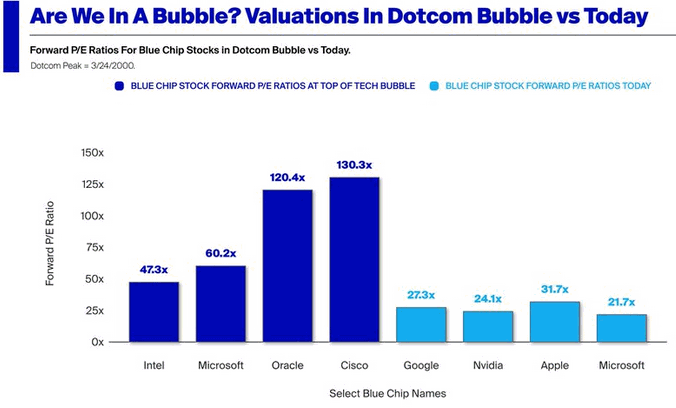
Chart of the Day: This is a denominator illusion. Today’s 22-32x forward multiples look benign next to Cisco’s 130x — but Cisco’s earnings collapsed first, then the multiple exploded into the crash. The four dotcom names are also cherry-picked extremes; broader 2000 market P/Es were nowhere near 130. More importantly: today’s mega-cap forward E is propped by AI capex from a handful of hyperscalers buying from each other, with OpenAI and Anthropic commitments anchoring downstream demand. If that circular flow normalizes even partially, the E in the ratio shrinks fast. Bubbles rarely peak on stretched multiples — they peak on stretched assumptions about future earnings power.
Market Intelligence Brief (MIB) Ver. 17.99
For professional investors only. Not investment advice.
© 2026 RecessionALERT.com

Comments are closed.