
MIB WEEKLY DIGEST
Week of Jun 1–5, 2026
May NFP 172K — double consensus — pushed Fed hike odds above 50% for the first time in 2026, snapping the S&P’s nine-week winning streak on its worst day since October as Computex’s AI semiconductor euphoria reversed simultaneously. The Iran arc ran all five sessions — WTI peaking at $96 on US strikes against Qeshm Island before retreating to $90.24 — keeping PCE elevated entering Warsh’s June 16–17 inaugural FOMC. Jensen Huang crowned Marvell (MRVL) “the next trillion-dollar company” driving a +32% single-day surge, while SpaceX priced at $1.77T and Alphabet raised $84.75B — confirming AI capex has outgrown mega-cap free cash flows and the public equity market is the new funding mechanism.
TABLE OF CONTENTS
A. WEEK AT A GLANCE
B. WEEK IN MARKETS
C. WEEK’S TOP STORIES (10)
D. WEEK IN THE ECONOMY (5)
E. WEEK IN EARNINGS (3)
F. NEXT WEEK SETUP
G. CHART OF THE WEEK
A. WEEK AT A GLANCE -> TOP
The S&P 500 fell −2.59% on the week, breaking a 9-week winning streak as Friday’s May NFP 172K (vs 85K consensus) triggered 2026’s most aggressive single-week rate path repricing — Fed hike odds crossing 50% for the first time, the 2Y yield up +14.9 bps to 4.151%, and VIX surging +40% to 21.57. The week built systematically toward this outcome: five sessions of cumulative hawkish signals (JOLTS +731K record beat, Hammack’s “may soon be appropriate,” Logan’s “neutral or a bit loose,” dual ISM beats above 54) culminating in the NFP blowout that collapsed AI semiconductor valuations and locked in a hawkish setup entering Warsh’s June 16–17 inaugural FOMC with no Fed communication possible. Iran kept energy markets volatile throughout — WTI peaking at $96.20 on Wednesday’s US strikes before retreating to $90.24 on partial de-escalation — keeping PCE pressures elevated even as the rate-regime inflection simultaneously compressed AI hardware premiums.
• May NFP 172K vs 85K consensus (Fri): S&P −2.64% (worst day since October); VIX +40% to 21.57; Fed hike odds crossed 50% for first time in 2026; FOMC blackout Saturday June 7 locked in the repricing with no Fed communication before Warsh’s June 16–17 debut
• WTI peaked at $96.20 (Wed) on US strikes on Iran’s Qeshm Island — week’s highest energy price; retreated to $90.24 by Friday on Israel-Lebanon ceasefire and de-escalation signals; net WoW +3.30%; each $10 sustained above baseline adds ~25–35 bps to PCE already running at 3.8%
• MRVL +32.52% Tuesday on Jensen Huang’s Computex endorsement — “next trillion-dollar company”; AVGO −13.66% WoW after Q3 AI chip guidance miss and Alphabet market share loss to MediaTek; AI semiconductor complex surrendered Computex gains in a single Friday session (MRVL net WoW +28.52%)
• SpaceX priced $75B IPO at $1.77T (Wed/Fri); Alphabet raised $84.75B equity for AI capex; Anthropic filed S-1 at $965B; Meta reportedly weighing tens of billions more — AI capex has definitively outgrown mega-cap organic free cash flow generation
• Challenger 97K May cuts; 40% AI-attributed (Thu) — record: AI displacement surpassed DOGE-related cuts as dominant corporate restructuring driver; arrived 18 hours before the NFP 172K blowout in the week’s sharpest labor market paradox (leading indicators bearish, lagging indicator blowout bullish)
• Healthcare sector +3.06% Thursday (Dow ATH 51,562): Coordinated BofA/MS upgrades on UNH cited MCR improvement to 83.9% and AI-driven cost efficiency; Healthcare +0.80% WoW after YTD −1.42% structural lag — the week’s clearest sector rotation signal running counter to the dominant bearish narrative
1. The Rate Regime Inflection — Five sessions of cumulative hawkish data building to NFP 172K locked in hike odds above 50% entering FOMC blackout — the first time in 2026 a rate hike has been the majority-consensus outcome. The “AI bull thesis requires rate cuts” assumption that drove Q1’s record rally has been structurally challenged in a single week. The 2Y yield’s +14.9 bps WoW outpacing the 10Y’s +9.6 bps is the cleanest signal: markets are pricing Fed action, not growth collapse — the opposite of what the post-April rally had priced in. Wednesday’s May CPI is the last pre-FOMC input that could resolve or intensify the inflection.
2. AI Capex Exceeds Mega-Cap Self-Funding Capacity — Alphabet’s $84.75B equity raise (first since 2005), SpaceX’s $1.77T IPO funded partly by $30B Google GPU compute deals, Anthropic’s $965B S-1, and Meta’s reported consideration together mark the week when AI infrastructure spending definitively outgrew organic mega-cap cash generation. This is structural, not temporary — frontier model training and AI deployment at scale requires capital commitments that stretch beyond even the world’s most cash-generative businesses. Public equity markets are now the primary funding mechanism for AI infrastructure, with institutional supply pressure on existing holdings as the direct consequence.
3. AI Silicon Layer Migration — Jensen Huang’s Computex endorsements (MRVL connectivity, NVDA RTX Spark consumer PC), AVGO’s Alphabet market share loss to MediaTek, and CrowdStrike’s billings miss against PANW’s all-guidance-raised beat collectively confirm that the AI supply chain is actively redistributing across suppliers, not concentrating. MRVL +28.52% and AVGO −13.66% WoW in the same week is the clearest data point: the AI chip opportunity is real and growing (AVGO’s Q3 still implies ~200% YoY AI revenue growth), but no single supplier retains captive demand in the way that drove 2024–2025 premium multiples. Portfolio managers must now assess AI exposure at the specific supplier and layer level, not just the sector level.
 — Leading economic indicators. Accurate market forecasts. Apply for membership at join.recessionalert.com
B. WEEK IN MARKETS -> TOP
The week’s arc ran from AI infrastructure euphoria — NVDA’s Computex launch, Huang crowning MRVL “the next trillion-dollar company,” Alphabet’s $84.75B equity raise, Anthropic’s S-1 at $965B, SpaceX pricing at $1.77T — to a rate-regime inflection in a single Friday session. May NFP 172K (vs 85K consensus) converted a week of building hawkish signals — JOLTS +731K record beat, Hammack’s “may soon be appropriate,” Logan’s “neutral or a bit loose” — into a market-defining outcome: Fed hike odds crossed 50% for the first time in 2026, the S&P snapped a 9-week winning streak on its worst day since October, and the AI semiconductor complex surrendered Computex’s gains in hours. The Iran arc ran the full week — WTI peaking at $96 on Wednesday’s US strikes before retreating to $90.24 on ceasefire news — keeping PCE elevated entering Warsh’s June 16–17 inaugural FOMC.
FRIDAY CLOSE & WEEK-ON-WEEK CHANGE — Fri, Jun 5, 2026:
MAJOR INDICES
Dow Theory weekly signal fires: DJIA −0.33% vs DJTA +2.35% — a 2.68% same-week divergence that crosses the 2% threshold. Transports gained as crude’s intra-week roundtrip (ceasefire suspension Monday → $96.20 peak Wednesday → $90.24 Friday close) delivered net fuel-cost relief for logistics, while industrial blue chips absorbed the broader NFP rate shock. The S&P’s 9-week winning streak broke on Friday’s worst session since October; NDX −4.53% WoW led losses as the AI semiconductor complex (AVGO −13.66%, INTC −13.52%, MU −11.02% WoW) paid for Computex-era multiples in a repriced rate world.
| Index | Fri Close | WoW Change | WoW % | Why It Moved (Week) |
|---|---|---|---|---|
| S&P 500 | 7,383.84 | −196.24 | −2.59% | May NFP 172K (2× consensus) on Friday broke a 9-week winning streak; Technology −4.62% WoW drove the bulk of the decline as Computex AI euphoria reversed on higher-for-longer rate repricing. Partial offset from Healthcare and Consumer Defensive gains mid-week. |
| Dow Jones | 50,866.78 | −165.87 | −0.33% | Near-flat WoW despite Friday’s −1.35% — Thursday’s Dow ATH at 51,562 (healthcare/financial rotation) largely offset the NFP rate shock. Defensive Dow composition cushioned losses relative to the Nasdaq. |
| DJ Transportation | 21,913.6 | +503.2 | +2.35% | Crude’s intra-week roundtrip — $87.36 last Friday → $96.20 peak Wednesday → $90.24 Friday close — delivered net fuel-cost relief for logistics; DJTA diverged positively from DJIA on Friday (+0.65% vs −1.35%). |
| Nasdaq 100 | 28,957.60 | −1,375.58 | −4.53% | Worst weekly index decline — AVGO guidance miss (Wed AMC) and NFP rate shock (Fri) collapsed Computex AI euphoria; MRVL’s net +28.52% WoW could not offset the broad semiconductor complex selling. |
| Russell 2000 | 2,832.35 | −88.58 | −3.03% | Rate-sensitive small caps hit by higher-for-longer repricing; outperformed Monday–Thursday (3 consecutive sessions of RUT > S&P) then reversed sharply on Friday as hike odds crossed 50%. |
| NYSE Composite | 23,256.50 | −35.67 | −0.15% | Near-flat broad market; Healthcare, Consumer Defensive, and Real Estate sector WoW gains largely offset Technology and Basic Materials losses across the full five sessions. |
VOLATILITY & TREASURIES
The 2Y’s +14.9 bps WoW outpace over the 10Y’s +9.6 bps is a clean Fed-action repricing — the front end absorbed the probability shift from ~22% to 53% hike odds as NFP 172K (Friday) capped cumulative hawkish signals: JOLTS +731K record beat (Tuesday), Hammack’s “may soon be appropriate” (Tuesday), Logan’s “neutral or a bit loose” (Wednesday). DXY crossing 100 while gold fell −5.21% WoW is this cycle’s clearest “safety goes to dollars, not precious metals” signal — inflation-driven rate expectations have displaced geopolitical gold demand as the primary defensive bid.
| Instrument | Fri Level | WoW Change | Why It Moved (Week) |
|---|---|---|---|
| VIX | 21.57 | +6.25 (+40.8%) | Single-session 40% spike on Friday NFP shock crossed the volatility regime threshold at 20; options market pricing a higher-for-longer rate environment and compressing AI hardware multiples that had been priced on rate-cut assumptions. |
| 10-Year Treasury Yield | 4.532% | +9.6 bps | Broke through 4.5% on Friday NFP; cumulative hawkish signals all week (JOLTS, Hammack, Logan, NFP) drove the 10Y to the threshold where further yield expansion begins to compress equity multiples meaningfully. |
| 2-Year Treasury Yield | 4.151% | +14.9 bps | Front end led higher than the 10Y all week — consistent with rate-hike repricing (not growth collapse). FOMC blackout Saturday June 7 locked in this level entering Warsh’s June 16–17 debut with no Fed communication possible. |
| US Dollar Index (DXY) | 100.06 | +1.14 (+1.15%) | Dollar crossed 100 on Friday’s NFP-driven rate repricing; safe-haven flows went to the dollar rather than Treasuries or gold — a classic inflation-driven regime, not a growth-scare refuge bid. |
COMMODITIES
Gold −5.21%, silver −10.71%, and platinum −7.80% all declining alongside equities rather than into them confirms forced deleveraging over safe-haven rotation: the Iran geopolitical gold premium accumulated over weeks was liquidated in a single session as rising real yields and DXY 100 overwhelmed the safe-haven bid. Bitcoin −16.31% WoW — Monday’s Mt. Gox $735M hot-wallet scare (−5.49% that session) followed by rate-shock risk-off through Friday. Copper −2.47% reversed Tuesday’s AI-infrastructure demand rally; industrial metals did not sustain the growth optimism once the rate repricing arrived.
| Asset | Fri Price | WoW Change | WoW % | Why It Moved (Week) |
|---|---|---|---|---|
| Gold | $4,353.55/oz | −$239.45 | −5.21% | Failed safe-haven test on Friday — forced deleveraging of Iran geopolitical premium positions as real yields rose and DXY crossed 100; gold sold WITH equities, not into them. |
| Silver | $68.015/oz | −$8.158 | −10.71% | Amplified gold’s forced deleveraging — dual hit from precious metals complex selling and industrial demand growth concerns on rate-shock repricing. |
| Copper | $6.2610/lb | −$0.1585 | −2.47% | Reversed Tuesday’s +1.90% AI-infrastructure demand rally; rate-shock growth concerns eroded the industrial capex bid that had driven earlier gains. |
| Platinum | $1,779.05/oz | −$150.45 | −7.80% | Precious metals complex broad deleveraging alongside gold and silver; automotive/industrial exposure compounded the Friday risk-off selling. |
| Bitcoin | $61,469 | −$11,983 | −16.31% | Mt. Gox estate $735M hot-wallet transfer (Monday, −5.49% crypto-specific) followed by rate-shock risk-off correlated tracking through Friday. No safe-haven bid — tracking equities as a risk proxy throughout the week. |
ENERGY
WTI’s +3.30% WoW net obscures an $8.84/bbl intra-week roundtrip: ceasefire suspension Monday ($87→$92), US strikes Wednesday (peak $96.20), Israel-Lebanon ceasefire Thursday (−$3), de-escalation Friday ($90.24). Oil with equities Monday = demand/growth read; oil against equities Wednesday = supply-shock stagflationary character — both patterns occurred in one week, which is the week’s energy signal. Henry Hub −2.07% fully decoupled from crude (LNG maintenance, storage dynamics). TTF +4.71% confirms European markets absorbed more Middle East LNG supply risk than the insulated US domestic gas market.
| Asset | Fri Price | WoW Change | WoW % | Why It Moved (Week) |
|---|---|---|---|---|
| Crude Oil (WTI) | $90.24/bbl | +$2.88 | +3.30% | Iran ceasefire suspension (Mon) and US strikes on Qeshm Island (Wed) drove WTI to $96.20 peak; Israel-Lebanon ceasefire (Thu) and de-escalation (Fri) retraced toward $90.24. Net supply-risk premium remains embedded. |
| Crude Oil (Brent) | $92.94/bbl | +$1.82 | +2.00% | Parallel Iran arc dynamics with WTI; smaller WoW gain as Monday’s WTI-specific geopolitical premium compressed the WTI-Brent spread mid-week before partial normalization by Friday close. |
| Natural Gas (Henry Hub) | $3.222/MMBtu | −$0.068 | −2.07% | Fully decoupled from crude all week — LNG export throughput fell on Golden Pass/Freeport LNG maintenance; Thursday’s summer heat +4.32% session reversed on Friday as LNG capacity data landed. |
| Natural Gas (Dutch TTF) | $16.46/MMBtu | +$0.74 | +4.71% | European gas tracked Middle East LNG supply uncertainty more closely than Henry Hub; Tuesday’s +6.43% surge on Iran ceasefire suspension drove most of the WoW gain. |
S&P 500 SECTORS — WEEKLY ROTATION
Technology −4.62% WoW despite MRVL’s net +28.52% gain — strip Marvell out and the AI chip complex (QCOM −13.97%, AVGO −13.66%, INTC −13.52%, MU −11.02% WoW among the five weekly decliners) would have produced a deeper sector loss, confirming how concentrated Computex euphoria was in a single name. Healthcare +0.80% after YTD −1.42% is a managed-care mean-reversion bounce on Thursday’s UNH upgrade wave — not regime leadership. Basic Materials −5.54% deepens its −2.87% 3-month structural decline — the week’s clearest multi-horizon laggard.
| Sector | 1-Week | 1-Month | 3-Month | 6-Month | YTD | 12-Month |
|---|---|---|---|---|---|---|
| Energy | +1.70% | −1.21% | +2.86% | +25.24% | +28.22% | +40.54% |
| Real Estate | +0.93% | −0.61% | +3.17% | +6.59% | +8.71% | +7.42% |
| Healthcare | +0.80% | +2.59% | +0.03% | −1.57% | −1.42% | +14.74% |
| Consumer Defensive | +0.79% | −2.97% | −2.56% | +4.83% | +6.44% | +1.94% |
| Financial | +0.52% | +0.12% | +4.93% | +0.75% | −1.94% | +10.47% |
| Industrials | −0.48% | −1.75% | +4.32% | +15.63% | +14.52% | +25.78% |
| Utilities | −0.89% | −4.95% | −4.53% | +1.48% | +3.96% | +13.08% |
| Communication Services | −3.88% | −5.60% | +5.68% | +2.45% | +2.88% | +28.27% |
| Technology | −4.62% | +4.08% | +25.17% | +18.27% | +19.63% | +43.45% |
| Consumer Cyclical | −5.52% | −5.83% | +0.84% | −5.63% | −5.25% | +5.02% |
| Basic Materials | −5.54% | −6.39% | −2.87% | +15.05% | +10.97% | +37.11% |
TOP WEEKLY MOVERS:
The week’s leaderboard bifurcates cleanly: financials (WFC, C) and healthcare (UNH, ABBV) rotated into the rate-repricing environment, while AI-adjacent technology (QCOM, AVGO, INTC, PLTR, MU) paid for Computex-era multiples in a hawkishly repriced rate world. MRVL leads gainers at +28.52% WoW despite Friday’s −16.74% crash — net of the reversal, the Jensen Huang endorsement effect was durable (S&P 500 inclusion June 22 adds structural demand). The tech decliners split into two catalyst types: NVDA competitive displacement (QCOM −13.97%, INTC −13.52%) and AVGO guidance miss contagion (AVGO −13.66%, MU −11.02%), with valuation compression adding to PLTR −13.42%. These are not the same story.
TOP 5 WEEKLY GAINERS
| Ticker | Week | YTD | Year | Why It Moved |
|---|---|---|---|---|
| MRVL | +28.52% | +210.04% | +304.34% | Jensen Huang endorsed Marvell as “the next trillion-dollar company” at Computex 2026 (June 2), driving +32.52% in a single session on AI custom ASIC and silicon photonics thesis. NVDA’s $2B strategic investment and NVLink Fusion partnership (Thursday) added a second catalyst. S&P 500 inclusion announced June 22. Friday’s NFP rate shock reversed −16.74% but net WoW gain held: +28.52%. |
| WFC | +5.67% | −12.08% | +9.40% | Financial sector beneficiary of cumulative Fed hawkish repricing all week (JOLTS +731K beat, Hammack, Logan, NFP 172K); rate-hike environment directly expands net interest margin. Q1 2026 EPS beat (+1.27% vs est.) and $6B medium-term note issuance also noted. |
| C | +5.22% | +13.52% | +72.78% | Financial sector rotation on rate repricing; confirmed as OpenAI IPO co-underwriter (alongside Goldman, Morgan Stanley, JPMorgan), creating fee income upside from the largest anticipated US IPO. CEO Fraser AI commentary and tokenization positioning attracted institutional flows. |
| UNH | +5.04% | +21.01% | +35.03% | Coordinated BofA (Buy, $450 PT) and Morgan Stanley (OW, $453 PT) upgrades Thursday citing medical care ratio improvement to 83.9% YoY and AI-driven cost efficiency potential (45% managed care EPS upside estimated). Sector-wide re-rating: HUM +6%, MRK +4.85%, LLY +4.31%. Quarterly dividend raised 5% to $2.32. |
| ABBV | +4.37% | −0.55% | +21.21% | No single catalyst — broad healthcare sector lift from Thursday’s managed care re-rating combined with Piper Sandler Buy reaffirmation (June 1) and defensive rotation into healthcare. Pipeline advances (ABBV-932, upadacitinib) provided fundamental backdrop. |
TOP 5 WEEKLY DECLINERS
| Ticker | Week | YTD | Year | Why It Moved |
|---|---|---|---|---|
| QCOM | −13.97% | +26.24% | +46.34% | NVDA’s RTX Spark (Monday) directly threatens Snapdragon X Elite PC AI market; Dragonfly data center chip launched at Computex without specifications (details deferred to June 24 Investor Day) — investors penalized the vague reveal. JPMorgan raised PT to $265 but held Neutral. NFP rate shock Friday added multiple compression. |
| AVGO | −13.66% | +11.45% | +48.40% | Q2 FY2026 earnings (Wed AMC): revenue miss ($22.19B vs $22.72B est.), Q3 AI chip guidance $16.0B (missed $17.2B by $1.2B), Alphabet shifting custom silicon to MediaTek. Despite record AI revenue (+143% to $10.8B) and record FCF, guidance miss and competitive displacement drove −12.59% Thursday and further −7.6% Friday. |
| INTC | −13.52% | +168.75% | +396.10% | NVDA RTX Spark competitive threat to Intel’s x86 PC market (Monday). AVGO sector contagion Thursday. NFP rate shock Friday. Partial offset: strategic partnerships with Hitachi and Foxconn announced for AI infrastructure. Intel’s 250%+ YTD run made the premium multiple vulnerable to rate shock. |
| PLTR | −13.42% | −23.75% | +13.05% | Bearish analyst note projecting 51% downside to $103.50 (Tuesday) triggered −5.28%; valuation at ~76x projected 2027 earnings despite strong Q1 (85% rev growth, FY guidance raised to $7.65B). Director insider selling $505K added overhead. NFP rate-shock multiple compression Friday. |
| MU | −11.02% | +202.73% | +712.88% | Hit all-time high $1,046.97 on June 1 after analyst doubled PT; then AVGO guidance miss raised AI infrastructure spend concerns (−7.74% Thursday contagion); NFP rate shock −13.25% Friday. Nvidia confirmed MU qualifies for latest HBM supply but macro concerns overwhelmed. Q3 FY2026 earnings June 24. |
— Institutional-grade intelligence for serious investors. Apply for membership at join.recessionalert.comC. WEEK’S TOP STORIES -> TOP
The week organized around three threads. The Fed/rate repricing thread (#1, #5) ran all five sessions, with May NFP 172K locking in >50% hike odds entering FOMC blackout on Saturday. The AI capital formation and valuation thread (#3, #4, #6) revealed that AI infrastructure spending has outgrown mega-cap free cash flows while competitive silicon dynamics are redistributing supplier positions. The geopolitical-energy thread (#2) provided the inflationary backdrop that made Fed patience structurally impossible. Stories #7–#10 are signal threads from the domestic economy running beneath the dominant macro narratives.
BEARISH
1. Fed Hawkish Escalation — NFP 172K Blowout Locks In Rate Regime Inflection: Hike Odds Cross 50%, S&P Snaps 9-Week Streak on Worst Day Since October
The core facts:The week built systematically toward a hawkish conclusion that culminated in a single day repricing. Monday: Bowman signaled a potential rate-hike pivot; Schmid raised balance sheet tightening as a policy tool and called inflation “too hot for five years.” Tuesday: JOLTS April openings surged to 7.618M (+731K, largest beat in report history, a 2-year high) + Hammack declared in her final pre-blackout address that “it may soon be appropriate to act” — 2026 hike odds jumped to 34%. Wednesday: Logan declared policy “neutral or perhaps even a bit loose.” Thursday: Claims 225K (biggest miss since February) created a brief pause. Friday: May NFP printed 172,000 vs 85,000 consensus — more than double expectations, with net +93K in upward revisions. Fed hike odds trajectory: ~22% (Monday) → 34% (Tuesday) → 41% (Thursday) → 53% (Friday). Kalshi crossed 52%. S&P 500 −2.64%, worst day since October. VIX +40% to 21.57. 2Y yield +14.9 bps WoW to 4.151%. FOMC blackout began Saturday June 7 — no Fed communication before Warsh’s June 16–17 inaugural decision.
Why it matters:NFP was not a standalone Friday shock — it was the culmination of five days of hawkish signal accumulation that left no room for a dovish FOMC narrative to survive. The rate-repricing is locked in: FOMC blackout prevents any Fed course correction before Warsh chairs his debut June 16–17 meeting with hike-or-hold as the genuine binary, not cut-or-hold. The 2Y yield’s +14.9 bps WoW outpacing the 10Y’s +9.6 bps confirms markets priced Fed action, not growth collapse — a curve-flattening hike repricing pattern. May CPI (Wednesday June 10) is the only remaining input that could shift the calculus; a dual hot NFP + CPI reading would push hike odds toward 70% and trigger a second wave of bond and equity repricing.
What to watch:May CPI (Wed Jun 10) — the last pre-FOMC data input; Warsh’s June 16–17 press conference for his first explicit rate path signal; 2Y yield sustained break above 4.20% as the hike-pricing barometer.
UNCERTAIN
2. Iran Arc Runs All Five Sessions: Ceasefire Suspended Monday, WTI to $96 on US Strikes Wednesday, Partial De-escalation by Friday — Net WTI +3.3% WoW, PCE Pressures Intact
The core facts:Monday: Iran’s Revolutionary Guard-linked Tasnim news agency reported ceasefire talks suspended following Israel’s Lebanon escalation. WTI surged +5.5% to $92.18 — repricing the S&P’s embedded peace premium. Tuesday: WTI held above $93; API crude draw reported at −6.8M barrels (7th consecutive weekly draw). Wednesday: US CENTCOM confirmed self-defense strikes on Iran’s Qeshm Island targeting radar and drone command facilities; IRGC claimed retaliatory strikes on US bases in Kuwait and Bahrain. WTI surged to $96.20 — highest since the conflict’s initial escalation; EIA confirmed −8.0M barrel draw. Thursday: Israel and Lebanon announced a ceasefire agreement; Trump signaled positive US-Iran diplomatic progress; WTI −$3 to $93.02. Friday: De-escalation extended; WTI −3.01% to $90.24; Energy Secretary Wright ordered companies to return 40M additional SPR barrels as a supply normalization signal. Net WoW: WTI +3.30% ($87.36→$90.24), Brent +2.00%.
Why it matters:WTI sustained above $90 adds approximately 25–35 bps to headline PCE per $10 above baseline — with PCE already at 3.8%, the week’s crude arc kept the Fed’s inflation path under direct pressure throughout. The de-escalation into Friday provides directional relief, but Reuters’ simultaneous Friday warning about globally depleted inventories after the conflict’s supply shock cannot be dismissed: seven consecutive weekly crude draws and a partial SPR release created structurally thin inventory cushions. Any renewed Iran disruption would reverse the $6/bbl weekly decline within days. The UNCERTAIN classification reflects genuine dual-character: PCE relief path emerging, but inventory fragility preserving the upside oil risk.
What to watch:WTI $90/bbl as the PCE-relief inflection point; formal US-Iran MOU negotiations for terms on Hormuz reopening and sanctions relief; EIA weekly crude inventory data for recovery pace from the 7-week draw streak.
UNCERTAIN
3. Computex AI Euphoria to Rate-Shock Reversal: MRVL +33% Then −17%, AVGO Guidance Miss, $1T+ Wiped on Friday — AI Demand Real, AI Hardware Premium Not
The core facts:Monday: NVDA launched RTX Spark superchip at Computex 2026 — its first consumer PC AI processor, co-developed with Microsoft and MediaTek; QCOM −8.78%, INTC −4.69% absorbed competitive losses as AI-adjacent enterprise names surged (DELL +10.7%, ORCL +9.9%, IBM +7.6%). Tuesday: Jensen Huang publicly declared Marvell “the next trillion-dollar company” at Computex; MRVL +32.52% — largest single-session gain for the stock since 2000; semiconductor equipment +5–7% (AMAT, LRCX, KLAC). Wednesday AMC: Broadcom reported Q2 FY2026 — revenue miss ($22.19B vs $22.72B), Q3 AI chip guidance $16.0B (vs $17.2B consensus, a $1.2B shortfall), Alphabet disclosed as shifting custom silicon work to MediaTek (loss of near-exclusive AVGO positioning). Thursday: AVGO −12.59%; MRVL +4.90% on its own Q1 FY2027 earnings beat + NVDA $2B strategic investment + NVLink Fusion partnership. Friday: NFP rate shock + Computex euphoria reversal — MRVL −16.74%, MU −13.25%, INTC −11.28%, QCOM −10.98%, NVDA −6.3%, AVGO −7.6%; Technology sector −6.11%; $1T+ wiped in single session. Net WoW: MRVL +28.52% (S&P 500 inclusion June 22 adds structural demand); AVGO −13.66%; INTC −13.52%; QCOM −13.97%; MU −11.02%.
Why it matters:Friday’s collapse was macro-driven (rate shock amplifying stretched valuations), not a signal that AI chip demand is slowing — AVGO’s Q3 AI guidance of $16.0B still implies ~200% YoY growth. The structurally significant disclosure was the Alphabet-to-MediaTek market share shift: hyperscalers are beginning to diversify custom silicon sourcing, ending AVGO’s near-exclusive positioning and making the AI chip opportunity more competitive, less concentrated. MRVL’s net +28.52% WoW despite Friday’s crash confirms the Jensen Huang endorsement effect was durable — the silicon photonics/AI connectivity thesis is real. The UNCERTAIN classification captures the dual reality: AI demand cycle intact, AI hardware premium at elevated rates not.
What to watch:AVGO Q4 FY2026 guidance for Alphabet market share recovery; MRVL stability above ~$190 (pre-Computex level) as a gauge of endorsement premium durability; hyperscaler Q2 capex disclosures for custom silicon allocation shifts among suppliers.
UNCERTAIN
4. AI Capex Exceeds Mega-Cap Free Cash Flows: Alphabet Raises $84.75B, SpaceX Prices at $1.77T, Anthropic Files at $965B, Meta Weighing Tens of Billions — Public Equity Now Funds AI Infrastructure
The core facts:Monday: Anthropic filed confidential S-1 with the SEC at $965B valuation (annualized revenue $47B, +4.7× YoY). Tuesday: Alphabet announced $80B equity offering — its first stock issuance since 2005 — to fund $180B 2026 AI capex; GOOGL/GOOG both −4%; Berkshire Hathaway entered a $10B private placement at fixed prices ($351.81/$348.20) creating a structural price floor. Wednesday: SpaceX priced a $75B IPO at $1.77T valuation — largest primary equity offering in US history by 3× — with Nasdaq debut June 12 (SPCX); IPO documents disclosed Google agreed to pay $920M/month for 110,000 NVIDIA GPUs through June 2029 (total ~$30B), with a separate Anthropic compute deal. Anthropic simultaneously raised its confidential S-1 valuation to ~$1T. Friday: The Financial Times reported Meta is weighing “tens of billions” in new equity to fund $145B 2026 AI capex; META −5.5%.
Why it matters:The paradigm shift is structural: AI capex has grown so large that even trillion-dollar companies cannot self-fund it from operations. Alphabet choosing $84.75B equity dilution over debt financing signals management believes the competitive cost of under-investing exceeds dilution cost — a confidence statement that paradoxically validates the AI investment thesis. SpaceX’s $30B Google GPU compute deal establishes a new category: rocket company as AI cloud infrastructure provider, competing with AWS, Azure, and Google Cloud for managed AI workloads. The combined supply pipeline (Anthropic ~$1T + SpaceX $1.77T + OpenAI September target ~$1T + potential Meta raise) creates unprecedented public equity supply pressure on existing mega-cap AI holdings. SPCX’s debut June 12 forces passive index rebalancing — institutions must sell existing positions to fund new allocations.
What to watch:SPCX June 12 Nasdaq debut — first-day trading range vs. $135 offer price; Meta confirmation of banking mandates; Alphabet’s ATM drawdown pace in Q3 as a signal of capex urgency; S&P 500/Nasdaq-100 index committee inclusion announcement timeline for SPCX.
BEARISH
5. Challenger: 97,006 May Cuts with Record 40% AI-Attributed — AI Displacement Now Dominant Corporate Restructuring Driver, Surpassing DOGE-Related Government Cuts
The core facts:Thursday (June 4): Challenger, Gray & Christmas reported 97,006 announced job cuts in May — up 16% from April and the highest May total since 2020. AI was cited as the primary reason for 38,579 cuts (40% of May total) — the highest monthly AI attribution since Challenger began tracking the category in 2023 and a dramatic acceleration from 7% in January, 25% in March, 26% in April. Technology sector led all industries with 38,242 cuts (2-year sector high), with 2026 YTD tech cuts up 65% vs. the same period in 2025. Transportation sector cuts YTD up 449% YoY; pharma up 753% YoY. DOGE-related government cuts fell 94% YoY — AI displacement has displaced the prior dominant restructuring narrative. Simultaneously, Thursday’s initial jobless claims 225K (biggest miss since February) arrived 18 hours before Friday’s NFP 172K blowout — creating the week’s most acute labor market paradox.
Why it matters:The 40% AI attribution rate, accelerating from near-zero in early 2025 to the dominant single reason for announced corporate restructuring in 15 months, represents the fastest documented pace of AI-driven labor displacement in any prior technology transition. For the Fed, Thursday’s claims spike and Challenger surge create the “lagging vs. leading” dilemma — current NFP strong but forward indicators (announced cuts, claims trend) signal deterioration. Daly’s Thursday remark that AI productivity gains are “everywhere except in the data” crystallizes the monetary policy calibration problem: headcount is being reduced faster than productivity gains appear in GDP, suggesting the post-transition is still ahead of us. For equity markets, AI displacement validates the bear case for enterprise software (fewer human seats) while supporting AI infrastructure hardware (the capex driving the displacement is real and growing).
What to watch:June Challenger for acceleration above 40% AI attribution; Friday NFP sector breakdown confirming tech/transportation announced cuts converting to actual separations; enterprise software demand commentary (CRM, SAP, ORCL, WDAY) for seat-count headwinds.
BEARISH
6. FTC Escalates Microsoft Cloud/AI Antitrust Probe — Azure, Copilot, and OpenAI Investment Under Scrutiny; MSFT −4.17% Tuesday, Multi-Year Regulatory Overhang Begins
The core facts:Tuesday (June 2): The FTC broadened its antitrust investigation into Microsoft, issuing civil investigative demands to Microsoft and at least eight competitors — including AWS, Google Cloud, and Salesforce — covering Azure licensing structures, Copilot AI assistant bundling across Microsoft 365 and GitHub, and the competitive implications of the OpenAI investment. Regulators are examining whether bundling security, AI, and productivity features into all-in-one subscriptions forecloses rivals and whether Microsoft’s cloud infrastructure position gives it an unfair advantage when backing AI model providers. Microsoft (~$3.3T market cap) fell −4.17% — erasing ~$140B in market value — despite its Build 2026 conference running simultaneously. A Copilot AI service outage on June 1 had added prior-day sentiment headwinds.
Why it matters:An FTC probe into a $3.3T company is a multi-year valuation overhang regardless of merits — it constrains acquisition activity, forces licensing disclosures, and could produce structural remedies affecting Azure bundling economics. The OpenAI investment angle is the highest-stakes element: if regulators determine it constitutes anticompetitive arrangement, structural remedies could include divestiture or access requirements that directly undermine Microsoft’s AI moat. The EU Digital Markets Act precedent (Teams/Office bundling separation) provides a template: product separation reduces the cross-selling synergies that justify Azure premium ARPU assumptions currently embedded in analyst models. Current MSFT estimates embed AI/cloud bundling economics that a forced separation would compress.
What to watch:FTC formal charge vs. consent decree negotiation — formal charges halt certain bundling practices immediately; EU/FTC coordination signals for global remedies; MSFT Q2 Azure growth for the competitive lock-in metrics regulators may use as evidence of anticompetitive foreclosure.
BULLISH
7. Healthcare Sector Surges 3.06% on Coordinated UNH Re-rating — Managed Care Cost Trend Inflection Drives Dow ATH at 51,562; Healthcare +0.80% WoW After YTD −1.42% Laggard
The core facts:Thursday (June 4): Bank of America upgraded UnitedHealth Group from Neutral to Buy (PT $450); Morgan Stanley simultaneously raised its PT to $453 (OW). BofA cited medical care ratio improvement to 83.9% (down 90 bps YoY) and estimated UNH’s earnings power is approximately 50% above its own conservative 2026 guidance. Morgan Stanley noted AI-driven efficiency gains across managed care could translate into 45% average EPS upside for the sector. UNH surged +5.16% Thursday; sector-wide re-rating followed — Humana +6%, Cigna +4%, MRK +4.85%, LLY +4.31%. Healthcare sector +3.06% Thursday — the day’s best sector by a wide margin and the primary driver of the Dow’s ATH close at 51,562 (+1.73%). WoW: Healthcare sector +0.80% after YTD −1.42% and 3M +0.03% structural lag. UNH also raised its quarterly dividend 5% to $2.32.
Why it matters:Coordinated Buy upgrades on the same day from BofA and Morgan Stanley signals conviction, not routine maintenance. The “50% above guidance” framing from BofA is a classic sandbagging setup: if MCR is truly at 83.9% and improving, the beat cadence through 2026 creates a rising estimate path with multiple re-rating potential. For portfolio managers who have been underweight Healthcare for three months (the structural laggard relative to Technology), Thursday’s re-rating creates a rebalancing imperative. The sector’s single-day +3.06% recovery illustrates how quickly a laggard sector with improving fundamentals can revert in a risk environment where defensive cash flows are increasingly valued — particularly with VIX crossing 20 on Friday.
What to watch:UNH Q2 2026 earnings for MCR trend confirmation below 84%; HUM and CI for sector-wide cost trend validation; JPMorgan/Goldman follow-on Healthcare upgrades that could extend the re-rating into a durable sector rotation.
BULLISH
8. Berkshire Hathaway Acquires Taylor Morrison Homes for $6.8B at 24% Premium — Buffett’s Largest Single-Family Housing Bet Validates US Structural Housing Deficit Thesis; TMHC +22%
The core facts:Monday (June 1): Berkshire Hathaway announced an all-cash acquisition of Taylor Morrison Home Corporation (TMHC) for approximately $6.8B at $72.50 per share — a 24% premium to the pre-announcement close. Taylor Morrison builds primarily in the Sun Belt, Southeast, and Western US markets, focusing on move-up and luxury entry-level buyers. TMHC surged +22.3% in premarket on the announcement. Berkshire already holds Clayton Homes (modular/manufactured housing); this represents a significant expansion into traditional site-built single-family homebuilding. The deal was announced on the same day construction spending data showed April single-family residential construction up +1.4% MoM.
Why it matters:Warren Buffett deploying $6.8B into homebuilding at 30-year mortgage rates near 7% sends an unambiguous signal: the structural US housing deficit (estimated 3–4 million units) is durable enough to justify premium pricing in any rate environment. At 24% premium in a record equity market, Berkshire sees private-market homebuilder value materially above public pricing — a classic “public markets undervaluing a durable business” signal with historical precedent for sector re-rating. The same-day construction spending data (+1.4% single-family) provided simultaneous economic validation. Berkshire’s entry creates a re-rating precedent for peers NVR, D.R. Horton, and Lennar — any activist or strategic buyer now has a 24% premium public transaction as an acquisition anchor.
What to watch:DHI, NVR, and LEN share price convergence toward Berkshire implied private-market value; whether Berkshire adds to homebuilder positions through open-market purchases; regulatory approval timeline (expected straightforward).
BEARISH
9. Trump Proposes Section 301 Tariffs on 60 Countries — USMCA Partners Canada and Mexico Included, Signaling Willingness to Reopen Settled Trade Frameworks
The core facts:Wednesday (June 3): The Trump administration announced proposed Section 301 forced-labor tariffs of 10–12.5% on imports from 60 countries, explicitly including Canada, Mexico (USMCA partners), the EU, the UK, and Taiwan. Public hearings scheduled July 7. Thursday (June 4): USTR Greer at the OECD Paris ministerial confirmed that existing bilateral tariff caps (EU and Japan capped at 15%) will be honored — “a deal is a deal” — meaning EU net exposure is 10%, Japan below 15%. However, Greer specifically noted that a separate ongoing excess manufacturing capacity investigation could push tariffs above the bilateral caps if completed — leaving an open vector.
Why it matters:Including USMCA partners Canada and Mexico — supposedly settled under the Trump 1.0 renegotiation — signals the administration’s willingness to treat any trade framework as renegotiable when geopolitical or political objectives align. For US companies with Canadian and Mexican supply chains (autos, industrials, tech hardware), the July 7 public hearing creates a 30-day uncertainty window. The auto sector is already managing steel/aluminum tariff costs and rising rates slowing vehicle demand — this adds a potential third cost layer. Taiwan’s inclusion directly affects semiconductor supply chains at a particularly sensitive moment given Computex AI investment cycle and the AVGO/MRVL silicon rebalancing underway.
What to watch:July 7 public hearing country-by-country exemption results; EU and Japanese government formal responses; semiconductor supply chain impact assessment for TSMC-manufactured components entering the US under the Taiwan tariff proposal.
BEARISH
10. Powell Warns “Fed Cannot Survive” Political Interference — SCOTUS Case on Governor Removal Authority Is an Unpriced Institutional Tail Risk Entering Warsh’s Debut
The core facts:Monday (June 1): Former Fed Chair Jerome Powell — now a sitting governor with tenure through January 2028 — used his JFK Profile in Courage Award address at the Kennedy Library to warn that a single administration establishing legal authority to remove officials over policy disagreements “would open the way for future elected officials to follow suit,” ultimately destroying the credibility the Fed has spent decades building. Without naming Trump, Powell directly referenced administration efforts to remove Governor Lisa Cook and public pressure for rate cuts. Powell’s unusual retention of his governor seat after leaving the chairmanship denied the administration an additional Board appointment. His remarks arrived as SCOTUS prepares to rule on a case directly addressing presidential authority to remove Fed governors.
Why it matters:Fed independence is the institutional anchor that allows the Fed to credibly commit to fighting inflation — a commitment markets price into every long-duration asset. If SCOTUS rules that the president can remove governors at will, the Fed’s ability to maintain restrictive policy when the administration prefers accommodation is structurally compromised. With PCE at 3.8% and hike odds now above 50%, inflation expectations would reprice materially higher if Fed credibility erodes — the 10Y TIPS breakeven is the first-order transmission instrument. The SCOTUS case represents a macro tail risk markets have not yet priced. Chair Warsh chairs his June 16–17 debut under simultaneous institutional uncertainty: Powell sitting as governor, Governor Cook’s removal still under legal challenge, and SCOTUS ruling potentially arriving before or after the decision.
What to watch:SCOTUS ruling timeline on Fed-governor protections — a pre-FOMC ruling creates maximum market-impact scenario; 10Y TIPS breakevens for any move above 3.0% signaling Fed credibility erosion; Warsh’s formal stance on institutional independence in his June 16–17 press conference.
— Separating signal from noise since 2007. Apply for membership at join.recessionalert.comD. WEEK IN THE ECONOMY -> TOP
Archetype: Fed-cut bets re-priced. This week’s data was unambiguously hawkish. JOLTS April +731K (largest beat in history), Hammack’s “may soon be appropriate to act” (Tuesday), Logan’s “neutral or a bit loose” (Wednesday), and May NFP 172K (vs 85K consensus, Friday) drove 2026’s most aggressive single-week rate path repricing: Polymarket hike odds surged from ~22% to 53%, ≥1 cut odds collapsed from ~65% to 28%, and the 2Y yield rose +14.9 bps WoW (see Vol & Treasuries table in Section B). Dual ISM beats above 54 — Manufacturing 54.0% (4-year high, Monday) and Services 54.5% (Wednesday) — provided growth cover for the hawks. One counter-signal persisted: Thursday’s claims 225K and Challenger 97K cuts with record 40% AI-attributed suggest the labor market may be softening on a forward basis even as lagging indicators stay robust. Wednesday’s May CPI is the last pre-FOMC input that can resolve or intensify the rate-regime inflection before Warsh’s June 16–17 debut.
POLYMARKET ODDS — WEEK-ON-WEEK SHIFT:
| Market | Last Friday (May 29) | This Friday (Jun 5) | Δ |
|---|---|---|---|
| US Recession by end-2026 | ~19% | 19% | 0 pp |
| Fed rate hike in 2026 | ~22% | 53% | +31 pp |
| Fed rate cuts ≥1 in 2026 | ~65% | 28% | −37 pp |
BEARISH
1. May Nonfarm Payrolls 172K — Double the 85K Consensus; Rate Shock Triggers S&P’s Worst Session Since October (BLS, Jun 5, 2026)
What they’re saying:172,000 nonfarm payrolls added in May vs. 85,000 consensus — more than double expectations. Prior months revised upward a net +93,000 (March: 185K→214K; April: 115K→179K). Unemployment held at 4.3% (in line), participation unchanged at 61.8%, average hourly earnings +0.3% MoM / +3.4% YoY (slight deceleration from 3.6%, in line with consensus). Manufacturing +7K, government +52K led the gains.
The context:The blowout print triggered immediate “good news is bad news” reaction. S&P 500 −2.64% (worst day since October), Nasdaq −4.77%, VIX +40% to 21.57, 10Y yield crossed 4.5%, 2Y +10.2 bps. FOMC blackout began Saturday — no Fed communication until after Warsh’s June 16–17 decision. With PCE at 3.8%, ISM Manufacturing at a 4-year high, ISM Services at a 3-month high, and now NFP more than doubling consensus, the hawkish case for Fed action is stronger than at any point since the hiking cycle began. The wage deceleration (3.4% vs. 3.6% prior) is the only dovish data point in the entire report.
What to watch:May CPI (Wed Jun 10) — a dual hot NFP + CPI combination would push hike odds toward 70% and trigger a second wave of bond/equity repricing before the June 16–17 FOMC decision.
UNCERTAIN
2. JOLTS April 7.618M — Largest Beat in History; But Quits Hit 6-Year Low and Hires Fell 419K — Frozen Labor Market, Not a Healthy One (BLS, Jun 2, 2026)
What they’re saying:Job openings surged +731K to 7.618M — the largest single-month upside beat in the report’s history and a 2-year high. Professional and business services drove nearly all of the gain. However, total hires fell 419K (second-largest decline since July 2020), the hiring rate dropped 0.3 points to 3.2%, and the quits rate fell to its lowest level in six years at 2.977M — workers too economically insecure to voluntarily leave jobs.
The context:The JOLTS divergence — surging openings against falling hires and quits — describes a frozen labor market, not a tight one. Companies posting positions but not filling them signals demand deterioration is building beneath the headline. Historically, openings lead payrolls lower by 2–3 months when hires decelerate this sharply; Friday’s NFP 172K beat (lagging indicator) and Thursday’s claims 225K spike (leading indicator) illustrate the divergence perfectly. The UNCERTAIN classification reflects genuine ambiguity: headline labor demand appears hot, but underlying behavioral metrics (low quits, falling hires) signal the same fragility visible in the Challenger 97K cuts and the RCM/TIPP 10th consecutive month below 50.
What to watch:JOLTS hiring rate — a sustained drop below 3.0% would confirm genuine demand deterioration; next jobless claims for trend continuation above 215K; June JOLTS (released late July) for whether the quits collapse compounds.
BULLISH
3. Dual ISM Beats: Manufacturing 54.0% (4-Year High, Mon) + Services 54.5% (3-Month High, Wed) — Both Above 54 Simultaneously for First Time Since Mid-2023 (ISM, Jun 1 & Jun 3, 2026)
What they’re saying:ISM Manufacturing PMI rose to 54.0% in May (vs. 53.0% consensus, highest since May 2022); New Orders surged to 56.8%, Production to 54.3%. ISM Services PMI hit 54.5% in May (vs. 53.8% consensus, 3-month high); Business Activity 57.7%, New Orders 57.3%. Combined with S&P Global Final Manufacturing PMI 55.1 (multi-year high, released June 1), the manufacturing trifecta was confirmed. Prices Paid remained deeply elevated in both surveys — Manufacturing 82.1%, Services 71.3% — consistent with services CPI above 4%.
The context:Both ISM composites simultaneously above 54 for the first time since mid-2023 eliminates any “growth is slowing” rationale for Fed patience — this is the most important data cover the hawks received all week. The bullish classification reflects genuine activity acceleration; however, the embedded inflation from elevated Prices Paid sub-indexes means the growth data is not cleanly positive for markets — it feeds directly into the NFP Friday outcome and the hike repricing. Employment sub-indexes contracted in both Manufacturing (4th consecutive month) and Services, suggesting firms are running hot on output while cutting headcount — consistent with the AI productivity substitution story visible in the Challenger data.
What to watch:June ISM Manufacturing and Services (due early July) for sustainability above 54; ADP and NFP employment sub-components for whether manufacturing/services headcount contraction deepens; ISM Prices Paid trajectory as the leading inflation pipeline indicator ahead of July PCE.
BEARISH
4. Initial Claims 225K (Biggest Miss Since February) + GDPNow Q2 Deceleration to 3.0% — Leading Indicators Send a Different Message Than the Headline (BLS / Atlanta Fed, Jun 4 & Jun 1, 2026)
What they’re saying:Initial jobless claims for the week ending May 30 rose to 225,000 — above the 213,000 consensus and the highest weekly print since early February, arriving 18 hours before NFP 172K. The Atlanta Fed GDPNow model cut its Q2 2026 real GDP tracking estimate to 3.0% (from 4.3% on May 21), a 130 bps decline in ten days with no single upward revision — driven by weaker-than-expected wholesale inventories, softer consumption data, and deteriorating net export dynamics.
The context:The claims spike and GDPNow deceleration are the two leading-indicator counter-signals to the week’s dominant hawkish data narrative. The 225K claims print arriving 18 hours before NFP 172K crystallizes the week’s central labor market paradox: lagging indicators (jobs added) remain strong while leading indicators (claims trend, JOLTS quits, Challenger cuts) are deteriorating. GDPNow’s 130 bps two-week drop — three consecutive downward revisions — is the kind of trajectory that historically precedes quarterly growth disappointments relative to the consensus range. Fed Daly’s Thursday remark that AI productivity gains are “everywhere except in the data” is the Fed’s implicit acknowledgment of this divergence.
What to watch:GDPNow post-June 10 CPI and June 11 PPI updates for further deceleration; jobless claims for the week ended June 6 (Thu Jun 11) — a print at or above 230K would confirm a deteriorating trend before the June 16–17 FOMC; Q2 GDP advance estimate (late July) for confirmation of the current deceleration path.
BEARISH
5. PCE 3.8% / IMF Extends US Inflation Timeline to End-2027 / Beige Book Flags K-Shaped Consumer Stress — Inflation Persistence Confirmed From Multiple Institutional Voices (BEA / IMF / Federal Reserve, Jun 1–4, 2026)
What they’re saying:April PCE (released May 28, incorporated into week’s context) ran at 3.8% YoY — hottest since 2021 — while real disposable income fell $19.9B (−0.1%), squeezing household purchasing power. Thursday (Jun 4): The IMF extended its timeline for US inflation returning to 2% by six months to end-2027, urging the Fed to “proceed with caution” and calibrate policy “carefully to incoming data.” The June Beige Book (released Wed Jun 3) confirmed modest growth in 10 of 12 districts with a sharply bifurcated consumer: upper-income households resilient, middle-income budgets stretched, lower-income households increasing credit card use and shifting spending to necessities.
The context:The IMF’s six-month timeline extension — announced as Warsh prepares his debut FOMC — is not a dramatic revision, but its timing matters: it represents the global policy consensus that the path back to 2% inflation is longer than assumed and rate cuts are not imminent. The Beige Book’s K-shaped consumer portrait is particularly significant for the Fed: headline aggregate spending remains stable (upper-income households still spending freely), masking accumulating financial stress at the lower end. Delinquency risk can build invisibly in the aggregates until it becomes acute — the combination of PCE at 3.8% squeezing real purchasing power and lower-income credit card dependency building suggests the inflation fight has real distributional consequences the Fed’s rate decisions must navigate.
What to watch:May CPI (Wed Jun 10) as the decisive pre-FOMC inflation print; NY Fed Quarterly Household Debt and Credit Report (due mid-June) for lower-income delinquency rate trajectory; next PCE release (late June) for May trend direction under the Warsh-era policy framework.
— Know the probability before the market prices in the risk. Apply for membership at join.recessionalert.comE. WEEK IN EARNINGS -> TOP
TOP EARNINGS OF THE WEEK
BULLISH
1. Palo Alto Networks (PANW): +9.96% AH | Beat + All FY2026 Guidance Raised; AI Security Platform Consolidation Thesis Confirmed at Scale
The Numbers:Q3 FY2026 (released Tue Jun 2 AMC): Non-GAAP EPS $0.85 vs $0.79 est. (+7.6% beat) | Revenue $3.002B vs $3.003B est. (in-line, +31% YoY) | NGS ARR $8.1B | RPO $18.4B | FY2026 revenue guidance raised to $11.415–11.425B (vs $11.29B consensus) | FY2026 EPS guidance raised to $3.77–3.79 (vs $3.70 est.) | FY2026 NGS ARR guidance raised to $8.90–8.95B (+59–60% YoY) | FY2026 RPO guidance raised to $20.9–21.0B (+32–33% YoY)
The Problem/Win:All four guidance categories — full-year revenue, EPS, NGS ARR, and RPO — raised simultaneously, a rare sweep that signals management confidence in forward demand visibility rather than guidance sandbagging. NGS ARR growth at +59–60% YoY in the FY guidance demonstrates that platformization — consolidating enterprise security spend across SASE, Cortex XSIAM, and network security — is converting into durable recurring revenue at scale. CEO Arora: “Q3 was a standout quarter for Palo Alto Networks, with accelerating organic bookings growth as customers turn to us to secure their AI deployments at scale.” The $18.4B RPO balance provides exceptional revenue visibility into FY2027.
The Ripple:PANW’s strong result validates enterprise security spend at a time of high IT budget scrutiny, and directly raised the bar for CrowdStrike. PANW’s platformization success — customers consolidating from point products to the full PANW suite — represents market share capture from mid-tier security vendors. The result complements Section C story #3 (AI chip cycle): every AI workload and cloud migration generates incremental security surface area, and PANW is the primary beneficiary of that structural demand expansion.
What It Means:PANW’s beat + all-raised-guidance confirms that enterprise AI deployment is a net positive for cybersecurity demand. The +9.96% AH reaction signals the market re-rating PANW toward a platform-security compounder with durable revenue visibility rather than a cyclical IT spend proxy.
What to watch:CrowdStrike Q2 FY2027 billings recovery as the direct competitive read-through; PANW Q4 FY2026 results (late August) for whether RPO sustains toward $20.9–21.0B guidance; net new NGS ARR as the first signal of a platformization ceiling.
BEARISH
2. Broadcom (AVGO): −13.66% WoW | Record AI Revenue Can’t Overcome Q3 Guidance Miss and Alphabet Market Share Loss to MediaTek
The Numbers:Q2 FY2026 (released Wed Jun 3 AMC): Revenue $22.19B vs $22.72B est. (miss, +48% YoY) | AI semiconductor revenue $10.8B (+143% YoY, record) | Non-GAAP EPS $2.44 | FCF $10.3B (record) | Operating margin 67.3% (record) | Q3 guidance: revenue $29.4B; AI chip revenue $16.0B (+~200% YoY) vs analyst consensus $17.2B — a $1.2B shortfall | Management disclosed Alphabet is shifting some custom AI chip work to MediaTek
The Problem/Win:The win is substantial: record AI chip revenue (+143%), record FCF, record operating margin — the business is performing exceptionally. The problem is the guidance miss: Q3 AI chip guidance of $16.0B vs $17.2B consensus signals the AI hardware buildout is expanding more slowly than the most aggressive market assumptions. More structurally significant: the Alphabet market share loss to MediaTek ends AVGO’s near-exclusive custom AI chip positioning. Hyperscalers are beginning to diversify custom silicon sourcing — this is a durable competitive change, not a one-quarter anomaly.
The Ripple:−12.59% Thursday + further −7.6% Friday on NFP rate shock. Sector contagion hit MU (−7.74% Thursday), ARM (−4%), ANET (−4.79%), AMD (−3.56%). Marvell (+4.90% Thursday) was the notable counterpoint — the AI chip opportunity is real but redistributing across suppliers, not contracting. AVGO’s −13.66% WoW ranks it among the top 5 weekly decliners in the mega-cap universe.
What It Means:Broadcom’s result confirms AI chip demand is real and growing (~200% YoY Q3 guidance still), but the era of near-exclusive hyperscaler positioning is ending. Portfolio managers must now assess AI chip exposure at the supplier level, not just the sector level — AVGO and MRVL moving in opposite directions this week is the clearest evidence of that redistribution.
What to watch:AVGO Q4 FY2026 guidance for any Alphabet market share recovery; hyperscaler Q2 capex disclosures for custom silicon allocation among AVGO, MRVL, and MediaTek; Q3 actual AI chip revenue vs. the $16.0B guidance floor.
BULLISH
3. Marvell Technology (MRVL): +4.90% Thu | Q1 FY2027 Beat + NVDA $2B Strategic Investment and NVLink Fusion Partnership — Earnings Validate the Computex Week Thesis
The Numbers:Q1 FY2027 (released Thu Jun 4): Revenue $2.42B (+28% YoY, above guidance range) | Beat analyst estimates across EPS and revenue | NVDA announced $2B strategic investment in Marvell | NVLink Fusion partnership formalized — enabling MRVL custom ASIC integration with NVIDIA NVLink networking | Full-year outlook raised
The Problem/Win:A clean fundamental beat on both revenue and EPS, with guidance raised — but the structural story is bigger than the quarter. The NVDA $2B strategic investment and NVLink Fusion partnership simultaneously arrived, providing institutional permission to size MRVL. NVIDIA’s investment aligns Huang’s financial interests with Tuesday’s “next trillion-dollar company” endorsement, creating a self-reinforcing validation cycle. The S&P 500 inclusion announcement (June 22) adds passive buying pressure to the fundamental story.
The Ripple:MRVL’s earnings beat directly contrasts with AVGO’s guidance miss in the same week — the two results together confirm that the AI chip opportunity is redistributing within the supply chain, not contracting. MRVL’s net +28.52% WoW gain (despite Friday’s −16.74% rate-shock reversal) demonstrates the durability of the silicon photonics and AI connectivity thesis even through aggressive rate repricing. Note: MRVL’s strong Thursday earnings (+4.90%) should be read alongside Section C story #3 — the earnings print provides the fundamental proof of concept for Huang’s Computex endorsement that the market needed.
What It Means:Marvell’s results validate the AI custom ASIC and silicon photonics thesis at the revenue level — not just as an endorsement story. For portfolio managers, the NVDA strategic investment creates a structural supply-chain alignment between the world’s largest AI hardware company and its primary connectivity supplier, a relationship that resembles the TSMC/NVDA manufacturing partnership in its exclusivity implications.
What to watch:MRVL next earnings for first concrete custom ASIC revenue figures from the NVLink Fusion partnership; stability of MRVL above ~$190 (pre-Computex level) as the earnings-and-partnership fundamental floor; AMD and Intel custom ASIC pipeline announcements as competitive responses.
WEEK AHEAD PREVIEW:
Q1 2026 earnings season is effectively complete at 97% reported, with the final handful reporting through mid-June. The week ahead brings one mega-cap earnings event and the market-defining FOMC decision.
Adobe Inc (ADBE) — AMC, Thursday June 11 — Consensus: Rev ~$6.45B (guided $6.43–6.48B), EPS ~$5.83 (guided $5.80–5.85 non-GAAP). Key focus: AI monetization velocity — Firefly ARR surpassed $250M with subscription ARR up 75% QoQ in Q1; analysts are tracking whether AI revenue maintains its >100% YoY growth trajectory; CEO Shantanu Narayen’s succession timeline (announced he will step down) and impact on the $25B buyback program through 2030; Semrush acquisition integration (completed April 2026). ADBE is down approximately 6%+ on the week in the AI/tech selloff, creating a lower entry point ahead of earnings. Note: given Friday’s rate shock and tech compression, the print itself matters less than the AI monetization guidance — the market needs to see that AI-driven revenue growth is accelerating to justify ADBE’s premium multiple.
Also this week: SpaceX (SPCX) Nasdaq IPO roadshow begins June 8, debut June 12 — first-day trading range vs. $135 offer price is the primary AI capital markets event of the week. FOMC meeting and rate decision June 16–17 (Chair Warsh’s inaugural meeting — the dominant macro event for markets over the next two weeks).
— US market commentary trusted by family offices and institutions. Apply for membership at join.recessionalert.comF. NEXT WEEK SETUP -> TOP
UPCOMING RELEASES:
| Date | Event | Why It Matters |
|---|---|---|
| Mon, Jun 8 | Consumer Inflation Expectations (May; prior 3.6%) | Near-term household price expectations; a reading above prior in the week following the NFP blowout would amplify the higher-for-longer narrative entering FOMC blackout and add inflation expectation de-anchoring risk. |
| Tue, Jun 9 | NFIB Business Optimism (May; prior 95.9) | Small-business hiring plans and capex intentions are leading labor market signals; a deterioration would complicate the strong-NFP narrative with a Main Street divergence entering Warsh’s debut. |
| Tue, Jun 9 | Balance of Trade (Apr; exp. −$55.2B, prior −$60.3B) | Expected improvement reflects front-loaded imports slowing; a miss would weigh on Q2 GDP tracking and potentially reverse the modest deficit trend visible in the April advance estimate. |
| Tue, Jun 9 | Existing Home Sales (May; exp. 4.05M, prior 4.02M) | Rate-sensitive housing demand with 30-year mortgage at 6.48%; Friday’s 10Y yield spike to 4.53% further pressures affordability. Any deterioration compounds the near-record 5.8% home delisting rate visible in the April data. |
| Wed, Jun 10 | CPI Report (May; core MoM exp. 0.3%, prior 0.4%; core YoY exp. 2.9%; headline YoY prior 3.8%) | The single most consequential data point before the June 16–17 FOMC. A dual hot NFP + hot CPI would push year-end hike odds toward 70% and trigger a second wave of bond and equity repricing. An in-line reading sustains current 53% hike odds. Only a below-consensus print creates any rate-cut optionality — and given Friday’s labor market signal, that would be a major surprise. |
| Thu, Jun 11 | PPI Report (May; MoM exp. 0.8%, prior 1.4%; core MoM exp. 0.4%, prior 1.0%) | Final pipeline inflation gauge before the FOMC decision. Prior month’s 1.4% MoM was a significant acceleration; a sustained elevated reading confirms goods-price pressures remain in the production pipeline, reinforcing the hawkish June 17 case. |
| Thu, Jun 11 | Initial Jobless Claims (week ended Jun 6; prior 225K) | First labor market read after Friday’s NFP 172K blowout. Continued low claims would cement the strong-labor-market signal; a spike above 230K would introduce complexity to the rate-hike narrative before Warsh’s debut. |
| Fri, Jun 12 | SpaceX (SPCX) Nasdaq IPO Debut ($135 offer price, $1.77T valuation) | Largest US IPO in history. First-day trading vs. $135 offer price will test the public market’s capacity to absorb a $75B primary raise under post-NFP market conditions (VIX at 21+, NDX −4.53% WoW). S&P 500/Nasdaq-100 index inclusion mechanics will force passive rebalancing of existing mega-cap technology positions. |
| Mon–Wed, Jun 16–17 | FOMC Meeting & Rate Decision — Chair Warsh’s Debut (FOMC blackout began Sat Jun 7) | The dominant macro event. With hike odds at 53%, PCE at 3.8%, NFP 172K, and ISM dual beats above 54, Warsh’s inaugural SEP dot plot will reveal his rate path thesis. Any shift from “patient” to “prepared to act” in the statement, or a dot plot showing fewer rate cuts, would push 2Y yield toward 5.0% and compress equity multiples from current levels. |
WHAT TO WATCH NEXT WEEK:
1. Will May CPI (Wednesday) confirm NFP’s hawkish signal? A dual hot print — NFP 172K + CPI upside surprise — pushes year-end hike odds toward 70% and likely commits Warsh to a hawkish hold at June 17 with a dot plot showing upward rate revisions. The key question is whether Warsh signals a June hike is live, or merely that September is the first live meeting. The distinction is worth roughly 10–15 bps in the 2Y yield and 3–5% in the Nasdaq.
2. Can the AI semiconductor complex find a floor after the Computex-to-NFP boom-bust cycle? MRVL, MU, QCOM, and INTC all entered Friday down 11–17% WoW from varying Computex peaks. With AVGO’s Alphabet market share loss now a structural story and hyperscaler silicon diversification underway, the question is whether Friday’s selloff was mean-reversion of Computex excess (buying opportunity) or the start of sustained multiple compression in a durably higher-rate environment. MRVL’s S&P inclusion (June 22) provides a mechanical demand floor; the rest of the complex must rely on earnings fundamentals.
3. Does SpaceX’s SPCX June 12 Nasdaq debut validate or collapse the trillion-dollar AI infrastructure valuation thesis? The $1.77T debut arrives with VIX at 21+ and NDX down 4.53% WoW — the worst possible market backdrop for the largest US IPO in history. First-day trading above $135 confirms institutional appetite survives the rate shock; a break below the offer price would signal that the AI capital formation arc (Section C #4) has hit a genuine absorption ceiling.
4. Does WTI hold below $90 through the FOMC blackout? Oil’s partial de-escalation to $90.24 provides the Fed with a narrow PCE relief path — but Reuters’ Friday warning about globally depleted inventories means the de-escalation is fragile. Any renewed Iran incident could reverse $6/bbl of decline in hours, arriving at Warsh’s doorstep mid-FOMC deliberations with no ability for Fed communication before the decision.
— US market commentary trusted by family offices and institutions. Apply for membership at join.recessionalert.comG. CHART OF THE WEEK -> TOP
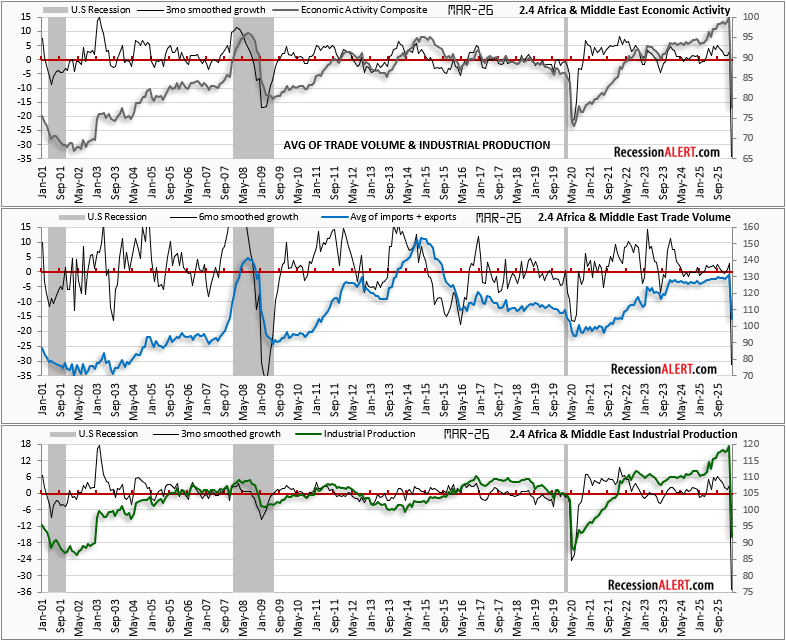
Chart of the Week: The structural explanation for why WTI dominated all five sessions this week: Middle East trade volume and industrial production collapsed at COVID-trough magnitudes in weeks, not years — and unlike prior oil shocks (1973, 1979, 1990) where barrels returned when politics resolved, this week’s US strikes on Qeshm Island targeted physical infrastructure that requires months to rebuild, not days. WTI’s intra-week roundtrip ($87→$96→$90) reflects diplomatic progress, but this chart shows the supply curve that diplomacy is racing against.
MIB Weekly Digest Ver. 1.64
For professional investors only. Not investment advice.
© 2026 RecessionALERT.com

Comments are closed.