
May NFP 172,000 — double the 85,000 consensus — snapped the S&P’s nine-week winning streak (-2.64%) and pushed Fed hike odds above 50% for the first time in 2026; FOMC blackout begins Saturday. AI semis cratered 11–17% (MRVL -16.74%, MU -13.25%) as Computex euphoria reversed, wiping $1T+. Meta reportedly weighing tens of billions in equity dilution for AI capex; META -5.5%. SpaceX priced $75B IPO at $1.77T valuation, Nasdaq debut June 12. Jun 10 CPI is the last print before Warsh’s June 17 debut.
TABLE OF CONTENTS
A. EXECUTIVE SUMMARY
B. MARKET DATA
C. HIGH-IMPACT STORIES (5)
D. MODERATE-IMPACT STORIES (5)
E. ECONOMY WATCH (6)
F. EARNINGS WATCH (0)
G. WHAT’S NEXT
H. CHART OF THE DAY
A. EXECUTIVE SUMMARY -> TOP
May’s 172,000 NFP print — more than double the 85,000 consensus and accompanied by a net +93,000 in upward revisions — delivered the most unambiguous hawkish signal of 2026, snapping the S&P 500’s nine-week winning streak on its worst single-day decline since October. Rate shock was the proximate catalyst, but damage was concentrated in AI semiconductors: the Nasdaq-100’s -4.77% collapse dwarfed the S&P’s -2.64% as Computex-week euphoria collided with a repriced rate environment — MRVL, MU, INTC, and QCOM each falling 11–17%. The macro-policy stakes are acute: FOMC blackout begins Saturday, and Chair Warsh chairs his inaugural June 16–17 meeting with Fed hike odds now above 50% locked in, with no Fed communication possible until after the decision. Today’s selloff was a rate-shock repricing, not a recession signal — the 2Y yield’s +10.2bps surge outpacing the 10Y’s +5.5bps confirms near-term tightening is the driver; Consumer Defensive (+1.60%) was the sole green sector, confirming systematic de-risking, not macro panic.
• May NFP 172K vs 85K consensus (+93K in upward revisions): Fed hike odds cross 50% for first time in 2026; “zero cuts” probability rises to 71.8%. FOMC blackout begins June 7 — rate repricing enters Warsh’s inaugural meeting locked in.
• AI semiconductor wipeout: MRVL -16.74%, MU -13.25%, INTC -11.28%, QCOM -10.98%, NVDA -6.3%, AVGO -7.6%; Technology sector -6.11% (worst day since Computex week); $1T+ in market cap erased in a single session.
• SpaceX prices $75B IPO at $1.77T valuation — largest primary equity offering in history; includes $30B Google AI compute deal (110,000 NVIDIA GPUs, $920M/month through 2029) and a separate Anthropic deal. Nasdaq debut June 12 under ticker SPCX.
• Meta reportedly weighing tens of billions in equity dilution for AI capex; META -5.5%. Follows Alphabet’s $84.75B equity raise this week — both signal AI infrastructure costs have grown beyond mega-cap free cash flow capacity.
• Gold -3.36% alongside equities (silver -8.05%, copper -4.19%, platinum -6.36%): simultaneous multi-asset selloff confirms forced institutional deleveraging, not safe-haven rotation. Dollar absorbed the defensive flows; VIX surged +40% to 21.57.
• Economy Watch: ISM Services PMI 54.5 (beat, 3-month high), but employment sub-index contracted while prices paid rose — a stagflationary services signal. Beige Book confirms K-shaped consumer stress: lower-income households increasing credit card use and reducing spending to necessities.
1. Rate Regime Inflection Enters Fed Blackout — Today’s NFP eliminated any residual cut optionality and elevated hike probability above 50% as a market consensus outcome for the first time in 2026. With FOMC blackout starting June 7, this repricing enters Warsh’s inaugural June 16–17 decision with no ability for Fed course-correction. Wednesday’s May CPI is the final data point before the meeting — a hot reading could push hike odds toward 70% and trigger a second wave of bond and equity repricing across an already-disrupted market.
2. AI Capex Financing Crack — From Self-Funding to Equity Markets — Alphabet raised $84.75B this week explicitly for AI infrastructure; Meta is reportedly considering a similar mega-raise. These signal that AI capex has grown so large that even trillion-dollar companies cannot self-fund it from operations. Yet SpaceX prices a $1.77T IPO partly on $30B+ in contracted AI compute revenue, confirming that demand for AI infrastructure is not in question — only who pays for it. The financing model has shifted from retained earnings to public equity dilution, creating a structural valuation headwind for the Magnificent 7 that compounds with the rate shock.
3. Forced Deleveraging Across Asset Classes — Gold, silver, copper, platinum, and Bitcoin all declined alongside equities rather than into them. Gold’s failure to attract safe-haven flows is the defining signal: when the most profitable, most liquid positions are sold alongside equities, it indicates margin calls and systematic risk-limit breaches cascading across portfolios — not orderly rotation. The VIX’s +40% surge to 21.57 marks a volatility regime shift; portfolios built on the low-VIX, rate-cut assumption of early 2026 have been structurally repriced in a single session.
 — Leading economic indicators. Accurate market forecasts. Apply for membership at join.recessionalert.com
B. MARKET DATA -> TOP
A blockbuster May payrolls report — 172,000 jobs against an 85,000 consensus, more than double expectations — snapped the S&P 500’s nine-week winning streak (-2.64%) and sent the Nasdaq-100 to its worst session of 2026 (-4.77%) as higher-for-longer rate fears collided with stretched AI valuations. Every major semiconductor name shed 11–17%, with Computex-week AI euphoria unwinding violently, while DJ Transportation (+0.65%) diverged sharply — falling crude providing a fuel-cost cushion that insulated logistics names. Consumer Defensive (+1.60%) was the only meaningful green sector as institutions rotated into PG, KO, and BRK-A, confirming systematic de-risking. Gold’s -3.36% decline alongside equities — rather than a safe-haven bid — signals broad-based forced deleveraging, not orderly rotation.
CLOSING PRICES – Friday, June 5, 2026:
MAJOR INDICES
Today’s session split into two distinct markets: the Nasdaq-100 (-4.77%) absorbed the AI/semis shock while DJ Transportation (+0.65%) diverged sharply — a 2.0% DJIA/DJTA same-day split emerges today for the first time this week, driven by falling crude cushioning logistics names as rate fears hammered high-multiple tech. Dow Theory bull confirmation technically remains in force — both DJIA and DJTA remain within 2% of their 10-session highs (DJIA at -1.35%, DJTA above its prior peak at +0.65%) — but today introduces the first structural crack in that signal. Russell 2000 (-3.51%) underperformed S&P 500 (-2.64%) on the session, consistent with broad risk-off, while NYSE breadth confirmed the rout: defensive sectors alone prevented a deeper headline decline.
| Index | Close | Change | %Move | Why It Moved |
|---|---|---|---|---|
| S&P 500 | 7,383.84 | -200.47 | -2.64% | NFP 172k vs 85k est. triggered rate-shock selloff; S&P breaks nine-week winning streak on worst single-day drop since October |
| Dow Jones | 50,866.78 | -695.15 | -1.35% | Blue-chip defensive premium cushioned the loss; Dow less exposed to AI/semis concentration than Nasdaq |
| DJ Transportation | 21,913.6 | +140.60 | +0.65% | Oil -3% cut fuel costs for airlines and trucking; DJTA diverged sharply from industrials creating today’s Dow Theory split |
| Nasdaq 100 | 28,957.60 | -1,450.21 | -4.77% | AI semis crashed 11–17% as Computex euphoria reversed; Meta -5.5% on stock offering news; rate shock hit high-multiple growth hardest |
| Russell 2000 | 2,832.35 | -102.98 | -3.51% | Rate-sensitive small-caps hit hard by higher-for-longer fears; NFP beat removed near-term rate cut expectations |
| NYSE Composite | 23,256.50 | -316.27 | -1.34% | Broad market selloff; defensive sector contributions (Consumer Defensive +1.60%, Healthcare +0.13%) partially offset the decline |
VOLATILITY & TREASURIES
VIX surging +40% to 21.57 while 10Y yields rose +5.5 bps and 2Y jumped +10.2 bps is a rate-shock signature, not a recession signal — in a recession scare bonds rally and yields fall. The 2Y’s steeper advance than the 10Y confirms markets are repricing the near-term Fed rate trajectory after the massive NFP beat, pricing out any remaining cut expectations; the yield curve flattened (10Y-2Y spread narrowed from 0.425% to 0.381%). DXY +0.65% reinforces the stronger-for-longer dollar narrative, adding another valuation headwind to equities and commodities.
| Instrument | Level | Change | Why It Moved |
|---|---|---|---|
| VIX | 21.57 | +6.17 (+40.06%) | Equity fear spike driven by NFP shock and AI/semis cascade; VIX crossing 20 resets volatility regime expectations |
| 10-Year Treasury Yield | 4.532% | +5.5 bps | NFP 172k vs 85k est. drove yields higher; market repriced Fed rate path as rate-cut timeline pushed further out |
| 2-Year Treasury Yield | 4.151% | +10.2 bps | 2Y led yields higher — most sensitive to Fed expectations; curve flattened as short end repriced near-term rate hike risk |
| US Dollar Index (DXY) | 100.06 | +0.65 (+0.65%) | Dollar strengthened on hot NFP; higher-for-longer US rates attracted dollar flows and pressured commodity complex |
COMMODITIES
A textbook forced-deleveraging pattern: gold (-3.36%), silver (-8.05%), copper (-4.19%), and platinum (-6.36%) all fell simultaneously alongside equities — gold’s failure to catch a safe-haven bid is the defining signal, pointing to portfolio-wide institutional unwinding rather than orderly risk rotation. Bitcoin’s -3.38% tracked equities exactly, confirming risk-asset correlation with no crypto-specific catalyst. When all four precious and industrial metals sell off together on a major equity down day, it signals margin calls or systematic de-risking across asset classes, not merely a sector rotation.
| Asset | Price | Change | %Move | Why It Moved |
|---|---|---|---|---|
| Gold | $4,353.55/oz | -$151.45 | -3.36% | NFP-driven dollar strength and rising real yields pressured gold; no safe-haven bid — forced deleveraging dominated buying |
| Silver | $68.015/oz | -$5.956 | -8.05% | Dual hit: industrial demand concerns from growth slowdown fears plus broad precious metals complex deleveraging |
| Copper | $6.2610/lb | -$0.274 | -4.19% | Stronger dollar pressured commodity complex; global growth concerns from higher-for-longer rates weighed on industrial demand outlook |
| Platinum | $1,779.05/oz | -$120.85 | -6.36% | Precious metals complex deleveraging; industrial demand concerns amplified selling alongside broader commodity selloff |
| Bitcoin | $61,469 | -$2,152 | -3.38% | Tracked equity risk-off with no crypto-specific catalyst; consistent with broad institutional de-risking pattern |
ENERGY
Energy fell WITH equities — a demand-destruction read, not a supply shock. WTI (-3.01%) fell further than Brent (-2.20%), modestly widening the WTI/Brent spread to $2.70, as US-Iran ceasefire extension talks continued to ease supply disruption fears. Natural gas (-3.42%) decoupled from crude on its own supply story: LNG export throughput fell to 16.4 bcfd from 17.1 bcfd in May as seasonal maintenance at Golden Pass and Freeport LNG cut capacity. Dutch TTF was flat in EUR terms; the stronger dollar accounts for virtually its entire USD-denominated decline of -0.77%.
| Asset | Price | Change | %Move | Why It Moved |
|---|---|---|---|---|
| Crude Oil (WTI) | $90.24/bbl | -$2.80 | -3.01% | US-Iran ceasefire extension talks eased supply disruption fears; demand-side pressure from global growth uncertainty |
| Crude Oil (Brent) | $92.94/bbl | -$2.09 | -2.20% | Same geopolitical dynamics as WTI; spread to WTI held at $2.70 — no regional supply disruption signal |
| Natural Gas (Henry Hub) | $3.222/MMBtu | -$0.114 | -3.42% | LNG export throughput fell to 16.4 bcfd from 17.1 bcfd in May; seasonal maintenance at Golden Pass and Freeport LNG cut capacity |
| Natural Gas (Dutch TTF) | $16.46/MMBtu | -$0.13 | -0.77% | Flat in EUR terms (€48.752, 0.00%); USD-denominated decline driven entirely by EUR/USD -0.77% on stronger dollar |
S&P 500 SECTORS
Today’s defensive flight inverts the prior month’s pattern completely: Consumer Defensive leads the day (+1.60%) despite being the 1-month worst performer (-2.97%) and 3-month laggard (-2.56%). Technology (-6.11%) — the 3-month and 1-year leader (+25.17%, +43.45%) — suffered the most violent single-day reversal. Basic Materials (-5.05%) deepens its near-term slide (1-week -5.54%, 1-month -6.39%), now the worst short-horizon streak of any sector — a structural concern independent of today’s macro catalyst.
| Sector | 1-Day | 1-Week | 1-Month | 3-Month | 6-Month | YTD | 12-Month |
|---|---|---|---|---|---|---|---|
| Consumer Defensive | +1.60% | +0.79% | -2.97% | -2.56% | +4.83% | +6.44% | +1.94% |
| Real Estate | +0.57% | +0.93% | -0.61% | +3.17% | +6.59% | +8.71% | +7.42% |
| Utilities | +0.21% | -0.89% | -4.95% | -4.53% | +1.48% | +3.96% | +13.08% |
| Healthcare | +0.13% | +0.80% | +2.59% | +0.03% | -1.57% | -1.42% | +14.74% |
| Financial | -0.39% | +0.52% | +0.12% | +4.93% | +0.75% | -1.94% | +10.47% |
| Industrials | -1.54% | -0.48% | -1.75% | +4.32% | +15.63% | +14.52% | +25.78% |
| Communication Services | -1.63% | -3.88% | -5.60% | +5.68% | +2.45% | +2.88% | +28.27% |
| Energy | -2.16% | +1.70% | -1.21% | +2.86% | +25.24% | +28.22% | +40.54% |
| Consumer Cyclical | -2.48% | -5.52% | -5.83% | +0.84% | -5.63% | -5.25% | +5.02% |
| Basic Materials | -5.05% | -5.54% | -6.39% | -2.87% | +15.05% | +10.97% | +37.11% |
| Technology | -6.11% | -4.62% | +4.08% | +25.17% | +18.27% | +19.63% | +43.45% |
TOP MEGA-CAP MOVERS:
GAINERS
| Company | Ticker | Close | Change | Why It Moved |
|---|---|---|---|---|
| Procter & Gamble Co | PG | $146.54 | +4.09% | Classic defensive flight-to-safety rotation; Consumer Defensive sector’s best day in months as institutions de-risked from AI/semis |
| Coca-Cola Co | KO | $99.48 | +3.46% | Same defensive rotation as PG; stable dividend and recession-resistant business attracted risk-reduction flows |
| Berkshire Hathaway Inc | BRK-A | $733,550 | +2.11% | Buffett value/defensive profile outperforms on high-volatility days; large cash position and diversified book cushion rate shock |
| Johnson & Johnson | JNJ | $232.77 | +2.02% | Defensive Healthcare rotation; dividend quality bid on flight-to-safety as Healthcare sector held positive (+0.13%) on the day |
| Berkshire Hathaway Inc | BRK-B | $488.13 | +1.98% | Same defensive drivers as BRK-A; Berkshire B shares mirror parent company’s risk-off premium |
DECLINERS
| Company | Ticker | Close | Change | Why It Moved |
|---|---|---|---|---|
| Marvell Technology Inc | MRVL | $263.47 | -16.74% | Computex-week AI euphoria reversal; MRVL had surged 32%+ on Jensen Huang’s “next trillion-dollar company” call (June 2); NFP rate shock amplified profit-taking on extreme valuation |
| Micron Technology Inc | MU | $864.01 | -13.25% | Memory chip demand concerns as higher rates compress AI capex outlook; caught in broad semiconductor complex selloff |
| Sandisk Corp | SNDK | $1,559.32 | -11.39% | Storage/flash memory caught in AI capex reversal; benefited from Computex AI enthusiasm and reversed sharply with it |
| Intel Corp | INTC | $99.17 | -11.28% | Broad semiconductor selloff; foundry profitability concerns amplified by AI spending uncertainty on higher-rate outlook |
| Qualcomm Inc | QCOM | $215.94 | -10.98% | Mobile chip leader hit by AI capex pullback fears; high P/E multiple particularly vulnerable to rate-driven multiple compression |
— Institutional-grade intelligence for serious investors. Apply for membership at join.recessionalert.comC. HIGH-IMPACT STORIES -> TOP
BEARISH
1. May NFP 172,000 — 2x Consensus Blowout Detonates Rate Shock; S&P Posts Worst Day Since October, VIX +40%
The core facts:The BLS released its May Employment Situation report at 8:30 AM ET: 172,000 nonfarm payrolls added vs. 85,000 consensus — more than double expectations. Prior months were revised upward a net +93,000 (March: 185K→214K; April: 115K→179K). The unemployment rate held at 4.3% (in line); average hourly earnings rose 0.3% MoM / 3.4% YoY (slight deceleration from 3.6%, in line with estimates). Market reaction was immediate and violent: S&P 500 -2.64% — its worst single-session decline since October and breaking a 9-week winning streak; Nasdaq -4.77%; VIX surged 40% to 21.57. The 10-year Treasury yield rose 5.5 basis points to 4.532%, crossing the 4.5% threshold; the 2-year yield surged 10.2 basis points to 4.151% — the curve flattened sharply as the front end priced in an elevated probability of Fed tightening. The DXY dollar index gained ~30 points. Fed year-end rate-hike probability on CME FedWatch climbed to approximately 61%; Kalshi showed hike odds crossing 52% — the first time in 2026 that a rate hike has been the majority-consensus outcome for the Fed.
Why it matters:The NFP blowout eliminates any residual near-term rate cut probability and resurrects hike speculation at the worst possible moment for markets: FOMC blackout begins Saturday June 7, Chair Kevin Warsh’s inaugural FOMC meeting is June 16-17, and the committee already had four hawks dissenting toward a hike at the May 1 meeting. Today’s data delivers the most unambiguous hawkish signal of 2026 — a labor market running at 172K/month with 93K of positive revisions is not a Fed-pivot setup under any framework. The 2Y yield outpacing the 10Y by 4.7 basis points in a single session is particularly telling: the Treasury market is pricing the short end (Fed action) upward faster than the long end (inflation expectations), a pattern consistent with markets pricing in policy tightening rather than inflation spiral. The VIX spike to 21.57 signals a volatility regime shift — the complacent low-VIX environment of the past several weeks was pricing in rate-cut scenarios that today’s print conclusively invalidates. Crucially, this repricing enters FOMC blackout locked in: the Fed cannot communicate, and markets cannot revise their assessment before Warsh’s first decision.
What to watch:The June 16-17 FOMC decision and statement — Warsh’s first post-meeting press conference will be his initial communication on the rate path under his leadership. CME FedWatch hike probability evolution through the blackout period; the 2-year Treasury yield for any sustained break above 4.20% that would embed a full 25bps hike into the front end.
BEARISH
2. AI Semiconductor Collapse — Computex Euphoria Reverses; MRVL -16.74%, MU -13.25%, Tech Sector -6.11%; $1T+ Wiped in Single Session
The core facts:The AI semiconductor complex suffered its worst single-session wipeout in months: Marvell Technology (MRVL) -16.74%, Micron (MU) -13.25%, SanDisk (SNDK) -11.39%, Intel (INTC) -11.28%, Qualcomm (QCOM) -10.98%, Applied Materials (AMAT) -9.71%, ASML -6.59%, NVIDIA (NVDA) -6.3%, Broadcom (AVGO) -7.6%. The Technology sector fell -6.11% — the worst of all 11 S&P 500 sectors and the sector’s worst single day in recent months. The Nasdaq Composite dropped 4.77% (approximately 1,121 points), with semiconductor stocks accounting for the majority of the decline. Two distinct catalysts converged: (1) Computex AI euphoria reversal — MRVL had surged 32.52% in a single session (its largest gain since 2000) after NVIDIA CEO Jensen Huang called Marvell “the next trillion-dollar company” at Computex 2026 (June 2), and the broader semiconductor complex had rallied ~90% in under three weeks; (2) NFP rate shock — the 172K payrolls blowout drove real yield expansion, compressing the high-multiple AI semiconductor valuations that had been priced on rate-cut assumptions.
Why it matters:MRVL’s -16.74% reversal after a 32.52% Computex surge represents the most dramatic single-stock momentum collapse in the semiconductor space since the early post-ChatGPT era. The critical analytical distinction from yesterday’s AVGO guidance story: today’s selloff is macro-driven (rate shock amplifying already-stretched valuations), not company-specific — every major semiconductor name fell regardless of its own recent guidance. This is a valuation correction forced by external monetary conditions, not a signal about AI chip demand fundamentals. However, the distinction matters less to portfolio managers managing risk: the combined AI semiconductor and equipment complex lost in excess of $1 trillion in market capitalization in a single session, triggering risk models and margin calls that in turn force further liquidation. For the broader market, the Technology sector’s -6.11% single-day decline was the primary driver of the S&P’s -2.64% and constitutes a significant de-rating of the “AI premium” embedded across growth portfolios. The question for the weeks ahead is whether today’s move represents a mean-reversion of Computex-week excess (in which case MRVL at a pre-Computex level would be a buying opportunity) or the beginning of a sustained compression of AI hardware multiples driven by the rate environment.
What to watch:MRVL’s price relative to its pre-Computex level (~$165) as a gauge of how much Computex premium has been returned; the Philadelphia Semiconductor Index (SOX) for support level confirmation; any hyperscaler AI capex guidance revisions in upcoming earnings calls that could reestablish the demand narrative.
UNCERTAIN
3. US-Iran De-escalation Extends; WTI Falls 3% Toward $90 Threshold — Energy Secretary Wright Orders 40M-Barrel SPR Payback
The core facts:WTI crude oil fell -3.01% to $90.24/bbl; Brent crude declined -2.20% to $92.94/bbl, extending Thursday’s decline as traders gained confidence that the US-Israel-Iran conflict is unlikely to escalate further. Energy Secretary Chris Wright announced Friday that companies which borrowed Strategic Petroleum Reserve crude during the Iran conflict will be required to return 40 million additional barrels — payable as a premium above the borrowed volume once hostilities resolve — a signal that the US government is moving to normalize oil supply management post-conflict. The Energy sector fell -2.16% on the session, the second-worst performing sector after Technology, despite remaining the year-to-date leader (+28.22%). Separately, Reuters reported that analysts and oil executives warned on Friday that global oil inventories remain heavily depleted after the conflict-driven supply shock, leaving markets acutely vulnerable to any renewed disruption. Baker Hughes reported Friday that the US oil rig count rose to 431 (+2) — a seventh consecutive weekly gain, the longest streak since 2022 — signaling that producers are responding to elevated prices with accelerating drilling.
Why it matters:The UNCERTAIN classification reflects a genuine dual dynamic at work: the oil price decline from $96+ earlier this week toward $90 is directionally bullish for the macro environment — each sustained $10 decline in WTI removes approximately 25-35 basis points from headline PCE, a meaningful offset in a day when NFP just printed its most hawkish read of 2026. Reaching and sustaining $90 would begin to provide measurable inflation relief to the Fed by the July PCE print. However, the Reuters supply vulnerability warning cannot be dismissed as noise: global inventories depleted over two weeks of geopolitical disruption cannot be restocked in days, and the US SPR buffer was partly drawn down during the conflict. The Energy Secretary’s SPR payback announcement — while orderly — confirms the buffer was used and must be rebuilt, not a sign of abundant supply cushion. The Baker Hughes 7-week rig streak shows producer response, but new wells take 3-12 months to reach production. The critical risk: any renewed Iran-related supply disruption, even a partial one, would hit an exceptionally thin global inventory cushion — and this week’s $6 decline would reverse with extreme speed.
What to watch:WTI’s $90/barrel level as the PCE-relief inflection point for Fed policy; any formal US-Iran diplomatic statement on terms of engagement before the June 7 FOMC blackout; EIA weekly crude inventory data for signs of the depleted-inventory risk crystallizing.
BULLISH
4. SpaceX IPO Priced at $135/Share — $1.77 Trillion Valuation, $75 Billion Raise; Largest IPO in History Targets Nasdaq Debut June 12
The core facts:SpaceX priced its Nasdaq IPO at $135 per share on Friday, targeting a $1.77 trillion valuation via an offering of approximately 556 million Class A shares for total proceeds of $75 billion — the largest primary equity offering in market history, surpassing Saudi Aramco’s 2019 $25.6 billion raise by nearly 3x. The roadshow begins June 8; the Nasdaq debut is targeted for June 12 under the ticker SPCX. Two significant pre-IPO AI compute deals were disclosed in the offering documents: Google agreed to pay SpaceX $920 million per month from October 2026 through June 2029 (total value approximately $30 billion) for access to 110,000 NVIDIA GPUs to power Google’s Gemini AI models; SpaceX separately entered a similar compute arrangement with Anthropic. At $1.77 trillion, SPCX would rank among the top four or five US companies by market capitalization on the day it lists, above Meta Platforms and below Microsoft, Apple, and NVIDIA.
Why it matters:The SpaceX IPO is a watershed capital markets event for three reasons simultaneously: (1) Scale precedent — a $75 billion primary raise tests whether public equity markets have the depth to absorb offerings of this magnitude; the successful pricing suggests they do, critical validation for the pipeline of major AI-economy IPOs anticipated in 2026-2027 (Anthropic, OpenAI, and others). (2) AI infrastructure dual mandate — SpaceX enters the public markets as the only company simultaneously operating in space launch/Starlink broadband AND the AI GPU compute leasing market; the Google and Anthropic deals transform SpaceX into an AI cloud infrastructure provider with $30B+ in contracted revenue from day one of public life. (3) Index mechanics — at $1.77T, SPCX will be among the largest Nasdaq-listed companies; S&P 500 and Nasdaq-100 index inclusion will force passive funds to build positions on or shortly after June 12, creating known institutional demand pressure. For portfolio managers, SPCX’s listing reshapes the large-cap technology landscape: it is simultaneously a defense/aerospace name, a broadband communications company, and an AI infrastructure provider — with no clean peer comparison in the existing index framework.
What to watch:SpaceX (SPCX) June 12 Nasdaq debut — trading volume and first-day price action relative to the $135 offer price; S&P 500/Nasdaq-100 index committee inclusion announcement timeline; any additional hyperscaler compute contracts disclosed during the roadshow (June 8-11).
BEARISH
5. Meta Considers Tens of Billions in Stock Offering to Fund AI Capex — META -5.5%; Follows Alphabet’s $84.75B Equity Raise This Week
The core facts:The Financial Times reported Friday that Meta Platforms is considering selling tens of billions of dollars of new stock to fund its AI infrastructure buildout, which could reach $145 billion in spending in 2026 and increase further in 2027. Meta has not yet hired investment banks and may ultimately decide against an offering, but the internal discussions have advanced enough to surface in reporting. Meta shares fell more than 5% on Friday on the report. The FT story arrives in the immediate wake of Alphabet (Google parent) completing its own $84.75 billion equity offering this week — the largest-ever single corporate equity raise — also explicitly designated for AI infrastructure. Meta’s AI capex plan is the most aggressive among the Magnificent 7 as a percentage of revenue; the company previously guided $60-65B in 2025 capex and has substantially exceeded that pace in 2026.
Why it matters:Even an unconfirmed report of tens-of-billions in equity dilution sends META down more than 5% because it exposes a fundamental structural shift: AI capex has exceeded Meta’s organic free cash flow generation capacity. For years, the Magnificent 7’s AI investments were described as self-funding — cash machines reinvesting their own profits into the next growth cycle. Alphabet raising $84.75B and Meta reportedly considering a similar move signals that AI infrastructure spending has grown so large, so fast, that even trillion-dollar companies cannot fund it from operations alone. The market’s reaction is rational: dilution means existing shareholders own less of the same cash flows, and the “AI capex is productive investment” thesis requires that the returns on that capital eventually show up in revenue growth and margins — a timeline that is years away. For the Communication Services sector (which fell -1.63% on Friday), this is a structural earnings headwind: capex goes up immediately, earnings come later, and equity raises arrive in between. The precedent is also concerning from a capital allocation standpoint: if both Google and Meta are simultaneously raising equity for AI, the capital markets competition for tech equity proceeds will be fierce through 2026-2027.
What to watch:Any Meta confirmation of banking mandates (the escalation step between “considering” and “executing”); Meta’s next earnings call or analyst day for updated 2026-2027 capex guidance vs. FCF generation; Alphabet’s post-offering stock performance as the template for how the market absorbs large AI infrastructure equity raises.
— Quantifying recession risk so you don’t have to guess. Apply for membership at join.recessionalert.comD. MODERATE-IMPACT STORIES -> TOP
BEARISH
6. Fed Rate Hike Odds Cross 50% for First Time in 2026 — Polymarket/Kalshi Inflection Signals Rate Regime Shift Before Warsh’s Debut
The core facts:Kalshi’s Federal Reserve rate hike probability market rose from approximately 40% to 53% on the May NFP beat — the first time in 2026 that a rate hike has been the majority-consensus outcome on prediction markets. CME FedWatch showed the probability of at least one 25bps hike before year-end at approximately 61%. The “zero cuts” probability climbed to 71.8% (from roughly 60% before NFP). The Motley Fool summarized the market read: “odds of the Fed cutting interest rates before 2028 are now slim to none.” Context: hawkish FOMC member Cleveland Fed President Beth Hammack pre-signaled on June 2 that it “may be appropriate to act soon” — remarks that now read as forward guidance for a rate increase rather than mere caution. FOMC blackout begins June 7, locking in today’s repricing as the market’s final verdict before Warsh’s June 16-17 decision.
Why it matters:The crossing of the 50% threshold for rate hike (not cut) probability is a market structure inflection with direct implications for portfolio construction. Fund managers running against consensus previously had a defensible argument that cuts remained the base case; that argument no longer holds. The repricing has immediate consequences across asset classes: short-end bonds (2Y yield now pricing hike risk), REITs (rate-sensitive, already under pressure), consumer credit (30-year mortgage at 6.48% has no near-term relief path), leveraged finance (floating-rate exposure for private equity-backed companies grows more burdensome), and long-duration growth stocks (discount rate goes up, valuations go down). The Hammack signal is particularly important: she was one of four dissenting FOMC members at the May meeting and appears to have been telegraphing what she will vote for in June. If Warsh aligns with the hawk wing at his inaugural meeting, a June 17 hike is live.
What to watch:Warsh’s June 17 post-FOMC press conference for his first explicit signal on the rate path; the 2-year Treasury yield as the real-time hike probability instrument — any sustained break above 4.20% embeds a full hike; CME FedWatch evolution through the 10-day blackout period.
BEARISH
7. Gold Fails Safe-Haven Test — Falls 3.36% to $4,354 Alongside Equities; Silver -8.05%, Copper -4.19%; Dollar Absorbs Defensive Flows
The core facts:Gold fell -3.36% to $4,353.55/oz — the lowest price of 2026 and on pace for the worst weekly performance of the year (down nearly 4% for the week). Silver declined -8.05%, copper -4.19%, and platinum -6.36%. All four precious and industrial metals sold off simultaneously alongside equities rather than providing the safe-haven bid that geopolitical uncertainty typically generates. The US Dollar Index (DXY) surged approximately 30 points on the NFP beat, absorbing the defensive flows that in prior cycles would have flowed into gold. Real yields (10Y TIPS) moved sharply higher as the 10Y nominal yield rose 5.5bps while inflation breakevens were relatively stable — a direct headwind for non-yielding assets like gold.
Why it matters:Gold declining alongside equities in a major risk-off session is a clear signal of institutional forced deleveraging rather than ordinary sector rotation. The mechanism: as equity portfolios decline (S&P -2.64%, Tech -6.11%), margin calls and risk-limit breaches force liquidation of the most profitable, most liquid positions — gold, which had previously appreciated on the Iran conflict geopolitical premium, is prime for forced selling. The dual negative for gold (higher real yields + Iran de-escalation removing the conflict premium) created maximum selling pressure. The silver -8.05% and copper -4.19% moves are particularly informative: industrial metals collapsing alongside precious metals indicates this is portfolio-level de-risking, not merely a monetary metal repricing. For portfolio managers, gold’s safe-haven failure in this session has a distinct strategic implication: in a rate-hike environment, the dollar — not gold — is now the primary defensive asset. Portfolios constructed with gold as the primary macro hedge are now misaligned with the 2026 rate environment.
What to watch:Gold’s $4,300/oz level as first technical support after breaking 2026 lows; CFTC Commitments of Traders report for reduction in institutional net-long gold positioning; real yields (10Y TIPS) as the structural driver — if real yields stabilize, gold should find a floor.
BULLISH
8. Google Agrees to $30B SpaceX GPU Compute Deal — $920M/Month for 110,000 NVIDIA GPUs to Power Gemini AI
The core facts:Google agreed to pay SpaceX $920 million per month from October 2026 through June 2029 for access to 110,000 NVIDIA GPUs to power its Gemini AI models, with a reduced fee applying during a ramp-up period before October. Total contract value exceeds $30 billion. The agreement — disclosed in SpaceX’s IPO filing on Friday — allows Google to terminate with 90 days notice after December 31, 2026; if SpaceX fails to deliver full committed GPU capacity by September 30, Google may terminate outright or accept a pro-rata reduction. SpaceX separately signed a similar compute arrangement with Anthropic, disclosed alongside the Google deal. TechCrunch first reported the details; Reuters and WSJ confirmed.
Why it matters:Google — one of the world’s largest cloud infrastructure operators with its own custom TPU chips and data centers — agreeing to pay $920 million per month to rent GPUs from a rocket company is the single most revealing data point about the magnitude of the current AI compute shortage. It signals that even hyperscalers with in-house silicon are unable to self-supply GPU capacity at the pace AI model training and inference demands. For NVIDIA, the deal is a structural demand validation: 110,000 H100/B100-class GPUs at $30,000-$40,000 per unit represents $3-4 billion of NVIDIA hardware embedded in a single bilateral arrangement, entirely separate from the hyperscaler direct-purchase programs. The Anthropic deal adds further contracted demand. Combined, SpaceX’s pre-IPO GPU compute contracts confirm that a new category of “AI compute infrastructure provider” has emerged — one that competes with AWS, Azure, and Google Cloud for AI workloads, not by building data centers, but by aggregating GPU inventory at scale. This has long-term implications for cloud pricing and hyperscaler competitive positioning.
What to watch:SPCX June 12 IPO debut for market valuation of the AI compute revenue stream; AWS and Azure responses to SpaceX’s entry into the managed GPU compute market; NVIDIA’s next earnings data center revenue guidance for any disclosure of contracted compute partnership revenue.
UNCERTAIN
9. Intel Analyst Upgrade Wave Amid Semiconductor Selloff — Contrarian Calls Defend 250% YTD Rally Thesis as INTC Falls -11.28%
The core facts:Despite Intel (INTC) falling -11.28% Friday in the broad AI semiconductor selloff, multiple Wall Street analysts issued or reiterated upgrades on the stock, characterizing the decline as a macro-driven correction that does not undermine Intel’s structural thesis. INTC had rallied approximately 250% year-to-date entering June — one of the largest YTD gains among S&P 500 large-caps — driven by Intel Foundry Services (IFS) ramp expectations, AI PC chip demand (Intel Core Ultra), and US semiconductor independence policy tailwinds. China Renaissance also initiated NVIDIA (NVDA) with a Buy rating and $319 price target on Friday, directly into the session when NVDA fell -6.3% — a similarly contrarian call on the AI chip leader.
Why it matters:Analyst upgrades into a -11% single-session decline are a meaningful contrarian signal — they indicate that buy-side desk conviction in the structural thesis remains intact even as the macro environment forces a tactical de-rating. For Intel specifically, the upgrade wave makes the distinction between two sources of INTC’s 250% YTD gain: the rate-sensitive speculative multiple (being compressed today) and the policy-driven foundry thesis (not rate-sensitive). Intel Foundry Services’ US-domestic semiconductor independence mandate from both Congress and the executive branch does not change because the 2-year yield moved 10bps in a day. However, the UNCERTAIN classification reflects real risk: Intel has historically disappointed on execution timelines (18A process node, foundry customer conversion rates), and a rate-shock environment that pushes up cost of capital makes the long multi-year payoff of a foundry turnaround story less attractive relative to near-term returns from other sectors.
What to watch:Intel’s next earnings call for 18A process node customer traction and IFS utilization metrics; any CHIPS Act funding disbursements to Intel Foundry as a policy support catalyst; AMD’s AI GPU market share data as the alternative capital allocation target in the semiconductor space.
UNCERTAIN
10. Oil Supply Paradox: Seven-Week US Rig Count Streak Meets Depleted Global Inventories — Markets Vulnerable Despite Ceasefire De-escalation
The core facts:Baker Hughes reported Friday that the US oil rig count rose to 431 (+2) — a seventh consecutive weekly increase and the longest streak since 2022 — confirming that US producers are responding to elevated oil prices with a sustained acceleration in drilling activity. Simultaneously, Reuters reported that analysts and oil sector executives warned on Friday that global oil inventories remain heavily depleted following the Iran-conflict supply shock, leaving markets acutely vulnerable to any renewed disruption despite this week’s $6/bbl price decline. The EIA’s most recent weekly data (week ended May 29) showed a -8.0 million barrel crude inventory draw, combined with an 8 million barrel SPR release — the SPR buffer was partially drawn down during the conflict and must be rebuilt. WTI traded at $90.24 on Friday despite the geopolitical de-escalation, underscoring the floor provided by tight inventories.
Why it matters:The oil supply picture entering the summer demand season presents a structurally bifurcated setup: the bullish medium-term (depleted global inventories, depleted SPR, 7-week rig ramp) coexisting with the bearish short-term (Iran de-escalation removing the geopolitical premium, WTI declining from $96 toward $90). For the Fed’s inflation calculus, the critical question is whether this week’s oil decline is the beginning of a sustained move toward $80 (meaningful PCE relief) or a short-term retracement before inventories reassert a higher floor (oil stabilizes at $90-95, limiting inflation relief). The rig count acceleration is a medium-term bullish signal for US production, but new wells take 3-12 months to reach output — providing no near-term supply cushion for the current depleted inventory environment. The Reuters supply shock warning is not alarmist: thin inventories mean that even a partial supply disruption (a single infrastructure incident, an OPEC quota cut, or a renewed Iran incident) could push WTI back above $95 with extraordinary speed.
What to watch:EIA weekly crude inventory data for the next 4-6 weeks as the primary signal for whether the SPR drawdown and conflict-era depletion is being reversed; Baker Hughes rig count for acceleration or deceleration of the drilling response; WTI’s $85/barrel level as the threshold below which energy-sector earnings estimates would begin to face revision.
— Separating signal from noise since 2007. Apply for membership at join.recessionalert.comE. ECONOMY WATCH -> TOP
Friday’s May jobs report — 172,000 vs an 85,000 consensus, with back-month revisions adding another 93,000 — rewrote the 2026 monetary policy narrative from “when do we cut” to “do we hike”: the 10-year yield surged 6.7 basis points past 4.54%, Polymarket crossed 50% on a Fed hike for the first time, and Nasdaq fell 3% in the classic good-news-is-bad-news trade. The ISM Services PMI beat (54.5) and Beige Book reinforced a resilient-but-bifurcated economy — upper-income spending intact, lower-income under credit-card stress, prices moderate to strong in 10 of 12 Fed districts. Chair Warsh chairs his debut FOMC in 11 days; FOMC blackout starts Saturday; Wednesday’s May CPI is the last major data print before the decision.
May Nonfarm Payrolls Soar to 172K — Double the Consensus; Treasury Yields Surge Past 4.5%, Nasdaq Tumbles 3% (BLS / FXStreet, June 5, 2026)
What they’re saying:The U.S. economy added 172,000 jobs in May — more than double the 85,000 consensus and topping the highest individual forecast in the range. Manufacturing payrolls added 7,000 (vs. 2,000 expected), government hiring surged 52,000, and prior months were revised up a net 93,000 (March to +214K, April to +179K). The unemployment rate held at 4.3% (in line), participation was unchanged at 61.8%, and average hourly earnings came in at 0.3% MoM and 3.4% YoY — both exactly in line with consensus, providing no additional inflation signal.
The context:The blowout print triggered an immediate “good news is bad news” reaction. The 10-year Treasury yield surged 6.7 basis points to 4.542% (crossing 4.5% for the first time since March), the 2-year added 10 basis points to 4.15%, the Nasdaq fell 3% as higher yields crushed tech valuations, and the DXY rose above 100. Odds of a Fed hike by year-end jumped to 61% from 45%. With FOMC blackout starting Saturday and Warsh’s debut meeting June 16–17, the strong print significantly narrows the Fed’s room to pivot toward cuts and positions hike risk as the dominant tail scenario.
What to watch:May CPI (Wednesday, Jun 10) — if inflation also surprises to the upside, a dual-hot jobs-plus-inflation reading would significantly increase the probability of a hike at or before the September FOMC meeting. Watch 10-year yield above/below 4.5% as a key risk-off trigger for equities.
Cleveland Fed’s Hammack: Rates May Need to Rise “Soon” if Inflation Trends Persist (Federal Reserve Bank of Cleveland, June 2, 2026)
What they’re saying:In a June 2 speech at the City Club of Cleveland — ahead of Friday’s NFP blowout — Fed President Beth Hammack said holding rates steady is “reasonable for now” given elevated uncertainty, but added that if recent data trends continue, “it may soon be appropriate for policy to act” to counter persistently elevated inflation. Hammack was one of four dissenters at the April 28-29 FOMC, objecting to the forward guidance language. Post-NFP, year-end hike odds rose to 61% (CME) and Polymarket’s Fed hike market crossed 53%.
The context:Hammack’s framing adds institutional weight to a hawkish narrative that had been building since April’s FOMC minutes revealed most participants favored removing the easing bias and that many believed hikes would be appropriate if inflation persisted above 2%. Chair Warsh — who took over May 22 and chairs his first FOMC June 16-17 — has not publicly signaled a preference. Friday’s jobs data effectively ends any dovish optionality at the June meeting. The FOMC blackout begins Saturday, June 7, silencing all Fed communication until after the June 17 decision.
What to watch:Any pre-blackout Fed remarks today (Friday, Jun 5) are the final communication window; June 10 CPI and June 11 PPI are the last two major inflation data points before the decision. Hammack is a non-voter in 2026 but her views reflect the internal Committee shift toward hike-or-hold, not cut.
Prediction Markets: Fed Rate Hike Odds Cross 50% for First Time After Jobs Blowout (Polymarket, June 5, 2026)
What they’re saying:Following Friday’s NFP blowout, Polymarket’s Fed rate hike market surged to 53% (from 40% prior session — a +13 percentage-point jump), crossing above 50% and signaling that traders now see a hike as more likely than not at some point in 2026. The probability of zero rate cuts this year also rose to 71.8%, implying ≥1 cut odds fell to just 28% (from 31%). Recession odds moved only marginally to 19% (from 18%), a notably small reaction given the scale of the rate repricing.
The context:The 50% threshold crossing is a momentum signal — prediction markets tend to self-reinforce once a scenario becomes consensus. The divergence between stable recession odds (19%) and rising hike odds (53%) is a “no landing” or mild stagflation signal: the economy is too strong for cuts, but inflation is too elevated for easing. This rate scenario is directly hostile to the equity multiple expansion that drove Q1 2026’s record earnings; a higher-for-longer path removes the valuation tailwind that has been supporting S&P 500 forward P/E expansion since January.
What to watch:Polymarket Fed hike market through June 10 CPI — a hot print could push hike odds toward 70% and trigger a second wave of yield and equity repricing ahead of the June 16-17 FOMC.
ISM Services PMI 54.5 in May — 3-Month High Beat, But Employment Contracts and Prices Accelerate (ISM, June 3, 2026)
What they’re saying:The ISM Services PMI jumped to 54.5 in May, beating the 53.8 consensus and rising from April’s 53.6 — the 23rd consecutive month of services expansion and the strongest reading since February. Business activity surged to 57.7 (from 55.9) and new orders jumped to 57.3 (from 53.5), signaling robust demand pipelines entering the summer. Services account for approximately 78% of U.S. GDP; the sustained expansion directly supports the labor market resilience confirmed in Friday’s NFP.
The context:Beneath the headline beat, two sub-indices told a conflicting story: employment contracted while prices paid intensified. The combination — employers cutting headcount while passing through higher costs to customers — is the services-sector inflation persistence the Fed has explicitly flagged as a concern since 2024. Unlike goods inflation (which can cool quickly), services price pressure is sticky and labor-intensive; if the employment contraction within services is a leading indicator of broader labor softening, the current headline resilience in NFP may be narrower than it appears.
What to watch:Services employment sub-index over the next 1-2 months — if it remains contractionary while prices paid stay elevated, it reinforces stagflationary dynamics within the sector that is responsible for the majority of GDP and employment.
Beige Book: Modest Growth in 10 of 12 Districts, K-Shaped Consumer Stress, Inflation Rising (Federal Reserve, June 3, 2026)
What they’re saying:The Federal Reserve’s June 2026 Beige Book found economic activity growing at a “slight to moderate” pace in 10 of 12 districts (one district reported a slight decline; one reported no change). Employment was essentially flat in 11 of 12 districts. Consumer spending was sharply bifurcated: higher-income households remained resilient and price-insensitive, while middle-income consumers stretched budgets further, and lower-income households increased credit card use, reduced retail visits, and shifted spending to necessities. Manufacturing grew modestly to strongly in 9 of 12 districts.
The context:The Beige Book portrait — modest growth, flat employment, rising prices, lower-income financial stress — is the Fed’s preferred qualitative cross-check against hard data. The K-shaped consumer dynamic is particularly significant: headline aggregate spending figures remain stable because upper-income households (who own most financial assets) are still spending freely, masking the accumulation of financial stress at the lower end. This bifurcation means delinquency risk can build invisibly in the aggregate data until it becomes acute. Combined with accelerating prices driven by energy costs, the Beige Book provides qualitative support for Hammack’s hawkish stance.
What to watch:NY Fed Quarterly Household Debt and Credit Report (due later in June) — will quantify the lower-income credit card stress the Beige Book describes qualitatively; delinquency rates above 2020 levels would be a material negative signal for consumer discretionary and financial sectors.
US Factory Orders Surge 4.8% in April — Biggest Monthly Gain in 11 Months (Census Bureau, June 3, 2026)
What they’re saying:US factory orders jumped 4.8% in April 2026, beating the 4.6% consensus and marking the largest monthly gain since May 2025. The headline was led by a 165.9% surge in commercial aircraft orders — a notoriously volatile component that can reflect a single large Boeing delivery slot rather than broad manufacturing demand. The broader manufacturing picture was corroborated by the June 2026 Beige Book, which found modest to strong gains in 9 of 12 districts, and by ISM Manufacturing PMI coming in at 54% in May.
The context:Stripping out transportation equipment (which distorts the headline), the underlying factory orders trend points to a manufacturing sector that has turned the corner from the 2025 contraction. This matters for the equity narrative because industrial and materials sectors were among the worst performers through most of last year; a sustained factory recovery would shift sector leadership away from tech and toward cyclicals — particularly if the rate backdrop stabilizes. However, the aircraft-driven volatility means this data point needs confirmation before generating conviction.
What to watch:May Factory Orders (released early July) and May Durable Goods ex-transportation — consistency of gains beyond the aircraft distortion will determine whether this is a genuine manufacturing recovery signal.
— Know the probability before the market prices in the risk. Apply for membership at join.recessionalert.comF. EARNINGS WATCH -> TOP
YESTERDAY AFTER THE BELL (Markets Reacted Today)
No major earnings yesterday after the bell from companies with >$100B market cap.
TODAY BEFORE THE BELL (Markets Already Reacted)
No major earnings before the bell from companies with >$100B market cap.
TODAY AFTER THE BELL (Markets React Tomorrow)
No major earnings after the bell from companies with >$100B market cap.
WEEK AHEAD PREVIEW:
Q1 2026 earnings season is effectively complete at 97% reported, with the final handful of calendar-year companies reporting through mid-June. The week ahead brings one mega-cap earnings event and the market-defining FOMC decision.
Adobe Inc (ADBE) — AMC, Thursday June 11 — Consensus: Rev ~$6.45B (guided $6.43-6.48B), EPS ~$5.83 (guided $5.80-5.85 non-GAAP). Key focus: AI monetization velocity — Firefly ARR surpassed $250M with subscription ARR up 75% QoQ in Q1; analysts are tracking whether AI revenue maintains its >100% YoY growth trajectory; CEO Shantanu Narayen’s succession timeline (announced he will step down) and impact on the $25B buyback program through 2030; integration of Semrush acquisition (completed April 2026). ADBE is down approximately 6%+ on the week in the AI/tech selloff, creating a lower entry point ahead of earnings. Note: given today’s rate shock and tech compression, the print itself matters less than the AI monetization guidance — the market needs to see that AI-driven revenue growth is accelerating to justify ADBE’s premium multiple.
Also this week: SpaceX (SPCX) Nasdaq IPO roadshow begins June 8 (debut June 12); FOMC meeting and rate decision June 16-17 (Chair Warsh’s inaugural meeting — the dominant macro event for markets over the next two weeks).
— US market commentary trusted by family offices and institutions. Apply for membership at join.recessionalert.comG. WHAT’S NEXT -> TOP
UPCOMING RELEASES:
| Date | Event | Why It Matters |
|---|---|---|
| Mon, Jun 8 | Consumer Inflation Expectations (May; prior 3.6%) | Near-term household price expectations; a reading above prior in the week following the NFP blowout would amplify the higher-for-longer narrative entering FOMC blackout. |
| Tue, Jun 9 | NFIB Business Optimism (May; prior 95.9) | Small-business hiring plans and capex intentions are leading labor market signals; a deterioration would complicate the strong-NFP narrative with a Main Street divergence. |
| Tue, Jun 9 | Balance of Trade (Apr; expected -$55.2B, prior -$60.3B) | Expected improvement reflects front-loaded imports slowing; a miss would weigh on Q2 GDP tracking and potentially reverse the modest deficit trend. |
| Tue, Jun 9 | Existing Home Sales (May; expected 4.05M, prior 4.02M) | Rate-sensitive housing demand with 30-year mortgage at 6.48%; today’s 10Y yield spike to 4.53% further pressures affordability — any further deterioration compounds the higher-for-longer cost story. |
| Wed, Jun 10 | CPI Report (May; core MoM exp. 0.3%, prior 0.4%; core YoY exp. 2.9%; headline MoM exp. 0.5%, prior 0.6%; headline YoY prior 3.8%) | The single most consequential data point before the June 16–17 FOMC. A dual hot NFP + hot CPI would push year-end hike odds toward 70% and trigger a second wave of bond and equity repricing. Even an in-line reading sustains current hike odds. A below-consensus print is the only scenario that creates even modest rate-cut optionality — and given today’s labor market signal, that would be a major surprise. |
| Thu, Jun 11 | PPI Report (May; MoM exp. 0.8%, prior 1.4%; YoY prior 6.0%; core MoM exp. 0.4%, prior 1.0%) | Final pipeline inflation gauge before the FOMC decision. Prior month’s 1.4% MoM was a significant acceleration; a sustained elevated reading would confirm that goods-price pressures remain in the production pipeline, reinforcing the case for a hawkish June 17 outcome. |
| Thu, Jun 11 | Initial Jobless Claims (week ended Jun 6; prior 225K) | First labor market read after today’s NFP blowout. Continued low claims would cement the strong-labor-market signal; an unexpected spike would introduce complexity to the rate-hike narrative before Warsh’s debut. |
KEY QUESTIONS:
1. Will Wednesday’s May CPI confirm the hot labor market with an equally hot inflation print — and if so, does a dual NFP + CPI beat make a June 17 rate hike the base case for Warsh’s inaugural FOMC meeting?
2. Is today’s $1T+ AI semiconductor wipeout a one-session Computex-week mean reversion, or the beginning of sustained multiple compression as AI hardware names are repriced in a durably higher-rate environment?
3. Can AI infrastructure financing remain stable as both Alphabet and Meta pursue mega equity raises simultaneously — and does this dilution wave mark a structural ceiling on Magnificent 7 valuations as AI capex outpaces organic cash generation?
— US market commentary trusted by family offices and institutions. Apply for membership at join.recessionalert.comH. CHART OF THE DAY -> TOP
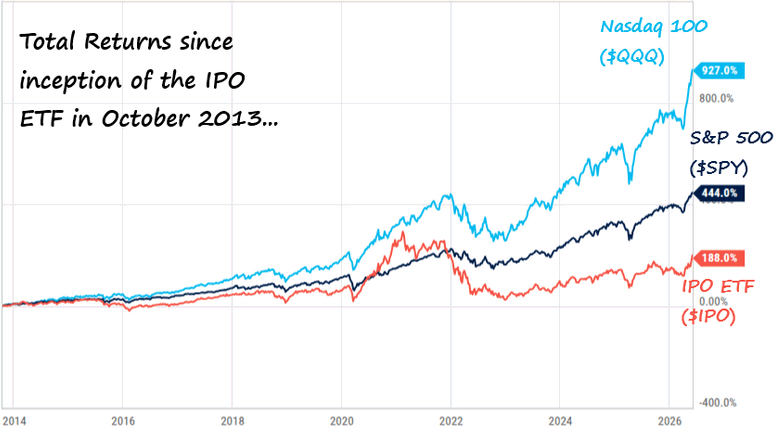
IPO returns are what happens when the people who know the company best are net sellers. The IPO ETF’s +188% since October 2013 — against SPY’s +444% and QQQ’s +927% — isn’t a stock-picking miss; it’s the architecture of primary issuance. Founders, VCs, and PE sponsors float supply when their internal mark says the offering price is generous, never at troughs. The first-day pop accrues almost entirely to allocated insiders; public buyers enter after peak euphoria, then absorb 90-day employee unlocks, 180-day sponsor distributions, and follow-on secondaries priced inside the curve to clear inventory. The flat line since 2021 is not a baseline — it is a bubble-vintage unwind, a SPAC-and-ZIRP cohort still convalescing inside a 12-year chart. Vintage is the variable, and 1999 and 2020–2021 both proved supply waves cluster at tops. SpaceX, OpenAI, and Anthropic queueing into all-time highs is the next vintage being loaded into the same trap — a $300B-plus SpaceX deal does not conjure fresh capital, it siphons it from the AI leaders portfolios already own. The disciplined trade isn’t the bell — it’s the calendar, 180 days out.
Market Intelligence Brief (MIB) Ver. 18.40
For professional investors only. Not investment advice.
© 2026 RecessionALERT.com

Comments are closed.