
OpenAI missed revenue and user targets (WSJ), gutting AI chip stocks — AMAT -5.87%, KLAC -4.79%, AVGO -4.39%; Nasdaq -1.01%. UAE quit OPEC after 58 years, effective May 1. Trump rejected Iran’s Hormuz reopening proposal — Brent hit $112.70 intraday, US gas $4.18/gal (highest since Aug 2022). Powell’s final FOMC opened Tuesday. Coca-Cola (+3.86%), Visa, and Starbucks all beat and raised guidance. GOOGL/MSFT/META Wednesday — $700B AI capex on trial.
TABLE OF CONTENTS
A. EXECUTIVE SUMMARY
B. MARKET DATA
C. HIGH-IMPACT STORIES (5)
D. MODERATE-IMPACT STORIES (5)
E. ECONOMY WATCH (6)
F. EARNINGS WATCH (6)
G. WHAT’S NEXT
H. CHART OF THE DAY
A. EXECUTIVE SUMMARY -> TOP
Equities sold off on a narrow but pointed AI shock — Nasdaq -1.01%, S&P 500 -0.49% — after a WSJ report on OpenAI revenue and user shortfalls hit semiconductor-capex names AMAT (-5.87%), KLAC (-4.79%), and AVGO (-4.39%) the hardest, with ORCL -4.05% on the cloud read-through. Energy was the day’s only material sector gain (+1.38%) as Brent touched $112.70 intraday on a Trump-Iran Hormuz impasse and a UAE OPEC exit announced for May 1, while gold fell -1.82% — a tell that markets are pricing this energy shock as inflationary rather than recessionary, with 2Y yields up 3.3 bps confirming the read. Defensive rotation absorbed the tech damage cleanly: KO (+3.86%), UNH (+3.41%), PM (+3.10%), Consumer Defensive +0.85%, Real Estate +0.82%. The breadth tells the story — NYSE Composite finished essentially flat (+0.04 pts), VIX fell 1.05%, and 7 of 11 sectors moved less than ±1%, marking this as a targeted AI-capex repricing, not a broad selloff.
• AI capex on trial: $700B hyperscaler spend (GOOGL/MSFT/META/AMZN all Wed AMC) faces an OpenAI revenue miss; SoftBank -10% in Tokyo; chip complex AMAT/KLAC/AVGO/ANET all -4% to -6%.
• UAE exits OPEC May 1 — first structural rupture since 1973; supply-coordination uncertainty stacked on top of nine-week Hormuz closure after Trump rejected Iran’s reopening proposal.
• Energy hits the consumer: US gas $4.176/gal (highest since Aug 2022); WTI briefly above $100 intraday, settled $99.93 (+3.35%); Brent $111.26 (+2.35%).
• Powell’s final FOMC opened — rate hold certain (CME FedWatch 100%); Senate Banking votes on Warsh nomination Wednesday after Tillis dropped his hold.
• Earnings split sharply: KO +3.86% (guide raised), V +6.8% EPS beat + $20B buyback, SBUX +5% AH (SSS +6.2%, guide raised); GLW -8.90% on Q2 light at 92x P/E.
• Bond market reads sticky inflation: 10Y at 4.348% (+1.3 bps); 2Y at 3.838% (+3.3 bps) — curve flattening; Moody’s recession odds 48.6% vs Goldman/S&P at 30%; Dimon warns next credit cycle “worse than people think.”
1. AI monetization scrutiny meets capex peak — OpenAI’s revenue shortfall lands 24 hours before the four largest hyperscalers report. Any AI capex trim from GOOGL/MSFT/META/AMZN triggers a second leg lower in chips and AI-adjacent infrastructure (GLW already -8.9%, ANET -4.16%). Conversely, an Azure/Cloud growth reaffirmation is the cleanest counter-narrative the bull case has available.
2. Energy as a stealth tax that bypasses the Fed — Hormuz closed nine weeks, UAE quitting OPEC, Trump rejecting Iran’s offer: three structural supports for $100+ oil that monetary policy cannot offset. At $4.18/gallon, every sustained $10/bbl in crude is a ~$80-100B annual purchasing-power hit on US households — a regressive consumption tax that compresses the very consumer-confidence resilience the Conference Board print celebrated.
3. Rotation, not panic — VIX fell on a down-equity day, NYSE Composite finished flat, and gold dropped 1.82% on an active geopolitical shock. The market is treating today as a targeted AI-capex repricing while bidding defensives (KO, UNH, PM) and Energy. The bond market disagrees with the equity calm: 2Y +3.3 bps and curve flattening say sticky inflation, not slowdown — setting up a stagflation overlay into Thursday’s GDP/PCE doubleheader.
 — Leading economic indicators. Accurate market forecasts. Apply for membership at join.recessionalert.com
B. MARKET DATA -> TOP
A WSJ report that OpenAI missed internal revenue and user targets drove a concentrated selloff in AI-exposed chips and hardware, pulling the Nasdaq -1.01% and S&P -0.49% even as the Dow held near flat (-0.06%) on its lower tech exposure. The day’s story was narrow: semiconductor equipment stocks (AMAT -5.87%, KLAC -4.79%, AVGO -4.39%) absorbed the AI skepticism while defensive names (KO +3.86%, UNH +3.41%, PM +3.10%) caught a rotation bid. Energy (+1.38%) was the only sector to rally materially as WTI neared $100/bbl for a seventh consecutive session on Strait of Hormuz supply fears — a supply-shock crude move, not a demand signal. The anomaly: gold fell -1.82% despite the active geopolitical backdrop, as rising yields (+3.3 bps on the 2Y) and a stronger dollar drained the safe-haven premium.
CLOSING PRICES – Tuesday, April 28, 2026:
MAJOR INDICES
The NYSE Composite’s flat close (+0.04 pts) vs. the Nasdaq’s -1.01% tells the real story: this was a concentrated tech-AI event, not a market-wide move. A Dow Theory non-confirmation is now entrenched through a fifth consecutive session — DJIA remains within 1% of its 9-session high while DJTA sits 13.4% below its peak, a warning that industrial strength is not being validated by transport activity. Small-cap and mega-cap performance has been nearly identical over the past 9 sessions (+1.65% both), suggesting no breadth divergence beyond today’s AI-specific shock.
| Index | Close | Change | %Move | Why It Moved |
|---|---|---|---|---|
| S&P 500 | 7,138.77 | -35.14 | -0.49% | WSJ report that OpenAI missed revenue and user targets triggered AI/chip hardware selloff; broad market pressure concentrated in tech and semis |
| Dow Jones | 49,136.15 | -31.64 | -0.06% | Blue-chip composition limited downside; less AI-chip weighted; industrials and financials insulated from AI-capex selloff |
| DJ Transportation | 20,733.9 | -109.9 | -0.53% | Rising fuel costs (WTI +3.35%; avg US gas $4.18/gal, highest since Aug 2022) pressuring freight and logistics margins |
| Nasdaq 100 | 27,029.01 | -276.67 | -1.01% | OpenAI revenue miss directly hit AI chip and cloud infrastructure stocks (NVDA, AVGO, AMAT, ORCL); concentrated exposure to AI-capex narrative |
| Russell 2000 | 2,757.18 | -33.57 | -1.20% | Small-cap sensitivity to rising short-end rates (2Y +3.3 bps); broader tech/growth exposure; underperformed mega-caps on risk-off rotation |
| NYSE Composite | 22,905.5 | +0.04 | +0.00% | Broader market universe absorbed concentrated AI/tech shock; defensive rotation into Energy, Consumer Defensive, and Real Estate offset tech losses |
VOLATILITY & TREASURIES
VIX fell -1.05% on a down-equity day — options markets declining to panic signals this was an orderly sector rotation, not systemic risk repricing. But the bond market sent a different message: the 2Y yield rose 3.3 bps (outpacing the 10Y’s +1.3 bps), flattening the curve from ~53 bps to ~51 bps and signaling sticky near-term inflation from the energy shock. The dollar’s mild strength (+0.16%) confirms rate premium re-pricing, not a safe-haven flight.
| Instrument | Level | Change | Why It Moved |
|---|---|---|---|
| VIX | 17.83 | -0.19 (-1.05%) | Orderly sector rotation rather than systemic fear; options market signaling targeted AI-capex risk repricing, not broad market panic |
| 10-Year Treasury Yield | 4.348% | +1.3 bps | Energy-driven inflation premium ahead of FOMC (Apr 28-29); WTI near $100 reinforcing sticky inflation narrative; bonds not catching a safe-haven bid |
| 2-Year Treasury Yield | 3.838% | +3.3 bps | Near-term rate expectations repricing higher on Hormuz-driven energy inflation; short-end leads long-end — curve flattening signal |
| US Dollar Index (DXY) | 98.64 | +0.16 (+0.16%) | Mild yield premium vs. peers; Iran/US diplomatic uncertainty sustaining modest safe-haven dollar bid; not a strong flight-to-safety move |
COMMODITIES
Gold’s -1.82% decline on a day with active Hormuz supply tensions is the striking anomaly: the safe-haven premium is being crowded out by rising yields and a stronger dollar, signaling investors are treating the energy shock as inflationary rather than recessionary. Silver (-2.64%) and copper (-1.69%) both fell sharply, pointing to weakening industrial demand expectations — AI capex skepticism seeping into materials. Bitcoin (-0.72%) outperformed equities modestly, tracking neither risk-on nor risk-off cleanly.
| Asset | Price | Change | %Move | Why It Moved |
|---|---|---|---|---|
| Gold | $4,608.05/oz | -$85.65 | -1.82% | Profit-taking after recent highs; rising yields (+3.3 bps 2Y) and stronger dollar crowding out safe-haven premium; diplomatic progress on Iran reducing geopolitical risk bid |
| Silver | $73.043/oz | -$1.983 | -2.64% | Following gold lower; industrial demand component pressured by AI capex skepticism and weakening growth expectations |
| Copper | $5.9765/lb | -$0.1025 | -1.69% | Industrial demand concerns; OpenAI revenue miss raises doubts over AI data center buildout pace; weakening growth outlook weighing on base metals |
| Platinum | $1,949.30/oz | -$48.30 | -2.42% | Broad precious metals selloff; profit-taking following recent run; auto-catalyst demand subdued amid energy cost pressures on vehicle sales |
| Bitcoin | $76,459.0 | -$558.0 | -0.72% | Mild risk-off pressure; outperforming equities — not tracking the AI/tech selloff as a pure risk proxy; crypto-specific dynamics providing partial insulation |
ENERGY
WTI near $100/bbl marks a seventh consecutive gain on Hormuz supply fears, and the key read is equity direction: crude is rising alongside falling equities — the classic supply-shock signature, not a growth/demand story. Natural gas (-1.61%) sits out the crude rally entirely, confirming the move is a geopolitical crude-risk trade with no spillover into broader energy. The WTI/Brent spread ($4.48) is tight, signaling the disruption is global rather than regional.
| Asset | Price | Change | %Move | Why It Moved |
|---|---|---|---|---|
| Crude Oil (WTI) | $99.60/bbl | +$3.23 | +3.35% | Strait of Hormuz near-shutdown (Iran/US standoff); 7th consecutive session gain; briefly crossed $100/bbl intraday; market awaiting Trump response to Iran’s latest reopening proposal |
| Crude Oil (Brent) | $104.08/bbl | +$2.39 | +2.35% | Same Hormuz supply disruption; tight WTI/Brent spread ($4.48) confirms global rather than regional concern; Hormuz carries ~20% of global energy flows |
| Natural Gas (Henry Hub) | $2.685/MMBtu | -$0.044 | -1.61% | Decoupled from crude; US storage/weather dynamics dominate; Hormuz supply shock is crude-specific with no LNG transmission to domestic gas markets |
| Natural Gas (Dutch TTF) | $14.97/MMBtu | -$0.37 | -2.41% | European gas market weaker on milder-than-expected weather and adequate storage; EUR/USD decline adds marginal FX drag; diverging sharply from crude direction |
S&P 500 SECTORS
Technology’s -1.63% today unwinds a 1-month +20.08% run — the AI-capex enthusiasm that drove April’s rally is now the source of its correction. Clearest rotation signal: Energy (+1.38%) and Consumer Defensive (+0.85%) led while Basic Materials (-2.21%) and Technology (-1.63%) lagged — a classic risk-off/inflation-hedge pivot. Basic Materials’ -2.21% day and -1.92% week compound a -2.93% 3-month decline, pointing to structural pressure beneath its 1-year +49% run.
| Sector | 1-Day | 1-Week | 1-Month | 3-Month | 6-Month | YTD | 12-Month |
|---|---|---|---|---|---|---|---|
| Energy | +1.38% | +2.87% | -5.05% | +18.14% | +32.94% | +30.83% | +44.45% |
| Consumer Defensive | +0.85% | +1.09% | +2.35% | +1.19% | +6.62% | +7.88% | +6.73% |
| Real Estate | +0.82% | +0.34% | +9.41% | +5.04% | +2.72% | +7.66% | +8.59% |
| Financial | +0.15% | -0.71% | +9.21% | -2.71% | +1.61% | -2.92% | +15.58% |
| Healthcare | -0.06% | -1.94% | +1.71% | -7.25% | -0.25% | -5.46% | +8.39% |
| Utilities | -0.08% | +2.72% | +2.74% | +5.68% | +2.91% | +9.01% | +21.96% |
| Communication Services | -0.46% | +1.66% | +17.58% | +1.43% | +7.22% | +3.27% | +42.62% |
| Consumer Cyclical | -0.69% | -1.19% | +11.55% | -5.32% | -3.04% | -2.61% | +17.34% |
| Industrials | -0.94% | -0.75% | +8.49% | +3.88% | +11.91% | +12.40% | +37.37% |
| Technology | -1.63% | +1.91% | +20.08% | +5.94% | +4.77% | +8.31% | +48.38% |
| Basic Materials | -2.21% | -1.92% | +6.68% | -2.93% | +23.35% | +14.58% | +49.05% |
TOP MEGA-CAP MOVERS:
GAINERS
| Company | Ticker | Close | Change | Why It Moved |
|---|---|---|---|---|
| Coca-Cola Co | KO | $78.35 | +3.86% | Q1 2026 BMO earnings beat; pricing power and volume growth reaffirmed; defensive brand positioning bid up on broader market uncertainty |
| UnitedHealth Group Inc | UNH | $366.77 | +3.41% | Defensive rotation into healthcare; Q1 EPS beat ($7.23 vs $6.56 est., April 21) carrying through; safe-haven positioning on tech selloff |
| Philip Morris International Inc | PM | $165.89 | +3.10% | Defensive Consumer Staples rotation; smoke-free product growth (ZYN, IQOS) narrative; solid earnings momentum supporting premium valuation on risk-off day |
| International Business Machines Corp | IBM | $233.04 | +2.19% | Enterprise IT services insulated from AI-chip selloff; diverges from semiconductor/cloud peers; positioned as stable-revenue tech amid AI-capex skepticism |
| T-Mobile US Inc | TMUS | $186.72 | +2.17% | Pre-earnings positioning ahead of AMC Q1 report; telecom treated as defensive play amid tech selloff; Communication Services sub-sector insulation |
DECLINERS
| Company | Ticker | Close | Change | Why It Moved |
|---|---|---|---|---|
| Applied Materials Inc | AMAT | $381.11 | -5.87% | WSJ OpenAI revenue miss → AI capex concerns slash semiconductor equipment demand outlook; AMAT directly exposed to wafer fab equipment spend cycle |
| KLA Corp | KLAC | $1,808.97 | -4.79% | Same AI-capex theme; process control equipment for advanced chip fabs; any slowdown in AI semiconductor investment directly compresses KLAC’s order pipeline |
| Broadcom Inc | AVGO | $399.83 | -4.39% | Custom AI silicon (hyperscaler ASICs) and networking chips; OpenAI shortfall raises doubts about AI infrastructure capex trajectory; direct demand risk |
| Arista Networks Inc | ANET | $165.29 | -4.16% | AI/ML data center networking hardware; linked to AI infrastructure buildout pace; OpenAI revenue miss signals slower datacenter expansion, pressuring switch/router demand |
| Oracle Corp | ORCL | $165.96 | -4.05% | Cloud and AI infrastructure platform; named in market reports as directly impacted by OpenAI revenue shortfall; GPU cloud and AI database demand concerns |
— Institutional-grade intelligence for serious investors. Apply for membership at join.recessionalert.comC. HIGH-IMPACT STORIES -> TOP
UNCERTAIN
1. UAE Announces Departure from OPEC Effective May 1 — 58-Year Membership Ends
The core facts:The United Arab Emirates announced via state news agency WAM that it will leave both OPEC and the broader OPEC+ alliance effective May 1, 2026. The UAE is OPEC’s third-largest producer and had been a member since 1971 (through Abu Dhabi since 1967). The departure follows years of escalating tensions over production quotas the UAE regarded as unfairly restrictive — the country has significantly expanded production capacity and has been pushing for higher output allowances. Relations with Saudi Arabia, OPEC’s dominant power, have grown increasingly strained over both economic and geopolitical friction, particularly in the context of the ongoing Iran war. Oil prices initially surged more than 3% Tuesday before trimming gains as the UAE exit introduced supply-coordination uncertainty on top of the existing Hormuz disruption. WTI settled near $99.93/barrel; Brent at $111.26/barrel.
Why it matters:The UAE’s exit is the most consequential structural rupture in OPEC since the 1973 oil crisis. Without the UAE, OPEC loses coordination over roughly 3-4% of global oil supply — and the precedent could encourage other Gulf states chafing under Saudi quota dominance to follow. In the near term, the UAE is free to pump at will: its breakeven is ~$30/barrel and capacity is ~4 mbpd — it could flood markets or channel production into non-OPEC frameworks. For US portfolio managers, elevated oil is a direct headwind to consumer spending, a tailwind to energy stocks, and a complicating factor for the Fed’s inflation mandate already complicated by a near-$100 WTI environment.
What to watch:Saudi Arabia’s formal response and whether it triggers retaliatory quota adjustments; whether Kuwait, Iraq, or other Gulf members signal similar exits. The May 1 effective date is the immediate catalyst — watch crude opening prices that day.
BEARISH
2. Trump Rejects Iran’s Hormuz Proposal — Oil Surges 3%, Brent Hits $112.70 Intraday High
The core facts:Iran conveyed a formal proposal to Washington via Pakistan (acting as intermediary) to reopen the Strait of Hormuz in exchange for the US lifting its naval blockade and ending the joint US-Israel war — with nuclear program talks deferred to post-war negotiations. President Trump reviewed the offer and is dissatisfied, according to reporting Tuesday, because the proposal postpones the nuclear issue. Trump has insisted Iran’s nuclear program must be addressed at the outset of any agreement, not afterward. As a result, the strait remains effectively closed entering its ninth week. WTI crude futures rose more than 3% to settle at $99.93/barrel; Brent surged nearly 3% to $111.26, touching an intraday high of $112.70 — the highest Brent level since March 31. National AAA average retail gas reached $4.176/gallon, the highest since August 2, 2022.
Why it matters:The Strait of Hormuz channels roughly 20 million barrels per day of crude, fuels, and petrochemicals — approximately 20% of global oil supply. The IEA has characterized this as “the largest supply disruption in the history of the global oil market.” With Trump demanding nuclear talks first and Iran unwilling to include them, there is no near-term path to resolution. Even if hostilities ended immediately, normalization would take 4-6 months. The compounding effect — Hormuz closure plus UAE’s OPEC exit announced the same day — sent energy markets into a supply-shock repricing. Sustained $100 WTI is equivalent to a broad-based consumption tax on US households and a persistent upside risk to core inflation.
What to watch:Whether Iran modifies its proposal to include nuclear talks upfront, and Trump’s response. Monitor WTI on a closing basis above $100 — that threshold historically accelerates consumer price pass-through and forces Fed recalibration.
BEARISH
3. WSJ: OpenAI Missed Revenue and User Targets — AI Chip Stocks Plunge 3–4%
The core facts:The Wall Street Journal reported Tuesday that OpenAI fell materially short of its own internal revenue and user growth targets. The company missed its goal of reaching 1 billion weekly active users by end-2025 and failed to hit multiple monthly revenue milestones earlier in 2026. ChatGPT’s share of generative-AI web traffic has declined from 86.7% to 64.5% year-on-year, while Google’s Gemini surged from 5.7% to 21.5%. CFO Sarah Friar reportedly warned colleagues internally that OpenAI could face difficulty funding future compute contracts if revenue growth does not accelerate. OpenAI disputed the characterization, stating it is “totally aligned on buying as much compute as we can.” Market impact was swift: Nvidia fell ~3%, AMD fell ~4%, Broadcom fell ~4%, Oracle fell 3-7% intraday; Nasdaq Composite fell 0.9% to 24,663.80; Russell 2000 fell 1.15%. SoftBank Group, one of OpenAI’s largest investors, sank ~10% in Tokyo trading.
Why it matters:The entire AI infrastructure trade — which has driven semiconductor stocks, data center REITs, and cloud hyperscalers to historic valuations — rests on the assumption that frontier AI generates commercial returns sufficient to justify the capital investment. OpenAI is the world’s leading frontier AI company and its largest commercial customer for AI compute. A revenue shortfall at OpenAI is not merely a private company’s problem: it directly calls into question the demand sustainability underpinning NVDA, AVGO, AMD, and Oracle’s AI-driven growth narratives. The timing is maximally painful — the four largest AI hyperscalers (GOOGL, MSFT, META, AMZN) collectively spending ~$700B on AI capex in 2026 all report earnings in the next 48 hours.
What to watch:GOOGL, MSFT, META, and AMZN earnings calls Wednesday April 29 AMC — specifically Azure growth guidance, Gemini cloud contracted RPO, AWS revenue acceleration, and any CEO commentary on AI demand pipeline. If hyperscalers also trim AI capex guidance, expect a second leg lower in chip stocks.
UNCERTAIN
4. Microsoft-OpenAI Exclusivity Ends: Amazon Wins Cloud Access in Historic AI Industry Realignment
The core facts:Microsoft and OpenAI announced a fundamental restructuring of their foundational AI partnership on April 28, ending the exclusivity that had defined the relationship since 2019. Under the revised terms: (1) Microsoft’s license to OpenAI’s intellectual property transitions from exclusive to non-exclusive, running through 2032; (2) OpenAI is now free to offer all its products and models to customers via any cloud provider; (3) Amazon’s previously announced $50B deal with OpenAI — which had been in legal jeopardy under the old exclusivity clause — is now cleared; (4) Microsoft retains priority placement on Azure (OpenAI products ship first on Azure unless Microsoft declines), a 20% revenue share through 2030 (now capped rather than uncapped), and the IP license; (5) The AGI trigger clause — which would have required Microsoft to assess its response if OpenAI declared AGI — was removed entirely. MSFT shares were broadly flat on the announcement.
Why it matters:This reshapes the entire AI cloud ecosystem. Microsoft built its AI moat on exclusive access to GPT-4 and successors — that moat is now crumbling. Amazon (AWS) can now compete directly for OpenAI enterprise customers, and Google (via GCP) is similarly free to onboard OpenAI workloads. The longer-term winner may be OpenAI itself: multi-cloud distribution broadens its revenue base and reduces dependency on a single partner. For Microsoft, the deal protects its $13B+ investment while conceding structural AI cloud dominance. For Amazon, it’s a massive catch-up — AWS was the only major cloud hyperscaler without a frontier model partnership, a competitive gap that is now closed ahead of AMZN’s own earnings this week.
What to watch:Azure growth guidance and OpenAI partnership economics commentary from MSFT Q3 earnings (April 29 AMC). Amazon’s first OpenAI model launches on AWS. Whether Google announces a similar non-exclusive agreement to match Amazon’s access.
UNCERTAIN
5. FOMC Day 1: Powell’s Final Meeting Begins — Rate Hold Certain, Warsh Succession Imminent
The core facts:The Federal Open Market Committee commenced its two-day April 28-29 policy meeting Tuesday — the final FOMC meeting chaired by Jerome Powell, whose term as Fed Chair ends May 15, 2026. The Fed is universally expected to hold the federal funds rate at 3.50-3.75% (CME FedWatch: 100% probability of hold); this will mark the third consecutive pause in 2026. The decision and Powell’s final press conference are scheduled for Wednesday, April 29 at 2:00 PM ET. Separately, the Senate Banking Committee is scheduled to vote on Kevin Warsh’s nomination as Fed Chair on April 29 — Senator Thom Tillis (R-NC), the final holdout, reversed his block following closure of the DOJ probe into Fed building renovation cost overruns. Warsh’s confirmation is now all but certain; a full Senate floor vote is expected the week of May 11.
Why it matters:The April meeting is a policy crossroads: the Fed holds rates while facing $100+ oil (inflationary), a cooling but still-resilient labor market, and a GDP growth deceleration into April 30’s advance Q1 GDP print. Markets have fully priced out any 2026 rate cuts. Powell’s final statement will be parsed for: (1) how the Fed characterizes the inflation-growth tradeoff in the context of the Iran war; (2) whether the language signals any bias for Warsh’s incoming approach; and (3) whether Powell publicly endorses staying on as Fed Governor post-May 15. Warsh is known as more hawkish and less institutionally deferential than Powell — his confirmation could trigger a longer-term re-rating of rate expectations.
What to watch:Wednesday’s FOMC statement (2:00 PM ET) and Powell’s press conference (2:30 PM ET) — specifically any language changes around the “risks are balanced” formulation or inflation persistence. Senate Banking Committee Warsh vote results Wednesday April 29.
— Quantifying recession risk so you don’t have to guess. Apply for membership at join.recessionalert.comD. MODERATE-IMPACT STORIES -> TOP
BULLISH
6. Conference Board Consumer Confidence Beats: 92.8 vs. 89.0 Estimate — Highest Reading of 2026
The core facts:The Conference Board Consumer Confidence Index rose to 92.8 in April 2026 from 92.2 in March, beating the consensus estimate of 89.0 by 3.8 points — the largest positive surprise of the year and the index’s highest level in 2026. Labor market perceptions improved: 27.3% of respondents said jobs are “plentiful” (up from prior month), while those saying jobs are “hard to get” fell to 19.8% from 21.3%. The beat diverges sharply from the University of Michigan’s April consumer sentiment index, which was revised to a record-low 49.8 in its final reading, with 12-month inflation expectations spiking to 4.7% from 3.8%.
Why it matters:The Conference Board measures current economic conditions and near-term expectations, making it a leading indicator for consumer spending. Its April beat signals that household balance sheets and labor market perceptions remain resilient despite elevated oil prices and geopolitical stress — a key support for S&P 500 earnings, roughly 70% of which are driven by domestic consumer activity. The divergence between CB (beat) and UMich (record low) is notable: CB focuses on labor market and income; UMich is more sensitive to inflation expectations and political sentiment. Both can be simultaneously true in a K-shaped economy where high-income households feel confident while lower-income consumers face energy cost pressure.
What to watch:May Conference Board release (late May) to confirm whether the CB-UMich divergence narrows. Watch retail sales (May 15) as the ground-truth on whether confidence is translating into actual spending.
BEARISH
7. US Gas Prices Hit $4.18/Gallon — Highest Since August 2022 as Iran War Reaches Consumers at the Pump
The core facts:AAA reported Tuesday that the national average price for regular unleaded gasoline reached $4.176/gallon — the highest since August 2, 2022, during the post-Ukraine invasion energy shock. WTI crude futures briefly exceeded $100/barrel intraday (first time since March 2022), before settling at $99.93; Brent touched $112.70 intraday. The nine-week Hormuz closure combined with the UAE’s OPEC exit announcement on the same day provided the dual catalyst driving Tuesday’s surge. Energy costs are now the single-largest contributor to household budget pressure in 2026.
Why it matters:Every sustained $10/barrel rise in crude oil costs US households approximately $80-100B/year in purchasing power — equivalent to a regressive consumption tax that falls disproportionately on lower-income households. At $4.18/gallon, gas is now absorbing a meaningfully higher share of disposable income than the 2024 baseline. For equity markets, the consumer discretionary sector is most exposed; for the Fed, elevated pump prices feed directly into headline CPI and complicate the path to any rate normalization. Combined with University of Michigan sentiment at record lows, the consumer spending outlook is bifurcating: confident on labor, stressed on energy.
What to watch:Whether WTI sustains above $100 on a closing basis — that threshold historically triggers accelerated consumer price pass-through and adds pressure on the Fed to address energy-driven inflation. Watch April CPI release (May 13) for energy component contribution.
UNCERTAIN
8. IEEPA Tariff Refund Wave Begins: GM Books $500M Benefit — $127B+ Returns to Corporate Balance Sheets
The core facts:General Motors became the first major S&P 500 company to quantify its benefit from the Supreme Court’s February 2026 IEEPA ruling (which struck down Trump’s tariff authority under the International Emergency Economic Powers Act) — disclosing a $500M tariff refund expectation in its Q1 2026 earnings call Tuesday. GM reduced its FY 2026 tariff cost outlook by $500M (to $2.5-3.5B from $3.0-4.0B) and raised full-year EBIT guidance accordingly. CBP’s CAPE portal — launched April 20 — is now actively processing Phase 1 refund claims: 56,000+ importers have enrolled, representing ~$127B in eligible Phase 1 refunds (out of ~$170B total IEEPA duties collected). Refunds are expected within 60-90 days of CBP acceptance; interest accrues at ~$22M/day on unrefunded amounts.
Why it matters:As Q1 earnings season accelerates (28% of S&P 500 reported), a growing wave of industrial, consumer, and auto companies will disclose IEEPA refund benefits — potentially lifting EPS estimates broadly and providing one-time cash flow boosts. However, the net market effect is uncertain: the refunds are a partial reversal of previously embedded tariff costs (so EPS beats may already be priced in where companies flagged this), and the fiscal deficit implications of $127B+ in government outflows are negative for Treasury yields and the dollar. Industries most exposed include auto, semiconductor supply chains, retail, and manufacturing.
What to watch:This week’s mega-cap earnings calls (especially AMZN and MSFT, both major importers) for additional refund disclosures. Track cumulative CAPE portal claims volume as an indicator of total corporate refund pipeline size.
UNCERTAIN
9. $700B AI Capex Goes on Trial: GOOGL, MSFT, META All Report Wednesday in Earnings Superweek
The core facts:Alphabet (GOOGL, $4.2T market cap), Microsoft (MSFT, $3.2T), Meta Platforms (META, $1.7T), and Amazon (AMZN, $2.8T) all report Q1 2026 results this week — GOOGL, MSFT, META, and AMZN all on April 29 AMC. Consensus estimates: GOOGL EPS $2.63 / Rev $106.98B; MSFT EPS $4.05 / Rev $81.40B; META EPS $6.67 / Rev $55.56B. Combined, the four companies are projected to spend approximately $700B on AI capex in 2026. The backdrop has materially worsened since last Friday: Tuesday’s OpenAI revenue miss (WSJ) injected direct uncertainty into whether frontier AI is generating returns sufficient to justify this infrastructure spend. Gemini’s surge (5.7% → 21.5% of gen-AI web traffic) positions Alphabet as a potential winner from OpenAI’s stumble.
Why it matters:AI infrastructure spending is the single largest equity market investment theme of 2026. The $700B in combined hyperscaler capex flows directly to NVDA, AVGO, AMD, TSMC, and the broader semiconductor ecosystem. If any of the four companies trims AI capex guidance on Wednesday’s calls, the chip stock selloff that began Tuesday will accelerate. Conversely, if MSFT confirms Azure AI growth above 40% and GOOGL shows cloud RPO expansion, it provides a direct counter-narrative to the OpenAI miss. For META, the question is whether $135B in AI capex guidance survives contact with OpenAI’s monetization challenges.
What to watch:Azure constant-currency growth rate and guidance (MSFT); Google Cloud RPO and Gemini seat growth (GOOGL); META capex guidance vs. $135B prior; AMZN AWS growth acceleration and AI workload commentary. Any capex reduction guidance from any of the four would be a high-impact negative catalyst for semiconductors.
UNCERTAIN
10. 10-Year Treasury Yield Climbs to 4.35% — Highest in a Month as Oil-Driven Inflation Fears Resurface
The core facts:The 10-year US Treasury yield rose to approximately 4.35% Tuesday — the highest level since late March — as a 3% oil price surge, FOMC meeting uncertainty, and renewed inflation concerns combined to push bond prices lower. The prior yield as of April 24 stood at ~4.31%. Markets have fully priced out any 2026 rate cuts (0% probability across all remaining 2026 meetings per CME FedWatch), and the rising yield environment reflects a “higher for longer” repricing driven primarily by energy-induced inflation persistence. The move comes as the April 30 advance Q1 GDP print and March core PCE are due this week — a critical macro doubleheader.
Why it matters:The 10-year yield is the discount rate that underpins all equity valuation — particularly high-multiple tech stocks. At 4.35%, it begins to meaningfully compress the present value of long-duration growth earnings. For the S&P 500, which still trades at elevated P/E multiples, even a modest rise toward 4.5% triggers multiple compression particularly in the Nasdaq-heavy AI names that already sold off today. The combined dynamic — oil above $100 feeding into inflation, Fed on hold through year-end, 10Y rising — creates a genuine stagflationary overlay on equity markets entering a peak earnings week.
What to watch:10Y yield above 4.50% would signal a broader duration risk re-pricing. This Thursday’s Q1 GDP advance estimate and March core PCE (April 30) are the next key macro inputs — a GDP miss combined with elevated PCE would confirm the stagflation scenario the bond market is beginning to price.
— Separating signal from noise since 2007. Apply for membership at join.recessionalert.comE. ECONOMY WATCH -> TOP
Today’s data split sharply along the soft/hard divide on the eve of the FOMC decision: confidence beat (CB 92.8 vs 89 est, a 2026 high) and Richmond manufacturing flipped to expansion (+3 vs -2 est), while the hard signals weakened — ADP weekly payrolls slid to 39.25K from 54.75K and Case-Shiller’s national home price gain decelerated to 0.7% YoY with real prices negative for a ninth straight month. Institutional recession odds remain bifurcated (Moody’s 48.6% vs Goldman/S&P 30%) and Dimon used the morning to warn that the next credit cycle “will be worse than people think.” Markets are pricing soft-landing through the FOMC; the underlying data is asking harder questions.
Case-Shiller Home Prices Decelerate as Real Prices Fall for Ninth Straight Month (S&P Cotality, April 28)
What they’re saying:The S&P Cotality Case-Shiller National Home Price Index posted a 0.7% YoY gain for February, down from 0.8% in January and missing the 1.1% consensus. The 20-City composite rose 0.9% YoY, also a miss versus the 1.1% expected, with the MoM print at -0.1% versus +0.2% expected. Denver (-2.2%) displaced Tampa as the weakest market, and Los Angeles and Washington joined the list of metros posting outright YoY price declines.
The context:For the ninth consecutive month, CPI (running 1.7 ppts hotter) outpaced national home price appreciation — meaning real home prices are now in an extended drawdown, the longest such streak since the post-2008 recovery. More than half of the 20 major metros tracked posted YoY declines. The deceleration matters because housing wealth has been a key offset to consumer balance-sheet stress; that cushion is now visibly thinning into a Fed week where rate-cut hopes have already been pared back.
What to watch:Wednesday April 29 brings Housing Starts (March consensus 1.40M vs 1.487M prior) and Building Permits (March, prior 1.386M) — both flagged high-impact. A weak housing print into the FOMC decision would amplify the slowdown narrative.
ADP Weekly Employment Slides to 39.25K, Lowest in Recent Run (ADP, April 28)
What they’re saying:The ADP weekly employment change reading printed 39.25K for the week, down from 54.75K the prior week — a 28% drop and the softest weekly read in the current sequence. The series is ADP’s high-frequency private-payrolls proxy, designed to give a real-time read on hiring momentum between the monthly NFP and ADP releases.
The context:Coming alongside Conference Board confidence noting an improved labor differential, the weekly ADP slowdown introduces a divergence — perceived job availability is improving while actual hiring momentum is decelerating. That gap is a classic late-cycle pattern: households update their assessment of the job market more slowly than the underlying flow data deteriorates. Governor Waller’s recent comments explicitly cite a “softening” labor market as justification to move policy closer to the 3% neutral setting.
What to watch:Thursday April 30 Initial Jobless Claims and the May 2 Nonfarm Payrolls release. A second consecutive softening week in ADP combined with a claims uptick would force the Fed’s labor-side patience narrative onto the defensive.
Consumer Confidence Beats to 2026 High Despite Iran-War Anxiety (Conference Board, April 28)
What they’re saying:The Conference Board Consumer Confidence Index rose 0.6 points to 92.8 in April from an upwardly revised 92.2 in March, handily beating the 89 consensus and reaching its highest level so far in 2026. The Expectations Index rose 1.2 points to 72.2, while the Present Situation Index slipped 0.3 to 123.8. The labor market differential — those saying jobs are “plentiful” minus those saying they’re “hard to get” — widened to 7.5 ppts from 6.1, the standout positive in the report.
The context:The print is striking precisely because the macro backdrop is hostile: Brent above $100, an active Iran conflict cited explicitly in survey verbatims, and rising “very likely” recession sentiment within the same survey. Confidence held up because the perceived labor market improved — the share reporting jobs “hard to get” fell to 19.8% from 21.3%. That divergence between job-market perception and the day’s softer ADP weekly read is exactly the late-cycle dynamic to flag.
What to watch:University of Michigan final consumer sentiment May 2. If Michigan diverges sharply lower from Conference Board (as it has repeatedly through 2025-26), it signals the resilience reading is a labor-perception artifact rather than a broader confidence base.
Richmond Fed Manufacturing Flips to Expansion at +3, Five Points Above Consensus (Federal Reserve Bank of Richmond, April 28)
What they’re saying:The Richmond Fed’s Fifth District composite manufacturing index rose to +3 in April from 0 in March, beating the -2 WSJ consensus by five points. Two of three components — new orders and employment — rose; shipments was unchanged. Services revenues for the same district rose to 9 from a prior 9 (unchanged), while Dallas Fed Services Revenues firmed to 4.3 from 1.3.
The context:The Richmond surprise contrasts sharply with yesterday’s Dallas Fed Manufacturing print at -2.3 — though even Dallas showed a 12-point jump in its production sub-index. The mid-Atlantic strength suggests the manufacturing weakness flagged in recent ISM and regional Fed data is uneven rather than synchronized. Crucially, the new-orders rebound matters most: it’s the leading component of the composite and the cleanest read on forward demand.
What to watch:ISM Manufacturing PMI release May 1 — the first national read post all five regional Fed surveys. Consensus around 49.5; a print above 50 would confirm the regional signal is broadening rather than isolated.
Institutional Recession Odds Bifurcate: Moody’s 48.6% vs Goldman/S&P at 30% (Multiple, April 28)
What they’re saying:Updated institutional recession odds published this week show a wide dispersion: Moody’s Analytics at 48.6% (verified updated April 2026), EY-Parthenon at 40% (contingent on oil holding above $100), Goldman Sachs at 30% (base case 70% avoidance), and S&P Global at 30% (up from 20% pre-conflict). Polymarket’s prediction-market read sits at 26% — well below the institutional house views. The Conference Board separately noted the share of consumers calling a 12-month recession “very likely” rose again in April.
The context:The 18-point gap between Moody’s and Goldman/S&P is unusually wide and reflects a real disagreement about whether sustained $100+ oil and fragile credit conditions are enough on their own to tip the cycle. S&P’s move from 20% to 30% is the cleanest “Iran shock” markup; Moody’s higher level reflects greater weight on structural fiscal and credit fragility. Markets are pricing closer to the Goldman/S&P optimist view — which leaves more room for downside surprise if the data turns.
What to watch:The Q1 GDP Advance + March Core PCE doubleheader Thursday April 30. GDPNow is at 1.2% — the weakest tracker reading of the cycle. A sub-1% GDP print would likely trigger a fresh round of recession-odds revisions higher across all four institutional trackers.
Dimon: Next Credit Recession “Worse Than People Think,” Warns of “Bond Crisis” Risk (Bloomberg / CNBC, April 28)
What they’re saying:JPMorgan CEO Jamie Dimon warned today that a credit-market downturn could be sharper than current pricing reflects, even after big banks posted a banner Q1. On the $1.8 trillion private credit market — now home to more than 1,000 firms — Dimon said “not all 1,000 of them” are well-underwritten and that “because we haven’t had a credit recession in so long, when we have one it will be worse than people think.” Separately, he flagged risk of “some kind of bond crisis” if global government deficits aren’t addressed proactively.
The context:Dimon’s framing matters because it’s an explicit divergence between bank loan-portfolio performance (which is fine) and the non-bank credit ecosystem (which has never been stress-tested at this scale). He stopped short of calling private credit “systemic,” but the implicit warning is that a downturn would be amplified by underwriting standards built during a benign decade. Pairs awkwardly with this morning’s Case-Shiller deceleration and the building credit-card delinquency data flagged by the NY Fed.
What to watch:Quarterly senior loan officer survey (next release expected early May) and the May NY Fed Household Debt and Credit Report. Any acceleration in C&I or credit-card delinquencies would be the first hard validation of the Dimon thesis.
— Know the probability before the market prices in the risk. Apply for membership at join.recessionalert.comF. EARNINGS WATCH -> TOP
YESTERDAY AFTER THE BELL (Markets Reacted Today)
No major earnings yesterday after the bell from companies with >$100B market cap. (Cadence Design Systems and Public Storage reported AMC on April 27 but both are below the $100B threshold.)
TODAY BEFORE THE BELL (Markets Already Reacted)
BULLISH
11. Coca-Cola (KO): +3.86% | Pricing Power Intact — Beats on EPS and Revenue, Raises FY2026 Guidance
The Numbers:Released BMO. Q1 2026: Revenue $12.47B vs. $12.24B est (+1.92% beat); Adj. EPS $0.86 vs. $0.81 est (+5.95% beat); EPS GAAP $0.91 (+18% YoY). Organic revenue +10% (volume +3%, price/mix +2%). Operating margin 35.0% vs. 32.9% prior year (+210 bps). FY2026 guidance: organic revenue growth 4-5% (held); comparable EPS growth raised to 8-9% (from 7-8%) on lower effective tax rate. Stock +3.86%.
The Problem/Win:All operating segments reported volume growth globally — a signal that demand for KO’s brands remains robust across income segments despite elevated living costs. Premium brands (Fairlife, Smartwater) continue to outperform, supported by high-income consumers, while core carbonated volumes held. Tariff headwinds on aluminum cans and agricultural commodities (sugar, high-fructose corn syrup) compressed gross margin by ~30 bps but were absorbed within the overall margin expansion. CEO James Quincey highlighted resilient consumer demand across geographies.
The Ripple:Beats from defensive consumer staples giants with global volume growth signal that the consumer spending slowdown narrative may be overstated at the aggregate level. PepsiCo (PEP), Keurig Dr Pepper (KDP), and Constellation Brands (STZ) all moved modestly higher on the read-through.
What It Means:KO’s ability to grow volume globally while raising pricing confirms its status as a recession-resilient compounder. The guidance raise is particularly significant — it signals management confidence despite oil-driven commodity pressure, providing a positive anchor for consumer staples sector positioning.
BEARISH
12. Corning (GLW): -8.90% | Beats Q1 But Q2 Guidance Miss and Valuation Concern Punish Stock
The Numbers:Released BMO. Q1 2026: Revenue $4.35B vs. $4.30B est (+1.09% beat); Core EPS $0.70 vs. $0.69 est (+1.19% beat). Optical Communications segment +36% YoY to $1.85B (AI-driven demand); Solar +80% YoY to $370M. Q2 2026 guidance: Revenue ~$4.6B vs. $4.65B est (-1.1% miss); EPS $0.73-$0.77. Stock -8.90%.
The Problem/Win:Despite a clean Q1 beat, three factors triggered the sharp decline: (1) Q2 revenue guidance of $4.6B came in 1.1% below consensus — a narrow miss but meaningful at a 92x P/E valuation with zero margin for error; (2) JPMorgan downgraded GLW to Neutral citing the elevated multiple versus execution risk; (3) a $30M headwind from an extended solar wafer plant maintenance shutdown in Q2; (4) senior executives — including CFO and EVP — sold ~233,000 shares ($32.6M) in the prior quarter, flagging valuation discomfort from insiders. The stock’s 287% rally over the prior year made any guidance shortfall disproportionately punishing.
The Ripple:GLW’s decline reinforces a broader theme: AI infrastructure-adjacent stocks (optical fiber, solar, data center components) that have rerated on the AI capex thesis are vulnerable to any softening in that narrative — amplified by today’s OpenAI revenue miss. Coherent (COHR) and II-VI adjacents traded lower in sympathy.
What It Means:At 92x earnings, GLW left no room for a guide-down — even a small one. The stock remains a high-quality compounder with AI optical tailwinds, but the valuation re-rating has run ahead of fundamental delivery. Investors should watch for Q2 execution on the solar plant restart and any commentary from NVDA or hyperscalers on optical interconnect demand.
What to watch:Q2 earnings (late July) — whether the solar plant comes back online cleanly and whether optical communications sustains 30%+ growth as hyperscaler data center buildouts continue.
UNCERTAIN
13. S&P Global (SPGI): -0.86% | Clean Beat on Ratings and Indices — Capital Markets Activity Remains Robust
The Numbers:Released BMO. Q1 2026: Revenue $4.17B vs. $4.07B est (+2.42% beat); Adj. EPS $4.97 vs. $4.82 est (+3.19% beat); +10% YoY revenue growth (9% organic constant currency). Ratings segment +13% YoY to $1.30B; Indices segment +17% YoY to $519M (fastest growth across all divisions). Adjusted operating margin +100 bps to 51.8%. FY 2026 guidance: organic constant-currency revenue growth 6-8% (maintained). Stock -0.86%.
The Problem/Win:The modest stock decline despite a clean beat reflects market expectations that were already elevated and guidance that was merely maintained rather than raised. The core signal is positive: SPGI’s ratings division (+13%) reflects active corporate bond issuance and M&A-related credit activity; the indices segment (+17%) reflects strong ETF and passive investment flows. AI-ready data is generating premium pricing, with customers paying up for contracted API access to SPGI’s proprietary datasets.
The Ripple:SPGI’s strong ratings revenue confirms that credit markets remain open and issuance is healthy — a broadly positive signal for investment-grade corporate credit, bank earnings, and financial sector valuations. Moody’s (MCO) traded flat on the read-through.
What It Means:SPGI remains one of the highest-quality business models in the S&P 500 (51.8% adjusted operating margin). The maintained guidance is conservative given Q1 overdelivery; a guidance raise at midyear would be a catalyst. The flat stock reaction on a beat is a mild cautionary signal about sector-level positioning.
TODAY AFTER THE BELL (Markets React Tomorrow)
BULLISH
14. Visa (V): +3.67% AH | Beat + $20B Buyback — Payments Volume +9%, Cross-Border +12%, Consumer Spending Resilient
The Numbers:Released AMC (webcast 5:00 PM ET). Fiscal Q2 2026 (Jan-Mar): Net revenue $11.2B vs. $10.75B est (+4.2% beat); Non-GAAP EPS $3.31 vs. $3.10 est (+6.8% beat); GAAP EPS $3.14 (+36% YoY). Payments volume +9% YoY; total cross-border volume +12%; processed transactions +9%. New $20B multi-year share repurchase program authorized. Quarterly dividend $0.670/share.
The Problem/Win:Visa delivered an across-the-board beat that directly contradicts the narrative of consumer spending deterioration. Cross-border volume growth of 12% is particularly significant — it reflects both continued travel spending (despite elevated fuel costs) and robust international e-commerce. The $20B buyback authorization underscores management’s confidence in cash generation; combined with dividends, Q2 capital returns reached $9.2B in a single quarter.
The Ripple:Visa’s beat is a positive leading indicator for Mastercard (MA, reporting next week), American Express (AXP), and the broader consumer spending ecosystem. Strong cross-border volumes validate Booking Holdings’ travel revenue print and SBUX’s global same-store sales growth — a coherent consumer resilience narrative emerging from tonight’s AMC slate.
What It Means:At $589B market cap, Visa is the world’s largest payments network and serves as a real-time proxy for global consumer activity. Its 9% payment volume growth and 12% cross-border growth provide the strongest evidence to date that consumers remain engaged despite oil prices and geopolitical uncertainty. The $20B buyback is accretive to EPS and signals 5-7% additional return of capital over the coming years.
BULLISH
15. Starbucks (SBUX): +5% Extended | Niccol Turnaround Gains Momentum — SSS +6.2%, Guidance Raised
The Numbers:Released AMC. Fiscal Q2 2026 (Jan-Mar): Revenue $9.53B vs. $9.17B est (+3.9% beat); Adj. EPS $0.50 vs. $0.43 est (+16.3% beat). Global comparable store sales +6.2% (higher transactions + average ticket); North America SSS +7.1%; China SSS +0.5%. FY2026 guidance raised: global SSS growth to at least +5% (from +3%); adjusted EPS to $2.25-$2.45 (from $2.15-$2.40). Stock +5% in extended hours.
The Problem/Win:CEO Brian Niccol’s “Back to Starbucks” turnaround program — focused on simplified menus, shorter wait times, improved worker compensation, and in-store execution — is delivering measurable results 7 months in. Same-store sales growth of +6.2% represents a complete reversal from consecutive negative comps that preceded Niccol’s arrival. Critically, the beat was driven by both higher traffic (more visits) and higher ticket (more spending per visit) — a rare combination that signals authentic brand health recovery rather than discount-driven volume. North America’s +7.1% is the headline; China’s +0.5% remains a watch item.
The Ripple:SBUX’s turnaround confirmation is broadly positive for the casual dining and quick-service restaurant sector — particularly Restaurant Brands International (QSR) and Yum! Brands (YUM), which are executing similar operational improvement programs. The guidance raise at 7 months into a multi-year plan suggests investors underestimated the pace of recovery.
What It Means:At $110B market cap, SBUX is the largest global specialty coffee chain and a consumer discretionary bellwether. The +16% EPS beat and guidance raise convert a turnaround thesis into a near-term catalyst. The China recovery (+0.5%) remains slow relative to the US but has stabilized — a future acceleration there would provide the next leg of the investment thesis.
What to watch:Q3 FY2026 SSS guidance (late July) — whether momentum sustains into summer peak season, and China’s trajectory toward a positive inflection.
UNCERTAIN
16. Booking Holdings (BKNG): ~Flat AH | Q1 Beat but Cautious Q2 Guidance as Middle East Conflict Shadows Travel Outlook
The Numbers:Released AMC. Q1 2026: Revenue +16% YoY; GAAP EPS $1.36 vs. $1.08 est (+25.9% beat); Adj. EBITDA +19% to $1.3B; GAAP net income $1.1B, +225% YoY. Q2 2026 guidance: room nights growth +2-4%; revenue growth +4-6%. Full-year 2026: high single-digit revenue growth with Adj. EBITDA growth slightly faster than revenue, “assuming Middle East conflict impacts ease.”
The Problem/Win:The Q1 beat was strong — GAAP EPS surged 25.9% above estimates. However, the Q2 guidance range of +2-4% room nights growth is conservative relative to Q1’s momentum, and the explicit caveat that full-year targets assume “Middle East conflict impacts ease” introduces a material contingency at a time when that conflict is actively escalating. Booking has significant exposure to European and Middle Eastern travel routes that directly intersect with the Hormuz crisis disruption zone. The EBITDA growth trajectory (+19%) confirms the business model’s unit economics remain excellent.
The Ripple:BKNG’s cautious Q2 guide and explicit Middle East risk caveat signals to Expedia (EXPE) and Airbnb (ABNB) that geopolitical risk is a real headwind to 2026 travel volumes — even as Visa’s cross-border payment data showed resilience. The divergence suggests travel is shifting routes (away from Middle East) rather than declining outright.
What It Means:BKNG remains a high-quality business, but the Iran war is a direct risk to its addressable market in a way that competitors with more North America/domestic focus don’t face. The “assuming conflict impacts ease” guidance language is the key phrase to watch — if peace talks remain stalled (as Trump’s rejection today suggests), Q2 guidance may prove optimistic.
Additional AMC reporters tonight (results pending as of report time): T-Mobile US (TMUS, $205B — EPS est $2.01, Rev est $22.98B); Welltower (WELL, $150B — EPS est $0.68, Rev est $3.12B); Seagate Technology (STX, $126B — EPS est $3.51, Rev est $2.96B). Markets react to all three tomorrow. Completeness note: Novartis ADR (NVS, $266B) and BP ADR ($119B) reported BMO but are excluded under the US-domicile filter; both are foreign-headquartered with ADR listings.
WEEK AHEAD PREVIEW:
Q1 2026 earnings season enters its most consequential stretch, with over $15 trillion in combined market cap reporting in the next 48 hours. Wednesday AMC features the Magnificent 4 (GOOGL, MSFT, META, AMZN) all in a single session, with Apple following Thursday AMC — a superweek now running directly into an OpenAI revenue-miss headwind that raises the stakes on AI monetization disclosures.
Alphabet (GOOGL) — Wednesday April 29, AMC — Est. EPS $2.63 / Rev $106.98B — Key focus: Google Cloud growth rate and contracted RPO (Remaining Performance Obligations); Gemini enterprise seat expansion following ChatGPT market share losses; capital expenditure guidance for AI infrastructure.
Microsoft (MSFT) — Wednesday April 29, AMC — Est. EPS $4.05 / Rev $81.40B — Key focus: Azure constant-currency growth guidance; OpenAI partnership economics post-restructuring (non-exclusive, revenue share capped); Copilot enterprise seat growth and monetization trajectory.
Meta Platforms (META) — Wednesday April 29, AMC — Est. EPS $6.67 / Rev $55.56B — Key focus: Whether AI capex guidance of ~$135B is maintained, trimmed, or raised; advertising revenue resilience; Llama 4 commercial uptake and enterprise AI adoption metrics.
AbbVie (ABBV) — Wednesday April 29, BMO — Est. EPS $2.59 / ~$14.72B rev — Key focus: Skyrizi and Rinvoq combined revenues vs. Humira biosimilar erosion trajectory; pipeline updates.
Qualcomm (QCOM) — Wednesday April 29, AMC — Est. EPS $2.56 / Rev $10.59B — Key focus: Handset chip demand recovery signals; automotive and IoT diversification progress; any AI-at-edge design win announcements.
Amazon (AMZN) — Wednesday April 29, AMC — Est. EPS $1.63 / Rev $177.28B — Key focus: AWS revenue growth and AI workload acceleration; advertising segment; any IEEPA tariff refund disclosure; retail margin recovery.
KLA Corp (KLAC) — Wednesday April 29, AMC — Est. EPS $9.17 / Rev $3.37B — Key focus: Wafer fab equipment order book and AI-driven foundry capex commentary directly stress-tested by today’s OpenAI revenue miss; process-control revenue trajectory toward management’s $26B-by-2030 target; service-revenue doubling thesis; China export-control and tariff impact on margins. KLAC fell -4.79% today on AI-capex skepticism, making this the cleanest read on whether the demand thesis survives.
Amphenol (APH) — Wednesday April 29, BMO — Est. EPS $0.94 / Rev $7.08B — Key focus: Datacom segment (now ~38% of sales) momentum and AI/data-center connectivity orders; integration update on the $10.5B CommScope CCS acquisition; revenue and EPS guidance versus management’s Q1 outlook of $6.90-7.00B revenue and $0.91-0.93 EPS (44-48% YoY EPS growth); automotive electrification trends.
Equinix (EQIX) — Wednesday April 29, AMC — Est. EPS $4.30 / Rev $2.52B — Key focus: AFFO/share trajectory (consensus $10.89, +12.6% YoY) and whether the 200 bps adjusted-EBITDA margin expansion target is materializing; AI-related bookings as share of new deals (>60% of Q4 2025 largest new deals tied to AI workloads — investors looking for continuation); hyperscaler pricing power and occupancy rates as the cleanest read on AI compute demand converting into colocation absorption.
Apple (AAPL) — Thursday April 30, AMC — Key focus: iPhone demand amid competition from OpenAI/Qualcomm-powered alternative AI phones; China revenue trajectory; services segment growth; FY2026 guidance.
Note: Q1 2026 GDP advance estimate and March core PCE also release Thursday April 30 — the macro doubleheader coincides with peak earnings flow, creating maximum information density for portfolio positioning.
— US market commentary trusted by family offices and institutions. Apply for membership at join.recessionalert.comG. WHAT’S NEXT -> TOP
UPCOMING RELEASES:
| Date | Event | Why It Matters |
|---|---|---|
| Wed, Apr 29 | FOMC Rate Decision (expected hold at 3.50-3.75%) + Powell Final Press Conference 2:30 PM ET | Powell’s last meeting; statement language parsed for inflation/growth balance and any handoff signal toward Warsh’s incoming approach. Senate Banking Warsh confirmation vote same day. |
| Wed, Apr 29 | Housing Starts (Mar, expected 1.40M, prior 1.487M); Building Permits (Mar, prior 1.386M); Durable Goods Orders MoM (Mar, expected +0.5%, prior -1.4%) | Housing weakness into the FOMC decision amplifies the slowdown narrative on top of Case-Shiller’s deceleration. Durable goods reads forward capex sentiment as AI-spend guidance lands. |
| Thu, Apr 30 | Q1 2026 GDP Advance Estimate; March Core PCE; Initial Jobless Claims | Macro doubleheader. GDPNow at 1.2% — weakest tracker reading of the cycle; sub-1% GDP plus elevated PCE confirms the stagflation overlay the bond market is starting to price. |
| Fri, May 1 | ISM Manufacturing PMI (consensus ~49.5) | First national read after the regional Fed mix (Richmond +3, Dallas -2.3). A print above 50 would confirm Richmond’s flip-to-expansion is broadening rather than isolated. |
| Fri, May 1 | UAE OPEC Exit Effective Date | First trading day with the UAE outside OPEC’s coordination framework after 58 years of membership. Watch for crude opening price action and any retaliatory Saudi quota response. |
KEY QUESTIONS:
1. Does any of GOOGL/MSFT/META/AMZN trim AI capex guidance on this week’s calls — and if so, does the chip complex see a second leg lower below today’s AMAT/KLAC/AVGO declines?
2. With WTI flirting with $100, gas at $4.18/gallon, Hormuz entering its tenth week, and the UAE leaving OPEC, can the Conference Board confidence beat survive the next gas-price update — or does the K-shaped consumer story flip BEARISH inside one or two prints?
3. Does Powell’s final statement signal continuity for Warsh’s incoming approach, or does the language tilt hawkish on energy-driven inflation — setting up a steeper rate-path repricing as the chair handoff approaches?
— US market commentary trusted by family offices and institutions. Apply for membership at join.recessionalert.comH. CHART OF THE DAY -> TOP
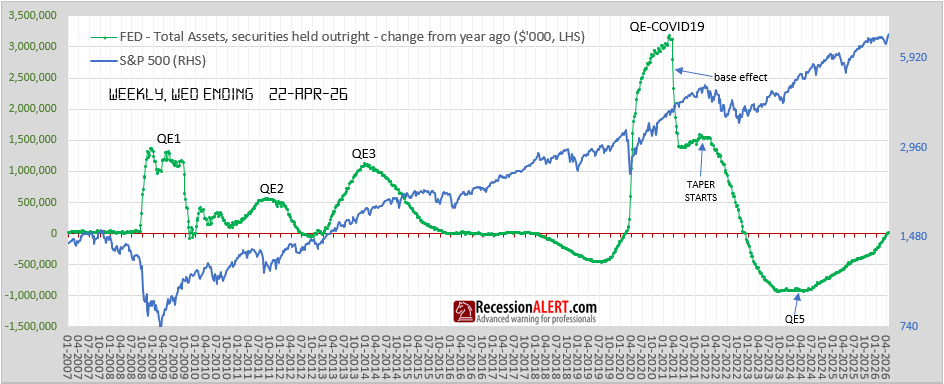
Chart of the Day: Every time the Fed has opened the liquidity spigot, the stock market has followed it higher — and every time it’s closed it, markets have struggled. What looks like a free market pricing risk is largely a mirror of central bank balance sheet expansion, with the S&P 500 essentially acting as a liquidity gauge rather than an economic one. We’re now watching the cycle restart in real time, with the Fed quietly reflating after the deepest post-COVID drain in history, just as equities sit at record highs — raising the uncomfortable question of whether markets can ever truly be allowed to clear on their own terms again.
Market Intelligence Brief (MIB) Ver. 17.47
For professional investors only. Not investment advice.
© 2026 RecessionALERT.com

Comments are closed.