
S&P 500 (+0.12%) and Nasdaq (+0.01%) eked out paper-thin records as Brent spiked above $101 on stalled Hormuz talks. Trump cancelled Pakistan envoys; IEA warned supply won’t recover for two years. Qualcomm surged 12% on a report OpenAI is building an AI smartphone chip with QCOM and MediaTek. Microsoft-OpenAI exclusivity ended, freeing OpenAI to deploy on AWS/GCP. Powell’s likely final FOMC opens Tuesday; Warsh Senate vote Wednesday. Verizon posted its first positive Q1 phone adds in 13 years.
TABLE OF CONTENTS
A. EXECUTIVE SUMMARY
B. MARKET DATA
C. HIGH-IMPACT STORIES (5)
D. MODERATE-IMPACT STORIES (5)
E. ECONOMY WATCH (5)
F. EARNINGS WATCH (1)
G. WHAT’S NEXT
H. CHART OF THE DAY
A. EXECUTIVE SUMMARY -> TOP
The S&P 500 and Nasdaq’s hollow records mask a stagflation-pricing tape: Brent surged 2.77% above $101 on stalled Iran talks while 10Y yields rose 3.2 bps to 4.341% — Treasuries explicitly declined to confirm the equity high, pricing oil-driven inflation rather than growth. Only three of eleven sectors closed green, with Consumer Defensive (-1.15%) the worst as record-low UMich sentiment (49.8) showed up in MCD and PM sell-offs. The Dow Theory non-confirmation persists in its second week — DJIA sits within 0.65% of its high while Transports are 12.9% below theirs — signalling the industrial economy is refusing to validate the mega-cap rally heading into Powell’s likely final FOMC.
• Brent +2.77% to $101.88; WTI +2.40% to $96.67 on Hormuz re-escalation after Trump cancelled Pakistan envoys; IEA warns Mideast supply won’t recover for up to two years.
• Qualcomm +12% on Ming-Chi Kuo report OpenAI is co-designing a custom AI smartphone chip with QCOM and MediaTek targeting 300–400M annual units by 2028.
• Microsoft-OpenAI exclusivity ends — OpenAI now free to deploy on AWS/GCP; revenue share to MSFT capped through 2030; bullish AMZN/GOOG cloud, neutral-to-negative MSFT moat.
• FOMC begins Tuesday — Powell’s likely final meeting; rate hold near-certain (Polymarket 99.3%); Warsh Senate Banking vote Wednesday 10am ET creates a single-day Fed-succession event.
• China NDRC blocks Meta’s $2B Manus deal citing tech-export controls — first explicit signal that Beijing treats agentic AI as a strategic asset on par with semiconductors.
• Verizon (VZ) +1.55% — first positive Q1 phone adds in 13 years (+55K); EPS $1.28 beat, revenue $34.40B miss; full-year EPS guidance raised to +5–6% YoY.
1. Hollow Records on a Stagflationary Tape — S&P and Nasdaq closed at fresh records with only 3 of 11 sectors green, the Dow, NYSE Composite, and Transports all red, and the 10Y yield rising on a supply-shock inflation premium. The bond market is openly dissenting from the equity tape; the divergence is not noise, it is the most important read of the day.
2. AI Hardware Arms Race Decouples From Microsoft — The end of MSFT-OpenAI exclusivity and the QCOM/MediaTek/OpenAI smartphone chip report on the same day mark OpenAI’s pivot to a multi-cloud, multi-hardware platform. Read-through: bullish for AMZN/GOOG cloud workloads and QCOM addressable market; bearish for MSFT’s Azure moat and AAPL’s iPhone hardware narrative.
3. Fed-Transition Risk Compounds the Macro Stack — Powell’s swan-song FOMC, Warsh’s parallel confirmation vote Wednesday, the April 30 GDP/PCE doubleheader, and Dalio’s public warning against stagflationary cuts converge in a single 96-hour window. Markets are pricing zero rate cuts well into 2027 if Warsh-led; duration-sensitive assets and 30x+ multiples carry the most asymmetric risk.
 — Leading economic indicators. Accurate market forecasts. Apply for membership at join.recessionalert.com
B. MARKET DATA -> TOP
The S&P 500 and Nasdaq logged technical records (+0.12% and +0.01% respectively) on vanishingly thin gains as stalled US-Iran peace talks and a fresh Strait of Hormuz escalation pushed Brent back above $100 — the real story of the day was oil, not equities. Only three of eleven sectors closed green; Consumer Defensive (-1.15%) led the decline on record-low consumer sentiment (49.8), while Energy stocks fell -0.10% even as crude surged 2.4%, a divergence that signals macro skepticism in the sector itself. The bond market was the most honest voice: 10-year yields rose 3.2 bps to 4.341% as equities barely moved — Treasuries pricing a supply-shock inflation risk that the headline index is ignoring. Micron (+5.60%) extended the semiconductor rally while AMD (-3.79%) reversed Friday’s 14% surge after a Northland Capital downgrade, and T-Mobile (-3.71%) sold off ahead of its after-close earnings report.
CLOSING PRICES – April 27, 2026:
MAJOR INDICES
The S&P and Nasdaq records are the thinnest possible — a +0.12% and effectively flat Nasdaq gains while the Dow, NYSE Composite, and DJ Transports all closed red; breadth was deteriorating, not expanding. Dow Theory non-confirmation persists in force: DJIA sits within 0.65% of its 8-session high while the Transports sit 12.9% below theirs, a sustained divergence now in its second week that signals the industrial engine is not validating the mega-cap rally. Russell 2000 barely participated (+0.13%), confirming this remains a concentrated mega-cap story.
| Index | Close | Change | %Move | Why It Moved |
|---|---|---|---|---|
| S&P 500 | 7,173.97 | +8.89 | +0.12% | Hollow record; tech pre-earnings positioning offset oil/Iran-driven weakness |
| Dow Jones | 49,167.79 | -62.92 | -0.13% | Blue-chip industrials and consumer names dragged; MCD and defensive names sold |
| DJ Transportation | 20,843.80 | -48.20 | -0.23% | Higher fuel costs from Brent above $100 weigh on airline/transport operating margins |
| Nasdaq 100 | 27,305.68 | +2.01 | +0.01% | Effectively flat at record; MU/NVDA/INTC gains offset AMD/LRCX/AMAT declines |
| Russell 2000 | 2,790.75 | +3.75 | +0.13% | Marginal gain; small-cap participation muted on rising yields and oil |
| NYSE Composite | 22,905.46 | -29.09 | -0.13% | Broad market finished red; confirms record headline indices are misleading breadth |
VOLATILITY & TREASURIES
The cross-asset signal here is a flashing amber: VIX eased (-3.63%) while 10Y yields rose 3.2 bps — options desks are less fearful of volatility, but bond investors are pricing higher inflation from the oil shock, not growth optimism. The yield curve steepened modestly (10Y +3.2 bps vs 2Y +2.3 bps), consistent with a supply-shock read rather than rate-cut repricing. Bond non-participation in the equity record is the key tell — Treasuries are declining to endorse this rally, citing stagflationary oil and Iran risk rather than demand-driven growth.
| Instrument | Level | Change | Why It Moved |
|---|---|---|---|
| VIX | 18.03 | -0.68 (-3.63%) | Options fear eased slightly; VIX near 18 still signals elevated uncertainty vs pre-conflict |
| 10-Year Treasury Yield | 4.341% | +3.2 bps | Oil-driven inflation premium; bond market not confirming the equity record |
| 2-Year Treasury Yield | 3.799% | +2.3 bps | Front-end rose alongside long end; modest steepening — supply-shock, not growth repricing |
| US Dollar Index (DXY) | 98.50 | -0.07 (-0.07%) | Essentially flat; Iran risk and oil offsetting any safe-haven dollar bid |
COMMODITIES
Precious metals fell across the board — gold -0.91%, silver -1.23%, platinum -1.84% — a rotation out of haven assets as Iran ceasefire talks, however stalled, remain alive and VIX eased; this is haven unwind, not a demand-growth signal. Copper was flat (-0.05%), consistent with industrial growth expectations that haven’t yet changed. Bitcoin -1.86% declined with gold, confirming both are in light haven-unwind mode rather than independently driven — the crypto/gold correlation held today.
| Asset | Price | Change | %Move | Why It Moved |
|---|---|---|---|---|
| Gold | $4,697.75/oz | -$43.15 | -0.91% | Haven unwind as VIX eased; Iran peace talks remain nominally alive |
| Silver | $75.478/oz | -$0.936 | -1.23% | Tracked gold lower; industrial component offered no offsetting support |
| Copper | $6.0857/lb | -$0.0027 | -0.05% | Flat; industrial demand expectations unchanged, neither bullish nor bearish signal |
| Platinum | $1,993.10/oz | -$37.30 | -1.84% | Heaviest precious metals decline; auto-sector demand concerns amid high oil costs |
| Bitcoin | $76,972 | -$1,458 | -1.86% | Fell with gold in mild haven-unwind trade; tracking macro risk, not crypto-specific catalysts |
ENERGY
WTI and Brent surged in lockstep (+2.40%/+2.77%) on Strait of Hormuz escalation and stalled peace talks — this is a pure supply-disruption shock, not a demand signal. The critical tell: Energy sector stocks fell -0.10% while crude surged over 2% — equity investors are pricing demand destruction from high oil, not riding the commodity move; that’s a stagflationary read, not a bullish energy trade. Dutch TTF fell in euro terms (-0.48%) while Henry Hub rose +1.79%, a US-vs-Europe gas divergence driven by US storage and weather rather than Middle East supply.
| Asset | Price | Change | %Move | Why It Moved |
|---|---|---|---|---|
| Crude Oil (WTI) | $96.67/bbl | +$2.27 | +2.40% | Strait of Hormuz effectively closed; US-Iran peace talks stalled over weekend |
| Crude Oil (Brent) | $101.88/bbl | +$2.75 | +2.77% | Global benchmark back above $100; IEA warned of unprecedented supply shock |
| Natural Gas (Henry Hub) | $2.731/MMBtu | +$0.048 | +1.79% | Modest bounce from Friday’s 3.56% drop; storage glut dynamic intact |
| Natural Gas (Dutch TTF) | $15.336/MMBtu | -$0.079 | -0.51% | TTF fell in euro terms (-0.48%); European gas decoupling from crude amid weather/storage |
S&P 500 SECTORS
Only three of eleven sectors closed green — Communication Services (+0.73%) and Financial (+0.56%) led while Technology barely held positive (+0.16%), a stark contrast to Friday’s tech-led sweep. Consumer Defensive was the worst sector (-1.15%), now negative on the week (-0.34%) despite being a relative outperformer during the Iran conflict; the Michigan Consumer Sentiment record low (49.8) is showing up in staples sell-offs with MCD and PM both down sharply. Healthcare’s rout deepened to -7.96% over three months and -5.38% YTD — today’s -0.43% confirms structural, not tactical, deterioration as GLP-1 competitive displacement continues.
| Sector | 1-Day | 1-Week | 1-Month | 3-Month | 6-Month | YTD | 12-Month |
|---|---|---|---|---|---|---|---|
| Communication Services | +0.73% | +0.76% | +15.60% | +1.91% | +8.95% | +3.75% | +44.36% |
| Financial | +0.56% | -1.89% | +6.68% | -2.82% | +2.43% | -3.07% | +15.15% |
| Technology | +0.16% | +3.38% | +19.64% | +9.06% | +8.01% | +10.10% | +52.97% |
| Utilities | 0.00% | +0.93% | +3.15% | +7.24% | +4.30% | +9.10% | +21.62% |
| Industrials | -0.03% | -1.06% | +8.13% | +5.47% | +13.54% | +13.47% | +38.76% |
| Energy | -0.10% | +2.65% | -5.12% | +18.27% | +30.23% | +29.05% | +42.62% |
| Basic Materials | -0.39% | -2.31% | +10.16% | +0.38% | +26.13% | +17.16% | +50.86% |
| Healthcare | -0.43% | -3.12% | +0.06% | -7.96% | -0.07% | -5.38% | +8.69% |
| Real Estate | -0.53% | -2.18% | +7.58% | +4.26% | +2.37% | +6.78% | +7.54% |
| Consumer Cyclical | -0.69% | -1.50% | +9.25% | -4.23% | -2.45% | -1.93% | +20.20% |
| Consumer Defensive | -1.15% | -0.34% | +2.00% | +0.67% | +5.32% | +6.97% | +5.42% |
TOP MEGA-CAP MOVERS:
GAINERS
| Company | Ticker | Close | Change | Why It Moved |
|---|---|---|---|---|
| Micron Technology | MU | $524.56 | +5.60% | Extended semi rally on AI-memory demand read-through from Intel’s Data Center beat |
| NVIDIA Corp | NVDA | $216.61 | +4.00% | AI-compute demand narrative intact; held $5T cap; Alphabet pre-earnings cloud-AI positioning |
| Intel Corp | INTC | $84.99 | +2.97% | Continued post-earnings momentum; Data Center & AI revenue beat holding institutional interest |
| Alphabet Inc | GOOG | $348.52 | +1.81% | Pre-earnings run; Q1 2026 results due Apr 29 AMC — cloud growth and AI ad-revenue in focus |
DECLINERS
| Company | Ticker | Close | Change | Why It Moved |
|---|---|---|---|---|
| Advanced Micro Devices | AMD | $334.63 | -3.79% | Northland Capital downgrade to Market Perform + profit-taking after Friday’s 13.91% surge |
| T-Mobile US | TMUS | $182.75 | -3.71% | Pre-earnings sell-off ahead of Q1 results due AMC today; merger speculation adds uncertainty |
| Lam Research | LRCX | $259.47 | -3.10% | Semi equipment profit-taking; LRCX rose sharply Friday on Intel halo, giving back gains |
| McDonald’s Corp | MCD | $290.21 | -3.06% | Consumer Defensive worst sector; record-low UMich sentiment (49.8) signals trade-down risk ahead of Apr 30 earnings |
| Applied Materials | AMAT | $404.86 | -2.92% | Semi equipment rotation; paired with LRCX in profit-taking after Friday’s Intel-driven equipment rally |
— Institutional-grade intelligence for serious investors. Apply for membership at join.recessionalert.comC. HIGH-IMPACT STORIES -> TOP
UNCERTAIN
1. FOMC Convenes Tuesday — Powell’s Likely Final Meeting; Rate Hold Unanimous, Warsh Senate Vote Wednesday
The core facts:The Federal Open Market Committee begins its two-day April 28–29 meeting today, with futures markets pricing a 100% probability of no change to the 3.50%–3.75% fed funds target. This is likely Jerome Powell’s final meeting as chair — his term expires May 15, 2026. There will be no updated Summary of Economic Projections and no fresh dot plot. Separately, the Senate Banking Committee is scheduled to vote on Kevin Warsh’s nomination Wednesday, April 29, at 10 am ET — the same day the FOMC statement drops — a procedural coincidence that puts maximum focus on the Fed succession in a single 24-hour window.
Why it matters:The rate decision itself is mechanical — the uncertainty is in Powell’s press conference language. Markets will parse every word for clues about the data threshold for cuts, guidance on whether oil-driven inflation warrants a hawkish shift, and any signal on balance-sheet trajectory. With Warsh waiting in the wings — a known hawk who has telegraphed “regime change” on inflation measurement and balance-sheet reduction — the Wednesday confirmation vote is arguably more market-moving than the rate announcement. A confirmed Warsh means the March 2027 dot plot is the last one markets can trade on Powell’s framework.
What to watch:Powell’s Wednesday press conference language on stagflation risk and rate-cut optionality. Senate Banking vote outcome Wednesday at 10 am ET — if confirmed, watch 10Y yields and rate-cut probability repricing in the following 48 hours.
BEARISH
2. Trump Cancels Pakistan Talks; Hormuz Blockade Deepens — IEA Warns Supply Won’t Recover for Up to Two Years
The core facts:President Trump on Saturday (April 25) cancelled plans to send envoys Steve Witkoff and Jared Kushner to Pakistan for direct talks with Iran after Iran’s Foreign Minister had already left Islamabad. Trump cited “too much time wasted on traveling” and “tremendous infighting and confusion within their leadership,” while reaffirming the US naval blockade of Iranian ports will remain until a deal is reached. Iran dismissed any ceasefire extension as “meaningless” while the blockade persists. Brent crude rose to $106.99 intraday Monday, with WTI briefly topping $97/bbl. The IEA, in its April monthly report, warned that even a full Hormuz reopening would not restore Middle East output to pre-war levels for up to two years, given damage to more than 80 energy facilities across the region.
Why it matters:The Pakistan cancellation eliminates the nearest-term de-escalation catalyst that markets had been pricing. The IEA’s two-year recovery timeline transforms the oil risk from a “geopolitical spike” into a structural supply deficit — meaning even a deal this week does not return crude to $60 or $70. With core PCE already running above 4% annualized and inflation expectations at 4.8% (UMich final April), a persistent $95–$110 crude regime is the single largest threat to the Fed’s rate-hold optionality. Oil-driven stagflation is no longer a tail risk; it is the base case for the rest of 2026.
What to watch:Any resumption of direct US-Iran contact — a phone call between Trump and Iranian leadership would be the most immediate de-escalation signal. Watch Brent’s $110 level as the next key threshold; a sustained break above would accelerate stagflation pricing. EIA weekly inventory report Wednesday for US strategic reserve data.
BULLISH
3. Qualcomm Surges 12% on Report OpenAI Is Building Custom AI Smartphone Chip With Qualcomm and MediaTek
The core facts:Analyst Ming-Chi Kuo (TF International Securities) reported Monday that OpenAI is developing a custom smartphone processor in partnership with Qualcomm (QCOM) and MediaTek, with Chinese manufacturer Luxshare co-designing and building the physical device. The AI-native phone would eliminate traditional apps in favor of an agent-driven interface, targeting 300–400 million annual shipments by 2028. Mass production is expected to begin 2028, with supplier finalization in late 2026/early 2027. Qualcomm surged 12%+ on the report; the news also serves as the first concrete application of the Microsoft-OpenAI exclusivity restructuring announced the same day, signalling OpenAI’s intent to deploy across multi-cloud and multi-hardware ecosystems.
Why it matters:A Qualcomm-powered OpenAI phone targeting 300–400 million units annually would represent one of the largest addressable-market expansions in smartphone history and is a direct competitive threat to Apple’s iPhone hardware moat. For Qualcomm, an OpenAI design win at that scale would be transformational to its addressable market. For Apple, the risk is not just competition but loss of the AI-native framing that AAPL has been trying to establish with Apple Intelligence. The report is unconfirmed — Qualcomm, OpenAI, and MediaTek did not comment — but Ming-Chi Kuo’s track record on Apple supply-chain reporting is strong, lending credibility.
What to watch:Apple’s April 30 earnings — Tim Cook’s commentary on AI device strategy will be read as a direct response to this report. Any official confirmation from Qualcomm or OpenAI would materially accelerate the trade. Watch AAPL for any weakening on QCOM’s gain as markets price the competitive threat.
UNCERTAIN
4. Microsoft and OpenAI Restructure Partnership: Exclusivity Ends, Revenue Share Capped — OpenAI Free to Expand Beyond Azure
The core facts:Microsoft and OpenAI announced Monday that they have reworked their partnership agreement. Key changes: (1) Microsoft’s exclusive right to sell OpenAI’s models is eliminated — OpenAI can now partner with any cloud provider including AWS and Google Cloud; (2) Microsoft retains a non-exclusive IP license through 2032; (3) OpenAI’s revenue-share payments to Microsoft will be capped and continue through 2030, independent of AGI milestones; (4) Microsoft stops paying revenue share on OpenAI products it resells. Microsoft framed the change as helping fight antitrust scrutiny across the US, UK, and Europe. MSFT shares ended slightly higher after initial wobble on the news.
Why it matters:The end of exclusivity is a double-edged sword for Microsoft. On the negative side, Azure loses its moat as the sole gateway to OpenAI’s enterprise-grade models — Amazon and Google can now offer OpenAI directly on their clouds, intensifying the AI-workload competition. On the positive side, Microsoft sheds antitrust risk that was materially clouding its EU and UK cloud-market positioning. The capped revenue share protects Microsoft’s bottom line while removing the upside optionality of OpenAI’s scale. Net read-through: bullish for Amazon and Google (new OpenAI access), neutral-to-slightly-negative for MSFT enterprise AI moat, and unambiguously bullish for OpenAI’s expansion strategy.
What to watch:Microsoft’s Tuesday earnings call — Azure revenue guidance and any commentary on OpenAI partner economics will clarify how much of the moat Microsoft retains. Watch whether AWS or GCP announce new OpenAI partnerships within the next 30 days.
BULLISH
5. S&P 500 and Nasdaq Post Fresh Record Closes; XLK +2.5% as Markets Absorb Geopolitical Risks
The core facts:The S&P 500 eked out a fresh record close at 7,173.91 (+0.12%) and the Nasdaq Composite also notched a record at 24,887.10 (+0.20%), extending the consecutive-record streak into a new week despite a heavy geopolitical and macro calendar. The Technology Select Sector SPDR (XLK) gained 2.5%, driven by semiconductor names. The Dow Jones Industrial Average fell 62.92 points (–0.13%) to 49,167.79, reflecting weakness in industrials and energy-exposed names. It was the start of the heaviest earnings week of 2026, with roughly one-third of S&P 500 firms reporting, including all five Magnificent Seven companies.
Why it matters:The market’s continued record-setting in the face of Hormuz re-escalation, a cancelled ceasefire meeting, record-low consumer sentiment, and a looming Fed chair transition reflects extraordinary conviction in the AI/earnings thesis as an overriding driver of institutional flows. The Dow’s underperformance vs. Nasdaq (+2.5% XLK vs. –0.13% Dow) is the starkest “two-speed market” divergence in months. This week’s earnings — GOOGL, MSFT, META, AMZN — will either validate the record levels or expose them as priced-to-perfection vulnerability. There is no constructive path for the index if cloud and AI capex commentary disappoints.
What to watch:The aggregate AI capex disclosed across GOOGL/MSFT/META/AMZN this week. Market consensus is ~$520B for the four combined in 2026; any downside revision would be a material catalyst for an index re-rate. Watch the SOX for continuation of the 18-session streak.
— Quantifying recession risk so you don’t have to guess. Apply for membership at join.recessionalert.comD. MODERATE-IMPACT STORIES -> TOP
BEARISH
6. Ray Dalio Warns Kevin Warsh: Cutting Rates in a Stagflationary Era Would Be a Policy Mistake
The core facts:Bridgewater founder Ray Dalio stated publicly Monday that incoming Fed chair nominee Kevin Warsh should not cut interest rates in what Dalio described as a “stagflationary” environment — persistent price pressures coinciding with decelerating economic growth. Dalio argued that a rate cut under those conditions would put the Fed’s institutional standing at risk. The backdrop: Morgan Stanley economists have Q1 GDP at 2.4% with core PCE running at 4.1% annualized; S&P Global’s April flash PMI showed output growing modestly while input costs rose at the steepest pace since 2022. Consumer year-ahead inflation expectations hit 4.8% in the final UMich April survey.
Why it matters:Dalio’s warning carries institutional weight precisely because it aligns with Warsh’s own publicly stated hawkish instincts — effectively pre-endorsing a rate-hold (or even tightening) regime. For fixed-income markets, this raises the probability that rate cuts in 2026 are zero or one at most, pushing the first cut into 2027. Duration-sensitive assets (long bonds, rate-sensitive equities like REITs and utilities) face extended headwinds. The stagflation framing is also a direct challenge to equity multiples — historically, stagflation environments compress P/E ratios, which is in direct tension with a 30x+ Nasdaq trading at all-time highs.
What to watch:Powell’s press conference Wednesday — any language suggesting the Fed is weighing stagflation vs. pure inflation will validate Dalio’s framing and accelerate yield re-pricing. Watch TIPS breakevens for market-implied inflation expectations shifting after the FOMC.
BEARISH
7. China Blocks Meta’s $2 Billion Acquisition of AI Startup Manus, Citing Tech-Export Concerns
The core facts:China’s National Development and Reform Commission issued a one-line notice Monday prohibiting foreign investment in Manus, the Chinese-founded AI startup Meta had agreed to acquire for approximately $2 billion in December 2025. The NDRC ordered all parties to withdraw from the deal, citing laws covering technology export controls, technology import/export regulations, and overseas investment. Beijing’s rationale: transferring Manus’s agentic AI technology to a US company would constitute an illegal tech export. Meta said the transaction “complied fully with applicable law” and anticipated “an appropriate resolution.” Manus shares were delisted from any secondary-market trading. Meta shares fell on the news.
Why it matters:The NDRC veto is the clearest signal yet that China views agentic AI as a strategic asset equivalent to semiconductors — subject to the same export-control logic it applies to advanced chip architectures. For US tech companies, this establishes a new category of M&A risk: Chinese-founded AI startups, regardless of where they are domiciled, may face Chinese regulatory veto of any US acquisition. For Meta specifically, the deal failure reinforces the company’s need to build AI-agent capabilities internally (after the Manus setback) precisely as it reports earnings this week. The $2B loss is immaterial; the strategic loss of Manus’s agent technology is the real cost.
What to watch:Meta’s earnings call this week for commentary on internal AI-agent development timeline as a substitute for the Manus capability. Watch for US regulatory reciprocity — any parallel US action blocking Chinese AI investments in response would escalate the bifurcation of global AI ecosystems.
BEARISH
8. Mizuho Downgrades Adobe to Neutral, Cuts PT to $270 from $315 — AI Competition Threatens Terminal Value
The core facts:Mizuho analyst Gregg Moskowitz downgraded Adobe (ADBE) from Outperform to Neutral on Monday, cutting his price target to $270 from $315 — a 14% PT reduction. Moskowitz cited intensifying AI competition in the prosumer and small-business segments, warning of “risk of margin erosion” and projecting Adobe’s organic revenue and ARR CAGR over the next two to three years at “high-single-digits at best,” well below the double-digit growth investors have historically priced in. Adobe shares fell roughly 2% on the note. Separately, Mizuho upgraded CrowdStrike (CRWD) to Outperform on the same day, reflecting a divergent view on which software platforms are net AI beneficiaries vs. net victims.
Why it matters:The downgrade is the latest sign of a bifurcating software market: companies using AI as a distribution weapon (OpenAI, Midjourney, Canva) are gaining prosumer share from Adobe’s traditional Creative Cloud franchise at a pace that is now visible in analyst models. Mizuho’s divergent ADBE-down/CRWD-up call is a template for how the sell-side is beginning to separate AI-native winners from AI-disrupted incumbents — a distinction that will become a major portfolio-construction theme through 2026. Adobe’s next earnings report is the near-term test of whether the revenue deceleration Moskowitz projects is already in the numbers.
What to watch:Adobe’s next earnings date (mid-June). Watch creative-tool app-download data and SMB survey results for leading indicators of prosumer-segment share loss. Track CRWD for follow-through on the Mizuho upgrade thesis.
BULLISH
9. Mizuho Upgrades CrowdStrike to Outperform — Cybersecurity Named Net AI Winner as Software Bifurcates
The core facts:On the same call that downgraded Adobe, Mizuho analyst Gregg Moskowitz upgraded CrowdStrike (CRWD) to Outperform, identifying the cybersecurity platform as a direct beneficiary of AI-driven threat proliferation and enterprise consolidation to fewer, higher-value security vendors. The upgrade reflects Mizuho’s view that AI is expanding the attack surface faster than legacy security can defend, creating a durable structural demand driver for AI-native platforms like CrowdStrike’s Falcon. CRWD’s market cap is approximately $100B.
Why it matters:The ADBE/CRWD divergent call is a microcosm of the emerging “AI winners vs. AI losers” software thesis. Cybersecurity as a sector is structurally insulated from AI disruption — AI-generated threats require AI-native defenses, meaning the market size grows with AI adoption rather than shrinking. For institutional investors rotating within software, the Mizuho call provides a framework: move from AI-vulnerable creative/productivity tools (Adobe, some Microsoft segments) toward AI-necessary infrastructure (CrowdStrike, Palo Alto Networks, SentinelOne).
What to watch:CRWD’s next earnings call — net new ARR and platform consolidation metrics (customers using 5+ modules) are the key KPIs. Watch BUG and CIBR cybersecurity ETFs for broader sector momentum following the Mizuho upgrade.
BULLISH
10. Q1 2026 Earnings Season Accelerates: 28% Reported, 84% EPS Beat Rate, Record 13.4% Net Profit Margin
The core facts:The latest FactSet Earnings Insight (as of April 24, 2026) shows 28% of S&P 500 companies have reported Q1 results, with 84% beating EPS estimates — above the 5-year average of 78% and 10-year average of 76%. Companies are reporting earnings 12.3% above consensus estimates (vs. the 5Y average surprise of 7.3%). The blended net profit margin of 13.4% would be the highest on record in FactSet’s tracking history if it holds. Industrials lead in positive surprise magnitude (+33.2%). The blended earnings growth rate for Q1 2026 is on track above the pre-season estimate of 13.2% YoY.
Why it matters:A 13.4% net margin at the index level — if sustained — would be a structural argument for elevated equity multiples even at record prices. The 12.3% above-consensus surprise magnitude suggests Q1 estimates were set too conservatively, likely because analysts embedded more Iran-war risk than actually hit corporate income statements in Q1. The critical test this week: whether the mega-caps (GOOGL, MSFT, META, AMZN) delivering 30–40% of index earnings maintain this beat-rate cadence, or whether Iran-driven cost pressures or guidance caution breaks the pattern.
What to watch:FactSet’s next weekly Earnings Insight update (April 25) will reflect this week’s hyperscaler results. If the 84% beat rate holds above 80% after the Mag-7 week, the earnings season earns a “strong” designation that historically supports index multiples for the next quarter.
— Separating signal from noise since 2007. Apply for membership at join.recessionalert.comE. ECONOMY WATCH -> TOP
The week opens on a fork: Powell’s swan-song FOMC (April 28-29) collides with the April 30 doubleheader of Q1 GDP advance and March core PCE — the cleanest stagflation read of the year. Iran’s weekend declaration that the Strait of Hormuz “will under no circumstances” reopen pushed Brent back above $107 and US crude above $96, locking in the energy pulse the Fed flagged at the March meeting. Today’s Dallas Fed manufacturing print encapsulated the disconnect: headline business activity slipped deeper into contraction (-2.3) while the production sub-index jumped 12 points to 19.0. Markets are pricing 99% no-change at the FOMC, but the statement language and the Senate Banking vote on Warsh (Wednesday 10am) will set the tone into May.
Dallas Fed Manufacturing Index Slips to -2.3 — Headline Worsens, Production Diverges (Dallas Fed, April 27)
What they’re saying:The Dallas Fed’s general business activity index for Texas manufacturing fell to -2.3 in April from -0.2 in March, the lowest level so far in 2026. But the production sub-index jumped 12 points to 19.0 — a reading suggestive of an above-average pace of output expansion — and the company outlook index rebounded to +3 with uncertainty receding from a one-year high.
The context:The split between deteriorating sentiment (general activity, business outlook surveys) and accelerating hard data (production, output volumes) is becoming the signature of this cycle. It mirrors last week’s S&P Global flash PMI, where the manufacturing PMI hit a 47-month high while output prices rose at the sharpest rate since mid-2022. The takeaway for the FOMC: tariff and oil-shock front-running is generating activity AND inflation simultaneously — the worst combination for cut timing.
What to watch:Richmond Fed Manufacturing (April 28) and ISM Manufacturing (May 1) for cross-confirmation of the production-vs-sentiment divergence.
Powell’s Swan-Song FOMC and Warsh Confirmation Vote Set Up High-Stakes Week (Conference Board / Senate Banking, April 27)
What they’re saying:The April 28-29 FOMC meeting is widely expected to be Powell’s last as Chair (term ends May 15). Polymarket prices a 99.3% probability of no rate change. In parallel, the Senate Banking Committee has scheduled an executive-session vote on Kevin Warsh’s nomination for 10:00 AM Wednesday — Senator Tillis dropped his blockade after the DOJ ended its criminal probe of Powell, clearing the path for full Senate confirmation by May 15. April is not a projections meeting (no SEP, no fresh dot plot), so statement language and Powell’s final press conference carry the full signaling weight.
The context:Warsh signalled at his April 21 hearing that he favors a “regime change” on the Fed’s inflation framework — preferring trimmed-mean gauges over the current core PCE preference and pushing for a leaner balance sheet. Jefferies’ Kumar believes a Warsh-led Fed would lean more dovish, projecting two cuts this year, though the Chair doesn’t vote alone. The two-track event (Powell’s last meeting + Warsh’s confirmation vote running in parallel) creates a discontinuity risk that has not appeared on the Fed calendar in over a decade.
What to watch:FOMC statement Wednesday 2pm — specific changes around “patient,” “data-dependent,” or any new inflation-uncertainty language. Powell press conference 2:30pm. Senate Banking vote outcome 10am Wednesday.
Iran Says Hormuz “Under No Circumstances” Reopens — Brent Back Above $107 (CNN / Reuters, April 26)
What they’re saying:An Iranian official Sunday declared the Strait of Hormuz “will under no circumstances” return to its previous state, accusing the US of undermining trust in ceasefire talks. Brent crude rose 2.14% to $107.58, US crude up 2.08% to $96.36. AAA pegged retail gasoline at $4.10/gal — up 27% since the start of the war but down from a recent peak. IMF chief economist Gourinchas reiterated that the IMF’s adverse-scenario projection (global growth 2.5%, US inflation north of 5%) is now the more likely path.
The context:The energy shock is now in its sixth week — long enough for second-round effects to embed in services and goods PCE. Moody’s Zandi has warned a recession becomes hard to avoid if oil stays elevated past mid-Q2. The Hormuz statement is the first explicit signal from Tehran that the supply disruption is structural rather than tactical, removing the “transitory” anchor the Fed has leaned on.
What to watch:Brent above $110 sustained → trigger for sell-side recession-probability upgrades. Below $90 sustained → soft-landing thesis re-anchors.
Q1 GDP Advance + March Core PCE Doubleheader Looms April 30 (BEA / Atlanta Fed / Morningstar, April 27)
What they’re saying:Thursday April 30 brings the Q1 2026 GDP advance estimate and March Personal Income & Outlays (with core PCE) on the same morning — the highest-information data day of the month. Atlanta Fed GDPNow last printed 1.24% on April 21. Consensus core PCE: +2.7% YoY (vs. +2.8% in February); Morningstar’s Caldwell estimates the three-month annualized run rate at 3.8%, up from 1.6% the prior three months — a sharp re-acceleration if confirmed.
The context:A sub-1% Q1 GDP print paired with a hot core PCE would be the cleanest stagflation data release of the cycle and would force the FOMC to clarify its reaction function on its first post-meeting business day. Goldman’s December core PCE forecast remains 2.5% — well below Caldwell’s run-rate estimate, framing the magnitude of the data risk.
What to watch:April 30 8:30am — joint release. GDPNow updates Tuesday April 28 will firm the entry point. Core PCE above 0.4% MoM → yields likely test 4.7% on the 10Y; below 0.2% MoM → soft-landing rebid.
Conference Board: Soft-Landing Base Case Increasingly Fragile Amid Fed Transition Risk (Conference Board, April 27)
What they’re saying:The Conference Board’s FOMC Meeting Preview published today flagged that while a “soft landing” remains the base case, the simultaneous Powell-to-Warsh leadership transition introduces new policy uncertainty that could heighten recession risks if the handoff is not seamless. The brief specifically called out the upcoming meeting as a pivotal moment — Powell’s last regular FOMC, with Warsh’s confirmation running in parallel.
The context:Institutional 12-month recession probabilities continue to span Goldman 30% / JPM 35-40% / Moody’s 42% / Wilmington 45%. Bankrate’s economist survey averages 28%, while Polymarket prices 26% (unchanged from Friday). The Conference Board flag is notable because the institution has historically anchored the consensus “soft-landing” framing — its softening tone today represents drift on the optimist end of the institutional distribution, which historically precedes broader downward revisions.
What to watch:NY Fed Q1 2026 Household Debt & Credit Report (early May) — delinquency transition rates will validate or refute the consumer-deterioration thesis underlying the Conference Board’s flagged risk.
— Know the probability before the market prices in the risk. Apply for membership at join.recessionalert.comF. EARNINGS WATCH -> TOP
YESTERDAY AFTER THE BELL (Markets Reacted Today)
No major earnings yesterday after the bell from companies with >$100B market cap.
TODAY BEFORE THE BELL (Markets Already Reacted)
UNCERTAIN
11. Verizon (VZ): +1.55% | Q1 First Positive Phone Adds in 13 Years; EPS Beats, Revenue Misses; Guidance Raised (Released: BMO April 27)
The Numbers:Adj. EPS $1.28 vs. $1.21 est. (+5.76% beat); Revenue $34.40B vs. $34.82B est. (–1.22% miss). Postpaid phone net adds: +55,000 — first positive Q1 in 13 years, +344,000 YoY improvement. Postpaid phone churn: 0.90% (5 bps improvement sequentially; below 0.85% by March). Broadband net adds: 341,000 (214K fixed wireless, 127K fiber). Total broadband subscribers: 16.8 million. 2026 adj. EPS guidance raised to +5.0%–6.0% YoY growth; retail postpaid phone net adds guide raised to upper half of 750,000–1 million range.
The Problem/Win:The postpaid net-add turnaround is the headline — 13 years of Q1 subscriber losses makes this quarter a genuine structural inflection point, driven by Verizon’s transformation program (network investment, competitive pricing on myPlan/myHome bundles, and reduced churn). Revenue missed on the top line ($34.40B vs. $34.82B) — the near-term negative — but the guidance raise signals management’s confidence that subscriber momentum more than offsets near-term ARPU pressure.
The Ripple:Read-through to AT&T (T) and T-Mobile (TMUS, reporting this week): Verizon’s churn improvement puts competitive pressure on rivals’ sub-adds narratives. Fixed-wireless growth (+214K) continues to signal that cable broadband faces structural share loss to telco wireless alternatives — negative for CHTR, CMCSA.
What It Means:The revenue miss keeps VZ from a full “beat-and-raise” rating, but the 13-year postpaid turnaround is a credible inflection that supports the ongoing transformation thesis. With the EPS guidance raise, VZ remains a defensible yield-plus-growth holding in a high-rate environment.
What to watch:T-Mobile Q1 earnings (this week) for the competitive response to VZ’s sub-add recovery. Watch VZ’s Q2 revenue trajectory — a second consecutive revenue miss would undercut the transformation narrative despite the subscriber gains.
TODAY AFTER THE BELL (Markets React Tomorrow)
No major earnings after the bell from companies with >$100B market cap. (Cadence Design Systems and Public Storage report AMC today but both are below the $100B threshold for inclusion.)
WEEK AHEAD PREVIEW:
This is the heaviest earnings week of Q1 2026 season — all five Magnificent Seven companies report, along with a deep bench of large-caps across consumer, financials, and industrials. The cumulative AI capex disclosed this week will set the tone for the market through June.
Alphabet (GOOGL) — AMC Tuesday April 28 ($2.1T cap) — Google Cloud growth and AI-infrastructure capex; Search ad-monetization in the face of generative-AI competition; YouTube monetization trends.
Microsoft (MSFT) — AMC Tuesday April 28 ($3T+ cap) — Azure capacity and revenue growth; OpenAI partnership economics post-restructuring; impact of voluntary buyouts on cost structure.
Visa (V) — AMC Monday April 27 ($590B cap) — US consumer spending trends through April; cross-border volumes as a proxy for global travel and trade health.
Coca-Cola (KO) — BMO Tuesday April 28 ($325B cap) — organic revenue growth and pricing power amid elevated input costs; emerging-market volume trends.
T-Mobile US (TMUS) — AMC Tuesday April 28 ($201B cap) — postpaid phone net adds vs. Verizon’s recovery; 5G fixed-wireless penetration update.
Booking Holdings (BKNG) — AMC Tuesday April 28 ($138B cap) — travel demand resilience amid energy-driven cost pressures and Iran-war geopolitical uncertainty.
Starbucks (SBUX) — AMC Tuesday April 28 ($112B cap) — same-store sales recovery under CEO Brian Niccol; China comp trends.
Meta Platforms (META) — AMC Wednesday April 29 — AI capex vs. $135B guidance; Manus deal failure commentary; Reality Labs operating loss; ad-revenue ARPU.
Amazon (AMZN) — AMC Thursday April 30 — AWS revenue growth; Anthropic commercial milestones; retail margin pass-through of tariff and energy costs.
Apple (AAPL) — AMC Thursday April 30 — iPhone demand amid AI device competition narrative (OpenAI/Qualcomm phone); Apple Intelligence monetization update; Services growth.
— US market commentary trusted by family offices and institutions. Apply for membership at join.recessionalert.comG. WHAT’S NEXT -> TOP
UPCOMING RELEASES:
| Date | Event | Why It Matters |
|---|---|---|
| Tue, Apr 28 | CB Consumer Confidence Apr (exp. 89.4, prior 91.8) | Confirms or refutes the UMich record-low (49.8) sentiment signal; another miss accelerates the consumer-deterioration thesis |
| Tue, Apr 28 | Richmond Fed Manufacturing Apr (prior 0); Dallas Fed Services Apr (prior −13.3) | Cross-confirmation of today’s Dallas Fed split between deteriorating sentiment and rising production sub-indexes |
| Wed, Apr 29 | FOMC Statement & Powell Press Conference (rate hold expected); Senate Banking vote on Warsh nomination (10:00 AM ET) | Powell’s likely final meeting paired with Warsh’s confirmation in a single 24-hour window — the most consequential Fed-succession event in over a decade |
| Thu, Apr 30 | Q1 GDP Advance Estimate + March Core PCE (consensus +2.7% YoY) (8:30 AM ET) | Cleanest stagflation read of the cycle; sub-1% GDP paired with hot core PCE forces FOMC to clarify reaction function on its first post-meeting business day |
| Fri, May 1 | ISM Manufacturing PMI Apr | Final cross-check on the production-vs-sentiment divergence; high reading + high prices-paid sub-index would lock the stagflation framing |
KEY QUESTIONS:
1. Will Powell’s final press conference acknowledge stagflation explicitly — and if so, does that elevate or undercut Warsh’s incoming “regime change” agenda?
2. Does the Mag-7 cumulative 2026 AI capex disclosed this week validate the ~$520B consensus, or does any meaningful downward revision crack the priced-to-perfection thesis sustaining the record indices?
3. With the 10Y already pricing oil-driven inflation, how much further can Treasuries discount stagflation before bond non-confirmation forces equity multiples lower — or do mega-cap earnings absorb the macro hit?
— US market commentary trusted by family offices and institutions. Apply for membership at join.recessionalert.comH. CHART OF THE DAY -> TOP
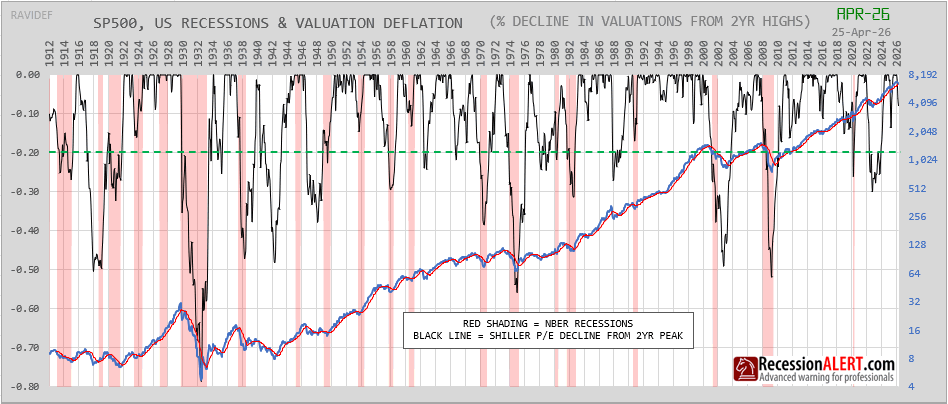
Chart of the Day: During the prior correction, a lot of noise on social media was present about how forward PE multiples had been declining to bargain territory, specifically in the technology sector. But on a historical earnings perspective the discount on the S&P 500 index had been very mild to say the least — far below that usually enjoyed by investors in prior corrections. The problem is the forward earnings expectations — the denominator in the forward PE ratings — had been rising a lot and was very bullish.
Market Intelligence Brief (MIB) Ver. 17.36
For professional investors only. Not investment advice.
© 2026 RecessionALERT.com

Comments are closed.