
Alphabet fell 5.1% — worst day in years — after its transformer co-inventor defected to OpenAI and AlphaFold’s Nobel laureate moved to Anthropic, while Alphabet raised $84.75B for the AI compute those leaders built. WTI hit an eight-month low at $74.09 on US Treasury authorization of Iranian oil exports, yet 10-year yields rose 6 bps — bond markets declining to confirm oil disinflation as a Fed catalyst. Micron surged 6.8% on an Anthropic co-design deal; Russell 2000 crossed 3,000 for the first time.
TABLE OF CONTENTS
A. EXECUTIVE SUMMARY
B. MARKET DATA
C. HIGH-IMPACT STORIES (5)
D. MODERATE-IMPACT STORIES (5)
E. ECONOMY WATCH (1)
F. EARNINGS WATCH (0)
G. WHAT’S NEXT
H. CHART OF THE DAY
A. EXECUTIVE SUMMARY -> TOP
The S&P 500 fell 0.37% Monday as Alphabet’s dual AI leadership departures — Gemini co-lead Noam Shazeer to OpenAI and Nobel laureate John Jumper to Anthropic — repriced the structural moat of a company simultaneously committing $84.75 billion to the AI infrastructure those researchers built. Communication services fell 3.48% and SpaceX (SPCX) extended its post-IPO collapse (−16.43%) on a $20B bond offering and MSCI’s CCC ESG rating, while the semiconductor hardware layer cleanly decoupled: Micron (+6.82%) on an Anthropic co-design deal and Intel (+5.19%) on 18A-P risk production entry. Iran’s 60-day peace roadmap and US Treasury authorization of Iranian oil exports drove WTI to an eight-month low of $74.09, yet 10-year yields rose 6 basis points in parallel — a flat yield shift signaling inflation persistence, not recession relief. The Russell 2000’s historic close above 3,000, combined with outperformance in defensives and AI hardware, confirmed the session as a rotation away from mega-cap tech, not a broad risk-off retreat.
• GOOG −5.08% — Alphabet’s worst day in over a year: transformer co-inventor Noam Shazeer defects to OpenAI; AlphaFold Nobel laureate John Jumper moves to Anthropic; Communication Services −3.48%; Alphabet simultaneously raised $84.75B for AI compute those leaders built, compounding dilution with leadership risk.
• Iran deal advances, oil collapses, bond yields rise anyway: WTI hit an eight-month low at $74.09 (−2.32%) on US Treasury authorization of Iranian oil exports — down 7% from the Juneteenth close of $80.57; 10Y yields rose 6 bps in parallel, bond markets declining to confirm oil deflation as a Fed pivot catalyst.
• Semiconductor hardware decouples from software selloff: Micron (MU) +6.82% on Anthropic co-design partnership for AI memory architecture; Intel (INTC) +5.19% on 18A-P risk production entry; Lam Research (LRCX) +5.27% — AI infrastructure demand rewarded while AI narrative names sold.
• Russell 2000 closes above 3,000 for the first time in history (+0.78%): small-cap breadth outperforms on mega-cap stress day; Dow +0.29% lifted by Intel (Dow component); NYSE Composite +0.41% — broad market confirms rotation, not broad risk-off retreat.
• SpaceX (SPCX) −16.43% — third straight post-IPO session of losses: $20B bond offering raises cash-burn concerns ($4.9B 2025 net loss); MSCI CCC ESG rating removes ~$30T AUM from buyer pool; SPCX now only 14% above $135 IPO price; Industrials sector dragged −1.89%.
• AbbVie (ABBV) +6.25% — $10.9B Apogee Therapeutics at 50% premium: lead compound zumilokibart (atopic dermatitis, mega-blockbuster potential, >$5B peak revenue) directly addresses post-Humira growth gap; Healthcare sector +0.96%.
1. AI Hardware vs. AI Software: A Structural Decoupling — Monday’s session was not a broad tech selloff — it was an internal repricing within the AI complex. Alphabet’s researcher exodus (−5.08%), SpaceX’s ESG/leverage crash (−16.43%), and Palantir (−6.98%) crushed the AI narrative layer while Micron (+6.82%), Intel (+5.19%), and Lam Research (+5.27%) surged on concrete infrastructure demand. The market is differentiating between owning the people who invent AI and owning the memory, compute, and manufacturing the models run on. Technology sector was essentially flat (−0.03%) while Communication Services fell 3.48% — the former owns hardware, the latter owns narrative.
2. Oil Relief Without Inflation Relief — Iran’s 60-day deal roadmap pushed WTI to an eight-month low, but bond markets refused the inflation-relief narrative: 10-year yields rose 6 bps and 2-year yields rose 5.3 bps simultaneously — a parallel flat shift reflecting near-term inflation persistence, not easing expectations. Alphabet’s $84.75B AI capex commitment and Chevron’s 20-year data center PPA with Microsoft (2.7 GW) both signal that AI infrastructure investment is sustaining an inflationary undertow crude’s decline alone cannot offset. Thursday’s May PCE (prior: 3.80% YoY core), not oil prices, will determine whether September hike odds (currently 57%) move materially.
3. Broad Market Rotation Is Confirmed — The Russell 2000’s historic first close above 3,000, the Dow’s outperformance of the S&P 500, and 10 consecutive sessions of small-cap outperformance (+4.82% vs. S&P 500) create a coherent rotation thesis: domestic-economy optimism — Iran-driven energy cost relief, soft-landing pricing in a hawkish Fed environment — is drawing capital from high-multiple mega-cap tech into small-cap, defensives, and transports with direct economic exposure. Consumer Cyclical remains the contrarian warning: negative across 1D, 1W, 1M, 6M, and YTD, suggesting the rotation has yet to translate into consumer spending recovery.
 — Leading economic indicators. Accurate market forecasts. Apply for membership at join.recessionalert.com
B. MARKET DATA -> TOP
A fractured session Monday: Alphabet’s AI talent exodus sent GOOG down 5.08%, dragging communication services 3.48% lower and pressuring the S&P 500 (-0.37%), while the Micron-Anthropic partnership and Intel’s 18A-P milestone sent semiconductors surging — the Nasdaq 100 finished nearly flat (-0.19%) as semi gains offset GOOG’s drag. The Dow (+0.29%) and Russell 2000 (+0.78%) both outperformed, with Intel’s 5.19% rise (a Dow component) driving blue-chip strength while transports (+0.73%) extended the small-cap breadth signal. SpaceX (SPCX) tumbled another 16.43% — third straight session of losses — on a $20B bond offering and MSCI’s CCC ESG rating, nearly erasing its post-IPO premium. Oil slid 2.3% on Iran deal progress while 10Y yields rose 6 bps — yields rising on a mixed tape signal stickier inflation rather than growth relief.
CLOSING PRICES – MONDAY, JUNE 22, 2026:
MAJOR INDICES
Today’s session split cleanly: the Dow (+0.29%), transports (+0.73%), and Russell 2000 (+0.78%) outperformed while the S&P 500 (-0.37%) and Nasdaq 100 (-0.19%) trailed — Intel’s 5.19% surge (Dow component) inflated the blue-chip index as GOOG and NFLX dragged growth benchmarks. Over the past 10 sessions, Russell 2000 has outperformed S&P 500 by +4.82% (signal extends into a second consecutive session), confirming broad market participation. Simultaneously, Nasdaq 100 has outperformed S&P 500 by +3.59% over 10 sessions (second consecutive session) — the coexistence of both signals reveals that the mid-cap layer of the S&P 500 is being squeezed between a surging small-cap base and dominant large-cap tech.
| Index | Close | Change | %Move | Why It Moved |
|---|---|---|---|---|
| S&P 500 | 7,473.03 | -27.55 | -0.37% | GOOG (-5.08%) AI talent exodus weighed on comm services (-3.48%); semiconductor surge (MU +6.82%, INTC +5.19%) partially offset through Nasdaq 100 component strength. |
| Dow Jones | 51,712.53 | +147.83 | +0.29% | Intel’s 5.19% gain (Dow component) lifted index; less comm services exposure than S&P 500 insulated from GOOG’s drag; Financials added support. |
| DJ Transportation | 21,795.6 | +157.7 | +0.73% | Iran deal progress improving fuel-cost outlook for carriers and logistics; rotation into domestic-economy plays supported transport names broadly. |
| Nasdaq 100 | 30,347.08 | -59.11 | -0.19% | GOOG and NFLX dragged on comm services weight; semiconductor surge (MU, LRCX, INTC) nearly offset; sharp intra-sector rotation left the index nearly flat. |
| Russell 2000 | 3,003.12 | +23.35 | +0.78% | Domestic-economy optimism and rotation away from mega-cap comm services; small-cap breadth signal extending from Thursday’s session into the long weekend. |
| NYSE Composite | 23,596.22 | +96.48 | +0.41% | Broader sector composition buffered tech drag; defensive sectors (Energy, Healthcare, REITs, Utilities) all green offset SPX’s comm-services-driven underperformance. |
VOLATILITY & TREASURIES
VIX rose 2.98% to 17.28 — measured caution, not panic (it peaked at 22.22 on June 5). More telling: 10Y and 2Y yields rose in near-parallel (+5.9 bps and +5.3 bps), a flat-shift that signals inflation persistence, not recession flight-to-safety. Iran deal progress is deflating oil but evidently not inflation expectations — Alphabet’s $84.75B equity raise for AI compute and continued AI capex buildout keep the inflation-through-investment narrative alive. Bond market declining to confirm the equity risk-off move is the session’s most underappreciated signal.
| Instrument | Level | Change | Why It Moved |
|---|---|---|---|
| VIX | 17.28 | +0.50 (+2.98%) | GOOG AI talent shock elevated uncertainty; VIX well below June 5 peak (22.22) — caution, not fear; measures return to near-normal volatility after post-Iran-crisis compression. |
| 10-Year Treasury Yield | 4.512% | +5.9 bps | Yields rose despite equity weakness — bond market declining to confirm risk-off; sticky inflation expectations persist even as Iran deal eases oil prices; Alphabet’s $84.75B AI capex raise a symbolic driver. |
| 2-Year Treasury Yield | 4.232% | +5.3 bps | Parallel shift with 10Y signals broad repricing of near-term inflation, not curve steepening; Fed rate cut timeline remains data-dependent amid mixed macro signals. |
| US Dollar Index (DXY) | 101.02 | +0.22 (+0.22%) | Modest safe-haven bid consistent with cautious equity sentiment; dollar move restrained relative to the session’s equity volatility — not a full defensive surge. |
COMMODITIES
Gold fell 0.85% — unusual on a cautious equity day, but Iran de-escalation is systematically unwinding the geopolitical fear premium in precious metals. Industrial metals diverged upward: copper (+0.48%), silver (+0.44%), and platinum (+0.54%) rose on AI/electrification demand and Iran supply-chain relief. Bitcoin’s 0.99% gain tracked the small-cap and transport risk-on signal rather than the VIX, confirming crypto is following equity breadth rather than the fear side of the tape.
| Asset | Price | Change | %Move | Why It Moved |
|---|---|---|---|---|
| Gold | $4,209.82/oz | -$36.08 | -0.85% | Iran de-escalation trade unwinding geopolitical fear premium; safe-haven demand fading as diplomatic progress advances toward nuclear deal resolution. |
| Silver | $65.198/oz | +$0.288 | +0.44% | Industrial demand (AI/electrification buildout) offset gold’s safe-haven decline; silver’s industrial-to-precious duality confirmed growth pricing over fear. |
| Copper | $6.3673/lb | +$0.0303 | +0.48% | AI/electrification infrastructure demand persists; Iran deal eases supply-chain concerns; copper rising confirms industrial growth narrative underpinning the commodity complex. |
| Platinum | $1,677.25/oz | +$9.05 | +0.54% | Industrial and auto-catalyst demand supporting platinum; rising alongside copper and silver in the industrial-metals-over-gold divergence trade. |
| Bitcoin | $64,431.0 | +$631.0 | +0.99% | Tracking small-cap/transport risk-on signal; BTC decoupled from VIX rise today, confirming crypto is following equity breadth momentum rather than the fear side of the session. |
ENERGY
WTI (-2.32%) and Brent (-2.95%) fell in near-perfect lockstep on Iran peace deal expectations — no spread widening, confirming a global supply story rather than a regional disruption. Henry Hub was flat (-0.09%): domestic gas decoupled from crude geopolitics. Dutch TTF rose +3.0% to $14.03/MMBtu — European gas moving on seasonal summer demand dynamics independent of the Iran crude narrative. Crude declining alongside a mixed equity tape (Dow +0.29%, S&P -0.37%) reads as supply expansion from Iran, not demand destruction — a critical distinction for energy sector fundamentals.
| Asset | Price | Change | %Move | Why It Moved |
|---|---|---|---|---|
| Crude Oil (WTI) | $74.09/bbl | -$1.76 | -2.32% | Iran peace deal progress signals gradual return of Persian Gulf supply; WTI near its lowest level since early March as the de-escalation trade continues to compress crude. |
| Crude Oil (Brent) | $77.69/bbl | -$2.36 | -2.95% | Same Iran supply driver as WTI; Brent-WTI spread compressed further — no regional disruption premium, confirming this is globally-priced supply risk, not a localized event. |
| Natural Gas (Henry Hub) | $3.273/MMBtu | -$0.003 | -0.09% | Domestic gas flat; decoupled from crude geopolitics — US LNG export demand and summer cooling demand in balance; no Iranian natural gas supply linkage to Henry Hub. |
| Natural Gas (Dutch TTF) | $14.03/MMBtu | +$0.41 | +3.0% | European gas rising on seasonal summer demand; TTF moving independently of the Iran crude narrative — +3% while WTI falls 2.3% confirms the two markets are pricing separate dynamics. |
S&P 500 SECTORS
Today’s defensive rotation (Energy +1.12%, Healthcare +0.96%, Real Estate +0.91%) inverts the multi-week trend: Energy leads today yet is the worst sector over 1W (-5.43%), 1M (-9.18%), and 3M (-7.79%) — an oversold bounce from the quarter’s biggest laggard. Industrials fell 1.89% despite Caterpillar’s ~4% gain — SpaceX’s 16.43% post-IPO crash dominated the sector’s Aerospace & Defense weight. Communication Services (-3.48% today, -8.01% 1M) deepens its slide on GOOG’s AI talent shock. Consumer Cyclical is the structural outlier: negative across 1D, 1W, 1M, 6M, and YTD — persistent demand pressure visible across every time horizon.
| Sector | 1-Day | 1-Week | 1-Month | 3-Month | 6-Month | YTD | 12-Month |
|---|---|---|---|---|---|---|---|
| Energy | +1.12% | -5.43% | -9.18% | -7.79% | +22.89% | +21.35% | +24.37% |
| Healthcare | +0.96% | -1.15% | +1.98% | +4.98% | -0.81% | -1.74% | +14.25% |
| Real Estate | +0.91% | -2.22% | -0.28% | +8.93% | +7.71% | +8.28% | +6.83% |
| Utilities | +0.59% | +0.67% | -0.23% | +1.02% | +5.74% | +5.11% | +14.26% |
| Financial | +0.54% | +1.46% | +4.62% | +13.37% | +3.03% | +2.09% | +15.89% |
| Technology | -0.03% | +3.43% | +5.49% | +33.89% | +29.38% | +24.74% | +47.31% |
| Consumer Defensive | -0.57% | -3.48% | -4.95% | +1.54% | +3.58% | +5.67% | +4.39% |
| Basic Materials | -0.83% | -1.32% | +0.39% | +11.43% | +14.74% | +13.42% | +41.25% |
| Industrials | -1.89% | +2.13% | +5.49% | +13.75% | +20.36% | +18.66% | +31.12% |
| Consumer Cyclical | -2.06% | -1.68% | -4.36% | +6.26% | -6.00% | -6.01% | +5.86% |
| Communication Services | -3.48% | -2.96% | -8.01% | +4.43% | +1.38% | -1.68% | +21.64% |
TOP MEGA-CAP MOVERS:
GAINERS
| Company | Ticker | Close | Change | Why It Moved |
|---|---|---|---|---|
| Micron Technology | MU | $1,211.38 | +6.82% | Micron-Anthropic strategic partnership announced — AI memory/storage architecture collaboration and supply sourcing deal; Micron also investing in Anthropic’s Series H. AI data center demand reinforces the memory super-cycle thesis. |
| AbbVie | ABBV | $230.01 | +6.25% | $10.9B acquisition of Apogee Therapeutics at 50% premium, bolstering immunology pipeline with zumilokibart (atopic dermatitis, blockbuster potential) to address post-Humira growth gap. |
| Lam Research | LRCX | $409.54 | +5.27% | Semi equipment surge on dual catalysts: Intel 18A-P entering risk production (equipment demand spike) and sector-wide AI memory tailwind from Micron-Anthropic partnership. |
| Intel Corp | INTC | $140.94 | +5.19% | Intel announced its 18A-P advanced process node entered risk production — a critical Intel Foundry Services milestone validating the IFS roadmap and AI infrastructure buildout thesis. |
| Sandisk Corp | SNDK | $2,273.73 | +4.07% | Enterprise flash memory beneficiary of AI data center tailwind from Micron-Anthropic deal; semiconductor complex broadly lifted by the MU partnership and Intel foundry milestone. |
DECLINERS
| Company | Ticker | Close | Change | Why It Moved |
|---|---|---|---|---|
| Space Exploration Technologies | SPCX | $154.60 | -16.43% | Third straight post-IPO decline (−5% Wed, −3.6% Thu, −16.4% Mon): $20B bond offering raised cash-burn concerns ($4.9B 2025 net loss), and MSCI assigned SpaceX its lowest CCC ESG rating (controversies score 1/10). Stock now only 14% above $135 IPO price. |
| Palantir Technologies | PLTR | $119.50 | -6.98% | Software/AI complex selloff on Alphabet AI talent departure news; AI agents viewed as disruption threat to enterprise analytics models; PLTR already down 21% YTD on persistent valuation concerns. |
| Netflix | NFLX | $72.88 | -5.82% | Communication services sector rotation accelerated by Alphabet’s AI talent shock; Netflix swept lower with the broader GOOG-led sector decline; no company-specific catalyst identified. |
| Alphabet | GOOG | $348.78 | -5.08% | Worst day in a year: Gemini co-lead VP (Noam Shazeer, re-acquired for $2.7B via Character.AI in 2024) departed for OpenAI; Nobel Prize-winning DeepMind VP (John Jumper, AlphaFold) moved to Anthropic. Alphabet also announced an $84.75B equity raise for AI compute, adding dilution risk to the talent shock. |
| Oracle Corp | ORCL | $175.07 | -5.00% | Software complex sold off on Alphabet’s AI talent departure news; AI agents viewed as disruption to enterprise subscription economics. Oracle trades 46.8% below its September 2025 52-week high ($328.33), down 10.8% YTD. |
— Institutional-grade intelligence for serious investors. Apply for membership at join.recessionalert.comC. HIGH-IMPACT STORIES -> TOP
BEARISH
1. Alphabet’s Worst Day in Over a Year — Transformer Co-Author Exits to OpenAI, Nobel Laureate Leaves for Anthropic; GOOG -5.08%, Communication Services -3.48%
The core facts:Alphabet (GOOG) fell 5.08% Monday — its worst single-session decline in over a year — as markets absorbed the first-ever consecutive departures of two of Google’s most consequential AI researchers. Noam Shazeer, VP of Engineering and co-lead of the Gemini program, announced his move to OpenAI late last week; Shazeer is the co-author of the 2017 “Attention Is All You Need” paper that introduced the transformer architecture underlying all modern large language models. Google had paid $2.7 billion in September 2024 to acquire his startup Character.AI and re-secure him. John Jumper, VP of Google DeepMind and head of the AlphaFold team, announced his departure for Anthropic on June 19 (Juneteenth); Jumper shared the 2024 Nobel Prize in Chemistry for AlphaFold. Monday is the first trading day for both announcements simultaneously. The selloff cascaded: Communication Services fell 3.48%, software names including Palantir (-6.98%) and Oracle (-5.00%) declined in sympathy. Separately, Alphabet has raised its 2026 capital expenditure guidance to $180-190 billion (up $5 billion) and completed an $84.75 billion equity raise — the largest in corporate history — to fund AI infrastructure.
Why it matters:The dual defection is structurally unlike a typical executive departure: Shazeer and Jumper are not business managers — they are the architects of the technology Alphabet’s AI advantage rests on. Shazeer invented the transformer; Jumper built the protein-folding model that won a Nobel Prize. When the people who built the foundation move to competitors, it signals to institutional markets that Alphabet’s AI talent moat — long assumed to be its primary competitive defense against OpenAI and Anthropic — is more permeable than believed. The market reaction (GOOG -5%, sector -3.48%) reflects a structural repricing of this moat. Compounding the talent risk is the equity raise context: Alphabet raised $84.75 billion, raising its annual AI capex to $180-190 billion — the largest single-year corporate infrastructure commitment ever. The combination of unprecedented capital spending and simultaneous loss of the technical leaders overseeing that spending creates an execution risk premium that was not previously priced. For portfolio managers: Alphabet’s weight in the S&P 500 and Nasdaq-100 makes GOOG -5% a material drag on passive equity exposure. The Communication Services sector impact (-3.48%) ripples through any index or factor strategy with growth/tech bias.
What to watch:Whether Alphabet announces replacements for Shazeer and Jumper and at what seniority level — an internal promotion vs. an external hire signals the depth of the talent bench; any change in Google’s AI product roadmap timeline as the first operational consequence of the leadership gaps.
BEARISH
2. Iran Deal Accelerates — Qatar/Pakistan 60-Day Roadmap Triggers Oil’s Sharpest Weekly Drop Since February; WTI Hits 8-Month Low at $74.09, Energy Sector Oversold Bounce
The core facts:WTI crude oil fell 2.32% to $74.09 per barrel Monday — its lowest level since early October — extending a seven-percent decline from the Juneteenth international close of $80.57 as Iran de-escalation accelerated over the long weekend. The catalyst: Qatar and Pakistan jointly announced a 60-day US-Iran peace roadmap on Sunday, formalizing a bridging framework that superseded the abrupt cancellation of the Geneva Bürgenstock talks on June 19. Simultaneously, the US Treasury Department authorized Iranian oil production, delivery, and sale for a 60-day window — the first formal US authorization of Iranian petroleum exports since sanctions were tightened in 2019. Iran has now increased visible Hormuz shipments to the highest level since the conflict began. Kuwait lifted force majeure notices and ADNOC resumed supply operations. The energy sector (XLE) traded with an unusual +1.12% bounce on the session — the third consecutive day of crude declines paradoxically producing an oversold technical rebound in equity prices as institutional investors covered short positions.
Why it matters:The Qatar/Pakistan roadmap and Treasury authorization represent the transition from deal announcement (June 15-17 MOU) to deal execution with formal US government authority — a materially more credible signal than a diplomatic handshake. For equity portfolios: (1) Energy sector earnings models built on $85-90+ WTI are under forced revision — at $74 WTI and trending toward supply-surplus, E&P names (XOM, CVX, COP) face multi-quarter earnings pressure. (2) The paradox of XLE +1.12% on crude -2.32% illustrates an important structural feature: equity prices lead earnings estimates, and institutional managers are making a bet that the worst of the energy re-rating is priced at these levels. (3) Defense names (RTX, LMT, NOC) face compounding headwinds as the 60-day roadmap removes the short-term war-restock premium that had supported munition cycle valuations. (4) The Iran oil return timeline — 4-8 weeks to full export capacity — is now firming, with the IEA’s 5 mb/d 2027 surplus projection becoming the anchor for long-dated oil pricing. The Friday Geneva cancellation-then-Monday roadmap sequence is also significant: markets now understand this negotiation will have false starts, creating ongoing two-sided oil volatility.
What to watch:Wednesday’s EIA crude inventory report (June 24) for the first hard data signal of whether Iranian crude is materializing in US supply; WTI holding above $70/barrel as the floor below which widespread E&P profitability is impaired; any escalation in follow-on Geneva talks beyond the 60-day bridging framework.
BULLISH
3. Micron and Anthropic Announce Strategic Partnership — MU +6.82% as AI Memory Architecture Co-Design and Series H Investment Signal Next AI Infrastructure Layer
The core facts:Micron Technology (MU) surged 6.82% to $1,211.38 Monday after announcing a sweeping strategic partnership with Anthropic covering multi-year supply agreements, AI memory and storage architecture co-design, and a strategic investment in Anthropic’s Series H funding round. Under the partnership, Micron will supply Anthropic’s AI data centers with high-bandwidth memory (HBM), DRAM, and solid-state drives — the three primary memory storage layers required for large-scale AI model training and inference. The co-design relationship is the more structurally significant element: Micron and Anthropic will jointly engineer memory and storage architectures specifically optimized for AI workloads, putting Micron inside the AI model design process rather than operating as a commodity supplier. Micron’s strategic investment joins Samsung, SK Hynix, Altimeter Capital, Sequoia, and Amazon as investors in Anthropic’s Series H ($65 billion round at a $965 billion post-money valuation, closed May 28). The broader semiconductor complex lifted: Lam Research (LRCX) +5.27%, Intel (INTC) +5.19%, SanDisk (SNDK) +4.07% — a notable countercurrent against the day’s broader technology pressure.
Why it matters:The Micron-Anthropic partnership represents a structural shift in how AI model developers are approaching the memory supply chain — from commodity procurement to co-engineered architecture. The practical implication: as AI models scale (Claude 4’s context windows, multi-modal architecture, and agentic deployment patterns require memory bandwidth that standard DRAM cannot efficiently deliver), the companies building the memory to match are being locked in at the design phase, not the procurement phase. For institutional investors: (1) Micron is the primary US-domiciled HBM producer at scale, making it the clearest domestic beneficiary of the AI memory build-out — the Anthropic partnership is direct demand visibility. (2) The $965 billion Anthropic valuation (at Series H) establishes it as the second-largest private technology company in history — and Micron’s strategic equity stake gives it derivative exposure to that valuation trajectory. (3) The semiconductor complex lifting on a day when GOOG -5% dragged broader tech illustrates the AI hardware/AI software divergence that is the dominant intra-technology investment thesis of 2026: the hardware infrastructure layer (chips, memory, servers) has structurally decoupled from the AI model leadership layer (software companies dependent on talent). Micron and the HBM complex trade on demand certainty regardless of which company owns the top AI talent.
What to watch:Micron’s Q3 2026 earnings call (late June) for first disclosure of HBM revenue attributed to AI customer partnerships; SK Hynix and Samsung’s response to Micron’s deepening Anthropic relationship as a read on how competitive the AI memory architecture market is becoming.
BEARISH
4. SpaceX (SPCX) -16.43% — $20B Bond Offering and MSCI CCC ESG Rating Compound Post-IPO Selloff; Industrials Sector Dragged -1.89%
The core facts:SpaceX (SPCX) fell 16.43% Monday — its third consecutive session of post-IPO losses (−5% June 17, −3.6% June 18, −16.4% June 22) — driven by two weekend catalysts. First, SpaceX debuted a $20 billion bond offering to fund AI buildout and space operations; the deal received investment-grade ratings from all three major agencies (Moody’s Baa1, Fitch BBB+, S&P BBB) but raised equity market concerns about the company’s ongoing cash burn ($4.9B net loss in 2025, $4.28B in Q1 2026 alone). Second, MSCI assigned SpaceX its lowest possible CCC ESG rating on June 21 — matching the ESG tier Russia occupies following its Ukraine invasion — citing a controversies score of 1/10 and governance score of 3.2/10. The CCC rating creates mandatory exclusion from ESG-mandated institutional funds and passive sustainable equity strategies. SPCX now trades approximately 14% above its $135 IPO price from June 14, down from a post-IPO peak of approximately $185 (approximately 37% above offering price). The Industrials sector fell -1.89% Monday, principally attributable to SpaceX’s weight in the Nasdaq Composite, despite Caterpillar gaining approximately 4%.
Why it matters:The MSCI CCC ESG rating and $20B bond announcement interact in a structurally important way: the credit markets and equity markets are now pricing SpaceX oppositely. Credit investors — who received investment-grade ratings — are comfortable with SpaceX’s ability to service debt given Starlink’s cash flow and long-cycle government contracts. Equity investors — confronted with a CCC ESG rating, $9B+ in annual losses, and a $2.4 trillion implied market cap requiring extraordinary long-term profitability — are questioning the valuation multiple. For institutional portfolios: (1) ESG-mandated funds (which manage approximately $30 trillion in AUM globally) are legally or mandatorily excluded from holding SPCX at a CCC rating — this removes a substantial buyer cohort from the equity. (2) The $20B bond offering increases leverage on a company already burning $4B+ per quarter. (3) Lock-up expiration in approximately December 2026 creates a structural supply overhang. The Industrials sector impact (-1.89%) is disproportionate for a single non-S&P-500 name and illustrates the systemic size of SpaceX’s market capitalization relative to any traditional sector classification framework.
What to watch:SPCX holding above the $135 IPO price as the critical psychological support; whether any ESG rating agency (MSCI, Sustainalytics) modifies the CCC rating in response to governance changes; lock-up expiration in December 2026 as the next major supply event.
BULLISH
5. Russell 2000 Crosses 3,000 for the First Time Ever — Small-Cap Breadth Signal Cuts Through Large-Cap Tech Selloff; RUT +0.83% to 3,004.40
The core facts:The Russell 2000 index closed above 3,000 for the first time in its history on Monday — gaining 0.83% to settle at 3,004.40 — a milestone that stands in sharp contrast to a session in which the S&P 500 fell 0.37% and the Nasdaq-100 declined 0.25% on Alphabet’s leadership exodus. The Russell 2000’s historic close occurred on a day dominated by large-cap technology headlines, amplifying its analytical significance: small-cap outperformance on a day of mega-cap stress is a structural breadth confirmation signal. Small-cap companies are inherently more exposed to domestic economic conditions, interest rate cycles, and credit availability than mega-cap technology peers — making their outperformance especially notable given the hawkish Warsh FOMC backdrop (9 of 18 officials projecting a 2026 rate hike). The Russell 2000 has now gained approximately 25% from its 2026 lows and has consistently outperformed during sessions of geopolitical de-escalation (Iran deal progress reducing energy costs for small domestic manufacturers).
Why it matters:The Russell 2000 crossing 3,000 for the first time is not a headline number — it is a market structure signal. Three things make this significant for institutional portfolio managers: (1) Small-cap outperformance in a hawkish rate environment inverts the standard playbook that says rate sensitivity should suppress small-cap valuations relative to large-cap cash-flow-stable names. The reversal signals that the market is pricing a soft-landing scenario in which rate pressure is manageable and domestic economic conditions are strong enough to support smaller companies. (2) The divergence from mega-cap (S&P 500 -0.37%) while small-cap (+0.83%) outperforms shows that Monday’s selloff is not a broad risk-off event — it is a specific repricing of AI software/leadership risk (concentrated in large-cap technology). The overall market is not retreating; it is rotating. (3) Historical context: the Russell 2000 crossing 2,000 in September 2019 was a precursor to a year of small-cap outperformance. Milestone breaches in the Russell 2000 have historically attracted fresh passive inflows into small-cap ETFs (IWM) as algorithmic and systematic strategies rebalance exposure upward toward a new range. For growth vs. value managers: the small-cap milestone, combined with Iran-driven oil cost relief for domestic manufacturers, creates a potential sustained rotation thesis that has not been broadly institutional consensus.
What to watch:Russell 2000 sustaining above 3,000 in subsequent sessions as confirmation that the milestone is a floor rather than a false breakout; small-cap performance relative to the S&P 500 over the next 30 days as the key indicator of whether a durable rotation from mega-cap technology to broad market is underway.
— Quantifying recession risk so you don’t have to guess. Apply for membership at join.recessionalert.comD. MODERATE-IMPACT STORIES -> TOP
BULLISH
6. Intel 18A-P Process Enters Risk Production — INTC +5.19%, Foundry Roadmap Execution Validates Apple-Intel Partnership Timeline
The core facts:Intel (INTC) announced Monday that its 18A-P advanced chipmaking process has entered risk production — a critical Intel Foundry Services (IFS) milestone that moves the process from paper specification to initial silicon output. INTC gained 5.19% on the day, also serving as a Dow component (helping the Dow index to a modest +0.29% on a day the S&P 500 fell 0.37%). Semiconductor equipment names leveraged to 18A-P production ramp lifted in sympathy: Lam Research (LRCX) +5.27%, Applied Materials (AMAT) +3.74%, KLA Corporation (KLAC) +3.70%. The 18A-P node is a critical process variant for Intel’s foundry strategy — it represents the production variant of Intel’s 18A node that Apple is expected to use for its M7 SoC production (per the June 18 Apple-Intel partnership announcement). Risk production means Intel is now producing initial silicon wafers on the process to identify yield issues before committing to volume manufacturing.
Why it matters:The 18A-P risk production entry is the first concrete execution milestone in the Apple-Intel foundry partnership announced last Thursday. The Apple partnership’s commercial value — and the market’s willingness to sustain the 10-15% INTC premium that resulted from the announcement — depends entirely on Intel’s ability to demonstrate that 18A-P can achieve sufficient yield for Apple’s exacting quality standards. Risk production is the first real-world yield test: Intel will spend the next several months running wafers, identifying defects, and optimizing the process. For institutional investors: (1) The 18A-P risk production entry reduces the most proximate execution risk (the process doesn’t exist) and shifts concern to the next risk (can yields reach production-viable levels). (2) The semiconductor equipment complex (LRCX, AMAT, KLAC) benefits directly from every wafer run at an advanced node — risk production generates real equipment utilization revenue even before volume ramp. (3) Intel’s foundry thesis — which drove the June 18 SOX +6% record — requires sustained execution milestones every 3-6 months to maintain investor confidence. The 18A-P risk production announcement is the first scheduled checkpoint and it was delivered on schedule.
What to watch:Intel’s first 18A-P yield data disclosure (expected Q3 2026 earnings call) as the next critical execution gate; Apple’s formal public confirmation of the M7/18A-P design relationship as the commercial anchor for the IFS foundry thesis.
BULLISH
7. AbbVie Acquires Apogee Therapeutics for $10.9B at 50% Premium — ABBV +6.25%, Immunology Pipeline Expansion Signals Post-Humira Growth Execution
The core facts:AbbVie (ABBV) surged 6.25% to $230.01 after announcing the acquisition of Apogee Therapeutics in a deal valued at approximately $10.9 billion — a 50% premium to Apogee’s pre-announcement share price. The key asset: zumilokibart, Apogee’s lead immunology compound targeting atopic dermatitis, with anticipated commercial launch estimated in early 2030. AbbVie describes zumilokibart’s blockbuster potential as “mega-blockbuster” — a designation reserved for drugs with >$5 billion in peak annual revenue. The acquisition directly addresses AbbVie’s single greatest long-term investor concern: how to replace Humira (adalimumab) revenue as biosimilar competition accelerates. Healthcare sector gained 0.96% on the session, with AbbVie the primary positive contributor in the sector.
Why it matters:AbbVie’s Humira generated $20+ billion in annual revenue at its peak — its biosimilar erosion since 2023 has been the defining long-term overhang on ABBV’s valuation and the reason the stock has chronically traded at a discount to large pharma peers. The $10.9 billion acquisition of Apogee — at a 50% premium that signals AbbVie was willing to pay to preempt competitive bidding — is the clearest execution signal in years that AbbVie’s post-Humira pipeline strategy is real and adequately funded. For institutional portfolios: (1) Atopic dermatitis is one of the largest addressable markets in immunology — Dupixent (Sanofi/Regeneron) demonstrated the category’s commercial ceiling at $13+ billion in annual revenue. A 50% premium to acquire the leading zumilokibart program before Phase 3 completion signals AbbVie’s confidence in the mechanism. (2) The 6.25% single-day gain on a $200B+ company is a meaningful absolute dollar move in an already-large pharma name — institutional holders of AbbVie are capturing real P&L. (3) The 50% premium also confirms that the M&A market for late-stage immunology assets remains highly competitive — implying peers (BMY, MRK, PFE) face similar pipeline gaps and similar acquisition cost curves to fill them.
What to watch:Zumilokibart’s Phase 3 trial readout timeline (expected 2027-2028) as the next binary risk event for the deal thesis; whether any regulatory or competitive bidder challenge emerges for the acquisition.
UNCERTAIN
8. Nasdaq-100 and S&P 500 June Quarterly Rebalance — CoreWeave, Astera, Marvell Among AI Names Added; Forced Flows Create Divergent Single-Stock Moves
The core facts:The June 2026 quarterly rebalance of the Nasdaq-100 and S&P 500 took effect Monday, creating a new index composition that immediately redirected passive fund flows across the AI and technology ecosystem. The Nasdaq-100 added CoreWeave (CRWV), Astera Labs (ALAB), Nebius (NBIS), Rocket Lab (RKLB), and Teradyne (TER). The S&P 500 added Marvell Technology (MRVL) and Flex (FLEX). The additions triggered divergent moves on the day of inclusion: Astera Labs (ALAB) +5.42%, Teradyne (TER) +4.25% led the gainers, while CoreWeave (CRWV) -5.58% and Rocket Lab (RKLB) -6.44% experienced “buy the rumor, sell the news” selling as institutional investors who pre-bought ahead of the rebalance realized gains. Marvell’s S&P 500 inclusion — notable for an AI custom silicon chipmaker — was already partially anticipated and produced a more muted single-day reaction.
Why it matters:The composition of this rebalance’s additions is analytically significant: five of the seven names added (CoreWeave, Astera, Nebius, Marvell, Flex) are directly tied to AI infrastructure buildout — GPU cloud compute, AI networking silicon, AI data center services, custom silicon, and advanced manufacturing. This is the broadest single AI-infrastructure cohort ever added in a quarterly index rebalance and represents index providers formally codifying the AI capital expenditure cycle as a permanent structural sector, not a cyclical theme. For institutional portfolios: (1) Passive funds tracking the Nasdaq-100 (approximately $500 billion in AUM) and S&P 500 must now hold these names — forced buying creates durable demand support for smaller-cap AI names like Astera and Rocket Lab. (2) The “sell on inclusion” pattern for CoreWeave and Rocket Lab illustrates the risk in chasing pre-rebalance momentum — the buying pressure is captured by the pre-positioning trade, not by retail buyers on inclusion day. (3) Marvell’s S&P 500 inclusion brings an AI custom silicon company into the benchmark at scale for the first time, creating a new category exposure for all S&P 500 index investors.
BULLISH
9. Chevron Signs 20-Year Electricity Deal With Microsoft for 2.7 GW AI Data Center — Energy-AI Nexus Creates New Long-Cycle Demand Signal for US Power Infrastructure
The core facts:Chevron has agreed to supply electricity to Microsoft under a 20-year power purchase agreement, enabling Microsoft to build one of the largest artificial intelligence data centers in the United States — a 2.7-gigawatt campus spanning more than 2,000 acres in Reeves County, West Texas, in the heart of the Permian Basin. The scale of the power commitment (2.7 GW is roughly equivalent to the electricity output of three nuclear power plants) and the 20-year duration make this among the largest corporate power agreements in US history. Chevron will supply gas-generated electricity from Permian Basin operations. The West Texas location leverages cheap land, proximity to existing Chevron energy infrastructure, and favorable regulatory conditions. The deal is strategically notable as Chevron’s first major direct electricity sale to a technology company.
Why it matters:The Chevron-Microsoft deal crystallizes a structural market development that institutional investors have been tracking in energy and utilities for 18 months: AI data center power demand is creating a new, massive, long-duration demand category for US electricity that is reshaping energy company business models. The specific implications of this deal: (1) For Chevron: the 20-year power purchase agreement provides contracted electricity revenue that is structurally different from volatile commodity oil pricing — it is a recurring, creditworthy offtake contract that improves Chevron’s earnings quality and reduces reliance on crude price cycles. The deal signals that major oil companies see direct electricity sales to hyperscalers as a durable revenue diversification strategy. (2) For Microsoft: securing 2.7 GW of electricity at contracted rates for 20 years removes the primary cost and supply uncertainty for one of its largest AI data center buildouts — the Permian Basin location likely offers below-market electricity rates. (3) For the broader energy-infrastructure sector: utilities, independent power producers, and gas pipeline companies are all competing for hyperscaler power purchase agreements that offer this contracted-revenue profile. The Chevron deal sets a pricing and structure benchmark that the entire sector will reference. (4) For investors: the intersection of energy companies and AI capital expenditure creates a cross-sector opportunity that traditional sector silos miss — Chevron is simultaneously an energy company and an AI infrastructure enabler in this transaction.
What to watch:Whether other major oil companies (ExxonMobil, BP) announce similar hyperscaler power purchase agreements in the next 90 days as the Chevron deal establishes the template; utilities sector reaction to oil companies entering their traditional power-generation customer base.
UNCERTAIN
10. Wall Street Splits on September Hike — Goldman, BofA Join Hike Camp; JPMorgan, Morgan Stanley Hold; Institutional Divergence Widens Post-Warsh FOMC
The core facts:Wall Street’s leading research desks have now published material divergences in their post-FOMC rate path forecasts, moving the debate from “hike or no hike” to “when and from which institution.” Goldman Sachs and Bank of America have updated their forecasts to call for a 25 basis point rate increase at the September 2026 FOMC meeting, citing the three-to-four additional months of inflation data needed to confirm the Warsh committee’s PCE revision to 3.6% as sustainable. JPMorgan’s global research team maintains the Fed will hold rates through all of 2026 before a hike in September 2027, arguing the labor market gradual softening (continuing claims now 1,810K and rising) gives the committee sufficient justification to stay on hold. Morgan Stanley is the most dovish outlier — calling for a complete hold through year-end regardless of inflation data, citing household balance sheet sensitivity to any additional rate increase from 4.25-4.50% levels. These positions represent genuine institutional conviction changes published in the days following the June 17 FOMC meeting, not mere elaborations of pre-FOMC views.
Why it matters:When Goldman and BofA — historically two of the most closely tracked Fed-watching desks on the Street — align on a September hike call while JPMorgan and Morgan Stanley diverge, the market faces a genuine binary outcome in which its two most trusted rate forecasters disagree. For fixed income portfolios: the 2-year Treasury (the most rate-sensitive instrument) faces persistent uncertainty — holders of 2Y must price the probability-weighted average of September hike (Goldman/BofA) vs. hold (JPMorgan/Morgan Stanley). For equity portfolios: a September 2026 hike matters more for rate-sensitive sectors (utilities, REITs, homebuilders, regional banks) than for S&P 500 EPS growth overall — the hike-sensitive sectors need to be actively managed against the Goldman/BofA scenario. The Warsh committee’s own dot plot showed 9 of 18 officials projecting at least one 2026 hike and 9 projecting no change — a 50/50 split inside the FOMC itself, which precisely matches the institutional divergence playing out on the Street. The practical investment implication: the rate path uncertainty premium will remain elevated in 2-10 year Treasuries until July PCE data (August release) provides the inflation signal that breaks the institutional deadlock.
What to watch:July PCE inflation (released late August) as the decisive data point that will likely resolve the Goldman/BofA vs. JPMorgan/Morgan Stanley split; Fed Chair Warsh’s first major post-FOMC speech for any signals on which data he weights most heavily heading into September.
— Separating signal from noise since 2007. Apply for membership at join.recessionalert.comE. ECONOMY WATCH -> TOP
The week’s data calendar is near-empty after Juneteenth closed US markets Friday, leaving the Iran-driven oil collapse as the single dominant macro signal: crude fell ~7% from Friday’s close to an eight-month low near $74/barrel Monday as Qatar and Pakistan unveiled a 60-day US-Iran deal roadmap and the US Treasury authorized Iranian oil exports, directly threatening the energy-shock inflation thesis behind Warsh’s hawkish dot plot. With the Fed’s 2026 PCE forecast at 3.6% and nine officials backing a hike, sustained oil deflation could unwind that pricing — but the 60-day timeline carries real risk (Geneva talks were abruptly cancelled Friday). Eyes turn to this week’s data wall: Flash PMIs Tuesday, New Home Sales and bank stress tests Wednesday, Thursday’s PCE (the Fed’s preferred inflation gauge) plus Q1 GDP final.
Crude Oil Tumbles to Eight-Month Low as US-Iran 60-Day Deal Roadmap Advances (CNBC / Reuters, June 22, 2026)
What they’re saying:WTI crude fell to approximately $74.30/barrel on Monday — the lowest level since early March 2026 and down roughly 7% from Friday’s Juneteenth international close near $80.57 — as Qatar and Pakistan jointly announced a 60-day roadmap toward a formal US-Iran peace agreement. The US Treasury Department simultaneously authorized the production, delivery, and sale of Iranian oil and petroleum products for 60 days, triggering supply-surge expectations: Iran increased visible crude shipments through the Strait of Hormuz to their highest level since the Middle East conflict began, while Kuwait lifted force majeure notices and Abu Dhabi’s ADNOC resumed supply operations. Morgan Stanley estimates 50% of disrupted production could be restored by September 2026 and 80% by December, assuming the deal holds.
The context:The Iran conflict had been a primary driver of the Fed’s June 17 hawkish pivot — the FOMC under new Chair Warsh revised its 2026 PCE inflation forecast to 3.6% (from 2.7%) and the dot plot placed a median year-end funds rate of 3.8%, with nine of 18 officials projecting at least one hike. Lower crude prices directly reduce US gasoline and energy costs, easing the supply-shock inflation that forced that policy pivot. If sustained, oil deflation could soften both Thursday’s May PCE print and market pricing for a 2026 rate hike — currently at 57% on Polymarket (up just 1 pp from pre-FOMC). Geopolitical risk remains elevated: Geneva follow-up talks were abruptly cancelled June 19, and the 60-day roadmap has no formal verification mechanism. The Strait of Hormuz handles roughly 20% of global oil supply (~17–20M barrels/day), making actual cargo flow data the critical signal between now and September’s supply-recovery milestone.
What to watch:Thu Jun 25: May PCE inflation (the Fed’s preferred gauge; prior 3.80% YoY core) and Q1 GDP Third Estimate — the first hard data to show whether energy disinflation is materializing in the broader price level. Monitor Strait of Hormuz cargo volumes vs. authorized volumes for the gap between authorization and actual supply recovery. Polymarket Fed hike odds (currently 57%) for repricing as the oil-deflation narrative builds. Wed Jun 24: Fed Bank Stress Test Results (4:00 PM ET) — a separate read on financial system resilience heading into a potential rate-hike cycle.
— Know the probability before the market prices in the risk. Apply for membership at join.recessionalert.comF. EARNINGS WATCH -> TOP
YESTERDAY AFTER THE BELL (Markets Reacted Today)
No major earnings yesterday after the bell from companies with >$100B market cap. (Thursday June 18 was a quiet AMC session; Friday June 19 was Juneteenth — US markets closed.)
TODAY BEFORE THE BELL (Markets Already Reacted)
No major earnings before the bell from companies with >$100B market cap. (Two companies reported BMO today — Fervo Energy Co and HawkEye 360 Inc — but both are well below the $100B market cap threshold and do not qualify for MIB coverage.)
TODAY AFTER THE BELL (Markets React Tomorrow)
No major earnings after the bell from companies with >$100B market cap expected today.
WEEK AHEAD PREVIEW:
Q1 2026 earnings season is effectively complete (~89% reported); Q2 2026 season does not open until approximately July 11. This week’s scheduled reporters are all below the $100B market cap threshold. The week’s key events are macro data releases and the Federal Reserve Bank Stress Tests.
Tuesday, June 23: S&P Global Flash US Manufacturing and Services PMIs (June) — first read on whether the Philly Fed’s June Prices Paid surge (53.2) is replicating as a national trend. A national Prices Paid acceleration above 55 would be an incremental data point for the Goldman/BofA September hike camp.
Wednesday, June 24: Federal Reserve Annual Bank Stress Test Results (DFAST/CCAR) — due 4:00 PM ET. Results determine which major banks (JPM, BAC, C, WFC, GS, MS) pass the severely adverse scenario and unlock dividend increases and share buyback authorizations. In a potential rate-hiking environment, stress test results carry heightened importance as a signal of whether banking system capital buffers are adequate for higher-for-longer rates. Also: EIA Crude Oil Inventory Report — first hard data on whether Iranian crude is materializing in US supply.
Thursday, June 25: Initial Jobless Claims (week ending June 21) and Q1 2026 GDP Final Revision — watch continuing claims against the 1,850K threshold as the first materially dovish labor signal; GDP final revision expected to confirm ~2.4% Q1 growth.
FedEx (FDX) — AMC Tuesday June 23 — $78.45B market cap (below MIB’s $100B threshold; mentioned for context) — Q4 fiscal year earnings; key focus: freight volume trends and cost reduction progress as a bellwether for industrial and trade activity.
Next major earnings with potential MIB-eligible market cap: Q2 season opens approximately July 11, 2026.
— US market commentary trusted by family offices and institutions. Apply for membership at join.recessionalert.comG. WHAT’S NEXT -> TOP
UPCOMING RELEASES:
| Date | Event | Why It Matters |
|---|---|---|
| Tue, Jun 23 | ADP Employment Change — Weekly (prior: 25.5K) | First labor market signal of the week; continuing claims (1,810K, rising) have been JPMorgan’s primary argument against a September hike — any further softening reinforces the hold case. |
| Tue, Jun 23 | S&P Global Flash US Manufacturing PMI — June | First June activity read; manufacturing has been under pressure from tariff and supply-chain uncertainty — a sub-50 print would reinforce soft-landing concerns entering the PCE week. |
| Tue, Jun 23 | S&P Global Flash US Services PMI — June | Services activity is the key inflation transmission channel — a strong print supports the Warsh Fed’s 3.6% PCE forecast and the Goldman/BofA September hike case; a weak print supports JPMorgan’s hold call. |
| Wed, Jun 24 | New Home Sales — May (expected: 0.640M, prior: 0.622M) | Housing demand signal in a hawkish rate environment; a beat above 0.640M would confirm the soft-landing rotation thesis underpinning the Russell 2000’s breakout above 3,000. |
| Wed, Jun 24 | EIA Crude Oil Inventory — Week of Jun 20 | First inventory data following Monday’s US Treasury authorization of Iranian oil exports; a large build would confirm that Iranian crude is materializing in US supply, validating the WTI deflation trade and supporting Thursday’s PCE disinflation case. |
| Wed, Jun 24 | Fed Bank Stress Test Results (4:00 PM ET) | Annual assessment of major bank resilience under adverse scenarios; results determine dividend and buyback capacity for large banks — relevant for Financials sector positioning and for assessing systemic credit risk ahead of a potential September hike. |
| Thu, Jun 25 | Q1 2026 GDP — Third Estimate (prior: 1.6%) | Final Q1 growth benchmark before Q2 GDPNow tracking (currently 3.0% as of Jun 17) — material revision would reset the growth narrative; a downward revision deepens the stagflation risk framing that drove the Warsh Fed’s hawkish pivot. |
| Thu, Jun 25 | May PCE Inflation / Personal Income & Outlays (prior: 3.80% YoY core) | The Fed’s preferred inflation gauge and the week’s decisive data point. Goldman Sachs and BofA’s September hike call requires sticky PCE above ~3.5%; a meaningful print below 3.6% would erode hike odds (currently 57% on Polymarket) and validate JPMorgan’s hold thesis. Iran-driven oil deflation in May may appear here for the first time. |
| Thu, Jun 25 | Initial Jobless Claims — Week ending Jun 21 | Real-time labor market health indicator; a spike above 250K would shift the September debate toward the JPMorgan/Morgan Stanley hold camp; a hold near current levels (~220K) maintains the hawkish case for Goldman/BofA. |
KEY QUESTIONS:
1. Will Thursday’s May PCE (prior: 3.80% YoY core) show that Iran-driven oil deflation fed into broader price relief — or will sticky core services keep the September hike probability above 50%, vindicating Goldman Sachs and BofA’s hike call over JPMorgan and Morgan Stanley’s hold?
2. Will Wednesday’s EIA crude inventory report provide the first hard evidence that US Treasury-authorized Iranian oil is materializing in actual US supply — or will the 60-day roadmap prove slower to convert than markets priced on Monday, reintroducing crude volatility into the back half of the week?
3. Can the Russell 2000 sustain above the historic 3,000 level in subsequent sessions — confirming the small-cap breakout as a durable rotation floor — or does the September hike risk backdrop prove too hawkish for domestic-economy names to extend their outperformance?
— US market commentary trusted by family offices and institutions. Apply for membership at join.recessionalert.comH. CHART OF THE DAY -> TOP
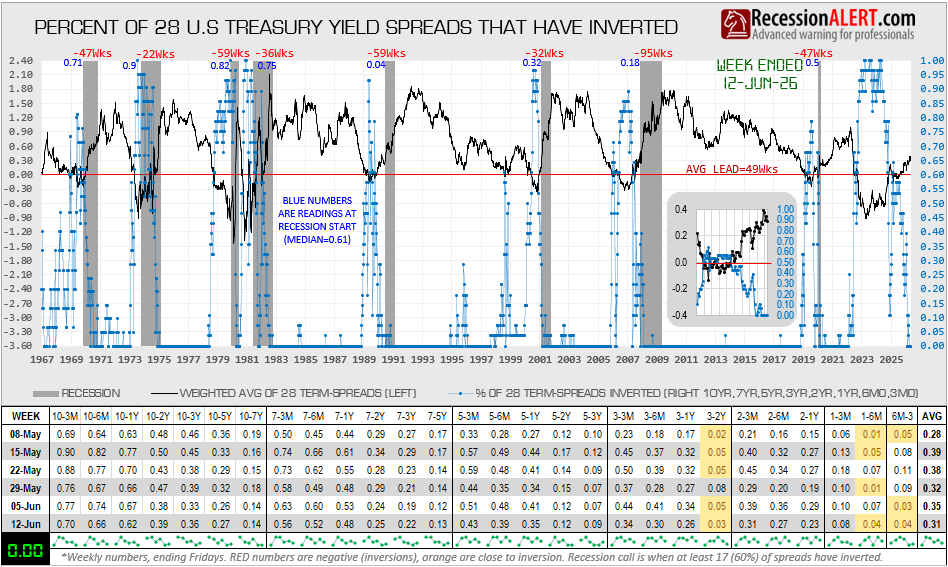
The longer the curve stays warning-free, the safer the all-clear feels. That reflex is the trap. Zero of 28 spreads inverted, the weighted average back to +0.31 and climbing — at face value, the recession watch is over. By this chart’s own history, that read is backwards. The last four recessions began at 0.04, 0.32, 0.18, and 0.50 inverted — curves that had already re-steepened. The inversion is the warning; the recession lands during the normalization that follows. We are eight weeks into that steepening, after the longest, broadest inversion the series has recorded. The clock that matters just started. The mechanism is the tell. The front end is falling because the Fed is cutting — a bull steepener, the textbook fingerprint of a central bank chasing a slowing economy, not confirming a durable expansion. Disinversion isn’t recovery; it’s the curve pricing the cuts that precede the contraction. The honest counter: this inversion already outran every prior lead — 95 weeks was the record — without a recession, so this may be the first genuine miss. Watch the long end. If steepening turns bear-led, the soft landing holds. If it stays cut-driven, the dangerous window is opening, not closing.
Market Intelligence Brief (MIB) Ver. 18.40
For professional investors only. Not investment advice.
© 2026 RecessionALERT.com

Comments are closed.