
MARKET INTELLIGENCE BRIEF (MIB)
Tuesday, June 23, 2026
The Korean Kospi’s ETF-driven circuit-breaker detonated a global chip rout — SOXX -7.5%, MU -13.2%, Nasdaq 100 -3.30%; ~$776B erased in a single session. BofA simultaneously raised its Fed call to three 2026 hikes, pushing futures to 66% year-end probability; former NY Fed chief Dudley warned the Fed risks losing credibility as an inflation fighter. Senate passed an Iran War Powers resolution 50-48 — the first bipartisan passage ever — cementing de-escalation as WTI extended to $73.74. Micron reports tonight.
TABLE OF CONTENTS
A. EXECUTIVE SUMMARY
B. MARKET DATA
C. HIGH-IMPACT STORIES (5)
D. MODERATE-IMPACT STORIES (5)
E. ECONOMY WATCH (5)
F. EARNINGS WATCH (0)
G. WHAT’S NEXT
H. CHART OF THE DAY
A. EXECUTIVE SUMMARY -> TOP
South Korean Kospi’s 4.07% circuit-breaker collapse — forced ETF unwinds in leveraged Samsung and SK Hynix funds — detonated a global semiconductor contagion: the Philadelphia Semiconductor Index fell 7.5%, Nasdaq 100 shed 3.30%, and S&P 500 declined 1.44%. The rout ran alongside a concurrent macro shock: Bank of America escalated its 2026 Fed forecast to three hikes (September, October, December), driving CME futures to 66% year-end probability, as former NY Fed President Dudley warned the Fed risks losing inflation-fighting credibility — together squeezing growth-stock valuations beyond the Korean contagion itself. Cross-asset signals pointed to growth-scare, not inflation fear: 10-year Treasury yields fell 4.4 bps (safe-haven duration bid) even as BofA’s hawkish note drove the dollar higher; gold shed 1.75% when rate expectations overrode the safe-haven bid; copper fell 3.78% on subdued Chinese industrial demand. Rotation was decisive: Consumer Defensive (+1.85%), Healthcare (+1.37%), Real Estate (+1.28%), and Utilities (+0.62%) advanced while Technology led declines at -3.94% — a structural rotation, not a single-day flush.
• Korean ETF contagion — SOXX -7.5%, MU -13.2% (reports Q3 earnings tonight from a 13-point hole), SNDK -13.6%, NVDA -3.2%; Nasdaq 100 -3.30%; ~$776B erased — a financial-contagion event, not a demand-driven selloff.
• BofA raises Fed forecast to three 2026 hikes (Sep/Oct/Dec), pushing CME futures to 66% year-end probability; Dudley warns Fed risks losing inflation-fighting credibility — growth stocks face dual compression from contagion and rate re-pricing.
• Senate passes Iran War Powers resolution 50-48 — first bipartisan both-chamber passage in 10 attempts; four Republican defections make re-escalation politically costly; WTI extended to $73.74, forcing downward revisions to energy-sector earnings models.
• Flash Manufacturing PMI 55.7 (6-year output high) vs. Richmond Fed 4 (misses 9 consensus, prior 13) — the divergence signals the national headline may be front-running-distorted, not a broad-based demand acceleration.
• IBM +5.04% against tech’s -3.94% rout — JPMorgan Overweight upgrade and AI-enterprise thesis; LMT +2.04% on $8.4B DoD PAC-3 contract — defense and AI-deployment names offered risk-off insulation on a broad-market down day.
• Pantheon Macro cuts year-end core PCE forecast below 3% (vs. Fed’s 3.6%), citing Iran-driven energy disinflation and metals retreat — Thursday’s May Core PCE (exp. +0.3% MoM / +3.4% YoY) is the first decisive arbiter between Pantheon and BofA-Dudley scenarios.
1. AI Hardware vs. AI Enterprise: The Intra-Tech Rotation Sharpens — Tuesday’s session drew a clean line through the technology complex: AI hardware and memory names (SOXX -7.5%, MU -13.2%, SNDK -13.6%, NVDA -3.2%) absorbed the Korean contagion in full, while IBM (+5.04%) on a JPMorgan AI-enterprise upgrade rallied through the selloff. Institutional capital is not exiting technology — it is reallocating within it, from infrastructure buildout (chips, memory, servers) to application deployment (software, consulting, hybrid cloud). For portfolio construction, the intra-tech distinction is now consequential: owning the full technology complex simultaneously holds one leg breaking down and one leg being bid up.
2. Two Inflation Models, One Decisive Print: Thursday’s Core PCE — BofA’s three-hike call and Dudley’s credibility warning define the hawkish scenario; Pantheon’s sub-3% PCE forecast and Iran-driven energy disinflation define the dovish scenario. Both are internally coherent and both are actionable: a portfolio positioned for Dudley/BofA owns TIPS and value/dividend names, while one positioned for Pantheon owns duration and growth. Markets currently price the BofA scenario (66% year-end hike probability), compressing growth-stock discount rates. Thursday’s May Core PCE — expected +0.3% MoM / +3.4% YoY — is the first data point that will begin separating the two models. An inline or hotter print validates BofA; a surprise miss begins the Pantheon disinflation path.
3. Iran De-escalation Gains Structural Durability — The Senate’s bipartisan 50-48 War Powers passage — the first time both chambers have succeeded in ten attempts, including four Republican defections — creates political cost for re-escalation beyond what an executive-only ceasefire process could impose. WTI at $73.74 (down from $80+ pre-de-escalation) is the deflationary channel that flows directly into Pantheon’s PCE model; if oil holds through the 60-day bridging period, the energy-services inflation component that has kept PCE above target for five years faces meaningful compression into Q3 — a tailwind that directly challenges the BofA-Dudley hawkish scenario.
 — Leading economic indicators. Accurate market forecasts. Apply for membership at join.recessionalert.com
B. MARKET DATA -> TOP
South Korean chip stock collapses (Kospi -4.07%) ignited a global semiconductor contagion, dragging Nasdaq 100 -3.30% and S&P 500 -1.44% while the Dow held nearly flat (-0.09%), insulated by IBM’s 5% JPMorgan-driven surge and its lower tech weighting. The session split cleanly into risk-off defensives: Consumer Defensive (+1.85%), Healthcare (+1.37%), and Real Estate (+1.28%) rallied as flight-to-quality rotation while Technology (-3.94%) and Basic Materials (-2.99%) absorbed the selling. The most telling cross-asset signal was bonds buying alongside the equity selloff — 10Y yields fell 4.4 bps as investors sought safe-haven duration even as the BofA rate hike note drove gold -1.75% and copper -3.78%. VIX closed at 19.48, still in the lower fear zone — a tactical pullback signature, not structural panic.
CLOSING PRICES – Tuesday, June 23, 2026:
MAJOR INDICES
The semis rout drove a clean narrative divergence: Nasdaq 100 -3.30% bore the brunt while the Dow’s -0.09% quasi-flat close confirmed the selloff as tech-specific, not broad. Russell 2000’s -0.94% outperformed the Nasdaq by more than two points — and over the past 10 sessions, RUT returned +4.17% vs SP500 -0.54%, sustaining a 4th consecutive session of small-cap relative outperformance: breadth widening even as headline indices pull back. No Dow Theory threshold crossed; DJIA sits 0.65% from its 10-session high and DJTA 4.27% below — neutral posture.
| Index | Close | Change | %Move | Why It Moved |
|---|---|---|---|---|
| S&P 500 | 7,365.48 | -107.31 | -1.44% | South Korean chipmaker rout (Kospi -4.07%) triggered global semis selloff; Technology sector -3.94% overwhelmed defensive gains |
| Dow Jones | 51,665.43 | -47.28 | -0.09% | Lower tech weighting and IBM +5% JPMorgan upgrade buffered blue-chip index; near-flat close masks broad defensive bid |
| DJ Transportation | 21,631.4 | -164.4 | -0.75% | Growth-fear headwinds weighed on transport names; industrials sold on global demand deceleration narrative |
| Nasdaq 100 | 29,347.27 | -999.81 | -3.30% | Full force of memory/semis rout: MU -13%, SNDK -14%, MRVL/LRCX/KLAC each -9%; BofA rate hike note pressured growth premiums |
| Russell 2000 | 2,976.10 | -28.30 | -0.94% | Small-cap relative outperformance (+4.17% vs SP500 -0.54% over 10 sessions); lower semis weighting insulated from worst of the selloff |
| NYSE Composite | 23,463.63 | -132.59 | -0.56% | Broad market decline; 6 of 11 sectors red; defensives partially offset tech and materials drag |
VOLATILITY & TREASURIES
VIX spiked to 19.48 (+12.73%) while 10Y yields fell 4.4 bps — a growth-scare signature, not inflation fear; in an inflation scare, bonds sell off (yields rise) alongside equities. Instead, investors bought duration as safe-haven from Asian contagion even as the BofA rate hike note lifted DXY +0.33%. The yield curve flattened marginally (10Y fell more than 2Y) — consistent with growth-risk demand concentrated in the long end.
| Instrument | Level | Change | Why It Moved |
|---|---|---|---|
| VIX | 19.48 | +2.20 (+12.73%) | Global semis contagion + BofA rate hike warning elevated equity uncertainty; spike from 17.28 reflects escalating risk-off |
| 10-Year Treasury Yield | 4.459% | -4.4 bps | Bonds rallied as growth-fear safe-haven; flight to duration despite BofA’s hawkish note; 10Y fell more than 2Y (mild flattening) |
| 2-Year Treasury Yield | 4.201% | -3.0 bps | Front-end modestly lower; still reflecting Fed credibility on near-term inflation path despite softer growth signals |
| US Dollar Index (DXY) | 101.36 | +0.34 (+0.33%) | Dollar strengthened on BofA rate hike pricing and safe-haven demand from global equity rout |
COMMODITIES
Gold’s -1.75% decline amid a risk-off session is the tell: the BofA rate hike note was powerful enough to override any safe-haven bid, making non-yielding gold a liability as the dollar firmed. Silver amplified the drop at -6.03% — its industrial component added growth-fear selling pressure on top of precious metals weakness. Copper’s -3.78% on subdued Chinese industrial demand confirmed the session’s growth-scare thesis. Bitcoin -2.86% tracked equities in lockstep, reinforcing its risk-proxy role.
| Asset | Price | Change | %Move | Why It Moved |
|---|---|---|---|---|
| Gold | $4,129.00/oz | -$73.70 | -1.75% | BofA rate hike note overrode safe-haven bid; firmer rate expectations weigh on non-yielding gold; Iran de-escalation reduced geopolitical premium |
| Silver | $61.630/oz | -$3.950 | -6.03% | Amplified gold’s decline; industrial demand component adds growth-fear selling on top of precious metals weakness |
| Copper | $6.1248/lb | -$0.2408 | -3.78% | Subdued Chinese industrial demand; easing supply (higher global concentrate flows); global growth scare amplified the selloff |
| Platinum | $1,653.30/oz | -$18.90 | -1.13% | Broader precious metals selloff; limited independent catalyst; dollar strength weighed |
| Bitcoin | $62,479 | -$1,841 | -2.86% | Tracked equity risk-off in lockstep; no crypto-specific catalyst; risk-proxy behavior confirmed |
ENERGY
WTI and Brent fell in lockstep (-1.10% / -1.26%), no meaningful spread widening — a demand-driven decline confirming growth-fear pricing, not supply relief. Energy sector held +0.39% despite crude’s drop, suggesting equities are anchored to Iran de-escalation fundamentals rather than the daily oil tape. Henry Hub -2.56% on domestic supply while Dutch TTF eked +0.32% higher — European summer storage demand the lone offset.
| Asset | Price | Change | %Move | Why It Moved |
|---|---|---|---|---|
| Crude Oil (WTI) | $73.05/bbl | -$0.81 | -1.10% | Demand-led pullback on global growth scare; Iran ceasefire in place limits supply-shock premium; growth fear outweighs geopolitical support |
| Crude Oil (Brent) | $76.54/bbl | -$0.98 | -1.26% | Aligned with WTI on demand-pricing narrative; no supply-side differentiation; spread stable at ~$3.49 |
| Natural Gas (Henry Hub) | $3.195/MMBtu | -$0.084 | -2.56% | Domestic supply ample; lower near-term demand forecast on milder weather outlook |
| Natural Gas (Dutch TTF) | $14.02/MMBtu | +$0.04 | +0.32% | European summer storage demand provides modest support; diverged from Henry Hub on regional dynamics |
S&P 500 SECTORS
Technology led the quarter (+26.42% 3M, +19.82% YTD) but today’s worst decliner (-3.94%) — and extending a week-long slide (-3.90% 1W), confirming a structural rotation, not a single-day flush. Defensives occupy all four top-performer slots today: Consumer Defensive, Healthcare, Real Estate, and Utilities — a classic risk-off flight-to-quality formation. Basic Materials’ -2.99% extends its -6.03% 1-week loss, the steepest non-tech drawdown of the quarter.
| Sector | 1-Day | 1-Week | 1-Month | 3-Month | 6-Month | YTD | 12-Month |
|---|---|---|---|---|---|---|---|
| Consumer Defensive | +1.85% | -1.06% | -1.46% | +2.85% | +6.17% | +7.62% | +5.82% |
| Healthcare | +1.37% | +0.63% | +2.73% | +6.12% | +0.65% | -0.39% | +16.49% |
| Real Estate | +1.28% | -0.12% | +0.90% | +9.43% | +9.63% | +9.67% | +8.30% |
| Utilities | +0.62% | +0.66% | -0.56% | +0.42% | +5.38% | +5.76% | +15.02% |
| Energy | +0.39% | -1.86% | -8.29% | -7.97% | +24.85% | +21.82% | +24.25% |
| Financial | -0.06% | +0.92% | +4.20% | +11.76% | +2.71% | +2.03% | +15.65% |
| Communication Services | -0.30% | -5.31% | -8.41% | +3.27% | -0.35% | -1.97% | +23.32% |
| Consumer Cyclical | -1.09% | -4.35% | -6.01% | +2.49% | -8.48% | -7.04% | +5.01% |
| Industrials | -1.62% | -3.02% | +3.73% | +10.22% | +17.33% | +16.73% | +28.96% |
| Basic Materials | -2.99% | -6.03% | -3.35% | +5.14% | +10.99% | +10.03% | +38.66% |
| Technology | -3.94% | -3.90% | +0.67% | +26.42% | +22.51% | +19.82% | +42.16% |
TOP MEGA-CAP MOVERS:
GAINERS
| Company | Ticker | Close | Change | Why It Moved |
|---|---|---|---|---|
| International Business Machines | IBM | $264.94 | +5.04% | JPMorgan upgraded to Overweight (target $291 from $270); IBM-OpenAI cyber defense partnership announced; federal EO on quantum research boosted AI positioning |
| Merck & Co | MRK | $119.60 | +3.57% | Healthcare sector led (+1.37%) on defensive rotation; risk-off flight-to-quality bid lifted large pharma names broadly |
| Johnson & Johnson | JNJ | $239.08 | +3.37% | Healthcare defensive rotation; sector bid as investors rotated out of tech and into quality defensives amid semis contagion |
| Philip Morris International | PM | $178.69 | +3.19% | Consumer Defensive sector led (+1.85%); tobacco names bid in flight-to-quality; international revenue stream seen as diversification from US growth scare |
| RTX Corp | RTX | $186.39 | +2.51% | Defense contractor names bid amid geopolitical uncertainty; Industrials sector pullback (-1.62%) masked strength in defense sub-sector |
DECLINERS
| Company | Ticker | Close | Change | Why It Moved |
|---|---|---|---|---|
| Sandisk Corp | SNDK | $1,963.60 | -13.64% | NAND flash storage bellwether; South Korean chip contagion hit memory names hardest; pre-earnings de-risking amplified sector selloff |
| Micron Technology | MU | $1,051.77 | -13.18% | Pre-earnings de-risking ahead of Q3 FY2026 report (June 24); Asian semis contagion compounded; analysts watching HBM4 demand and FY2027 guidance |
| Marvell Technology | MRVL | $279.04 | -9.36% | Korean chip contagion; data-center semiconductor networking names sold as AI capex growth fears escalate on global slowdown concerns |
| Lam Research | LRCX | $371.33 | -9.33% | Semiconductor equipment; downstream demand fears from Korean chip rout; capex pullback risk for fab equipment if memory demand softens |
| KLA Corp | KLAC | $244.49 | -9.17% | Semiconductor inspection equipment; equipment suppliers sold alongside chip names on capex pullback risk and Korean contagion |
— Institutional-grade intelligence for serious investors. Apply for membership at join.recessionalert.comC. HIGH-IMPACT STORIES -> TOP
BEARISH
1. Korean KOSPI Circuit-Breaker Triggers Global Chip Rout; US Semiconductor Index -7.5%, Nasdaq 100 -3.30%
The core facts:South Korea’s Kospi index plunged approximately 10% Tuesday, triggering a circuit-breaker trading suspension at the Korea Exchange after South Korea’s Financial Services Commission publicly expressed concern over the overheating of single-stock leveraged ETFs tied to Samsung Electronics and SK Hynix approved just weeks prior. The forced ETF unwind cascaded globally: SK Hynix and Samsung each fell more than 12%. US semiconductor stocks absorbed the contagion in force — the Philadelphia Semiconductor Index fell approximately 7.5%, with SanDisk (SNDK) -13.6%, Micron Technology (MU) -13.2% (ahead of its June 24 AMC earnings), Lam Research (LRCX) -9.3%, KLA Corporation (KLAC) -9.2%, and Nvidia (NVDA) -3.2%. The Nasdaq 100 declined 3.30%, the Nasdaq Composite fell 2.2% (approximately $776 billion in market value erased), and the S&P 500 fell 1.44%.
Why it matters:The Korean ETF-triggered selloff illustrates a structural vulnerability in the global chip rally: when derivative products on concentrated positions in a single-country chip market become a systemic risk, the forced unwind does not discriminate between Korea-exposed and US-only chip stocks. The resulting US semiconductor index decline (-7.5%) was not driven by demand deterioration or earnings misses — it was a purely financial-contagion event that compressed valuations across the entire AI hardware supply chain. For institutional investors: (1) The AI hardware complex (chips, memory, equipment) has traded at premium multiples priced for strong demand visibility — a 7.5% single-session decline due to Korean ETF mechanics, not fundamentals, represents a valuation reset risk that can recur without advance warning. (2) Micron (-13.2%) now faces its Q3 FY2026 earnings call on June 24 with the stock already down 13% from the prior close — the stakes for the HBM4 demand guidance are significantly elevated. (3) Equipment makers (LRCX, KLAC) losing 9%+ in a single session is particularly notable because their revenue is driven by long-cycle wafer fabrication commitments that remain fully intact — the selloff is decoupled from the underlying backlog reality.
What to watch:Micron’s Q3 FY2026 earnings (June 24 AMC) as the first fundamental data point to confirm or refute whether the AI memory demand thesis underpinning the chip rally remains intact; whether South Korea’s financial regulator takes additional action on leveraged ETF products and generates further forced-unwind pressure in Asian trading.
BEARISH
2. Bank of America Raises Fed Forecast to Three 2026 Rate Hikes; Futures Hit 66% Year-End Probability — Growth Stocks and Gold Sold
The core facts:Bank of America’s economics team — citing the June 17 FOMC’s hawkish surprise (9 of 18 officials projecting at least one 2026 hike, Chair Warsh’s revised core PCE projection to 3.6%) and stronger-than-expected labor data — escalated its Federal Reserve rate forecast to three consecutive 25 basis-point increases in September, October, and December 2026. Under BofA’s revised base case, the federal funds rate would end 2026 at 4.25–4.50%, up 75 basis points from the current 3.50–3.75% target range — a more aggressive call than Goldman Sachs (one September hike) and diametrically opposed to JPMorgan (hold through year-end). CME FedWatch futures pricing reflects the hawkish absorption: probability of at least one 2026 hike reached approximately 66%. Asset-class reactions were divergent: gold fell -1.75% on rate-hike expectations; the DXY dollar index gained +0.33%; paradoxically, 10-year Treasury yields fell 4.4 basis points as growth-scare safe-haven demand from the equity selloff overwhelmed the rate signal in the bond market.
Why it matters:BofA’s escalation from 0 hikes to 3 represents the sharpest upward revision to the Fed path from a major bank since the 2022 tightening cycle. The previous consensus included Goldman (1 hike) and JPMorgan (none) — BofA’s call now defines the hawkish tail risk the market must price. For equity portfolios: (1) Three additional 25 bps hikes compress the discount rate on growth-stock valuations — technology and AI stocks with terminal-value-heavy earnings profiles are most directly exposed. (2) The 10Y falling despite BofA’s hawkish call reflects an important inversion: the immediate market reaction is equity-driven flight to safety, not rate-driven yield pressure; this divergence may resolve once the growth-scare subsides, at which point the 10Y could face renewed upward pressure aligned with the BofA scenario. (3) For rate-sensitive sectors (utilities, REITs, homebuilders, regional banks): three hikes add approximately 75 bps to mortgage rates and funding costs — further multiple compression if BofA proves correct.
What to watch:July PCE data (released late August) as the decisive inflation print that confirms or refutes the 3-hike scenario; CME FedWatch futures odds — a move above 70% probability for September hike would signal markets have broadly capitulated to the BofA scenario.
UNCERTAIN
3. Flash PMI Manufacturing Hits 6-Year Output High (55.7); Composite 52.2 — But Factory Employment Bleeding at Fastest Rate Since 2009
The core facts:S&P Global’s June 2026 Flash US Manufacturing PMI registered 55.7, above the 54.8 consensus estimate and the fastest pace of manufacturing output growth in six years. The Flash Composite PMI rose to 52.2 — a 5-month high — from 51.5 in May. Services PMI came in at 51.3 versus 51.0 prior. Despite the headline beat, the underlying data carries a critical caveat: factory employment contracted at the fastest pace since 2009 (excluding the pandemic), and S&P Global economists noted the manufacturing surge is partly attributable to Middle East supply-chain front-running — companies pre-building inventory ahead of potential shipping disruptions — rather than organic end-demand acceleration. The composite signal is consistent with only approximately 1% annualized GDP growth in Q2 2026, suggesting the expansion remains narrow and input-driven.
Why it matters:The manufacturing PMI beat is pulling in opposite directions simultaneously. For rate hawks: a 55.7 manufacturing reading reduces the Fed’s justification for easing and strengthens the case for the BofA-called September hike — the data does not provide cover for staying on hold. For growth bulls: the GDP-consistent growth rate of ~1% annualized combined with factory job cuts running at the fastest since 2009 (excluding pandemic) signals the surge is narrow and front-running-driven, not broad-based. The front-running dynamic is particularly important: supply-chain pre-purchasing has pulled demand forward from H2 2026 into Q2 — this could create a manufacturing deceleration in the second half even absent new shocks. For fixed income: the PMI beat, combined with the BofA 3-hike call, creates a complex signal — strong short-term activity data that would normally pressure yields is being offset by equity-driven flight to safety that is pulling the 10Y down 4.4 bps today.
What to watch:July Flash PMI (approximately July 23) for whether the front-running demand normalizes; June ISM Manufacturing PMI (scheduled July 1) as the more widely-watched survey that will confirm or contradict today’s S&P Global flash reading.
BEARISH
4. Richmond Fed Manufacturing Collapses to 4 vs 9 Consensus; Shipments Implode from 16 to 3 — Sharply Contradicts Flash PMI Headline
The core facts:The Richmond Federal Reserve’s June 2026 Manufacturing Survey posted a composite reading of 4, sharply missing the consensus expectation of 9 and contracting from May’s strong reading of 13. The components were uniformly weak: shipments dropped from 16 to 3; services revenues turned negative (from +14 to -1); and the employment index fell to -1 from +3 in May. The Richmond survey covers the Fifth Federal Reserve District (Virginia, Maryland, North and South Carolina, Washington DC, and parts of West Virginia) and is one of five regional Fed manufacturing surveys. Today’s Richmond collapse stands in sharp contrast to S&P Global’s Flash Manufacturing PMI national reading of 55.7 — creating the largest single-day divergence between a major regional Fed survey and the flash national composite in recent memory.
Why it matters:The Flash PMI vs. Richmond divergence is the most analytically important element of today’s manufacturing data. National flash PMIs are timelier but sample-weighted toward large companies and coastal manufacturers — they may overrepresent the AI/tech capex supply chain and the Middle East supply-chain front-runners. Richmond’s district includes defense-adjacent manufacturers, mid-Atlantic industrials, and services businesses less exposed to tech-driven pre-purchasing. When a regional survey collapses while the national flash beats, the divergence typically signals the national headline is driven by a narrow, identifiable segment. The Richmond collapse is a yellow flag for Q3 manufacturing momentum: if similar weakness appears in subsequent regional surveys (Empire State, Philadelphia, Dallas), the national PMI would likely converge lower — removing one of the primary data-driven arguments for a September rate hike. For the Fed: 9 of 18 officials already split on a 2026 hike face contradictory signals — strong national flash but weak regional data does not make September’s decision simpler.
What to watch:Philadelphia Fed Manufacturing Survey (released mid-July) and Empire State Manufacturing (early July) for corroboration of the Richmond weakness; June ISM Manufacturing index (July 1) for which survey — flash or regional — the definitive survey sides with.
BEARISH
5. Senate Passes Iran War Powers Resolution (50-48); WTI Extends Decline to $73.74 — Energy-Sector Earnings Models Face Forced Revision
The core facts:The US Senate voted 50-48 Tuesday to pass a War Powers Act resolution directing President Trump to remove US forces from hostilities against Iran — the first time both chambers of Congress have passed such a resolution after 10 prior attempts. Four Republicans broke ranks: Senators Cassidy (LA), Collins (ME), Paul (KY), and Murkowski (AK); one Democrat, Fetterman (PA), voted against. The resolution is a concurrent resolution and carries no legal enforcement mechanism — it does not require the President’s signature. But as the first bipartisan passage by both chambers, it represents an unprecedented political signal on the Iran engagement. The Senate vote compounded ongoing oil-market de-escalation: WTI crude extended its decline to approximately $73.74 per barrel, building on Monday’s $74.09 close and down sharply from the $80+ pre-de-escalation level. Brent settled at approximately $77.08.
Why it matters:The Senate vote’s market significance is twofold. First, the bipartisan passage — even without legal force — reduces the political feasibility of re-escalation: when 4 Republican senators break ranks on war powers, the White House faces political cost from renewed military engagement during the 60-day bridging period. This makes the Iran de-escalation more durable than a purely executive-driven process. Second, and more immediately: WTI at $73.74 continues to force downward revisions to energy-sector earnings models. At $80+ WTI — the pre-conflict planning price — XOM, CVX, COP, and independent E&Ps projected strong 2026 cash flows. At $73.74 WTI — and trending toward the IEA’s long-term supply-surplus scenario — per-barrel profitability for US shale is under meaningful pressure. For portfolio managers: energy sector weight reduction (XLE approximately 3.8% of S&P 500) is the logical portfolio consequence if WTI remains range-bound at $73–77 through the 60-day bridging period.
What to watch:WTI holding above $70 as the critical floor for broad US shale profitability; Wednesday’s EIA crude inventory report (June 24) for the first hard data on whether Iranian crude is beginning to appear in US supply statistics; any White House response to the concurrent resolution.
— Quantifying recession risk so you don’t have to guess. Apply for membership at join.recessionalert.comD. MODERATE-IMPACT STORIES -> TOP
BULLISH
6. IBM Surges +5.04% Against Tech Rout — JPMorgan Upgrades to Overweight ($291 PT), OpenAI Cyber Partnership, Quantum EO Converge
The core facts:IBM (IBM) gained 5.04% Tuesday — one of the sharpest advances in the Technology sector on a day the sector fell 3.94% — as three catalysts converged simultaneously. JPMorgan upgraded IBM to Overweight from Neutral and raised its price target to $291 from $270, citing the company’s broadening AI deployment strategy, improving enterprise software pipeline, and expanding consulting reach into AI implementation. Separately, IBM announced a strategic cyber defense partnership with OpenAI focused on enterprise-scale AI-driven threat detection. A federal executive order signed this week boosted funding for quantum computing research, a field where IBM is the dominant large-scale incumbent. IBM’s 9-percentage-point intraday spread versus the Technology sector (IBM +5.04%, sector -3.94%) is an unusually large divergence for a mega-cap diversified technology company.
Why it matters:IBM’s session performance reflects the market’s emerging distinction between “AI infrastructure enablers” (chips, memory, servers — sold off hard today) and “AI enterprise deployment” companies (software, consulting, hybrid cloud — partially bid on the theory that corporate AI spending is shifting from infrastructure buildout to deployment and productivity). JPMorgan’s upgrade specifically cites IBM’s AI strategy expansion — suggesting the firm sees IBM’s consulting business and software stack as positioned to capture the application layer of the AI cycle rather than the hardware layer now under valuation pressure. The OpenAI cyber defense partnership directly connects IBM to the enterprise AI ecosystem; if Alphabet’s talent exodus (covered June 22) benefits OpenAI, IBM is now a named beneficiary of that partnership. For portfolio managers: IBM’s performance today is a clean signal that the rotation within technology is real — certain enterprise software and services names can be defensive or even bullish during hardware selloffs.
What to watch:IBM’s next earnings report for initial evidence that the JPMorgan AI-consulting thesis is correct — specifically, AI-driven services revenue as a percentage of total services; enterprise reception to the OpenAI cyber defense partnership as a forward demand signal.
UNCERTAIN
7. Former NY Fed President Dudley: “Fed Risks Losing Inflation-Fighter Credibility” — Warns Reliance on Market Signals Is a Structural Error
The core facts:Former New York Federal Reserve President William Dudley published a Bloomberg opinion piece Tuesday warning that the Federal Reserve risks losing its inflation-fighting credibility if it continues to calibrate policy primarily based on financial-market signals. “Reliance on market views for policy is a mistake,” Dudley wrote, noting the Fed has operated above its 2% inflation target for over five years and that the case for cutting rates is “very, very weak.” Dudley’s piece — published on the same day CME futures repriced to 66% odds of a year-end hike — amplifies the BofA 3-hike call as an independent, credible voice. Unlike bank economists who can be accused of talking their book, Dudley’s commentary carries the weight of a former senior policymaker who helped design post-2008 Fed frameworks.
Why it matters:Dudley’s structural critique — that the Fed’s behavioral pattern of waiting for market approval before acting creates a feedback loop that delays necessary tightening — has direct implications for the September 2026 hike timeline. If the Fed waits for market conditions to “clear” before hiking, and markets react negatively to hike expectations (as they did today), the feedback loop could delay the hike further — and push eventual tightening later into the cycle, which is bearish for long-term inflation expectations and bond market credibility. For fixed income: a credibility-loss narrative adopted by additional credible voices has historically led to 10Y yield re-rating well ahead of actual Fed action. Today the 10Y fell on growth-scare safe-haven demand — but as the equity selloff subsides, Dudley’s credibility framework could become the dominant rate narrative in August-September. The timing of his piece is significant: publishing when futures are already at 66% hike odds adds institutional legitimacy to what could have been dismissed as a fringe view.
What to watch:Whether Fed Chair Warsh publicly responds to the credibility narrative — his next major speech would become a significant market event; July PCE data as the anchor point Warsh will likely use to signal the September decision.
BULLISH
8. Pantheon Macro Cuts Q4 Core PCE Forecast to Below 3%; Challenges Fed’s 3.6% Projection and Reduces Year-End Hike Probability
The core facts:Pantheon Macroeconomics lowered its Q4 2026 core PCE inflation forecast on June 23, citing two disinflationary inputs not fully reflected in the Fed’s own June projections: Brent crude at approximately $79/barrel — down from the ~$105 conflict peak — and broad metals retreat (copper -3.78% today, iron ore softening). Under Pantheon’s revised model, core PCE reaches below 3% by year-end, well beneath the Fed’s June median projection of 3.6%. If Pantheon’s forecast proves correct, the case for BofA’s 3-hike scenario deteriorates significantly: at sub-3% core PCE, the Fed’s own stated framework would not support additional tightening. Prediction market pricing for a year-end 2026 hike stood at approximately 60% before today’s equity selloff.
Why it matters:The Pantheon forecast represents the key bull case for risk assets in H2 2026: if energy disinflation from the Iran de-escalation flows through to core PCE faster than the Fed projects, the 3-hike scenario dissolves and the debate shifts back to rate stability or cuts in 2027. For portfolio construction: a 60-day window during the Iran bridging period in which oil prices are likely to remain depressed — if that period extends, it compresses the energy-services inflation component that has been the primary driver of PCE-above-target persistence. Pantheon’s scenario is the counterargument to today’s Dudley warning: where Dudley sees the Fed acting too slowly to contain embedded inflation, Pantheon sees inflation falling faster than the Fed has modeled. The H2 rate path will be determined by which model is closer to reality — and July PCE is the decisive arbiter. Both scenarios are actionable: a portfolio positioned for Pantheon’s outcome owns duration and growth, while a portfolio positioned for Dudley’s outcome owns TIPS and value/dividend names.
What to watch:The July PCE print (released late August) as the first decisive data point that sides with Pantheon’s sub-3% trajectory or the Fed’s 3.6% projection; August Jackson Hole symposium as the likely forum where the Fed signals its September intention.
BULLISH
9. Lockheed Martin +2.04% — DoD Awards $8.4B PAC-3 MSE Contract; Program Value Reaches $13.3B Total
The core facts:Lockheed Martin (LMT) gained 2.04% Tuesday after the Department of Defense awarded an $8.4 billion contract modification for PAC-3 Missile Segment Enhancement (MSE) interceptors, bringing the program’s cumulative contract value to $13.3 billion. PAC-3 MSE is the primary active air-defense interceptor for the Patriot missile system, deployed by US forces and NATO allies. The award comes as global defense budgets have expanded in response to geopolitical volatility over the past 18 months. LMT’s advance on a broadly falling day (S&P -1.44%) illustrates defense stocks’ partial decoupling from technology-driven equity selloffs.
Why it matters:The $8.4B PAC-3 contract is significant for three reasons. First, it is one of the largest single-day US defense contract awards of the year, reflecting sustained DoD commitment to air-defense capacity even as the Iran-US de-escalation advances — signaling the US military is not standing down preemptively. Second, LMT’s +2.04% gain on a broad-market down day confirms institutional managers are treating defense as a defensive sector in equity selloffs — a rotation that benefits LMT, RTX, and NOC during periods of macro uncertainty. Third, the PAC-3 MSE program is exportable: NATO and allied governments have been major buyers, and the $13.3B cumulative value represents sustained allied demand, not just domestic revenue. For portfolio managers: LMT and the broader defense complex offer stable long-cycle government-contract revenue streams insulated from the AI ROI uncertainty now pressuring technology valuations — the performance differential today (+2.04% vs. tech sector -3.94%) illustrates this defensive property.
What to watch:Whether the Iran de-escalation trajectory creates margin pressure on future DoD defense appropriations as the geopolitical risk premium recedes; LMT’s next earnings release for PAC-3 revenue contribution and international sale pipeline update.
BEARISH
10. Copper -3.78% as Chinese Industrial Demand Concerns Deepen; Growth-Scare Narrative Extends to Commodities
The core facts:Copper prices fell 3.78% Tuesday as mounting concerns over subdued Chinese industrial demand combined with rising global copper concentrate supply flows from South America depressed the market. Traditional copper-consuming Chinese industries — construction, consumer appliances, and heavy manufacturing — are operating below capacity as China’s property market recovery remains incomplete. While EV production, renewable energy, and data center construction are partially offsetting traditional demand, the net result is copper demand growth running below consensus expectations for 2026. Copper producers Freeport-McMoRan (FCX) and Southern Copper (SCCO) declined in sympathy with the metal.
Why it matters:Copper’s decline amplifies the growth-scare narrative that dominated today’s equity session. The metal is widely used as an early-warning indicator for global industrial activity (“Dr. Copper”). A 3.78% single-session decline — occurring on the same day as the Korean semiconductor circuit-breaker, the broader equity selloff, and BofA’s hawkish rate call — creates a coherent macro signal: the combination of rate hike fears and genuine demand uncertainty is repricing risk assets across equities, commodities, and currencies simultaneously. For US portfolio managers: the copper decline validates the thesis that today’s semiconductor/tech selloff is not purely financial contagion (Korean ETF dynamics) but has real-economy underpinnings — weak Chinese industrial demand reduces the most optimistic scenarios for the AI hardware upgrade cycle, since China is simultaneously the world’s largest semiconductor consumer and the dominant copper-consuming industrial economy. Weak copper also signals that the green-energy demand narrative is not yet sufficient to offset traditional industrial softness.
What to watch:China’s June industrial production report (expected mid-July) for confirmation of whether the demand weakness is structural or cyclical; copper holding above the $4.00/lb level historically associated with broad US mining company profitability.
— Separating signal from noise since 2007. Apply for membership at join.recessionalert.comE. ECONOMY WATCH -> TOP
June 23’s data split along a familiar but sharper fault line: the S&P Global Flash Composite PMI hit a 5-month high of 52.2 — with manufacturing output growing at its fastest pace in six years — yet the Richmond Fed’s manufacturing index collapsed to 4 against a 9 consensus (prior: 13), with shipments at 3 and services revenues turning negative. The national-versus-regional divergence matters because the Flash PMI’s manufacturing surge appears partly driven by front-running on Middle East supply-chain risk, raising durability concerns. On the inflation side, Pantheon Macro cut its Q4 forecast as oil and metals retreat, offering modest Fed relief — but Bill Dudley’s warning that “reliance on market views for policy is a mistake” signals persistent credibility risk with core PCE still tracking 3.4% YoY. Thursday’s PCE print and Q1 GDP third estimate are the week’s definitive data tests.
US Flash PMI Composite Hits 5-Month High as Manufacturing Output Surges at Fastest Pace in Six Years (S&P Global, June 23, 2026)
What they’re saying:The S&P Global Flash US Composite PMI rose to 52.2 in June, up from 51.5 in May and the fastest expansion in private-sector activity since January 2026. Manufacturing PMI climbed to 55.7, beating the 54.6 consensus and May’s 55.1 print, with manufacturing output surging to 57.7 — the strongest output growth in six years. Services PMI improved to 51.3 from 50.7. Business confidence reached its highest level since February.
The context:The manufacturing surge is partly attributed to front-loading of contracts ahead of feared supply disruptions from the ongoing Middle East conflict, rather than organic end-demand growth — a durability concern for investors. Services new orders received a temporary boost from FIFA World Cup spending. The national composite reading contradicts the sharp regional miss from the Richmond Fed released the same morning, suggesting supply-chain front-running may be distorting the aggregate picture more than expected.
What to watch:July Flash PMI (mid-July) to assess whether manufacturing demand normalizes as pre-emptive restocking abates; services confidence is the cleaner growth signal through the World Cup distortion period.
Richmond Fed Manufacturing Crashes to 4 in June, Far Below 9 Consensus, as Shipments and Services Revenues Collapse (Richmond Fed, June 23, 2026)
What they’re saying:The Fifth District composite manufacturing index fell to 4 in June, significantly below the consensus expectation of 9 and May’s reading of 13. Shipments plunged from 16 to 3 — among the sharpest single-month declines in recent history — while services revenues turned negative, dropping from 14 to -1. All three key sub-components deteriorated simultaneously.
The context:The Richmond Fed covers Virginia, Maryland, and the Carolinas — a region with meaningful manufacturing and defense-sector exposure. The breadth of the collapse (composite, shipments, and services all declining sharply) suggests the weakness is not confined to a single sub-sector. The stark divergence with the national Flash PMI may indicate that regional manufacturers are experiencing demand pullback while large national firms front-run supply chains — a two-speed economy within a single month’s data release.
What to watch:Kansas City Fed Manufacturing Index (June 25); ISM Manufacturing PMI (July 1) to determine whether the regional deterioration extends to the national composite.
Pantheon Macro Cuts Q4 Inflation Forecast as Oil and Metals Retreat, Sees Core PCE Below 3% by Year-End (Pantheon Macro / Seeking Alpha, June 23, 2026)
What they’re saying:Pantheon Macro reduced its Q4 2026 core PCE inflation estimate, citing sustained declines in oil and metals prices. Brent crude traded at $79.25 per barrel as of June 22 — significantly below the ~$105/barrel peak during the escalation of the US-Iran conflict earlier this year. Pantheon expects core PCE to remain elevated near-term but fall below 3% by year-end, noting that weakening labor conditions limit the risk of persistent price pressures from the commodity shock.
The context:If correct, this materially eases pressure on a Fed that currently projects PCE at 3.6% year-end — revised up sharply from its March 2.7% estimate — and would reduce the probability of an H2 2026 rate hike (currently priced at 60% by prediction markets). The key risk is a re-escalation of the Middle East conflict that reverses the commodity retreat. The call puts Pantheon in a notably more dovish camp than the FOMC’s own dot plot, which had nine of 18 officials projecting at least one hike.
What to watch:May core PCE (Thursday, June 25 — expected +0.3% MoM / +3.4% YoY vs prior +0.2% / +3.3%); Brent crude price action into month-end as Middle East situation develops.
Dudley: “Reliance on Market Views for Policy Is a Mistake” — Former NY Fed President Warns Fed Credibility at Risk (Bloomberg / Seeking Alpha, June 23, 2026)
What they’re saying:Former New York Fed President Bill Dudley argued in a new opinion piece published June 23 that the Federal Reserve risks losing credibility as an inflation fighter after failing to sustainably reach its 2% target for over five years. “The case for cutting rates is actually very, very weak,” Dudley stated, adding that the Fed’s reliance on market signals to guide policy is itself a policy error. He flagged rising long-run inflation expectations and questioned whether current monetary policy has been genuinely restrictive given the economy’s continued strength throughout the rate cycle.
The context:Dudley’s warning lands six days after the June 17 FOMC decision — where nine of 18 officials projected at least one hike before year-end — and amid Warsh-era Fed governance under Trump administration pressure for lower rates. The structural concern: if inflation expectations become unanchored, the Fed’s task grows exponentially harder, raising the risk of a sharper forced tightening cycle. His critique that market dependence is a policy mistake directly challenges the Fed’s data-dependent communication strategy and elevates the hawkish tail risk scenario for H2.
What to watch:Fed Governor Williams speech Thursday at 3:40 PM ET; July preliminary University of Michigan long-run inflation expectations (mid-July); June FOMC Minutes (~July 8).
ADP Weekly Hiring Pulse Rebounds to 30,750 Jobs, First Uptick in Hiring Since Early May (ADP, June 23, 2026)
What they’re saying:U.S. private employers added an average of 30,750 jobs per week in the four weeks ending June 6, according to ADP’s NER Pulse — up from 25,500 in the prior four-week period. The gain represents the first sequential uptick in weekly hiring since May 2, 2026, signaling a tentative stabilization in the labor market after several weeks of deceleration.
The context:The weekly NER Pulse is a high-frequency indicator based on a four-week moving average with a two-week lag — it precedes and differs from the authoritative monthly ADP Employment Change report. The uptick is directionally constructive but carries measurement uncertainty. A sustained trend in coming weeks would support the labor market resilience narrative and reduce urgency of a Fed pivot toward cuts. The broader labor picture remains the Fed’s primary anchor: unemployment is stable near 4.5%, and weekly jobless claims (Thursday) offer the next real-time read.
What to watch:Initial Jobless Claims Thursday June 25 (expected 225K vs prior 226K); June monthly ADP National Employment Report (first Wednesday of July); BLS June Non-Farm Payrolls (expected July 3, 2026).
— Know the probability before the market prices in the risk. Apply for membership at join.recessionalert.comF. EARNINGS WATCH -> TOP
YESTERDAY AFTER THE BELL (Markets Reacted Today)
No major earnings yesterday after the bell from companies with >$100B market cap.
TODAY BEFORE THE BELL (Markets Already Reacted)
No major earnings before the bell from companies with >$100B market cap. Carnival Corp (CCL, $39.7B) and Sunbelt Rentals (SUNB, $31.2B) reported BMO but fall below the >$100B threshold.
TODAY AFTER THE BELL (Markets React Tomorrow)
No major earnings after the bell from companies with >$100B market cap. FedEx (FDX, $75.7B) and Cerebras Systems (CBRS, $49.8B) report AMC but fall below the >$100B threshold.
WEEK AHEAD PREVIEW:
Q1 2026 earnings season is effectively complete (~89% reported). The week’s only mega-cap reporter is Micron Technology on Wednesday — arriving after a -13.2% single-session selloff triggered by today’s Korean semiconductor circuit-breaker, which sharply elevates the stakes for the guidance call.
Micron Technology (MU) — -13.18% today | Wednesday Jun 24, AMC | EPS Est: $20.83 (non-GAAP) | Revenue Est: $35.85B | Key focus: HBM4 Vera Rubin volume ramp progress (commenced March 2026, tracking ahead of HBM3E yield curve); Q4 FY2026 and FY2027 HBM capacity allocation visibility; whether CEO Sanjay Mehrotra reaffirms the 50–66% unfilled demand narrative as the supply deficit anchor; gross margin trajectory (consensus projects record ~80%+ in FQ3); any commentary on the AI memory co-design partnership with Anthropic announced June 22. Today’s -13.18% decline means the stock enters earnings with the bar significantly lowered — a beat-and-guide-up would be a sharp reversal catalyst, while in-line results may not be sufficient to recover the session’s losses.
No additional >$100B US-domiciled reporters are expected Thursday June 25 or Friday June 26. Q2 2026 earnings season opens approximately July 11.
— US market commentary trusted by family offices and institutions. Apply for membership at join.recessionalert.comG. WHAT’S NEXT -> TOP
UPCOMING RELEASES:
| Date | Event | Why It Matters |
|---|---|---|
| Wed, Jun 24 | New Home Sales May (exp. 0.640M, prior 0.622M) | Housing demand signal in a rate-sensitive environment; with BofA’s three-hike scenario repricing mortgage costs, a miss would reinforce fears of rate-driven demand destruction in housing. |
| Wed, Jun 24 | Fed Bank Stress Test Results (4:00 PM ET) | Annual DFAST results determine dividend and buyback capacity for major US banks; surprises in either direction move bank stocks materially after-hours and set the capital-return narrative for Q3. |
| Wed, Jun 24 | Building Permits Final May (exp. 1.413M, prior 1.423M) | Forward-looking housing supply indicator; a downward revision relative to the flash estimate would confirm housing activity is softening under rate pressure. |
| Thu, Jun 25 | Core PCE Price Index May — MoM (exp. +0.3%, prior +0.2%) & YoY (exp. +3.4%, prior +3.3%) | The Fed’s preferred inflation gauge and the session’s highest-stakes release. An inline or hotter print validates BofA’s three-hike scenario and sustains 66% futures odds; a surprise miss begins the Pantheon sub-3% disinflation path and would immediately pressure rate-hike pricing lower. Either outcome materially repositions growth vs. value positioning heading into Q3. |
| Thu, Jun 25 | GDP Growth Rate QoQ Final Q1 (exp. +1.6%, prior Q4 +0.5%) | Final Q1 revision unlikely to move markets unless it surprises significantly relative to the second estimate; context matters more — paired with a hot PCE, a downside GDP revision would sharpen the stagflation concern. |
| Thu, Jun 25 | Initial Jobless Claims (week of Jun 20; exp. 225K, prior 226K) | High-frequency labor market read; stable claims near 225K would support the BofA scenario (labor resilience = no reason to pause hikes); a jump above 240K would begin to undercut the hawkish case and signal labor-market softening. |
| Thu, Jun 25 | Durable Goods Orders May (exp. -4.3%, prior +7.9%) | Expected sharp reversal after April’s surge; the magnitude of the swing will test whether the Flash PMI’s manufacturing strength (55.7) reflects genuine orders or Front-running inventory build. A deeper-than-expected decline would support the Richmond Fed’s bearish read. |
| Thu, Jun 25 | Personal Income May (exp. +0.4%, prior 0.0%) & Personal Spending May (exp. +0.6%, prior +0.5%) | Released alongside PCE — income and spending growth underpin or undercut the inflation-persistence narrative; strong income growth feeding into spending would add to PCE upside risk, while weakness would support the Pantheon disinflation case. |
| Thu, Jun 25 | Fed Governor Williams Speech (3:40 PM ET) | First Fed communication after today’s BofA three-hike call and Dudley’s credibility warning; Williams is a centrist voter — any acknowledgment of the hawkish shift or pushback on the credibility narrative would be a significant market signal for September. |
KEY QUESTIONS:
1. Will Thursday’s May Core PCE confirm BofA’s three-hike scenario (inline or hotter) or begin the Pantheon sub-3% disinflation path (a miss) — and does the reading materially shift the September rate decision from a coin-flip to a consensus?
2. Can Micron’s Q3 FY2026 earnings (tonight, post-close) stabilize the AI memory demand thesis after a 13% single-session collapse driven by Korean ETF mechanics — or does HBM4 guidance disappoint and confirm the contagion exposed real demand vulnerability?
3. Does the Richmond Fed’s collapse to 4 prove a leading indicator of broader manufacturing deceleration — confirmed when Empire State, Philadelphia Fed, and ISM Manufacturing report over the next two weeks — or does the Flash PMI’s 6-year high (55.7) reflect the true demand picture?
— US market commentary trusted by family offices and institutions. Apply for membership at join.recessionalert.comH. CHART OF THE DAY -> TOP
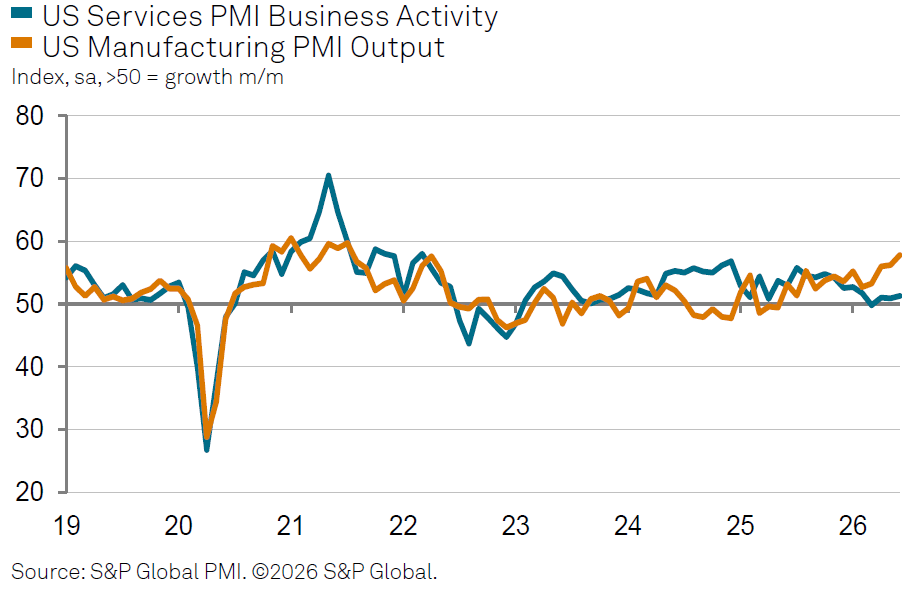
Manufacturing output just printed a 59-month high — and factories are gutting payrolls to do it. Read that again: output index 57.7, the fastest expansion since mid-2021, while manufacturers cut headcount at the sharpest pace since 2009 ex-pandemic. Firms that believe their order books do not fire into a production surge. These plants don’t believe them — they front-ran the war, stacking input inventories at the fastest rate in the survey’s near-two-decade history, bar only the 2025 tariff scramble. That isn’t end-demand; it’s a hedge with an expiry date, output borrowed against tomorrow’s shortages rather than earned this quarter. Which is why the divergence is the signal: manufacturing has broken decisively above services to invert the cycle’s usual order, but one line is borrowing tomorrow’s orders while the other reports today’s — services, two-thirds of the economy, crawling at 51.3 as price-weary customers push back. Beneath both, the composite musters barely 1% annualized growth, leaving the Fed a sub-1% economy with selling-price inflation still climbing. The first-order hit already lands on households — in pink slips, not forecasts. Read the breakout not as factories leading a rebound, but as the sector quietly liquidating its own optimism.
Market Intelligence Brief (MIB) Ver. 18.40
For professional investors only. Not investment advice.
© 2026 RecessionALERT.com

Comments are closed.