
Dow crossed 50,000 as Trump declared Iran talks ‘in final stages,’ crashing WTI -5.7% to $98 and pulling the 10-year yield -9 bps. NVIDIA Q1 beat ($81.6B, +85% YoY; Q2 guide $89–93B, $80B buyback) lifted AMD +8.1% and INTC +7.4%. Russell 2000 led all indices at +2.51% as rate-sensitive small-caps caught the yield-relief bid. April FOMC minutes put a majority on record for hiking; December probability above 50%. 20-year Treasury auction cleared at 5.12% with below-average demand, post-Moody’s.
TABLE OF CONTENTS
A. EXECUTIVE SUMMARY
B. MARKET DATA
C. HIGH-IMPACT STORIES (5)
D. MODERATE-IMPACT STORIES (5)
E. ECONOMY WATCH (5)
F. EARNINGS WATCH (5)
G. WHAT’S NEXT
H. CHART OF THE DAY
A. EXECUTIVE SUMMARY -> TOP
The Dow crossed 50,000 as Trump declared Iran negotiations “in the final stages,” crashing WTI 5.7% to $98.26 — below $100 for the first time since the conflict began — in a rare disinflationary shock that also drove the 10-year yield down 9.3 bps. The simultaneous bond-and-equity rally is the hallmark of inflation relief, not a growth surge: oil’s collapse directly challenges the rate-hike path embedded in today’s April FOMC minutes, which put a majority on record for hiking if inflation persists. NVIDIA’s after-close Q1 beat ($81.6B, +85% YoY; Q2 guidance $89–93B) added an independent AI-capex tailwind, driving the semiconductor complex throughout the session. Nine of eleven S&P 500 sectors closed green — Consumer Cyclicals (+2.36%) and Technology (+2.12%) led — with only Energy (-1.96%) and Consumer Defensive (-0.81%) declining, the latter confirming institutional rotation out of safety positioning.
• Iran ceasefire optimism delivers historic session: WTI -5.7% to $98.26, Brent -6.4% to $104.91; Senate votes 50–47 limiting Trump’s Iran war powers; Dow crosses 50,000 for first time; XOM -3.86%, CVX -3.00%.
• NVIDIA Q1 FY2027 blowout: revenue $81.6B (+85% YoY, beat vs $78.9B est); Q2 guidance $89–93B above $87.4B consensus; $80B buyback announced — demand-saturation bear thesis removed; AMD +8.1%, INTC +7.4%, LRCX +6.84%.
• FOMC April minutes signal rate hike risk: majority favor additional firming if inflation persists; December 2026 hike probability crossed 50%; hawkish signal absorbed without derailing the rally — Chair Warsh inherits this record at June 16.
• 20-year Treasury auction weak: 5.122% yield (23.9 bps above prior auction), B/C 2.55 vs 2.65 average — below-average demand four days after Moody’s downgraded U.S. to Aa1; fiscal risk premium expanding independently of Fed policy.
• Breadth confirms genuine risk-on: Russell 2000 +2.51% leads all major indices (vs S&P +1.08%); 10-year yield -9.3 bps to 4.58%; Consumer Cyclicals +2.36% vs Consumer Defensive -0.81% — widest cyclical/defensive spread of 2026.
• Key events Thursday: WMT Q1 2026 earnings BMO; Housing Starts and Building Permits (April) at 8:30 AM ET; Initial Jobless Claims; Philadelphia Fed Manufacturing Index.
1. Iran Peace = Potential CPI Reset — Oil below $100 is not just an energy trade: each sustained $10/barrel decline shaves approximately 0.25–0.30 percentage points off headline CPI, potentially collapsing the December 2026 rate-hike probability (now above 50%) that the April FOMC minutes just embedded in the policy baseline. The bull case is a confirmed deal sending oil toward $85–90 and forcing a June FOMC pivot away from the hawkish text; the bear case is negotiations stalling, oil rebounding above $105, and the hike-ready majority in the minutes resurging as the dominant rate narrative before June 16.
2. AI Capex Cycle Confirms and Broadens — NVIDIA’s 3%+ revenue beat against a full China H20 headwind removes demand-saturation concerns and reaffirms Blackwell GPU order books are full. Intel’s simultaneous “sold out through 2026” server CPU condition and 10–15% ASP pricing power confirm the cycle is broadening from GPU silicon to the full compute stack. Portfolios cannot reduce AI exposure to a single-name NVDA bet: AMD, INTC, LRCX, and HBM memory (MU) are now confirmed parallel demand beneficiaries with independent earnings upside.
3. Fiscal Premium Survives Disinflation — The 20-year Treasury’s below-average B/C at 5.12% — 24 bps above the prior auction and occurring amid today’s oil-driven rate relief — signals the long end carries a structural fiscal risk premium that geopolitical tailwinds cannot fully neutralize. Post-Moody’s downgrade, below-average foreign bidder participation and $3–4 trillion in projected annual Treasury issuance are expanding the term premium independently of the Fed: even as front-end yields fell 7–9 bps today, the long end’s structural cheapening is compounding the debt-service cost trajectory on a separate and persistent track.
 — Leading economic indicators. Accurate market forecasts. Apply for membership at join.recessionalert.com
B. MARKET DATA -> TOP
Middle East ceasefire optimism crashed crude oil more than 5% (WTI to $98.44, Brent to $104.91), triggering simultaneous rallies in both equities and bonds — a rare disinflationary shock that lifted the Dow above 50,000 for a historic close and drove the 10-year yield sharply lower (-9.3 bps). The session was broadly constructive with nine of eleven S&P 500 sectors closing higher: the semiconductor complex led (AMD +8.1%, INTC +7.4%) ahead of Nvidia’s after-hours earnings beat, while the DJ Transportation index outperformed all major benchmarks (+2.27%) as airlines surged on lower fuel cost expectations. Energy was the day’s sole significant decliner (-1.96%), rotating lower as oil’s supply-risk premium unwound its year-to-date leadership. The dual tailwind of oil-driven inflation relief and Nvidia’s blowout Q1 is the strongest fundamental signal in weeks — though the Iran deal remains fragile and any reversal would immediately reprice bonds and energy names.
CLOSING PRICES – Wednesday, May 20, 2026:
MAJOR INDICES
Dow Theory bull confirmation extended to a third consecutive session today, with the transports breaking to a new 10-session high (20,619 vs prior peak of 20,366 on May 6) — the industrial-transport validation of this advance is now the strongest in two weeks. Over the past 10 sessions, however, the S&P 500 has outperformed the Russell 2000 by 3.4 percentage points — a narrow mega-cap leadership signal now in its fourth consecutive day. Today’s session begins to complicate that read: small-caps surged 2.51% against the S&P’s 1.08%, the widest single-session small-cap outperformance of the recent period, suggesting breadth may be genuinely broadening — though one session has not yet closed the 10-session gap.
| Index | Close | Change | %Move | Why It Moved |
|---|---|---|---|---|
| S&P 500 | 7,432.89 | +79.28 | +1.08% | Broad risk-on advance; nine of eleven sectors positive as Iran ceasefire optimism eased inflation fears; semiconductor rally and simultaneous yield decline reinforced the move |
| Dow Jones | 50,009.35 | +645.47 | +1.31% | Historic close above 50,000; blue-chip cyclicals (Financials, Industrials, GS +5.75%) led; disinflationary oil collapse underpinned the advance and eased cost-pressure concerns for Dow components |
| DJ Transportation | 20,619.7 | +458.6 | +2.27% | Airlines surged on Middle East peace optimism and falling fuel costs; index hit a new 10-session high, strengthening Dow Theory bull confirmation; aviation and logistics names led |
| Nasdaq 100 | 29,297.70 | +478.85 | +1.66% | Semiconductor complex surged ahead of Nvidia’s after-hours earnings beat; AMD +8.1%, INTC +7.4% (analyst upgrades on AI inference demand), LRCX +6.84%; AI capex narrative drove broad chip buying |
| Russell 2000 | 2,815.99 | +68.92 | +2.51% | Small-caps led all major indices; domestic cyclicals disproportionately benefited from improved risk appetite and lower fuel costs; widest single-session small-cap outperformance vs S&P in recent weeks |
| NYSE Composite | 23,021.74 | +224.07 | +0.98% | Broad-based advance across NYSE-listed equities; positive close consistent with the nine-of-eleven sector breadth confirming this was a market-wide risk-on move, not a narrow leadership story |
VOLATILITY & TREASURIES
Unlike a typical risk-on session where yields rise alongside equities, today saw both stocks and bonds rally simultaneously — VIX fell 3.4% while the 10-year yield dropped 9.3 bps, the hallmark of a disinflationary shock rather than a growth surge. Oil’s 5.7% decline cut inflation expectations and triggered bond buying, likely repricing Fed cut odds higher. The 2Y-10Y spread held near +54 bps (both yields fell ~8-9 bps proportionally), confirming the market read this as inflation relief — not a demand recession signal — and declining to steepen the curve in a bearish direction.
| Instrument | Level | Change | Why It Moved |
|---|---|---|---|
| VIX | 17.45 | -0.61 (-3.38%) | Risk appetite improved on Iran ceasefire optimism; VIX declining alongside equity gains confirms this was a genuine sentiment shift, not a hedged or cautious rally |
| 10-Year Treasury Yield | 4.581% | -9.3 bps | Oil’s 5.7% collapse eased inflation expectations; bond market rallied alongside equities — the simultaneous move is the disinflationary read: lower energy costs reducing the near-term inflation outlook |
| 2-Year Treasury Yield | 4.044% | -7.7 bps | Front-end yields eased on reduced near-term inflation expectations; market likely repriced Fed cut probability higher given oil-driven disinflation signal; no recessionary steepening |
| US Dollar Index (DXY) | 99.09 | -0.25 (-0.25%) | USD softened modestly on improved global risk appetite; typical risk-on USD weakness as safe-haven demand receded; EUR/USD +0.19% partially reflects reduced geopolitical risk premium |
COMMODITIES
Gold and silver both declined, but with distinct reads: gold’s mild -0.25% reflects reduced safe-haven demand as Iran talks progressed — a geopolitical premium unwinding, not a trend shift. Silver’s steeper -1.72% underperformed gold, suggesting softer inflation-hedge demand rather than industrial slowdown concern. Copper’s +0.39% decoupled from precious metals entirely, confirming industrial demand expectations held steady — this was a geopolitical/inflation story, not a growth scare. Bitcoin tracked equities as a mild risk-on proxy; no independent crypto catalyst.
| Asset | Price | Change | %Move | Why It Moved |
|---|---|---|---|---|
| Gold | $4,546.47/oz | -$11.53 | -0.25% | Safe-haven demand receded as Iran ceasefire talks progressed; mild decline reflects reduced geopolitical fear premium; gold holding near all-time highs despite the risk-on session |
| Silver | $76.11/oz | -$1.33 | -1.72% | Precious metals broadly lower on risk-on rotation; silver’s steeper decline vs gold (-1.72% vs -0.25%) suggests reduced inflation-hedge demand on the disinflationary oil signal |
| Copper | $6.34/lb | +$0.02 | +0.39% | Industrial metal held up and decoupled from precious metals selloff; flat-to-positive copper confirms this was a geopolitical/inflation story — no growth-scare or demand-destruction read |
| Platinum | $1,959.30/oz | -$18.10 | -0.92% | Precious metals broadly soft; automotive and industrial demand outlook stable but insufficient to offset reduced inflation-hedge and safe-haven bid on the risk-on day |
| Bitcoin | $77,553 | +$485 | +0.63% | Tracking equities in a mild risk-on move; no independent crypto catalyst identified; consistent with its recent pattern as a broad risk-sentiment proxy |
ENERGY
WTI and Brent fell in near-lockstep (WTI -5.69%, Brent -6.41%, spread ~$6.47) — a global supply-risk premium deflation, not regional demand destruction. Natural gas sat out the decline entirely, confirming this is a geopolitical crude story: the Strait of Hormuz disruption premium is unwinding, not a broad energy demand collapse. Crucially, oil fell sharply while equities rallied — the inverse relationship signals a supply-shock unwind: bullish for cost-sensitive equities, disinflationary for the macro outlook, and bearish only for energy producers with direct crude exposure.
| Asset | Price | Change | %Move | Why It Moved |
|---|---|---|---|---|
| Crude Oil (WTI) | $98.44/bbl | -$5.94 | -5.69% | Iran ceasefire optimism; Trump stated the conflict could end “very quickly,” deflating the Strait of Hormuz supply-disruption premium; US-Iran negotiations advancing despite conflicting signals from both sides |
| Crude Oil (Brent) | $104.91/bbl | -$7.19 | -6.41% | Same Middle East catalyst; global benchmark declined sharply as Hormuz supply-risk premium unwound; second consecutive session of elevated crude declines on peace-deal progress |
| Natural Gas (Henry Hub) | $3.035/MMBtu | +$0.01 | +0.36% | Natural gas uncorrelated with crude on this geopolitical driver; domestic supply-demand dynamics held steady; decoupling confirms the catalyst is Hormuz crude risk, not broad energy demand |
| Natural Gas (Dutch TTF) | $16.84/MMBtu | -$0.78 | -4.43% | European gas partially tracked crude lower on Middle East peace hopes; EUR/USD slight strength (+0.19%) added modestly to USD-denominated conversion; move not driven by European-specific demand dynamics |
S&P 500 SECTORS
Nine of 11 sectors closed green — a near-complete sweep that confirms a macro/sentiment flush, not a rotation. The two holdouts are the most analytically revealing: Energy’s -1.96% despite its +33.6% YTD lead signals direct oil-price transmission (the sector leads when oil rises; it retraces when oil falls), while Consumer Defensive’s -0.81% confirms genuine risk-on rotation out of safety holdings. Basic Materials bounced +2.10% today after being the week’s worst performer (-6.57% 1W) — a single-session technical rebound from oversold conditions; the 3-month loss of -5.62% and 1-month -3.19% signal structural weakness, not a reversal.
| Sector | 1-Day | 1-Week | 1-Month | 3-Month | 6-Month | YTD | 12-Month |
|---|---|---|---|---|---|---|---|
| Consumer Cyclical | +2.36% | -1.54% | -0.31% | +1.51% | +1.39% | -1.72% | +7.49% |
| Technology | +2.12% | +0.52% | +11.07% | +20.65% | +19.03% | +18.13% | +43.77% |
| Basic Materials | +2.10% | -6.57% | -3.19% | -5.62% | +24.74% | +13.00% | +42.80% |
| Industrials | +1.64% | -1.53% | -0.69% | -2.24% | +17.37% | +12.48% | +23.53% |
| Financial | +1.57% | +1.32% | -0.16% | -0.73% | +4.04% | -2.50% | +7.98% |
| Real Estate | +1.27% | +0.48% | +1.07% | +2.01% | +8.01% | +8.55% | +5.93% |
| Utilities | +0.85% | -0.63% | -2.06% | -3.39% | +1.30% | +5.34% | +12.61% |
| Healthcare | +0.59% | -0.06% | 0.00% | -6.00% | -1.40% | -3.62% | +12.25% |
| Communication Services | +0.14% | -2.11% | +5.19% | +11.13% | +13.33% | +6.88% | +36.64% |
| Consumer Defensive | -0.81% | +0.82% | +4.25% | -1.10% | +13.35% | +11.23% | +7.49% |
| Energy | -1.96% | +2.48% | +5.02% | +10.58% | +32.25% | +33.60% | +44.40% |
TOP MEGA-CAP MOVERS:
GAINERS
| Company | Ticker | Close | Change | Why It Moved |
|---|---|---|---|---|
| Advanced Micro Devices | AMD | $447.58 | +8.10% | AI capex halo ahead of Nvidia’s after-hours earnings beat; semiconductor complex surged as NVDA’s record Q1 revenue ($81.6B) confirmed the data center upgrade cycle remains intact; AMD directly positioned in AI GPU market |
| Intel Corp | INTC | $119.02 | +7.42% | Multiple analyst upgrades citing surging server CPU demand from AI inference and agentic AI workloads; CEO Lip-Bu Tan confirmed manufacturing yield improvements on advanced nodes now achieving industry-best levels — a major credibility milestone for Intel’s turnaround |
| Lam Research Corp | LRCX | $292.09 | +6.84% | Semiconductor equipment directly leveraged to AI capex buildout; Nvidia’s earnings beat validates sustained wafer deposition and etch tool spending — LRCX is a primary beneficiary of AI-driven advanced-node fab investment |
| Goldman Sachs Group | GS | $982.12 | +5.75% | Capital markets firm disproportionately benefited from Dow’s 50,000 close and elevated equity trading volumes; strong market conditions boost Goldman’s trading revenue, deal-making outlook, and M&A advisory pipeline |
| GE Aerospace | GE | $300.17 | +5.22% | Airlines surged on Iran ceasefire optimism and lower fuel costs; GE Aerospace (commercial jet engines) benefits directly from aviation travel recovery and accelerating fleet expansion — airline confidence translates to engine order momentum |
DECLINERS
| Company | Ticker | Close | Change | Why It Moved |
|---|---|---|---|---|
| Exxon Mobil Corp | XOM | $156.28 | -3.86% | Direct earnings impact from WTI’s 5.7% decline; Iran ceasefire optimism deflated the Strait of Hormuz supply-disruption premium that has supported oil majors; highest crude-price sensitivity among mega-cap energy names |
| Chevron Corp | CVX | $191.33 | -3.00% | Same Middle East catalyst as XOM; integrated oil major hit directly by crude price collapse; second consecutive session of crude-driven energy sector pressure as Hormuz risk premium deflates |
| Walmart Inc | WMT | $131.04 | -2.35% | Risk-on rotation out of defensive retail; Consumer Defensive sector broadly lower as investors rotated into cyclicals and tech on improved macro outlook; no company-specific catalyst |
| Costco Wholesale Corp | COST | $1,074.01 | -1.86% | Consumer Defensive sold on broad risk-on sentiment; wholesale clubs held as defensive proxies and sold when fear subsides; reduced safe-haven demand drove sector-wide rotation out |
| T-Mobile US Inc | TMUS | $190.16 | -1.69% | Communication Services sector underperformed (+0.14% vs S&P +1.08%); no company-specific catalyst; telecom defensive characteristics attracted light selling pressure on a broad risk-on day |
— Institutional-grade intelligence for serious investors. Apply for membership at join.recessionalert.comC. HIGH-IMPACT STORIES -> TOP
BULLISH
1. Trump Declares Iran Talks “In Final Stages” — WTI Crashes Below $100 to $98.26, Brent -5%+ to $105; Senate Passes 50-47 War Powers Limit
The core facts:President Trump declared on May 20 that U.S.-Iran negotiations are “in the final stages,” sending WTI crude futures down more than 5% to settle at $98.26/barrel — below $100 for the first time since the conflict began — and Brent crude to $105.02/barrel, a decline of more than 5%. Separately, the U.S. Senate voted 50-47 to limit Trump’s war powers regarding Iran, removing congressional authorization for further military escalation. The dual catalysts — presidential peace declaration and legislative war-power constraint — collapsed the Strait of Hormuz supply-disruption risk premium that had driven Brent above $115. Major energy equities fell sharply in response: ExxonMobil (XOM) -3.86%, Chevron (CVX) -3.00%. The broader market surged on the disinflationary read: S&P 500 +1.08% to 7,432.97, Dow +1.31% to 50,009.35 (first close above 50,000), Nasdaq +1.54% to 26,270.36.
Why it matters:Oil falling below $100 is a major disinflationary event with direct Fed policy implications. Every sustained $10/barrel decline in WTI reduces U.S. headline CPI by approximately 0.25-0.30 percentage points, directly countering the energy-driven inflation thesis that has dominated Fed deliberations since the conflict began. The Senate war powers vote constrains Trump’s ability to unilaterally re-escalate, meaningfully reducing the tail risk of a renewed supply-disruption spiral. Three immediate transmission channels: (1) Gasoline prices will begin declining from the $4.50+/gallon average within 2-3 weeks if oil sustains below $100, releasing household purchasing power; (2) The Fed’s rate-hike calculus faces a pivot point — if CPI decelerates materially in the June-July prints, the December 2026 rate-hike probability (now above 50%) could collapse; (3) Energy sector earnings estimates face downward revision as the forward oil price deck resets. The Dow crossing 50,000 for the first time is primarily a function of this geopolitical de-escalation — driven by Financials (GS +5.75%), Industrials, and broad cyclical recovery, not tech.
What to watch:Whether WTI sustains below $100/barrel — the defining threshold for Fed “transitory” oil-inflation reframing and gasoline-price relief; the May 21-22 Gulf ceasefire window for confirmation vs. breakdown of the “final stages” claim; Brent for a retest toward $90 as the market’s full peace-deal repricing target.
BEARISH
2. FOMC April Minutes: Majority Ready to Hike If Inflation Persists — December Rate-Hike Probability Tops 50%, Hawkish Text Fails to Derail Iran-Driven Rally
The core facts:The Federal Reserve released the minutes from the April 28-29 FOMC meeting at 2:00 PM ET on May 20. The minutes revealed that a majority of participants indicated additional policy firming — i.e., rate hikes — would likely become appropriate if inflation continues running persistently above the 2% target. Officials broadly agreed inflation risks remain tilted to the upside. Many participants said they would have preferred to remove the committee’s easing bias from the policy statement, and the language characterizing inflation was upgraded from “somewhat elevated” to “elevated.” The historic 4-way dissent — one vote for a cut (Miran), three votes against the easing bias (Hammack, Kashkari, Logan) — was documented in full. Rate markets repriced: the probability of a December 2026 rate hike crossed 50%, and January 2027 hike probability reached 58%. Despite the hawkish text, markets rallied on the day as Iran/oil disinflationary developments overwhelmed the rate-path signal.
Why it matters:The minutes represent the most explicit FOMC hike signal since the 2022 tightening cycle, materially altering the policy rate path distribution for institutional fixed-income portfolios. Two critical read-throughs: (1) New Chair Warsh inherits this April minutes record as the baseline from which his June 16-17 FOMC leadership begins. If the April majority endorsed “upside risks predominate,” Warsh can implement his hawkish instincts with institutional policy coherence, making a June hike or explicit removal of easing bias the path of least internal resistance; (2) The market’s dismissal of the hawkish minutes today — driven by Iran disinflationary offset — may prove temporary. If the Iran peace talks stall, oil rebounds above $105, and CPI remains above 3.5%, the hike pathway documented in the minutes becomes the dominant rate narrative again with December as the live meeting. Front-end yields will re-price sharply in that scenario.
What to watch:June 16-17 FOMC meeting as Warsh’s first policy statement — specifically whether the easing bias is removed; CME FedWatch June and September 2026 hike probabilities for forward market consensus; any Warsh public statements before June elaborating on the April internal deliberations.
BEARISH
3. 20-Year Treasury Auction Clears at 5.122% With Below-Average Demand — B/C 2.55 vs 10-Auction Average 2.65; Post-Moody’s Fiscal Anxiety Persists Despite Oil-Driven Rate Relief
The core facts:The Treasury’s $16 billion 20-year bond auction on May 20 cleared at 5.122% — 23.9 basis points above the prior 20-year auction at 4.883% — with a bid-to-cover ratio of 2.55 against the 10-auction average of 2.65. Below-average demand at a 5.12% yield signals that investors are requiring elevated risk premiums to absorb U.S. long-dated debt even amid today’s oil-driven rate relief. The auction arrived four days after Moody’s downgraded U.S. sovereign credit from Aaa to Aa1 (May 16), citing the $2 trillion-plus FY2026 projected deficit and rising debt service costs. Foreign (indirect) bidder participation came in below the recent average, continuing the pattern visible in recent TIC data showing foreign official institutions as net sellers of Treasuries.
Why it matters:A below-average B/C at a 5.12% yield — after a 24-basis-point cheapening since the prior auction — means the market still requires a meaningful concession to absorb U.S. debt. This is structurally significant for three reasons: (1) The term premium on long-dated Treasuries is expanding independently of Fed policy; even as overall yields fell today on Iran optimism, the long end’s relative weakness against the front end signals that fiscal sustainability concerns are becoming a structural force in rate markets, not a cyclical one; (2) At 5.12% on 20-year paper, the practical cost of rolling U.S. debt service accelerates — current deficit trajectories imply $3-4 trillion in annual Treasury issuance through the decade, and each basis point of concession at auction compounds into tens of billions in additional annual interest expense; (3) Below-average foreign bidder allocation, combined with the Moody’s downgrade, raises the question of whether sovereign reserve managers are beginning to shift marginal Treasury accumulation toward alternatives — a slow-moving but consequential structural transition for long-end yield levels.
What to watch:Next major Treasury auctions for B/C trends as the fiscal demand signal; 10-year yield for a sustained return toward 4.40-4.50% on Iran peace confirmation vs. a bounce above 4.70% on fresh inflation signals; any formal sovereign reserve-manager diversification announcements from major wealth funds as the structural demand risk indicator.
BULLISH
4. AI Capex Sector Erupts: AMD +8.1%, LRCX +6.84%, Nasdaq +1.54% — NVDA Q1 FY2027 Beats $81.62B (+85% YoY), Q2 Guidance Above Consensus, $80B Buyback Confirms Blackwell Supercycle
The core facts:The AI infrastructure trade dominated the May 20 session and extended into after hours. AMD (Advanced Micro Devices) surged +8.1%, Lam Research (LRCX) gained +6.84%, Intel (INTC) rose +7.42%, and the Nasdaq Composite closed +1.54% at 26,270 — all driven by anticipation of and confirmation from NVIDIA’s Q1 FY2027 earnings release. NVIDIA reported Q1 FY2027 revenue of $81.62 billion against an $78.91 billion consensus — an 85% year-over-year increase from $44.06 billion — with non-GAAP EPS of $1.87 vs. $1.75 estimate. Data center revenue reached $75.2 billion (vs. $73.47 billion expected), and Gaming hit a record $3.76 billion (+42% YoY). Q2 FY2027 guidance was set at approximately $89-93 billion — above the $87.36 billion consensus. NVIDIA announced an $80 billion share repurchase program. NVIDIA absorbed a full China H20 revenue headwind (zero H20 revenue this quarter vs. $4.6 billion in Q1 FY2026) and still posted a 5%+ revenue beat.
Why it matters:NVDA’s Q1 beat against a China-headwind baseline removes the primary AI hardware bear thesis — demand saturation — and reconfirms that Blackwell GPU order books are full independent of the China market. The $80 billion buyback at a $5.4 trillion market cap signals management’s conviction in sustained cash generation at multi-hundred-billion annual revenue run rates. For the AI supply chain, three read-throughs: (1) AMD, LRCX, and INTC are confirmed beneficiaries of the same infrastructure build that is filling NVDA’s pipeline — their session surges were validated, not speculative; (2) HBM/AI memory demand (Micron, SK Hynix) is unambiguously confirmed by data center revenue at $75.2B; (3) Hyperscalers (MSFT, AMZN, GOOGL, META) will be pressed at their next earnings calls to provide order cadence details as NVDA’s Q2 guide implies continued aggressive capex commitment. The Nasdaq’s +1.54% single-day gain represents a direct manifestation of the AI sector’s weight in the index.
What to watch:NVDA regular-session open for whether AH softness is “sell the news” consolidation or a more sustained peak signal; AMD Q2 2026 earnings for parallel GPU demand confirmation; hyperscaler Q2 capex commentary as the demand-side validation of NVDA’s Q2 guide.
BULLISH
5. Keybanc Lifts Intel to Overweight — INTC +7.42% as AI Inference Drives CPU Sold-Out Condition Through 2026; ASPs Rising 10-15% in Server Market Structural Reset
The core facts:Keybanc Capital Markets upgraded Intel (INTC) to Overweight from Sector Weight with a $60 price target on May 20, with analyst John Vinh citing robust AI inference-driven server CPU demand as the primary catalyst. Intel is effectively sold out of server CPUs for 2026 and is actively considering raising average selling prices (ASPs) by 10-15% to manage demand overflow. Additional analyst upgrades followed with the same thesis. The structural driver: AI agentic workloads are normalizing the CPU-to-GPU deployment ratio from approximately 1:8 toward 1:1, as inference and AI-orchestration tasks require CPU cycles alongside GPU acceleration. Intel CEO Lip-Bu Tan confirmed that 18A node manufacturing yields are tracking above targets, accelerating the company’s foundry turnaround timeline. INTC closed +7.42% on the session.
Why it matters:The INTC upgrade signals a structural broadening of the AI capex cycle beyond GPUs. The “sold out of server CPUs for 2026” signal is among the strongest possible supply-demand indicators available for an industrial commodity: demand is so strong that Intel cannot build fast enough, which simultaneously implies pricing power (10-15% ASP hike) and earnings estimate upgrades. For the semiconductor sector: (1) The CPU-to-GPU ratio normalization means Intel and AMD EPYC are now competing for the same hyperscaler capex wallets that previously went almost entirely to NVIDIA — the total addressable market for data center CPU spend is expanding, not shrinking; (2) Intel’s 18A yield improvement is the first credible signal of a manufacturing capability recovery in years — removing the “INTC is a structurally broken foundry” bear thesis; (3) Server CPU price hikes represent input cost increases for data center operators (Microsoft, Amazon, Google), who have been absorbing AI infrastructure cost inflation and may begin passing it through to cloud service pricing.
What to watch:Intel Q2 2026 earnings for server CPU revenue growth and ASP realization confirmation; AMD EPYC server revenue for parallel AI inference demand validation; Intel’s 18A yield data at the next investor event as the manufacturing turnaround credibility test.
— Quantifying recession risk so you don’t have to guess. Apply for membership at join.recessionalert.comD. MODERATE-IMPACT STORIES -> TOP
BULLISH
6. Airlines Lead S&P 500 — United Airlines Session Top Performer; DAL, LUV, CCL, Norwegian Surge as Oil -5%+ Cuts Fuel Costs and Iran Peace Opens Middle East Routes
The core facts:United Airlines (UAL) was the S&P 500’s top-performing stock on May 20 as WTI crude fell more than 5% to $98.26/barrel. Delta Air Lines (DAL), Southwest Airlines (LUV), Carnival Corp (CCL), Norwegian Cruise Line (NCLH), and GE Aerospace (GE, +5.22%) all posted substantial gains. The Consumer Cyclical sector, which includes airlines and leisure travel, led all S&P 500 sectors at +2.36% for the session. The catalyst was two-fold: (1) Direct fuel cost benefit — every $10/barrel decline in WTI reduces airline fuel costs by approximately 3-4 cents per gallon; airlines typically hedge 50-70% of near-term consumption, but the unhedged portion benefits immediately, and full-year fuel cost guidance revisions will follow; (2) Geopolitical reopening dividend — Iran peace talks at “final stages” implies eventual reopening of Iranian airspace and broader Middle East regional routes, reducing circuitous routing costs and restoring Persian Gulf destinations for leisure and business travelers.
Why it matters:Airlines have been among the most compressed S&P 500 sub-sectors this year under dual pressure: energy inflation (jet fuel at elevated levels) and Middle East conflict (route disruptions, reduced leisure demand for regional travel). An oil crash toward $100 removes approximately $500M-$1B in annualized fuel cost burden for a major carrier like UAL alone, and route normalization would add incremental revenue from previously closed markets. For GE Aerospace, the peace dividend extends to commercial aviation fleet expansion confidence: operators who deferred procurement amid geopolitical uncertainty will accelerate orders. The travel recovery thesis also benefits hotel chains and discretionary consumer spending, reinforcing the consumer sentiment improvement associated with lower gasoline prices.
What to watch:WTI sustained below $100/barrel as the multi-month airline fuel cost benefit threshold; any formal announcement of Hormuz reopening or Middle East airspace normalization; UAL and DAL Q2 2026 guidance updates as they recalibrate fuel cost assumptions.
UNCERTAIN
7. EIA Reports -7.86M Barrel Crude Draw (vs -2.9M Expected) — Strategic Petroleum Reserve Falls to Lowest Since July 2024 at 374.2M Barrels as Emergency Buffer Depletes
The core facts:The EIA weekly petroleum report released May 20 showed commercial crude oil inventories drew -7.863 million barrels for the week ending May 16 — more than 2.5 times the Wall Street expectation of a -2.942 million barrel draw. The draw reflects strong refinery run rates and export demand. Simultaneously, the Strategic Petroleum Reserve (SPR) contracted by an additional 9.92 million barrels during the same period, falling to 374.2 million barrels — its lowest operational capacity since July 2024. Combined commercial and SPR drawdowns mark a significant depletion of total U.S. oil buffer stocks. The inventory data was released on the same day WTI crashed to $98.26/barrel on Iran peace optimism — creating a direct contradiction between physical supply tightness and geopolitical price relief.
Why it matters:The -7.86M barrel draw creates a fundamental tension with today’s oil price collapse: physical inventories are historically tight and depleting rapidly, yet oil fell 5%+ on forward geopolitical signals. The resolution matters for portfolio construction: (1) If Iran peace materializes and Hormuz reopens, the supply-disruption premium unwinds — but the underlying inventory deficit remains, meaning oil has a structural price floor significantly above the pre-conflict level (~$73/barrel); the market is pricing the peace deal faster than the inventory can rebuild; (2) The SPR at 374M barrels (lowest since July 2024) means the U.S. government has substantially less emergency buffer available for future supply shocks — any re-escalation from a depleted SPR baseline would send oil materially higher than the first shock did; (3) The IEA’s recent warning that global emergency reserves are depleting toward “only weeks of supply remaining” is now corroborated by the U.S. SPR data — a coordinated global reserve depletion signal that creates asymmetric re-escalation risk.
What to watch:Weekly EIA reports for whether the drawdown pace decelerates as geopolitical tension eases; SPR level for any government announcement of a pause or reversal of emergency releases; WTI differential between current $98 and pre-conflict $73 as the market’s residual structural risk premium after peace signals.
BULLISH
8. Russell 2000 Surges +2.6% to 2,817 — 10-Year Yield Retreats Below 4.60% on Iran Disinflation, Unlocking Rate-Sensitive Small Caps in Broadest Market Rally of 2026
The core facts:The Russell 2000 (IWM) surged +2.6% to 2,817.36 on May 20, significantly outperforming the S&P 500 (+1.08%) and Dow (+1.31%). The catalyst was the 10-year Treasury yield pulling back below 4.60% as WTI crude’s 5%+ decline on Iran peace optimism transmitted a disinflationary signal into the bond market. Small-cap stocks are disproportionately rate-sensitive because they carry higher variable-rate debt burdens relative to large caps, their earnings multiples expand more when discount rates fall, and many are domestic-focused with less geopolitical exposure. The 152-basis-point daily outperformance gap between the Russell 2000 (+2.6%) and the S&P 500 (+1.08%) is among the widest large/small differentials of 2026, indicating institutional rotation into rate-sensitive domestic names.
Why it matters:The Russell 2000’s outperformance is a direct function of the bond market’s response to Iran peace optimism — and represents one of the clearest near-term beneficiaries of an oil-inflation resolution. If Hormuz reopens and oil stabilizes at or below $100, the 10-year yield could settle in the 4.30-4.50% range from today’s 4.60% level, translating into a sustained valuation re-rating for small caps whose multiples have been compressed by high discount rates. For institutional allocation, this signals a potential rotation trigger: the relative performance gap between large-cap growth (S&P 500 dominated by mega-cap tech) and small-cap value/domestic names may continue to close if inflation expectations decline further. Regional banks within the Russell 2000 benefit disproportionately from a normalizing yield curve while also gaining from falling short-rate expectations.
What to watch:10-year yield for a sustained break below 4.50% as the level that institutionally anchors the small-cap rotation trade; IWM for follow-through above the 2,850 resistance level; upcoming jobless claims and housing data for confirmation that the domestic economy supports small-cap earnings recovery.
BULLISH
9. Consumer Defensive Sector -0.81% Underperforms by 189 Basis Points — Walmart -2.35%, Costco -1.86% as Risk-On Rotation Confirms Improving Investor Confidence
The core facts:The S&P 500 Consumer Staples sector fell -0.81% on May 20 while the broader S&P 500 gained +1.08% — a 189-basis-point relative underperformance representing a textbook risk-on rotation. Walmart (WMT, $1.04 trillion market cap) fell -2.35% and Costco (COST, ~$400 billion+ market cap) declined -1.86%, with no company-specific negative news driving either move. The Consumer Discretionary sector, by contrast, gained +2.36% — producing a 317-basis-point Discretionary vs. Staples divergence, the widest cyclical/defensive spread of 2026. The selloff in defensives reflects institutional portfolio rebalancing away from high-premium safe-haven stocks: oil falling 5%+ reduces the purchasing-power stress narrative that had driven defensive inflows throughout the conflict period.
Why it matters:The Consumer Defensive selloff is the institutional read that the Iran oil crash is a genuine economic improvement, not a head fake. When fear recedes and energy costs fall, the premium embedded in food and household staples stocks — historically expensive relative to their earnings growth — becomes the relative-value loser. For WMT specifically, today’s -2.35% move is notable given WMT reports Q1 2026 earnings BMO tomorrow (May 21); some of today’s selling reflects pre-earnings position trimming as traders reassess WMT’s defensive premium with oil deflating the energy-stress thesis. The XLY/XLP ratio divergence (317 basis points today) is now tracking at levels consistent with prior risk-on pivots from high inflation environments — historically a leading indicator of sustained cyclical outperformance over a 3-6 month horizon.
What to watch:WMT Q1 2026 earnings BMO May 21 — comp store sales guidance and consumer traffic data as the next test of whether the defensive thesis is structurally weakening; XLY/XLP ratio for continuation of the cyclical/defensive divergence; gasoline price data for the first week of June as the leading indicator for consumer spending recovery.
BULLISH
10. UAE Announces Hormuz Bypass Pipeline Now 50% Complete — Overland Route Would Permanently Eliminate Strait of Hormuz Oil Supply Chokepoint Risk for Gulf Exports
The core facts:The United Arab Emirates officially announced on May 20 that its overland crude oil pipeline — designed to bypass the Strait of Hormuz entirely — is now approximately 50% complete. The pipeline routes UAE crude from inland producing fields to the port of Fujairah on the Gulf of Oman, circumventing the Hormuz chokepoint. At full operational capacity, the pipeline can move approximately 1.5-2 million barrels per day around the Strait. The announcement coincides with Trump’s “final stages” peace declaration and today’s WTI crash below $100, adding a structural long-term supply security development to the shorter-term geopolitical news flow.
Why it matters:The UAE pipeline’s 50% completion signals a structural, multi-year de-risking of Gulf oil supply that extends beyond the current Iran conflict. Even if Iran and the U.S. reach a deal, the pipeline becomes a durable hedge against future Hormuz disruptions — reducing the geopolitical risk premium embedded in oil on a permanent basis. Three portfolio implications: (1) The structural Hormuz risk premium (estimated at $15-25/barrel at peak conflict intensity) may not fully return even in future re-escalation scenarios, as alternative routes progressively come online — compressing the ceiling on Iran-conflict oil spikes; (2) Saudi Arabia and other Gulf producers have been similarly expanding bypass capacities, meaning the aggregate of these infrastructure investments represents a multi-year erosion of Hormuz concentration risk across Gulf exporters; (3) The completion timeline — 50% done, implying roughly 12-18 months to full operation — means the oil market cannot price out Hormuz risk entirely yet, but the directional trajectory of structural supply risk reduction is now confirmed.
What to watch:UAE pipeline completion timeline and official capacity announcements; parallel Saudi bypass pipeline updates; oil futures structure (contango/backwardation) as the forward market signal on whether structural supply-risk relief is being priced into longer-dated contracts.
— Separating signal from noise since 2007. Apply for membership at join.recessionalert.comE. ECONOMY WATCH -> TOP
Wednesday’s dominant tension is a Fed-fiscal collision: April FOMC minutes revealed the most hawkish committee signal in months — a majority flagging rate hikes, the easing bias openly challenged — while the Treasury’s 20-year auction cleared at 5.12% on below-average demand, the bond market’s verdict on post-Moody’s fiscal risk. Philly Fed President Paulson reinforced the hold-with-hike-risk message independently. Housing remains structurally impaired (NAHB 37, 25th straight negative reading) and West Marine’s Chapter 11 adds to the retail stress ledger as consumer discretionary absorbs the dual squeeze of high rates and energy-driven inflation. With GDPNow at 4.0% for Q2, the hard growth data still holds — but bond market and policy signals are tightening.
FOMC April 28-29 Minutes: Majority Flag Rate Hike Risk; Fed Upgrades Inflation to “Elevated” (Federal Reserve, May 20)
What they’re saying:Minutes from the April 28-29 FOMC meeting — released Wednesday — show a Fed shifting in a decisively hawkish direction. A majority of participants flagged that “policy firming would likely become appropriate” if inflation remains persistently above 2%, and many participants wanted to remove the easing bias from the post-meeting statement entirely. The Fed upgraded its inflation characterization from “somewhat elevated” to “elevated,” reflecting widening breadth and increasing stickiness of price pressures, with the vast majority noting elevated risk that inflation takes longer to return to 2% than previously expected.
The context:The minutes record April’s historic 4-way dissent — the most since 1992 — with Miran favoring a quarter-point cut while Logan, Kashkari, and Hammack opposed the easing bias in the statement. With April CPI at 3.8% YoY (driven by energy and tariff pass-through) and no committee consensus on the direction of the next move, the minutes expose the Fed’s dilemma: a labor market still broadly stable but an inflation picture deteriorating from multiple directions. These are the final minutes under Powell; Chair Warsh’s first meeting is June 16.
What to watch:June 16 FOMC decision — Chair Warsh’s first — for any shift in rate bias language or explicit hike signal; any Fed commentary on inflation path in the interim; May CPI (due mid-June) as the key data gate before the decision.
20-Year Treasury Auction Attracts Below-Average Demand; Yield Hits 5.12% as Fiscal Concerns Persist (Treasury/RTTNews, May 20)
What they’re saying:The Treasury sold $16 billion in 20-year bonds Wednesday at a high yield of 5.122%, up sharply from the prior auction’s 4.883% — a jump of nearly 24 basis points. The bid-to-cover ratio came in at 2.55, below the 10-auction average of 2.65, indicating soft investor appetite. The weak result extends a pattern of strained demand for long-end Treasuries in the post-Moody’s environment.
The context:Last Friday’s Moody’s downgrade of US sovereign credit to Aa1 — removing the final triple-A rating — has sharpened the market’s fiscal risk premium on long-duration Treasuries. The $2 trillion+ projected FY2026 deficit, with interest costs expected to consume ~30% of federal revenue by 2035, is increasingly being priced into the yield curve. A sustained 5%+ yield on 20-year paper raises the cost of US refinancing, tightens financial conditions independently of Fed policy, and pressures mortgage rates — compounding the housing affordability crisis already reflected in today’s NAHB reading.
What to watch:Thursday’s 10-year TIPS auction (1:00 PM ET) for further demand-side signal; 10-year Treasury yield for any spread widening vs. 2-year; Congressional action on the debt ceiling and spending path ahead of the next Treasury refunding announcement.
Philly Fed’s Paulson: Rates “Mildly Restrictive,” Inflation Too High for Cuts — Rate Hikes Remain on the Table (Philadelphia Fed/Bloomberg, May 19)
What they’re saying:Philadelphia Fed President Anna Paulson, speaking at the Atlanta Fed’s 2026 Financial Markets Conference, stated that monetary policy is “mildly restrictive” and that the current stance is “helping to keep inflation pressures in check while the labor market remains stable.” Rate cuts require demonstrated, sustained progress on inflation — a bar not yet met. Paulson flagged that inflation was “too high” even before the Middle East energy shock, with upside risks from tariffs and global supply chain disruptions compounding energy-driven CPI.
The context:Paulson’s remarks align with and independently reinforce the hawkish tone from the April FOMC minutes released the same day. With April CPI at 3.8% YoY and Brent crude near $110, the Fed faces a stagflationary squeeze: labor broadly stable but inflation sticky and multi-sourced (tariffs, energy, services). Paulson’s comment that rate hikes remain “on the table” — if inflation fails to progress — marks an escalation from the prior “patient hold” posture that dominated committee messaging in Q1 2026.
What to watch:Friday’s University of Michigan Consumer Sentiment final (exp. 48.2) for consumer inflation expectations — 5-year expectations rose to 4.5% in the preliminary reading, a closely-watched Fed input; any additional Fed official commentary before the June 16 blackout period.
NAHB Builder Confidence Edges Up to 37 in May, But Marks 25th Consecutive Negative Reading as Affordability Crisis Deepens (NAHB, May 18)
What they’re saying:Builder confidence in the new single-family housing market rose 3 points to 37 in May, beating the 35 estimate. All three components improved: current sales conditions (40), six-month sales expectations (45), and buyer traffic (25). Despite the beat, 32% of builders cut prices in May and 61% deployed sales incentives — the 14th consecutive month at or above 60% incentive usage.
The context:The 37 reading remains deeply in contractionary territory — the 25th straight negative print. Higher mortgage rates (MBA 30-year at 6.56%, reported Wednesday), rising gas prices, and geopolitical uncertainty linked to the Middle East war continue to suppress buyer demand, with the West (27) and South (36) showing the sharpest regional stress. The small month-over-month gain is encouraging but insufficient to signal a housing recovery; at these affordability levels, incremental confidence gains have historically not translated into meaningful starts or permit activity.
What to watch:Thursday May 21 Housing Starts April (exp. 1.41M vs prior 1.502M) and Building Permits (exp. 1.39M) at 8:30 AM ET — a miss would confirm the confidence uptick has not translated to ground activity; Existing Home Sales Friday May 22.
West Marine Files Chapter 11 Bankruptcy; Marine Retailer Buckles Under $500M+ Debt Load (National Law Review, May 17)
What they’re saying:West Marine, Inc., the national specialty retailer of boating and marine products with approximately 250 stores, filed for Chapter 11 bankruptcy protection in Delaware on May 17. Total liabilities fall in the $500 million to $1 billion range. The filing includes multiple affiliates: Marine One Holdco, Marine One Parent, Rising Tide Holdings, Rising Tide Parent, Seascapes, and West Marine Products.
The context:West Marine was taken private by L Catterton in 2017 and has carried a heavy leveraged buyout debt load through a deteriorating consumer environment — a pattern repeating across multiple retail Chapter 11s since 2024. The marine/boating segment faces a compounding squeeze: fuel cost inflation (oil near $110/bbl) suppresses discretionary boating activity, while high rates and consumer balance sheet stress reduce demand for big-ticket marine equipment. The bankruptcy follows a broader theme of LBO-era specialty retailers failing to refinance at post-zero-rate borrowing costs.
What to watch:West Marine’s reorganization plan and store closure announcements; any contagion signals in specialty/outdoor retail; Q2 2026 retail bankruptcy pipeline as higher-for-longer rates pressure LBO-era debt maturities.
— Know the probability before the market prices in the risk. Apply for membership at join.recessionalert.comF. EARNINGS WATCH -> TOP
YESTERDAY AFTER THE BELL (Markets Reacted Today)
No major earnings yesterday after the bell from companies with >$100B market cap.
TODAY BEFORE THE BELL (Markets Already Reacted)
UNCERTAIN
11. Analog Devices (ADI): -4.15% | Q2 2026 Beat Offset by Sharp Q3 Revenue Guidance Step-Down
The Numbers:Q2 2026 Revenue: $3.62B vs. $3.51B est. (+3.14%); Adj. EPS: $3.09 vs. $2.89 est. (+7.03%). By segment: Industrial (50% of revenue): +56% YoY, +20% QoQ — led by aerospace/defense and automated test equipment (ATE); Automotive (24%): +2% YoY; Communications (15%): +79% YoY. Q3 2026 guidance: revenue $3.09B ±$100M (midpoint representing a ~-15% sequential step-down from Q2 actual); adj. EPS $3.03 ±$0.15. Released BMO.
The Problem/Win:The Q2 beat was broad-based and strong — the Communications recovery (+79% YoY) and Industrial resurgence (+56% YoY) both exceeded expectations. However, Q3 guidance midpoint of $3.09B represents a significant sequential step-down from Q2’s $3.62B actual, implying inventory cycle normalization after what appears to have been a robust re-stocking quarter in aerospace/defense and ATE. The guidance miss overwhelmed the strong Q2 print, triggering the -4.15% session decline.
The Ripple:ADI’s Industrial results are a positive read-through for Texas Instruments (TXN) and Microchip Technology (MCHP). However, the Q3 guidance step-down raises questions about whether Q2’s strength was driven by inventory re-stocking that may now pause — a pattern TXN investors will scrutinize at their next earnings report.
What It Means:ADI is executing well on end-market recovery, but the Q3 step-down confirms that the industrial semiconductor cycle has not entered sustained linear growth — investors should expect a choppy inventory-build / pause pattern through H2 2026 rather than a clean ramp.
What to watch:Texas Instruments next earnings for industrial cycle confirmation; ADI Q4 2026 guidance as the next sequencing data point for industrial semiconductor demand trajectory.
BULLISH
12. TJX Companies (TJX): +5.66% | Q1 FY2027 EPS Surges +16.82% Above Estimate — Off-Price Trade-Down Accelerating
The Numbers:Q1 FY2027 Revenue: $14.32B vs. $14.02B est. (+2.20%); Adj. EPS: $1.19 vs. $1.02 est. (+16.82%). Comparable store sales and customer transaction counts ahead of plan. Released BMO.
The Problem/Win:TJX delivered a standout Q1 as consumers under purchasing-power pressure — gasoline at $4.50+/gallon, University of Michigan sentiment at a historic low of 48.2, and housing unaffordability — continue trading down to off-price retail. The company’s TJ Maxx, Marshalls, and HomeGoods banners become destination retailers precisely when full-price discretionary spending softens. The +16.82% EPS beat reflects both revenue upside and operating leverage from higher traffic and transaction volumes. The result directly contradicts Home Depot’s Q1 warning (filed May 19) of “greater consumer uncertainty” — TJX is the beneficiary of exactly the consumer caution that pressured HD.
The Ripple:The TJX beat confirms the consumer bifurcation thesis: spending is shifting from large-ticket home improvement (deferred) to off-price value (defensive). Ross Stores (ROST) and Burlington (BURL) are the most direct sector read-throughs. Full-price specialty retailers face continued share loss to value channels in this environment.
What It Means:TJX is one of the most reliable off-price compounders in an inflationary consumer stress environment. This result confirms that thesis is active and accelerating — the combination of energy price inflation, low consumer confidence, and housing affordability stress is channeling discretionary spend toward TJX’s value proposition at an above-expected rate.
What to watch:Ross Stores’ next earnings for same-store sales confirmation of off-price outperformance; monthly retail sales data for acceleration in discount/off-price vs. deceleration in full-price channels.
BULLISH
13. Lowe’s Companies (LOW): +1.23% | Q1 2026 Beats Cautious Bar; Comparable Sales +0.6%, Full-Year FY2026 Guidance Reaffirmed
The Numbers:Q1 2026 Revenue: $23.08B vs. $22.98B est. (+0.44%); Adj. EPS: $3.03 vs. $2.97 est. (+1.91%). Comparable store sales: +0.6% (vs. negative comps feared after HD’s May 19 warning). Online sales: +15.5%. Pro customer sales: strong. Full-year FY2026 guidance reaffirmed: total sales $92-94B (up 7-9% YoY), comp sales flat to +2%, adj. EPS $12.25-12.75. Released BMO.
The Problem/Win:Lowe’s result is more significant than the modest headline beat implies. Home Depot’s May 19 cautious guidance — citing “greater consumer uncertainty and housing affordability pressure” — created fears of a home improvement sector collapse. LOW’s positive comps (+0.6%) and FY2026 guidance reaffirmation materially outperformed the HD-depressed bar, suggesting Lowe’s Pro-customer exposure (contractors and professional remodelers) and its online channel (+15.5% growth) are buffering the same housing affordability headwinds that pressured HD’s DIY-heavy mix. Guidance reaffirmation is the most important signal — LOW management is not seeing accelerating demand deterioration.
The Ripple:LOW’s relative outperformance vs. HD validates the Pro customer/omnichannel premium. Sherwin-Williams (SHW), Masco (MAS), and building materials suppliers are the most direct read-throughs. The LOW result provides a floor for sector sentiment, preventing the full HD-bear thesis from taking hold.
What It Means:LOW’s operational resilience relative to HD confirms that the home improvement sector is bifurcating by customer segment — Pro/contractor activity remains resilient even as homeowner DIY softens. Investors should distinguish by customer mix when positioning in home improvement retail.
What to watch:HD’s next quarterly earnings for whether LOW’s outperformance is structural or cyclical; housing starts and existing home sales data for the underlying demand signal; 30-year mortgage rate for the first print below 7% as the potential home improvement demand inflection catalyst.
TODAY AFTER THE BELL (Markets React Tomorrow)
BULLISH
14. NVIDIA Corporation (NVDA): AH: n/a | Q1 FY2027 Revenue $81.62B (+85% YoY) Crushes Estimates — Q2 Guidance ~$91B, $80B Buyback: Blackwell Supercycle Undiminished
The Numbers:Q1 FY2027 Revenue: $81.62B vs. $78.91B est. (+3.44%); Non-GAAP EPS: $1.87 vs. $1.75 est. (+6.86%). Data Center: $75.2B vs. $73.47B est. (+2.35%); Gaming: $3.76B (record, +42% YoY). China H20 revenue: $0 (vs. $4.6B in Q1 FY2026 — full headwind absorbed). Q2 FY2027 guidance: ~$89-93B (above $87.36B consensus). Announced $80 billion share repurchase program. Released AMC; AH trading direction not confirmed at report time.
The Problem/Win:NVIDIA absorbed a full China H20 headwind (~$4.6B lost vs. prior year) and still posted a 5%+ revenue beat — confirming that Blackwell GPU demand from non-China hyperscalers, sovereign AI programs, and enterprise deployments is not just compensating for China but accelerating beyond it. The $80 billion share buyback at a $5.4 trillion market cap signals management’s conviction in sustained cash generation at multi-hundred-billion annual revenue run rates — an unprecedented capital return commitment in semiconductor sector history. Q2 guidance midpoint of ~$91B implies ~+11% sequential acceleration, signaling the AI infrastructure buildout is in expansion, not plateau.
The Ripple:NVDA’s results validate the AMD, LRCX, and INTC session surges (AMD +8.1%, LRCX +6.84%, INTC +7.42%) as justified demand signals, not speculation. Micron (MU) and SK Hynix are the most direct follow-on HBM demand beneficiaries. Hyperscalers (MSFT, AMZN, GOOGL, META) will face scrutiny at next earnings calls to provide NVDA order cadence confirmation given Q2 guidance implies continued aggressive AI capex.
What It Means:NVDA’s results remove the primary AI hardware bear thesis — demand saturation — and reconfirm the earnings upgrade cycle for the semiconductor supply chain. At $5.4 trillion, NVDA’s revenue scale and margin structure make it the primary single-company driver of Nasdaq price performance on any given earnings day.
What to watch:NVDA regular-session open tomorrow for AH price action resolution; AMD Q2 2026 earnings for parallel GPU demand confirmation; hyperscaler Q2 capex guidance for demand-side NVDA order validation.
BEARISH
15. Intuit Inc (INTU): -11.45% AH | Q3 FY2026 Beat and Guidance Raise Overshadowed by 17% Workforce Reduction Announcement
The Numbers:Q3 FY2026 Revenue: $8.56B vs. $8.54B est. (+0.23%); Adj. EPS: $12.80 vs. $12.57 est. (+1.83%). Full-year FY2026 guidance raised: adj. EPS $23.80-23.85 vs. $23.20 est. Q4 adj. EPS guided $3.56-3.62 vs. $3.20 est. (+12.5% Q4 beat). Announced 17% workforce reduction (~3,000 employees), with $300-340M in restructuring charges. Stock -11.45% in AH trading to $339.48. INTU was already down ~36% YTD entering today. Released AMC.
The Problem/Win:Intuit’s numerical results beat estimates and raised guidance — under normal circumstances, a bullish print. But the 17% workforce reduction overrides the financial beat: layoffs at this scale signal management sees structural revenue erosion from AI-driven disruption of its core products. TurboTax faces direct competition from AI-powered tax filing tools; QuickBooks faces AI-enabled bookkeeping alternatives. The market’s -11.45% AH reaction confirms investors are re-rating the company’s competitive moat, not celebrating the guidance raise. The “guidance raised via cost cuts from layoffs” read — rather than organic demand acceleration — compounds the negative interpretation.
The Ripple:The INTU selloff is a sector-level signal for financial software companies with similar AI disruption exposure: H&R Block (HRB), Block (SQ), Paylocity (PCTY). The “beat-and-cut-headcount” pattern — strong near-term financials alongside aggressive structural rightsizing — will be closely watched by investors in other enterprise software names reporting over the coming weeks as a template for AI-disruption disclosures.
What It Means:INTU’s workforce reduction represents the first major “AI-displaced white-collar jobs” restructuring announcement from a $100B+ financial technology company. The market’s negative reaction confirms that even substantial guidance increases cannot fully offset the structural narrative of AI disrupting professional services software moats.
What to watch:Intuit Q4 FY2026 earnings (August 2026) for whether the workforce reduction translates into margin expansion or accelerating revenue deceleration; H&R Block (HRB) for parallel competitive disruption signals; TurboTax market share data in Q1 2027 tax season for AI alternative adoption rates.
WEEK AHEAD PREVIEW:
Q1 2026 earnings season is approaching completion with approximately 89% of S&P 500 companies having reported. NVIDIA’s AMC print tonight is the final mega-cap reporter; blended EPS growth of +27.7% YoY marks the highest growth rate since Q4 2021. The remaining reporting calendar is sparse, with two significant names on Thursday.
Walmart (WMT) — BMO, Thursday May 21 — Street expects revenue of $174.84B and adj. EPS of $0.66. Key focus: U.S. same-store sales (consensus ~3.9-4.5%) as the primary domestic consumption barometer amid record-low consumer confidence (UMich 48.2 preliminary); management commentary on gasoline-price pass-through impacts on consumer basket composition; advertising and membership business momentum as high-margin revenue diversification; and initial guidance sensitivity to today’s oil crash. Note: WMT fell -2.35% today in a pre-earnings positioning unwind as the defensive/staples trade reversed on Iran peace optimism.
Deere & Company (DE) — BMO, Thursday May 21 — Street expects EPS of $5.70 on revenue of $11.55B, with year-over-year EPS declining approximately -12.5% as soft agricultural commodity prices weigh on farm equipment purchasing decisions. Key focus: Agriculture & Turf segment order cadence and dealer inventory levels; management commentary on tariff impacts on equipment production costs and farmer capex discipline; Construction & Forestry segment as a potential offset to ag weakness; and any full-year FY2026 guidance adjustment given the evolving oil-price and macro backdrop.
No significant mega-cap earnings are scheduled for Friday May 22. Key economic data this week: Housing Starts and Building Permits (Thu May 21, 8:30 AM ET), Initial Jobless Claims May 16 (Thu May 21, 8:30 AM ET), Philadelphia Fed Manufacturing Index May (Thu May 21, 8:30 AM ET), and University of Michigan Consumer Sentiment final May (Fri May 22).
— US market commentary trusted by family offices and institutions. Apply for membership at join.recessionalert.comG. WHAT’S NEXT -> TOP
UPCOMING RELEASES:
| Date | Event | Why It Matters |
|---|---|---|
| Thu, May 21 | Housing Starts — April (exp. 1.41M, prior 1.502M) | April starts are expected to fall 6% from March, compounding the NAHB’s 25th consecutive sub-50 builder confidence print. A miss would confirm high mortgage rates (~6.56%) and energy-cost pressure continue to suppress actual construction activity despite the modest confidence uptick. A beat — especially if driven by multifamily — would be the first credible housing recovery signal of 2026. |
| Thu, May 21 | Building Permits — April Preliminary (exp. 1.39M, prior 1.363M) | Permits lead starts by 1–3 months; a beat would signal the pipeline is gradually rebuilding despite affordability headwinds. The expected 1.39M is marginally above the prior 1.363M — even a small positive surprise would be read as early confirmation that WTI’s retreat below $100 is beginning to ease builder cost calculations. |
| Thu, May 21 | Initial Jobless Claims — Week of May 16 (exp. 210K, prior 211K) | Claims have held in a tight 205–215K band, the key signal that the labor market remains broadly stable despite multiple macro headwinds. Any print above 230K would shift the Fed’s risk calculus away from the hike-if-inflation-persists posture documented in the April FOMC minutes. A print below 200K would reinforce the no-cut, possible-hike baseline. |
| Thu, May 21 | Philadelphia Fed Manufacturing Index — May (exp. 18, prior 26.7) | Expected to fall sharply from April’s 26.7 — a 32% decline to 18 — as tariff-related input cost uncertainty and slowing new orders weigh on Mid-Atlantic factory activity. A miss well below 18 would add to ISM manufacturing’s recent soft readings and raise questions about industrial earnings resilience; a beat above 20 would confirm the April strength was not an anomaly. |
| Thu, May 21 | Continuing Jobless Claims — Week of May 9 (prior 1,782K) | Continuing claims track how long the unemployed stay out of work — a rising trend would signal labor market loosening even without a spike in initial filings. A sustained rise above 1,800K would indicate reabsorption of laid-off workers is slowing, a leading indicator of eventual consumer spending deterioration. |
| Fri, May 22 | Fed Governor Waller Speech | First Fed commentary after the April FOMC minutes release and today’s Iran-driven oil crash. Markets will parse Waller’s remarks for any revision to the hike-if-inflation-persists posture — specifically whether the 5%+ oil decline changes the near-term inflation assessment before the June 16 blackout period begins. Any softening of the hawkish tone would be a significant signal for rate markets. |
| Fri, May 22 | Michigan Consumer Sentiment — Final May (exp. 48.2, prior 49.8) | The final reading is expected to confirm a deterioration in sentiment from April’s 49.8, extending the sub-50 run that signals consumer caution. The relationship between sentiment and spending is noisy at low readings; what matters is whether current conditions or forward expectations are driving the softness — the latter has more Fed-policy relevance. |
| Fri, May 22 | Michigan 5-Year Inflation Expectations — Final May (exp. 3.4%, prior 3.5%) | The Fed watches the 5-year expectations measure as a gauge of inflation anchoring; a print above 3.5% would reinforce the “elevated inflation risk” framing in the April minutes and harden the December hike probability further. The preliminary reading prompted concern internally; the final confirmation will determine whether the Fed treats this as a blip or an anchor-drift signal heading into June 16. |
| Fri, May 22 | CB Leading Economic Index — April MoM (exp. -0.2%, prior -0.6%) | The LEI has printed negative in four of the last six months, a historically recessionary pattern. An expected improvement from -0.6% to -0.2% would reduce near-term recession probability marginally; a fourth consecutive negative print exceeding -0.4% would deepen the recessionary signal and complicate the Fed’s hike calculus with a stagflationary data stack. |
| Fri, May 22 | Existing Home Sales — April | With mortgage rates at 6.56% and affordability at multi-decade lows, existing sales have been range-bound near cyclical lows. Any print below 3.9M annualized would reinforce the housing contraction narrative; a recovery toward 4.2M+ would suggest buyers are beginning to adjust to the higher-rate environment and could signal a floor forming in transaction volume. |
KEY QUESTIONS:
1. Will Iran negotiations finalize within the May 21–22 window — and does WTI sustain below $100? That threshold determines whether the June–July CPI prints soften enough to collapse the December rate-hike probability (now above 50%) embedded in the April FOMC minutes, or whether a deal stall sends oil back above $105 and reinstates the hawkish baseline before Chair Warsh’s June 16 debut.
2. Do Thursday’s Housing Starts and Building Permits confirm the NAHB’s modest confidence uptick, or reveal that mortgage rates and energy costs continue to suppress actual construction? A miss on both would confirm the 25th consecutive sub-50 confidence reading has not translated to ground activity — structurally bearish for homebuilders and rate-sensitive REITs into the summer.
3. Does Friday’s Michigan 5-year inflation expectations final confirm an anchor-drift signal — and how does Fed Governor Waller frame today’s oil crash in his remarks? With the June 16 FOMC blackout period approaching, Friday is the last major window for Fed communication to either validate or walk back the hike-ready majority documented in the April minutes.
— US market commentary trusted by family offices and institutions. Apply for membership at join.recessionalert.comH. CHART OF THE DAY -> TOP
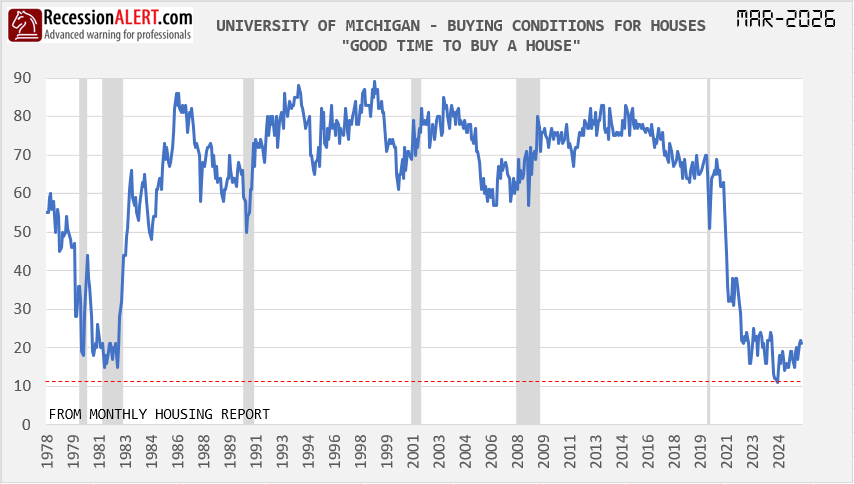
Chart of the Day: The recovery in housing sentiment is not a price story — it’s a plumbing story. Case-Shiller still sits at its 2022 peak, yet the Michigan index has doubled off its trough, from roughly 10 to 20 — and it has done so while payrolls held, equities made highs, and the NBER said nothing. Every prior trough in this 48-year series sat inside a recession bar. This one is clearing without one. Five marginal levers did the work: thirty-year mortgages retraced from nearly 8% to 6.36%; inventory rebuilt from sub-two to four-to-five months; Austin, Phoenix and the Florida Sun Belt corrected 15–20% from peak; real wages compounded; and four years of stasis quietly killed the “rates back to 3%” reflex. Acceptance, not capitulation. Homebuilders, mortgage origination and rate-sensitive durables re-rate on friction relief, not mean reversion — unless the ten-year unwinds the retrace and the plumbing seizes again. Recoveries built on plumbing do not announce themselves. They compound.
Market Intelligence Brief (MIB) Ver. 18.24
For professional investors only. Not investment advice.
© 2026 RecessionALERT.com

Comments are closed.