
AI mega-caps remain under distribution as SpaceX’s $75B IPO ($150B+ in orders) drains liquidity — MRVL -7.6%, AAPL -3.7%, Nasdaq -1.12%. Iran-Israel ceasefire cuts WTI -3% to $88.54 — but Hormuz stays blocked and Trump vowed a US response to the Apache downing. NFIB price plans hit 34% (4-year high); Wednesday’s CPI consensus is 4.2% YoY (3-year high) — make-or-break for Warsh’s June 17 FOMC debut. GSK bids $10.6B (40% premium) for Nuvalent’s oncology pipeline; 9 of 11 sectors advanced on defensive rotation.
TABLE OF CONTENTS
A. EXECUTIVE SUMMARY
B. MARKET DATA
C. HIGH-IMPACT STORIES (5)
D. MODERATE-IMPACT STORIES (5)
E. ECONOMY WATCH (5)
F. EARNINGS WATCH (0)
G. WHAT’S NEXT
H. CHART OF THE DAY
A. EXECUTIVE SUMMARY -> TOP
The AI trade unwind deepened: XLK fell 1.70% as the Nasdaq 100 lost 1.12% — MRVL ‑7.6%, AAPL ‑3.7%, QCOM ‑5.7%, DELL ‑4.7% — as SpaceX’s $150B IPO order book systematically drained institutional liquidity from existing AI mega-caps while Apple’s EU regulatory block structurally limits the iPhone supercycle thesis. Beneath the tech drag, breadth was constructive: 9 of 11 S&P sectors advanced, the DJ Transports surged 1.33% to a new 10-session high extending Dow Theory bull confirmation to a fourth straight session, and Real Estate’s +2.22% gain confirmed defensive rotation rather than broad capitulation. The Iran-Israel ceasefire cut WTI ‑3.02% to $88.54, delivering a near-term PCE tailwind into Wednesday’s CPI — where consensus expects 4.2% YoY — while NFIB’s price plans hit a 4-year high (34%), creating a comprehensively hawkish policy backdrop for Kevin Warsh’s June 17 FOMC debut. Sector breadth is constructive; the macro regime is not.
• AI trade unwind enters second week: XLK ‑1.70%, Nasdaq ‑1.12%; MRVL ‑7.6%, AAPL ‑3.7%, QCOM ‑5.7% as SpaceX’s $75B IPO ($150B+ in institutional orders) continues draining mega-cap tech allocations ahead of June 11 pricing.
• Iran-Israel ceasefire partially unwinds geopolitical premium: WTI ‑3.02% to $88.54, gold ‑1.84% to $4,283 — but the Hormuz blockade persists and Trump vowed a US response to the Apache downing, preserving residual risk premium.
• Stagflation setup entering FOMC: NFIB price plans surge to 34% (4-year high); Wednesday’s May CPI consensus is 4.2% YoY (potential 3-year high) and the single most consequential data point before Warsh’s June 17 debut — December hike probability above 50%.
• Breadth constructive beneath the headline: 9 of 11 S&P sectors advanced; Real Estate led (+2.22%) on existing home sales beat (4.17M vs 4.07M est.); DJTA +1.33% to a new 10-session high; Dow Theory bull signal extended to four consecutive sessions.
• GSK acquires Nuvalent for $10.6B at a 40% premium (NUVL +39%): validates buyout-level valuations for best-in-class NSCLC pipelines in FDA review windows; signals active pharma M&A competition for oncology assets.
1. AI Trade: Structural Reset, Not a Dip — The XLK selloff enters its second week with three simultaneous, reinforcing headwinds: SpaceX’s $150B order book systematically draining institutional AI allocations (a crowding-out that clears only on June 12), Apple’s EU regulatory block structurally limiting the iPhone supercycle addressable market, and stretched semiconductor valuations (MRVL at ~92x) with no near-term earnings catalyst. The Dow +0.17% / Nasdaq ‑1.12% divergence is the signature of institutional distribution — not retail panic or macro fear. Portfolio managers must decide whether Technology’s 3-month +22.82% lead is a foundation for the second half or a ceiling entering a policy tightening window.
2. Stagflation Setup into FOMC — Macro signals entering Warsh’s June 17 debut are uniformly hawkish: NFIB price plans at 4-year highs, CPI consensus at 4.2% YoY (potential 3-year high), Atlanta Fed GDPNow cooling 130 bps in three weeks to 3.0%, and 10-year yields at 4.52%. Wednesday’s CPI is the single most important near-term catalyst — a print at or above 4.2% pushes December hike probability toward 80% and compresses equity multiples in the same session; a sub-4.0% print is the only near-term relief valve. The hard/soft divergence persists: consumer financial pessimism is at a 4-year high even as sellers maintain pricing power.
3. Energy: Ceasefire Relief Meets Structural Depletion — WTI’s ‑3% today is a near-term PCE tailwind, but the EIA’s June STEO projects OECD oil stocks heading to their lowest levels since 2003 — the depletion is constraint-driven (Hormuz blockade), not demand-driven. Today’s price decline is geopolitical risk unwinding, not a demand signal. If the nuclear deal breaks down or Trump’s vowed US response escalates, the market has essentially no inventory buffer. Energy investors face genuine binary risk through the June 17 FOMC window.
 — Leading economic indicators. Accurate market forecasts. Apply for membership at join.recessionalert.com
B. MARKET DATA -> TOP
A reversal of the AI trade and Iran-Israel ceasefire announcement split the session: the Nasdaq 100 fell 1.12% as chipmakers and Apple — barred from its EU Siri launch by antitrust regulators — led Technology down 1.70%, yet 9 of 11 S&P 500 sectors advanced and the Dow gained 0.17%. The ceasefire unwound the geopolitical risk premium in crude (WTI -3.02%, Brent -2.64%) and precious metals (gold -1.84%, silver -4.62%), while existing-home-sales data at a three-year high drove Home Depot up 3.75% and lifted Real Estate 2.22%. Transports surged 1.33% on cheaper fuel, extending Dow Theory bull confirmation to a 4th consecutive session. Despite constructive breadth, the VIX rose 5% to 19.87 — Trump’s warning that the US “must respond” to Iran retaliation kept hedgers active beneath an otherwise positive tape.
CLOSING PRICES – Tuesday, June 9, 2026:
MAJOR INDICES
The S&P’s -0.26% headline masked a constructive session — 9 of 11 sectors advanced, the NYSE rose 0.68%, and the Russell 2000 gained 0.35%; the cap-weighted drag came entirely from Technology’s -1.70%. The Dow–Nasdaq split (+0.17% vs -1.12%) is a tech rotation, not a market-wide selloff. DJTA set a new 10-session high today (+1.33%), and Dow Theory bull confirmation extends to its 4th consecutive session — DJIA remains within 1.3% of its 10-session peak of 51,562.
| Index | Close | Change | %Move | Why It Moved |
|---|---|---|---|---|
| S&P 500 | 7,386.44 | -19.29 | -0.26% | Technology sector drag (-1.70%) overwhelmed broad market strength; cap-weighting distorted headline despite 9/11 sectors advancing |
| Dow Jones | 50,870.94 | +84.93 | +0.17% | Defensive/industrial rotation; blue-chip index less exposed to tech; Industrials +1.02%, Consumer Defensive +0.90% |
| DJ Transportation | 22,426.5 | +293.7 | +1.33% | Oil’s 3% decline cut fuel cost outlook; defensive demand rotation into logistics and airline names; new 10-session high |
| Nasdaq 100 | 29,084.50 | -329.76 | -1.12% | AI trade reversal; Apple Siri EU antitrust block (-3.7%), chipmakers MRVL (-7.6%), QCOM (-5.7%), DELL (-4.7%) led tech rout |
| Russell 2000 | 2,865.34 | +9.92 | +0.35% | Small-caps outperformed on domestic focus; defensive rotation benefited non-tech, non-energy names |
| NYSE Composite | 23,381.09 | +156.89 | +0.68% | Broad market advance (9/11 sectors positive) reflected in equal-weighted broad measure; outperformed the cap-weighted S&P |
VOLATILITY & TREASURIES
VIX at 19.87 (+5%) alongside falling yields (-3 bps across the curve) is an options signal, not a macro fear signal — tech’s high-premium names drove put-buying rather than broad flight to safety. The curve steepened marginally (2Y -3.6 bps, 10Y -3.3 bps) and the DXY barely moved (-0.09%), confirming Trump’s Iran warning was absorbed with relative calm in rates and FX even as equity vol spiked.
| Instrument | Level | Change | Why It Moved |
|---|---|---|---|
| VIX | 19.87 | +0.95 (+5.02%) | Tech selloff elevated put-buying in high-premium AI names; Trump warning on Iran retaliation kept hedgers active despite broad sector breadth |
| 10-Year Treasury Yield | 4.519% | -3.3 bps | Modest flight-to-safety bid from geopolitical uncertainty; Iran ceasefire ambiguity kept bond demand steady despite equities mixed |
| 2-Year Treasury Yield | 4.122% | -3.6 bps | Short-end fell slightly more than long-end; marginal curve steepening; safety bid in front end on policy uncertainty |
| US Dollar Index (DXY) | 99.95 | -0.09 (-0.09%) | Dollar marginally softer; Iran-Israel ceasefire reduced safe-haven demand for USD; move essentially flat |
COMMODITIES
Gold (-1.84%) and silver (-4.62%) fell together as the Iran-Israel ceasefire removed geopolitical safe-haven demand — but silver fell twice as hard as gold, reflecting its higher industrial beta amplifying the decline. Copper was essentially flat (-0.04%), a positive divergence: industrial demand signals held despite broad precious metals weakness. Bitcoin tracked tech risk-off (-2.23%), declining in step with the AI unwind rather than decoupling.
| Asset | Price | Change | %Move | Why It Moved |
|---|---|---|---|---|
| Gold | $4,283.00/oz | -$80.40 | -1.84% | Iran-Israel ceasefire removed geopolitical risk premium; safe-haven demand unwound |
| Silver | $65.415/oz | -$3.170 | -4.62% | Precious metals sold broadly on ceasefire; silver’s higher industrial demand beta amplified the decline vs gold |
| Copper | $6.3477/lb | -$0.0023 | -0.04% | Virtually unchanged; industrial demand signals resilient despite broad commodity weakness — positive divergence |
| Platinum | $1,726.65/oz | -$28.65 | -1.63% | Followed precious metals complex lower on reduced safe-haven demand from ceasefire |
| Bitcoin | $62,104.00 | -$1,415.00 | -2.23% | Tracked equities risk-off; declining in step with AI trade unwind, no decoupling signal |
ENERGY
WTI (-3.02%) and Brent (-2.64%) fell in near-lockstep (spread stable at $3.22) — the Iran-Israel ceasefire removed a global supply-risk premium, not a localized disruption. Oil declining while 9 of 11 S&P sectors rose is a cost-input relief signal (positive for industrials and transport), not a demand-collapse warning. Henry Hub essentially flat (-0.29%) confirms the move is crude-specific rather than a broad energy inflation trade.
| Asset | Price | Change | %Move | Why It Moved |
|---|---|---|---|---|
| Crude Oil (WTI) | $88.54/bbl | -$2.76 | -3.02% | Iran-Israel ceasefire removed supply-risk premium; market repriced geopolitical conflict probability lower |
| Crude Oil (Brent) | $91.76/bbl | -$2.49 | -2.64% | Same ceasefire catalyst; WTI-Brent spread stable at $3.22, confirming global rather than regional disruption removal |
| Natural Gas (Henry Hub) | $3.138/MMBtu | -$0.009 | -0.29% | Essentially flat; move in crude is geopolitical, not a broad energy inflation catalyst affecting gas |
| Natural Gas (Dutch TTF) | $16.49/MMBtu | -$0.36 | -2.12% | European gas followed crude lower on ceasefire; TTF-Henry Hub divergence ($16.49 vs $3.14) reflects Europe’s distinct LNG import dependency |
S&P 500 SECTORS
Nine of 11 sectors advanced — only Energy (-1.45%) and Technology (-1.70%) in the red — but the holdouts are also the YTD leaders (+27.55% and +19.58% respectively), signaling profit-taking rotation from the year’s biggest winners. Technology’s 3-month dominance (+22.82%) is being challenged as Real Estate (+2.22%), Healthcare (+1.49%), and Utilities (+1.00%) lead today — defensives recovering ground after a difficult quarter.
| Sector | 1-Day | 1-Week | 1-Month | 3-Month | 6-Month | YTD | 12-Month |
|---|---|---|---|---|---|---|---|
| Real Estate | +2.22% | +3.04% | +0.65% | +4.10% | +7.88% | +9.69% | +7.86% |
| Healthcare | +1.49% | +4.88% | +5.12% | +0.53% | +0.15% | -0.45% | +14.54% |
| Industrials | +1.02% | +0.13% | +1.00% | +4.73% | +16.01% | +15.43% | +25.77% |
| Utilities | +1.00% | -0.73% | -3.51% | -5.14% | +2.15% | +3.24% | +12.03% |
| Consumer Defensive | +0.90% | +2.87% | -1.94% | -2.29% | +6.57% | +7.27% | +4.00% |
| Financial | +0.89% | +1.13% | +1.68% | +5.69% | +0.92% | -1.40% | +9.90% |
| Basic Materials | +0.64% | -6.69% | -6.15% | -4.46% | +15.38% | +10.94% | +37.02% |
| Consumer Cyclical | +0.13% | -2.64% | -5.21% | +1.17% | -5.06% | -4.67% | +6.65% |
| Communication Services | +0.01% | -1.29% | -6.45% | +3.71% | +0.16% | +1.96% | +24.93% |
| Energy | -1.45% | -1.89% | +0.63% | +3.27% | +25.19% | +27.55% | +37.57% |
| Technology | -1.70% | -8.49% | +2.01% | +22.82% | +17.33% | +19.58% | +42.66% |
TOP MEGA-CAP MOVERS:
GAINERS
| Company | Ticker | Close | Change | Why It Moved |
|---|---|---|---|---|
| Home Depot Inc | HD | $321.33 | +3.75% | May 2026 existing-home sales climbed to highest since October 2022; housing recovery directly boosts home improvement demand |
| GE Aerospace | GE | $330.44 | +2.61% | Defensive industrials rotation; record $210B backlog cited; defense/aerospace secular demand benefited from sector leadership day |
| Procter & Gamble Co | PG | $148.67 | +2.46% | Consumer defensive rotation into dividend-yielding staples as tech sold off; sector up 0.90% on the day |
| Coca-Cola Co | KO | $81.34 | +2.26% | Defensive rotation; non-cyclical consumer names bid as growth unwind continued; yield appeal with rates modestly lower |
| Johnson & Johnson | JNJ | $237.00 | +2.08% | Healthcare sector leadership (+1.49% today); defensive value rotation from growth names amid tech AI unwind |
DECLINERS
| Company | Ticker | Close | Change | Why It Moved |
|---|---|---|---|---|
| Marvell Technology Inc | MRVL | $266.88 | -7.61% | AI trade reversal; valuation reset (P/E ~92x, +344% prior year); semiconductor AI names broadly sold on inflection concerns |
| Qualcomm Inc | QCOM | $205.42 | -5.67% | Chipmaker AI unwind; mobile/connectivity semiconductor exposure caught in broad semis selloff |
| Dell Technologies Inc | DELL | $381.78 | -4.74% | AI server demand concerns; enterprise tech sold off in reversal of prior AI optimism; gave back recent post-earnings gains |
| Apple Inc | AAPL | $290.38 | -3.70% | New Siri AI assistant barred from EU launch by antitrust regulators; AI strategy disappointment weighed on largest index constituent |
| Palantir Technologies Inc | PLTR | $132.07 | -3.22% | High-valuation AI/data analytics software sold in tech unwind; growth names broadly retreated as AI rotation reversed |
— Institutional-grade intelligence for serious investors. Apply for membership at join.recessionalert.comC. HIGH-IMPACT STORIES -> TOP
BEARISH
1. AI Trade Reversal Deepens: XLK -5.14%, Nasdaq -1.12% — SpaceX Crowding, Apple Woes, and Valuation Pressure Converge
The core facts:Technology Select Sector SPDR (XLK) fell 5.14% Tuesday — the sector’s second -5% session in four trading days — with the Nasdaq 100 losing 1.12% and the S&P 500 declining 0.3%. Key movers: Marvell (MRVL) -7.61% (trading at ~92x P/E following a +344% prior-year gain), Qualcomm (QCOM) -5.67%, Apple (AAPL) -3.6%, Dell (DELL) -4.74%, Palantir (PLTR) -3.22%, Advanced Micro Devices (AMD) -3.02%, Micron (MU) -8.30%, Microsoft (MSFT) -2.02%. The session featured sharp defensive rotation: Dow gained +0.2% while tech fell, with 9 of 11 S&P 500 sectors advancing. Multiple simultaneous headwinds drove the selloff: SpaceX’s $75B IPO drawing $150B+ in institutional orders (long-only funds liquidating AI mega-caps for SPCX allocations); Apple’s new Siri AI blocked from the EU by the Digital Markets Act; AMD facing tighter China AI export restrictions; Barclays and UBS maintaining bearish stances on AAPL post-WWDC; and broad analyst warnings about elevated semiconductor valuations.
Why it matters:Monday’s 5.99% SOX recovery from Friday’s rate-shock selloff proved to be a one-day relief bounce, not a structural reversal. The convergence of factors is what elevates this beyond normal volatility: valuation compression (MRVL at 92x is inherently vulnerable to any risk-off catalyst), the SpaceX IPO systematically draining liquidity from existing large-cap AI names, Apple’s AI narrative weakening with the EU ban, and AMD facing renewed China risk. The Dow +0.2% / Nasdaq -1.12% divergence is the signature of institutional distribution — money rotating from growth to defensive — rather than retail panic. For portfolio managers, the AI semiconductor leadership complex now faces multiple simultaneous headwinds requiring re-assessment: valuation, liquidity competition, regulatory constraints, and export restrictions simultaneously.
What to watch:XLK’s behavior over the next 48 hours relative to Tuesday’s close — failure to recover confirms a new leg down rather than noise. SpaceX IPO pricing on June 11 as the specific event that removes the crowding-out overhang. CME FedWatch hike probability for October 2026 as the rate-anxiety amplifier for growth valuations.
UNCERTAIN
2. Iran-Israel Halt Attacks, Nuclear Talks Advance — WTI Drops 4% to $87.61; Hormuz Blockade Persists Despite Apache Downing
The core facts:Iran and Israel agreed to halt attacks against each other Tuesday, with White House officials confirming nuclear negotiations are making positive progress and President Trump stating a deal was “days away.” WTI crude fell 4.04% to settle near $87.61/bbl; Brent fell 3.53% to $90.92. Gold declined 1.84% to approximately $4,283/oz; silver plunged 4.62%. However, the Strait of Hormuz remains under a dual US-Iran blockade and has not reopened. Overnight, Iran shot down a US Apache helicopter over the Strait; Trump vowed the US “must respond” while simultaneously citing deal proximity — a dual message that preserved residual risk premium. Iran’s Energy Secretary separately flagged accelerating Hormuz ship traffic, suggesting incremental corridor reopening. OPEC+’s July production increase of +188K bpd (approved Sunday) remains “symbolic” given the ongoing supply disruption premium.
Why it matters:WTI at $87.61 marks a $6/barrel drop in two sessions from Sunday’s $93.67 close, driven entirely by ceasefire/diplomatic signals. For the FOMC (meeting June 16-17), oil’s trajectory is critical: the NFIB/CPI/sticky-inflation backdrop already argues for hawkish patience, but oil at $88 vs. $94 represents a meaningful near-term PCE headwind reduction that slightly eases the pressure. The UNCERTAIN classification reflects genuine ambiguity: a formal nuclear agreement has not been signed, the Strait blockade remains in force, Trump’s “must respond” language maintains binary risk, and even today’s ceasefire came alongside an Apache helicopter downing. Gold’s 1.84% decline confirms institutional risk-appetite improvement — but $4,283 is still elevated relative to pre-conflict levels ($3,800-$4,000), preserving a residual geopolitical premium of roughly $200-400/oz.
What to watch:Any formal nuclear agreement announcement or Hormuz reopening confirmation — those are the catalysts that fully unwind the remaining geopolitical premium. Trump’s stated US “response” to the Apache downing — any military action would immediately reverse today’s oil relief. WTI’s $90/barrel level: sustained trading above it would signal the premium is re-entering rather than deflating.
BEARISH
3. NFIB Small Business Price Plans Jump to 34% — 4-Year High; May CPI Expected at 4.2% Tomorrow as Warsh’s June 17 FOMC Debut Approaches
The core facts:The NFIB released its May 2026 Small Business Survey Tuesday. The share of small businesses planning to raise prices over the next three months jumped 7 percentage points to 34% — the highest since July 2022. Separately, 36% of owners reported raising prices in May, the highest since March 2023. The NFIB Optimism Index fell 0.6 points to 95.3 (below the 98.0 long-term average), and the uncertainty index surged 3 points to 91 (vs. a 68 historical average). The data sets up a compounding hawkish sequence: May CPI is due Wednesday at 8:30 AM ET with consensus at 4.2% YoY headline (up from 3.8% in April) and 2.9% YoY core — if it prints as expected, it would be the highest headline rate since March 2023. The 10-year yield holds above 4.55%; 30-year above 5.0%. CME FedWatch prices ~99.1% probability of no change at the June 16-17 FOMC but has hike probability for later in 2026 above 50%. The Atlanta Fed GDPNow model places Q2 GDP growth at 3.0% — down from 4.3% just three weeks ago — amplifying the stagflation pressure entering Warsh’s debut decision.
Why it matters:Tuesday’s NFIB data delivers the most direct forward-looking price warning before Wednesday’s CPI: the businesses that produce and sell goods and services are planning to raise prices at the fastest rate since July 2022. This is not lagged data — it is stated forward intent from the businesses that operate in the real economy. Combined with a CPI expected at 4.2% YoY — a three-year high — the data setup entering Warsh’s inaugural June 17 FOMC decision is comprehensively hawkish. The hard/soft divergence persists: the consumer sector is under financial stress (NY Fed’s Monday survey showed worst financial pessimism since July 2022), but sellers maintain pricing power. For bond markets, the compounding signal is that 10-year and 30-year yields are already at post-crisis highs — a CPI beat tomorrow would likely push yields materially higher and compress equity multiples in the same session, creating a correlated drawdown in both bonds and equities.
What to watch:Wednesday’s May CPI at 8:30 AM ET — the single most consequential data point before the June 17 FOMC. A headline print above 4.2% YoY would materially increase hike probability for the July-September window and likely push the 10-year above 4.70%. A soft print below 4.0% would be a relief catalyst. CME FedWatch September and November 2026 hike probabilities post-CPI as the real policy signal.
BEARISH
4. EU DMA Blocks Apple’s Siri AI from iOS 27 Launch — 450 Million European Users Cut Off; Barclays and UBS Maintain Bearish Stance Post-WWDC
The core facts:Apple confirmed Tuesday that Siri AI will not be available on iOS 27 or iPadOS 27 in the European Union, citing the European Commission’s interpretation of the Digital Markets Act (DMA). Apple had proposed a privacy-preserving EU-specific compliance solution over the preceding months; the Commission rejected all proposals, effectively requiring Apple to give third-party virtual assistants direct access to user data without the privacy protections Apple deems necessary — a condition Apple will not accept. Approximately 450 million European users will be unable to access the flagship new Siri AI feature at iOS 27 launch. Barclays reiterated its Underweight rating with a $253 price target; UBS maintained its Neutral stance — both analysts citing the absence of evidence that Apple Intelligence will drive near-term iPhone upgrade demand. AAPL fell approximately 3.6% to $290.55, extending Monday’s post-WWDC -1.89% reversal from a 52-week intraday high of $317.40.
Why it matters:The EU ban is the most concrete quantification yet of the Apple Intelligence limitation — not “Siri AI is unimpressive” (sentiment) but “450 million users cannot access it regardless of quality” (regulatory fact). Europe represents approximately 25-30% of iPhone premium revenue and is the world’s most important market for premium smartphone upgrade cycles. The iPhone supercycle thesis — the primary bull case supporting Apple’s elevated multiple — requires global AI adoption to compel holdout upgraders. A regulatory wall in the EU structurally limits the addressable upgrade pool at launch. The two-day move from the WWDC intraday high ($317.40) to Tuesday’s close ($290.55) represents roughly a $220 billion market-cap erasure — and at ~$4.4 trillion total market cap, AAPL carries S&P 500-level index weight. The consecutive daily declines post-WWDC signal institutional distribution, not volatility.
What to watch:Whether Apple pursues a DMA legal challenge or negotiates a privacy-preserving interoperability framework — both options are measured in months, not weeks. AAPL analyst rating changes in the next 7-10 days as the institutional consensus continues to reset. iPhone 17 pre-order data in September 2026 as the first hard upgrade cycle signal.
UNCERTAIN
5. SpaceX $75B IPO — Largest in US History — $150B+ in Orders Before June 11 Pricing; Long-Only Funds Liquidating Mega-Cap Tech for SPCX Allocations
The core facts:SpaceX confirmed its initial public offering of 555.6 million shares at $135/share will price June 11, 2026 and begin trading June 12 on Nasdaq (ticker: SPCX) at an approximately $1.8 trillion valuation — the largest IPO in US history by dollar offering size. Institutional order books closed Tuesday with over $150 billion in demand, more than double the $75 billion being raised; multiple institutions placed individual orders exceeding $10 billion. Goldman Sachs projects SpaceX total revenue could exceed $474 billion by 2030, with AI computing comprising approximately $322 billion. Morgan Stanley projects $3.4 trillion in revenue by 2040. Long-only fund managers are actively liquidating positions in existing AI-infrastructure and semiconductor mega-caps to free cash for SPCX allocations, contributing to Tuesday’s XLK -5.14% selloff. Separately, OpenAI filed a confidential S-1 for an IPO targeting a public valuation up to $1 trillion — introducing a second massive private-to-public supply event on the near-term horizon.
Why it matters:The SpaceX IPO introduces a structural crowding-out dynamic that will persist until June 12’s first trading day. Every dollar a long-only fund commits to SPCX must come from existing positions — and the selling pressure is falling disproportionately on the AI-infrastructure complex, the sector with the largest institutional overweights and highest liquidity for rapid selling. At $150 billion in orders for a $75 billion deal, the crowding-out is real and quantifiable. The parallel OpenAI S-1 filing signals that 2026 is the year the private AI economy goes public, creating a sustained pipeline of massive new supply competing for institutional AI allocations. The UNCERTAIN classification reflects the dual nature: SPCX long-term is a potentially transformative AI-compute and space infrastructure franchise; but near-term, it is a systematic liquidity drain on the assets that have driven this bull market. After June 12 pricing, the overhang clears — but OpenAI and other private AI unicorns maintain the pipeline effect.
What to watch:SpaceX IPO pricing on June 11 (above/at/below $135) and first-day trading on June 12 as the specific catalyst that removes the crowding-out overhang. Whether SPCX’s first-day trading performance triggers additional mega-cap tech rotation or restabilizes the sector. OpenAI IPO timeline as the next supply overhang event.
— Quantifying recession risk so you don’t have to guess. Apply for membership at join.recessionalert.comD. MODERATE-IMPACT STORIES -> TOP
BULLISH
6. Existing Home Sales Climb 3.2% to 4.17M — Highest Since December 2025; Real Estate Sector Leads (+2.22%), HD +3.75% Despite 4.55% Yields
The core facts:May 2026 existing home sales beat expectations, rising to an annualized rate that beat consensus and reached the highest level since December 2025. The beat is notable against a backdrop of 10-year Treasury yields above 4.55%. The Real Estate sector (XLRE) led all 11 S&P 500 sectors on Tuesday with a gain of approximately 2.22%, as the housing resilience data sparked rotation into rate-sensitive defensives. Home Depot (HD) surged 3.75%. Homebuilder names (DHI, LEN, TOL) also participated in the advance. [Full data analysis, subindices, and geographic detail covered in Section E — Economy Watch.]
Why it matters:The housing beat-despite-yields dynamic carries a clear market-impact signal: mortgage spread compression appears more powerful than elevated rate levels in driving demand, or supply constraints are the binding factor rather than affordability. For portfolio managers, Real Estate leading on a day when technology fell 5% is the definition of defensively-driven sector rotation. The consumer balance sheet implication is also constructive: households can still absorb 4.55% mortgage rates, reducing the probability of a housing-led demand collapse in H2 2026. For sector allocation, the home improvement and building materials complex (HD, LOW, builders) received a tangible demand signal entering what should be peak renovation season. The data is an isolated bright spot on an otherwise broad-based growth-uncertainty day.
What to watch:Mortgage rate trajectory (30-year conventional) following Wednesday’s CPI print — a hot CPI would drive yields higher and create immediate affordability pressure for June contract closings. Homebuilder ETF (ITB) as the forward signal for whether housing demand can sustain above 4M at elevated rates.
BULLISH
7. GSK Pays $10.6B for Nuvalent — $124/Share All-Cash, 40% Premium; Two FDA-Tracked NSCLC Drugs in 2026 Approval Window; NUVL +39%
The core facts:GSK plc announced an agreement to acquire Nuvalent, Inc. (NUVL) for $10.6 billion, paying $124 per share in cash — a 40% premium to Monday’s close. The acquisition includes two late-stage non-small cell lung cancer (NSCLC) assets: zidesamtinib (ROS1 inhibitor) and neladalkib (ALK inhibitor), both under US FDA review with potential 2026 approvals. GSK also acquires Ris-Rez, a B7-H3 antibody-drug conjugate (ADC) for potential future oncology expansion. NUVL surged approximately 39% on the news; GSK shares fell on deal cost concerns. This is GSK’s largest acquisition in over a decade under new CEO Luke Miels, who has been explicit about building a targeted oncology franchise. The deal is expected to close in Q3 2026 subject to shareholder and regulatory approval, and is projected to be accretive to core EPS in 2029 inclusive of synergies.
Why it matters:A $10.6 billion all-cash acquisition at a 40% premium for pre-approval oncology assets sends a clear valuation signal across the biopharma M&A complex: major pharma is willing to pay substantial premiums for best-in-class NSCLC assets while they are still in the regulatory pipeline, before commercial revenue is established. For US portfolio managers, this transaction carries three specific read-throughs: (1) the ROS1/ALK inhibitor class commands buyout-level premiums, validating pipeline-stage peer valuations; (2) oncology M&A competition is active — multiple large-cap pharma names are deploying cash for targeted pipeline acquisitions; (3) mid-cap US oncology names with similar FDA-tracked NSCLC or solid-tumor assets become implicit acquisition targets. US oncology peers — Blueprint Medicines (BPMC), Turning Point Therapeutics’ acquirer Bristol-Myers Squibb (BMY), and any name with ALK/ROS1 platform — could see valuation re-rating on deal comparables.
What to watch:FDA review timelines for zidesamtinib and neladalkib in 2026 — any accelerated approval signal would validate GSK’s deal rationale and reinforce NSCLC asset premiums. Peer oncology M&A activity in the ALK/ROS1 inhibitor space for further premium compression across the sector.
UNCERTAIN
8. Gold -1.8% to $4,283, Silver -4.6% — Ceasefire Premium Unwind; 7% Below Late-May Peak as Safe-Haven Demand Reverses
The core facts:Gold declined approximately 1.84% to $4,283/oz Tuesday as the Iran-Israel ceasefire removed the geopolitical risk premium that drove precious metals to record levels in May. Silver fell 4.62%, proportionally more than double gold’s decline, reflecting both safe-haven liquidation and its higher industrial demand beta. Gold is now approximately 7% below its late-May peak near $4,593/oz, with the majority of the decline occurring over the past two weeks as ceasefire signals progressively emerged. Gold mining names (GDX) declined in sympathy. Silver at -4.62% single-session is among the metal’s sharpest single-day declines of the year.
Why it matters:The precious metals selloff provides a useful portfolio risk-sentiment gauge for Tuesday’s broad session. The gold decline confirms the same directional signal as WTI’s -4% move: institutional risk appetite is recovering, and defensive hedges built for the conflict scenario are being unwound. For US equity portfolios, reduced precious metals hedging directionally benefits risk assets — capital returning from gold/silver goes somewhere, and in Tuesday’s session it went into defensive equities (real estate +2.22%, consumer staples +1.7%). However, at $4,283 gold remains substantially elevated relative to pre-conflict levels ($3,800-$4,000 range), indicating a $200-400/oz residual premium that would flush only on a confirmed, durable nuclear agreement with verifiable protocols. The UNCERTAIN classification reflects this: gold’s direction is down, which is positive for risk sentiment, but $4,283 still prices considerable geopolitical risk that could reverse rapidly on any ceasefire breakdown. Silver’s -4.62% has an additional industrial read: the metal’s use in solar panels and electronics means a move of this magnitude may also reflect global demand concerns beyond pure geopolitics.
What to watch:Gold’s response to Wednesday’s May CPI — a hot inflation print would trigger safe-haven re-entry, limiting gold’s further downside and potentially reversing today’s move. $4,000/oz as the structural support level; a breach would signal the full geopolitical premium has been exited and macro inflation-hedge demand is the primary driver.
UNCERTAIN
9. Fed to Release 2026 Large-Bank Stress Test Results June 24 — 32 Banks Tested on Severe CRE Recession Scenario; Capital Mandates Not Adjusted
The core facts:The Federal Reserve announced Tuesday it will release annual large-bank stress test results on June 24, 2026 — ahead of the typical mid-to-late-July timeline. This year’s severely adverse scenario subjects 32 major lenders — including JPMorgan Chase, Bank of America, Citigroup, Wells Fargo, Goldman Sachs, and Morgan Stanley — to a severe global recession with concentrated commercial real estate (CRE) and residential real-estate stress scenarios. The Fed explicitly noted that outcomes from the 2026 stress test will NOT adjust current-year capital mandates, departing from prior years when results directly set individual bank capital buffer requirements. The accelerated release date (June 24, five business days before typical timing) aligns with the post-Warsh Fed’s preference for streamlined regulatory timelines.
Why it matters:Despite the “no current-year capital mandate adjustment” caveat, the June 24 results carry real capital allocation significance. Stress test outcomes will directly inform individual banks’ Q3 capital return capacity — share buyback programs, special dividends, and capital plan filings — which become eligible for board approval immediately following results. A benign pass for all 32 institutions would likely spark a wave of buyback authorizations in late June and July, supporting bank sector valuations. A stress revelation in CRE portfolios — particularly for regional or mid-tier lenders with concentrated office or commercial real estate exposure — could re-ignite the regional bank valuation discount that compressed in early 2026. For sector positioning, large-cap bank stocks tend to exhibit elevated volatility in the two-week window surrounding stress test releases. The CRE stress scenario is particularly relevant given ongoing office vacancy pressures and rising delinquency rates in commercial property.
What to watch:The June 24 results themselves — CRE scenario outcomes for mid-tier regional banks (WFC, KEY, CFG, FITB) represent the highest uncertainty. Any bank that falls short of minimum capital thresholds faces forced balance sheet reduction, which would be a material negative catalyst. Large-cap banks that pass with headroom will likely announce buyback increases within days of the release.
UNCERTAIN
10. EIA Short-Term Energy Outlook: OECD Oil Stocks Headed to 2003 Lows as 2.6 mbpd Global Drawdown Persists; First Projected Demand Decline Since 2020
The core facts:The US Energy Information Administration (EIA) released its June 2026 Short-Term Energy Outlook on Tuesday, projecting that OECD crude oil stockpiles are on pace to reach their lowest levels since 2003. Global inventories are contracting at approximately 2.6 million barrels per day as buyers attempt to offset supply losses from the Strait of Hormuz blockade, which has effectively removed more than 11 million barrels per day of Middle East export capacity from normal shipping lanes. Simultaneously, the EIA projects 2026 global oil demand will show the first annual decline since the 2020 pandemic, driven by Chinese crude imports falling to approximately 7.8 million barrels per day last month — roughly 4 million bpd below the 2025 average and an 8-year low — as China draws down inventory rather than purchasing at elevated prices.
Why it matters:The EIA’s dual signal — inventories depleting toward 2003 lows while demand simultaneously contracts — describes a uniquely complex energy market: the drawdown is constraint-driven (Hormuz blockade preventing normal supply flows), not demand-driven (China is actually buying less). For US portfolio managers, today’s oil price decline (WTI -4%) reflects the ceasefire premium unwind — but the EIA inventory depletion signal argues that any full Hormuz reopening would provide a one-time supply normalization, not an inventory rebuild. The structural depletion toward 2003 lows means the energy market has essentially no buffer if the ceasefire breaks down. The first projected global demand decline since 2020 creates a nuanced picture for energy equities: US-focused producers (XOM, CVX, COP) are insulated from Hormuz risk and benefit from tight domestic spreads, while globally-oriented refining margins face compression from demand softness. Energy sector leadership in recent weeks has reflected the Hormuz premium — today’s -1.87% for XOM signals partial unwind.
What to watch:Weekly EIA crude inventory data (released each Wednesday) as the real-time stock drawdown signal. China crude import data for July as the demand recovery confirmation or continued 8-year-low signal. Any Hormuz corridor reopening announcement — a return to full Strait capacity would be the first structural inventory-rebuild catalyst.
— Separating signal from noise since 2007. Apply for membership at join.recessionalert.comE. ECONOMY WATCH -> TOP
Housing surprised to the upside — Existing Home Sales climbed 3.2% in May to a post-December high of 4.17M, beating 4.07M consensus — but the surrounding economic picture is less reassuring. NFIB small-business optimism missed for the second straight month as the share of owners planning price increases jumped seven points to 34%, the highest since July 2022. GDPNow’s Q2 tracking estimate has slid to 3.0% from 4.3% in mid-May, a sharp reversal even as May payrolls came in at 172,000 — more than double expectations. With the 10-year at 4.55% and December rate-hike odds approaching 70%, all eyes turn to Wednesday’s May CPI — expected to accelerate to 4.2% YoY, a near three-year high — ahead of Kevin Warsh’s debut FOMC meeting June 16–17.
Existing Home Sales Surge 3.2% in May to 4.17M — Highest Since December (NAR, June 9, 2026)
What they’re saying:Existing home sales rose 3.2% month-over-month in May to a seasonally adjusted annual rate of 4.17 million, beating the 4.07 million consensus and the 4.04 million April reading. The result marks the highest pace since December 2025. Gains were strongest in the Midwest (+6.4% to 1.0M) and South (+3.2% to 1.96M), while the West was unchanged at 0.75M. Median sale price stood at $429,300 with 4.5 months of inventory available.
The context:The beat is notable given the 10-year Treasury continues to hover near 4.55%, a level that historically constrains housing affordability. Better-than-expected mortgage spreads appear to be the catalyst rather than outright rate relief — a sign that demand is more durable than feared. A housing rebound of this magnitude in May provides a constructive signal for consumer balance sheets and is a positive input to Q2 GDP. The risk is that a higher-than-expected May CPI on Wednesday could reignite yield pressure and reverse near-term momentum.
What to watch:May CPI release Wednesday June 10 — a headline print at or above 4.2% YoY would pressure mortgage rates and test whether spring housing demand persists into June. Pending Home Sales and mortgage application data over the next two weeks will confirm or reverse this momentum.
NFIB Small Business Optimism Slips to 95.3 in May, Misses Forecast as Price Plans Hit 4-Year High (NFIB, June 9, 2026)
What they’re saying:The NFIB Small Business Optimism Index fell 0.6 points to 95.3 in May, missing the 96.0 consensus and remaining below its 52-year average of 98.0. The share of owners planning to raise prices over the next three months jumped seven points to 34% — the highest level since July 2022 — while 36% reported already raising prices in May, up six points and the highest since March 2023. The Uncertainty Index rose three points to 91, well above its historical average of 68. Inflation ranked as the second-most pressing concern, behind taxes.
The context:The surge in forward price plans is a leading inflation indicator — small businesses are the marginal price-setter in the services and consumer discretionary sectors. Readings above 30% on “plans to raise prices” have historically preceded CPI acceleration by 1–3 months. Combined with tariff pass-through still working through supply chains and energy costs elevated by Middle East dynamics, the signal points to inflation remaining stickier than Fed models may be projecting. Elevated uncertainty at 91 is also consistent with a pulling-back on hiring intentions, which would be an early deterioration in the labor market picture.
What to watch:May CPI (June 10) and PPI (June 12) for confirmation of cost pass-through. If CPI prints at or above 4.2% YoY — consistent with NFIB’s price-plan signal — expect the Fed to adopt a more explicitly hawkish tone at the June 16–17 FOMC meeting.
Atlanta Fed GDPNow Cools to 3.0% for Q2 2026 — Down Sharply from 4.3% in Mid-May (Atlanta Fed, June 1, 2026)
What they’re saying:The Atlanta Fed’s GDPNow model nowcast for Q2 2026 real GDP growth fell to 3.0% as of June 1, down from 3.8% on May 28 and a peak of 4.3% on May 21. The model was scheduled for an update today incorporating today’s trade deficit and wholesale inventory data; regardless of today’s print, the trajectory over the past three weeks shows a 130-basis-point deterioration in Q2 growth tracking in under three weeks.
The context:The sharp pullback in GDPNow contradicts the surface-level read on the economy — May payrolls were nearly double expectations at 172,000 — and highlights a divergence between labor market resilience and underlying goods/trade/inventory dynamics. Q2 at 3.0% would still be above-trend, but the direction matters: a quarter that looked like 4%+ growth just three weeks ago is now tracking substantially lower. If the model continues to drift south in June, the case for the Fed remaining patient through year-end weakens further.
What to watch:Atlanta Fed GDPNow updates through mid-June as more Q2 data arrives; May CPI (June 10) and PPI (June 12) will directly update the nowcast’s inflation component. If GDPNow slips below 2.5%, the stagflation narrative — sticky inflation with decelerating growth — will gain institutional backing ahead of the June 17 FOMC press conference.
US Trade Deficit Narrows to $55.9B in April as Export Surge Offsets Tariff-Era Import Rebound (BEA / Census Bureau, June 9, 2026)
What they’re saying:The goods and services trade deficit narrowed to $55.9 billion in April, slightly better than the $56.1 billion consensus and a modest improvement from March’s deficit, which was revised sharply lower to $56.6 billion from the initially reported $60.3 billion. April exports rose to $327.1 billion (+$8.3B vs March) while imports rose to $383.0 billion (+$7.6B vs March). Year-to-date, the deficit has narrowed $213.5 billion or 49.1% from the same period in 2025. Wholesale Inventories for April also came in slightly above consensus at +0.6% (exp. +0.5%).
The context:The dramatic year-to-date improvement (49.1%) is largely a statistical artifact of the 2025 tariff front-running effect — companies aggressively pulled forward imports in early 2025 ahead of tariff implementation, inflating that year’s deficit. The April figure represents normalization rather than a structural export-driven adjustment. The March revision ($3.7B narrower) confirms the underlying trade picture is better than previously tracked, which is a modest positive for Q2 GDP revisions. The slight export growth is constructive but has not yet translated into a sustained improvement in the goods balance.
What to watch:Monthly Budget Statement (June 10, expected -$270M vs prior $215B surplus) for fiscal trajectory context. Q2 GDP first estimate will capture how April’s trade data flows into national accounts.
10-Year Treasury Holds Near 4.55% as December Rate-Hike Odds Approach 70% Ahead of May CPI (CME FedWatch / Market Consensus, June 9, 2026)
What they’re saying:The 10-year Treasury yield hovered near 4.55% Monday — its highest level in two weeks — as May’s blowout jobs report (172K vs ~80K expected) reinforced expectations that the Fed may need to raise rates before year-end. Fed funds futures imply approximately 70% odds of at least one 25-basis-point hike by December 2026, with October emerging as the first live meeting at roughly 52% probability. Markets are pricing a near-certainty (99%+) that the Fed holds at 3.50–3.75% at the June 16–17 meeting, but attention has shifted firmly to what Kevin Warsh signals in his first post-meeting press conference.
The context:The April FOMC minutes (released May 20) noted that “some policy firming would likely become appropriate” if inflation remains elevated — language markets initially discounted but are now repricing as April PCE (+3.8% YoY) and NFIB’s price-plan surge corroborate. A rate hike cycle reversal — after two cuts in late 2025 — would be a significant regime shift for risk assets. Equity valuations at current multiples are most vulnerable to a hike scenario; the 10-year at 4.55% is already pressuring the equity risk premium. Wednesday’s May CPI is the single most important near-term data point for rate path and asset prices.
What to watch:May CPI Wednesday June 10 (exp. 4.2% YoY headline, 2.9% core YoY — a beat on either would push December hike probability toward 80%+). FOMC statement and Warsh press conference June 17 — any shift from “on hold” to explicitly “data-dependent with a bias toward firming” would be market-moving.
— Know the probability before the market prices in the risk. Apply for membership at join.recessionalert.comF. EARNINGS WATCH -> TOP
YESTERDAY AFTER THE BELL (Markets Reacted Today)
No major earnings yesterday after the bell from companies with >$100B market cap.
TODAY BEFORE THE BELL (Markets Already Reacted)
No major earnings before the bell from companies with >$100B market cap. (J.M. Smucker Co, BMO: $11.99B market cap — below threshold.)
TODAY AFTER THE BELL (Markets React Tomorrow)
No major earnings after the bell from companies with >$100B market cap. (Casey’s General Stores, AMC: $28.17B market cap — below threshold.)
WEEK AHEAD PREVIEW:
Q1 2026 earnings season is effectively complete (~98% reported). Q2 2026 season begins in mid-July. This week, Oracle is the sole mega-cap reporter, with Wednesday’s post-close result functioning as a real-time test of AI infrastructure demand.
Oracle (ORCL) — AMC, Wednesday June 10 — Q4 FY2026. Consensus: revenue ~$19.1B (+20% YoY), GAAP EPS ~$1.47, non-GAAP EPS ~$1.96-$2.00; cloud revenue growth guided at +46-50%. Key focus: (1) Remaining Performance Obligations (RPO) backlog — last reported at a record $553B (+325% YoY) as hyperscalers lock in AI compute capacity ahead of demand; (2) Oracle Cloud Infrastructure (OCI) growth rate, which posted 84% YoY last quarter; (3) FY2027 revenue trajectory toward management’s $90B target; (4) FY2026 capex at $50B and $261B in additional data center lease commitments — whether Oracle’s AI financing model is credible vs. overleveraged. The stock entered earnings week down ~12.9% from its recent highs amid Tuesday’s broad AI de-risking session.
Beyond this week, no additional mega-cap reporters through mid-June. The next major earnings cluster begins with the Q2 2026 season in mid-to-late July.
— US market commentary trusted by family offices and institutions. Apply for membership at join.recessionalert.comG. WHAT’S NEXT -> TOP
UPCOMING RELEASES:
| Date | Event | Why It Matters |
|---|---|---|
| Wed, Jun 10 | May CPI — Headline: exp. +4.2% YoY / +0.5% MoM; Core: exp. +2.9% YoY / +0.3% MoM | The single most consequential data point before the June 17 FOMC. A headline at or above 4.2% would push December hike probability toward 80% and is likely to compress equity multiples and drive yields higher in the same session. NFIB’s 34% forward price-plan signal (4-year high) argues for an upside surprise; a sub-4.0% print is the only near-term relief valve for risk assets. |
| Wed, Jun 10 | Monthly Budget Statement May (exp. ‑$270M vs. prior +$215B surplus) | A swing from a $215B surplus to a near-zero balance reflects seasonal payroll tax timing reversals and elevated spending. Provides context for Treasury issuance trajectory and supply pressure on the long end of the curve. |
| Thu, Jun 11 | Initial Jobless Claims week ending Jun 6 (exp. 219K vs. prior 225K); PPI MoM May (exp. +0.7% vs. prior +1.4%); Core PPI YoY May (exp. +5.3% vs. prior +5.2%) | PPI is the inflation pipeline signal: at +5.3% YoY core, producer prices remain well above comfort levels and confirm cost pass-through potential into CPI over the following 2–4 months. Claims at 219K would confirm continued labor market tightness, maintaining pressure on the Fed’s dual mandate. A PPI beat following a hot CPI would lock in a hawkish FOMC tone for June 17. |
| Fri, Jun 12 | Michigan Consumer Sentiment Prel June (exp. 46 vs. prior 44.8); Michigan 5-Year Inflation Expectations Prel (prior 3.9%) | At 44.8 in May, consumer sentiment is near recessionary trough levels. A modest recovery to 46 expected — but 5-year inflation expectations anchored near 3.9% (well above the Fed’s 2% target) are the component Warsh will cite. A re-anchoring above 4.0% would be a significant signal that long-run expectations are becoming unmoored, creating explicit justification for a rate hike at a future meeting. SpaceX (SPCX) also prices and begins trading this week, removing the institutional crowding-out overhang on AI mega-caps. |
KEY QUESTIONS:
1. Will Wednesday’s May CPI confirm the stagflation setup — and if so, will Warsh use his June 17 inaugural FOMC press conference to explicitly signal a rate-hike bias, marking the end of the on-hold cycle?
2. Does the Iran-Israel ceasefire hold long enough for a formal nuclear agreement and Hormuz reopening, or does Trump’s vowed US response to the Apache downing reignite the geopolitical risk premium in oil and gold — and push WTI back above $90?
3. With XLK down nearly 7% over the past week, does the AI trade stabilize after SpaceX’s June 11 pricing removes the institutional crowding-out overhang — or does the parallel OpenAI S-1 filing signal a sustained supply pipeline that keeps mega-cap tech under distribution pressure into Q3?
— US market commentary trusted by family offices and institutions. Apply for membership at join.recessionalert.comH. CHART OF THE DAY -> TOP
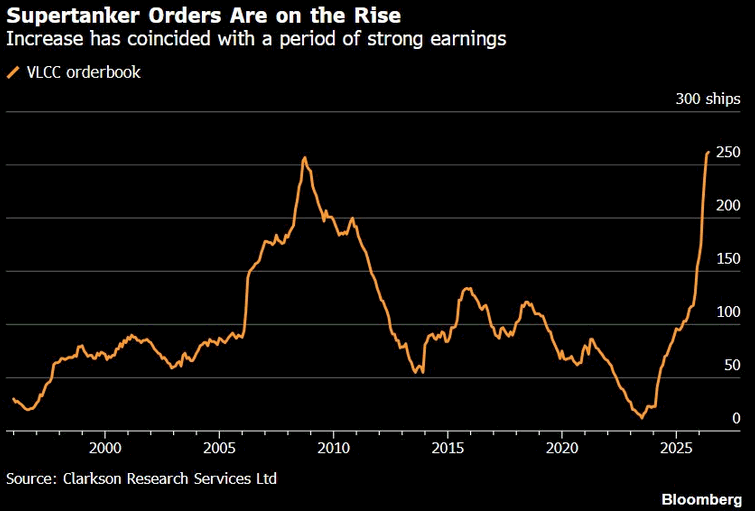
Strong earnings are how shipping cycles end, not how they continue — and the chart’s subtitle telegraphs the trap without naming it. Orderbooks do not spike when supply is tight; they spike when cashflow is fat enough that management capitalises a windfall into steel. That is the mechanism now. Q1 2026 VLCC spot earnings near $175,000/day — fuelled by the Hormuz closure, Sinokor’s roughly 25% lock-up of non-sanctioned tonnage, India re-routing Middle East crude to replace Russian barrels, persistent Cape diversions — funded 125 ships across Q4’25-Q1’26 alone, beating 2006’s 108-ship full-year record and dragging the orderbook-to-fleet ratio from ~1% in mid-2023 to ~26% in fifteen months. The print at 250 hulls is, to the digit, the 2008 peak that seeded the 2010-2013 collapse. Forty deliveries land in 2026, fifty-eight in 2027, into a rate environment those drivers must still be producing. The falsification is genuine: if ton-mile expansion is structural — Hormuz contested, Russian flows rerouted, Sinokor locked — 250 is the new floor. If it isn’t, this is not a coincidence — it’s a countdown.
Market Intelligence Brief (MIB) Ver. 18.40
For professional investors only. Not investment advice.
© 2026 RecessionALERT.com

Comments are closed.