
May CPI hit 4.2% YoY — a three-year high — making December a near-certain hike and pushing Goldman’s odds to 20%. US-Iran ceasefire collapsed: US struck Iranian air defenses, Iran retaliated, Trump signaled civilian-infrastructure strikes. WTI +4.06% to $91.78 on a seventh straight EIA draw of -7.2M bbl, triple estimates. SMCI -17% on a $7B raise dragged QCOM -6.92%, AVGO -5.12% as SpaceX’s $75B IPO extracts AI-trade liquidity. S&P -1.62%, Dow cracked 50,000; only Consumer Defensives and Energy finished green.
TABLE OF CONTENTS
A. EXECUTIVE SUMMARY
B. MARKET DATA
C. HIGH-IMPACT STORIES (5)
D. MODERATE-IMPACT STORIES (6)
E. ECONOMY WATCH (5)
F. EARNINGS WATCH (1)
G. WHAT’S NEXT
H. CHART OF THE DAY
A. EXECUTIVE SUMMARY -> TOP
The dual shock of May CPI at 4.2% (three-year high) and the collapse of the US-Iran ceasefire drove the S&P 500 -1.62%, Dow through 50,000 for the first time, and Nasdaq -1.98% — nine of eleven S&P sectors declined. The 4.2% headline closed every Fed easing door — Goldman now prices 20% near-term hike probability — while GDPNow has fallen from 4.3% to 3.0% in three weeks: slowing growth with no rate-cut relief available is the stagflation bind in real time. Gold’s 4.49% plunge despite active military escalation confirmed the rate-expectations trade dominates: hot CPI drove real yields higher and overwhelmed every geopolitical safe-haven bid. Consumer Defensives (+1.43%) and Energy (+1.18%) were the only green sectors — KO hit an all-time high, CVX gained on WTI +4.06% — while Technology (-2.51%), Industrials (-3.32%), and Basic Materials (-2.89%) led the losses in a textbook institutional stagflation rotation.
• May CPI 4.2% YoY (three-year high) — energy drove >60% of the monthly gain (gasoline +40.5% YoY); core CPI 0.2% MoM (below 0.3% estimate) provides no durable relief; CME FedWatch prices December hike as near-certainty; Goldman Sachs puts near-term hike probability at 20%.
• US-Iran ceasefire collapsed — US struck Iranian air defense sites; Iran retaliated against US regional bases; Trump confirmed proximity to authorizing strikes on civilian infrastructure (power plants, bridges); Strait of Hormuz dual-blockade intact removing 11M+ bbl/day.
• SMCI -17% on $7B dilutive equity raise — funding $39B AI server backlog; sector-wide AI chip selloff: QCOM -6.92%, AVGO -5.12%, MRVL -5.35%; XLK extended weekly loss to -9.32% from +18.87% three-month high — SpaceX $75B IPO pricing June 11 extracting liquidity from the most crowded institutional trade.
• EIA: seventh consecutive weekly crude draw of -7.2M barrels (triple the -2.2M consensus) — US commercial stocks 5% below five-year average; structural depletion trajectory absent Hormuz reopening or SPR releases.
• Consumer Defensives rotate to all-time highs — KO +2.77% (Morgan Stanley Top Pick), TMUS +3.39%, PM +2.50%; stagflation rotation consistent for second consecutive session as institutional portfolios shed high-multiple growth.
• 10-Year Treasury 4.556% (+2.7 bps), VIX 22.22 (+11.83%) — stagflation-fear signature, not recession; US fiscal deficit at $1.7T rolling 12-month (5.2% of GDP); household financial stress at its highest since July 2022 (NY Fed May survey).
1. Stagflation Trap Tightens — GDPNow falling from 4.3% to 3.0% in three weeks while CPI rises to 4.2% is the Fed’s worst possible configuration: inflation prevents cuts, decelerating growth makes hikes dangerous, yet December hike odds approach certainty. Warsh inherits this bind for his June 17 inaugural FOMC — every policy pathway involves pain, and the dot plot will be parsed for every signal of how he intends to navigate it.
2. Iran Escalation: Duration, Not Disruption — Tuesday’s ceasefire reversed in 24 hours. Seven consecutive EIA draws at accelerating magnitude, Trump signaling civilian-infrastructure strikes, and Hormuz dual-blockade removing 11M+ bbl/day describes a supply crunch measured in months, not days. The EIA projects OECD stocks at their lowest since 2003 by late 2026. Portfolios built on Hormuz normalization — short energy, long growth — need structural reassessment, not just tactical hedges.
3. AI Infrastructure Crowded-Trade Unwinding — SMCI’s $7B dilution on $39B in real demand is the demand-confirmed/execution-risk paradox visible in a single stock. SpaceX’s $75B SPCX IPO (with $150B in demand, pricing June 11) is systematically extracting liquidity from the most overweight institutional trade in the market. XLK’s -9.32% weekly reversal from +18.87% three-month leadership is the crowded-trade unwind signature — and FOMC uncertainty on June 17 extends the de-risking overhang through next week.
 — Leading economic indicators. Accurate market forecasts. Apply for membership at join.recessionalert.com
B. MARKET DATA -> TOP
Hot May CPI — a three-year high of 4.2% — combined with U.S. military strikes against Iranian air defense installations to deliver a dual macro shock, driving a near-sweep selloff with nine of eleven S&P 500 sectors in the red. The flight-to-defensives signal was unambiguous: Consumer Defensive (+1.43%) and Energy (+1.18%) were the sole green sectors as portfolios rotated toward inflation-resilient staples and direct oil-supply exposure. The session’s most analytically significant anomaly was gold’s 4.49% collapse — an unusual safe-haven failure where hot CPI pushed real yields higher and overwhelmed the typical geopolitical bid. WTI crude surged 4.06% while Brent barely moved (-0.03%), compressing the WTI-Brent spread from roughly $6.55 to $2.94 and confirming the market reads this as a U.S.-centric supply shock, not a global oil repricing event.
CLOSING PRICES – Wednesday, June 10, 2026:
MAJOR INDICES
The broad selloff masked a subtle hierarchy of pain: DJ Transportation (-2.69%) absorbed a double hit from surging fuel costs and slowing global trade expectations, while Nasdaq (-1.98%) and the Dow (-1.87%) fell on tech/AI liquidation and industrial growth fears respectively. Russell 2000 (-1.04%) held up better than all large-cap indices — domestic small-caps were relatively insulated from the Iran supply shock and globally-exposed mega-cap selling. No Dow Theory or breadth history signals crossed their 10-session thresholds today; the common thread across all indices was a dual-mandate headache for the Fed, with no supportive pivot narrative available on a day of hot inflation and geopolitical escalation.
| Index | Close | Change | %Move | Why It Moved |
|---|---|---|---|---|
| S&P 500 | 7,267.07 | -119.58 | -1.62% | Hot May CPI (4.2%, 3-year high) + U.S.-Iran military strikes drove broad selloff; tech/AI stocks led losses |
| Dow Jones | 49,919.09 | -953.02 | -1.87% | Industrial and blue-chip exposure to growth concerns; higher-for-longer Fed pricing pressured cyclical names |
| DJ Transportation | 21,822.5 | -604.0 | -2.69% | Worst index on the day: WTI +4.06% raised fuel cost outlook; Iran escalation raised global trade risk |
| Nasdaq 100 | 28,508.03 | -576.47 | -1.98% | AI/semiconductor selloff: QCOM -6.92%, AVGO -5.12%, MRVL -5.35%; Super Micro Computer -17% on equity raise |
| Russell 2000 | 2,837.08 | -29.94 | -1.04% | Smallest decline among major indices; domestic small-caps relatively insulated from global Iran supply shock |
| NYSE Composite | 23,080.83 | -300.26 | -1.28% | Broad market selloff; 9 of 11 sectors down confirmed macro-driven not rotational selling |
VOLATILITY & TREASURIES
VIX surging 11.83% while both Treasury yields rose is a textbook stagflation-fear signature — not recession fear (which would drive yields lower as bonds caught a safe-haven bid). The 2Y +2.3 bps vs 10Y +2.7 bps represents marginal curve steepening, with both moving higher confirming persistent inflation pricing rather than growth collapse. The dollar’s negligible +0.07% move is conspicuous: no safe-haven bid materialized despite the Iran strikes — risk-off was expressed through equity selling and gold liquidation, not dollar buying.
| Instrument | Level | Change | Why It Moved |
|---|---|---|---|
| VIX | 22.22 | +2.35 (+11.83%) | Fear spike from U.S.-Iran escalation + Strait of Hormuz disruption; CPI shock compounded the volatility bid |
| 10-Year Treasury Yield | 4.556% | +2.7 bps | Hot May CPI (4.2%) reinforced higher-for-longer Fed; oil-driven inflation expectations pushed long end higher |
| 2-Year Treasury Yield | 4.147% | +2.3 bps | Near-term Fed rate cut expectations pared back after CPI surprise; 2Y most sensitive to policy-path repricing |
| US Dollar Index (DXY) | 99.95 | +0.07 (+0.07%) | Minimal safe-haven dollar demand; geopolitical risk expressed through energy and equity channels, not FX |
COMMODITIES
Gold’s 4.49% collapse on a geopolitical escalation day is the session’s most analytically revealing signal — rising real yields (hot CPI forcing Fed rate-hold) overrode the traditional geopolitical safe-haven bid, sending gold to a 2-month low. Silver and platinum fell in sympathy; copper’s -1.93% confirms industrial demand skepticism tied to global growth concerns. Bitcoin’s flat +0.04% response signals no alternative-asset rotation; crypto tracked the broad risk-off tape without adding any distinct narrative.
| Asset | Price | Change | %Move | Why It Moved |
|---|---|---|---|---|
| Gold | $4,094.10/oz | -$192.30 | -4.49% | Unusual safe-haven failure: hot CPI → higher real yields → heavy selling overrides geopolitical bid; 2-month low |
| Silver | $63.500/oz | -$1.740 | -2.67% | Sympathy with gold selloff; industrial demand concern added pressure as global growth outlook deteriorated |
| Copper | $6.1997/lb | -$0.1223 | -1.93% | Industrial metals under pressure; global growth concerns amplified by Iran escalation and hot inflation read |
| Platinum | $1,665.50/oz | -$46.10 | -2.69% | Precious metals complex broadly sold as rising real yields compressed the precious metals trade |
| Bitcoin | $61,796.0 | +$26.0 | +0.04% | Essentially flat; muted amid broad risk-off tape with no crypto-specific catalyst; tracking equities without diverging |
ENERGY
WTI’s 4.06% surge while Brent barely moved (-0.03%) tells a precise story: Brent was already carrying a full Middle East risk premium from prior sessions; U.S. strikes on Iranian air defense sites drove WTI to catch up, compressing the spread from roughly $6.55 to $2.94. Critically, oil rising while equities fell hard is a supply-shock read, not a demand/growth signal — stagflationary, not bullish for the broader tape. Natural gas (+1.46%) was a sympathy lift; Dutch TTF was flat, showing no European transmission of today’s disruption.
| Asset | Price | Change | %Move | Why It Moved |
|---|---|---|---|---|
| Crude Oil (WTI) | $91.78/bbl | +$3.58 | +4.06% | U.S. strikes on Iran air defense + Strait of Hormuz disruption; WTI catching up to elevated Brent; spread compressed $6.55→$2.94 |
| Crude Oil (Brent) | $94.72/bbl | -$0.03 | -0.03% | Already elevated from prior Middle East risk premium; gapped down at open but recovered; net flat as risk priced in |
| Natural Gas (Henry Hub) | $3.186/MMBtu | +$0.046 | +1.46% | Sympathy lift with broader energy complex; Iran disruption raises LNG route concerns |
| Natural Gas (Dutch TTF) | $16.90/MMBtu | $0.00 | 0.00% | Flat; European natural gas market not yet materially affected by today’s Iran escalation |
S&P 500 SECTORS
Nine of 11 sectors declined — a macro flush, not a rotation. The two holdouts (Consumer Defensive +1.43%, Energy +1.18%) narrate the session: inflation resilience and direct oil-supply exposure. Technology’s -2.51% deepens its weekly -9.32% slide from recent 3-month highs (+18.87%) — systematic distribution of a near-term winner. Basic Materials (-2.89%) extends bleeding across 1D/1W/1M/3M time horizons; with copper and industrial metals under structural demand pressure, the weakness appears durable beyond today’s geopolitical shock.
| Sector | 1-Day | 1-Week | 1-Month | 3-Month | 6-Month | YTD | 12-Month |
|---|---|---|---|---|---|---|---|
| Consumer Defensive | +1.43% | +3.71% | +0.37% | +0.30% | +9.11% | +8.83% | +5.80% |
| Energy | +1.18% | -1.24% | -0.46% | +2.23% | +27.65% | +29.06% | +39.11% |
| Real Estate | -0.04% | +3.27% | +0.67% | +5.08% | +8.65% | +9.64% | +7.71% |
| Utilities | -0.32% | -0.20% | -4.43% | -0.73% | +2.91% | +2.91% | +12.10% |
| Financial | -0.70% | +1.73% | +1.26% | +5.87% | +0.59% | -2.09% | +9.69% |
| Healthcare | -1.18% | +2.97% | +4.29% | -0.21% | +0.04% | -1.63% | +13.28% |
| Communication Services | -1.46% | -2.09% | -5.85% | +2.45% | +0.26% | +0.51% | +23.29% |
| Consumer Cyclical | -2.10% | -3.61% | -6.44% | -0.73% | -5.87% | -6.70% | +2.83% |
| Technology | -2.51% | -9.32% | -1.35% | +18.87% | +13.12% | +16.31% | +38.27% |
| Basic Materials | -2.89% | -7.89% | -10.68% | -6.55% | +13.44% | +7.72% | +32.00% |
| Industrials | -3.32% | -2.86% | -3.17% | +1.54% | +12.50% | +11.62% | +21.57% |
TOP MEGA-CAP MOVERS:
GAINERS
| Company | Ticker | Close | Change | Why It Moved |
|---|---|---|---|---|
| T-Mobile US | TMUS | $185.55 | +3.39% | Defensive rotation into domestic telecom; recent earnings beat; insulated from Iran/Middle East direct exposure |
| Coca-Cola | KO | $83.59 | +2.77% | Classic inflation hedge and defensive rotation; hot CPI reinforces consumer staples pricing-power thesis |
| Philip Morris International | PM | $182.95 | +2.50% | Consumer defensive rotation; tobacco demand recession/inflation-resilient; beneficiary of flight-to-quality |
| Chevron | CVX | $189.80 | +1.63% | Direct oil-price beneficiary; WTI +4.06% on U.S.-Iran escalation and Strait of Hormuz disruption |
| Costco Wholesale | COST | $983.37 | +1.53% | Consumer defensive rotation; Costco’s membership model and bulk pricing seen as inflation-resilient |
DECLINERS
| Company | Ticker | Close | Change | Why It Moved |
|---|---|---|---|---|
| Qualcomm | QCOM | $191.20 | -6.92% | Broad semiconductor/AI selloff; significant China revenue exposure (~60%) amplifying geopolitical risk concerns |
| Caterpillar | CAT | $856.16 | -6.40% | Hot CPI reinforced higher-for-longer rates, pressuring capital goods; global growth outlook deteriorated on dual shock |
| GE Vernova | GEV | $867.09 | -5.77% | AI data center power-demand play sold off with broader tech/AI theme; rate-sensitive long-duration growth story |
| Marvell Technology | MRVL | $252.59 | -5.35% | Semiconductor/AI infrastructure selloff; rising rates compress data center capex expectations |
| Broadcom | AVGO | $372.10 | -5.12% | AI chip bellwether under pressure; broad semiconductor sector selling extended by higher-for-longer rate fears |
— Institutional-grade intelligence for serious investors. Apply for membership at join.recessionalert.comC. HIGH-IMPACT STORIES -> TOP
BEARISH
1. May CPI Hits 4.2% YoY — Three-Year High — as Fed Repricing Spikes December Hike Odds Ahead of Warsh’s Inaugural FOMC June 17
The core facts:May headline CPI came in at 4.2% YoY — in line with consensus but the highest reading since April 2023 — with energy accounting for over 60% of the monthly gain as gasoline surged 40.5% YoY on sustained Hormuz supply disruption. Core CPI rose 0.2% MoM (below the 0.3% consensus estimate) and 2.9% YoY, with shelter slowing to 0.3% MoM and new vehicles, furniture, and pharmaceuticals all posting their first monthly price declines in 14 months. The softer core print triggered a brief 2-basis-point dip in the 2-year yield to 4.11%, but the headline level cemented the hawkish backdrop: the 10-year Treasury yield rose to 4.556%, and CME FedWatch now prices a December 2026 Fed rate hike at near-certainty. Goldman Sachs — which withdrew its rate-cut forecast on June 7 — now forecasts zero 2026 cuts with a 20% probability of at least one hike. Mohamed El-Erian of Allianz stated “neither hikes nor cuts” is appropriate given current conditions. With the FOMC meeting June 16-17, this is the final major inflation print before Chairman Kevin Warsh’s inaugural policy decision and first dot-plot release.
Why it matters:The 4.2% headline rate compresses multiple Fed pathways simultaneously. A cut is now both politically and economically impossible — the Fed cannot ease into 4.2% inflation with a sitting Chairman making his debut decision. A hike is gaining probability: December odds approach certainty, and Goldman’s 20% near-term hike probability is the highest major-institution signal since the 2022 tightening cycle. The soft core (0.2% MoM) prevents emergency action but provides no durable relief — energy’s 23.5% YoY surge reflects structural Hormuz constraints rather than demand. For equity portfolios, the worst combination is sustained ~4.2% inflation while growth simultaneously decelerates (Atlanta Fed GDPNow: 3.0%, down from 4.3% three weeks ago). The NFIB’s June 9 price-plans data — 34% of small businesses planning price hikes, the highest since July 2022 — means the pipeline for future CPI upside is already loaded. Multi-year-high inflation without a cut catalyst and with a hike becoming plausible compresses long-duration equity multiples across the entire growth spectrum.
What to watch:June 16-17 FOMC statement and Warsh’s press conference — the first dot-plot and forward-guidance framework under the new Chair. Thursday’s May PPI MoM (exp. +0.7%) as the next CPI-leading inflation print; a beat would accelerate the hike timeline. CME September-December 2026 hike probability post-FOMC as the market’s real-time policy read.
BEARISH
2. US-Iran Ceasefire Collapses — US Strikes Iranian Air Defense, Iran Retaliates Against US Bases; WTI +4.06% to $91.78, VIX +11.83% to 22.22
The core facts:The brief Iran-Israel-US ceasefire that emerged June 9 collapsed entirely on June 10 after Iran’s downing of a US Apache helicopter over the Strait of Hormuz triggered direct US military action. The US launched “self-defense” strikes against Iranian air defense sites; Iran subsequently launched retaliatory strikes against US regional bases. Speaking from the Oval Office, President Trump stated, “We’re going to be attacking them, attacking them very hard,” and confirmed he was close to authorizing escalatory strikes on Iranian infrastructure — including power plants and bridges. The Strait of Hormuz remains under a dual US-Iran blockade removing over 11 million barrels per day of Middle East export capacity. WTI crude surged 4.06% to $91.78/bbl, recovering back toward its pre-ceasefire highs; Brent crude reached $94.72. The CBOE Volatility Index (VIX) jumped 11.83% to 22.22. Combined with the hot CPI print released the same morning, markets priced a simultaneous inflation shock and geopolitical risk premium — the stagflation scenario — in a single session.
Why it matters:June 9’s ceasefire-driven 4% WTI decline proved to be a one-day reversal, not a structural de-escalation. Today’s military exchange re-introduces the full Hormuz disruption premium and adds a new dimension: potential US escalation to Iranian civilian infrastructure. If Trump authorizes strikes on Iranian power plants and bridges, this conflict crosses from a military engagement into a civilian-infrastructure war — with unpredictable third-party intervention risk, deeper humanitarian consequences, and crude oil supply implications far beyond the Hormuz blockade already in place. For US equities, the dual shock of hot CPI + Iran re-escalation on the same session is the worst combination: inflation prevents the Fed from cutting to cushion a growth shock, while the geopolitical risk directly transmits through energy prices that are themselves the primary driver of the CPI surge. Energy equities (CVX, XOM, COP, OXY) are structural beneficiaries of sustained supply disruption; technology, consumer discretionary, and industrial names face the most concurrent pressure.
What to watch:Any confirmed US strikes on Iranian civilian infrastructure (power, bridges) as the major-escalation threshold — crude oil above $100/bbl would likely follow. Strait of Hormuz AIS vessel-tracking data for any incremental corridor reopening. The June 16-17 FOMC — if WTI remains near $92 at meeting time, the energy-driven CPI trajectory directly informs the Committee’s path assessment.
BEARISH
3. Super Micro’s $7B Equity Raise Triggers Sector-Wide AI Infrastructure Selloff — SMCI -17%, QCOM -6.92%, AVGO -5.12%, MRVL -5.35%, XLK -2.51%
The core facts:Super Micro Computer (SMCI) announced June 9 after market close a $7 billion equity and equity-linked financing package — consisting of a $5 billion underwritten offering and up to $2 billion in at-market sales — to fund component procurement for $39 billion in AI server orders from over 20 customers. SMCI fell 9.5% June 9 in after-hours and an additional 17-19.7% on June 10 to approximately $32.35, erasing roughly $12 billion in market capitalization over two sessions. The announcement triggered broad-based AI infrastructure selling: Qualcomm (QCOM) fell 6.92%, Broadcom (AVGO) fell 5.12%, Marvell Technology (MRVL) fell 5.35%, AMD and NVDA also declined. The Technology Select Sector SPDR (XLK) fell 2.51% on the session, extending its weekly loss to -9.32% — reversing the majority of a sector that had led all sectors with +18.87% over the prior three months. Multiple analysts raised price targets on NVDA and INTC during the session on Blackwell shipment expansion and restructuring catalysts, but institutional selling dominated.
Why it matters:SMCI’s equity raise signals two conflicting realities simultaneously: AI server demand is genuinely enormous ($39B backlog from 20+ customers is not speculative), but even the primary beneficiaries of that demand require massive dilutive capital to execute — introducing execution risk and shareholder value erosion. The 26% two-day stock decline on what should be a demand-confirmation announcement is the market’s verdict on the dilution risk. The broader spillover — QCOM, AVGO, MRVL down 5%+ on an AI demand signal — reflects forced selling and portfolio rebalancing as institutional managers reduce AI semiconductor overweights ahead of the SpaceX (SPCX) IPO pricing June 11. At $75 billion raised with $150 billion in demand, SPCX is systematically extracting liquidity from the most crowded AI-infrastructure trade in the market. XLK’s -9.32% week-to-date from its prior-three-month leadership position (+18.87%) is the signature of a crowded-trade reversal: the same institutional concentration that drove the sector to 92x P/E multiples is now the source of the selling pressure.
What to watch:SMCI equity offering pricing and institutional book-coverage confirmation — a well-absorbed deal validates the demand signal. XLK behavior relative to today’s close through SpaceX’s SPCX pricing June 11 — recovery would signal the crowding-out selling has passed. NVDA Q2 FY2027 earnings (August) as the next fundamental anchor for the AI hardware cycle.
BEARISH
4. Dow Breaks Below 50,000 for the First Time — S&P 500 -1.62%, Nasdaq -1.98% as Stagflation Shock Ends June Rally
The core facts:US equities recorded their worst back-to-back session in three weeks as the dual shock of hot CPI (4.2% YoY) and renewed US-Iran military escalation hit simultaneously. The Dow Jones Industrial Average fell 1.87% (953 points) to 49,918.78 — breaking below the psychologically significant 50,000 level. The S&P 500 declined 1.62% to 7,266.99 (first back-to-back decline in three weeks). The Nasdaq Composite fell 1.98% to 25,169.50. Sector dispersion was the defining feature of the session: Consumer Defensives advanced approximately 1.43% (TMUS +3.39%, KO +2.77%, PM +2.50%); Energy also gained on WTI +4.06%. Nine of eleven S&P 500 sectors declined, with Technology (-2.51%), Industrials (-3.32%), and Materials among the hardest hit. The VIX surged 11.83% to 22.22. The session’s pattern — defensives and energy advancing, growth and cyclicals falling sharply — is the textbook institutional stagflation rotation.
Why it matters:The Dow breaking 50,000 is primarily psychological, but the breadth and composition of today’s selloff is analytically informative. The sector pattern confirms institutional distribution rather than retail panic: smart-money rotation out of high-multiple growth and into pricing-power defensives is the deliberate portfolio adjustment for a stagflation environment. The Atlanta Fed GDPNow model’s Q2 GDP estimate has declined from 4.3% to 3.0% in three weeks — simultaneous with CPI rising to 4.2% — creating the inflation-with-slowing combination that most equity frameworks have no good answer for. For portfolio managers who overweighted the AI-infrastructure complex in H1 2026 (the right trade through May), today’s session is the structural inflection signal: reducing technology and AI capex exposure while adding staples, utilities, and energy is now the defensive posture, not just a tactical trim. XLK’s -9.32% weekly decline — from a sector that led the market at +18.87% three-month performance — is the magnitude of the crowded-trade reversal underway.
What to watch:S&P 500’s 100-day and 200-day moving averages as institutional model-driven support levels. The VIX staying above 20 would signal sustained risk-off positioning. June 16-17 FOMC as the event that either reinforces the stagflation narrative (hawkish hold or hike signal) or — very unlikely given 4.2% CPI — provides a surprise dovish relief catalyst.
BEARISH
5. EIA Reports Seventh Straight Weekly Crude Draw of -7.2 Million Barrels — US Stocks 5% Below 5-Year Average as Hormuz Crisis Deepens Supply Crunch
The core facts:The US Energy Information Administration’s weekly petroleum status report released Wednesday showed US commercial crude oil inventories drew down approximately 7.2 million barrels last week — roughly triple the consensus forecast of approximately -2.2 million barrels and the seventh consecutive weekly decline. US commercial crude stocks are now approximately 5% below the five-year seasonal average. The draw is driven almost entirely by the Strait of Hormuz blockade, which has removed over 11 million barrels per day of Middle East export capacity since late May. The EIA’s June Short-Term Energy Outlook projects OECD crude inventories will reach their lowest level since 2003 by late 2026. The draw contrasts with Tuesday’s API report of a surprise +9.1 million barrel build — a discrepancy that reflects Hormuz-related import timing distortions in the preliminary API data. WTI extended gains following the release.
Why it matters:Seven consecutive weeks of inventory draws with accelerating magnitude describes a structural depletion trajectory rather than seasonal noise. The gap between API’s +9.1M and EIA’s -7.2M is itself diagnostic: it reflects the difficulty of accurately capturing Hormuz-disruption-related import timing, meaning the official EIA figure — the market-moving one — will likely continue to show draws until the blockade ends. The 5%-below-average storage position is the market’s working capital buffer against supply disruption; at the current depletion rate, US commercial stocks could reach minimum operational levels within 4-6 months absent Hormuz reopening, SPR releases, or domestic production surge. US-focused E&P names (CVX, XOM, COP, OXY) are the structural winners: domestic production is unimpaired by Hormuz, WTI pricing is rising, and their inventory economics improve with each weekly draw. Refiners face the inverse pressure — feedstock costs rising as product demand softens from the broader economic deceleration signaled by today’s dual-shock session.
What to watch:Next Wednesday’s EIA inventory report — a draw exceeding 10 million barrels would signal an emergency supply trajectory. SPR release authorization as a potential White House policy response. Any Strait of Hormuz corridor reopening announcement as the structural relief catalyst that breaks the depletion sequence.
— Quantifying recession risk so you don’t have to guess. Apply for membership at join.recessionalert.comD. MODERATE-IMPACT STORIES -> TOP
UNCERTAIN
6. WTI Surges 4.06% While Brent Barely Moves — Spread Compresses from $6.55 to $2.94, Signaling US-Centric Supply Squeeze
The core facts:WTI crude oil surged 4.06% to $91.78/bbl on Wednesday while Brent crude declined just 0.03% to $94.72/bbl. The WTI-Brent spread compressed dramatically from approximately $6.55 to $2.94 — as WTI caught up to an already-elevated Brent. The divergent move reflects the market’s reading of today’s US-Iran escalation: primarily a US supply-chain stress event rather than a global repricing. Brent had already priced significant Hormuz disruption over the past six weeks; WTI lagged as US domestic production provides partial insulation. Wednesday’s strike escalation — and Trump’s threatened strikes on Iranian infrastructure — pushed WTI pricing toward parity with the global disruption premium. US E&P companies (CVX, XOM, COP, OXY) gained meaningfully on the session.
Why it matters:The WTI-Brent spread is a direct portfolio positioning signal. A compressed spread means US domestic producers’ realized price is converging toward global levels — capturing the full Hormuz premium — which is explicitly bullish for US-focused E&P names. The $3.60/bbl spread improvement since yesterday (from $6.55 to $2.94) is material at scale for US producer economics. For portfolio managers holding energy underweights — common given the sector’s trailing performance — the WTI normalization is a catch-up catalyst. The UNCERTAIN classification reflects the dual nature: spread compression is bullish for US E&P but signals that integrated majors with global refining exposure (PSX, MPC) face feedstock cost increases proportional to WTI’s convergence with Brent. The net direction depends on refiner crack-spread dynamics as WTI input costs rise.
What to watch:Whether WTI crosses above Brent (WTI > Brent) — historically rare and a signal that US supply is perceived as more constrained than global supply. US refiner crack spreads (Valero, MPC, PSX) as the downstream margin read as WTI feedstock costs rise.
BULLISH
7. Consumer Defensives Lead on a Broadly Red Day — Stagflation Playbook Boosts TMUS +3.39%, KO +2.77% to All-Time High, PM +2.50% as Nine Sectors Decline
The core facts:Consumer Defensive stocks emerged as the clear standout on an otherwise broadly negative Wednesday, with the sector advancing approximately 1.43% as institutional money rotated away from growth and into companies with durable pricing power. Key movers: T-Mobile US (TMUS) +3.39%; Coca-Cola (KO) +2.77% — reaching a fresh all-time high following a Morgan Stanley “Top Pick” designation citing superior organic sales growth and Fairlife milk segment expansion; Philip Morris International (PM) +2.50%; Costco (COST) +1.53%. Real Estate (XLRE) and Utilities (XLU) also gained — consistent with a rate-uncertainty rotation into yield-comparable defensives. The rotation occurred simultaneously with XLK declining 2.51%, Industrials falling 3.32%, and nine of eleven S&P 500 sectors declining. This pattern has now been consistent across two consecutive sessions.
Why it matters:The stagflation rotation pattern — defensives and energy advancing, growth and cyclicals falling — has now been the dominant institutional behavior across multiple consecutive sessions. This is not volatility; it is deliberate portfolio repositioning. The companies that outperform in stagflation share three characteristics that Consumer Staples names exhibit cleanly: inelastic demand regardless of economic cycle; pricing power that maintains margins even as input costs rise; and dividend yield that competes with declining real bond returns. KO’s fresh all-time high on a -1.62% S&P session is the most visible single data point: a $300+ billion market-cap stock advancing 2.77% on a broad down day is institutional buying, not retail speculation. For sector managers, the question is no longer whether to add defensives — it is how much to add and which to prefer. The Morgan Stanley KO call adds analyst-community validation to the rotation thesis.
What to watch:Thursday’s PPI MoM (exp. +0.7%) — a beat would reinforce the stagflation narrative and further extend the defensive premium. Friday’s Michigan Consumer Sentiment (exp. 46 vs. prior 44.8) and 5-year inflation expectations as the next read on whether consumer stress is deepening or plateauing.
BEARISH
8. Caterpillar Plunges -6.40% — Nearly Double the Industrials Sector — as Higher-for-Longer Fed and Iran Risk Hammer Capital Goods Complex
The core facts:Caterpillar (CAT) fell 6.40% on Wednesday — nearly double the Industrials sector’s -3.32% decline — as the convergence of hot CPI (cementing higher-for-longer Fed policy) and US-Iran military escalation (raising global infrastructure investment risk) hit the capital goods complex simultaneously. GE Vernova (GEV) fell 5.77%, extending a sharp reversal from its AI data center power build-out thesis as long-duration growth names repriced against a 4.55%+ 10-year Treasury yield. Other notable industrial declines: Dover, Ingersoll Rand, and Trane Technologies all fell more than the sector. The Industrials sector’s -3.32% session loss extended the week’s cumulative decline to approximately -5%, erasing substantially all of May’s post-trade-deal recovery gains.
Why it matters:CAT’s outsized relative decline maps precisely to its rate-sensitivity profile. Caterpillar’s demand depends on three rate-sensitive channels simultaneously: US infrastructure spending (municipal issuers constrained by elevated borrowing costs), global mining and construction investment (impacted by Iran-driven supply chain uncertainty), and corporate capex cycles (directly affected by higher-for-longer debt service). With the 10-year at 4.556% and a December hike near-certainty, each additional quarter of elevated rates reduces the NPV of the multi-year infrastructure projects that drive CAT’s heavy equipment backlog. GEV’s -5.77% is equally diagnostic: the AI data center power thesis is compelling long-term, but at elevated multiples the discount rate expands faster than near-term revenue can compensate. Both names represent the rate-vulnerability segment of the industrial complex that benefits most from a rate cut — which is now off the table.
What to watch:CAT’s Q2 order backlog update (late July earnings) as the first hard data on whether elevated rates are suppressing demand bookings. 10-year Treasury yield: a hold below 4.60% would limit further multiple compression; a sustained break above 4.75% post-FOMC would be a fresh catalyst for industrial drawdowns.
UNCERTAIN
9. Trump Says US Won’t Renew USMCA — $1.8 Trillion in Annual North American Trade in Limbo as July 1 Review Deadline Approaches
The core facts:President Trump stated in the Oval Office on Wednesday that the United States is “not looking to renew” the Canada-US-Mexico Agreement (USMCA) before its July 1 review milestone — the first scheduled 16-year extension opportunity for the 2020 trade deal that governs approximately $1.8 trillion in annual North American trilateral trade. Rather than supporting a blanket 16-year extension, the Trump administration is pushing for separate bilateral renegotiations with Canada and Mexico. Without renewal, USMCA enters rolling annual reviews but technically remains in force for up to a decade absent one country’s formal withdrawal. The July 1 deadline has now passed without a US commitment to renewal, setting up months of bilateral renegotiation. Key sector exposures at risk: US auto manufacturers (GM, F, STLA), agricultural exporters, and industrial supply chains spanning aerospace, electronics, and chemicals.
Why it matters:The USMCA non-renewal signal introduces sustained negotiating uncertainty into $1.8 trillion in annual trade at a moment when US manufacturers are already absorbing Section 232 tariffs on machinery (effective June 8) and Iran-driven supply chain disruption. The compounding effect is the real risk: manufacturers facing simultaneously tariffs, Hormuz supply disruption, higher-for-longer rates, and now North American trade re-negotiation have an extremely complex capital investment calculus. The bilateral strategy — Canada and Mexico negotiated separately — gives the US maximum leverage but eliminates the trilateral coordination that makes the continental supply chain efficient. For auto names specifically: GM and Ford source critical components across all three countries under USMCA tariff-rate quotas; any renegotiation of these provisions requires years of supply chain restructuring, not quarters. The UNCERTAIN classification reflects that USMCA technically remains in force, but the uncertainty premium is real and priced by long-cycle capital allocation decisions today.
What to watch:Any formal US withdrawal notice (triggering a 6-month notice period and potential deal termination). CAD/USD and MXN/USD exchange rates as real-time trade risk proxies. GM and Ford Q2 earnings calls (late July) for management commentary on North American supply chain re-planning contingencies.
BEARISH
10. Microsoft Xbox Plans Major Layoffs — First Restructuring Under New CEO Asha Sharma as Division Revenue Falls $500M Despite $20B in Spending
The core facts:Microsoft’s Xbox gaming division is planning significant layoffs expected after the close of Microsoft’s fiscal year on June 30, Bloomberg News reported Wednesday. The restructuring is the first major strategic action by Asha Sharma, who became Xbox CEO in February 2026. Sharma stated internally that Xbox’s accountability margin has fallen to 3% and that the division spent more than $20 billion on content, platforms, and hardware subsidies over the past five years while annual revenue declined by nearly $500 million over the same period. The layoffs will affect game development, marketing, and business support functions. MSFT fell 1.50% on the session — underperforming the broader Nasdaq as the combined pressure of Xbox restructuring news and the sector-wide AI/tech selloff weighed on the stock, which has now given back approximately 8% from its June 9 all-time high.
Why it matters:Xbox’s restructuring is a direct consequence of the Activision Blizzard acquisition thesis failing to deliver: the $69 billion deal closed in 2023 premised on Xbox scaling its subscriber base into a durable ecosystem, but a 3% accountability margin on $20B+ in cumulative spending reveals the strategy has not generated commensurate returns. For Microsoft’s overall investment case, gaming is approximately 10-12% of revenue — Azure, Office, and AI businesses dominate and remain strong. However, the Xbox write-down signal adds to the AI/tech complex’s negative narrative on a day when the entire sector is already under systematic pressure. The restructuring may ultimately be value-additive (removing a capital-inefficient division), but the near-term message — that Microsoft’s largest-ever acquisition is being strategically retreated from — extends gaming sector headwinds across platform and subscription-first gaming business models. For the broader gaming/media sector, the Xbox signal continues the theme of platform subscription models underperforming monetization expectations.
What to watch:Microsoft fiscal Q4 FY2026 earnings (expected late July) — the first earnings report that will include Sharma’s strategic commentary and any Xbox-related impairment charges. Game Pass subscriber count as the key KPI for whether the content strategy is generating the subscriber growth that justified the Activision acquisition price.
BEARISH
11. Gold Plunges -4.15% to ~$4,105/oz — Largest Single-Day Decline Since March as CPI-Driven Rate Hike Expectations Crush Safe-Haven Premium
The core facts:Gold declined approximately 4.15% on Wednesday to approximately $4,105 per troy ounce — the largest single-session decline since March 2026. GLD (SPDR Gold Shares ETF) fell 4.15%, extending Tuesday’s -1.84% ceasefire-related selloff. The trigger was the May CPI release: the headline 4.2% YoY print combined with the path toward a December Fed rate hike priced near certainty drove real yield expectations higher, undermining gold’s zero-coupon attractiveness. The two-day cumulative decline — from $4,283 at Tuesday’s close to approximately $4,105 — represents approximately $178/oz in value destruction. Silver fell in sympathy. Gold remains approximately $100-300 above its pre-conflict baseline of $3,800-4,000/oz, but the May peak of approximately $4,593 is now more than $488/oz in the rearview.
Why it matters:Gold’s sharp negative reaction to a hot CPI print is mechanically counterintuitive but analytically correct for the current environment. Traditional gold bulls assume: hot inflation → gold up. The current dynamic is more nuanced: hot inflation + rate hike certainty → stronger dollar + higher real yields → gold down. The inflation-hedge bid is being overwhelmed by the real-rate compression effect of near-certain December hike pricing. What this tells portfolio managers: gold in this cycle is functioning more as a dollar-short and geopolitical hedge than as a pure inflation hedge. As the Iran war premium built gold from ~$3,900 to $4,593 at the May peak, and the path back to $4,000 (the structural support level) is now plausible if the Hormuz blockade gradually normalizes. At $4,105, gold is simultaneously pricing reduced geopolitical certainty (Iran re-escalation today vs. ceasefire yesterday is contradictory) and reduced inflation-hedge effectiveness — a double negative for the bull case.
What to watch:Thursday’s PPI print — a hot PPI reading would test whether the inflation-hedge bid re-enters against the rate-compression pressure. The $4,000/oz level as structural support; a breach would signal full geopolitical premium exit and trigger systematic momentum selling. GLD ETF weekly flow data as institutional positioning confirmation.
— Separating signal from noise since 2007. Apply for membership at join.recessionalert.comE. ECONOMY WATCH -> TOP
Energy-driven inflation hit a 3-year high in May at 4.2% YoY, even as core decelerated to 0.2% MoM — a narrow bright spot against an otherwise hawkish data set. The Fed enters Warsh’s inaugural June 16–17 FOMC with rates locked at 3.50%–3.75%; Goldman Sachs formally abandoned its rate-cut forecast on June 7, raising its own hike probability to 20%, while CME futures price a June hold at 96%. Beneath the macro surface, household stress is mounting: the NY Fed’s May survey showed 13.3% of consumers rated their situation “much worse” than a year ago — the highest distress reading since July 2022. Meanwhile, the federal 12-month rolling deficit hit $1.7 trillion (5.2% of GDP), with tariff revenues falling even as tariff rates remain elevated.
CPI May 2026: Core Cools to 0.2% MoM, But Headline Hits 3-Year High at 4.2% on Energy Surge (BLS / CNBC / CBS News, June 10, 2026)
What they’re saying:Headline CPI rose 0.5% MoM (seasonally adjusted) and 4.2% YoY in May — the fastest annual pace since April 2023 — accelerating from 3.8% in April. Core CPI rose 0.2% MoM (vs. 0.3% expected) and 2.9% YoY, a modest beat driven by a sharp shelter slowdown (+0.3% MoM vs. prior months’ higher pace) and first price declines in 14 months for new vehicles, furniture, and prescription drugs. Energy drove over 60% of the monthly gain (+3.9% MoM; gasoline +40.5% YoY), directly tied to the Iran war and Strait of Hormuz supply disruptions. Market reaction was muted: equity futures fell but recovered from lows; Treasury yields were flat.
The context:The core beat provides incremental relief — Oxford Economics’ Nancy Vanden Houten called May a likely “peak for headline CPI, although inflation will be slow to decline.” But 4.2% headline and PCE tracking near 3.8% leave the Fed with no room to ease. CME FedWatch assigns 96% probability to a June 17 hold. Northlight CIO Chris Zaccarelli warned the Fed “will be in no position to cut rates if this continues” and flagged a hike as the next likely move. GDPNow holds Q2 2026 growth at 3.3% — resilient growth with hot inflation is the classic stagflationary bind Warsh inherits.
What to watch:June 16–17 FOMC (Warsh’s first meeting as Chair) — the updated Summary of Economic Projections / dot plot will be the first read on whether Warsh signals a hike bias. June 11: PPI May (exp. +0.7% MoM) — will determine whether wholesale inflation is tracking with or ahead of CPI. June 12: Michigan Consumer Sentiment prel. (exp. 46).
Goldman Sachs Withdraws 2026 Rate-Cut Forecast; Raises Hike Probability as Inflation Entrenches (Goldman Sachs / Benzinga / CoinGape, June 7, 2026)
What they’re saying:Goldman Sachs on June 7 formally withdrew its forecast for any Fed rate cuts in 2026, raising its own probability of at least one modest hike to 20%. Schwab’s head of fixed income research, Collin Martin, stated “the case can be made for a hike right now given sustained high inflation and a strong labor market.” Prediction markets moved to 63% hike odds by October 2026 following strong May jobs data and the 4.2% CPI trajectory. A Reuters survey of 102 economists (June 4–9) found 72 now project rates hold flat at 3.50%–3.75% for all of 2026 — the most unified “hold” consensus of the year.
The context:Goldman’s reversal follows May payrolls showing unemployment stable at 4.3% alongside above-forecast wage growth — effectively closing the “labor market softening” window that had kept cuts on the table. With headline CPI at 4.2%, core at 2.9%, and PCE at 3.8% as of April, no disinflation narrative survives intact. The critical market question entering Warsh’s June 16–17 inaugural FOMC is whether the new chair signals a hike bias in the dot plot — a credibility test for how Warsh intends to lead a divided committee (4 dissents at the April meeting, the most since 1992).
What to watch:June 16–17 FOMC SEP (dot plot) — any shift to a median that shows a 2026 hike would reprice the entire Treasury curve. July FOMC meeting (CME assigns 83.7% hold odds; any dissents from Warsh’s first meeting will define his credibility on inflation).
NY Fed: Household Financial Stress Hits Highest Level Since July 2022 as Labor Outlook Worsens (NY Fed Survey of Consumer Expectations, June 8, 2026)
What they’re saying:The NY Fed’s May Survey of Consumer Expectations (released June 8) shows 13.3% of households rated their current situation “much worse” than a year ago — up 2.7 percentage points from April and the highest reading since July 2022. Expectations for future credit access, household financial conditions, and delinquency rates all deteriorated. Labor market expectations worsened notably: consumers reported lower job-finding odds and higher layoff expectations. One-year inflation expectations fell 0.1pp to 3.5%; three- and five-year expectations held at 3.1% and 3.0%, respectively.
The context:Consumer stress is deepening even as headline unemployment sits at 4.3% and GDP grows near 3% — indicating that cumulative price-level effects since 2023 and energy-driven cost-of-living pressures are outpacing the macro data. The deterioration in credit and delinquency expectations is a leading indicator for household balance sheet cracks to emerge in hard data (consumer credit, retail sales, savings rate) over the next two quarters. The 3.5% one-year inflation expectation — well above the Fed’s 2% target — reinforces that price credibility remains damaged, complicating the easing path further.
What to watch:June 12 Michigan Consumer Sentiment preliminary (exp. 46, prior 44.8) and 5-year inflation expectations (prior 3.9%) — the Michigan long-run inflation figure is Fed-watched; a move above 4.0% would materially pressure Warsh at his first meeting. July consumer credit data.
U.S. Fiscal Deficit Reaches $1.7 Trillion Rolling 12-Month as Tariff Revenue Declines (CBO / CRFB, June 8, 2026)
What they’re saying:CBO estimates the federal budget ran a $294 billion deficit in May 2026. The 12-month rolling deficit (June 2025–May 2026) reached $1.7 trillion, or approximately 5.2% of GDP. The FY2026 YTD deficit through May (the first 8 months of the fiscal year) stands at $1.2 trillion. May revenue totaled $335 billion — down $36 billion from May 2025 — driven by lower corporate income taxes and customs duties. Monthly spending was $630 billion, down $57 billion year-over-year.
The context:The decline in customs duties despite elevated tariff rates signals that import volumes have dropped sharply — a demand-destruction effect from trade barriers now manifesting in fiscal shortfalls. At 5.2% of GDP, the rolling deficit exceeds historical CBO baseline projections and adds to long-end Treasury yield pressure at a time when the 10-year is holding near 4.5% and annual debt service costs exceed $1 trillion. The Treasury’s 10-year note auction today (1:00 PM ET) and 30-year bond auction Thursday will test whether bond markets are beginning to price a fiscal risk premium into term structure.
What to watch:Today’s 10-year Treasury Note Auction (1:00 PM ET) and Thu Jun 11 30-year Bond Auction — bid-to-cover ratios and tail size will signal whether fiscal concerns are entering bond market pricing. FY2026 full-year deficit trajectory vs. CBO’s June baseline update (typically released mid-summer).
GoHealth Files Prepackaged Chapter 11 to Hand Medicare Marketplace to Lenders (NatLawReview / GuruFocus, June 7, 2026)
What they’re saying:GoHealth Inc. (Nasdaq: GOCO), a Chicago-based digital Medicare insurance marketplace, filed for voluntary prepackaged Chapter 11 in Delaware on June 7 with $917.9 million in assets and $986.7 million in liabilities. The restructuring plan transfers ownership to existing lenders while reinstating preferred equity, paying trade creditors in full, and preserving health insurance carrier relationships. All lenders and a significant majority of Class A shareholders have consented to the plan; the company expects to emerge from bankruptcy ahead of the 2026 annual enrollment period. GOCO common equity faces potential Nasdaq delisting and transfer to OTC markets.
The context:GoHealth’s collapse caps a multi-year decline since its 2020 IPO, built around Medicare Advantage enrollment growth that stalled under new CMS reimbursement regulations in 2024–25. The prepackaged structure limits near-term systemic disruption — trade creditors and carrier relationships are protected — but GOCO’s failure adds to a rising 2026 healthcare services bankruptcy count driven by reimbursement pressure and energy-driven cost inflation. Broader insurance distribution consolidation is accelerating: three national Medicare brokerage platforms have restructured or filed since 2025.
What to watch:GoHealth’s emergence timeline ahead of 2026 AEP (annual enrollment period begins Oct 15); CMS Medicare Advantage rate and regulation updates for plan year 2027; other mid-sized insurance marketplace platforms with elevated leverage exposure.
— Know the probability before the market prices in the risk. Apply for membership at join.recessionalert.comF. EARNINGS WATCH -> TOP
YESTERDAY AFTER THE BELL (Markets Reacted Today)
No major earnings yesterday after the bell from companies with >$100B market cap.
TODAY BEFORE THE BELL (Markets Already Reacted)
No major earnings before the bell from companies with >$100B market cap.
TODAY AFTER THE BELL (Markets React Tomorrow)
UNCERTAIN
12. Oracle Corp (ORCL): -7.12% AH | Record $638B Backlog Doesn’t Reassure — GAAP EPS Miss and Execution Questions Send Stock Lower Despite Cloud Beat
The Numbers:Q4 FY2026 total revenue: $19.2B (+21% YoY) vs. est. $19.10B — beat. Non-GAAP EPS: $2.11 vs. est. $1.96 — beat (+7.7%). GAAP EPS: $1.45 vs. est. $1.50 — miss. Cloud revenue: $9.9B (+47% YoY); Cloud Infrastructure (OCI): +93% YoY; Cloud Applications (SaaS): +10% YoY. Remaining Performance Obligations: $638B (+53% YoY), including $75B prepaid or customer-supplied AI hardware. FY2027 guidance: revenue $90B (reaffirmed), non-GAAP EPS $8.05 (raised). Q1 FY2027 cloud revenue growth guidance: +57-64% in USD. Regular session: -2.21%. After-hours: -7.12%. Released: AMC.
The Problem/Win:The win is unmistakable in the cloud numbers: OCI at +93% growth, a $638B RPO up 53% YoY, and $75B in prepaid AI hardware represent genuine hyperscale competitive traction. The problem is equally unmistakable: GAAP EPS missed ($1.45 vs. $1.50 estimate), driven by the expanding gap between non-GAAP ($2.11) and GAAP ($1.45) — a $0.66 difference reflecting substantial stock-based compensation and other adjustments that institutional investors increasingly scrutinize at elevated multiples. The -7.12% after-hours reaction on a guidance raise is the market’s verdict: even confirmed AI cloud demand at 93% OCI growth was priced in at current multiples, and a GAAP miss in a session where the entire tech sector is under rate-driven compression leaves no margin for disappointment.
The Ripple:OCI’s 93% growth is a competitive read-through to AWS, Azure, and Google Cloud — institutional AI workloads are distributing across multiple hyperscaler platforms rather than consolidating to one. For AWS (AMZN) and Azure (MSFT), Oracle’s OCI growth is market expansion, not competitive loss. The ORCL selloff on a guidance raise signals that the valuation premium for AI cloud certainty is being systematically unwound — not just at Oracle but across the AI infrastructure complex. Combined with SMCI’s dilutive equity raise and today’s broader XLK selloff, ORCL’s after-hours reaction is the third data point in 24 hours confirming the AI capex thesis is moving from “priced to perfection” toward a “show me the GAAP earnings” regime.
What It Means:Oracle’s record FY2026 and $90B FY2027 guidance confirm the underlying AI cloud demand is real and enormous. But the -7.12% AH reaction on strong cloud metrics and raised guidance signals the market is repricing all AI cloud infrastructure multiples — not just Oracle’s — toward GAAP-earnings discipline. For sector managers, this establishes that guidance raises without GAAP-beat confirmation are no longer sufficient to hold multiples in a higher-for-longer rate environment.
What to watch:Oracle Q1 FY2027 earnings (September 2026) for early evidence of backlog conversion and GAAP/non-GAAP convergence. OCI quarterly revenue run-rate acceleration toward the $90B annual target as the key execution proof point.
WEEK AHEAD PREVIEW:
Q1 2026 earnings season is effectively complete (~99% of S&P 500 reported). No mega-cap reporters (>$100B US-domiciled) are scheduled for the remainder of this week — Adobe (ADBE, $94.33B) and Lennar (LEN, $22.08B) report AMC Thursday June 11 but fall below the $100B threshold.
Key macro events this week: Thursday June 11 — May PPI MoM (exp. +0.7%); Initial Jobless Claims week ending June 6 (exp. 219K); SpaceX (SPCX) IPO pricing after market close. Friday June 12 — SpaceX (SPCX) first day of trading on Nasdaq; Michigan Consumer Sentiment preliminary June (exp. 46 vs. prior 44.8); Michigan 5-year inflation expectations preliminary (prior 3.9%).
Q2 2026 earnings season begins mid-to-late July 2026.
— US market commentary trusted by family offices and institutions. Apply for membership at join.recessionalert.comG. WHAT’S NEXT -> TOP
UPCOMING RELEASES:
| Date | Event | Why It Matters |
|---|---|---|
| Thu, Jun 11 | Initial Jobless Claims (week ending Jun 6; exp. 219K, prior 225K) | Labor market signal ahead of Warsh’s inaugural FOMC; after May payrolls showed stable 4.3% unemployment, a surprise rise would be the first crack in the strong-labor narrative keeping hike expectations elevated. A continued sub-220K print would cement the higher-for-longer case. |
| Thu, Jun 11 | PPI May: MoM exp. +0.7% (prior +1.4%); YoY exp. +6.4% (prior +6.0%); Core PPI MoM exp. +0.5% (prior +1.0%); Core PPI YoY exp. +5.4% (prior +5.2%) | Pipeline inflation read that leads CPI by 1–3 months. The prior MoM (+1.4%) makes the +0.7% consensus look like deceleration — but any upside surprise following today’s 4.2% CPI would be the compounding signal that forces Warsh’s hand. A beat would accelerate the December hike timeline and shift July FOMC odds. |
| Fri, Jun 12 | Michigan Consumer Sentiment Prel. June (exp. 46, prior 44.8); 5-Year Inflation Expectations (prior 3.9%); Consumer Expectations (exp. 44.3, prior 44.1) | The 5-year inflation expectations figure is Fed-watched; a move above 4.0% would directly pressure Warsh at his inaugural meeting. Combined with the NY Fed’s reading showing household financial stress at a 4-year high, any further consumer deterioration this week carries outsized policy weight. |
| Tue–Wed, Jun 16–17 | FOMC Meeting — Rate Decision & Press Conference (Jun 17); First SEP/Dot Plot under Chair Warsh; current target range 3.50%–3.75% | Warsh’s inaugural meeting as Fed Chair — the most consequential FOMC in years. Market pricing: December hike near-certainty, July 83.7% hold. The updated dot plot will reveal whether Warsh signals a 2026 hike bias. A hawkish hold — explicitly acknowledging the 4.2% CPI trajectory — would reprice the Treasury curve and extend equity multiple compression. Any surprise dovish lean would trigger a sharp relief rally. |
KEY QUESTIONS:
1. Will Thursday’s PPI (exp. +0.7% MoM) print above consensus — and if so, does accelerating pipeline inflation shift July FOMC hike odds, or does today’s soft core CPI (0.2% MoM) contain the repricing?
2. Does Trump authorize strikes on Iranian civilian infrastructure (power plants, bridges) — and if so, does WTI break above $100/bbl, delivering a second and more severe inflation shock to an economy already in the stagflation bind Warsh must navigate June 17?
3. Can the AI semiconductor complex (QCOM, AVGO, MRVL) absorb SpaceX’s $75B SPCX IPO liquidity extraction this week, or does XLK’s -9.32% weekly decline extend further as institutional rebalancing continues ahead of June 17 FOMC?
— US market commentary trusted by family offices and institutions. Apply for membership at join.recessionalert.comH. CHART OF THE DAY -> TOP
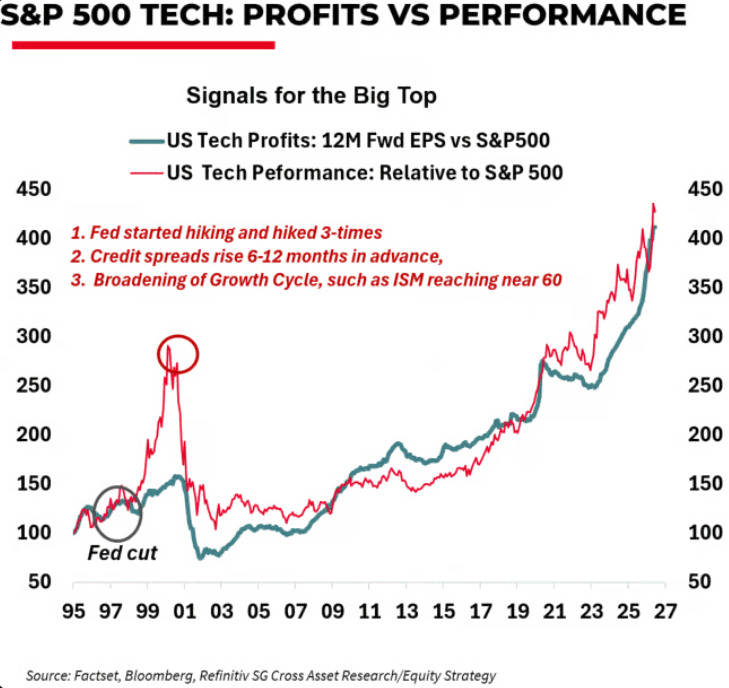
Both lines sit 50% above their 2000 peak — red near 430, teal near 420 — and that fact tells you almost nothing about whether we’re staring at the dotcom setup. The diagnostic was never the altitude; it was the gap. In March 2000, red decoupled to ~290 while teal stalled near 150 — a ~140-point chasm, performance running on pure multiple expansion while forward earnings refused to follow. Today the two lines track within a whisker. The rally is paid for, not borrowed: Nvidia’s data-center segment runs near a $35B quarterly clip, hyperscaler capex pushes toward a $400B combined run-rate, and each dollar of build lands on the counterparty’s ledger as signed RPO, metered cloud consumption, per-seat attach. That is contracted revenue, not pets.com eyeball counts. SocGen’s three preconditions confirm it — Fed hiking three times, spreads widening 6-12 months ahead, ISM near 60 — read zero of three: Fed cutting, spreads tight, ISM 54. Watch the spread, not the altitude. Red peeling above teal is the 2000 tell — until then, “higher than 2000” is geography, not pathology.
Market Intelligence Brief (MIB) Ver. 18.40
For professional investors only. Not investment advice.
© 2026 RecessionALERT.com

Comments are closed.