
MARKET INTELLIGENCE BRIEF (MIB)
Monday, August 17, 2026
The US-Iran framework expired with no extension and Trump threatened to bomb Oman — WTI +3.23% to $84.10, Energy led. The 30-year yield hit 5.31%, highest since 2007, while the 2-year barely moved. Nvidia guaranteed up to $105B for one OpenAI campus in Ohio. Meta’s youth-harms trial opened with $1.4T on the table; META -3.54%. Canada has 36 hours before a 50% tariff. Anthropic posted $11.5B Q2 revenue and its first operating profit.
TABLE OF CONTENTS
A. EXECUTIVE SUMMARY
B. MARKET DATA
C. HIGH-IMPACT STORIES (5)
D. MODERATE-IMPACT STORIES (8)
E. ECONOMY WATCH (3)
F. EARNINGS WATCH (0)
G. WHAT’S NEXT
H. CHART OF THE DAY
A. EXECUTIVE SUMMARY -> TOP
Equities fell in a shallow, uniform decline — S&P 500 -0.52% to 7,745.39, Dow -0.51%, Nasdaq 100 -0.17% — as the expiry of the US-Iran framework with no extension sent WTI up 3.23% to $84.10 and pushed the 30-year Treasury yield to 5.31%, its highest since June 2007. The tell is what did not happen: the 2-year moved 1 bp and the dollar slipped 0.09%, so this was a term-premium repricing rather than a growth scare — equities de-rated on the discount rate, not on demand, which is why VIX rose 6.60% alongside rising yields instead of falling ones. Breadth confirms the read: the four green sectors were Energy (+0.85%), Basic Materials, Industrials and Healthcare, while Consumer Defensive (-1.49%) and Communication Services (-1.41%) lagged. The latter is now the market’s worst three-month performer at -9.30%, as Meta’s legal risk compounds into structural repricing rather than a one-day move.
• The 60-day US-Iran framework lapsed with no extension and Trump ruled one out, threatening on the same day to bomb Oman — the mediator Iran is talking to about reopening Hormuz. WTI +3.23% to $84.10; Brent barely moved (+0.03% to $91.08), a routing problem rather than a barrels problem.
• The 30-year Treasury reached 5.31%, a 19-year high, on energy-driven inflation risk and heavy long-dated supply, while the 2-year sat at 4.182%. Wednesday brings both the FOMC minutes and a 20-year auction — the first real test of long-end demand at these levels.
• Nvidia will guarantee up to $105 billion for the first 4.25 GW of an OpenAI campus in Pike County, Ohio, under a 20-year SB Energy lease. A memory squeeze split the complex the same session: SanDisk +8.88%, Applied Materials +5.55%, Marvell +5.54%, Micron +4.13% against Microsoft -3.04% and Oracle -2.57%.
• Meta’s youth-harms trial opened in Oakland against 29 state AGs, with Meta’s own lawyers citing a $1.4 trillion damages ceiling and the states seeking age gating and the removal of infinite scroll. META -3.54% to $568.97; the injunctive relief, not the damages number, is the exposure.
• Canada’s negotiators were in Washington with 36 hours on the clock before 50% Section 338 duties hit roughly $20 billion of goods at 12:01 a.m. ET Wednesday, applying regardless of USMCA origin. Home Depot reports Tuesday, Target and Lowe’s Wednesday, Walmart Thursday.
• Empire State manufacturing surged to 20.6 against an 11.0 consensus, the strongest since early 2022 — but prices paid hit 58.6 against selling prices of 22.7, a margin squeeze rather than clean strength. Builder confidence rose to 35, still a 16th straight month below breakeven.
1. This is a cost-push tape, and every cross-asset signal agrees — Oil up, long end up, front end anchored, dollar flat, gold and silver bid, copper unmoved. That combination is inflation risk being repriced into the term premium, not growth being marked down; swaps still put a September hike under 30%. The Empire State internals say the same thing from the micro side — a headline that nearly doubled forecasts sitting on top of the widest paid-versus-received price gap in months. For portfolios the implication is that the hurdle rate is rising while demand holds, which pressures duration-sensitive equities without offering the offsetting comfort of a Fed cut. Watch Wednesday’s 20-year auction: it prices the supply half of the problem directly.
2. AI capex has become a credit question, and today supplied both sides of it — Nvidia guaranteeing $105 billion against a single campus is vendor financing at utility scale, with the credit risk sitting upstream at the chipmaker rather than with the operator, and a two-decade fixed lease underwritten against inference revenue that does not yet exist at that magnitude. The cost side is moving against it: memory has displaced power as the binding constraint, with HBM sold out through 2026, which is why storage and equipment names rallied while the hyperscalers absorbing the input cost fell. The counter-evidence arrived the same session — Anthropic’s Q2 revenue above $11.5 billion, fourteen times the year-ago quarter, and a first operating profit. The bull and bear case for the whole complex are now the same trade viewed from opposite ends.
3. Policy and legal risk are repricing sectors structurally, not episodically — The Canada action is the fourth sectoral proclamation in six weeks, and its willingness to override USMCA rules of origin is worth more to the import-cost curve than its $20 billion notional. Meta’s trial is the same phenomenon in equities: Communication Services is worst today, worst this week and worst over three months, which is accumulation rather than reaction. The DOJ’s Clayton Act inquiry into Andreessen Horowitz extends the pattern into who is allowed to fund the next tier of data infrastructure. None of these resolve on a single headline, and all of them raise the discount applied to the affected cash flows for as long as they remain open.
 — Leading economic indicators. Accurate market forecasts. Apply for membership at join.recessionalert.com
B. MARKET DATA -> TOP
Equities pulled back for a second straight session as oil’s surge on deepening Iran/Strait of Hormuz tensions revived inflation fears and lifted yields, with the S&P 500 (-0.52%) and Dow (-0.51%) retreating broadly while the VIX jumped 6.6%. Communication Services (-1.41%) and Consumer Defensive (-1.49%) led sector declines as a 29-state child-safety trial against Meta (-3.54%) opened, while Energy (+0.85%) extended its multi-week leadership on WTI’s 3.23% jump to $84.10. The sharpest divergence: a DRAM shortage sent memory and AI-storage names — SanDisk (+8.88%), Applied Materials (+5.55%), Micron (+4.13%) — surging even as the same shortage squeezed hyperscaler margins, pressuring Microsoft (-3.04%) and Oracle (-2.57%). Gold and 10Y yields rose together, a mild stagflation signature.
CLOSING PRICES – August 17, 2026:
MAJOR INDICES
Dow Theory bull confirmation is now in its 4th session, with DJIA and DJTA both holding within 2% of their 10-session highs despite today’s pullback. The move was broad, not narrow — Dow, S&P, and Nasdaq 100 all fell within a tight -0.17% to -0.52% band, and NYSE breadth (-0.42%) tracked the headline indices closely, confirming a market-wide risk-off session rather than single-sector rotation. Small-caps and growth both roughly kept pace with the S&P over the past 10 sessions, showing no meaningful breadth deterioration beneath the pullback.
| Index | Close | Change | %Move | Why It Moved |
|---|---|---|---|---|
| S&P 500 | 7,745.39 | -40.37 | -0.52% | Broad risk-off on oil-driven inflation fears |
| Dow Jones | 53,459.78 | -272.63 | -0.51% | Tracked broad market decline |
| DJ Transportation | 21,844.40 | +52.00 | +0.24% | Held up despite higher oil input costs |
| Nasdaq 100 | 29,995.38 | -50.76 | -0.17% | Memory-maker gains offset megacap software declines |
| Russell 2000 | 3,059.01 | -9.41 | -0.31% | Small-caps tracked broad market pullback |
| NYSE Composite | 24,717.81 | -103.87 | -0.42% | Broad-market breadth confirmed the headline decline |
VOLATILITY & TREASURIES
VIX’s 6.6% jump alongside rising 10Y (+3bps) and 2Y (+1bp) yields is an inflation-fear signature, not recession fear — a genuine growth scare sends yields lower as bonds catch a bid. DXY slipped slightly (-0.09%) despite the volatility spike, an unusual non-participation suggesting the dollar isn’t yet pricing this as a broad risk event, just an oil-driven inflation repricing.
| Instrument | Level | Change | Why It Moved |
|---|---|---|---|
| VIX | 15.19 | +0.94 (+6.60%) | Oil-driven inflation fear repricing |
| 10-Year Treasury Yield | 4.726% | +3 bps | Rising oil price fed inflation expectations |
| 2-Year Treasury Yield | 4.182% | +1 bps | Modest front-end repricing on inflation risk |
| US Dollar Index (DXY) | 99.57 | -0.09 (-0.09%) | Marginally softer despite risk-off tape |
COMMODITIES
Gold (+0.81%) and silver (+1.22%) rose together as classic inflation hedges, while copper’s flat close broke from the rally — industrial demand isn’t confirming the precious-metals move. Bitcoin’s 2.22% gain tracked the day’s isolated risk-on pockets in equities (semis, industrials) rather than acting as a hedge, undercutting its safe-haven framing on a broadly down day.
| Asset | Price | Change | %Move | Why It Moved |
|---|---|---|---|---|
| Gold | $4,473.30/oz | $+36.00 | +0.81% | Inflation-hedge bid on rising oil/yields |
| Silver | $65.905/oz | $+0.797 | +1.22% | Tracked gold’s inflation-hedge move |
| Copper | $6.6130/lb | $0.0000 | 0.00% | Flat — industrial demand not confirming metals rally |
| Platinum | $1,781.80/oz | $+24.90 | +1.42% | Tracked broader precious-metals strength |
| Bitcoin | $64,349.00 | $+1,397.00 | +2.22% | Tracked isolated equity risk-on pockets, not a hedge |
ENERGY
WTI’s 3.23% surge dramatically outpaced Brent’s 0.03% move, compressing the spread as the US benchmark reprices faster on Strait of Hormuz supply-risk headlines than globally-diversified Brent. Natural gas fell 1.06%, decoupling entirely from crude — confirming a geopolitical oil story, not a broad energy-inflation trade. Oil rising while equities fell is the stagflationary read: cost-push pressure, not demand strength.
| Asset | Price | Change | %Move | Why It Moved |
|---|---|---|---|---|
| Crude Oil (WTI) | $84.10/bbl | $+2.63 | +3.23% | Iran/Strait of Hormuz supply-risk headlines |
| Crude Oil (Brent) | $91.08/bbl | $+0.03 | +0.03% | Already reflected this week’s 5%+ Hormuz risk premium |
| Natural Gas (Henry Hub) | $2.704/MMBtu | $-0.029 | -1.06% | Decoupled from crude — no supply-risk transmission |
| Natural Gas (Dutch TTF) | $21.16/MMBtu | $+0.31 | +1.50% | European gas tracked broader energy-complex firmness |
S&P 500 SECTORS
Communication Services is now the market’s clearest structural laggard — worst sector today (-1.41%), this week (-2.83%), and over three months (-9.30%) — as legal risk (Meta’s child-safety trial) compounds. Consumer Defensive shows a similar but shallower slide. Energy is the mirror image, leading every horizon from 1-day to 12-month on sustained crude strength.
| Sector | 1-Day | 1-Week | 1-Month | 3-Month | 6-Month | YTD | 12-Month |
|---|---|---|---|---|---|---|---|
| Energy | +0.85% | +2.76% | +6.68% | +2.66% | +14.83% | +36.63% | +42.46% |
| Basic Materials | +0.65% | -1.02% | +10.15% | +1.70% | -3.08% | +16.05% | +33.99% |
| Industrials | +0.43% | +1.52% | +5.03% | +4.65% | +3.85% | +17.74% | +22.01% |
| Healthcare | +0.06% | -0.90% | +2.68% | +13.61% | +5.64% | +7.81% | +24.45% |
| Technology | -0.01% | +2.31% | +8.37% | +7.31% | +29.90% | +26.38% | +33.67% |
| Utilities | -0.46% | +1.84% | -2.62% | -0.49% | -6.30% | +2.45% | +3.94% |
| Real Estate | -0.84% | +0.80% | -2.16% | +4.33% | +3.13% | +10.39% | +8.90% |
| Financial | -0.86% | -0.10% | +2.43% | +12.70% | +10.82% | +8.28% | +14.23% |
| Consumer Cyclical | -0.91% | -2.78% | +1.18% | -0.63% | +0.26% | -3.28% | +0.68% |
| Communication Services | -1.41% | -2.83% | -2.34% | -9.30% | +1.87% | -1.93% | +9.86% |
| Consumer Defensive | -1.49% | -0.61% | -0.93% | -2.86% | -7.00% | +7.23% | +4.07% |
TOP MEGA-CAP MOVERS:
GAINERS
| Company | Ticker | Close | Change | Why It Moved |
|---|---|---|---|---|
| Sandisk Corp | SNDK | $1,786.85 | +8.88% | Aug 13 Investor Day: 80%+ gross margin target, $93.9B contracted backlog, new AI-flash tech with Kioxia |
| Applied Materials Inc | AMAT | $535.31 | +5.55% | Semiconductor equipment demand rallying with DRAM/AI-storage complex |
| Marvell Technology Inc | MRVL | $234.33 | +5.54% | Tracked the DRAM/AI-storage rally alongside SNDK, AMAT, MU |
| Space Exploration Technologies Corp | SPCX | $146.23 | +4.45% | Post-IPO momentum in space/AI/connectivity conglomerate |
| Micron Technology Inc | MU | $1,011.75 | +4.13% | DRAM price shortage driving memory-maker gains on AI storage demand |
DECLINERS
| Company | Ticker | Close | Change | Why It Moved |
|---|---|---|---|---|
| Meta Platforms Inc | META | $568.97 | -3.54% | 29-state child-safety trial opens; Zuckerberg to testify on alleged teen harm |
| Philip Morris International Inc | PM | $184.52 | -3.08% | Tracked broader Consumer Defensive weakness; no company-specific catalyst identified |
| Microsoft Corp | MSFT | $480.35 | -3.04% | DRAM cost inflation pressuring hyperscaler capex margins |
| Netflix Inc | NFLX | $76.02 | -2.74% | Communication Services sector weakness amid social-media legal risk repricing |
| Oracle Corp | ORCL | $146.65 | -2.57% | Broad cloud/tech pullback amid rising yields and DRAM cost inflation |
— Institutional-grade intelligence for serious investors. Apply for membership at join.recessionalert.comC. HIGH-IMPACT STORIES -> TOP
BEARISH
1. The US-Iran Framework Expires With No Extension — and Trump Threatens to Bomb the Mediator on the Same Day
The core facts:The 60-day memorandum of understanding signed on June 17 by President Trump and Iranian President Masoud Pezeshkian, brokered by Pakistan, lapsed Monday with no extension and no breakthrough. Asked directly whether he would seek an extension, Trump said no; a senior Iranian official told reporters there are no talks about extending the period. In a Fox News interview with Trey Yingst the same day, Trump said of Oman — the country Iran says it is in active talks with over reopening the Strait of Hormuz — “if Oman gets in the way, we’ll bomb the [expletive] out of them.” The framework left the two decisive issues unresolved: ultimate authority over shipping through the strait, and Iran’s nuclear programme. Energy Secretary Chris Wright told Fox News the same day that the President is “playing the long game,” adding that Iran “can’t export any oil right now. That’s part of our economic strangulation.” WTI settled +3.23% at $84.10 and Energy (+0.85%) led all sectors as the S&P 500 fell 0.52% to 7,745.39.
Why it matters:The market has spent five months pricing an escalation whose ceiling was set by a diplomatic clock. That clock has now run out with both sides further apart than when it started. The mechanical consequence is the toll regime: Iran’s Persian Gulf Strait Authority, stood up in early May, charges some tankers up to $2 million to transit, and the MoU had suspended that levy for its 60-day window — expiry restores it. Transit volumes are running roughly 90% below the pre-war average of about 130 ships a day, and the true figure is increasingly unknowable as vessels sail with trackers off. The threat to Oman is the part that changes the distribution of outcomes rather than the level of risk: it is aimed at the mediator, not the adversary, which removes the most plausible route to a negotiated reopening at exactly the moment the crude curve is priced off that possibility. When the administration’s most senior energy official tells the market on the same day that there is no hurry, the premium in the front of the curve stops looking temporary.
What to watch:Whether Oman’s mediation channel survives the week, and whether WTI holds above $84. The EIA weekly petroleum status report on Wednesday, August 19 is the next scheduled read on how fast US inventories are absorbing the disruption.
BEARISH
2. The 30-Year Treasury Yield Reaches Its Highest Level Since 2007 — and the Front End Refuses to Follow
The core facts:The 30-year Treasury yield rose nearly six basis points Monday to 5.31%, its highest level since June 2007 and within striking distance of that year’s 5.44% crisis-era peak. The rest of the curve barely moved: the 10-year added 3 bps to 4.726% and the 2-year just 1 bp to 4.182%. Bloomberg attributed the long-end selloff to surging government spending, a heavy calendar of long-dated issuance, and inflation that has run above the Federal Reserve’s target for five years. The equity decline was broad and shallow — Dow -0.51%, S&P 500 -0.52%, Nasdaq 100 -0.17%, NYSE Composite -0.42% — while VIX jumped 6.60% to 15.19, gold rose 0.81% to $4,473.30 and silver 1.22%. The dollar did not participate, slipping 0.09% to 99.57.
Why it matters:This is the uncomfortable combination. The front end is priced for the Fed to stay put — swaps imply under a 30% chance of a September hike, down from roughly 70% at the start of August on soft payrolls, contained CPI and last week’s weak retail sales. The long end is selling off anyway, on energy-driven inflation risk and supply rather than on growth. That distinction governs how to read the tape: equities fell on the discount rate, not on demand, which is why the decline was uniform across indices and why the VIX rose alongside rising yields instead of falling ones. A genuine growth scare sends the long end lower as bonds catch a bid; this did the opposite. The dollar’s non-participation is the corroborating tell — currency markets are treating this as an oil-driven inflation repricing rather than a broad risk event. At 5.31%, the long bond raises the hurdle rate on every duration-sensitive asset in the market, and it does so while the Fed’s own policy rate is anchored, which is the definition of a term-premium problem rather than a policy one.
What to watch:Wednesday, August 19 carries both the FOMC minutes and a 20-year bond auction — the first real test of long-end demand at these levels. Jackson Hole later this month is the next scheduled opportunity for the Board to address the divergence.
UNCERTAIN
3. Nvidia Puts Up to $105 Billion Behind a Single OpenAI Campus in Ohio — Vendor Financing at Utility Scale
The core facts:Nvidia will guarantee up to $105 billion in financing for the first phase of an OpenAI data-centre campus at the PORTS-Pike Technology Campus in Pike County, Ohio, disclosed Monday. The credit funds an initial 4.25 gigawatts of compute capacity with an option on a further 3.75 GW. SB Energy, a SoftBank subsidiary, will build, own and operate the site under a 20-year lease to OpenAI; Nvidia is separately investing $1.5 billion into SB Energy. SB Energy and SoftBank have committed to build power supply for 10 GW and to invest at least $4.2 billion into regional grid infrastructure. First capacity is targeted for 2028. OpenAI says the project supports 35,000 construction jobs through 2032 and 2,500 permanent roles.
Why it matters:This is the same mechanism Goldman Sachs was syndicating to insurers and private credit last Friday against Nvidia’s $500 billion AI platform — now with a named site, a named counterparty, a disclosed number and a securities filing behind it. Nvidia is underwriting the balance sheet that buys Nvidia’s chips, and the credit risk stays upstream with the vendor rather than sitting with the operator. The scale is what makes it auditable for the first time: a 20-year lease on 4.25 GW is a two-decade fixed obligation underwritten against inference revenue that does not yet exist at that magnitude. The cost side is deteriorating at the same time. Memory has displaced power and GPUs as the binding constraint on AI buildouts — DRAM and NAND demand is running well ahead of supply with tightness expected to persist beyond calendar 2027, and all three HBM producers are reported sold out of 2026 capacity. That squeeze was visible directly in Monday’s tape, with memory and equipment names surging (SanDisk +8.88%, Applied Materials +5.55%, Marvell +5.54%, Micron +4.13%) while the hyperscalers absorbing the input cost fell (Microsoft -3.04%, Oracle -2.57%). Financing capacity at fixed terms into a market where the key input is inflating is the risk this structure concentrates.
What to watch:Whether Nvidia syndicates the guarantee out as it did with the $500 billion platform or retains it, and how the exposure is disclosed in the next 10-Q. First Ohio capacity is not due until 2028.
BEARISH
4. Canada’s Negotiators Are in Washington With 36 Hours on the Clock Before a 50% Tariff Hits $20 Billion of Goods
The core facts:Canada-US Trade Minister Dominic LeBlanc and chief negotiator Janice Charette met US Trade Representative Jamieson Greer and Commerce Secretary Howard Lutnick in Washington on Monday, roughly 36 hours before Section 338 duties take effect at 12:01 a.m. ET on Wednesday, August 19. A Sunday-evening session involving LeBlanc, Greer and Charette was characterised by both sides as constructive, and the Washington Post reported Saturday that the two sides were “inching closer” to a deal. Greer’s public position is unchanged — Canada must lift its retaliatory measures to avoid the new duties — and he says Trump and Prime Minister Mark Carney will be given options following the talks. Carney said he expects to speak with Trump before the deadline. The three proclamations signed July 20 impose an additional 50% duty on roughly $20 billion of Canadian motor vehicles, alcohol, dairy and consumer goods, applying regardless of USMCA origin, with carve-outs for energy, potash, fish, critical minerals and Section 232 goods. No outcome had been announced as of Monday’s close.
Why it matters:The USMCA-origin override matters more than the dollar value. Twenty billion dollars is small against roughly $700 billion in annual bilateral goods trade, and the carve-outs protect the categories with the most direct inflation transmission. What does not shrink is the precedent: a Section 338 action that ignores a ratified free-trade agreement’s rules of origin tells every counterparty that treaty text is not a defence against a sectoral proclamation. That is the fourth such action in six weeks, after the July 24 Section 301 forced-labour tariffs, the August 6 polysilicon proclamation and the August 13 drone order — and the pattern, not any single measure, is what the import-cost curve is now pricing. The timing is awkward for the consumer complex reporting this week: Home Depot reports Tuesday, one day before the duties land, with Target and Lowe’s on Wednesday and Walmart on Thursday. Forward commentary from those four will be worth more than the quarters themselves.
What to watch:The 12:01 a.m. ET Wednesday deadline. A Trump-Carney call before then is the only visible off-ramp, and Canadian retaliation lifting is the stated condition.
BEARISH
5. Meta Goes to Trial Against 29 States Over Youth Harms — and Its Own Lawyers Put the Exposure at $1.4 Trillion
The core facts:Trial proceedings opened Monday in Oakland, California in the consolidated action brought by 29 state attorneys general, with California, Colorado, New Jersey and Kentucky trying the bellwether case and opening statements set for Tuesday. The states allege Meta illegally collected data from children under 13, designed Facebook and Instagram to drive compulsive use among minors, and misled users and the public about platform safety. Meta’s own attorneys have said the consolidated trial could produce damages as high as $1.4 trillion; lawyers for the states have said $200 billion is the more likely figure. The states are also seeking injunctive relief — court-ordered age restrictions and the elimination of infinite scroll among the remedies requested. The trial is expected to run seven weeks. META fell 3.54% to $568.97, Pinterest fell roughly 4%, and Communication Services was the day’s worst sector at -1.41%.
Why it matters:The damages headline is the least useful number in the case. A $1.4 trillion award is not a realistic outcome and both sides know it; it is a ceiling calculated from statutory per-violation penalties, and Meta’s lawyers cite it precisely because it is absurd. The injunctive relief is the real exposure. Court-ordered age gating and the removal of infinite scroll would alter the engagement mechanics that generate ad inventory, and a remedy of that kind travels — it would apply prospectively rather than as a one-time charge, and every peer platform would face the same template. The New Mexico ruling earlier this month is the instructive precedent in the other direction: that judge awarded $567 million but expressly declined to touch Meta’s algorithms, infinite scroll or autoplay on First Amendment and Section 230 grounds, making the refusal the market-relevant part of the decision. Whether an Oakland court reaches the same conclusion over seven weeks is now the open question. The sector context sharpens it: Communication Services is the market’s clearest structural laggard — worst today (-1.41%), worst this week (-2.83%) and worst over three months (-9.30%) — which is legal-risk repricing accumulating, not a one-day move.
What to watch:Opening statements Tuesday, and any early ruling on the scope of injunctive relief. A seven-week calendar puts a verdict in early October.
— Quantifying recession risk so you don’t have to guess. Apply for membership at join.recessionalert.comD. MODERATE-IMPACT STORIES -> TOP
UNCERTAIN
6. Berkshire’s Q2 13F Puts Alphabet Among Its Largest Holdings, Doubles Down on Homebuilders and Liquidates Constellation Brands Entirely
The core facts:Berkshire Hathaway’s second-quarter 13F, filed after Friday’s close and reported Saturday, shows roughly 48.1 million additional Alphabet shares bought during the quarter, lifting the holding to about 106 million shares. Berkshire added to Alphabet Class A and Class C, Delta Air Lines, Lennar Class A and Class B, the New York Times and Macy’s. It exited Constellation Brands completely, selling all 632,890 shares. It cut financials hard: Capital One down 58%, Bank of America down roughly 6% and Ally Financial down roughly 6.9%. Greg Abel took over as chief executive at the start of the year and agreed in June to a $10 billion stock investment in Alphabet, extending a position first opened last autumn. Constellation Brands fell 6.2% on Monday.
Why it matters:Rotating out of consumer staples and card lenders and into a hyperscaler and homebuilders is a legible macro statement: long AI infrastructure and rate-sensitive housing, short the US consumer’s credit. The Capital One reduction is the sharpest single signal in the filing — a 58% cut in a subprime-exposed card lender by an investor with a multi-decade record in consumer finance, made in a quarter when delinquency data was still benign. Read against Monday’s tape the housing side is contrarian rather than confirmatory: Berkshire doubled homebuilder exposure into a 30-year yield that has since reached a 19-year high, which is a bet that mortgage rates matter less to Lennar’s earnings than the structural shortfall in units. The Constellation exit is the cleanest name-level read and the market treated it that way, marking the stock down 6.2% on a disclosure containing no operating information whatsoever.
What to watch:The Q3 13F, due mid-November, and whether Abel keeps adding to Alphabet. Consumer-credit metrics from the card issuers in their next quarterly reports are the direct test of the financials cut.
BULLISH
7. Anthropic’s Q2 Revenue Passes $11.5 Billion and It Posts Its First Operating Profit — Fourteen Times the Year-Ago Quarter
The core facts:Anthropic’s second-quarter revenue exceeded $11.5 billion, reported Saturday — up from $787 million in the year-ago quarter, a more than fourteen-fold increase, and from $4.73 billion in the first quarter of 2026. The company posted positive adjusted operating income for the first time. The figures are preliminary and could change. Anthropic disclosed a $47 billion annualised run rate in May during its $65 billion Series H; chief executive Dario Amodei attributes the growth to enterprise adoption of the Claude 4 model family and the Claude Enterprise tier. An IPO window has been flagged for October.
Why it matters:This is the number every AI-infrastructure valuation is implicitly underwriting. The core bear case on AI capex has been that the compute buildout runs years ahead of monetisable demand — that the chips and the data centres are being financed against revenue that will arrive late, if at all. A private model developer more than doubling revenue sequentially and crossing into operating profit is the strongest single datapoint against that case currently available, and it lands the same session as Nvidia’s $105 billion Ohio guarantee. The two stories are the same argument from opposite ends: vendor-financed compute is only as sound as the inference revenue underneath it, and one of the two leading labs has now shown the revenue scales faster than the capex. The caveat worth keeping is that these are unaudited preliminary figures from a private company with an IPO two months out, which is the point in a company’s life when disclosure is most favourably framed.
What to watch:The October IPO window and the S-1, which would convert these preliminary figures into audited ones. Whether Q3 sustains the sequential pace is the more important test.
BULLISH
8. Stripe Agrees to Buy OpenRouter for More Than $7 Billion — a 5.4x Markup in Three Months
The core facts:Bloomberg reported Sunday that Stripe has finalised an agreement to acquire OpenRouter, the AI model-routing gateway, for more than $7 billion. OpenRouter was valued at $1.3 billion in its May 2026 Series B — a 5.4x markup in roughly three months. Existing backers include Sequoia, Andreessen Horowitz, Menlo Ventures and Alphabet’s CapitalG. Stripe declined to comment on what it called rumours or speculation. Both companies are private; the size threshold here is met through Stripe’s own valuation and the listed read-through rather than through the target.
Why it matters:A payments company paying $7 billion for model routing is a statement about where the margin in AI settles. Routing is the layer that meters which model answers which request and at what price — it is a toll booth, not a technology moat, and Stripe’s core competence is precisely metering and billing. The implication for listed names is a structural argument against model-layer pricing power: if the value accrues to whoever bills the inference rather than whoever performs it, the model developers are commoditised suppliers into someone else’s checkout. It also puts a fresh private mark on AI-adjacent infrastructure at a moment when public markets are questioning the capex cycle, and a 5.4x step-up in ninety days says the private bid has not cooled at all.
What to watch:Whether other payments or infrastructure names bid for metering and routing assets, which would confirm the toll-booth thesis rather than leave it as one buyer’s view.
BEARISH
9. The DOJ Is Examining Whether Andreessen Horowitz’s Board Seats Violate the Clayton Act — the First Real Test Against a Venture Firm
The core facts:Bloomberg reported Monday that the Justice Department is examining whether Andreessen Horowitz breached Section 8 of the Clayton Act by placing co-founder Ben Horowitz on the board of Databricks and partner Martin Casado on the board of Fivetran — rival companies in data collection and analytics. Section 8 generally bars a person from serving simultaneously as a director or officer of competing companies, subject to limited exceptions. The investigation has been under way for nearly a year and began around the time regulators were reviewing Fivetran’s acquisition of dbt Labs; Casado also sat on the dbt Labs board, and the DOJ cleared that transaction unconditionally in June after a months-long review. The probe arrives under new antitrust leadership following Gail Slater’s departure in February 2026.
Why it matters:Section 8 enforcement has historically been aimed at operating companies, not funds. Extending it to venture capital would reach standard practice across the entire industry — almost every multi-stage fund holds board seats at adjacent portfolio companies, and the interlock question becomes structural rather than incidental as portfolios concentrate into a narrow set of AI and data-infrastructure themes. The detail that makes this more than a theoretical exercise is the sequencing: the DOJ cleared the dbt Labs deal unconditionally in June while this inquiry was already open, which suggests the interlock question is being pursued independently of merger review rather than as leverage within it. The listed read-through is second-order but real — the data-infrastructure layer under examination is the same one feeding hyperscaler and AI workloads, and a governance constraint on private capital changes who is able to fund the next tier of it.
What to watch:Whether the DOJ opens a formal proceeding or issues civil investigative demands to other funds — that is the signal this is a policy shift rather than a single-firm matter.
BULLISH
10. argenx’s Phase 3 ALKIVIA Trial Hits Its Primary Endpoint in a Myositis Subtype With No Approved Therapy
The core facts:VYVGART Hytrulo (efgartigimod alfa and hyaluronidase-qvfc) delivered a statistically significant 15.4-point greater mean Total Improvement Score at week 52 versus placebo — 47.95 against 32.56 — in the Phase 3 ALKIVIA trial. Separation from placebo emerged as early as week 4 and was sustained through the full year even with steroid tapering. Safety was consistent with the known VYVGART profile. This is the first Phase 3 to show significant improvement in immune-mediated necrotising myopathy, a myositis subtype with no approved therapies, and argenx has flagged an IMNM regulatory filing. The result was co-announced with Zai Lab. ARGX rose roughly 10% on the session.
Why it matters:A label expansion into an indication with no incumbent is the highest-margin form of pharmaceutical growth. There is no market share to take, no comparator price to undercut and no head-to-head superiority hurdle — the payer conversation starts from a standard of care that does not exist. The week-4 separation matters commercially as much as clinically, because early response supports the case for reimbursement without a lengthy trial period. This is also the second consecutive session in which a late-stage readout rather than an FDA decision was the sector’s catalyst, which is a shift in where drug-pricing risk is being expressed. Healthcare closed +0.06%, one of only four sectors in the green, and is the market’s best three-month performer at +13.61%.
What to watch:The IMNM filing timeline and any FDA acceptance date, plus whether the full dataset is presented at an upcoming neurology or rheumatology congress.
UNCERTAIN
11. L3Harris Names Sam Mehta Chief Executive as Christopher Kubasik Exits the Combined CEO and Chairman Roles
The core facts:L3Harris named Sam Mehta chief executive on Monday as Christopher Kubasik departed the combined chief executive and chairman roles. No reason for the departure was given in the day’s coverage. LHX fell roughly 4.6% on the session.
Why it matters:An abrupt exit from a combined chief-executive-and-chairman role at a top-five US defence prime is a governance event the market prices as information regardless of what the company discloses, and a 4.6% decline against no announced operational problem is the market supplying its own interpretation. The timing sharpens the reaction rather than explaining it: the Middle East escalated on the same session, defence budgets are the live fiscal question, and L3Harris sits in the segment most exposed to a sustained naval and air posture in the Gulf. What is not established should be stated plainly — no cause has been given, and none should be inferred from the price move. The concentration of both roles in one person is itself part of the story, because an unexplained departure from a combined seat removes the board’s usual mechanism for signalling continuity.
What to watch:Whether the board provides a reason or separates the chairman role permanently, and Mehta’s first guidance commentary.
UNCERTAIN
12. Apple Is Upgraded at Redburn While Workday Is Cut by Two Firms in the Same Session — Monday’s Analyst Reshuffle
The core facts:Rothschild & Co Redburn upgraded Apple to Buy from Neutral. Citi moved Palantir to Buy with a $235 price target; B. Riley took Airbnb to Buy at $170; BofA moved Comcast to Buy at $37; Citi took Zoom to Buy at $106; Morgan Stanley moved Datadog to Overweight with a $180 target unchanged; Freedom Broker took Cisco to Buy from Hold; and Wells Fargo moved Okta to Overweight from Equal Weight. On the other side, Workday was cut by two firms in a single session — BTIG to Neutral from Buy and Deutsche Bank to Hold from Buy. Phillip Securities moved Shopify to Accumulate from Buy, and Wolfe Research cut Rivian to Underperform from Peer Perform with a $16 target.
Why it matters:The Apple upgrade is the most consequential call of the group because of what it underwrites. Commerce Secretary Howard Lutnick said last week that the administration opposes Apple sourcing memory from China’s CXMT and YMTC — the cheaper supply Apple had been testing for its China-market devices — while Micron, which supplies roughly 30% of Apple’s memory, has lobbied the White House directly against the switch. There is no rule preventing Apple from buying Chinese memory; this is jawboning rather than regulation. Upgrading into that constraint, in a quarter when memory pricing is the steepest input-cost move in the hardware complex, is an explicit call that Apple absorbs the cost without margin damage. The Workday double downgrade carries more information than the eight upgrades combined: two firms de-rating the same name on the same day is a coordinated view rather than two independent opinions, and it follows take-private reporting on the stock earlier this month — the sell side is reacting to a situation, not to a print.
What to watch:Whether a third firm joins the Workday de-rating, and whether Apple’s gross-margin guidance next quarter validates the Redburn call.
BEARISH
13. Yemen’s Mokha Port Suspends All Operations After More Than 25 Missiles — a Second Chokepoint Degrading While the First Is Shut
The core facts:The director of Yemen’s Mokha port said at a Saturday news conference that the port has suspended all commercial and maritime operations after being struck by more than 25 missiles over recent days. Seven people were killed and losses are estimated at $16 million. On Friday the Houthis fired six ballistic missiles at the city; Houthi spokesman Brig. Gen. Yahya Saree said the strikes targeted Saudi military concentrations and vessels belonging to what he described as its proxies. Mokha sits on the Red Sea beside the Bab el-Mandeb strait — the alternate route Saudi Arabia has been using to move crude while the Strait of Hormuz is closed.
Why it matters:This is the second chokepoint degrading while the first is shut, and it removes optionality the oil market has been assuming rather than adding a new risk. Aramco has been allocating September Asian cargoes one at a time as shipowners avoid both waterways; a working port on Bab el-Mandeb ceasing operations is the physical confirmation of that avoidance. For US transmission the channel is freight and insurance rather than barrels — Gulf crude that can route through neither strait has to travel further at higher war-risk premiums, and that cost lands in refined product prices with a lag. Monday’s spread action is consistent with a routing problem rather than a barrels problem: WTI jumped 3.23% to $84.10 while Brent moved 0.03% to $91.08, compressing a spread that normally widens on a global supply shock.
What to watch:Whether Saudi Arabia shifts volumes to the East-West pipeline to Yanbu, and war-risk insurance rates on Red Sea transits — the cleanest real-time price of the disruption.
— Separating signal from noise since 2007. Apply for membership at join.recessionalert.comE. ECONOMY WATCH -> TOP
Domestic data surprised broadly to the upside Monday — Empire State manufacturing surged to 20.6 (vs. 11 expected), its strongest reading since early 2022, while NAHB builder sentiment edged to 35 for a second straight beat — but both prints sit against a deteriorating rates backdrop. Treasury’s June TIC data showed foreign appetite for US bonds cooling sharply even as a fresh US-Iran flare-up pushed Brent toward $91 and sent the 30-year Treasury yield to its highest level since 2007. Improving real-side data can’t offset a rates and inflation shock the Fed didn’t ask for. Watch whether Wednesday’s FOMC minutes acknowledge the oil-driven upside inflation risk.
Empire State Manufacturing Index Surges to 20.6, Crushing Estimates (Federal Reserve Bank of New York, Aug 17, 2026)
What they’re saying:The NY Fed’s Empire State Manufacturing Survey jumped to 20.6 in August, nearly doubling the median forecast of 11.0 and marking the strongest reading since early 2022, up from July’s 15.6. New orders rose to 17.3 and shipments to 11.7, both firmly in expansion territory, while the future business conditions index climbed to 32.1.
The context:The headline beat masks a margin story — the prices-paid index spiked to 58.6 while selling prices rose just 22.7, the widest gap in months and a sign manufacturers are absorbing cost increases rather than passing them through, echoed by a supply-availability index at -13.4. Empire State is the first regional Fed survey of the month and typically sets the tone for the ISM manufacturing print three weeks later.
What to watch:Industrial production and capacity utilization data (Tue, Aug 18) for confirmation of the regional manufacturing strength.
Builder Confidence Ticks Up to 35 for Second Straight Beat, But Affordability Concerns Persist (NAHB/Wells Fargo, Aug 17, 2026)
What they’re saying:The NAHB/Wells Fargo Housing Market Index rose one point to 35 in August, beating the consensus forecast of 33 for a second consecutive above-expectations reading. Current sales conditions rose two points to 39, while future sales expectations and prospective buyer traffic held steady at 43 and 23.
The context:The improvement is directional, not structural — August marks the 16th straight month the index has held below the 40 breakeven level, and the 16th consecutive month in which at least 30% of builders report cutting prices to move inventory. Elevated mortgage rates — the 30-year Treasury hit its highest level since 2007 on Monday amid a fresh oil-driven yield spike — are working directly against any sentiment recovery.
What to watch:Housing Starts and Building Permits data for July (Tue, Aug 18).
Foreign Demand for US Assets Cools in June as Treasury TIC Data Shows Slower Bond Inflows (US Treasury, Aug 17, 2026)
What they’re saying:Net long-term TIC flows totaled $172.7B in June, beating the $151.4B consensus but down sharply from May’s $231.2B, while net foreign purchases of US bonds specifically collapsed to $6.8B from $56.6B the prior month. Overall net capital flows into the US, including short-term instruments, held roughly steady at $133.5B.
The context:The data offers a mixed read on foreign appetite for US assets — investors remained net buyers and beat expectations on the headline, but the sharp month-over-month deceleration in bond purchases specifically suggests waning demand for Treasuries even before Monday’s yield spike, complicating financing of a federal deficit running above $1.8 trillion for the fiscal year.
What to watch:July TIC data (mid-September) for whether the bond-purchase slowdown persists.
— Know the probability before the market prices in the risk. Apply for membership at join.recessionalert.comF. EARNINGS WATCH -> TOP
YESTERDAY AFTER THE BELL (Markets Reacted Today)
No major earnings yesterday after the bell from companies with >$100B market cap. This subsection covers the full market-closed span from Friday’s close through this morning’s open; no company above the threshold reported over the weekend of August 15-16.
TODAY BEFORE THE BELL (Markets Already Reacted)
No major earnings before the bell from companies with >$100B market cap.
TODAY AFTER THE BELL (Markets React Tomorrow)
No major earnings after the bell from companies with >$100B market cap. The day’s largest reporter was Fabrinet (FN) at a $21.45B market cap, well below the coverage threshold.
WEEK AHEAD PREVIEW:
Q2 2026 earnings season is 88% complete, and what remains is concentrated almost entirely in the consumer complex. This week delivers four consecutive reads on the US consumer, and all four land either side of Wednesday’s Section 338 tariff deadline on Canadian goods — which makes forward commentary considerably more valuable than the quarters themselves.
Home Depot (HD) — BMO, Tuesday, August 18 — Consensus of $4.73 EPS on $47.24B revenue, implying roughly flat earnings on mid-single-digit sales growth. Management has guided FY2026 comparable sales to flat-to-+2% and Q1 landed at +0.6%; a Q2 comp at or above that pace with US comps positive keeps the full-year path intact. The 50% Section 338 duties on Canadian goods take effect the day after this print, making tariff commentary the most consequential part of the call.
Target (TGT) — BMO, Wednesday, August 19 — Earnings call at 8:00 a.m. ET. Key focus is non-food discretionary spending, foot traffic and digital sales — the cleanest available read on whether the discretionary softness visible in July retail sales (-0.6% MoM, control group -0.4%) is a pause or a trend.
Lowe’s (LOW) — BMO, Wednesday, August 19 — Earnings call at 9:00 a.m. ET, one hour after Target. Reports into the same home-improvement demand question as Home Depot the day before, with the added complication of a 30-year Treasury yield at a 19-year high pressuring the renovation-financing channel.
Walmart (WMT) — BMO, Thursday, August 20 — Materials at approximately 7:00 a.m. ET with the call to follow. The largest US retailer closes the group and carries the widest read on trade-down behaviour, grocery pricing and the pass-through of accumulated tariff costs into shelf prices.
Q3 2026 earnings season begins in mid-October, with the large banks first as usual.
— US market commentary trusted by family offices and institutions. Apply for membership at join.recessionalert.comG. WHAT’S NEXT -> TOP
UPCOMING RELEASES:
| Date | Event | Why It Matters |
|---|---|---|
| Tue, Aug 18 | Housing Starts & Building Permits (Jul) — starts expected 1.35M vs 1.427M prior; permits expected 1.37M vs 1.374M prior | The first hard housing read since the 30-year Treasury reached 5.31%. Builder confidence has now spent 16 straight months below breakeven with 30% of builders cutting prices, so a starts print near the 1.35M consensus would confirm sentiment is finally translating into reduced supply rather than just weaker margins. |
| Tue, Aug 18 | Industrial Production & Capacity Utilization (Jul) — expected +0.3% MoM and 76.3% | The national check on Monday’s Empire State surge to 20.6. A confirming print supports the view that manufacturing is genuinely re-accelerating; a miss would suggest the regional beat was a New York story rather than a national one, and would sit awkwardly against the prices-paid spike inside the same survey. |
| Tue, Aug 18 | Import & Export Prices (Jul) — imports expected +0.1% MoM, exports +0.2% | The cleanest read on whether tariff costs are landing at the border ahead of Wednesday’s Canada duties, and the first check on how much of the crude move is feeding imported energy prices. Import prices are the upstream input to the goods side of CPI. |
| Tue, Aug 18 | NY Fed Services Activity Index (Aug) — prior 8.7 | Same survey window and same respondents’ region as Monday’s manufacturing beat. Services carry the larger share of employment, so a matching move would broaden the strength story beyond factories; a divergence would narrow it. |
| Tue, Aug 18 | Pending Home Sales (Jul) — expected +0.2% MoM | Contract signings lead closings by roughly two months, making this the most forward-looking housing indicator on the calendar. It is the direct test of Berkshire’s contrarian homebuilder additions against a 19-year high in long-end yields. |
| Tue, Aug 18 | ADP Weekly Employment Change — prior 8.25K | A high-frequency labour reading in a stretch with no monthly payrolls print. With swaps putting a September hike under 30% largely on soft payrolls, weekly deterioration would harden that pricing while the long end sells off regardless. |
| Wed, Aug 19 | FOMC Minutes | The market needs to know whether the Committee is treating the energy-driven inflation impulse as transitory or as something requiring a policy response. The minutes are the last scheduled window into Committee thinking before Jackson Hole, and the front end is priced for patience while the 30-year is not. |
| Wed, Aug 19 | 20-Year Bond Auction — prior 5.163% | The first live test of long-end demand since the 30-year hit its highest level since 2007. June TIC data already showed foreign bond purchases collapsing to $6.8B from $56.6B, so a weak tail here would confirm the supply-and-term-premium diagnosis rather than the inflation-expectations one. |
| Wed, Aug 19 | 50% Section 338 tariffs on ~$20B of Canadian goods take effect (12:01 a.m. ET) | The duties apply regardless of USMCA origin, which makes the precedent larger than the notional. Motor vehicles, alcohol, dairy and consumer goods are covered; energy, potash, fish and critical minerals are carved out. A Trump-Carney call is the only visible off-ramp, and the deadline lands between Home Depot’s Tuesday report and Walmart’s on Thursday. |
KEY QUESTIONS:
1. Does Wednesday’s 20-year auction clear cleanly, or does a weak tail confirm that the 30-year’s move to 5.31% is a term-premium and supply problem the Fed’s policy rate cannot fix?
2. If no Trump-Carney deal lands before 12:01 a.m. ET Wednesday, how do Home Depot (Tue), Target and Lowe’s (Wed) and Walmart (Thu) frame passing a 50% duty through to the shelf — and does forward commentary matter more than the quarters themselves?
3. With the US-Iran framework expired and the mediator publicly threatened, does WTI hold above $84 — and does the memory squeeze now inflating AI input costs start showing up in hyperscaler capex guidance rather than just in semiconductor share prices?
— US market commentary trusted by family offices and institutions. Apply for membership at join.recessionalert.comH. CHART OF THE DAY -> TOP
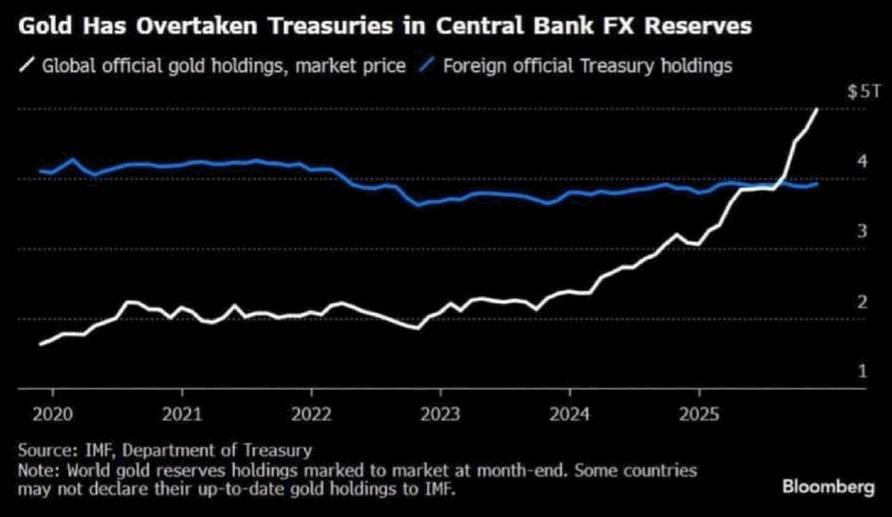
Foreign demand for Treasuries has never been higher — the chart just doesn’t plot it. The blue line is official holdings alone, flat because reserve managers stopped adding, not because they left: total foreign holdings hit a record $9.49 trillion in February, and by March official money accounted for roughly $3.9 trillion of it, leaving private investors with about 58% of the foreign book. The white line looks like the refutation, and it is not. Net official gold buying slowed to 850 tonnes in 2025, after three straight years above 1,000, while the metal rose some 60% — the crossing is a revaluation of bullion already held, not a rotation out of US paper. Flat is not neutral. Official holdings sideways against $31.5 trillion of marketable debt compounding 8.6% a year concede a point of share a year without a bond sold; foreign official now owns roughly 12% of the market. The marginal buyer changed character rather than disappearing — money that holds to maturity under a mandate, replaced by capital that marks to market, prices duration commercially, and has no policy reason to absorb a bad auction. The same deficit gets funded at a different price and with a different failure mode; term premium is now set by investors with an opinion, and household and corporate borrowing costs are increasingly exposed to a bid that can reprice. Washington has not lost its foreign creditor. It has lost the one that had to be there.
What it means: treat a weak long-end auction as information, not plumbing — the marginal bidder no longer has to show up. Only official holdings growing with supply would change that; one positive TIC month is noise.
Market Intelligence Brief (MIB) Ver. 18.78
For professional investors only. Not investment advice.
© 2026 RecessionALERT.com

Comments are closed.