
MARKET INTELLIGENCE BRIEF (MIB)
Friday, July 10, 2026
SK Hynix’s record $26.5B Nasdaq debut popped 14% and Meta’s best week since 2024 powered stocks higher, though small-caps and high-multiple software names (PANW, DELL, MRVL) slid on rate jitters. Fed Chair Warsh’s first Monetary Policy Report struck a hawkish note ahead of Tuesday’s CPI and his House/Senate testimony next week — with FOMC minutes showing 9 of 18 officials eyeing a hike. SpaceX bonds trade like junk. Trade deficit widened to $77.6B. Nvidia rose 4% on eased UAE chip curbs.
TABLE OF CONTENTS
A. EXECUTIVE SUMMARY
B. MARKET DATA
C. HIGH-IMPACT STORIES (5)
D. MODERATE-IMPACT STORIES (6)
E. ECONOMY WATCH (5)
F. EARNINGS WATCH (0)
G. WHAT’S NEXT
H. CHART OF THE DAY
A. EXECUTIVE SUMMARY -> TOP
Equities notched modest gains for a fourth straight session as SK Hynix’s blockbuster $26.5 billion Nasdaq debut (+14%) and Meta’s best week since February 2024 extended the AI-infrastructure trade, reinforced by Washington’s decision to ease UAE chip-export restrictions and open new Nvidia/AMD sales channels. The advance unfolded against a hawkish policy backdrop: the Fed’s first Monetary Policy Report under Chair Warsh pledged an “absolute commitment” to 2% inflation just days before Tuesday’s CPI print and Warsh’s first congressional testimony, while SpaceX’s bonds traded at junk-like spreads — a credit-market signal that AI-capex financing conditions may be tightening even as equity investors reward the buildout. Breadth was narrow beneath the headline gains: small-caps and high-multiple software names (Palo Alto, Dell, Marvell) sold off on rate concerns even as AI-memory and hardware names rallied, underscoring a market discriminating within the AI trade rather than embracing it wholesale.
• S&P 500 (+0.42% to 7,575.25), Dow (+0.29%), and Nasdaq 100 (+0.33%) closed higher on broad participation (9 of 11 sectors green), while the Russell 2000 fell 0.46% as small-caps lagged.
• SK Hynix’s Nasdaq debut (SKHYV) surged 14% on a record $26.5B raise — the largest-ever US listing by a foreign company; Meta (+5.97%) extended its best week since February 2024.
• Fed’s first Monetary Policy Report under Chair Warsh struck a hawkish tone (“absolute commitment” to 2% inflation) ahead of his House testimony Tuesday, Senate testimony Wednesday, and Tuesday’s CPI print; FOMC minutes showed 9 of 18 officials saw a case for a hike.
• SpaceX (SPCX) fell 4.51% as its bonds traded at junk-equivalent spreads, a credit-stress signal tied to its $60B acquisition and AI-unit cash burn.
• Washington eased UAE chip-export restrictions, opening billions in AI-hardware sales for Nvidia (+4.03%) and AMD.
• US trade deficit widened to $77.6B in May, the biggest gap since March 2025, adding a headwind to Q2 GDP as Atlanta Fed GDPNow eased to 1.3%.
1. AI trade bifurcation, not a broad rally — Memory and hardware suppliers (SK Hynix, Nvidia, SanDisk, Cisco) rallied on capacity and export-policy tailwinds, while high-multiple software and platform names (Palo Alto, Dell, Marvell, Netflix) sold off on rate-driven valuation resets. Portfolio exposure labeled “AI” needs to distinguish hardware-buildout beneficiaries from software names facing multiple compression.
2. Credit markets are pricing AI-capex risk that equities aren’t — SpaceX’s bonds trading at junk-equivalent spreads despite a roughly $1.9 trillion valuation is an early signal that debt investors are more skeptical of AI-linked leverage and cash burn than equity investors — a leading indicator worth monitoring as the AI-capex cycle continues.
3. A new Fed chair, a hawkish tone, and a loaded week ahead — Chair Warsh’s first Monetary Policy Report and a divided FOMC (9 of 18 seeing a case for a hike) raise the stakes for Tuesday’s CPI print and his back-to-back House/Senate testimony next week; combined with a widening trade deficit dragging on Q2 GDP, the macro backdrop looks more fragile than today’s equity gains suggest.
 — Leading economic indicators. Accurate market forecasts. Apply for membership at join.recessionalert.com
B. MARKET DATA -> TOP
AI-infrastructure enthusiasm drove the session, led by SK Hynix’s record $26.5 billion Nasdaq ADR debut (+14% at the open) and Meta’s continued surge, extending its weekly gain past 14% — the largest since February 2024. The S&P 500, Dow, and Nasdaq all closed modestly higher on broad-based gains (nine of eleven sectors green), but leadership stayed narrow beneath the surface: the Russell 2000 fell as small-caps lagged, and high-multiple growth names — Palo Alto Networks, Dell, Netflix, Marvell — sold off on elevated-rate valuation resets even as AI-memory suppliers extended their rally. Crude eased despite ongoing Middle East tensions, and yields ticked higher even as the VIX fell 5% — a mild bond non-confirmation of the rally.
CLOSING PRICES – July 10, 2026:
MAJOR INDICES
Dow Theory bull confirmation remains intact, now in its fourth session, as DJIA and DJTA both sit within 2% of their 10-session highs. Beneath that, leadership stayed narrow — the S&P has outpaced the Russell 2000 by nearly 4 points over the past 10 sessions, confirming mega-cap concentration over broad participation. The S&P’s slight edge over the Dow (+0.42% vs +0.29%) reflects a mild tech tilt, not a bifurcation; the NYSE Composite’s muted +0.20% shows the broader tape lagging cap-weighted gains.
| Index | Close | Change | %Move | Why It Moved |
|---|---|---|---|---|
| S&P 500 | 7,575.25 | +31.61 | +0.42% | AI-led rally (SK Hynix debut, Meta surge) lifted the index broadly |
| Dow Jones | 52,637.09 | +149.68 | +0.29% | Modest blue-chip participation in the AI-led advance |
| DJ Transportation | 22,178.1 | -5.5 | -0.02% | Essentially flat; Dow Theory bull confirmation intact (4th session) |
| Nasdaq 100 | 29,825.11 | +98.01 | +0.33% | AI/semis strength (NVDA, SK Hynix debut) offset growth-stock valuation resets |
| Russell 2000 | 2,978.64 | -13.90 | -0.46% | Small-caps lagged the mega-cap AI rally; narrow leadership |
| NYSE Composite | 23,925.07 | +48.23 | +0.20% | Broad tape tracked mega-cap AI-led gains, muted vs. cap-weighted indices |
VOLATILITY & TREASURIES
VIX’s 5% slide alongside rising yields (10Y +2.1bps, 2Y +4.8bps) is a bond non-confirmation, not celebration — bonds sold off even as equities rallied and options markets calmed, hinting at reduced rate-cut conviction rather than pure risk-on. The 2Y outpacing the 10Y modestly flattens the curve. DXY was essentially flat, offering no independent signal.
| Instrument | Level | Change | Why It Moved |
|---|---|---|---|
| VIX | 15.03 | -0.81 (-5.11%) | Risk appetite firmed on the AI-led rally |
| 10-Year Treasury Yield | 4.560% | +2.1 bps | Modest upward drift; reduced rate-cut conviction |
| 2-Year Treasury Yield | 4.210% | +4.8 bps | Outpaced the 10Y, mildly flattening the curve |
| US Dollar Index (DXY) | 100.97 | +0.07 (+0.07%) | Essentially flat |
COMMODITIES
Precious metals slipped together — gold and silver both lower — while copper’s modest gain kept industrial-demand signals separate from the safe-haven complex, consistent with the day’s risk-on tone. Bitcoin’s 1.5% gain tracked equities rather than decoupling, reinforcing that today’s move was broad risk appetite, not a crypto-specific catalyst.
| Asset | Price | Change | %Move | Why It Moved |
|---|---|---|---|---|
| Gold | $4,113.70/oz | -$27.10 | -0.65% | Safe-haven demand eased on the risk-on tone |
| Silver | $60.165/oz | -$0.583 | -0.96% | Tracked gold lower |
| Copper | $6.2800/lb | +$0.0200 | +0.32% | Industrial-demand signal diverged from precious-metals softness |
| Platinum | $1,629.00/oz | -$1.10 | -0.07% | Roughly flat, tracked the precious-metals complex |
| Bitcoin | $64,206.0 | +$965.0 | +1.53% | Tracked equities higher; broad risk-on, not crypto-specific |
ENERGY
WTI fell further than Brent, modestly widening the spread, while crude eased despite the ongoing Middle East conflict — a supply/inventory story, not an escalation risk. Oil retreating as equities rallied argues for a disinflationary, growth-friendly read rather than cost-push pressure. Henry Hub’s sharper 2.4% drop decoupled US gas entirely from the crude complex; Dutch TTF stayed roughly flat.
| Asset | Price | Change | %Move | Why It Moved |
|---|---|---|---|---|
| Crude Oil (WTI) | $71.41/bbl | -$0.67 | -0.93% | Eased despite ongoing Middle East tensions; supply/inventory-driven |
| Crude Oil (Brent) | $76.01/bbl | -$0.29 | -0.38% | Fell less than WTI, modestly widening the spread |
| Natural Gas (Henry Hub) | $2.940/MMBtu | -$0.072 | -2.39% | Decoupled from crude on separate supply/weather drivers |
| Natural Gas (Dutch TTF) | $16.28/MMBtu | -$0.02 | -0.13% | Roughly flat; European gas steady |
S&P 500 SECTORS
Nine of eleven sectors closed green — a broad sentiment flush rather than rotation. The two holdouts are telling: Healthcare’s -1.1% today extends its -2.05% weekly slide, a reversal from its +5.7% monthly gain, while Industrials also lagged. Financials’ +6.83% one-month run continues to lead the “old economy” cyclical trade alongside Tech’s persistent multi-quarter surge.
| Sector | 1-Day | 1-Week | 1-Month | 3-Month | 6-Month | YTD | 12-Month |
|---|---|---|---|---|---|---|---|
| Consumer Defensive | +0.89% | -1.02% | -0.27% | -1.67% | +8.47% | +7.03% | +5.07% |
| Basic Materials | +0.84% | -2.42% | -2.80% | -8.19% | +2.41% | +7.81% | +29.39% |
| Utilities | +0.80% | -0.31% | +3.19% | -4.34% | +7.62% | +6.54% | +13.66% |
| Financial | +0.52% | +0.66% | +6.83% | +9.65% | +3.91% | +5.33% | +13.60% |
| Energy | +0.50% | +3.50% | -3.68% | -5.54% | +23.36% | +22.85% | +26.57% |
| Communication Services | +0.44% | +1.28% | +0.10% | +6.24% | +4.05% | +5.04% | +34.42% |
| Consumer Cyclical | +0.28% | +0.94% | +1.53% | +3.36% | -4.99% | -3.39% | +5.10% |
| Technology | +0.27% | +2.81% | +2.20% | +24.21% | +20.03% | +21.97% | +34.32% |
| Real Estate | +0.26% | -0.75% | +0.10% | +4.90% | +9.66% | +9.83% | +8.38% |
| Industrials | -0.32% | -2.63% | +0.43% | +3.23% | +12.43% | +16.13% | +21.90% |
| Healthcare | -1.10% | -2.05% | +5.70% | +7.67% | +1.41% | +5.17% | +19.95% |
TOP MEGA-CAP MOVERS:
GAINERS
| Company | Ticker | Close | Change | Why It Moved |
|---|---|---|---|---|
| Meta Platforms Inc | META | 669.21 | +5.97% | Extending its largest weekly rally since Feb. 2024 on AI-infrastructure momentum |
| NVIDIA Corp | NVDA | 210.96 | +4.03% | AI/semis strength; SK Hynix Nasdaq debut boosted HBM supply-chain sentiment |
| T-Mobile US Inc | TMUS | 187.61 | +3.38% | Fixed-wireless share gains, capex discipline ahead of Q2 earnings |
| Sandisk Corp | SNDK | 1,915.92 | +3.10% | Signed multi-year flash-memory supply deal with Meta |
| Cisco Systems Inc | CSCO | 121.31 | +2.54% | AI infrastructure networking demand (“AI plumbing” narrative) |
DECLINERS
| Company | Ticker | Close | Change | Why It Moved |
|---|---|---|---|---|
| Space Exploration Technologies Corp | SPCX | 145.30 | -4.51% | Debt markets flash warning signs on a $25B bond sale trading like junk, following a $60B acquisition |
| Palo Alto Networks Inc | PANW | 325.91 | -3.67% | High-multiple software valuation reset amid elevated-rate expectations |
| Dell Technologies Inc | DELL | 434.97 | -3.93% | AI-server margin compression concerns persist; heavy insider selling |
| Marvell Technology Inc | MRVL | 235.81 | -3.07% | Custom-ASIC/hyperscaler competition concerns; sector rotation ahead of SK Hynix debut |
| Netflix Inc | NFLX | 73.37 | -2.78% | Subscriber-growth plateau concerns ahead of July 16 earnings |
— Institutional-grade intelligence for serious investors. Apply for membership at join.recessionalert.comC. HIGH-IMPACT STORIES -> TOP
BULLISH
1. SK Hynix’s Record $26.5 Billion Nasdaq ADR Debut Surges 14% on 7x Oversubscription, Validating AI-Memory Buildout
The core facts:SK Hynix listed 177.9 million American depositary receipts on the Nasdaq under the provisional ticker SKHYV, pricing the offering at $149 per ADR to raise $26.5 billion — the largest US share sale ever completed by a foreign company, surpassing Alibaba’s $25 billion 2014 listing. The ADRs opened at $170, a 14% premium to the offering price, pushing SK Hynix’s total market capitalization to roughly $1.25 trillion. Order books were covered more than seven times over before pricing. SK Hynix holds a 56-58% share of the global high-bandwidth-memory (HBM) market and is a critical Nvidia supplier; the permanent ticker SKHY takes effect Monday, and proceeds are earmarked for South Korean manufacturing expansion and EUV lithography equipment purchases.
Why it matters:The listing is a direct market test of whether investors will still finance the AI-infrastructure buildout at current valuations, and the 7x oversubscription and 14% pop answer that question emphatically for now. The rally extended broadly across the memory, optical, and networking supply chain (SanDisk +3.10%, Cisco +2.54%, Nvidia +4.03%), signaling investors are treating the listing as validation of the AI-capex cycle’s durability rather than an isolated foreign-listing event — reinforcing the same AI-infrastructure trade at the center of Story 2.
What to watch:SK Hynix’s first full session under its permanent ticker SKHY on Monday, and any read-through to Micron and Samsung as peers in the HBM supply chain.
BULLISH
2. Meta’s AI Cloud Ambitions Fuel Best Weekly Rally Since 2024 as AI-Infrastructure Trade Broadens, While High-Multiple Growth Names Diverge Lower
The core facts:Meta Platforms rose 5.97% to $669.21, extending its weekly gain to roughly 15% — its best week since February 2024 — on continued investor enthusiasm for its planned “Meta Compute” AI cloud infrastructure business, which would put the company in direct competition with AWS, Azure, and Google Cloud. Meta separately disclosed plans to begin manufacturing its first in-house AI chip, code-named Iris, in September, targeting 14 gigawatts of computing capacity next year at a projected cost of roughly $22 billion per gigawatt — about half of prior Wall Street cost assumptions. The rally extended across the AI-infrastructure supply chain: Nvidia rose 4.03% to $210.96, SanDisk rose 3.10% after signing a multi-year flash-memory supply deal with Meta, and Cisco rose 2.54% on continued “AI plumbing” networking demand. Beneath the surface, high-multiple growth and software names diverged sharply lower: Palo Alto Networks fell 3.67%, Dell fell 3.93%, and Marvell fell 3.07%.
Why it matters:The divergence between AI-infrastructure hardware/memory names (rallying) and AI-adjacent software/platform names (selling off) shows investors discriminating within the broader AI trade rather than treating it as a single basket. Meta’s disclosure that its in-house chip costs are running roughly half of Street assumptions is a capex-efficiency signal that, if it holds, could ease investor concern about the sustainability of hyperscaler AI spending — a central swing factor for both the equity rally and the Fed’s AI-driven-inflation debate in Story 3.
What to watch:Confirmation of Meta’s Iris chip production timeline when manufacturing begins in September, and whether the software/hardware performance divergence within the AI trade persists or narrows.
UNCERTAIN
3. Fed’s First Monetary Policy Report Under Chair Warsh Signals Unhedged Commitment to 2% Target, Setting Up Next Week’s Congressional Testimony
The core facts:The Federal Reserve released its semiannual Monetary Policy Report to Congress today, the first under new Chair Kevin Warsh, using language read as hawkish in pledging an “absolute commitment” to the 2% inflation target. Treasury yields ticked modestly higher (10-year +2.1 bps to 4.560%, 2-year +4.8 bps to 4.210%) while the dollar was essentially flat, a muted but directionally hawkish reaction. The report sets up Warsh’s first congressional testimony as chair — before the House next Tuesday, July 14, and the Senate Banking Committee next Wednesday, July 15 — landing just ahead of Tuesday’s CPI print.
Why it matters:A new Fed chair reinforcing hawkish language just five days before a CPI print raises the stakes for that release and for the testimony itself. Coming one day after NY Fed President Williams named AI-driven demand as his top inflation concern, today’s report signals the hawkish framing is broadening beyond a single voter to the institution’s formal communication — a dynamic that directly entangles the Fed’s forward path with the same AI-capex cycle powering today’s equity rally in Stories 1 and 2.
What to watch:Chair Warsh’s House testimony Tuesday, July 14, and Senate Banking testimony Wednesday, July 15, alongside Tuesday’s CPI print — both are high-probability catalysts for a further repricing of 2026 hike odds.
BEARISH
4. SpaceX Shares Fall Further as Bonds Trade at Junk-Like Spreads, Deepening Post-IPO Slide
The core facts:SpaceX shares fell 4.51% to $145.30 today, extending a post-IPO decline of roughly 25-32% from its all-time high. The move continues a credit-market deterioration flagged in recent sessions: SpaceX’s nominally BBB-rated bonds are trading at an average 1.62-percentage-point spread over Treasuries — a level consistent with BB (junk) credit — and its 2056 bonds have fallen from a 99.45-cent issue price to roughly 94.5 cents. Five-year bonds carry a 1.18-point spread, widening to 1.99 points on 30-year paper. The stress follows SpaceX’s roughly $60 billion acquisition and its assumption of $17.5 billion in debt from affiliates xAI and X via a $20 billion bridge loan requiring repayment within six months of listing, against a reported $6.4 billion 2025 operating loss in its AI unit, which is burning cash at an annualized $30 billion rate.
Why it matters:A roughly $1.9 trillion-valued company’s debt trading at junk-equivalent spreads is a genuine credit-stress signal, not noise — the market is explicitly questioning whether SpaceX’s AI and launch-unit cash burn can be sustained against its acquisition-driven debt load. Because SpaceX’s valuation and financing have become a bellwether for how capital markets price the broader AI-infrastructure buildout (alongside Stories 1 and 2), a further deterioration in its credit standing would raise questions about financing conditions for other capital-intensive AI bets.
What to watch:Any formal credit-rating action from Moody’s, S&P, or Fitch, and whether SpaceX’s bond spreads stabilize or widen further at upcoming debt-market pricing.
BULLISH
5. Trump Administration Eases UAE Chip-Export Restrictions, Opening Billions in AI Hardware Sales for Nvidia and AMD
The core facts:The US Commerce Department removed the UAE from restricted Export Administration Regulations Country Groups D:3 and D:4 and added it to the less-restrictive Group A:5, expanding license-free access for approved UAE entities to advanced US AI chips, servers, commercial satellites, and dual-use technology under the Strategic Trade Authorization program. UAE firms G42 and Core42, along with US companies operating in the country including Amazon, Apple, and xAI, no longer require individual export licenses for AI chips and servers; the administration separately authorized over $1 billion in Nvidia GPU shipments to a UAE AI firm. Nvidia shares rose 4.03% to $210.96 today, with the export easing cited alongside SK Hynix’s debut (Story 1) as a contributing catalyst.
Why it matters:This is a structural policy shift, not a one-day headline — it removes a standing regulatory constraint on AI-hardware exports to a major Gulf AI-infrastructure hub, directly expanding the addressable market for Nvidia, AMD, and the hyperscalers building data centers in the region. For portfolio managers, it reinforces that US AI-export policy is moving toward facilitating allied buildouts rather than tightening, a tailwind for the semiconductor supply chain that compounds the bullish reads in Stories 1 and 2.
What to watch:Follow-on Commerce Department disclosures of specific license-free shipment volumes to the UAE, and whether Nvidia or AMD reference the policy change in forward guidance on their next earnings calls.
— Quantifying recession risk so you don’t have to guess. Apply for membership at join.recessionalert.comD. MODERATE-IMPACT STORIES -> TOP
BULLISH
6. T-Mobile Rises 3.4% on Fixed-Wireless Share Gains and Accelerating Free Cash Flow Ahead of Q2 Earnings
The core facts:T-Mobile shares rose 3.38% to $187.61, outperforming a broadly lower telecom sector, as investors positioned ahead of its Q2 earnings report. The move was driven by continued fixed-wireless access market-share gains from cable incumbents — T-Mobile is targeting 15 million FWA customers by 2030 — alongside accelerating free cash flow as capital expenditures decline and its 5G network matures; the company’s full-year adjusted free cash flow guidance stands at $18.1-18.7 billion.
Why it matters:T-Mobile’s outperformance against a down telecom tape signals investors are rewarding capital discipline and market-share execution independent of the AI-infrastructure narrative dominating today’s session, a useful read on where non-AI capital is rotating within a narrow-leadership market.
What to watch:T-Mobile’s upcoming Q2 earnings report for confirmation of free cash flow guidance and fixed-wireless subscriber additions.
BEARISH
7. Netflix Falls 2.8% as Subscriber Engagement and Ad-Tier Cannibalization Concerns Intensify Ahead of July 16 Earnings
The core facts:Netflix shares fell 2.78% to $73.37, extending a decline that has brought the stock down more than 40% from its highs, on intensifying concerns that domestic subscriber growth is approaching saturation. Internal reviews have flagged falling engagement (viewing duration and series-completion rates) even as churn remains at industry lows, while analysts increasingly warn that rapid ad-tier scaling is cannibalizing higher-priced standard subscriptions faster than ad revenue can offset — pressuring North American ARPU. The post-password-sharing-crackdown growth boost is also seen entering an exhaustion phase; Netflix is reportedly exploring live TV channels and streaming bundles as internal responses.
Why it matters:The stock’s move reads as a valuation-versus-growth story similar to Costco’s reaction in yesterday’s MIB — a premium-multiple name being marked down on decelerating growth signals ahead of its print, rather than a fresh fundamental shock. It is a relevant read for how the market is treating maturing subscription-growth stories broadly as rate expectations firm.
What to watch:Netflix’s Q2 earnings report on July 16 for subscriber and engagement metrics, and any strategic commentary on live TV or bundling initiatives.
BULLISH
8. Circle Internet Wins Final OCC Approval for National Trust Bank, Strengthening USDC’s Regulatory Foundation
The core facts:Circle Internet Group received final approval from the Office of the Comptroller of the Currency to establish First National Digital Currency Bank, N.A., operating as Circle National Trust — a national trust bank authorized to open on or after today. The bank will provide federally regulated fiduciary custody for USDC, the world’s largest regulated stablecoin, with reserve management planned as a future capability; it may eventually extend custody services to a limited set of institutional clients such as banks and regulated derivatives organizations. Circle submitted its application in June 2025 and received conditional approval in December 2025.
Why it matters:A national trust charter is one of the more durable regulatory moats available to a stablecoin issuer, formalizing federal oversight of USDC’s custody infrastructure at a moment when stablecoin regulation remains a live policy question. It reinforces Circle’s positioning as the most institutionally compliant stablecoin issuer, a relevant competitive signal for investors tracking the digital-asset infrastructure space.
What to watch:The formal opening date of Circle National Trust and any disclosed timeline for extending custody services to third-party institutional clients.
BEARISH
9. High-Multiple Software Names Extend Selloff as Elevated-Rate Expectations Drive Valuation Reset
The core facts:Palo Alto Networks fell 3.67% to $325.91, Dell fell 3.93% to $434.97, and Marvell fell 3.07% to $235.81 today, part of a broader high-multiple software and hardware selloff distinct from the AI-infrastructure rally in Stories 1 and 2. Palo Alto’s decline reflects continuing concern over its platformization transition weighing on billings growth; Dell faces AI-server margin-compression worries alongside heavy insider selling; Marvell is under pressure from custom-ASIC/hyperscaler competition concerns and sector rotation ahead of the SK Hynix debut.
Why it matters:The divergence between AI-infrastructure hardware/memory winners and high-multiple software/platform names losing ground in the same session shows investors discriminating within the broader AI and technology trade as elevated-rate expectations persist, rather than treating the sector as a single basket — a rotation pattern that compounds the pattern already visible in Story 2 and is likely to continue as long as rate-cut conviction stays low.
What to watch:Whether the valuation-reset selloff broadens to other high-multiple software and cybersecurity names, and next Tuesday’s CPI print as a catalyst for rate expectations.
UNCERTAIN
10. Oil Steadies Near Multi-Week Lows as US-Iran Talks Continue and IEA Flags 2026 Demand Contraction
The core facts:WTI crude fell 0.93% to $71.41/bbl and Brent fell 0.38% to $76.01/bbl today, easing despite ongoing Middle East tensions as technical talks between the US and Iran continued and markets priced a gradual, non-escalatory path forward — even as Strait of Hormuz shipping traffic remains well below pre-conflict levels and is unlikely to swiftly recover. Separately, the IEA’s July Oil Market Report projected global 2026 demand will contract by roughly 1.2 million barrels per day before a 2.0 million-barrel-per-day rebound to 104.8 million barrels per day in 2027, with June non-OECD inventories (led by China) drawing down 37 million barrels.
Why it matters:The combination of easing prices alongside a still-depressed and slow-to-recover Hormuz shipping lane is a fragile equilibrium — a favorable, disinflationary signal for the Fed’s forward calculus (Story 3) that could reverse quickly if diplomacy stalls or the strait is disrupted again. The IEA’s downward demand revision adds a structural, non-geopolitical headwind to crude’s medium-term path independent of the Middle East backdrop.
What to watch:Progress in US-Iran technical talks and any change in Strait of Hormuz shipping volumes; the IEA’s next monthly report for confirmation of the 2026 demand-contraction trend.
UNCERTAIN
11. Apple Sues OpenAI, Alleging Trade-Secret Theft Tied to AI Hardware Ambitions
The core facts:Apple filed suit in federal court in Northern California against OpenAI, its hardware subsidiary io Products, and two former Apple employees — OpenAI Chief Hardware Officer Tang Tan and engineer Chang Liu — alleging a pattern of trade-secret theft directed by OpenAI’s senior leadership to accelerate its consumer AI hardware ambitions. The complaint alleges Tan used Apple’s confidential project code names during recruiting, coached departing employees on evading Apple’s security procedures, and that Liu retained an Apple laptop containing confidential technical documents on unannounced products after joining OpenAI. Apple’s complaint states more than 400 former Apple employees now work at OpenAI, which acquired Jony Ive’s io Products for roughly $6.5 billion.
Why it matters:The suit is a direct escalation in the competitive rivalry between Apple and OpenAI in consumer AI hardware — a market Apple has been slow to enter and OpenAI is aggressively building toward. Beyond the legal exposure to OpenAI (a private company with no direct public-market read-through), the case signals how seriously incumbent hardware makers are treating personnel and IP leakage to AI-native competitors, a dynamic relevant to any public company competing for AI talent.
What to watch:OpenAI’s formal response and whether Apple seeks a preliminary injunction that could delay or constrain OpenAI’s hardware product timeline.
— Separating signal from noise since 2007. Apply for membership at join.recessionalert.comE. ECONOMY WATCH -> TOP
The week closes on a fittingly split note: Warsh’s Fed used its first Monetary Policy Report to promise “price stability” even as June minutes revealed nine of 18 officials already see a case for another hike, while growth-side data quietly deteriorated — the trade deficit swelled to $77.6B on an import surge, GDPNow eased to 1.3%, and credit-card balances contracted for the first time in months. Pantheon’s warning that a 50-year-low labor force participation rate risks an unemployment “snapback” adds a structural crack beneath resilient headline job numbers. None of it moves the Fed off its hawkish holding pattern ahead of Tuesday’s CPI and Warsh’s congressional debut.
US Trade Deficit Widens to $77.6B in May, Biggest Gap Since March 2025, as Import Surge Weighs on GDP (Bureau of Economic Analysis, July 7, 2026)
What they’re saying:The Commerce Department reported the U.S. goods-and-services trade deficit widened to $77.6 billion in May from a revised $54.6 billion in April, roughly in line with the $78.5 billion consensus estimate. Imports climbed 3.3% to a more-than-one-year high of $395.3 billion — led by pharmaceuticals, cell phones, crude oil, and passenger cars — while exports fell 3.2% to $317.7 billion.
The context:Economists flagged that the widening gap means net exports will weigh more heavily on second-quarter GDP than they did in the first quarter, a headwind arriving alongside the Atlanta Fed’s GDPNow tracking estimate easing to 1.3% (from 1.4%) as of July 8.
What to watch:The BEA’s advance Q2 GDP estimate (expected late July) for confirmation of the net-export drag; June trade data (due early August) for whether the import surge persists.
Fed’s First Monetary Policy Report Under Warsh Vows “Price Stability” as Inflation Stays Elevated on Tariffs, Iran War (Federal Reserve / Bloomberg, July 10, 2026)
What they’re saying:The Federal Reserve’s semiannual Monetary Policy Report to Congress, the first under Chair Kevin Warsh, told lawmakers the Fed “will deliver price stability,” describing growth as solid and productivity as strong while finding little sign of stress in the banking system. The report attributed the past year’s higher inflation to the Iran war, tariffs, and soaring technology-goods costs, though it noted the trimmed-mean inflation gauge has declined.
The context:The report sets the stage for Warsh’s congressional testimony before the House Financial Services Committee and Senate Banking Committee next Tuesday and Wednesday, where lawmakers are expected to press him on whether a July pause is data-dependent or a fixed commitment. The unhedged “will deliver” language is being read by some economists as a firmer hawkish signal than typical Fed guidance.
What to watch:Warsh’s testimony before the House (Tue) and Senate (Wed) next week; Tuesday’s CPI print, which lands the same day as the House testimony and could shape his tone live.
FOMC Minutes Show Committee Split at Warsh’s First Meeting, Nine of 18 Officials Saw Case for a Hike (Federal Reserve, July 8, 2026)
What they’re saying:Minutes from the June FOMC meeting revealed officials were divided on the rate path even though the vote to hold at 3.50%-3.75% was unanimous — nine of 18 policymakers said they saw a case for at least one more hike before year-end, a hawkish tilt not previously disclosed. Warsh declined to submit his own dot-plot projection, citing his stated distaste for forward guidance.
The context:The split — some members citing elevated inflation risk, others still eyeing eventual cuts if price pressures ease — confirms markets had underestimated hawkish sentiment on the committee; Polymarket’s odds of a 2026 hike stand at 59%, unchanged from yesterday’s session.
What to watch:Whether additional officials publicly align with the hawkish camp ahead of the July 28-29 FOMC meeting; Warsh’s testimony next week for signs of where he personally stands.
Consumer Credit Flat in May as Credit Card Balances Contract 4.7%, Auto and Student Loans Keep Growing (Federal Reserve G.19, July 8, 2026)
What they’re saying:Total consumer credit was unchanged on a seasonally adjusted basis in May, the Fed’s G.19 release showed, masking a sharp divergence: revolving credit (mostly credit cards) contracted at a 4.7% annualized rate after two months of brisk growth, while nonrevolving credit (auto and student loans) rose 1.6%.
The context:The pullback in revolving credit suggests households are pulling back on discretionary card spending even as auto and student borrowing continues — a pattern consistent with cautious, but not collapsing, consumer demand.
What to watch:June’s G.19 release (early August) for confirmation of whether the credit-card pullback persists; Tuesday’s CPI print for corroborating signs of consumer strain.
Pantheon Macroeconomics Warns of Unemployment “Snapback” Risk in H2 as Labor Force Participation Hits 50-Year Low (Pantheon Macroeconomics, July 8, 2026)
What they’re saying:Pantheon Macroeconomics flagged that the labor force participation rate’s slide to 61.5% — the lowest outside the pandemic since 1976, after a 720,000 drop in the labor force in June concentrated among prime-age workers — leaves the job market vulnerable to a “snapback” in the unemployment rate in the second half of 2026 if discouraged workers re-enter the labor force.
The context:A falling participation rate has been artificially flattering the headline unemployment rate; Pantheon’s thesis is that any reversal — workers returning as wage or confidence conditions shift — would mechanically push unemployment higher even without net job losses, complicating the Fed’s read on labor-market slack.
What to watch:July’s employment report (Aug 1) for early signs of a participation rebound; any acknowledgment of this dynamic from Warsh in next week’s testimony.
— Know the probability before the market prices in the risk. Apply for membership at join.recessionalert.comF. EARNINGS WATCH -> TOP
YESTERDAY AFTER THE BELL (Markets Reacted Today)
No major earnings yesterday after the bell from companies with >$100B market cap.
TODAY BEFORE THE BELL (Markets Already Reacted)
No major earnings before the bell from companies with >$100B market cap. (Delta Air Lines reported BMO at a $57.41B market cap, below the section’s $100B threshold.)
TODAY AFTER THE BELL (Markets React Tomorrow)
No major earnings after the bell from companies with >$100B market cap.
WEEK AHEAD PREVIEW:
Q1 2026 earnings season is effectively complete (89% reported). Q2 2026 earnings season opens Tuesday, July 14, with the money-center banks kicking off the reporting cycle.
JPMorgan Chase (JPM) — BMO, Tue Jul 14 — net interest income guidance, trading and investment-banking revenue trends, and credit-provision levels across consumer and commercial books will set the tone for the sector.
Bank of America (BAC) — BMO, Tue Jul 14 — net interest income trajectory and consumer-banking margin trends as rate-cut expectations continue to shift.
Goldman Sachs (GS) — BMO, Tue Jul 14 — whether the firm’s investment-banking and M&A momentum (global deal-making tracked roughly $1.2 trillion in Q2) extends into results, alongside Global Banking & Markets and Asset & Wealth Management growth; the firm’s board is also expected to act on a previously announced quarterly dividend increase to $5.00 from $4.50 per share.
Wells Fargo (WFC) — BMO, Tue Jul 14 — net interest income guidance and expense discipline following the lifting of its asset cap.
Citigroup (C) — BMO, Tue Jul 14 — progress on its multi-year restructuring alongside capital-markets and international consumer-banking trends.
The money-center banks’ results will set the tone for broader S&P 500 reporting, which accelerates through late July.
— US market commentary trusted by family offices and institutions. Apply for membership at join.recessionalert.comG. WHAT’S NEXT -> TOP
UPCOMING RELEASES:
| Date | Event | Why It Matters |
|---|---|---|
| Mon, Jul 13 | Monthly Budget Statement (prior -$293B) | Fiscal deficit trend into mid-year; context for Treasury issuance and rate expectations |
| Tue, Jul 14 | Core & Headline Inflation Rate MoM/YoY (prior Core 0.2% MoM/2.9% YoY; Headline 0.5% MoM/4.2% YoY) | The single biggest catalyst of the week — lands the same day as Chair Warsh’s House testimony and will shape his live tone on rate-path commitments |
| Tue, Jul 14 | Fed Chair Warsh Testimony (House Financial Services Committee) | First congressional testimony since taking the chair; markets will parse for confirmation of the hawkish tone in this week’s Monetary Policy Report |
| Wed, Jul 15 | PPI MoM / Core PPI MoM & YoY (prior 1.1% / 0.4% / 4.9%) | Pipeline inflation read one day after CPI and Warsh’s Senate testimony; corroborates or complicates the Fed’s hawkish framing |
| Wed, Jul 15 | Fed Chair Warsh Testimony (Senate Banking Committee) | Second day of testimony; follows Tuesday’s CPI print, giving Warsh a data point to react to live before lawmakers |
| Wed, Jul 15 | Fed Beige Book | Anecdotal regional economic conditions ahead of the July 28-29 FOMC meeting; watch for AI-capex and labor-participation commentary |
| Thu, Jul 16 | Initial Jobless Claims (prior 215K) | Weekly labor-market gauge, elevated in relevance given Pantheon’s flagged unemployment “snapback” risk tied to falling labor-force participation |
KEY QUESTIONS:
1. Does Tuesday’s CPI print confirm the hawkish framing in Chair Warsh’s first Monetary Policy Report and the FOMC minutes showing 9 of 18 officials favoring a hike — or does it give him room to soften his tone live during testimony?
2. Does the AI-infrastructure rally (SK Hynix, Meta, Nvidia) keep broadening, or does the divergence versus high-multiple software names (Palo Alto, Dell, Marvell) deepen as rate expectations stay elevated?
3. Does SpaceX’s junk-equivalent bond spread stabilize, or does further credit deterioration spread concern to financing conditions for other capital-intensive AI bets?
— US market commentary trusted by family offices and institutions. Apply for membership at join.recessionalert.comH. CHART OF THE DAY -> TOP
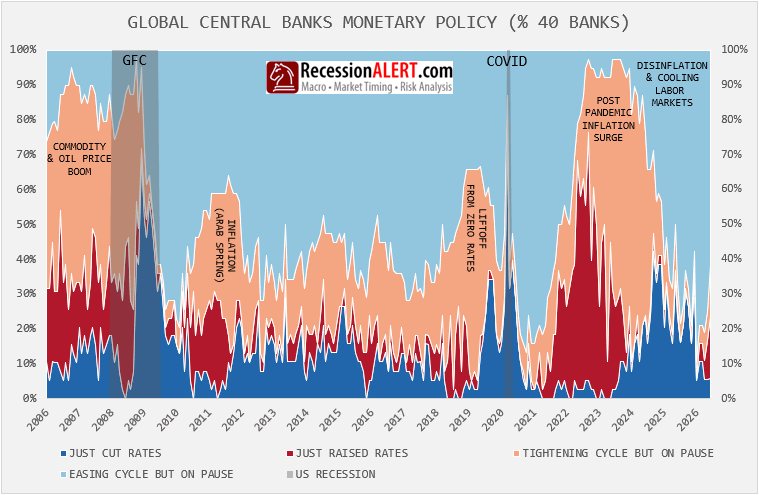
Room to ease, no reason to panic — and now the tide is turning. At its 2025 peak roughly 95% of the world’s ~40 central banks sat in the easing camp, breadth statistically indistinguishable from the GFC (97%) and COVID (92%) crisis reservoirs — except no recession bar sits beneath it. This was the only near-universal easing in the record chosen rather than forced, and it left a shallow footprint: the actively-cutting cohort peaked near 42%, barely half the 70–76% surges those downturns compelled. The mechanism explains the shortfall. Disinflation was largely won and labor cooled without breaking, so banks had cause to trim off the post-pandemic peak but no collapse demanding deep cuts. Now that same intact growth is pulling the first banks back. The whole formation has already rolled over — the easing camp breaking from 95% to about 68% and still falling — and the active margin has flipped hawkish: roughly 18% of banks raising against 6% cutting, both tightening cohorts climbing together, the first net-tightening margin since the 2022–23 hiking cycle. Read the dominant light-blue band correctly and it is not stimulus but a lagging reservoir — a snapshot still looks easy while the flow reverses. Margins lead levels, and the global liquidity tide that never fully came in is already going back out. The marginal central bank is now a buyer of dollars, not a seller.
Market Intelligence Brief (MIB) Ver. 18.42
For professional investors only. Not investment advice.
© 2026 RecessionALERT.com

Comments are closed.