
MARKET INTELLIGENCE BRIEF (MIB)
Thursday, July 9, 2026
Markets shrugged off a second day of US-Iran strikes as the S&P 500 gained 0.81% and Nasdaq 100 surged 1.62% on an AI-chip rally ahead of SK Hynix’s record $29B Nasdaq debut. NY Fed’s Williams named AI demand his top inflation fear, sending 2026 hike odds to 59% from 48%. Costco (COST) tumbled 4.2% on decelerating comps while oil fell 2.3% despite fresh strikes. State AGs moved to block the $110B Paramount-WBD merger while a 30-year auction drew record demand.
TABLE OF CONTENTS
A. EXECUTIVE SUMMARY
B. MARKET DATA
C. HIGH-IMPACT STORIES (4)
D. MODERATE-IMPACT STORIES (6)
E. ECONOMY WATCH (6)
F. EARNINGS WATCH (1)
G. WHAT’S NEXT
H. CHART OF THE DAY
A. EXECUTIVE SUMMARY -> TOP
Equities extended their advance for a sixth straight session even as U.S. forces struck roughly 90 Iranian targets for a second consecutive day, with markets treating the escalation as a contained pattern rather than a supply-shock risk — a read that hinges on Hormuz traffic staying open. That calm sits uneasily alongside NY Fed President Williams naming AI-driven demand his top inflation concern today, a comment that sent 2026 hike odds surging 11 points to 59% and directly ties the AI-capex cycle powering the semiconductor rally — ahead of Friday’s record $29B SK Hynix Nasdaq debut — to the Fed’s tightening path. The advance was broad, with Russell 2000 and NYSE Composite both participating, but the rotation beneath it was sharp: AI-infrastructure hardware rallied while high-multiple software (Palantir, IBM) and defensives (Costco) sold off, and Energy reversed hard despite oil’s growth-friendly decline on de-escalation bets.
• S&P 500 +0.81% to 7,543.55, Nasdaq 100 +1.62%, Dow +0.27% — semiconductor-led AI rally overshadowed a second day of US-Iran strikes.
• Oil fell despite fresh strikes — WTI -2.3% to $71.82, Brent -2.5% to $76.06 — as markets priced a bumpy path to Iran de-escalation.
• Fed’s Williams named AI-driven demand his top inflation risk; 2026 hike odds jumped to 59% from 48% — July 14 CPI and Chair Warsh’s testimony are the next catalysts.
• Costco (COST) -4.2% on June comps decelerating to 8.8% from May’s 12.5%; JPMorgan trimmed its price target to $1,100.
• SK Hynix’s record $29B Nasdaq debut (largest ADR listing in history, Friday July 10) drove a sector-wide chip rally — SanDisk +7.6%, Lam Research +6.0%, AMD +5.7%.
• State AGs preparing antitrust suit to block Paramount Skydance’s $110B Warner Bros. Discovery merger; Paramount shares fell 6%.
1. The AI-Capex Cycle Now Cuts Both Ways — The same AI-infrastructure buildout powering today’s semiconductor rally is the explicit inflation risk Williams flagged, entangling equity upside with the Fed’s tightening path; a capex slowdown or a hawkish surprise from Warsh’s July 14 testimony could hit both fronts at once.
2. Geopolitical Risk Is Being Priced as Contained, Not Existential — A second day of direct strikes drove oil down and equities up, a de-escalation bet that could unwind quickly if Hormuz traffic is disrupted or Iran targets export infrastructure.
3. Premium-Multiple Names Are the Marginal Casualty of Firming Rate Expectations — Costco, Palantir, and IBM all sold off on valuation sensitivity even amid a broad risk-on tape, a pattern likely to recur as the market digests next week’s CPI print and hike-odds repricing.
 — Leading economic indicators. Accurate market forecasts. Apply for membership at join.recessionalert.com
B. MARKET DATA -> TOP
Equities rallied broadly as investors looked past a fresh escalation in the US-Iran conflict, with the S&P 500 gaining 0.81% and the Nasdaq 100 surging 1.62% on a semiconductor-led AI rally ahead of SK Hynix’s Nasdaq debut Friday — Sandisk (+7.6%), Lam Research (+6.0%), and AMD (+5.7%) led gainers. Oil fell despite US airstrikes on 90 Iranian targets and Trump declaring the ceasefire “over,” with WTI down 2.3% as markets weighed a bumpy path to de-escalation against near-term risk. Consumer Defensive was the day’s weakest sector (-1.32%) as Costco tumbled 4.2% on decelerating comp sales, while gold, silver, and copper rallied together in a broad reflation trade. Treasury yields eased modestly (10Y -1.8bps) despite better-than-expected jobless claims, keeping the curve mildly steeper.
CLOSING PRICES – July 9, 2026:
MAJOR INDICES
Dow Theory’s bull confirmation is now entrenched in its sixth consecutive session, with DJIA and DJTA both within — or above — their 10-session highs. Today’s action skewed toward transports: DJTA surged 2.07% against DJIA’s 0.27%, a same-day divergence exceeding 1.5 points that reflects semiconductor and industrial strength rather than blue-chip laggards. Small-caps and mega-cap tech moved roughly in line with the S&P, keeping breadth broad rather than narrow — NYSE Composite’s 0.36% gain confirms the advance wasn’t confined to a handful of names.
| Index | Close | Change | %Move | Why It Moved |
|---|---|---|---|---|
| S&P 500 | 7,543.55 | +60.84 | +0.81% | AI/semiconductor rally offset Iran conflict escalation |
| Dow Jones | 52,487.44 | +139.05 | +0.27% | Blue-chips lagged the tech-led advance |
| DJ Transportation | 22,183.6 | +449.7 | +2.07% | Sharp outperformance drove Dow Theory bull confirmation |
| Nasdaq 100 | 29,727.10 | +474.54 | +1.62% | Semiconductor surge (SNDK, LRCX, AMD) ahead of SK Hynix Nasdaq debut |
| Russell 2000 | 2,992.60 | +36.21 | +1.22% | Tracked the broad market advance |
| NYSE Composite | 23,876.84 | +86.23 | +0.36% | Broad-based advance confirmed by composite gain |
VOLATILITY & TREASURIES
VIX’s 6.27% drop came alongside falling — not rising — yields, a goldilocks signature rather than the inflation-fear pattern that pairs equity calm with higher rates. The 2Y fell 2.9bps versus the 10Y’s 1.8bps, modestly steepening the curve as short-end cut expectations firmed following today’s benign jobless claims and Williams’ disinflation comments. DXY was essentially flat, arguing against a dollar-driven read on the session.
| Instrument | Level | Change | Why It Moved |
|---|---|---|---|
| VIX | 15.84 | -1.06 (-6.27%) | Markets shrugged off Iran strikes; risk appetite steady |
| 10-Year Treasury Yield | 4.549% | -1.8 bps | Eased on benign jobless claims, Williams’ disinflation comments |
| 2-Year Treasury Yield | 4.172% | -2.9 bps | Short-end led yields lower on stable labor data |
| US Dollar Index (DXY) | 100.94 | -0.06 (-0.05%) | Roughly flat; muted FX response to Iran news |
COMMODITIES
Gold, silver, platinum, and copper all rallied in lockstep — a broad reflation trade rather than a safe-haven flight, since equities rose alongside them rather than falling. Silver’s 3.01% gain outpaced gold’s 1.18%, tilting the move toward industrial-demand optimism over pure fear positioning. Bitcoin’s 1.87% gain tracked the equity advance, confirming rather than diverging from the day’s risk-on tone.
| Asset | Price | Change | %Move | Why It Moved |
|---|---|---|---|---|
| Gold | $4,130.55/oz | $+48.15 | +1.18% | Rebounded with broad metals complex on weaker-dollar reflation trade |
| Silver | $60.303/oz | $+1.763 | +3.01% | Outpaced gold on industrial-demand optimism |
| Copper | $6.2488/lb | $+0.1413 | +2.31% | Tracked the broad metals rally |
| Platinum | $1,620.35/oz | $+32.55 | +2.05% | Tracked the broad metals rally |
| Bitcoin | $63,261.0 | $+1,164.0 | +1.87% | Tracked equity risk-on tone |
ENERGY
WTI and Brent fell in near lockstep (-2.31%/-2.51%), a global rather than regional move as markets priced a “bumpy path” to Iran de-escalation despite fresh US strikes and Trump’s ceasefire reversal. Falling oil alongside rising equities is the growth-friendly read — lower input costs, not a stagflationary shock. Henry Hub plunged 6.29% on an above-average storage build outlook, decoupling entirely from crude, while Dutch TTF rose 2.20% — a clear US-Europe gas divergence.
| Asset | Price | Change | %Move | Why It Moved |
|---|---|---|---|---|
| Crude Oil (WTI) | $71.82/bbl | $-1.70 | -2.31% | Fell despite fresh US strikes on Iran; markets priced bumpy de-escalation path |
| Crude Oil (Brent) | $76.06/bbl | $-1.96 | -2.51% | Fell in lockstep with WTI on de-escalation bets |
| Natural Gas (Henry Hub) | $3.010/MMBtu | $-0.202 | -6.29% | Plunged on forecast for larger-than-normal weekly storage build |
| Natural Gas (Dutch TTF) | $16.78/MMBtu | $+0.38 | +2.32% | Rose on European supply tightness, diverging from US gas |
S&P 500 SECTORS
Energy’s weekly leadership (+4.21%) reversed sharply — today’s worst sector (-1.26%) and worst on the month (-5.54%), whipsawed by the oil selloff despite still leading on 6-month, YTD, and 12-month horizons. Technology, by contrast, extended its dominance across every window, topping today’s session (+1.70%) on top of a 24.05% three-month and 35.14% one-year run. Consumer Defensive’s session-worst -1.32% confirms a clean rotation out of safety.
| Sector | 1-Day | 1-Week | 1-Month | 3-Month | 6-Month | YTD | 12-Month |
|---|---|---|---|---|---|---|---|
| Technology | +1.70% | +0.76% | +0.20% | +24.05% | +19.54% | +21.63% | +35.14% |
| Consumer Cyclical | +1.38% | -0.06% | +1.44% | +5.02% | -5.62% | -3.62% | +5.41% |
| Basic Materials | +1.28% | -1.22% | -2.99% | -8.96% | +0.35% | +6.96% | +29.14% |
| Financial | +1.07% | +1.27% | +7.21% | +9.34% | +1.98% | +4.78% | +13.21% |
| Industrials | +0.77% | -2.10% | +1.79% | +4.64% | +10.78% | +16.50% | +23.21% |
| Real Estate | +0.26% | +0.18% | +2.09% | +5.49% | +8.15% | +9.50% | +8.02% |
| Communication Services | +0.13% | +0.12% | -0.23% | +6.46% | +4.65% | +4.58% | +34.94% |
| Healthcare | -0.03% | +1.82% | +8.47% | +8.86% | +3.81% | +6.34% | +22.25% |
| Utilities | -0.27% | +0.81% | +3.40% | -4.20% | +4.47% | +5.69% | +13.57% |
| Energy | -1.26% | +4.21% | -5.54% | -6.80% | +21.47% | +22.25% | +25.35% |
| Consumer Defensive | -1.32% | +0.32% | -0.25% | -1.70% | +6.31% | +6.09% | +3.73% |
TOP MEGA-CAP MOVERS:
GAINERS
| Company | Ticker | Close | Change | Why It Moved |
|---|---|---|---|---|
| Sandisk Corp | SNDK | 1857.81 | +7.56% | AI/memory demand rally ahead of SK Hynix’s Nasdaq debut Friday |
| Lam Research Corp | LRCX | 353.17 | +6.01% | Broad semiconductor-equipment rally on AI capex optimism |
| Advanced Micro Devices Inc | AMD | 546.72 | +5.67% | AI/semiconductor sector rally |
| Palo Alto Networks Inc | PANW | 338.31 | +5.53% | Rode broader AI/tech rally on strong FY26 guidance momentum |
| Marvell Technology Inc | MRVL | 243.33 | +5.01% | AI/semiconductor sector rally |
DECLINERS
| Company | Ticker | Close | Change | Why It Moved |
|---|---|---|---|---|
| Costco Wholesale Corp | COST | 912.75 | -4.24% | June comp sales decelerated to 8.8% from 12.5% in May, missed estimates; JPMorgan cut price target to $1,100 |
| Philip Morris International Inc | PM | 181.17 | -3.15% | Defensive-sector rotation amid broad risk-on tape |
| ExxonMobil Holdings Corp | XOM | 137.46 | -2.60% | Tracked the crude oil decline |
| Palantir Technologies Inc | PLTR | 129.06 | -2.39% | High-valuation software rotation, profit-taking, insider-sale concerns |
| International Business Machines Corp | IBM | 295.30 | -2.23% | High-valuation software/enterprise-tech pullback |
— Institutional-grade intelligence for serious investors. Apply for membership at join.recessionalert.comC. HIGH-IMPACT STORIES -> TOP
UNCERTAIN
1. US-Iran Ceasefire Collapse Enters Second Day of Strikes, But Markets Shrug It Off as Oil Falls and Equities Rally
The core facts:U.S. Central Command completed a second consecutive day of strikes on roughly 90 Iranian targets, aimed at further degrading Iran’s ability to threaten commercial shipping in the Strait of Hormuz. President Trump, speaking from the NATO summit in Ankara, reiterated the ceasefire memorandum is “over” and warned of further action; Iran responded with strikes on U.S.-allied targets in Kuwait and Bahrain. Despite the escalation, WTI fell 2.3% to roughly $71.85/bbl and Brent fell 2.5% to about $76.10, as markets priced a “bumpy path” toward eventual de-escalation and OPEC+’s ongoing output increases. Equities rallied through the news: the S&P 500 rose 0.81% to 7,543.64, the Nasdaq Composite gained 1.30%, and the Dow added 0.27%, with the move led by a semiconductor-driven risk-on tape rather than defensive positioning.
Why it matters:The disconnect between a second day of direct military escalation and a broad equity rally is itself the signal: markets are treating the conflict as a contained, non-escalatory pattern rather than a supply-shock risk, a materially different read than yesterday’s session when the first round of strikes sent the Dow down over 1% and oil surging more than 4%. That reassessment is fragile — it depends on Hormuz traffic (roughly 20% of global oil volume) staying open and on Iran not following through on threats against export infrastructure. A reversal of this “de-escalation” pricing would hit both the energy-cost assumptions embedded in the Fed’s inflation outlook and the AI-capex-driven equity rally simultaneously.
What to watch:Whether Hormuz tanker traffic is physically disrupted in coming sessions, and whether Iran acts on threats against Kharg Island export terminal or a strait blockade — either would force a rapid repricing of today’s calm.
BULLISH
2. Semiconductor Complex Surges as SK Hynix’s Record $29B Nasdaq Debut Nears, Overshadowing Iran Conflict
The core facts:The SOX index rose 3.1% and the SMH ETF gained 2.5% as investors positioned ahead of SK Hynix’s Nasdaq debut on Friday, July 10 — the largest ADR listing in history at roughly $29 billion (reports indicate demand was more than seven times oversubscribed), which will value the memory-chip maker near $1 trillion on the back of its dominant ~57-58% share of the global high-bandwidth-memory market. Individual movers included SanDisk (+7.6%), AMD (+7.75%, reversing a multi-day slide), Marvell (+5-6.5%), Lam Research (+6.0%), Lumentum (+11.87%), and Corning (+7.02%). Micron separately rose more than 7% after committing up to $3 billion to expand its U.S. semiconductor manufacturing footprint. The rally was strong enough to lift the Nasdaq Composite 1.30% even as broader markets digested the Iran escalation.
Why it matters:SK Hynix’s listing is a direct read on whether the market can still finance the AI-infrastructure buildout at current valuations — Fortune has framed it as a test of “boom or bust” sentiment for the entire memory-chip complex. That the rally extended broadly across memory, optical, and packaging names (not just SK Hynix’s direct peers) signals investors are treating this as validation of the AI-capex cycle’s durability, not an isolated stock event, and it was strong enough on its own to override the day’s geopolitical risk-off impulse.
What to watch:SK Hynix’s opening trade and first-day performance on Friday, July 10, as a read-through for the broader AI-memory complex; any follow-on read-across to Micron and Samsung.
UNCERTAIN
3. Fed’s Williams Names AI-Driven Demand as Top Inflation Risk, Sending Rate-Hike Odds Sharply Higher
The core facts:New York Fed President John Williams — traditionally a centrist voice on the FOMC — said today that AI-driven demand is now his primary inflation concern and that the Fed “won’t look through” a sustained AI-driven demand-supply gap (full remarks in Section E). The market reaction was immediate and sizable: Polymarket-implied odds of at least one 2026 rate hike jumped 11 percentage points in a single session to 59%, while CME FedWatch put the odds of a hold at the July 29 meeting down to roughly 69.5% from 80% a week ago.
Why it matters:A centrist voter explicitly validating the hawkish minority view — one day after June’s minutes showed nine of eighteen officials already eyeing a hike — meaningfully raises the odds that Chair Warsh’s committee tightens further this year. For portfolio managers, the notable shift is the inflation transmission channel itself: Williams is framing AI infrastructure spending (not tariffs or energy) as the structural, harder-to-reverse driver, which entangles the Fed’s forward path directly with the same AI-capex cycle currently powering the equity rally in Story 2 — a linkage that raises the stakes of any AI-spending slowdown for both growth and policy.
What to watch:The July 14 CPI print and Fed Chair Warsh’s same-day testimony — both are high-probability catalysts for a further hike-odds repricing in either direction.
BEARISH
4. State AGs Prepare Antitrust Suit to Block $110B Paramount Skydance-Warner Bros. Discovery Merger
The core facts:Reuters reported that California, New York, Pennsylvania and roughly ten other states are finalizing an antitrust lawsuit aimed at blocking Paramount Skydance’s approximately $110 billion acquisition of Warner Bros. Discovery, arguing the combination would harm competition across entertainment and news. Paramount Skydance shares fell 6% on the news; the company has publicly denied the competitive-harm allegations and is separately seeking to have earlier private litigation over the deal dismissed.
Why it matters:This would be one of the largest media mergers on record, and a coordinated multi-state suit — layered on top of the DOJ’s existing Second Request review — materially raises the odds of a prolonged legal fight or a forced restructuring of deal terms. For media and communications investors, it reinforces that antitrust enforcement remains an active constraint on large-scale consolidation even amid a generally permissive M&A environment elsewhere in the market.
What to watch:Formal filing of the state lawsuit, expected within weeks; any DOJ Second Request outcome or divestiture requirement that could emerge in parallel.
— Quantifying recession risk so you don’t have to guess. Apply for membership at join.recessionalert.comD. MODERATE-IMPACT STORIES -> TOP
BEARISH
5. Costco Falls 4.2% as June Comp Growth Decelerates and JPMorgan Trims Price Target
The core facts:Costco fell 4.24% after reporting June comparable-sales growth of 8.8% (for the five weeks ended July 5), decelerating from May’s 12.5% pace and missing Telsey’s 10.6% estimate, despite headline net sales of $29.24 billion (+10.6% YoY) and U.S. comps of 10.6%. JPMorgan’s Christopher Horvers maintained his Overweight rating but trimmed the price target to $1,100 from $1,110, citing the deceleration against Costco’s still-elevated 42-48x forward P/E.
Why it matters:Costco trades at a valuation that leaves little room for anything short of consistent acceleration, so even a still-healthy 8.8% comp print reads as a disappointment when priced for perfection. The reaction is a useful read on how the market is treating premium-multiple consumer names generally as rate expectations firm — the same dynamic playing out in Story 6 below.
What to watch:July comparable sales data (early August) to determine whether June marks a one-month deceleration or a new trend.
BEARISH
6. Palantir Falls Another 4% as Valuation-Driven Software Rotation Continues
The core facts:Palantir shares fell roughly 4% today (extending a decline that has brought the stock down about 29-40% year-to-date from its 2026 highs), part of a broader enterprise-software and cybersecurity sell-off distinct from the hardware/semiconductor-led rally in Story 2. The move was driven by continued profit-taking on Palantir’s premium valuation, modest insider-sale disclosures, and renewed risk-off pressure from the Iran escalation weighing disproportionately on high-multiple names.
Why it matters:The divergence between AI-infrastructure hardware names (rallying) and AI-adjacent software/application names (selling off) shows investors are discriminating within the AI trade rather than treating it as a single basket — a rotation pattern likely to persist as rate expectations firm and premium multiples come under scrutiny.
What to watch:Whether the software-sector selloff broadens to other high-multiple names (Snowflake and peers have faced similar pressure) or stabilizes as an isolated Palantir valuation correction.
UNCERTAIN
7. Henry Hub Natural Gas Plunges 6.3% as Storage Build Overshoots Forecasts
The core facts:Henry Hub natural gas futures fell 6.29% after the EIA reported a 61 Bcf storage injection for the week ended July 3 — above the roughly 49-51 Bcf consensus — pushing total working gas in underground storage to 2,983 Bcf, some 185 Bcf above the five-year average. The move decoupled entirely from crude oil (which fell on Iran-conflict de-escalation pricing, per Story 1), while European Dutch TTF gas rose 2.2% on separate regional supply tightness.
Why it matters:The bigger-than-expected build signals ample domestic supply heading into peak summer cooling demand, a modest positive for utility input costs and power-sector margins even as the broader energy complex whipsaws on geopolitical headlines. The US/Europe divergence also underscores that domestic gas markets are currently insulated from the international supply disruptions playing out in Story 8 below.
What to watch:Next week’s EIA storage report for confirmation of the above-average build trend heading into the July-August demand peak.
UNCERTAIN
8. Fed Chair Warsh Names Task Force Leaders Including Marc Andreessen, Doug McMillon in Sweeping Operations Review
The core facts:Fed Chair Kevin Warsh announced leadership of five task forces of outside experts tasked with rethinking core aspects of how the Fed conducts monetary policy, with recommendations due by year-end. Andreessen Horowitz co-founder Marc Andreessen will co-lead the group evaluating the Fed’s approach to the labor market, productivity, and AI; former Walmart CEO Doug McMillon will co-lead a task force on improving the quality and timeliness of the economic data underpinning Fed policy decisions, alongside Harvard’s Raj Chetty and the University of Chicago’s Kevin Murphy.
Why it matters:This is a structural governance move by a new Fed chair already reshaping communication norms (Warsh withheld his own dot-plot at the June meeting). Andreessen’s specific mandate — labor market, productivity, and AI — directly overlaps with the AI-driven-inflation debate central to Story 3, meaning private-sector AI-investment voices will now have a formal channel into how the Fed models this risk. The market implication is longer-dated and structural rather than an immediate price catalyst.
What to watch:Task force recommendations due by year-end 2026; any interim commentary from Andreessen or McMillon on AI’s role in the Fed’s inflation framework.
BULLISH
9. 30-Year Treasury Auction Draws Blowout Foreign Demand Despite Highest Yield Since 2007
The core facts:Today’s $22 billion 30-year bond auction cleared at the richest yield since 2007, yet stopped through for the first time since March with a bid-to-cover of 2.44 versus the 2.39 six-auction average — foreign (indirect) bidders took the second-highest share on record (full auction detail in Section E).
Why it matters:The result is a genuinely reassuring signal for long-duration U.S. credit at a moment when hike odds are rising (Story 3): investors are willing to lock in current multi-decade-high yields rather than demanding further concessions, suggesting fiscal-deficit and rate-path concerns have not yet undermined foreign appetite for Treasurys. That combination — elevated cost of capital alongside strong demand — argues against a near-term “yields spiraling out of control” scenario that would pressure equity multiples further.
What to watch:Whether foreign demand holds up at upcoming long-end auctions if Fed hike-odds repricing continues.
UNCERTAIN
10. Global Diesel Squeeze Intensifies as Russia’s Export Ban Meets a Sharp US Distillate Draw
The core facts:Today’s EIA weekly petroleum report showed a 5.0 million-barrel draw in U.S. distillate (diesel) inventories to 103.6 million barrels, confirming a sharp domestic tightening that compounds Russia’s July 8 ban on all diesel exports (roughly 11% of global supply) imposed after Ukrainian drone strikes hit Russian refineries. U.S. ultra-low-sulfur diesel futures posted their biggest daily gain in four years (+11.6%) on the news, and European diesel margins hit a record $60.17/bbl.
Why it matters:Diesel is the transport-and-freight input cost that feeds most directly into broader goods inflation, and a global squeeze layered on top of the Iran-driven crude volatility in Story 1 creates a second, distinct energy-cost channel for the Fed’s inflation calculus to contend with — one not directly tied to Middle East de-escalation prospects. Refiners with distillate-heavy output could see margin support, while transport, logistics, and airline names face a fresh input-cost headwind.
What to watch:Whether Russia’s ban (in effect through July 31) is extended or lifted early; next week’s EIA distillate data for confirmation of the drawdown trend.
— Separating signal from noise since 2007. Apply for membership at join.recessionalert.comE. ECONOMY WATCH -> TOP
Today’s data split along a familiar fault line: labor stayed resilient (claims fell to 215K, beating estimates) while inflation expectations and Fed rhetoric turned more hawkish. Williams named AI-driven demand his top inflation worry and warned the Fed won’t “look through” it, and Polymarket-implied hike odds jumped 11 points to 59% in a single session — markets catching up to Wednesday’s hawkish FOMC minutes. Housing continued to cool (existing home sales missed, -2.4% MoM) even as a 30-year Treasury auction at the highest yield since 2007 drew unusually strong foreign demand. The NY Fed’s survey crystallizes the tension: consumer inflation expectations hit multi-year highs even as job-loss fears eased.
Existing Home Sales Fall to 4.09M in June, Missing Estimates as Prices Hit Record High (National Association of Realtors, July 9, 2026)
What they’re saying:Existing home sales fell 2.4% month-over-month in June to a seasonally adjusted annual rate of 4.09 million units, below the 4.20 million consensus estimate and down from May’s 4.19 million pace. The median existing-home price climbed to a record $440,600, up 1.8% year-over-year, even as elevated mortgage rates kept buyers on the sidelines.
The context:NAR’s own affordability index actually improved to 102.3 in June from 95.5 a year ago, and the print is still up 2.8% versus June 2025 — evidence the housing market remains a two-speed story of improving affordability but rate-sensitive month-to-month demand. Chief Economist Lawrence Yun attributed the swing to buyers’ continued sensitivity to small moves in mortgage rates.
What to watch:New and pending home sales data over the next two weeks for confirmation of the June softening; the 30-year mortgage rate (6.49% as of today) for any relief that could unlock pent-up demand.
Jobless Claims Fall to 215K, Beating Forecasts as Treasury Yields Ease on Mideast Tensions (Department of Labor, July 9, 2026)
What they’re saying:Initial jobless claims for the week ended July 4 came in at 215,000, below the 218,000 consensus and down from the prior week’s revised 217,000. The four-week moving average eased to 218,750 from 222,500, continuing a gradual downtrend.
The context:The beat reinforces the view that the labor market remains resilient even as other data show pockets of softness. Treasury yields fell in the session — the 10-year down more than 2 basis points to 4.543% — as traders balanced the constructive claims print against renewed Iran-related geopolitical tension.
What to watch:Continuing claims (1,814,000, still elevated versus the cycle) for signs re-employment is slowing; the July nonfarm payrolls report due in early August.
Fed’s Williams Names AI-Driven Demand as Top Inflation Risk, Warns Fed Won’t “Look Through” It (Federal Reserve Bank of New York, July 9, 2026)
What they’re saying:New York Fed President John Williams said artificial-intelligence-related demand is now his primary inflation concern, warning that if AI investment creates a sustained gap between demand and supply, “that’s the kind of situation where you don’t look through this.” He separately said he does not expect a sustained surge in energy prices despite renewed Middle East hostilities.
The context:Williams is traditionally viewed as a centrist voice on the FOMC, so his explicit warning that AI-driven inflation could force the Fed’s hand adds weight to Wednesday’s hawkish June minutes and today’s jump in market-implied hike odds. It reframes the inflation debate away from tariffs and energy toward a structural, harder-to-reverse AI capex/demand channel.
What to watch:Incoming capex and AI-investment data for evidence of a “sustained impulse”; the next FOMC statement’s language on inflation risk balance.
Polymarket Traders Push 2026 Fed Rate-Hike Odds to 59%, Up 11 Points in a Week (Polymarket, July 9, 2026)
What they’re saying:The probability of at least one Fed rate hike in 2026, as priced on Polymarket, rose to 59% from 48% in the prior session — an 11-percentage-point jump. On the more granular “how many hikes” market, “1 hike (25bps)” is now the frontrunner at 47%, versus “0 hikes” at 41%.
The context:The repricing follows Wednesday’s June FOMC minutes showing nine of eighteen officials still eyeing a hike, and now Williams’ hawkish AI-inflation comments — market positioning is catching up to the Fed’s own dot plot. Odds of at least one cut this year held roughly steady at 22% (vs. 21% prior), underscoring that the swing is specifically a hike repricing, not merely a “no cuts” shift.
What to watch:Next week’s CPI print (Jul 14) and Fed Chair Warsh’s same-day testimony — both are high-probability catalysts for a further repricing in either direction.
30-Year Treasury Auction Clears at 5.058%, Highest Since 2007, on Blowout Foreign Demand (U.S. Treasury, July 9, 2026)
What they’re saying:The Treasury sold $22 billion of 30-year bonds at a high yield of 5.058% — the richest level since 2007 — but the auction stopped through (priced 0.3bp below the when-issued yield) for the first time since March, with a bid-to-cover ratio of 2.44 versus a 2.39 six-auction average. Indirect (foreign) bidders took 77.7% of the auction, the second-highest share on record.
The context:The combination of a multi-decade-high yield and unusually strong demand is a genuinely mixed signal: elevated long-end yields raise the cost of capital for equities and credit, but the stop-through pricing and record foreign appetite suggest investors are willing to lock in current yields rather than demanding further concessions — a vote of confidence in U.S. long-duration debt even as hike odds rise.
What to watch:Whether foreign demand persists at upcoming auctions if Fed hike odds continue climbing.
NY Fed Survey: Consumer Inflation Expectations Hit Multi-Year Highs Even as Job-Loss Fears Ease (Federal Reserve Bank of New York, July 7, 2026)
What they’re saying:The NY Fed’s June Survey of Consumer Expectations showed one-year-ahead inflation expectations rising 0.2 points to 3.7% — the highest since September 2023 — and three-year expectations up 0.2 points to 3.3%, the highest since June 2022. Five-year expectations held at 3%.
The context:The inflation read cuts against the labor and household-finance components of the same survey, which improved: expected earnings growth ticked up, perceived odds of job loss fell, and the share of households expecting to miss a debt payment dropped to its lowest since April 2023. The split mirrors today’s broader theme — a resilient consumer/labor backdrop colliding with stickier inflation expectations, reinforcing the case for a more hawkish Fed reaction function.
What to watch:July’s Survey of Consumer Expectations (due early August); the July 14 CPI print, which will test whether realized inflation is validating consumer expectations.
— Know the probability before the market prices in the risk. Apply for membership at join.recessionalert.comF. EARNINGS WATCH -> TOP
YESTERDAY AFTER THE BELL (Markets Reacted Today)
No major earnings yesterday after the bell from companies with >$100B market cap.
TODAY BEFORE THE BELL (Markets Already Reacted)
UNCERTAIN
11. PepsiCo (PEP): -3.26% | Beats on EPS and Revenue, But Margin Contraction and Cautious North America Outlook Weigh
The Numbers:Revenue of $24.18B beat the $23.95B estimate (+0.98% surprise); adjusted EPS of $2.20 beat the $2.19 estimate; GAAP EPS of $2.18 beat the $2.16 estimate. The company reaffirmed full-year 2026 guidance of 2-4% organic revenue growth and 4-6% core constant-currency EPS growth. Released: BMO.
The Problem/Win:Despite the top- and bottom-line beat, core operating margins contracted roughly 40 basis points and North American demand remained weak as inflation-pressured consumers pulled back, offsetting stronger international volume growth. Investors focused on the margin pressure and a more cautious tone on the balance of the year rather than the headline beat.
The Ripple:The reaction adds to a broader pattern (alongside Costco in Story 5) of the market discounting consumer-staples and discretionary names on margin and demand softness even when headline numbers clear the bar.
What It Means:The reaffirmed guidance suggests management does not see a structural deterioration, but the market is signaling reduced tolerance for margin softness in staples names amid a still-pressured North American consumer.
What to watch:Commentary on North American pricing and volume trends at the next earnings call; whether input-cost inflation (including from Story 10’s diesel squeeze) pressures margins further in H2.
TODAY AFTER THE BELL (Markets React Tomorrow)
No major earnings after the bell from companies with >$100B market cap.
WEEK AHEAD PREVIEW:
Q1 2026 earnings season is complete. Q2 2026 earnings season opens Tuesday, July 14, with the four largest U.S. banks reporting before the bell — the traditional kickoff that sets the tone for the broader season.
JPMorgan Chase (JPM) — BMO, Tue Jul 14 — Consensus ~$5.58 EPS on ~$51.1B revenue (+10.7% EPS, +8.5% revenue YoY); as the season’s first mega-cap reporter, results and management commentary on loan growth and trading revenue will set the tone for the entire bank complex.
Bank of America (BAC) — BMO, Tue Jul 14 — Consensus ~$1.13 EPS on ~$30.7B revenue (estimate raised ~2.2% over the past month); focus on net-interest-income trajectory as the yield curve stays flat under a hawkish Fed.
Goldman Sachs (GS) — BMO, Tue Jul 14 — Consensus ~$14.47 EPS on ~$16.2B revenue; trading and investment-banking revenue will be watched closely given elevated market volatility from the Iran conflict (Story 1) and the SK Hynix listing wave (Story 2).
Wells Fargo (WFC) — BMO, Tue Jul 14 — Consensus ~$1.72 EPS on ~$21.9B revenue (estimates trimmed ~1% recently, reflecting margin pressure); key focus is progress on its post-asset-cap growth pivot.
Citigroup (C) — BMO, Tue Jul 14 — Consensus ~$2.74 EPS on ~$23.7B revenue; markets/banking segment trends and continued progress on the multi-year restructuring plan are the key focus.
Sector-wide, Zacks projects Q2 Investment Banks/Managers industry earnings up +10.4% YoY on +10.7% higher revenues, with bulls citing accelerating loan growth and bears flagging a flatter yield curve and private-credit competition as headwinds.
— US market commentary trusted by family offices and institutions. Apply for membership at join.recessionalert.comG. WHAT’S NEXT -> TOP
UPCOMING RELEASES:
| Date | Event | Why It Matters |
|---|---|---|
| Mon, Jul 13 | Monthly Budget Statement (prior -$293B) | Fiscal deficit trend read, relevant backdrop for the Treasury’s financing needs after this week’s strong long-end auction demand |
| Tue, Jul 14 | ADP Employment Change (prior 21.0K) | Early labor-market signal ahead of the more market-moving CPI print the same day |
| Tue, Jul 14 | CPI / Core CPI MoM & YoY (prior Core YoY 2.9%, Core MoM 0.2%) | Highest-probability catalyst for further repricing of 2026 hike odds, which already jumped to 59% this week on Williams’ AI-inflation warning |
| Tue, Jul 14 | Fed Chair Warsh Testimony | Same-day as CPI — Warsh’s tone on the AI-driven inflation debate and rate path will be read directly against the print |
| Tue, Jul 14 | Fed Goolsbee Speech | Additional FOMC voice on the AI-driven inflation debate opened by Williams this week |
KEY QUESTIONS:
1. Does next week’s CPI print validate or undercut the market’s fresh 59% hike-odds repricing, and how does Chair Warsh’s same-day testimony shape that read?
2. Can equities keep pricing the Iran conflict as contained if Hormuz tanker traffic sees any physical disruption in the coming sessions?
3. Does the semiconductor rally hold through SK Hynix’s Friday debut, or does a soft opening trade reset AI-capex valuation assumptions across the complex?
— US market commentary trusted by family offices and institutions. Apply for membership at join.recessionalert.comH. CHART OF THE DAY -> TOP
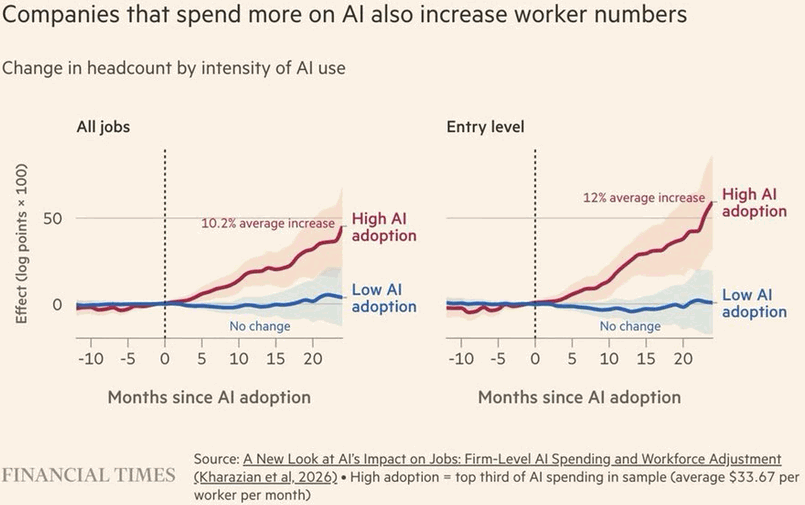
The feared-first casualty is growing fastest. Across ~21,600 US firms, the entry-level roles everyone insists AI will automate away first are, in this data, expanding most: firms in the top third of AI spending added 12% to entry-level headcount over the two years after adoption, outpacing the 10.2% they added overall. The right panel climbs above the left. That inverts the class-of-2026 apocalypse thesis. At these firms AI reads as a scale play, not a severance plan — the threshold is a trivial $33.67 per worker per month, so heavy adoption means leaning into growth and needing more hands to deploy the tools. Complement, not substitute. Read the caveat honestly: this is an event study on self-selected adopters — larger, VC-backed, engineering-heavy firms already growing faster than peers. AI may mark a winner, not make one; the flat pre-period hides a steeper trajectory all along. But the direction cuts hard against Wall Street. The loudest AI trade underwrites margin expansion through headcount substitution — software eats the wage bill. This is firm-level evidence against that mechanism. And note the tell: divergence opens only around month 5. A 24-month window may catch just the early, complementary phase; substitution, if it comes, surfaces later, outside this frame. AI cannot be both the jobs apocalypse policymakers fear and the headcount-cut bonanza equity models assume. Underwrite one, and stop expecting the other.
Market Intelligence Brief (MIB) Ver. 18.42
For professional investors only. Not investment advice.
© 2026 RecessionALERT.com

Comments are closed.