
MARKET INTELLIGENCE BRIEF (MIB)
Monday, June 29, 2026
The Supreme Court preserved Fed independence 5-4 (Lisa Cook stays) while overturning Humphrey’s Executor 6-3, sending the Nasdaq 100 to a 2.26% gain. NVIDIA’s $3.2B Corning AI deal drove GLW +15.7% and SOXX +3.76% as Alphabet debuted on the Dow, crossing 52,000. Iran’s ‘stand down’ unwound gold -1.60% but Doha talks Tuesday face structural friction. Pantheon projects Thursday’s NFP at 75K vs 172K in May — stagflation signal crystallizing. Strategy plans to sell $1.25B in Bitcoin, flipping BTC supply negative.
TABLE OF CONTENTS
A. EXECUTIVE SUMMARY
B. MARKET DATA
C. HIGH-IMPACT STORIES (5)
D. MODERATE-IMPACT STORIES (7)
E. ECONOMY WATCH (5)
F. EARNINGS WATCH (0)
G. WHAT’S NEXT
H. CHART OF THE DAY
A. EXECUTIVE SUMMARY -> TOP
Equities rallied in a narrow, AI-concentrated session: the Nasdaq 100 surged 2.26% as the Supreme Court’s 5-4 ruling preserving Federal Reserve independence — Governor Lisa Cook stays while the underlying case continues — provided the institutional relief that underpinned broad risk appetite. NVIDIA’s $3.2 billion commitment to Corning’s AI optical infrastructure and Russell reconstitution rebalancing drove semiconductor equipment names 10–15% higher, confirming the AI capex supercycle as the structural market engine despite last week’s selloff. The session’s critical warning signal is the bond market’s non-confirmation: 2-year yields rose 1.8 bps alongside the equity rally, pricing near-term inflation risk from Strait of Hormuz supply uncertainty rather than endorsing growth confidence. Six of 11 S&P 500 sectors closed green; communication services and technology drove the overwhelming majority of gains while the Russell 2000’s near-flat finish (+0.07%) confirms this was mega-cap tech concentration, not a broad-based recovery.
• SCOTUS 6-3 overturns Humphrey’s Executor — FTC, CFPB, FERC, and NLRB leaders now removable at will by the President; separately, a 5-4 majority kept Fed Governor Lisa Cook in place, deferring FOMC board composition risk to lower courts. Net read: broadly bullish for corporate M&A (Trump-aligned FTC less likely to block deals) and broadly uncertain for energy permitting (FERC), financial regulation (CFPB), and labor relations (NLRB).
• Nasdaq 100 +2.26%, S&P 500 +1.17%, Dow 52,182 (record) — AI capex surge drove GLW +15.7%, KLAC +12.0%, AMAT +10.8%, WDC +11.2%, SOXX +3.76%; Alphabet (GOOGL +4.96%) debuted on the Dow, replacing Verizon (VZ -5.24%). Six of 11 S&P 500 sectors advanced — gains concentrated in mega-cap tech and communication services.
• Critical data sequence this week: Fed Chair Warsh speaks Wednesday Jul 1 (9 AM ET); June NFP Thursday Jul 2 (8:30 AM ET) — Pantheon projects 75K vs 172K in May, the weakest print since 2023. Bimodal rate pricing: 55% September cut + 52% September hike simultaneously — the week’s most important risk sequence for duration-sensitive assets.
• US-Iran “stand down” — Doha bilateral talks Tuesday, but Iran’s technical experts won’t participate, limiting the framework’s scope. WTI +1.72% on Strait skirmish fears vs Brent -0.26% on ceasefire talk; gold -1.60% unwound safe-haven premia. JPMorgan and Citi independently project ~4M bbl/day global crude oversupply by 2027 as Iranian and US production return to market simultaneously — structural ceiling for energy equities even on a successful deal.
• Space sector institutionalizing: SpaceX (SPCX) joins the Nasdaq-100 effective July 7 — second forced-buy event in two weeks after Russell 1000 inclusion; Rocket Lab acquires Iridium in an $8B deal (RKLB +15.9%, IRDM +25.4%), creating a vertically integrated launch + constellation + services platform with pole-to-pole global coverage.
• Bitcoin supply picture shifts negative: Strategy (MSTR) plans to sell up to $1.25B in Bitcoin — the largest single institutional liquidation since accumulation began in 2020 — adding supply overhang on top of $1.35B in Bitcoin spot ETF outflows last week. Rising real yields (Core PCE 3.4%, Kashkari rate hike projection) compress BTC versus 4%+ money market returns.
1. Fed Independence vs. Fiscal Dominance — Today’s 5-4 SCOTUS ruling preserved the FOMC’s institutional firewall for now, but the underlying presidential removal case proceeds in lower courts — FOMC board composition risk is deferred, not resolved. Meanwhile, Treasury’s $1.9 trillion FY2026 deficit projection (5.8% of GDP) with no fiscal consolidation signal competes directly with the Warsh Fed’s hawkish rate bias for 10-year term premium. Rising 2-year yields on a broad risk-on day is the bond market’s notation of that structural tension: fiscal expansion and monetary tightening are pulling in opposite directions, and the 2Y/10Y spread at -27.1 bps reflects the market’s confusion about which force wins.
2. AI Capex Supercycle vs. Macro Deceleration — NVIDIA’s $3.2B Corning commitment, SOXX on pace for a record quarterly gain, SpaceX’s dual Russell/Nasdaq-100 inclusion, and Rocket Lab’s $8B Iridium acquisition collectively signal accelerating AI and space infrastructure investment precisely as broader macro indicators stall: Pantheon’s 75K NFP forecast, Dallas Fed stalling at zero, and consumer sentiment at 49.5 all point to a two-speed economy. Portfolio positioning must navigate the paradox: overweight mega-cap tech captures today’s rally, but the rising yields that bond non-confirmation is flagging will eventually compress growth multiples if the stagflation scenario materializes Thursday.
3. Iran De-Escalation — Priced for Perfection — Markets priced the “stand down” as durable peace: gold -1.60%, VIX -4.13%. But WTI +1.72% on the same day reflected genuine Strait of Hormuz supply risk that equity markets chose to discount. Tuesday’s Doha talks face a structural obstacle (Iran’s technical experts absent), and JPMorgan/Citi’s ~4M bbl/day oversupply projection frames the ceiling for energy equities even on a successful deal. The energy sector’s -0.33% decline on a broad risk-on day is the market’s own signal: it trusts the ceasefire enough to sell gold, but not enough to re-rate energy stocks.
 — Leading economic indicators. Accurate market forecasts. Apply for membership at join.recessionalert.com
B. MARKET DATA -> TOP
NVIDIA’s $3.2 billion commitment to Corning’s AI optical infrastructure and Alphabet’s Dow Jones debut — replacing Verizon — drove a concentrated Mag7 rally that pushed the Nasdaq 100 up 2.26% while the Russell 2000 barely moved (+0.07%); only 6 of 11 sectors closed green, confirming this was a tech-concentration story, not broad-based strength. The session’s cleanest anomaly was the WTI/Brent split: US crude rose +1.72% on intraday Iran/Strait skirmish fears while Brent fell -0.26% as ceasefire talk held — compressing the spread from ~$4.43 to $3.05, signaling US-specific supply risk rather than a global energy trade. Gold’s -1.60% decline confirmed safe-haven unwinding from the Iran “stand down,” though 2Y yields rose +1.8 bps alongside the equity rally — bond non-participation that portfolio managers should note heading into a data-heavy week.
CLOSING PRICES – Monday, June 29, 2026:
MAJOR INDICES
Today’s rally was narrow: Nasdaq 100 surged 2.26% as AI capex and Alphabet’s Dow debut drove mega-cap tech, while the Russell 2000 gained just 0.07% — the session’s starkest index divergence. The Dow crossed 52,000 for the first time, partly a mechanical effect of Alphabet’s price-weighted addition replacing Verizon. No Dow Theory divergence signals crossed threshold today (DJIA/DJTA same-day spread: 0.14%). The 10-session breadth signal remains constructive: Russell 2000 has outperformed S&P 500 by 2.2% over the past 10 sessions — now in its fourth consecutive session of that signal — affirming medium-term broad market participation even as today’s gains concentrated sharply in mega-cap tech.
| Index | Close | Change | %Move | Why It Moved |
|---|---|---|---|---|
| S&P 500 | 7,440.27 | +86.25 | +1.17% | NVIDIA/Corning AI deal and Alphabet’s Dow debut drove Mag7 tech surge; Iran “stand down” boosted risk appetite broadly |
| Dow Jones | 52,182.08 | +305.97 | +0.59% | Alphabet replaced Verizon in the Dow; index crossed 52,000 for the first time; blue-chip gains more moderate than tech-heavy benchmarks |
| DJ Transportation | 21,924.8 | +99.00 | +0.45% | Moderate risk-on gains; industrials and transports lagged the mega-cap tech surge; Iran ceasefire talk eased logistics disruption concerns |
| Nasdaq 100 | 29,774.75 | +656.51 | +2.26% | NVIDIA’s $3.2B Corning AI optical deal; Alphabet +4.96%, Tesla +8.45%, Amazon +3.18% drove the largest single-day gain vs peers |
| Russell 2000 | 3,012.19 | +2.11 | +0.07% | Small caps barely participated; session concentrated in mega-cap tech and AI capex names; AI data center story did not lift small-cap names |
| NYSE Composite | 23,802.71 | +113.48 | +0.48% | Broad market advanced on risk-on sentiment; composite gain moderates the headline index performance — advances outnumbered declines |
VOLATILITY & TREASURIES
VIX fell 4.13% as Iran tensions temporarily eased, but bond markets didn’t confirm the risk-on tone: 10Y and 2Y yields both rose (+0.9 and +1.8 bps respectively) alongside the equity rally — a bond non-participation pattern. The short end outpacing the long nudged the 2Y/10Y spread 0.9 bps toward steepening; still deeply inverted at -27.1 bps, signaling near-term inflation repricing (WTI up on Strait fears) rather than growth enthusiasm. DXY -0.25% reflects risk-on positioning but is too modest to signal a decisive safe-haven reversal.
| Instrument | Level | Change | Why It Moved |
|---|---|---|---|
| VIX | 17.65 | -0.76 (-4.13%) | Iran “stand down” and tech rally compressed near-term fear premium; remains elevated above recent post-Iran-deal lows |
| 10-Year Treasury Yield | 4.378% | +0.9 bps | Bond market cautious; yields ticked up despite equity gains — partial non-confirmation of the risk-on move |
| 2-Year Treasury Yield | 4.107% | +1.8 bps | Short end rising faster than the long end; near-term inflation repricing on WTI surge and Strait of Hormuz supply uncertainty |
| US Dollar Index (DXY) | 101.11 | -0.25 (-0.25%) | Mild dollar weakness on risk-on sentiment; not a decisive safe-haven reversal; consistent with moderate risk appetite |
COMMODITIES
Gold (-1.60%) and silver (-1.54%) fell in lockstep as Iran’s “stand down” unwound safe-haven premia — a clean geopolitical unwind, not an inflation signal. Platinum’s -3.28% drop is the session’s structural outlier, extending PGM demand weakness from an auto industry slowdown that today’s catalyst did not touch. Copper’s mild -0.55% decline declined to confirm the AI/growth narrative; base metals are not yet pricing the AI data center demand story. Bitcoin +1.53% tracked equities as a pure risk-on proxy — no independent crypto catalyst, confirming risk-asset rather than safe-haven behavior today.
| Asset | Price | Change | %Move | Why It Moved |
|---|---|---|---|---|
| Gold | $4,030.70/oz | -$65.60 | -1.60% | Iran “stand down” dismantled geopolitical safe-haven premium; risk-on rotation into equities reduced demand for gold |
| Silver | $58.755/oz | -$0.919 | -1.54% | Followed gold lower on Iran ceasefire sentiment; precious metals in lockstep — dual unwind of safe-haven and industrial demand signals |
| Copper | $6.1730/lb | -$0.034 | -0.55% | Mild decline; industrial demand signals mixed globally; base metals cautious despite AI data center narrative |
| Platinum | $1,593.20/oz | -$54.10 | -3.28% | Steepest precious metal decline; auto industry structural weakness reducing PGM demand; drop unrelated to today’s Iran or AI catalysts |
| Bitcoin | $60,301 | +$908 | +1.53% | Tracked equities as risk-on proxy; no independent crypto catalyst; confirming risk-asset rather than safe-haven behavior |
ENERGY
WTI and Brent sent opposing signals: US crude surged +1.72% on intraday Iran/Strait skirmish fears while Brent fell -0.26% as ceasefire talk held — compressing the WTI/Brent spread from ~$4.43 to $3.05. This is a US-specific supply-risk trade, not a global demand story. Henry Hub -3.26% decoupled from crude entirely, confirming the oil move is geopolitical, not a broad energy demand trade. Dutch TTF +4.40% shows European gas markets priced the Strait risk more aggressively than US markets — a divergence worth monitoring if Iran tensions re-escalate.
| Asset | Price | Change | %Move | Why It Moved |
|---|---|---|---|---|
| Crude Oil (WTI) | $70.42/bbl | +$1.19 | +1.72% | Intraday US-Iran exchange of fire near Strait of Hormuz drove supply-disruption bid; US crude benchmark more sensitive to Strait logistics |
| Crude Oil (Brent) | $73.47/bbl | -$0.19 | -0.26% | Global benchmark fell as Iran ceasefire talk held; WTI/Brent spread compressed from ~$4.43 to $3.05 — divergent read on supply risk |
| Natural Gas (Henry Hub) | $3.172/MMBtu | -$0.107 | -3.26% | Decoupled from crude; heat forecast moderation eased demand outlook; Iran ceasefire talk reduced geopolitical supply premium |
| Natural Gas (Dutch TTF) | $14.25/MMBtu | +$0.60 | +4.40% | European gas markets priced Strait of Hormuz risk more aggressively than the US; surged even as Henry Hub fell — structural European energy vulnerability |
S&P 500 SECTORS
Today’s 6-of-11 green sectors confirms a concentrated AI/growth rally, not a breadth sweep. Communication Services (+2.92%) surged from deep 1-month underperformance (-8.74% 1M) on Alphabet’s Dow debut — a textbook index-inclusion bounce from a persistent laggard. Technology +2.13% partially reversed last week’s -3.51% slide while retaining dominant 3-month leadership (+33.33%). Basic Materials (-1.33%) is the structural laggard across every near-term timeframe: -4.70% 1W, -7.78% 1M — the session’s worst performer has also been the quarter’s weakest, signaling persistent structural weakness rather than a tactical rotation.
| Sector | 1-Day | 1-Week | 1-Month | 3-Month | 6-Month | YTD | 12-Month |
|---|---|---|---|---|---|---|---|
| Communication Services | +2.92% | +0.84% | -8.74% | +12.59% | -1.43% | -0.86% | +19.37% |
| Consumer Cyclical | +2.15% | +1.77% | -5.50% | +9.56% | -6.70% | -4.41% | +5.23% |
| Technology | +2.13% | -3.51% | -2.24% | +33.33% | +18.92% | +20.40% | +36.61% |
| Industrials | +1.65% | +1.24% | +3.81% | +16.07% | +17.85% | +20.21% | +29.56% |
| Healthcare | +0.50% | +7.09% | +6.92% | +13.25% | +3.88% | +5.21% | +21.52% |
| Financial | +0.19% | -0.28% | +4.74% | +14.72% | +0.16% | +1.80% | +11.95% |
| Energy | -0.33% | -1.88% | -6.40% | -13.61% | +19.91% | +19.07% | +24.65% |
| Utilities | -0.39% | +2.52% | +2.06% | +1.10% | +7.05% | +7.77% | +15.44% |
| Consumer Defensive | -0.41% | +2.06% | +0.09% | +2.34% | +7.14% | +7.85% | +6.44% |
| Real Estate | -0.45% | +2.62% | +2.23% | +12.80% | +10.35% | +11.11% | +10.51% |
| Basic Materials | -1.33% | -4.70% | -7.78% | +0.76% | +5.61% | +8.12% | +32.74% |
TOP MEGA-CAP MOVERS:
GAINERS
| Company | Ticker | Close | Change | Why It Moved |
|---|---|---|---|---|
| Corning Inc | GLW | $255.69 | +15.67% | NVIDIA announced $3.2B investment to expand Corning’s AI optical connectivity manufacturing tenfold; fiber production to grow 50%+ |
| KLA Corp | KLAC | $278.39 | +11.97% | AI data center capex surge lifted semiconductor equipment sector broadly; NVIDIA/Corning deal signals accelerating advanced fab tool demand |
| Western Digital Corp | WDC | $651.88 | +11.16% | AI data center storage demand surge; enterprise HDD volumes rising sharply with AI workload expansion; beneficiary of NAND/HDD storage split |
| Applied Materials Inc | AMAT | $694.64 | +10.82% | Semiconductor equipment rally on NVIDIA-led AI capex surge; data center infrastructure build-out driving advanced fab equipment orders |
| Palo Alto Networks Inc | PANW | $332.00 | +9.14% | Bullish analyst commentary on Q3 beat (sales +31% to $3.0B; next-gen ARR +60% to $8.1B); AI-driven cybersecurity demand accelerating |
DECLINERS
| Company | Ticker | Close | Change | Why It Moved |
|---|---|---|---|---|
| SanDisk Corp | SNDK | $2,050.39 | -1.93% | WDC spinoff (NAND flash) underperformed as AI storage demand favored parent’s enterprise HDD segment; intra-storage rotation |
| Honeywell International Inc | HON | $227.80 | -1.90% | Underperformed the +1.65% Industrials sector; sentiment rotated toward higher-beta AI/tech plays; no HON-specific catalyst identified |
| UnitedHealth Group Inc | UNH | $419.82 | -1.89% | Ongoing Medicare Advantage pricing and regulatory headwinds; continued underperformance despite Healthcare sector’s +0.50% gain |
| Chevron Corp | CVX | $168.47 | -1.51% | Brent crude fell -0.26% as ceasefire talk held; integrated energy majors pressured by mixed oil benchmark signals despite WTI gains |
| Microsoft Corp | MSFT | $368.57 | -1.18% | Underperformed tech sector (+2.13%); rotation toward higher-beta AI names; Alphabet’s Dow debut refocused AI cloud competition narrative |
— Institutional-grade intelligence for serious investors. Apply for membership at join.recessionalert.comC. HIGH-IMPACT STORIES -> TOP
UNCERTAIN
1. Supreme Court Preserves Fed Independence (5-4) While Overturning 91-Year Presidential Removal Precedent (6-3) — Humphrey’s Executor Gone; Lisa Cook Stays
The core facts:The Supreme Court delivered two landmark rulings on June 29. First, in a 6-3 majority, the Court upheld Trump’s firing of FTC Commissioner Rebecca Kelly Slaughter without cause, overturning the 91-year-old Humphrey’s Executor v. United States precedent — the foundational protection for all multi-member independent federal agencies. The ruling means the President can now remove at will the leadership of more than two dozen independent agencies: FTC, NLRB, FERC, NRC, CFPB, and others. Second, in a 5-4 majority, the Court rejected the Trump administration’s bid to stay the lower court order protecting Federal Reserve Governor Lisa Cook — meaning Cook remains in her position while the underlying litigation proceeds. Chief Justice Roberts and Justice Kavanaugh joined the three liberal justices in the 5-4 majority on the Cook ruling. Stocks rallied broadly: Nasdaq +2.1%, S&P 500 +1.2%, Dow +0.6% to a record 52,182.74.
Why it matters:The Humphrey’s Executor overturning is the most consequential expansion of executive power over the administrative state since Seila Law (2020). The immediate market read is bifurcated: for corporate America, the ruling is broadly bullish — a Trump-aligned FTC chair is far less likely to block tech mergers, pharmaceutical consolidation, or cross-sector M&A, removing a major regulatory cost embedded in deal premiums since 2021. For regulated industries depending on agency stability (energy via FERC, financial services via CFPB, labor-intensive sectors via NLRB), the ruling introduces structural uncertainty about which regulatory frameworks survive. The Fed carve-out (5-4, Cook stays) was the critical market-positive signal: markets feared a world where Trump could summarily remove Fed governors mid-cycle, distorting FOMC composition and rate decisions. Today’s ruling preserves that institutional firewall — for now. The underlying merits of whether a president can ultimately fire a Fed governor remain unresolved in lower courts. The market’s broad relief rally (Nasdaq +2.1%) reflects the immediate net assessment: regulatory overhaul is bullish for tech and corporate efficiency; Fed independence preserved is bullish for all rate-sensitive assets.
What to watch:Lower court resolution of the Lisa Cook case — if Trump ultimately prevails on the merits, FOMC board composition risk re-emerges. FERC independence implications for energy permitting and utility regulatory certainty. FTC M&A posture under Trump-aligned leadership as the first practical test of reduced antitrust enforcement.
BULLISH
2. Alphabet Debuts on the Dow Jones Industrial Average — GOOGL +4.96%, Verizon Out -5.24%, Dow Crosses 52,000 for First Time
The core facts:Alphabet (GOOGL) made its Dow Jones Industrial Average debut on June 29, replacing Verizon Communications (VZ) in the price-weighted index. GOOGL surged +4.96%; VZ fell -5.24% to $44.10. The Dow Jones closed at a record 52,182.74 (+306.63, +0.6%) — its first close above 52,000 and 18th record close of 2026 — in part a mechanical effect of adding a high-priced stock to the price-weighted index. Caterpillar (CAT, +3.58% to $1,033.19) was the single largest positive contributor to the Dow’s intraday point gain. Communication services led all S&P 500 sectors, advancing +2.92% on the session. Broader markets: Nasdaq +2.1% to 25,820.14 and S&P 500 +1.2% to 7,440.43, both snapping five-day losing streaks from last week’s AI hardware selloff. Skepticism about Verizon’s newly announced BT Group international joint venture compounded VZ’s index-removal decline.
Why it matters:Alphabet’s Dow inclusion creates permanent structural demand: every fund, ETF, and investment product tracking the DJIA must hold GOOGL proportional to its index weight — a forced-buy demand floor independent of near-term fundamentals. This is particularly meaningful given the June 26 DST tariff threat (GOOGL -2.19%) — the structural index demand directly counterbalances the policy-headline risk that periodically pressures GOOGL. Verizon’s removal confirms the secular shift in the US economic engine: legacy telecom infrastructure is out; global digital advertising, cloud, and AI are in. Communication services leading all sectors (+2.92%) on Alphabet’s inclusion day signals the market is pricing GOOGL’s Dow weight as an ongoing demand source, not a one-day event. The Dow crossing 52,000 is partly mechanical (high-priced stocks inflate a price-weighted average) but also reflects the breadth of today’s rally: 26 of 30 Dow components advanced.
What to watch:Whether communication services sector leadership persists beyond the inclusion-day premium; Alphabet Q2 2026 earnings (mid-July) for international revenue risk commentary given the outstanding DST tariff threat; Verizon’s strategic response to Dow removal and BT Group JV scrutiny.
UNCERTAIN
3. US and Iran “Stand Down for Now” After Hormuz Weekend Skirmish — Peace Talks Set for Tuesday in Doha; WTI Recovers to $71 Off Four-Month Low
The core facts:Following a weekend military exchange near the Strait of Hormuz, US and Iranian forces agreed to “stand down for now,” with bilateral peace talks scheduled for Tuesday in Doha. Iran indicated that its technical experts will not negotiate directly — a structural friction point that limits the talks’ scope. Persian Gulf shipping resumed to approximately 75% of prewar levels; Gulf producers (Saudi Ras Tanura, UAE, Kuwait, Qatar) are ramping supply, and Iraq is seeking a higher OPEC production quota. WTI crude settled near $71/bbl (+~1.72%) off a four-month low; Brent was -0.26% (the WTI-Brent spread compressed from $4.43 to $3.05). Gold fell -1.60% on reduced safe-haven demand. Dutch TTF natural gas surged +4.40% — European gas markets priced the Strait risk more aggressively than US oil benchmarks. JPMorgan and Citi separately projected a ~4 million bbl/day global crude oversupply by 2027 as Iranian crude and expanded US production return to market simultaneously.
Why it matters:The “stand down for now” language is deliberate ambiguity — neither side has committed to a durable ceasefire, and Iran’s refusal to allow technical experts to negotiate directly in Doha signals ongoing friction below the headline de-escalation. The oil market response is analytically complex: WTI rebounding to $71 is relief-rally pricing of ceasefire durability, not demand recovery. JPMorgan and Citi’s ~4M bbl/day oversupply projection frames the structural headwind for energy prices even if the Iran deal holds — Iranian crude returning to market (~1.5M bpd) combined with last week’s US rig count expansion (+10, largest in four years) creates a dual supply catalyst that makes a sustained WTI recovery above $75 structurally difficult. The TTF +4.40% divergence from WTI reveals that European gas markets are assigning a higher probability to further disruption than US oil markets — a geographic risk premium that could spread if Tuesday’s Doha talks falter. For US energy equities, the conflicting signals (oil price recovering but structural oversupply ahead) compress the sector’s re-rating catalyst. For Fed policy, oil’s decline from its post-conflict peak is the single most important input into whether the May PCE headline at 4.1% represents a durable inflationary trend or a temporary energy-driven spike.
What to watch:Tuesday Doha bilateral peace talks — whether Iran’s technical experts join and what concrete steps emerge; WTI’s ability to hold $70 as the ceasefire durability test over the next 48 hours; the 60-day Iran sanctions waiver expiration date as the binary hard deadline for deal structure.
BULLISH
4. AI Infrastructure Stocks Snap Five-Day Losing Streak — Corning +14%, KLAC +12%, AMAT +11%, SOXX +3.76%; Semis on Track for Record Quarterly Gain
The core facts:The AI hardware supply chain broke out broadly on June 29. Corning (GLW) surged +14.03% — the primary driver was FTSE Russell’s annual index reconstitution, which reclassified Corning from value benchmarks into growth indexes (Russell 1000 Growth, Russell 3000 Growth, Russell Top 200 Growth), triggering substantial institutional rebalancing as fund managers shifted from value to growth mandates. Semiconductor equipment names followed: KLA Corporation (KLAC) +11.97%, Applied Materials (AMAT) +10.82%, Western Digital (WDC) +11.16%. The iShares Semiconductor ETF (SOXX) gained +3.76%; VanEck Semiconductor (SMH) +3.15%; Tech Select (XLK) +2.33%. Communication services and consumer discretionary outpaced defensives across the board. Semiconductors are now on pace for a record quarterly gain despite last week’s OpenAI IPO delay-triggered selloff (WDC -13%, NVDA -6%, STX -12% on June 26).
Why it matters:Corning’s reclassification from cyclical value to high-growth technology enabler is a permanent structural shift: every Russell 1000 Growth fund must now hold GLW, creating an ongoing passive demand floor. More importantly, the reclassification signals that the investment community has made a definitive judgment about Corning’s business identity — it is now an AI infrastructure growth asset, not a specialty glass manufacturer. This taxonomy change has compounding effects: it improves Corning’s index weight in growth benchmarks over time and lowers its cost of capital. The semiconductor equipment surge (KLAC +12%, AMAT +11%) alongside the reconstitution move reflects the market separating last week’s narrative from fundamental demand: the OpenAI IPO delay was an equity-market-access story, not an AI capex demand signal. Orders for optical fiber, wafer fabrication equipment, and advanced memory proceed regardless of when OpenAI completes its IPO. Semiconductors on track for a record quarterly gain underscores the AI compute supercycle’s durability despite headline volatility. For portfolio managers who reduced semiconductor exposure on the OpenAI IPO delay selloff last week, today’s reversal is a tactical signal that the dip was a positioning overcorrection.
What to watch:SOXX’s quarterly close (last three trading days of June) to confirm “record quarterly gain”; Russell rebalancing absorption by June 30 close — watch for reversal if passive flows normalize post-rebalancing; Micron Q4 FY2026 (~September) as the first hard data test of whether AI memory demand has decelerated.
BEARISH
5. Stagflation Countdown: Pantheon Macro’s 75K June NFP Forecast — Weakest Payroll Print Since 2023 — Widens the Fed’s Bimodal Rate Path Ahead of Thursday
The core facts:Pantheon Macroeconomics projects just 75,000 June nonfarm payrolls — versus 172,000 in May and a 40,000/month average since January 2025 in the structural “low-hire, low-fire” labor market — citing World Cup disruption to leisure and hospitality hiring as the near-term cyclical drag. NFP is due Thursday July 2 at 8:30 AM ET. If realized, 75K would be the weakest single-month payroll print since 2023. Macro context: May PCE headline came in at 4.1% (a three-year high), Core PCE at 3.4%, while Kashkari flipped to projecting a 2026 rate hike (June 26), Williams extended the 2% inflation return timeline to 2028, and the FOMC dot plot showed 9 of 18 officials projecting at least one hike this year. September rate cut probability: approximately 55%. September rate hike probability: approximately 52% via Polymarket — markets are simultaneously pricing both outcomes. Dallas Fed General Business Activity for June printed 0.0 (down from +0.4), stalling May’s modest recovery. [Section E covers the data in full; this story addresses the forward market-positioning implications.]
Why it matters:A 75K NFP print alongside 4.1% headline PCE is a textbook stagflation configuration — the Federal Reserve cannot cut without inflaming inflation already at 3-year highs, and cannot raise without risking a labor market that is already running at replacement-rate minimums. The bimodal rate market (55% cut + 52% hike simultaneously) creates extreme volatility for all duration-sensitive assets: long-duration bonds, rate-sensitive equities (utilities, REITs, small-caps), and credit spreads. The “World Cup disruption” seasonal factor embedded in Pantheon’s forecast complicates the interpretation: if leisure hiring was genuinely depressed by the World Cup scheduling, a July payroll rebound is mechanically likely — which would be bullish for the September hike scenario. But the structural 40K/month trend since January 2025 cannot be seasonally adjusted away; it reflects a genuine low-velocity labor market that limits the economy’s ability to absorb rate hikes. Thursday’s print is the most important data point before Wednesday’s July 1 Fed Chair Warsh speech — if Warsh speaks before the NFP release, his language on the labor market will be the market’s first signal about the Fed’s conditioning on Thursday’s outcome. A 75K or below print would force immediate bond market repricing of the 55% cut probability toward certainty, compressing credit spreads and driving the 10Y below 4.5%.
What to watch:Thursday July 2 NFP print vs. 75K Pantheon forecast at 8:30 AM ET — the magnitude of the miss or beat relative to the 172K May baseline is the key variable; Fed Chair Warsh speech Wednesday July 1 for pre-NFP labor market framing; September FOMC rate path repricing in the hours after Thursday’s release as the immediate binary market signal.
— Quantifying recession risk so you don’t have to guess. Apply for membership at join.recessionalert.comD. MODERATE-IMPACT STORIES -> TOP
BULLISH
6. Rocket Lab Acquires Iridium in $8 Billion Space Infrastructure Deal — RKLB +15.9%, IRDM +25.4%
The core facts:Rocket Lab announced it will acquire Iridium Communications in an approximately $8 billion deal. Rocket Lab (RKLB) surged +15.9%; Iridium (IRDM) gained +25.4% on the announcement. Iridium operates a fleet of 66 Low Earth Orbit satellites providing global satellite communications coverage, including critical voice, data, and IoT connectivity for maritime, aviation, defense, and industrial customers. The acquisition transforms Rocket Lab from a pure-play launch provider into a vertically integrated space infrastructure company: launch capability + satellite constellation + satellite communications services. The space sector broadly lifted on the transaction.
Why it matters:The Rocket Lab-Iridium combination creates a vertically integrated space infrastructure platform — launch, constellation operation, and connectivity services under one roof. Iridium’s 66-satellite LEO fleet is the only satellite network with true pole-to-pole global coverage, serving defense, maritime, and industrial customers who cannot rely on terrestrial connectivity. For Rocket Lab, the acquisition is a strategy pivot from high-growth but low-margin launch services to recurring, high-margin satellite services revenue. The transaction also accelerates RKLB’s defense positioning: Iridium holds significant US DoD contracts, which aligns with the broader re-militarization of the space sector following SpaceX’s rising influence. The deal arrives in the same week SpaceX qualified for the Nasdaq-100 and Corning was reclassified as a growth stock — a consistent market theme that space infrastructure is graduating from venture-capital curiosity to institutional investment grade. The combined RKLB+IRDM entity would have over 600 ground stations worldwide and a customer base spanning 150+ countries.
What to watch:Regulatory review timeline (DoD involvement given Iridium’s defense contracts); Rocket Lab’s financing structure for the $8B deal (equity vs. debt); whether SpaceX responds competitively to the combined entity’s defense customer base.
BULLISH
7. Comcast to Split into Two Publicly Traded Companies in Tax-Free Spinoff — Broadband vs. NBCUniversal/Sky — CMCSA +4.5%
The core facts:Comcast announced it will separate into two independent, publicly traded companies via a tax-free spinoff expected to complete in approximately one year. The retained entity will house Comcast’s core broadband connectivity and cable infrastructure business. The spun-off entity will contain NBCUniversal (broadcast, film, streaming) and Sky (European pay-TV and broadband). Comcast (CMCSA) rose +4.5% on the announcement. The strategic rationale: broadband and media require fundamentally different capital allocation frameworks, and the conglomerate structure has long been viewed as creating a valuation discount relative to pure-play peers. The separation allows each entity to pursue focused M&A, optimize capital structure independently, and attract specialized investor bases.
Why it matters:Comcast’s spinoff is a direct acknowledgment that the convergence thesis — combining distribution (broadband) with content (NBCUniversal/Sky) — has not generated the expected synergies or valuation premium. The market’s +4.5% immediate reaction confirms investors agree with the separation thesis. For the broadband entity, the pure-play status unlocks capital discipline focused on high-margin connectivity revenue, competitive fiber rollout, and wireless bundling — without the content volatility drag. For the media entity, separation from the broadband balance sheet enables bolder streaming strategy decisions (Peacock expansion, potential M&A with other content assets) without the governance friction of a conglomerate board. The move accelerates a broader trend of legacy media companies disaggregating: Disney debated separating ESPN, WBD has restructured repeatedly, Paramount was acquired by Skydance. Comcast’s action validates that the streaming era has fundamentally broken the distribution-plus-content conglomerate value proposition. For peers: the spinoff announcement puts pressure on Charter Communications and other hybrid cable/media operators to clarify their own structural positioning.
What to watch:Formal spinoff filing (Form 10 registration) and projected completion timeline; NBCU/Sky entity’s initial capital structure and whether it pursues Peacock M&A immediately post-separation; Charter Communications’ strategic response to Comcast’s broadband pure-play positioning.
BULLISH
8. SpaceX Qualifies for the Nasdaq-100 in Record Time — Effective July 7; QQQ Tracker Forced Buying Event Follows Russell 1000 Inclusion
The core facts:SpaceX (SPCX) qualified for the Nasdaq-100 Index — one of the fastest index inclusions on record — and will officially join before trading on July 7, 2026. The qualification follows SpaceX’s June 12 IPO and its Russell 1000 and Russell 3000 additions effective at the close of June 26. The Nasdaq-100 inclusion triggers mandatory buying from all products tracking the index, including the QQQ ETF (approximately $300+ billion in assets under management) and over a dozen leveraged and inverse Nasdaq-100 products. This represents the second forced-buying event for SpaceX in fewer than two weeks following the Russell reconstitution.
Why it matters:The Nasdaq-100 inclusion is significantly more consequential than the Russell 1000 addition in terms of passive capital compelled to hold SPCX. QQQ alone is the most actively traded US ETF by volume; total Nasdaq-100 tracking AUM exceeds $500 billion. SpaceX’s weight in the Nasdaq-100 will be calculated based on float-adjusted market cap — and given SpaceX’s valuation trajectory and the concentrated IPO float, its mechanical buy-demand could be comparable to or exceed the Russell inclusion event. The back-to-back index inclusions also eliminate the optionality for institutional managers to avoid SPCX on valuation grounds: both growth and broad-market mandates now require a SpaceX position. The speed of the dual inclusion (Russell week one, Nasdaq-100 week two) reinforces last Friday’s STORY 7 narrative: SpaceX’s fast-track eligibility rules are reshaping how quickly newly public companies institutionalize. For the broader aerospace and space sector, SpaceX’s rapid benchmark entry permanently anchors the sector as a passive allocation destination.
What to watch:SPCX price action on July 7 (effective date) for the inclusion-day premium vs. post-event reversal pattern; QQQ rebalancing mechanics for the estimated forced-buy dollar amount; whether an S&P 500 inclusion follows (requires GAAP profitability — SpaceX currently does not qualify).
BEARISH
9. Strategy (Michael Saylor) Plans to Sell Up to $1.25 Billion in Bitcoin — Cash Reserve Buildup Signals Reduced Institutional Confidence in BTC as Treasury Asset
The core facts:Strategy (formerly MicroStrategy) announced that the company may sell up to $1.25 billion of Bitcoin from its holdings to bolster cash reserves, according to CNBC. The announcement represents a meaningful reversal from the company’s founding thesis — Strategy has been the most prominent institutional Bitcoin accumulator since 2020, positioning its Bitcoin holdings as a superior treasury reserve asset. The company holds tens of billions of dollars of Bitcoin accumulated over the past six years. The proposed $1.25 billion in Bitcoin sales would constitute one of the largest single institutional Bitcoin liquidations since the strategy was initiated. Last week, US-listed Bitcoin spot ETFs recorded approximately $1.35 billion in net outflows — among the largest weekly redemption totals since the January 2024 launch of the spot ETF category.
Why it matters:Strategy’s Bitcoin sell announcement is a significant signal because of who it is: the company’s identity as a leveraged Bitcoin holding vehicle is the entire basis of Michael Saylor’s investment thesis and Strategy’s equity premium over its underlying BTC holdings. If Strategy itself is selling Bitcoin for cash, the implied message is that cash reserves are worth more than Bitcoin at current prices — a direct repudiation of the company’s core proposition. The timing compounds the negative signal: rising real yields (Core PCE at 3.4%, Kashkari hike projection, Williams 2028 timeline) increase the opportunity cost of holding non-yielding crypto assets relative to 4%+ money market rates. Last week’s $1.35 billion in Bitcoin ETF outflows already indicated institutional allocators were reducing exposure; Strategy’s announced intention to sell adds a supply overhang from the largest single non-exchange Bitcoin holder. The combination of ETF redemptions and Strategy selling shifts the short-term supply/demand balance in Bitcoin markets toward distribution rather than accumulation — exactly the opposite of the narrative that drove Bitcoin’s 2024-2025 institutional adoption wave.
What to watch:Strategy’s actual Bitcoin sale execution (timing, volume, price) as the market-impact event; next week’s Bitcoin spot ETF flow data for continuation of the redemption trend; Bitcoin price response if Strategy begins selling and whether the $1.25B overhang creates sustained downward pressure.
UNCERTAIN
10. Treasury Q2 Borrowing at $189B; FY2026 Deficit Tracking $1.9T — Fiscal-Monetary Policy Tension Crystallizes as Warsh Fed Holds Hawkish Bias
The core facts:Treasury’s official Q2 2026 economic assessment, released June 29, confirmed net Q2 borrowing of $189 billion with a $900 billion cash balance at quarter-end. The CBO projects the full FY2026 federal deficit at $1.9 trillion — approximately 5.8% of GDP — driven by expanded defense spending, entitlement growth, and interest expense on the $37+ trillion national debt at elevated rates. Treasury’s Q2 assessment acknowledges PCE at 3.5% through March 2026 but characterizes the economic outlook as “resilient.” Separately, the Fed under Chair Warsh is operating in an explicitly hawkish framework (nine FOMC officials project at least one 2026 hike; no dovish dissent remains after Kashkari’s flip last week). The 10-year Treasury yield remains under pressure from the dual supply impulse — elevated deficit spending compels continued heavy Treasury issuance — while the Fed’s hawkish bias simultaneously constrains the front end.
Why it matters:The fiscal-monetary tension is now the structural backdrop for all US rate markets: a $1.9 trillion annual deficit requires ongoing bond market absorption precisely when the Fed is signaling tighter monetary conditions. This creates a term premium dynamic — long-duration yields rise not from growth expectations but from supply/risk premium as bond investors demand compensation for holding ever-larger Treasury issuance. For equities, the fiscal backdrop compresses the forward P/E multiple expansion that would otherwise follow a rate-cut cycle: if fiscal spending remains at 5.8% of GDP, the neutral rate is structurally higher, which limits the multiple expansion equity investors price into future rate relief. Treasury’s characterization of the economy as “resilient” despite 4.1% headline PCE suggests the administration is not seeking fiscal consolidation — meaning the supply of Treasuries will remain elevated regardless of rate environment. The $900 billion cash balance at quarter-end represents a potential deployment buffer, but also a technical supply risk as Treasury rebuilds that balance through additional issuance in Q3.
What to watch:Q3 2026 Treasury borrowing announcement for the size of upcoming coupon and bill issuance; 10-year yield behavior above 4.5% as the term premium inflection point; any fiscal consolidation signals from the White House budget office in the context of the Warsh Fed’s hawkish stance.
UNCERTAIN
11. Dallas Fed Manufacturing Stalls at Zero in June; Wednesday’s ISM Manufacturing PMI (Consensus 54) Is the Deciding Data Point for Industrial Momentum
The core facts:The Dallas Fed General Business Activity Index for June 2026 fell to 0.0 from +0.4 in May — a neutral reading that halts May’s modest recovery from contractionary territory. The index has oscillated between minor contraction and neutral since early 2026, reflecting tariff-driven demand uncertainty in the manufacturing and energy-exposed Texas economy. ISM Manufacturing PMI for June is due Wednesday July 1, with consensus near 54.0 (matching the May reading). ISM Manufacturing Prices Paid (a key inflation input) is expected to ease from 82.1 to approximately 79 — a positive supply-chain signal if confirmed. [Section E covers the data layer in full; this story addresses the forward sector-positioning implications.]
Why it matters:The Dallas Fed at zero is not contractionary, but the stalling pattern raises the stakes for Wednesday’s ISM: a reading at or below 54 following zero Dallas activity would confirm that manufacturing is plateauing rather than accelerating, limiting the industrial and materials sector re-rating that has been partially driven by infrastructure/defense spending. The Prices Paid component is the higher-stakes sub-index: an easing from 82.1 to 79 would represent the first meaningful moderation in input-cost inflation in months — a signal that supply chain price pressures are beginning to normalize, which could reduce the Fed’s inflation anxiety about the goods sector and incrementally support a September cut scenario. Conversely, if Prices Paid remains elevated (above 82), the ISM data would reinforce Kashkari’s hike projection and further tighten the bimodal rate path. Industrials, materials, and energy-adjacent manufacturing are the most exposed sectors: flat ISM at 54 + stalling Dallas = limited upside for cyclical re-rating; easing Prices Paid = margin relief for manufacturers.
What to watch:Wednesday July 1 ISM Manufacturing PMI — whether it holds at 54 or breaks lower; ISM Prices Paid specifically for the input-cost inflation read (82.1 → 79 is the base case; above 82 would be a September hike catalyst).
BULLISH
12. Maersk Raises 2026 EBITDA Guidance to $8–10B on “Stronger-Than-Expected Container Demand” — Global Trade Volumes Signal Tariff Front-Running Persists
The core facts:A.P. Møller-Maersk (AMKBY) raised its 2026 full-year EBITDA guidance to $8–10 billion, citing “stronger-than-expected container demand” and improved freight rate visibility. Maersk shares (AMKBY) advanced +3.31% on the guidance increase. Maersk is the world’s second-largest container shipping company by TEU capacity and operates one of the most comprehensive global supply chain networks, with direct exposure to US import and export trade volumes. The guidance raise follows a period of elevated spot freight rates driven by tariff-related import front-running — businesses accelerating shipment of goods ahead of potential tariff increases.
Why it matters:Maersk’s guidance raise is a direct supply-chain indicator with a clear US transmission mechanism: “stronger-than-expected container demand” in the context of elevated tariff uncertainty means US importers are continuing to front-run goods shipments — pulling forward inventory at a pace that sustains shipping demand even in a moderating consumer environment. This has a dual implication. First, it partially validates the May goods trade deficit blowout to $105.8 billion: the front-running that drove that deficit is still ongoing, suggesting Q2 net exports will subtract meaningfully from GDP growth. Second, elevated shipping volumes sustaining Maersk’s earnings are a lagging bullish signal for US warehouse and logistics REITs (PLD, SEGRO) and domestic trucking and distribution operators who benefit from elevated import throughput. The risk is a subsequent demand cliff if tariff policy stabilizes and importers stop front-running: Maersk’s raised guidance reflects current demand velocity, not necessarily the rate of change.
What to watch:June full US goods trade balance (follows last week’s $105.8B Advance print) to confirm whether front-running sustained; Maersk Q2 earnings for spot rate trajectory vs. contract rates as the durability signal; US warehouse vacancy rates as the downstream indicator of import front-running demand.
— Separating signal from noise since 2007. Apply for membership at join.recessionalert.comE. ECONOMY WATCH -> TOP
The week opens at a contradictory inflection point: Pantheon Macro’s 75,000 June payroll forecast — less than half of May’s 172K print — signals that the “low-hire, low-fire” labor market is deepening, while Treasury’s Q2 assessment cites a 10% Q1 business-investment surge as evidence of continued resilience. The most pivotal shift is in energy: crude hit a 3-month low after the US-Iran peace deal, opening the first credible path to reversing May’s energy-driven PCE spike (4.1%, a 3-year high), though gas at $4.07/gallon leaves household budgets strained. Dallas Fed manufacturing stalled at zero in June, and the Warsh Fed — nine members now leaning toward a hike — faces a defining week: JOLTs, ISM Manufacturing, Warsh’s debut speech Wednesday, and June NFP Thursday.
Oil Prices Hit 3-Month Low on US-Iran Peace Deal, Opening Path to PCE Disinflation (NBC News / Various, June 26–29, 2026)
What they’re saying:Following the US-Iran preliminary peace deal signed June 25, crude oil fell to its lowest level since March — Brent breaking below $80/barrel and WTI retreating to early-March lows. US gas prices remain elevated at $4.07/gallon (36% above pre-war levels), but the energy-driven surge that pushed May headline PCE to 4.1% — a 3-year high — has begun to reverse. Economists caution that full normalization at the pump may not arrive until 2027.
The context:Energy prices were the primary driver of May’s PCE acceleration (headline up from 3.8% to 4.1%; core held at 3.4%). With crude now retreating, June and Q3 PCE readings could fall materially — shifting the Fed’s rate-hike calculus. Nine FOMC members currently project at least one hike in 2026, with September the most likely date. A sustained energy retreat would reduce the urgency, but oil remains 40% above pre-conflict levels, and the Warsh Fed has signaled it needs clear evidence of disinflation before pivoting. The balance of risk remains skewed toward tighter policy.
What to watch:Oil price trajectory this week; June CPI (mid-July); June PCE (July 30). The pace of crude normalization will directly inform whether the Warsh Fed hikes in September or defers to November.
Pantheon Macro Forecasts Just 75K June Payrolls; World Cup a Hiring Bust as “Low-Hire, Low-Fire” Economy Deepens (Pantheon Macroeconomics / Seeking Alpha, June 29, 2026)
What they’re saying:Pantheon Macroeconomics is projecting just 75,000 June nonfarm payrolls — less than half of May’s 172K print — citing disappointing World Cup employment effects: leisure and hospitality jobs actually fell in host cities as regular travelers avoided them. Since January 2025, US payroll gains have averaged just 40,000 per month, reflecting a labor market locked in defensive “low-hire, low-fire” equilibrium with minimal turnover and decelerating wage growth.
The context:A 75K print would be the weakest nonfarm payroll reading in over a year and would deepen the tension in the Fed’s dual mandate: labor market fragility combined with above-target inflation (PCE 4.1%) creates a genuine stagflationary dilemma. The Warsh Fed has signaled it can tolerate some labor softening as the price for restoring price stability — but a sustained run of sub-100K payrolls would force a harder conversation about whether to hike into a weakening labor market. Slowing wage growth, if confirmed, would be the one disinflationary signal that could give the Fed room to hold.
What to watch:ADP Employment Change (Wednesday, Jul 1, expected 113K); June NFP (Thursday, Jul 2, Pantheon expects 75K); unemployment rate (prior 4.3%).
Dallas Fed Manufacturing Stalls at Zero in June, Interrupting May’s Recovery From April Contraction (Federal Reserve Bank of Dallas, June 29, 2026)
What they’re saying:The Dallas Fed’s General Business Activity Index for Texas manufacturing came in at exactly 0 in June — down from 0.4 in May — snapping a one-month recovery from April’s -2.3 contraction. The reading signals that Texas factory activity is at neutral: neither expanding nor contracting. No consensus estimate was available, making a formal surprise comparison impossible.
The context:Texas manufacturing has oscillated near the zero line throughout 2026: March -0.2, April -2.3 (contraction), May +0.4 (recovery), June 0 (neutral). The inability to sustain expansion above zero is consistent with the national manufacturing picture — the ISM PMI has held above 50 for three months, but increasingly driven by front-running orders rather than organic demand. The ISM Prices Paid index (prior 82.1) will be watched closely for any sign that input cost inflation is easing alongside the oil price decline.
What to watch:ISM Manufacturing PMI (Wednesday, Jul 1, expected 54); ISM Manufacturing Prices Paid (expected 79 vs. 82.1 prior — a potential signal of easing input-cost inflation).
Treasury’s Q2 2026 Economic Assessment Cites 10% Business Investment Surge, But Q1 Optimism Runs Into Q2 Data Reality (U.S. Department of the Treasury, June 29, 2026)
What they’re saying:In its Q2 2026 economic policy statement to the Treasury Borrowing Advisory Committee, the Treasury Department reported that business investment rose over 10% year-over-year in Q1 2026 (led by equipment and IP spending) and that private payroll growth ran at more than 2.5 times the 2025 monthly average. Headline PCE through March was acknowledged at 3.5% — characterized as “largely energy-driven.” The WSJ’s April economist survey, cited by Treasury, placed 12-month recession probability at 33%. Treasury plans to borrow $189B in Q2 with an expected $900B end-of-June cash balance.
The context:Treasury’s assessment is grounded in Q1 data that predates the most consequential shocks of the quarter: May PCE accelerated to 4.1% (its highest since April 2023), the goods trade deficit surged to $105.8B in May, and Michigan Consumer Sentiment remains at historically depressed levels (49.5 in June). The gap between Treasury’s official Q1 optimism and incoming Q2 data is sharpening — the Q2 GDP advance estimate (July 28) will be the definitive verdict on whether the Q1 investment surge was sustained or represents a front-running peak.
What to watch:Q2 GDP advance estimate (July 28, 2026); GDPNow update (Wednesday, Jul 1, currently tracking 2.5% for Q2).
May Wholesale and Retail Inventories Rise On-Target; Steady Stockpiling Adds Modest Q2 GDP Tailwind (U.S. Census Bureau, June 26, 2026)
What they’re saying:May wholesale inventories rose 0.3% to $944.0 billion — exactly in line with consensus — with April revised upward to +0.7% from the initial +0.6%. Retail inventories climbed 0.6% to $832.2 billion. Year-over-year, wholesale inventories are up 4.3% and retail up 3.4%, reflecting a sustained multi-month rebuild across the supply chain.
The context:Inventory accumulation contributes positively to the GDP calculation — a modest tailwind for Q2 GDPNow (currently 2.5%, Atlanta Fed, June 25). Continued stockpiling suggests businesses retain confidence in near-term demand. However, inventory builds can flip from positive to negative signal: if stockpiles rise faster than final demand, they become a future production drag. With Consumer Confidence at 93.1 (Tuesday’s print will show whether June improved) and real disposable income under pressure from elevated PCE, the ability to work through these inventories in Q3 is an open question.
What to watch:CB Consumer Confidence (Tuesday, Jun 30, expected 94.2 vs. 93.1 prior); Q2 GDP advance estimate (July 28).
— Know the probability before the market prices in the risk. Apply for membership at join.recessionalert.comF. EARNINGS WATCH -> TOP
YESTERDAY AFTER THE BELL (Markets Reacted Today)
No major earnings yesterday after the bell from companies with >$100B market cap.
TODAY BEFORE THE BELL (Markets Already Reacted)
No major earnings before the bell from companies with >$100B market cap.
TODAY AFTER THE BELL (Markets React Tomorrow)
No major earnings after the bell from companies with >$100B market cap.
WEEK AHEAD PREVIEW:
Q1 2026 earnings season is effectively complete (89% reported as of ~June 26). Q2 2026 season opens around July 11. This week carries minimal large-cap earnings activity ahead of the July reporting cycle.
Nike (NKE) — AMC Tuesday June 30 — Q4 FY2026 results; EPS consensus $0.12 (vs. $0.14 prior year), revenue consensus $10.85B (down ~2% YoY). Stock is down approximately 35% year-to-date. Key focus: CEO Elliott Hill’s turnaround trajectory, Greater China marketplace cleanup progress (management guided ~20% Greater China revenue decline in Q4 due to deliberate sell-in reduction), and whether tariff-related margin pressure has peaked. This is the single most important consumer discretionary read of the week.
Q2 2026 earnings season begins mid-to-late July with the major banks (JPM, C, BAC, WFC typically the first week of July results); the full large-cap earnings calendar accelerates the week of July 14.
— US market commentary trusted by family offices and institutions. Apply for membership at join.recessionalert.comG. WHAT’S NEXT -> TOP
UPCOMING RELEASES:
| Date | Event | Why It Matters |
|---|---|---|
| Tue, Jun 30 | JOLTs Job Openings — May (exp. 7.28M, prior 7.618M) | A decline to 7.28M would extend the labor market cooling trend ahead of Thursday’s NFP; the openings-to-unemployed ratio is the Fed’s preferred labor market slack indicator and a key input into Warsh’s Wednesday framing. |
| Tue, Jun 30 | JOLTs Job Quits — May (prior 2.977M) | The quit rate is the most sensitive real-time measure of worker confidence; a decline confirms the “low-hire, low-fire” equilibrium Pantheon is citing in its 75K NFP forecast and supports the case for labor market fragility. |
| Tue, Jun 30 | CB Consumer Confidence — Jun (exp. 94.2, prior 93.1) | Consumer confidence at 93.1 is already historically depressed; a miss would compound stagflation concerns as Iran ceasefire uncertainty and gas prices ($4.07/gallon) continue to weigh on household sentiment. |
| Tue, Jun 30 | Chicago PMI — Jun (exp. 60, prior 62.7) | Follows Dallas Fed stalling at zero in June; a reading below 60 would indicate regional manufacturing momentum is fading and raise the stakes for Wednesday’s national ISM print. |
| Tue, Jun 30 | S&P/Case-Shiller Home Price MoM — Apr (prior +1.0%) | Housing price momentum is a lagging rate-sensitive signal; persistence above +1% despite 4.378% 10-year yields would suggest the housing market has adjusted to higher rates rather than re-pricing lower — relevant for REIT positioning. |
| Tue, Jun 30 | House Price Index MoM — Apr (prior +0.1%) | FHFA-based measure; corroborates or diverges from Case-Shiller’s picture of housing affordability trends under the Warsh Fed’s hawkish rate posture. |
| Wed, Jul 1 | Fed Chair Warsh Speech — 9:00 AM ET | The week’s highest-stakes policy signal — Warsh speaks before Thursday’s NFP release, making his framing of the labor-inflation tradeoff the market’s first guide to how the Fed will condition its September decision on Thursday’s print. Watch specifically for any shift in the 2026 hike tilt given 4.1% PCE vs. a potentially sub-100K payroll environment. |
| Wed, Jul 1 | ISM Manufacturing PMI — Jun (exp. 54.0, prior 54.0) | Dallas Fed stalled at zero; a flat or declining ISM would confirm manufacturing is plateauing rather than accelerating and limit the industrial sector re-rating. A miss below 54 would be bearish for Basic Materials (already the weakest sector across every near-term timeframe). |
| Wed, Jul 1 | ISM Manufacturing Prices Paid — Jun (exp. 79, prior 82.1) | The highest-stakes ISM sub-index: an easing from 82.1 to 79 would be the first meaningful moderation in goods-sector input cost inflation in months, providing a potential disinflationary data point for the Warsh Fed heading into Thursday’s NFP. A reading above 82 would reinforce Kashkari’s hike projection. |
| Wed, Jul 1 | ADP Employment Change — Jun (exp. 113K, prior 122K) | The day-before NFP preview; consensus at 113K is well above Pantheon’s 75K NFP forecast — a miss below 100K on ADP would amplify NFP anxiety; a beat above 130K would raise doubts about the Pantheon downside scenario. |
| Thu, Jul 2 | Nonfarm Payrolls — Jun, 8:30 AM ET (Pantheon exp. 75K, prior 172K) | The week’s binary risk event. A 75K or below print alongside 4.1% headline PCE creates a textbook stagflation configuration, forcing a bimodal repricing: bond markets would immediately push September cut probability toward certainty, compressing the 10Y below 4.5%; but the Fed cannot cut without validating further inflation. A beat above 130K would reopen the September hike scenario. Also watch the unemployment rate (prior 4.3%) and average hourly earnings for the wage growth read. |
KEY QUESTIONS:
1. Will Fed Chair Warsh’s Wednesday speech pre-signal the FOMC’s tolerance threshold for labor market weakness — specifically, does a potential 75K NFP print on Thursday shift the September calculus toward a cut, or does 4.1% headline PCE mean the Warsh Fed holds hawkish regardless of the payroll number?
2. Do Tuesday’s Doha talks produce a concrete Iran deal framework despite the absence of technical experts — and can WTI hold the $70 level as the 48-hour ceasefire durability test, or does Strait of Hormuz risk re-emerge if Tuesday’s session ends without a communiqué?
3. Does Wednesday’s ISM Prices Paid confirm an easing from 82.1 to the consensus 79 — the first meaningful goods-sector input cost moderation in months — and if so, does that disinflationary signal give the Warsh Fed enough cover to pause its hike tilt even if Thursday’s NFP beats the 75K forecast?
— US market commentary trusted by family offices and institutions. Apply for membership at join.recessionalert.comH. CHART OF THE DAY -> TOP
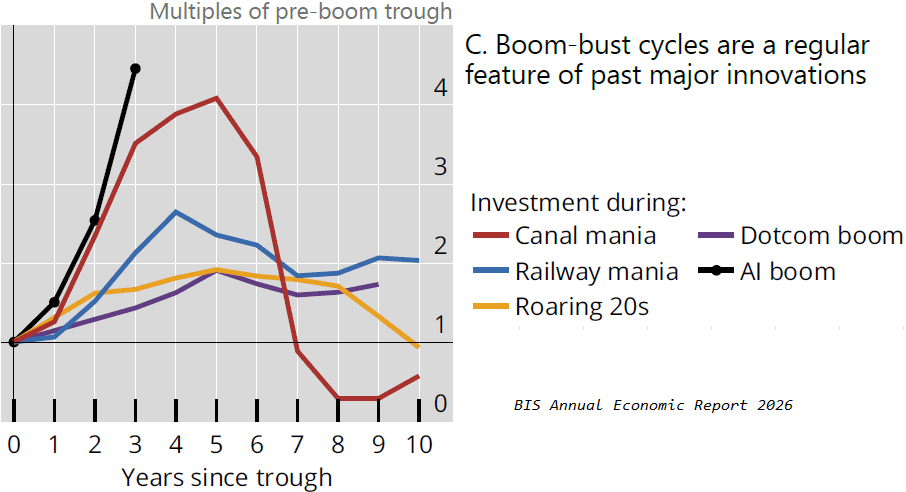
By year three, AI’s line has already cleared where Canal mania peaked in year five — the steepest curve of all five episodes, near 4.3x its trough and still climbing vertically, with railways, the Roaring Twenties, even the canals’ high behind it. That settles the “just another dotcom bubble” reflex: dotcom was the mildest episode here, cresting around 1.5x. But the reframing that matters isn’t the shape — it’s the letterhead. The Bank for International Settlements, the central banks’ bank, has formally entered AI capex into a two-century register of manias, each ending in reversal and recession, recategorizing it from an earnings story into a financial-stability one. And the reversal is the base case, not the tail: canals round-tripped to zero by year eight, the Roaring Twenties bled below their start, even railways and dotcom merely plateaued — none kept climbing. AI simply stops at year three, short of every inflection where the others rolled over. The mechanism decides which line it follows: over $1 trillion of hyperscaler capex is outrunning earnings and free cash flow, and whether returns arrive before that committed capital must be serviced sorts plateau from round-trip. First-order, markets reprice multiples and spreads; second-order, a capex bust drags GDP and jobs. AI’s worst chart is still blank.
Market Intelligence Brief (MIB) Ver. 18.40
For professional investors only. Not investment advice.
© 2026 RecessionALERT.com

Comments are closed.