
MARKET INTELLIGENCE BRIEF (MIB)
Tuesday, June 30, 2026
JOLTS beat for a fifth straight month at 7.594M, driving September rate-hike probability to 60%+ — same session S&P 500 closed Q2 +14.9% (best since 2020) and the Dow hit an all-time high. Cleveland Fed’s Hammack: AI infrastructure demand is a structural inflation force; rate hikes may be necessary. USMCA clean extension rejected — $1.5T North American trade enters annual review limbo. House Select probed MRK, LLY (-2.48%), PFE, ABBV, BMY over PLA hospital trials. SNDK +10.89% on $3,000 Bernstein PT.
TABLE OF CONTENTS
A. EXECUTIVE SUMMARY
B. MARKET DATA
C. HIGH-IMPACT STORIES (5)
D. MODERATE-IMPACT STORIES (6)
E. ECONOMY WATCH (6)
F. EARNINGS WATCH (0)
G. WHAT’S NEXT
H. CHART OF THE DAY
A. EXECUTIVE SUMMARY -> TOP
The S&P 500’s +14.9% Q2 — best since 2020 — and the Dow’s all-time high at 52,318 are the record-book result of a quarter-end relief rally that did not resolve the macro tension it inherited. The fifth consecutive JOLTS beat (7.594M vs. 7.3M) and Cleveland Fed President Hammack’s Sintra declaration that AI infrastructure demand is structural inflation drove September rate-hike probability from 20% to 60%+ on the same session — validating the AI/growth thesis while simultaneously threatening its valuation assumptions. Fund managers who underperformed now face benchmark pressure to add equity in Q3, but Technology (+39.24% Q2) — the most extended sector entering that quarter — is also most exposed to rate-hike repricing if Thursday’s NFP validates what JOLTS is already signaling. Six of 11 sectors red or flat is not breadth: it is the market pricing a narrowing growth story where only AI infrastructure capex and adjacent industrials clear the risk/reward bar.
• JOLTS May: fifth consecutive beat at 7.594M (vs. 7.3M consensus) — September rate-hike probability surged from ~20% to 60%+; July hike odds at 30%; 2-year Treasury yield +3.1 bps as rate futures repriced immediately
• Hammack (Sintra, Cleveland Fed): AI infrastructure demand is a “structural” inflation force — not tariff-driven, not transitory; explicitly declined to take a July hike off the table; Warsh speech Wednesday 9 AM ET is the next key event
• Q2 record close: S&P 500 +14.9% (best Q2 since 2020); Dow second consecutive ATH at 52,318 (+8.9% H1, best H1 since 2021); Nasdaq +21.4% Q2 — offset by Consumer Confidence miss (91.2 vs. 94.7) with “jobs hard to get” at a 5-year high
• USMCA: US refused clean extension — $1.5T North American trade relationship enters decade-long annual review track from 2027; MXN and CAD as real-time confidence gauges; autos (GM, F, STLA), agriculture most exposed
• Pharma national security probe: House Select Committee on China opened investigations into MRK, ABBV, PFE, LLY (‑2.48%), BMY over clinical trials at PLA-affiliated hospitals and Xinjiang; July 17 disclosure deadline
• SNDK +10.89% on Bernstein’s $3,000 PT raise (AI flash storage LTA structure re-rates NAND from commodity to recurring-revenue; +857% YTD); DLR ‑4.5% on $3.5B Northern Virginia data center equity dilution
1. AI Infrastructure: Bull Catalyst and Inflation Trap Simultaneously — The same AI capex supercycle that drove Technology +39.24% Q2 and SNDK +857% YTD is the structural inflation force Hammack identified at Sintra. Hyperscalers paying “almost any price” for physical infrastructure makes AI demand price-insensitive, non-transitory, and immune to tariff normalization — placing the Fed in a policy trap where tightening to control AI-driven inflation compresses the multiples of the AI equities themselves. The market cannot sustain both a permissive Fed and an AI bull market at current PCE levels.
2. Rate-Hike Risk Hiding Beneath the Record Quarter — JOLTS beat #5, Hammack’s structural inflation thesis, Consumer Confidence’s 5-year “jobs hard to get” high, and GDPNow’s slide to 2.5% from 4.3% constitute a stagflation data set: labor demand firm in AI/government sectors while worker perception deteriorates and consumer spending growth decelerates. The Warsh Fed’s no-dot-plot communications regime amplifies every data print into a maximum-movement event — Thursday’s NFP carries outsized volatility risk in both directions.
3. USMCA Annual Review Track Adds a New North American Supply Chain Risk Layer — The shift from a stable 16-year extension to annual review leverage creates deal-killer uncertainty for capital allocation decisions across US‑Canada‑Mexico supply chains. US automakers running just-in-time manufacturing across the border and agricultural exporters dependent on duty-free access cannot underwrite 5‑10 year investment decisions against a rolling renegotiation framework — a direct cost-of-capital headwind not yet priced into sector valuations.
 — Leading economic indicators. Accurate market forecasts. Apply for membership at join.recessionalert.com
B. MARKET DATA -> TOP
US-Iran ceasefire durability — and a last-day AI/semis surge — lifted the S&P 500 to close Q2 as its best quarter since 2020, with the Dow touching an all-time high of 52,317. The rally was selective rather than broad: Technology (+2.67%) and Industrials (+1.81%) surged while only five of eleven sectors closed green. Rate-sensitive Real Estate (-1.92%), Utilities (-1.36%), and Consumer Defensive (-1.46%) were the session’s biggest losers as the 10-Year yield rose +4.5 bps — a rising-rate headwind hiding beneath the headline optimism. For a PM: a quarter-end risk-on tone with unresolved bond non-participation; the terminal rate debate is still open.
CLOSING PRICES – Tuesday, June 30, 2026:
MAJOR INDICES
Nasdaq led on an AI/semis surge (+1.69%) as Dow industrials hit an all-time high — but transports fell -0.80%, opening a 1.06% DJIA/DJTA same-day spread that stops short of formal Dow Theory non-confirmation yet flags transport underperformance against the industrial advance. Key breadth signal: Russell 2000 extends its 9th consecutive session outpacing the S&P 500 — small-caps up +1.98% vs large-caps down -0.74% over 10 sessions — an entrenched broad-participation read. Five of 11 sectors green confirms the advance was concentrated in tech and industrials, not a market-wide sweep.
| Index | Close | Change | %Move | Why It Moved |
|---|---|---|---|---|
| S&P 500 | 7,498.79 | +58.36 | +0.78% | Iran ceasefire durability + AI/semis rebound wrapped S&P’s best Q2 since 2020; broad index gains partially offset by rate-sensitive sector declines |
| Dow Jones | 52,317.81 | +135.07 | +0.26% | All-time high close; blue-chip advance (+0.26%) lagged tech-heavy indices as Dow composition skews less toward high-beta semiconductor names |
| DJ Transportation | 21,749.0 | -176.00 | -0.80% | Bucked broader advance; quarter-end rotation into tech/semis drew capital from transport names; DJTA 2.7% below its 10-session high while Dow industrials hit new ATH |
| Nasdaq 100 | 30,276.35 | +501.60 | +1.69% | AI/semis surge led — AMD +7.68%, KLAC +8.38%, MRVL +7.25%, SNDK +10.89%; largest index percentage gainer on the session |
| Russell 2000 | 3,026.05 | +15.63 | +0.52% | Small-cap participation on domestic risk-on tone; 9th consecutive session outperforming S&P 500 over rolling 10-session window (+1.98% vs -0.74%) |
| NYSE Composite | 23,834.23 | +31.52 | +0.13% | Broad advance tempered by rate-sensitive sector selling; composite’s modest gain reflects the split between growth leaders and real estate/utilities declines |
VOLATILITY & TREASURIES
VIX slid -6.80% as Iran ceasefire anxiety unwound — but bond markets refused to confirm: 10Y yields rose +4.5 bps to 4.47% and 2Y yields added +3.1 bps on the same day equities rallied. That VIX-down/yields-up combination signals persistent inflation and rate-path anxiety, not risk-on consensus; in a genuine growth rally, bonds catch a bid alongside equities. The DXY barely moved (+0.07%), leaving the message unambiguous: the terminal rate debate is unresolved at quarter-end.
| Instrument | Level | Change | Why It Moved |
|---|---|---|---|
| VIX | 16.45 | -1.20 (-6.80%) | Iran ceasefire holding reduced tail-risk premium; VIX approaching its 10-session low as quarter-end fear unwinds |
| 10-Year Treasury Yield | 4.467% | +4.5 bps | Sticky inflation expectations + quarter-end duration selling; bond market declining to confirm equity rally — inflation narrative unresolved by ceasefire |
| 2-Year Treasury Yield | 4.170% | +3.1 bps | Near-term rate path uncertainty; Fed-on-hold narrative intact; 10Y-2Y spread at 29.7 bps (curve steepening modestly from 28.3 bps prior) |
| US Dollar Index (DXY) | 101.17 | +0.07 (+0.07%) | Effectively flat; quarter-end rebalancing flows offset Iran ceasefire pressure; dollar holding mid-range despite equity risk-on tone |
COMMODITIES
All four precious metals and copper posted modest gains — a quiet, corroborating session with no dramatic cross-commodity divergence. Gold holding near $4,026 signals residual safe-haven demand persisting despite ceasefire relief; the metal’s floor is higher than its pre-escalation baseline, anchored by sticky inflation and rate uncertainty. Bitcoin’s -2.82% decline against a risk-on equity tape is the standout: crypto-specific selling decoupled from the broader risk revival, suggesting profit-taking or on-chain dynamics rather than a macro sentiment signal.
| Asset | Price | Change | %Move | Why It Moved |
|---|---|---|---|---|
| Gold | $4,025.95/oz | +$4.30 | +0.11% | Modest safe-haven demand persists; gold holding above $4,000 despite ceasefire relief — floor anchored by sticky inflation and unresolved rate uncertainty |
| Silver | $59.175/oz | +$0.132 | +0.22% | Tracking gold higher; industrial demand component supported by AI/electrification tailwinds |
| Copper | $6.2535/lb | +$0.0068 | +0.11% | Industrial metals holding; China demand outlook stable; AI/electrification build-out supporting medium-term copper demand |
| Platinum | $1,561.75/oz | +$2.70 | +0.17% | Modest gain tracking precious metals complex; automotive and industrial demand steady |
| Bitcoin | $58,637 | -$1,704 | -2.82% | Declined against risk-on equity tape — crypto-specific selling decoupled from broader risk sentiment; profit-taking at prior resistance levels |
ENERGY
WTI and Brent effectively flat (-0.21% and +0.01%) — Iran sanctions relief has been fully absorbed over the past 18 sessions as WTI fell from $84 to $70 since June 12; the geopolitical risk premium is spent. Oil moving sideways alongside a +0.78% equity gain is a growth-neutral read: no new demand acceleration or supply catalyst. Dutch TTF +1.93% while Henry Hub barely moved (-0.15%) — European gas market recovering on its own storage and supply dynamics, fully diverging from US gas fundamentals.
| Asset | Price | Change | %Move | Why It Moved |
|---|---|---|---|---|
| Crude Oil (WTI) | $69.92/bbl | -$0.15 | -0.21% | Essentially flat; Iran sanctions relief fully absorbed (WTI fell ~$14 since June 12); OPEC+ production outlook now the primary price driver |
| Crude Oil (Brent) | $73.40/bbl | +$0.01 | +0.01% | Fractionally positive; WTI/Brent spread at $3.48 — narrow spread signals global rather than regional supply dynamics; no new disruption premium building |
| Natural Gas (Henry Hub) | $3.255/MMBtu | -$0.005 | -0.15% | Effectively flat; US natural gas fundamentals unchanged; summer demand tracking seasonal norms |
| Natural Gas (Dutch TTF) | $14.54/MMBtu | +$0.28 | +1.93% | European gas market recovering independently; UK/European storage refill demand and LNG supply tightness diverging from US fundamentals; TTF/Henry Hub spread widening |
S&P 500 SECTORS
Technology (+2.67%) rebounds from a -1.22% monthly slump but remains the quarter’s structural leader (+39.24% 3M) — today’s move is mean-reversion amplified by the AI catalyst, not a new trend break. Rate-sensitive sectors took the hardest hits: Real Estate (-1.92%), Utilities (-1.36%), and Consumer Defensive (-1.46%) sold off simultaneously as 10Y yields rose +4.5 bps — the rate pressure hiding beneath the headline gains. Healthcare (-0.96%) consolidates after leading the week (+4.63%) and month (+6.61%); the pullback is tactical, not structural, given its 3M and 12M persistence.
| Sector | 1-Day | 1-Week | 1-Month | 3-Month | 6-Month | YTD | 12-Month |
|---|---|---|---|---|---|---|---|
| Technology | +2.67% | +3.14% | -1.22% | +39.24% | +21.80% | +23.62% | +39.94% |
| Industrials | +1.81% | +4.35% | +5.90% | +19.98% | +19.78% | +21.83% | +30.37% |
| Basic Materials | +0.75% | -1.03% | -7.30% | +1.56% | +5.44% | +8.92% | +34.64% |
| Consumer Cyclical | +0.12% | +3.02% | -4.46% | +9.89% | -6.37% | -4.29% | +3.83% |
| Financial | +0.02% | -0.20% | +4.36% | +13.96% | +0.35% | +1.82% | +11.69% |
| Communication Services | -0.07% | +1.08% | -7.42% | +12.19% | -1.30% | -0.92% | +17.77% |
| Energy | -0.48% | -2.73% | -6.02% | -13.52% | +19.70% | +18.49% | +24.63% |
| Healthcare | -0.96% | +4.63% | +6.61% | +11.72% | +2.98% | +4.19% | +20.62% |
| Utilities | -1.36% | +0.51% | +1.31% | -0.84% | +5.75% | +6.30% | +13.74% |
| Consumer Defensive | -1.46% | -1.26% | +0.56% | +0.28% | +5.54% | +6.27% | +4.36% |
| Real Estate | -1.92% | -0.62% | +1.15% | +10.21% | +8.19% | +8.98% | +8.11% |
TOP MEGA-CAP MOVERS:
GAINERS
| Company | Ticker | Close | Change | Why It Moved |
|---|---|---|---|---|
| Sandisk Corp | SNDK | $2,273.73 | +10.89% | Bernstein raised price target to $3,000 from $1,700 (Outperform); 2026’s best S&P 500 performer (+857% YTD); AI-driven flash storage demand narrative intact; parent WDC fell as capital rotated to the spinoff |
| KLA Corp | KLAC | $301.71 | +8.38% | Semiconductor equipment surge on AI/tech rebound; Iran ceasefire removed global-supply-chain risk overhang; semis equipment names disproportionately benefited from sector re-rating |
| Advanced Micro Devices | AMD | $580.91 | +7.68% | AI chip rebound; semiconductor sector led the quarter-end recovery; concerns that AI stocks had gone too high partially unwound on solid demand signals |
| Marvell Technology | MRVL | $297.89 | +7.25% | AI data center networking and custom chip demand acceleration; broader semis complex re-rating on Iran ceasefire + AI spending narrative normalization |
| GE Vernova | GEV | $1,174.86 | +6.56% | AI data center power infrastructure demand driving electricity grid equipment orders; Industrials led the market (+1.81%) and GEV significantly outpaced the sector |
DECLINERS
| Company | Ticker | Close | Change | Why It Moved |
|---|---|---|---|---|
| Netflix | NFLX | $71.40 | -3.23% | Sustained downtrend continues: META expanding Instagram for TV to Samsung smart TVs + FOXA’s $22B Roku acquisition reshaping streaming landscape; Reed Hastings departure weighing; stock down ~40% from June 2025 ATH |
| Eli Lilly | LLY | $1,199.43 | -2.48% | Healthcare sector rotation/profit-taking after sector led the week (+4.63%) and month (+6.61%); weight-loss drug competition concerns persist; broader defensive selling on risk-on rotation |
| Western Digital | WDC | $638.72 | -2.02% | Spinoff Sandisk (SNDK) surged +10.89% on Bernstein analyst upgrade; capital rotating from parent WDC into the higher-momentum spinoff |
| Citigroup | C | $139.96 | -1.78% | Rising yield headwind (10Y +4.5 bps); quarter-end rebalancing out of Financials; bank margin compression concerns as curve steepens modestly |
| Johnson & Johnson | JNJ | $253.97 | -1.76% | Healthcare sector selling; defensive names underperformed on broad risk-on rotation; JNJ’s pharmaceutical pipeline concerns and litigation overhang continue to weigh |
— Institutional-grade intelligence for serious investors. Apply for membership at join.recessionalert.comC. HIGH-IMPACT STORIES -> TOP
BEARISH
1. JOLTS May Beats for Fifth Straight Month at 7.594M — September Rate Hike Probability Surges to 60%+
The core facts:May JOLTS job openings came in at 7.594 million versus the 7.30 million consensus — the fifth consecutive beat and the highest reading since May 2024 — reaffirming that US labor demand remains structurally firm despite five months of “low-hire, low-fire” payroll data. Markets repriced the Fed’s rate path immediately upon release: September rate hike probability surged from approximately 20% to 60%+, and July hike odds moved to approximately 30%, both per CME FedWatch. The 2-year Treasury yield rose sharply as rate futures absorbed the stronger-than-expected demand signal, compressing near-term rate-cut pricing entirely from the forward curve.
Why it matters:The JOLTS beat creates a direct contradiction at the heart of the Fed’s dual mandate: job openings at a two-year high confirm labor demand resilience that, at 4.1% headline PCE and 3.4% Core PCE, leaves the Fed with no easing room. Five consecutive above-consensus JOLTS prints signal that the structural labor tightness — driven partly by Hammack’s “insatiable” AI infrastructure capex demand — is not a seasonal anomaly but a durable feature of the post-tariff, AI-driven economy. For rate-sensitive assets, the repricing is asymmetric: the 60% September hike probability is not fully priced into long-duration bonds or high-multiple tech equities, creating residual downside risk for both asset classes if Thursday’s NFP confirms the labor market’s resilience. The Warsh Fed’s deliberate communication restraint — no dot-plot, shorter statements — amplifies the volatility: with no forward guidance to anchor expectations, each data print creates maximum market movement rather than incremental updating against a stated path. Today’s JOLTS print, combined with Hammack’s explicit rate hike warning from Sintra (see Story 2), represents the strongest single-day endorsement of a 2026 tightening scenario since the hiking cycle discussion began.
What to watch:Thursday July 2 NFP at 8:30 AM ET versus Pantheon’s 75K forecast — a strong print above 150K would push September hike probability to near-certainty; a 75K miss would sharply deflate hike odds despite today’s JOLTS strength. Fed Chair Warsh’s speech Wednesday July 1 at 9:00 AM ET for whether he validates or pushes back on the hike narrative before NFP.
BEARISH
2. Cleveland Fed’s Hammack: AI Infrastructure Is a Structural Inflation Driver — Rate Hike May Be Necessary
The core facts:Cleveland Federal Reserve President Beth Hammack, speaking Tuesday from the ECB’s Sintra forum in Portugal, stated explicitly that AI infrastructure demand is fueling inflation and that rate increases may be needed if elevated prices persist. Hammack cited an Ohio-based manufacturer of electric switching equipment for data centers, noting that hyperscalers “will pay almost any price” for AI infrastructure inputs — framing AI capex as a demand-pull inflation driver rather than a cyclical or tariff-driven phenomenon. “If inflation continues to persist at these elevated levels and I don’t see any restraint from policy, we may need to raise rates,” she said. Hammack is a voting FOMC member in 2026 — she dissented at the June FOMC meeting — and was speaking on the same day as the fifth consecutive JOLTS beat.
Why it matters:Hammack’s AI-inflation framing is analytically distinct from the standard tariff-passthrough narrative that has dominated the inflation discourse since early 2026. She is identifying AI infrastructure capex as a structural demand-pull force — one that is not transitory, not tariff-dependent, and not addressable through supply-chain normalization. This is a more durable and harder-to-dismiss inflation thesis than any trade-war framing: if hyperscalers are price-insensitive buyers of physical infrastructure inputs (power, data center electrical equipment, fiber, cooling), then the Fed cannot rely on goods disinflation to offset service-sector stickiness. Hammack’s position directly contradicts Chair Warsh’s baseline view that AI productivity gains will prove disinflationary — creating an explicit intra-FOMC policy disagreement now visible in real-time at a globally watched forum. The market’s immediate read: her hawkish signal, combined with today’s JOLTS beat, collectively increases the probability that the June 2026 FOMC was not the rate peak. For long-duration Treasuries, utilities, REITs, and high-multiple technology names, a structural AI-inflation thesis — if it gains traction with additional FOMC members — is a persistent valuation headwind that rate-cut pricing cannot resolve.
What to watch:Fed Chair Warsh speech Wednesday July 1 — specifically whether he addresses the AI-inflation framing and affirms his disinflation baseline or signals openness to Hammack’s structural thesis; any additional FOMC voter commentary in the pre-NFP window as the rate hike probability solidifies.
BULLISH
3. S&P 500 Caps Best Quarter Since 2020 (+14.9%); Dow Closes at Second Consecutive Record 52,319 — Best H1 Since 2021
The core facts:US equity markets closed June 30 with historic quarterly and half-year milestones. The Dow Jones Industrial Average set a second consecutive all-time high close at 52,319.20 (+136.46, +0.3%), locking in the best first half since 2021 (+8.9% H1). The S&P 500 advanced +0.79% to approximately 7,449–7,499, completing Q2 2026 with a gain of +14.9% — the best quarter since Q3 2020 during the COVID recovery. The Nasdaq Composite surged +1.52% to 26,213.72, finishing Q2 +21.4%. Technology led all 11 S&P 500 sectors at +2.67% for the session and +39.24% over the quarter. The Russell 2000 gained +0.46% to 3,024.37, crossing a new milestone as the quarter-end rally broadened beyond mega-cap names. The primary catalysts for the Q2 record run: the June 29 Supreme Court ruling preserving Fed independence (removing FOMC composition risk), Alphabet’s Dow inclusion creating forced passive buying, AI/semiconductor sector re-rating as the AI capex supercycle thesis survived the OpenAI IPO delay narrative, and the US-Iran ceasefire removing the energy shock that had pressured risk assets since late 2025.
Why it matters:Quarter-end performance benchmarks matter structurally: mutual funds and institutional managers who missed the Q2 rally face pressure to increase equity exposure in Q3 to track benchmarks, creating a systematic forced-buy dynamic that supports prices even if macroeconomic data — JOLTS beats, Hammack hike warnings, bimodal rate markets — complicates the forward picture. The S&P 500’s +14.9% Q2 is doubly significant because it follows a Q1 that was more modest — meaning the H1 2026 total return has materially outperformed the “stagflation” consensus that emerged in Q1 on tariff anxiety and Iran war risk. For portfolio managers rebalancing into Q3, the tactical question is whether to ride the momentum or reduce equities to lock in the historic quarterly gain: the Warsh Fed’s deliberate ambiguity — no dot-plot, shorter statements — creates maximum uncertainty about the Q3 macro backdrop, which historically argues for profit-taking after a 15% quarter. The technology sector’s +39.24% quarterly gain positions it as the most extended and most rate-sensitive sector entering Q3 — any additional rate hike pricing will disproportionately pressure tech valuations.
What to watch:July inflows data and fund positioning reports for whether institutional buyers accelerate equity allocation after the record Q2, or lock in gains; Thursday July 2 NFP as the first Q3 data test of whether the macro backdrop supports the current valuation multiple.
UNCERTAIN
4. US Refuses Clean USMCA Extension at Mandated 2026 Review — Annual Review Track Triggered, North American Trade Uncertainty Deepens
The core facts:At the USMCA’s mandated July 1, 2026 joint review, the United States signaled it will not grant a clean extension of the United States-Mexico-Canada Agreement. US Trade Representative Jamieson Greer confirmed he was not prepared to recommend clean renewal, and President Trump has publicly stated he is “not looking to renew” the deal as structured. Under the USMCA’s sunset clause, a refusal by any one party to agree to an extension triggers a decade-long annual review track beginning in 2027 — the agreement does not terminate immediately but enters a rolling renegotiation cycle that can extend to 2036. The Trump administration’s preferred outcome is a bilateral restructuring with annual reviews, using the USMCA review as leverage to extract concessions from Canada and Mexico on trade disputes, migration, drug trafficking, and continental defense matters. A “clean extension” — one that preserves the existing text for an additional 16 years — is now off the table.
Why it matters:USMCA governs approximately $1.5 trillion in annual trade between the US, Canada, and Mexico — the world’s largest tripartite trade relationship. The shift from a stable 16-year extension framework to an annual review track introduces a new category of political risk: North American supply chain stability is now subject to year-over-year renegotiation leverage, meaning any geopolitical friction (auto content disputes, Canadian dairy, Mexican energy nationalism) can be weaponized at an annual review. For US-listed companies with deeply integrated North American supply chains — autos (GM, Ford, Stellantis), agriculture, semiconductor manufacturing inputs, and energy — the inability to make 5-10 year capital allocation decisions against a stable USMCA framework increases their cost of capital. The most immediate sector exposures: US automakers whose plants are split across US-Mexico supply chains (critical for just-in-time manufacturing), US agricultural exporters dependent on duty-free access to Canada and Mexico, and the Canadian dollar and Mexican peso as the real-time market sentiment gauges. The base case — a “painful extension” with renegotiation stretching into late 2026 — is not a benign outcome: a prolonged negotiation gap creates deal-killer uncertainty for M&A and capital investment in all three economies.
What to watch:Canada and Mexico’s formal response to the US non-extension signal — whether they respond as a trilateral bloc or seek bilateral tracks separately; Mexican peso (MXN) and Canadian dollar (CAD) as real-time confidence gauges; any Trump executive action using the review as leverage for non-trade concessions.
UNCERTAIN
5. US-Iran Doha Technical Talks Proceed Without Direct Contact; WTI Holds Near $70 as API Reports 6.072M-Barrel Crude Draw
The core facts:The first Doha diplomatic engagement following the June 24 ceasefire declaration proceeded Tuesday with US Special Envoy Steve Witkoff and Jared Kushner meeting Qatari Prime Minister Sheikh Mohammed bin Abdulrahman as mediators. Iranian delegations participated separately — the US and Iran are not meeting directly — with Pakistan and Qatar serving as interlocutors. The structure mirrors Iran’s stated position that its technical experts will not negotiate directly with US counterparts, limiting the talks’ near-term scope. Concurrently, the American Petroleum Institute reported a 6.072 million barrel crude draw for the week ended June 27 — more than 50% above the 4.1 million barrel consensus and dramatically above the prior week’s -0.765 million barrel draw — the largest weekly crude inventory decline since April. WTI crude held near $70 per barrel; the benchmark is down approximately 19% month-to-date and 24% quarter-to-date from the war-premium highs. Gold fell alongside oil, closing Q2 at approximately $4,000 — its worst quarterly performance in 13 years — as Iran war risk premia unwound throughout the quarter.
Why it matters:The indirect negotiation structure in Doha confirms the analytical point from yesterday’s report: Iran’s refusal to allow direct technical talks limits the pace of ceasefire formalization. The risk scenario is not a ceasefire collapse but a prolonged limbo — neither a full normalization that removes all risk premium nor an active conflict that reinstates it. Oil markets are reading the ceasefire as durable at current WTI levels (~$70), but the 6.072M API draw introduces a counternarrative: US crude inventory is being drawn at a pace that suggests either front-running of Iranian crude re-entry (importers buying ahead of anticipated supply glut) or demand recovery stronger than the bearish price tape implies. JPMorgan and Citi’s ~4M bbl/day oversupply thesis (from yesterday’s report) remains the structural medium-term bear case, but the API draw signal creates near-term technical support. For US energy equities, the dual signal — ceasefire holding but talks moving slowly, inventory drawing bullishly but structural oversupply looms — creates a range-bound sector with no obvious directional catalyst until the Doha talks produce concrete outcomes on Strait of Hormuz passage guarantees and Iranian crude re-entry timelines.
What to watch:Wednesday EIA weekly petroleum status report to confirm or contradict the API 6.072M draw; whether Doha talks advance to direct US-Iran technical contact by Thursday; WTI’s hold above $68 as the ceasefire durability price floor.
— Quantifying recession risk so you don’t have to guess. Apply for membership at join.recessionalert.comD. MODERATE-IMPACT STORIES -> TOP
BEARISH
6. CB Consumer Confidence Misses at 91.2 — “Jobs Hard to Get” Hits Five-Year High, Compressing Discretionary Spending Outlook
The core facts:The Conference Board Consumer Confidence Index for June came in at 91.2, missing the 94.7 consensus estimate. The “Jobs Hard to Get” subcomponent rose to 22.5% — the highest reading since January 2021 — signaling that US consumers increasingly perceive labor market access as more difficult even as JOLTS job openings remain at a two-year high. The divergence between employer demand (strong openings data) and worker perception (elevated “jobs hard to get”) signals a structural mismatch rather than broad-based labor market tightness. Released on the same day as the JOLTS beat, the consumer confidence miss compounds the bifurcated macro picture: demand for labor is firm, but workers are not experiencing that demand as accessible opportunity.
Why it matters:Consumer confidence at 91.2 with “jobs hard to get” at a five-year high is a 2-3 month leading indicator for the unemployment rate — historical patterns suggest elevated “hard to get” readings precede unemployment rate increases. For consumer discretionary equities and retail, the miss argues for a more cautious Q3 consumer spending trajectory: households perceiving difficulty finding work tend to increase precautionary savings and reduce discretionary outlays, compressing margins for mid-to-high discretionary retailers. The simultaneous JOLTS-strong / confidence-weak combination suggests that AI-driven data center construction and government infrastructure are absorbing labor demand, while traditional consumer-facing service sector hiring is decelerating — a sector-bifurcated labor market that suppresses broad wage growth despite aggregate openings strength.
What to watch:Thursday July 2 NFP unemployment rate — whether the “jobs hard to get” signal begins to appear in the headline rate; next retail sales print for confirmation of the consumer spending deceleration thesis.
BEARISH
7. Chicago PMI Decelerates Sharply to 56.7 — Largest Monthly Drop Since Late 2025, Raises Stakes for Wednesday’s ISM Manufacturing
The core facts:The Chicago Business Barometer (Chicago PMI) for June fell to 56.7 from 62.7 in May, against expectations of 58.1 — the largest single-month deceleration since late 2025. The reading remains in expansion territory (above 50) but the magnitude of the decline interrupts the manufacturing re-acceleration narrative that had built over Q2 as tariff front-running drove order backlogs. The Dallas Fed’s June Business Activity Index was 0.0 (reported yesterday) — stalling at neutral from +0.4 in May — reinforcing the Chicago signal. ISM Manufacturing PMI for Wednesday July 1 carries a consensus of 54.0 (matching May’s reading); ISM Prices Paid is expected to ease from 82.1 to approximately 79.
Why it matters:Chicago PMI’s 6-point deceleration raises the probability that Wednesday’s ISM Manufacturing prints below 54.0 — an outcome that would confirm a manufacturing plateau rather than acceleration, limiting industrials and materials sector re-rating into Q3. The more consequential sub-index is ISM Prices Paid: an easing from 82.1 to 79 would be the first meaningful input-cost moderation in months — reducing the Fed’s goods-sector inflation anxiety and incrementally supporting a September cut scenario. But if Prices Paid remains elevated (82+), it would reinforce Hammack’s AI-infrastructure supply-demand tightness thesis and strengthen hike arguments. The Chicago deceleration also signals potential tariff front-running demand exhaustion: if businesses pulled forward Q2 orders to beat tariff deadlines, Q3 ordering rates could slow further, extending the manufacturing softness into a period when the Fed cannot offset with accommodation.
What to watch:Wednesday July 1 ISM Manufacturing PMI — a print below 52 would signal a genuine manufacturing deceleration; ISM Prices Paid specifically, with above 82 being the threshold that strengthens the September hike case.
UNCERTAIN
8. Digital Realty Acquires Blackstone’s 64% Stake in Three Northern Virginia Data Centers for $3.5B — DLR -4.5% on Equity Dilution
The core facts:Digital Realty Trust (DLR) closed its acquisition of Blackstone’s blended 64% equity interest in three fully leased hyperscale data centers in Northern Virginia, paying $3.5 billion in total consideration ($1.2 billion cash, $2.3 billion in DLR shares). The assets — located in Manassas (two centers) and Sterling (one on the Digital Dulles campus) — collectively hold 288 megawatts of total IT capacity and are 100% leased to three distinct investment-grade hyperscale customers. The gross asset value is $7.8 billion, implying a cap rate of approximately 6.5% upon stabilization. DLR fell -4.5% on the equity issuance, as the $2.3 billion in share consideration dilutes existing shareholders. For Blackstone, the sale at a $7.8 billion portfolio valuation represents a profitable exit from data center assets it has held through the AI demand surge.
Why it matters:The transaction is a data point in the ongoing price discovery process for hyperscale data center assets — and the 6.5% cap rate on fully-leased Northern Virginia assets is the market’s current clearing price for prime AI infrastructure real estate. Northern Virginia is the world’s largest data center market, and a 100%-leased, investment-grade-tenant portfolio transacting at $27M per megawatt ($7.8B ÷ 288 MW) sets a benchmark for comparable assets. DLR’s -4.5% reaction signals that markets view the equity dilution as an expensive growth path — investors are discounting the strategic value of the expansion against the share count increase. The deal arrives on the same day Realty Income announced a separate data center joint venture seeded with assets valued over $6 billion, confirming a structural shift in REIT capital allocation toward hyperscale AI infrastructure. The simultaneous DLR and Realty Income announcements on June 30 reflect the AI data center buildout as now a defining theme for real estate capital markets, compressing traditional retail and office REIT strategies in favor of compute infrastructure.
What to watch:DLR’s post-close equity stabilization as index funds absorb the dilution; cap rate trajectory for comparable Northern Virginia hyperscale assets as the next benchmark; DLR Q3 earnings for color on hyperscale customer demand and lease renewal pricing.
BEARISH
9. House Select Committee on China Opens National Security Investigation Into Merck, AbbVie, Pfizer, Eli Lilly, BMS Over Clinical Trials at Chinese Military Hospitals
The core facts:The House Select Committee on the Chinese Communist Party, chaired by Representative John Moolenaar (R-MI), launched national security investigations into five of the largest US pharmaceutical companies — Merck, AbbVie, Pfizer, Eli Lilly, and Bristol Myers Squibb — over clinical trials conducted at Chinese military hospitals and in Xinjiang. The committee’s letters allege that Merck sponsored or collaborated in 224 clinical studies in China since 2005, including 40 at PLA-affiliated medical centers and at least 31 in Xinjiang. AbbVie conducted more than 100 clinical studies in China, including 16 at military centers and 17 in Xinjiang. Drugmakers have until July 17 to provide detailed due diligence, data protection processes, and site standards for their Chinese trial locations. The committee’s letters state there is “no evidence of illegal activity” but that conducting trials at PLA hospitals “exposes American companies to ethical and security risks” of IP transfer to the Chinese military.
Why it matters:The investigation targets five companies that collectively represent a significant share of the S&P 500 Healthcare sector, creating a regulatory overhang that could constrain their China clinical development strategies. For the broader pharma sector, the probe arrives at an already fraught moment: the July 31 implementation date for 100% tariffs on branded pharmaceutical imports means pharma equities are simultaneously absorbing tariff risk, pricing pressure narratives, and now a national security compliance inquiry. The China clinical trial investigation is particularly sensitive because it implicates the R&D pipeline — clinical data gathered at PLA-affiliated hospitals could face FDA review challenges if the committee’s concerns lead to regulatory action on trial integrity. For investors, the July 17 disclosure deadline is the first forcing function: companies whose responses reveal extensive PLA hospital exposure could face additional scrutiny, while companies that can demonstrate clean site protocols may differentiate. The investigation also reflects the bipartisan intensification of the China decoupling imperative across healthcare supply chains — following previous action on API manufacturing (active pharmaceutical ingredients) sourced from China, the probe now reaches clinical development itself.
What to watch:July 17 congressional disclosure deadline and whether any company’s response triggers follow-on regulatory or FDA action; FDA’s own position on trial data integrity from PLA-affiliated sites as the regulatory enforcement risk; sector reaction if additional pharma names beyond the initial five are identified.
BEARISH
10. Gold Ends Worst Quarter in 13 Years Near $4,000 — Hawkish Fed Repricing and Iran Ceasefire Unwind Safe-Haven Bid Accumulated Since January
The core facts:Gold closed Q2 2026 holding near $4,000 per ounce after falling approximately 11% for the quarter — its worst quarterly performance since Q3 2013, when the first taper tantrum drove a comparable precious metals rout. The quarter’s decline reverses a portion of gold’s extraordinary Q1 surge to a record high near $5,600 per ounce in January 2026, driven by Iran war escalation. The primary drivers of Q2’s decline: the US-Iran ceasefire unwinding the geopolitical risk premium accumulated during the conflict, the Fed’s hawkish pivot under Chair Warsh (nine FOMC members projecting at least one 2026 hike), rising real yields making the opportunity cost of holding non-yielding gold prohibitive at current 4%+ money market rates, and a stronger US dollar driven by the hawkish rate repricing. Gold ETF outflows indicate institutional allocators rotated out of precious metals toward risk assets during Q2, consistent with the equity markets’ best quarter since 2020.
Why it matters:Gold’s worst-quarter-in-13-years framing carries two portfolio-management implications. First, it is a retrospective confirmation of the Q2 risk appetite shift: money that flowed into gold during the Iran war hysteria has rotated back into equities, strengthening the Q2 equity rally’s duration but also leaving gold exposed if macro conditions shift. Second, it is a forward-looking signal about the Fed’s credibility at current PCE levels: gold at $4,000 despite 4.1% headline inflation indicates markets believe the Warsh Fed will tighten sufficiently to restore price stability — gold would be closer to $5,000+ if markets expected the Fed to fall behind the curve. The $4,000 support level is technically and psychologically significant: a break below it would signal intensified expectations of Fed tightening that could also pressure equities; a recovery above $4,200 would suggest inflation expectations are re-anchoring higher despite today’s hawkish repricing. For portfolio construction, gold’s 11% Q2 decline compresses the traditional equity-gold diversification benefit — if both assets are now positively correlated (equities rally as gold falls on risk-on flows), alternative diversifiers (TIPs, commodities) become more relevant in Q3 allocations.
What to watch:Gold’s technical support at $4,000 — a break below that level would be a signal of accelerating hawkish repricing; Thursday NFP: a weak print (≤75K) could reverse gold as rate-cut odds spike; ETF flow data over the next two weeks for whether institutional gold selling has run its course.
BULLISH
11. Sandisk (SNDK) +5.47% as Bernstein Raises Price Target to $3,000 — Memory LTA Structural Shift Anchors AI Storage Supercycle
The core facts:Bernstein analyst Mark Newman raised the Sandisk Corporation (SNDK) price target from $1,700 to $3,000, maintaining an Outperform rating, driving the stock up approximately 5.47% on June 30. The analyst cited a fundamental structural shift in how memory manufacturers are structuring long-term supply agreements (LTAs) with hyperscale customers: fixed or range-bound pricing, upfront financial commitments, and 3-5 year contract terms. At $3,000, Bernstein’s target implies approximately 50% additional upside from current prices despite SNDK already being the S&P 500’s best-performing stock year-to-date with an approximately 857% gain. The $3,000 target is derived from 11x Bernstein’s FY2028 EPS estimate or 14x the FY2026-2030 through-cycle average EPS. Sandisk’s parent lineage (spun from Western Digital) makes it the pure-play flash and NAND memory vehicle for the AI storage buildout.
Why it matters:The LTA pricing structure Bernstein identifies is the memory sector’s equivalent of the defense industry’s long-term contracts: it transforms NAND flash from a notoriously cyclical commodity into a recurring-revenue technology business with predictable cash flows. For investors, this re-rating thesis is durable rather than cyclical: if hyperscalers are committing to 3-5 year fixed-price memory supply agreements, Sandisk’s earnings volatility — historically the primary reason memory stocks trade at discounts to the broader semiconductor sector — is structurally compressed. The LTA development is also competitively significant: if Sandisk has locked in hyperscaler commitments at fixed pricing, rivals (Samsung, SK Hynix) face structurally reduced addressable markets for spot and contract NAND sales to the same customer set. Bernstein’s $3,000 target, using through-cycle EPS averaging, signals that the analyst believes the LTA structure eliminates the down-cycle risk that traditionally forces through-cycle EPS discounting — an unusually high-conviction call at an already-extreme trailing valuation. With WDC (parent company) falling -2.02% as capital rotates to the purer SNDK vehicle, the market is explicitly pricing the spinoff premium as a structural, not transitory, feature.
What to watch:Samsung and SK Hynix pricing behavior in response to SNDK’s LTA-driven demand lock-in; SNDK next quarterly results for confirmation that fixed-price LTA volumes are displacing spot contract mix; whether other memory names (MU, SK Hynix ADR) see comparable LTA adoption.
— Separating signal from noise since 2007. Apply for membership at join.recessionalert.comE. ECONOMY WATCH -> TOP
June 30’s data delivered a hawkish-growth paradox: JOLTS job openings posted a fifth consecutive beat (7.594M vs. 7.30M est.), endorsing Cleveland Fed President Hammack’s same-day warning that AI-fueled demand may necessitate rate hikes. Yet the consumer is fraying — confidence missed by 3.5 points (91.2 vs. 94.7 est.) with “jobs hard to get” at its highest since January 2021. The Chicago PMI decelerated sharply to 56.7 (prior 62.7), and GDPNow has slipped to 2.5% from a May peak of 4.3% as PCE growth is revised lower. Fed Chair Warsh’s July 1 speech and Thursday’s June payrolls (consensus 110K) are the week’s binary risk pivots.
JOLTS Job Openings Beat for Fifth Straight Month at 7.594M, Endorsing Fed Hike Bets (BLS, June 30, 2026)
What they’re saying:US job openings rose to 7.594 million in May, beating the 7.30M consensus by 294,000 — the fifth consecutive beat of estimates and the highest level in over two years. The prior reading held near the same level at 7.585M. Job quits rose to 3.065M (from 2.977M prior), indicating workers remain confident enough to leave jobs voluntarily — a signal of continued labor market health.
The context:The persistent strength in labor demand leaves the Fed with little cover to ease policy. Markets repriced rate hike odds higher immediately following the print, with futures placing roughly 30% probability on a July hike and over 60% on tightening by September. The JOLTS beat directly amplifies Hammack’s June 30 hawkish message and keeps upward pressure on 2-year Treasury yields heading into Thursday’s payrolls report — the week’s single most important macro data point.
What to watch:June Nonfarm Payrolls (Thursday, Jul 2, 8:30 AM ET; consensus 110K, Pantheon 75K); Fed Chair Warsh speech (Wednesday, Jul 1, 9:00 AM ET).
Consumer Confidence Falls Short at 91.2 — “Jobs Hard to Get” Hits Five-Year High (Conference Board, June 30, 2026)
What they’re saying:The Conference Board Consumer Confidence Index rose just 0.6 points to 91.2 in June — a 3.5-point miss vs. the 94.7 consensus — while the prior month (May) was revised down from 93.1 to 90.6. The share of consumers saying jobs are “hard to get” climbed to 22.5%, the highest reading since January 2021. Falling gas prices offered partial relief but were insufficient to lift overall sentiment.
The context:The sharp deterioration in the labor market assessment — released simultaneously with a JOLTS beat — underscores a growing divergence: employers are still posting jobs, but workers increasingly feel those openings aren’t accessible. Historically, rising “jobs hard to get” readings lead the unemployment rate higher by two to three months. This confidence miss introduces risk that the consumer spending tailwind supporting PCE through H1 2026 may fade into Q3, a development that would push GDPNow’s already-declining Q2 estimate lower.
What to watch:ADP Employment Change (Wednesday, Jul 1, 8:15 AM ET; consensus 113K); June Nonfarm Payrolls (Thursday, Jul 2, 8:30 AM ET); July Consumer Confidence (late July).
Cleveland Fed’s Hammack: AI-Driven Demand Could Force Rate Hikes — July Not Off the Table (Cleveland Federal Reserve, June 30, 2026)
What they’re saying:Cleveland Fed President Beth Hammack stated that “insatiable” demand for artificial intelligence infrastructure may be a persistent and structural source of inflation. She said: “If inflation continues to persist at these elevated levels and I don’t see any restraint from policy, we may need to raise rates to bring that policy restraint in and to bring inflation back down.” She did not commit to a July FOMC hike, but explicitly declined to take one off the table.
The context:Hammack’s hawkish framing is notable for two reasons: it identifies AI capital expenditure — not tariffs — as the primary inflation driver, and it positions the Fed as potentially needing to act rather than simply wait. Polymarket’s Fed hike probability ticked up to 55% (from 53% prior session) following today’s JOLTS and Hammack combination. While she is not a 2026 FOMC voter, her remarks add institutional weight to the hiking scenario and may foreshadow the tone of Fed Chair Warsh’s speech Wednesday morning — the most consequential forward guidance event of the week.
What to watch:Fed Chair Warsh speech (Wednesday, Jul 1, 9:00 AM ET) — watch for any explicit endorsement or pushback on the rate hike framing.
Chicago PMI Slips to 56.7 in June, Missing Consensus and Cooling Sharply from May’s Four-Year High (MNI Markets, June 30, 2026)
What they’re saying:The Chicago Business Barometer fell to 56.7 in June from 62.7 in May, missing the 58.1 consensus estimate. The index remains well above the 50 expansion/contraction threshold, indicating continued Midwest business activity growth, but the 6-point single-month drop is the largest deceleration since late 2025. Separately, the Dallas Fed Services Index recovered to 2.9 in June from -7.7 in May, offering a partial offset at the regional level.
The context:The May surge to a four-year high of 62.7 was likely inflated by tariff front-running — businesses pulling forward purchases before new import costs took effect. The June normalization confirms that dynamic is unwinding. With the ISM Manufacturing PMI (broader and more closely watched) due Wednesday at an expected 54.0, the Chicago print introduces downside risk to that reading. An ISM print below 50 would flip the national manufacturing signal to contraction and materially reset Q3 growth expectations.
What to watch:ISM Manufacturing PMI June (Wednesday, Jul 1, 10:00 AM ET; consensus 54.0, prior 54.0); ISM Manufacturing Prices Paid (consensus 79, prior 82.1).
Atlanta Fed GDPNow Q2 2026 Estimate Slips to 2.5% as Consumer Spending Nowcast Revised Lower (Federal Reserve Bank of Atlanta, June 25, 2026)
What they’re saying:The Atlanta Fed’s GDPNow model places Q2 2026 real GDP growth at 2.5% in its most recent update (June 25), down from 3.0% on June 17 and a peak of 4.3% in late May. The primary driver of the most recent downward revision was a reduction in the nowcast of Q2 real personal consumption expenditures (PCE) growth from 2.7% to 2.0%. The next GDPNow update is scheduled for Wednesday, July 1 — it will incorporate today’s JOLTS and confidence data.
The context:A 1.8-percentage-point decline from the May peak suggests the tariff-driven front-running in consumer and business spending has largely exhausted itself. The 2.5% tracking estimate still represents healthy above-trend growth, but the directional trend matters: if today’s Conference Board miss foreshadows continued PCE softness, Wednesday’s GDPNow update may push the Q2 estimate closer to 2.0%. That level would still avoid a contraction but would mark the weakest quarterly growth since Q1 2023 and further complicate the Fed’s stagflation calculus.
What to watch:GDPNow update (Wednesday, Jul 1) incorporating today’s releases; June Nonfarm Payrolls (Thursday, Jul 2, 8:30 AM ET) — last major Q2 labor market data point before the advance GDP estimate.
FHFA Home Prices Dip 0.1% in April; Case-Shiller Shows 11th Straight Month of Real-Term Decline (FHFA / S&P Global, June 30, 2026)
What they’re saying:The FHFA monthly house price index fell 0.1% MoM in April, against a +0.2% consensus and a revised +0.2% prior reading. Year-over-year gains moderated to +2.0%. The S&P Cotality Case-Shiller 20-City Composite rose 1.1% YoY (up from 0.9% prior), but with CPI running at approximately 3.8% in April, home values declined in real (inflation-adjusted) terms for an eleventh consecutive month. Regional divergence remains sharp — Mountain division -0.8% MoM; New England +1.0% MoM.
The context:Housing is caught in a persistent dual headwind: elevated mortgage rates (30-year at 6.49%) continue to suppress affordability-driven demand, while constrained inventory limits price relief for buyers. The eleven-month streak of real-term price declines erodes household wealth for existing homeowners via the “wealth effect” — a meaningful headwind for consumer spending. A reversal would require either a significant rate cut (not currently priced before late 2026/2027) or a supply shock. Wednesday’s MBA Mortgage Applications data will indicate whether any rate-driven demand activity is emerging.
What to watch:MBA Mortgage Applications (Wednesday, Jul 1, 7:00 AM ET); 30-Year Mortgage Rate (Jul 3 print, currently 6.49%).
— Know the probability before the market prices in the risk. Apply for membership at join.recessionalert.comF. EARNINGS WATCH -> TOP
YESTERDAY AFTER THE BELL (Markets Reacted Today)
No major earnings yesterday after the bell from companies with >$100B market cap.
TODAY BEFORE THE BELL (Markets Already Reacted)
No major earnings before the bell from companies with >$100B market cap.
TODAY AFTER THE BELL (Markets React Tomorrow)
No major earnings after the bell from companies with >$100B market cap. Nike (NKE, $60.79B market cap) reports AMC tonight — below the >$100B inclusion threshold.
WEEK AHEAD PREVIEW:
Q1 2026 earnings season is effectively complete at 89% of the S&P 500 reported, with blended EPS growth of +27.7% YoY — the strongest quarter since Q4 2021. The week of June 30 – July 3 marks the seasonal trough before Q2 2026 earnings season opens. No mega-cap companies (>$100B market cap) are scheduled to report through Friday July 3; the next wave of major reporters is expected in mid-July, beginning approximately July 11 when FactSet publishes its Q2 2026 season-opening Earnings Insight.
Q2 2026 earnings season begins mid-to-late July with the major financial sector reporters (JPMorgan, Goldman, Citigroup, Wells Fargo, BlackRock) typically among the first large-caps to report — watch for JPMorgan’s Q2 date announcement as the de facto season-open signal.
— US market commentary trusted by family offices and institutions. Apply for membership at join.recessionalert.comG. WHAT’S NEXT -> TOP
UPCOMING RELEASES:
| Date | Event | Why It Matters |
|---|---|---|
| Wed, Jul 1 | Fed Chair Warsh Speech (9:00 AM ET) | Most consequential forward guidance event of the week — markets watching for whether Warsh validates Hammack’s AI-inflation thesis and September hike framing, or reaffirms his disinflation baseline. Any explicit endorsement of rate-hike language would accelerate bond selling and widen the rate-sensitive sector selloff heading into NFP. |
| Wed, Jul 1 | ISM Manufacturing PMI Jun (exp. 54.0, prior 54.0) | Chicago PMI’s 6-point deceleration to 56.7 introduces downside risk to this print. A sub-50 ISM would signal national manufacturing contraction and materially reset Q3 growth expectations; a stable 54.0 confirms expansion continues despite front-running demand exhaustion. |
| Wed, Jul 1 | ISM Manufacturing Prices Paid Jun (exp. 79, prior 82.1) | The most Fed-sensitive ISM sub-index. An easing from 82.1 to 79 would be the first meaningful input-cost moderation in months, incrementally supporting a September cut scenario. A hold above 82 reinforces Hammack’s structural inflation thesis and strengthens the hike argument before Thursday’s payrolls. |
| Wed, Jul 1 | ADP Employment Change Jun (exp. 113K, prior 122K) | Private-sector payroll preview for Thursday’s NFP. A print below 100K would raise probability that the Pantheon 75K NFP scenario materializes; a beat above 130K would add to JOLTS-driven confidence in labor market resilience and extend the September hike narrative. |
| Wed, Jul 1 | Construction Spending MoM May (exp. +0.2%, prior +0.4%) | Tracks AI data center and infrastructure buildout alongside residential construction. A deceleration would signal capex front-running is unwinding; an upside surprise would corroborate Hammack’s AI capex demand thesis and support the Industrials sector’s +19.98% Q2 run. |
| Thu, Jul 2 | Nonfarm Payrolls Jun (exp. 110K, prior 172K; Pantheon: 75K) | The week’s single most important data point. A print above 150K would push September hike probability to near-certainty and trigger broad repricing of long-duration Treasuries and high-multiple tech equities. A Pantheon-scenario 75K miss would sharply deflate hike odds despite JOLTS strength, reversing Tuesday’s rate repricing. Note: Friday Jul 3 is the NYSE-observed Independence Day holiday — this is the week’s final trading day. |
| Thu, Jul 2 | Initial Jobless Claims Jun 27 (exp. 220K, prior 215K) | Real-time labor market health check released alongside NFP. A spike above 240K would signal early cracks in the labor market consistent with Consumer Confidence’s “jobs hard to get” reading; a stable sub-220K print would reinforce the JOLTS narrative of structural tightness. |
| Thu, Jul 2 | Unemployment Rate Jun (exp. 4.3%, prior 4.3%) | A tick up to 4.4%+ would begin to validate Consumer Confidence’s 5-year “hard to get” high as a leading indicator; a hold at 4.3% keeps the Fed’s dual mandate in tension — openings strong, headline stable — and leaves September ambiguous until ISM and PCE data arrive. |
| Thu, Jul 2 | Average Hourly Earnings MoM Jun (exp. +0.3%, prior +0.3%) | Wage growth stability is the Fed’s services-inflation anchor. A +0.4%+ reading would add a wage-push inflation signal on top of JOLTS and Hammack’s AI-demand thesis, meaningfully strengthening the September hike case. |
| Thu, Jul 2 | Average Hourly Earnings YoY Jun (exp. +3.5%, prior +3.4%) | Year-over-year wage acceleration to 3.5% with headline PCE at 4.1% still leaves real wages negative — a consumer spending headwind that reinforces the Conference Board confidence miss. Any upside surprise above 3.6% would compound the Fed’s inflation calculus. |
KEY QUESTIONS:
1. Will Warsh’s Wednesday speech validate Hammack’s AI-inflation thesis — or push back on the rate-hike framing — before Thursday’s NFP data settles the September probability question for markets?
2. Does Thursday’s NFP confirm the labor market strength JOLTS is already signaling, locking in a September hike and triggering a repricing of Technology’s +39.24% Q2 valuation multiple before Q3 has fully begun?
3. Can the USMCA renegotiation be contained to a tolerable “painful extension” — or will the shift to annual review leverage trigger supply chain capital-allocation paralysis in autos and agriculture before a new framework is agreed?
— US market commentary trusted by family offices and institutions. Apply for membership at join.recessionalert.comH. CHART OF THE DAY -> TOP
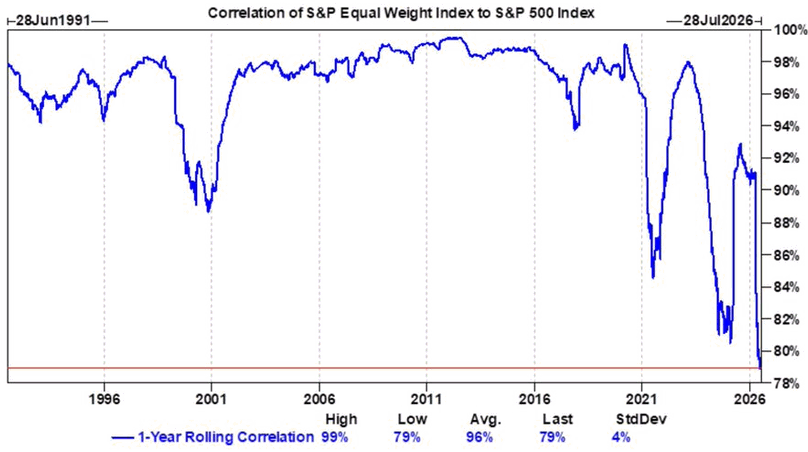
Concentration has a fingerprint, and it just printed its widest reading in 35 years. The one-year correlation between the S&P 500 and its equal-weight twin has fallen to 79% — tied for the lowest since 1991 and roughly 4.25 standard deviations below the 96% norm, a tail so far out the chart’s axis can’t frame it. The index and the median stock it claims to hold have never moved less alike. The dot-com peak and the COVID melt-up punched correlation down too, but those were sharp, event-driven dislocations that snapped back within months once the catalyst passed. This is different in kind, not degree. It has ground near record lows for two to three years, and when it tried to heal — bouncing to ~92% — it failed, rolling straight back to a fresh low. That persistence is the tell: this is breadth narrowing rendered as a single number, cleaner than any advance-decline reading, the steady-state signature of a market where a few mega-caps carry the index while the median stock stalls. The implication cuts deepest for the $10T+ of household savings indexed to the cap-weighted S&P: they own breadth on paper and concentration in fact. The prior dips healed because the story ended. This one hasn’t started writing its ending.
Market Intelligence Brief (MIB) Ver. 18.40
For professional investors only. Not investment advice.
© 2026 RecessionALERT.com

Comments are closed.