
MIB WEEKLY DIGEST
Week of Jun 22–26, 2026
Iran’s Hormuz normalization sent WTI down 8.6% to $70 and gold below $4,000 — extracting months of war-risk premium in five sessions — while the FOMC simultaneously reached unanimous hawk consensus as Core PCE hit a 3-year high of 3.4% and Kashkari abandoned his rate-cut projection for a hike. Micron’s $41.5B revenue quarter proved AI memory demand is real and HBM is booked through 2027; the OpenAI IPO delay on Friday questioned whether AI monetization can sustain the infrastructure being built at this pace. The Russell 2000 hit an all-time record as capital fled mega-cap tech into healthcare (+7.59% WoW, record weekly outperformance) — a breadth signal that contradicted every headline index number.
TABLE OF CONTENTS
A. WEEK AT A GLANCE
B. WEEK IN MARKETS
C. WEEK’S TOP STORIES (10)
D. WEEK IN THE ECONOMY (5)
E. WEEK IN EARNINGS (2)
F. NEXT WEEK SETUP
G. CHART OF THE WEEK
A. WEEK AT A GLANCE -> TOP
The S&P 500’s -1.97% headline masked a decisive week of rotation: the Nasdaq shed 4.2% on AI hardware stress tests while the Russell 2000 hit an all-time record, healthcare gained 7.6%, and the NYSE Composite finished positive — breadth told a categorically different story than the headline index. Iran’s Hormuz normalization simultaneously extracted the geopolitical war-risk premium from oil (-8.6% WoW), gold (-3.3%), and Treasuries (-7.4 bps on 10Y), while the AI investment thesis was challenged by Alphabet’s talent exodus, Korean ETF contagion, and the OpenAI IPO delay — then partly refuted by Micron’s historic $41.5B blowout with HBM bookings through 2027. The FOMC reached unanimous hawk consensus (Core PCE 3.4%, Kashkari’s hike flip from cut) even as the bond market simultaneously priced September cuts on a $105.8B trade deficit blowout — the widest policy-vs.-market divergence of the cycle, entering July’s decisive data calendar.
• Biggest index divergence of 2026: Nasdaq 100 -4.23% WoW (Korean chip contagion Tue, OpenAI IPO delay Fri) vs. Russell 2000 +0.90% — which broke 3,000 for the first time in history Monday (3,003.12) and set an all-time closing record Thursday (3,007.86), a 7-session small-cap outperformance streak.
• Biggest mega-cap mover: ABBV +17.03% (Monday’s $10.9B Apogee Therapeutics acquisition at a 49.5% premium anchored healthcare’s record weekly outperformance of +7.59%); WDC -21.41% was the week’s largest mega-cap decliner on dilutive share issuance, Korean contagion, and OpenAI IPO delay.
• Standout energy and commodity move: WTI -8.64% WoW (briefly below $70 intraday Wednesday) as Iran Hormuz normalization executed; gold -3.31% (briefly below $4,000 Wednesday); silver -11.06% as dual geopolitical and monetary safe-haven bids faded; Bitcoin -5.15% and broke $60,000 (50% off its 2026 peak).
• Biggest earnings of the week: Micron Technology Q3 FY2026 — revenue $41.46B vs. $35.91B estimate (+15.4% beat), EPS $25.11 vs. $20.86 (+20.4% beat), Q4 guidance approximately $50B; HBM fully booked through 2027; $22B in customer deposits. Revenue quadrupled year-over-year in a single quarter.
• Biggest macro data prints: Core PCE 3.4% YoY (highest since October 2023); advance goods trade deficit $105.8B vs. $85B expected (largest monthly miss of 2026); Q1 GDP hollow beat (2.1%) with real consumer spending +0.5% (weakest since Q1 2022); GDPNow Q2 cut to 2.5%.
• Biggest geopolitical event: Iran Hormuz normalization drove the week’s largest oil decline (-8.6% WoW); the week closed with an Iranian drone striking a Singapore-flagged cargo vessel near Oman and Trump declaring a “ceasefire violation” — leaving the Iran binary unresolved into the weekend.
1. AI Hardware vs. AI Monetization — The week drew the clearest line yet between companies that own the physical infrastructure of AI (semis, memory — Micron confirmed with HBM booked through 2027 and $22B in customer deposits) and companies that must monetize AI to justify capex (OpenAI delaying its IPO; Apple and Microsoft raising hardware prices to pass through memory costs). This hardware/software split showed up every session — Monday’s Alphabet talent selloff, Tuesday’s Korean chip rout, Wednesday’s disinflation trade, Thursday’s AAPL/MSFT consumer device price hikes, Friday’s enterprise software rally — and will be the defining intra-tech investment question of H2 2026.
2. The Disinflation That Wasn’t — Iran’s oil normalization (WTI -8.6%) and 10Y yields falling 7.4 bps created a narrative of Fed-friendly disinflation; Core PCE simultaneously printed at its highest since October 2023 (3.4%), the FOMC went unanimously hawkish, and Kashkari explicitly identified AI infrastructure capex as a new non-transitory inflation driver that no prior Fed tightening cycle ever named. The expected disinflation impulse from oil is being offset by a structural inflation source embedded in the same AI investment cycle driving equity market performance — making the rate path genuinely indeterminate until July data resolves it.
3. Breadth Over Headlines — The Russell 2000 all-time record while the Nasdaq posted a four-day losing streak is the structural signal of the week: 7 consecutive sessions of small-cap outperformance, healthcare’s regime leadership across 1-week, 1-month, and 3-month horizons, four of the five weekly mega-cap gainers being healthcare names, and the Dow/NYSE Composite finishing the week positive — all confirm that the capital rotation away from mega-cap tech is durable and broad-based, not a tactical one-day trade against a single catalyst.
 — Leading economic indicators. Accurate market forecasts. Apply for membership at join.recessionalert.com
B. WEEK IN MARKETS -> TOP
The week’s two dominant catalysts split markets by a sharper line than any single session could reveal. Iran’s Hormuz normalization extracted a geopolitical war-risk premium that had distorted energy, precious metals, and bonds for months — WTI fell 8.6%, gold shed 3.3%, and 10-year yields declined 7.4 bps simultaneously, a synchronized deflation of conflict-driven distortions. Simultaneously, the AI hardware investment thesis was stress-tested from three sides: Alphabet’s AI talent exodus Monday raised questions about model-moat durability; Korean ETF forced-unwinds drove the semiconductor index -7.5% Tuesday; and the OpenAI IPO delay on Friday raised the possibility that AI infrastructure capex has front-run revenue by years, not quarters. The result: the Nasdaq shed 4.2% while healthcare climbed 7.6%, the Russell 2000 hit an all-time record, and the bond market declined to price the Fed’s hawkish PCE reaction — a week where breadth told a fundamentally different story than the headline.
FRIDAY CLOSE & WEEK-ON-WEEK CHANGE — Fri, Jun 26, 2026:
MAJOR INDICES
RUT’s +0.90% against the S&P 500’s -1.97% and the NYSE Composite’s +0.81% flipped the breadth read: small-cap and the broad market held while the Nasdaq bore the AI hardware correction alone. Two Market History signals fired simultaneously — RUT outperformed SP500 by 2.87pp (confirmed broad participation, threshold >2pp) and SP500 outperformed NDX by 2.26pp (confirmed broadening from concentrated tech leadership, threshold >2pp) — the first time both signals fired in the same week this cycle. The Dow’s +0.58% gain (led by defense and healthcare rather than technology) confirmed the rotation: this was a week where the S&P 500’s headline was the wrong summary statistic.
| Index | Fri Close | WoW Change | WoW % | Why It Moved (Week) |
|---|---|---|---|---|
| S&P 500 | 7,353.15 | -147.50 | -1.97% | Mega-cap tech drag all week (GOOG exodus Mon, Korean chip contagion Tue, AAPL/MSFT price hikes Thu, OpenAI delay Fri); healthcare and small-cap rotation partially offset but couldn’t close the gap. |
| Dow Jones | 51,865.52 | +300.82 | +0.58% | Lower tech/comm weight insulated blue-chips from GOOG, AAPL, MSFT drag; LMT’s $43.4B missile defense contracts and healthcare names (JNJ +11.5%, ABBV +17%) were active contributors all week. |
| DJ Transportation | 21,822.4 | +184.5 | +0.85% | Iran-driven fuel cost deflation (WTI -8.6% WoW) supports carrier margins; domestic economic growth expectations kept transport outperforming despite macro uncertainty. |
| Nasdaq 100 | 29,118.24 | -1,287.95 | -4.23% | Week’s worst index: concentrated in the AI hardware correction all five sessions — GOOG exodus Mon, Korean SOXX -7.5% Tue, AAPL/MSFT price hike shock Thu, WDC/STX/SNDK -10–21% Fri on OpenAI delay. |
| Russell 2000 | 3,002.57 | +26.71 | +0.90% | Broke 3,000 for the first time in history Monday (3,003.12); set all-time record Thursday (3,007.86); 7-session small-cap outperformance streak driven by Iran oil relief and domestic cyclical resilience. |
| NYSE Composite | 23,689.23 | +189.49 | +0.81% | Broad market outperformed the S&P 500 WoW; defensive/healthcare rotation and small-cap strength kept NYSE breadth positive even as the Nasdaq bled. |
VOLATILITY & TREASURIES
The 10Y fell 7.4 bps and the 2Y fell 8.5 bps on a week when PCE printed a 3-year high (3.4%) and every FOMC voice turned hawkish — a textbook bond-market non-confirmation of the Fed’s signal. The front end falling faster (mild bull steepening) reveals the mechanism: short-term markets are building rate-cut expectations even as officials talk hikes, with Friday’s $105.8B trade deficit blowout pushing September cut odds to 55%. VIX peaked at 19.48 on Tuesday’s Korean chip contagion but closed the week at 18.38 — fear was sector-specific, not systemic. The week’s Hormuz vessel-strike catalyst (Iranian drone, Fri) produced no sustained Treasuries safe-haven bid, confirming the bond market read the incident as geopolitical noise rather than a deal fracture.
| Instrument | Fri Level | WoW Change | Why It Moved (Week) |
|---|---|---|---|
| VIX | 18.38 | +1.98 (+12.07%) | Rose from post-FOMC lows; peaked at 19.48 Tue on Korean chip circuit-breaker then faded to 18.38 by Fri — the pattern confirms AI hardware selloffs, not a systemic fear event. |
| 10-Year Treasury Yield | 4.373% | -7.4 bps | Fell despite PCE 3.4% (3-year high Thu) and unanimous FOMC hawkishness — disinflation trade (Iran oil) Wed dominated by 9.6 bps alone; bond market is declining to price the hike risk the Fed is signaling. |
| 2-Year Treasury Yield | 4.094% | -8.5 bps | Front end fell more than long end (mild bull steepening): trade deficit blowout Fri pushed September cut odds to 55%, front-running the Fed’s own hawkish signal — bimodal rate path compressing into July data. |
| US Dollar Index (DXY) | 101.32 | +0.50 (+0.50%) | Mild WoW gain carried over from Warsh FOMC hawkish tone (Jun 17); moderated by week-end as cut odds built; dollar muted relative to yield/rate shifts, suggesting limited safe-haven demand. |
COMMODITIES
Iran’s deescalation extracted the war-risk premium from precious metals systematically — gold -3.31% WoW (briefly below $4,000 Wednesday) and silver -11.06% as both the geopolitical safe-haven and monetary inflation-hedge bids faded. Friday’s Iranian drone strike produced only a +0.99% gold tick, not a sustained bid — markets priced deal durability over the incident. Copper’s -3.89% decline conceals a Thursday +2.10% recovery session on Micron’s AI capex confirmation signal — industrial metals caught between Chinese demand weakness and US AI infrastructure buildout pulling in opposite directions through the week. Bitcoin -5.15% and breaking through $60,000 (50% off its 2026 peak) confirms the digital-gold safe-haven narrative has entirely decoupled in a rising real-rate environment.
| Asset | Fri Price | WoW Change | WoW % | Why It Moved (Week) |
|---|---|---|---|---|
| Gold | $4,087.85/oz | -$139.90 | -3.31% | Iran war-risk premium unwound systematically all week; largest single session was Wed -3.21% ($4,016, briefly below $4,000) as Hormuz tankers transited freely; Fri Iran vessel strike added only a marginal +0.99% bounce. |
| Silver | $58.505/oz | -$7.273 | -11.06% | Gold selloff amplified by industrial demand component (China weakness, copper -3.89%); worst performer in the precious metals complex WoW — dual safe-haven and industrial exposure compounding the decline. |
| Copper | $6.1300/lb | -$0.2480 | -3.89% | Chinese industrial demand concerns weighed Mon-Wed; Thursday recovery +2.10% on Micron’s AI capex confirmation; net WoW negative as China demand headwinds outweighed AI infrastructure demand signal. |
| Platinum | $1,619.00/oz | -$77.40 | -4.56% | Broad precious metals selloff tracking gold on Iran de-escalation; auto-catalyst demand concerns added secondary pressure; partial recovery Fri on thin safe-haven bid from vessel incident. |
| Bitcoin | $59,667 | -$3,239 | -5.15% | Breached $60,000 Thursday (50% off 2026 peak); spot ETF outflows ~$1.35B for the week; PCE 3.4% raises real yields, compressing the non-yielding crypto allocation thesis — no safe-haven bid even on Friday’s Iran vessel strike. |
ENERGY
WTI and Brent fell 8.6% and 7.6% in near-lockstep — the tight spread through the entire week confirms a global supply normalization story, not a regional disruption. Iran’s Strait of Hormuz return (US Treasury authorization Monday, OPEC+ +188K bpd July increase, rising tanker transits from mid-week) extracted the geopolitical premium relentlessly; Friday’s Iranian drone strike on a cargo vessel failed to reverse the trajectory. Henry Hub’s +2.18% decoupled from crude entirely, confirming US gas moves on domestic cooling demand. The defining oil signal of the week: crude fell alongside a falling Nasdaq (both down) but the consumer-facing Dow gained — textbook supply-shock unwind where lower oil is a disinflation input to consumer spending, not a demand-destruction warning.
| Asset | Fri Price | WoW Change | WoW % | Why It Moved (Week) |
|---|---|---|---|---|
| Crude Oil (WTI) | $69.96/bbl | -$6.62 | -8.64% | Iran Hormuz normalization dominated every session: US Treasury 60-day authorization Mon, tankers re-transiting from Wed, OPEC+ output increase; WTI briefly below $70 intraday Wed; Friday’s drone strike failed to recover lost ground. |
| Crude Oil (Brent) | $73.32/bbl | -$6.06 | -7.63% | Same Iran supply normalization driver as WTI; tight WTI-Brent spread throughout the week confirming this is a global supply-premium unwind, not a regional disruption event. |
| Natural Gas (Henry Hub) | $3.287/MMBtu | +$0.070 | +2.18% | Decoupled from crude throughout the week; US domestic summer cooling demand and LNG export dynamics drove the modest gain independently of any Hormuz normalization dynamics. |
| Natural Gas (Dutch TTF) | $13.61/MMBtu | $0.00 | 0.00% | Net unchanged WoW despite intra-week session volatility; European markets pricing limited Iran crude benefit to their supply chain; summer storage demand provided an offsetting floor. |
S&P 500 SECTORS — WEEKLY ROTATION
Healthcare’s +7.59% week — also the 1-month (+7.74%) and 3-month (+10.79%) leader — marks regime leadership, not mean reversion. Crucially, four of the five weekly top mega-cap gainers (ABBV, MRK, JNJ, LLY) are healthcare names, confirming the sector move was broad-based defensive rotation amplified by specific catalysts (ABBV’s $10.9B Apogee acquisition Mon, LLY’s EU Jaypirca CHMP recommendation Fri) landing in receptive ground — not single-name-driven. The mirror: Technology (+27.97% 3-month champion) posted its worst week (-5.54%), a textbook profit-taking correction from prior leadership, not a structural breakdown. The week had no 9-of-11 breadth sweep — only 5 sectors positive vs. 6 negative — confirming this was a precision rotation, not a macro sweep.
| Sector | 1-Week | 1-Month | 3-Month | 6-Month | YTD | 12-Month |
|---|---|---|---|---|---|---|
| Healthcare | +7.59% | +7.74% | +10.79% | +3.91% | +4.68% | +21.25% |
| Real Estate | +4.02% | +2.35% | +12.33% | +11.63% | +11.62% | +10.97% |
| Utilities | +3.53% | +1.42% | +1.77% | +7.97% | +8.18% | +17.01% |
| Consumer Defensive | +1.90% | -0.08% | +3.28% | +8.30% | +8.29% | +6.71% |
| Financial | +0.07% | +4.08% | +11.98% | +0.38% | +1.60% | +12.86% |
| Energy | -0.45% | -6.26% | -12.19% | +19.99% | +19.46% | +26.95% |
| Consumer Cyclical | -2.42% | -7.13% | +4.32% | -8.48% | -6.41% | +3.99% |
| Industrials | -2.71% | +1.65% | +12.16% | +15.67% | +17.68% | +28.41% |
| Basic Materials | -4.22% | -5.62% | +3.09% | +7.09% | +9.64% | +37.27% |
| Communication Services | -5.43% | -11.09% | +7.11% | -3.98% | -3.66% | +17.98% |
| Technology | -5.54% | -2.87% | +27.97% | +16.70% | +17.91% | +34.77% |
TOP WEEKLY MOVERS:
The leaderboard split cleanly by sector. Four of five gainers are healthcare — ABBV +17% (Apogee deal), LLY +10% (EU Jaypirca approval), MRK +13% (Keytruda EU/FDA approvals), JNJ +11.5% (defensive bid + Guggenheim PT raise) — confirming the sector’s +7.59% week was broad rotation with specific catalysts landing in receptive ground. IBM’s +9% stands apart as counter-trend: YTD -8.30%, Year -6.95% — a JPMorgan upgrade and the enterprise AI software rotation rewarded a multi-year laggard as capital fled AI hardware. On the losing side, WDC (-21%) and STX (-16%) carry 3-year returns of +1,966% and +1,386% respectively — technical unwinds of AI storage names compressed by Korean contagion Tuesday, dilutive equity offerings, and the OpenAI IPO delay questioning the capex demand timeline.
TOP 5 WEEKLY GAINERS
| Ticker | Week | YTD | Year | Why It Moved |
|---|---|---|---|---|
| ABBV | +17.03% | +10.88% | +35.63% | Monday’s $10.9B acquisition of Apogee Therapeutics at a 49.5% premium for zumilokibart (atopic dermatitis, >$5B peak revenue potential) drove a +6.25% initial surge; healthcare sector defensive rotation sustained gains all week as ABBV +4.20% Friday amplified the move. Momentum continuation: YTD +10.88%, Year +35.63%, 10Y +323%. |
| MRK | +12.99% | +22.23% | +63.21% | Cluster of regulatory approvals across the week: EU approved Keytruda + Padcev combo (Jun 23) and FDA approved Keytruda/Keytruda Qlex + Trodelvy (Jun 25); initiated at Outperform by CICC; BMO and Scotiabank reaffirmed Buy. Defensive rotation into pharma amplified all approvals. |
| JNJ | +11.50% | +23.05% | +67.53% | Healthcare defensive rotation all week; Guggenheim raised price target to $270 ahead of Q2 earnings (Jul 15); 64th consecutive annual dividend increase reinforced Dividend King status; +4.0% Friday as LLY’s EU approval lifted the broader pharma sector. |
| LLY | +9.97% | +12.42% | +51.94% | EU CHMP recommended Jaypirca (pirtobrutinib) for all-line CLL on Friday (+7.13%), removing prior BTK-inhibitor restriction and substantially expanding addressable market; Medicare GLP-1 Bridge program ($50/month for Zepbound/Foundayo) announced Thursday; stock hit all-time high Friday. |
| IBM | +9.04% | -8.30% | -6.95% | Pure counter-trend reversal off a multi-year laggard: JPMorgan upgraded to Overweight (Tue) + IBM-OpenAI cyber defense partnership (Jun 22); 0.7-nanometer NanoStack chip unveiled Thu; enterprise AI software rotation Friday (+4.91%) as capital fled AI hardware names. Counter-trend: YTD -8.30%. |
TOP 5 WEEKLY DECLINERS
| Ticker | Week | YTD | Year | Why It Moved |
|---|---|---|---|---|
| WDC | -21.41% | +240.42% | +823.40% | Post-record-high unwinding (peaked ~$746 Jun 18 after a 52% 6-day sprint): Korean chip contagion Tue (-13.2% largest session); dilutive share issuance (21.3M shares via convertible note exchange); OpenAI IPO delay Fri questioning AI storage demand visibility. Despite the week’s -21%, still +240% YTD and +823% Year. |
| ORCL | -19.40% | -23.80% | -30.21% | FY2026 10-K (filed Jun 22) disclosed capex surging to $55.7B (from $21.2B), FCF deeply negative at -$23.7B, FY2027 capex projected $95B; $20B equity dilution program filed; ~21,000 job cuts. Structural laggard: YTD -23.80%, Year -30.21% — AI capex burden with no FCF recovery. |
| SPCX | -17.17% | -4.80% | – | Post-IPO correction from ~$185 peak (Jun 14): $20B bond offering raised cash-burn concerns ($4.9B 2025 net loss); MSCI CCC ESG rating removed ~$30T AUM from buyer pool Mon (-16.43%). Stock stabilized by Fri as Russell 1000 inclusion forced $22-27B in mechanical buying at close; net -17% WoW. |
| STX | -15.92% | +226.77% | +539.63% | Set record high ~$1,094 Monday then reversed: Fox Advisors downgrade (expectations “getting ahead” of HDD pricing); Korean KOSPI circuit-breaker Tue triggered global storage selloff; Micron “sell the news” Thu; OpenAI IPO delay Fri. Still +226% YTD despite the week’s -16%. |
| MRVL | -14.11% | +213.92% | +233.59% | S&P 500 inclusion effective Monday — classic “sell the news” reversal after pre-inclusion run-up; CFO insider divestment (~207K shares, ~$60M) dampened institutional sentiment; Korean chip contagion and AI hardware sector-wide correction amplified the unwind. |
— Institutional-grade intelligence for serious investors. Apply for membership at join.recessionalert.comC. WEEK’S TOP STORIES -> TOP
The week’s 10 stories form three threads. The geopolitical thread (#1) built a deflationary oil story all week then fractured on Friday’s vessel strike — leaving the Iran binary live into the weekend. The AI monetization thread (#3, #4, #5) simultaneously validated the supply side (Micron’s $41.5B blowout) and questioned the demand side (OpenAI IPO delay), while AI costs transmitted to consumer hardware pricing for the first time. The policy divergence thread (#2, #6, #7, #8, #9, #10) ran the Fed to unanimous hawk consensus while the bond market priced September cuts — the same week’s data pulling markets in opposite directions.
UNCERTAIN
1. Iran-Hormuz Arc: US Treasury Authorization → Tankers Transit → Drone Vessel Strike — WTI Falls 8.6% WoW to $69.96 Despite Friday Ceasefire Violation
The core facts:Monday: Qatar and Pakistan jointly announced a 60-day US–Iran peace roadmap; the US Treasury Department authorized Iranian oil production, delivery, and sale for 60 days; WTI fell 2.32% to $74.09 (8-month low). Tuesday: Senate passed the Iran War Powers resolution 50–48 — the first time both chambers passed such a resolution in 10 attempts, with four Republican defections making re-escalation politically costly. Wednesday: Iran nuclear deal progress and free tanker traffic through the Strait of Hormuz drove WTI to $69.87 (briefly below $70 intraday) — despite an EIA crude drawdown of 6.1 million barrels that would ordinarily be bullish; OPEC+ simultaneously proceeded with a +188,000 bpd July output increase and Saudi Arabia/Kuwait cut their Asian selling price premiums. Thursday: Iran’s Revolutionary Guard Corps reversed three tankers at Hormuz, citing unauthorized transit routes. Friday: An Iranian drone struck a Singapore-flagged cargo vessel near Oman; President Trump declared it a “ceasefire violation”; the IMO temporarily paused its evacuation plan. Despite the escalation, WTI fell a further 2.73% to $69.96 — oil was down 8.64% for the full week (see Energy table in Section B).
Why it matters:The week extracted the Iran geopolitical war-risk premium that had accumulated since February’s Hormuz closure — removing an estimated 50–100 bps from core PCE’s energy component, dropping 30-year mortgage rates from 6.59% toward 6.47%, and reducing the Fed’s inflation justification for a September hike. But the Friday vessel strike and Trump’s “ceasefire violation” declaration introduce a critical binary: if the US responds with sanctions or military action, 1.0–1.5 million bpd of Iranian crude access is re-restricted, producing a rapid $5–10 WTI recovery from $69 that fully priced a functional deal. Energy sector equities (XLE -12.19% over 3 months) carry asymmetric upside on any re-escalation. The market’s decision to price the drone strike as noise rather than a deal fracture — oil fell again on Friday even after the attack — reflects a high-conviction bet on deal permanence that the 60-day bridging framework does not guarantee (see also gold: +0.99% Fri, partial safe-haven bid only). The Senate’s bipartisan passage makes re-escalation politically costly for the White House, which is the strongest structural argument that deal durability holds.
What to watch:US government official response to Trump’s “ceasefire violation” declaration in the 48–72 hours after Friday’s Oman vessel strike — escalatory sanctions or military response would be the primary market catalyst; daily tanker tracking through Hormuz as the supply flow indicator; the 60-day sanctions waiver expiration timeline as the hard binary event for Iranian crude market access.
BEARISH
2. Fed Hawk Consensus Arc: From Divided to Unanimous — Core PCE 3.4% (3-Year High), Kashkari Flips, Williams Extends to 2028; September Hike Live
The core facts:Monday: Goldman Sachs and Bank of America updated their forecasts for a September 2026 rate hike; JPMorgan and Morgan Stanley held hold positions — a clean 2v2 institutional split. BofA escalated Tuesday to three 2026 hikes (September, October, December), driving CME futures to 66% year-end hike probability. Former NY Fed President Dudley warned on Tuesday that the Fed “risks losing inflation-fighting credibility.” Thursday: May Core PCE printed 3.4% year-over-year — the highest since October 2023 — with personal income +0.7% (vs. +0.4% consensus) and spending +0.7%. NY Fed President Williams characterized inflation as “unquestionably elevated” and extended his 2% target timeline to 2028; Chicago Fed President Goolsbee said inflation is “going the wrong way.” December rate hike probability rose to approximately 40%. Friday: Minneapolis Fed President Neel Kashkari — historically among the FOMC’s most dovish voices — explicitly reversed his March projection of a rate cut to one rate hike in 2026, citing AI data center capex as a non-tariff inflation source. Polymarket 2026 hike probability settled at approximately 52%.
Why it matters:The full-Committee hawkish convergence (Warsh FOMC June 17 → Williams Thu → Goolsbee Thu → Kashkari Fri) in under 10 days represents the most rapid consensus shift toward tightening since the 2022 rate cycle opened. When the historically most dovish FOMC voice endorses a hike, the distribution of plausible outcomes has shifted: the question is no longer “cut or hold” but “hold or hike.” This has structural implications for all long-duration assets — utilities, REITs, growth tech, long-dated bonds — that have been re-rating upward in anticipation of eventual rate relief. Kashkari’s explicit identification of AI capex as a near-term inflation driver adds an unusual dimension: the same AI investment cycle that is driving equity market performance is now officially identified by a Fed official as an inflationary force. Paradoxically, the bond market declined to confirm this hike risk (10Y fell 7.4 bps WoW), and the Friday trade deficit blowout ($105.8B vs. $85B expected) simultaneously pushed September cut odds to 55% — creating the bimodal rate path that will dominate July positioning.
What to watch:Fed Chair Warsh’s Wednesday July 1 speech — the first Tier-1 Fed communication post-PCE and post-trade data — will likely be the week’s most market-moving event; July CPI (July 15) and July PCE (July 31) as the decisive data points resolving the cut vs. hike binary before the September 15–16 FOMC.
BEARISH
3. AI Hardware Bifurcation: Alphabet Talent Exodus Mon → Korean SOXX -7.5% Tue → OpenAI IPO Delay Fri — Nasdaq -4.23% WoW, Storage -15–21%
The core facts:Monday: Alphabet (GOOG) fell 5.08% — its worst day in over a year — as transformer co-inventor Noam Shazeer departed for OpenAI and Nobel laureate John Jumper (AlphaFold) moved to Anthropic; Alphabet simultaneously raised $84.75 billion in the largest equity offering in corporate history. Communication Services fell 3.48%; software names (PLTR -6.98%, ORCL -5.00%) declined in sympathy. Tuesday: South Korea’s KOSPI plunged approximately 10%, triggering a circuit-breaker as forced unwinds in leveraged Samsung and SK Hynix ETFs cascaded globally. The Philadelphia Semiconductor Index fell 7.5%; MU -13.2%, SNDK -13.6%, LRCX -9.3%, KLAC -9.2%, NVDA -3.2%; Nasdaq 100 -3.30%; approximately $776 billion in market value erased in a single session. Friday: Reports from the New York Times and Bloomberg indicated OpenAI is weighing a delay of its IPO until 2027, citing tech stock volatility and insufficient market appetite at CEO Sam Altman’s $1 trillion valuation target. WDC -13.17%, STX -12.24%, SNDK -10.46%, TXN -8.46%, MU -6.69%, NVDA -6%; Nasdaq -1.09%. SoftBank, holding ~13% of OpenAI via ~$65B cumulative investment, fell more than 12%.
Why it matters:The three events form a coherent arc that stress-tested the AI hardware investment thesis from different angles. Monday’s Alphabet talent exodus raised questions about AI model-moat durability — when the inventors of the transformer and the protein-folding Nobel laureate defect simultaneously, markets repriced how defensible Google’s AI advantage actually is. Tuesday’s Korean ETF contagion was financial, not fundamental — LRCX and KLAC losing 9%+ on ETF mechanics, not demand deterioration. But Friday’s OpenAI IPO delay report carried a structural implication: if the world’s highest-profile AI company is pulling its public offering because the market won’t pay $1 trillion for a pre-profit AI business, the entire AI infrastructure capex cycle — from chips to memory to data centers — may have front-run revenue by years. Enterprise AI software names rallied sharply on Friday (MSFT +5.71%, PLTR +5.28%, IBM +4.91%): markets instantly repriced from AI hardware capex to AI software monetization. The Nasdaq’s -4.23% WoW was the direct consequence of this multi-front AI hardware correction.
What to watch:Any direct OpenAI confirmation or denial of the 2027 IPO timeline; NVIDIA’s next earnings call for hyperscaler capex guidance commentary post-IPO delay report; Micron Q4 FY2026 results (~September) as the first hard demand test of whether the OpenAI delay translates to actual revenue reduction from the $50B guidance.
BULLISH
4. Micron $41.5B Revenue Quarter Confirms AI Memory Supercycle — HBM Booked Through 2027, $22B Customer Deposits, $50B Q4 Guide
The core facts:Micron Technology (MU) reported fiscal Q3 FY2026 results after the close on Wednesday June 24: revenue $41.46B vs. $35.91B estimated (+15.4% beat), Non-GAAP EPS $25.11 vs. $20.86 (+20.4% beat), Q4 FY2026 guidance approximately $50B (vs. ~$44B consensus, another ~20% sequential step-up). Data center revenue reached $25B for the quarter; gross margin exceeded 81%. HBM3E and HBM4 are fully booked through calendar 2027, with demand signals extending into 2028; HBM4 is ramping at approximately twice the pace of HBM3E. In an unprecedented move for what has historically been a commodity memory business, Micron has secured $22 billion in strategic customer cash deposits and financial commitments — effectively pre-selling multi-year production capacity. Revenue quadrupled year-over-year (from approximately $8.7B in Q3 FY2025). Thursday: MU +15.74%, SNDK +21.97%, AMAT +13.42%, KLAC +7.62%, LRCX +7.21% (recovering much of Tuesday’s ETF-driven losses); SOXX +3.94%.
Why it matters:Micron’s Q3 FY2026 report constitutes the most decisive single-quarter validation of the AI memory supercycle thesis to date. The $22 billion in customer deposits is structurally significant: it converts what was historically a volatile commodity business into something approaching contracted backlog revenue, providing visibility unprecedented in the memory industry. HBM bookings through 2027 confirm supply tightness for at least 18 more months. The $50B Q4 guidance implies the cycle is accelerating, not plateauing — the question shifts from “is AI memory demand real?” to “how much of the cycle is already priced in?” For semiconductor equipment companies (AMAT, LRCX, KLAC), Micron’s capacity ramp commitment means sustained multi-year wafer fabrication equipment orders. The result also directly explains Friday’s Apple and Microsoft hardware price hikes (Story #5): AI memory tightness has now reached consumer device pricing, completing the transmission from data center to household. The Micron blowout proved Tuesday’s -13.2% selloff was pure Korean ETF mechanics, not fundamental demand deterioration — the $50B Q4 guide refutes any “AI bubble” narrative for HBM specifically.
What to watch:Micron Q4 FY2026 results (approximately September 2026) for delivery vs. the ~$50B guidance; SK Hynix’s $29.4B Nasdaq ADR listing (targeted July 10) as the next AI memory competitive benchmark and sector rebalancing event; NVIDIA earnings call for HBM4 Vera Rubin demand commentary confirming Micron’s production ramp visibility.
BEARISH
5. Apple and Microsoft Raise Hardware Prices as AI Memory Surge Flows to Consumers — AAPL -6.12%, MSFT -3.46%; iPhone Pricing Deferred
The core facts:On Thursday June 25, Apple announced sweeping consumer hardware price increases citing AI-driven DRAM and NAND memory cost inflation: the entry-level MacBook Neo rose $100 to $699; MacBook Air 13-inch +$200 to $1,299; 1TB M5 MacBook Pro +$300; iPad base price +$100 to $449; iPad Pro +$200; Apple TV +$70 to $199. Apple did not raise iPhone, Watch, or AirPods prices but signaled “further adjustments are possible.” Microsoft simultaneously raised Xbox 512GB by $100. AAPL fell 6.12% to $275.15 and MSFT fell 3.46% to $352.83; Dell (DELL) fell 5.67% on margin compression read-through. AAPL’s -6.12% on a market cap exceeding $4 trillion represents approximately $250 billion in single-session value destruction; combined AAPL+MSFT account for roughly 12% of S&P 500 weight.
Why it matters:This is the moment the AI infrastructure cost cycle became visible to every consumer with an Apple product. The $100–$300 price hikes represent the first direct transmission of the AI memory supercycle — which drove Micron to $41.5B quarterly revenue — into consumer hardware economics. Apple’s decision NOT to raise iPhone prices signals acute demand elasticity concerns in its highest-volume product; the hardware that got hikes are mid-tier and premium SKUs where the memory cost burden is most concentrated. The market reaction reflects two simultaneous bearish reads: Apple’s inability to absorb memory costs without passing them through signals gross margin pressure, while the consumer demand destruction risk (sticker shock slowing already-decelerating upgrade cycles) adds a demand-side compression to the cost-side headwind. For the PC and device supply chain, Dell’s -5.67% confirms institutional holders expect AI memory premiums to compress margins across all hardware vendors into 2027.
What to watch:iPhone price announcement as the secondary shock — Apple explicitly deferred it; Apple Q3 FY2026 earnings (late July) for gross margin guidance quantifying the memory cost absorption problem; whether Samsung and SK Hynix pricing follows Micron’s lead into further DRAM tightening.
BULLISH
6. Russell 2000 Breaks 3,000 for First Time Ever; Sets All-Time Record Thursday — 7-Session Small-Cap Outperformance Streak Confirms Structural Rotation
The core facts:Monday June 22: The Russell 2000 closed above 3,000 for the first time in its history (3,003.12, +0.78%) — a milestone achieved on the same day the S&P 500 fell 0.37% on Alphabet’s AI talent exodus, amplifying the divergence signal. Thursday June 25: The Russell 2000 set an all-time closing record of 3,007.86 (+0.68%), with an intraday peak of 3,033.75 — on the same day the Nasdaq posted a fourth consecutive losing session. Dow Jones also hit an intraday record Thursday. The Russell 2000 outperformed the S&P 500 by 2.87 percentage points for the week (RUT +0.90% vs. SP500 -1.97%), extending its outperformance streak to 7 consecutive sessions. Over the 10-session period from June 16–26, RUT returned approximately +4.74% versus SP500 +1.25% — a 3.5pp outperformance that crosses the confirmed “broad market participation” threshold (see the Indices micro-synthesis in Section B).
Why it matters:A Russell 2000 all-time record on the same day the Nasdaq posts a four-day losing streak is a structural signal. Small-cap outperformance in a hawkish rate environment inverts the standard playbook — small-caps are rate-sensitive — implying markets are pricing a soft-landing scenario where domestic economic conditions support smaller companies even as rates stay elevated. The drivers are coherent: Iran-driven oil deflation reduces input costs for domestic manufacturers; the all-banks-cleared stress test unlocks small-bank capital returns; the rotation from mega-cap tech is releasing liquidity into the rest of the market. For institutional managers with growth-heavy tech allocations, the 7-session streak constitutes the clearest rotation evidence since the S&P 500’s January “equal-weight outperformance” episodes. The milestone 3,000 breach also typically attracts incremental passive inflows into small-cap ETFs (IWM) as systematic strategies rebalance upward toward a new range — creating structural demand support for the level.
What to watch:Russell 2000 sustaining above 3,000 in the coming sessions as confirmation that the milestone is a floor, not a false breakout; S&P 500 equal-weight versus cap-weighted performance divergence over the next two weeks as the rotation breadth indicator.
BULLISH
7. Healthcare Posts Record Weekly Outperformance +7.59% — LLY EU Jaypirca Approval, ABBV Apogee Acquisition, and Defensive Rotation Converge
The core facts:Healthcare was the week’s best-performing sector by a wide margin — +7.59% for the week, +7.74% for the month, and the 3-month leader at +10.79% — confirming regime leadership rather than a mean-reversion bounce (see the sector rotation table in Section B). Monday: AbbVie (ABBV) surged 6.25% on the $10.9B Apogee Therapeutics acquisition (49.5% premium, zumilokibart atopic dermatitis compound with >$5B peak revenue potential). Johnson & Johnson (JNJ) gained 3.37% on defensive rotation and the Guggenheim PT raise to $270 ahead of Q2 earnings (July 15). Tuesday: Merck (MRK) gained 3.57% as the EU approved Keytruda plus Padcev combination. Thursday: Merck’s FDA approval of Keytruda plus Trodelvy added further regulatory momentum; healthcare gained another 1.39% on the session as AI hardware turmoil drove capital into defensives. Friday: Eli Lilly (LLY) surged 7.13% after the EU CHMP recommended Jaypirca (pirtobrutinib) for all-line chronic lymphocytic leukemia (CLL) — removing prior BTK-inhibitor restriction and substantially expanding the commercial opportunity; Healthcare sector +2.68% for its single best session of the week, posting its strongest weekly outperformance relative to the S&P 500 on record.
Why it matters:Healthcare offered what no other sector did this week: both defensive characteristics (low rate sensitivity vs. growth tech, dividend stability) AND growth optionality (GLP-1 expansion, oncology pipeline catalysts). In an environment where AI hardware volatility compressed tech multiples and hawkish Fed signals threatened rate-sensitive sectors, healthcare’s dual profile attracted institutional capital that needed to be deployed somewhere. The four mega-cap healthcare names in the weekly gainers top five (ABBV +17%, MRK +13%, JNJ +11.5%, LLY +10%) confirm the sector-wide nature of the move — it was not single-name-driven but a genuine rotation event. The LLY Jaypirca EU CHMP recommendation is independently significant: “all-line” CLL approval substantially expands the addressable market and directly de-risks the FDA’s parallel US filing (expected H2 2026). The week may have marked the beginning of a sustained healthcare rotation that extends well into Q3.
What to watch:FDA decision on Jaypirca CLL in H2 2026 as the US commercial trigger; JNJ Q2 earnings (July 15) as the first major pharma reporter of Q2 season; whether healthcare’s 3M leadership (+10.79%) sustains against profit-taking after an extraordinary +7.59% single week.
BULLISH
8. All 32 Banks Clear 2026 Stress Test; SCB Frozen Through 2027 Unlocks Estimated $200–300B Buyback Cycle
The core facts:Wednesday June 24, 4:00 PM ET: The Federal Reserve released 2026 bank stress test results — all 32 large US banks passed the severely adverse scenario ($708B in hypothetical losses absorbed; aggregate CET1 capital fell only 1.6 percentage points, remaining well above regulatory minimums). The stressed scenario assumed 10% unemployment, -30% residential home prices, -39% commercial real estate decline. The Fed simultaneously froze stress capital buffer (SCB) requirements through 2027, giving bank CFOs two-year buyback planning certainty. JPMorgan, Wells Fargo, BNY Mellon, US Bancorp, and State Street each confirmed plans to increase dividends and expand buyback programs; aggregate industry capital return authorizations are estimated at $200–300 billion.
Why it matters:The all-pass result is the green light large-bank capital return programs have been waiting for. The two-year SCB freeze is the most consequential structural element: CFOs at JPM, WFC, BAC, C, GS, and MS can now structure multi-year buyback programs with full regulatory visibility, converting quarterly uncertainty into multi-year planning precision. The largest money-center institutions have been accreting excess capital for several quarters; the stress test results authorize deploying that capital at scale. For equity investors, the near-term catalyst is the dividend and buyback announcement cycle completing within 24–48 hours of results. The thin 1.6pp capital drawdown — the cleanest pass in several years — under a scenario more severe than the 2008 financial crisis provides institutional investors with credible evidence that banking system capital buffers are adequate even in a potentially rate-hiking environment (see Story #2). Financials sector was essentially flat for the week (+0.07%) but the underlying capital return authorization provides a structural demand tailwind heading into Q3 earnings season.
What to watch:Individual bank buyback authorization sizes as they are announced; JPMorgan, Wells Fargo, and Citigroup Q2 2026 earnings (approximately July 14–15) for NII trajectory guidance and commercial real estate reserve commentary in a hawkish rate environment.
BEARISH
9. Growth Data Contradiction: Q1 GDP Hollow Beat (Import Compression), Consumer Spending Weakest Since 2022, Trade Deficit Blows Out to $105.8B
The core facts:Thursday June 25: Q1 2026 GDP final revision came in at 2.1% SAAR — beating the 1.6% consensus — but the upward revision was driven entirely by a large downward revision to import growth (to 11.8% from 21.1%), which mechanically inflates the calculation rather than reflecting demand strength. Real consumer spending grew just 0.5% — the weakest since Q1 2022 — and real final sales to private domestic purchasers hit a three-year low. Corporate profits beat (+0.5% vs. -0.4% expected). The Atlanta Fed simultaneously cut its GDPNow Q2 2026 estimate from 3.0% to 2.5%, specifically reducing real personal consumption expenditure growth from 2.7% to 2.0%. Chicago Fed CFNAI printed -0.10 in May, reversing from +0.19 in April — below trend for the first time in two months. Friday June 26: The advance goods trade balance for May showed a deficit of $105.8 billion vs. -$85.0B consensus and -$83.0B prior — a $20.8B monthly miss (+27.4% jump), largest in years. Net exports are on track to subtract approximately 0.75–1.0 percentage points from Q2 GDP. September rate CUT probability immediately repriced from ~45% to ~55% on the release.
Why it matters:The combination paints a coherent — and concerning — domestic demand picture. Import compression (tariff front-running pulling imports forward) mechanically boosted Q1 GDP while real consumer spending languished at a 3-year low; GDPNow’s same-day cut confirms the weakness carries into Q2. The $105.8B trade deficit represents the perverse arithmetic of tariff policy: when businesses front-run tariffs by pulling forward imports, the trade balance deteriorates mechanically even though tariffs were intended to improve it. This creates a GDP miss caused by the policy that was supposed to boost the number. For equity markets: the corporate profits beat (+0.5% vs. -0.4%) in the GDP revision provides genuine constructive offset for earnings expectations. But the domestic demand deterioration — consumer spending at a 3-year low while the FOMC debates hiking — is the scenario that creates a hard landing risk if September rate hike odds continue rising into fall. Treasury Secretary Bessent’s June 24 “3% GDP before year-end” forecast faces a more difficult proving ground than the headline Q1 number implies.
What to watch:Atlanta Fed GDPNow updates through July as the real-time domestic demand signal; Q2 advance retail sales and personal spending data (late July) to determine whether Q1’s 0.5% consumer print was a trough or a trend; Q2 GDP advance estimate (late July) as the first confirmation of the 0.75–1.0pp trade deficit drag.
BEARISH
10. Trump Threatens 100% Tariffs on All Goods From Digital Services Tax Nations — France, UK, India, Spain, Austria Directly Exposed; GOOG -2.19%
The core facts:On Friday June 26, President Trump announced the US would “immediately” impose 100% tariffs on all goods imported from any country levying a digital services tax (DST) on US technology companies. Countries currently imposing DSTs include France, Italy, Spain, the United Kingdom, India, Austria, and approximately a dozen others. The primary exposed companies are Meta Platforms, Alphabet (GOOG), and Amazon, all of which operate at scale in DST jurisdictions — GOOG fell 2.19% on the announcement. The legal basis for “immediate” executive 100% tariff imposition without a USTR investigation was not specified in Trump’s announcement. A 100% tariff on all goods from France, the UK, India, and Spain would represent one of the largest single-day US trade escalations since the April 2025 universal tariff announcement, targeting allied trading partners specifically in retaliation for their taxation of US tech companies.
Why it matters:The DST tariff threat reintroduces acute trade war risk against allied partners at a moment when risk assets had begun pricing in trade normalization (US–Iran oil deal, partial US–China tariff rollback discussions). For US tech companies: DSTs are primarily a cost-center (2–5% levies on local revenues) but the threat that the US will impose country-wide 100% goods tariffs in retaliation is explicitly coercive — it dares any country to expand DST coverage. For broader markets: a 100% regime against France, the UK, India, and Spain would reintroduce tariff uncertainty into sectors that had largely moved past the April 2025 trade shock — European luxury goods (LVMH, Hermès), UK defense exporters, and Indian IT services companies would face immediate re-rating pressure. The timing adds significance: announced Friday evening as the week ends, it creates 48 hours of geopolitical uncertainty before Monday’s open, compounding the existing Iran vessel-strike binary.
What to watch:EU and France’s formal response — whether they expand, pause, or rescind DST plans in response to Trump’s threat; USTR’s identification of statutory authority for “immediate” imposition; Alphabet and Meta Q2 2026 earnings (mid-July) for commentary on international revenue risk from DST expansion.
— Separating signal from noise since 2007. Apply for membership at join.recessionalert.comD. WEEK IN THE ECONOMY -> TOP
A textbook stagflation pulse emerged this week: Core PCE printed 3.4% year-over-year — the highest since October 2023 — while Q1 real consumer spending was simultaneously revised to +0.5%, the weakest quarterly reading since Q1 2022 and real final sales to private domestic purchasers hit a 3-year low. Hot inflation and decelerating real demand arriving in the same week validate the Fed’s hawkish pivot but hollow out its implicit soft-landing rationale. The bond market absorbed both without breaking: 10Y yields fell 7.4 bps WoW as the trade deficit blowout ($105.8B vs. $85B expected) simultaneously pushed September cut odds to 55%, creating the bimodal rate path — hike odds at ~52% and cut odds at ~55% coexisting — that signals genuine market confusion about the policy trajectory (see Polymarket table below; 10Y -7.4 bps and 2Y -8.5 bps WoW in Section B). The one clean bullish read: jobless claims fell to 215K (17-week low) and the Sahm Rule sits at just 0.10, confirming that whatever the inflation and growth data say, employers are not yet laying off workers at recession pace. Tuesday’s Fed Chair Warsh speech (July 1) will be the first opportunity to resolve whether Core PCE validates a September hike or the trade deficit/consumer weakness buys more time on the calendar.
POLYMARKET ODDS — WEEK-ON-WEEK SHIFT:
| Market | Last Friday (Jun 18) | This Friday (Jun 26) | Δ |
|---|---|---|---|
| US Recession by end-2026 | N/A | N/A | — |
| Fed rate hike in 2026 | ~56% | ~52% | -4 pp |
| Fed rate cuts ≥1 in 2026 | N/A | ~55% (Sep est.) | — |
Note: Polymarket recession odds and prior-week cut odds were not explicitly cited in this week’s MIB sources. Hike odds derived from Monday Jun 22 MIB (57%, “up 1pp from pre-FOMC”) and Friday Jun 26 Story 5 (Kashkari). September cut estimate from Friday’s trade deficit story (CME-based repricing).
BEARISH
1. Core PCE 3.4% YoY — Highest Since October 2023; Income +0.7% and Spending +0.7% Beat Nominal, Miss Real (BEA, Thu Jun 25)
What they’re saying:May Core PCE rose 0.3% MoM (in-line with the 0.3% consensus) and 3.4% YoY — the highest annual rate since October 2023, 70 basis points above the Fed’s 2% target. Headline PCE printed 4.1% YoY. Personal income surged +0.7% MoM (vs. +0.4% consensus), and personal spending +0.7% MoM (vs. +0.6% consensus). JPMorgan chief economist Bruce Kasman noted inflation is “stickier than people perceive.” CME FedWatch December rate hike probability rose to approximately 40% on the release.
The context:The print validates the Warsh FOMC’s June 17 hawkish pivot — which dropped the easing bias, raised the 2026 PCE forecast to 3.6%, and signaled a potential rate hike — and eliminates any remaining ambiguity about the Fed’s near-term posture. The income beat (+0.7% vs. +0.4%) creates a compounding concern: consumers are earning more and spending more, sustaining demand-side price pressure precisely when the Fed needs demand to moderate. However, with headline PCE at 4.1% YoY, the +0.7% nominal spending gain represents a real purchasing power loss — the bond market’s 10Y yield falling 7.4 bps WoW while PCE beat reflects this growth-vs.-inflation ambiguity (see the Vol & Treasuries micro-synthesis in Section B). Fed Williams and Goolsbee both delivered hawkish commentary Thursday afternoon (“unquestionably elevated” / “going the wrong way”), while the Atlanta Fed simultaneously cut its Q2 real spending nowcast to 2.0%.
What to watch:Fed Chair Warsh’s July 1 speech for explicit September guidance; July CPI (July 15) and July PCE (July 31) as the decisive data points resolving the September hike vs. cut binary.
BEARISH
2. Advance Goods Trade Deficit Explodes to $105.8B vs. $85B Expected — Q2 GDP Under Threat; September Cut Odds Jump to 55% (Census Bureau, Fri Jun 26)
What they’re saying:The advance goods trade balance for May 2026 showed a deficit of $105.8 billion — a $20.8 billion miss vs. -$85.0B consensus and -$83.0B prior, representing a 27.4% single-month jump. Exports fell 5.4% and imports rose 3.6%. Net exports are on track to subtract approximately 0.75–1.0 percentage points from Q2 real GDP. CME federal funds futures immediately repriced September cut probability from approximately 45% to approximately 55%.
The context:The blowout deficit reflects tariff front-running: businesses pulling forward imports ahead of potential tariff escalation mechanically widens the trade gap even as underlying domestic demand may be unaffected. The result is a GDP miss caused by a policy intended to improve the trade balance — the same dynamic that inflated Q1’s headline GDP by reducing imports. The September cut repricing to 55% is structurally significant because it directly contradicts Kashkari’s concurrent hike projection — bond markets are simultaneously pricing a trade-deficit-driven cut scenario AND a PCE-driven hike risk scenario, compressing the margin for policy error. Atlanta Fed GDPNow now runs at 2.5% for Q2 and will incorporate the trade data early next week; a further cut to 2.0–2.2% would materially challenge Treasury Secretary Bessent’s “3% before year-end” forecast.
What to watch:Atlanta Fed GDPNow update Wednesday July 1 incorporating the trade data; June trade balance (goods and services) to confirm whether May’s $105.8B is a one-month tariff anomaly or a trend; July PCE as the data point that determines whether September is cut or hike.
UNCERTAIN
3. Q1 GDP Final: 2.1% Headline Beats, but Consumer Spending +0.5% Weakest Since 2022; GDPNow Q2 Cut to 2.5% (BEA / Atlanta Fed, Thu Jun 25)
What they’re saying:Q1 2026 GDP final revision printed 2.1% SAAR — beating the 1.6% consensus — but the upward revision was driven almost entirely by a large downward revision to import growth (to 11.8% from 21.1%), a mechanical arithmetic lift rather than demand strength. Real personal consumption rose just 0.5% — the weakest quarterly read since Q1 2022 — and real final sales to private domestic purchasers hit a 3-year low. Corporate profits beat: +0.5% vs. -0.4% expected. The Atlanta Fed simultaneously cut its Q2 GDPNow estimate from 3.0% to 2.5%, specifically reducing real PCE growth from 2.7% to 2.0%. Chicago Fed National Activity Index fell to -0.10 in May (below trend).
The context:The Q1 final GDP report is an archetypal hollow beat. Import compression mechanically inflates GDP when imports fall — this is the statistical effect of tariffs reducing US import volumes, not evidence of domestic activity acceleration. The genuine domestic demand signals in the report are uniformly weak: consumer spending at a 3-year low, real final sales at their weakest since 2023. Corporate profits’ +0.5% beat is constructive for Q2 earnings expectations. GDPNow’s same-day cut from 3.0% to 2.5% confirms the weakness carries forward into Q2 rather than recovering. The stagflation read emerges clearly: nominal strength (income +0.7%, spending +0.7%) coexists with real demand erosion (consumer spending +0.5% real), because 4.1% headline PCE is consuming the nominal income gains.
What to watch:Q2 GDP advance estimate (late July) as the first real-time read; GDPNow path through July as the best available leading indicator; Q2 retail sales and PCE to determine whether the consumer spending trough was Q1-specific or the beginning of a sustained deceleration.
UNCERTAIN
4. Flash PMI Manufacturing 55.7 (6-Year High) vs. Richmond Fed Collapse to 4 — National vs. Regional Manufacturing Divergence Signals (S&P Global / Richmond Fed, Tue Jun 23)
What they’re saying:S&P Global’s June 2026 Flash US Manufacturing PMI registered 55.7 — above the 54.8 consensus, the fastest pace of output growth in six years — with manufacturing output surging to 57.7. The Flash Composite PMI rose to 52.2. On the same Tuesday: the Richmond Fed’s June manufacturing index collapsed to 4 — sharply missing the 9 consensus and reversing from 13 in May. Richmond shipments plunged from 16 to 3; services revenues turned negative. S&P Global economists noted the manufacturing surge is partly attributable to Middle East supply-chain front-running — companies pre-building inventory rather than reflecting organic end-demand acceleration. Flash PMI also flagged factory employment contracting at the fastest pace since 2009 (excluding pandemic).
The context:The PMI divergence is the week’s most analytically important manufacturing signal: national flash PMIs may overrepresent large manufacturers and tech-sector suppliers who are front-running Iran/Middle East supply disruptions, while the Richmond survey’s Fifth District (Virginia, Maryland, the Carolinas) captures mid-Atlantic industrials and defense-adjacent manufacturers that are not part of that front-running pattern. When a regional survey collapses while the national flash beats, the national headline is typically driven by a narrow, identifiable segment. The Richmond collapse compounds the week’s manufacturing picture: a two-speed economy visible within a single month’s data releases, exactly the kind of signal that leaves the Fed uncertain whether regional softening is a leading indicator or an outlier before July ISM provides the national definitive read.
What to watch:ISM Manufacturing PMI July 1 (prior 54.0) as the national benchmark that will confirm which signal — the flash 55.7 or the Richmond 4 — more accurately represents the June manufacturing picture; ISM Prices Paid sub-index (prior 82.1) as the direct hike catalyst if it holds elevated.
BULLISH
5. Initial Jobless Claims Fall to 215K — 17-Week Low; Sahm Rule at 0.10; Labor Market Resilience Keeps Fed’s Hawkish Window Open (DOL, Thu Jun 25)
What they’re saying:Initial jobless claims for the week ended June 20 fell to 215,000 — 12,000 below the prior week’s 227,000 and well below the 225,000 consensus — the lowest level since February 2026. Continuing claims edged slightly higher to 1,821,000 (vs. 1,800,000 consensus) but remain within normal historical ranges. The Sahm Rule recession indicator sits at 0.10, far below the 0.50 threshold that has historically signaled recession onset. Core nondefense capital goods orders ex-aircraft (the “core capex” proxy) rose +1.6% MoM — more than double the 0.6% consensus — confirming business investment in AI infrastructure and industrial automation remains active.
The context:The 215K print is the week’s single cleanest positive data point — and simultaneously the Fed’s primary justification for holding or hiking. A labor market at 215K initial claims (17-week low) and a Sahm Rule of 0.10 is precisely the environment in which the FOMC feels least constrained from raising rates: with core PCE at 3.4% and income growing +0.7%, labor market strength is an inflation-sustaining dynamic rather than a pure positive for risk assets. The core capex beat (+1.6% vs. +0.6%) adds a second constructive data point: corporate America is investing in AI infrastructure and industrial machinery even as consumer spending decelerates, confirming the two-speed economy (corporate capex strong / consumer real demand soft) that now defines the macro landscape.
What to watch:Initial jobless claims July 2 for trend confirmation; June nonfarm payrolls (July 3 — the first post-FOMC labor market test Warsh cited as a key data point); continuing claims approaching 1,850,000 as the threshold where labor softening would begin to challenge the hike narrative.
— Know the probability before the market prices in the risk. Apply for membership at join.recessionalert.comE. WEEK IN EARNINGS -> TOP
TOP EARNINGS OF THE WEEK
BULLISH
1. Micron Technology (MU): WoW -0.1% (Tue -13.2% / Thu +15.74% / Fri -6.69%) | AI Memory Supercycle Confirmed — Revenue Quadruples, HBM Booked Through 2027, $22B in Customer Deposits
The Numbers:Q3 FY2026 (reported AMC June 24, markets reacted June 25): Revenue $41.46B vs. $35.91B estimated (+15.4% beat); Non-GAAP EPS $25.11 vs. $20.86 estimated (+20.4% beat). Data center revenue: $25B for the quarter; Enterprise SSD revenue: $5B (20% of data center total). Gross margin: 81%+ (record). Operating cash flow: $25.39B; Adjusted free cash flow: $18.3B; Cash and investments: $30.2B. Q4 FY2026 guidance: approximately $50B (±$1B) vs. approximately $44B consensus — implying another ~20% sequential step-up. HBM3E and HBM4 fully booked through calendar 2027; HBM4 volume ramp tracking at approximately twice the pace of the prior-generation HBM3E ramp. Strategic customer cash deposits and financial commitments: $22B.
The Problem/Win:The week’s most important earnings print sets a baseline that eliminates the “AI bubble” thesis for HBM memory specifically. Revenue quadrupling year-over-year (from approximately $8.7B in Q3 FY2025 to $41.46B) is not a rounding error — it reflects HBM4 price discipline that Micron can maintain because the product is sold out. The $22B in strategic customer deposits is the structural differentiator from prior memory supercycles: hyperscalers and AI infrastructure companies have pre-committed capital to Micron specifically, providing revenue visibility that converts a historically volatile commodity business into something approaching contracted backlog. Gross margins above 81% confirm pricing power is structural — supply tightness at both HBM3E (locked through 2027) and HBM4 (locked through 2027, demand extending into 2028) means no price capitulation is imminent. The intra-week price action tells its own story: MU -13.2% Tuesday (Korean ETF contagion — pure financial mechanics, no fundamental signal), then +15.74% Thursday as the print reversed every assumption embedded in that forced-unwind selloff, then -6.69% Friday (“sell the news” + OpenAI IPO delay report). The net WoW of essentially flat (-0.1%) despite the most consequential earnings quarter in the company’s history reflects the OpenAI delay’s demand uncertainty hanging over the print — a tension that the September Q4 results will resolve decisively.
The Ripple:Applied Materials (AMAT) +13.42% Thursday: Micron’s HBM4 ramp (2x HBM3E pace) implies multi-year deposition and etch equipment orders. SanDisk (SNDK) +21.97% Thursday: AI NAND storage demand read-through confirmed by SNDK’s own Q3 beat (see below). KLAC +7.62%, LRCX +7.21%: process control and etch equipment makers fully recovered Tuesday’s Korean contagion losses in a single session. SK Hynix’s $29.4B Nasdaq ADR listing (July 10 target) received a powerful fundamental tailwind — MU’s $50B Q4 guide validates the AI memory capital cycle SK Hynix is raising $29.4B to fund. Apple and Microsoft announced hardware price hikes Thursday (see Section C Story #5): the direct causal link is Micron’s pricing power flowing through to consumer device OEMs.
What It Means:For institutional allocators, the question has definitively shifted from “is AI memory demand real?” to “how much of the cycle duration is already priced in?” The booked-through-2027 reality, the $22B in committed deposits, and the 4.75x YoY revenue growth create a fundamental earnings visibility that cannot be dismissed as speculation. The risk is timing: if OpenAI’s IPO delay reflects genuine AI monetization uncertainty, Micron’s $50B Q4 guide — and the $60–70B FY2027 implicit trajectory — could ultimately face demand revision in 2027 even as the near-term supply remains genuinely tight.
What to watch:Micron Q4 FY2026 guidance delivery (approximately September 2026) vs. the ~$50B target as the first demand-cycle test post-OpenAI delay report; NVIDIA earnings for explicit HBM4 Vera Rubin volume commentary; SK Hynix July 10 Nasdaq listing pricing as the next AI memory competitive benchmark.
BULLISH
2. SanDisk (SNDK): WoW -10.46% (Tue -13.6% / Thu +21.97% / Fri -10.46%) | AI NAND Flash Beat + Q4 Step-Up Confirms Memory Supply Tightness Is Sector-Wide
The Numbers:Q3 FY2026 (reported in conjunction with Micron week): Revenue approximately $5.95B; Q4 FY2026 guidance $7.75–8.25B — a 30–38% sequential step-up. No GAAP/non-GAAP EPS details available from the daily sources; the beat was confirmed by management commentary and the +21.97% Thursday session reaction.
The Problem/Win:SanDisk’s Q3 beat and Q4 guidance step-up arrived in the same reporting window as Micron, providing independent corroboration that AI-driven NAND flash storage demand is not a Micron-specific story but a market-wide cycle. Unlike HBM (where only Micron, SK Hynix, and Samsung compete), NAND flash for enterprise AI storage is a broader market — SanDisk’s confirmation that Q4 revenue will step up 30–38% sequentially validates the enterprise AI storage demand read-through. This is precisely the sector ripple that gave Micron’s HBM story additional market-wide credibility: two independent memory verticals (DRAM/HBM and NAND flash) both reporting beats and raising guidance simultaneously closes the argument that AI hardware demand is concentrated in any single product type.
The Ripple:Western Digital (WDC), the parent company from which SNDK was recently spun off, did NOT benefit proportionally — WDC was the week’s worst performer (-21.41%) on dilutive share issuance and OpenAI IPO delay concerns, confirming the corporate separation created a premium for SNDK as a pure-play AI storage vehicle. The asymmetry (SNDK beats broadly / WDC declines structurally) illustrates how the AI storage thesis has already differentiated between names within the same supply chain.
What to watch:SNDK Q4 FY2026 results against the $7.75–8.25B guidance range; whether the WDC/SNDK performance divergence continues to widen or converges as the market recalibrates AI storage demand post-OpenAI IPO delay.
WEEK AHEAD PREVIEW:
Q1 2026 earnings season is effectively complete with 89% of S&P 500 companies reported, blended EPS growth of +27.7% YoY — the strongest quarter since Q4 2021. No S&P 500 companies with market cap above $100B are scheduled to report during the week of June 29 – July 3, 2026.
Q2 2026 earnings season opens approximately July 14, with the major US banks (JPMorgan Chase, Wells Fargo, Citigroup) expected to report first around July 14–15. Given the week’s dual data signals — Core PCE at 3.4% (inflation pressure) and Q1 real consumer spending at a 3-year low (demand caution) — the Q2 bank season will be the first hard test of whether financial institutions are absorbing rate environment uncertainty into loan loss reserves or reflecting credit deterioration in their portfolios. The 2026 stress test all-pass (32 of 32, 1.6pp CET1 drawdown) provides capital-adequacy cover for dividend and buyback announcements expected this week.
— US market commentary trusted by family offices and institutions. Apply for membership at join.recessionalert.comF. NEXT WEEK SETUP -> TOP
UPCOMING RELEASES:
| Date | Event | Why It Matters |
|---|---|---|
| Mon, Jun 29 | Dallas Fed Manufacturing Jun (prior 0.4) | First June regional manufacturing read of the week; follows the sharp Flash PMI vs. Richmond divergence (55.7 vs. 4); directional preview for the national ISM print on Wednesday. |
| Tue, Jun 30 | JOLTs Job Openings May (prior 7.618M) | Key Fed labor-market indicator; the openings-to-unemployed ratio is central to Kashkari’s tightness argument; any sustained decline below 7.0M would strengthen the September cut case against the consensus hike projection. |
| Tue, Jun 30 | CB Consumer Confidence Jun (prior 93.1) | Divergence check against Michigan’s 49.5 bounce from record lows; CB historically leads spending decisions; a sharp miss below 88 would re-introduce consumer recession risk into the Q3 equity narrative. |
| Tue, Jun 30 | Chicago PMI Jun (prior 62.7) | Highly correlated ISM Manufacturing preview; prior 62.7 was a multi-year high; confirms or challenges the Kansas City Fed’s June surge (19, 4-year high) before the national read Wednesday. |
| Tue, Jun 30 | S&P/Case-Shiller Home Price MoM Apr (prior 1.0%) | Rate-sensitive housing data; Real Estate is the second-best 3-month sector (+12.33%) driven by rate-cut expectations — any deceleration signals 10Y at 4.37% is beginning to weigh on residential demand. |
| Wed, Jul 1 | Fed Chair Warsh Speech (9:00 AM ET) | Most critical event of the week; first Tier-1 Fed communication after Core PCE, the $105.8B trade deficit, and Kashkari’s hike flip; any explicit September language forces immediate CME FedWatch repricing and sets the equity multiple tone for Q3. |
| Wed, Jul 1 | ADP Employment Change Jun (prior 122K) | NFP preview; Fed is explicitly data-dependent on labor conditions; a miss below 100K strengthens the September cut case; a beat above 150K reinforces Kashkari’s hike narrative heading into the July 3 NFP. |
| Wed, Jul 1 | ISM Manufacturing PMI Jun (prior 54.0) | National manufacturing benchmark; a second consecutive print above 53 validates the Flash PMI 55.7 and Kansas City 19 surge; the Prices Paid sub-index (prior 82.1) directly feeds the inflation hike calculus and was cited by Kashkari as the AI capex inflation driver. |
| Wed, Jul 1 | ISM Manufacturing Prices Paid Jun (prior 82.1) | Already at 82.1 — a level explicitly cited by Kashkari as evidence of non-tariff inflation from AI data center buildout; any acceleration above 84 reinforces the hike case; a decline toward 75 would be the first credible cut-supportive manufacturing data point of the cycle. |
WHAT TO WATCH NEXT WEEK:
1. Can Warsh resolve the bimodal rate path on Wednesday? The FOMC has reached unanimous hawk consensus (Kashkari flip, Williams extending to 2028, PCE 3.4%) while the same week’s data (trade deficit blowout, GDPNow at 2.5%, consumer spending 3-year low) simultaneously argues for September cuts at 55% odds. If Warsh explicitly endorses September as a live hike meeting in front of that growth backdrop, the compression of soft-landing positioning would be the sharpest since March 2022. If he defers to data-dependency, the bimodal path persists into July CPI (July 15) and the selloff risk shifts to that print.
2. Does ISM Manufacturing Prices Paid hold above 80, confirming AI capex as a new non-transitory inflation source? Kashkari explicitly cited AI data center investment as a near-term inflation driver — a claim that has no precedent in post-2022 Fed communication. The Philly Fed Prices Paid jumped to 53.2 in June, and the Kansas City Fed Prices Paid accelerated in the same month. If ISM Prices Paid (prior 82.1) holds elevated while the Richmond Fed collapse to 4 and the $105.8B trade deficit argue for slowing growth, the stagflation pulse identified this week would solidify as the dominant Q3 macro frame.
3. Does the US escalate following Trump’s “ceasefire violation” declaration over Friday’s Iranian drone strike — or does the 60-day accommodation hold? Trump’s public “ceasefire violation” language creates a 48–72 hour window in which the market must price binary escalation or confirmation of accommodation continuity. At $69 WTI, the market has fully priced deal permanence — any sanctions or military response in response to the Oman vessel strike would produce a rapid $5–10 WTI recovery, reversing several weeks of disinflation narrative and compounding the Fed’s inflation problem heading into July data.
— US market commentary trusted by family offices and institutions. Apply for membership at join.recessionalert.comG. CHART OF THE WEEK -> TOP
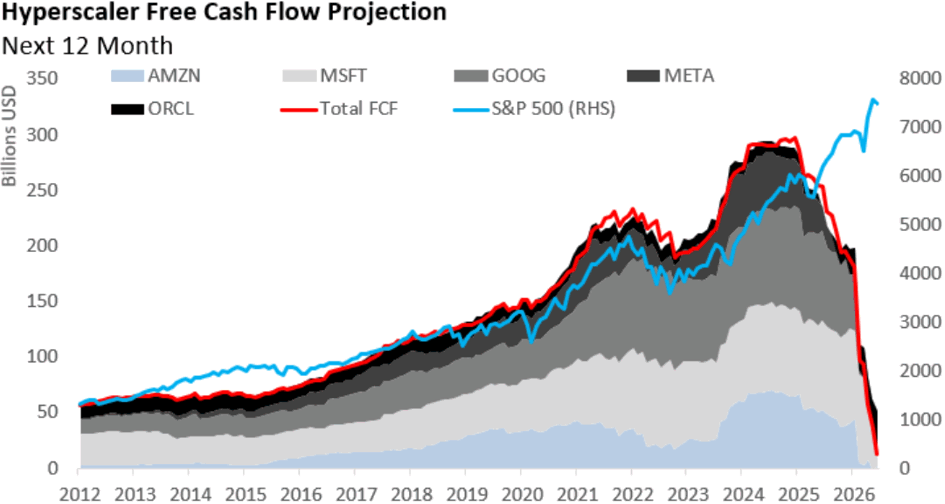
Chart of the Week: Micron’s $41.5B revenue blowout and the OpenAI IPO delay arrived in the same week — two views of the same chart. The AI hardware supply side is confirmed real (HBM booked through 2027, $22B in customer deposits); the demand sustainability question is now live (OpenAI deferring its $1 trillion public offering because the market won’t price a pre-profit AI company at that valuation). This chart explains how both can be true simultaneously: hyperscaler capex has tripled to $725B in 2026 guidance while forward free cash flow approaches zero, the build now self-funding through bond markets and customer deposits rather than operating cash — the week proved both clauses of Friday’s chart caption at once: the market is still pricing optionality, and the infrastructure is already holding obligations.
MIB Weekly Digest Ver. 1.64
For professional investors only. Not investment advice.
© 2026 RecessionALERT.com

Comments are closed.