
MARKET INTELLIGENCE BRIEF (MIB)
Thursday, November 12, 2026
Jensen Huang quit Nvidia effective immediately; NVDA fell 4.34% and at least six firms cut it to Hold, while AMD (+5.86%) and Broadcom (+5.54%) rallied. Hammack and Daly called for higher rates, a December hike is fully priced, and the 10-year jumped 13.7 bps to 5.133%. Brent rose 3.51% on Houthi strike claims against Saudi oil sites. Existing-home sales sank to their lowest since August 2010. Trump threatened to double Mexico tariffs, and SpaceX-Tesla merger talks advanced, per Bloomberg.
TABLE OF CONTENTS
A. EXECUTIVE SUMMARY
B. MARKET DATA
C. HIGH-IMPACT STORIES (5)
D. MODERATE-IMPACT STORIES (7)
E. ECONOMY WATCH (5)
F. EARNINGS WATCH (2)
G. WHAT’S NEXT
H. CHART OF THE DAY
A. EXECUTIVE SUMMARY -> TOP
Stocks absorbed a key-person shock and a hawkish repricing at once: Jensen Huang’s immediate resignation sent Nvidia down 4.34%, but Broadcom, AMD and Alphabet rallied, holding the S&P 500’s loss to 0.35% and the Nasdaq 100’s loss to 0.30%. The larger signal came from rates: the 10-year jumped 13.7 bps to 5.133% while Hammack and Daly called for further tightening and markets fully priced a December 9 hike, and bonds sold off alongside equities instead of offering a haven. Brent’s 3.51% rise on Houthi claims of strikes on Saudi oil sites and Trump’s threat to double tariffs on Mexico added two fresh inflation channels on the same day. Breadth was far weaker than the headline: nine of 11 sectors fell, the rate-sensitive Russell 2000 fell 1.66% and Basic Materials fell 2.13%, leaving Energy (+1.15%) and Communication Services (+0.13%) as the only gainers.
• NVDA fell 4.34% to $166.19, well off an intraday low of $148.80, after Jensen Huang resigned effective immediately; CFO Colette Kress is interim CEO, Harvey C. Jones becomes the first Chair of the Board, and Q3 results stay on Tuesday, November 17.
• At least six firms cut NVDA to Hold-equivalent, with Evercore ISI’s target cut to $186 from $465 and Bernstein’s to $200 from $400; AMD rose 5.86% after a William Blair upgrade, AVGO rose 5.54% and GOOGL rose 1.79%.
• The 10-year rose 13.7 bps to 5.133% and the 2-year rose 13.6 bps to 4.884%; CME FedWatch fully prices a December 9 hike (85.5% for 25 bps, 14.5% for 50 bps), the dollar index posted its highest close since at least April 15, and gold fell 2.97% to $3,881.70.
• Brent rose 3.51% to $96.02 and WTI rose 2.51% to $88.70 after the Houthis claimed attacks on the Saudi East-West pipeline and Yanbu, and Trump said the US does not need a deal with Iran; XOM approved the $12.5 billion Longtail project offshore Guyana after the close.
• Existing-home sales fell 5.5% to 3.75 million, below the 3.85 million forecast and the lowest pace since August 2010; the October federal deficit reached $404.0 billion against a $298.6 billion forecast, and initial claims rose to 200,000.
• Trump threatened to double tariffs on Mexico “IMMEDIATELY” over migrant caravans, with no order issued; Bloomberg reported SpaceX-Tesla merger talks are progressing toward a possible December announcement, and SpaceX planned more than $74 billion of AI supercomputing campuses.
1. The AI trade rotated rather than broke — Nvidia now carries a leadership vacuum and a ratings overhang into Tuesday’s results, with Evercore ISI and Bernstein cutting their targets by half or more, yet capital moved within the complex instead of leaving it: AMD, Broadcom and Alphabet rallied, and SpaceX added more than $74 billion of planned supercomputing campuses the same day. The risk sits in the index’s heaviest single weight rather than in AI demand, which argues for spreading AI-hardware exposure across names rather than exiting the theme.
2. Inflation pressure is building from several directions as the Fed leans in — Hammack and Daly called for higher rates on the day Brent rose 3.51% on Houthi claims of strikes on the East-West pipeline, Saudi Arabia’s main export route around Hormuz; Trump threatened to double Mexico tariffs; and NFIB showed a net 37% of small firms planning price increases, the most since July 2022. With the 2s10s spread steady at about 25 bps, the long end is repricing alongside the policy path, and bonds offered no hedge against falling equities. Friday’s October PPI (0.4% expected) is the next test of whether a 50 bp December move comes into play.
3. Higher rates are biting in housing and small caps, not yet in jobs — Existing-home sales fell to the lowest pace since August 2010 and the Russell 2000 fell 1.66%, the most of the major indices, while October’s $404.0 billion deficit, about $105 billion wider than forecast, adds Treasury supply with the 10-year at 5.133%. Initial claims at 200,000 and continuing claims down 20,000 give the Fed no labor-market reason to wait, so rate-sensitive sectors face pressure from both the policy path and the bond market.
 — Leading economic indicators. Accurate market forecasts. Apply for membership at join.recessionalert.com
B. MARKET DATA -> TOP
Jensen Huang’s resignation as Nvidia’s chief executive set the tone: Nvidia fell 4.34%, though well off its intraday low, while rivals Broadcom, AMD and Alphabet rallied, leaving the S&P 500 down a modest 0.35%. Beneath the headline the selloff was broad, with nine of eleven sectors lower, the Russell 2000 down 1.66% and decliners outnumbering advancers 3.4-to-1 on the NYSE, per Reuters. The sharper signal came from rates: the 2-year and 10-year yields each rose about 14 bps, the dollar posted its highest close since at least April 15 and gold fell to its lowest close over the same span. Energy was the exception, as crude climbed on attacks on Saudi energy sites.
CLOSING PRICES – Thursday, November 12, 2026:
MAJOR INDICES
The headline indices each fell about a third of a percent, but breadth was far weaker: the Russell 2000 dropped 1.66% and the NYSE Composite 0.74%. With the Dow and the Transports both within 2% of their 10-session highs, the Dow Theory bull confirmation extends into a second session. Over the past 10 sessions the S&P 500 has beaten the Nasdaq 100 by 2.13 points, a broadening rotation now in its ninth session.
| Index | Close | Change | %Move | Why It Moved |
|---|---|---|---|---|
| S&P 500 | 7,592.40 | -26.98 | -0.35% | Fell as Nvidia dropped after CEO Jensen Huang stepped down, per Reuters; Broadcom, AMD and Alphabet each rose and were among the biggest boosts to the index, per Reuters, limiting the decline and leaving the index back below 7,600 |
| Dow Jones | 52,297.09 | -189.40 | -0.36% | Fell with the broad market; no discrete Dow-specific catalyst identified |
| DJ Transportation | 20,538.92 | -119.73 | -0.58% | Fell with the broad market; no discrete transport-specific catalyst identified |
| Nasdaq 100 | 28,289.19 | -85.06 | -0.30% | Nvidia’s slide after Huang’s exit was largely offset by gains in rivals Broadcom, AMD and Alphabet; the index held above 28,000 |
| Russell 2000 | 2,799.06 | -47.20 | -1.66% | Fell the most of the six indices as yields jumped; no discrete small-cap catalyst identified |
| NYSE Composite | 24,466.97 | -181.56 | -0.74% | Broad decline: nine of eleven sectors fell, and decliners outnumbered advancers 3.4-to-1 on the NYSE, per Reuters |
VOLATILITY & TREASURIES
The 2-year and 10-year yields each rose about 14 bps in the first cash session since Tuesday, a parallel shift that left the 2s10s spread unchanged at about 25 bps. Bonds sold off alongside stocks rather than catching a haven bid, while the VIX rose 6.86% and the dollar posted its highest close since at least April 15.
| Instrument | Level | Change | Why It Moved |
|---|---|---|---|
| VIX | 18.69 | +1.20 (+6.86%) | Rose as Huang’s exit from Nvidia unsettled AI-linked stocks |
| 10-Year Treasury Yield | 5.133% | +13.7 bps | Rose in the first cash session since Tuesday, after Wednesday’s Veterans Day closure; no discrete same-day catalyst identified. Markets fully price a December rate hike, per Reuters, and San Francisco Fed President Daly said further hikes would likely be needed |
| 2-Year Treasury Yield | 4.884% | +13.6 bps | Rose in step with the 10-year; no discrete same-day catalyst identified |
| US Dollar Index (DXY) | 103.19 | +0.29 (+0.28%) | Highest close since at least April 15 for a second session; Investing.com tied the dollar’s rise to expectations of further Fed rate hikes |
COMMODITIES
Every metal fell: gold dropped 2.97% to its lowest close since at least April 15 and silver 3.94%, with copper and platinum lower too. Investing.com tied gold’s slide to rising Fed rate-hike bets and a firmer dollar. Bitcoin’s 3.25% drop came alongside the selloff in AI-linked stocks, with no crypto-specific catalyst found.
| Asset | Price | Change | %Move | Why It Moved |
|---|---|---|---|---|
| Gold | $3,881.70/oz | $-118.80 | -2.97% | Lowest close since at least April 15; fell as Fed rate-hike expectations and the dollar rose, per Investing.com |
| Silver | $49.955/oz | $-2.047 | -3.94% | Fell with gold; no discrete silver-specific catalyst identified |
| Copper | $6.1930/lb | $-0.0970 | -1.54% | No discrete same-day catalyst identified |
| Platinum | $1,519.55/oz | $-18.95 | -1.23% | Fell with the precious metals; no discrete same-day catalyst identified |
| Bitcoin | $71,497.0 | $-2,402.0 | -3.25% | Fell alongside AI-linked stocks; no discrete crypto-specific catalyst identified |
ENERGY
Brent outpaced WTI, widening the spread to $7.32, while Henry Hub closed at its highest level since at least April 15 and Dutch TTF jumped 8.14%. Crude’s gain had a named driver: Yemen’s Houthis said they attacked Saudi oil facilities as shipping disruptions in the Strait of Hormuz continued, per Reuters. Energy rose against a falling equity tape.
| Asset | Price | Change | %Move | Why It Moved |
|---|---|---|---|---|
| Crude Oil (WTI) | $88.70/bbl | $+2.17 | +2.51% | Settled $88.74, up $2.21, per Reuters, after Yemen’s Houthis said they attacked a pumping station on Saudi Arabia’s East-West oil pipeline, a Yanbu oil facility and an Aramco building in Riyadh, as Strait of Hormuz disruptions continued; President Trump also wrote that the US did not need a deal with Iran |
| Crude Oil (Brent) | $96.02/bbl | $+3.26 | +3.51% | Settled $95.82, up $3.06, per Reuters, on the same attacks on Saudi energy sites and Hormuz shipping disruptions |
| Natural Gas (Henry Hub) | $3.361/MMBtu | $+0.146 | +4.54% | Highest close since at least April 15; no discrete same-day catalyst identified |
| Natural Gas (Dutch TTF) | $30.362/MMBtu | $+2.286 | +8.14% | Extended its rally to a third session on near-term supply worries, per Investing.com |
S&P 500 SECTORS
An 82% breadth sweep: nine of 11 sectors fell, and the holdouts were Energy (+1.15%), lifted by crude, and Communication Services (+0.13%), home to Alphabet’s gain. Basic Materials (-2.13%) fell most on a day gold, silver and copper all declined. Healthcare (-0.92%) was among the weaker sectors despite leading over three and six months.
| Sector | 1-Day | 1-Week | 1-Month | 3-Month | 6-Month | YTD | 12-Month |
|---|---|---|---|---|---|---|---|
| Energy | +1.15% | +2.98% | -5.53% | +1.07% | +4.28% | +36.86% | +33.82% |
| Communication Services | +0.13% | +3.40% | -9.01% | -7.41% | -15.76% | -8.06% | -5.52% |
| Utilities | -0.18% | +1.18% | +4.43% | -1.26% | -3.84% | +1.72% | -2.69% |
| Consumer Defensive | -0.19% | -0.45% | +5.86% | +7.14% | +5.19% | +16.63% | +17.35% |
| Consumer Cyclical | -0.55% | +1.93% | +5.95% | +0.32% | -1.42% | -1.97% | -3.81% |
| Real Estate | -0.73% | -0.21% | +6.14% | -3.57% | -0.12% | +7.51% | +4.21% |
| Technology | -0.78% | +6.12% | -7.63% | -8.10% | -3.22% | +16.25% | +13.02% |
| Financial | -0.80% | +1.22% | +4.89% | -1.87% | +10.61% | +7.20% | +11.16% |
| Industrials | -0.86% | +5.71% | +0.44% | -8.45% | -7.06% | +7.18% | +8.26% |
| Healthcare | -0.92% | +1.40% | +7.80% | +9.11% | +21.86% | +16.54% | +17.75% |
| Basic Materials | -2.13% | -0.16% | -0.71% | -6.31% | -9.25% | +8.27% | +16.44% |
TOP MEGA-CAP MOVERS:
GAINERS
| Company | Ticker | Close | Change | Why It Moved |
|---|---|---|---|---|
| Advanced Micro Devices Inc | AMD | 585.30 | +5.86% | Rallied as investors turned to Nvidia rivals after CEO Jensen Huang stepped down; Reuters named AMD among the biggest boosts to the S&P 500 |
| Broadcom Inc | AVGO | 364.36 | +5.54% | Rose as an Nvidia rival after Huang’s exit, and Reuters named it among the biggest boosts to the S&P 500; an analyst said Nvidia’s succession uncertainty opens the door for Google’s TPUs and Broadcom, per Investing.com, not independently confirmed |
| Arista Networks Inc | ANET | 206.63 | +5.06% | No discrete same-day catalyst identified; Investing.com attributed the gain to a continued recovery after its November 3 third-quarter report |
| ExxonMobil Holdings Corp | XOM | 169.78 | +1.84% | Rose with Energy (+1.15%), the session’s best sector, as crude climbed on attacks on Saudi energy sites, per Reuters |
| Alphabet Inc | GOOGL | 298.70 | +1.79% | Rose as an Nvidia rival after Huang’s exit, and Reuters named it among the biggest boosts to the S&P 500; Investing.com cited investor focus on Google’s in-house TPU chips |
DECLINERS
| Company | Ticker | Close | Change | Why It Moved |
|---|---|---|---|---|
| NVIDIA Corp | NVDA | 166.19 | -4.34% | CEO Jensen Huang stepped down on Thursday after revelations of extramarital affairs, including one involving a suspected Chinese spy, per Reuters; CFO Colette Kress is interim CEO. The shares closed well off an earlier drop of nearly 12%, per Reuters |
| Applied Materials Inc | AMAT | 380.95 | -3.58% | Fell during the session ahead of its quarterly report after the close, as AI-linked stocks slid; no discrete same-day catalyst identified |
| Palo Alto Networks Inc | PANW | 322.66 | -3.53% | Jefferies cut its price target to $400 from $450 on Thursday while keeping a Buy rating, per Investing.com, not independently confirmed; results are due November 18 |
| GE Aerospace | GE | 330.86 | -3.47% | No discrete same-day catalyst identified |
| Netflix Inc | NFLX | 62.69 | -2.87% | No discrete same-day catalyst identified |
— Institutional-grade intelligence for serious investors. Apply for membership at join.recessionalert.comC. HIGH-IMPACT STORIES -> TOP
BEARISH
1. Nvidia’s Jensen Huang Resigns Effective Immediately; CFO Colette Kress Becomes Interim CEO and the Shares Fall 4.34%
The core facts:Nvidia said on Thursday that Jensen Huang, its co-founder, had resigned as president, chief executive and a director, effective immediately. Chief Financial Officer Colette Kress will serve as interim CEO and remain CFO until a permanent successor is named, and Harvey C. Jones becomes the company’s first-ever Chair of the Board. The board will consider internal and external candidates. “The Board has full confidence in Colette and the leadership team,” Jones said, adding that operations, customer commitments and the product roadmap would continue “without interruption.” Third-quarter results stay on Tuesday, November 17. The resignation follows Huang’s November 8 admission of an affair and the board’s investigation into reports that he was the target of a foreign intelligence effort. The shares closed at $166.19, down 4.34%, well off an earlier drop of nearly 12%, per Reuters, and the S&P 500 fell 0.35%.
Why it matters:Nvidia is one of the world’s largest companies, at roughly $4.0 trillion, and the heaviest single weight in the AI trade, so losing its founder-CEO without a named successor is a key-person shock to the whole complex. The market’s reaction was a rotation rather than an exit: Broadcom, AMD and Alphabet each rose and were among the biggest boosts to the S&P 500, per Reuters, which held the index’s loss to about a third of a percent. Nvidia recovered most of its intraday loss, a sign that buyers see the franchise as intact even as the leadership question stays open. Reuters also flagged possible consequences for US chip-export policy toward China, where the company’s conduct was already under scrutiny.
What to watch:The November 17 results and call (2 p.m. PT), the first under interim leadership: whether the board reaffirms guidance and customer commitments, and whether it gives any timetable for naming a permanent CEO.
BEARISH
2. Hammack and Daly Say Rates Must Go Higher as Two- and 10-Year Yields Jump About 14 bps and a December Hike Is Fully Priced
The core facts:Cleveland Fed President Beth Hammack, a 2026 voter, said at Ohio State University that the Fed “needs to move rates higher to get to restrictive rate policy” and “has been missing on the inflation mandate for years,” while favoring modest, steady increases and saying she does not think the Fed is behind the curve. San Francisco Fed President Mary Daly told a Stanford audience that “further tightening will be needed” and that “inflation pressure is up, not down.” Chicago’s Austan Goolsbee said the Fed is “failing on the inflation side of its mandate,” per investingLive. CME FedWatch shows a December 9 hike fully priced, with an 85.5% chance of 25 bps and 14.5% of 50 bps. In the first cash session since Tuesday, the 10-year yield rose 13.7 bps to 5.133% and the 2-year 13.6 bps to 4.884%. The dollar index rose 0.28% to 103.19, its highest close since at least April 15, and gold fell 2.97% to $3,881.70, its lowest close over the same span.
Why it matters:The move was a parallel shift, with the 2s10s spread steady at about 25 bps, so the long end is repricing alongside the policy path instead of flattening toward a slowdown. Bonds sold off with stocks rather than providing a haven, and the rate-sensitive Russell 2000 fell 1.66%, the most of the major indices. Hammack’s preference for gradual moves argues against a 50 bp step in December, but the speakers agreed on direction, and none offered a case for pausing. With the 10-year back above 5.1%, financial conditions are tightening on their own, which Daly’s remarks suggest the Fed welcomes rather than resists.
What to watch:October producer prices on Friday, November 13, and the FOMC minutes on Wednesday, November 18; a 10-year close above 5.315%, its highest since at least April 15, would mark a new high for the move.
BEARISH
3. Brent Jumps 3.51% as the Houthis Claim Strikes on Saudi Oil Sites and Trump Says the US Does Not Need an Iran Deal
The core facts:Brent closed at $96.02 a barrel, up 3.51%, and WTI at $88.70, up 2.51%; on the futures settlement, Brent settled up $3.06 at $95.82 and WTI up $2.21 at $88.74, per Reuters. Trade was volatile, with crude selling off early and then rebounding after Yemen’s Houthis said they had attacked a pumping station on the Saudi East-West oil pipeline, an oil facility in Yanbu and an Aramco building in Riyadh; the Saudi-led coalition later said it had intercepted two drones. President Trump wrote that the US did not need a deal with Iran: “Those days have long since passed.” Iran’s military said four tankers had been hit by explosions in the Strait of Hormuz after ignoring warnings, which Reuters could not immediately verify, and Ukraine said its drones hit Russia’s Ust-Luga port. Pulling the other way, EIA data showed commercial crude stocks rising 4.657 million barrels, and OPEC+ output rose in October. Both benchmarks were still down about 2.5% for the week, per Reuters.
Why it matters:The East-West pipeline to Yanbu is Saudi Arabia’s main route for exporting crude without passing through Hormuz, so a credible threat to it targets the supply buffer the market has relied on through the Gulf disruptions. Trump’s reversal from talk of a negotiated end to the conflict removes a source of downside pressure on prices. Energy (+1.15%) was the session’s best sector, but costlier oil also feeds the inflation pressure the Fed’s hawks cited on the same day.
What to watch:The IEA Oil Market Report on Friday, November 13, and any confirmed damage at Yanbu or on the East-West line; Brent’s $100 level is the threshold for a renewed inflation scare.
BEARISH
4. Trump Threatens to “IMMEDIATELY” Double Tariffs on Mexico Unless It Stops Migrant Caravans
The core facts:President Trump posted on Thursday that Mexico “MUST STOP THEM, NOW” and that tariffs on Mexico would be doubled “IMMEDIATELY” if it did not, adding “there will be no leniency!” He named no specific tariffs, rate or deadline, and no order was issued. The post followed the departure on Tuesday of an estimated 1,500 migrants, mostly from Central America, from Tapachula near the Guatemalan border. At her morning press conference, President Claudia Sheinbaum said, “Since President Trump came into government, no migrant caravan has reached the northern border,” and that one of two current caravans had shrunk to fewer than 100 people. The two countries are negotiating a trade deal after Trump chose in July not to extend the USMCA.
Why it matters:Mexico is one of the largest US trading partners and is woven into North American auto, electronics and food supply chains, so doubling its tariffs would raise costs for US manufacturers and add to goods inflation at a moment when the Fed is already tightening. Without a legal instrument or a target the threat reads as negotiating leverage over a trade deal still in talks, but it shows that trade escalation remains a live tool after the midterms.
What to watch:Any executive order or Federal Register notice specifying which Mexican goods would be affected, and the peso as the market’s gauge of how seriously the threat is taken.
UNCERTAIN
5. SpaceX-Tesla Merger Talks Progress Toward What Would Be the Largest Corporate Merger in History, With an Announcement Possible in December
The core facts:Talks to combine SpaceX and Tesla, Elon Musk’s two largest companies, are progressing, and a deal could be announced as soon as December, Bloomberg reported on Thursday afternoon, citing people familiar with the matter. Boards and advisers are negotiating the terms and how the combined company would be organized, and Bloomberg described the combination as “marking the largest corporate merger in history.” Tesla rose as much as 1.9% to $398.35 during the session and SpaceX 0.6% to $140.63, per a Dow Jones report. Neither company responded to requests for comment.
Why it matters:A combination would merge a top-ten S&P 500 weight with a newly listed space and AI-infrastructure business, raising questions about the exchange ratio, governance and related-party conflicts that Tesla holders will have to vote on. It would also fold Tesla’s capital into SpaceX’s AI build-out, which on the same day added more than $74 billion of planned supercomputing campuses (Story 9). The muted share reaction suggests investors want terms before pricing it in.
What to watch:Board statements or filings from either company, and whether Tesla’s board forms an independent special committee to negotiate, a standard requirement for a deal with this much related-party overlap.
— Quantifying recession risk so you don’t have to guess. Apply for membership at join.recessionalert.comD. MODERATE-IMPACT STORIES -> TOP
UNCERTAIN
6. At Least Six Firms Cut Nvidia to the Equivalent of Hold as William Blair Upgrades AMD and the Rivals Rally More Than 5%
The core facts:Evercore ISI’s Mark Lipacis cut Nvidia to In Line from Outperform and his target to $186 from $465, and Bernstein’s Stacy Rasgon cut to Market Perform with a $200 target, down from $400, writing: “Our gut tells us that we probably haven’t yet fully probed the depths of what might be found here.” Oppenheimer’s Rick Schafer moved to Perform, calling Huang’s exit a “material, potentially thesis-changing event,” and William Blair, KeyBanc and Melius also cut to Hold-equivalent ratings. William Blair, the same morning, upgraded AMD to Outperform from Market Perform. AMD closed up 5.86% at $585.30, Broadcom 5.54% at $364.36 and Alphabet 1.79% at $298.70, and Reuters named all three among the biggest boosts to the S&P 500. Nvidia’s intraday low was $148.80.
Why it matters:A cluster of downgrades on one day means Nvidia now faces a ratings overhang as well as a leadership vacuum, which can weigh on flows into the stock for longer than the headline shock. The simultaneous AMD upgrade and the rally in Broadcom and Alphabet show the street repositioning within AI hardware rather than abandoning it, which kept the Nasdaq 100’s loss to 0.30%.
What to watch:Further target cuts or reinstatements after Nvidia’s November 17 results, and whether AMD and Broadcom hold their gains once the results are out.
UNCERTAIN
7. The Fed’s 2027 Calendar Turns October Into a Strategy-Only Meeting and Has No December Meeting, Leaving Seven Policy Decisions
The core facts:The Federal Reserve released its tentative 2027 FOMC schedule at 12:45 p.m. ET on Thursday: January 26-27, March 16-17, April 27-28, June 8-9, July 27-28, September 14-15, October 26-27 and November 16-17, followed by January 25-26, 2028. The Committee will announce its policy decision on the second day of each meeting “except the October 26-27 meeting,” which “will be dedicated to the discussion of broad monetary policy strategy issues.” No December meeting is listed, and the release gave no reason for the changes.
Why it matters:The FOMC normally announces eight scheduled decisions a year; this calendar has seven, with a nine-week gap from September 15 to November 17 and a ten-week gap from November 17 to January 26, 2028. In a tightening cycle, fewer decision points mean larger or less frequent moves, or a greater reliance on guidance between meetings. The calendar is tentative and a year out, but it sets the cadence markets will price 2027 policy against.
What to watch:Whether the minutes of the October 27-28 meeting, due Wednesday, November 18, explain the change.
BULLISH
8. China Approves Eli Lilly’s Orforglipron, the First GLP-1 Weight-Loss Pill Cleared in the Country
The core facts:China’s medicines regulator approved Eli Lilly’s orforglipron, sold as Foundayo in the US, for weight loss, making Lilly the first drugmaker to win Chinese approval for a GLP-1 weight-loss pill, Reuters reported on Thursday; until now Chinese approvals in the category covered only injectables. J.P. Morgan’s head of China healthcare research expects annual GLP-1 weight-management sales in China to reach 30 billion yuan (about $4.5 billion) within five to seven years, from 3 billion to 4 billion yuan now. Lilly did not comment on price. Its shares rose 1.2% in premarket trading but were later quoted 0.70% lower at $1,427.28, while Novo Nordisk’s Danish shares rose more than 2%, per Reuters.
Why it matters:An oral GLP-1 avoids the cold-chain and injection barriers that have limited uptake in China, giving Lilly first-mover access to what J.P. Morgan sees as a roughly tenfold market expansion. The premarket gain faded on a day Healthcare fell 0.92%, so the approval reads as a long-dated growth driver rather than a near-term earnings event.
What to watch:Lilly’s China pricing and any move toward national reimbursement listing, and the outcome of the separate type 2 diabetes review.
BULLISH
9. SpaceX Plans More Than $74 Billion of AI Supercomputing Campuses in Arizona and Texas
The core facts:SpaceX announced on Thursday more than $74 billion of planned investment in two supercomputing campuses: about $50 billion in Cochise County, Arizona, with roughly 5,500 construction jobs and 1,000 ongoing roles, and $24 billion on SpaceX-owned land near the Port of Brownsville at Starbase, Texas, which will train frontier models and generate its own electricity off the public grid. It also committed $220 million to expand Brownsville-area water and sewage capacity. In Arizona it is working with local electric cooperatives on existing renewable resources and says the project could cut members’ bills by up to 20%. A Starbase hearing notice describes a SpaceX-owned natural-gas power station for the Texas site, with a tax-abatement vote set for December 9. The Arizona plan had been discussed at a public meeting the previous week; Thursday’s announcement combined both sites.
Why it matters:The commitment adds to the AI capital-spending pipeline that supports chip, power-equipment and construction demand, on a day Nvidia’s leadership crisis put that trade in question. Self-generated power at Starbase shows large AI builders working around grid constraints, and SpaceX’s call for “stable, competitive policies” points to the political risk from a Texas governor-elect who campaigned on a data-center moratorium.
What to watch:The Starbase City Commission’s December 9 vote on the tax-abatement agreement.
UNCERTAIN
10. FDA Has Shelved Its National Priority Voucher Fast-Review Pilot, Reuters Reports; HHS Says the Program Is Ongoing
The core facts:The FDA has shelved the Commissioner’s National Priority Voucher pilot, Reuters reported on Thursday: according to one source, leadership told companies the agency is not moving forward with it, and while applications remain open, submitted ones do not advance. No new vouchers have been awarded since Commissioner Marty Makary left in May, and the agency has had no commissioner since. Of 22 drugs that received vouchers, 12 have been approved, five of them since Makary’s departure, and career scientists have resumed overseeing the review timelines of the nine still in the program. HHS spokesperson Emily Hilliard disputed the account, saying the pilot is ongoing and that the FDA is reviewing feedback from a June 2026 public hearing.
Why it matters:The vouchers promised review in a fraction of the usual timeline, and drugmakers have built launch plans around them. If the program has stalled, sponsors of the nine pending drugs face standard timelines and the sector loses one of the few regulatory tailwinds of the past year, at a time when the FDA is operating without a confirmed leader.
What to watch:Whether the FDA issues any new voucher or a formal statement on the pilot, and progress on nominating a permanent commissioner.
BULLISH
11. ExxonMobil Approves the $12.5 Billion Longtail Project, Its Eighth Development Offshore Guyana
The core facts:ExxonMobil said after the close on Thursday (3:30 p.m. CT) that it will invest an additional $12.5 billion in Longtail, in the southeastern part of the Stabroek block, with start-up expected in 2030. Its floating production vessel is designed to process 1.2 billion cubic feet of gas a day and up to 250,000 barrels of condensate, capacity figures outlined before today’s decision. ExxonMobil operates the project with a 45% stake, alongside Hess Guyana (30%) and CNOOC (25%). Longtail is Stabroek’s eighth development: four are producing, Uaru is expected to start in the fourth quarter, and Whiptail and Hammerhead are under construction.
Why it matters:Longtail is a gas-and-condensate project, not another oil vessel, which extends Guyana’s growth into gas and gives ExxonMobil and Chevron, through its Hess stake, a visible pipeline of production into the next decade. A $12.5 billion commitment at a time of Gulf supply disruption signals confidence in long-cycle, non-Middle East supply. ExxonMobil rose 1.84% during the session, before the announcement, with the Energy sector.
What to watch:Uaru’s start-up in the fourth quarter, which would take Stabroek to five producing developments.
BEARISH
12. Louisiana Sues Ten Prediction-Market Platforms, Including Robinhood, Coinbase and Kalshi, Seeking an Immediate Restraining Order
The core facts:Louisiana Attorney General Liz Murrill sued Kalshi, Robinhood, Polymarket, Forecastex, Crypto.com, Coinbase, Novig, Underdog, Gemini and Prophetx on Thursday, seeking an immediate restraining order and an injunction on the grounds that their event contracts break state law. “For too long, they have violated our laws with impunity,” she wrote. Louisiana is the 11th state to sue one or more prediction markets, per The Block. Robinhood said its event contracts are regulated by the CFTC, Coinbase called the suit “fragmented enforcement” that Congress sought to prevent, and Kalshi had prepared an emergency restraining-order filing of its own.
Why it matters:Event contracts, mostly on sports, have become a growth line for Robinhood and Coinbase, and a rising count of state suits turns the question of whether the CFTC’s jurisdiction pre-empts state gambling law into a revenue risk. The suit comes the same week a federal judge ruled that sports event contracts are not swaps, letting New York apply its gambling law, which weakens the platforms’ main pre-emption defense.
What to watch:Whether a Louisiana court grants the restraining order, and any CFTC statement on its jurisdiction over sports contracts.
— Separating signal from noise since 2007. Apply for membership at join.recessionalert.comE. ECONOMY WATCH -> TOP
Thursday’s data sharpened the split between a rate-sensitive economy under strain and an inflation pulse that keeps the Fed on a tightening path. Existing-home sales fell to 3.75 million, the slowest pace since August 2010, and October’s $404.0 billion federal deficit overshot forecasts by about $105 billion, on a day the 10-year yield rose 13.7 bps to 5.133%. The labor market held: claims rose to 200,000, but the four-week average was unchanged and continuing claims fell. NFIB’s survey showed a net 37% of small firms planning price increases, the most since July 2022, the kind of pricing power that strengthens the case for a hike at the December 9 meeting.
Existing-Home Sales Drop 5.5% to 3.75 Million, Missing the 3.85 Million Forecast and Hitting the Lowest Pace Since August 2010 (NAR, Nov 12)
What they’re saying:Existing-home sales fell 5.5% in October to a seasonally adjusted annual rate of 3.75 million, below the 3.85 million forecast and down from 3.97 million in September, the National Association of Realtors reported. Sales were 8.8% lower than a year earlier, the median price rose just 0.4% to $416,700, and inventory rose 1.3% to 1.59 million units, a 5.1-month supply. NAR Chief Economist Lawrence Yun said mortgage rates “have climbed to their highest levels since 2000, aside from a single month in 2023. As a result, home sales fell to their lowest level since August 2010.”
The context:Housing is showing the clearest strain from higher borrowing costs: sales fell from September in the Midwest, South and West and held steady only in the Northeast, while year-over-year declines reached all four regions. With prices barely rising and supply building, demand rather than inventory is the constraint. Yun noted distressed sales are only 2% of transactions and said there “could be sizable pent-up demand if mortgage rates decline”, but the 10-year Treasury yield closed at 5.133% on Thursday, up 13.7 bps.
What to watch:The NAHB Housing Market Index on Tuesday, November 17, then October housing starts, building permits and pending home sales on Wednesday, November 18.
October Federal Deficit Reaches $404.0 Billion, About $105 Billion Wider Than Forecast (U.S. Treasury, Nov 12)
What they’re saying:The federal government ran a $404.0 billion deficit in October, the first month of fiscal 2027, according to the Monthly Treasury Statement released at 2:00 p.m. ET, against a consensus forecast of $298.6 billion. The September deficit was $27.0 billion.
The context:A shortfall this large in the opening month of the fiscal year matters for the bond market, because deficits are financed with Treasury issuance, and it landed on a day the 10-year yield rose 13.7 bps to 5.133% and the 2-year rose 13.6 bps to 4.884%. The receipts and outlays behind the miss could not be independently confirmed, so it is not yet clear how much came from weaker revenue and how much from higher spending, including interest costs.
What to watch:Treasury International Capital data on foreign demand for US securities on Wednesday, November 18, and the November Monthly Treasury Statement in mid-December.
Initial Jobless Claims Rise to 200,000 Against a 195,000 Forecast as Continuing Claims Fall 20,000 (Labor Department, Nov 12)
What they’re saying:Seasonally adjusted initial claims rose 9,000 to 200,000 in the week ending November 7, above the 195,000 forecast; the prior week was revised up by 2,000 to 191,000. The four-week moving average was unchanged at 195,250. Continuing claims fell 20,000 to 1,697,000 in the week ending October 31, and the insured unemployment rate held at 1.1%.
The context:The weekly rise is modest and leaves claims near the 200,000 mark, with a flat four-week average showing no trend toward more layoffs. Falling continuing claims indicate laid-off workers are still being reabsorbed. For a Fed weighing a December hike, a steady labor market removes one of the main arguments for waiting.
What to watch:October retail sales on Tuesday, November 17, and the next weekly claims report on Thursday, November 19.
NFIB: A Net 37% of Small Firms Plan Price Increases, the Most Since July 2022 (NFIB, Nov 10)
What they’re saying:NFIB’s Small Business Optimism Index slipped 0.1 point to 97.8 in October, just below its 53-year average of 98.0, while its Uncertainty Index fell 6 points to 84, the lowest since December 2025. A seasonally adjusted net 37% of owners plan to raise prices over the next three months, up 6 points and the highest reading since July 2022, and a net 33% reported raising average selling prices, up 2 points and well above the historical average of 14%.
The context:Price plans tend to lead realised price increases, and the jump follows October CPI rising 0.4% against a 0.3% forecast. Labor demand also firmed: 36% of owners reported job openings they could not fill, up 4 points, and a net 24% plan to raise compensation, the most since December 2025. Credit is tightening at the margin, with a net 13% reporting a higher rate on their most recent loan, the highest since August 2024.
What to watch:October producer prices on Friday, November 13, and October import prices on Tuesday, November 17.
30-Year Mortgage Rate Falls to 7.11%, a Seven-Week Low and Fourth Straight Weekly Decline (Freddie Mac, Nov 12)
What they’re saying:The average 30-year fixed mortgage rate fell to 7.11% from 7.18% a week earlier, Freddie Mac’s Primary Mortgage Market Survey showed, its fourth consecutive weekly decline and its lowest level in seven weeks. The 15-year rate fell to 6.45% from 6.57%. A year ago the 30-year rate stood at 6.24%.
The context:The decline offers modest relief to a housing market that just posted its weakest existing-home sales since August 2010, but borrowing costs remain 87 bps above a year earlier. The survey was published on a day the 10-year Treasury yield, the main benchmark for mortgage pricing, rose 13.7 bps to 5.133%, a move that works against further declines if it holds.
What to watch:The MBA’s weekly mortgage rate survey and October housing starts, both on Wednesday, November 18.
— Know the probability before the market prices in the risk. Apply for membership at join.recessionalert.comF. EARNINGS WATCH -> TOP
YESTERDAY AFTER THE BELL (Markets Reacted Today)
No major earnings yesterday after the bell from companies with >$100B market cap.
TODAY BEFORE THE BELL (Markets Already Reacted)
No major earnings before the bell from companies with >$100B market cap.
TODAY AFTER THE BELL (Markets React Tomorrow)
BULLISH
13. Cisco Systems (CSCO): -1.66% AH | Record $18.5 Billion Revenue and a Raised Fiscal 2027 Outlook, but Margins Narrow
The Numbers:Released: AMC, Thursday, November 12. Fiscal first-quarter revenue of $18.5 billion, up 24%, against the $18.12 billion consensus; non-GAAP EPS of $1.40, up 40%, against $1.33 expected; GAAP EPS $1.14. Second-quarter guidance: revenue of $18.0 billion to $18.2 billion and non-GAAP EPS of $1.34 to $1.36. Fiscal 2027 guidance raised to revenue of $74.8 billion to $75.8 billion and non-GAAP EPS of $5.47 to $5.53, from $72.2 billion to $73.4 billion and $5.05 to $5.11 in August. The shares rose 1.24% to $102.01 in the regular session and were at $100.32 in extended trading at 6:18 p.m. ET.
The Problem/Win:Product revenue rose 32%, led by Networking up 43%, and Cisco raised its expectation for AI infrastructure revenue from hyperscalers to $9 billion in fiscal 2027, more than double fiscal 2026. CEO Chuck Robbins called it “the very early stages of a multi-year networking supercycle.” The problem is mix: non-GAAP gross margin fell to 65.6% from 68.1% a year earlier, and the second-quarter revenue guide sits below the $18.5 billion just delivered.
The Ripple:A 43% networking gain confirms that AI demand is broadening from chips into the network layer, supportive for Arista (+5.06% today) and Broadcom, while the margin squeeze shows that hyperscaler business carries lower gross margins than Cisco’s traditional enterprise sales.
What It Means:Cisco is a clear AI beneficiary on volume, but investors are weighing growth against margin dilution, which explains the muted after-hours reaction to a beat-and-raise.
What to watch:Friday’s regular-session move, and whether second-quarter gross margin guidance stabilizes near the first quarter’s 65.6%.
BULLISH
14. Applied Materials (AMAT): +0.21% AH | Record $10.41 Billion Revenue, Up 53%, and a First-Quarter Outlook of $11.1 Billion
The Numbers:Released: AMC, Thursday, November 12. Fiscal fourth-quarter revenue of $10.41 billion, up 53% from a year earlier, against the $10.30 billion consensus; non-GAAP EPS of $4.16 against $4.06 expected; GAAP EPS $3.40. Non-GAAP gross margin 50.6%. Fiscal 2026 revenue of $34.45 billion, up 21%. First-quarter guidance: revenue of $11.1 billion, plus or minus $500 million, and non-GAAP EPS of $4.35, plus or minus $0.20. The shares fell 3.58% to $380.95 in the regular session ahead of the report and were at $381.75 in extended trading at 6:18 p.m. ET.
The Problem/Win:Semiconductor Systems revenue reached $8.00 billion and Applied Global Services $1.90 billion, and CEO Gary Dickerson said the company is on track to grow Semiconductor Systems “more than 40 percent in our calendar 2026.” China fell to 25% of revenue from 28% the prior quarter, with Taiwan the largest region at 28%, which reduces exposure to export-control risk. The first-quarter midpoint implies about 7% sequential growth.
The Ripple:The results and guidance show chipmakers kept ordering equipment through the AI-stock selloff, supportive for Lam Research and KLA, and show demand for leading-edge capacity intact on the day Nvidia lost its CEO.
What It Means:A record quarter with a higher outlook and a smaller China share is a clean report, but the flat after-hours reaction suggests it was largely expected after a 53% growth rate.
What to watch:Friday’s regular-session reaction and whether China’s share holds near 25% in the first quarter.
WEEK AHEAD PREVIEW:
Q3 2026 earnings season is in its final stretch, with 88% of the S&P 500 reported as of November 6. The next five sessions carry seven in-scope reporters above $100 billion, concentrated in Nvidia, Home Depot and Disney on Tuesday, November 17, Palo Alto Networks, TJX and Lowe’s on Wednesday, November 18, and Walmart on Thursday, November 19.
NVIDIA (NVDA) — AMC, Tuesday, November 17 — -4.34% today; consensus EPS $2.47 and about $108.7 billion of revenue, against company guidance of $108.0 billion, plus or minus 2%; key focus: the first report under interim CEO Colette Kress, whether guidance and customer commitments are reaffirmed, data-center revenue after $89.0 billion (+117%) last quarter, China exposure, and any timetable for a permanent CEO.
Home Depot (HD) — BMO, Tuesday, November 17 — consensus EPS $3.84 and about $42.8 billion of revenue; key focus: whether comparable sales build on the second quarter’s 1.7% gain against full-year guidance for comparable sales flat to up 2%, with existing-home sales at their lowest since August 2010 and the 10-year yield above 5.1%.
Walt Disney (DIS) — BMO, Tuesday, November 17 — consensus EPS $1.68 and about $25.2 billion of revenue; key focus: delivery on guidance for about $4.9 billion of fourth-quarter segment operating income, softer domestic streaming advertising, weaker Asian park attendance, and the first fiscal 2027 outlook.
Palo Alto Networks (PANW) — AMC, Wednesday, November 18 — -3.53% today; consensus EPS $0.97 and about $3.31 billion of revenue, in line with company guidance; key focus: Next-Generation Security ARR against guidance of $9.54 billion to $9.56 billion, AI-driven security demand and margins.
TJX Companies (TJX) — BMO, Wednesday, November 18 — consensus EPS $1.34 and about $15.8 billion of revenue; key focus: third-quarter comparable sales against guidance of up 2% to 3%, after a 4% second-quarter gain, and whether growth at the Marmaxx division has steadied.
Lowe’s (LOW) — BMO, Wednesday, November 18 — consensus EPS $2.89 and about $22.4 billion of revenue; key focus: comparable sales against a roughly flat full-year outlook, the drag from weak housing activity, and Pro demand as the Foundation Building Materials acquisition is integrated; read it against Home Depot’s figures from the previous day.
Walmart (WMT) — BMO, Thursday, November 19 — consensus EPS $0.64 and about $187.3 billion of revenue, against company guidance of $0.62 to $0.64 and net sales growth of 3% to 3.75% in constant currency, including a headwind of more than 100 bps from the timing of Flipkart’s Big Billion Days sale; key focus: Walmart U.S. comparable sales after the second quarter’s 2.6% gain missed expectations, fuel costs the company expects to exceed its original plan by more than $2 billion this fiscal year, and the drag from drug-pricing rules.
Excluded: Alibaba Group (BABA, BMO Thursday, November 19, $234.74 billion), an ADR. No in-scope company above $100 billion reports on Friday, November 13 or Monday, November 16; the largest names on those days are Americas Gold and Silver ($943 million) and Baidu ($21.44 billion, an ADR). Intuit ($90.91 billion, AMC Thursday, November 19) is below the threshold.
— US market commentary trusted by family offices and institutions. Apply for membership at join.recessionalert.comG. WHAT’S NEXT -> TOP
UPCOMING RELEASES:
| Date | Event | Why It Matters |
|---|---|---|
| Fri, Nov 13 | PPI MoM (Oct) — expected 0.4%, prior 1.3%; Core PPI MoM expected 0.3%, prior 0.7% | The first producer-price read since October CPI rose 0.4% against a 0.3% forecast. A hot print would strengthen the case for a 50 bp December hike, which CME FedWatch prices at 14.5%. |
| Fri, Nov 13 | Fed speakers: Bowman (10:50 AM), Daly (12:00 PM), Jefferson (7:00 PM) | Daly speaks a day after saying “further tightening will be needed”; Bowman and Jefferson give Board views on how large the December step should be. |
| Fri, Nov 13 | IEA Oil Market Report | The agency’s first read since the Houthis claimed attacks on the Saudi East-West pipeline and Yanbu. Brent closed at $96.02; $100 is the threshold for a renewed inflation scare. |
| Mon, Nov 16 | NY Empire State Manufacturing Index (Nov) — prior 25.5 | The first November factory read, testing whether manufacturing holds up with the 10-year above 5.1% and a fresh tariff threat against Mexico. |
| Tue, Nov 17 | Retail Sales MoM (Oct) — prior 0.8%; Control Group prior 0.1% | The main consumer test for a Fed weighing the size of its December hike; strength would add to the inflation case the hawks made this week. |
| Tue, Nov 17 | Import Prices MoM (Oct) — prior 1.1%; Industrial Production MoM (Oct) — prior 0.7% | Import prices show whether goods inflation is still building before any new Mexico tariffs; industrial output gauges the factory sector’s response to higher rates. |
| Tue, Nov 17 | NAHB Housing Market Index (Nov) — prior 29 | Builder sentiment after existing-home sales fell to their lowest pace since August 2010. |
| Wed, Nov 18 | Housing Starts (Oct) — prior 1.221M; Building Permits — prior 1.398M; Pending Home Sales MoM — prior -7.3% | Pending sales lead closings, so a further drop would point to more weakness after October’s 3.75 million existing-home sales pace. |
| Wed, Nov 18 | FOMC Minutes (Oct 27-28 meeting; 2:00 PM) | The Committee’s view of the tightening path, and possibly an explanation for the 2027 calendar’s strategy-only October meeting and missing December decision. |
| Wed, Nov 18 | Net Long-term TIC Flows (Sep) — prior $279.2B | Foreign demand for US securities, the other side of October’s $404.0 billion deficit, with the 10-year at 5.133%. |
| Thu, Nov 19 | Initial Jobless Claims (week to Nov 14); Philadelphia Fed Manufacturing (Nov) — prior 20.9; Fed Hammack Speech (8:50 AM) | Claims at 200,000 give the Fed no labor-market reason to pause; Hammack, who said the Fed “needs to move rates higher,” speaks again. |
KEY QUESTIONS:
1. Can Nvidia’s board steady the franchise at Tuesday’s November 17 results, by reaffirming guidance and giving a timetable for a permanent CEO, or does the ratings overhang keep money rotating into AMD and Broadcom?
2. Does Friday’s October PPI confirm the price pressure in NFIB’s survey and move December odds toward a 50 bp hike, with the 10-year already at 5.133%?
3. Will Wednesday’s FOMC minutes say how much more tightening the Committee expects, and will Brent’s push toward $100 make that path steeper?
— US market commentary trusted by family offices and institutions. Apply for membership at join.recessionalert.comH. CHART OF THE DAY -> TOP
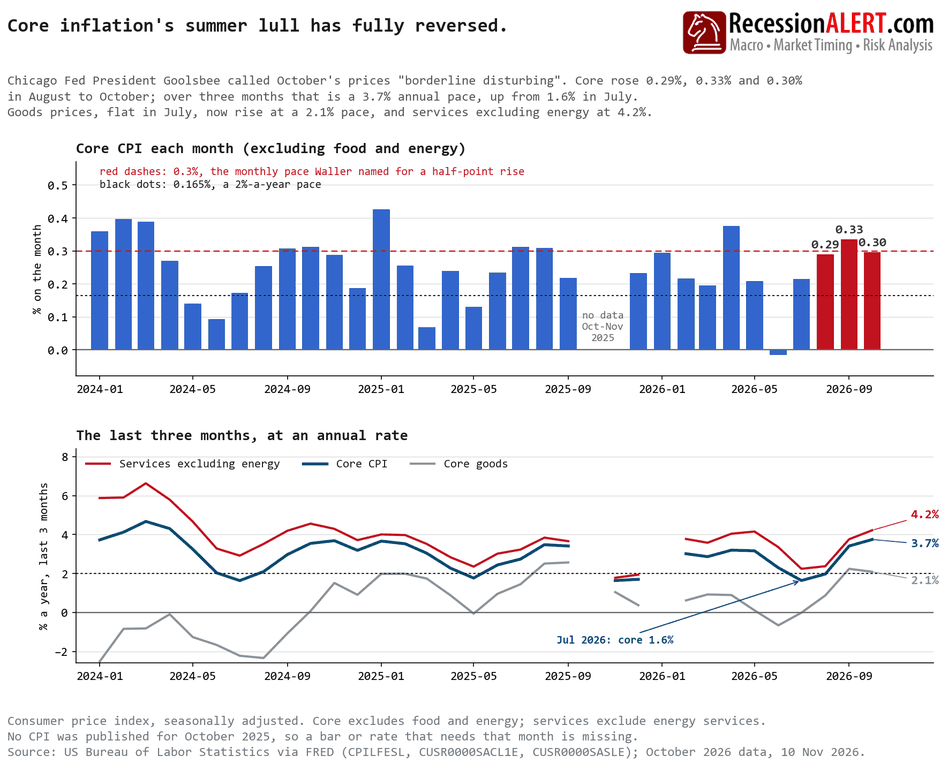
The rebound in core inflation has no single author. Core consumer prices, which strip out food and energy, rose 0.29%, 0.33% and 0.30% from August to October, more than doubling their three-month annual pace from July’s 1.6% to 3.7%, the highest since April 2024. One month near 0.3% is noise; three is a pace. Split the index into its two halves and both have turned at once: goods prices (cars, clothing, furniture), flat in the three months to July, now rise at a 2.1% annual rate, while services excluding energy (rent, insurance, medical care) have gone from 2.2% to 4.2%. The composition matters more than the level. A jump confined to one category can be waited out, because it tends to unwind on its own; a move in goods and services together leaves nothing to set aside. The last quarter shaped like this, in late 2024, ran at a similar 3.7% pace and was still at 3.0% five months later. For the Fed, that removes the easiest argument for patience. Governor Waller said a run of “about 0.3% or higher” means a half-point rate rise “should be considered”; markets treat a December rise as settled and give the larger step 10%. Goldman expects a third rise in March, after September’s and December’s. Households meet the faster half in bills they cannot shop around, with any rate rise landing on top. Inflation without a culprit is inflation with a trend.
What it means: For households, the fastest rises are in rent, insurance and medical care, and card and other variable-rate loans follow the Fed’s rate, so a December rise adds to both. For stock investors, the question moves from whether rates rise to how far: each further month near 0.3% makes a half-point, now priced at one in ten, more likely. For the economy, borrowing stays dear for longer, with Goldman’s first cut pushed to December 2027. The test is November’s core reading: below about 0.2% and the summer lull may return; another 0.3% makes the half-point live.
Market Intelligence Brief (MIB) Ver. 20.05
For professional investors only. Not investment advice.
© 2026 RecessionALERT.com

Comments are closed.