
MARKET INTELLIGENCE BRIEF (MIB)
Wednesday, November 11, 2026
CoreWeave’s beat-and-raise revived the AI-hardware trade: the Nasdaq 100 jumped 2.28% as Micron (+11.89%) and Dell (+11.75%) surged, while Microsoft, Meta and Amazon fell. Futures price a December hike as certain and lean toward a second by January, sending the dollar to its highest close since at least April 15. Brent rose 1.14% as Iran refused to export enriched material. Nvidia lagged as a Senate Republican urged Huang to go. Anthropic’s IPO book is oversubscribed at a $1.4 trillion valuation.
TABLE OF CONTENTS
A. EXECUTIVE SUMMARY
B. MARKET DATA
C. HIGH-IMPACT STORIES (5)
D. MODERATE-IMPACT STORIES (5)
E. ECONOMY WATCH (5)
F. EARNINGS WATCH (0)
G. WHAT’S NEXT
H. CHART OF THE DAY
A. EXECUTIVE SUMMARY -> TOP
Wednesday’s 1.31% gain in the S&P 500 was a verdict on how AI spending is financed rather than on whether it continues: CoreWeave, the chain’s weakest link with credit default swaps near 1,150 bps before the print, paired a beat-and-raise with a cap on parent-level borrowing, and capital flowed to the companies that receive AI spending while Microsoft, Meta and Amazon, which pay for it, fell. The rally came despite, not because of, monetary policy: futures moved from a 17.3% chance of a December pause a week ago to a fully priced hike and a lean toward a second by January, and with cash Treasuries shut for Veterans Day the dollar absorbed the repricing at its highest close since at least April 15. Breadth was broad, with nine of 11 sectors higher led by Technology (+3.07%) and Energy (+1.49%), but Technology remains 9.67% down on the month, so the session repaired only part of the rout.
• CRWV rose 24.71% to $60.77 after a revenue beat, raised full-year guidance of $13.0-$13.3 billion and a pledge of no new parent-level unsecured debt through 2027; MU rose 11.89%, DELL 11.75%, ORCL 8.82% and AMD 7.32%, while MSFT fell 2.26%, META 1.97% and AMZN 1.74%.
• CME FedWatch prices a December 9 hike at 100%, against a 17.3% chance of no change a week earlier; Goldman Sachs added a March 2027 hike and Deutsche Bank a January one, Goolsbee called October CPI “borderline disturbing” and Paulson backed “further gradual tightening.”
• The dollar index rose 0.69% to 102.94, its highest close since at least April 15, while gold fell 0.96% to $3,991.52, its first close below $4,000 since November 3; the cash Treasury market was closed for Veterans Day.
• NVDA rose only 2.87% to $173.73 as Senator Cramer said of Huang, “I just think he’s got to go,” Reuters found a blacklisted Chinese military university bought H200s through a reseller, and Baird cut the stock to Neutral with its target lowered to $200 from $500.
• Brent rose 1.14% to $92.53 as Iran said enriched nuclear material will not leave the country and two tankers hit mines near Hormuz; OPEC’s report showed OPEC+ October output recovering to 97% of pre-war levels.
• Anthropic’s IPO book is oversubscribed several times over at $70-$78 a share, a valuation of about $1.4 trillion; with the $26 billion Class N placement the deal targets about $90 billion, above SpaceX’s record, with trading expected Thursday, November 19.
1. The AI trade split between those who build and those who pay — CoreWeave’s cap on parent-level borrowing addressed the financing worry behind November’s selloff, and the relief went to memory, servers and chips while the three largest AI spenders fell. Anthropic’s oversubscribed book confirms public appetite for AI exposure at about $1.4 trillion, but it also draws roughly $64 billion of new public stock from the same pool of growth capital and deepens circular ties, with seven chip and cloud suppliers in the placement. Apple (+2.04%), with a far lighter data-centre budget, outpaced the spenders, and Nvidia’s 2.87% gain against 7%-12% moves in other chipmakers shows a company-specific discount going into its November 17 results.
2. Tightening is being priced, not yet feared — Goldman and Deutsche Bank both added hikes, Goolsbee and Paulson framed the debate as one of pace, and ADP’s weekly pulse, averaging 19,750 private jobs a week, removes the labor-side case for patience. Equities absorbed it, with the VIX down 10.17%, but the bond market has not voted: cash Treasuries reopen Thursday with the 10-year near 5% and must catch up with a day of hawkish repricing in futures and the dollar. For long-duration growth stocks, Friday’s PPI (headline expected +0.4%) is the next discount-rate test.
3. Oil’s barrels are back; the risk is getting them out — OPEC+ output recovered to 97% of pre-war levels in October and the EIA sees Brent easing to $77 by the fourth quarter of 2027, yet Brent rose 1.14% as Iran ruled out sending enriched material abroad, a question Washington has made a precondition for talks, and mines struck two tankers near Hormuz. Supply no longer sets the price; transit risk does, and that keeps fuel costs in the inflation data while the Fed weighs its pace. Next week’s Trump-Xi meeting in Shenzhen adds a separate catalyst, with Bessent’s “de-risk, not decouple” framing favouring non-sensitive goods over chips.
 — Leading economic indicators. Accurate market forecasts. Apply for membership at join.recessionalert.com
B. MARKET DATA -> TOP
CoreWeave’s third-quarter results, released after Tuesday’s close, revived the AI-infrastructure trade and drove a broad, tech-led rebound: the Nasdaq 100 rose 2.28% and the S&P 500 closed back above 7,600. Breadth was wide, with nine of eleven sectors higher, but the gains split along the AI supply chain: chip and server makers led while three of the largest AI spenders, Microsoft, Meta and Amazon, fell. The dollar diverged from the risk-on tape with its highest close since at least April 15, while gold slipped. The cash Treasury market was closed for Veterans Day, so yields barely moved and carry no signal for the session.
CLOSING PRICES – Wednesday, November 11, 2026:
MAJOR INDICES
A broad rebound with tech in front: the Nasdaq 100’s gain was more than four times the Dow’s, while the NYSE Composite rose 0.76% and the Dow Transports 1.19%. With both the Dow and the Transports within 2% of their 10-session highs, a Dow Theory bull confirmation emerges today. Over the past 10 sessions the Russell 2000 has outperformed the S&P 500 by 2.17 points, an entrenched small-cap leadership pattern now at least 12 sessions long, and the S&P 500 has beaten the Nasdaq 100 by 3.22 points, a broadening rotation now in its eighth session.
| Index | Close | Change | %Move | Why It Moved |
|---|---|---|---|---|
| S&P 500 | 7,619.38 | +98.45 | +1.31% | Rebounded after CoreWeave’s third-quarter results, released after Tuesday’s close, revived the AI-infrastructure trade, per Reuters; Technology (+3.07%) led nine of eleven sectors higher and the index closed back above 7,600 |
| Dow Jones | 52,486.49 | +254.60 | +0.49% | Rose a more modest 0.49% as the rally concentrated in technology; no discrete Dow-specific catalyst identified |
| DJ Transportation | 20,658.65 | +242.07 | +1.19% | Rose with the broad rebound and confirmed the Dow’s strength; no discrete transport-specific catalyst identified |
| Nasdaq 100 | 28,374.25 | +633.46 | +2.28% | Led the rebound as CoreWeave’s results lifted semiconductor and AI-hardware stocks; closed back above 28,000 |
| Russell 2000 | 2,846.26 | +24.89 | +0.88% | Rose with the broad rebound but trailed the large-cap tech gains; no discrete small-cap catalyst identified |
| NYSE Composite | 24,648.53 | +186.20 | +0.76% | Broad participation, with nine of eleven sectors higher |
VOLATILITY & TREASURIES
With the cash Treasury market shut for Veterans Day, yields offer no read on the session, and the 2s10s spread is essentially unchanged at about 25 bps. That leaves the dollar as the day’s macro signal: it posted its highest close since at least April 15 alongside a 10.17% drop in the VIX and an equity rally, rather than alongside risk aversion.
| Instrument | Level | Change | Why It Moved |
|---|---|---|---|
| VIX | 17.48 | -1.98 (-10.17%) | Fell as stocks rebounded on the revived AI trade |
| 10-Year Treasury Yield | 4.996% | +0.2 bps | Little changed; the US cash Treasury market was closed for Veterans Day, per Investing.com |
| 2-Year Treasury Yield | 4.748% | 0.0 bps | Unchanged; the US cash Treasury market was closed for Veterans Day, per Investing.com |
| US Dollar Index (DXY) | 102.94 | +0.71 (+0.69%) | Highest close since at least April 15, extending Tuesday’s gains after the October CPI report and Governor Waller’s December-hike call; no discrete same-day catalyst identified for Wednesday’s move |
COMMODITIES
Gold and silver split: gold fell 0.96% while silver gained 0.93%, and copper edged higher. Gold’s slide came alongside the dollar’s highest close since at least April 15. Bitcoin rose 1.21%, tracking the equity rebound rather than charting its own course.
| Asset | Price | Change | %Move | Why It Moved |
|---|---|---|---|---|
| Gold | $3,991.52/oz | $-38.68 | -0.96% | Gave up early gains, per Investing.com, to close lower as the dollar firmed; no discrete same-day catalyst identified |
| Silver | $51.700/oz | $+0.475 | +0.93% | Rose against gold’s decline; no discrete same-day catalyst identified |
| Copper | $6.2643/lb | $+0.0298 | +0.48% | No discrete same-day catalyst identified |
| Platinum | $1,536.40/oz | $-2.00 | -0.13% | No discrete same-day catalyst identified |
| Bitcoin | $74,714.0 | $+892.0 | +1.21% | Rose with the equity rebound; no discrete crypto-specific catalyst identified |
ENERGY
Brent outpaced WTI, widening the spread to $6.14, while Henry Hub fell and Dutch TTF rose 2.24%, a split between US and European gas. Crude’s gain had a named driver: Iran’s security chief said the country would not allow enriched nuclear material to leave, per Reuters, which also cited continued shipping attacks in the Strait of Hormuz.
| Asset | Price | Change | %Move | Why It Moved |
|---|---|---|---|---|
| Crude Oil (WTI) | $86.39/bbl | $+0.35 | +0.41% | Settled $86.53, up 49 cents, per Reuters, after Iran’s security chief said the country would not allow enriched nuclear material to leave, feeding supply worries |
| Crude Oil (Brent) | $92.53/bbl | $+1.04 | +1.14% | Settled $92.76, up $1.27, per Reuters, on the same Iranian comments; Reuters also cited continued shipping attacks in the Strait of Hormuz |
| Natural Gas (Henry Hub) | $3.247/MMBtu | $-0.049 | -1.49% | No discrete same-day catalyst identified |
| Natural Gas (Dutch TTF) | $28.344/MMBtu | $+0.620 | +2.24% | Rebounded from Tuesday’s one-month low on renewed Middle East shipping attacks, per Investing.com |
S&P 500 SECTORS
An 82% breadth sweep: nine of 11 sectors rose, led by Technology (+3.07%) and Energy (+1.49%), confirming a broad relief rally. The holdouts were Consumer Cyclical (-0.29%), home to Amazon’s decline, and Real Estate (-0.14%). Technology’s bounce still leaves it down 9.67% over the month, so one session has repaired little of the rout.
| Sector | 1-Day | 1-Week | 1-Month | 3-Month | 6-Month | YTD | 12-Month |
|---|---|---|---|---|---|---|---|
| Technology | +3.07% | -1.15% | -9.67% | -7.80% | -0.63% | +17.16% | +12.99% |
| Energy | +1.49% | -0.85% | -6.45% | +1.11% | +3.83% | +35.31% | +33.84% |
| Communication Services | +0.88% | +1.54% | -10.69% | -7.47% | -16.04% | -8.18% | -5.27% |
| Industrials | +0.75% | +1.33% | -0.13% | -7.45% | -5.55% | +8.10% | +9.00% |
| Financial | +0.56% | -0.67% | +4.88% | -1.14% | +12.16% | +8.07% | +12.53% |
| Utilities | +0.29% | +0.59% | +4.15% | -0.67% | -3.22% | +1.90% | -2.52% |
| Consumer Defensive | +0.27% | -0.80% | +8.50% | +7.31% | +5.89% | +16.85% | +18.99% |
| Healthcare | +0.09% | -0.54% | +11.04% | +9.57% | +22.66% | +17.59% | +21.78% |
| Basic Materials | +0.04% | -0.23% | -0.59% | -3.74% | -8.80% | +10.34% | +19.40% |
| Real Estate | -0.14% | -1.17% | +5.94% | -2.64% | +0.08% | +8.30% | +6.06% |
| Consumer Cyclical | -0.29% | -0.88% | +5.41% | +0.69% | -1.22% | -1.43% | -3.29% |
TOP MEGA-CAP MOVERS:
GAINERS
| Company | Ticker | Close | Change | Why It Moved |
|---|---|---|---|---|
| Micron Technology Inc | MU | 811.30 | +11.89% | Led a broad chip rally after CoreWeave’s results, released after Tuesday’s close, eased worries about AI-infrastructure demand, per Reuters; an Investing.com report that Micron agreed to buy about $1.0 billion of Anthropic’s IPO shares was not independently confirmed |
| Dell Technologies Inc | DELL | 373.68 | +11.75% | Rose with the AI-hardware complex on CoreWeave’s results; Investing.com describes CoreWeave as a Dell customer and cites a same-day Dell AI Data Platform update, neither independently confirmed |
| Oracle Corp | ORCL | 128.38 | +8.82% | Rose with AI-cloud infrastructure names after CoreWeave’s results, per Investing.com |
| Intel Corp | INTC | 62.50 | +7.52% | Rose with the sector-wide chip rally after CoreWeave’s results; no Intel-specific catalyst identified |
| Advanced Micro Devices Inc | AMD | 552.90 | +7.32% | Rose with the chip rally after CoreWeave’s results; a same-day UBS note said AMD and Arm are gaining server-CPU share, per Investing.com, following Oppenheimer’s Monday (Nov 9) upgrade to Outperform |
DECLINERS
| Company | Ticker | Close | Change | Why It Moved |
|---|---|---|---|---|
| Space Exploration Technologies Corp | SPCX | 139.75 | -2.33% | No discrete same-day catalyst identified |
| Microsoft Corp | MSFT | 521.12 | -2.26% | Fell against the technology rally; no discrete same-day catalyst identified, continuing Tuesday’s (Nov 10) slide after Anthropic’s AI office tools, including the Excel rival Claude Sheets, per Investing.com |
| Meta Platforms Inc | META | 628.77 | -1.97% | No discrete same-day catalyst identified; Meta said on Wednesday its infrastructure head Santosh Janardhan will leave in early 2027, per Reuters, but that is not established as the cause |
| Amazon.com Inc | AMZN | 266.17 | -1.74% | No discrete same-day catalyst identified |
— Institutional-grade intelligence for serious investors. Apply for membership at join.recessionalert.comC. HIGH-IMPACT STORIES -> TOP
BULLISH
1. CoreWeave’s Results Revive the AI-Hardware Trade: Nasdaq 100 Jumps 2.28% as Micron and Dell Gain Nearly 12%, While Microsoft, Meta and Amazon Fall
The core facts:CoreWeave’s third-quarter results, released after Tuesday’s close, beat on revenue ($3.66 billion against expectations of about $3.54-$3.56 billion), raised full-year revenue guidance to $13.0-$13.3 billion, and came with a pledge of no additional parent-level unsecured debt through 2027, per Deutsche Bank’s Jim Reid. Its shares rose 24.71% to $60.77. Reuters said the results let investors look past fears of excessive AI spending. The Nasdaq 100 rose 2.28% to 28,374.25 and the S&P 500 1.31% to 7,619.38, its first close above 7,600 since November 4, while the VIX fell 10.17% to 17.48. Technology (+3.07%) led nine of 11 sectors higher. Micron rose 11.89% to $811.30, Dell 11.75%, Oracle 8.82%, Intel 7.52% and AMD 7.32%, with Broadcom up 3.99% and Corning up 7.43% on the day Jefferies initiated it at Buy with a $134 target. Three of the largest AI spenders fell: Microsoft 2.26% to $521.12, Meta 1.97% and Amazon 1.74%.
Why it matters:Much of November’s selloff centred on how AI spending is being financed, and CoreWeave, heavily indebted and with its five-year credit default swaps near 1,150 bps before the print per Goldman Sachs, was the weakest link in that chain. A beat-and-raise paired with a cap on parent-level borrowing addressed the financing question directly, and the relief went straight to the companies that receive AI capital spending: memory, servers and chips. The market drew the opposite conclusion for the companies that pay for it. Microsoft extended Tuesday’s slide on Anthropic’s move into office software, and Meta and Amazon slipped despite the rally. One session repaired only part of the damage: Technology is still down 9.67% over the month and the Nasdaq 100 remains below its November 4 close of 28,437.17.
What to watch:Applied Materials and Cisco report after Thursday’s close, the first test of whether equipment and networking orders held through the selloff; Nvidia reports on Tuesday, November 17.
BEARISH
2. Futures Leave No Doubt on a December Hike and Lean Toward a Second by January, as the Dollar Posts Its Highest Close Since at Least April 15
The core facts:CME FedWatch, read on Wednesday afternoon, prices a 100% probability of a hike at the December 9 FOMC meeting: 89.6% for a quarter-point move to 4.00%-4.25% and 10.4% for a half-point move, up from 8.0% on Tuesday. A week earlier, on November 4, it gave a 17.3% chance of no change. For the January 27 meeting it puts 63.1% on a 4.25%-4.50% range and 6.9% on 4.50%-4.75%, so futures now lean toward at least two hikes by January. Goldman Sachs and Deutsche Bank both added a further hike to their forecasts after Tuesday’s October CPI. With the cash Treasury market closed for Veterans Day, the dollar index carried the repricing: it rose 0.69% to 102.94, its highest close since at least April 15 and above the prior high of 102.59 set on October 12. Gold fell 0.96% to $3,991.52, its first close below $4,000 since November 3.
Why it matters:A week ago the market still allowed a meaningful chance that the Fed would pause in December; that option is now priced out entirely, and the debate has moved to the size and number of further moves. Equities rallied regardless, so the tightening is being absorbed for now. But a rising dollar and rising policy-rate expectations raise discount rates for long-duration growth stocks, cut the dollar value of multinationals’ overseas earnings and pressure gold, which lost its $4,000 handle. Wednesday’s holiday also leaves a gap: Treasuries have not traded since Tuesday’s CPI-driven selloff in short-dated notes, so Thursday’s reopening must catch up with a day of hawkish repricing in futures and currencies.
What to watch:Thursday’s reopening of the cash Treasury market, with the 10-year at 4.996%, and Friday’s October PPI. A move in December half-point odds above 20% would signal that markets are taking Governor Waller’s 50 bp case seriously.
UNCERTAIN
3. Crude Rebounds From a Two-Month Low as Iran Says Enriched Nuclear Material Will Not Leave the Country and More Tankers Are Hit Near Hormuz
The core facts:Brent closed at $92.53, up 1.14%, and WTI at $86.39, up 0.41%, widening the spread to $6.14, a day after Brent hit its lowest level in two months. Iran’s security chief said Tehran would not allow any enriched nuclear material to leave the country, Reuters reported; Washington has said nuclear matters must be part of any initial negotiations to end the war. Iran’s Revolutionary Guards Navy said two tankers caught fire after hitting naval mines on an “unauthorized route” through the Strait of Hormuz, and Washington Institute data show 37 ships were attacked in October, the most in any month since the war began. Separately, a drone attack set fire to Russia’s Ust-Luga oil port on the Baltic, injuring three workers. Energy (+1.49%) was the second-best sector, and Dutch TTF gas rose 2.24%.
Why it matters:Crude’s slide from about $112 at the end of October rested on hopes of a near-term deal, and Wednesday’s statement puts the nuclear question, which Washington has made a precondition, squarely in the way. “Oil prices are being supported by fading hopes of an imminent de-escalation,” said UBS’s Giovanni Staunovo, while Sparta Commodities’ June Goh noted “an increase of vessel attacks in the Gulf shipping lanes amidst uncertainty of the diplomacy talks.” LSEG Oil Research warned that even a deal would not restore flows quickly, since higher volumes “would still depend on mine clearance.” For equities the effect cuts both ways: firmer crude supports energy earnings, but it keeps fuel costs in the inflation data at the moment the Fed is weighing how fast to tighten.
What to watch:The EIA’s weekly inventory report, delayed to Thursday at 12:00 PM ET by the holiday, after American Petroleum Institute data showed a 9 million-barrel crude build; and any confirmation or denial of US-Iran contacts.
BEARISH
4. Nvidia’s Huang Crisis Widens: A Senate Banking Republican Calls for Him to Go, Reuters Finds a Blacklisted Chinese Military University Bought H200s, and Baird Cuts to Neutral
The core facts:Senator Kevin Cramer, a Republican on the Senate Banking Committee, told Politico late Tuesday that Jensen Huang should step down as Nvidia’s chief executive: “The potential for extortion is so tremendous that something as sensitive as Nvidia chips, I just think he’s got to go.” Early Wednesday, Reuters reported that Northwestern Polytechnical University, one of China’s “Seven Sons of National Defense” and on the US Entity List since 2001, bought two H200 chips in October for 874,700 yuan ($123,000) through a domestic reseller, Shaanxi Bosuan Network Technology, and rented H200 computing capacity through five contracts this year. A Reuters review of 26 Chinese procurement and corporate records found universities and research institutes obtaining restricted Nvidia chips or computing through domestic suppliers. Baird analyst Tristan Gerra downgraded Nvidia to Neutral from Outperform and cut his price target to $200 from $500. Nvidia said it has no reason to believe US national security or confidential information has been compromised. The shares rose 2.87% to $173.73, well behind Micron’s 11.89% and AMD’s 7.32%.
Why it matters:The affair now carries three separate risks for the market’s most important stock. Leadership: a sitting member of the committee that oversees export policy has called for the CEO’s removal. Export controls: the Reuters records show restricted chips reaching a blacklisted defence university through domestic resellers, strengthening the bipartisan case for chip-tracking requirements and tighter oversight just as the administration has been licensing some H200 sales to China case by case. Sentiment: a 60% cut to a price target signals that some analysts no longer see the issue as background noise. Nvidia’s lag on a day of 7%-12% gains elsewhere in semiconductors shows the market is already pricing a discount specific to Nvidia.
What to watch:Nvidia’s third-quarter results after the close on Tuesday, November 17, and the briefing three Republican committee chairmen have requested with Huang on Wednesday, November 18.
BULLISH
5. Anthropic’s IPO Book Is Covered Several Times Over, Putting a Record Listing of About $90 Billion on Track at a Valuation Near $1.4 Trillion
The core facts:Anthropic’s initial public offering is oversubscribed several times over, driven by anchor-sized indications of interest, Bloomberg reported on Wednesday, citing people familiar with the matter. The company is marketing about 801 million Class A shares, plus roughly 24 million sold by existing investors, at $70-$78 each, valuing it at about $1.4 trillion. Including a $26 billion placement of Class N stock to AMD, Broadcom, Google, Micron, Microsoft, Nvidia and TSMC, the deal targets about $90 billion at the top of the range, which would exceed SpaceX’s June record of about $86 billion including its over-allotment. The $1.4 trillion valuation is roughly 45% above the $965 billion of Anthropic’s June private round. Trading is expected to begin next Thursday, November 19, and Chief Executive Dario Amodei is due to hold a live-streamed event with JPMorgan Chase CEO Jamie Dimon on Friday.
Why it matters:Heavy demand at a $1.4 trillion valuation, in the same week as an AI selloff, is a direct read on how much capital public investors are still willing to commit to the sector. The report landed on the same day CoreWeave’s debt pledge steadied the AI trade. The deal also cuts two ways for listed stocks. Seven of the largest chip and cloud companies are buying in, deepening the circular ties between AI suppliers and their customers that have unsettled investors. Absorbing roughly $64 billion of new public stock, plus the placement, also draws on the same pool of growth capital that funds the megacaps. Microsoft is both an investor and a target: it has fallen two days running since Anthropic launched office tools that compete with Excel.
What to watch:Whether pricing lands above the $78 top of the range, and the first-day trade on November 19; a weak debut would test the AI rebound that began on Wednesday.
— Quantifying recession risk so you don’t have to guess. Apply for membership at join.recessionalert.comD. MODERATE-IMPACT STORIES -> TOP
BULLISH
6. OPEC+ Output Recovers to 97% of Pre-War Levels as October Production Jumps 2.04 Million Barrels a Day; OPEC Holds Its 2026 Demand Forecast After Six Cuts
The core facts:OPEC’s November Monthly Oil Market Report, released Wednesday, showed OPEC+ crude output rising about 2.04 million barrels per day in October to 41.23 million b/d, 97% of the 42.72 million b/d the group produced in February before the war, according to Reuters. Saudi Arabia told OPEC it pumped 10.563 million b/d in October, up more than 2 million b/d from September and its highest since the war began, though still below February’s 10.882 million b/d. Russian output rose after US sanctions relief and a mid-October “energy ceasefire” with Ukraine. OPEC left its 2026 world demand growth forecast unchanged at 180,000 b/d after six consecutive monthly cuts, and still expects demand to rise 2.55 million b/d in 2027 to about 108.3 million b/d.
Why it matters:The report shows that production capacity is largely back, so what keeps oil prices high is now the risk of getting barrels through Hormuz rather than a shortage of barrels. That gives crude a clear path lower once shipping normalises, which is consistent with official forecasts of Brent easing through 2027. It is also the disinflation the Fed would need to slow its tightening. Halting the run of demand downgrades suggests OPEC sees the worst of the war’s damage to consumption as priced in. For now, though, Wednesday’s rise in crude on Iranian nuclear comments shows that geopolitics still outweighs supply in setting prices.
What to watch:The IEA’s monthly Oil Market Report on Friday, for whether it confirms the OPEC+ supply rebound.
BULLISH
7. Bessent Says the US Aims to “De-Risk, Not Decouple” From China and Previews a Trump-Xi Meeting in Shenzhen Next Week
The core facts:Treasury Secretary Scott Bessent told the National Committee on U.S.-China Relations gala that “our objective is to de-risk, not to decouple,” and that “the United States must produce more of what we consume, while China must consume more of what it produces,” according to remarks Treasury posted on Wednesday. He said he would join President Trump in Shenzhen next week, where the two leaders will meet, ahead of a fourth encounter in Miami. He announced a new US-China dialogue on superintelligence, covering how advanced models are tested before release and a direct channel to alert each other to serious incidents. He also described a Board of Investment to handle market access and predictability for companies. The speech repeated earlier commitments: a Board of Trade to identify more favourable tariff treatment for $30 billion of non-sensitive goods in each direction, and Chinese purchases of at least 25 million metric tons of US soybeans and 10 million tons of coal over two years. It did not mention export controls.
Why it matters:The tone contrasts sharply with the White House’s tariff rhetoric earlier this week, and the news of a leaders’ meeting in Shenzhen next week sets a near-term catalyst for China-exposed US stocks. The timing matters for semiconductors: the meeting comes as Reuters documents restricted Nvidia chips reaching a blacklisted Chinese university, and Bessent’s silence on export controls leaves open whether chip access will be on the table. A “de-risk” framework implies managed trade in non-sensitive goods while strategic technology stays fenced off, which supports agriculture and consumer exporters more than chipmakers.
What to watch:The Trump-Xi meeting in Shenzhen next week, and whether chip export licensing or the Board of Trade’s tariff list appears in any joint statement.
BULLISH
8. Pfizer Lands Up to $1.5 Billion From Blackstone to Fund Its Obesity Drug Berobenatide Through 2028
The core facts:Pfizer and Blackstone Life Sciences announced after Wednesday’s close that Blackstone-managed funds will provide up to $1.5 billion to co-fund development of berobenatide, Pfizer’s investigational injectable for chronic weight management, covering development costs through 2028. In return Blackstone is eligible for milestone-based payments tied to US approval of monthly berobenatide monotherapy and to certain sales milestones. Blackstone takes no rights or ownership in the drug, and Pfizer keeps full operational control. Pfizer has 10 ongoing and planned Phase 3 trials of berobenatide, including combinations with amylin analogues, and plans more than 20 obesity-related trials in 2026. Pfizer shares closed up 0.31% at $29.45 before the announcement, valuing the company at about $168 billion.
Why it matters:Pfizer is chasing an obesity market dominated by Eli Lilly, now worth about $1.35 trillion, and a 10-trial Phase 3 programme is expensive for a company of Pfizer’s size. Outside funding of this kind moves late-stage spending off Pfizer’s own budget, protecting margins and the dividend while keeping all of the upside if the drug is approved, at the cost of milestone payments later. Large private funds stepping into drug-development risk also shows that investors see the obesity category as worth backing even from a challenger with no product on the market.
What to watch:Pfizer’s share reaction on Thursday, the first after the announcement, and the timing of the first berobenatide Phase 3 readouts.
BEARISH
9. Federal Judge Rules Sports Event Contracts Are Not “Swaps,” Letting New York Apply Its Gambling Law to Prediction Markets
The core facts:US District Judge Colleen McMahon in Manhattan denied a preliminary injunction sought by Ludlow Exchange, the operator of the prediction-market platform Novig, against New York’s attorney general and gaming regulators, The Block reported on Wednesday. The court held that Novig’s sports event contracts “bear more than a passing resemblance to sports betting” and are not swaps under the Commodity Exchange Act, rejecting the argument that the Commodity Futures Trading Commission has exclusive jurisdiction over them. New York may therefore require Novig to obtain a state gambling licence or stop listing the contracts there. Gaming lawyer Daniel Wallach said federal courts in the Second Circuit have now ruled 10 times in sports prediction-market cases, all in favour of the states.
Why it matters:The business model of sports prediction markets rests on federal pre-emption: if event contracts are swaps regulated by the CFTC, state gambling laws cannot touch them. A ruling that they are not swaps, although made at the preliminary-injunction stage, gives states a template to require licences, which would carry state taxes and restrictions. That threatens the growth case for listed firms that have built event-contract businesses, such as Robinhood and CME Group, and strengthens licensed sportsbooks. Neither stock reacted on Wednesday: Robinhood rose 4.00% and CME 2.19% in the broad rally.
What to watch:Whether Novig appeals to the Second Circuit, and whether New York moves to state-court enforcement against other platforms.
BULLISH
10. China Renaissance Upgrades Apple to Buy With a $425 Target; Shares Rise 2.04% as Apple Outpaces the AI Spenders
The core facts:China Renaissance analyst Jack Zhou upgraded Apple to Buy from Hold with a $425 price target, Benzinga reported on Wednesday; no rationale was published with the call. Apple rose 2.04% to $355.63 from Tuesday’s $348.51, giving it a market value of about $5.17 trillion. The target implies about 19.5% upside from Wednesday’s close. Apple’s gain came as Microsoft (-2.26%), Meta (-1.97%) and Amazon (-1.74%) fell.
Why it matters:Apple spends far less on AI data centres than Microsoft, Meta or Amazon, and on a day when investors rewarded AI suppliers and marked down the biggest AI spenders, that light-capex profile looked like an advantage. An upgrade from a China-based broker also bears on Apple’s most debated exposure: demand in China and the effect of US-China relations, which Bessent’s remarks and next week’s planned leaders’ meeting in Shenzhen bring back into focus. The call is a single upgrade from a smaller firm, so its weight lies in the direction it points rather than its size.
What to watch:Whether other brokers follow, and any China trade outcomes from next week’s Trump-Xi meeting in Shenzhen.
— Separating signal from noise since 2007. Apply for membership at join.recessionalert.comE. ECONOMY WATCH -> TOP
With no federal data on Veterans Day and the cash Treasury market shut, the economic story was the Fed’s reaction function hardening after a third straight hot CPI print. Chicago’s Goolsbee called the report “borderline disturbing” and Philadelphia’s Paulson backed “further gradual tightening,” while Goldman added a March hike and Deutsche Bank a January one. Fed funds futures now treat a December hike as a given, and the debate has moved to how far and how fast. Nothing in the real economy argues for waiting: ADP’s weekly pulse shows private hiring firming for a second week, and the EIA sees Brent holding near $100 through year-end. The front end has already moved, with the 2-year yield 22 bps above last Friday’s level.
Goolsbee Calls October CPI “Borderline Disturbing” as Paulson Backs “Further Gradual Tightening” (CNBC / Philadelphia Fed, Nov 10-11)
What they’re saying:Chicago Fed President Austan Goolsbee told PBS NewsHour on Tuesday that October’s CPI was “another distressing report — borderline disturbing,” adding, “We’ve got a real inflation issue on our hands that has been developing.” Philadelphia Fed President Anna Paulson, a 2026 FOMC voter, said in prepared remarks that “For now, further gradual tightening seems appropriate,” and that underlying inflation “has been stuck between 2.5 and 3 percent.” She would “act more quickly if inflation expectations drift up,” “if wage pressures build, or if underlying inflation moves higher,” but added that “Long-term expectations are well anchored, and wage pressures have been limited.”
The context:These two officials sit at the cautious end of a committee now debating the pace of tightening, not its direction. Paulson’s “gradual” stands against Governor Waller’s case for a half-point move and Dallas Fed President Logan’s call to move faster this winter, and Goolsbee, a 2027 voter, declined to commit on December: “I’m not a fan of being very specific and tying our hands.” Per CNBC, CME FedWatch shows fed funds futures unanimously pricing a December rate HIKE from the current 3.75%-4.00% range, with 15% odds of a half-point HIKE and 60% odds of a 4.25%-4.50% range by the January meeting. Polymarket’s “Another Fed rate hike in 2026” market stands at 97%.
What to watch:A heavy run of Fed speakers: Cleveland’s Hammack (Thursday 9:00 AM ET), Goolsbee again (Thursday 11:30 AM), New York’s Williams (Thursday 6:30 PM), and Bowman, Daly and Jefferson on Friday. October PPI on Friday (headline expected +0.4% after +1.3%) is the next inflation read before the December 8-9 FOMC.
Goldman Adds a March Hike and Deutsche Bank a January Hike After Third Hot CPI Print (Investing.com / Reuters, Nov 10-11)
What they’re saying:Goldman Sachs added a third quarter-point HIKE to its forecast, in March 2027, on top of a December HIKE, which would take the fed funds rate to a 4.25%-4.50% peak. Chief US economist David Mericle said October’s upside “appeared to reflect more than just the most direct effects of higher oil prices,” and he sees March as “a bit more likely” than January. Deutsche Bank added a January HIKE to its earlier December and March calls, three straight quarter-point HIKES. It said the report showed “broad-based gains, reinforcing our concerns from earlier this year about the persistence of price pressures.”
The context:Both banks keep a 25 bp December move as their base case. Deutsche wrote that “a larger increment is not our base case,” and Goldman suspects most voters would hesitate to jump to 50. Three quarter-point HIKES from today’s 3.75%-4.00% range would leave Deutsche’s path at 4.50%-4.75%. Goldman also pushed its first rate cut back a quarter, to December 2027, and kept its eventual terminal rate at 3.25%-3.50%. Mericle expects most officials to signal a third hike in the December dot plot, which would need only two more participants to raise their projections.
What to watch:The minutes of the October FOMC meeting on Wednesday, November 18 (2:00 PM ET), for how many officials already leaned toward a faster pace, and October PPI on Friday.
ADP Weekly Pulse: Private Hiring Strengthens for a Second Week to 19,750 Jobs a Week (ADP, Nov 10)
What they’re saying:ADP’s NER Pulse showed private employers adding an average of 19,750 jobs per week in the four weeks ending October 24, up from 19,500 and 16,750 in the two prior readings. “Hiring strengthened for the second week,” ADP said, cautioning that the numbers are preliminary and could change as new data is added.
The context:The pace is still below the 26,000-a-week peak for the four weeks ending September 26, but well above the 10,000-12,250 range of mid-August. The series is seasonally adjusted and runs with a two-week lag. A firming labor market removes the employment-side argument for patience: Paulson said on Tuesday that the labor market “has strengthened in 2026,” which leaves inflation as the only mandate in play.
What to watch:Initial jobless claims on Thursday (8:30 AM ET; expected 195K, prior 189K) and the next NER Pulse on Tuesday, November 17 (8:15 AM ET).
Front End Reprices for Hikes: 2-Year Yield Up 22 bps in Two Sessions as 2s10s Narrows to 25 bps (U.S. Treasury, Nov 10)
What they’re saying:Treasury’s daily par yield curve put the 2-year at 4.73% on Tuesday, November 10, up from 4.51% on Friday, November 6. The 10-year rose less, to 4.98% from 4.86%, narrowing the 2s10s spread to 25 bps from 35 bps. The 3-month bill rose to 4.30% from 4.19%, and the 30-year to 5.35% from 5.26%.
The context:Short rates rising faster than long ones is a bear flattening, the pattern of a market pricing tighter policy rather than stronger growth. A 3-month bill at 4.30% sits 30 bps above the top of the 3.75%-4.00% target range, consistent with a December HIKE being fully priced. The cash Treasury market was closed on Wednesday for Veterans Day, so Tuesday’s levels are the latest settled read; the dollar meanwhile posted its highest close since at least April 15.
What to watch:Cash trading resumes Thursday, with jobless claims at 8:30 AM ET and October PPI on Friday as the first tests of the repricing.
EIA Sees Brent Near $100 Through Year-End Before Easing to $77 by Late 2027 (EIA, Nov 10)
What they’re saying:The EIA’s November Short-Term Energy Outlook expects Brent to “remain near $100 per barrel (b) for the remainder of this year,” averaging $97 in 2026 and $86 in 2027 before falling to $77 in the fourth quarter of 2027. It forecasts US retail gasoline at $3.89 a gallon in 2026 and $3.73 in 2027, diesel at $5.25 and $5.03, and US crude output of 13.9 million b/d in 2026, rising to a record 14.3 million b/d in 2027.
The context:The forecast, completed November 5, cites attacks on oil tankers in the Persian Gulf and assumes most Middle East production outside Iran returns to pre-conflict averages by the middle of next year. Brent closed Wednesday at $92.53/bbl, below the agency’s near-term path, after Iran’s security chief said the country would not allow enriched nuclear material to leave. The outlook cuts both ways: elevated fuel costs, diesel above $5 especially, keep headline inflation pressure alive into the December FOMC, while the projected 2027 slide is the disinflation the Fed’s hike path is meant to buy time for.
What to watch:EIA weekly crude and gasoline inventories on Thursday at 12:00 PM ET, delayed a day by the holiday (expected -1.1M and -0.1M barrels).
— Know the probability before the market prices in the risk. Apply for membership at join.recessionalert.comF. EARNINGS WATCH -> TOP
YESTERDAY AFTER THE BELL (Markets Reacted Today)
No major earnings yesterday after the bell from companies with >$100B market cap.
TODAY BEFORE THE BELL (Markets Already Reacted)
No major earnings before the bell from companies with >$100B market cap.
TODAY AFTER THE BELL (Markets React Tomorrow)
No major earnings after the bell from companies with >$100B market cap.
WEEK AHEAD PREVIEW:
Q3 2026 earnings season is in its final stretch, with 88% of the S&P 500 reported as of November 6. The next five sessions carry eight in-scope reporters above $100 billion: AI hardware and networking on Thursday, Nvidia, Home Depot and Disney on Tuesday, November 17, and TJX, Lowe’s and Palo Alto Networks on Wednesday, November 18.
Cisco Systems (CSCO) — AMC, Thursday, November 12 — consensus EPS $1.33 and about $18.1 billion of revenue, against company EPS guidance of $1.32 to $1.34; key focus: whether orders were pulled forward ahead of price increases, as Morgan Stanley warned in its November 5 downgrade, and cloud-business margins.
Applied Materials (AMAT) — AMC, Thursday, November 12 — consensus EPS $4.06 and about $10.3 billion of revenue; key focus: whether equipment orders held through the chip selloff, China’s share of sales (28% last quarter) and export-control exposure, sharpened by Wednesday’s Reuters report that restricted Nvidia chips reached a blacklisted Chinese university.
Home Depot (HD) — BMO, Tuesday, November 17 — consensus EPS $3.84 and about $42.8 billion of revenue; key focus: whether comparable sales build on the second quarter’s 1.7% gain (US +1.3%), when transactions fell 1% and growth came from higher ticket, against full-year guidance for comparable sales flat to up 2%, with the 10-year yield near 5% weighing on housing demand.
Walt Disney (DIS) — BMO, Tuesday, November 17 — consensus EPS $1.69 and about $25.2 billion of revenue; key focus: delivery on guidance for about $4.9 billion of fourth-quarter segment operating income and about 16% full-year adjusted EPS growth including a 53rd week, softer domestic streaming advertising, weaker Asian park attendance, and the first fiscal 2027 outlook.
NVIDIA (NVDA) — AMC, Tuesday, November 17 — +2.87% today; consensus EPS $2.47 against company revenue guidance of $108.0 billion, plus or minus 2%, and a 74.0% gross margin; key focus: data-center revenue after $89.0 billion (+117%) last quarter, China exposure after Wednesday’s Reuters report of H200s reaching a blacklisted university, any update on the board’s independent review, and management’s response to calls for Jensen Huang to step down, the day before a requested congressional briefing.
TJX Companies (TJX) — BMO, Wednesday, November 18 — consensus EPS $1.34 and about $15.8 billion of revenue; key focus: third-quarter comparable sales against company guidance of up 2% to 3%, after a 4% second-quarter gain, and whether growth at the Marmaxx division has steadied, since the August outlook disappointed on that concern.
Lowe’s (LOW) — BMO, Wednesday, November 18 — consensus EPS $2.89 and about $22.4 billion of revenue; key focus: comparable sales against a roughly flat full-year outlook, the drag from weak housing activity, and Pro demand as the Foundation Building Materials acquisition is integrated; read it against Home Depot’s figures from the previous day.
Palo Alto Networks (PANW) — AMC, Wednesday, November 18 — consensus EPS $0.97 and about $3.31 billion of revenue, in line with company guidance of $0.96 to $0.98 and $3.30 to $3.31 billion; key focus: Next-Generation Security ARR against guidance of $9.54 to $9.56 billion (+63%), AI-driven security demand, and margins, after the shares fell 9.3% on last quarter’s beat.
Excluded as a foreign listing outside the S&P 500: Brookfield Corporation (BN, BMO Thursday, $103.15 billion). No in-scope company above $100 billion reports on Friday, November 13 or Monday, November 16; the largest names on those days are Americas Gold and Silver ($1.00 billion) and Baidu ($22.03 billion, an ADR).
— US market commentary trusted by family offices and institutions. Apply for membership at join.recessionalert.comG. WHAT’S NEXT -> TOP
UPCOMING RELEASES:
| Date | Event | Why It Matters |
|---|---|---|
| Thu, Nov 12 | Cash Treasury market reopens after Veterans Day; Initial Jobless Claims (week to Nov 7; expected 195K, prior 189K) | The first settled bond-market read since Tuesday’s CPI selloff, with the 10-year at 4.996%; it must catch up with a day of hawkish repricing in futures and the dollar. Claims near 190K would extend ADP’s signal of firming hiring and leave inflation as the only mandate in play. |
| Thu, Nov 12 | Fed speakers: Hammack (9:00 AM ET), Barr, Goolsbee (11:30 AM ET), Daly, Williams (6:30 PM ET) | The first full day of Fed commentary since futures fully priced a December hike. Support for Governor Waller’s 50 bp case would push December half-point odds toward the 20% level that would mark a live debate. |
| Thu, Nov 12 | Existing Home Sales (Oct; expected 3.85M, prior 3.99M) | The forecast implies a drop of about 3.5%, a read on how a 10-year near 5% and a 7.21% MBA 30-year mortgage rate are cooling housing demand into winter. |
| Thu, Nov 12 | EIA Crude and Gasoline Stocks (week to Nov 7; 12:00 PM ET, delayed by the holiday; crude expected -1.1M) | API data showed a 9 million-barrel crude build. A confirmed build would test whether Brent’s rebound to $92.53 rests on fundamentals or on Hormuz transit risk alone. |
| Fri, Nov 13 | PPI MoM (Oct; expected 0.4%, prior 1.3%); Core PPI MoM (expected 0.3%, prior 0.7%) | The next inflation read after a third straight hot CPI print. Pipeline prices at or above forecast would strengthen the half-point case against Paulson’s call for “further gradual tightening.” |
| Fri, Nov 13 | Fed speakers: Bowman (10:50 AM ET), Daly (12:00 PM ET), Jefferson (7:00 PM ET); IEA monthly Oil Market Report | Leadership voices speak after PPI and will shape the signal for December 9. The IEA report shows whether it confirms OPEC+ output recovering to 97% of pre-war levels. |
| Mon, Nov 16 | NY Empire State Manufacturing Index (Nov; prior 25.50) | The first November factory gauge, arriving as rising policy-rate expectations and the dollar’s highest close since at least April 15 tighten financial conditions. |
| Tue, Nov 17 | Retail Sales MoM (Oct; prior 0.8%); Control Group (prior 0.1%); Import Prices MoM (Oct; prior 1.1%) | Shows whether higher borrowing costs are reaching consumer spending; import prices are the direct read on how oil and the stronger dollar are feeding goods inflation. |
| Tue, Nov 17 | ADP NER Pulse (8:15 AM ET; prior 19,750 a week); Industrial Production MoM (Oct; prior 0.7%) | A third straight rise in ADP’s weekly pulse would confirm the labor strength Paulson cited and further weaken any case for the Fed to slow down. |
| Wed, Nov 18 | FOMC Minutes (Oct meeting; 2:00 PM ET); Housing Starts (Oct; prior 1.221M) | The minutes show how many officials already leaned toward a faster pace before October’s CPI, a guide to how many will signal a third hike in the December dot plot. |
| Thu, Nov 19 | Anthropic IPO expected to begin trading (range $70-$78) | A deal of about $90 billion including the placement would be the largest listing on record; a weak debut would test the AI rebound that began on Wednesday. |
KEY QUESTIONS:
1. When cash Treasuries reopen on Thursday, does the 10-year close above 5% as it catches up with Wednesday’s hawkish repricing, and do Thursday’s Fed speakers and Friday’s PPI push December half-point odds above 20%?
2. Was CoreWeave’s borrowing cap enough to end November’s AI-financing scare, or does the selloff in Microsoft, Meta and Amazon deepen as Anthropic’s roughly $90 billion listing prices and begins trading on Thursday, November 19?
3. Can Nvidia close its discount to other chipmakers when it reports on Tuesday, November 17, a day before the briefing three Republican committee chairmen have requested with Huang, and does next week’s Trump-Xi meeting in Shenzhen put chip export licensing on the table?
— US market commentary trusted by family offices and institutions. Apply for membership at join.recessionalert.comH. CHART OF THE DAY -> TOP
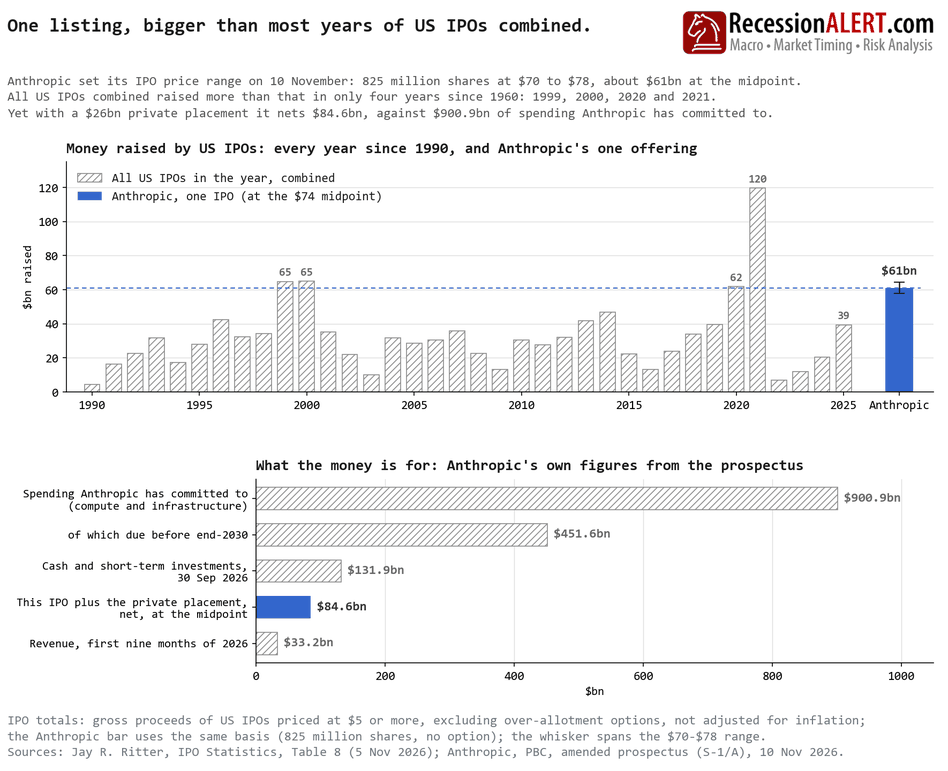
Among the buyers of Anthropic’s new shares are the companies it pays. Beside an IPO of about $61bn at the $74 midpoint (more than all US listings combined raised in any year since 1960 except 1999, 2000, 2020 and 2021) sits a $26bn private placement, shares sold directly at the same price, to Google and Nvidia (about $10bn each), AMD, Broadcom, Micron, Microsoft and TSMC: the firms that sell it chips, memory, chip manufacturing and cloud computing. Together the IPO and the placement net about $84.6bn. Huge against the market for new stock, the IPO is still only about 6% of the shares, and small against what it must pay for. The bill is bigger still: about $900.9bn of committed spending, substantially all on compute and infrastructure and not all of it firm, with $451.6bn due before end-2030, of which cash plus this raise covers roughly half. Those commitments are, broadly, the suppliers’ future sales, so each buyer is funding the customer that fills its own order book. The other half of the 2030 bill must come from revenue, $33.2bn in nine months against $2.5bn a year earlier, or from raising again, and that depends on the window: the four bigger years were peaks in share sales, when buyers paid most, and 2000 and 2021 were followed by collapses in new listings. The compute is already promised. The suppliers now own shares in whether it gets paid for.
What it means: For stock investors, Nvidia, Google and the other suppliers now hold Anthropic twice, as a customer and as shares, so slower growth in its revenue would hit their sales and their stake together. For the economy, about $450bn of committed spending before 2031 keeps money flowing into AI chips, computers and buildings, provided the funding to pay for it keeps arriving. The test is the price: a deal set above the $78 top would show buyers still have room; one below $70 would say the window is narrowing.
Market Intelligence Brief (MIB) Ver. 20.05
For professional investors only. Not investment advice.
© 2026 RecessionALERT.com

Comments are closed.