
MARKET INTELLIGENCE BRIEF (MIB)
Thursday, August 27, 2026
Technology surged 3.09% and carried the S&P 500 up 0.72% — while the NYSE Composite fell and eight of eleven sectors closed red. Cleveland’s Hammack says “now is the time to act” on a rate hike; the two-year moved 0.8bp. July’s goods trade gap blew out to $118.8B on a 68.7% jump in Korean chip imports — the same flow Washington is weighing tariffing. Palo Alto +12.83% on deal reports. Nvidia is said to be buying Hugging Face for $12.9B.
TABLE OF CONTENTS
A. EXECUTIVE SUMMARY
B. MARKET DATA
C. HIGH-IMPACT STORIES (6)
D. MODERATE-IMPACT STORIES (8)
E. ECONOMY WATCH (5)
F. EARNINGS WATCH (7)
G. WHAT’S NEXT
H. CHART OF THE DAY
A. EXECUTIVE SUMMARY -> TOP
The S&P 500 rose 0.72% to 7,730.99 and the Nasdaq 100 gained 1.43%, but the NYSE Composite fell 0.38% and eight of eleven sectors closed red — Technology’s 3.09% surge on Nvidia’s post-earnings reversal supplied effectively the entire index gain. That concentration is the day’s risk rather than its reassurance: the same session produced a report that Washington is weighing extending semiconductor duties to data-center servers, and a July goods trade deficit blown out to $118.8 billion by a 68.7% surge in Korean chip imports — the physical footprint of the AI buildout, and precisely the flow a tariff would tax. Three Fed officials warned on inflation from Jackson Hole, one calling for immediate action, and the two-year moved 0.8 basis points. Defensives funded the rotation — Consumer Defensive −1.39%, Utilities −0.70%, Healthcare −0.97% — leaving index exposure a concentrated bet on a single capex narrative.
• Breadth contradicted the headline: Technology +3.09% supplied the whole advance while the NYSE Composite fell 0.38%, DJ Transportation dropped 0.66% and the Russell 2000 managed +0.28%. The S&P reclaimed 7,700 but still sits 0.87% below its August 13 close.
• Jackson Hole turned openly hawkish and nothing repriced: Cleveland’s Hammack said “now is the time to act,” Schmid called policy non-restrictive but wants more data, and Goolsbee said “everybody should be on edge.” The 2-year rose 0.8bp to 4.232%, the VIX fell 4.60% to 14.51 and the dollar was flat at 99.14.
• A chip tariff aimed at the buildout itself: the administration is reported to be weighing duties on laptops, data-center servers and gaming hardware, with January’s data-center exemption potentially scrapped. No rate, no legal instrument, no Federal Register notice yet.
• The macro data split three ways: the July goods trade gap widened 17.2% to $118.8B against ~$99B expected on record capital-goods imports; wholesale inventories jumped 1.3% versus 0.1% consensus; jobless claims fell to 203K, below the 208K forecast.
• Two unconfirmed deals moved real money: Palo Alto Networks added 12.83% (~$35B) on reported approaches to Cribl and ClickHouse, and Nvidia is reported to have agreed to buy Hugging Face for $12.9B — roughly 86x sales, with no signed agreement and no company confirmation on either.
• The cycle’s biggest bank deregulation went unremarked: the OCC and FDIC finalised a rule directing examiners away from “policies, process, documentation” toward material financial risk. Financials closed −0.51%. Separately, the DOJ took a record $250M HSR penalty from KKR, more than twenty times any prior merger-filing fine.
1. Index exposure is now a capital-expenditure bet, and the policy risk to that bet showed up the same day — A 0.72% gain built on one sector is a different risk object from a 0.72% gain built on eleven, and the cross-asset tape agrees: copper, the metal levered to real activity, slipped 0.21% while silver rose 1.76% and compressed the gold/silver ratio to 67.3. That is AI capex being repriced, not growth. The trade data put a number on the same flow — capital-goods imports up 11.3% including a 68.7% surge in Korean semiconductors — and the tariff report proposes taxing exactly it. The read-through runs from the names that led today’s tape straight to the hyperscalers funding them.
2. The hawks are speaking and the front end is not listening, which loads everything onto Friday — Three officials warned on inflation, one of them a sitting voter and July dissenter calling for immediate action, and the 2-year moved less than a basis point while the VIX fell. Polymarket’s 2026 hike probability held at 57%, unchanged. That is not disbelief so much as a market that has decided the dissenters do not control the outcome — which places unusual weight on Warsh’s first keynote as Chair, with no Q&A scheduled, against a VIX at 14.51. Governor Cook’s counsel simultaneously telling the White House there is no cognizable cause for her removal leaves the September vote count itself unsettled, and none of it is priced.
3. Reported, not signed — and the market paid anyway — The session’s two largest strategic stories both rest on single-outlet reporting of talks: Nvidia/Hugging Face at ~86x sales, and Palo Alto circling two private data and observability names worth a combined $18.5B. Neither has a confirming filing. Investors nonetheless added roughly $35B to Palo Alto’s market value, which is a re-rating of platform strategy after CyberArk rather than a valuation of the targets. The signal for portfolio construction is that the AI-adjacent software layer is consolidating at prices set by strategic control rather than cash flow, and that standalone observability and data-infrastructure names are now visibly acquisition inventory.
 — Leading economic indicators. Accurate market forecasts. Apply for membership at join.recessionalert.com
B. MARKET DATA -> TOP
Nvidia’s quarterly report — delivered after Wednesday’s close and initially sold in extended trade — reversed into a session-long AI bid that carried Salesforce, CrowdStrike and the software complex with it. The advance was as narrow as it was large: Technology was one of only three sectors to close green, and the NYSE Composite fell 0.38% while the S&P 500 rose 0.72%. The most telling divergence sat inside the Dow itself, where DJ Transportation dropped 0.66% against the Dow’s 0.20% gain. Crude rebounded and volatility fell, but with breadth this thin the tape is expressing one theme rather than a broad improvement in risk appetite — a distinction that matters ahead of Friday’s Jackson Hole keynote.
CLOSING PRICES – Thursday, August 27, 2026:
MAJOR INDICES
The Nasdaq 100 more than doubled the S&P 500’s gain while the NYSE Composite fell — headline strength and market breadth pointing in opposite directions. DJ Transportation dropped 0.66% against the Dow’s advance, an old-economy drag the mega-cap tape masked. The Russell 2000’s slim gain shows only marginal small-cap participation. No Dow Theory or relative-performance signal crossed threshold: this was a single-sector move, not a market-wide advance.
| Index | Close | Change | %Move | Why It Moved |
|---|---|---|---|---|
| S&P 500 | 7,730.99 | +55.29 | +0.72% | Nvidia’s post-earnings rally and a broad software bid lifted Technology; the gain was concentrated rather than broad. |
| Dow Jones | 53,569.44 | +105.56 | +0.20% | Mega-cap technology exposure carried the index; industrial, healthcare and consumer components lagged. |
| DJ Transportation | 21,440.27 | -142.79 | -0.66% | Freight and transport names sold off; no discrete same-day catalyst identified. |
| Nasdaq 100 | 29,641.56 | +417.04 | +1.43% | Nvidia (+8.74%), Salesforce (+22.58%) and Broadcom (+4.49%) drove the day’s largest index gain. |
| Russell 2000 | 3,014.34 | +8.44 | +0.28% | Marginal small-cap participation in a tech-led advance. |
| NYSE Composite | 24,649.03 | -93.05 | -0.38% | The broad-market gauge fell as 8 of 11 sectors declined — breadth diverged sharply from the headline indices. |
VOLATILITY & TREASURIES
The VIX slid 4.60% to 14.51 while both yields edged higher — equity complacency without a matching bond bid. The 2s10s spread widened only marginally, to 44.7bp from 44.0bp, leaving the curve’s modest positive slope intact; nothing here repriced the Fed path ahead of Friday’s Jackson Hole keynote. The dollar was effectively unchanged. Treasuries declined to confirm the equity move, which is what a single-theme melt-up looks like rather than a macro repricing.
| Instrument | Level | Change | Why It Moved |
|---|---|---|---|
| VIX | 14.51 | -0.70 (-4.60%) | Fell as the Nvidia event risk cleared without incident. |
| 10-Year Treasury Yield | 4.679% | +1.5 bps | Modest backup ahead of Friday’s Jackson Hole keynote; no scheduled data release today. |
| 2-Year Treasury Yield | 4.232% | +0.8 bps | Front end near-unchanged; near-term Fed path repricing was muted. |
| US Dollar Index (DXY) | 99.14 | -0.03 (-0.03%) | Effectively flat; no discrete macro catalyst. |
COMMODITIES
Silver’s 1.76% gain against gold’s flat close compressed the gold/silver ratio to 67.3 from 68.3 — an industrial-precious bid rather than a haven one, which fits the risk-on tape. Copper is the dissent: the one metal levered to real activity slipped while equities rallied, consistent with a move driven by AI capital-expenditure expectations rather than broad growth. Bitcoin’s 1.95% gain tracked equity risk appetite rather than any crypto-specific catalyst.
| Asset | Price | Change | %Move | Why It Moved |
|---|---|---|---|---|
| Gold | $4,656.76/oz | $+3.46 | +0.07% | Flat as the risk-on equity tape capped haven demand. |
| Silver | $69.220/oz | $+1.194 | +1.76% | Outperformed gold on the industrial leg of precious-metals demand. |
| Copper | $6.5858/lb | $-0.0137 | -0.21% | Slipped despite the equity rally — industrial demand did not confirm the move. |
| Platinum | $1,854.60/oz | $+10.10 | +0.55% | Tracked silver higher within the precious complex. |
| Bitcoin | $79,981.0 | $+1,533.0 | +1.95% | Rose with equity risk appetite; no discrete crypto-specific catalyst identified. |
ENERGY
Brent outpaced WTI, widening the transatlantic spread to $4.96 from $4.64 — a global rather than US-specific bid, and a partial retracement of Wednesday’s decline on Iran sanctions that landed softer than the market had positioned for. Crude rose alongside equities, nominally the demand-side reading, though an advance this narrow carries no real growth signal. Dutch TTF’s 3.36% jump outran Henry Hub roughly three to one, keeping the European premium the dominant gas story.
| Asset | Price | Change | %Move | Why It Moved |
|---|---|---|---|---|
| Crude Oil (WTI) | $83.55/bbl | $+1.32 | +1.61% | Rebounded after Wednesday’s decline on Iran sanctions that fell short of market expectations. |
| Crude Oil (Brent) | $88.51/bbl | $+1.57 | +1.81% | Outpaced WTI, widening the Brent-WTI spread to $4.96 — a global rather than regional bid. |
| Natural Gas (Henry Hub) | $2.906/MMBtu | $+0.032 | +1.11% | Modest gain; no discrete same-day catalyst identified. |
| Natural Gas (Dutch TTF) | $23.17/MMBtu | $+0.75 | +3.36% | European premium widened; the move outran Henry Hub roughly three to one. |
S&P 500 SECTORS
Only three of eleven sectors closed green, and Technology (+3.09%) supplied effectively all of the index gain. Defensives sat at the bottom — Consumer Defensive (-1.39% today, -6.47% over six months) and Utilities (-0.70%, -9.55%) — so this was concentration, not flight-to-safety. Healthcare gave back 0.97% despite owning the strongest quarter of any sector (+12.46%), the signature of a funding rotation into a single theme.
| Sector | 1-Day | 1-Week | 1-Month | 3-Month | 6-Month | YTD | 12-Month |
|---|---|---|---|---|---|---|---|
| Technology | +3.09% | +2.82% | +13.12% | +1.90% | +27.07% | +25.59% | +34.83% |
| Basic Materials | +0.21% | +3.28% | +15.17% | +5.09% | -1.69% | +23.23% | +39.03% |
| Energy | +0.01% | -2.23% | +3.92% | +6.76% | +12.24% | +35.82% | +38.98% |
| Industrials | -0.47% | +0.11% | +3.39% | -2.89% | -2.39% | +12.39% | +15.06% |
| Financial | -0.51% | +1.76% | +2.29% | +11.34% | +9.45% | +8.14% | +12.94% |
| Utilities | -0.70% | -1.13% | -3.44% | -4.69% | -9.55% | +0.17% | +2.38% |
| Communication Services | -0.79% | +0.72% | +0.33% | -9.89% | +0.31% | -1.93% | +9.52% |
| Real Estate | -0.96% | -0.96% | -2.91% | +1.26% | +1.91% | +9.85% | +5.74% |
| Healthcare | -0.97% | -0.20% | +3.18% | +12.46% | +8.55% | +10.75% | +24.78% |
| Consumer Cyclical | -1.00% | -1.17% | +4.79% | -5.22% | -0.91% | -4.05% | -1.84% |
| Consumer Defensive | -1.39% | -0.31% | -4.13% | -1.34% | -6.47% | +6.35% | +4.78% |
TOP MEGA-CAP MOVERS:
GAINERS
| Company | Ticker | Close | Change | Why It Moved |
|---|---|---|---|---|
| Salesforce Inc | CRM | $252.05 | +22.58% | Earnings-driven (reported after Wednesday’s close); an expanded partnership with Anthropic was announced the same evening. |
| Crowdstrike Holdings Inc | CRWD | $227.96 | +20.50% | Earnings-driven (reported after Wednesday’s close). |
| Palo Alto Networks Inc | PANW | $382.85 | +12.83% | Press reports that Palo Alto is weighing acquisitions of Cribl and ClickHouse, plus read-through from CrowdStrike’s results. PANW does not report until September 1, so this is not an earnings move. |
| NVIDIA Corp | NVDA | $227.98 | +8.74% | Earnings-driven (reported after Wednesday’s close); reversed a 1.3% decline in extended trade. |
| Palantir Technologies Inc | PLTR | $185.90 | +4.73% | No discrete same-day catalyst identified; tracked the broad software and AI complex (Technology +3.09%). |
DECLINERS
| Company | Ticker | Close | Change | Why It Moved |
|---|---|---|---|---|
| GE Aerospace | GE | $342.73 | -3.29% | No discrete same-day catalyst identified; no fresh company filing or release was found for the session. |
| Merck & Co Inc | MRK | $149.54 | -2.33% | No discrete same-day catalyst identified; the decline clears the Healthcare sector’s -0.97% by more than a point. |
| Costco Wholesale Corp | COST | $934.66 | -2.24% | Tracked Consumer Defensive, the session’s weakest sector at -1.39%. |
| Netflix Inc | NFLX | $79.81 | -2.03% | No discrete same-day catalyst identified; continuation of the 2026 downtrend, with shares near the low end of their 52-week range. |
| Philip Morris International Inc | PM | $190.48 | -1.87% | Tracked Consumer Defensive weakness (-1.39%). |
— Institutional-grade intelligence for serious investors. Apply for membership at join.recessionalert.comC. HIGH-IMPACT STORIES -> TOP
UNCERTAIN
1. Technology Added 3.09% and the Rest of the Market Fell — the S&P Rose 0.72% While the NYSE Composite Declined
The core facts:The S&P 500 closed at 7,730.99, up 0.72%, and the Nasdaq 100 gained 1.43% to 29,641.56 — while the NYSE Composite, the broadest of the headline gauges, fell 0.38% to 24,649.03. Eight of eleven sectors closed red. Technology rose 3.09% and supplied effectively the entire index gain; the only other green sectors were Basic Materials at +0.21% and Energy at +0.01%. Inside the Dow itself, DJ Transportation dropped 0.66% against the Dow’s 0.20% advance, and the Russell 2000 managed only +0.28%. The funding side was visible in the defensives: Consumer Defensive was the session’s worst sector at -1.39%, Utilities fell 0.70% and Healthcare gave back 0.97% despite owning the strongest three-month return of any sector at +12.46%. Costco fell 2.24%, Philip Morris 1.87%. The S&P reclaimed the 7,700 handle from a prior close of 7,675.70, but this is a reclaim rather than a breakout — the index closed at 7,799.19 on August 13 and remains 0.87% below that level, and no major index made a 93-session window high.
Why it matters:A 0.72% index gain built on one sector is a different risk object from a 0.72% gain built on eleven, and the cross-asset tape says so. The VIX fell 4.60% to 14.51 while both the 10-year and 2-year yields edged higher — 4.679% and 4.232%, up 1.5bp and 0.8bp — so equity complacency arrived without a matching bond bid, and the 2s10s spread widened only marginally to 44.7bp from 44.0bp. The dollar was unchanged at 99.14. Most telling is copper: the one metal levered to real activity slipped 0.21% while silver, which carries an industrial-precious dual demand, rose 1.76% and compressed the gold/silver ratio to 67.3 from 68.3. That combination is consistent with a market repricing AI capital-expenditure expectations, not broad economic growth. For a portfolio manager the practical consequence is that index-level exposure is now a concentrated bet: the same three or four names that produced today’s gain are the ones carrying the drawdown risk if the capex narrative is interrupted, and today’s session offered two candidate interruptions in the chip-tariff report and the semiconductor import surge covered below.
What to watch:Whether the NYSE Composite closes the gap to the S&P 500 over the next several sessions, or the divergence widens — a broadening advance would confirm the move, a continued split would confirm it as positioning. Warsh’s Friday keynote at 10:00am ET is the first scheduled event capable of moving both sides of that spread at once.
BEARISH
2. Cleveland’s Hammack Says “Now Is the Time to Act” on a Rate Increase — and the Two-Year Moved Eight Tenths of a Basis Point
The core facts:Cleveland Fed President Beth Hammack, in a live CNBC interview from Jackson Hole timed at 10:27am ET, said “I don’t want to prejudge anything. But I believe now is the time to act,” adding that “we’ve been in an inflationary situation for more than five years” and “I don’t see any restriction in policy when I look at financial conditions and when I talk to market participants.” Kansas City’s Jeff Schmid, interviewed separately the same day, agreed on the stance — “I don’t know what we’re restricting currently with the rate policy that we’re at today” — but declined to commit on timing, answering “I think we need a little bit more information” when asked whether he would back a hike at the September 15-16 meeting. Chicago’s Austan Goolsbee, on a podcast the same day, said “everybody should be on edge, and I would say my biggest fear in the short run continues to be that inflation is not under control.” Hammack was one of three dissenters at the July 28-29 FOMC, which voted 9-3 to hold at 3.50%-3.75% with all three dissents favouring a quarter-point increase. Section E carries the data layer on the Fed commentary and on the symposium backdrop.
Why it matters:The market response is the story. Three officials warned on inflation on the symposium’s opening day, one of them a sitting voter calling for immediate action, and the front end of the curve moved 0.8 basis points. The 10-year added 1.5bp to 4.679%, the dollar was flat, and the VIX fell 4.60%. That is not a market that disbelieves the hawks so much as one that has decided they do not control the outcome — which places an unusual weight on a single scheduled event, Warsh’s first keynote as Chair on Friday morning, for which no Q&A is scheduled. The asymmetry is uncomfortable: if Warsh validates the Hammack framing, the repricing has to happen in one session against a VIX at 14.51 and an equity market whose entire day’s gain came from one sector. If he does not, the dissent bloc is publicly isolated ahead of a September meeting that carries a Summary of Economic Projections. Note also the direction of the debate — it is about a hike, not a cut, and has been for several sessions.
What to watch:Warsh’s keynote Friday at 10:00am ET, and specifically whether he addresses the September path at all rather than confining himself to the symposium’s payments-and-innovation theme. Watch the 2-year for a move beyond 4.30% as the confirmation that the front end has begun to price the dissenters.
UNCERTAIN
3. Nvidia Is Reported to Have Agreed to Buy Hugging Face for $12.9 Billion — With No Signed Agreement and No Company Confirmation
The core facts:The Information reported Wednesday night that Nvidia had agreed to acquire Hugging Face, the open-source repository where developers host, build and distribute AI models, for $12.9 billion. Reuters carried it the same night and it entered broad circulation on Thursday across CNBC, Bloomberg, TechCrunch, Fortune and SiliconANGLE. The status is a reported agreement, not a signed one: TechCrunch cites Business Insider the same evening saying talks had “not yet produced a signed agreement and could still atomize,” and CNBC’s source described it as “part of ongoing and recent talks.” Neither company responded to requests for comment, and there is no Nvidia press release dated August 27 — verified against the issuer’s own release feed. On price, Hugging Face last raised $235 million in 2023 at a $4.5 billion valuation, and an Nvidia approach in late 2025 — a $500 million investment at a $7 billion valuation — was rejected. Reported annual revenue is roughly $150 million. Nvidia closed at $227.98, up 8.74%, but that move is the reaction to Wednesday’s fiscal Q2 results and is covered in Section F; it should not be attributed to this report.
Why it matters:At $12.9 billion against roughly $150 million of revenue this is approximately 86 times sales, and Nvidia is not buying revenue. It is buying the default distribution layer for open-source models — the place where a very large share of non-frontier AI development actually begins. The strategic logic is the same one visible everywhere in this session’s tape: the company that already owns the compute layer is extending upward into the software and model ecosystem that determines what the compute gets used for. That is vertical integration by the dominant supplier into its own customers’ toolchain, and it invites an antitrust question that a $12.9 billion price tag does not make go away. For portfolio construction the more immediate point is that this is the second reported multi-billion-dollar platform land-grab of a single session, alongside Palo Alto’s approaches below — the AI trade is now visibly consuming its own adjacent software layer, and the acquirers are paying revenue multiples that only make sense as strategic control premiums.
What to watch:An 8-K or a company press release from Nvidia confirming terms — until one exists the deal is reporting, not fact. Watch also whether any antitrust commentary attaches, given Nvidia’s position in the compute layer beneath the asset it would be acquiring.
BEARISH
4. The Administration Is Weighing Chip Tariffs on the Finished Goods Chips Go Into — Laptops, Data-Center Servers and Gaming Hardware
The core facts:Politico reported Thursday, citing eight people familiar with the discussions, that the administration is preparing a second round of semiconductor duties extended to an expanded range of products “made alongside chips,” explicitly naming laptops, data-center servers and gaming hardware. Commerce Secretary Howard Lutnick is described as favouring a system that ties foreign companies’ tariff relief to their investment in US chip production, and a staggered phase-in is under consideration. Tom’s Hardware, covering the same report, adds that January 2026’s data-center exemptions may be scrapped. This is a report of internal deliberations rather than an announced action: no rate has been reported, no legal authority has been confirmed, and no instrument exists. The White House told Politico that “reshoring semiconductor manufacturing is a top priority for President Trump, whose policies have already secured hundreds of billions of dollars of investments in this key sector.” Industry advocates counter that domestic production capacity is nowhere near sufficient to meet current demand, so the incidence would fall on American buyers.
Why it matters:A duty on chips is a tax on a component. A duty on data-center servers is a tax on the AI buildout itself — the single capital-expenditure cycle that produced Technology’s 3.09% gain today and that Nvidia’s $279 billion of supply commitments is built to serve. The potential removal of the January data-center exemption is the specific and most consequential element, because that exemption is what currently keeps hyperscaler capex outside the tariff perimeter. The read-through runs directly to the names that led today’s tape and to the hyperscalers funding them. It also collides with the session’s own trade data, which showed July capital-goods imports at a record $140.1 billion on an 11.3% monthly jump including a 68.7% surge in Korean semiconductor shipments: that surge is the physical footprint of the buildout, and it is precisely the flow this proposal would tax. Treat the absence of a rate as the reason to size the risk rather than to dismiss it — with no instrument published there is nothing to model, and a phase-in structure tied to US investment commitments would create very different winners and losers than a flat rate.
What to watch:A Section 232 notice or presidential proclamation in the Federal Register naming the expanded product scope — that is the first document that would convert this from reporting into a modellable cost. Watch specifically whether the January 2026 data-center exemption survives.
BULLISH
5. Palo Alto Networks Adds 12.83% — a $35 Billion Move on a Report That It Is Circling Cribl and ClickHouse
The core facts:Palo Alto Networks closed at $382.85, up 12.83%, on a market capitalisation of roughly $312 billion — the third-largest mega-cap gain of the session and the only one in the top five not driven by an earnings release. The Information reported that CEO Nikesh Arora held acquisition talks with Okta between late 2024 and early 2025 and approached Datadog’s CEO in spring 2025, and is now circling Cribl and ClickHouse. Cribl is cited at roughly $200 million of annual recurring revenue growing 70%, at a $3.5 billion valuation; ClickHouse at more than $250 million of ARR and a $15 billion private mark. Palo Alto does not report until September 1, so this is not an earnings move, and a second driver was the read-through from CrowdStrike’s results lifting the whole cybersecurity group. On freshness: the report carries a Wednesday date, the stock did not move Wednesday, and it was up 11.1% by 10:05am ET Thursday — a pattern consistent with publication after Wednesday’s 6pm cutoff, the same Wednesday-night sequence The Information ran on the Nvidia story above.
Why it matters:Adding roughly $35 billion of market value on reported approaches to two private companies worth a combined $18.5 billion is not a valuation judgement about Cribl and ClickHouse. It is the market re-rating Palo Alto’s platform strategy after the $25 billion CyberArk acquisition, and deciding that a security vendor which can absorb the observability and data layers is worth materially more than one that sells security alone. Both named targets sit in data pipelines and analytics rather than security proper, which tells you the perimeter Arora is drawing. The read-through is uncomfortable for standalone observability and data-infrastructure names, which are now visibly acquisition inventory, and it is a second data point in the same session — alongside Nvidia and Hugging Face — that the AI-adjacent software layer is consolidating into a handful of platforms at prices set by strategic rather than financial buyers. Note that the move rests on a single outlet’s reporting of approaches, not on any confirmed transaction.
What to watch:Palo Alto’s own fiscal Q4 report on September 1 after the close, and specifically whether management addresses balance-sheet capacity for further M&A so soon after CyberArk. Any confirmed approach to either target would be the first hard datum behind today’s move.
BULLISH
6. The OCC and FDIC Tell Bank Examiners to Stop Writing Up Process and Documentation
The core facts:The OCC and FDIC issued a joint final rule on Thursday, announced in OCC release NR-IA-2026-71, establishing a uniform definition of “unsafe or unsound practice” for enforcement and supervisory purposes and directing examiners to prioritise material financial risks over “policies, process, documentation, and other nonfinancial risks.” The rule standardises the circumstances in which Matters Requiring Attention are issued. It arrived with a four-part package: NR 2026-72 on transparency and consistency in enforcement and supervisory standards, Bulletin OCC 2026-40 implementing the final rule, Bulletin OCC 2026-41 revising the enforcement and MRA policies-and-procedures manuals, and Bulletin OCC 2026-42, a notice of proposed rulemaking on MRAs for violations of laws and regulations. It builds on an October 2025 proposal, with modifications. The effective date is not stated in the release; the underlying Federal Register instrument has not been located, so the date is unresolved rather than absent. This is sector-level rather than company-specific.
Why it matters:Matters Requiring Attention are the working currency of US bank supervision. They drive compliance headcount, remediation programmes, and — critically — whether a bank’s capital actions, acquisitions and new business lines get approved. Narrowing the standard to material financial risk removes the mechanism by which supervisors have imposed cost through process criticism rather than through capital or credit findings, and it is the most consequential deregulatory step for the banking asset class in this cycle. What that discipline actually costs was visible in the same session’s earnings: Toronto-Dominion raised its fiscal 2026 US BSA/AML remediation budget to roughly $550 million from $500 million on higher lookback costs, having already spent $125 million in the quarter. That is one bank, one programme, under the old standard. The market has not priced any of this — Financials closed down 0.51% and the rule went essentially unremarked on a day the tape was consumed by AI — which is the opportunity and the reason to read the Federal Register text when it lands rather than the press release.
What to watch:Federal Register publication of the joint rule and its stated effective date, which the announcement did not carry. Watch also the comment period on Bulletin OCC 2026-42, which would extend the same narrowed standard to MRAs issued for legal and regulatory violations.
— Quantifying recession risk so you don’t have to guess. Apply for membership at join.recessionalert.comD. MODERATE-IMPACT STORIES -> TOP
UNCERTAIN
7. The July Trade Gap Is an Invoice for the AI Buildout — and It Arrived the Same Day as the Tariff Proposal That Would Tax It
The core facts:July’s advance goods trade deficit widened to $118.8 billion, roughly $20 billion worse than consensus, on a jump in capital-goods imports that included a 68.7% surge in Korean semiconductor shipments. Section E carries the full data layer — the composition, the export side and the GDP arithmetic. What matters here is the market read: the widening is not a consumption story, it is the accounting record of hyperscaler capital expenditure landing on US shores, and it arrived in the same session as a Politico report that the administration is weighing extending semiconductor duties to data-center servers and finished electronics.
Why it matters:Two of the day’s stories describe the same physical flow from opposite ends. The trade data measures the AI buildout as an import; the tariff proposal contemplates taxing it. Held together they define the cost risk sitting under Technology’s 3.09% gain, and they give it a rough scale — the semiconductor import surge is large enough to move a national trade balance by $20 billion against consensus in a single month. There is a second-order point for anyone modelling GDP: a deficit this wide is arithmetically a drag, but a drag composed of capital goods is investment arriving, not demand failing, and the two have opposite implications for forward earnings. The Atlanta Fed’s Q3 nowcast turning back up to 4.6% earlier this week is consistent with that reading. The uncertainty is genuine and sits in the tariff question rather than in the data.
What to watch:Whether capital-goods imports hold near record pace in the August advance report due mid-September, and whether any tariff instrument published before then carries a carve-out for data-center equipment.
BEARISH
8. The DOJ Extracts a Record $250 Million Merger-Filing Penalty From KKR — Twenty Times Any Prior HSR Fine
The core facts:The Justice Department announced a proposed settlement resolving allegations that KKR & Co. GP LLC violated the Hart-Scott-Rodino Act across at least 16 transactions in 2021 and 2022 — altering documents in HSR filings for at least eight, making no filing at all for at least two, and systematically omitting required documents in at least ten. The penalty is $250 million; the DOJ had sought $650 million. Associate Attorney General Stanley E. Woodward Jr. described it in the department’s release as “more than 20 times any prior HSR penalty obtained by the DOJ” — that superlative is the DOJ’s own characterisation, reported as such and not independently corroborated. The settlement requires court approval; the release does not name the court and does not state whether KKR admitted or denied liability. Axios reported separately, as a single uncorroborated outlet, that the entire $250 million will be reimbursed by outside law firms KKR is not naming, with no financial impact on the firm, its funds or investors — that claim is carried here attributed and unverified, and it should not be relied on.
Why it matters:The dollar figure is immaterial to a firm of KKR’s size; the precedent is not. HSR filing has been treated as an administrative formality with nuisance-level penalties, and a twenty-fold step change in the price of getting it wrong re-rates the compliance cost of every private-equity roll-up and bolt-on strategy in the market. Sponsors run high transaction volumes precisely because each individual filing has been cheap to process; if the marginal filing now carries genuine enforcement tail risk, deal velocity and legal cost both move. The reimbursement claim, if it verifies, would blunt the direct financial read-through entirely while leaving the precedent intact — which is why it matters whether it verifies, and why it is presented here as a report rather than a fact.
What to watch:Court approval of the consent settlement and whether it discloses the admission position. Watch also for corroboration of the outside-counsel reimbursement, which is currently single-sourced.
BULLISH
9. Enbridge Sells 29% of Its Westcoast System to KKR and Apollo for C$2.7 Billion to Fund Two BC Pipeline Expansions
The core facts:Enbridge announced a joint venture led by KKR in collaboration with Apollo to fund the Aspen Point and Sunrise Expansion Programs on the Westcoast pipeline system in British Columbia. The partners invest approximately C$2.7 billion, including C$0.7 billion in cash to Enbridge at closing, for an indirect cumulative 29% interest in the aggregate Westcoast system. BNN Bloomberg carried the headline figure as US$1.95 billion; the two currencies describe the same transaction and the C$ figures are the company’s own. This is a distinct transaction from Enbridge’s acquisition of Salt Creek Midstream’s Delaware Basin gathering system announced the previous session.
Why it matters:This is the private-capital-into-regulated-infrastructure trade running at scale, and the structure is the point: Enbridge funds two expansion programmes without issuing equity or adding leverage, retains 71% and operatorship, and takes C$0.7 billion of cash off the table at closing. For a midstream operator carrying a large multi-year capital programme, selling a minority of a mature system to fund growth on the same system is the cheapest capital available. The read-through is to every North American midstream name with a funded backlog and a share price that will not support equity issuance — this is now a demonstrated template with two of the largest alternative managers on the other side. It is also the second KKR appearance of the session in a very different posture from the first.
What to watch:Whether Enbridge’s next capital-allocation update reduces guided equity needs by roughly the cash received, which is the test of whether this is genuinely accretive funding rather than balance-sheet optics.
BEARISH
10. Deutsche Bank Cuts Novo Nordisk to Sell on a Patent Cliff Six Years Out
The core facts:Deutsche Bank downgraded Novo Nordisk from Hold to Sell, citing the US patent cliff on Ozempic and Wegovy in 2032. No price target was disclosed in either source carrying the call. The ADR closed down 1.97% on a market capitalisation of roughly $203.5 billion, making this the largest-cap confirmed rating change of the session; it was confirmed by CNBC and MarketBeat.
Why it matters:A Sell rating predicated on a 2032 event is a statement about terminal value, not about the next four quarters, and that is what makes it worth noting rather than filing. The GLP-1 complex has been valued on a growth curve whose duration nobody has been forced to defend; putting a date on the end of exclusivity for the two franchise assets converts an abstract risk into a discounting problem. The read-through runs to Eli Lilly, which faces the same structural question on a different timetable and which fell 3.59% in the prior session on separate reimbursement and rebate concerns. Note that the absence of a disclosed price target limits how far this can be taken — a Sell without a target is a direction, not a valuation.
What to watch:Whether a second major house follows with a terminal-value-based downgrade of the GLP-1 complex, which would mark the argument moving from one desk to the sector consensus.
BEARISH
11. Moderna Raises $2 Billion in Zero-Coupon Convertibles and Falls 4.60%
The core facts:Moderna launched a $2.0 billion private placement of convertible senior notes due 2032 at 7:20am ET. The notes are senior unsecured, carry no regular interest and are non-accreting, and are settleable in cash or stock at Moderna’s election, with a 13-day $300 million greenshoe. Proceeds fund capped call transactions — the cap initially at least 150% of the pricing-date share price — plus general corporate purposes “potentially including oncology growth investments and debt repayment.” The stock closed at $142.77, down 4.60%, on a market capitalisation of roughly $57 billion. Separately and on a different cause, Moderna announced FDA approval of its updated 2026-27 COVID vaccines at 3:56pm ET the same day; the two events share a tape but not a catalyst and should not be merged.
Why it matters:Zero-coupon, non-accreting paper is the cheapest debt a company can issue and it is only available to issuers whose equity carries enough volatility for the conversion option to be worth the foregone yield. Moderna is monetising its own share-price volatility to fund an oncology pivot, which is a candid statement about where management sees the franchise going: the COVID revenue base is not funding the next platform. The capped call reduces dilution to a 150%-plus strike and the 4.60% decline is the market pricing the residual — reasonable for a raise equal to roughly 3.5% of market capitalisation. The uncomfortable reading is the size relative to the company: a $57 billion issuer raising $2 billion of convertible paper to fund pipeline investment is telling you the internal cash generation does not cover the ambition.
What to watch:The final pricing terms including the conversion premium and whether the $300 million greenshoe is exercised within its 13-day window — a full exercise would signal stronger demand than the equity reaction implies.
BULLISH
12. OFAC Strips the US Choice-of-Law Requirement From Eight Venezuela Oil, Mining and Petrochemical Licences
The core facts:OFAC posted amended General Licences 46D, 47B, 48C, 50C, 51C, 52B, 54B and 61A on Thursday, with new FAQs 1267 and 1268 and amendments to FAQs 1233 and 1244. Coverage spans oil and petrochemical products, US-origin diluents, oil and gas sector operations, minerals including gold, transactions involving Petroleos de Venezuela, and telecommunications. The substantive change, per FAQ 1267, is that OFAC removed the requirement that contract terms “be construed and interpreted in accordance with the laws of a state or other jurisdiction within the United States,” citing “investment-related reforms made by the GOV since January 2026.” FAQ 1268 confirms the surviving condition: dispute resolution must still occur in the United States, the United Kingdom, France or Singapore. GL 46D is effective August 27 and supersedes GL 46C dated June 10; payments to blocked persons route to Foreign Government Deposit Funds under EO 14373, and transactions involving Russian, Iranian, North Korean, Cuban or Chinese-controlled parties remain prohibited.
Why it matters:Choice of law is not a technicality in a sanctioned jurisdiction — it is the mechanism by which a Western operator makes a Venezuelan contract enforceable at all, and requiring it has been a practical brake on the scale of commitments anyone would make. Removing it while retaining the venue requirement is a deliberate loosening that reduces the legal friction on new investment without giving up jurisdictional reach, and OFAC’s stated rationale points at Caracas having earned it through reforms. Combined with a Brent price of $88.51 and a widening transatlantic spread, the commercial case for expanded Venezuelan operations improves at exactly the moment the licensing constraint eases. The predecessor licence GL 50A named BP, Chevron, Eni, Repsol, Shell and Maurel & Prom as authorised oil and gas operators; the GL 50C text has not been read here, so that roster should be treated as a lead and verified before any operator is named as a beneficiary.
What to watch:The GL 50C text for the current list of authorised operators, and whether any named major announces expanded Venezuelan investment in the weeks following — that would be the first evidence the loosening is being used rather than merely offered.
UNCERTAIN
13. Governor Cook’s Counsel Tells the White House There Is No Legally Cognizable Cause to Remove Her
The core facts:Attorney Abbe David Lowell sent a five-page letter to the White House on behalf of Federal Reserve Governor Lisa Cook stating that “Governor Cook has never committed mortgage fraud or any intentional wrongdoing, and there is no legally cognizable cause for removing her from the Federal Reserve Board,” and that “an inadvertent oversight is not fraudulent or criminal.” The letter answers an August 5 letter from White House Deputy Chief of Staff Dan Scavino asserting “sufficient reason to believe that you made false statements on one or more mortgage agreements,” which set a response deadline of Wednesday August 26. Lowell noted that the President, Treasury Secretary Bessent and Attorney General Todd Blanche have each previously listed multiple properties as primary residences. The Reuters wire copy is timestamped 7:31pm ET Wednesday and CNBC’s 8:15pm ET, both after the prior session’s cutoff. The underlying allegations stem from an FHFA criminal referral by Director Bill Pulte; there is no indication a criminal investigation is proceeding.
Why it matters:This is the Fed-independence question arriving as a live legal dispute rather than a commentary theme, and the timing places it directly against the Jackson Hole story above. A Board where a sitting governor is contesting removal for cause is a Board whose composition — and therefore whose September vote count — is not settled, at a meeting that already carries three dissenters favouring a hike and a new Chair delivering his first keynote. The market has priced none of this: the dollar was flat, the curve barely moved, and the reaction function that would normally punish institutional uncertainty at a central bank has not engaged. That is either correct complacency, on the view that this resolves quietly, or it is the largest unpriced tail in the front end. Lowell’s observation about the President’s and Cabinet officials’ own filings signals the defence will be selective-enforcement, which points toward litigation rather than resignation.
What to watch:Any White House response to the letter, and whether Cook participates in the September 15-16 FOMC — her presence or absence at that meeting is the first concrete market-relevant consequence.
UNCERTAIN
14. Qatar Enters the Hormuz Mediation as a Third Party — and Crude Rose 1.61% Anyway
The core facts:Qatar’s Prime Minister Sheikh Mohammed bin Abdulrahman bin Jassim Al Thani met Iranian Foreign Minister Abbas Araghchi in Tehran, and the Qatari Ministry of Foreign Affairs confirmed a discussed framework including “a temporary joint navigational corridor through the Strait of Hormuz, and agreement on the implementation of a joint project to clear the Strait of mines.” Sheikh Mohammed stressed “the need to respect the sovereignty of neighboring countries and freedom of navigation.” Separately, Iran’s Mohsen Rezaei told Lebanon’s Al Manar TV that Tehran is preparing a list of conditions for mediators to reopen the Strait, including ending the war in the region. The corridor concept itself is not new — an Iran-Oman version circulated in the two prior sessions — and what is new today is Qatar entering as mediator with its own foreign ministry confirming the framework. Against this, the White House said the naval blockade remains in effect and that “no negotiations are happening right now.” WTI closed at $83.55, up 1.61%, and Brent at $88.51, up 1.81%, widening the Brent-WTI spread to $4.96 from $4.64.
Why it matters:The price action refuses the diplomatic narrative, and that disagreement is the signal. A day of visible de-escalation progress — a new mediator, a confirmed corridor framework, a mine-clearing project — produced a crude rally, with Brent outpacing WTI to widen the transatlantic spread, which is the signature of a global supply concern rather than a US demand story. Two readings fit. Either the market discounts the diplomacy entirely, in which case the White House’s blockade statement is the operative fact and the corridor talk is noise; or the rebound is simply the retracement of Wednesday’s decline on Iran sanctions that landed softer than positioning implied, and the diplomacy is not in the price at all. Note also an unreconciled contradiction in the official record: the same White House spokesperson is separately quoted saying the US “is essentially controlling the Strait of Hormuz, which remains open,” which cannot be squared with contemporaneous reporting that the Strait has been largely closed since March or with negotiations over reopening it. That contradiction is flagged, not resolved.
What to watch:Whether the Brent-WTI spread keeps widening beyond $5.00, which would confirm the bid is a global supply-risk premium rather than a US demand signal. Any US acknowledgement of the Qatari channel would be the first evidence the blockade position is softening.
— Separating signal from noise since 2007. Apply for membership at join.recessionalert.comE. ECONOMY WATCH -> TOP
Today’s data underscored a familiar split: labor held firm (jobless claims fell to 203K, a fourth straight low print) while trade math turned unfriendly, with the goods deficit widening to $118.8B — the widest since March 2025 — on a surge of AI-linked capital goods imports. Cleveland Fed’s Hammack said “now is the time to act” on a rate increase while Kansas City’s Schmid argued policy isn’t even restrictive but stopped short of backing a September 16 hike, as day two of Jackson Hole opened with the 30-year yield near 5.26%, a 19-year high, and Bessent’s debt-buyback intervention already fading. Markets are bracing for Kevin Warsh’s Friday 10am keynote — his first as Fed Chair — to resolve whether he leans toward Hammack’s call to act now or Collins’ steadier “mildly restrictive” framing.
Goods Trade Deficit Widens to $118.8B, Widest Since March 2025, on AI-Driven Import Surge (Census Bureau / Bloomberg, Aug 27, 2026)
What they’re saying:The Commerce Department’s advance report showed the goods trade deficit widened 17.2% to $118.8 billion in July, well above the roughly $99 billion economists expected. Imports rose 3.7% to $318.2 billion, led by an 11.3% jump in capital goods including a 68.7% surge in Korean semiconductor shipments tied to AI infrastructure buildout, while exports fell 2.9% to $199.4 billion — a third straight monthly decline.
The context:A wider trade gap is arithmetically a drag on GDP, and this miss came in nearly $20 billion worse than consensus, but the composition — record capital goods imports rather than consumer goods — reflects continued heavy AI-related capex rather than outright demand weakness.
What to watch:The full August trade report due mid-September, and whether capital-goods imports continue near-record pace as AI capex ramps.
Jobless Claims Fall to 203K as Labor Market Resilience Persists Ahead of Payrolls Revision (Dept. of Labor, Aug 27, 2026)
What they’re saying:Initial jobless claims fell to 203,000 for the week ended August 22, below the 208,000 expected and down from a revised 207,000, extending a run of historically low readings since mid-July’s 189,000 print. Continuing claims also eased to 1.778 million from 1.796 million, below the 1.79 million forecast.
The context:The data reinforces that layoffs remain contained even as growth cools elsewhere, keeping the low-hire, low-fire labor backdrop intact. Markets are more focused on Friday’s preliminary annual benchmark revision to nonfarm payrolls, which last year subtracted roughly 911,000 jobs.
What to watch:Friday’s Non-Farm Payrolls Annual Revision (preliminary) at 10:00am ET — a large downward revision would bolster the case for a more dovish Fed path.
Wholesale Inventories Jump 1.3% in July, 13x Consensus (Census Bureau, Aug 27, 2026)
What they’re saying:Advance wholesale inventories rose 1.3% in July, far above the 0.1% economists expected and up from June’s 0.3% gain — the largest monthly build in months.
The context:Paired with today’s trade data showing record capital-goods imports, the inventory surge points to businesses stockpiling ahead of anticipated tariff actions and continued AI-infrastructure buildout rather than a straightforward demand signal. A build this large also raises the risk of a destocking-driven drag on GDP in coming quarters if end demand doesn’t keep pace.
What to watch:The full wholesale trade report with sales figures, which will show whether the inventory-to-sales ratio is rising.
Cleveland Fed’s Hammack: “Now Is the Time to Act” on Rates; Schmid Says Policy ‘Not Restrictive’ But Wants More Data (CNBC / Reuters, Aug 27, 2026)
What they’re saying:Cleveland Fed President Beth Hammack, in a live CNBC interview from Jackson Hole, said “I don’t want to prejudge anything. But I believe now is the time to act,” adding that “we’ve been in an inflationary situation for more than five years” and “I don’t see any restriction in policy when I look at financial conditions.” Kansas City Fed President Jeff Schmid agreed on the stance, saying he doesn’t see the current 3.50%-3.75% funds rate as restricting the economy and calling inflation “still stubborn and sticky” but, asked whether he would back a hike at the September 15-16 FOMC meeting, replied “I think we need a little bit more information.” Chicago’s Austan Goolsbee separately warned that “everybody should be on edge,” calling inflation his “biggest fear in the short run.”
The context:Three officials used the symposium’s opening day to warn that inflation remains too high, and Hammack, one of three July FOMC dissenters who favoured a quarter-point increase, is the first to call publicly for immediate action. That widens the gap against Boston Fed President Collins’ characterization of policy as “mildly restrictive” earlier this week, just as Chair Warsh prepares his first Jackson Hole keynote Friday. Polymarket’s implied probability of a 2026 hike held at 57% following the remarks, unchanged from Wednesday’s session.
What to watch:Chair Warsh’s Friday 10:00am ET keynote for whether he aligns with Hammack’s call to act now, Schmid’s wait-for-more-data stance, or Collins’ steadier framing.
Bond Market ‘On Edge’ as Jackson Hole Enters Day Two Ahead of Warsh’s Historic Keynote (CNBC / Kansas City Fed, Aug 27, 2026)
What they’re saying:The Jackson Hole Economic Policy Symposium — themed “Financial Innovation: Implications for Payments and Policy” — entered its second day with the 30-year Treasury yield still hovering near 5.26%, a 19-year high, after Treasury Secretary Bessent’s expanded debt-buyback operations provided only brief relief from the long-end selloff.
The context:The backdrop includes a CBO deficit estimate raised to $2.1 trillion for the year and an FOMC already split by its most hawkish dissent in nearly a decade, raising the stakes for Kevin Warsh’s Friday 10:00am ET address — his first as Fed Chair.
What to watch:Warsh’s keynote Friday, and whether the 30-year yield breaks further above 5.26% into the speech.
— Know the probability before the market prices in the risk. Apply for membership at join.recessionalert.comF. EARNINGS WATCH -> TOP
YESTERDAY AFTER THE BELL (Markets Reacted Today)
BULLISH
15. NVIDIA (NVDA): +8.74% | The Overnight Fade Reversed Into an 8.74% Session Gain
The Numbers:Released AMC Wednesday August 26. Fiscal Q2 2027 revenue $96.22B against $92.27B expected, a 4.28% beat; adjusted EPS $2.22 versus $2.09, up 6.22%; GAAP EPS $2.46 against $2.11, up 16.47%. Data Center revenue $89.0B, up 117% year over year and now 92% of total revenue. GAAP and non-GAAP gross margin both 75.0%. Q3 guidance $108B plus or minus 2%, against roughly $104.2B consensus. Supply commitments more than doubled to $279B from $119B, primarily memory. Market cap $5,517.12B at the calendar capture.
The Problem/Win:The beat-and-raise initially faded, with the stock down about 1.3% in extended trade roughly thirty minutes ahead of the call — the bar had moved, and a 4.28% revenue beat is thin by this company’s own recent standards. The reversal came in the regular session, closing up 8.74% at $227.98. Twelve firms raised targets: Bernstein to $400 from $315, Rosenblatt to $390, Truist to $346, Wedbush to $345, RBC to $330, JP Morgan to $320, Citigroup, Mizuho and Oppenheimer each to $315, and Morgan Stanley, UBS and Needham each to $300.
The Ripple:This single reversal carried the market. Technology closed +3.09% and supplied effectively the entire S&P 500 gain of 0.72%; the Nasdaq 100 rose 1.43%. Broadcom added 4.49%, Intel 4.36%, Oracle 2.06%. Against that, the NYSE Composite fell 0.38% with eight of eleven sectors red — the advance was one theme, not a market.
What It Means:The $279B supply commitment is the number that matters more than the quarter: it is a balance-sheet-scale prepayment of future capacity, and it converts Nvidia’s forward revenue from a demand forecast into a procurement schedule. It also concentrates memory-supply risk in one issuer.
What to watch:Broadcom’s September 2 report is the custom-XPU cross-check on this quarter — AI semiconductor revenue guided above $16B. Watch whether the gross margin holds at 75.0% as the memory commitment converts into cost of goods.
BULLISH
16. CrowdStrike (CRWD): +20.50% | Record Net New ARR Accelerating 51% Year Over Year
The Numbers:Released AMC Wednesday August 26. Fiscal Q2 2027 revenue $1.47B against $1.44B expected, up 26% year over year; adjusted EPS $0.31 versus $0.29. ARR $5.84B, up 25%. Record net new ARR of $333M, accelerating to +51% year over year. Free cash flow $377.4M. Falcon Flex ending ARR above $2.29B, up 101%. FY27 revenue guidance $5.99B-$6.01B against $5.94B consensus, and FY27 net new ARR growth guidance raised 630 basis points to 34% at the midpoint. Market cap $232.12B.
The Problem/Win:Net new ARR is the cleanest read on a subscription security business and it accelerated rather than merely grew — 51% year-over-year growth in the incremental number, on a base already at $5.84B, is the datum that produced a 20.50% session gain to $227.96. Nine firms raised targets: Citigroup and RBC to $260, TD Cowen, Rosenblatt and Needham to $250, Scotiabank to $250 on a single source, DA Davidson and BTIG to $245, BMO to $235.
The Ripple:The read-through lifted the whole cybersecurity complex and was one of the two drivers behind Palo Alto Networks’ 12.83% gain, covered as Story 5 above. That makes CrowdStrike’s quarter a sector event rather than a company one.
What It Means:The Falcon Flex ARR doubling is the structural signal — customers consolidating multiple security modules onto one contract vehicle is what platform economics looks like when it works, and it is why the sector is consolidating into platforms rather than competing on point products.
What to watch:Palo Alto’s September 1 report is the direct test of whether this is category growth or share taken from a competitor.
BULLISH
17. Salesforce (CRM): +22.58% | Guidance Raised and Agentforce ARR Up 210% — But the EPS Headline Is a Mark-to-Market Gain
The Numbers:Released AMC Wednesday August 26. Fiscal Q2 2027 revenue $11.35B against $11.33B expected, up 11% year over year; subscription and support $10.8B, up 12%. Non-GAAP EPS $5.90 against $3.27 consensus and GAAP EPS $4.29 — but that figure includes a $2.6B gain on strategic investments tied to the company’s Anthropic stake, which is mark-to-market and not operating performance. FY27 revenue guidance raised to $46.1B-$46.4B from $45.9B-$46.2B. Agentforce plus Data Cloud ARR near $3.9B, up more than 210% year over year. Market cap $206.43B.
The Problem/Win:The revenue beat was 0.13% — essentially in line. What produced a 22.58% gain to $252.05 was the guidance raise and the Agentforce number, which is the first credible evidence that Salesforce is monetising AI rather than describing it. Ten firms raised targets: Deutsche Bank to $275, Loop Capital to $270, JP Morgan and Mizuho to $265, BMO to $260, UBS to $240, Morgan Stanley to $235, Citigroup to $233, Wells Fargo to $230, Bernstein to $195. Read the EPS line with care — stripping the $2.6B investment gain leaves a considerably less dramatic result.
The Ripple:Salesforce was the session’s largest mega-cap gainer and, with CrowdStrike and Nvidia, one of the three names that produced Technology’s 3.09%. The company also announced Claudeforce with Anthropic the same evening, putting its own sales stack inside Anthropic’s Claude — a product integration announced with no commercial terms disclosed.
What It Means:An 11% revenue grower re-rating 22.58% in one session is the market repricing the terminal growth rate, not the quarter. That repricing rests on Agentforce ARR compounding from a $3.9B base, which is now the single number the equity depends on.
What to watch:Whether next quarter separates Agentforce ARR from Data Cloud — the combined disclosure makes the growth rate impossible to attribute, and management will be asked.
TODAY BEFORE THE BELL (Markets Already Reacted)
UNCERTAIN
18. Royal Bank of Canada (RY): -1.29% | A Beat on Both Lines, and the Stock Still Fell as Provisions Climbed
The Numbers:Released BMO Thursday August 27. US-converted EPS $3.09 against $2.94 expected, a 5.10% beat; revenue $13.37B against $13.12B, up 1.96%. In reporting currency: fiscal Q3 net income C$6.02B against C$5.41B a year earlier, diluted EPS C$4.23 versus C$3.75, up 13%, on revenue of C$18.54B against C$16.99B. Provision for credit losses C$1.00B, up from C$881M a year earlier. CET1 ratio 13.5%. Market cap $283.62B — the largest reporter of the session.
The Problem/Win:The win was breadth: management attributed the gain to higher results in Wealth Management, Capital Markets and Commercial Banking simultaneously, which is a harder result to produce than a single strong segment. The problem is the provision line, up 13.5% year over year to C$1.00B on a quarter when earnings rose 11%. The stock closed down 1.29%, so the market took the provision build as the more informative number.
The Ripple:Three Canadian banks reported before the bell and the tape did not treat them as one trade — RY -1.29%, TD +1.39%, CM -2.84%. Financials closed down 0.51%. The dispersion says the market is differentiating on credit and one-off items rather than pricing a common Canadian banking factor.
What It Means:A CET1 of 13.5% alongside a rising provision is a bank preparing rather than a bank deteriorating. The read-through worth carrying is that Canadian credit is being provisioned into ahead of the September 8 counter-tariff package, not after it.
What to watch:Whether the provision build continues into fiscal Q4 once Canada’s counter-tariffs take effect September 8, covering C$27.6bn of US imports at 15%, 25% and 50% rates.
BULLISH
19. Toronto-Dominion (TD): +1.39% | Record US Net Interest Margin and a Falling Provision — With the AML Bill Still Rising
The Numbers:Released BMO Thursday August 27. US-converted EPS $2.00 against $1.78 expected, a 12.12% beat; revenue $12.21B against $10.81B, a 12.99% beat — the largest revenue surprise of the three Canadian reporters. In reporting currency: fiscal Q3 net income C$4.62B against C$3.34B a year earlier, diluted EPS C$2.74 versus C$1.89, on revenue of C$16.89B against C$15.30B. Provision for credit losses fell to C$917M from C$1.00B. US Banking earnings rose 11% and its net interest margin reached a record 3.47%. Market cap $204.58B.
The Problem/Win:The win is the combination that RBC did not deliver — earnings up sharply while provisions fell, with record earnings in the Canadian businesses and wholesale banking. The problem is unchanged and expensive: TD now expects fiscal 2026 US BSA/AML remediation and related governance and control investments of approximately US$550M pre-tax, raised from US$500M on higher lookback costs, having incurred US$125M in the quarter alone. The AML consent order remains in force.
The Ripple:TD was the only one of the three Canadian reporters to close green. Its remediation disclosure is also the concrete price tag for the supervisory regime that the OCC and FDIC moved to narrow the same day, covered as Story 6 above.
What It Means:A record 3.47% US net interest margin at a bank operating under an asset cap and a consent order is the strongest possible argument that the franchise damage from the AML case was regulatory rather than commercial.
What to watch:Whether the FY2026 remediation estimate is raised again at fiscal Q4 — it has now moved once, and the stated reason was lookback scope, which is the component hardest to bound in advance.
UNCERTAIN
20. Canadian Imperial Bank of Commerce (CM): -2.84% | Capital Markets Profit Up 34% and the Stock Was the Session’s Worst Bank
The Numbers:Released BMO Thursday August 27. US-converted EPS $1.97 against $1.83 expected, a 7.89% beat; revenue $6.04B against $5.81B, up 3.95%. In reporting currency: fiscal Q3 net income C$2.41B against C$2.10B, and adjusted net income C$2.65B, giving adjusted diluted EPS of C$2.73 against C$2.16 a year earlier and above the C$2.53 Bloomberg consensus. Revenue C$8.37B against C$7.25B, with net interest income C$4.51B and non-interest income C$3.86B. Capital markets net income C$722M, up 34% year over year and ahead of the C$670M forecast. Canadian personal and business banking net income C$948M. The gap between reported and adjusted earnings is C$269M of charges tied to the announced sale of its 91.67% interest in CIBC Caribbean Bank to Butterfield. Market cap $106.41B.
The Problem/Win:CIBC beat on every adjusted measure, led by a 34% jump in capital markets, and fell 2.84% — the worst reaction of any bank in the session. The most likely explanation is the C$269M Caribbean disposal charge dragging reported earnings below the adjusted headline, but no causal attribution is established here and none should be assumed.
The Ripple:The three Canadian banks reporting the same morning finished -1.29%, +1.39% and -2.84%, a 4.2-point spread on a day Financials fell 0.51%. That dispersion is the sector story: this was not a Canadian banking trade.
What It Means:A capital-markets-led beat is the lowest-quality kind of bank beat because it is the least repeatable segment, and a market that sells a 7.89% EPS surprise is saying it has noticed. The Caribbean exit removes a business but also removes its earnings.
What to watch:Completion of the CIBC Caribbean sale to Butterfield and whether further charges follow, and whether the capital markets contribution normalises next quarter.
TODAY AFTER THE BELL (Markets React Tomorrow)
UNCERTAIN
21. Marvell Technology (MRVL): -6.01% AH | Record Revenue, Raised Outlook, and the Stock Fell on Gross Margin
The Numbers:Released AMC Thursday August 27. Fiscal Q2 2027 revenue $2.74B, a company record and up 37% year over year, against a $2.72B estimate; adjusted EPS $0.94 against $0.93. Data Center revenue grew 46% year over year and now represents 79% of total revenue, up from 74% a year ago. Q3 guidance revenue $3.15B plus or minus 5% and adjusted EPS $1.10 plus or minus five cents, both above estimates — but with Q3 gross margin guided to 57.5%-58.5%. Full-year fiscal 2027 and fiscal 2028 outlooks raised, with fiscal 2028 data-center revenue expected to grow approximately 55%. Market cap $211.45B. Closed the regular session at $241.45, down 1.49%, then $226.93 in the aftermarket at 5:34pm ET.
The Problem/Win:Every headline number beat and both forward years were raised — CEO Matt Murphy told investors “we are seeing exceptional AI-related bookings, and as a result, we are significantly raising Marvell’s revenue outlook for both fiscal 2027 and fiscal 2028.” The stock fell 6.01% after hours anyway, and the gross margin guide is the visible reason: 57.5%-58.5% is the cost of winning custom silicon volume. The expanded custom deal with Google, which includes a warrant for up to 7% of shares tied to revenue milestones, is the structural win and the margin pressure at the same time.
The Ripple:Marvell is the custom-silicon counterweight to Nvidia’s merchant model, and an after-hours decline on a raised outlook is a negative read for the whole custom-XPU thesis heading into Broadcom on September 2. It also lands against Nvidia’s 75.0% gross margin — the gap between 75% and 58% is the price of building to a hyperscaler’s specification rather than selling it your own part.
What It Means:Custom silicon buys revenue visibility and sells margin. Marvell has now demonstrated both halves of that trade in a single quarter, and the market priced the second half.
What to watch:Broadcom’s September 2 report for whether its custom-XPU margins tell the same story, and the vesting schedule on the Google warrant, which is dilution tied to the very revenue growth being celebrated.
WEEK AHEAD PREVIEW:
Q2 2026 earnings season is 88% complete. Neither Friday August 28 nor Monday August 31 carries a single reporter above $100B market cap — the largest names on those two calendars are Frontline at $9.74B and Science Applications International at $5.45B. The season’s remaining mega-cap weight is concentrated in the first two sessions of September.
Palo Alto Networks (PANW) — AMC, Tuesday September 1 — consensus $0.98 EPS on $3.35B revenue, $312.02B market cap. Key focus: the direct read-through on whether CrowdStrike’s accelerating net new ARR is category growth or share taken, plus any commentary on balance-sheet capacity for further M&A after the $25B CyberArk deal and today’s reported approaches to Cribl and ClickHouse. Shares closed +12.83% today on that reporting.
Dell Technologies (DELL) — AMC, Tuesday September 1 — consensus $4.91 EPS on $44.93B revenue, $306.16B market cap. Key focus: AI server order backlog and margin on those orders — the same volume-versus-margin question Marvell just answered badly — and any comment on the reported expansion of semiconductor tariffs to data-center servers, which would land directly on this cost base.
Medtronic (MDT) — BMO, Tuesday September 1 — consensus $1.39 EPS on $9.55B revenue, $115.16B market cap. Key focus: diabetes and cardiovascular segment growth and pricing, in a Healthcare sector that gave back 0.97% today despite holding the strongest three-month return of any sector at +12.46%.
Broadcom (AVGO) — AMC, Wednesday September 2 — consensus $3.22 EPS on $29.24B revenue, $1,767.63B market cap. Key focus: AI semiconductor revenue, guided above $16B, as the custom-XPU cross-check on both Nvidia’s quarter and Marvell’s margin guide. Shares closed +4.49% today on the Nvidia read-through.
Snowflake (SNOW) — AMC, Wednesday September 2 — consensus $0.45 EPS on $1.48B revenue, $114.07B market cap. Key focus: product revenue growth and net revenue retention, read against Salesforce’s Data Cloud ARR and against ClickHouse’s reported $15B private mark — the data layer is repricing and Snowflake is the listed proxy for it.
Thursday September 3 carries no reporter above $100B; the largest is Ciena at $56.60B. Q3 2026 earnings season begins mid-to-late October.
— US market commentary trusted by family offices and institutions. Apply for membership at join.recessionalert.comG. WHAT’S NEXT -> TOP
UPCOMING RELEASES:
| Date | Event | Why It Matters |
|---|---|---|
| Fri, Aug 28 | Fed Chair Warsh Jackson Hole keynote, 10:00am ET | The single largest scheduled risk in the window and the first keynote of his chairmanship, with no Q&A scheduled. Three officials called for or leaned toward a hike this week and the front end moved less than a basis point; whether Warsh validates that framing or isolates the dissent bloc has to be repriced in one session against a VIX at 14.51. |
| Fri, Aug 28 | Non-Farm Payrolls annual benchmark revision, preliminary, 10:00am ET (prior year: −911K) | Restates the level of employment the Fed has been reading all year. Last year’s preliminary revision removed roughly 911,000 jobs; another large downward mark would reopen the labor-slack argument directly against this week’s hawkish commentary, two and a half weeks before the September 15–16 FOMC. |
| Fri, Aug 28 | Chicago PMI (expected 57) and Michigan Consumer Sentiment final (expected 51.0) | The regional activity and household reads that bracket the week. Sentiment near 51 against a PMI in expansion territory is the split this cycle keeps producing — firms transacting, consumers not believing it — and the Michigan inflation expectations series inside the release is the component the hawkish bloc has been citing. |
| Mon, Aug 31 | Dallas Fed Manufacturing Index (prior 1.3) | First read of the new week and the earliest regional check on whether July’s record capital-goods import surge is showing up as domestic factory activity or simply as landed foreign equipment. A print back below zero would argue the buildout is not broadening into US manufacturing. |
| Tue, Sep 1 | ISM Manufacturing PMI (prior 55.6) and employment sub-index (prior 52.8) | The month’s first tier-one activity print, and the employment component is the leading indicator into Friday payrolls. With tariffs on chips and finished electronics under active consideration, the prices-paid and new-orders detail is where any pre-emptive cost pass-through would first appear. |
| Tue, Sep 1 | JOLTS Job Openings (prior 7.359M) | The vacancy side of the low-hire, low-fire labor market that this week’s 203K claims print described from the layoff side. Openings are the cleanest test of whether labor demand is genuinely intact or simply not yet shedding, and the ratio to unemployed is a series the Fed reads directly. |
| Wed, Sep 2 | ADP Employment Change (prior 44K) and Factory Orders MoM (prior −0.3%) | A 44K prior on ADP is already close to stall speed, and factory orders carry the durable capital-goods detail that would corroborate or contradict the import surge behind July’s trade gap. Together they are the mid-week bridge between the revision and the September FOMC setup. |
| Wed, Sep 2 | EIA crude and gasoline stock changes | Crude rallied 1.61% into a session of visible Hormuz de-escalation progress, with Brent outpacing WTI to widen the transatlantic spread to $4.96. The inventory data is the domestic-demand control on that divergence: a build alongside a firm Brent premium would confirm the bid is global supply risk rather than US consumption. |
| Thu, Sep 3 | ISM Services PMI (prior 54.1) | Services is roughly three-quarters of the economy and the prices sub-index has been the more persistent of the two ISM inflation gauges — the specific series behind Schmid’s “stubborn and sticky” characterisation and Goolsbee’s stated fear that inflation is not under control. |
| Thu, Sep 3 | Balance of Trade, exports and imports (prior −$73.3B) | The full goods-and-services report behind today’s advance number. It carries the composition detail that determines whether a $118.8B goods gap reads as investment arriving or demand failing — opposite implications for forward earnings and for the Q3 GDP arithmetic. |
| Ongoing | Federal Register: semiconductor tariff instrument; OCC/FDIC joint rule effective date | Neither is calendared. A Section 232 notice naming laptops, servers and gaming hardware is the first document that would make the chip-tariff risk modellable, and whether January’s data-center exemption survives is the specific term that matters. Separately, the OCC/FDIC announcement carried no effective date for a rule that materially narrows what examiners can write up. |
KEY QUESTIONS:
1. Does Warsh address the September path at all on Friday, or confine himself to the symposium’s payments-and-innovation theme — and if he validates Hammack’s call to act, can a 2-year at 4.232% and a VIX at 14.51 absorb that repricing in a single session?
2. Does the NYSE Composite close its gap to the S&P 500 over the next several sessions, or does the divergence widen? A broadening advance confirms today’s move; a continued split confirms it as positioning in a handful of names.
3. If a semiconductor tariff instrument does appear, does it carve out data-center equipment? That single term decides whether the proposal is a cost on consumer electronics or a tax on the hyperscaler capex cycle that produced Technology’s 3.09% gain.
— US market commentary trusted by family offices and institutions. Apply for membership at join.recessionalert.comH. CHART OF THE DAY -> TOP
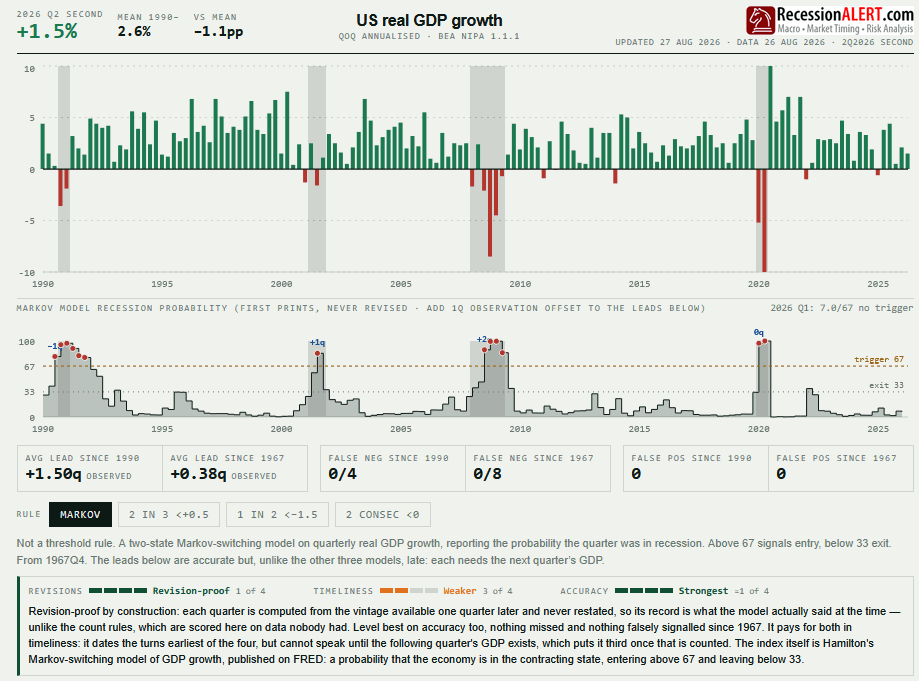
The headline decelerated. The economy did not. Real GDP grew 1.5% in the second quarter, unchanged in yesterday’s second estimate and down from 2.1% in the first. But GDP counts production, and it deducts imports and swings in inventories. Strip those out and what American households and businesses actually bought grew 4.2% — revised up from 3.9%. Net exports cost the headline 1.14 points, slower stock-building another 0.72. BEA said it plainly: stronger consumer spending, partly offset by an upward revision to imports. The same appetite that lifted demand pulled in the foreign goods that get deducted from it. Count the same economy from income rather than purchases — wages, profits and rents — and it grew 2.2%, against 1.2% in the first quarter. The two measures swapped places, and averaged, as BEA publishes them, the economy went slightly faster: 1.8% against 1.7%. Corporate profits rose $400.9bn, after $74.4bn. Which is why September is priced near 40% for a hike, not a cut, with core inflation at 3.3%, and why Warsh’s Jackson Hole debut tomorrow matters more than a 1.5% print suggests. The recession probability below sits at 7 against a trigger of 67. The one crack: durables, equipment and housing were marked down in the release that marked demand up. Not a slowing economy. A slowing measurement of a fast one.
What it means: the number that made headlines yesterday understates what Americans are actually spending, and the Fed knows it. If you are positioned for rate cuts — long-dated bonds, or shares that do well when borrowing gets cheaper — this release argues the other way. Watch durable goods and business equipment: both shrinking in the same quarter, which last happened in 2021, is what would change it.
Market Intelligence Brief (MIB) Ver. 19.35
For professional investors only. Not investment advice.
© 2026 RecessionALERT.com

Comments are closed.