
MARKET INTELLIGENCE BRIEF (MIB)
Wednesday, August 26, 2026
Markets barely moved on a hot headline PCE — but futures now price a September rate HIKE near 38%, not a cut. Meta paid $16.7bn and accepted a decade-long two-hour daily cap on teen accounts. America is heading for its first $4 Labor Day on record, and it’s a refining story, not a crude one. Boston Scientific’s cyberattack has stopped it shipping orders worldwide. Atlanta Fed’s Q3 nowcast turned back up to 4.6%. Warsh’s first Jackson Hole keynote lands Friday.
TABLE OF CONTENTS
A. EXECUTIVE SUMMARY
B. MARKET DATA
C. HIGH-IMPACT STORIES (5)
D. MODERATE-IMPACT STORIES (8)
E. ECONOMY WATCH (5)
F. EARNINGS WATCH (4)
G. WHAT’S NEXT
H. CHART OF THE DAY
A. EXECUTIVE SUMMARY -> TOP
A one-basis-point move in the 10-year on a hotter-than-expected headline PCE print (3.7% YoY, core in line at 3.3%) is not calm — it is deferred risk. Fed funds futures price a September rate HIKE at roughly 38%, not a cut, and the tape has stopped trading individual releases while it waits for Kevin Warsh’s first Jackson Hole keynote as chair on Friday. Beneath the flat close sits an economy running at two speeds: the Atlanta Fed lifted its Q3 nowcast to 4.6% today on an investment component growing 14.5% that is overwhelmingly AI capex, against a confirmed Q2 GDP of just 1.5% and a consumer Pantheon Macro says is fading. Breadth told the same story — Industrials led at +0.98% after being the week’s laggard, Basic Materials fell 1.24% despite topping the YTD board, and healthcare’s two largest names sold off hard into a crowded-trade unwind.
• The live policy question is a hike, not a cut — CME-implied odds of a 25bp September increase sat near 38% after the PCE print, with a hike by year-end near 73%. The 10Y rose 1bp to 4.649%, the 2Y to 4.209%, the dollar firmed 0.24% and the VIX fell 1.55% to 15.21.
• Meta settles with 29 state AGs for $16.7 billion — and accepts a ten-year, two-hour daily cap plus a midnight blackout on teen accounts. Shares traded a 6.5% intraday range ($561.95–$598.37) on 22.5m shares against a 14.8m average, resolving into roughly nothing.
• First $4 Labor Day on record — and crude closed down — the national average is $4.085 (EIA) with diesel at $5.65, up 52% year-on-year, while WTI settled at $81.89 (-0.57%). Refineries are at 97.4% utilisation and distillate stocks sit 13-14% below the five-year seasonal average.
• Boston Scientific (BSX) discloses an active cyberattack — an 8-K says the incident has caused “a global disruption” including its ability to process and ship customer orders, with no restoration timeline and no materiality assessment. Shares fell as much as 5.8% premarket, roughly 4.5% in morning trade.
• Healthcare’s crowded trade unwound — Eli Lilly (LLY) -3.59% on obesity-reimbursement and rebate-quality concerns, Merck (MRK) -2.14% despite a Phase 3 melanoma win and an FDA sBLA acceptance the same day. Against it, UBS upgraded argenx (ARGX) +2.71% on an $18bn Vyvgart peak-sales estimate.
• The AI-infrastructure bid stayed intact but mostly catalyst-free — Arista (ANET) +5.92%, GE Vernova (GEV) +2.84% on a Korean HVDC joint venture with LS Electric, Oracle (ORCL) +2.84%, Palantir (PLTR) +2.76%, Dell (DELL) +2.73%. Only GE Vernova had a same-day document behind the move.
1. The Risk Is a Hike, and Positioning Is Built for the Opposite — futures put a September increase near 38% and a hike by year-end near 73%, yet the reflex in most books is still to trade the next move as an easing. A one-basis-point response to a 3.7% headline print says the tape has stopped pricing data and is waiting for the person who decides. A BofA fund-manager survey has 69% expecting a neutral tone from Warsh on Friday — precisely the configuration in which a hawkish surprise reprices the front end hardest. The 2-year at 4.209% is the cleanest single read on that risk.
2. One Statistic, Two Economies — the Atlanta Fed’s Q3 nowcast turned back up to 4.6% today while the BEA confirmed Q2 at just 1.5%, and that gap is too wide to be noise. The nowcast is being carried by private investment growth of 14.5% that is overwhelmingly datacentre construction, the same spending Nvidia quantified after the bell with a supply commitment above $279 billion. Read 4.6% as a statement about AI capex, not about households — where Pantheon Macro, the Conference Board’s expectations gauge and this week’s 10.5% new-home-sales drop all point the other way. The Fed sets policy against the average of two economies that describes neither.
3. Refining, Not Crude, Is Now the Inflation Transmission Channel — oil closed lower and pump prices are at a record for the calendar date anyway. With refineries at 97.4% of operable capacity, distillate 13-14% below its five-year seasonal average, and Ukrainian drones hitting Russia’s second-largest gasoline plant for the fifth time this year, the binding constraint has moved from barrels to the ability to turn barrels into fuel. Diesel up 52% year-on-year feeds through freight into goods prices with a lag of months — the mechanism by which a war 5,000 miles away removes the Fed’s room to ease, on a day headline PCE already printed 3.7%.
 — Leading economic indicators. Accurate market forecasts. Apply for membership at join.recessionalert.com
B. MARKET DATA -> TOP
Wall Street closed little changed Wednesday as investors weighed hotter-than-expected headline PCE inflation (3.7% YoY) against anticipation of Nvidia’s after-the-bell report, with the S&P 500 (-0.02%) and Dow (-0.21%) essentially flat while the Nasdaq 100 (+0.05%) and DJ Transports (+0.59%) posted modest gains. Sector action was narrow and directionless — Industrials led (+0.98%) while Basic Materials lagged (-1.24%) despite its 39.6% 12-month gain, and healthcare names sold off broadly (Eli Lilly -3.59%, Merck -2.14%) on no fresh company-specific news. Tech and industrial names topped the mega-cap board — Arista (+5.92%), Oracle (+2.84%), GE Vernova (+2.84%, Korea HVDC joint venture) — keeping the AI-infrastructure trade alive even as bond yields ticked up modestly. Natural gas diverged sharply from crude, with Henry Hub +2.94% against a 3.53% slide in Dutch TTF.
CLOSING PRICES – August 26, 2026:
MAJOR INDICES
Dow Theory bull confirmation remains in force — DJIA and DJTA both sit within 2% of their 10-session highs, with transports outperforming industrials today (+0.59% vs -0.21%). NYSE Composite (-0.11%) and Russell (-0.14%) tracked the blue-chip weakness while Nasdaq 100 (+0.05%) held flat; the tape stayed narrow and directionless as investors digested hotter-than-expected headline PCE ahead of Nvidia’s after-the-bell report.
| Index | Close | Change | %Move | Why It Moved |
|---|---|---|---|---|
| S&P 500 | 7,675.70 | -1.58 | -0.02% | Flat as hotter headline PCE offset by anticipation of Nvidia earnings |
| Dow Jones | 53,463.88 | -113.52 | -0.21% | Weighed by Merck, IBM and Goldman declines |
| DJ Transportation | 21,583.06 | +127.44 | +0.59% | Outperformed on transport strength, no single catalyst |
| Nasdaq 100 | 29,224.52 | +15.29 | +0.05% | Held flat; AI-infrastructure gainers offset mega-cap softness |
| Russell 2000 | 3,005.90 | -4.12 | -0.14% | Tracked modest broad-market softness |
| NYSE Composite | 24,742.07 | -26.58 | -0.11% | Broad market slightly lower with blue-chip tape |
VOLATILITY & TREASURIES
VIX eased to 15.21 even as yields nudged higher — 10Y +1bp, 2Y +0.5bp — a muted reaction to hotter headline PCE (3.7% YoY) that suggests the inflation print didn’t shift the rate path materially. The dollar firmed alongside the yield move (DXY +0.24%), a conventional pairing rather than a risk-off signal.
| Instrument | Level | Change | Why It Moved |
|---|---|---|---|
| VIX | 15.21 | -0.24 (-1.55%) | Eased despite mixed inflation read |
| 10-Year Treasury Yield | 4.649% | +1.0 bps | Ticked up on hotter annual PCE reading |
| 2-Year Treasury Yield | 4.209% | +0.5 bps | Modest rise tracking the 10Y |
| US Dollar Index (DXY) | 99.17 | +0.24 (+0.24%) | Firmed alongside the yield uptick |
COMMODITIES
Precious metals slid in lockstep — gold -0.98%, silver -0.94%, platinum -1.10% — a broad pullback from recent record levels rather than a divergence. Copper’s steeper -1.72% drop hints at a softer industrial-demand read. Bitcoin’s modest +0.29% gain decoupled from the metals rout, tracking equities’ flat tape instead.
| Asset | Price | Change | %Move | Why It Moved |
|---|---|---|---|---|
| Gold | $4,648.51/oz | -$45.99 | -0.98% | Pulled back from recent highs amid firmer dollar |
| Silver | $68.035/oz | -$0.647 | -0.94% | Tracked gold lower |
| Copper | $6.5983/lb | -$0.1157 | -1.72% | Softer industrial-demand read |
| Platinum | $1,841.05/oz | -$20.45 | -1.10% | Tracked the broader precious-metals pullback |
| Bitcoin | $78,436.0 | +$229.0 | +0.29% | Modest gain, tracking the flat equities tape |
ENERGY
WTI and Brent eased in tandem on a modest supply-side pullback — no meaningful spread widening. Natural gas told a different story: Henry Hub jumped 2.94% while Dutch TTF sank 3.53%, a sharp transatlantic divergence pointing to region-specific supply/demand dynamics rather than a broad energy move.
| Asset | Price | Change | %Move | Why It Moved |
|---|---|---|---|---|
| Crude Oil (WTI) | $81.89/bbl | -$0.47 | -0.57% | Modest pullback, no fresh supply catalyst |
| Crude Oil (Brent) | $86.53/bbl | -$0.74 | -0.85% | Eased in tandem with WTI |
| Natural Gas (Henry Hub) | $2.904/MMBtu | +$0.083 | +2.94% | Jumped on domestic supply/demand shift |
| Natural Gas (Dutch TTF) | $21.98/MMBtu | -$0.80 | -3.53% | Sharp drop on European gas demand/supply dynamics |
S&P 500 SECTORS
Basic Materials led YTD gains (+22.97%) yet was today’s biggest laggard (-1.24%), a sharp same-day reversal. Communication Services extended its 3-month slide (-8.93%) with another red session, while Industrials — this week’s laggard (-1.16%) — topped today’s board (+0.98%), a reversal worth watching.
| Sector | 1-Day | 1-Week | 1-Month | 3-Month | 6-Month | YTD | 12-Month |
|---|---|---|---|---|---|---|---|
| Industrials | +0.98% | -1.16% | +0.35% | -2.39% | -1.31% | +12.92% | +16.86% |
| Utilities | +0.31% | -1.03% | -4.29% | -4.99% | -9.22% | +0.88% | +3.37% |
| Technology | +0.28% | -0.41% | +6.99% | +0.30% | +21.27% | +21.83% | +31.48% |
| Energy | +0.18% | -1.58% | +6.03% | +6.57% | +12.41% | +35.81% | +38.66% |
| Financial | -0.08% | +1.42% | +1.05% | +11.42% | +10.95% | +8.69% | +14.34% |
| Consumer Defensive | -0.43% | -1.10% | -2.44% | -0.53% | -5.42% | +7.85% | +5.77% |
| Consumer Cyclical | -0.64% | -1.57% | +4.77% | -3.90% | -0.24% | -3.09% | -0.53% |
| Real Estate | -0.66% | -0.06% | -2.35% | +1.79% | +3.57% | +11.08% | +6.76% |
| Communication Services | -0.78% | +0.75% | +1.28% | -8.93% | +0.62% | -1.15% | +10.31% |
| Healthcare | -0.95% | -1.03% | +3.65% | +15.01% | +9.36% | +11.83% | +26.88% |
| Basic Materials | -1.24% | +3.85% | +13.75% | +5.89% | -1.49% | +22.97% | +39.63% |
TOP MEGA-CAP MOVERS:
GAINERS
| Company | Ticker | Close | Change | Why It Moved |
|---|---|---|---|---|
| Arista Networks | ANET | 202.25 | +5.92% | No discrete same-day catalyst; continuation of AI-networking re-rating post-Q2 guidance raise |
| GE Vernova | GEV | 953.09 | +2.84% | Korea HVDC grid joint venture with LS Electric announced today |
| Oracle | ORCL | 148.87 | +2.84% | No discrete same-day catalyst; continued AI-cloud infrastructure re-rating (US govt & Google deals) |
| Palantir Technologies | PLTR | 177.50 | +2.76% | No discrete same-day catalyst; continuation of AI-software rally since Q2 earnings (Aug 3-4) |
| Dell Technologies | DELL | 463.82 | +2.73% | Hybrid AI enterprise strategy unveiled at 2026 Seoul forum |
DECLINERS
| Company | Ticker | Close | Change | Why It Moved |
|---|---|---|---|---|
| Eli Lilly | LLY | 1189.41 | -3.59% | No discrete same-day catalyst; employer weight-loss-drug coverage rollbacks (PepsiCo, Starbucks) an ongoing overhang |
| Merck & Co | MRK | 153.10 | -2.14% | No discrete same-day catalyst; sector-wide healthcare weakness despite positive Merck-Moderna trial data |
| IBM | IBM | 229.87 | -1.84% | No discrete same-day catalyst identified |
| Goldman Sachs | GS | 1040.46 | -1.74% | No discrete same-day catalyst; pullback from recent record highs amid valuation concerns |
| Coca-Cola | KO | 90.08 | -1.70% | No discrete same-day catalyst; profit-taking after Aug 24 all-time high |
— Institutional-grade intelligence for serious investors. Apply for membership at join.recessionalert.comC. HIGH-IMPACT STORIES -> TOP
UNCERTAIN
1. The Market Is Pricing a September HIKE, Not a Cut — and Today’s PCE Print Did Nothing to Take It Off the Table
The core facts:July PCE landed at 8:30 ET with headline inflation a tenth above consensus at 3.7% year-over-year and core in line at 3.3%. The market’s response was almost nothing: the S&P 500 closed -0.02% at 7,675.70, the Dow -0.21%, the Nasdaq 100 +0.05%. The 10-year yield rose one basis point to 4.649% and the 2-year half a point to 4.209%; the dollar index firmed 0.24% to 99.17 and the VIX fell 1.55% to 15.21. Crucially, the policy question priced into fed funds futures is a hike, not a cut — CME FedWatch-implied odds of a 25bp September increase sat near 38% after the print, with the probability of a hike by year-end around 73%. That September figure has been the market’s live variable all month: it stood near 67% on July 31 before the July payrolls miss knocked it down. Section E carries the full data breakdown.
Why it matters:The direction of the risk is the whole point, and it is the opposite of the reflex most portfolios are positioned for. With headline inflation running at nearly double the 2% target and the labour market soft enough to have cut hike odds almost in half this month, the Fed is boxed between a mandate it is missing badly and an economy that cannot obviously absorb tightening. That is why a hot print produced a one-basis-point move: the tape has already stopped trading each release as a directional signal and is waiting for the person who decides. Friday is the first genuine information event — Kevin Warsh’s inaugural Jackson Hole keynote as chair, at 10:00 ET, with no Powell-style forward-guidance framework yet established to anchor expectations. A BofA fund-manager survey has 69% expecting a neutral tone, which is precisely the setup in which a hawkish surprise repriced the front end hardest. The muted reaction today is not calm; it is deferred risk.
What to watch:Warsh’s keynote Friday, August 28 at 10:00 ET, and whether September hike probability breaks back above 50% on it. The 2-year yield at 4.209% is the cleanest single read on that repricing.
UNCERTAIN
2. Meta Settles With 29 State Attorneys General for $16.7 Billion — and Accepts a Two-Hour Daily Cap on Teen Accounts for the Next Decade
The core facts:Disclosed in a court filing mid-trial today, Meta will pay $16.7 billion to resolve claims by 29 state attorneys general that it designed Facebook and Instagram to addict minors, improperly captured data from children, and misled the public about platform safety. Reporting places Meta’s aggregate settlement exposure across related matters nearer $18 billion. The case was co-led by California’s Rob Bonta alongside the attorneys general of Colorado, New Jersey and Kentucky. Meta admitted no wrongdoing. The non-monetary terms are the substantive half: for the next ten years Meta will restrict teen use of Facebook and Instagram to two hours per day, block access entirely from midnight, expand parental controls, and raise age-verification standards. Shares traded a 6.5% intraday range — a $561.95 low against a $598.37 high, changing hands near $577 — on volume of 22.5 million against a 14.8 million average, though the close was not large enough to place Meta among the session’s five biggest mega-cap movers.
Why it matters:The cash is affordable and almost beside the point — $16.7 billion is roughly a quarter’s free cash flow for Meta. The decade-long engagement cap is not. A two-hour ceiling and a midnight blackout on the teen cohort is a permanent, court-supervised constraint on impressions in the demographic that seeds every subsequent cohort of users, and it is being imposed on the exact product surface Meta has spent three years defending as a First Amendment and Section 230 matter. That defence has now been traded away for finality. The read-through runs well past Meta: 29 states have just established a template with quantified time limits, and TikTok, Snap and YouTube face substantially the same claims from substantially the same plaintiffs. The market’s difficulty in pricing this — a 6.5% intraday swing that resolved into roughly nothing — is the honest response to a settlement that removes an enormous tail risk and installs a structural revenue drag in the same document.
What to watch:Whether Snap, Pinterest or Alphabet disclose settlement discussions with the same AG coalition, and Meta’s next 10-Q for the first disclosed estimate of the revenue impact from the teen time limits.
UNCERTAIN
3. Crude Broke 3% on a Signed Hormuz Corridor and Round-Tripped the Entire Move on a Bloomberg Report That Putin Is Escalating
The core facts:Iran’s deputy foreign minister for legal and international affairs, Kazem Gharibabadi, confirmed that Tehran and Muscat have agreed a temporary seven-mile (11.3 km) transit corridor through the Strait of Hormuz, with entry and part of the exit running through Iranian territorial waters. Foreign Minister Abbas Araghchi met his Omani counterpart Badr Albusaidi in Tehran on the corridor and on a parallel mine-clearing project; technical talks on a permanent arrangement run 30 to 60 days. The strait does not fully reopen until Washington honours the lapsed June interim deal. Brent broke below $90 overnight and both benchmarks were down roughly 3% intraday. They did not stay there: Bloomberg reported, citing three people close to the Kremlin, that Russia is weighing intensified ballistic-missile attacks on Kyiv having concluded peace talks are exhausted, and crude recovered almost the entire loss into the settle. WTI finished at $81.89 (-0.57%) and Brent at $86.53 (-0.85%). Kpler counted just five commodity vessels transiting Hormuz on Tuesday against a ten-day average of fifteen.
Why it matters:A round trip of that size is more informative than a 3% decline would have been. It says the market will not pay for a Hormuz de-escalation headline while a second, entirely separate supply war is intensifying — and it says the risk premium has migrated from the Gulf to Russia. Note what the corridor actually is: seven miles wide, temporary, routed through Iranian territorial waters, contingent on an American commitment that has already lapsed once, and running at a third of normal transit volume. That is a hostage arrangement with a shipping lane attached, not a reopening, and the tanker count is the tell. Meanwhile the Bloomberg report is single-outlet and rests on unnamed sources — it should be held as a report rather than an established fact — but it moved the complex several dollars, which is itself the tradeable information. For a US portfolio the practical consequence is that crude has stopped being a clean directional expression of Middle East risk; energy closed +0.18% on a session in which the benchmark traded a 3% range.
What to watch:Kpler’s daily Hormuz transit count against the fifteen-vessel ten-day average — a move back toward normal volumes would validate the corridor; continued single-digit counts mean it exists on paper only.
BEARISH
4. America Is Heading for Its First $4 Labor Day on Record — and It Is a Refining Story, Not a Crude Story
The core facts:GasBuddy’s Patrick De Haan said this morning that Americans could for the first time ever face a national average above $4 a gallon on Labor Day, eclipsing the $3.83 record set in 2012. The national average is $4.05 to $4.09 depending on the survey; the EIA independently put it at $4.085 on August 24, up 3.6 cents on the week and 93.8 cents on the year. Diesel is the sharper problem — $5.58 on GasBuddy’s tape and $5.652 on the EIA’s on-highway series, up 19.8 cents in a week and $1.944 on the year, a 52% annual increase. Today’s EIA weekly report put distillate stocks at 103.4 million barrels, roughly 13-14% below the five-year seasonal average, and gasoline at 206.8 million, 6% below. Refineries are already running flat out at 97.4% of operable capacity. Federal forecasters now expect gasoline, diesel and jet stocks to finish the year at their lowest since 2000. The supply side keeps deteriorating: overnight, Ukrainian special operations and unmanned systems forces struck Lukoil’s Nizhegorodnefteorgsintez plant at Kstovo — Russia’s second-largest gasoline producer at roughly 340-350 kb/d and up to 11% of national petrol output — the fifth strike on that single asset this year, amid 426 drones over Russia in one night.
Why it matters:Crude closed down today. Pump prices are at a record for the calendar date anyway, and that disconnect is the entire story: the binding constraint has moved from barrels to the ability to turn barrels into fuel, and refining capacity cannot be conjured on a drone-strike timetable. At 97.4% utilisation the US system has no slack to absorb an outage of its own, which turns every incremental Russian refinery fire into a global products bid. The macro consequence lands directly on the story above — energy is a heavyweight CPI component, headline PCE already printed 3.7%, and a 52% year-on-year move in diesel feeds through freight into goods prices with a lag of months, not weeks. This is the mechanism by which a war 5,000 miles away removes the Fed’s room to cut. It is also a straightforward consumer tax: 94 cents a gallon year-on-year, arriving in the same quarter Pantheon Macro flags the tax-refund cash cushion fading and the Conference Board’s expectations gauge sits below its own recession threshold.
What to watch:Next Wednesday’s EIA distillate number — another draw from 103.4 million barrels with refineries already at 97.4% utilisation would confirm the squeeze is structural, and diesel cracks would follow.
BEARISH
5. The Atlanta Fed’s Q3 Nowcast Turned Back Up to 4.6% Today — and Cleveland’s Says Inflation Is Re-Accelerating Too
The core facts:The Atlanta Fed updated GDPNow today and lifted its Q3 2026 real GDP estimate to 4.6%, from 4.0% on August 18. Per the bank’s own commentary the revision came from consumption and investment together: the Q3 nowcast for real personal consumption expenditure growth rose from 2.5% to 3.1%, and real gross private domestic investment growth from 13.7% to 14.5%. The series had been falling all month — 5.0% on July 30, 6.2% on August 3, 5.9% on August 4, 4.3% on August 14, 4.0% on August 18 — and today it turned. Separately, the Cleveland Fed’s inflation nowcast has August core PCE running at 3.40% year-over-year and CPI at 3.37%, both above the July core PCE of 3.3% that printed this morning. Against this, the BEA’s second estimate confirmed Q2 real GDP at just 1.5%, down from 2.1% in Q1.
Why it matters:Two Reserve Banks’ own models are now pointing at growth and inflation re-accelerating into the September FOMC, which is the single configuration that makes a hike defensible rather than merely feared — and it directly contradicts the consumer-slowdown narrative that Pantheon Macroeconomics, the Conference Board expectations index and this week’s 10.5% new-home-sales collapse have been building. Both cannot be right. The gap between Q2’s confirmed 1.5% and a Q3 nowcast of 4.6% is far too wide to be noise, and the honest reading is that GDPNow is being driven by an investment component running at 14.5% growth that is overwhelmingly AI capital expenditure — the same spending Nvidia quantified after the bell tonight with a supply commitment that more than doubled to $279 billion. That is a real economy with two distinct speeds inside it, and the aggregate statistic the Fed sets policy against averages them into something that describes neither. A portfolio manager should treat 4.6% as a statement about datacentre construction, not about the household sector.
What to watch:The next GDPNow update and whether 4.6% holds or resumes falling; and the August core PCE print in late September against Cleveland’s 3.40% nowcast — a confirmed acceleration above July’s 3.3% would put the September hike back in play decisively.
— Quantifying recession risk so you don’t have to guess. Apply for membership at join.recessionalert.comD. MODERATE-IMPACT STORIES -> TOP
BEARISH
6. Boston Scientific Discloses an Active Cyberattack That Has Stopped It Shipping Customer Orders Worldwide
The core facts:In an 8-K filed today, Boston Scientific said it identified a cybersecurity incident on August 25 affecting certain IT systems that has produced “a global disruption to the Company’s operations.” The filing is unusually specific about the operational reach: the incident has caused, and is expected to continue to cause, disruptions and limitations of access to information systems and business applications supporting the company’s operations, including its ability to process and ship customer orders. Incident-response protocols were activated and third-party cybersecurity experts engaged. The company said the timeline for full restoration is not yet known and that it has not determined whether the incident is likely to have a material effect. Staff at its Cork, Ireland facility were told to work from home. The shares fell as much as 5.8% in premarket trade and were down roughly 4.5% in morning dealing.
Why it matters:The phrase that matters is “process and ship customer orders.” Boston Scientific’s customers are hospitals and cath labs, and its products are pacemakers, defibrillators, stents and ablation catheters that are consumed in scheduled and emergent procedures. An order-fulfilment outage of unknown duration at a company of that scale is not an IT inconvenience; it is deferred revenue that may not be recoverable, because a hospital that cannot get a device this week substitutes a competitor’s rather than postponing the patient. Abbott, Medtronic and Edwards are the direct beneficiaries of every day this runs. The second-order point is that management explicitly declined to assess materiality — standard 8-K language, but it means the quarter is genuinely unquantified with five weeks left in it, and the disclosure landed six days before Medtronic reports on September 1 into the same end market.
What to watch:A follow-up 8-K quantifying materiality, or a company statement confirming order processing has been restored — each day without one raises the probability that Q3 guidance moves.
BULLISH
7. The FDA Approves the First RAS Inhibitor for Pancreatic Cancer, and It Nearly Doubles Median Survival
The core facts:The FDA approved Revolution Medicines’ Rasonque (daraxonrasib) for adults with metastatic pancreatic adenocarcinoma who have had at least one prior systemic therapy or are not candidates for multiagent therapy. In the randomised open-label Phase 3 RASolute 302 trial of 500 previously treated patients, median overall survival was 13.2 months against 6.7 months for standard chemotherapy — a 60% reduction in the risk of death. The drug requires no companion diagnostic and is approved with or without an identified RAS tumour mutation. It carried Breakthrough Therapy and Orphan Drug designations plus Priority Review, was reviewed under the Commissioner’s National Priority Voucher pilot, and cleared roughly 6.5 months ahead of its PDUFA date. List price is $39,800 per 30-day supply, available immediately. Revolution Medicines’ market capitalisation is $44.77 billion at $208.17 a share.
Why it matters:RAS has been the archetypal undruggable target for four decades and metastatic pancreatic cancer is the disease with the worst survival statistics in oncology, so a first-in-class approval that nearly doubles median survival is a genuine platform validation rather than an incremental label. The commercially decisive detail is the absence of a companion diagnostic — every previously treated metastatic patient is addressable without genotyping, which removes the testing bottleneck that has kept the KRAS G12C franchises (Amgen’s Lumakras, Bristol Myers’s Krazati) confined to single-digit percentages of tumours. That makes this a competitive datapoint against both, and it re-rates the multi-selective RAS(ON) approach relative to mutation-specific inhibitors across the sector. The $39,800 monthly price is a separate story in its own right and will draw payer and PBM attention immediately, particularly given a policy environment already running most-favoured-nation pricing agreements. Also note the regulatory signal: clearance 6.5 months early under the National Priority Voucher pilot tells developers the pathway is real.
What to watch:Amgen and Bristol Myers commentary on Lumakras and Krazati positioning, and the first payer coverage decisions on a $39,800-per-month oncology drug with no diagnostic gate.
BULLISH
8. Salesforce Puts Its Own Sales Stack Inside Anthropic’s Claude and Calls It “Claudeforce” — the First Time It Has Branded Somebody Else’s Product
The core facts:Salesforce and Anthropic expanded their strategic partnership today and launched Claudeforce, a plugin embedding 37 pre-built Salesforce sales skills directly inside Claude — composing emails, updating records and taking CRM actions from within Anthropic’s product rather than Salesforce’s. The companies said further integrations across Claude, Salesforce and Slack will follow. It is the first time Salesforce has applied its “-force” suffix to another company’s product. Marc Benioff framed it as “fusing Claude’s extraordinary reasoning with the trusted data, workflows, and governance every enterprise runs on.” No financial terms were disclosed, so the arrangement cannot be sized. Salesforce separately reported Q2 FY2027 results after the close (Section F), a quarter that included a $2.6 billion gain on strategic investments tied to its Anthropic stake.
Why it matters:Read the direction of travel, because it is the opposite of what the branding suggests. Salesforce is not putting Claude into Salesforce; it is putting Salesforce into Claude, and accepting that the seat a salesperson spends the day in may be Anthropic’s rather than its own. CNBC framed the announcement explicitly as Benioff’s answer to “SaaSpocalypse” concerns — the thesis that conversational AI collapses the value of application front-ends and leaves incumbents holding commoditised data plumbing. That thesis took a $37 billion scalp yesterday when Intuit guided fiscal 2027 revenue below consensus and drew eleven price-target cuts (Section F). Salesforce’s response is to concede the interface and defend the layer underneath it — data, workflow and governance — which is a coherent strategy and also an admission. For a portfolio manager the practical question across the whole enterprise-software complex is now whether a company owns the system of record or merely the screen; the first survives this transition and the second may not.
What to watch:Whether Microsoft, Workday or ServiceNow announce comparable “our stack inside someone else’s assistant” integrations — that would confirm interface concession is becoming the sector’s default posture rather than a Salesforce-specific bet.
BULLISH
9. GE Vernova Forms a Korean HVDC Joint Venture and Rises 2.84% — the Session’s Only Mega-Cap Gainer With a Discrete Catalyst
The core facts:GE Vernova announced an agreement with LS Electric to establish a joint venture, to be named Grid X Technology, in voltage-sourced converter HVDC — the transmission technology at the centre of Korea’s next-generation grid. The venture pairs GE Vernova’s VSC-HVDC technology with LS Electric’s local manufacturing and project-execution capability, covering key equipment supply and joint execution of Korean HVDC projects, with stated intent to pursue overseas markets together. The agreement was signed at CIGRE 2026 in Paris, with LS Electric chairman Koo Ja-kyun and CEO Chae Dae-seok alongside GE Vernova’s electrification CEO Philippe Piron and grid systems integration CEO Johan Bindele. It ties to Korea’s West Coast Energy Highway initiative. Shares closed at $953.09, up 2.84%, on a $253.84 billion market capitalisation.
Why it matters:On a session where the four other mega-cap gainers — Arista +5.92%, Oracle +2.84%, Palantir +2.76%, Dell +2.73% — all moved without a same-day catalyst, this one had a document behind it, which is worth noting on its own about the quality of the AI-infrastructure bid. The substance is that HVDC is the physical bottleneck in the datacentre buildout, not chips: moving gigawatts from where power is generated to where it is consumed is what constrains every hyperscaler siting decision, and there are perhaps four credible VSC-HVDC suppliers globally. Localising manufacture through a Korean partner is how GE Vernova gets access to a market that mandates domestic content, and the same template applies to Japan, India and the EU. Industrials led the sector board today at +0.98% after being the week’s laggard at -1.16%, and this is the kind of order-book news that sustains that reversal rather than a one-day rotation.
What to watch:The first awarded contract value under Grid X Technology, and whether GE Vernova’s electrification backlog disclosure at the next quarter reflects Korean HVDC volume.
BEARISH
10. UBS Cuts SAP to Neutral While Raising Its Price Target 23% — and the Reason Is That the Agent Count Is Not Adding Up
The core facts:UBS analyst Michael Briest downgraded SAP from Buy to Neutral while simultaneously lifting his price target to EUR 201 from EUR 164 — a 23% increase on the downgrade. The rationale is delivery pace against ambition: SAP has 17 AI agents generally available and 15 ramping, against a stated goal of 200 by year-end, and Briest expects a cloud-backlog slowdown in the second half of 2026. The ADR closed at $211.68, down 2.42%; the Frankfurt line fell 3.4% to EUR 179.14. Market capitalisation is $242.08 billion.
Why it matters:Cutting a rating while raising a target is unusual enough to be the signal itself: it says the analyst thinks the shares are worth more than he previously modelled and still expects them to lag, which is a statement about the sector’s re-rating rather than the company’s earnings. Thirty-two agents delivered against two hundred promised is a 16% completion rate with four months to run, and the reason that arithmetic matters beyond SAP is that essentially every enterprise-software incumbent has issued a comparable agent-count commitment as evidence it is not being disintermediated. This is the first time a major bank has scored one of those promises and marked it down. Read it alongside Intuit’s guidance reset yesterday and Salesforce conceding the front-end to Claude today: three separate datapoints in two sessions, all pointing at the same question of whether incumbent software can convert AI ambition into backlog on the timetable it has guided to. The cloud-backlog call is the thing to test, because backlog is where the answer shows up before revenue does.
What to watch:SAP’s current cloud backlog growth rate at its next quarterly release — a deceleration would validate Briest and put the whole cohort’s agent-count guidance under the same scrutiny.
BULLISH
11. Enbridge Buys Salt Creek Midstream’s Delaware Basin Gathering System for $600 Million and Extends Its Permian Export Chain
The core facts:Enbridge announced at 08:42 ET that it will acquire Salt Creek Midstream’s crude gathering business for US$600 million in cash, taking 100% of the Orla and Wink North gathering systems and a 50% interest in Delaware Crossing. The assets comprise roughly 500 miles of Delaware Basin crude gathering with 420,000 b/d of capacity and 350,000 barrels of storage, serving more than 20 producers across approximately 320,000 net dedicated acres with an average remaining contract life of about ten years. The system connects Permian barrels to Enbridge’s Ingleside Energy Center. The company said the transaction is immediately accretive to distributable cash flow and earnings per share, left 2026 guidance unchanged, and expects to close later this year. Enbridge’s market capitalisation is roughly US$108.6 billion; its ordinary shares list directly on the NYSE.
Why it matters:This was the largest confirmed transaction of a session in which no company above $100 billion announced any M&A at all — a genuinely quiet deal tape, verified across five independent wires and EDGAR full-text search. What Enbridge is buying is the wellhead end of a chain it already owns the export end of: Ingleside is the largest crude export terminal in the United States, and gathering acreage with ten-year average contract life feeding directly into it converts third-party barrels into captive throughput. That is the highest-quality form of midstream growth, because it is contracted volume rather than commodity exposure, which is why the company could leave guidance untouched while calling it immediately accretive. The strategic read for the sector is that Permian consolidation has moved down the value chain from producers to the gathering systems that serve them, and that US crude export infrastructure is being bid for at a moment when Hormuz transit is running at a third of normal volumes.
What to watch:Enbridge’s Ingleside throughput disclosure after close, and whether Plains, Targa or Energy Transfer respond with competing Delaware Basin gathering acquisitions.
BEARISH
12. Eli Lilly Falls 3.59% and Merck 2.14% as the Obesity Reimbursement Overhang Meets a Rebate-Quality Problem
The core facts:Eli Lilly closed at $1,189.41, down 3.59%, and Merck at $153.10, down 2.14% — both underperforming a healthcare sector that fell 0.95%, and both among the session’s five largest mega-cap decliners. The drivers reported for Lilly are profit-taking after recent gains combined with persistent concern over corporate and commercial health-plan reimbursement for obesity treatments, following coverage rollbacks at employers including PepsiCo and Starbucks. Compounding it, management disclosures indicating that Q2 outperformance was aided by non-recurring US rebate and discount adjustments have sharpened analyst concern about growth deceleration and margin compression in the second half. Merck fell despite genuinely positive same-day news — a Merck/Moderna Phase 3 melanoma trial win and an FDA sBLA acceptance for ENFLONSIA. Moderna itself fell 5.46%.
Why it matters:The rebate-adjustment disclosure is the part with lasting consequence. If a meaningful slice of Lilly’s Q2 beat came from non-recurring rebate and discount true-ups rather than volume, then the reported earnings power of the GLP-1 franchise is lower than the print implied, and second-half comparisons get harder at exactly the moment employer coverage is being withdrawn. Those two forces compound rather than offset: shrinking covered lives and lower realised net price per script hit revenue and margin simultaneously. Merck’s session is the more telling signal for the sector, because a company that delivered a Phase 3 win and a regulatory acceptance on the same day still fell 2.14% — when good news cannot lift a name, the selling is positioning rather than fundamentals, and healthcare has run +15.01% over three months and +26.88% over twelve. That is a crowded trade unwinding at the margin, and it is worth watching whether it broadens.
What to watch:Further employer or PBM announcements withdrawing GLP-1 coverage, and Lilly’s next quarterly disclosure of net price realisation versus volume growth in the incretin franchise.
BULLISH
13. UBS Upgrades argenx and Raises Its Target 46% on an $18 Billion Vyvgart Peak-Sales Estimate
The core facts:UBS analyst Xian Deng upgraded argenx from Neutral to Buy and lifted the price target to $1,400 from $960, a 46% increase. The basis is a raised probability-adjusted peak-sales estimate for Vyvgart of roughly $18 billion, against a headline opportunity the analyst frames at $20 billion, with $5.5 billion modelled for myositis subtypes alone versus consensus nearer $2.6 billion — a revision made following Phase 3 ALKIVIA data. Shares closed at $1,047.10, up 2.71%, on a $64.17 billion market capitalisation. The call was corroborated across four outlets.
Why it matters:The interesting number is not the target but the $5.5 billion versus $2.6 billion gap on myositis — a single indication where one bank now models more than double the street. That is the shape of an estimate revision that either drags consensus toward it over two or three quarters or gets marked back down, and it is the most concrete disagreement about a large-cap biotech franchise available today. The broader point for a healthcare allocation is the contrast with the story immediately above: on a session when the sector’s two largest names sold off on reimbursement and rebate-quality concerns, capital was being upgraded into a rare-disease franchise with narrow, high-value indications and no employer-coverage exposure. That is the defensive rotation inside healthcare that a 26.88% twelve-month sector gain tends to produce late — out of volume-driven primary-care franchises and into specialty biologics where payers have no realistic substitution option.
What to watch:Whether other banks revise myositis peak-sales estimates toward UBS’s $5.5 billion over the next two quarters — consensus migration is what converts this from one analyst’s call into a re-rating.
— Separating signal from noise since 2007. Apply for membership at join.recessionalert.comE. ECONOMY WATCH -> TOP
Q2 GDP held at 1.5% growth — a step down from Q1’s 2.1% — while the Fed’s preferred inflation gauge accelerated to 3.7% YoY, undercutting hopes that price pressures were cooling ahead of Warsh’s first Jackson Hole keynote as Fed chair on Friday. Durable goods orders beat headline estimates but only because of an aircraft rebound; stripped of transportation, core capital-goods orders missed, pointing to still-soft business investment. Pantheon Macro flagged a consumer slowdown gathering steam as the tax-refund cash cushion fades, while a milder-than-expected Iran sanctions package pulled oil down 0.6%, offering a rare disinflationary offset. The mix leaves the Fed little room to ease.
Q2 GDP Confirmed at 1.5% as PCE Inflation Holds Hot at 3.7%, Clouding Path to Jackson Hole (BEA / CNBC, Aug 26, 2026)
What they’re saying:Real GDP grew at a 1.5% annualized rate in Q2’s second estimate, unchanged from the advance reading but down from 2.1% in Q1, per the Bureau of Economic Analysis. The Fed’s preferred inflation gauge, the PCE price index, rose 0.2% in July, lifting the year-over-year rate to 3.7% — a tenth above the 3.6% consensus — while core PCE held in line at 3.3% YoY. Personal income (+0.4%) and spending (+0.2%) both beat estimates, and Q2 corporate profits jumped 8.2%.
The context:The data confirms a “sturdy but slowing” economy even as headline inflation runs nearly double the Fed’s 2% target, reinforcing a higher-for-longer setup two days before Fed Chair Kevin Warsh’s first Jackson Hole keynote. The 10-year Treasury yield ticked up to 4.65% on the print, and September rate-hike odds slipped to roughly 38-40% from 55% a month ago.
What to watch:Warsh’s Jackson Hole keynote, Friday Aug 28, 10:00 AM ET, for the first signal on his own policy framework ahead of the September FOMC meeting.
Durable Goods Orders Beat at +1.1%, But Aircraft Rebound Masks Soft Core Capex (Census Bureau, Aug 26, 2026)
What they’re saying:Headline durable goods orders rose 1.1% in July, more than double the 0.5% consensus, driven by a 2.3% rebound in transportation equipment. Stripped of transportation, orders rose just 0.4% against a 0.6% forecast, and non-defense capital goods orders ex-aircraft — the Fed’s preferred proxy for business investment — undershot expectations at 0.2% versus 0.9%.
The context:The divergence is the story: the headline beat is a Boeing-driven artifact of the volatile aircraft category, not evidence of broadening capex strength. Underlying business investment intentions look softer than the topline suggests, consistent with a private sector still cautious on capital spending even as consumer-facing data holds up.
What to watch:August durable goods orders, due late September, for confirmation of whether the ex-transport softness persists.
Jackson Hole Symposium Opens Tonight; Warsh’s First Keynote as Fed Chair Looms Friday (Kansas City Fed, Aug 26, 2026)
What they’re saying:The Kansas City Fed’s Jackson Hole Economic Policy Symposium opens this evening under the theme “Financial Innovation: Implications for Payments and Policy.” Fed Chair Kevin Warsh, who took over on May 22, 2026, delivers his first keynote as chair Friday at 10:00 AM ET.
The context:Markets are treating the speech as the first real set-piece look at Warsh’s own policy framework, distinct from Jerome Powell’s more explicit forward guidance. A Bank of America fund-manager survey shows 69% expect a neutral tone, while TD Securities called the appearance a critical moment for Warsh to reestablish the Fed’s inflation credibility — a task made harder by today’s hotter-than-expected PCE print.
What to watch:Warsh’s keynote, Friday Aug 28, 10:00 AM ET — any signal on the September FOMC decision will move risk assets broadly.
Pantheon Macro Warns Consumer Slowdown Is Gathering Steam as Q2 Growth Cushion Fades (Pantheon Macroeconomics via Seeking Alpha, Aug 26, 2026)
What they’re saying:Pantheon Macroeconomics said the strength in Q2 GDP growth is likely to fade sharply in the second half of 2026, citing a fading tax-refund cash buffer, weak income growth, elevated gasoline prices, and falling personal savings rates. The firm noted only AI-linked investment is showing strength, with continued weakness in non-tech fixed investment.
The context:The warning lands the same day the government confirmed solid Q2 income and spending growth, framing today’s strength as a peak rather than a trend — a read consistent with August’s drop in consumer confidence and this week’s 10.5% plunge in new home sales.
What to watch:August retail sales and the September Conference Board consumer confidence reading for early signs of the slowdown Pantheon expects.
Crude Oil Drops 0.6% as Iran Sanctions Fall Short of Expectations (U.S. Treasury Dept / market data, Aug 26, 2026)
What they’re saying:WTI crude fell to $81.89/bbl, down 0.57% on the session, after Washington’s latest measures to pressure Iran proved less severe than markets had anticipated. Treasury Secretary Scott Bessent said countries trading with Tehran would be given a deadline to wind down those ties rather than face immediate secondary sanctions. Separately, EIA data showed a smaller-than-expected crude build (+95K bbls vs. +600K expected) alongside a much larger gasoline draw (-2.536M vs. -700K expected).
The context:The muted sanctions response eases near-term risk of a Strait of Hormuz-linked price spike, offering a rare disinflationary offset on a day the PCE print ran hot. Crude remains roughly 26% above year-ago levels even after the pullback, and commercial inventories are still tracking below their five-year range.
What to watch:Whether Iran and its trading partners comply with the wind-down deadline, and whether oil’s retreat shows up in next month’s inflation data.
— Know the probability before the market prices in the risk. Apply for membership at join.recessionalert.comF. EARNINGS WATCH -> TOP
YESTERDAY AFTER THE BELL (Markets Reacted Today)
UNCERTAIN
14. Intuit (INTU): -3.24% | A 13% Earnings Beat Erased by Fiscal 2027 Guidance, and Eleven Price-Target Cuts in One Morning
The Numbers:Released AMC August 25. Fiscal Q4 revenue $4.35B versus $4.27B expected (+2.04% surprise); adjusted EPS $4.03 versus $3.58 (+12.53%); GAAP EPS $1.34. The problem is the outlook: fiscal 2027 revenue guidance of $23.28B-$23.51B against consensus near $23.72B, implying 9-10% growth versus the 14% pace delivered in fiscal 2026. TurboTax revenue is guided to grow just 2-3% next year against 7% this year. Adjusted EPS guidance $22.88-$23.12. Market capitalisation $94.61B on today’s calendar. Shares fell more than 11% immediately after the release and 12% in early Wednesday trade before closing at $345.88, down 3.24%.
The Problem/Win:Management attributed the deceleration to three things: weaker Mailchimp sales, continued decline in desktop products, and lower average revenue per TurboTax customer following pricing changes intended to attract more users. That last item is the one that matters — it is a deliberate trade of price for volume in the franchise that carries the company, and the guidance concedes it will not pay for itself next year. Stifel’s summary was that Intuit reset expectations with FY27 guidance below consensus and new three-year CAGR targets below prior expectations, which is a structural reset rather than a single soft quarter.
The Ripple:The analyst response was close to unanimous and unusually severe. JPMorgan cut Intuit from Overweight to Neutral and took its price target to $331 from $605 — a 45% reduction. Bank of America moved Buy to Neutral, $400 to $360. Nine further firms cut targets without changing ratings: Susquehanna $427 to $415, KeyBanc $450 to $400, Citi $457 to $416, Barclays $443 to $408, Oppenheimer $406 to $380, Morgan Stanley $335 to $315, Wells Fargo $360 to $300, Truist $350 to $300, with Evercore ISI holding at $400. The single upward revision came from Piper Sandler, which raised its target to $290 from $250 while maintaining Underweight — the most bearish holder on the name was the only one moving higher.
What It Means:Intuit has become the reference case for the argument that AI compresses the value of established application software, and the shares have traded below their highs for most of 2026 on precisely that reassessment. The company’s answer is to place AI at the centre of its strategy through automation and tighter integration between software and human experts — but the FY27 guidance is the first quantification of what the transition costs on the way through.
What to watch:TurboTax revenue growth in the fiscal Q2 print that covers the tax season — 2-3% guided growth leaves no margin for share loss, and that quarter is where the price-for-volume trade is settled.
TODAY BEFORE THE BELL (Markets Already Reacted)
No major earnings before the bell from companies with >$100B market cap. The largest BMO reporter on today’s calendar was Williams-Sonoma (WSM) at a $27.96B market capitalisation, roughly a quarter of the inclusion threshold. No ADR above $100B reported before the bell either, so nothing was excluded on ADR grounds.
TODAY AFTER THE BELL (Markets React Tomorrow)
BULLISH
15. NVIDIA (NVDA): -1.3% AH | A $96 Billion Quarter, a $108 Billion Guide, and Supply Commitments That More Than Doubled to $279 Billion
The Numbers:Released AMC. Fiscal Q2 2027 revenue $96.22B versus $92.27B expected (+4.28% surprise), up 18% sequentially and 106% year-over-year from $46.7B. Adjusted EPS $2.22 versus $2.09 (+6.04%), up 111.4% from $1.05 a year ago; GAAP EPS $2.46. GAAP and non-GAAP gross margins both 75.0%. Data Center revenue $89.0B, up 117% year-over-year and ahead of roughly $86.33B expected — now 92% of total company revenue. Q3 guidance of $108B plus or minus 2%, against consensus near $104.2B. Market capitalisation $5,073.77B. Shares were down about 1.3% in extended trade roughly thirty minutes ahead of the conference call.
The Problem/Win:The line that will drive tomorrow’s tape is not on the income statement. Supply commitments more than doubled to $279 billion from $119 billion the prior quarter, primarily for memory procurement. That is a company pre-buying against a demand curve it expects to keep bending upward, and it is the single largest forward signal in the release. Jensen Huang’s framing was that “AI has reached its inflection point” and “the AI infrastructure buildout is at full steam.” Against all that, a beat of this magnitude producing a negative after-hours print says the bar had moved to where a $3.8 billion revenue beat and a $3.8 billion guidance raise were already in the price.
The Ripple:The $279 billion memory commitment is a direct read-through to the HBM supply chain — SK Hynix, Micron and Samsung — and it validates the pricing power those suppliers have been exercising all year. The Q3 guide of $108B implies roughly $100B of quarterly Data Center revenue, which flows to the electrical and grid complex that GE Vernova addressed today, and to Broadcom’s custom-XPU programme reporting September 2 with AI semiconductor revenue guided above $16B. It also puts a number on the investment component driving the Atlanta Fed’s Q3 nowcast to 4.6%. Note the whole session was positioned around this print: the S&P closed -0.02% and the Nasdaq 100 +0.05% with the tape explicitly waiting.
What It Means:The quarter is unambiguously strong and the guidance raise is larger than consensus expected, but the after-hours fade is the information: expectations have caught up with delivery, and NVIDIA now has to beat a bar set by its own trajectory rather than by analysts. The supply-commitment figure is the reason to stay constructive — it is management’s own capital at risk against 2027 demand.
What to watch:Tomorrow’s cash open versus the -1.3% after-hours print, and any conference-call detail on how much of the $279 billion supply commitment is memory pre-payment versus wafer capacity.
BULLISH
16. CrowdStrike (CRWD): +11% AH | Record Net New ARR of $333 Million and a 630 Basis-Point Guidance Raise
The Numbers:Released AMC. Fiscal Q2 2027 revenue $1.47B versus $1.44B expected, up 26% from $1.17B a year ago; adjusted EPS $0.31 versus $0.29 expected. Annual recurring revenue $5.84B at July 31, up 25% year-over-year. Net new ARR of $333M was a record, accelerating to 51% year-over-year growth. Operating cash flow $530.3M against $332.8M a year ago; free cash flow $377.4M against $283.6M. Full-year FY27 revenue guidance $5.99B-$6.01B against $5.94B consensus, and Q3 guidance up to $1.53B against $1.52B expected — with FY27 net new ARR growth guidance raised by 630 basis points to 34% at the midpoint. Market capitalisation $192.63B. Shares rose more than 11% in extended trade.
The Problem/Win:Net new ARR is the metric that governs this business, and re-accelerating it to 51% growth while raising the full-year growth guide by 630 basis points is the strongest combination the company can produce. George Kurtz called it “the best quarter in CrowdStrike’s history” and tied it explicitly to AI adoption: “The Mythos moment translated into mass-market acceptance that AI adoption needs security, and that’s CrowdStrike.” Falcon Flex is the delivery mechanism — ending ARR from Flex-adopting accounts exceeded $2.29B, accelerating to 101% year-over-year growth.
The Ripple:An 11% after-hours move on a $193 billion base re-rates the entire security cohort — Palo Alto Networks reports September 1 into exactly this read, and SentinelOne and Zscaler trade off the same net-new-ARR framing. More broadly, this is the counterexample to the SaaSpocalypse thesis running through Intuit and SAP above: security is a software category where AI adoption creates incremental demand rather than substituting for the vendor, and CrowdStrike just quantified it at 101% growth in its flagship consumption vehicle.
What It Means:A beat on every headline metric plus a guidance raise on the one that matters most, delivered with accelerating rather than decelerating growth. The market’s 11% response is proportionate rather than exuberant given the ARR acceleration.
What to watch:Palo Alto Networks on September 1 — whether it confirms the AI-security demand cycle CrowdStrike just described, or whether the gain is share taken rather than a rising category.
BULLISH
17. Salesforce (CRM): +14% AH | Guidance Raised and Agentforce ARR Up 210% — With a $2.6 Billion Anthropic Gain in the Quarter
The Numbers:Released AMC. Fiscal Q2 2027 revenue $11.35B versus $11.32B expected, up 11% year-over-year, with subscription and support revenue $10.8B, up 12%. GAAP diluted EPS $4.29, up 119% year-over-year; non-GAAP diluted EPS $5.90, up 103%, against a $3.27 consensus — results that included a $2.6B gain on strategic investments arising from the company’s stake in Anthropic. Full-year FY27 revenue guidance raised to $46.1B-$46.4B from $45.9B-$46.2B; fiscal Q3 revenue guided to $11.42B-$11.50B. Combined Agentforce and Data Cloud ARR reached nearly $3.9B, up more than 210% year-over-year. Market capitalisation $168.40B. Shares rose 14% in extended trade.
The Problem/Win:Two things are true and should be separated. The operating result is good but not spectacular — 11% revenue growth, a $30 million beat, and a $200 million raise to the full-year range. The EPS figures are flattered by the $2.6 billion strategic-investment gain on the Anthropic holding, and that is a mark-to-market on a private position rather than operating performance; the year-over-year EPS growth rates of 119% and 103% should be read with that in mind. The genuine win is Agentforce plus Data Cloud at nearly $3.9 billion of ARR growing above 210%, which is the first datapoint of real scale showing an incumbent converting AI product into recurring revenue.
The Ripple:A 14% after-hours move on a $168 billion company is a sector event, and it lands on the same evening the company announced Claudeforce with Anthropic (Section D). The pairing is the point: Salesforce is monetising AI two ways at once — a $3.9 billion agent ARR line and a $2.6 billion equity gain in the model provider it is partnering with — and that combination is not available to Workday, ServiceNow or Adobe, which trade off the same disintermediation fear. Set against Intuit’s reset and UBS’s downgrade of SAP on agent-delivery pace, this quarter is the strongest counterargument the enterprise-software incumbents have produced.
What It Means:Guidance up, agent ARR compounding above 210%, and a large one-off investment gain in the same period. The operating trajectory justifies a positive response; the magnitude of the after-hours move reflects relief that the SaaSpocalypse thesis did not show up in Salesforce’s numbers.
What to watch:Whether Agentforce and Data Cloud ARR growth holds above 200% next quarter off a nearly $3.9B base, and how much of the fiscal Q3 guide assumes Claudeforce contribution.
WEEK AHEAD PREVIEW:
Q2 2026 earnings season is 88% complete, but the calendar is back-loaded with off-cycle technology and Canadian bank reporters. Tomorrow brings the heaviest single day of the stretch, and next week delivers Broadcom.
Royal Bank of Canada (RY) — BMO, Thursday August 27 — consensus $2.94 EPS on $13.12B revenue, $287.32B market cap. Key focus: credit provisions and management commentary on the September 8 counter-tariff package, which now covers C$27.6 billion of US imports at 15%, 25% and 50% rates.
Marvell Technology (MRVL) — AMC, Thursday August 27 — consensus $0.93 EPS on $2.72B revenue, $214.66B market cap; options imply a move of roughly 14%. Key focus: the custom AI silicon ramp, read directly against NVIDIA’s $279 billion supply commitment and Broadcom’s XPU programme.
Toronto-Dominion (TD) — BMO, Thursday August 27 — consensus $1.78 EPS on $10.81B revenue, $201.78B market cap. Key focus: the US retail segment and progress on AML remediation.
Canadian Imperial Bank of Commerce (CM) — BMO, Thursday August 27 — consensus $1.83 EPS on $5.81B revenue, $109.53B market cap. Key focus: credit quality in the Canadian mortgage book.
Dell Technologies (DELL) — AMC, Tuesday September 1 — consensus $4.91 EPS on $44.93B revenue, $300.69B market cap. Key focus: AI server backlog conversion and ISG margins; the shares rose 2.73% today on the hybrid AI enterprise strategy unveiled at the company’s Seoul forum.
Palo Alto Networks (PANW) — AMC, Tuesday September 1 — consensus $0.98 EPS on $3.35B revenue, $276.54B market cap. Key focus: platformisation and next-generation security ARR, now with CrowdStrike’s record $333 million net new ARR quarter as the comparison.
Medtronic (MDT) — BMO, Tuesday September 1 — consensus $1.39 EPS on $9.55B revenue, $117.78B market cap, quarter ended July 31. Key focus: the MiniMed diabetes separation, tariff exposure and the robotic surgery ramp — and any commentary on order share gained while Boston Scientific’s shipping systems are down.
Broadcom (AVGO) — AMC, Wednesday September 2 — consensus $3.24 EPS on $29.36B revenue, $1,691.75B market cap. Key focus: AI semiconductor revenue, guided above $16 billion for the quarter on more than 200% year-over-year growth, and the custom XPU programme now spanning six hyperscale customers including Google, Meta, Anthropic and OpenAI. Full-year 2026 AI revenue is guided near $56 billion with 2027 reiterated above $100 billion.
Snowflake (SNOW) — AMC, Wednesday September 2 — consensus around $1.48B revenue for the quarter ended July 31, $109.31B market cap. Key focus: product revenue against guidance of $1.415B-$1.42B (roughly 30% year-over-year growth) and whether the FY2027 non-GAAP operating margin target of 13.5% holds alongside AI investment.
No company above $100 billion reports on Friday August 28 or Monday August 31. The market event on Friday is Fed Chair Kevin Warsh’s first Jackson Hole keynote at 10:00 ET.
— US market commentary trusted by family offices and institutions. Apply for membership at join.recessionalert.comG. WHAT’S NEXT -> TOP
UPCOMING RELEASES:
| Date | Event | Why It Matters |
|---|---|---|
| Thu, Aug 27 | Initial Jobless Claims (exp. 208K) | The labour market is the only argument against a September hike. July payrolls missed by more than 100K and halved hike odds; a claims print drifting above 208K keeps that offset alive, while a firm number removes it two days before Warsh speaks. |
| Thu, Aug 27 | Goods Trade Balance, Advance (exp. -$99B) | A direct input to the Atlanta Fed’s Q3 nowcast, which turned back up to 4.6% today. A wider deficit subtracts from that estimate and would begin narrowing the gap against the confirmed 1.5% Q2 print. |
| Fri, Aug 28 | Fed Chair Warsh — Jackson Hole keynote, 10:00 ET | The week’s dominant event and the first look at Warsh’s own policy framework since he took the chair on May 22. With no Powell-style forward guidance anchoring expectations and 69% of BofA’s fund-manager survey expecting a neutral tone, the asymmetry sits on a hawkish surprise. Watch the 2-year at 4.209%. |
| Fri, Aug 28 | Non-Farm Payrolls Annual Revision, Preliminary | The benchmark revision restates the level of employment growth across the prior year. A large downward revision would retroactively soften the labour-market picture the hike case is being argued against — landing the same morning as the keynote. |
| Fri, Aug 28 | Michigan Consumer Sentiment, Final (exp. 51.0) | A reading near 51 is close to historic lows and squares with the consumer-fatigue case Pantheon Macro made today. With gasoline at a record for the calendar date and diesel up 52% year-on-year, the inflation-expectations sub-index is the component that matters for the Fed. |
| Fri, Aug 28 | Chicago PMI (exp. 57) | A same-day cross-check on the Industrials reversal — the sector led today at +0.98% after being the week’s laggard. An expansionary print supports the order-book read; a miss makes today’s move look like rotation. |
| Mon, Aug 31 | Dallas Fed Manufacturing Index | A regional read on the soft core-capex signal inside today’s durable goods report, where non-defence capital goods ex-aircraft rose just 0.2% against a 0.9% forecast. Also the first energy-belt survey since crude round-tripped a 3% intraday move. |
| Tue, Sep 1 | ISM Manufacturing PMI + Employment | The month’s first hard read on whether the two-speed economy is broadening. Prices-paid is the line to watch given headline PCE at 3.7% and a refining-driven products squeeze feeding input costs. |
| Tue, Sep 1 | JOLTS Job Openings | The vacancy-to-unemployed ratio is the Fed’s cleanest measure of labour-market tightness. A further decline strengthens the case that the economy cannot absorb tightening — the exact bind that has kept September hike odds near 38% rather than above 50%. |
| Wed, Sep 2 | ADP Employment Change | The first private-payroll estimate for August and the opening marker for the September FOMC labour debate, arriving days after the benchmark revision reframes the prior year. |
| Wed, Sep 2 | EIA Weekly Petroleum Status — crude, gasoline and distillate stocks | The most consequential release on this list after Friday. Distillate sits at 103.4m barrels, 13-14% below the five-year seasonal average, with refineries already at 97.4% utilisation. Another draw would confirm the products squeeze is structural rather than seasonal, and diesel cracks would follow. |
KEY QUESTIONS:
1. Does Warsh use Friday’s keynote to validate the roughly 38% September hike pricing, or to steer the front end back toward neutral — and with 69% of managers positioned for a neutral tone, which direction carries the larger repricing if he surprises?
2. Which economy is the Fed actually setting policy against — the one in a 4.6% Q3 nowcast driven by 14.5% investment growth that is largely datacentre construction, or the one in a confirmed 1.5% Q2 with fading refund cash, falling savings and a 10.5% drop in new home sales?
3. If the constraint on fuel prices is refining capacity rather than crude supply, how much of a 52% year-on-year move in diesel reaches goods prices before the September FOMC — and does that make the inflation problem one monetary policy can address at all?
— US market commentary trusted by family offices and institutions. Apply for membership at join.recessionalert.comH. CHART OF THE DAY -> TOP
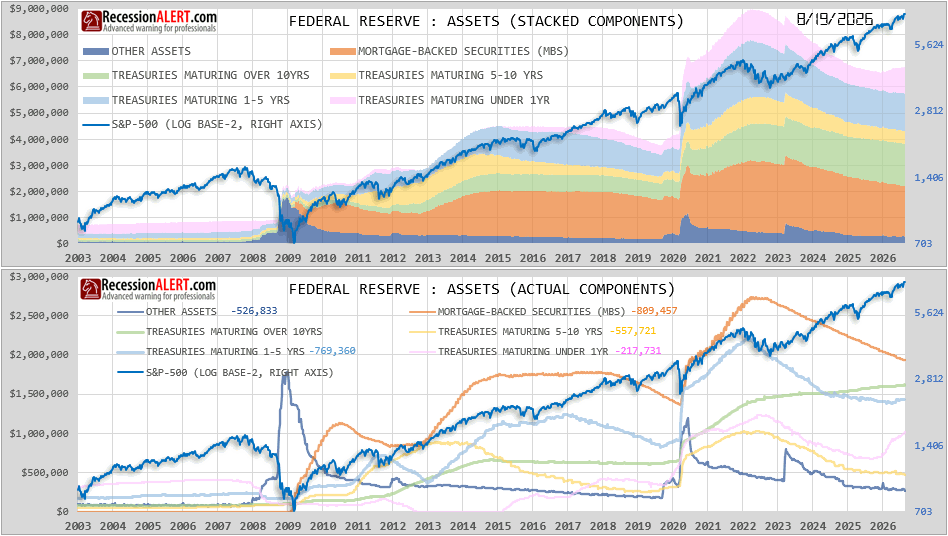
The Fed’s balance sheet has grown $127bn over the past year, and not a dollar of it removes duration. That is what quantitative easing does — the Fed buys long-dated paper, private investors are left holding less interest-rate risk in aggregate, term premia compress. That channel is the entire transmission, so measure the year the way the mechanism does, by maturity, and the QE5 claim inverts. Holdings of everything maturing beyond twelve months, agency MBS included, are $186bn smaller than last August. The stack grew only because the pink band grew $340bn — paper maturing inside a year, near-cash swapped for near-cash. That puts 220% of securities growth in the front bucket. No QE ever run exceeded 12%; the one close match is October 2019’s bill programme at 91%, which Powell introduced by saying “This is not QE.” The composition is mechanical, not chosen. Since December the Desk rolls all maturing Treasury principal at auction, allocated pro-rata across what Treasury is selling, and that calendar is bill-heavy — even the over-10yr bucket’s $38bn lands there because nothing matures out of it. The liability side settles it separately: through 12 August, reserves fell $373bn as the Treasury’s account rose $444bn. An expansion that drains the banking system and cannot compress a term premium even in principle is reserve maintenance wearing QE’s silhouette. Watch the coupon buckets: until 5-10yr and over-10yr rise faster than rollover explains, the Fed is taking duration off nobody’s hands.
What it means: the Fed’s buying will not pull long-term rates down. It is buying paper that matures inside a year, and that does not touch them. Mortgage rates and long bond yields still answer to how much long-dated debt the Treasury sells, so watch the quarterly refunding. That changes only if the Fed starts buying longer bonds faster than its automatic rollovers explain.
Market Intelligence Brief (MIB) Ver. 19.28
For professional investors only. Not investment advice.
© 2026 RecessionALERT.com

Comments are closed.