
MARKET INTELLIGENCE BRIEF (MIB)
Friday, August 28, 2026
Warsh’s Jackson Hole debut put a September hike back on the table: the two-year jumped 12.2bp to 4.354%, its biggest day since June. Gold -3.34%, silver -4.31% and the Russell -1.39% took the hit while the S&P shrugged at -0.25%. He also retired forward guidance outright. Chicago PMI cratered to 47.1. PayPal -12.71% after Advent and Stripe walked from a $53bn bid it had already rejected. Semis unwound 4-5%; Amazon +3.95%. BioNTech -8.37% on a halted cancer trial.
TABLE OF CONTENTS
A. EXECUTIVE SUMMARY
B. MARKET DATA
C. HIGH-IMPACT STORIES (7)
D. MODERATE-IMPACT STORIES (8)
E. ECONOMY WATCH (5)
F. EARNINGS WATCH (1)
G. WHAT’S NEXT
H. CHART OF THE DAY
A. EXECUTIVE SUMMARY -> TOP
The S&P 500’s 0.25% decline is the least informative number of the session. Fed Chair Kevin Warsh’s first Jackson Hole keynote told a market that has spent 2026 arguing over the timing of cuts that the next move is more likely up, and the front end repriced accordingly: the two-year rose 12.2 basis points to 4.354% against a ten-year up only 5.7, a bear flattening that prices near-term tightening without a matching lift to long-run growth. The damage landed where real yields bite rather than on the index, with gold off 3.34%, silver 4.31%, the Russell 2000 1.39% and semiconductor equipment 4% to 5% on no company news. Breadth was broad but shallow, NYSE Composite tracking the S&P at −0.26%; Communication Services and Consumer Cyclical led, while Technology, Basic Materials and, unusually for a risk-off tape, Utilities lagged.
• Warsh made September a live meeting: CME hike odds for the September 16 FOMC moved from roughly 35% on Thursday to somewhere between 46% and 57% depending on the intraday read, and Polymarket’s 2026-hike contract jumped eleven points to 68%. The two-year closed +12.2bp at 4.354%, its largest single-day rise since June 17 and some 60bp above the top of the current 3.50%−3.75% target range.
• He separately retired forward guidance as standing practice: it “has overstayed its welcome,” with transparency about future decisions “not a virtue unto itself.” More policy information now arrives on decision days and less between them — a structural change to the volatility calendar every rates position is underwritten against.
• Two soft data prints drew no rates response at all: Chicago PMI collapsed to 47.1 from 57.6 against 58.3 consensus, the steepest monthly drop since COVID, and the BLS benchmark revision cut March payrolls by 79,000 against an expected +183,000. Neither moved the front end — the employment side of the mandate is not the binding constraint right now.
• The repricing landed on real-yield proxies, not the index: gold −3.34% to $4,508.44 and silver −4.31% — their worst sessions since June 10 and June 24 — alongside Russell 2000 −1.39%, bitcoin −3.23% and a dollar index +0.51%. The VIX fell 0.62% to 14.42.
• Semiconductor equipment unwound as a single group: Lam Research −5.24%, Nvidia −4.56%, KLA −4.48% and Applied Materials −4.34% supplied four of the five largest mega-cap declines, on no company-specific catalyst and against a Technology sector down 1.41%.
• Single names ran their own stories: PayPal −12.71% after Advent and Stripe abandoned a $60.50-a-share, $53B approach the board had rejected — PYPL closed Thursday at $61.47, above the offer. Amazon +3.95% on Evercore’s $355 target, BioNTech −8.37% on a futility stop in its colorectal arm, CME +1.73% on a Treasury cross-margining filing.
1. The index was the wrong instrument today — A reader who saw only the S&P’s 0.25% decline would conclude the speech was absorbed; gold, silver and small caps moved several multiples of it. Index-level risk metrics understated Friday’s factor move by an order of magnitude, which matters for anyone carrying rate risk hedged through S&P options rather than through rates directly. The VIX falling alongside a 12.2bp move in the two-year is a non-confirmation worth noticing rather than dismissing — the equity options market and the rates market are not currently telling the same story.
2. Duration risk now sits inside the AI trade — Semiconductor capital equipment carries the longest-duration cash flows in the index, which makes it the first thing sold when the discount rate moves and close to the last thing genuinely affected by what Warsh said about inflation. Nvidia gave back part of an 8.74% post-earnings move two days after the print, on no news. AI capex exposure has acquired a rates beta that was not obviously priced a month ago, and it is asymmetric: the names that led on falling-rate expectations are the ones that lead lower when a hike becomes live.
3. The stagflationary bind arrived in its most awkward form — The Fed signalled tightening in the same week a leading manufacturing indicator went into contraction and payrolls were revised down, and the market chose to price the inflation side as binding. That choice is the risk. If Chicago leads the national series, Friday’s flattening is the last hawkish gesture before a capitulation on growth and the front end reverses violently; if Chicago is regional noise, the two-year has further to run. Tuesday’s ISM and Friday’s payrolls are the tests, and positioning cannot straddle both outcomes cheaply.
 — Leading economic indicators. Accurate market forecasts. Apply for membership at join.recessionalert.com
B. MARKET DATA -> TOP
Fed Chair Kevin Warsh’s hawkish debut keynote at Jackson Hole — declaring the Fed still has “work to do” on inflation — pushed September rate-hike odds to 57% and drove a broad but shallow equity pullback (S&P -0.25%, Dow flat at -0.02%) alongside a sharp yield repricing, with the 2-Year (+12.2 bps) outpacing the 10-Year (+5.7 bps) in a bear-flattening move. Small-caps bore the brunt (Russell 2000 -1.39%) while richly-valued AI/semiconductor equipment names unwound part of a multi-week rally on profit-taking (Lam Research -5.24%, Nvidia -4.56%, KLA -4.48%). Banks bucked the tape on rate-hike tailwinds for net interest margins (Wells Fargo +2.02%, Bank of America +1.88%), while Amazon (+3.95%) led gainers on a bullish Evercore note on agentic-AI shopping demand. Gold’s 3.34% slide was the session’s cleanest rates-transmission signal, falling in lockstep with the real-yield repricing.
CLOSING PRICES – August 28, 2026:
MAJOR INDICES
Blue-chips absorbed the Warsh shock better than growth: the Dow closed effectively flat (-0.02%) while the Nasdaq 100 (-0.70%) and Russell 2000 (-1.39%) bore the brunt of the hawkish repricing. NYSE Composite breadth (-0.26%) tracked the S&P closely, suggesting the selling was broad rather than concentrated in a handful of names — but small-caps’ underperformance signals the market is pricing near-term rate risk more than a growth scare.
| Index | Close | Change | %Move | Why It Moved |
|---|---|---|---|---|
| S&P 500 | 7,711.76 | -19.23 | -0.25% | Broad but shallow pullback after Fed Chair Warsh’s hawkish Jackson Hole debut lifted Sept. rate-hike odds to 57% |
| Dow Jones | 53,559.99 | -9.45 | -0.02% | Blue-chips essentially flat, absorbing the Warsh-driven rate repricing better than growth names |
| DJ Transportation | 21,378.75 | -61.52 | -0.29% | Tracked the broader risk-off tone from Warsh’s hawkish remarks |
| Nasdaq 100 | 29,433.43 | -208.13 | -0.70% | High-multiple growth/semis names led losses as yields jumped on hawkish Fed commentary |
| Russell 2000 | 2,972.37 | -41.97 | -1.39% | Small-caps hit hardest by the rate-sensitive repricing following Warsh’s Jackson Hole speech |
| NYSE Composite | 24,585.18 | -63.85 | -0.26% | Broad-based decline consistent with the S&P, confirming the selloff wasn’t narrow |
VOLATILITY & TREASURIES
The 2-Year’s 12.2 bp jump outpaced the 10-Year’s 5.7 bp rise — a bear-flattening move confirming markets are repricing near-term Fed hawkishness specifically, not a broader inflation or growth shift. VIX’s modest 0.62% dip despite the yield spike is a mild non-confirmation: equity options aren’t pricing real distress from Warsh’s remarks. DXY’s 0.51% gain tracked the rate move in the usual direction.
| Instrument | Level | Change | Why It Moved |
|---|---|---|---|
| VIX | 14.42 | -0.09 (-0.62%) | Modest dip despite the yield spike — equity options show no real distress from Warsh’s remarks |
| 10-Year Treasury Yield | 4.729% | +5.7 bps | Jumped as Warsh signaled the Fed has more inflation-fighting work to do |
| 2-Year Treasury Yield | 4.354% | +12.2 bps | Outpaced the 10-Year move as September rate-hike odds jumped to 57% |
| US Dollar Index (DXY) | 99.67 | +0.51 (+0.51%) | Dollar gained in step with the hawkish rate repricing |
COMMODITIES
Gold and silver moved in lockstep — down 3.34% and 4.31% respectively — the cleanest read-through from today’s real-yield repricing, since higher rates raise the opportunity cost of holding non-yielding metals. Platinum’s smaller 1.13% decline and Bitcoin’s 3.23% drop both tracked the same risk-off/higher-rates theme rather than telling an independent story today.
| Asset | Price | Change | %Move | Why It Moved |
|---|---|---|---|---|
| Gold | $4,508.44/oz | -$155.56 | -3.34% | Fell sharply on the real-yield repricing following Warsh’s hawkish Jackson Hole remarks |
| Silver | $66.44/oz | -$2.99 | -4.31% | Tracked gold lower on the same real-yield pressure, with added industrial-demand sensitivity |
| Copper | $6.54/lb | -$0.08 | -1.20% | Modest decline in step with the broader risk-off tone |
| Platinum | $1,832.85/oz | -$20.95 | -1.13% | Smaller decline than gold/silver — less rate-sensitive |
| Bitcoin | $77,488.00 | -$2,583.00 | -3.23% | Fell with broader risk assets on the hawkish Fed repricing |
ENERGY
WTI and Brent both sat out the session’s macro turbulence, essentially flat (-0.06% and -0.26%), while Dutch TTF’s 3.07% slide outpaced Henry Hub’s 1.34% decline — a European-specific dynamic rather than a broad energy read-through. Energy stocks (+0.05%) similarly shrugged off the equity pullback, underscoring that today’s story was a rates event, not a commodity-driven one.
| Asset | Price | Change | %Move | Why It Moved |
|---|---|---|---|---|
| Crude Oil (WTI) | $83.48/bbl | -$0.05 | -0.06% | Essentially flat, sitting out today’s rates-driven equity and metals moves |
| Crude Oil (Brent) | $88.29/bbl | -$0.23 | -0.26% | Similarly flat; no discrete catalyst |
| Natural Gas (Henry Hub) | $2.875/MMBtu | -$0.039 | -1.34% | Modest decline, untethered from the equity/rates story |
| Natural Gas (Dutch TTF) | $22.60/MMBtu | -$0.72 | -3.07% | Underperformed Henry Hub on European-specific supply/demand dynamics; no discrete same-day catalyst identified |
S&P 500 SECTORS
Communication Services (+1.43%) and Consumer Cyclical (+1.35%) led, while rate-sensitive Financial (+0.26%) also gained — a signal today’s hawkish repricing was read as manageable rather than threatening for cyclicals. Technology (-1.41%) and Basic Materials (-1.52%) lagged as richly-valued AI/semis names gave back gains from their recent rally, and Utilities (-1.12%) fell despite typically defensive positioning — an inversion worth noting.
| Sector | 1-Day | 1-Week | 1-Month | 3-Month | 6-Month | YTD | 12-Month |
|---|---|---|---|---|---|---|---|
| Communication Services | +1.43% | +1.26% | +4.01% | -7.18% | +0.45% | -0.50% | +11.32% |
| Consumer Cyclical | +1.35% | -0.62% | +4.96% | -2.98% | +0.81% | -2.74% | -0.39% |
| Consumer Defensive | +0.57% | -0.33% | -1.72% | +1.18% | -7.28% | +6.96% | +5.11% |
| Financial | +0.26% | +0.95% | +1.18% | +11.25% | +12.17% | +8.42% | +13.20% |
| Energy | +0.05% | -2.12% | +2.95% | +7.77% | +10.56% | +35.89% | +37.87% |
| Real Estate | -0.43% | -1.33% | -2.21% | +1.68% | +1.44% | +9.35% | +4.66% |
| Healthcare | -0.76% | -2.18% | +3.58% | +12.35% | +6.31% | +9.90% | +23.77% |
| Industrials | -1.01% | -1.49% | +1.16% | -3.28% | -3.23% | +11.26% | +13.91% |
| Utilities | -1.12% | -0.27% | -4.60% | -5.18% | -11.02% | -0.95% | +1.04% |
| Technology | -1.41% | +1.22% | +5.67% | -1.11% | +27.71% | +23.81% | +32.21% |
| Basic Materials | -1.52% | -1.24% | +10.93% | +3.23% | -3.95% | +21.25% | +36.81% |
TOP MEGA-CAP MOVERS:
GAINERS
| Company | Ticker | Close | Change | Why It Moved |
|---|---|---|---|---|
| Amazon.com Inc | AMZN | 266.38 | +3.95% | Evercore ISI note found agentic-AI shopping (Alexa AI) is driving incremental purchases, lifting shares |
| Netflix Inc | NFLX | 81.73 | +2.37% | Rose with Communication Services sector strength; no discrete same-day catalyst identified beyond that |
| Wells Fargo & Co | WFC | 86.69 | +2.02% | Banks rallied on rate-hike odds boosting net-interest-margin expectations after Warsh’s hawkish remarks |
| Bank Of America Corp | BAC | 62.32 | +1.88% | Same NIM-expansion tailwind as peer banks on the hawkish rate repricing |
| Alphabet Inc | GOOGL | 346.45 | +1.70% | Gained with broader Communication Services sector strength |
DECLINERS
| Company | Ticker | Close | Change | Why It Moved |
|---|---|---|---|---|
| Lam Research Corp | LRCX | 301.90 | -5.24% | Profit-taking across richly-valued semiconductor equipment names after a multi-week AI-driven rally |
| NVIDIA Corp | NVDA | 217.59 | -4.56% | Gave back part of its recent post-earnings rally amid Warsh’s hawkish yield repricing |
| KLA Corp | KLAC | 175.54 | -4.48% | Semiconductor-equipment profit-taking alongside sector peers LRCX and AMAT |
| GE Vernova Inc | GEV | 911.93 | -4.39% | Continuation of a 6-session, 14% decline since a CFO-transition announcement; no fresh same-day catalyst identified |
| Applied Materials Inc | AMAT | 461.42 | -4.34% | Semiconductor-equipment profit-taking alongside sector peers LRCX and KLAC |
— Institutional-grade intelligence for serious investors. Apply for membership at join.recessionalert.comC. HIGH-IMPACT STORIES -> TOP
BEARISH
1. Warsh’s Jackson Hole Debut Turns September Into a Live Hike Meeting — the Two-Year Closed at Its Highest Level Since at Least Mid-April
The core facts:Fed Chair Kevin Warsh used his first Jackson Hole keynote, delivered at 10:00 ET, to say the Fed “must be confident that underlying inflation is moving to our objective, clearly and at sufficient speed. Otherwise, we have work to do,” and that this summer’s better-than-expected PCE and CPI readings “do not tell me that underlying trends have meaningfully improved.” Section E carries the substance of what he said; what mattered to the tape was the repricing that followed. CME FedWatch odds of a 25 basis point hike at the September 16 FOMC moved from roughly 35% on Thursday to somewhere between 46% and 57% depending on which intraday read is taken, and Polymarket’s 2026-hike contract jumped eleven points to 68%. The two-year Treasury yield closed at 4.354%, up 12.2 basis points — its highest close since at least mid-April and its largest single-day rise since June 17. The ten-year added 5.7 basis points to 4.729%, leaving the 2s10s spread at 37.5 basis points, some 6.5 basis points flatter on the session. The dollar index gained 0.51% to 99.67. The current target range is 3.50%-3.75%, held at the July 29 meeting.
Why it matters:The market has spent 2026 arguing about when the Fed cuts. Warsh has now told it the next move is more likely up, and the front end repriced accordingly while the long end barely moved — a bear flattening, which is what it looks like when traders price near-term tightening without a matching lift to long-run growth expectations. The transmission was clean and highly selective. Banks gained on net interest margin expectations, with Wells Fargo +2.02% and Bank of America +1.88% against a Financial sector that added only 0.26%, while the rate-sensitive complex took the damage: Russell 2000 -1.39%, gold -3.34%, silver -4.31%. The S&P 500’s own 0.25% decline badly understates what happened underneath it. For a US portfolio manager the live question has changed shape: not when the easing cycle starts, but whether tightening into a manufacturing sector that just printed a sub-50 Chicago PMI is a policy error the curve will be forced to price later. A two-year at 4.354% sits roughly 60 basis points above the top of the current target range — the market is not merely allowing for a hike, it is carrying more than one.
What to watch:The September 16 FOMC decision, and CME FedWatch pricing into it — a hold that leaves hike odds above 50% is a very different signal from one that unwinds them. The August employment report on Friday, September 4 is the nearer test.
UNCERTAIN
2. Warsh Retires Forward Guidance as a Standing Fed Practice: “It Has Overstayed Its Welcome”
The core facts:In the same speech, and separately from the inflation message, Warsh announced a change to how the Federal Reserve communicates. Forward guidance “as a regular practice,” he said, “has overstayed its welcome.” He added that “transparency in communications about future policy decisions is not a virtue unto itself,” that “oversharing policy deliberations and overcommitting to future decisions can lead markets, businesses, and households astray,” and that in normal times the role of forward guidance “should be limited and circumscribed.” He declined to name whatever replaces it: “you can call it an outline… you can call it a trail map… just don’t call it forward guidance.” He also rejected mechanical reaction functions, saying he wished understanding of the economy were precise enough “that some simple function like a Taylor rule could be rigorously relied upon,” and reasserted that “money matters” and that central banks should monitor monetary aggregates. The regime he described is already operating: the Board’s own 2026 speeches archive contains exactly one Board of Governors speech in all of August 2026 — this one — following six clustered between July 13 and July 16 and six weeks of silence since.
Why it matters:This is a structural change to the information environment every rates position in the market is underwritten against, and it is being announced rather than drifted into. Forward guidance has been a core Fed tool since 2008; a Chair explicitly retiring it as standing practice removes the mechanism through which the committee has smoothed policy surprises for the better part of two decades. The near-term consequence is mechanical: with less pre-committed guidance, more of the information content of policy arrives on decision days, which raises realised volatility around FOMC dates and lowers it in between. The valuation of gamma around September 16 should reflect that. The longer-term consequence is harder to price and cuts both ways, which is why this is filed uncertain rather than bearish — a Fed that commits less can also change course faster without a credibility cost, and the “discipline, not a decision” framing Warsh used is a claim to exactly that flexibility. The August speech drought is the detail worth holding onto: the practice changed before the speech announced it, which means the market has already been operating in this regime for six weeks without labelling it.
What to watch:The September 16 FOMC statement and press conference — specifically whether the statement’s forward-looking language is shortened or dropped, and whether the SEP dot plot survives in its current form.
BEARISH
3. The Semiconductor-Equipment Complex Gave Back 4% to 5% in a Session the S&P 500 Fell 0.25%
The core facts:Lam Research closed at $301.90, down 5.24%; Nvidia at $217.59, down 4.56%; KLA at $175.54, down 4.48%; and Applied Materials at $461.42, down 4.34%. Four of the session’s five largest mega-cap declines came from one group, against a Technology sector down 1.41% and an S&P 500 down 0.25%. The four moved together and moved roughly three times their own sector, which is the signature of a positioning unwind rather than four separate company events; Phase 1’s research identified no company-specific catalyst for any of them. Context matters for the size of the move: Technology is still up 5.67% over one month, 27.71% over six and 23.81% year to date, so Friday subtracted from a rally rather than reversing one. Only Basic Materials (-1.52%) fell further among sectors.
Why it matters:This is the clearest available evidence that Friday’s rate move was transmitted through valuation rather than through fundamentals. Semiconductor capital equipment carries the longest-duration cash flow stream in the index — its earnings sit years out on an AI build-out schedule — which makes it the first thing sold when the discount rate moves and close to the last thing genuinely affected by what Warsh said about inflation. Nvidia’s presence in the group is the most informative part: it reported two days ago and rose 8.74% on the print, so Friday was giving back part of a post-earnings move rather than repricing the quarter. The read-through for US large-cap portfolios is that AI capex exposure now carries a rates beta that was not obviously priced a month ago, and that beta is asymmetric — the same names that led on falling-rate expectations are the ones that lead lower when a hike becomes live. Anyone who has been treating semiconductor equipment as a secular growth allocation rather than a duration allocation got a demonstration on Friday that the market does not agree.
What to watch:Broadcom’s results after the close on Wednesday, September 2 — at a $1.75 trillion market capitalisation it is the largest AI-semiconductor print of the coming week and the first real test of whether Friday was positioning or the start of a re-rating.
BEARISH
4. A Contractionary Chicago PMI Landed on the Same Morning as a Hawkish Fed — and the Market Priced the Fed
The core facts:The MNI Chicago Business Barometer’s collapse into contraction territory, and the scale of its miss against consensus, are covered in full in Section E. What belongs here is the market’s response to having both events in the same session, and the answer is that it was almost entirely one-sided. Every instrument that repriced on Friday repriced for a tighter Fed, not for a weaker economy: the two-year yield rose 12.2 basis points, September hike odds rose, the dollar gained 0.51% and gold fell 3.34%. A market pricing a manufacturing contraction would have produced the opposite of all four. The only readings consistent with a growth scare were the Russell 2000’s 1.39% decline and Utilities falling 1.12% despite their defensive character — and both are equally well explained by the rate move.
Why it matters:This is the stagflationary bind arriving in its most awkward form: the Fed is signalling tightening in the same week a leading manufacturing indicator went into contraction, and the market has decided the inflation side is the binding constraint. That decision is the risk. If Chicago is a genuine lead on national manufacturing, the Fed is being pushed toward hiking into a slowdown, and the curve that flattened on Friday would have to steepen violently later as the front end reverses — the classic sequence in which the flattening move is the market’s last hawkish gesture before it capitulates on growth. If Chicago is regional noise, Friday’s pricing is correct and the front end has further to go. Positioning cannot straddle both outcomes cheaply, which is why the September 1 ISM print matters more than a manufacturing survey usually does.
What to watch:ISM Manufacturing PMI on Tuesday, September 1, consensus 55.3 — a confirming print near 50 would put the Fed’s hawkish turn and the manufacturing cycle in open conflict for the first time this cycle.
BEARISH
5. The Hawkish Repricing Landed on Gold, Silver and Small Caps — Not on the S&P 500
The core facts:Gold fell 3.34% to $4,508.44 an ounce and silver 4.31% to $66.44 — gold’s steepest single-session decline since June 10 and silver’s largest since June 24 — while the dollar index added 0.51% and the Russell 2000 lost 1.39%. Bitcoin fell 3.23% to $77,488. Against that, the S&P 500 closed down 0.25%, the Dow essentially unchanged at -0.02%, and the VIX actually fell 0.62% to 14.42. The industrial metals moved far less: platinum -1.13%, copper -1.20%. Energy sat the session out entirely, with WTI at $83.48 (-0.06%) and Brent at $88.29 (-0.26%), and the Energy sector closing marginally positive at +0.05%.
Why it matters:The headline index is the worst available summary of what Friday did. A reader who saw only the S&P 500’s 0.25% decline would conclude the Warsh speech was absorbed; the instruments that actually repriced say the opposite. Gold, silver and small caps are the three cleanest expressions of real yields and the dollar in the tradeable universe, and all three moved several multiples of the index. That divergence carries two practical implications. First, index-level risk metrics understated Friday’s factor move by an order of magnitude, which matters for anyone whose hedges are struck on the S&P rather than on rates directly. Second, the VIX’s decline alongside a 12.2 basis point move in the two-year is a mild non-confirmation worth noticing rather than dismissing: equity options are not pricing distress from a Fed that has just put a hike on the table, which is either complacency or a judgement that a single hike does not threaten large-cap earnings. On the evidence of the metals, the rates market and the equity options market are not currently telling the same story.
What to watch:Whether gold stabilises or extends into next week — a second 3% session would confirm a positioning unwind rather than a one-day repricing — and whether the VIX begins to converge toward the rates move ahead of September 16.
BEARISH
6. Advent and Stripe Walk Away From a $53 Billion Pursuit of PayPal — and the Stock Falls 12.71%
The core facts:Bloomberg reported Friday, with Axios confirming, that the consortium of Advent International and Stripe has abandoned its pursuit of PayPal. The offer was $60.50 per share, valuing the company at more than $53 billion. It was made in July, when PayPal was trading near historic lows at roughly a $40 billion market capitalisation, and PayPal’s board rejected it as undervaluing the company without sending a formal reply. PYPL closed at $53.66, down 12.71%, a $45.90 billion market capitalisation and the session’s worst large-cap decline; it traded as much as 16% lower pre-market. The decisive fact sits in Thursday’s close: PayPal finished August 27 at $61.47 — above the $60.50 offer. Three brokers published the same day, all reacting to the collapse: Loop Capital cut its target to $50 from $62 and Mizuho to $51 from $60, both at Hold, while KBW maintained a Buy at $70. Mizuho’s Dan Dolev cited branded-checkout commoditisation, German market share loss and competition from X-Money. Bloomberg reported the buyers could return if circumstances change. Characterisations of the deal as one of the largest leveraged buyouts ever attempted trace to the reporting outlets’ own framing rather than to a league table.
Why it matters:The board was vindicated on price and punished on outcome, and the gap between those two things is the general lesson. PayPal traded above the rejected offer on Thursday, so on the market’s own evidence the board’s valuation judgement was correct — and the stock still lost an eighth of its value the moment the bid disappeared, because what was actually supporting the price was the bid rather than the business. That is a distinction every holder of a rumoured target should price. For the wider payments complex the read-through is unambiguous and negative: the most credible strategic and financial buyers in the sector looked at a $53 billion take-private of the incumbent, walked, and did so at a moment when leveraged finance markets are otherwise wide open — SoftBank raised $10 billion in term debt the same day. The constraint was not funding. It was the asset.
What to watch:Whether a revised approach materialises at a lower price now that the market has repriced the standalone case, and whether PayPal announces a capital-return or strategic response before its next quarterly report.
UNCERTAIN
7. Ukraine Struck Three Russian Refineries in One Night — About 17% of Russian Refining Capacity Is Now Disrupted, and Crude Closed Flat
The core facts:Three separate facilities were hit overnight. Rosneft’s Kuibyshev refinery in Samara Oblast halted oil processing from August 28, with both main crude distillation units — CDU-4 and CDU-5, 70,000 barrels a day each — damaged along with secondary units; nameplate capacity is roughly 7 million tonnes a year. The Afipsky refinery in Krasnodar Krai caught fire, with falling drone debris killing two people and injuring two others. Slavneft-YANOS in Yaroslavl, a Rosneft and Gazprom Neft joint venture and one of Russia’s largest at about 15 million tonnes a year, also caught fire; one civilian was killed and 27 injured when debris struck an intercity bus. Reuters estimates Ukrainian attacks have now disrupted at least 17% of Russian refining capacity, and Bloomberg counts at least 21 refinery strikes in August — the most in any single month — with fuel queues returning inside Russia. Crude did not respond: WTI closed at $83.48, down 0.06%, and Brent at $88.29, down 0.26%.
Why it matters:The flat close is the story, and it is worth being precise about why. Refinery strikes destroy refining capacity, not crude production — the immediate effect is more Russian crude looking for an export home and less Russian diesel and gasoline reaching the domestic market, which is bearish flat price and bullish product cracks. Two independent facts point the same way. Goldman Sachs estimated Friday that Persian Gulf crude and product exports have recovered to 15-16 million barrels a day, roughly two-thirds of pre-war levels and well above the 5-6 million barrel trough in March, attributing part of that to “dark” crossings and ship-to-ship transfers and arguing explicitly that it caps crude’s upside even if disruption persists. And CENTCOM’s commander said in a video released Thursday night that US forces have cleared the international shipping lanes through the Strait of Hormuz of Iranian sea mines, calling it a “major milestone” — a claim allies have privately disputed, with an estimated 80 to 150 mines laid and not all believed cleared. Where the dislocation is genuinely showing up is freight, not flat price: Baltic Exchange data put Saudi-to-China supertanker earnings at about $647,000 a day, more than ten times the year-earlier rate. The market is pricing barrels as available and the cost of moving them as extreme, which is a very different risk profile from the outright supply shock of March.
What to watch:Diesel and gasoline crack spreads rather than crude flat price — that is where a 17% refining outage transmits — and whether Hormuz transit counts, still running near 4% of the pre-crisis baseline, begin to recover on the CENTCOM claim.
— Quantifying recession risk so you don’t have to guess. Apply for membership at join.recessionalert.comD. MODERATE-IMPACT STORIES -> TOP
BEARISH
8. The Payroll Benchmark Revision Missed Consensus by Roughly 262,000 Jobs — and the Bond Market Ignored It
The core facts:The BLS’s preliminary annual benchmark revision to March 2026 nonfarm payrolls is covered in full in Section E, including the private-sector detail and the comparison with last year’s far larger revision. What belongs here is the reaction, and the reaction was effectively nil. The two-year Treasury yield rose 12.2 basis points on the session and September hike odds went up, which is precisely the opposite of what a downward labour-market revision would normally produce. No rates instrument moved in the direction the data pointed. The next hard read arrives quickly: the August employment report is due Friday, September 4, with consensus at roughly +45,000 payrolls and the unemployment rate expected to rise to 4.2%.
Why it matters:A benchmark revision landing the same morning as a hawkish Chair keynote is close to a natural experiment in what the market currently prices, and it returned an unusually clean answer: the employment side of the dual mandate is not the binding constraint right now. That is a meaningful shift in the reaction function traders are trading against. For most of the past two years, soft labour data reliably bid the front end; on Friday it did not move it at all. The implication for positioning is that labour-market disappointments are, for the moment, a weaker hedge against rate risk than they have been — and that the September 4 payroll print will need to be genuinely poor, not merely soft, to change the September FOMC calculus. It also raises the stakes on the revision itself: if the March level was overstated, every subsequent monthly print is being measured off a base that is too high, which makes the run-rate look better than it is at exactly the moment the Fed has stopped weighting it.
What to watch:The August employment report on Friday, September 4 — and specifically whether a miss moves the two-year at all, which is the direct test of whether Friday’s non-reaction was a one-off or the new regime.
UNCERTAIN
9. SoftBank Launches a $10 Billion Term Loan — the First Substantial Takeout of Its $40 Billion OpenAI Bridge
The core facts:SoftBank Group launched a $10 billion two-year recourse term facility at an opening margin of 275 basis points over SOFR, stepping up 25 basis points if OpenAI has not completed an IPO within twelve months. Apollo Global Funding and Sumitomo Mitsui Banking Corp join Goldman Sachs, JP Morgan and Mizuho Securities as mandated lead arrangers. The loan carries a SoftBank guarantee and a cash-collateral account with mandatory prepayment tied to the OpenAI share valuation. IFR reports it alongside a $6.05 billion one-year commitment line and a 1 trillion yen (about $6.3 billion) seven-year retail bond, and describes the package as the first substantial takeout of the $40 billion bridge facility maturing in March 2027. Bloomberg separately reported on August 26 that SoftBank was weighing a $10 billion to $20 billion offshore bond, with a spokesperson saying “nothing has been decided, including the amount for each” — what is new on Friday is the loan, not the bond.
Why it matters:The IPO step-up is the term worth reading twice. A margin that rises 25 basis points if OpenAI has not listed within twelve months is a syndicate putting an explicit price on the exit — modest in absolute terms, but it converts a private-company milestone into a contractual cash-flow trigger, and it tells you what the lenders think the refinancing path actually is. The structure is otherwise notably conservative for AI-adjacent paper: full recourse to SoftBank, a parent guarantee, and a cash-collateral account with mandatory prepayment tied to the OpenAI mark. Lenders are financing SoftBank’s balance sheet, not OpenAI’s equity story. For US investors the relevance is the funding channel rather than the borrower: this is the clearest public window into how the AI build-out is being financed, and $10 billion of the $40 billion bridge being termed out at SOFR+275 says the market is open on terms that are demanding but not distressed. It is filed uncertain because the same facts support two readings — a healthy refinancing, or the first tranche of a $40 billion problem that still has $30 billion left to solve before March 2027.
What to watch:Whether the remaining balance of the bridge is refinanced on comparable terms or requires wider spreads, and any concrete OpenAI listing signal inside the twelve-month step-up window.
BULLISH
10. Amazon Adds 3.95% on Evercore’s Finding That AI Shopping Agents Are Generating Incremental Purchases
The core facts:Amazon closed at $266.38, up 3.95% — the day’s largest mega-cap gain and one of only two sizeable advances on an otherwise negative tape — after Evercore ISI’s Mark Mahaney raised his twelve-month price target to $355 from $315 and reiterated an Outperform rating. The note rests on Evercore’s own consumer survey work: 57% of surveyed users of Alexa’s AI shopping features reported buying a product they had not previously been aware of, and 36% said they bought more because of the AI addition to Alexa. Evercore’s annual online retail survey separately found 92% of respondents had used Amazon, making it the most-used platform in the sample. The $355 target implied roughly 40% upside from Thursday’s close. Amazon’s gain came alongside broader Communication Services strength (+1.43%) and Consumer Cyclical (+1.35%), the two leading sectors on the session.
Why it matters:The bull case for agentic commerce has until now been a capability argument — the tools work, therefore they will matter. This is one of the first widely-circulated attempts to size it as incremental demand rather than substituted demand, which is the distinction that decides whether AI shopping is a revenue event or a margin event for retail platforms. If agents genuinely surface purchases consumers would not otherwise have made, the beneficiary is the platform that owns the agent and the fulfilment behind it, and Amazon owns both. That a 3.95% move in a $2.8 trillion-scale name occurred on a survey note, on a day the index fell, is itself a statement about how thinly this optionality has been priced. A caution belongs alongside it, and it is not a small one: this is a single sell-side consumer survey, self-reported, and “bought something I was not previously aware of” measures discovery rather than incremental spend — a consumer who buys a different item they did not know about has not necessarily bought more. The finding is worth acting on as a directional signal, not as a quantified revenue estimate.
What to watch:Whether other brokers replicate the survey finding with independent data, and Amazon’s next quarterly disclosure on retail revenue per active customer — the metric where an incremental-demand effect would have to appear.
BULLISH
11. Walmart Settles the Justice Department’s Federal Opioid Dispensing Suit — Terms Undisclosed
The core facts:The Justice Department and Walmart each confirmed on Friday that they have settled the government’s 2020 civil suit alleging Walmart pharmacies unlawfully dispensed controlled substances in violation of the federal Controlled Substances Act from 2013 onward. Neither party disclosed terms. The Justice Department said it was “pleased to have reached a settlement with Walmart resolving allegations that its pharmacies failed to comply with their obligations under the Controlled Substances Act in dispensing opioids and other controlled substances.” DOJ had previously said Walmart faced potential civil penalties “in the billions.” The case was among the most significant federal actions brought against a single company over the opioid epidemic, and is separate from Walmart’s 2022 $3.1 billion settlement with state and local governments. WMT closed at $103.09, up 0.45%, at a market capitalisation of $820.52 billion.
Why it matters:Removing an uncapped liability is usually worth more than the settlement number turns out to be, and that is the case here. The federal Controlled Substances Act exposure was open-ended and unquantifiable — DOJ’s own “in the billions” framing set no ceiling — which meant it functioned as a permanent discount on the equity rather than a provision on the balance sheet. Converting it into a known number, whatever that number proves to be, is the value event. The muted 0.45% move says the market had largely written the case off already, which is itself informative: six years of litigation had reduced a headline federal enforcement action to a rounding error in the share price. For the broader pharmacy channel — the large chains and the grocery pharmacies — the settlement establishes that a negotiated resolution is available on terms a defendant is willing to accept, which lowers the tail risk on comparable exposures even though no precedent is set by a settlement without disclosed terms.
What to watch:The settlement figure when it appears in a Walmart filing, and whether DOJ pursues comparable resolutions with other national pharmacy operators.
BULLISH
12. Europe’s Rewritten Heart Failure Guidelines Give Semaglutide and Tirzepatide a Class IIa Recommendation in Preserved-EF Patients With Obesity
The core facts:The European Society of Cardiology released substantially rewritten 2026 heart failure guidelines at its Congress in Munich. The mildly-reduced-ejection-fraction category (LVEF 41-49%) is removed, leaving two phenotypes, and “acute” heart failure is renamed “decompensated.” Mineralocorticoid receptor antagonists are upgraded to Class I in chronic heart failure regardless of ejection fraction. The commercially significant change is a Class IIa recommendation for semaglutide or tirzepatide in preserved-LVEF patients with obesity, reaching Eli Lilly (market capitalisation $1.05 trillion; closed $1,174.61, -0.13%) and Novo Nordisk ($203.56 billion; closed $45.59, -1.45%). Transcatheter edge-to-edge mitral repair and durable mechanical circulatory support were also upgraded, reaching Abbott ($194.62 billion; closed $112.47, +0.79%) and Edwards Lifesciences ($51.97 billion; +0.24%). Separately the same day, the ESC and the European Renal Association issued their first joint cardiovascular and chronic-kidney-disease guidelines, recommending eGFR and urine albumin-to-creatinine screening for every cardiovascular patient and early use of RAS and SGLT2 inhibitors alongside statins — reaching the SGLT2 franchises including AstraZeneca ($251.73 billion; closed $162.70, -1.11%).
Why it matters:A professional-society guideline is not a regulatory action, and none of the affected names moved on it — Healthcare was down 0.76% on the session and Lilly and Novo both closed lower. But guidelines are the documents formularies and reimbursement committees actually read, and a Class IIa recommendation in heart failure with preserved ejection fraction extends the GLP-1 case from weight and diabetes into a cardiology indication with a very large addressable population and a payer conversation that is fundamentally different. The obesity drugs have been fighting a coverage battle framed around lifestyle; a cardiology guideline reframes the same molecule as heart failure therapy. That is the mechanism by which the category’s reimbursement profile changes, and it typically shows up in prescription data quarters before it shows up in a price target. The kidney guideline works the same way for the SGLT2 franchises, with the added detail that finerenone and the GLP-1s are explicitly not named in that document — a reader would reasonably expect them to be, and their absence bounds the read-through.
What to watch:Whether the American College of Cardiology and American Heart Association follow with comparable US guidance, and any Lilly or Novo commentary on pursuing a formal HFpEF label.
BEARISH
13. BioNTech Falls 8.37% as the Genentech-Partnered Colorectal Arm of Autogene Cevumeran Is Stopped for Futility
The core facts:BioNTech and Genentech terminated the Phase 2 adjuvant colorectal-cancer arm of autogene cevumeran after the data safety monitoring board identified a numerical overall-survival imbalance and concluded further treatment was unlikely to change the efficacy outcome. The termination applies to the adjuvant monotherapy setting; the Phase 2 pancreatic trial IMcode003, which combines the candidate with checkpoint inhibition and chemotherapy, continues unaffected. BNTX closed at $102.08, down 8.37%, a $25.64 billion market capitalisation and the largest single-name decline established in the day’s regulatory and health coverage. Partner Roche closed at $55.19, down 2.09%, at $362.16 billion. Moderna, whose exposure here is a platform sentiment read-through rather than a direct one, closed at $137.99, down 3.35%; it separately priced an upsized $2.6 billion zero-coupon convertible due March 2032 the same day, raised from $2.0 billion, at a conversion price of about $210.58. Aggregator copy circulated Friday putting BioNTech down 10% and Moderna down 6% — both are intraday figures and neither is the close.
Why it matters:Individualised mRNA cancer vaccines are the single largest non-COVID value driver in the mRNA platform story, and adjuvant colorectal cancer was among the more commercially attractive indications in the programme — a large, well-defined post-surgical population with an established standard of care to add to. The specific reason for stopping matters more than the fact of stopping: a numerical overall-survival imbalance is a harder signal to explain away than a simple efficacy miss, because it raises the question of whether the intervention is doing something adverse rather than merely nothing. That distinction is what separates an indication failure from a platform question, and on one arm of one trial it cannot yet be resolved either way. The 8.37% move against Roche’s 2.09% is the correct relative pricing — BioNTech is a single-platform story and Roche is not. For US investors the read-through runs to the wider mRNA-oncology complex, where Moderna’s 3.35% decline on no news of its own is the market marking the whole category down together.
What to watch:The IMcode003 pancreatic readout, which is now the programme’s load-bearing trial, and any disclosure of the survival imbalance data that would distinguish an indication failure from a platform safety signal.
BEARISH
14. The USITC Institutes a Section 337 Investigation Against Apple, With an Import Ban as the Relief Sought
The core facts:The US International Trade Commission voted on August 28 to institute Investigation No. 337-TA-1520, “Certain Mobile Devices with Hardware and Software for Exchanging Electronic Content.” The complainant is GG Technologies, Inc., doing business as StayTouch, of Santa Monica, California; Apple Inc. of Cupertino is the sole named respondent. The complaint was filed on July 28, and the Commission voted to institute one month later. The relief sought is a limited exclusion order and a cease and desist order — in substance an import ban on infringing mobile devices, which is why a patent complaint carries trade consequences rather than only monetary ones.
Why it matters:Section 337 matters to Apple in a way that district-court patent litigation does not, and the difference is structural rather than a matter of degree. The ITC cannot award damages; its only meaningful remedy is exclusion from the US market. For a company whose hardware is manufactured offshore and imported, that converts a patent dispute from a cost question into an availability question, and it does so on the ITC’s compressed statutory timetable rather than a district court’s. Institution is not a finding of infringement and the great majority of Section 337 cases end without an exclusion order — but the base rate of settlement rises sharply once one is genuinely on the table, which is precisely why complainants choose this forum. For a US large-cap portfolio the practical exposure is small and the tail is not: the case is early, the complainant is a small private company, and the realistic outcomes are settlement or dismissal. It belongs on the risk register rather than in a valuation.
What to watch:The ITC’s target date for completion, set shortly after institution, and whether Apple moves to settle before an evidentiary hearing is scheduled.
BULLISH
15. CME Files a Cross-Margining Framework for US Treasury Clearing — the First Real Challenge to FICC’s Incumbency
The core facts:The SEC published CME Securities Clearing’s proposed new Rule 514 for public inspection on August 28 (release 34-106193, file SR-CMESC-2026-007). The rule establishes cross-margining with CFTC-registered derivatives clearing organisations, beginning with a proprietary arrangement with CME itself: participants would margin eligible Treasury securities transactions at CMESC jointly with interest-rate futures at CME, using the SPAN 2 methodology targeting 99% coverage over a two-business-day margin period of risk. Access is limited to CMESC members and independent users that are also CME clearing members or affiliates. CME Group closed at $285.80, up 1.73%, at a $102.77 billion market capitalisation — one of the stronger large-cap performances on a down session. Separately the same day, in its only press release of the date, the SEC proposed amending Exchange Act Rule 3a12-8 to add European Union debt obligations as exempted securities for futures trading and marketing purposes, placing futures on EU debt under exclusive CFTC jurisdiction; Chairman Paul S. Atkins called the proposal “harmonization in practice and builds on our efforts with the CFTC to preserve investor protection while closing regulatory gaps.” That proposal carries a 60-day comment period.
Why it matters:The Treasury clearing mandate is the largest structural change to US government bond markets in a generation, and margin efficiency is the variable that determines whether dealers and relative-value participants can afford to comply with it. Cash Treasuries and interest-rate futures are the two legs of the basis trade; margining them separately at two clearing houses is a capital charge on a position that is close to flat on risk. A framework that nets them is therefore not a technical filing — it is the difference between a liquidity provider staying in the trade and leaving it, and it arrives at a moment when the front end has just moved 12 basis points in a day and the market needs that liquidity. Commercially, this is the first serious challenge to FICC and DTCC’s incumbency in Treasury clearing, and CME is attacking with the one asset FICC cannot match: it already clears the futures leg. The stock’s 1.73% gain against a falling index suggests the market read it that way. The two SEC items together also point to a coordinated SEC-CFTC posture on jurisdictional harmonisation, which is the enabling condition for cross-margining working at all.
What to watch:The comment period on SR-CMESC-2026-007 and, in particular, whether FICC or DTCC files opposition — and any competing cross-margining proposal from the incumbent.
— Separating signal from noise since 2007. Apply for membership at join.recessionalert.comE. ECONOMY WATCH -> TOP
Today’s data crystallized a stagflation-adjacent tension: Chicago PMI cratered to 47.1 — the steepest month-over-month drop since COVID and the year’s weakest reading — even as Fed Chair Kevin Warsh used his first Jackson Hole keynote to declare underlying inflation trends “not meaningfully improved,” explicitly floating further rate hikes. Markets repriced accordingly: Polymarket’s 2026 hike odds jumped 11 points to 68% and the 2-year yield rose over 6bps, even as a preliminary NFP benchmark revision (-79K, against a consensus call for a +183K upward revision) muddied the labor picture. Consumer sentiment beat estimates (51.7) but remains down 11% year-over-year on entrenched inflation worries. The read-through: the Fed is leaning hawkish just as a leading manufacturing indicator flashes contraction.
Chicago PMI Craters to 47.1, Steepest Drop Since COVID, Signals Manufacturing Contraction (MNI / Trading Economics, Aug 28, 2026)
What they’re saying:The MNI Chicago Business Barometer plunged to 47.1 in August from 57.6 in July, badly missing the 58.3 consensus and marking a -10.5 point month-over-month collapse — the largest single-month drop since the COVID shock and the lowest reading of 2026. The sub-50 print signals outright contraction in the Chicago-area manufacturing and business sector.
The context:Chicago PMI is a closely-watched leading indicator for the national ISM Manufacturing PMI, and analysts flagged the reading as “flashing recession signals.” The severity of the miss — more than 10 points below consensus — stands out even against a year of soft prints.
What to watch:ISM Manufacturing PMI, due Tuesday, September 1 (consensus 55.3) — a confirming or disconfirming read on whether the Chicago-area contraction is a national signal.
Fed Chair Warsh’s First Jackson Hole Speech Warns Inflation “Not Meaningfully” Improved, Floats Rate Hikes (Washington Post / CNBC / NPR, Aug 28, 2026)
What they’re saying:In his debut Jackson Hole keynote, Fed Chair Kevin Warsh said recent inflation reports “do not tell me that underlying trends have meaningfully improved,” with inflation still running near 3.7% against the Fed’s 2% target, and said the central bank “has more work to do” — a clearer signal than previously that further rate hikes remain on the table. He characterized the labor market as stable and consumer spending as resilient, while avoiding firm forward guidance.
The context:The speech lands after a week of hawkish commentary from other FOMC officials, and is Warsh’s first major public inflation assessment as Chair — markets read it as raising the odds of policy tightening rather than easing.
What to watch:The September FOMC meeting; any follow-on commentary from other Fed speakers in the coming week.
Markets Reprice Fed Hike Odds Sharply Higher After Warsh Remarks — 2-Year Yield Jumps, Polymarket Odds Surge 11 Points (Polymarket / CNBC, Aug 28, 2026)
What they’re saying:Following Warsh’s speech, Polymarket’s “Fed rate hike in 2026” contract jumped to 68% Yes from 57% in the prior session — an 11-point move — while CME FedWatch pricing showed a near 50% probability of a September hike. The 2-year Treasury yield, most sensitive to near-term policy expectations, rose more than 6bps to 4.298% (intraday, provisional pending Phase 1 close), even as the 30-year yield eased about 2bps to 5.168% (intraday, provisional), flattening the curve.
The context:The bear-flattening pattern — short rates rising, long rates steady-to-lower — is a classic signal that traders see tighter near-term policy without a corresponding lift to long-run growth expectations, consistent with today’s weak Chicago PMI print.
What to watch:The September FOMC decision; Polymarket and CME FedWatch pricing into the meeting.
BLS Preliminary Benchmark Revision Cuts March 2026 Payrolls by 79,000, Missing Expected Upward Revision (BLS / Yahoo Finance / ZeroHedge, Aug 28, 2026)
What they’re saying:The BLS’s preliminary annual benchmark revision lowered the March 2026 nonfarm payroll count by 79,000 (-0.1%), with private-sector employment revised down a larger 178,000. Economists surveyed by Bloomberg had expected an upward revision of 183,000, making the outcome a roughly 262,000-job negative surprise versus consensus.
The context:The cut is far smaller than last year’s record 911,000-job downward revision, but the reversal from an expected upward revision underscores continued softness in the labor market’s true underlying trend. The final benchmark revision will be incorporated into the January 2027 jobs report.
What to watch:The August jobs report due Friday, September 4 (consensus +45K payrolls; unemployment rate expected to rise to 4.2%).
Michigan Consumer Sentiment Falls to 51.7, Down 11% Year-Over-Year, Despite Beating Estimates (University of Michigan / Bloomberg, Aug 28, 2026)
What they’re saying:The University of Michigan’s final August consumer sentiment index came in at 51.7, edging out the 51.0 consensus estimate but down sharply from July’s 55.2 — a roughly 6% monthly decline and an 11% drop from a year ago. Survey director Joanne Hsu attributed the decline to persistent worries that inflation will remain elevated.
The context:The beat-versus-consensus headline obscures a steep underlying deterioration in sentiment, consistent with today’s other data — Chicago PMI’s collapse and Warsh’s hawkish remarks — painting a picture of a consumer and economy increasingly strained by sticky inflation even as the labor market holds up.
What to watch:September’s preliminary Michigan sentiment read; year-ahead inflation expectations, a key input to Fed policy deliberations.
— Know the probability before the market prices in the risk. Apply for membership at join.recessionalert.comF. EARNINGS WATCH -> TOP
YESTERDAY AFTER THE BELL (Markets Reacted Today)
UNCERTAIN
16. Marvell Technology (MRVL): -10.28% | A Record Quarter and a Raised Outlook, Undone by a 90-Basis-Point Gross Margin Guide
The Numbers:Fiscal Q2 2027, released AMC Thursday, August 27. Revenue $2.74 billion, a company record and up 37% year over year, against a $2.72 billion consensus. Adjusted EPS $0.94 versus $0.93 expected; GAAP EPS $0.33 against a $0.38 estimate, a 12.02% miss. Data centre revenue was a record $2.17 billion, up 46% year over year and now 79% of total revenue, up from 74%. Q3 guidance: revenue $3.15 billion plus or minus 5% and adjusted EPS $1.10 plus or minus $0.05, both above consensus, with data centre revenue guided to roughly +75% year over year — but non-GAAP gross margin guided to 57.5%-58.5%, about 90 basis points below the prior quarter sequentially. FY2027 and FY2028 outlooks were both raised, with FY2028 data centre revenue guided to roughly +55%. Shares closed at $216.63, down 10.28%; market capitalisation $189.71 billion.
The Problem/Win:Marvell beat on both lines, guided the top line above consensus, and raised two fiscal years of outlook — and lost a tenth of its value. The gross margin guide is the entire explanation. CFO Dan Durn attributed the roughly 90 basis point sequential compression to product mix, as lower-margin custom silicon programmes accelerate significantly in the second half of the year. That is the trade Marvell has made explicitly: custom AI silicon buys enormous, contracted, visible volume — the expanded Google agreement disclosed with the quarter includes a warrant tied to revenue milestones — at a structurally lower margin than merchant products. Against Nvidia’s roughly 75% gross margin, a high-57s guide makes the comparison unflattering in a way no revenue number offsets. The stock had run roughly 185% year to date into the print, which set the bar at a level a mix-driven margin step-down could not clear.
The Ripple:Eight brokers published on Friday and seven of the eight targets sit well above the close — Stifel $350, RBC Capital $360, Roth MKM $350, UBS $310, Craig-Hallum raising to $300 from $217, BMO $250, and William Blair maintaining Buy without a target — against a single cut, B. Riley to $315 from $345. A near-uniformly bullish target set into a double-digit decline is the divergence worth noting: the sell side is treating the margin guide as a phase of the custom-silicon ramp and the market is treating it as the economics of the business. Marvell’s decline came on the same session the wider semiconductor-equipment complex fell 4% to 5% on a rates-driven unwind, so some of Friday’s move is macro rather than company-specific.
What It Means:The market has begun charging AI semiconductor names for the composition of their growth, not just its rate — 37% revenue growth with a falling margin now prices worse than slower growth with a stable one. That repricing, if it holds, is the more consequential development for the category than any single quarter.
What to watch:Broadcom’s fiscal Q3 report after the close on Wednesday, September 2 — the cleanest available read on whether custom-silicon margin dilution is a Marvell problem or a category problem.
TODAY BEFORE THE BELL (Markets Already Reacted)
No major earnings before the bell from companies with >$100B market cap.
TODAY AFTER THE BELL (Markets React Tomorrow)
No major earnings after the bell from companies with >$100B market cap.
WEEK AHEAD PREVIEW:
Q2 2026 earnings season is effectively complete at 97% reported. The coming week is a short, concentrated tail: no company above $100 billion reports on Monday, Thursday or Friday, and every name below lands across Tuesday and Wednesday.
Palo Alto Networks (PANW) — AMC, Tuesday, September 1 — consensus $0.98 EPS on $3.35B revenue, $302.85B market cap. Key focus: platformisation attach rates and next-generation security ARR, and management’s posture on the reported approaches to Cribl and ClickHouse that added 12.83% to the stock on Thursday. Jefferies raised its target to $450 from $335 on Friday; shares closed -2.93% today.
Dell Technologies (DELL) — AMC, Tuesday, September 1 — consensus $4.91 EPS on $44.93B revenue, $295.77B market cap. Key focus: AI server backlog conversion and, more pointedly after Marvell, the gross margin earned on it — Dell’s AI systems mix has been the clearest case study in whether AI infrastructure revenue is profitable revenue.
Medtronic (MDT) — BMO, Tuesday, September 1 — consensus $1.39 EPS on $9.55B revenue, $116.77B market cap. Key focus: diabetes and cardiac rhythm segment growth, plus any commentary on the ESC’s rewritten heart failure guidelines, which upgraded durable mechanical circulatory support and left ICD indication expansion unsupported by Friday’s CMR GUIDE result. TD Cowen raised its target to $110 from $100 on Friday; shares closed +1.38% today.
Broadcom (AVGO) — AMC, Wednesday, September 2 — consensus $3.22 EPS on $29.24B revenue, $1,754.55B market cap. Key focus: custom AI accelerator (XPU) revenue and the gross margin attached to it, read directly against Marvell’s 57.5%-58.5% guide. At $1.75 trillion this is the single most consequential print of the week and the definitive test of the custom-silicon margin question.
Snowflake (SNOW) — AMC, Wednesday, September 2 — consensus $0.45 EPS on $1.48B revenue, $113.68B market cap. Key focus: product revenue growth, net revenue retention and consumption trends — the cleanest available read on whether enterprise AI workloads are translating into incremental data platform spend.
Q3 2026 earnings season begins mid-to-late October.
— US market commentary trusted by family offices and institutions. Apply for membership at join.recessionalert.comG. WHAT’S NEXT -> TOP
UPCOMING RELEASES:
| Date | Event | Why It Matters |
|---|---|---|
| Mon, Aug 31 | Dallas Fed Manufacturing Index (prior 1.3) | The first regional read after Chicago’s collapse to 47.1. A second contractionary district survey would make the Chicago print harder to dismiss as noise before Tuesday’s national ISM. |
| Tue, Sep 1 | ISM Manufacturing PMI (expected 55.3); ISM Manufacturing Employment (prior 52.8) | The week’s pivotal release. Chicago PMI is a lead on this series and just fell 10.5 points; a print near 50 against a 55.3 consensus would put the Fed’s hawkish turn and the manufacturing cycle in open conflict. |
| Tue, Sep 1 | JOLTS Job Openings (prior 7.359M) | The vacancy-to-unemployed ratio is the labour-market slack measure the Committee cites most often. With the benchmark revision cutting March payrolls by 79,000, the openings level carries more weight than usual. |
| Wed, Sep 2 | ADP Employment Change (prior 44K) | The first private read into Friday’s payrolls, off a very low prior. A sub-25K print would put the +45K NFP consensus in question two days before the release. |
| Wed, Sep 2 | Factory Orders MoM (prior −0.3%); MBA 30-Year Mortgage Rate (prior 6.78%) | Factory orders give the hard-data check on the survey weakness. The mortgage rate is the cleanest transmission of Friday’s 5.7bp move in the ten-year into the household sector. |
| Thu, Sep 3 | ISM Services PMI (prior 54.1) | Services is roughly four-fifths of the economy and is where the sticky component of inflation lives. A firm print alongside a weak manufacturing ISM is the stagflationary split that most complicates the September decision. |
| Thu, Sep 3 | Initial Jobless Claims (prior 203K); Balance of Trade (prior −$73.3B) | Claims at 203K remain historically low and are the main evidence against a labour-market break. Any move above 220K would be the first genuine crack. |
| Fri, Sep 4 | Non-Farm Payrolls (expected 45K); Unemployment Rate (expected 4.2%); Average Hourly Earnings (expected +0.2% MoM, prior 3.2% YoY) | The last major labour reading before the September 16 FOMC. Friday’s non-reaction to a downward benchmark revision suggests a soft print alone will not move the front end — it now needs to be genuinely poor. Hourly earnings are the piece that speaks to Warsh’s inflation case directly. |
KEY QUESTIONS:
1. If Tuesday’s ISM confirms Chicago’s contraction, does the market keep pricing a September hike — or does the two-year’s 12.2bp move on Friday turn out to have been the top of the hawkish repricing rather than the start of it?
2. Friday’s payroll benchmark revision moved no rates instrument at all. Does the August employment report on September 4 restore the labour market’s influence on the front end, or confirm that the Committee is now weighting inflation alone?
3. With forward guidance retired as standing practice, should options into September 16 be repriced for a fatter event distribution — and does the VIX at 14.42, unchanged through a 12.2bp front-end move, already look mispriced against that?
— US market commentary trusted by family offices and institutions. Apply for membership at join.recessionalert.comH. CHART OF THE DAY -> TOP
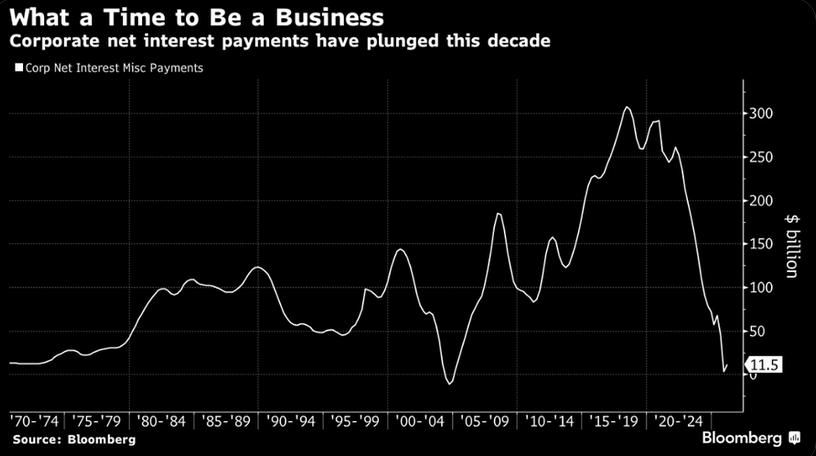
That near-vertical drop is real, but it is not a story about businesses. The government publishes this total in two pieces, and the operating companies — the firms that actually make things — show no plunge at all. Their net interest bill is 204.4 billion dollars, inside a 194.6 to 206.3 billion band it has not left for eleven straight quarters. Since the end of 2023 the headline fell 151.9 billion while theirs rose 5.4. In the quarter that finally took the headline below zero, theirs moved by sixty million dollars. The fall belongs to lenders. Banks take in more interest than they pay out, so they enter this total as a minus and drag it down, and that net take has swollen from 62.4 billion in late 2023 to 219.7 billion. The other side of the ledger is flat for its own reason: coupons locked in during 2020-21 reprice only as old bonds mature, while their cash now earns 4 to 5 percent. The chart is already a quarter stale — Wednesday’s release put the total at -15.4 billion, weakest of 318 quarters since 1947. Cuts break the truce. Cash reprices the day the Fed moves; a ten-year issued in 2021 does not. Watch the line Bloomberg left off the chart. It is the one that pays.
What it means: the exposure here is bank earnings, not company borrowing costs. That 220 billion the lenders collect has kept climbing through the Fed’s cuts, because old loans are still repricing upward. Companies with big cash piles and cheap old debt would see their interest line get worse, not better. The signal is their bill breaking out of the range it has held since 2023.
Market Intelligence Brief (MIB) Ver. 19.37
For professional investors only. Not investment advice.
© 2026 RecessionALERT.com

Comments are closed.