
MIB WEEKLY DIGEST
Week of Jun 29–Jul 2, 2026
The S&P 500 gained 1.76% this holiday-shortened week as the Dow notched three fresh records, but a violent AI-infrastructure whipsaw defined the tape: Monday’s snapback reversed into a two-day global semiconductor rout after Meta’s AI-cloud pivot (META +8.85% then -4.90%) triggered a KOSPI circuit breaker. The bigger story was labor: June nonfarm payrolls badly missed at 57K vs. 115K consensus, the third soft print of the week, forcing markets to price out a near-term Fed hike even as Hammack and Warsh talked tough on inflation days earlier. The Supreme Court preserved Fed independence while overturning a 91-year agency-removal precedent, and the US let USMCA drift into annual renegotiation.
TABLE OF CONTENTS
A. WEEK AT A GLANCE
B. WEEK IN MARKETS
C. WEEK’S TOP STORIES (8)
D. WEEK IN THE ECONOMY (5)
E. WEEK IN EARNINGS (0)
F. NEXT WEEK SETUP
G. CHART OF THE WEEK
A. WEEK AT A GLANCE -> TOP
The S&P 500 gained 1.76% on a volatile four-session week (markets closed Friday for Independence Day), with the Dow notching three fresh records while the Nasdaq whipsawed on an AI-infrastructure selloff. The dominant driver was a rapid deterioration in labor data — JOLTS’ strength gave way to an ADP miss, a GDPNow collapse, and a badly-missed June payrolls report — that collided with hawkish Fed rhetoric from Hammack and Warsh just 48 hours earlier. Markets closed the week pricing out near-term Fed-hike risk even as the Supreme Court reshaped federal-agency independence and the US let the USMCA drift into a decade of annual renegotiation.
• Dow set a fresh record close Thursday (+594.83, +1.14%) as a badly-missed jobs report drove rotation into Financials and Communication Services.
• PLTR led weekly gainers at +20.54% while SNDK led decliners at -25.27%, as the semiconductor/memory complex cratered even while software and cybersecurity names rallied.
• Meta whipsawed hardest of any mega-cap — +8.85% Wednesday on AI-cloud reports, then -4.90% Thursday when Zuckerberg admitted AI-agent progress “hasn’t accelerated as expected.”
• Brent crude slid to a 4-month low ($70.66) as Iran ceasefire talks dragged through the week without a breakthrough.
• June nonfarm payrolls badly missed at 57K vs. 115K consensus — the week’s most consequential data point and the third soft labor print in four sessions.
• The Supreme Court preserved Fed independence (5-4) while overturning the 91-year Humphrey’s Executor precedent (6-3), reshaping removal power over federal agencies.
1. The AI-capex debate turned genuinely two-sided — a Monday-Tuesday snapback in AI-infrastructure names reversed into a global semiconductor rout after Meta’s cloud pivot, with Nvidia’s relative resilience the cleanest signal markets are now differentiating GPU demand from memory/equipment demand.
2. Institutional risk repriced across three fronts at once — the Supreme Court reshaped federal-agency removal power, the US let USMCA drift into annual renegotiation, and Congress opened a national-security probe into five pharma giants, each introducing multi-year policy uncertainty for a different sector.
3. The labor market’s cooling arrived on schedule, and Fed rhetoric hadn’t caught up — last week’s 75K payroll forecast landed almost exactly on Thursday’s 57K NFP print, capping a run of soft data that directly contradicted Hammack’s and Warsh’s hawkish mid-week posture.
 — Leading economic indicators. Accurate market forecasts. Apply for membership at join.recessionalert.com
B. WEEK IN MARKETS -> TOP
The S&P 500 gained 1.76% on the week, but that headline masks a violent AI-infrastructure whipsaw: Monday-Tuesday’s snapback (Corning, KLAC, AMAT all +10%+ into a Q2-record close) reversed into a two-day semiconductor rout after Wednesday’s Meta AI-cloud news raised hyperscaler self-sufficiency fears, triggering a KOSPI circuit breaker and a 7% SOX opening drop. The real story, though, is labor: Pantheon’s 75K payroll warning last Friday was validated almost exactly by Thursday’s 57K NFP miss — the third consecutive soft print (ADP, GDPNow, NFP) that forced markets to price out a near-term Fed hike even as Fed officials talked tough all week. The Dow’s run to consecutive records — Alphabet’s Monday inclusion, Thursday’s Financials/Communication-Services rotation — sat oddly alongside that weakening labor backdrop and a slow-motion Iran ceasefire that pushed oil to a 4-month low.
FRIDAY CLOSE & WEEK-ON-WEEK CHANGE — Thu, Jul 2, 2026:
MAJOR INDICES
Dow Theory fired bullish confirmation Wednesday into Thursday — DJIA and DJ Transportation posted fresh weekly highs in the same two sessions, the industrials’ Alphabet-driven push above 52,000 finally validated by transports rather than diverging from them. That mechanical confirmation sat awkwardly beside the Nasdaq 100’s whipsaw: AI-infrastructure names led Monday-Tuesday’s advance before a two-day semiconductor rout gave most of it back by Thursday, leaving the blue-chip and tech benchmarks telling opposite stories about the week’s AI-capex debate.
| Index | Fri Close | WoW Change | WoW % | Why It Moved (Week) |
|---|---|---|---|---|
| S&P 500 | 7,482.70 | +129.55 | +1.76% | Broad advance through Tuesday’s quarter-close record (best Q2 since 2020, +14.9%) held despite a two-day semiconductor rout Wed-Thu and Thursday’s weak NFP; Dow-led rotation into Financials/Healthcare offset the Nasdaq’s AI-hardware drag. |
| Dow Jones | 52,900.07 | +1,034.55 | +2.00% | Record after record — Alphabet’s Monday inclusion (replacing Verizon) pushed it past 52,000 for the first time, and Thursday’s weak jobs report drove further rotation into Financials and Communication Services to a fresh 52,900 close. |
| DJ Transportation | 22,015.10 | +192.70 | +0.88% | Tracked the blue-chip advance with less volatility than tech; Thursday’s crude slide to a 4-month low supported freight-cost expectations even as growth data softened. |
| Nasdaq 100 | 29,321.29 | +203.05 | +0.70% | Whipsawed — AI-infrastructure names snapped back Monday-Tuesday on the Q2-close rally, then a two-day semiconductor rout (Meta’s AI-cloud pivot, a KOSPI circuit breaker) erased most of the early-week gains by Thursday. |
| Russell 2000 | 2,994.93 | -7.64 | -0.25% | Small-caps missed the blue-chip rotation into record highs; underperformed on both the AI-momentum snapback and the late-week flight into Financials/Communication-Services mega-caps. |
| NYSE Composite | 23,957.08 | +267.85 | +1.13% | Broad-based strength — advances outnumbered declines every session except Wednesday’s tech-led pullback, confirming the rally extended well beyond mega-caps by week’s end. |
VOLATILITY & TREASURIES
VIX fell 12% on the week — Monday’s Fed-independence ruling and Iran de-escalation calmed nerves early, and the drop held even through Wednesday-Thursday’s semiconductor rout, confirming that selloff was narrow, not systemic. Yields told a different story: Hammack’s AI-inflation warning and Warsh’s hawkish Sintra debut pushed the 10Y toward 4.48% by midweek, and Thursday’s badly-missed NFP only pared the move at the front end — the 2Y fell over 5bps while the 10Y closed net higher, a policy-vs-data tension the bond market hasn’t resolved.
| Instrument | Fri Level | WoW Change | Why It Moved (Week) |
|---|---|---|---|
| VIX | 16.14 | -2.24 (-12.19%) | Fell steadily as Iran de-escalation and the Supreme Court’s Fed-independence ruling calmed early-week nerves; Thursday’s weak NFP removed near-term hike risk without reviving fear. |
| 10-Year Treasury Yield | 4.469% | +9.6 bps | Net rise driven by mid-week hawkish Fed messaging (Hammack, Warsh) pushing yields to 4.48%+; Thursday’s weak NFP only partially reversed the move. |
| 2-Year Treasury Yield | 4.137% | +4.3 bps | Rose through Wednesday on JOLTS strength and hawkish Fedspeak, then fell over 5bps Thursday as the NFP miss forced markets to price out a near-term hike. |
| US Dollar Index (DXY) | 100.86 | -0.46 (-0.45%) | Drifted lower as the week’s hawkish Fed rhetoric failed to translate into dollar strength, then fell further Thursday on the weak jobs data. |
COMMODITIES
Silver’s 5.0% weekly gain outpaced gold’s 1.2% by a wide margin — an industrial-demand overlay atop the same dollar-driven move that lifted the whole precious-metals complex Thursday. That the biggest single-day gains across gold, silver and platinum all landed Thursday, on the weak jobs print rather than the week’s Iran or Fed headlines, confirms the complex was trading rate expectations, not geopolitics, by week’s end. Bitcoin’s 3.2% gain tracked equities throughout — a risk-proxy week, not an independent crypto narrative.
| Asset | Fri Price | WoW Change | WoW % | Why It Moved (Week) |
|---|---|---|---|---|
| Gold | $4,135.65/oz | +$47.80 | +1.17% | Ground higher despite a hawkish Fed setup mid-week, then jumped over 1% Thursday as the weak NFP revived rate-cut hopes and pressured the dollar. |
| Silver | $61.440/oz | +$2.935 | +5.02% | Outpaced gold throughout, tracking the precious-metals complex higher into Thursday’s dollar-weakening jobs miss. |
| Copper | $6.1755/lb | +$0.0455 | +0.74% | Roughly flat most of the week — industrial demand read unmoved by the AI capex-cycle jitters rattling semiconductor equities. |
| Platinum | $1,631.80/oz | +$12.80 | +0.79% | Tracked the broader precious-metals bid, with no PGM-specific catalyst distinguishing it from gold and silver’s Thursday dollar-driven gains. |
| Bitcoin | $61,568.0 | +$1,901.0 | +3.19% | Tracked equities’ risk-on tone through the Q2-close rally and held gains into Thursday’s mild risk-on jobs-miss reaction — no independent crypto catalyst. |
ENERGY
WTI and Brent fell in near-lockstep all week as the Iran ceasefire’s formalization dragged — Tuesday’s indirect Doha talks, Wednesday’s Iranian no-show, and Thursday’s Qatar “positive progress” report each nudged crude lower without ever producing a real supply shock, pushing Brent to a 4-month low by Friday close. Henry Hub decoupled entirely, trading flat on domestic fundamentals, while Dutch TTF surged 8.4% — European gas markets priced the stalled diplomacy as a bigger regional risk than US benchmarks did all week.
| Asset | Fri Price | WoW Change | WoW % | Why It Moved (Week) |
|---|---|---|---|---|
| Crude Oil (WTI) | $68.44/bbl | -$1.52 | -2.17% | Slow-motion Iran ceasefire formalization drift — Doha talks stalling mid-week, Qatar’s Thursday “positive progress” report pushed crude to a fresh multi-month low. |
| Crude Oil (Brent) | $71.58/bbl | -$1.74 | -2.37% | Moved in near-lockstep with WTI on the same de-escalation drift, confirming a global rather than regional pricing dynamic through the week. |
| Natural Gas (Henry Hub) | $3.208/MMBtu | -$0.079 | -2.40% | Decoupled from the Iran-driven oil narrative all week, trading on domestic summer-demand fundamentals with no clear directional catalyst. |
| Natural Gas (Dutch TTF) | $14.75/MMBtu | +$1.14 | +8.38% | Diverged sharply from Henry Hub and even from crude’s decline — European gas markets priced the stalled Doha diplomacy as a bigger regional risk than US benchmarks did. |
S&P 500 SECTORS — WEEKLY ROTATION
Healthcare’s 5.3% weekly lead is regime leadership, not a one-week bounce — it’s also positive across every longer horizon (1M +13.2%, 3M +11.3%, YTD +7.3%), and none of the week’s top five gainers (PLTR, PANW, AAPL, IBM, MSFT) are Healthcare names, confirming the move was broad-based rather than single-stock driven. The real single-name story sits inside Technology’s modest -0.35% weekly print: four of the week’s five worst decliners (SNDK, MU, MRVL, LRCX) are semiconductor names that cratered 10-25%, a concentrated AI-capex unwind the sector average understates.
| Sector | 1-Week | 1-Month | 3-Month | 6-Month | YTD | 12-Month |
|---|---|---|---|---|---|---|
| Healthcare | +5.30% | +13.19% | +11.29% | +6.69% | +7.35% | +22.35% |
| Communication Services | +4.55% | -2.39% | +8.11% | +0.33% | +0.82% | +20.67% |
| Consumer Cyclical | +4.06% | -2.01% | +5.57% | -4.99% | -4.24% | +4.46% |
| Financial | +3.28% | +7.32% | +13.53% | +3.87% | +4.64% | +13.20% |
| Consumer Defensive | +0.82% | +3.67% | +2.24% | +7.57% | +8.13% | +4.96% |
| Real Estate | +0.69% | +3.94% | +10.11% | +9.53% | +10.66% | +8.79% |
| Basic Materials | +0.66% | -7.07% | -2.96% | +9.42% | +10.53% | +34.32% |
| Industrials | -0.06% | +3.43% | +11.47% | +18.12% | +19.26% | +26.73% |
| Technology | -0.35% | -9.02% | +26.43% | +17.75% | +18.63% | +34.60% |
| Utilities | -0.45% | +2.76% | -1.30% | +6.21% | +6.87% | +13.40% |
| Energy | -1.09% | -8.68% | -10.09% | +18.16% | +18.72% | +24.90% |
TOP WEEKLY MOVERS:
All five gainers are nominally Technology names, yet the sector printed a flat -0.35% on the week — software/cybersecurity strength (PANW, IBM, MSFT) was masked by the semiconductor sub-industry collapse that also produced four of the five decliners. PLTR and MSFT’s gains are counter-trend bounces off deeply negative YTD bases (-2.1% and -19.3% respectively), while PANW and AAPL show genuine multi-horizon momentum. Every decliner remains up triple-to-quadruple digits over 3-5 years (MU +1,446% Year, SNDK +3,676% Year) — this week’s rout is a valuation reset within an intact uptrend, and SNDK fell despite Bernstein and BofA lifting targets to $3,000 and $2,500.
TOP 5 WEEKLY GAINERS
| Ticker | Week | YTD | Year | Why It Moved |
|---|---|---|---|---|
| PLTR | +20.54% | -2.13% | +743.44% | NVIDIA and Surf Air Mobility AI-deal announcements (Jun 28-29) sparked the initial move; CEO Karp’s comments criticizing AI-model pricing drove a 9%+ single-day surge Wednesday, and Michael Burry trimming his short position added a positioning tailwind into a stock still down ~29% YTD. |
| PANW | +18.76% | +76.71% | +172.44% | Surged to a fresh all-time high on a broad risk-on rotation into high-beta cybersecurity software, amplified by a major investment bank’s report projecting outsized growth in global security spending; BTIG and Wells Fargo both raised price targets, though a lawsuit alleging AI-generated “hallucinated” threat findings introduced a reputational-risk overhang. |
| AAPL | +12.17% | +13.53% | +45.28% | Rebounded from the prior week’s price-hike-driven selloff on renewed optimism around Apple’s AI roadmap and a friendlier macro backdrop for large-cap tech; the move accelerated Thursday as investors treated Apple as relatively insulated from the memory-chip cost shock hitting semiconductor names. |
| IBM | +12.10% | +0.65% | +116.37% | No single company-specific catalyst — the move tracked the broader enterprise-software rotation away from AI-hardware names, with a Buy-consensus rating from 16 analysts (average target $300) and new creative/media-agency partnership announcements providing incremental support. |
| MSFT | +10.67% | -19.26% | +14.67% | Haleon’s new five-year AI/cloud partnership announcement lifted shares Wednesday; broader survey data showing resilient cloud-spending intentions reinforced the move, even as reports of a fresh round of AI-cost-cutting layoffs next week introduced a note of caution. |
TOP 5 WEEKLY DECLINERS
| Ticker | Week | YTD | Year | Why It Moved |
|---|---|---|---|---|
| SNDK | -25.27% | +635.11% | +3676.24% | Fell despite Bernstein lifting its price target to $3,000 (from $1,700) and Bank of America raising its target to $2,500 — investor anxiety over a looming NAND supply glut from Samsung and SK Hynix capacity expansions, and fears hyperscaler AI capex may have peaked, overwhelmed the bullish analyst calls. |
| MU | -19.61% | +701.44% | +1445.81% | Part of the broader “Parabolic 7” memory-chip unwind on AI-capex-peak fears and rising DRAM/NAND competition; Cantor Fitzgerald raised its price target to $2,000 and Bank of America highlighted a new Micron-Anthropic supply partnership, but neither offset the sector-wide profit-taking after a strong H1 rally. |
| MRVL | -12.79% | +188.64% | +230.36% | Started the week higher on Nvidia CEO Jensen Huang’s comment that Marvell “could become the next trillion-dollar chip stock” and UBS/Cantor price-target hikes, but reversed hard into Thursday on a Hold downgrade citing gross-margin softness and a peaking custom-AI-silicon pricing cycle, compounded by the outgoing CFO’s $60 million share-sale filing. |
| LRCX | -12.55% | +105.59% | +446.64% | Rallied early on Cantor and Susquehanna price-target increases before reversing on insider-selling filings from the CEO and two other executives, the weak ADP jobs report, and valuation concerns after a 150%+ H1 rally left the stock above 70x trailing earnings. |
| AMAT | -9.72% | +134.66% | +217.31% | Hit an all-time high mid-week on Cantor, Susquehanna, and KeyBanc price-target increases and a new advanced-chipmaking product launch, then fell nearly 10% in the broader semiconductor equipment selloff as AI-capex-cycle concerns and CEO insider selling offset the earlier bullish catalysts. |
— Institutional-grade intelligence for serious investors. Apply for membership at join.recessionalert.comC. WEEK’S TOP STORIES -> TOP
Four threads ran through the week. The dominant one is the AI-capex debate (#1): a Monday-Tuesday infrastructure snapback reversed into a two-day semiconductor rout after Meta’s cloud pivot raised hyperscaler self-sufficiency fears. A parallel thread traces institutional risk repricing — the Supreme Court’s Fed-independence ruling (#4), the USMCA non-extension (#5), and the pharma clinical-trial investigation (#8) all reshaped policy certainty for specific sectors. A third thread is market resilience: the Dow’s record-setting run (#2) and Comcast’s split (#7) show non-tech leadership absorbing the AI whipsaw. Iran’s slow ceasefire drift (#3) quietly pressured oil throughout.
UNCERTAIN
1. AI Infrastructure Whipsaw: Monday’s Snapback Rally Reverses Into a Two-Day Global Semiconductor Rout After Meta’s Cloud Pivot
The core facts:Monday-Tuesday, AI-infrastructure names staged a sharp snapback from the prior week’s OpenAI-IPO-delay selloff — Corning +14% (Monday, on a Russell growth-index reclassification), KLA +12%, Applied Materials +11%, extending into Tuesday’s quarter-close rally (AMD +7.68%, KLAC +8.38%, SanDisk +10.89%) as the S&P 500 closed its best quarter since 2020. The rally reversed abruptly Wednesday when Bloomberg reported Meta Platforms is building a standalone AI cloud business to sell excess compute externally (META +8.85%) — read as evidence hyperscalers may need less third-party chip and equipment capacity than assumed, triggering a 20-minute KOSPI circuit breaker (SK Hynix, Samsung both -12%+), a ~7% opening drop in the Philadelphia Semiconductor Index, and two-day US declines of 10-25% in KLA, Micron, Lam Research, Applied Materials, and SanDisk. Thursday compounded the reversal when Meta itself fell 4.90% after CEO Zuckerberg told staff AI agent development “hasn’t accelerated as expected.”
Why it matters:The week’s price action is the market’s real-time referendum on the AI-capex supercycle, and it delivered a split verdict. SK Hynix’s disclosed decision to slow its HBM4 ramp in favor of higher-margin conventional DRAM is a supply-side admission that memory demand may not be unconditional; Meta’s cloud pivot is a demand-side signal that the largest compute buyers may increasingly serve themselves. Nvidia’s relative resilience through the rout suggests markets are differentiating GPU/training demand — still viewed as intact — from memory and equipment demand, now genuinely in question. (The Nasdaq 100 still finished the week +0.70% — see Major Indices table in Section B — masking a chip sub-sector that fell double digits net; see weekly decliners table, where four of the top five decliners are chip-equipment or memory names.)
What to watch:Whether SK Hynix’s conventional-DRAM pricing strategy triggers a formal HBM4 demand reassessment from peers; hyperscaler capex commentary at Q2 earnings calls in late July, especially Meta’s cloud-business ROI framing; Nvidia’s relative outperformance as the ongoing GPU-vs-memory demand differentiator.
BULLISH
2. Dow Sets Records All Week — Alphabet’s Debut Crosses 52,000 Monday, Financials/Communication-Services Rotation Extends the Run to 52,900 by Thursday
The core facts:The Dow Jones Industrial Average set a new all-time high in three of the week’s four sessions. Monday, Alphabet’s debut on the index — replacing Verizon — pushed the Dow above 52,000 for the first time (52,182.74), a move amplified mechanically by the price-weighted index’s inclusion of a high-priced stock but confirmed by broad participation (26 of 30 components advanced). Tuesday extended the record to 52,319.20 as the S&P 500 closed its best quarter since 2020 (+14.9%). Wednesday’s semiconductor rout barely dented the blue-chip average (-0.02%). Thursday, a badly-missed June payrolls report (57,000 vs. 115,000 consensus) triggered rotation into Financials (+2.2%) and Communication Services (+2.4%) — highlighted by Wells Fargo’s 3.99% gain after Goldman added it to its Conviction List and all 32 banks cleared the Fed’s 2026 stress test — driving the Dow to a fresh record 52,900.07 (+594.83, +1.14%) even as the Nasdaq fell on continued chip-sector weakness.
Why it matters:The week is a clean demonstration of index bifurcation: while the Nasdaq 100 whipsawed on the AI-infrastructure debate, the Dow’s non-tech composition (banks, healthcare, industrials) let it compound gains through both bullish catalysts (Alphabet’s inclusion, the Q2-close rally) and a bearish one (the weak jobs report, read as reducing near-term Fed-hike risk). Stress-test clearance for all 32 large banks removes a systemic overhang heading into Q2 earnings season and confirms the sector entered Q3 well-capitalized despite an elevated-rate environment — consistent with Financials’ second-best weekly sector performance (+3.28% — see sector rotation table in Section B).
What to watch:Whether Financials/Communication-Services leadership persists into next week’s post-holiday session; Wells Fargo’s OCC asset-cap removal timeline as the next bank-specific re-rating catalyst; Q2 bank earnings starting around July 11 for net-interest-income trajectory in the higher-for-longer rate environment.
UNCERTAIN
3. Iran Ceasefire Formalization Drags All Week — Doha Talks Stall, Then “Positive Progress” Sends Oil to a 4-Month Low
The core facts:The week traced a slow, uneven path toward normalizing last week’s US-Iran ceasefire. Monday, both sides agreed to “stand down for now” after a weekend Hormuz skirmish, with peace talks scheduled Tuesday in Doha; Iran indicated its technical experts would not negotiate directly. Tuesday’s talks proceeded through Qatari and Pakistani intermediaries without direct US-Iran contact, even as the API reported an outsized 6.072 million barrel crude draw. Wednesday, Iran declined a scheduled follow-up meeting in Qatar entirely, and WTI fell to $68.77 — its lowest level since late February — despite the EIA confirming a bullish 3.8 million barrel inventory draw. Thursday, Qatar’s Foreign Ministry reported “positive progress” in renewed talks (with the next meeting not expected until after July 9 funeral processions for Iran’s late Supreme Leader), and crude extended its slide to a fresh 4-month low (Brent $70.66, WTI $67.54).
Why it matters:Oil fell on every session of the week despite two separate weekly bullish inventory draws failing to support prices — a signal that the structural oversupply thesis (JPMorgan and Citi both project a roughly 4 million barrel/day 2026 surplus as Iranian crude and expanded US production return to market) is now dominating over both geopolitical risk premium and near-term supply data. For portfolio managers the pattern cuts two ways: falling energy costs are modestly disinflationary just as the Fed debates its next move, but the Energy sector’s structural repricing (worst 3-month performer at -10.09% even as it remains the YTD leader — see sector rotation table in Section B) continues even as Iran-specific risk premium has already been squeezed out.
What to watch:The post-July 9 resumption of US-Iran talks, once Iran’s mourning period concludes; WTI’s test of its ~$67 February 2026 low as technical support; OPEC+ compliance with its incremental July production increase as the next supply-side catalyst.
UNCERTAIN
4. Supreme Court Preserves Fed Independence, Overturns 91-Year Humphrey’s Executor Precedent — Then a Senator Reopens the Governance Question
The core facts:Monday, the Supreme Court delivered two landmark rulings. In a 6-3 decision, the Court upheld Trump’s removal of FTC Commissioner Rebecca Kelly Slaughter without cause, overturning the 91-year-old Humphrey’s Executor precedent that had protected the leadership of more than two dozen independent federal agencies (FTC, NLRB, FERC, NRC, CFPB, and others). Separately, in a 5-4 ruling, the Court rejected the administration’s bid to remove Federal Reserve Governor Lisa Cook, preserving her position while the underlying litigation continues — Chief Justice Roberts and Justice Kavanaugh joined the Court’s three liberal justices in that majority. Stocks rallied broadly (S&P 500 +1.2%, Nasdaq +2.1%). Two days later, Senator Elizabeth Warren formally requested a Fed Inspector General investigation into Vice Chair for Supervision Michelle Bowman over her attendance at a private Bank of America dinner during the Fed’s post-FOMC blackout period.
Why it matters:The two Monday rulings sent a bifurcated signal — broader executive removal power over independent agencies is bullish for deal-making and reduced regulatory friction, while the Fed carve-out preserving Cook’s position was the specific catalyst markets needed, removing fears FOMC composition could be summarily altered mid-cycle. Warren’s Bowman letter, while unlikely to produce disciplinary action on its own, reopens the same Fed-credibility question at a sensitive moment: Bowman is the Fed’s top bank supervisor, and the timing — during a blackout period, with a bank the Fed regulates — adds a conflict-of-interest dimension just as Chair Warsh navigates a hawkish policy pivot without the Fed’s traditional forward-guidance tools.
What to watch:Lower-court resolution of the Lisa Cook case — a reversal there would reopen FOMC-composition risk; the Fed Inspector General’s response to Warren’s letter; the FTC’s post-ruling M&A posture as the first practical test of reduced antitrust enforcement.
BEARISH
5. US Refuses Clean USMCA Extension at Mandated Review — Annual Renegotiation Track Now Runs Through 2036
The core facts:At the USMCA’s mandated July 1 joint review, the US signaled it will not grant a clean extension of the trade agreement governing roughly $1.5 trillion in annual US-Canada-Mexico trade. US Trade Representative Jamieson Greer confirmed he was not prepared to recommend renewal as structured, and President Trump stated he is “not looking to renew” the deal. Under USMCA’s sunset clause, any one party’s refusal triggers a decade-long annual review track beginning in 2027 rather than immediate termination — the agreement remains in force but enters a rolling renegotiation cycle extending to 2036. The administration’s stated preference is to use annual-review leverage to extract concessions on trade, migration, drug trafficking, and continental defense.
Why it matters:The shift from a stable 16-year extension framework to annual reviews introduces a new category of political risk for North American supply chains — auto-content disputes, Canadian dairy protections, and Mexican energy nationalism can now all be weaponized at each year’s review. For US-listed companies with integrated North American manufacturing (autos, agriculture, semiconductor inputs, energy), the inability to plan capital allocation against a stable multi-year trade framework raises the effective cost of capital; automakers with just-in-time US-Mexico supply chains are the most immediately exposed. The Canadian dollar and Mexican peso are the cleanest real-time gauges of how markets are pricing the drawn-out renegotiation risk.
What to watch:Canada and Mexico’s formal response — whether they negotiate as a trilateral bloc or pursue separate bilateral tracks; CAD and MXN as sentiment gauges; any Trump executive action using the review process as leverage for non-trade concessions.
BEARISH
6. Tesla Falls 7.49% — Worst Day in Nearly a Year — Despite a Blowout Q2 Delivery Beat of 480,126 Vehicles
The core facts:Tesla delivered 480,126 vehicles in Q2 2026, up 25% year-over-year and roughly 74,000 units above Wall Street’s ~406,600 consensus; energy storage deployments of 13.5 GWh also topped the 13.3 GWh estimate. Despite the decisive beat, TSLA fell approximately 7.49% Thursday — its worst single session in nearly a year — in a “sell the news” reaction following a 13%+ run into the report. Tesla reports full Q2 financial results after the close on July 22.
Why it matters:The negative reaction to a clear delivery beat signals investors have shifted focus from unit volumes to margins — Tesla’s roughly 421x trailing P/E had already priced in a strong number and more, leaving no room for anything short of a blowout-on-blowout surprise. The broader session’s risk-off tone in high-multiple growth names (the ongoing semiconductor rout, the weak jobs data) compounded the move. The real test now shifts to July 22, where gross-margin trends and US demand commentary — following expiration of the federal EV tax credit — will determine whether this quarter’s delivery strength translates into support for the stock’s valuation.
What to watch:Tesla’s July 22 Q2 earnings report for gross-margin trajectory and post-tax-credit US demand commentary; whether the “beat-but-sell” reaction pattern repeats or reverses ahead of that print.
BULLISH
7. Comcast to Split Into Two Public Companies — Broadband Retained, NBCUniversal and Sky Spun Off Tax-Free
The core facts:Comcast announced Monday it will separate into two independent, publicly traded companies via a tax-free spinoff expected to complete within approximately one year. The retained entity keeps Comcast’s core broadband and cable-infrastructure business; the spun-off entity houses NBCUniversal (broadcast, film, streaming) and Sky (European pay-TV and broadband). CMCSA rose 4.5% on the announcement.
Why it matters:The move is a direct acknowledgment that combining distribution (broadband) with content (NBCUniversal/Sky) has not generated the valuation premium the conglomerate structure was meant to unlock — the market’s immediate positive reaction confirms investors agree with the separation thesis. A standalone broadband entity gains capital-allocation focus on high-margin connectivity and fiber rollout without content-driven earnings volatility; a standalone media entity can pursue bolder streaming strategy without conglomerate-board friction. The announcement extends a broader legacy-media disaggregation trend — Disney has debated separating ESPN, Warner Bros. Discovery has restructured repeatedly, Paramount was absorbed by Skydance — and pressures Charter Communications and other hybrid cable/media operators to clarify their own structural positioning.
What to watch:The formal spinoff filing (Form 10 registration) and completion timeline; the NBCUniversal/Sky entity’s initial capital structure and whether it pursues near-term M&A; Charter’s strategic response to Comcast’s broadband pure-play positioning.
BEARISH
8. House China Committee Opens National-Security Investigation Into Five Pharma Giants Over Clinical Trials at Chinese Military Hospitals
The core facts:The House Select Committee on the Chinese Communist Party, chaired by Rep. John Moolenaar (R-MI), launched investigations Tuesday into Merck, AbbVie, Pfizer, Eli Lilly, and Bristol Myers Squibb over clinical trials conducted at Chinese military-affiliated (PLA) hospitals and in Xinjiang. The committee alleges Merck sponsored or collaborated on 224 clinical studies in China since 2005, including 40 at PLA-affiliated centers and at least 31 in Xinjiang; AbbVie conducted more than 100 China studies, including 16 at military centers and 17 in Xinjiang. The five companies have until July 17 to disclose due-diligence processes, data-protection measures, and site standards. The committee’s letters state there is “no evidence of illegal activity” but that PLA-hospital trials “expose American companies to ethical and security risks.”
Why it matters:The investigation targets five companies that together represent a significant share of the S&P 500 Healthcare sector — the week’s best-performing sector (+5.30% — see sector rotation table in Section B) — introducing a regulatory overhang precisely where investor positioning has concentrated. The probe compounds an already fraught backdrop for pharma: the July 31 implementation of 100% tariffs on branded pharmaceutical imports means the sector is simultaneously absorbing tariff risk and a national-security compliance inquiry reaching into clinical-trial data integrity, with potential FDA review implications if concerns escalate. The July 17 disclosure deadline is the first forcing function.
What to watch:The July 17 congressional disclosure deadline and whether any company’s response triggers follow-on FDA or regulatory action; whether additional pharma names are added to the investigation; the sector’s reaction if trial-data-integrity concerns escalate into formal review.
— Separating signal from noise since 2007. Apply for membership at join.recessionalert.comD. WEEK IN THE ECONOMY -> TOP
The week’s defining tension is policy-vs-data divergence: Fed voices spent Tuesday and Wednesday talking tougher than the incoming data justified. Hammack framed AI capex as a structural inflation force and Warsh declared “prices too high” with no forward guidance, even as JOLTS’ fifth straight beat gave way to a GDPNow collapse from 2.5% to 1.2% and a Consumer Confidence miss with “jobs hard to get” at a five-year high. Thursday resolved the tension in data’s favor — June NFP badly missed at 57,000 (vs. 115,000 consensus), the 2-year Treasury yield fell over 5bps (see Vol & Treasuries table in Section B), and markets rapidly priced out a near-term hike, leaving Warsh’s hawkish posture from two days earlier looking increasingly out of step. Wednesday’s FOMC Minutes will show whether that gap was rhetoric or genuine internal Fed division.
POLYMARKET ODDS — WEEK-ON-WEEK SHIFT:
| Market | Last Friday | This Friday | Δ |
|---|---|---|---|
| US Recession by end-2026 | N/A | N/A | N/A |
| Fed rate hike in 2026 | 52% | ~55% (Tue) | +3 pp |
| Fed rate cuts ≥1 in 2026 | N/A | N/A | N/A |
No dailies this week printed an explicit Polymarket reading for the full-year recession or ≥1-cut markets; the hike-odds figure is the most recent explicit print (Tuesday) since no later numeric reading appeared before Thursday’s NFP-driven repricing described above.
UNCERTAIN
1. June Nonfarm Payrolls Badly Miss at 57K vs. 115K Consensus (BLS, Thu, Jul 2)
What they’re saying:Nonfarm payrolls rose 57,000 in June, roughly half the 115,000 Dow Jones consensus and down sharply from May’s downwardly-revised 129,000; April-May were revised down a combined net 74,000. The unemployment rate fell to 4.2% from 4.3%, but only because labor-force participation dropped to 61.5% — its lowest since March 2021. Average hourly earnings rose 0.3% MoM / 3.5% YoY, in line with estimates.
The context:This was the third consecutive soft labor print of the week, following Wednesday’s ADP miss (98K) and the Atlanta Fed’s GDPNow collapse to 1.2%. The falling participation rate masks genuine softness behind an artificially lower unemployment rate. The 2-year Treasury yield fell over 5bps immediately (see Vol & Treasuries table in Section B) as traders priced out a near-term hike, while the Dow rallied to a fresh record on the “bad news is good news” read — even as gold’s 1.3% jump signaled bond and commodity markets read the print as a genuine growth warning, not just a dovish Fed input.
What to watch:July’s employment report (early August) for confirmation this is a genuine slowdown rather than a one-off print; the July 28-29 FOMC meeting for whether Chair Warsh’s hawkish Sintra language survives a visibly cooling labor market.
BEARISH
2. Warsh Makes Global Debut at ECB Sintra — “Prices Too High,” No Forward Guidance (Federal Reserve, Wed, Jul 1)
What they’re saying:Fed Chair Kevin Warsh, on his first major international appearance at the ECB Forum in Sintra, stated “prices are too high” while declining any signal on the July FOMC meeting, framing the omission as part of a broader shift toward real-time, data-dependent policy that will phase out forward guidance entirely over 9-12 months. He announced five external task forces to reform Fed operations.
The context:The 10-year Treasury yield rose 6bps the same session, and bonds and stocks declined in tandem — a “no safe haven” pattern confirming markets read the no-guidance stance as removing the traditional Fed backstop for equities. Eliminating forward guidance means every data print becomes a binary market event rather than an incremental update, structurally raising volatility in rates and rate-sensitive sectors. The stance aged poorly within 24 hours: Thursday’s NFP miss forced the same market that had priced a ~54% July hike probability Wednesday to abandon that scenario almost entirely.
What to watch:The July 16-17 FOMC meeting for whether the hawkish Sintra tone survives; Wednesday July 8’s FOMC Minutes for any internal dissent from Warsh’s posture.
BEARISH
3. JOLTS Beats for a Fifth Straight Month at 7.594M as Hammack Warns AI Capex May Force a Hike (BLS / Cleveland Fed, Tue, Jun 30)
What they’re saying:May JOLTS job openings came in at 7.594 million versus 7.30 million consensus — the fifth consecutive beat and the highest reading in over two years; job quits rose to 3.065 million from 2.977 million prior. The same day, Cleveland Fed President Beth Hammack said “insatiable” AI-infrastructure demand is a structural inflation source and that rate hikes “may be necessary,” explicitly declining to take a July move off the table.
The context:The two releases reinforced each other into the week’s most hawkish single session — Polymarket’s Fed-hike-in-2026 probability ticked up to roughly 55% from 53% the prior session (see Polymarket table above). Hammack’s framing is analytically distinct from the tariff-passthrough inflation narrative that has dominated 2026: AI infrastructure capex as a demand-pull force is structural, not resolvable through supply-chain normalization, and directly contradicts Chair Warsh’s baseline view that AI productivity gains will prove disinflationary — an intra-FOMC disagreement now visible in real time.
What to watch:Whether other FOMC voters echo Hammack’s AI-inflation framing; July’s JOLTS print for whether labor demand strength persists after Thursday’s weak NFP.
BEARISH
4. Atlanta Fed GDPNow Collapses to 1.2% From 2.5% in a Single Session (Federal Reserve Bank of Atlanta, Wed, Jul 1)
What they’re saying:The Atlanta Fed’s GDPNow model cut its Q2 2026 real GDP growth estimate to 1.2% from 2.5% on June 25 — a 1.3-percentage-point single-session revision, the largest of 2026. The private-investment nowcast fell from 8.5% to 6.5%, and the net-exports contribution dropped from -0.59 to -1.62 percentage points, after absorbing Wednesday’s ADP miss (98K), ISM PMI miss (53.3 vs. 54.0 consensus), and a construction-spending shortfall.
The context:At 1.2%, GDPNow sits well below the roughly 2.0% Bloomberg consensus for Q2 and signals sharp deceleration from Q1’s pace. Buried in the same day’s ISM release was a partial offset: Prices Paid plunged 9.1 points to 73.0 — the steepest monthly drop since July 2022 — suggesting the tariff-driven input-cost pressure that has dominated manufacturing surveys since late 2025 may be cresting, directly in tension with both Hammack’s and Warsh’s “inflation too high” framing from the same 48 hours.
What to watch:The BEA’s advance Q2 GDP estimate (late July) for confirmation; August’s ISM Prices Paid reading for whether the disinflation signal in manufacturing input costs holds.
BEARISH
5. Consumer Confidence Misses at 91.2 — “Jobs Hard to Get” Hits Five-Year High (Conference Board, Tue, Jun 30)
What they’re saying:The Conference Board Consumer Confidence Index rose just 0.6 points to 91.2 in June, missing the 94.7 consensus by 3.5 points; May was revised down from 93.1 to 90.6. The share of consumers saying jobs are “hard to get” climbed to 22.5% — the highest reading since January 2021 — even as the same-day JOLTS report showed job openings at a two-year high.
The context:The divergence between strong employer-side demand (JOLTS) and weak worker-side perception (“jobs hard to get”) proved prescient: that gauge has historically led the unemployment rate higher by two to three months, and Thursday’s NFP miss and participation-rate drop arrived almost exactly on that lag. For consumer discretionary names, the miss argues for a more cautious Q3 spending trajectory as households increase precautionary savings.
What to watch:July Consumer Confidence (late July) for whether the “jobs hard to get” reading continues climbing; the next retail-sales print for confirmation of a spending slowdown.
— Know the probability before the market prices in the risk. Apply for membership at join.recessionalert.comE. WEEK IN EARNINGS -> TOP
TOP EARNINGS OF THE WEEK
No major earnings from companies with >$100B market cap reported this week. Tesla’s Q2 delivery numbers (480,126 vehicles, a decisive beat that still triggered a 7.49% Thursday selloff) are covered as a market event in Section C rather than here, since Tesla does not report full Q2 financial results until July 22 — this week’s release was operational deliveries only, not an earnings print.
WEEK AHEAD PREVIEW:
Markets are closed Friday, July 3 for Independence Day. Q1 2026 earnings season is effectively complete (89% reported); Q2 2026 season opens in earnest the week of July 6-10, with the next FactSet scorecard update due ~July 11.
PepsiCo (PEP) — BMO, Thursday July 9 — Consensus calls for $2.21 EPS on $23.96B revenue. Key focus: continued weakness at PepsiCo Foods North America and whether management signals the recovery timeline slipping further into H2, versus continued international strength (5.4% organic sales growth expected).
No other >$100B US-domiciled reporters are confirmed for Monday-Wednesday (July 6-8); Q2 2026 earnings season begins in earnest with PepsiCo’s report.
— US market commentary trusted by family offices and institutions. Apply for membership at join.recessionalert.comF. NEXT WEEK SETUP -> TOP
UPCOMING RELEASES:
| Date | Event | Why It Matters |
|---|---|---|
| Mon, Jul 06 | ISM Services PMI (prior 54.5) | First services-sector read since the manufacturing side showed Prices Paid cooling sharply; confirms or contradicts whether disinflation is spreading beyond goods. |
| Tue, Jul 07 | Balance of Trade (prior -$55.9B) | Follows last month’s tariff-front-running-driven goods-deficit blowout; a continued wide deficit would extend the net-export drag on Q2/Q3 GDP. |
| Tue, Jul 07 | Consumer Inflation Expectations (prior 3.5%) | A second read on consumer inflation psychology after Michigan’s 5-year expectations eased in June; tests whether that improvement is holding. |
| Wed, Jul 08 | FOMC Minutes | The week’s single most important release — will reveal whether Warsh’s hawkish Sintra tone and Hammack’s AI-inflation warning reflect genuine committee consensus or masked internal disagreement, directly resolving this week’s policy-vs-data tension (see Section D synthesis). |
| Wed, Jul 08 | Consumer Credit Change (prior $20.73B) | A read on household borrowing appetite following this week’s soft Consumer Confidence and “jobs hard to get” signals. |
WHAT TO WATCH NEXT WEEK:
1. Does Wednesday’s FOMC Minutes confirm Warsh and Hammack speak for the committee, or expose internal dissent given this week’s run of soft data (ADP, GDPNow, NFP)? The minutes are the first hard evidence since Thursday’s jobs miss.
2. Does the semiconductor rout stabilize, or does SK Hynix’s HBM4 ramp-slowdown trigger formal demand downgrades from peers before Q2 hyperscaler earnings arrive in late July?
3. Do the post-July 9 US-Iran talks (once Iran’s mourning period ends) produce a durable ceasefire framework, or does WTI’s slide toward its ~$67 February low continue unresolved?
4. Does Financials/Communication-Services leadership persist into the post-holiday session, or does Thursday’s rotation prove a one-day reaction to the jobs miss rather than a durable shift?
— US market commentary trusted by family offices and institutions. Apply for membership at join.recessionalert.comG. CHART OF THE WEEK -> TOP
WHY THIS CHARTThis chart won over the other three candidates because it frames the exact tension the week’s price action then acted out: Monday’s AI-infrastructure snapback, Wednesday’s Meta-triggered global chip rout, and Thursday’s continued selloff (Section C, story #1) are precisely the “reversal is the base case, not the tail” argument this chart makes about historical capex manias, made three days before the market delivered a live case study.
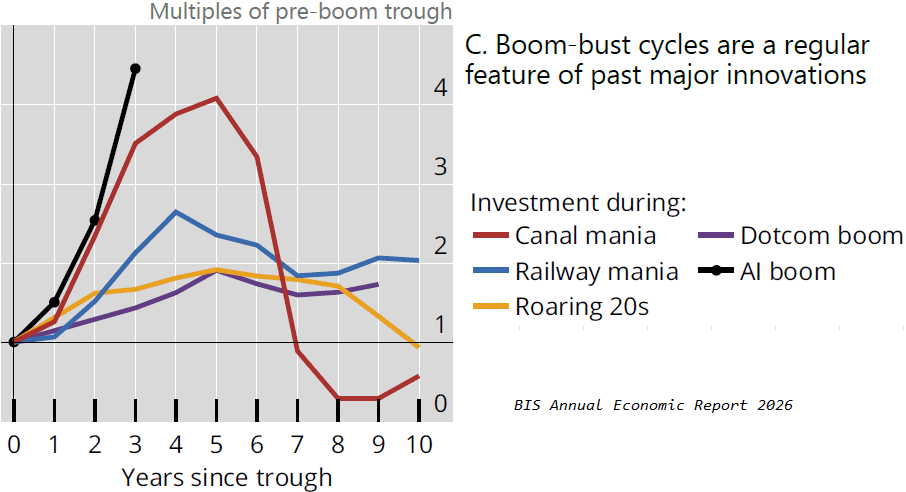
ORIGINAL CHART ANALYSIS — FROM MONDAY’S MIBBy year three, AI’s line has already cleared where Canal mania peaked in year five — the steepest curve of all five episodes, near 4.3x its trough and still climbing vertically, with railways, the Roaring Twenties, even the canals’ high behind it. That settles the “just another dotcom bubble” reflex: dotcom was the mildest episode here, cresting around 1.5x. But the reframing that matters isn’t the shape — it’s the letterhead. The Bank for International Settlements, the central banks’ bank, has formally entered AI capex into a two-century register of manias, each ending in reversal and recession, recategorizing it from an earnings story into a financial-stability one. And the reversal is the base case, not the tail: canals round-tripped to zero by year eight, the Roaring Twenties bled below their start, even railways and dotcom merely plateaued — none kept climbing. AI simply stops at year three, short of every inflection where the others rolled over. The mechanism decides which line it follows: over $1 trillion of hyperscaler capex is outrunning earnings and free cash flow, and whether returns arrive before that committed capital must be serviced sorts plateau from round-trip. First-order, markets reprice multiples and spreads; second-order, a capex bust drags GDP and jobs. AI’s worst chart is still blank.
MIB Weekly Digest Ver. 1.69
For professional investors only. Not investment advice.
© 2026 RecessionALERT.com

Comments are closed.