
MARKET INTELLIGENCE BRIEF (MIB)
Thursday, July 2, 2026
June payrolls badly missed at 57K vs. 115K est.; unemployment fell to 4.2% only as participation hit a five-year low. Dow rode Fed rate-cut hopes to a record (+1.14%) even as gold’s 1.3% jump read it as a growth warning. Semiconductors extended their rout (SanDisk -14%, KLA -11.5%) as Meta (-4.9%) admitted AI agents “hasn’t accelerated as expected.” Tesla fell 7.5% despite blowout deliveries; O’Reilly bid ~$10B for GPC’s NAPA; oil hit a 4-month low on US-Iran progress.
TABLE OF CONTENTS
A. EXECUTIVE SUMMARY
B. MARKET DATA
C. HIGH-IMPACT STORIES (6)
D. MODERATE-IMPACT STORIES (6)
E. ECONOMY WATCH (2)
F. EARNINGS WATCH (0)
G. WHAT’S NEXT
H. CHART OF THE DAY
A. EXECUTIVE SUMMARY -> TOP
Equities diverged sharply as June nonfarm payrolls badly missed at 57,000 versus 115,000 expected — the third consecutive weak labor print after Wednesday’s ADP miss and the Atlanta Fed’s cut of GDPNow to 1.2% — sending the Dow to a record close (+1.14%) on rotation into Financials and Communication Services while the Nasdaq sank 0.8-1.6% on an extending semiconductor selloff. The unemployment rate’s drop to 4.2% masked genuine deterioration: labor-force participation fell to 61.5%, its lowest since March 2021, a discouraged-worker dynamic rather than labor-market strength. Bond and commodity markets read the report as a growth warning rather than a Fed-relief rally — gold jumped 1.3% and the 2-year yield fell further even as equities cheered reduced hike odds — a “bad news is good news” split that leaves the underlying economic signal more troubling than the tape suggests. Breadth stayed narrow: gains concentrated in rate-sensitive value and healthcare names while small-caps and tech-heavy growth lagged, extending — not reversing — the AI-trade repricing’s second day.
• Dow +594.83 (+1.14%) to a record 52,900.07 on Financials/Communication Services rotation; S&P 500 flat (-0.01%) at 7,482.70; Nasdaq 100 -1.61%.
• June nonfarm payrolls: +57K vs. 115K expected, unemployment 4.2% (participation lowest since March 2021); September Fed hike odds erased, October still debated ahead of the July 28-29 FOMC.
• Semiconductor selloff extends to a second day: SMH -4.5%, SanDisk -14.13%, KLA -11.51%, Lam Research -10.19%, Marvell -9.84%; Nvidia relatively resilient (-1.4%).
• Meta -4.90% after Zuckerberg tells staff AI agent development “hasn’t accelerated as expected,” reversing Wednesday’s 8.85% AI-cloud rally; Apple +4.84% as a perceived “memory shock” haven within tech.
• Tesla -7.49% (worst day in nearly a year) despite blowout Q2 deliveries of 480,126 (+25% YoY, beat by ~74K units) — sell-the-news on a stretched ~421x P/E.
• O’Reilly submits ~$10B all-cash bid for GPC’s NAPA unit (GPC +13%, ORLY -5%); oil hits a 4-month low (WTI $67.54, Brent $70.66) on Qatar-brokered “positive progress” in US-Iran Hormuz talks.
1. “Bad News, Good News” Divergence Between Equities and Bonds/Gold — Equities read today’s payrolls miss as reducing Fed tightening risk, pushing the Dow to a record. But gold’s 1.3% rally and a further yield decline suggest bond and commodity markets are pricing the same data as a genuine growth warning, not just rate relief. With Atlanta Fed GDPNow now at 1.2% and three consecutive weak labor signals (ADP, payrolls, participation), the equity tape’s confidence may be underpricing growth-deceleration risk heading into the July 28-29 FOMC.
2. The AI-Capex Trade Is Repricing Structurally, Not Just Pulling Back — Semiconductors logged a second straight day of double-digit declines (KLA, Lam, SanDisk, Marvell all down 9-14%), and Meta’s own admission that AI agent development has lagged expectations reopened the unmonetized-capex critique a day after its AI-cloud story briefly quieted it. Nvidia’s relative resilience (-1.4%) suggests markets are differentiating GPU/training demand from equipment and memory demand — a distinction worth tracking into hyperscaler Q2 earnings.
3. Rotation Toward Rate-Sensitive Value Continues to Build — Financials, Healthcare, and Communication Services (ex-Meta) led again today, while Technology remains the sector laggard both on the day and for the month (-9.02%) despite its 34.60% 12-month lead. Falling yields (mortgage rates now at a seven-week low of 6.43%) and Chevron’s Wolfe Research upgrade on a structural Guyana free-cash-flow thesis both point the same direction: capital is favoring durable cash-flow visibility over momentum exposure as the AI trade cools.
 — Leading economic indicators. Accurate market forecasts. Apply for membership at join.recessionalert.com
B. MARKET DATA -> TOP
U.S. equities delivered a bifurcated session as June nonfarm payrolls badly missed at 57K vs. roughly 110K expected — released a day early ahead of Friday’s holiday — easing Fed-hike fears and sending the Dow to a fresh record (+1.14%) on Financials and Communication Services leadership, even as the Nasdaq 100 slid 1.61% on a sharp semiconductor selloff. SanDisk, KLA, Lam Research, and Marvell each fell 9-14% as the AI-memory “Parabolic 7” trade unwound on Meta cloud-capacity concerns and stretched valuations; Apple bucked the rout, gaining 4.84% on perceived insulation from the memory shock. Tesla dropped 7.49% in a classic sell-the-news reaction despite blowout Q2 deliveries of 480,126 units. Gold jumped over 2% and the dollar softened on the weak jobs print, while Treasury yields were little changed.
CLOSING PRICES – Thursday, July 2, 2026:
MAJOR INDICES
The Dow’s record close and NYSE Composite’s +0.93% gain mask a starkly narrow session — Nasdaq 100’s 1.61% slide on the chip selloff confirms this was tech-specific, not market-wide, weakness. Dow Theory bull confirmation extends into a second session as DJ Transportation notches a fresh 10-session high alongside the industrials. Over the past 10 sessions, the S&P 500 has edged out the Nasdaq 100 by roughly 2 points — a modest but building broadening rotation toward value and cyclicals.
| Index | Close | Change | %Move | Why It Moved |
|---|---|---|---|---|
| S&P 500 | 7,482.70 | -0.53 | -0.01% | Tech drag offset value rotation; finished roughly flat |
| Dow Jones | 52,900.07 | +594.83 | +1.14% | Fresh record close; Financials and Communication Services led |
| DJ Transportation | 22,015.10 | +55.30 | +0.25% | Tracked blue-chip strength; new 10-session high |
| Nasdaq 100 | 29,321.29 | -479.92 | -1.61% | Semiconductor/memory-chip selloff dragged mega-cap tech |
| Russell 2000 | 2,994.93 | -17.66 | -0.59% | Small-caps missed the blue-chip rotation |
| NYSE Composite | 23,957.08 | +219.90 | +0.93% | Broad-based strength confirms rally beyond mega-cap tech |
VOLATILITY & TREASURIES
VIX fell 2.71% even as Treasury yields barely moved — the June NFP miss (57K vs. ~110K expected, released early for the holiday) eased near-term Fed-hike odds without producing a large bond rally, a muted curve reaction relative to the size of the miss. DXY’s 0.50% slide and gold’s 1.30% jump suggest the dollar and precious metals treated today’s jobs print as more consequential than the Treasury curve did.
| Instrument | Level | Change | Why It Moved |
|---|---|---|---|
| VIX | 16.14 | -0.45 (-2.71%) | Eased as broad market absorbed tech-specific selloff |
| 10-Year Treasury Yield | 4.469% | -0.6 bps | June NFP badly missed (57K vs. ~110K est.), released a day early for the holiday |
| 2-Year Treasury Yield | 4.137% | -2.7 bps | Front-end led on Fed easing repricing after today’s NFP miss |
| US Dollar Index (DXY) | 100.86 | -0.50 (-0.50%) | Dollar softened on today’s NFP miss |
COMMODITIES
Gold and silver moved in lockstep (+1.30%, +1.54%) on dollar weakness tied to the soft jobs print, while copper sat flat — an industrial-demand read unmoved by the rate-cut repricing. Platinum’s 1.99% gain confirms broad precious-metals participation rather than a gold-specific haven bid. Bitcoin’s modest 1.22% gain tracked the day’s mild risk-on tone in blue-chips rather than decoupling on crypto-specific news.
| Asset | Price | Change | %Move | Why It Moved |
|---|---|---|---|---|
| Gold | $4,135.65/oz | $+53.25 | +1.30% | Today’s NFP miss lifted rate-cut bets, weighed on the dollar, and boosted haven demand |
| Silver | $61.440/oz | $+0.929 | +1.54% | Tracked gold higher on the same macro drivers |
| Copper | $6.1755/lb | $-0.0040 | -0.06% | Essentially flat; no distinct catalyst |
| Platinum | $1,631.80/oz | $+31.90 | +1.99% | Broad precious-metals bid alongside gold, silver |
| Bitcoin | $61,568.0 | $+741.0 | +1.22% | Tracked mild risk-on tone in blue-chips |
ENERGY
WTI and Brent were essentially unchanged, with Brent flat and WTI down a token 0.20% — a muted session with no distinct catalyst on either benchmark. Henry Hub natural gas likewise sat still (-0.37%), fully decoupled from Dutch TTF’s 2.90% gain, confirming the divergence is a European-specific supply dynamic rather than a global gas story.
| Asset | Price | Change | %Move | Why It Moved |
|---|---|---|---|---|
| Crude Oil (WTI) | $68.44/bbl | $-0.14 | -0.20% | Muted session; no distinct catalyst |
| Crude Oil (Brent) | $71.58/bbl | $0.00 | 0.00% | Unchanged; flat session |
| Natural Gas (Henry Hub) | $3.208/MMBtu | $-0.012 | -0.37% | Flat trading, decoupled from TTF’s gain |
| Natural Gas (Dutch TTF) | $14.75/MMBtu | $+0.42 | +2.90% | European gas firmed on regional supply dynamics |
S&P 500 SECTORS
Technology’s reversal is the standout: 2026’s 3-month (+26.43%) and 12-month (+34.60%) leader is now the day’s biggest laggard (-1.72%) and this month’s worst performer (-9.02%), as the memory-chip selloff hit the sector’s most richly-valued names. Healthcare, by contrast, leads across every horizon from today (+2.80%) through 12 months (+22.35%) — a rare across-the-board consistency signal amid otherwise rotating leadership.
| Sector | 1-Day | 1-Week | 1-Month | 3-Month | 6-Month | YTD | 12-Month |
|---|---|---|---|---|---|---|---|
| Healthcare | +2.80% | +5.30% | +13.19% | +11.29% | +6.69% | +7.35% | +22.35% |
| Consumer Defensive | +2.26% | +0.82% | +3.67% | +2.24% | +7.57% | +8.13% | +4.96% |
| Basic Materials | +2.09% | +0.66% | -7.07% | -2.96% | +9.42% | +10.53% | +34.32% |
| Utilities | +1.94% | -0.45% | +2.76% | -1.30% | +6.21% | +6.87% | +13.40% |
| Real Estate | +1.20% | +0.69% | +3.94% | +10.11% | +9.53% | +10.66% | +8.79% |
| Energy | +1.18% | -1.09% | -8.68% | -10.09% | +18.16% | +18.72% | +24.90% |
| Financial | +1.14% | +3.28% | +7.32% | +13.53% | +3.87% | +4.64% | +13.20% |
| Industrials | +0.23% | -0.06% | +3.43% | +11.47% | +18.12% | +19.26% | +26.73% |
| Consumer Cyclical | -0.72% | +4.06% | -2.01% | +5.57% | -4.99% | -4.24% | +4.46% |
| Communication Services | -0.81% | +4.55% | -2.39% | +8.11% | +0.33% | +0.82% | +20.67% |
| Technology | -1.72% | -0.35% | -9.02% | +26.43% | +17.75% | +18.63% | +34.60% |
TOP MEGA-CAP MOVERS:
GAINERS
| Company | Ticker | Close | Change | Why It Moved |
|---|---|---|---|---|
| Apple Inc | AAPL | $308.63 | +4.84% | Rebound buying plus perceived insulation from the memory-chip shock; AI roadmap optimism |
| Netflix Inc | NFLX | $77.65 | +4.66% | Led the Communication Services sector rally (XLC +2.4%) |
| AbbVie Inc | ABBV | $261.07 | +3.99% | Rode broad Healthcare sector leadership (sector +2.80%) |
| RTX Corp | RTX | $199.25 | +3.90% | Rode broader blue-chip/industrials rotation; no confirmed company-specific catalyst |
| Johnson & Johnson | JNJ | $263.04 | +3.57% | Healthcare sector strength |
DECLINERS
| Company | Ticker | Close | Change | Why It Moved |
|---|---|---|---|---|
| Sandisk Corp | SNDK | $1,745.00 | -14.13% | “Parabolic 7” AI-memory trade unwind on Meta cloud-capacity report, valuation concerns |
| KLA Corp | KLAC | $235.55 | -11.51% | Broad semiconductor-equipment selloff amid AI capex worries |
| Lam Research Corp | LRCX | $351.41 | -10.19% | Chip-equipment selloff alongside KLA; valuation reset |
| Marvell Technology Inc | MRVL | $245.29 | -9.84% | Part of the “Parabolic 7” AI/memory trade unwind |
| Tesla Inc | TSLA | $393.94 | -7.49% | Sell-the-news despite blowout Q2 deliveries (480,126, +25% YoY); stretched valuation, US demand concerns |
— Institutional-grade intelligence for serious investors. Apply for membership at join.recessionalert.comC. HIGH-IMPACT STORIES -> TOP
UNCERTAIN
1. June Nonfarm Payrolls Miss Badly at 57K vs. 115K Consensus — September Hike Off the Table, 2Y Yield Falls, Dow Hits Record on “Bad News, Good News”
The core facts:Nonfarm payrolls rose just 57,000 in June, badly missing the 115,000 Dow Jones consensus and decelerating sharply from May’s downwardly revised 129,000. The unemployment rate fell to 4.2% from 4.3%, but only because the labor force participation rate dropped to 61.5% — its lowest since March 2021. The 2-year Treasury yield fell 3.5 basis points to 4.13% and the 10-year edged up 1 basis point to 4.485%. Traders removed a September Fed hike from pricing, though CME FedWatch still shows a potential October move; gold jumped 2.03% on the print.
Why it matters:This was the week’s binary risk event, and it resolved decisively soft — the third consecutive weak labor signal after Wednesday’s ADP miss (98K) and the Atlanta Fed’s slash of GDPNow to 1.2%. The falling participation rate masks the softness behind an artificially lower unemployment rate, a discouraged-worker dynamic rather than genuine labor strength. Equities read the report as reducing near-term Fed tightening risk (Dow to a fresh record), while gold’s rally signals bond/commodity markets are treating it as a genuine growth warning — a “bad news is good news” split that leaves the underlying economic signal more concerning than the equity tape suggests.
What to watch:CME FedWatch’s October hike probability heading into the July 28-29 FOMC meeting (a hike there is not expected); July’s employment report in early August for confirmation this is a genuine slowdown rather than a one-off print.
BULLISH
2. Dow Rips to Record Close (+594.83, +1.14%) as Weak Jobs Data Fuels Rotation Into Financials and Communication Services
The core facts:The Dow Jones Industrial Average gained 594.83 points (+1.14%) to a record close of 52,900.07, touching a fresh intraday high of 52,903.85, as easing Fed-hike fears from the weak jobs report drove rotation into Financials (XLF +2.2%) and Communication Services (XLC +2.4%). The S&P 500 was essentially flat, up less than a point to 7,483.24, while the Nasdaq Composite fell 0.8% to 25,832.67 as semiconductors dragged; the Russell 2000 underperformed, down 0.39%.
Why it matters:The sharp divergence between the record-setting Dow and the tech-heavy Nasdaq signals a genuine rotation rather than a broad risk-on rally — capital moved out of the red-hot AI/semiconductor trade that led H1 2026 and into rate-sensitive value names as bond yields eased. Combined with today’s semiconductor selloff, this is the clearest evidence yet that the AI-momentum trade is undergoing a real repricing rather than a one-day pullback, with small-caps (Russell 2000) also lagging as a sign of narrowing breadth.
What to watch:Whether Financials/Communication Services leadership persists into next week’s post-holiday session; continued Russell 2000 underperformance as a market-breadth signal.
BEARISH
3. Semiconductor Selloff Extends to a Second Day — SMH -4.5%, Teradyne -13.6%, KLA -11.5%, as Meta’s AI Doubts Compound the Chip-Cycle Rout
The core facts:The VanEck Semiconductor ETF (SMH) fell 4.5% for a second consecutive session, led by Teradyne -13.6%, KLA -11.5%, and Micron -5.5%, while Nvidia held up relatively better at -1.4%. This extends the multi-day “Parabolic 7” unwind that began June 30-July 1 (KLAC, MU, SNDK, AMAT, LRCX were already down double digits), originally triggered by Meta’s reported plans for a standalone AI cloud business to sell excess compute, and compounded today by Applied Materials CEO Gary Dickerson’s disclosed $14.7M insider stock sale.
Why it matters:This is now a two-day, multi-name structural correction in the sector that led the market through H1 2026 (SMH +82% in H1), not an isolated single-stock event. Nvidia’s relative resilience continues to suggest markets are differentiating GPU/AI-training demand (still intact) from equipment and memory demand (now in question amid hyperscaler self-sufficiency concerns). Today’s fresh catalyst — Meta CEO Zuckerberg’s own admission that AI agent development “hasn’t accelerated as expected” — adds a second, independent data point casting doubt on near-term AI monetization pace, reinforcing rather than reversing the selloff.
What to watch:Whether Nvidia’s relative outperformance persists as the GPU-vs-memory demand differentiator; hyperscaler capex commentary ahead of Q2 earnings in late July.
UNCERTAIN
4. O’Reilly Automotive Submits ~$10B All-Cash Bid for Genuine Parts’ NAPA Unit — GPC +13%, ORLY -5%
The core facts:O’Reilly Automotive submitted an all-cash bid valued at $10 billion or more for Genuine Parts Company’s NAPA auto-parts arm, according to a Bloomberg report. GPC has been working with JPMorgan Chase and Guggenheim Securities since February to separate its auto-parts business and become a pure-play industrial distributor. A completed deal would be O’Reilly’s largest since its 2008 acquisition of CSK Auto Corp for roughly $1 billion. GPC shares jumped 13%; ORLY fell 5% on deal-size and financing concerns.
Why it matters:The deal would meaningfully consolidate the automotive aftermarket-parts industry, bringing NAPA — one of the sector’s most recognized brands — under O’Reilly’s ownership while allowing GPC to pursue a cleaner, industrials-only profile. ORLY’s decline reflects investor concern over financing size and integration risk for a deal roughly ten times the size of its largest prior acquisition; GPC’s surge reflects both the premium implied by an all-cash offer and validation of its industrials-focused pivot announced in February.
What to watch:Formal deal confirmation and financing structure — this remains an unconfirmed report, not an announced transaction; potential competing bidders in what is described as an active auction process.
BEARISH
5. Oil Slides to 4-Month Low as Qatar Reports “Positive Progress” in US-Iran Hormuz Talks — WTI $67.54, Brent $70.66
The core facts:Brent crude fell $0.91 (-1.3%) to $70.66/barrel and WTI fell $1.04 (-1.5%) to $67.54/barrel — both the lowest levels since late February 2026, just before the US-Israel-Iran conflict began. The decline followed Qatar’s confirmation that US and Iranian negotiators made “positive progress” in Doha talks tied to the ceasefire memorandum, easing fears of renewed Strait of Hormuz disruption. Qatar’s Foreign Ministry noted no breakthrough yet toward a lasting peace; the next meeting is scheduled after July 9 funeral processions for Iran’s late Supreme Leader.
Why it matters:This marks a genuine turn from Tuesday’s setback (Iran declining scheduled talks) back toward diplomatic progress, extending the multi-week unwind of the war-risk premium built into oil prices since the conflict began. Combined with the EIA’s confirmed pattern of crude-inventory draws failing to support prices, the move confirms the structural 2026 oversupply thesis (JPMorgan/Citi ~4M bbl/day surplus) remains the dominant price driver over both supply-disruption risk and inventory data. Falling energy costs are modestly disinflationary at the margin — a small tailwind against the Fed’s “prices too high” concern — but a continued headwind for energy-sector earnings.
What to watch:The post-July 9 resumption of US-Iran talks for signs of durable normalization versus renewed stalemate; WTI’s test of the ~$67 February 2026 low as technical support.
BEARISH
6. Meta Falls 4.90% as Zuckerberg Tells Staff AI Agent Development “Hasn’t Accelerated as Expected” — Reverses Wednesday’s AI-Cloud Rally
The core facts:Meta shares fell 4.90% Thursday after CEO Mark Zuckerberg told employees in an internal town hall that AI agent development “hasn’t accelerated in the way we expected” over the past four months — a sharp reversal from Wednesday’s 8.85% surge on reports of a standalone AI cloud business. The remarks come as Meta has raised full-year 2026 capex guidance to $125-145 billion (from $115-135 billion) to fund AI infrastructure, and follow May layoffs tied to AI restructuring that have yet to produce the anticipated results.
Why it matters:The reversal directly undercuts Wednesday’s bullish reframing of Meta’s AI spend as a monetizable cloud-revenue opportunity — Zuckerberg’s own admission that internal agent development is lagging expectations reopens the core investor critique (unmonetized, escalating capex with an uncertain payoff timeline) that Wednesday’s cloud-business report had briefly quieted. Communication Services had been the week’s best-performing sector on AI-cloud optimism; today’s reversal, paired with the ongoing semiconductor selloff, suggests markets are broadly re-examining AI-capex return timelines across both chip suppliers and hyperscalers simultaneously.
What to watch:Meta’s Q2 2026 earnings call (expected late July) for management’s formal framing of AI agent progress and capex ROI; peer hyperscaler commentary on AI agent monetization timelines.
— Quantifying recession risk so you don’t have to guess. Apply for membership at join.recessionalert.comD. MODERATE-IMPACT STORIES -> TOP
UNCERTAIN
7. Tesla Falls 7.49% — Worst Day in Nearly a Year — Despite Blowout Q2 Deliveries of 480,126 Vehicles, +25% YoY
The core facts:Tesla delivered 480,126 vehicles in Q2 2026, up 25% year-over-year and well above Wall Street’s roughly 406,600 consensus — a beat of approximately 74,000 units; energy storage deployments reached 13.5 GWh versus 13.3 GWh expected. Despite the decisive beat, TSLA shares fell approximately 7.49%, the stock’s worst single day in nearly a year, in a “sell the news” reaction after a 13%+ run into the report. Tesla reports full Q2 2026 financial results after market close on July 22.
Why it matters:The negative reaction to a decisive delivery beat signals investors have shifted focus from unit volumes to profitability — Tesla’s rich ~421x P/E multiple had already priced in the beat and more, leaving no room for a “sell the news” outcome even on strong operational execution. Today’s broader risk-off tone in high-multiple growth names (semiconductor selloff, weak jobs data) compounded the move. The real test shifts to the July 22 earnings report, where margins and US demand trends post-EV-tax-credit-expiration will determine whether delivery strength translates into earnings support for the valuation.
What to watch:Tesla’s July 22 Q2 2026 earnings report for gross margin trends and US demand commentary following the EV tax credit expiration.
BULLISH
8. Apple Rallies 4.84% as Investors Frame It a “Memory Shock” Safe Haven Within Tech
The core facts:Apple shares rose 4.84% even as the broader semiconductor/memory complex sold off sharply for a second consecutive session, with commentary framing Apple as relatively insulated from rising memory-chip input costs given its diversified supply chain and pricing power. The move also reflects rebound buying following a June 25 pullback tied to reports of Mac/iPad price increases.
Why it matters:Apple’s outperformance against a collapsing semiconductor tape signals investors are differentiating between companies exposed to rising component costs (memory/equipment makers now facing both an HBM/DRAM repricing and hyperscaler self-sufficiency concerns) and large-cap consumer technology names seen as able to pass through or absorb higher input costs. The move reinforces the day’s broader “Great Rotation” theme — capital shifting away from AI-infrastructure-exposed names toward companies perceived as further from the center of the memory-chip cost shock.
What to watch:Formal confirmation of Mac/iPad price increases tied to rising memory costs; whether Apple sustains the rebound if the semiconductor selloff persists into next week.
BULLISH
9. 30-Year Mortgage Rate Falls to Seven-Week Low of 6.43% as Bond Yields Ease on Weak Jobs Data
The core facts:Freddie Mac’s weekly Primary Mortgage Market Survey showed the average 30-year fixed mortgage rate fell to 6.43% for the week ended July 2, down from 6.49% the prior week — the lowest level in seven weeks, since May 14’s 6.36%. The decline tracks the broader bond-yield retreat following today’s weak June jobs report.
Why it matters:Modestly lower mortgage rates provide incremental relief for housing affordability at the margin, with Realtor.com noting pending home sales have now risen for seven consecutive months. The move is a direct market-impact extension of today’s jobs-driven bond rally — as the 2-year Treasury yield fell 3.5 bps on reduced Fed hike odds, mortgage-linked rates eased in tandem, illustrating the labor-market-to-housing transmission channel the Fed’s rate path directly influences.
What to watch:Whether the rate decline persists through the July 4 holiday week and translates into a pickup in the weekly MBA purchase application index.
BULLISH
10. Nvidia Launches Revenue-Sharing “DSX AI Factory” Program to Widen AI-Startup Cloud Access
The core facts:Nvidia rolled out a “DSX AI Factory” partnership program giving AI-native cloud providers access to its infrastructure through revenue-sharing and credit-backed financing — rather than requiring full cash payment upfront, Nvidia collects standard hardware revenue plus a recurring share of resulting cloud income, while offering buyback guarantees on unsold GPU capacity. Early named partners Sharon AI (up to 40,000 GB300 GPUs in Australia) and Firmus Technologies (Indonesia) represent a combined potential deployment of up to 210,000 GPUs; Nvidia named Baseten, Fireworks AI, and Together AI as the type of AI-native customer the program targets.
Why it matters:The financing structure shifts Nvidia from a pure equipment vendor toward a financier with a direct stake in customer utilization, lowering the capital barrier for smaller AI-native cloud providers and reducing their dependency on hyperscalers building proprietary chips. Diversifying Nvidia’s customer base toward smaller AI-native buyers is a structurally defensive move at a moment when today’s session raised fresh questions — via Meta’s cloud-business plans and AI-agent-pace remarks — about the durability of hyperscaler GPU demand.
What to watch:Additional partner announcements under the DSX program; whether the revenue-sharing model becomes a template other GPU/chip suppliers adopt to defend market share.
BULLISH
11. Lockheed Martin +4.62% as It Emerges as Frontrunner for Ultra Maritime in ~$3.5B Naval-Tech Deal
The core facts:Lockheed Martin shares rose 4.62% after a Financial Times report identified the company as the frontrunner to acquire Ultra Maritime, a naval anti-submarine warfare technology specialist and division of Advent’s Cobham Ultra business, in a deal that could be valued around $3.5 billion. No formal agreement has been reached and several other bidders remain in the competitive auction process; a public announcement could come as soon as next week.
Why it matters:Ultra Maritime’s sonobuoy and anti-submarine detection technology would be a differentiated addition to Lockheed’s naval defense portfolio amid elevated global defense spending. The deal, while not yet finalized, would rank among Lockheed’s larger recent acquisitions and signals continued consolidation appetite in the defense-technology supply chain; the stock’s reaction reflects market approval of the strategic rationale, though the outcome remains contingent on the competitive bid process.
What to watch:Formal deal confirmation, expected as soon as next week; the final agreed price relative to the reported $3.5 billion figure amid a competitive bidding process.
BULLISH
12. Chevron Upgraded to Outperform at Wolfe Research — $210 Price Target Implies 27% Upside on Guyana Free-Cash-Flow Inflection
The core facts:Wolfe Research upgraded Chevron to “Outperform” from “Peer Perform” with a $210 price target, implying roughly 27% upside from Wednesday’s $165.69 close. The firm cited a share-price pullback since the start of the year that has masked improving long-term free-cash-flow prospects, including incremental production options secured since January that extend the FCF growth outlook beyond 2030, and a pending inflection in Guyana free cash flow — the first since the Hess acquisition closed in July 2025.
Why it matters:The upgrade comes even as crude prices fell to a 4-month low today, underscoring that Wolfe’s thesis is structural — long-duration FCF growth from Guyana and other production additions — rather than a near-term commodity-price call, a distinction relevant for energy investors weighing today’s bearish oil-price action against company-specific fundamentals. Chevron shares outperformed the broader energy complex despite falling oil prices, suggesting the market is beginning to price in the FCF inflection thesis independent of spot crude direction.
What to watch:Chevron’s Q2 2026 earnings report for early confirmation of the Guyana FCF inflection; further sell-side commentary following Wolfe’s upgrade.
— Separating signal from noise since 2007. Apply for membership at join.recessionalert.comE. ECONOMY WATCH -> TOP
June payrolls rose just 57,000 — roughly half the 115K consensus — with April-May revised down a net 74,000 and unemployment’s dip to 4.2% explained by a shrinking, not strengthening, labor force (participation fell to a five-year low of 61.5%). The miss reset rate expectations fast: the 2-year Treasury yield dropped 5+ bps and traders now see little room for a July Fed hike, a reversal from Wednesday’s hawkish-leaning Warsh commentary. That yield relief immediately fed through to housing, where the 30-year mortgage rate slid to a seven-week low of 6.43%, extending a fourth straight weekly decline. GDPNow still holds at 1.2% for Q2 — the weakest since 2023 — with markets now betting the Fed blinks before growth does.
June Payrolls Add Just 57,000, Badly Missing 115K Estimate as Unemployment Rate Dips to 4.2% on Shrinking Labor Force (BLS, July 2, 2026)
What they’re saying:Nonfarm payrolls rose a seasonally adjusted 57,000 in June, roughly half the 115,000 Dow Jones consensus and down sharply from May’s downwardly revised 129,000. April and May were revised down a combined net 74,000. Government payrolls added just 8,000 versus a 32,000 prior gain, and household employment fell by 507,000. Average hourly earnings rose 0.3% MoM and 3.5% YoY, both in line with estimates — meaning real wage growth continues to track below inflation for a third straight month.
The context:The unemployment rate ticked down to 4.2% from 4.3%, a mild surprise versus the 4.3% consensus, but the improvement was driven by a 0.3-point drop in labor force participation to 61.5% — the lowest since March 2021 — meaning fewer people looking for work rather than more people finding it. JPMorgan Asset Management’s David Kelly called the report a “reality check for the real economy,” describing a “tortoise” economy of sluggish growth. The 2-year Treasury yield fell more than 5 bps to 4.108% as traders sharply pared bets on a July Fed hike, with one strategist noting it is now “difficult to envision a path toward a July Fed hike.”
What to watch:FOMC meeting July 28-29 — markets will watch whether Chair Warsh’s “inflation too high” stance from Wednesday’s ECB Forum remarks holds against a visibly cooling labor market. Next jobs report (July NFP) due August 7.
30-Year Mortgage Rate Falls to 6.43%, Seven-Week Low, as Bond Yields Retreat on Weak Jobs Data (Freddie Mac, July 2, 2026)
What they’re saying:The average 30-year fixed mortgage rate fell to 6.43% this week, down from 6.49%, marking its lowest level in seven weeks and a fourth consecutive weekly decline. The 15-year rate eased to 5.79% from 5.84%.
The context:The drop tracks the retreat in Treasury yields following today’s weak June jobs report, which reduced the odds of a near-term Fed rate hike. Realtor.com chief economist Danielle Hale pointed to eight consecutive months of declining home prices and seven months of gains in pending home sales as evidence buyers — mainly higher-income — are adjusting to the mid-6% rate environment as the “new normal,” with purchase demand edging higher.
What to watch:Weekly MBA mortgage applications data for confirmation that lower rates are translating into purchase activity; existing home sales data expected mid-July.
— Know the probability before the market prices in the risk. Apply for membership at join.recessionalert.comF. EARNINGS WATCH -> TOP
YESTERDAY AFTER THE BELL (Markets Reacted Today)
No major earnings yesterday after the bell from companies with >$100B market cap.
TODAY BEFORE THE BELL (Markets Already Reacted)
No major earnings before the bell from companies with >$100B market cap. (Lindsay Corp and Greenbrier Companies reported BMO but both remain well under the $100B threshold.)
TODAY AFTER THE BELL (Markets React Tomorrow)
No major earnings after the bell from companies with >$100B market cap.
WEEK AHEAD PREVIEW:
Markets are closed Friday, July 3 for Independence Day. Q1 2026 earnings season is effectively complete (89% reported); Q2 2026 season opens in earnest the week of July 6-10, with the next FactSet scorecard update due ~July 11.
PepsiCo (PEP) — BMO, Thursday July 9 — Consensus calls for $2.21 EPS on $23.96B revenue. Key focus: continued weakness at PepsiCo Foods North America and whether management signals the recovery timeline slipping further into H2, versus continued international strength (5.4% organic sales growth expected).
No other >$100B US-domiciled reporters are confirmed for Monday-Wednesday (July 6-8); Q2 2026 earnings season begins in earnest with PepsiCo’s report.
— US market commentary trusted by family offices and institutions. Apply for membership at join.recessionalert.comG. WHAT’S NEXT -> TOP
UPCOMING RELEASES:
| Date | Event | Why It Matters |
|---|---|---|
| Mon, Jul 6 | ISM Services PMI (prior 54.5) | Gauges service-sector momentum; a further slowdown here alongside today’s weak payrolls would reinforce the “tortoise economy” narrative and build the case for near-term Fed easing. |
| Tue, Jul 7 | Balance of Trade (prior -$55.9B) | Trade-deficit trends feed directly into GDP tracking estimates already under pressure, with Atlanta Fed GDPNow at 1.2%. |
| Tue, Jul 7 | Consumer Inflation Expectations (prior 3.5%) | Tests whether softening labor data is bleeding into inflation psychology — a key input to the Fed’s July 28-29 policy debate. |
| Wed, Jul 8 | FOMC Minutes | Markets will parse how seriously the Fed weighed today’s payrolls miss against Chair Warsh’s “inflation too high” stance from this week’s ECB Forum remarks. |
| Wed, Jul 8 | Consumer Credit Change (prior $20.73B) | Signals household borrowing appetite amid a cooling labor market and easing mortgage rates. |
KEY QUESTIONS:
1. Does the June payrolls miss mark the start of a genuine labor-market slowdown or a one-off print — and will the July 28-29 FOMC treat it as license to cut, given Chair Warsh’s “inflation too high” stance just two days earlier?
2. Is the semiconductor/AI-capex selloff a healthy repricing of a crowded trade or the start of a broader unwind — does Nvidia’s relative resilience hold once hyperscaler Q2 earnings arrive?
3. Does the O’Reilly-GPC NAPA bid finalize as reported, and does Qatar’s “positive progress” on US-Iran Hormuz talks translate into durable de-escalation once negotiations resume after July 9?
— US market commentary trusted by family offices and institutions. Apply for membership at join.recessionalert.comH. CHART OF THE DAY -> TOP
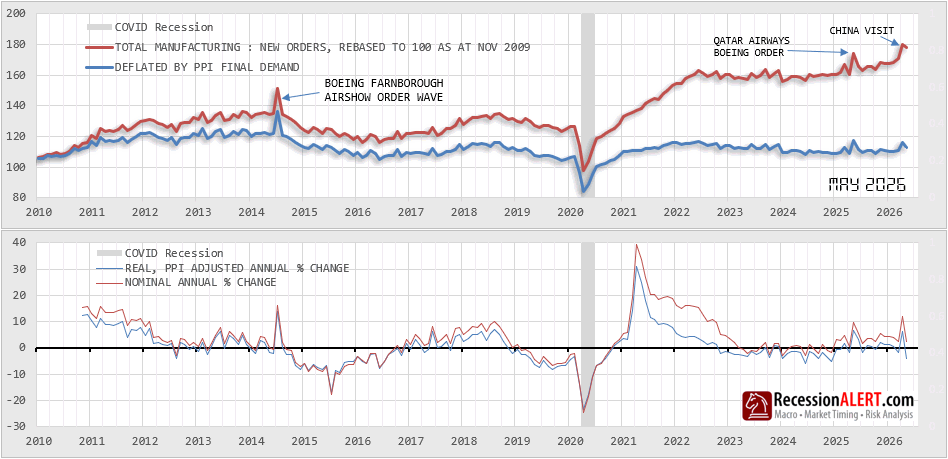
The record is a mirage, and the annotations show the wires. Nominal manufacturing new orders just hit an all-time high — 180.2 in April, 177.9 in May on a November-2009=100 base — yet deflate the same series by PPI Final Demand and real order volume sits at just 113. Sixty-five points of price, thirteen of volume. Two forces build the gap. The first is cumulative producer-price inflation — fifteen years of it — the entire structural wedge between the lines. The second is lumpier: the sharpest moves to the highs are Boeing order events, not broad demand — the 2014 Farnborough wave, Qatar Airways in 2025, and the mix of large widebody orders and a China deal propping up this spring’s record itself. A handful of aircraft contracts, booked in the most volatile category in the series, is doing the work the headline credits to manufacturing. Strip the deflator and the planes, and real orders have flatlined for fifteen years, below their 2013 peak. Feed a leading index the nominal line and it reads a state-visit aircraft order as an economic upturn — the number your model should ignore. Ingest this factor in real terms, as RecessionAlert’s US Monthly Leading Index does, or not at all.
Market Intelligence Brief (MIB) Ver. 18.42
For professional investors only. Not investment advice.
© 2026 RecessionALERT.com

Comments are closed.