
MARKET INTELLIGENCE BRIEF (MIB)
Monday, July 6, 2026
Broadcom’s decade-long Apple chip deal ignites a broad semiconductor rebound, driving the S&P (+0.72%) and Dow to record highs while AMD (+6.61%) and Arista (+8.31%) ride AI-infrastructure demand. June’s ISM Services report complicates the rate-cut story: hiring jumped even as growth cooled, muddying the Fed’s path into month-end’s FOMC. Tesla (+6.69%) rebounds on its first Miami robotaxi trading day. Vertex snaps up Crinetics for $10B in a biotech bet, and SK Hynix confirms a record $28B Nasdaq listing, pricing Thursday.
TABLE OF CONTENTS
A. EXECUTIVE SUMMARY
B. MARKET DATA
C. HIGH-IMPACT STORIES (5)
D. MODERATE-IMPACT STORIES (5)
E. ECONOMY WATCH (2)
F. EARNINGS WATCH (0)
G. WHAT’S NEXT
H. CHART OF THE DAY
A. EXECUTIVE SUMMARY -> TOP
Today’s advance extended last week’s rate-cut repricing, but the real driver behind the Nasdaq’s outperformance was a semiconductor sentiment reset: Broadcom’s disclosed extension of its Apple custom-chip deal through 2031 lifted the Philadelphia Semiconductor Index roughly 3% and reversed last week’s AI-equipment selloff, while AMD’s Turing GPU win and Arista’s BlackRock endorsement showed AI-infrastructure demand diversifying beyond Nvidia rather than stalling. That optimism sits uneasily against today’s ISM Services data — a jump in the Employment Index, the sector’s first hiring gain in four months, complicates the “labor is cooling” narrative underpinning the rate-cut trade — and against a visible Fed communication split (Waller favoring flexible guidance, Warsh data-only) clouding the path into the July 28-29 FOMC. Breadth was narrow: cyclical/growth sectors led while defensives (Healthcare, Real Estate, Utilities, Consumer Defensive) fell despite lower yields, confirming rotation rather than a broad rally.
• Broadcom (AVGO) +4-5% on a disclosed Apple custom-chip deal extension through 2031, igniting a sector-wide rebound — SOX +3%, Micron +3.43%, Intel +3.53%.
• Arista Networks (ANET) +8.31%, AMD +6.61% on a BlackRock AI-stock endorsement and a Turing GPU win taking share from Nvidia.
• Tesla (TSLA) +6.69% in its first trading session since the Miami robotaxi launch, rebounding from Thursday’s “sell the news” drop.
• Vertex Pharmaceuticals to acquire Crinetics Pharmaceuticals for ~$10 billion in cash, one of 2026’s largest biotech deals; Crinetics shares surged over 100%.
• SK Hynix confirmed a $28.1 billion Nasdaq ADR listing (ticker SKHY, pricing July 9) — the largest-ever US listing by a foreign company, drawing $7 billion in early demand.
• ISM Services PMI eased to 54.0 in June; the Employment Index jumped to 51.2 — the sector’s first hiring expansion in four months — even as price pressures cooled to a four-month low.
1. AI-infrastructure sentiment reset, not demand destruction — Broadcom’s Apple extension, AMD’s Turing win, and SK Hynix’s record US listing together point to durable AI capex conviction across multiple independent data points, not a single-stock bounce.
2. The rate-cut narrative is running into contradictory labor signals — ISM Services’ hiring jump sits at odds with last week’s weak payrolls report, meaning the Fed’s July 28-29 decision remains genuinely two-sided rather than a settled market call.
3. Rotation into cyclicals/growth, not a yield-driven rally — falling yields normally lift rate-sensitive defensives, yet Utilities, Real Estate, Healthcare, and Consumer Defensive all declined, confirming investors are chasing AI-led growth rather than seeking shelter.
 — Leading economic indicators. Accurate market forecasts. Apply for membership at join.recessionalert.com
B. MARKET DATA -> TOP
Markets extended last week’s rate-cut optimism after the weak June payrolls report, with the S&P 500 (+0.72%) and Dow (+0.30%, a record close) higher as yields eased across the curve (10Y -1.0bps, 2Y -1.9bps). The rally was narrow at the top: Nasdaq 100 (+1.26%) outpaced the Dow on fresh AI-infrastructure catalysts — Arista’s new AI switches and a BlackRock endorsement, AMD’s Turing GPU win — even as DJ Transports fell 0.65%, testing but not breaking Dow Theory’s bull confirmation. Defensive sectors (Healthcare, Real Estate, Utilities, Consumer Defensive) declined despite falling yields, signaling rotation into cyclicals/growth rather than a bond-proxy trade. Gold (+1.20%) and silver (+2.29%) rallied alongside the dovish repricing.
CLOSING PRICES – Monday, July 6, 2026:
MAJOR INDICES
Dow Theory bull confirmation remains in force, now in its third session — DJIA sits at a fresh 10-session high while DJTA holds within 0.65% of its own high despite today’s -0.65% dip. Over the past 10 sessions, the S&P 500 has outpaced the Nasdaq 100 by 2.82 points, extending into a second session — a broadening rotation toward value/cyclicals even as today’s session itself was an AI-led Nasdaq outperformer. Russell 2000 vs S&P 500 relative performance stayed within normal range (no breadth signal).
| Index | Close | Change | %Move | Why It Moved |
|---|---|---|---|---|
| S&P 500 | 7,537.48 | +54.24 | +0.72% | Rate-cut optimism following last week’s weak June jobs report |
| Dow Jones | 53,056.74 | +156.67 | +0.30% | Record close; broad blue-chip participation, boosted by Dell/White House ceremony |
| DJ Transportation | 21,871.2 | -143.9 | -0.65% | Lagged the broader tape; no distinct catalyst, mild profit-taking |
| Nasdaq 100 | 29,697.87 | +368.66 | +1.26% | AI-infrastructure strength led by Arista Networks and AMD |
| Russell 2000 | 3,010.69 | +14.58 | +0.49% | Small-caps gained on the lower-yield tailwind |
| NYSE Composite | 24,075.12 | +118.04 | +0.49% | Tracked the broad market’s advance |
VOLATILITY & TREASURIES
VIX fell alongside declining yields — a growth-friendly signature, not an inflation-fear one, confirming the rate-cut narrative rather than a risk-off bid. The 2Y’s larger decline (-1.9bps) versus the 10Y (-1.0bps) shows the front end leading, consistent with the market pricing in near-term Fed easing. DXY held essentially flat, offering no independent safe-haven signal.
| Instrument | Level | Change | Why It Moved |
|---|---|---|---|
| VIX | 15.56 | -0.25 (-1.58%) | Risk-on tone, rate-cut optimism |
| 10-Year Treasury Yield | 4.469% | -1.0 bps | Yields eased on rate-cut repricing after weak jobs data |
| 2-Year Treasury Yield | 4.112% | -1.9 bps | Front end led the decline on near-term Fed-cut odds |
| US Dollar Index (DXY) | 100.85 | +0.02 (+0.02%) | Essentially flat |
COMMODITIES
Gold, silver, platinum, and copper all advanced together — precious and industrial metals moving in lockstep points to a broad reflation/dovish-dollar trade rather than a pure safe-haven bid. Silver’s outsized gain (+2.29% vs gold’s +1.20%) reflects its industrial-demand leverage confirming, not contradicting, the growth signal. Bitcoin’s +1.70% tracked the equity rally, confirming risk-on sentiment rather than decoupling.
| Asset | Price | Change | %Move | Why It Moved |
|---|---|---|---|---|
| Gold | $4,175.24/oz | $+49.54 | +1.20% | Rate-cut expectations and lower real-rate outlook |
| Silver | $62.460/oz | $+1.396 | +2.29% | Precious + industrial demand combined |
| Copper | $6.2558/lb | $+0.0868 | +1.41% | Industrial demand/reflation trade |
| Platinum | $1,640.90/oz | $+12.80 | +0.79% | Tracked broader precious metals gain |
| Bitcoin | $63,821.0 | $+1,066.0 | +1.70% | Tracked the broader risk-on equities rally |
ENERGY
WTI and Brent both sat essentially flat, in lockstep — no fresh supply or demand shock today. Henry Hub (+1.75%) decoupled sharply from Dutch TTF (+0.29%), pointing to a US-specific natural gas driver rather than a global energy story; oil’s non-participation in the equity rally confirms this was a rate/AI story, not an energy-cost one.
| Asset | Price | Change | %Move | Why It Moved |
|---|---|---|---|---|
| Crude Oil (WTI) | $68.67/bbl | $-0.02 | -0.03% | Essentially flat, no fresh catalyst |
| Crude Oil (Brent) | $72.07/bbl | $-0.05 | -0.07% | Tracked WTI, essentially flat |
| Natural Gas (Henry Hub) | $3.252/MMBtu | $+0.056 | +1.75% | US-specific supply/demand dynamics |
| Natural Gas (Dutch TTF) | $14.80/MMBtu | $+0.04 | +0.29% | Modest gain, decoupled from Henry Hub |
S&P 500 SECTORS
Energy’s reversal is the standout: the sector leading the past six months (+18.46%) has cratered over the trailing month (-9.35%) and quarter (-11.33%). Meanwhile Real Estate, Utilities, Healthcare, and Consumer Defensive all declined today despite falling yields — normally a tailwind for these rate-sensitive/defensive names — confirming today’s move was a rotation into growth/cyclicals, not a bond-proxy trade.
| Sector | 1-Day | 1-Week | 1-Month | 3-Month | 6-Month | YTD | 12-Month |
|---|---|---|---|---|---|---|---|
| Communication Services | +1.58% | +6.31% | -0.24% | +9.87% | +2.41% | +2.41% | +22.59% |
| Technology | +1.58% | +2.22% | -6.09% | +27.70% | +20.45% | +20.45% | +34.58% |
| Financial | +1.30% | +4.31% | +10.13% | +14.94% | +5.99% | +5.99% | +14.45% |
| Consumer Cyclical | +1.14% | +3.60% | +0.19% | +8.25% | -3.16% | -3.16% | +4.86% |
| Industrials | +0.71% | +2.07% | +4.49% | +12.57% | +20.11% | +20.11% | +27.29% |
| Basic Materials | -0.08% | +0.81% | -5.59% | -2.80% | +10.45% | +10.45% | +31.68% |
| Energy | -0.22% | -0.84% | -9.35% | -11.33% | +18.46% | +18.46% | N/A |
| Real Estate | -0.73% | -1.56% | +3.46% | +7.91% | +9.85% | +9.85% | +7.66% |
| Utilities | -0.73% | -1.94% | +2.88% | -2.58% | +6.09% | +6.09% | +13.85% |
| Consumer Defensive | -0.94% | -1.09% | +2.05% | +0.73% | +7.12% | +7.12% | +3.90% |
| Healthcare | -1.02% | +1.51% | +11.31% | +10.58% | +6.26% | +6.26% | +21.73% |
TOP MEGA-CAP MOVERS:
GAINERS
| Company | Ticker | Close | Change | Why It Moved |
|---|---|---|---|---|
| Arista Networks Inc | ANET | $173.28 | +8.31% | New 1.6Tbps AI-networking switches, BlackRock top-30 AI stock endorsement, analyst price-target hikes |
| Tesla Inc | TSLA | $419.77 | +6.69% | Q2 deliveries topped 480,000 units, beating estimates; robotaxi service launched in Miami |
| Advanced Micro Devices Inc | AMD | $552.05 | +6.61% | AI startup Turing adopted AMD GPUs with AMD venture investment, taking share from Nvidia |
| Dell Technologies Inc | DELL | $411.80 | +4.43% | Trump promoted Dell computers at joint White House/NYSE/Nasdaq opening-bell ceremony |
| Morgan Stanley | MS | $222.10 | +3.82% | 15% dividend hike and $20B multi-year buyback announced |
DECLINERS
| Company | Ticker | Close | Change | Why It Moved |
|---|---|---|---|---|
| Abbvie Inc | ABBV | $254.76 | -2.42% | Profit-taking amid broader healthcare pullback; no distinct fresh catalyst |
| Merck & Co Inc | MRK | $126.78 | -2.15% | Broader healthcare sector rotation; no distinct fresh catalyst |
| Netflix Inc | NFLX | $76.02 | -2.10% | Continued weakness near 52-week lows ahead of July 16 earnings |
| Home Depot Inc | HD | $350.65 | -2.03% | Rotation out of rate-sensitive retail into growth/AI names |
| Unitedhealth Group Inc | UNH | $417.99 | -1.73% | Broader healthcare sector pullback; no distinct fresh catalyst |
— Institutional-grade intelligence for serious investors. Apply for membership at join.recessionalert.comC. HIGH-IMPACT STORIES -> TOP
BULLISH
1. Broadcom Extends Apple Custom-Chip Deal Through 2031, Leading a Broad Semiconductor Rebound as Philadelphia Semiconductor Index Jumps ~3%
The core facts:Broadcom disclosed in an SEC filing today that it has reached a multi-year agreement with Apple to extend their custom application-specific integrated circuit (ASIC) partnership through 2031, covering “multiple generations of Apple products.” Apple is estimated to account for roughly 20% of Broadcom’s annual revenue. Broadcom shares rose approximately 4-5% on the news, leading a broad chip-sector rebound: the Philadelphia Semiconductor Index (SOX) jumped about 3% and the Technology sector gained 1.58%, with Micron (+3.43%) and Intel (+3.53%) also participating. The rally fully reversed the prior week’s multi-day semiconductor selloff, helping push the Nasdaq Composite up 1.12% and the Nasdaq 100 up 1.26% to lead major indices.
Why it matters:The Apple extension removes a multi-year revenue-visibility overhang for Broadcom at a moment when investors have been nervously reassessing AI-infrastructure spending durability after last week’s sharp equipment/memory-maker selloff. Locking in Apple as a top customer through 2031 signals custom-silicon demand remains structurally intact even as questions swirl around hyperscaler self-sufficiency, and the sector-wide participation (not just Broadcom) suggests today’s move reflects a genuine sentiment reset rather than a single-stock event. Confirming sentiment: Nvidia supplier Foxconn separately reported stronger-than-expected quarterly sales over the holiday weekend, a second data point supporting sustained AI hardware demand.
What to watch:Whether the semiconductor rebound holds into Q2 earnings season (opening in earnest mid-to-late July) or proves a one-day bounce; hyperscaler capex commentary for confirmation of continued custom-silicon demand.
BULLISH
2. Arista Networks Jumps 8.31% on New AI-Networking Switches and BlackRock Endorsement; AMD Rallies 6.61% as Self-Driving Startup Turing Taps Its GPUs Over Nvidia’s
The core facts:Arista Networks rose 8.31% to $173.28 after being named one of BlackRock’s 30 most important AI stocks and on continued momentum from its new 7060XE7 series of 1.6Tbps AI-networking switches, which are backed by Meta, Microsoft, Oracle, AMD, and Broadcom partnerships; KeyBanc, BofA, and Morgan Stanley lifted price targets toward $190-200 today. Separately, AMD rose 6.61% to $552.05 after Japanese self-driving AI startup Turing announced it now runs roughly 10% of its AI training workloads on AMD GPUs — backed by a new investment from AMD’s venture-capital arm — marking a customer win away from Nvidia; Wells Fargo and Cantor Fitzgerald raised price targets citing a “generational cycle” in AI semiconductors.
Why it matters:Both moves reinforce today’s broader AI-infrastructure sentiment reset (see Story 1) but add company-specific evidence of demand diversification: Arista’s switch demand shows AI-networking build-out continuing independent of any single hyperscaler, while Turing’s AMD adoption is a concrete data point that AMD is winning real training workloads rather than just narrative momentum, chipping at Nvidia’s near-monopoly. Together with analyst target hikes across multiple desks, this signals institutional conviction that the AI-infrastructure trade’s recent pullback was a positioning reset, not a demand problem.
What to watch:Additional AMD customer wins as evidence of sustained Nvidia share erosion; Arista’s next earnings call for order backlog commentary on the new switch line.
UNCERTAIN
3. Vertex Pharmaceuticals to Acquire Crinetics Pharmaceuticals for $10 Billion in Cash, Expanding Endocrinology Portfolio
The core facts:Vertex Pharmaceuticals agreed to acquire Crinetics Pharmaceuticals for $85.00 per share in cash, a deal valued at approximately $10 billion (~$8.8 billion net of Crinetics’ cash). Both boards unanimously approved the transaction, expected to close in Q3 2026 pending regulatory and shareholder approval. Crinetics markets PALSONIFY, the first once-daily oral therapy for acromegaly, a rare pituitary-tumor condition; Vertex projects the combined assets could generate more than $5 billion in peak annual revenue, with the deal becoming accretive to non-GAAP operating income in 2029. Financing includes $4.5 billion in committed bridge financing from Bank of America and Morgan Stanley. Crinetics shares surged over 100% on the announcement; Vertex shares traded roughly 0.5% lower.
Why it matters:This is one of the largest biotech acquisitions of 2026 and signals continued M&A appetite among large-cap pharma to acquire commercial-stage rare-disease assets rather than build organically. Vertex’s slight share-price decline reflects standard deal-financing digestion (debt-funded, multi-year accretion timeline) rather than strategic disapproval — the market is pricing in near-term dilution against a 2029 accretion target. The scale of Crinetics’ pop confirms this was a full, uncontested premium bid rather than a competitive-auction outcome.
What to watch:Regulatory clearance timeline and Crinetics shareholder vote ahead of the targeted Q3 2026 close; Vertex’s financing execution on the $4.5 billion bridge facility.
BULLISH
4. Trump Rings NYSE/Nasdaq Opening Bell From the Oval Office in First-Ever Ceremony, Launching “Trump Accounts” as Dell Surges 4.43% on Presidential Endorsement
The core facts:President Trump rang the opening bell of both the NYSE and Nasdaq from the Oval Office today — the first time the opening bell has been rung from the White House — in a joint ceremony marking the launch of “Trump Accounts,” a new tax-advantaged investment account program for American children. Treasury Secretary Scott Bessent, Sen. Ted Cruz, and Michael and Susan Dell attended; Michael and Susan Dell pledged more than $6 billion to the program. During the ceremony, Trump promoted Dell computers directly, and Dell Technologies shares rallied 4.43% to $411.80.
Why it matters:Beyond the single-stock pop for Dell, the launch of a nationwide, tax-advantaged child investment account program is a material new federal financial-policy initiative with potential long-run implications for retail investment flows and household balance-sheet formation. The unprecedented staging — a sitting president hosting NYSE and Nasdaq leadership at the White House — also underscores this administration’s active engagement with capital markets as a policy and messaging tool, a dynamic investors should expect to recur.
What to watch:Enrollment and funding details for Trump Accounts as the program rolls out; whether other companies pursue similar high-profile funding pledges or presidential endorsements.
UNCERTAIN
5. OPEC+ Approves Fifth Consecutive Monthly Output Hike (+188K bpd for August) as Strait of Hormuz Exports Gradually Resume
The core facts:OPEC+ agreed to raise production quotas by a further 188,000 barrels per day for August, the fifth consecutive monthly increase, bringing the cumulative hike since April to almost 800,000 bpd. The decision comes as Strait of Hormuz tanker traffic gradually normalizes following the ceasefire memorandum, with OPEC+ output recovering from a May trough of 33.13 million bpd (down from 42.77 million bpd in February) but still below pre-war levels. WTI and Brent both traded essentially flat today ($68.67 and $72.07 respectively), with the Energy sector down 0.22% on the session — the news was largely priced in following last week’s slide to a four-month low.
Why it matters:The combination of rising OPEC+ supply and a normalizing Hormuz chokepoint confirms the 2026 oversupply thesis remains intact even as the group manages a still-incomplete recovery from the war-driven production collapse. For US markets, sustained lower oil prices are modestly disinflationary — a small tailwind for the Fed’s inflation fight — but continue to pressure an Energy sector already down 9.35% over the trailing month and 11.33% over the trailing quarter, a headwind for energy-sector earnings heading into Q2 reporting season.
What to watch:Tanker-crossing volumes through the Strait of Hormuz as the clearest real-time indicator of whether the recovery continues; OPEC+’s September quota decision for confirmation this hiking cycle persists.
— Quantifying recession risk so you don’t have to guess. Apply for membership at join.recessionalert.comD. MODERATE-IMPACT STORIES -> TOP
BULLISH
6. Tesla Rebounds 6.69% as Miami Robotaxi Service Opens in First Trading Session Since Holiday-Weekend Launch
The core facts:Tesla shares rose 6.69% to $419.77 today — the first trading session since the company launched fully unsupervised robotaxi service in Miami over the July 4th holiday weekend, its first expansion beyond Austin. The Miami service covers a 10-14 square mile zone in western Miami-Dade with no safety driver from day one, requiring riders to use a dedicated app amid an expected waitlist. Today’s rebound follows Thursday’s 7.49% “sell the news” drop that occurred despite a blowout Q2 delivery beat (480,126 vehicles, +25% YoY, already covered in the prior report).
Why it matters:Because markets were closed for the holiday weekend when Tesla actually opened the Miami service, today marks the first opportunity for investors to price in the launch, distinct from last week’s delivery-number reaction. The rebound signals that investors are compartmentalizing the autonomy narrative from near-term delivery/margin concerns — Miami expansion reinforces the long-term robotaxi thesis even as the stock’s rich valuation keeps it vulnerable to “sell the news” reactions on operational metrics alone.
What to watch:Ridership and safety data from the Miami rollout in coming weeks; Tesla’s July 22 Q2 earnings report for margin trends and commentary on robotaxi economics.
UNCERTAIN
7. Fed’s Waller Says Forward Guidance “More Art Than Science,” in Tension With Chair Warsh’s Data-Dependent Approach
The core facts:Fed Governor Christopher Waller said today that forward guidance “can be a valuable tool that has, at times, significantly strengthened policymaking” but is “more art than science,” arguing it needs to be applied flexibly and citing fall 2021 as an example where prior guidance constrained the Fed’s ability to respond to changing conditions. His remarks stand in some tension with Chair Kevin Warsh’s stated shift toward a purely data-dependent, no-guidance communication posture. Full details on the underlying inflation and labor data referenced are covered in Section E.
Why it matters:The visible difference in emphasis between a sitting governor and the new chair signals the Fed’s communication framework under Warsh remains unsettled just weeks into his tenure — a live consideration for markets pricing the path of policy, since inconsistent signaling between committee members raises the risk of policy-communication surprises around the July 28-29 FOMC meeting.
What to watch:The Fed’s communications policy task force member announcements expected this month; the July 8 FOMC minutes release for further insight into the committee’s internal guidance debate.
UNCERTAIN
8. Toyota to Invest $3.6 Billion Reshoring Tacoma Truck Production From Mexico to Texas, Doubling San Antonio Plant by 2030
The core facts:Toyota announced a $3.6 billion investment to relocate production of the Tacoma midsize pickup from its Baja California, Mexico plant to its San Antonio, Texas campus, adding a second assembly line and roughly doubling the facility’s footprint (adding 2.5 million square feet) by 2030. The expansion is expected to create 2,000 new US jobs and will occur over an approximate four-year transition period. This brings Toyota’s cumulative San Antonio investment to $8.3 billion since 2003. Toyota shares fell on the announcement amid investor concern over near-term capital spending and transition costs.
Why it matters:This is a concrete instance of automotive-manufacturing reshoring from Mexico to the US, consistent with the broader tariff and trade-policy pressures pushing companies to relocate production domestically. While the US jobs and investment figures are a positive for the domestic manufacturing base, the stock’s decline reflects near-term margin dilution from the four-year capex and transition period before reshoring benefits are realized.
What to watch:Whether other automakers announce similar reshoring moves in response to tariff pressure; Toyota’s capex guidance updates as the four-year transition proceeds.
UNCERTAIN
9. Microsoft Cuts 4,800 Jobs (~2.1% of Workforce) in AI-Driven “Reset,” Xbox Division Hit Hardest
The core facts:Microsoft is cutting 4,800 jobs, approximately 2.1% of its global workforce, with roughly 1,600 of the cuts concentrated in the Xbox gaming division; another 1,600 Xbox roles are expected to be eliminated later in fiscal year 2027, shrinking the division by about 3,200 positions total. Xbox CEO Asha Sharma told staff in an internal memo that “our business today is not healthy,” citing margins “3-10x lower than comparable platform and publishing businesses” amid a broader console-hardware cost crisis. The cuts are part of Microsoft’s wider restructuring toward AI investment priorities.
Why it matters:The layoffs illustrate the ongoing tension at large tech companies between funding AI capex and sustaining legacy hardware/gaming businesses — Microsoft is explicitly reallocating away from a structurally underperforming Xbox unit. For investors, this is a modest positive for near-term margin discipline but confirms gaming/hardware remains a drag that management is actively restructuring rather than growing.
What to watch:Further Xbox studio spinoff or divestiture announcements; Microsoft’s next earnings call for updated AI capex allocation following the restructuring.
BULLISH
10. SK Hynix Launches $28 Billion Nasdaq ADR Listing, Drawing $7 Billion in Investor Interest as AI Memory Boom Continues
The core facts:South Korea’s SK Hynix confirmed today it will raise approximately $28.1 billion (43 trillion won) through an American Depositary Receipt listing on the Nasdaq Global Select Market, offering 17.79 million new shares under the ticker “SKHY.” Final pricing is set for July 9, with trading beginning July 10. Early reports indicate the offering has already drawn roughly $7 billion in investor interest. If completed, it would be the largest-ever US listing by a foreign company. Proceeds are earmarked for new chip factories in South Korea and equipment purchases, including an ASML extreme ultraviolet scanner.
Why it matters:The scale of demand for SK Hynix’s US listing is a direct market signal that institutional investors remain willing to fund AI-memory capacity expansion at record scale, reinforcing today’s broader semiconductor-sentiment reset (see Story 1). A successful listing would also deepen US capital markets’ role in financing global AI-infrastructure buildout, giving US investors direct exposure to the HBM/DRAM supply chain alongside domestic names like Micron.
What to watch:Final pricing on July 9 and first-day trading performance on July 10; whether demand holds through final bookbuilding given the offering’s record size.
— Separating signal from noise since 2007. Apply for membership at join.recessionalert.comE. ECONOMY WATCH -> TOP
A holiday-shortened week produced a thin economic docket, but what did print cut both ways. June’s ISM Services PMI eased to 54.0 — in line with estimates — as business activity and new orders decelerated, yet the report’s employment index posted its sharpest gain since 2024 and price pressures cooled to a four-month low, complicating the “labor is cooling” read from June’s weak payrolls miss. Fed communication remains unsettled under new leadership: Governor Waller called for retaining flexible forward guidance days after Chair Warsh reiterated a purely data-dependent, no-guidance approach. With Wednesday’s FOMC Minutes the week’s main catalyst, markets are pricing a hold through year-end even as internal Fed messaging stays in flux.
ISM Services PMI Eases to 54.0 in June as Growth Slows but Hiring Jumps and Price Pressures Cool (ISM/FXStreet, July 6, 2026)
What they’re saying:The ISM Services PMI eased to 54.0 in June, down from 54.5 in May and matching the consensus estimate of 54. Business Activity slowed to 55.4 from 57.7 and New Orders eased to 55.1 from 57.3. The Employment Index jumped to 51.2 from 47.9 — its largest increase since 2024 and the first expansion in service-sector headcount since February — while the Prices Index eased to 67.7 from 71.3, a four-month low.
The context:The report is a study in contrasts: decelerating growth momentum alongside the first hiring expansion in the sector in four months, plus moderating price pressures. The employment rebound complicates the “labor is cooling” narrative that dominated last week’s weak June payrolls report (+57K vs. 115K expected), while the cooler prices component offers the Fed modest reassurance even as Chair Warsh maintains inflation “remains too high.”
What to watch:FOMC Minutes, Wednesday, July 8, for how policymakers weighed June’s mixed services data; July ISM Services PMI due Aug. 5.
Fed’s Waller Calls for Flexible Forward Guidance, in Tension With Warsh’s Data-Only Approach (Federal Reserve/Bloomberg, July 6, 2026)
What they’re saying:Speaking at a Bank of Italy-sponsored conference in Rome, Fed Governor Christopher Waller said signals from policymakers about the future path of interest rates “can play a useful role if done carefully,” arguing that understanding current starting conditions is essential to setting the appropriate policy response.
The context:Waller’s remarks sit in some tension with new Fed Chair Kevin Warsh, who has steered the central bank away from forward guidance toward a purely data-dependent posture, telling an ECB forum audience in Sintra on July 1 that inflation “remains too high” while declining to signal the July rate path. The split points to a still-unsettled communication framework under new Fed leadership — a source of policy uncertainty for markets currently pricing a hold through year-end.
What to watch:FOMC Minutes, Wednesday, July 8, for signs of how the committee is resolving its post-Warsh communication approach.
— Know the probability before the market prices in the risk. Apply for membership at join.recessionalert.comF. EARNINGS WATCH -> TOP
YESTERDAY AFTER THE BELL (Markets Reacted Today)
No major earnings yesterday after the bell from companies with >$100B market cap.
TODAY BEFORE THE BELL (Markets Already Reacted)
No major earnings before the bell from companies with >$100B market cap.
TODAY AFTER THE BELL (Markets React Tomorrow)
No major earnings after the bell from companies with >$100B market cap.
WEEK AHEAD PREVIEW:
Q2 2026 earnings season opens in earnest this week, with only one confirmed >$100B reporter on the calendar so far.
PepsiCo (PEP) — BMO, Thursday, July 9 — Consensus calls for EPS of ~$2.21 on revenue of ~$23.96B; analysts have trimmed targets into the print amid ongoing volume-growth scrutiny across the beverage/snack portfolio. As one of the first S&P 500 reporters of the quarter, PEP’s results and guidance commentary will set an early read-through for consumer-staples demand and input-cost trends heading into the broader Q2 season.
Delta Air Lines (~$57B market cap) also reports Friday, July 10, but falls below the $100B mega-cap threshold for individual coverage here. No other confirmed >$100B reporters were identified for the remainder of the week as of this report.
— US market commentary trusted by family offices and institutions. Apply for membership at join.recessionalert.comG. WHAT’S NEXT -> TOP
UPCOMING RELEASES:
| Date | Event | Why It Matters |
|---|---|---|
| Tue, Jul 7 | Balance of Trade (May; exp. -$78.0B, prior -$55.9B) | A widening trade deficit weighs on Q2 GDP tracking and reflects import demand ahead of further tariff implementation. |
| Tue, Jul 7 | ADP Employment Change, Weekly (prior 30.75K) | First payrolls proxy since last week’s weak June jobs report; further softening reinforces the Fed’s rate-cut case. |
| Tue, Jul 7 | Consumer Inflation Expectations (prior 3.5%) | Gauges whether households still see inflation as a live risk, informing Chair Warsh’s data-dependent posture. |
| Tue, Jul 7 | RCM/TIPP Economic Optimism Index (exp. 45, prior 42.5) | Consumer sentiment read heading into a data-heavy week; an upside surprise would push back on recession-watch narratives. |
| Wed, Jul 8 | FOMC Minutes | First look at how the committee weighed June’s mixed labor and services data, and how unsettled the Waller-Warsh guidance debate is internally. |
| Wed, Jul 8 | Wholesale Inventories MoM (exp. 0.3%, prior 0.6%) | Feeds directly into GDP tracking and signals whether businesses are restocking ahead of tariff-driven cost increases. |
| Wed, Jul 8 | Consumer Credit Change (exp. $17.0B, prior $20.73B) | Slower credit growth would signal consumers pulling back on borrowing, a leading indicator for retail spending. |
| Wed, Jul 8 | 10-Year Note Auction | Demand strength signals investor appetite for duration amid the current rate-cut repricing and could move yields. |
KEY QUESTIONS:
1. Does Wednesday’s FOMC Minutes reveal convergence toward Chair Warsh’s data-only communication approach, or does internal disagreement (per Waller’s remarks today) persist into the July 28-29 meeting?
2. Can the semiconductor-led rally (Broadcom, AMD, Arista) sustain through Q2 earnings season, or does it prove another “sell the news” reversal like Tesla’s post-delivery drop?
3. With ISM Services showing the first services-sector hiring gain in four months even as June payrolls decelerated sharply, which labor signal will the Fed weight more heavily heading into its next decision?
— US market commentary trusted by family offices and institutions. Apply for membership at join.recessionalert.comH. CHART OF THE DAY -> TOP
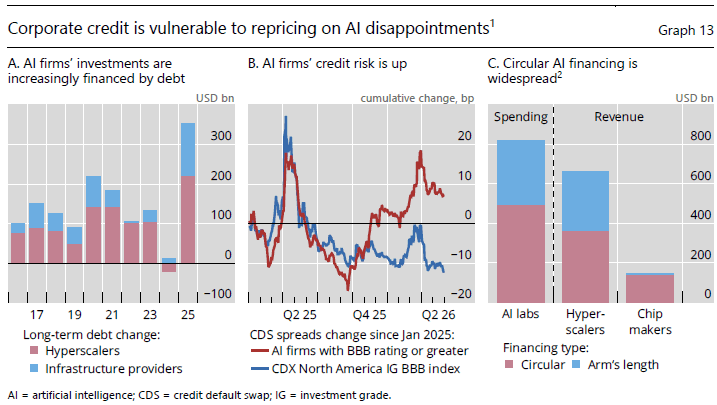
Equity markets and credit markets are reading the same AI balance sheets and reaching opposite conclusions — and history says the bond desk is the one to believe. Since January 2025, five-year CDS on investment-grade AI names has decoupled from the broad CDX IG BBB index, swinging to roughly +5bp and widening while the benchmark grinds ~15bp tighter — a 20bp gap that opened even as equity indices printed records (Panel B). Two structural facts argue it has further to run. First, the leverage is new and unrepriced: after a net ~$40bn paydown in 2024, AI-linked issuers levered up by a record ~$340bn in 2025, roughly double the 2020 peak (Panel A). Second, the plumbing is reflexive: circular financing accounts for ~58% of lab and ~57% of hyperscaler commitments — and an extraordinary ~96% of chip-maker commitments, the most-exposed link, whose forward book is almost entirely equity-for-purchase deals struck with their own customers. Their demand has no independent buyer of last resort; it evaporates the quarter one hyperscaler throttles capex, and with the same collateral potentially pledged twice, the true leverage stays unmappable until it crystallizes. Credit is the wire through which this reaches the real economy — the only precedents for synchronised equity-and-credit corrections are the GFC and March 2020. Equity is pricing the upside; credit is pricing the exit — and the credit line has not finished moving.
Market Intelligence Brief (MIB) Ver. 18.42
For professional investors only. Not investment advice.
© 2026 RecessionALERT.com

Comments are closed.