
MIB WEEKLY DIGEST
Week of May 11–15, 2026
WTI crude surged +11.52% to $105.48 as US-Iran ceasefire talks collapsed — “garbage” per Trump Tuesday — while CPI 3.8% (Tue) and PPI 6.0% (Wed) delivered the most concentrated inflation shock since 2022, pushing rate-hike odds from under 3% to over 50% in 72 hours and the 10Y yield to a one-year high of 4.601%. Kevin Warsh was sworn in as Fed Chair Friday inheriting this stagflation stack. The Trump-Xi summit briefly drove records (S&P 7,500, Dow 50,000 Thursday) before crashing Friday on zero binding deals — tariffs, chips, and Taiwan all unresolved. The week’s sole unambiguous bullish signal: Cisco’s AI networking orders +217% YoY confirmed the AI capex supercycle is accelerating.
TABLE OF CONTENTS
A. WEEK AT A GLANCE
B. WEEK IN MARKETS
C. WEEK’S TOP STORIES (10)
D. WEEK IN THE ECONOMY (5)
E. WEEK IN EARNINGS (3)
F. NEXT WEEK SETUP
G. CHART OF THE WEEK
A. WEEK AT A GLANCE -> TOP
MARKET SNAPSHOT
The S&P 500 ended the week barely positive (+0.13%) while every underlying pressure worsened: WTI crude surged +11.52% to $105.48 as US-Iran negotiations collapsed, and the CPI 3.8% / PPI 6.0% data sequence delivered the most concentrated inflation shock since 2022, pushing rate-hike odds from under 3% to over 50% in 72 hours. The week’s defining arc — summit-driven euphoria carrying the S&P to a new ATH of 7,500 and the Dow to 50,000 on Thursday, fully reversed by Friday’s stagflation reckoning — confirms that the macro baseline has shifted: energy inflation is entrenched, the Warsh Fed inherits an impossible hand, and the AI capex supercycle (confirmed by Cisco’s +217% YoY hyperscaler order acceleration) is now the sole structural bullish counterweight against a deteriorating macro backdrop. The Russell 2000’s −2.28% weekly loss against the S&P’s +0.13% surface gain confirms that the narrow AI mega-cap trade continues to mask deteriorating breadth beneath the headline.
THIS WEEK AT A GLANCE
• WTI crude +11.52% WoW to $105.48 — the largest weekly crude surge since the initial Hormuz closure shock; US-Iran ceasefire declared “garbage” by Trump Tuesday; IEA warned of the largest oil supply deficit in recorded history at 8.5 mb/day; Hormuz near-closed for 11 consecutive weeks.
• CPI 3.8% (Tue), PPI 6.0% (Wed), import prices +1.9% MoM double consensus (Thu) — rate-hike odds raced from under 3% to over 50% in 72 hours; 10Y yield surged +24.2 bps to 4.601% (one-year high); Goolsbee explicitly tabled rate hikes; entire Wall Street bank consensus shifted to zero 2026 cuts.
• Trump-Xi Beijing summit: Dow 50,000 / S&P 7,500 ATH Thursday → full reversal Friday — Day 2 produced zero binding commitments on tariffs, semiconductors, or Taiwan; next formal window is the fall Xi-US visit; Boeing’s jet deal was aspirational, not contracted.
• Kevin Warsh sworn in as 17th Fed Chair Friday — 54–45 partisan confirmation (narrowest modern-era), inheriting CPI 3.8%, PPI 6.0%, WTI $105, 10Y at 4.601%, and >50% rate-hike odds; inaugural FOMC June 16–17.
• AI capex supercycle confirmed: Cisco AI orders +217% YoY, FY target $5B→$9B; Applied Materials record margins (49.9%, 25-year high) + >30% equipment guidance raise — the week’s sole unambiguous bullish signal; Cerebras Systems IPO +68% confirms institutional demand for new AI infrastructure public market exposure.
• Consumer discretionary squeeze confirmed — April retail sales +0.5% headline driven entirely by gas stations; furniture −2.0%, department stores −3.2%, apparel −1.5%; UNH Q1 +9.7% EPS beat drove Healthcare sector to the week’s fourth-best performance (+0.21%), reversing its YTD laggard status in a single session.
KEY THEMES
1. Stagflation Is the Baseline, Not a Risk Scenario — CPI 3.8%, PPI 6.0%, and WTI +11.52% in a single week confirm that inflation has re-entrenched above the Fed’s target while consumer discretionary spending is already contracting. Friday’s cross-asset signature — equities, bonds, gold, and copper all falling while oil, yields, and the dollar rose simultaneously — is the cleanest stagflation print of the 2026 cycle. The Warsh Fed inherits this configuration with no easy policy tool: tightening compounds consumer distress, holding risks inflation entrenchment, and cutting would trigger a bond market tantrum.
2. The AI Capex Supercycle Runs Independent of the Macro Headwinds — Cisco’s +217% YoY hyperscaler networking order acceleration and Applied Materials’ 25-year-high gross margins confirm the AI infrastructure buildout is compounding even as the macro backdrop worsens. This creates the week’s core portfolio tension: AI infrastructure names (CSCO, AMAT, NVDA) are delivering hard-data earnings beats; everything rate-sensitive (REITs, utilities, homebuilders, Russell 2000) faces a structurally more hostile rate environment. The two narratives do not conflict — they coexist as parallel regime signals that pull institutional allocation in opposite directions simultaneously.
3. The US-China Stalemate Has Created a Structural Portfolio Bifurcation — The summit’s non-outcome extends the tariff and export-control environment by months (next window: fall Xi-US visit), bifurcating the S&P 500 into two sustained camps: beneficiaries of continued trade disruption (Energy +33% YTD, domestic-focused AI infrastructure, MSFT-type relative-value tech) vs. persistent losers (semiconductor China-export names, silver/copper/Materials, Tesla China revenue). This is not a one-week rotation but a structural allocation decision that portfolio managers must make under sustained uncertainty with no clear resolution timeline.
 — Leading economic indicators. Accurate market forecasts. Apply for membership at join.recessionalert.com
B. WEEK IN MARKETS -> TOP
Two competing narratives opened the week — Hormuz energy shock and Trump–Xi summit optimism — and only one survived: stagflation. WTI gained +11.52% as negotiations collapsed (Trump called the ceasefire “garbage” Tuesday), while CPI’s 3.8% on Tuesday and PPI’s 6.0% on Wednesday jointly destroyed the “Fed on hold through 2027” consensus, repricing rate-hike odds from under 3% to over 50% in 72 hours. Summit optimism briefly drove the S&P 500 to an ATH of 7,500 and the Dow to 50,000 on Thursday — both reversed sharply Friday when Day 2 produced zero binding commitments on tariffs, semiconductors, or Taiwan. The week’s critical bullish signal: Cisco’s $9B AI networking order raise (+217% YoY hyperscaler demand) confirmed the AI capex supercycle is accelerating. The defining structural event: Kevin Warsh’s swearing-in as Fed Chair Friday, inheriting CPI 3.8%, PPI 6.0%, and WTI $105 — his June 16–17 FOMC is now the single most consequential near-term binary for every rate-sensitive sector in the portfolio.
FRIDAY CLOSE & WEEK-ON-WEEK CHANGE — Fri, May 15, 2026:
MAJOR INDICES
The week produced one of the sharpest intra-week index swings of 2026: a summit-driven ATH (S&P 7,500, Dow 50,000) on Thursday reversed to broad selling Friday, leaving the S&P barely positive (+0.13%) while the Russell 2000 sank −2.28% — a 2.4-percentage-point gap signaling that the AI narrative sustains mega-cap premiums while rate-hike anxiety penalizes leveraged small-caps. The NYSE Composite’s −0.62% against a green S&P confirms the breadth damage beneath the headline.
| Index | Fri Close | WoW Change | WoW % | Why It Moved (Week) |
|---|---|---|---|---|
| S&P 500 | 7,408.50 | +9.63 | +0.13% | Mid-week summit optimism drove a new ATH (7,500 Thu); reversed sharply Fri on stalemate and oil shock — the week ended barely green only because CSCO’s AI earnings and Thu’s record held enough to offset Friday’s −1.24% reversal. |
| Dow Jones | 49,526.11 | −82.93 | −0.17% | Reclaimed 50,000 Thu on Cisco earnings and summit optimism, then shed −1.07% Fri as rate-hike fears and the summit disappointment hit blue-chip Financials, Industrials, and Utilities hardest. |
| DJ Transportation | 20,134.2 | −65.6 | −0.32% | Oil cost pressure (WTI +11.52% WoW) weighed on transports Mon–Wed; paradoxically gained +0.38% Fri when energy stocks within the index benefited from the crude surge — a divergence from the broader selloff. |
| Nasdaq 100 | 29,125.20 | −109.79 | −0.38% | CSCO +22% partially offset by INTC/AMD/MU profit-taking and CPI-driven multiple compression on Tue (−0.87%) and Fri (−1.54%); mid-week AI optimism briefly lifted the index to a new ATH. |
| Russell 2000 | 2,794.75 | −65.13 | −2.28% | Small-caps bore the full rate-hike regime shift — rising 10Y (+24 bps) and 2Y (+19 bps) disproportionately compress leveraged smaller balance sheets; Fri’s −2.39% was the worst single-session for any major index. |
| NYSE Composite | 22,799.43 | −142.72 | −0.62% | Broad market closed negative despite a green S&P — Energy offset partially, but healthcare, consumer cyclical, and rate-sensitive sectors dragged the broader NYSE universe below the index headline. |
VOLATILITY & TREASURIES
VIX +7.22% and 10Y yields +24.2 bps in the same week are inflation-fear, not recession hedging — in a growth scare, bonds rally and yields fall. Instead the 10Y hit 4.601% (a one-year high), with the curve steepening (10Y +24 bps vs 2Y +18.8 bps), pricing durable structural inflation rather than imminent Fed action. Tuesday’s CPI 3.8% and Wednesday’s PPI 6.0% were the triggers; the dollar’s +1.48% weekly gain confirmed capital fled to USD rather than Treasuries. Rate-hike odds moved from under 3% to over 50% in 72 hours.
| Instrument | Fri Level | WoW Change | Why It Moved (Week) |
|---|---|---|---|
| VIX | 18.42 | +1.24 (+7.22%) | Rose despite a mid-week record close — the oil shock and rate-hike repricing maintained a structural anxiety premium beneath summit-driven equity optimism. |
| 10-Year Treasury Yield | 4.601% | +24.2 bps | CPI 3.8% (Tue) and PPI 6.0% (Wed) drove the most aggressive weekly yield surge in months; Friday’s additional +14 bps on summit stalemate and oil shock pushed the 10Y to a one-year high. |
| 2-Year Treasury Yield | 4.075% | +18.8 bps | Front end repriced near-term Fed rate path; the 10Y rising faster than the 2Y (curve steepening) signals markets price structural long-run inflation, not just an imminent rate hike. |
| US Dollar Index (DXY) | 99.30 | +1.45 (+1.48%) | Safe-haven flows chose USD over Treasuries as yields rose — a stagflation signal; dollar strength amplified real-rate pressure on emerging markets and gold. |
COMMODITIES
Gold’s −3.86% loss despite an active Hormuz war is the week’s most revealing commodity signal: rising real yields (+24.2 bps on 10Y) and dollar strength (+1.48%) overwhelmed the safe-haven bid, confirming markets read this as an inflation shock rather than a systemic crisis. Silver’s −5.63% was amplified by China demand disappointment from the summit stalemate (silver is critical for solar panels and semiconductor manufacturing). Copper ended near-flat (−0.07%) — AI infrastructure demand balanced exactly against China growth pessimism. Bitcoin tracked equities as a risk proxy, offering no independent inflation-hedge signal.
| Asset | Fri Price | WoW Change | WoW % | Why It Moved (Week) |
|---|---|---|---|---|
| Gold | $4,543.82/oz | −$182.32 | −3.86% | Dollar strength and rising real yields overcame the Hormuz safe-haven bid all week; gold’s failure to rally on simultaneous 3.8% CPI and active geopolitical conflict confirms the market views this as an inflation shock, not a systemic crisis. |
| Silver | $76.362/oz | −$4.553 | −5.63% | Dual hit: rising yields crushed its monetary-metal role, while the summit stalemate crushed its industrial demand component (solar panels, semiconductor manufacturing rely on silver). Outsized loss vs. gold quantifies China demand pessimism. |
| Copper | $6.2788/lb | −$0.0045 | −0.07% | Near-flat close — AI infrastructure demand balanced against China growth pessimism after the summit disappointment; the flat result itself signals the two forces are exactly offsetting. |
| Platinum | $1,983.05/oz | −$82.70 | −4.00% | Sold alongside gold/silver complex on dollar strength and yield surge; automotive catalyst demand outlook dampened by tariff stalemate uncertainty for global auto supply chains. |
| Bitcoin | $79,072 | −$1,140 | −1.42% | Tracked equity risk-on / risk-off patterns across all five sessions; no independent crypto catalyst — confirmed risk-proxy behavior with no inflation-hedge or safe-haven premium this week. |
ENERGY
WTI +11.52% and Brent +8.82% on the week — the largest WoW crude surge in months — with the WTI/Brent spread stable, confirming a global supply shock rather than a regional disruption. Oil rising while equities fell Friday confirmed the stagflation fingerprint: supply-driven cost pressure, not demand-led growth. Henry Hub +7.68% added a domestic gas pressure vector (tight storage, seasonal demand build), while Dutch TTF +13.11% outpaced both — European gas markets priced the most acute Hormuz supply risk. Trump calling the ceasefire “garbage” Tuesday and the summit’s non-binding Hormuz language Friday drove the arc.
| Asset | Fri Price | WoW Change | WoW % | Why It Moved (Week) |
|---|---|---|---|---|
| Crude Oil (WTI) | $105.48/bbl | +$10.90 | +11.52% | US-Iran ceasefire collapse (Trump: “garbage” Tue), 11 consecutive weeks of Hormuz near-closure, IEA confirming largest supply deficit in history at 8.5 mb/day; WTI crossed $100 Tue, hit $105.48 Fri. |
| Crude Oil (Brent) | $109.17/bbl | +$8.85 | +8.82% | Same Hormuz shock as WTI; stable WTI/Brent spread confirms global rather than regional supply disruption; Brent above $109 by week’s end. |
| Natural Gas (Henry Hub) | $2.960/MMBtu | +$0.211 | +7.68% | Domestic gas rose independently of crude — a smaller-than-expected EIA storage injection Mon tightened seasonal balances; summer demand build ahead of peak cooling season added upward pressure. |
| Natural Gas (Dutch TTF) | $17.25/MMBtu | +$2.00 | +13.11% | European gas markets priced the highest Hormuz supply anxiety of the week — TTF outpacing Henry Hub confirmed a distinct European supply-risk premium that US domestic markets don’t fully share. |
S&P 500 SECTORS — WEEKLY ROTATION
Energy led all 11 sectors at +4.99% — driven by XOM (+9.23%) and CVX (+5.22%) riding the Hormuz oil shock, not broad economic growth: strip Energy and 10 of 11 sectors closed the week negative. Technology’s +0.53% was entirely CSCO-driven: the stock’s +22.41% weekly surge rescued a sector that would otherwise have joined the red majority. Structural deterioration deepens in rate-sensitive sectors: Utilities −3.11% WoW extends to −5.70% quarterly; Real Estate −2.95% WoW reflects the 10Y’s 24 bps surge; Basic Materials −3.50% was broad-based China demand pessimism after the summit stalemate — no single-name dominance, just sector-wide retreat.
| Sector | 1-Week | 1-Month | 3-Month | 6-Month | YTD | 12-Month |
|---|---|---|---|---|---|---|
| Energy | +4.99% | +2.93% | +11.84% | +31.34% | +33.07% | +41.94% |
| Consumer Defensive | +0.88% | +4.07% | −4.28% | +11.32% | +10.38% | +10.16% |
| Technology | +0.53% | +12.40% | +20.96% | +14.36% | +17.59% | +43.07% |
| Healthcare | +0.21% | −2.10% | −7.01% | −3.82% | −5.12% | +15.06% |
| Financial | −0.82% | −1.52% | −1.69% | −1.33% | −3.87% | +8.01% |
| Communication Services | −0.94% | +4.49% | +12.14% | +12.48% | +7.96% | +38.82% |
| Industrials | −1.55% | +0.43% | −0.96% | +13.47% | +12.54% | +26.42% |
| Real Estate | −2.95% | −1.41% | −1.13% | +3.23% | +5.77% | +6.15% |
| Utilities | −3.11% | −6.02% | −5.70% | −1.16% | +3.66% | +15.12% |
| Consumer Cyclical | −3.12% | −0.61% | +0.85% | −3.57% | −2.56% | +6.02% |
| Basic Materials | −3.50% | −3.63% | −4.72% | +20.91% | +14.17% | +47.10% |
TOP WEEKLY MOVERS:
The week’s leaderboard bifurcated into earnings catalysts vs. macro positioning. CSCO’s 3Y +150.98% and 5Y +345.57% (from the full screener) confirm this is now momentum leadership, not a recovery bounce. From the sector rotation table: CSCO single-handedly held Technology positive for the week — strip it and the sector was negative. From the catalyst write-ups: all five gainers had identifiable company-specific or sector-specific drivers (earnings, oil shock, drug data); all five decliners were macro/positioning-driven with no earnings failure. INTC +195% YTD, SNDK +493%, and AMD +98% before their respective weekly declines confirm the leaderboard’s losses are crowded-trade profit-taking on 2026’s most parabolic semiconductor positions, not fundamental breakdowns.
TOP 5 WEEKLY GAINERS
| Ticker | Week | YTD | Year | Why It Moved |
|---|---|---|---|---|
| CSCO | +22.41% | +53.46% | +83.96% | Q3 FY2026 blowout reported AMC May 13: AI networking orders +217% YoY, FY2026 AI order target raised from $5B to $9B, revenue $15.84B (+12% record). CEO called it a “networking supercycle.” Stock gapped +15% May 14 on the print. |
| PM | +10.89% | +18.21% | +12.10% | Q1 2026 earnings beat (EPS $1.96 vs $1.83 consensus); full-year guidance raised; IQOS smoke-free segment now 43% of revenues. Defensive rotation added buying pressure on Tuesday’s CPI shock day when institutional capital fled tech. |
| XOM | +9.23% | +31.23% | +45.44% | Hormuz oil supply shock drove WTI +11.52% WoW to $105.48 — Energy sector’s sole weekly outperformer. Q1 2026 earnings beat sustained institutional confidence; Argus analyst upgrade; ex-dividend May 15 ($1.03/share). |
| LLY | +5.95% | −6.49% | +37.04% | Late-phase obesity trial results released May 12 (Zepbound and oral Foundayo long-term weight maintenance data); $4.5B US manufacturing investment announced. Healthcare sector tailwind from UNH’s +9.7% earnings beat Tue lifted the whole space. |
| CVX | +5.22% | +25.39% | +34.33% | Same Hormuz/WTI surge as XOM; $2.17B Asia-Pacific asset sale announced (50% stake in Singapore Refining Company to Eneos); ex-dividend May 15. Confirmed as the week’s second-best Energy performer behind XOM. |
TOP 5 WEEKLY DECLINERS
| Ticker | Week | YTD | Year | Why It Moved |
|---|---|---|---|---|
| INTC | −12.93% | +194.77% | +404.73% | Hit all-time high $129.44 Mon on Apple foundry deal momentum, then consecutive selloffs on CPI shock Tue (−6.82%), QCOM Q3 guidance miss Thu, summit disappointment Fri (−6.18%). UBS reported Intel server CPU market share fell 370 bps in Q1; Foundry division posted $2.3B operating loss. |
| SNDK | −9.90% | +492.98% | +3372.15% | Broad semiconductor selloff on CPI shock and summit disappointment; Western Digital actively exiting its SNDK stake created shareholder overhang. Post-earnings fade despite a monster beat (revenue tripled, EPS $23.41 beat by ~$9) — macro and positioning drove the decline, not fundamentals. |
| QCOM | −8.03% | +17.80% | +32.03% | Wild week: ATH $247.90 Mon (+8.4% on tariff pause + hyperscaler data center win), crashed −11.5% Tue on CPI shock, −6.14% Thu on Q3 EPS guidance miss ($2.10–$2.30 vs $2.43 consensus) and JPMorgan downgrade to Neutral. Net week −8% despite Monday’s ATH. |
| AMD | −6.83% | +98.03% | +268.81% | No company-specific catalyst — broad semiconductor sector rotation: CPI shock Tue, China H200 purchase-hold anxiety from summit stalemate, pre-NVDA May 20 profit-taking Fri. Technically overbought after 98% YTD run before the week began. |
| HD | −6.28% | −13.54% | −21.42% | Structural housing weakness (30Y mortgage >7.5%, NAHB at 34 cycle low Mon, existing home sales miss Mon); Truist cut price target from $424 to $394; pre-earnings anxiety ahead of Q1 report May 19 with consensus projecting YoY EPS decline. Consumer discretionary squeeze from energy price surge. |
— Institutional-grade intelligence for serious investors. Apply for membership at join.recessionalert.comC. WEEK’S TOP STORIES -> TOP
Three narrative threads ran this week. The stagflation thread — stories #1, #2, #4, and #7 — linked the Hormuz energy shock to the inflation data cascade and the consumer squeeze that resulted, confirming by Friday that stagflation is the baseline, not a risk scenario. The US-China/diplomacy thread — stories #3 and #6 — built mid-week euphoria then erased it, leaving every semiconductor name with China exposure in the same position Monday as Friday, just at lower prices. The AI capex thread — stories #5 and #9 — ran independently of the other two, delivering the week’s only unambiguously bullish signal: hyperscaler AI infrastructure spending is accelerating, not plateauing.
BEARISH
1. Iran/Hormuz Saga: Ceasefire “Garbage” Mon–Tue → IEA Largest Supply Deficit in History Wed → Summit Non-Binding Hormuz Language Fri — WTI +11.52% WoW to $105.48; Stagflation Confirmed
The core facts:For the eleventh consecutive week, the Strait of Hormuz remained near-closed. Monday’s WTI +3.12% to $98.40 opened the week as Trump declared Iran’s counter-proposal “TOTALLY UNACCEPTABLE.” Tuesday Trump called the ceasefire “garbage,” WTI crossed $100 to $102.05, and Goldman Sachs warned of acute downstream product shortages in naphtha, LPG, and aviation fuel. Wednesday the IEA published a landmark warning: global oil inventories are draining at 8.5 million barrels per day — the largest supply deficit in recorded history — projecting Brent peaking near $115/bbl this quarter. The Trump-Xi summit produced a non-binding Hormuz access “commitment” Thursday absent from Beijing’s official Friday readout. Friday WTI surged +4.26% to $105.48, closing the week at its highest level since 2022. OPEC output sat at a 26-year low. Saudi Aramco’s CEO had warned markets may not normalize until 2027.
Why it matters:At $105+ WTI, the three transmission channels are all active simultaneously: (1) Direct CPI inflation — energy import prices surged +16.3% in April alone, sustaining headline CPI above 3.5% through at least the June print; (2) Margin compression across airlines, trucking, retail, and manufacturing — every company that burns or moves fuel faces a structural cost reset; (3) Consumer confidence destruction — Michigan Sentiment at a 74-year record low (48.2 on May 8) cited gas prices as the primary driver, and retail sales data Thu confirmed spending is shifting entirely to gasoline while furniture, autos, and apparel contract. Friday’s cross-asset signature — oil up, yields up, equities and bonds down, gold falling — is the cleanest stagflation print of the cycle: supply-side cost pressure entrenching inflation while demand softens. A sustained ceasefire and Hormuz reopening remain the single most powerful macro relief catalyst available, but the diplomacy path narrowed materially this week.
What to watch:Any US-Iran ceasefire proposal resumption; WTI sustained above $110/bbl (the level where energy economists model demand destruction as the supply-side adjustment mechanism); June CPI (released July) as the first full monthly read of the $100+ WTI environment embedding in consumer prices.
BEARISH
2. Stagflation Inflation Cascade: CPI 3.8% Tue → PPI 6.0% Wed → Import Prices +1.9% MoM (Double Consensus) Thu → 10Y Hits 4.601% Fri — Rate-Hike Odds Race from Under 3% to Over 50%
The core facts:Three consecutive days of inflation data delivered the most concentrated price-shock sequence since 2022. Tuesday’s April CPI: +0.6% MoM, +3.8% YoY (hottest since May 2023), core +0.4% MoM above the 0.3% consensus; CME FedWatch moved to zero probability of any 2026 cut and 30%+ hike odds in a single session. Wednesday’s April PPI: +1.4% MoM (largest monthly surge since March 2022), +6.0% YoY (hottest since December 2022); the 30-year Treasury cleared at auction at 5.046%. Thursday’s April import prices: +1.9% MoM (nearly double the +1.0% consensus), +4.2% YoY (largest since October 2022); fuel import prices +16.3% in a single month. Friday’s Empire State prices-paid: 62.6 (12-point spike); 10Y yield surged +14 bps to 4.601% (one-year high); rate-hike odds breached 50% for 2026. The NFIB small business pricing plans printed 30% (double the 13% historical average) on Tuesday, pre-loading the pipeline further. Throughout the week Goldman Sachs, BofA, JPMorgan, and RBC all eliminated 2026 cut expectations; Goolsbee explicitly put hikes back on the table Tuesday.
Why it matters:The three-day data cascade destroyed the “Fed on hold through 2027” consensus that had underwritten record S&P 500 multiples. Rate-hike odds moving from under 3% to over 50% in 72 hours is a structural repricing of the entire discount rate used to value every long-duration asset: REITs, homebuilders, utilities, and long-duration growth tech all face a mechanically higher cost of capital for longer than any of them had modeled. The import price pipeline matters most for what comes next: the April print (+4.2% YoY) will transmit into May and June CPI with 1-3 month lag. Combined with NFIB pricing plans at 30%, May CPI (released June) is likely to land at or above Tuesday’s 3.8% print — closing the Fed’s last window for a 2026 easing. The week also confirmed the inflation is broadening beyond energy: core CPI +0.4% MoM and non-fuel import categories both accelerating signal the tariff and energy shock is embedding in the broad price structure, not just the energy component.
What to watch:FOMC Minutes (May 20) for whether the April 29 meeting seriously discussed tightening; May CPI (June release) as the confirmation or moderation of the 3.8% trajectory; 10Y yield sustained above 4.75% as the equity market’s secondary pain threshold for growth sector repricing.
UNCERTAIN
3. Trump-Xi Summit: Euphoria Peaks with Dow 50,000 / S&P 7,500 ATH Thu → Crashes Fri on Zero Binding Deals — Tariffs, Semiconductors, and Taiwan All Unresolved
The core facts:The US-China summit in Beijing ran May 13–15. Day 1 (Wed) produced a 9-point commitment package: China’s purchase of 200 Boeing commercial jets (first Chinese aircraft purchase in nearly a decade), a joint Hormuz access statement, a US-China “board of trade,” and agricultural/crude oil purchase commitments. Markets drove all major indices to records Thursday on Cisco AI earnings plus summit optimism — Dow crossed 50,000, S&P crossed 7,500 for the first time, Nasdaq hit an ATH. The US also approved H200 chip export licenses for ~10 major Chinese firms (Alibaba, Tencent, ByteDance, etc.), each permitted up to 75,000 units. Day 2 (Fri) concluded without binding agreements on tariffs, semiconductor export controls, or Taiwan. Beijing’s official readout did not confirm the Boeing deal terms. No formal contracts were executed. Trump claimed an aspirational 750-jet commitment absent from Chinese statements. Xi will visit the US in fall 2026 — the next formal diplomatic window.
Why it matters:The summit produced an extremely high-expectation setup — two days of diplomatic buildup, CEO delegations (Nvidia’s Jensen Huang, Apple’s Tim Cook, Tesla’s Elon Musk), joint communiqués — and then failed to deliver on the three most economically material issues. Tariffs: no rollback or formal pause extension; the August 2026 snap-back binary remains live. Semiconductors: the US approved H200 exports but Beijing simultaneously instructed Chinese technology companies to hold purchases, converting a regulatory approval into a paper exercise; Nvidia’s China revenue recovery scenario remains conditional on fall diplomacy. Taiwan: the $14 billion US arms package decision was deferred. The simultaneous record equity close Thursday and the Friday reversal illustrates the market’s binary structure: when the only narrative strong enough to offset a 6.0% PPI print fails to deliver binding outcomes, the inflation math reasserts immediately. Boeing’s -4% on Thursday despite the jet deal — the market expected 500 jets, got an unconfirmed 200 — captured the gap between diplomatic language and commercial reality.
What to watch:Xi’s fall US visit as the next formal tariff/semiconductor framework window; any follow-on Commerce Department action on H200 purchase permissions; whether Chinese technology companies lift their self-imposed H200 purchase hold ahead of the fall summit.
BEARISH
4. Warsh Era Begins: Goldman Delays Cut Mon → Goolsbee Tables Hikes Tue → Warsh Confirmed Chair Wed → Sworn In Fri — Rate-Hike Regime Arrives at Maximum Inflation Pressure
The core facts:Monday Goldman Sachs delayed its first Fed cut to December 2026 and assigned 44% probability to a rate hike by April 2027; BofA, JPMorgan, HSBC, and RBC all maintained zero 2026 cut forecasts. Tuesday Chicago Fed President Goolsbee — historically the FOMC’s most dovish voice — explicitly stated he could not see how “only cuts are conceivably on the table,” citing “pervasive price pressures;” NY Fed’s Williams raised his 2026 inflation forecast to 3.0%. Tuesday the Senate confirmed Warsh to the Federal Reserve Board of Governors 51–45. Wednesday the Senate confirmed Warsh as Fed Chair 54–45 — the narrowest modern-era confirmation, the first strictly partisan Fed chair vote in history. Friday Kevin Warsh was sworn in as the 17th Federal Reserve Chair as Jerome Powell’s term expired, inheriting CPI 3.8%, PPI 6.0%, import prices +4.2% YoY, WTI $105, 10Y at 4.601%, and >50% rate-hike odds. Warsh’s inaugural FOMC is June 16–17.
Why it matters:The institutional contradiction peaked Friday: Trump installed a Fed Chair expected to be more hawkish than Powell, while simultaneously running tariffs that generate the inflation Warsh will need to combat. Warsh’s first communication as Chair — not yet delivered as of Friday’s close — is the single most anticipated market event of the coming week. If he acknowledges the rate-hike scenario as live (validating bond markets), every rate-sensitive sector reprices deeper: homebuilders (30Y mortgage rates already above 7.5%), REITs (DCF compression), utilities (dividend yield spread narrows against 4.6%+ risk-free). If he signals patience, the bond market risks a credibility crisis: rates have already moved to price tightening, and walking back the signal would widen term premiums. The 54–45 partisan confirmation is structurally significant beyond this cycle — the first Fed chair without bipartisan institutional mandate introduces a persistent political independence premium that will appear in bond market term premiums over the medium term.
What to watch:Warsh’s first public statement as Chair — the week’s single most consequential unscheduled catalyst; FOMC Minutes May 20 for whether the April 29 meeting showed internal hawkish momentum; June 16–17 FOMC as Warsh’s debut meeting.
BULLISH
5. AI Capex Supercycle Confirmed: Cisco AI Orders +217% YoY Raised to $9B Thu → Applied Materials Record Margins + >30% Equipment Growth Guidance Fri — Hyperscaler Commitment Is Compounding
The core facts:Thursday morning Cisco’s Q3 FY2026 results (reported AMC May 13) drove the week’s strongest bullish catalyst: revenue $15.84B (+12% YoY, record); AI networking orders to hyperscalers +217% YoY in Q3, with full-year FY2026 AI order target raised from $5B to $9B; Acacia optical interconnect orders exceeded $1B in Q3 alone, on pace for 200%+ full-year growth. CSCO surged +13.4% Thursday. The sector read-through was immediate: Broadcom +5.52%, Nvidia +4.39%, Oracle +3.08%. Thursday evening Applied Materials (AMAT) reported Q2 FY2026: revenue $7.91B (record, +11.4% YoY); gross margin 49.9% (highest in more than 25 years); CEO Gary Dickerson raised semiconductor equipment growth guidance from “more than 20%” to “more than 30%” for calendar 2026, citing AI DRAM demand. AMAT gained +4.12% Friday against a Nasdaq −1.54% tape. Cerebras Systems (CBRS) — a pureplay AI wafer-scale chip designer — debuted on Nasdaq May 14 with a +68% first-day surge on a $5.55B raise, reaching ~$95B market cap.
Why it matters:Cisco’s order data is uniquely credible because it captures what hyperscalers (Microsoft Azure, Google Cloud, Amazon AWS) are actually committing to spend — not guiding, but ordering — on AI infrastructure. A +217% acceleration in a single quarter is not a cyclical uptick; it forces upward revision to every layer of the AI supply chain model. Applied Materials confirms the same thesis from the upstream direction: its 25-year-high gross margins and >30% equipment growth guidance reflect what TSMC, Samsung, and Intel are committing to spend on AI chip fabrication. Together — Cisco on networking, AMAT on fabrication equipment — the two prints close the loop on the full-stack AI buildout: every layer is accelerating simultaneously. Cerebras’ +68% IPO debut adds the capital markets dimension: institutional investors are actively paying premium multiples for new AI infrastructure public market exposure, not just bidding up incumbents. The combined signal: the AI capex supercycle is compounding, not decelerating — and the bottleneck is physical infrastructure, not capital commitment.
What to watch:Nvidia Q1 FY2027 earnings May 20 AMC — the quarter’s single most consequential print; whether CSCO’s $9B AI order pace sustains into Q4 FY2026; Lam Research and KLA Corporation upcoming results for peer confirmation of AMAT’s >30% equipment growth signal.
BEARISH
6. Semiconductor Volatility Arc: QCOM ATH Mon → QCOM −11.5% Tue → Summit Bounce Wed–Thu → Broad Selloff Fri — INTC −12.93% WoW, China Export Overhang Unresolved
The core facts:The semiconductor sector experienced its most volatile week of 2026. Monday QCOM hit an all-time high of $247.90 (+8.4%) on three converging catalysts: the 90-day US-China tariff pause (restoring Android handset guidance visibility), a confirmed hyperscaler data center win, and multiple analyst upgrades (Baird $300, Tigress $280, Benchmark $225). Tuesday’s CPI shock collapsed QCOM −11.5%, INTC −6.82%, SNDK −6.17%, MU −3.61%. Wednesday-Thursday summit optimism partially reversed the damage (MU +4.83% on dual Street-high analyst upgrades, BofA $950 and Deutsche Bank $1,000; NVDA +4.39%, AVGO +5.52%). Thursday QCOM fell −6.14% on Q3 FY2026 guidance miss ($2.10–$2.30 vs $2.43 consensus) and a JPMorgan downgrade to Neutral; INTC −3.62% on a UBS report showing server CPU market share fell 370 bps. Friday’s summit disappointment drove MU −6.62%, INTC −6.18%, AMD −5.69% on pre-NVDA profit-taking and China export-control overhang. Weekly net: INTC −12.93%, SNDK −9.90%, QCOM −8.03%, AMD −6.83%.
Why it matters:The semiconductor sector has been the primary engine of the S&P 500’s 2026 YTD gains — INTC +194% YTD, SNDK +493%, AMD +98% before this week’s declines. When the market’s dominant sector experiences synchronized −5% to −12% weekly declines, the index-level drag is material. The China export-control overhang — specifically the Chinese technology companies’ self-imposed H200 purchase hold post-summit — represents a structural revenue impairment for Nvidia, Micron, and AMAT that cannot be resolved by US regulatory approvals alone; it requires Beijing political approval at the diplomatic level. QCOM’s wild week is the parable: a company with a verified hyperscaler win and a fresh ATH on Monday can lose 14% by Tuesday if the macro environment shifts. The AI infrastructure narrative is real (see Story #5), but it coexists with valuation fragility in the names carrying the largest YTD positions. NVDA earnings May 20 are the week’s most consequential circuit-breaker: strong guidance would stabilize the sector; weak China revenue commentary would extend the selloff.
What to watch:Nvidia Q1 FY2027 earnings May 20 AMC — data center revenue and China purchase guidance; whether Chinese tech companies lift the H200 purchase hold ahead of the fall Xi summit; QCOM Investor Day June 24 for data center revenue timeline confirmation.
BEARISH
7. Consumer Squeeze Confirmed: Retail Sales Gas-Only Beat Thu — Furniture −2.0%, Department Stores −3.2%, Autos −0.5%; K-Shaped Divide Deepens as Lower-Income Households Cut Discretionary Double Digits
The core facts:Thursday’s April retail sales headline (+0.5% MoM) met consensus — but gasoline station sales surged +2.8%, driven entirely by Iran-war-elevated energy prices, accounting for the entirety of the monthly gain. Every core discretionary category fell: furniture −2.0%, department stores −3.2%, motor vehicle dealers −0.5%, clothing −1.5%. The control group (feeding GDP) rose only +0.5%. Monday’s Existing Home Sales printed 4.02M (missing the 4.05M consensus) with the NAHB Housing Market Index at 34 — the lowest since September 2025 — confirming spring housing season was “lackluster” per NAR’s chief economist. Monday and Tuesday multiple reports documented accelerating K-shaped consumer bifurcation: lower-income households (under $75K) cut entertainment, dining, apparel, and beauty by double-digit percentages year-over-year, while high earners maintained spending. Credit card delinquencies held at ~8.7% and auto delinquencies at 7.7% per the NY Fed Q1 Household Debt report Tuesday. The NFIB April pricing plans at 30% (vs. 13% historical average) suggest small businesses are passing energy and tariff costs through to shelf prices.
Why it matters:The retail sales structure reveals a consumer being squeezed by energy costs, not spending freely. When gasoline prices inflate the headline while every discretionary category contracts, the reported growth number is a cost-push artifact. For equity investors: the consumer discretionary sector faces direct headwinds where companies selling furniture, clothing, autos, and general merchandise are operating into declining traffic at the same moment their import cost structure is being reset upward by tariff and energy pass-through. The K-shaped signal matters for portfolio construction: aggregate consumer spending data looks tolerable because high-income households sustain the headline, but the lower-income cohort that drives volume at fast-casual restaurants, value retail, and home improvement is already in measurable contraction. Companies with high lower-income household exposure — McDonald’s, Dollar General, Target — face volume compression that aggregate data masks. The housing deterioration compounds the picture: NAHB at 34 during the spring selling season is not a short-term wobble but a structural signal that homebuilder guidance revisions are coming.
What to watch:Walmart Q1 (May 21) for tariff cost pass-through messaging and consumer traffic; Home Depot Q1 (May 19) for housing-adjacent demand trajectory; May retail sales (mid-June) for confirmation of whether the discretionary contraction is accelerating.
BULLISH
8. UNH Q1 Beat +9.7% EPS / Healthcare Sector Reversal: YTD’s Worst Sector Becomes Tuesday’s Best — Managed Care Attracts Defensive Institutional Rotation on CPI Day
The core facts:UnitedHealth Group reported Q1 2026 BMO Tuesday: EPS $7.23 vs $6.59 consensus (+9.7% beat), revenue beat, medical benefit ratio improved to 83.9% vs 85.5% estimate, and the company raised full-year EPS guidance above $18.25. JPMorgan raised its price target to $420. UNH surged +3.11% on May 12, lifting the entire Healthcare sector +1.64% — the S&P 500’s best-performing sector for the day, reversing the YTD laggard (−4.11% entering the week) in a single session. By week’s end, Healthcare had gained +0.21% for the week — the fourth-best sector performance — despite broader equity weakness. Eli Lilly added separate healthcare tailwinds: late-phase obesity trial results (Zepbound/Foundayo long-term weight maintenance data) and a $4.5B US manufacturing investment announced May 12. LLY gained +5.95% for the week.
Why it matters:The Healthcare reversal on Tuesday is a dual signal. Fundamentally: UNH’s medical benefit ratio improvement (83.9% vs 85.5% est.) is the managed care sector’s most watched metric — it indicates the company’s ability to price risk appropriately — and the beat ended months of investor anxiety about runaway medical cost inflation. Institutionally: the pattern — a sector at −4.11% YTD becoming the day’s leader +1.64% on a hot CPI day — reveals deliberate defensive repositioning. Institutional investors reducing technology exposure (highest multiple, most rate-sensitive) and rotating into healthcare (lower multiples, stable cashflows, recession-resistant demand) is a risk-reduction trade that has structural implications: if healthcare sustains outperformance over the next 3–5 sessions, it signals the start of a sector leadership rotation from AI/growth to defensive/value that portfolio managers have been pricing into their models. LLY’s obesity drug pipeline adds a longer-term growth optionality layer that separates it from pure-defensive positioning.
What to watch:Healthcare sector relative performance vs. Technology over the next 3–5 weeks as a recession/defensive-positioning indicator; LLY FDA PDUFA dates for next obesity drug milestones; UNH Q2 medical cost ratio for confirmation of Tuesday’s trend.
UNCERTAIN
9. Tariff Refunds $166B Begin — Walmart, Target, Nike First Recipients Following Supreme Court IEEPA Ruling; Macro Complication: Liquidity Injection Arrives as CPI Hits 3.8%
The core facts:US Customs and Border Protection began disbursing the first wave of tariff refunds during the week of May 11–12, following the Supreme Court’s February 2026 ruling (6–3) that Trump’s IEEPA-based tariffs exceeded presidential authority. The White House estimates $166 billion in collected duties must be returned. First-wave recipients include Walmart (~$3–5B), Target ($1–2B), Nike ($800M–$1.2B), General Motors ($500M–$800M), and Macy’s ($300–$500M). More than 75,000 businesses filed refund claims; approximately 15% were initially rejected for paperwork issues. Roughly 330,000 importers paid the original tariffs. The Supreme Court ruling means new tariff structures require Congressional authorization — a significantly slower path.
Why it matters:$166 billion in refund capital flowing to corporate importers is a Q2–Q3 2026 liquidity event for US retail and manufacturing with a direct margin tailwind for mega-retailers — Walmart’s ~$3–5B refund represents a significant one-time gross margin boost that will appear in Q2 earnings. For GM and industrial importers, restored cash supports capex and component procurement delayed by tariff-era cost uncertainty. The macro complication is acute: this liquidity injection into the private sector arrives precisely when April CPI already runs at 3.8%, potentially sustaining consumer demand at a level that keeps inflation elevated and complicates the Warsh Fed’s anti-inflation mission. The UNCERTAIN sentiment captures the genuine two-sidedness: the refunds are operationally bullish for recipient companies but potentially hawkish for monetary policy. The IEEPA ruling also narrows the administration’s future tariff leverage: Section 301 and Section 232 authorities are slower, more procedurally constrained mechanisms that reduce the credibility of tariff threats in ongoing trade negotiations — a structural shift in trade negotiating posture.
What to watch:Walmart and Target Q1 earnings for first quantified disclosure of tariff refund gross margin impact; CBP disbursement pace for the 330,000 total claimants; any Congressional action on new tariff authorization frameworks following the IEEPA ruling.
BEARISH
10. Housing Deterioration Deepens: Existing Sales 4.02M Miss + NAHB 34 (Cycle Low) Mon — 30Y Mortgage Rates Above 7.5% as 10Y Yield Surges; Spring Selling Season “Lackluster”
The core facts:Monday’s April Existing Home Sales printed 4.02 million annualized units — missing the 4.05M consensus, recovering only +0.2% from March’s seven-month low. Inventory rose +5.8% to a 4.4-month supply. The NAHB/Wells Fargo Housing Market Index fell to 34 in April — the lowest reading since September 2025, below the 37 consensus — with builder confidence hammered by elevated mortgage rates, higher material costs from tariffs, and softening buyer traffic. NAR Chief Economist Lawrence Yun described the spring homebuying season as “lackluster.” The week’s 10Y yield surge (+24.2 bps to 4.601%) will directly lift 30Y mortgage rates above 7.5% in the coming days — the highest since late 2023 — extending and deepening the affordability constraint. Homebuilder equities (Toll Brothers, DR Horton, Lennar) face guidance revision risk heading into their next earnings calls.
Why it matters:The housing sector serves as both a leading economic indicator and a direct transmission belt for monetary policy. NAHB at 34 during the spring selling season — historically the industry’s peak revenue period — implies full-year housing start and revenue guidance revisions are coming across homebuilder names. The rate feedback loop is self-reinforcing: the CPI/PPI inflation data that pushed the 10Y up 24 bps this week will directly translate into higher mortgage rates in coming weeks, further suppressing the same housing transactions the NAHB index already flagged as weak. At the portfolio level, three asset classes face compounding headwinds: homebuilder equities (forward guidance compression), mortgage REITs (origination volume and funding cost pressure), and regional banks with large residential mortgage pipelines. The NAHB reading below 40 is also historically associated with 12–18 month builder capex pullbacks that reduce construction employment and housing supply simultaneously — a structural dynamic that compounds over multiple quarters.
What to watch:Housing Starts and Building Permits (May 21) as the leading indicator of builder activity post-yield surge; 30Y mortgage rate tracker for a sustained move above 7.75% — the level where new purchase applications historically compress further; Home Depot Q1 (May 19) for housing-adjacent demand color.
— Separating signal from noise since 2007. Apply for membership at join.recessionalert.comD. WEEK IN THE ECONOMY -> TOP
This week delivered a textbook stagflation pulse: hot inflation prints landed simultaneously with softening growth signals, leaving the incoming Warsh Fed with no clean policy tool in either direction. CPI 3.8% (Tue), PPI 6.0% (Wed), and import prices +1.9% MoM / +4.2% YoY (Thu) formed the most concentrated inflation data sequence since 2022 — driven by the Hormuz energy shock feeding into producer and import-stage prices. Against this, retail sales’ headline +0.5% met consensus but was driven entirely by gas stations; furniture, autos, and apparel contracted; the economy’s apparent strength is a cost-push artifact, not demand growth. Markets responded decisively: the 10Y yield surged +24 bps WoW to 4.601% (see Section B’s Vol & Treasuries table), Polymarket rate-hike odds raced from ~3% to over 50%, and Polymarket cut odds fell from ~44% to ~33% (see Polymarket table below). Goolsbee’s explicit tabling of rate hikes Tuesday and the unanimous bank-consensus shift to zero 2026 cuts completes the Fed-path repricing. The specific event that will resolve or sustain this tension: the FOMC Minutes on May 20 will reveal whether the April 29 meeting had already begun discussing tightening — the most consequential near-term policy data point available.
POLYMARKET ODDS — WEEK-ON-WEEK SHIFT:
| Market | Last Friday (May 8) | This Friday (May 15) | Δ |
|---|---|---|---|
| US Recession by end-2026 | ~22% | ~25% | +3 pp |
| Fed rate hike in 2026 | ~3% | >50% | +47 pp |
| Fed rate cuts ≥1 in 2026 | ~44% | ~33% | −11 pp |
BEARISH
April CPI +3.8% YoY — Hottest Since May 2023; Core +0.4% MoM Above Consensus (BLS, Tue May 12)
What they’re saying:The Bureau of Labor Statistics reported April CPI +0.6% MoM, +3.8% YoY — above the 3.7% consensus and the highest annual rate since May 2023. Core CPI (ex-food & energy) came in at +0.4% MoM and +2.8% YoY, both exceeding the 0.3%/2.7% consensus. Energy prices surged +3.8% MoM, accounting for more than 40% of the headline gain. Shelter +0.6%, food +0.5%. CME FedWatch moved to zero probability of any 2026 rate cut and 30%+ hike odds in a single session following the release.
The context:The core overshoot — both MoM and YoY above consensus — signals underlying demand-side pressure beyond the energy story, confirming the inflation is broadening. Markets reacted by selling the 10Y (yields +5.4 bps on the day) while the dollar strengthened +0.32%; equities fell −0.16% S&P on a sector-rotation basis (tech sold, healthcare and defensives bought). The Polymarket rate-hike probability jumped from 21% to 28% on the session alone. By Friday, after the cumulative PPI and import-price data, hike odds had crossed 50% — the CPI was the initial trigger of a five-day repricing cascade.
What to watch:May CPI (released mid-June) — with April import prices +4.2% YoY and NFIB pricing plans at 30%, a May reading at or above 3.8% would eliminate Warsh’s last window for a 2026 hold narrative.
BEARISH
April PPI +6.0% YoY, +1.4% MoM — Hottest Since December 2022; Trade Services +2.7% Confirms Tariff Pass-Through (BLS, Wed May 13)
What they’re saying:April PPI rose +1.4% MoM — the largest monthly surge since March 2022 — lifting the annual rate to +6.0% YoY, the hottest since December 2022. Trade services (a proxy for retail margins) jumped +2.7%, confirming tariff pass-through is accumulating in the wholesale pipeline. The 30-year Treasury auction cleared at 5.046% on the same day — the first 5%+ 30-year auction since July 2025. Rate hike probability reached 39% by December following the release.
The context:PPI leads CPI by 1–3 months, meaning the 6.0% wholesale print will continue transmitting into consumer prices through at least July. The tariff+energy closed-loop signal is now confirmed: energy and tariff costs entered at the import stage, compressed producer margins at the PPI stage, and the 30Y auction above 5% signals bond markets are pricing this as a persistent structural inflation regime, not a transitory spike. Yields were largely unchanged on the day despite the hot print — bond markets had pre-priced the inflation overshoot by Wednesday, a sign the CPI on Tuesday had done most of the repricing work.
What to watch:May PPI (mid-June) for whether the pipeline is re-accelerating or plateauing; 30Y bond auction results in coming weeks for demand confirmation at elevated yields; services PPI as the key indicator of whether the tariff pass-through is moving beyond goods into the broader service economy.
BEARISH
April Retail Sales +0.5% Headline Met — But Gasoline Stations (+2.8%) Drove the Entire Gain; Furniture −2.0%, Department Stores −3.2%, Clothing −1.5% (Census, Thu May 14)
What they’re saying:April retail sales rose +0.5% MoM to $757.1 billion, matching consensus. Year-over-year growth: +4.9%. Gas station sales surged +2.8%, driven entirely by Iran-war-elevated fuel prices. The control group (stripping food, autos, gas, and building materials — the closest proxy for core PCE) rose only +0.5% vs. a 0.4% estimate — a marginal beat but well below Q4 2025’s +0.9% average. Discretionary categories contracted across the board.
The context:A headline that meets consensus while masking broad discretionary contraction is the most structurally dangerous retail outcome: it confirms the K-shaped consumer squeeze is real but leaves the aggregate headline looking tolerable, delaying the analytical consensus on consumer deterioration. For equities, the read-through is direct: companies selling furniture, clothing, autos, and general merchandise are operating into declining traffic at the same moment their cost structures are being reset upward by tariff and energy pass-through. The GDPNow model updated Q2 tracking to 3.99% on the week — but this number is mechanically inflated by gas price-driven nominal spending; real consumer demand for discretionary goods is contracting.
What to watch:May retail sales (mid-June) for confirmation or recovery; Walmart Q1 (May 21) — the largest single consumer-data employer in the US — for same-store traffic color; XLY vs. XLP relative performance as the real-time institutional signal on consumer health rotation.
BEARISH
Fed Rate-Path Consensus Collapses: Goldman to December, BofA to 2H 2027, Goolsbee Tables Hikes — Zero-Cut Wall Street Consensus Confirmed as CME Hike Odds Cross 50%
What they’re saying:Monday Goldman Sachs delayed its first cut to December 2026 (from Q3) and assigned 44% probability to a rate hike by April 2027. BofA (updated May 8) had already eliminated all 2026 cuts, projecting first cut in 2H 2027. JPMorgan, HSBC, and RBC maintained zero 2026 cut forecasts. Tuesday, responding to CPI 3.8%, Chicago Fed President Goolsbee — historically the FOMC’s most dovish member — stated he sees “pervasive price pressures” and cannot view cuts as “the only thing conceivably on the table.” By Friday, CME FedWatch priced >50% probability of at least one hike by year-end — a complete reversal from the prior week’s consensus of “hold through 2027.”
The context:When Goolsbee — the FOMC’s most dovish voice — explicitly tables hikes, the doves have vacated the field. The policy distribution now spans flat-to-higher, with two-sided rate risk that compresses equity risk premiums for all growth assets. The 10Y yield’s +24 bps WoW surge (see Section B) is the market pricing this shift in real time. For portfolio construction: every leveraged borrower — household, corporate, real estate — must now model upside rate optionality. Warsh inherits this consensus and must either validate it (hawkish confirmation) or attempt to walk it back (credibility risk). The rate-cut Polymarket odds falling from ~44% to ~33% across the week (see Polymarket table above) is the prediction-market confirmation of the analyst consensus shift.
What to watch:Warsh’s first public statement as Fed Chair — whether he explicitly acknowledges hike risk or defers; FOMC Minutes May 20 for whether April 29 internal discussion had already shifted hawkish; June 16–17 FOMC dot plot as the definitive medium-term rate signal.
UNCERTAIN
GDPNow Q2 Tracking 3.99% + Empire State 4-Year High 19.6 — But Prices-Paid 62.6 Spike Exposes Tariff Front-Running Artifact; Apparent Strength Masks H2 Air-Pocket Risk (Fri May 15)
What they’re saying:The Atlanta Fed GDPNow model updated Q2 2026 tracking to 3.99% on May 14–15, incorporating the week’s retail sales (+0.5%) and industrial production (+0.7% April, beating the +0.3% consensus) data. Friday’s Empire State Manufacturing Index surged to 19.6 for May — the highest since April 2022 — against a 7.5 consensus; New Orders hit 22.7, also a 4-year high. However, the prices-paid index spiked 12 points to 62.6 (a 12-point acceleration), and delivery times hit 20.4 (4-year high). Auto manufacturing drove industrial production’s beat at +3.7% MoM.
The context:The activity/price divergence within Empire State is the tariff front-running signature: manufacturers pull orders forward ahead of tariff enforcement, driving New Orders and activity to multi-year highs while simultaneously bidding up input costs (prices-paid at 62.6). The auto production surge in industrial output tells the same story — auto manufacturers front-loading production before tariff-driven supply chain disruptions. For Warsh’s Fed: the data looks like an expanding economy (GDPNow 4.0%, Empire State 19.6), but the underlying demand is borrowed from future quarters. Goldman Sachs cut 12-month US recession odds from 30% to 25% on May 11 citing labor resilience — but maintained that cut probability is minimal, acknowledging the front-running dynamic. The Q3 2026 setup is a potential air-pocket when front-running exhausts.
What to watch:June Empire State and May ISM Manufacturing for early evidence that front-running demand is exhausting; Q2 GDP advance estimate (late July) for hard confirmation; GDPNow updates as May data incorporates — if the 4.0% tracking begins decelerating, the H2 air-pocket narrative gains credibility.
— Know the probability before the market prices in the risk. Apply for membership at join.recessionalert.comE. WEEK IN EARNINGS -> TOP
TOP EARNINGS OF THE WEEK
BULLISH
1. Cisco Systems (CSCO): +13.4% Week | Q3 AI Orders +217% YoY — FY Target Raised $5B→$9B, Revenue Record $15.84B
The Numbers:Q3 FY2026 (ended April 25), released AMC May 13. Revenue: $15.84B vs. $15.56B consensus (beat, +12% YoY, record). Adjusted EPS: $1.06 vs. $1.04 consensus (beat). AI infrastructure orders FY2026: raised from $5B to $9B. Q3 hyperscaler AI orders: $1.9B vs. $600M in Q3 FY2025 (+217% YoY). Acacia optical interconnect: $1B+ orders in Q3, on pace for 200%+ full-year growth. Q4 FY2026 revenue guidance: $16.7B–$16.9B (above consensus). Also announced workforce restructuring: ~4,000 jobs (less than 5% of employees) to reinvest in AI initiatives.
The Problem/Win:The order-book data is uniquely credible: a +217% year-over-year acceleration in a single quarter represents what hyperscalers (Microsoft Azure, Google Cloud, Amazon AWS) are actually committing to spend on AI networking — not guiding, but purchasing. The $9B full-year AI order target represents a near-doubling from the prior $5B commitment, materially exceeding what any analyst had modeled entering the week. The Acacia optical interconnect’s $1B+ quarterly order pace validates that AI infrastructure investment spans every network layer simultaneously, not just compute. CEO Chuck Robbins declared a “networking supercycle.” Six Wall Street firms raised price targets on May 14, with BofA and Citi specifically citing Cisco’s proprietary Silicon One ASIC chips as a supply-chain advantage competitors without in-house silicon cannot replicate.
The Ripple:Immediate sector-wide re-rating on May 14: Broadcom (AVGO) +5.52%, Nvidia (NVDA) +4.39%, Oracle (ORCL) +3.08%, Palantir (PLTR) +2.83%. S&P 500 Technology sector +1.89% — the day’s best-performing sector. Cerebras Systems’ +68% IPO debut the same day confirmed institutional appetite for AI infrastructure equity extends to new public market entrants. (Note: Section C Story #5 covers the full week-level AI capex confirmation arc — this entry focuses on what the print itself delivered financially.)
What It Means:Cisco’s order data sets a new baseline for AI capex modeling: hyperscaler networking spend is growing at 100–200% annually. Every AI supply chain layer from compute (NVDA) to networking (CSCO) to fabrication equipment (AMAT) is accelerating simultaneously. This forces upward revision to every layer of the AI infrastructure investment model and complicates the bear case that AI capex is plateauing.
What to watch:Cisco Q4 FY2026 earnings for whether the $9B AI order pace continues to compound; Nvidia Q1 FY2027 (May 20 AMC) for whether hyperscaler capex commentary confirms or moderates the CSCO order trajectory; AVGO June 3 earnings for custom ASIC demand validation.
BULLISH
2. UnitedHealth Group (UNH): +3.11% Week | Q1 EPS +9.7% Beat; Medical Benefit Ratio Improves to 83.9%; FY Guidance Raised Above $18.25
The Numbers:Q1 2026, released BMO May 12. Adjusted EPS: $7.23 vs. $6.59 consensus (+9.7% beat). Revenue: beat consensus estimates. Medical benefit ratio (MBR): 83.9% vs. 85.5% consensus — the most-watched managed care metric, indicating UNH’s ability to price risk accurately. Full-year 2026 adjusted EPS guidance raised to >$18.25. JPMorgan raised price target to $420 post-print.
The Problem/Win:The MBR improvement to 83.9% from the 85.5% consensus is the print’s most significant number — and the one that ended months of investor anxiety about runaway medical cost inflation. A lower MBR means the company retained more of each premium dollar after paying claims, directly expanding operating margin. The +9.7% EPS beat on top of the MBR improvement, combined with a raised FY guidance, represents execution on all three dimensions that managed care investors most closely track: claims management, pricing power, and forward earnings trajectory. Coming on the same day as April CPI 3.8%, the defensive appeal was amplified: UNH’s recession-resistant revenue structure (healthcare spending is demand-inelastic) attracted institutional capital fleeing rate-sensitive tech names.
The Ripple:Healthcare sector +1.64% on May 12 — the S&P 500’s best-performing sector for the day, reversing the YTD laggard (−4.11% entering the week). AbbVie (ABBV) +2.51%, Eli Lilly (LLY) +2.37% in the sector lift. Healthcare ended the week +0.21%, the fourth-best sector — a meaningful reversal for the cycle’s worst-performing major sector.
What It Means:UNH’s beat closes the managed care negative narrative from late 2025 and confirms the healthcare sector’s defensive appeal at a moment when rate-sensitive and AI-premium names face compression. The MBR improvement suggests medical cost inflation is more controllable than feared — relevant for Cigna, Humana, and CVS Health reporting in the next 4–6 weeks.
What to watch:UNH Q2 medical benefit ratio as the trend confirmation; Cigna and Humana upcoming prints for managed care sector-wide MBR confirmation; Healthcare sector relative performance vs. Technology over the next 4 weeks as a recession-positioning indicator.
BULLISH
3. Applied Materials (AMAT): +4.12% Week | Record Revenue, 25-Year-High Gross Margins, CEO Raises Equipment Growth Guidance from >20% to >30%
The Numbers:Q2 FY2026, released AMC May 14. Revenue: $7.91B vs. $7.69B consensus (beat, record, +11.4% YoY). Non-GAAP EPS: $2.86 vs. $2.68 consensus (+6.7% beat). GAAP EPS: $3.51 (+33.5% YoY). Gross margin: 49.9% — the highest in more than 25 years. Q3 FY2026 revenue guidance: $8.95B (above consensus at the time of reporting). Semiconductor equipment business growth guidance raised from “more than 20%” to “more than 30%” for calendar 2026. Quarterly cash dividend raised 15% (ninth consecutive year of increases). Co-innovation partnership with TSMC announced at AMAT’s EPIC Center targeting “next era of AI” manufacturing technologies.
The Problem/Win:The guidance raise from >20% to >30% equipment growth is the headline within the headline — a step-up that most consensus models had not captured. Record gross margins at 49.9% (highest in 25 years) validate AMAT’s pricing power within the AI-driven semiconductor equipment cycle. CEO Gary Dickerson explicitly cited the rapid hyperscaler AI buildout as driving the demand acceleration beyond prior guidance. AMAT carries the highest DRAM/HBM memory exposure among its semiconductor equipment peers (~31% of revenue), making its guidance the most direct read on whether the AI DRAM supercycle Gartner projected (+125% DRAM pricing for 2026) is translating into actual fab investment capital. The TSMC co-innovation partnership at AMAT’s EPIC Center adds strategic depth beyond the near-term revenue guide.
The Ripple:AMAT’s +4.12% on Friday against a Nasdaq −1.54% tape quantifies the resilience of AI equipment demand against simultaneous macro headwinds. Semiconductor equipment peers (KLAC, LRCX) face the same demand backdrop and benefit from the same validation. AMAT’s guidance is the upstream capital allocation signal for the semiconductor industry — its order book reflects where chipmakers are investing to build future supply, making it the last major data point before Nvidia’s May 20 earnings closes the AI capex chain.
What It Means:Applied Materials combines record margins, dividend growth, and multi-year equipment demand visibility with a structural advantage vs. GPU manufacturers: its primary customers (US-based hyperscalers, TSMC, Samsung) face no China export restriction risk. For institutional investors navigating the semiconductor sector after this week’s INTC/AMD/MU selloff, AMAT represents AI infrastructure participation without the China export-control binary that defines Nvidia’s revenue uncertainty.
What to watch:Nvidia Q1 FY2027 (May 20 AMC) for HBM demand commentary that directly validates AMAT’s DRAM equipment investment thesis; KLAC and LRCX upcoming results for whether the 25-year-high margin profile is sector-wide or AMAT-specific.
WEEK AHEAD PREVIEW:
Q1 2026 earnings season is in its final stretch (~89% of S&P 500 reported). Next week’s calendar includes several market-moving reporters, headlined by Nvidia’s AI infrastructure report on Wednesday.
Home Depot (HD) — BMO, Tuesday May 19 — Key focus: Big-box home improvement demand in a frozen housing market (30-year mortgage rates above 7.5%), lumber and building materials tariff cost pass-through, and Pro contractor segment as existing home sales remain near cycle lows. Consensus EPS: $3.41.
NVIDIA Corp (NVDA) — AMC, Wednesday May 20 — The most anticipated earnings event of the post-summit period. Key focus: Q1 FY2027 data center revenue and Q2 guidance; updated China revenue outlook following the summit’s failure to unlock H200 purchases (Chinese tech companies’ “purchase hold” remains in effect); Blackwell GPU shipment ramp and supply chain status; whether management guidance addresses the now-confirmed AI capex acceleration from Cisco and AMAT. Consensus EPS: $1.75. Market cap: ~$5.5T.
Analog Devices (ADI) — BMO, Wednesday May 20 — Key focus: Industrial and data center analog chip demand recovery from the 2024–2025 inventory correction cycle; automotive chip exposure relevant given tariff front-running in auto production; any commentary on industrial capex return pace. Consensus EPS: $2.89.
TJX Companies (TJX) — BMO, Wednesday May 20 — Key focus: Consumer discretionary traffic trends amid the energy price squeeze (WTI $105+); off-price retailer ability to capitalize on tariff-driven merchandise surpluses and overstocked inventory from goods importers; comp store sales in the current consumer environment. Consensus EPS: $1.02.
Lowe’s Companies (LOW) — BMO, Wednesday May 20 — Key focus: Home improvement demand mirror to Home Depot; Pro contractor segment activity; materials tariff cost absorption; guidance on housing-adjacent spending as mortgage rates constrain transaction volumes. Consensus EPS: $2.97.
Intuit (INTU) — AMC, Wednesday May 20 — Key focus: SMB spending environment in a tariff-inflation backdrop; AI-powered platform adoption growth (Copilot for accountants, QuickBooks AI); late-season TurboTax filing trends; any guidance update on platform monetization given rising SMB cost pressures. Consensus EPS: $12.57.
Walmart (WMT) — BMO, Thursday May 21 — Key focus: Tariff cost pass-through messaging and pricing strategy (CFO already warned consumers “could start to see higher prices as soon as later this month”); Q1 comparable sales and e-commerce growth trajectory; full-year EPS guidance update given oil and tariff headwinds; inventory positioning ahead of anticipated tariff-driven supply disruptions. Consensus EPS: $0.66.
Deere & Company (DE) — BMO, Thursday May 21 — Key focus: Farm equipment demand and order backlog amid commodity price volatility driven by the Iran-war energy shock; precision agriculture technology adoption rates; construction equipment demand against an uncertain infrastructure spending backdrop; any guidance revision reflecting farmer income sensitivity to energy costs. Consensus EPS: $5.70.
— US market commentary trusted by family offices and institutions. Apply for membership at join.recessionalert.comF. NEXT WEEK SETUP -> TOP
UPCOMING RELEASES:
| Date | Event | Why It Matters |
|---|---|---|
| Mon, May 18 | Fed Governor Venable Speech | First Fed communication in the Warsh era — Venable’s tone (hawkish vs. data-dependent) provides an early read on the new Fed’s inflation reaction function ahead of the June 16–17 FOMC. |
| Mon, May 18 | NAHB Housing Market Index (prior 34) | A 14-bps 10Y surge and a 30Y above 5.1% will compress builder sentiment further; reading below 34 would confirm that rising mortgage rates are freezing housing activity ahead of the spring selling season. |
| Mon, May 18 | Net Long-term TIC Flows / Overall Net Capital Flows | Critical with the 10Y at 4.601% — measures foreign demand for US Treasuries; a decline in foreign buying would amplify the bond selloff narrative and put additional upward pressure on long-end yields. |
| Tue, May 19 | ADP Employment Change Weekly (prior 33.0K) | High-frequency labor signal in the context of Goldman’s revised 25% recession probability; a sharp miss would raise doubts about the 3.99% GDPNow tracking and could temper rate-hike odds slightly. |
| Tue, May 19 | Fed Governor Paulson Speech; Fed Governor Venable Speech | Second round of Fed communications under Warsh; any coordinated hawkish tone from multiple governors would validate the bond market’s >50% hike-odds pricing and extend the 10Y selloff toward 4.75%. |
| Wed, May 20 | FOMC Minutes (Apr 29 meeting) | The most anticipated release of the week — reveals whether the April 29 FOMC seriously discussed tightening before Warsh’s arrival. Any reference to rate-hike scenarios would validate the dramatic shift in hike-odds pricing and cement the policy pivot narrative for H2 2026. |
| Thu, May 21 | Housing Starts (prior 1.502M) / Building Permits Prel (prior 1.363M) | With 30Y mortgage rates repricing above 7.5%, housing starts are a direct read on rate sensitivity in the real economy. A significant miss would confirm that the yield spike is already impacting forward supply pipelines. |
| Thu, May 21 | Initial Jobless Claims (prior 211K) | Key labor market barometer; a sustained move above 230K would signal that tariff uncertainty and oil cost pressures are beginning to crack hiring — the most direct challenge to the 3.99% GDPNow growth thesis. |
| Thu, May 21 | Philadelphia Fed Manufacturing Index (prior 26.7) | Regional confirmation of Empire State’s tariff front-running signal; prices-paid component is the Fed-sensitive variable — another print above 60 would strengthen the stagflation case and add pressure on Warsh ahead of the June FOMC. |
WHAT TO WATCH NEXT WEEK:
1. Will Warsh’s first public statement validate or resist the bond market’s >50% rate-hike odds? His first communication as Chair is the single most anticipated unscheduled catalyst for every rate-sensitive sector. If he acknowledges hike risk explicitly, REITs, homebuilders, and utilities face another leg down; if he signals patience, bond market credibility becomes the risk. There is no neutral answer when hike odds already price a coin-flip on tightening.
2. Can Nvidia’s May 20 earnings halt the semiconductor sector’s profit-taking wave — or deepen it? INTC −12.93%, AMD −6.83%, and MU −6.62% on the week reflect crowded-trade unwinding ahead of the quarter’s most consequential print. Strong data center demand and forward guidance would stabilize the sector; any weak China revenue commentary or cautious Q2 guidance could extend the selloff significantly, given how much of the S&P 500’s YTD performance is concentrated in this cohort.
3. Do the FOMC Minutes (May 20) reveal April 29 meeting discussion of rate hikes — and does this cement the stagflation narrative through the June 16–17 FOMC? The minutes are the missing piece of the rate-path puzzle: if April 29’s internal discussion showed serious tightening consideration, the policy pivot is confirmed as durable rather than data-reactive. If the minutes reflect a still-dovish Committee, the hawkish shift belongs entirely to Warsh’s arrival — a politically charged interpretation that bond markets will test immediately.
4. Will Walmart’s May 21 print be the first hard data confirmation of the consumer discretionary breakdown? Walmart is the most important single consumer read available — its same-store sales, traffic data, and tariff cost pass-through messaging will either validate or challenge the K-shaped consumer stress narrative that retail sales and sentiment data flagged this week. A Walmart guidance cut citing consumer weakness would reset the entire Q2 S&P 500 earnings revision cycle for consumer-facing sectors.
— US market commentary trusted by family offices and institutions. Apply for membership at join.recessionalert.comG. CHART OF THE WEEK -> TOP
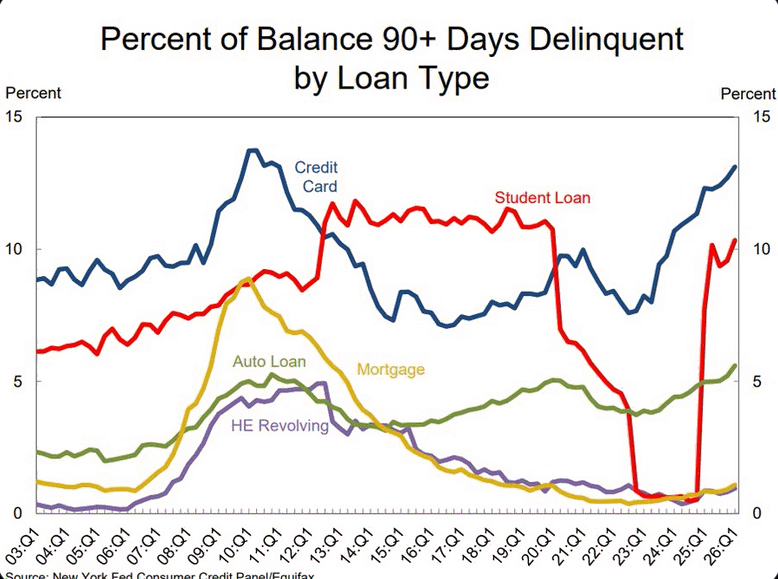
Chart of the Week: This chart, published Wednesday as Cisco’s AI supercycle data and PPI 6.0% landed simultaneously, captures the week’s most underappreciated tension: credit card 90+ delinquencies have reached 2010 GFC peak levels in a still-growing economy — not because of a recession, but because lower-income households are being squeezed by energy and tariff inflation. Thursday’s retail sales confirmed what the chart implies: the bottom half of the consumer income distribution is already in discretionary contraction while aggregate data still looks tolerable. With WTI at $105 and the Warsh Fed inheriting 3.8% CPI, the K-shaped stress signature visible here will deepen further before monetary policy can address it. Watch the card flow trajectory; mortgages, still near 1% delinquency, will not be the canary this cycle.
MIB Weekly Digest Ver. 1.57
For professional investors only. Not investment advice.
© 2026 RecessionALERT.com

Comments are closed.