
Fed holds 3.50–3.75% in historic 8-4 split as hawkish dissenters signal removal of easing bias; Trump locks in months-long Iran blockade as WTI surges 8.3% to $108/bbl and US gas hits 4-year high of $4.23/gal; UAE quits OPEC effective May 1; Atlanta Fed finalizes Q1 GDPNow at 1.2%, 110 bps below 2.3% consensus ahead of Thursday’s advance GDP + Core PCE release.
TABLE OF CONTENTS
A. EXECUTIVE SUMMARY
B. MARKET DATA
C. HIGH-IMPACT STORIES (5)
D. MODERATE-IMPACT STORIES (5)
E. ECONOMY WATCH (6)
F. EARNINGS WATCH (11)
G. WHAT’S NEXT
H. CHART OF THE DAY
A. EXECUTIVE SUMMARY -> TOP
MARKET SNAPSHOT
April 29’s surface calm on the S&P 500 (−0.03%) conceals one of the most structurally alarming sessions of 2026: nine of eleven sectors declined as WTI crude surged 8.3% to $108/bbl on Trump’s explicit confirmation of a months-long Iran naval blockade and Strait of Hormuz closure, while the FOMC voted 8-4 to hold at 3.50%–3.75% — the most fractious committee split since 1992. The simultaneous spike in yields (2Y +9.1 bps, 10Y +6.9 bps) and crude prices is the classical stagflation signature: cost-push inflation with a paralyzed central bank, not demand-driven growth. Only Energy (+2.0%) and fractional Technology (+0.34%) escaped the selloff; the Nasdaq’s earnings optimism — Intel +12%, Visa +8% — is doing the statistical work of holding the S&P index level while the underlying economic picture deteriorates on every other front, with breadth at its weakest in months.
TODAY AT A GLANCE
• Fed fractures on direction, not just pace: An 8-4 vote with dissenters in both directions — Miran demanding a cut, three hawks (Hammack, Kashkari, Logan) seeking to remove the easing bias entirely — eliminates forward guidance clarity just as Powell prepares to hand off to Kevin Warsh on May 15; rate cut odds collapsed 14 percentage points to 43% in a single session.
• Iran blockade locked in for months; gas at a 4-year high: Trump confirmed the naval blockade will continue indefinitely, keeping Strait of Hormuz traffic at ~5% of pre-war levels; the national gasoline average hit $4.23/gallon — a $20–30B annualized consumption tax on US households vs. year-ago levels — while UAE announced its exit from OPEC effective May 1, stripping the cartel of its second-largest producer (~3.2–3.5M bbl/day).
• Stagflation data bomb arrives Thursday: Atlanta Fed’s final Q1 GDPNow of 1.2% — 110 bps below the 2.3% Bloomberg consensus — prints alongside March Core PCE (exp. +0.3% MoM / +3.2% YoY) in a single release at 8:30 AM ET; Powell explicitly flagged oil would add ~0.6 percentage points to headline PCE, potentially pushing it above 3.0%.
• Semiconductor earnings lift Nasdaq against the macro tape: Intel +11.9% (AI/CPU demand beat, Q2 guidance above consensus), Visa +8.2% (cross-border volume +12%, $20B buyback), T-Mobile +6.2% (raised FY2026 guidance); Alphabet, Microsoft, and Meta report after-bell tonight — the Mag-7 earnings season is the primary counterweight to the oil/yield/stagflation headwinds.
• REITs, Utilities, Homebuilders face direct multiple compression: The 10Y at 4.42% and 2Y at 3.94% reflect a market pricing higher-for-longer; rate-sensitive sectors (Utilities −1.46%, Real Estate −0.84%) are the clearest casualties of the hawkish FOMC repricing, with Building Permits down 10.8% in March already signaling forward demand erosion.
• Core capex bright spot amid macro gloom: March durable goods nondefense capital goods ex-aircraft surged +3.29% — the strongest monthly gain since June 2020 — driven by the AI supply chain (computers +3.7%, comms equipment +3.0%), providing a counternarrative to the stagflation thesis: corporate investment conviction in AI infrastructure is intact even as broader conditions soften.
KEY THEMES
1. Stagflation Convergence Is Becoming the Baseline — Three forces arrived simultaneously on April 29: a 1.2% GDPNow (weakest since Q1 2023), oil-driven PCE overshoot explicitly acknowledged by the Fed Chair, and a paralyzed FOMC committee that cannot agree on direction. The policy trap is now visible — the Fed cannot cut (inflation too high) and cannot hike (growth too weak). Thursday’s Q1 GDP advance and Core PCE print is not a data release; it is the stagflation verdict. A sub-1.5% GDP + PCE above 2.8% combination would fundamentally reset 2026 equity risk appetite and the yield curve simultaneously.
2. The Fed Put Has Been Withdrawn — An 8-4 dissent with splits in both directions is unprecedented in modern policy history for its directional ambiguity. The committee has no consensus on where rates go next, no Chair continuity after May 15, and no forward guidance. The consequence for portfolio construction is concrete: sectors and strategies priced for two or more 2026 cuts — small-cap growth, dividend-growth, REITs, long-duration bond proxies — face a structural re-rating that a single data point cannot easily reverse. The “Fed backstop” assumption that has supported equity multiples through 2024–2025 cannot be relied upon for the remainder of 2026.
3. Energy as the Session’s Singular Variable — and Its Structural Shift — WTI +8.3%, Brent above $111, gas at $4.23 — every other major asset class either fell or barely broke even. This is not a commodity bull market; it is a geopolitical supply shock that is simultaneously repricing inflation, crushing rate-sensitive duration, eroding consumer discretionary spending power, and threatening industrial margins through the cost-push channel. The UAE’s OPEC exit adds a structural dimension beyond the immediate Hormuz crisis: long-term, an unshackled UAE can expand output independently, creating a bifurcated energy trade — near-term tightness (Hormuz) versus medium-term supply surge (UAE unconstrained). Portfolio managers must hold both scenarios simultaneously rather than anchoring to either the current shock or the eventual resolution.
 — Leading economic indicators. Accurate market forecasts. Apply for membership at join.recessionalert.com
B. MARKET DATA -> TOP
Today’s session fractured along two fault lines simultaneously. The S&P 500 barely moved (−0.03%) as Nasdaq’s tech-earnings optimism — Intel surging 12% on an AI/CPU demand beat, T-Mobile +6% on strong Q1 results — offset a fifth consecutive Dow losing day, with WTI crude’s 8.3% surge on Trump’s extended Iran naval blockade and Strait of Hormuz disruption crushing transports (−0.97%), utilities (−1.46%), and basic materials (−1.63%). Breadth was deeply negative: 9 of 11 sectors closed red, confirming the headline S&P flatness is a concentration artifact, not a health signal. The session’s most revealing anomaly: gold fell 1.1% despite crude’s supply-shock rally, as the Fed’s decision to hold rates at 3.50%–3.75% and the resulting yield spike (+9.1 bps on the 2Y, +6.9 bps on the 10Y) crushed the zero-yield metal’s appeal — leaving oil as the day’s sole inflation hedge with momentum.
CLOSING PRICES – April 29, 2026:
MAJOR INDICES
The session’s defining story is divergence, not direction: Nasdaq 100 +0.58% while the Dow fell for a fifth straight session, with Intel’s 12% earnings surge lifting semiconductors as oil-cost and yield pressure crushed transports, utilities, and blue-chips. Dow Theory non-confirmation is entrenched for a sixth consecutive session — the DJTA sits 14.2% below its 10-session peak while the DJIA hovers within 1.3% of its own high, signaling that transport-sector stress is deepening beneath the industrial headline. The S&P 500’s near-flat close (-0.03%) masks a profoundly narrow session; only Energy and a fractional Technology gain closed green among all 11 sectors.
| Index | Close | Change | %Move | Why It Moved |
|---|---|---|---|---|
| S&P 500 | 7,136.52 | −2.28 | −0.03% | Near-flat as semiconductor/earnings gains offset broad oil-cost and yield pressure; headline stability masks narrow breadth |
| Dow Jones | 48,861.68 | −280.25 | −0.57% | 5th consecutive losing session; oil surge raised inflation fears for blue-chip industrials and consumer names; FOMC hold failed to provide relief |
| DJ Transportation | 20,531.4 | −201.5 | −0.97% | WTI +8.3% on Iran blockade raised fuel-cost fears for airlines, trucking, and logistics; rising yields add financing cost pressure |
| Nasdaq 100 | 27,186.99 | +157.97 | +0.58% | Intel +12% on AI/CPU demand earnings beat; T-Mobile +6% on Q1 beat and raised guidance; positive sentiment ahead of Alphabet/Microsoft/Meta after-bell reports |
| Russell 2000 | 2,739.32 | −17.86 | −0.65% | Small-caps disproportionately exposed to fuel costs and tighter margins; rising yields crimp borrowing costs for leveraged small-cap balance sheets |
| NYSE Composite | 22,751.51 | −153.99 | −0.67% | Broad market decline reflecting 9-of-11 sector selloff; only Energy and fractional Technology gains escaped the oil-and-yields squeeze |
VOLATILITY & TREASURIES
VIX +5.3% and yields rising simultaneously is an inflation-fear signature — in a recession scare, yields fall as bonds catch a bid, but today both moved higher, confirming the Hormuz oil shock is repricing inflation, not growth. The 2Y rose 9.1 bps versus the 10Y’s 6.9 bps, compressing the already-inverted spread — short-end rates are catching up to long-end, signaling the market expects the Fed to stay on hold longer than the calendar suggests. DXY’s modest +0.34% gain is a mild safe-haven confirmation but far too subdued to reflect genuine flight-to-quality; the bond market is declining to participate in the equity relief rally.
| Instrument | Level | Change | Why It Moved |
|---|---|---|---|
| VIX | 18.78 | +0.95 (+5.33%) | Fear gauge rose as Iran/Strait of Hormuz oil shock escalated; uncertainty ahead of Mag-7 earnings and uncertainty around FOMC rate path |
| 10-Year Treasury Yield | 4.422% | +6.9 bps | Fed held at 3.50%–3.75%; WTI surge reignites inflation expectations, pushing long-end yields higher; bond market not providing equity-like relief |
| 2-Year Treasury Yield | 3.935% | +9.1 bps | Short-end surged more than long-end on FOMC hold; market pricing sticky near-term rates; 2Y–10Y spread compressed further (−48.7 bps) |
| US Dollar Index (DXY) | 98.96 | +0.34 (+0.34%) | Dollar firmed modestly on FOMC hold and mild safe-haven demand; subdued gain suggests market not in full risk-off flight despite oil shock |
COMMODITIES
Gold and oil have decisively decoupled — crude’s 8% supply-shock surge failed to lift the traditional inflation hedge as the FOMC’s rate hold kept “higher for longer” in force and crushed gold’s zero-yield appeal (−1.1%). All four precious and industrial metals fell in unison, with platinum’s −3.8% decline signaling auto-sector demand concerns beneath the oil headline. Bitcoin declined modestly in line with the risk-off equity tape, tracking sentiment rather than acting as an independent inflation hedge — no crypto-specific catalyst evident.
| Asset | Price | Change | %Move | Why It Moved |
|---|---|---|---|---|
| Gold | $4,558.11/oz | −$50.29 | −1.09% | FOMC rate hold (“higher for longer”) reduced gold’s zero-yield appeal; oil’s surge failed to trigger the usual safe-haven bid as rate-path dominates the narrative |
| Silver | $71.802/oz | −$1.943 | −2.63% | Tracked gold lower; additional industrial demand pressure from copper weakness; dual precious/industrial nature amplified the decline |
| Copper | $5.919/lb | −$0.055 | −0.92% | Global growth concerns weighed; oil-cost inflation signals potential demand slowdown for industrial metals; rising yields tighten financial conditions for commodity demand |
| Platinum | $1,883.90/oz | −$74.90 | −3.82% | Sharpest precious metals decline; auto-sector demand concerns as oil squeeze raises vehicle ownership costs; industrial component weakness compounded by gold’s drop |
| Bitcoin | $75,638 | −$902 | −1.18% | Modest risk-off decline tracking equity sentiment; no crypto-specific catalyst; trading as a correlated risk asset rather than an independent inflation hedge |
ENERGY
WTI and Brent moved in near-lockstep (+8.3% and +6.8%) with a narrow spread, confirming this is a global supply disruption — Iran’s Strait of Hormuz closure is choking ~20% of world oil trade. Natural gas sat out the crude rally entirely (Henry Hub −1.6%), confirming the move is a geopolitical crude supply shock, not a broad energy-inflation trade. Critically, oil surged while equities declined: a stagflationary read, not a demand/growth story — rising oil alongside falling broad indices signals cost-push pressure, not economic acceleration.
| Asset | Price | Change | %Move | Why It Moved |
|---|---|---|---|---|
| Crude Oil (WTI) | $108.18/bbl | +$8.25 | +8.26% | Trump vowed to maintain Iran naval blockade until nuclear deal; Strait of Hormuz closure blocks ~20% of global oil trade; WSJ reported plans for extended blockade lasting months |
| Crude Oil (Brent) | $111.48/bbl | +$7.08 | +6.78% | Global benchmark rose in lockstep with WTI on Hormuz disruption; narrow WTI–Brent spread confirms global, not regional, supply shock; Iran stalled on nuclear deal |
| Natural Gas (Henry Hub) | $2.649/MMBtu | −$0.042 | −1.56% | US domestic gas decoupled from oil surge; LNG export demand stable but not accelerating; adequate inventory levels; confirms move is crude-specific, not a broad energy trade |
| Natural Gas (Dutch TTF) | $16.03/MMBtu | +$1.07 | +7.15% | European gas followed crude higher as Hormuz disruption threatens LNG re-routing through alternative supply chains; Europe more vulnerable than the US to Middle East energy shock |
S&P 500 SECTORS
9 of 11 sectors closed red in a near-uniform macro flush, confirming the Iran oil shock and FOMC hold are systemic pressures, not selective. Energy (+2%) is the sole clear winner, riding the crude surge; Technology barely escaped red (+0.34%) on semiconductor earnings momentum. The most telling signal: Basic Materials — the 6-month leader at +22.5% — led the session’s declines at −1.63%, suggesting the oil supply shock is being read as industrial demand destruction, not broad commodity strength. Healthcare’s structural bleeding continues: −0.95% today, −3.02% this week, −7.09% over 3 months.
| Sector | 1-Day | 1-Week | 1-Month | 3-Month | 6-Month | YTD | 12-Month |
|---|---|---|---|---|---|---|---|
| Energy | +2.00% | +3.70% | −2.58% | +19.55% | +35.09% | +33.44% | +46.57% |
| Technology | +0.34% | −0.04% | +22.55% | +5.85% | +3.26% | +8.72% | +49.18% |
| Communication Services | −0.02% | +0.41% | +17.21% | +1.33% | +4.95% | +3.26% | +42.50% |
| Consumer Cyclical | −0.13% | −1.53% | +11.60% | −4.79% | −4.71% | −2.72% | +17.13% |
| Consumer Defensive | −0.40% | +0.24% | +1.38% | +1.51% | +6.51% | +7.45% | +6.35% |
| Financial | −0.44% | −0.93% | +7.95% | −2.79% | +0.63% | −3.38% | +14.37% |
| Industrials | −0.82% | −1.25% | +9.57% | +3.41% | +10.30% | +11.41% | +35.74% |
| Real Estate | −0.84% | +0.23% | +8.07% | +5.12% | +1.57% | +6.76% | +6.94% |
| Healthcare | −0.95% | −3.02% | +0.34% | −7.09% | −1.64% | −6.39% | +6.84% |
| Utilities | −1.46% | +1.13% | +0.74% | +4.23% | +1.14% | +7.42% | +19.33% |
| Basic Materials | −1.63% | −4.67% | +5.01% | −5.63% | +22.51% | +12.73% | +46.03% |
TOP MEGA-CAP MOVERS:
GAINERS
| Company | Ticker | Close | Change | Why It Moved |
|---|---|---|---|---|
| Intel Corp | INTC | $94.60 | +11.92% | Q1 2026 beat: revenue +7% YoY to $13.6B; Q2 guidance well above consensus; agentic AI workloads driving CPU shortage; Citi and Evercore upgraded to Buy/Outperform post-results |
| Visa Inc | V | $334.52 | +8.15% | After-bell Q1 beat (reported Apr 28): net rev $11.2B vs $10.75B est; adj EPS $3.31 vs $3.10; payments vol +9%, cross-border +12%; new $20B share buyback authorized |
| T-Mobile US Inc | TMUS | $198.24 | +6.17% | Q1 beat: EPS $2.27 vs $1.99 est; total service rev $18.8B (+11% YoY); raised FY2026 guidance; strategic fiber JV announcements added to positive sentiment |
| Advanced Micro Devices Inc | AMD | $336.37 | +4.07% | Intel earnings halo; AI/agentic demand broadly bullish for semiconductor sector; investors positioned ahead of AMD’s own results; NXP Semiconductors’ +19% beat reinforced the sector bid |
| Mastercard Incorporated | MA | $525.31 | +3.48% | Visa earnings halo; Visa’s cross-border volume beat signals broad payment network strength; both V and MA benefited from strong consumer cross-border spending data |
DECLINERS
| Company | Ticker | Close | Change | Why It Moved |
|---|---|---|---|---|
| Lilly (Eli) & Co | LLY | $851.21 | −2.61% | Pre-earnings nervousness ahead of Q1 report (due April 30 BMO); broader healthcare sector weakness (−0.95%); oil-driven inflation concerns may crimp pharma margin outlooks |
| International Business Machines Corp | IBM | $227.10 | −2.55% | Rotation into semiconductor AI plays (INTC +12%, AMD +4%) weighed on legacy IT services; rising yields (2Y +9.1 bps) pressured long-duration enterprise-tech valuations |
| GE Vernova Inc | GEV | $1,063.11 | −2.37% | Industrials sector under oil-cost pressure (−0.82%); energy equipment spending faces margin concerns as elevated crude raises input costs for power infrastructure build-out |
| Goldman Sachs Group Inc | GS | $905.60 | −2.26% | Financial sector hit by rising yields (2Y +9.1 bps); FOMC hold delays rate-cut tailwind for investment banking; oil-driven inflation fears weigh on M&A and deal-flow outlook |
| Palantir Technologies Inc | PLTR | $138.02 | −2.24% | Profit-taking in high-multiple AI software ahead of Mag-7 earnings; rising yields compressed growth/duration-sensitive valuations; modest risk-off rotation out of speculative tech |
— Institutional-grade intelligence for serious investors. Apply for membership at join.recessionalert.comC. HIGH-IMPACT STORIES -> TOP
UNCERTAIN
1. Federal Reserve Holds 3.50–3.75% Amid Historic 8-4 Dissent — Two-Way Policy Risk Emerges at Powell’s Final Meeting
The core facts:The FOMC voted 8-4 to hold the federal funds rate at 3.50–3.75%, marking the highest dissent count since October 1992. The split revealed a deeply fractured committee: Governor Stephen Miran (his 6th consecutive dissent) preferred a 25bps rate cut, while Governors Hammack, Kashkari, and Logan voted to hold but opposed retaining the statement’s easing bias — effectively signaling they lean toward higher-for-longer. The FOMC statement cited “heightened uncertainty” from Middle East developments and acknowledged inflation “remains elevated, in part reflecting the recent increase in global energy prices.” The 10-year Treasury yield jumped 5bps to 4.41%; the S&P 500 closed nearly flat at 7,135.95; the Dow fell 280 points, its 5th consecutive losing session.
Why it matters:A split with dissents in opposite directions — one member demanding a cut, three demanding tighter guidance — is historically unusual and signals the Fed board cannot agree on even the direction of future policy. The three hawkish dissenters (Hammack, Kashkari, Logan) seeking to remove the easing bias would signal rate hikes are back on the table; Miran’s cut preference signals growth deterioration demands stimulus. For portfolio managers, this ambiguity eliminates the predictable Fed put that has backstopped equity markets through 2024-2025. The 10Y jump to 4.41% reflects the bond market pricing a higher-for-longer base case, compressing duration in fixed income portfolios and raising the cost of capital for rate-sensitive sectors.
What to watch:Monitor Fed speak in coming days for any hawkish governor explicitly calling for removal of the easing bias — that would be the clearest signal rates are going higher, not lower. Watch the May 15 Chair transition: Powell’s successor will inherit this fractured committee and its unresolved policy disagreements.
UNCERTAIN
2. UAE Quits OPEC Effective May 1 — Cartel Loses Second-Largest Producer as Structural Cohesion Fractures
The core facts:The United Arab Emirates announced it will exit OPEC effective May 1, 2026, calling it a “sovereign national decision” to prioritize its own independent production expansion. The UAE is OPEC’s second-largest producer, pumping approximately 3.2–3.5 million barrels per day and accounting for roughly 14% of OPEC’s total output. The move delivers a structural blow to Saudi Arabia’s ability to enforce production discipline within the cartel. Brent crude topped $115/bbl on the announcement. U.S. gas prices reached a 4-year high of $4.23/gallon. President Trump praised the UAE’s decision as “a good thing.”
Why it matters:The UAE’s exit strips OPEC of a disproportionately productive and financially sophisticated member and creates a precedent for other disaffected Gulf states. Long-term, an unshackled UAE can ramp output independently, exerting downward pressure on oil prices — structurally positive for US consumers, inflationary relief, and the Fed’s rate path. However, in the near term, this news compounds the energy crisis narrative while physical supply through Hormuz remains constrained at 5% of pre-war levels. For energy sector investors, the UAE’s exit creates a bifurcated dynamic: near-term tightness (Hormuz crisis) vs. longer-term supply surge as the UAE expands unconstrained by OPEC quotas.
What to watch:Watch Saudi Aramco’s production response — whether Riyadh attempts to compensate for UAE output or cedes pricing authority signals how viable the remaining OPEC structure is. Any additional OPEC member signaling exit plans would trigger a step-change lower in the cartel’s long-term pricing power.
BEARISH
3. Trump Signals Months-Long Iran Siege — WTI Surges 7% to $107 as Hormuz Traffic Remains at 5% of Pre-War Levels
The core facts:The White House confirmed April 29 that President Trump is preparing officials for a prolonged U.S. naval blockade of Iranian ports, which has been in effect since April 13. Trump told Axios: “The blockade is somewhat more effective than the bombing. They are choking like a stuffed pig, and it is going to be worse for them.” Traffic through the Strait of Hormuz — which normally carries ~20 million barrels/day (~20% of world oil trade) — currently runs at approximately 5% of pre-war levels. Iran has offered to reopen Hormuz in exchange for a ceasefire and blockade lift; Trump has rejected the offer. WTI crude surged nearly 7% to settle at approximately $106.88/barrel; Brent topped $115.
Why it matters:Hormuz at 5% capacity is the single largest oil supply disruption in modern history, according to the IEA, which has already coordinated its largest-ever emergency reserve release (400 million barrels across 32 member countries). Trump’s explicit language of a prolonged siege removes near-term resolution hopes, locking in elevated oil prices through at least mid-2026. Every 10-cent increase in U.S. gasoline hurts consumer discretionary spending by an estimated $10–15B annually; at $4.23/gallon national average, US consumers are absorbing ~$20–30B in annualized incremental energy costs vs. year-ago levels. For the Fed, this pins energy-driven CPI/PCE in the elevated zone, making rate cuts politically and practically difficult through the summer.
What to watch:Monitor Strait of Hormuz tanker traffic via AIS tracking (VesselFinder, MarineTraffic). Any diplomatic ceasefire signal would send oil futures down 15–20% immediately — the April ceasefire demonstrated this binary nature. Iran’s next formal proposal is the key catalyst.
BEARISH
4. Brent Tops $115, U.S. Gas Hits 4-Year High of $4.23 — Powell Explicitly Flags Energy-Driven PCE Overshoot Risk
The core facts:Brent crude oil topped $115/barrel intraday April 29 while WTI settled near $107, as the Iran blockade and UAE OPEC exit compounded supply tightness. The national average gasoline price hit $4.23/gallon — a 4-year high. Federal Reserve Chair Powell explicitly stated at the April 29 FOMC press conference that “elevated oil prices will push up overall inflation” in the near term, with analyst estimates suggesting energy inflation will add approximately 0.6 percentage points to the March headline PCE print (due Thursday). The 10-year Treasury yield climbed to 4.41% (+5bps), approaching its highest level of the year.
Why it matters:Powell’s explicit flagging of oil-driven PCE overshoot at the FOMC press conference directly ties the energy crisis to the Fed’s rate path — it means the central bank has acknowledged it cannot ignore energy inflation even as growth softens. The 0.6pp PCE uplift could push headline PCE toward or above 3.0%, far from the 2% target. For fixed income portfolios, the 10Y at 4.41% with a stagflation backdrop is an unfavorable risk/reward — duration is being compressed. For equity markets, rate-sensitive sectors (REITs, utilities, homebuilders) face a direct valuation headwind as higher-for-longer repricing accelerates. Consumer discretionary is doubly exposed: energy costs are effectively a consumption tax on the lower 60% of households by income.
What to watch:Thursday’s March Core PCE release — a headline above 2.8% or core above 2.7% would confirm the energy-driven overshoot and further reduce 2026 rate cut probability. Gas price trajectory is the real-time leading indicator; any sustained move above $4.50/gallon would qualitatively change the Fed’s near-term optionality.
BEARISH
5. Atlanta Fed GDPNow Finalizes Q1 at 1.2% — 110bps Below 2.3% Consensus Ahead of Thursday’s Advance Release
The core facts:The Atlanta Federal Reserve updated its GDPNow model estimate for Q1 2026 real GDP growth to 1.2% on April 29 — its final update before the BEA’s official Q1 Advance Estimate release on Thursday April 30. The 1.2% print is approximately 110 basis points below the Wall Street consensus of 2.3% and represents a significant deceleration from what the Fed has characterized as “solid” prior-quarter growth. GDPNow historically tracks the advance estimate with high fidelity in its final weeks.
Why it matters:A 1.2% Q1 GDP print — if confirmed Thursday — would be the weakest quarterly growth reading since Q1 2023, and its simultaneous arrival with oil-driven PCE overshoot above 2.8% is the textbook stagflation setup: below-trend growth plus above-target inflation. For equity markets, this raises earnings revision risk for cyclicals and consumer discretionary, reduces the probability of a soft landing, and increases the pressure on the Fed to respond — but the FOMC’s 8-4 split shows it cannot agree on direction. For the 10Y yield, a sub-1.5% GDP print combined with elevated PCE would create a genuinely unprecedented policy challenge: the Fed cannot cut (inflation too high) and cannot hike (growth too weak). This is the scenario that historically drives a flattening or inversion of the yield curve.
What to watch:Thursday April 30 BEA Q1 GDP Advance Estimate is the immediate binary catalyst — a sub-1.5% print would materially reset equity risk appetite. The Core PCE same day sets the inflation side of the ledger. Together they define the Fed’s remaining optionality for 2026.
— Quantifying recession risk so you don’t have to guess. Apply for membership at join.recessionalert.comD. MODERATE-IMPACT STORIES -> TOP
UNCERTAIN
6. Powell Declares “Political Attacks Left Me No Choice” — Will Remain on Fed Board as Governor Through 2028
The core facts:During what is likely his final press conference as Federal Reserve Chair, Jerome Powell confirmed he will remain on the Board of Governors after his chairmanship ends May 15, 2026. Powell stated explicitly that political attacks — a reference to sustained Trump administration pressure over the past two years to remove him or override Fed independence — had “left him no choice” but to stay on the board to safeguard institutional stability. His governor term runs through 2028, giving him a voting seat on the FOMC alongside his successor. Kevin Warsh is widely expected to be nominated as the new Chair.
Why it matters:A departing chair publicly invoking political attacks as the reason to stay on the board is an extraordinary, unprecedented statement about the state of Fed-White House relations. For markets, Powell’s continued presence as a voting governor provides a modest stabilizing signal — he will be able to moderate any abrupt hawkish pivot under a new Chair and preserve institutional credibility in FOMC deliberations. However, the language itself — framing his decision as defensive and compelled — signals that the political pressure on the Fed is severe enough to require unusual personal sacrifice. For long-duration assets and rate markets, the underlying uncertainty about the incoming Chair’s direction (Warsh has historically leaned hawkish) remains unresolved.
What to watch:Any speech or interview by Kevin Warsh before May 15 that signals his preferred policy stance — the gap between Warsh and Powell on the board could create visible, investable FOMC vote splits in H2 2026.
BEARISH
7. Post-FOMC Rate Cut Odds Collapse 14pp to 43% — Markets Reprice Fed Path as Hawks Signal Easing Bias Should Be Removed
The core facts:Following the FOMC announcement, Polymarket’s Fed rate cut probability for 2026 collapsed 14 percentage points to 43% in a single trading session — the largest single-day repricing of Fed cut expectations in 2026. The move reflects the hawkish read on three dissenters (Hammack, Kashkari, Logan) who argued the easing bias should be removed from the statement, implying the committee’s effective center of gravity has shifted toward higher-for-longer. The 10-year Treasury yield rose 5bps to 4.41%. Rate-sensitive sectors including REITs, homebuilders, and utilities underperformed the broader tape.
Why it matters:A 14pp single-session collapse in rate cut odds is a significant reset of the 2026 equity discount rate backdrop. Sectors and strategies that were priced for two or more 2026 cuts — small-cap growth, dividend-growth, REITs, and long-duration bond proxies — face an immediate multiple compression headwind. The reset is particularly adverse for homebuilders (mortgage rates are closely tied to 10Y), where affordability stress has been building for 18 months. The 43% cut probability also means the options and bond markets are now approximately at coin-flip odds, implying the expected volatility in Fed-sensitive instruments rises significantly from here.
What to watch:Thursday’s Q1 GDP Advance and Core PCE are the nearest-term data points that will either validate or reverse this repricing. Weak GDP + hot PCE locks in higher-for-longer; strong GDP + cooling PCE reopens the cut debate. Watch also for any Fed governor speeches this week that confirm or walk back the hawkish dissent language.
UNCERTAIN
8. Russia Reaffirms OPEC+ Commitment After UAE Exit — Kremlin Hopes Alliance Survives Energy Market Turmoil
The core facts:Russia officially confirmed April 29 it will remain in the OPEC+ alliance following the UAE’s exit announcement. Kremlin spokesman Dmitry Peskov described OPEC+ as “especially crucial when energy markets are in turmoil,” citing its role in minimizing market fluctuations. Russia is the second-largest OPEC+ producer behind Saudi Arabia. Peskov expressed hope the UAE’s departure would not trigger a broader Gulf producer defection, and other OPEC members publicly backed continued alliance membership.
Why it matters:Russia’s public reaffirmation limits the immediate disintegration risk from the UAE shock — the alliance retains its two largest producers (Saudi Arabia and Russia) even without the UAE. For near-term oil prices, this partial stabilization signal is a slight negative offset to the UAE’s exit narrative; the remaining OPEC+ producers still control substantial combined output capacity. However, Russia’s historical compliance with OPEC+ quotas has been inconsistent, and its wartime economic pressures (defense spending, sanctions) create incentives for quiet production increases. The net effect is an OPEC+ that is weakened structurally but not immediately dissolved.
What to watch:Monitor any subsequent Gulf producer signals about OPEC membership reconsideration — a second major exit following the UAE would be the decisive blow to the cartel’s pricing power. Russia’s actual production figures in May-June will confirm whether it is maintaining quota compliance or quietly cheating.
UNCERTAIN
9. PayPal Makes Venmo a Standalone Business Unit — New CEO Signals Potential Sale as Stripe Circles the Asset
The core facts:PayPal Inc. (~$120B market cap) announced April 29 that new CEO Enrique Lores — who came from HP in March 2026 — is restructuring the company into three business segments: Checkout Solutions & PayPal, Consumer Financial Services & Venmo, and Payment Services & Crypto. Venmo will operate as an independent segment, making it substantially easier to track its standalone performance or execute a sale. Reports indicate Stripe is among the parties evaluating a Venmo acquisition. Two senior executives departed as part of the reorganization: Diego Scotti (consumer group) and Michelle Gill (small-business group). This restructuring follows years of PayPal losing checkout market share to Apple Pay, Google Pay, and Stripe.
Why it matters:Venmo has 90M+ users, growing monetization through Pay with Venmo and business profiles, and is widely regarded as PayPal’s single most valuable asset and most acquirable business. A combination with Stripe would merge Stripe’s dominant B2B infrastructure with Venmo’s consumer scale, creating a potential category-defining payments platform. For fintech sector investors, this restructuring confirms the strategic pivot away from PayPal’s integrated model and signals a value unlock event is being actively prepared. The separation also pressures competitors: Visa/Mastercard and Block (SQ) must now anticipate a potentially much larger Stripe in the consumer payments market.
What to watch:PayPal’s upcoming earnings call — the first test of investor reception to the new three-segment structure and the pace of a formal Venmo sale process. Any formal acquisition announcement would be a significant premium-valuation event for PYPL.
UNCERTAIN
10. Finland’s Kone to Acquire TK Elevator for $34.4B — Otis Faces World’s Largest Elevator Rival With U.S. Ambitions
The core facts:Kone Oyj (Finland) agreed April 29 to acquire TK Elevator — formerly a ThyssenKrupp unit, owned by PE firms Advent and Cinven — for €29.4 billion ($34.4 billion), one of Europe’s largest corporate transactions in recent years. The deal combines €5B cash, ~270 million new Kone Class B shares (~€15.2B), and ~€9.2B debt assumption. The combined entity would become the world’s largest elevator manufacturer by market value, overtaking U.S.-based Otis Worldwide (~$29.7B market cap). Kone specifically cited TK Elevator’s Americas business as a key strategic rationale — extending its historically limited U.S. geographic footprint. Closing is targeted no earlier than Q2 2027, pending antitrust clearance across multiple jurisdictions. Swiss rival Schindler has signaled it will raise antitrust objections.
Why it matters:For U.S. investors, Otis Worldwide is the primary competitive casualty — it will face a materially larger, better-capitalized rival with an expanded Americas footprint bidding for new installations, service contracts, and modernization projects. The pricing and contract dynamics in the U.S. elevator and escalator market will shift as Kone+TK Elevator gains scale. The deal also signals that industrial consolidation is proceeding aggressively in 2026 despite elevated borrowing costs and energy market volatility — private equity remains willing to monetize large industrial assets at significant premiums. For M&A watchers, the antitrust path is contested and complex, making the 2027 close date optimistic.
What to watch:Otis (OTIS) stock reaction and any strategic response — acquisitive M&A by Otis or pre-emptive contract defense moves would confirm the competitive threat is being internalized. U.S. DOJ review timeline will determine the competitive uncertainty window.
— Separating signal from noise since 2007. Apply for membership at join.recessionalert.comE. ECONOMY WATCH -> TOP
The week’s defining tension pits AI-driven capex strength against macro fragility: core capital goods surged +3.3% (best since June 2020) while GDPNow sits at 1.2% — 110 bps below the 2.3% consensus ahead of tomorrow’s advance GDP release. Powell’s final FOMC produced an 8-4 split, the most fractured vote since 1992, as three members opposed even a hint of easing bias amid sticky inflation and Middle East uncertainty. A widening goods trade gap (-$87.9B) and collapsing building permits (-10.8%) add to the downside case, though Goldman Sachs lowered its 12-month recession odds to 20%, down from 30% in March. All eyes turn to Thursday’s Q1 GDP advance and March Core PCE — the first hard test of how these cross-currents resolve.
Fed Holds 3.50–3.75% in Historic 8-4 Split as Powell Chairs Final Meeting (Federal Reserve, April 29, 2026)
What they’re saying:The FOMC voted 8-4 to hold the fed funds rate at 3.50%–3.75% for the third consecutive meeting — the most dissents since 1992. Three hawkish dissenters (Hammack, Kashkari, Logan) opposed language suggesting any easing bias; a fourth member dissented in the opposite direction, seeking a cut. The committee cited “heightened uncertainty” from Middle East conflicts (US-Israel war with Iran) and offered zero forward guidance on timing of rate cuts. Chair Powell — attending his final FOMC press conference before Kevin Warsh takes over May 15 — stated cuts are “not on the agenda” as long as the economy continues to grow, and confirmed he will remain on the Board of Governors to assist with the transition.
The context:An 8-4 split is a rare signal of a committee at a genuine crossroads: hawks fear sticky inflation entrenched by energy prices; the lone dove sees growth risk materializing faster than the consensus acknowledges. Without forward guidance, markets are left to price the path on their own — a vacuum that pushed “0 cuts in 2026” odds to ~58% on Polymarket in today’s session. Powell’s decision to stay on as Governor rather than exit cleanly adds an unusual institutional overhang entering the Warsh era.
What to watch:Kevin Warsh’s Senate confirmation timeline; any Fed speaker commentary on the dissent rationale in coming days; Thursday’s Q1 GDP advance and Core PCE for the data that will define the new chair’s opening policy stance.
Atlanta Fed Finalizes Q1 GDPNow at 1.2% — 110 bps Below Tomorrow’s 2.3% Consensus (Atlanta Fed, April 29, 2026)
What they’re saying:The Atlanta Fed’s GDPNow model finalized its Q1 2026 real GDP growth estimate at 1.2% SAAR on April 29, unchanged from its April 21 reading. The model cites private domestic investment gains offset by a significant deterioration in net exports — consistent with the March goods trade deficit surge. The official BEA advance GDP estimate is due tomorrow (April 30), with the Bloomberg consensus sitting at 2.3%.
The context:A 110-basis-point gap between GDPNow and consensus is unusually wide entering an advance release. The divergence likely traces to how forecasters are treating the March import surge — if front-running tariffs boosted inventories rather than demand, some of the trade drag reverses in subsequent quarters. But the near-term GDP print will still reflect the headline hit. At 1.2%, Q1 would mark the weakest growth quarter since early 2023.
What to watch:BEA Advance Q1 GDP (Thu Apr 30, 8:30 AM ET, consensus 2.3%); March Core PCE (same release, consensus +0.3% MoM / +3.2% YoY) — a weak GDP + elevated PCE print would crystallize stagflation concerns and put the FOMC dovish dissenter back in focus.
Goldman Cuts 12-Month Recession Odds to 20%; Philly Fed Anxious Index Holds at Elevated 20.9% (Multiple Sources, April 2026)
What they’re saying:Goldman Sachs lowered its 12-month U.S. recession probability to 20% in its April update, down from 30% in March as earlier oil price spike fears moderated; the firm’s base case calls for U.S. GDP growth of 2.6% in 2026. The Philadelphia Fed’s Q1 2026 Survey of Professional Forecasters places the “Anxious Index” — probability of real GDP declining in Q2 2026 — at 20.9%, down from a peak of 24.0% but still elevated. Polymarket pegs recession-by-end-2026 odds at 26%.
The context:The directional improvement in Goldman’s estimate — down 10pp in six weeks — reflects the same tariff-moderation narrative driving the equity rally. But 20%+ recession probability across multiple forecasters is not benign; it represents a persistent tail risk that keeps credit spreads elevated and capital allocation cautious. Bloomberg analysts warn that a stagflationary outcome (GDP miss + sticky inflation) would force the FOMC’s hand in ways current models don’t fully price — with the policy response constrained by a divided, transitioning committee.
What to watch:Tomorrow’s Q1 GDP advance and Core PCE are the next major data inputs for forecaster models; a GDP print at or below 1.5% would likely reverse the Goldman improvement and push Polymarket recession odds back above 30%.
March Housing Starts Surge to 15-Month High at 1.502M, But Building Permits Plunge 10.8% (Census Bureau, April 29, 2026)
What they’re saying:Privately-owned housing starts in March hit 1.502M SAAR — 10.8% above February’s 1.356M and above the 1.400M consensus, the highest reading since December 2024. Single-family starts led at 1.032M (+9.7% MoM). Building permits fell sharply to 1.372M (-10.8% MoM, -7.4% YoY), missing the 1.390M estimate — a divergence that splits the near-term construction picture from forward-looking demand signals.
The context:Starts beat on units already in the ground; permits signal what builders are authorizing next. A -10.8% MoM permit drop — while single-family permits fell 3.8% — suggests builder confidence is retreating even as active construction picks up. With MBA mortgage applications down 1.6% and the 30-year rate back above 6.37%, demand-side headwinds are accumulating. The starts beat contributes modestly to Q1 GDP residential investment; the permit miss argues against a sustained construction recovery into Q2.
What to watch:April pending home sales and existing home sales (due mid-May) for confirmation that the demand side is softening; May permits for whether the March drop was noise or trend reversal.
March Durable Goods Orders Beat at +0.8%; Core Capex Proxy Surges +3.3% — Best Since June 2020 (Census Bureau, April 29, 2026)
What they’re saying:New orders for manufactured durable goods rose 0.8% in March to $318.9B, beating the 0.5% consensus. The standout was core capex — nondefense capital goods orders excluding aircraft — which surged +3.29%, the largest monthly gain since June 2020, smashing the +0.5% estimate. February’s core capex was revised up to +1.60%. The AI-supply-chain complex drove the beat: computers and electronic products +3.7% (up 11 of the last 12 months), communications equipment +3.0%, electrical equipment +0.7%. Core capex is now up 6.7% year-over-year with gains in each of the last 12 months, extending the nominal all-time high.
The context:Core capex is the single best leading indicator of business investment intentions, and a +3.29% surge — even in a month dominated by Fed uncertainty — signals corporate conviction in AI infrastructure spending is intact. The 12-month run and +6.7% YoY pace argue directly against a capex recession narrative. For portfolio managers, this is the data point that keeps the tech and industrial hardware bull case alive even as macro conditions soften.
What to watch:April core capex orders (released late May) for durability; Q1 GDP nonresidential fixed investment component tomorrow — the capex surge should show up here and meaningfully offset the trade drag in the advance release.
Advance Goods Trade Deficit Widens 5.3% to -$87.9B in March; Import Surge Compounds GDP Drag (Census Bureau, April 29, 2026)
What they’re saying:The advance international trade deficit in goods widened to $87.9B in March — a 5.3% jump from February’s $83.5B and above the $86.95B consensus. Imports surged $9.6B to $299.3B, led by motor vehicles (+11%), while exports rose $5.2B to $211.5B. Wholesale inventories rose 1.4% (above the 0.4% estimate) and retail inventories climbed 0.7%, suggesting much of the import surge was absorbed into stockpiles rather than final demand.
The context:A widening trade deficit is a direct subtraction from GDP (net exports), and the March surge is a primary driver of GDPNow’s 1.2% tracking figure vs. the 2.3% consensus. The inventory build is a mitigating factor — tariff front-running that filled warehouses rather than boosted consumption drags Q1 GDP but creates a positive inventory carryover into Q2. The motor vehicle import spike in particular reads as stockpiling behavior ahead of potential auto tariff implementation.
What to watch:Tomorrow’s advance GDP net exports and inventory change components for the full Q1 trade impact; April trade data (released late May) to see if front-running reverses as expected.
— Know the probability before the market prices in the risk. Apply for membership at join.recessionalert.comF. EARNINGS WATCH -> TOP
YESTERDAY AFTER THE BELL (Markets Reacted Today)
BULLISH
11. Starbucks (SBUX): +5% | Turnaround Confirmed — U.S. Traffic Growth for Second Straight Quarter, Guidance Raised
The Numbers:Q2 FY2026 Revenue: $9.5B (+9% YoY). Non-GAAP EPS: $0.50. Global comparable store sales: +6.2% (vs. +4.0% est). U.S. comparable store sales: +7.1%, driven by +4.3% transaction growth. FY2026 guidance raised: Global SSS now expected +5% (from +3% prior); adjusted EPS range raised to $2.25–$2.45 (from $2.15–$2.40). Released: AMC April 28.
The Problem/Win:Second consecutive quarter of U.S. transaction growth — the clearest confirmation yet that SBUX’s operational turnaround under CEO Brian Niccol is taking hold. The 4.3% transaction jump represents the strongest U.S. traffic growth in three years, addressing the core bear case (customer defection to McDonald’s McCAfé, Dutch Bros, and independents) directly.
The Ripple:Strong Starbucks traffic data is a positive read for discretionary consumer resilience in the morning routine segment. Modest read-through for restaurant peers — though the elevated gasoline environment ($4.23/gallon) constrains how far discretionary spending can run.
What It Means:SBUX’s raised guidance confirms the turnaround is more than a base-effect bounce — sustained traffic growth at this rate suggests the brand repair under Niccol is durable. Watch for operating margin expansion in H2 FY2026 as the volume leverage flows through.
BULLISH
12. Visa (V): +6% | Fastest Revenue Growth Since 2013 — $20B Buyback Added, Cross-Border Payments Surge
The Numbers:Q2 FY2026 Revenue: $11.2B (+17% YoY — fastest growth since 2013, excluding pandemic rebound). EPS: $3.31 vs. $3.16 est (+4.7% beat). Payments volume: +9% to $3.7 trillion. Processed transactions: +9% to 66 billion. New $20B share buyback authorization. Released: AMC April 28.
The Problem/Win:The 17% revenue surge reflects a powerful combination of strong cross-border travel volumes (the travel recovery story is still running), consumer spending resilience (Visa’s data directly measures real-time spending), and accelerating digital payment adoption. The $20B buyback is the largest single authorization in Visa’s history and signals confidence in cash generation.
The Ripple:Visa’s 17% revenue growth is a direct positive read-through for Mastercard (MA reports April 30 BMO — consensus $8.26B revenue). Also broadly positive for the US consumer spending narrative, partially offsetting the macro headwinds from elevated gas prices.
What It Means:Visa is benefiting from the structural secular shift to digital payments plus a strong consumer spending base in the U.S. and internationally. The 17% revenue growth rate — if sustained into Q3 — would represent a material upward revision to Visa’s long-term earnings trajectory.
What to watch:Mastercard (MA) Q1 results pre-market Thursday April 30 for confirmation of the cross-border travel and consumer spending trends Visa described.
TODAY BEFORE THE BELL (Markets Already Reacted)
BULLISH
13. AbbVie (ABBV): +3.14% | Skyrizi Powers Immunology to $7.3B Quarter as HUMIRA Transition Exceeds Expectations
The Numbers:Q1 2026 Revenue: $15.002B vs. $14.72B est (+1.9% sur; +12.4% YoY). EPS: $2.65 vs. $2.59 est (+2.3% sur). Immunology: $7.29B (+16.4%); Skyrizi: $4.483B (+30.9%); Rinvoq: $2.1B (+20.2%); HUMIRA: $688M (-40.3%). Neuroscience: $2.9B (+24.3%, Vraylar $905M +18.4%). FY2026 EPS guidance raised to $14.08–$14.28 (raised by $0.12). Released: BMO April 29.
The Problem/Win:The Skyrizi + Rinvoq combination is exceeding even optimistic sell-side peak consensus estimates — Skyrizi at $4.5B quarterly run rate is tracking toward an $18B+ annual franchise, making the bear case on HUMIRA biosimilar cannibalization increasingly irrelevant. Neuroscience at $2.9B demonstrates AbbVie has diversified beyond its legacy immunology dependency.
The Ripple:AbbVie’s immunology strength is a sector-positive signal for Eli Lilly (LLY, reports Apr 30 BMO) and Johnson & Johnson’s immunology portfolio. The HUMIRA biosimilar drag (-40.3%) is well-telegraphed and not accelerating beyond guidance — removing a key overhang.
What It Means:ABBV’s raised FY guidance reflects genuine confidence in the Skyrizi/Rinvoq growth trajectory into new indications (alopecia, vitiligo). The stock’s +3% reaction on an already-high valuation reflects the market upgrading the long-term earnings power of the replacement portfolio.
BULLISH
14. Amphenol (APH): +3.24% | Record Demand on AI Data Center Connectivity — CCS Acquisition Ahead of Schedule
The Numbers:Q1 2026 Revenue: $7.62B vs. $7.08B est (+7.6% sur). EPS: $1.06 vs. $0.94 est (+12.6% sur). Released: BMO April 29.
The Problem/Win:AI data center demand for high-speed interconnects and fiber optic connectors continues to run at extraordinary levels — the IT datacom segment drove double-digit organic growth for the third consecutive quarter. The CCS acquisition (APH’s largest-ever deal) closed ahead of schedule and is already contributing scale in end-to-end fiber optic solutions. Defense & Aerospace (~20% of revenue) provides a resilient floor amid energy market volatility.
The Ripple:APH’s results serve as a leading indicator for hyperscaler AI capex — the EPS beat of +12.6% confirms that GOOGL, MSFT, AMZN, and META’s rising capex guidance is translating into real connector/fiber orders. Positive read-through for Vertiv (VRT), Eaton (ETN), and data center infrastructure suppliers broadly.
What It Means:APH’s 7.6% revenue beat on strong AI infrastructure demand — combined with CCS integration proceeding ahead of plan — validates the thesis that the AI infrastructure build-out is durable and accelerating, not plateauing. The +12.6% EPS beat suggests margin expansion is accompanying revenue growth.
TODAY AFTER THE BELL (Markets React Tomorrow)
BULLISH
15. Alphabet (GOOGL): +6% AH | AI Cloud Surge Powers 22% Revenue Beat — New All-Time High Near $367
The Numbers:Q1 2026 Revenue: $109.9B vs. $106.98B est (+2.7% sur; +22% YoY). Net income: $62.6B. EPS: $5.11. YouTube ads: $9.88B. Paid subscriptions: 350M+. Capex guidance raised. Released: AMC April 29.
The Problem/Win:Google Cloud accelerated on AI workload demand — both Search advertising and Cloud revenue beat estimates, confirming that GOOGL’s AI monetization is visible in the top line, not just the cost structure. The 22% revenue growth at this scale ($109.9B) is extraordinary. The raised capex guidance signals confidence in AI infrastructure ROI, unlike MSFT and META where capex raises triggered concern.
The Ripple:GOOGL’s AI-driven revenue beat puts pressure on the narrative that Microsoft is winning the AI cloud war — the market is now pricing parallel success. YouTube’s near-$10B quarter (+11% YoY) is broadly positive for digital advertising (META, SNAP). New ATH for GOOGL sets up a strong open for large-cap tech Thursday.
What It Means:GOOGL’s quarter is the cleanest AI revenue story of the Mag-4 tonight — the combination of Search durability and Cloud acceleration, at 22% revenue growth for a company of this size, represents genuine fundamental strength rather than financial engineering.
What to watch:Thursday morning open for GOOGL (and Mag-4 broadly) will set the tone for large-cap tech. Watch whether the AI capex narrative is received differently for GOOGL (growth-funded capex) vs. MSFT/META (return-question capex) as the market digests four simultaneous reports overnight.
UNCERTAIN
16. Microsoft (MSFT): -2% AH | Azure +40% Impresses — But $190B Annual Capex Triggers Investor Concern Despite Beat
The Numbers:Q3 FY2026 Revenue: $82.89B vs. $81.39B est (+1.8% sur). EPS: $4.27 vs. $4.06 est (+5.2% sur). Azure and cloud services revenue: +40% YoY. Full-year capex guidance: $190B (soaring memory costs cited). FY guidance raised. Released: AMC April 29.
The Problem/Win:Azure’s 40% growth is the single strongest enterprise cloud performance in the industry and validates MSFT’s AI infrastructure bet. EPS and revenue both beat consensus. However, the $190B full-year capex guidance — driven by soaring AI memory costs and the OpenAI partnership commitments — spooked investors on the question of when these investments generate commensurate returns. The stock’s after-hours decline despite a clean beat is the clearest signal that the market is applying a “capex ceiling” to Mag-4 multiples.
The Ripple:Azure +40% is a strong positive read-through for data center construction, cooling, power infrastructure, and semiconductor equipment. MSFT’s capex signal, combined with GOOGL’s and META’s raised capex, validates APH and KLAC’s AI demand narrative. Negative competitive read for Oracle (ORCL) cloud as Azure’s growth dominance continues.
What It Means:MSFT’s quarter confirms Azure is winning enterprise AI workloads but raises a new risk: at $190B annual capex, the free cash flow yield compression could limit the stock’s multiple expansion even as earnings grow. The market is beginning to price AI infrastructure as capital-intensive in a way that discounts near-term returns.
BULLISH
17. Amazon (AMZN): +4% AH | AWS Hits 15-Quarter Growth High at +28% — EPS Smashes Estimates by 70%
The Numbers:Q1 2026 Revenue: $181.5B vs. $177.3B est (+2.4% sur; +17% YoY). EPS: $2.78 vs. $1.63 est (+70.6% sur). AWS Revenue: $37.6B (+28% YoY — fastest growth in 15 quarters; accelerated from +24% prior quarter). FY2026 capex guidance: ~$200B. Guidance raised. Released: AMC April 29.
The Problem/Win:AWS reaccelerating to +28% is the cleanest AI revenue story of the Mag-4 tonight — enterprise AI workloads are driving accelerating cloud consumption, not merely normalizing. The 70% EPS beat reflects not just AWS margin expansion but also the advertising business hitting its stride. The $200B capex commitment is the largest of the four, but markets rewarded it because the AWS growth acceleration validates the investment thesis directly.
The Ripple:AWS +28% vs. Azure +40% frames the hyperscaler AI cloud race as genuinely competitive — neither is losing. AMZN’s advertising beat is a positive read-through for META. The $200B capex signal amplifies the data center infrastructure demand already flagged by MSFT, GOOGL, and META tonight.
What It Means:Amazon’s quarter demonstrates that AWS’s AI reacceleration is real and margin-accretive — the combination of +28% cloud growth and a 70% EPS beat marks Amazon as the strongest fundamental performer of the four Mag-4 reports tonight.
UNCERTAIN
18. Meta Platforms (META): -4.4% AH | Ad Revenue +33% Can’t Offset $10B Capex Raise Shocker
The Numbers:Q1 2026 Revenue: $56.31B vs. $55.56B est (+1.3% sur; +33% YoY). Adjusted EPS: $7.31 vs. $6.67 est; GAAP EPS: $10.44 (includes $8.03B tax benefit from One Big Beautiful Bill Act). Family DAP: 3.56B (+4% YoY). Ad impressions: +19%. Avg. price per ad: +12%. Capex guidance raised to $125–145B (from $115–135B). Q2 revenue guide: $58–61B. Released: AMC April 29.
The Problem/Win:Meta beat on revenue and adjusted EPS — the 33% revenue growth and +19% ad impressions confirm AI-powered ad targeting is delivering. However, the $10B capex raise at both ends ($125–145B, vs. prior $115–135B) attributed to “higher component pricing and additional data center costs” is the third consecutive quarter of capex escalation. Investors are beginning to question the free cash flow sustainability of this level of infrastructure investment, even with strong top-line performance. The stock’s -4.4% AH reaction signals the market has reached a capex tolerance ceiling for META specifically.
The Ripple:META’s capex raise is the third consecutive Mag-4 capex escalation tonight, amplifying the combined AI infrastructure spend signal. Together, the four Mag-4 companies are guiding to approximately $500B+ in combined FY2026 capex — a macroeconomically significant flow of capital into data center infrastructure, semiconductors, and power. Positive for NVDA, AVGO, energy utilities serving data centers. Negative FCF optics for META specifically may pressure comparable-multiple tech names.
What It Means:META’s quarter illustrates the emerging Mag-4 tension: strong AI-driven revenue growth is being met with skepticism when the capex required to sustain it keeps rising. The -4.4% AH reaction despite a beat signals investors want to see capex growth decelerate, not accelerate.
What to watch:Q2 revenue guide of $58–61B will be the key anchor when META opens Thursday. Monitor whether Wall Street upgrades or downgrades the stock on the capex trajectory — the gap between the buy-side’s capex tolerance and management’s conviction is the defining valuation debate for META in 2026.
BEARISH
19. KLA Corp (KLAC): -9% AH | Revenue Beat and $7B Buyback Can’t Prevent EPS-Driven Selloff
The Numbers:Q3 FY2026 Revenue: $3.415B vs. $3.37B est (beat). EPS (GAAP): $9.12 vs. $9.17 non-GAAP est (slight miss). Quarterly dividend raised to $2.30. $7B buyback authorization added. Q4 guidance raised. Released: AMC April 29.
The Problem/Win:Despite a revenue beat, raised dividend, substantial buyback, and lifted Q4 guidance, KLAC fell nearly 9% after hours — a reaction that likely reflects a non-GAAP EPS miss against elevated buy-side expectations or below-consensus elements in the Q4 guidance range. In semiconductor equipment (WFE), any guidance shortfall against the AI-spending backdrop is treated severely.
The Ripple:KLAC’s selloff is a cautionary signal for the broader semiconductor equipment sector (AMAT, LRCX, ASML) — if the leading process control name can’t satisfy elevated expectations despite beats, the sector may face multiple compression even as AI demand fundamentals remain intact.
What It Means:KLAC’s reaction illustrates the “sell the beat” dynamic in semiconductor equipment when buy-side expectations are extreme. The underlying business is solid, but valuation headroom at current multiples is thin, and any miss vs. elevated expectations will be punished disproportionately.
BULLISH
20. Qualcomm (QCOM): +4% AH | Automotive Revenue Hits Record $1.3B (+38%) — Diversification Story Gains Traction
The Numbers:Q2 FY2026 Non-GAAP EPS: $2.65 vs. $2.55 est (beat). Revenue: $10.6B vs. $10.58B est (in-line). GAAP EPS: $6.88 (includes $5.7B non-cash tax benefit from IRS/Treasury R&D guidance). QCT: $9.1B (Handsets $6.0B; IoT $1.7B +9%; Automotive record $1.3B +38%). QTL: $1.4B, 72% EBT margin. Q3 guidance: Revenue $9.2–10B, non-GAAP EPS $2.10–$2.30. Released: AMC April 29.
The Problem/Win:Qualcomm’s automotive segment reaching a record $1.3B (+38% YoY) is the clearest demonstration that its multi-year diversification beyond handsets is generating real revenue. QCOM is increasingly positioned as the infrastructure chip for connected/autonomous vehicles — a structurally large addressable market. The non-GAAP EPS beat and +4% AH reaction signal the market is increasingly valuing the diversification premium.
The Ripple:QCOM’s automotive strength is a positive read for the connected vehicle supply chain (NXP Semi, Mobileye). The IoT +9% growth supports the broader semiconductor recovery narrative. The in-line revenue (vs. EPS beat) suggests handset volumes remain steady but are not accelerating.
What It Means:QCOM’s diversification into automotive is executing on plan — if automotive can approach 20% of total revenue in FY2027, the company’s earnings multiple should re-rate upward as it escapes the handset cycle.
BEARISH
21. Equinix (EQIX): -3% AH | Revenue and EPS Miss on FX Headwinds Despite Record 51% EBITDA Margin
The Numbers:Q1 2026 Revenue: $2.444B vs. $2.516B est (miss; +10% YoY reported; +8% constant-currency). EPS: $4.20 vs. $4.26 est (miss). AFFO: $10.79/diluted share (+12%). Adjusted EBITDA: $1.245B (+17%), record 51% margin. FY2026 guidance raised: Revenue $10.144–10.244B; AFFO +12–14%. Released: AMC April 29.
The Problem/Win:EQIX’s constant-currency growth of 8% vs. reported 10% indicates FX headwinds are masking underlying operational strength — the record 51% EBITDA margin and +12% AFFO growth confirm that AI-driven demand is genuinely accelerating. However, missing on both revenue and EPS vs. consensus — even with raised full-year guidance — reflects stretched expectations for the highest-multiple data center REIT in the market.
The Ripple:EQIX’s FX-driven revenue miss is broadly applicable to other globally diversified REITs and infrastructure names with significant international revenue. Domestic-only data center competitors (Digital Realty/DLR, CyrusOne) are insulated from this dynamic. The full-year guidance raise provides a floor for the stock.
What It Means:EQIX remains the global standard for neutral colocation and interconnection, but FX headwinds in a strong-dollar environment limit near-term reported revenue growth even as the underlying AI demand narrative is intact.
WEEK AHEAD PREVIEW:
Q1 2026 earnings season reaches peak intensity Thursday April 30, with 14 qualifying large-cap U.S. reporters across pharma, industrials, energy, payments, and technology — headlined by Apple. The data slate compounds the challenge: Q1 GDP Advance, Core PCE, Initial Jobless Claims, and ECI Q1 all release the same day, making April 30 the most consequential session of the week.
Apple (AAPL) — AMC Apr 30, $3.97T — iPhone 17/SE demand cycle; China market recovery vs. ongoing headwinds; Services revenue trajectory ($26B+ quarterly run rate); adoption of Apple Intelligence AI features; FY26 full-year guidance. EPS GAAP Est: $1.95 | Revenue Est: $109.46B.
Eli Lilly (LLY) — BMO Apr 30, $804B — Zepbound and Mounjaro volume and pricing in the GLP-1 obesity market; manufacturing capacity expansion vs. demand; competitive positioning vs. Novo Nordisk. EPS GAAP Est: $7.01 | Revenue Est: $17.82B.
Mastercard (MA) — BMO Apr 30, $468B — Cross-border payments volume; consumer spending resilience read-through from Visa’s strong April 28 beat (+17% revenue); FX impact on international network revenue. EPS GAAP Est: $4.29 | Revenue Est: $8.26B.
Caterpillar (CAT) — BMO Apr 30, $377B — Infrastructure and mining equipment demand; dealer inventory destocking or restocking; China end-market exposure; energy sector equipment orders given Hormuz crisis-driven upstream investment. EPS GAAP Est: $4.57 | Revenue Est: $16.53B.
Merck (MRK) — BMO Apr 30, $274B — Keytruda cancer immunotherapy growth trajectory; Gardasil China volume recovery; WINREVAIR pulmonary hypertension launch uptake. EPS GAAP Est: -$1.62 (GAAP negative due to acquired IPR&D charges) | Revenue Est: $15.85B.
ConocoPhillips (COP) — BMO Apr 30, $156B — Q1 production volumes and realizations during the Hormuz disruption; capex discipline with Brent $115+; return-of-capital framework; any commentary on M&A given energy crisis-induced sector revaluation. EPS GAAP Est: $1.65 | Revenue Est: $15.62B.
Parker-Hannifin (PH) — BMO Apr 30, $120B — Motion and control systems revenue; aerospace and defense segment growth; industrial automation demand in energy sector capex cycle. EPS GAAP Est: $6.81 | Revenue Est: $5.40B.
Bristol-Myers Squibb (BMY) — BMO Apr 30, $118B — Post-Revlimid loss-of-exclusivity rebuilding; Sotyktu (deucravacitinib) psoriasis market penetration; Breyanzi and Opdualag oncology uptake; pipeline M&A signals. EPS GAAP Est: $1.18 | Revenue Est: $10.93B.
Altria Group (MO) — BMO Apr 30, $114B — Cigarette volume decline trajectory; NJOY e-vapor market share growth; dividend sustainability; federal regulatory risk on nicotine products. EPS GAAP Est: $1.24 | Revenue Est: $4.58B.
Southern Company (SO) — BMO Apr 30, $105B — Electric utility earnings; Vogtle nuclear units (Units 3 & 4) post-commercialization cost recovery; data center power demand tailwinds from AI infrastructure build-out in the Southeast. EPS GAAP Est: $1.21 | Revenue Est: $8.07B.
Amgen (AMGN) — AMC Apr 30, $182B — MariTide obesity drug Phase 3 timeline update (the key read vs. Eli Lilly/Novo Nordisk); Repatha and Evenity cardiovascular sales; biosimilar portfolio revenue contribution. EPS GAAP Est: $3.21 | Revenue Est: $8.58B.
Sandisk (SNDK) — AMC Apr 30, $157B — NAND flash memory pricing trajectory; AI-driven inference storage demand for hyperscaler data centers; enterprise SSD competitive positioning. EPS GAAP Est: $14.18 | Revenue Est: $4.72B.
Western Digital (WDC) — AMC Apr 30, $140B — HDD and flash storage demand; AI hyperscaler storage infrastructure investment cycle; NAND supply discipline post-Sandisk separation. EPS GAAP Est: $2.30 | Revenue Est: $3.25B.
Stryker (SYK) — AMC Apr 30, $121B — Mako robotic surgery system adoption; medical device demand recovery post-procedure backlog; margin expansion on volume leverage. EPS GAAP Est: $2.27 | Revenue Est: $6.34B.
Thursday’s data slate — Q1 GDP Advance, Core PCE, Initial Jobless Claims, and ECI Q1 — releases simultaneously with the earnings flood, making April 30 the likely highest-volatility session of the week.
— US market commentary trusted by family offices and institutions. Apply for membership at join.recessionalert.comG. WHAT’S NEXT -> TOP
UPCOMING RELEASES:
| Date | Event | Why It Matters |
|---|---|---|
| Thu, Apr 30 | GDP Growth Rate Q1 Advance (exp. 2.3%; GDPNow: 1.2%) | The single most consequential data point of the week — a print at or below 1.5% confirms the stagflation setup and would materially reset equity risk appetite. The 110-bps gap between GDPNow and consensus means there is genuine binary risk in this release. |
| Thu, Apr 30 | Core PCE Price Index MoM March (exp. +0.3%) | Powell explicitly flagged oil-driven energy inflation will add ~0.6 pp to headline PCE — a headline print above 2.8% YoY would confirm the overshoot and further reduce 2026 rate cut probability. Arriving with GDP, this sets both sides of the stagflation ledger simultaneously. |
| Thu, Apr 30 | Personal Income MoM March (exp. +0.3%) & Personal Spending MoM March (exp. +0.9%) | A spending beat alongside a PCE overshoot would be a stagflationary mix — consumers still spending but at inflated prices. A spending miss would confirm that gas prices ($4.23/gal) are already acting as a consumption drag, compounding the GDP downside. |
| Thu, Apr 30 | Employment Cost Index Q1 (exp. +0.8%, prior +0.7%) | The Fed’s preferred measure of wage inflation — an acceleration above 0.9% would signal that labor cost pressures are compounding energy-driven PCE, reinforcing the hawkish dissenter case for removing the easing bias. |
| Thu, Apr 30 | Initial Jobless Claims Apr 25 (exp. 215K, prior 214K) | Labor market resilience is the key variable keeping the FOMC from cutting; claims remaining near 215K supports the hawkish hold. Any sustained move above 230K would shift the balance toward the dovish dissenter’s growth-risk argument. |
| Thu, Apr 30 | Chicago PMI April (exp. 53, prior 52.8) | A regional manufacturing pulse read ahead of Friday’s national ISM — a reading below 50 (contraction) would be the first warning sign that the Iran oil shock is beginning to filter into Midwest industrial activity. |
| Fri, May 1 | ISM Manufacturing PMI April (exp. 53, prior 52.7) | A key leading indicator for industrial activity — consensus expects expansion to hold, but the oil cost shock and rising yields are headwinds. The Prices Paid component (exp. 80, prior 78.3) is the critical sub-index: a move toward 85+ would confirm cost-push inflation is accelerating through the manufacturing supply chain. |
| Fri, May 1 | ISM Manufacturing Prices Paid April (exp. 80, prior 78.3) | The inflation sub-index of ISM — already elevated, a further acceleration confirms that the oil shock is feeding into industrial input costs. This feeds directly into the Fed’s inflation calculus and supports the hawkish dissenters’ case. |
KEY QUESTIONS:
1. Does Thursday’s Q1 GDP advance confirm the Atlanta Fed’s 1.2% tracking estimate — and if weak GDP arrives alongside a Core PCE overshoot above 2.8%, how quickly do markets price out ALL remaining 2026 rate cuts and what does a true stagflation confirmation mean for equity multiples built on a soft-landing assumption?
2. With three FOMC hawks having explicitly called for removal of the easing bias at Powell’s final meeting, will Kevin Warsh enter the Chair role on May 15 aligned with the hawkish bloc — reopening the door to rate hikes — or will Powell’s continued presence as a voting Governor moderate the committee’s drift toward tightening?
3. Can the Mag-7 earnings wave (Alphabet, Microsoft, Meta reporting tonight; Amazon and Apple later this week) sustain sufficient Nasdaq momentum to hold the S&P 500 index level against the oil/yield/stagflation headwinds — or does a macro reset on Thursday overwhelm even strong tech earnings and force a broader index re-rating?
— US market commentary trusted by family offices and institutions. Apply for membership at join.recessionalert.comH. CHART OF THE DAY -> TOP
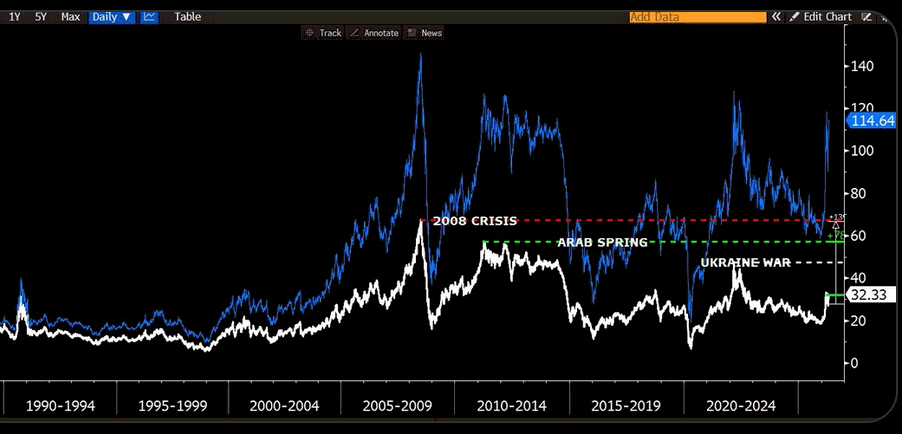
Chart of the Day: Nominal oil has spiked to 114.64, blowing through the 2008 Crisis, Arab Spring, and Ukraine War reference lines, but inflation-adjusted oil (white) is only at 32.33 — a fraction of its 2008 real-terms peak. That means today’s price isn’t actually extreme in real terms, and an Iran war shock has plenty of room to run higher before oil becomes genuinely expensive by historical standards.
Market Intelligence Brief (MIB) Ver. 17.63
For professional investors only. Not investment advice.
© 2026 RecessionALERT.com

Comments are closed.