
Trump’s Hormuz blockade sent Brent to $126 intraday (settling $114); US gasoline hits $4.30/gallon, threatening $190B in annualized spending losses. S&P 500 set record 7,209 — best April since 2020 — as GOOGL, CAT, and LLY each surged ~10% on earnings beats while META fell -8.65% on $145B AI capex without ROI clarity. Q1 GDP +2.0% (slight miss), PCE 3.5%, ECI +0.9% — markets price 77% odds of no Fed cuts in 2026; Warsh clears Senate Banking 13-11, confirmation due May 11.
TABLE OF CONTENTS
A. EXECUTIVE SUMMARY
B. MARKET DATA
C. HIGH-IMPACT STORIES (5)
D. MODERATE-IMPACT STORIES (5)
E. ECONOMY WATCH (8)
F. EARNINGS WATCH (22)
G. WHAT’S NEXT
H. CHART OF THE DAY
A. EXECUTIVE SUMMARY -> TOP
Wednesday’s broad rally defied the day’s macro signals — Hormuz still shut, Q1 GDP at +2.0% (miss), PCE at 3.5%, and ECI re-accelerating to +0.9% — as earnings quality from Alphabet (+10%), Caterpillar (+9.88%), and Lilly (+9.80%) overwhelmed stagflation concerns to lift the S&P 500 to a record 7,209. The session’s defining shift was the AI capex bifurcation: markets rewarded GOOGL for pairing its raise with 63% Cloud growth while punishing META (-8.65%) for committing $145B without equivalent revenue clarity, ending the era where AI infrastructure spend was rewarded on faith alone. Sector breadth confirmed broad participation — Communication Services (+3.43%) and Industrials (+2.97%) led with Technology the lone red sector (-0.17%) — while 10-year yields fell 4.7 bps not on cooling inflation but on a GDP composition propped by defense and shutdown reversals.
• S&P 500 set a new all-time high at 7,209 (+1.02%) — best April since November 2020, up ~10% for the month; Russell 2000 led all major indices at +2.16%, confirming broad-market rather than mega-cap-driven participation.
• Earnings sweep: GOOGL +10% (Cloud revenue +63% YoY, AI enterprise monetization confirmed), CAT +9.88% (record infrastructure backlog), LLY +9.80% (GLP-1 drug demand + FDA proposed ban on compounded semaglutide/tirzepatide).
• AI capex divide deepens: META -8.65%, NVDA -4.64%, MSFT -3.93%; combined hyperscaler 2026 capex now $725B (+77% YoY from $410B in 2025) — markets now demanding revenue proof before rewarding further spend.
• Hormuz blockade extended: Brent hit $126 intraday before settling at $114; US gasoline at $4.30/gallon (4-year high); recession models unmoved — Goldman 30%, Moody’s 48.6%, Wilmington Trust 45%; XOM and CVX report Friday.
• Stagflation data suite: Q1 GDP +2.0% (misses 2.3% consensus); Core PCE 3.2% YoY; GDP Price Index 4.5% QoQ; ECI +0.9% (beats +0.8% estimate) — FedWatch now prices 77.5% odds of no rate cuts through all of 2026.
• Jobless claims plunged to 189K — lowest since 1969, demolishing the 215K forecast — a single ultra-tight labor market reading against an otherwise cautionary macro backdrop; Kevin Warsh advanced 13-11 in Senate Banking on a straight party-line vote, with full confirmation expected week of May 11.
1. The AI Monetization Test Has Arrived — After years of rewarding AI capex on faith, Q1 2026 earnings produced the sharpest single-session bifurcation in the hyperscaler space: Alphabet’s 63% Cloud revenue growth and accelerating Gemini enterprise MAUs (+40% QoQ) proved that AI infrastructure is generating real returns; Meta’s $145B raise without equivalent revenue clarity drew the sharpest punishment. This is the most important AI market signal in 18 months — it will reset how every capex-heavy tech company is valued, and how investors parse the $725B arms race for the remainder of 2026.
2. Stagflation Is No Longer a Tail Risk — It Is the Base Case — Today’s data constellation — GDP slightly below consensus (+2.0%) with a composition built on transient defense and shutdown-reversal factors, Core PCE at 3.2%, ECI re-accelerating to +0.9%, Chicago PMI contracting to 49.2, and gasoline at $4.30/gallon — maps directly onto a stagflationary scenario. With 77.5% of markets pricing no cuts through 2026 and institutional recession odds at 30–48.6%, the Fed faces its most constrained position since 2007: inflation too persistent to cut, growth too uncertain to hike, and an oil shock with no diplomatic resolution in sight.
3. Energy’s Structural Shift Is Rewriting the Portfolio Playbook — The Hormuz blockade’s persistence transforms energy from a cyclical trade to a structural allocation: 13 million bpd in disrupted supply, Brent at $114 as a potential new floor, and the BNO ETF up 84% YTD. The sector winners (energy producers, defense) and losers (airlines facing existential jet fuel costs at $4.88/gallon, logistics, consumer discretionary) are now clearly defined. Portfolio managers must position for extended $114+ Brent while remaining alert to the asymmetric downside if the UAE floods markets post-blockade resolution — a scenario the Strait’s reopening could trigger almost overnight.
 — Leading economic indicators. Accurate market forecasts. Apply for membership at join.recessionalert.com
B. MARKET DATA -> TOP
Earnings delivered a broad rally Wednesday, with the Dow (+1.62%) leading as Caterpillar and Eli Lilly each surged ~10% on results-day beats while Alphabet’s post-earnings +10% powered Communication Services to the session’s top. Ten of 11 sectors closed green and Russell 2000 (+2.16%) outpaced the S&P (+1.02%), confirming participation beyond mega-cap concentration. Technology was the lone holdout (-0.17%): META’s AI-capex-driven -8.65% and NVDA’s -4.64% carved a sharp intra-sector divide from GOOGL’s success, masking what was a strong fundamental day for corporate earnings. Yields fell (10Y -4.7 bps) and VIX plunged 10.21% in a clean risk-on read, though the Dow Theory non-confirmation — DJTA sitting 13% below its April high while DJIA sets a new 10-session high — remains a structural caveat.
CLOSING PRICES – April 30, 2026:
MAJOR INDICES
Today’s move was genuine breadth: Russell 2000 (+2.16%) and NYSE Composite (+1.73%) both outpaced the S&P 500 (+1.02%), confirming participation well beyond mega-cap names. The Dow’s outperformance (+1.62%) reflects CAT and LLY’s massive point contributions via its price-weighted structure. The critical Market History signal: DJIA set a new 10-session high today while DJTA sits 13% below its own April 21 peak — a Dow Theory non-confirmation now entrenched in its 7th consecutive session. Until transports confirm the industrial rally, the broad tape’s apparent strength carries a structural caveat that has persisted for nearly two full weeks.
| Index | Close | Change | %Move | Why It Moved |
|---|---|---|---|---|
| S&P 500 | 7,209.03 | +73.08 | +1.02% | GOOGL, CAT, and LLY each surged ~10% on earnings beats; META -8.65% and NVDA -4.64% partially offset; broad participation outweighed tech drag |
| Dow Jones | 49,651.95 | +790.14 | +1.62% | Price-weighted structure amplified CAT (+9.88%) and LLY (+9.80%) earnings surges; Dow outperformed all headline indices |
| DJ Transportation | 20,793.5 | +262.2 | +1.28% | Modest recovery amid broad risk-on; transports remain structurally lagging — 13% below April 21 peak, sustaining Dow Theory non-confirmation |
| Nasdaq 100 | 27,452.12 | +265.14 | +0.98% | Alphabet’s +10% post-earnings surge partially offset by META -8.65%, NVDA -4.64%, MSFT -3.93%; net modest gain masking sharp intra-tech split |
| Russell 2000 | 2,798.61 | +59.14 | +2.16% | Small-caps led all indices on falling yields and broad risk-on; less exposed to AI capex ROI debate driving mega-cap splits |
| NYSE Composite | 23,144.64 | +393.13 | +1.73% | Broadest participation gauge confirmed market-wide advance; +1.73% reflected gains across all cap sizes and sectors beyond tech |
VOLATILITY & TREASURIES
VIX’s -10.21% collapse alongside falling yields is a clean, unambiguous risk-on read: the options market and the bond market are simultaneously releasing fear premium. The 2Y led the yield decline (-5.9 bps vs 10Y’s -4.7 bps), modestly steepening the curve to ~49.8 bps — near-term rate-cut odds firming on soft Q1 macro data. DXY’s -0.89% reinforces the picture with no safe-haven bid in sight; the dollar weakening alongside rallying equities confirms this is risk appetite, not flight-to-safety rotation.
| Instrument | Level | Change | Why It Moved |
|---|---|---|---|
| VIX | 16.89 | -1.92 (-10.21%) | Fear premium compressed sharply as earnings season confirmed broad corporate resilience; VIX back below 17 signals near-normal volatility regime |
| 10-Year Treasury Yield | 4.371% | -4.7 bps | Soft Q1 GDP advance and mixed PCE data reinforced soft-landing narrative; bond market pricing in near-term Fed flexibility |
| 2-Year Treasury Yield | 3.873% | -5.9 bps | 2Y led yield decline as near-term cut expectations firmed; 2Y-10Y spread widened slightly to ~49.8 bps |
| US Dollar Index (DXY) | 98.06 | -0.88 (-0.89%) | Dollar retreated as risk appetite grew; no safe-haven demand; DXY weakness supporting gold and commodities broadly |
COMMODITIES
Precious metals and copper moved together in a textbook dollar-weakness / risk-on trade — gold +1.52%, silver +2.82%, platinum +4.92%, copper +1.40% — unified by DXY’s -0.89% decline rather than a divergence story. Platinum’s outsized +4.92% surge stands apart, likely reflecting supply-side tightness rather than pure macro sentiment. Bitcoin’s modest +1.02%, tracking the equity tape closely, reinforces its current role as a risk proxy — no independent narrative driving the crypto space today.
| Asset | Price | Change | %Move | Why It Moved |
|---|---|---|---|---|
| Gold | $4,630.74/oz | +$69.24 | +1.52% | DXY weakness and risk-on sentiment lifted gold; approaching $4,650 as dollar softens on soft Q1 macro data |
| Silver | $74.12/oz | +$2.03 | +2.82% | Outpaced gold on combined precious metals demand and industrial usage optimism; tracking the broad commodity rally |
| Copper | $6.016/lb | +$0.083 | +1.40% | Industrial demand signal confirmed by strong CAT earnings; copper tracking constructive global growth narrative |
| Platinum | $1,994.10/oz | +$93.50 | +4.92% | Outsized move likely supply-side driven; approaching $2,000 milestone; auto sector demand and mining supply tightness |
| Bitcoin | $76,493 | +$774 | +1.02% | Tracking equity risk-on; modest gain consistent with broad market advance; no independent crypto catalyst driving the move |
ENERGY
WTI and Brent diverged sharply — WTI -1.22% while Brent gained +0.73% — widening the spread and signaling a US-specific inventory or demand concern rather than a global supply shock. Energy stocks gained +1.22% despite WTI’s decline, confirming the sector’s structural momentum (YTD +35.3%) absorbs single-session crude softness. Henry Hub’s +4.31% surge is an entirely separate story: production cutbacks by major US producers hitting 12-week lows are tightening domestic supply; TTF’s -1.35% decline confirms the divergence is US-specific, not a global gas demand move.
| Asset | Price | Change | %Move | Why It Moved |
|---|---|---|---|---|
| Crude Oil (WTI) | $105.58/bbl | -$1.30 | -1.22% | US-specific demand or inventory concerns weighed; WTI/Brent spread widened as Brent held firm — regional divergence, not global supply shock |
| Crude Oil (Brent) | $111.25/bbl | +$0.81 | +0.73% | Global supply concerns kept Brent elevated; held firm while WTI weakened, confirming the move is regionally driven |
| Natural Gas (Henry Hub) | $2.761/MMBtu | +$0.114 | +4.31% | US production cutbacks by major producers (EQT et al.) driving output to 12-week lows; domestic supply tightening despite elevated storage |
| Natural Gas (Dutch TTF) | $15.82/MMBtu | -$0.22 | -1.35% | European gas market diverging from US; ample EU storage keeping TTF soft as Henry Hub tightens — US-specific supply story confirmed |
S&P 500 SECTORS
Ten of 11 sectors closed green — a broad-participation flush — and the lone holdout is the telling one: Technology’s -0.17% comes after a +17.10% one-month surge, as META and NVDA’s AI capex debate carved it lower while Communication Services (+3.43%) surged on the same earnings cycle. The split is structural: internet/advertising (GOOGL) won, software/semiconductors (MSFT, NVDA) lost. Healthcare’s +2.26% is a one-day LLY earnings event against -4.28% YTD structural weakness — the sector has not turned, it just bounced.
| Sector | 1-Day | 1-Week | 1-Month | 3-Month | 6-Month | YTD | 12-Month |
|---|---|---|---|---|---|---|---|
| Communication Services | +3.43% | +4.38% | +16.22% | +1.96% | +8.79% | +6.71% | +46.62% |
| Industrials | +2.97% | +0.26% | +9.04% | +5.88% | +14.29% | +14.73% | +38.90% |
| Utilities | +2.65% | +1.09% | +3.43% | +7.73% | +6.54% | +11.42% | +23.34% |
| Healthcare | +2.26% | -0.28% | +0.04% | -4.72% | +1.38% | -4.28% | +8.50% |
| Consumer Defensive | +2.02% | +0.89% | +3.26% | +3.32% | +9.57% | +9.60% | +7.68% |
| Basic Materials | +2.00% | -1.61% | +2.84% | -3.13% | +23.96% | +14.96% | +48.54% |
| Real Estate | +1.48% | +0.74% | +8.25% | +5.28% | +4.92% | +8.40% | +8.16% |
| Consumer Cyclical | +1.31% | +0.88% | +9.38% | -3.06% | -3.63% | -1.48% | +17.86% |
| Energy | +1.22% | +4.19% | -0.74% | +19.56% | +37.31% | +35.30% | +49.08% |
| Financial | +1.04% | +0.93% | +6.39% | -2.72% | +1.99% | -2.38% | +14.68% |
| Technology | -0.17% | +1.30% | +17.10% | +7.74% | +1.81% | +8.53% | +48.11% |
TOP MEGA-CAP MOVERS:
GAINERS
| Company | Ticker | Close | Change | Why It Moved |
|---|---|---|---|---|
| Alphabet Inc (A) | GOOGL | $384.94 | +10.00% | Q1 earnings beat: AI-driven Cloud revenue and Search both accelerated above estimates; strong forward guidance; best single-day gain since April 2025 |
| Alphabet Inc (C) | GOOG | $381.94 | +9.97% | Same Q1 earnings catalyst as GOOGL; Class C shares mirroring Class A surge on identical underlying results |
| Caterpillar Inc | CAT | $890.11 | +9.88% | Q1 earnings beat on robust infrastructure, construction, and mining equipment demand; guidance raised; major Dow point contributor |
| Eli Lilly & Co | LLY | $934.60 | +9.80% | Q1 earnings beat (reported before market open); drug portfolio demand exceeded estimates; temporary reversal of Healthcare’s -4.28% YTD structural decline |
| Advanced Micro Devices | AMD | $354.34 | +5.11% | Continuing +59% April surge on AI data center GPU demand optimism; analyst upgrades ahead of May 5 earnings; benefiting from within-semiconductor rotation away from NVDA |
DECLINERS
| Company | Ticker | Close | Change | Why It Moved |
|---|---|---|---|---|
| Meta Platforms Inc | META | $611.23 | -8.65% | Q1 earnings beat but massive AI capex guidance increase ($60-70B+ full-year) spooked investors on ROI timeline; infrastructure spending seen outpacing near-term monetization |
| NVIDIA Corp | NVDA | $199.53 | -4.64% | Sympathy selloff amid AI capex ROI debate; within-semiconductor rotation toward AMD; broader tech sector pressure from META/MSFT selling |
| Mastercard Inc | MA | $502.92 | -4.25% | Q1 earnings beat (EPS $4.60 vs est $4.41, revenue +16% YoY) but April-to-date data showing cross-border volume slowdown triggered selloff despite headline beat |
| Microsoft Corp | MSFT | $407.78 | -3.93% | “Sell the news” rotation after strong Q1 beat (reported April 29 AMC); Azure/AI beat fully priced in after prior rally; falling with broader AI capex narrative |
| KLA Corp | KLAC | $1,750.38 | -3.62% | Semiconductor equipment weakness in sympathy with broader AI/chip sector rotation; KLAC tracking NVDA and MSFT selloff across the semiconductor stack |
— Institutional-grade intelligence for serious investors. Apply for membership at join.recessionalert.comC. HIGH-IMPACT STORIES -> TOP
BEARISH
1. Trump Extends US Naval Blockade of Strait of Hormuz — Brent Surges to $126 Four-Year High Before Settling at $114
The core facts:President Trump declared and extended a US naval blockade of the Strait of Hormuz on Thursday, ordering the US Navy to intercept vessels attempting passage. Brent crude surged to an intraday high of $126/barrel — its highest level in four years — before pulling back to close at $114.01 (down ~9.5% from the session peak). US average gasoline prices hit $4.30/gallon (4-year high). The Strait has been largely blocked since February 28, 2026, when the US and Israel launched an air war against Iran, triggering Iranian Revolutionary Guard counter-attacks, sea mines, and vessel seizures. The combined supply disruption now exceeds 13 million barrels per day; cumulative losses in April alone are estimated at 440 million barrels. Approximately 20% of all global oil trade transits the Strait.
Why it matters:The Hormuz closure is the most significant energy supply disruption in decades. At $4.30/gallon, US consumers face an estimated $190B annualized gasoline cost increase versus pre-crisis levels — a direct hit to discretionary spending. Every $10/barrel increase in oil adds roughly 25bps to headline PCE inflation; at $114+ Brent vs. prior-year levels, this threatens to keep inflation well above 3% through 2026 and neutralizes any near-term Fed easing. Economists now openly warn of global recession risk if the disruption extends into H2 2026. Airlines, logistics, chemicals, and consumer discretionary face the most acute margin pressure; energy producers (XOM, CVX, OXY, EOG) and defense companies benefit. The UAE’s exit from OPEC (effective May 1) adds a structural wildcard: once the Strait reopens, the UAE could flood markets with uncapped production, potentially reversing the oil shock sharply.
What to watch:Any diplomatic signals from US-Iran back-channels; Saudi Arabia and UAE contingency production plans; EIA weekly crude inventory report; whether Brent sustains above $110 as the new floor or retreats if peace talks accelerate.
UNCERTAIN
2. Q1 2026 GDP Advance Estimate: +2.0% — Sharp Rebound From Q4’s Near-Stall, Slight Miss vs. 2.3% Consensus
The core facts:The Bureau of Economic Analysis released the advance estimate of Q1 2026 real GDP at +2.0% annualized — below the 2.3% Wall Street consensus but a dramatic rebound from Q4 2025’s +0.5% final read (the weakest quarter since 2022). Growth was driven by increases in private investment, exports, consumer spending, and government spending. Imports, which subtract from GDP, increased — a potential sign of tariff-related inventory front-loading. The Atlanta Fed’s GDPNow model had projected only +1.2% going into today, making the +2.0% actual a significant positive surprise versus that real-time tracking estimate.
Why it matters:The rebound from near-stall confirms the US economy regained its footing in Q1 despite mounting headwinds — energy prices, tariff uncertainty, and a deeply divided Fed. The +2.0% print is solid enough to underpin equity valuations and argue against recession in the near term. However, the slight consensus miss and the import surge warrant close attention: if companies were front-loading inventories ahead of tariff escalation, Q2 domestic demand may appear weaker as that inventory is drawn down. The 2.0% read is also insufficient to give the Fed cover to cut rates — with inflation running 3.2-3.5%, real GDP growth above 2% actually reinforces the case for holding rates steady.
What to watch:First GDP revision (late May); Q2 2026 advance estimate (late July); inventory and import data in coming weeks to gauge whether the Q1 impulse was durable or front-loaded.
BULLISH
3. S&P 500 Hits All-Time High at 7,209 — Best April Since November 2020 as Tech Earnings Drive Historic Month-End Rally
The core facts:The S&P 500 closed at 7,209.01 (+1.02%) on Thursday, breaking above 7,200 for the first time to set a new all-time high. The index gained approximately +10% in April — its best monthly performance since November 2020 and the strongest April in six years. The Nasdaq Composite closed at a record 24,892.31 (+0.89%), and the Dow Jones Industrial Average added 790 points to 49,652.14. The Russell 2000 (+1.62%) led all major indexes, with all 11 S&P 500 sectors closing higher. Key individual drivers: Alphabet +9% (Cloud AI monetization confirmed), Caterpillar +10% (record backlog), Eli Lilly +9.8% (GLP-1 dominance), Qualcomm +15% (automotive record). The rally shrugged off both the Strait of Hormuz oil shock and a GDP miss versus consensus.
Why it matters:New all-time highs carry both technical and psychological significance — they confirm that the 2026 bull market is intact and that prior resistance levels have been absorbed. The +10% April return is extraordinary given the macro backdrop: an active oil war, sticky inflation above 3%, and a divided Fed with no rate cuts in sight. Most notable is the breadth: when the Russell 2000 outperforms mega-cap indexes and all 11 sectors close green simultaneously, it signals genuine broad-market participation rather than narrow large-cap leadership. The April ATH close provides a strong end-of-month mark for performance benchmarking, likely generating buy pressure from momentum-following strategies.
What to watch:Apple (AAPL) and Amgen (AMGN) after-hours results tonight — any material miss could test the ATH next session; May 1 nonfarm payrolls (consensus ~160K) as the next macro catalyst; whether the 7,200 level holds as support in early May.
BEARISH
4. March PCE Hits 3.5% Headline / 3.2% Core; ECI Beats at +0.9% — Fed Rate Cuts Effectively Dead Through Year-End
The core facts:The BEA released March personal income and outlays: headline PCE +0.7% MoM (3.5% YoY), core PCE (ex-food and energy) +0.3% MoM (3.2% YoY — both in line with consensus). Separately, the BLS reported the Q1 2026 Employment Cost Index rose +0.9% QoQ — above the +0.8% consensus and accelerating from Q4 2025’s +0.7%; the benefits component surged to +1.20% QoQ from +0.80% in Q4. CME FedWatch now shows a 77.5% probability the Fed holds rates through the end of 2026. The 10-year Treasury yield closed at 4.382%, down 3bps as modest growth concerns slightly offset the inflation pressure.
Why it matters:The PCE + ECI combination delivers an unambiguous message: inflation is not returning to 2% on any near-term timeline. Core PCE has now been running above 3% for multiple months; the ECI’s acceleration shows wage pressures are a second-round source of inflation — precisely what Fed hawks (Hammack, Kashkari, Logan) cited when dissenting from the April FOMC’s easing bias. With 77.5% of market participants now pricing no cuts through 2026, the “higher for longer” regime is fully entrenched. This reshapes asset allocation: it extends the penalty on rate-sensitive sectors (real estate, utilities, long-duration growth stocks) while supporting financials and short-duration value. The tug-of-war reflected in the 10Y yield — hot inflation vs. softer GDP — leaves the bond market in an uncomfortable position.
What to watch:May CPI release (~May 13) — if April energy costs drive headline above 4%, the hawk case for a hike strengthens; Fed governors’ speeches next week interpreting today’s data; whether the 10Y breaks above 4.5% as the “no cuts in 2026” narrative solidifies.
UNCERTAIN
5. Big Tech’s $725B AI Capex Arms Race Splits Market — Google Rewarded for ROI; Microsoft and Meta Punished for Spend-First Uncertainty
The core facts:Q1 2026 mega-cap earnings crystallized the AI infrastructure arms race at unprecedented scale. Combined hyperscaler capex guidance for 2026 reached $725B — up 77% from 2025’s $410B — split among Amazon ($200B), Microsoft (~$190B), Alphabet ($180-190B, raised), and Meta ($125-145B, raised). Markets sharply bifurcated on ROI evidence: Alphabet soared +9% today (Google Cloud revenue +63% YoY to $20B; “enterprise AI solutions” cited as the primary cloud growth driver for the first time), while Microsoft fell -3.8% and Meta plunged -7.5% after their capex raises failed to come with compelling near-term return narratives. NVIDIA fell -4% in sympathy as capex-without-ROI skepticism raised questions about the sustainability of H2 chip demand.
Why it matters:The $725B combined AI capex figure represents the largest single-year private investment in computing infrastructure in history — exceeding the GDP of many G20 nations. The market’s bifurcation is the most important signal: after years of rewarding AI capex on faith, investors are now demanding revenue evidence. Alphabet has delivered (Cloud +63%, Gemini enterprise MAUs +40% QoQ); Microsoft’s Azure +40% beat is real, but the $190B capex raise — including $25B from higher memory component costs — implies margin compression before meaningful returns materialize. Meta’s $145B capex with a still-developing monetization roadmap drew the sharpest punishment. This shift from “spend to win” to “show me the revenue” will likely reset how all AI-heavy companies communicate their capex plans in coming quarters.
What to watch:Microsoft Azure Q4 guidance (street expects 42-44% growth to justify the $190B capex); Meta’s Q2 Llama and Ray-Ban AI revenue breakout; NVIDIA earnings (~May 28) for data center revenue trajectory confirmation.
— Quantifying recession risk so you don’t have to guess. Apply for membership at join.recessionalert.comD. MODERATE-IMPACT STORIES -> TOP
BULLISH
6. FDA Proposes Excluding Semaglutide and Tirzepatide From Compounding List — Major Win for Eli Lilly and Novo Nordisk
The core facts:The FDA proposed excluding the active ingredients in three blockbuster GLP-1 drugs from the list of substances that outsourcing compounding facilities can use for bulk manufacturing: semaglutide (Wegovy and Ozempic — Novo Nordisk), tirzepatide (Zepbound and Mounjaro — Eli Lilly), and liraglutide. If finalized, the rule would ban large-scale compounding of these medicines unless they return to the FDA drug shortage list. The FDA determined there is no “clinical need” for bulk compounding given adequate brand-name supply availability.
Why it matters:Compounded versions of GLP-1 drugs — often sold via telehealth platforms at 40-60% below brand-name prices — have captured meaningful market share from Lilly and Novo. For LLY specifically, with $8.66B in Mounjaro and $4.16B in Zepbound Q1 revenues already at record levels, eliminating the compounding threat removes a structural competitive discount that has pressured brand pricing and patient access. Today’s FDA proposal amplified LLY’s +9.80% earnings-driven surge. If finalized, the entire addressable GLP-1 market would flow entirely to branded products, providing a multibillion-dollar annual revenue tailwind for LLY and NVO. The FDA’s determination of “no clinical need” for compounding also strengthens the intellectual property moat around these drugs.
What to watch:Public comment period timeline (60-90 days typical); potential legal challenges from telehealth compounders; FDA finalization date; whether compounding platforms pivot to related molecules not covered by the proposal.
UNCERTAIN
7. Senate Banking Committee Clears Warsh 13-11 in Historic Partisan Vote — Full Senate Confirmation Expected Week of May 11
The core facts:The Senate Banking Committee voted 13-11 along strict party lines to advance Kevin Warsh’s nomination as the next Federal Reserve Chair — the first fully partisan vote on a Fed chair nominee in the committee’s history, per Sen. Elizabeth Warren. All 13 Republican members voted in favor; all 11 Democrats opposed. The full Senate confirmation vote is expected during the week of May 11. Republicans hold a 53-seat majority, making confirmation nearly certain. The pivotal Republican vote — Sen. Thom Tillis — came through after the DOJ dropped its criminal investigation into Chairman Jerome Powell, clearing the final procedural obstacle.
Why it matters:Warsh’s imminent arrival reshapes the Fed’s policy calculus. As a former Fed governor (2006-2011) known for skepticism of quantitative easing, a more data-dependent stance, and willingness to confront inflation proactively, his leadership would reinforce the current “hold” posture. This is particularly relevant given today’s hot PCE/ECI data — Warsh’s instincts align with the hawk bloc that voted against even an easing bias at the April FOMC. Markets will parse his inaugural monetary policy speech carefully for any signals on the rate path, balance sheet trajectory, and Fed independence from White House influence. The historic partisan split also signals that Fed leadership has permanently entered the political arena.
What to watch:Full Senate confirmation vote (week of May 11); Warsh’s first public statements on monetary policy priorities post-confirmation; any market reaction to Warsh’s characterization of the current rate stance.
BEARISH
8. Chicago PMI Slips Back Into Contraction at 49.2 — Misses 53 Consensus by a Wide Margin
The core facts:The MNI Chicago Business Barometer (Chicago PMI) fell to 49.2 in April from 52.8 in March, significantly below the 53.0 consensus forecast. A reading below 50 signals contraction in the Chicago metro area’s manufacturing and business activity. The 3.8-point miss was well outside the typical forecast error range. The index had briefly entered expansion territory in March before sharply reversing, suggesting the prior improvement was transient.
Why it matters:Chicago PMI is a historically reliable leading indicator of the national ISM Manufacturing PMI, which releases tomorrow (May 1, consensus 53). A sharp Chicago miss often presages a national miss by 1-3 weeks. Combined with today’s other data — GDP slightly undershooting, inflation running hot, and regional manufacturing contracting — the picture for Q2 industrial activity begins to look stagflationary: slowing output combined with persistent cost pressures. Energy input costs are the most likely culprit, as jet fuel, diesel, and industrial feedstocks have all risen sharply with the oil shock. If tomorrow’s ISM confirms weakness, the industrial sector’s 2026 growth narrative shifts materially and earnings estimates for industrials would face downward revisions.
What to watch:ISM Manufacturing PMI (Friday May 1, consensus 53); ISM New Orders and Prices Paid sub-indices as the key signal; whether other regional Fed manufacturing surveys confirm the Chicago PMI’s deterioration.
BEARISH
9. Airlines Face Existential Jet Fuel Crisis as Hormuz Oil Shock Bites — Energy Stocks Surge 84% YTD While Carriers Cut Capacity
The core facts:Jet fuel has surged to approximately $4.88/gallon — nearly double the level of six months ago — driven directly by the Strait of Hormuz supply disruption. American Airlines (AAL), carrying $36.5B in debt and operating with zero fuel hedging, estimates its annual costs increase ~$50M per 1-cent rise in jet fuel prices; at current levels, AAL faces several billion dollars of incremental annual cost above guidance. Delta Air Lines benefits from its unique ownership of the Monroe Energy refinery in Pennsylvania, providing a natural cost hedge. The broader airline industry has broadly cut capacity and raised fares aggressively. Meanwhile, the energy sector surged: the BNO (United States Brent Oil Fund ETF) is up approximately 84% YTD, the top-performing major ETF in the US market.
Why it matters:Airlines represent both a cost-push inflation vector (rising fares flow directly into CPI services components) and a real-time barometer of consumer discretionary health. If carriers continue cutting capacity and raising fares through the summer travel season, it will amplify overall inflation while potentially suppressing leisure demand — a simultaneous stagflationary squeeze. The sector rotation — from transports and consumer discretionary into energy producers — is one of the starkest in recent memory. Portfolio managers must navigate: energy winners (XOM, CVX reporting Friday, benefiting from $114+ Brent) vs. transport/consumer losers (airlines, logistics, trucking). For the broader consumer, $4.30 gasoline and higher airfares together represent a meaningful hit to real disposable income.
What to watch:XOM and CVX Q1 earnings (Friday May 1, BMO) for energy sector financials and Q2 guidance; any US-Iran diplomatic signals that could ease the Hormuz blockade; weekly EIA crude inventory data; AAL Q2 capacity guidance (typically mid-July).
UNCERTAIN
10. March Consumer Spending Surges +0.9% — Strongest Monthly Gain in Over a Year Supports GDP; But Robust Spending Feeds Inflation Fire
The core facts:The BEA’s March personal income and outlays report showed consumer spending (PCE) rising +0.9% month-over-month — one of the largest monthly increases in over a year — with personal income +0.6% MoM and disposable income +0.6% MoM. Spending gains were broad-based across goods (+1.2%) and services (+0.8%). The data reflects conditions in March — before the April surge in oil prices — and may represent the “last clean month” before energy costs began meaningfully absorbing consumer wallet share.
Why it matters:The +0.9% spending surge is the primary mechanical anchor of Q1’s +2.0% GDP read — consumers are still the engine of US growth. However, the strength of consumer spending is a double-edged signal: robust demand supports corporate revenues and employment, but it also means continued pressure on services inflation (already the stickiest component of core PCE at 3.2% YoY). The March data predates April’s oil shock; Q2 readings will reveal whether the $4.30/gallon gasoline cost and higher airfares have begun to crowd out discretionary spending. A sharp spending deceleration in April-May data would reduce recession risk while also helping cool inflation — a paradox the Fed is unlikely to act upon without multiple months of confirming data.
What to watch:April personal income and spending data (late May); University of Michigan consumer sentiment for May; credit card spending indices from Mastercard and Visa for real-time consumer activity signal.
— Separating signal from noise since 2007. Apply for membership at join.recessionalert.comE. ECONOMY WATCH -> TOP
Q1 GDP’s 2.0% advance print — below the 2.3% consensus and inflated by one-time shutdown reversals and Iran-conflict defense outlays — landed alongside Core PCE QoQ accelerating to 4.3% and ECI wages rising 0.9%, crystallizing the stagflation signal the Fed’s historic 8-4 split last week already telegraphed. Labor remains the single clean bullish data point: claims collapsed to 189K (a 55-year low) and Personal Income beat at +0.6% MoM — but Chicago PMI’s slide to 49.2 (contraction) warns that manufacturing is cracking under tariff and oil-cost pressures. Institutional recession odds remain structurally elevated (Moody’s 48.6%, Goldman 30%) despite the Atlanta Fed Q2 GDPNow’s optimistic 3.7% debut; the Fed’s policy optionality is narrowing, caught between an inflation floor and a growth ceiling that refuse to converge.
Q1 2026 GDP Advance: 2.0% Growth Misses 2.3% Consensus; Rebound Built on Transient Factors (BEA, April 30, 2026)
What they’re saying:Real GDP expanded at a 2.0% annual rate in Q1 2026 per the BEA’s advance estimate — beating Q4 2025’s 0.5% final print but falling short of the 2.3% consensus. Growth was driven by investment, exports, government spending, and consumer outlays; real consumer spending rose 1.6% QoQ while Personal Income surged +0.6% MoM in March (vs. +0.3% expected) and Personal Spending came in at +0.9% MoM in-line with estimates. The GDP Price Index rose 4.5% QoQ (above 3.8% expected), reflecting broad price pressures.
The context:The GDP headline masks fragile underlying composition — a significant share of the Q4-to-Q1 acceleration reflects the reversal of federal employee compensation lost during Q4’s government shutdown and elevated defense outlays linked to the Iran conflict. Stripping those transient factors, organic private-sector growth was considerably softer. Markets responded with measured caution: Treasury yields edged higher on the firmer price index while equity futures held narrow ranges, as traders parsed composition over the headline 2.0% figure.
What to watch:Friday ISM Manufacturing PMI (expected 53, prior 52.7) will test whether industrial momentum holds; Q2 Atlanta Fed GDPNow debuts at 3.7%, suggesting growth follow-through, but composition quality will be the critical determinant.
Initial Jobless Claims Plunge to 189K — Lowest Since 1969, Demolishing 215K Forecast (DOL, April 30, 2026)
What they’re saying:Initial jobless claims fell 26,000 to 189,000 for the week ending April 25 — the lowest level in more than 55 years (since November 1969) — dramatically undershooting the 215,000 forecast. The 4-week moving average also declined to 207,500, confirming the drop is not a one-week aberration. Continuing claims came in at 1,785K vs. 1,820K expected.
The context:A sub-200K reading has occurred fewer than a dozen times in the past decade and signals that layoffs remain near historic minimums despite rising recession concerns and elevated corporate cost pressures. For the Fed, a labor market this tight complicates any argument for early rate cuts — particularly against a 3.5% PCE headline backdrop. The claims reading is the single clearest bullish outlier in today’s otherwise mixed data suite.
What to watch:April BLS nonfarm payrolls (May 2 release) will confirm whether historic claims strength is matched by hiring momentum, or whether employers are simply freezing firing while equally restraining new hiring.
Core PCE Accelerates to 4.3% QoQ; ECI Wages Rise 0.9% — Stagflation Signal Compounds Fed’s Dilemma (BEA/BLS, April 30, 2026)
What they’re saying:The BEA’s Q1 advance report showed Core PCE prices rose 4.3% QoQ annualized (above the 4.1% estimate) while March Core PCE held at 3.2% YoY and 0.3% MoM — meeting monthly expectations but running 120 bps above the Fed’s 2% target. The PCE headline (all items) was 3.5% YoY. Simultaneously, the Employment Cost Index rose 0.9% QoQ in Q1, beating the 0.8% estimate and accelerating from Q4 2025’s 0.7% — its highest quarterly print in three quarters.
The context:The ECI-PCE combination is among the Fed’s most closely watched stagflation signals: labor costs are re-accelerating while consumer prices remain structurally elevated, driven partly by oil-price pass-through from the Iran conflict and tariff-related import inflation. The Fed held at 3.50–3.75% last week in an historic 4-way dissent — three hawks opposed to easing bias, one dove calling for immediate cuts. Today’s data reinforces the hawkish bloc’s position: inflation is not solved, and premature easing risks a 1970s-style re-acceleration.
What to watch:Friday ISM Manufacturing Prices Paid (expected 80, prior 78.3) will show whether producer-side inflation is intensifying. April PCE data (released May 30) is the next clean read on whether tariff pass-through is accelerating or plateauing.
Chicago PMI Slides to 49.2 in April — Manufacturing Slips Into Contraction on Sharp Miss Vs. 53 Forecast (MNI, April 30, 2026)
What they’re saying:The Chicago PMI fell to 49.2 in April from 52.8 in March, missing the consensus forecast of 53 and falling below the 50-threshold that separates expansion from contraction. The reading signals regional factory and supplier activity in the Chicago metro area is contracting, with the miss tracking back to softening new orders and tighter production schedules amid tariff-related uncertainty.
The context:The regional weakness stands against the S&P Global US Manufacturing PMI’s April flash at 54.0, suggesting the Chicago contraction may reflect localized supply-chain stress rather than a national rollover. However, the Chicago index historically correlates closely with the national ISM Manufacturing PMI (released Friday, expected 53). Chicago PMI has now posted below 52 in three of the last four months, consistent with a manufacturing sector under sustained cost pressure rather than experiencing a one-time shock.
What to watch:Friday’s ISM Manufacturing PMI (expected 53, prior 52.7) is the definitive read — a sub-50 print would confirm Chicago’s contraction is a national warning, not a regional anomaly. ISM Prices Paid (expected 80) will also signal whether input inflation is deepening manufacturing margin pressure.
Recession Odds Remain Structurally Elevated: Goldman 30%, Moody’s 48.6%, Wilmington Trust 45% — GDP Miss Provides No Relief (Multiple Sources, April 30, 2026)
What they’re saying:With Q1 GDP missing consensus and Core PCE QoQ accelerating to 4.3%, Wall Street recession probability models show no meaningful improvement: Goldman Sachs holds at 30% (raised from 25% on re-priced oil and lower GDP trajectory), Moody’s Analytics proprietary machine-learning model sits at 48.6%, Wilmington Trust at 45%, and EY-Parthenon at 40%. Prediction markets remain below institutional models — Polymarket at 25%, Kalshi at 33% — but both have risen from April lows.
The context:Moody’s chief economist Mark Zandi stated that 48.6% is historically the highest the model has registered without a recession following — the model has “never gotten this high without a recession ensuing.” Goldman cites U.S. growth cooling to 1.25–1.75% in H2 2026 (near stall speed), unemployment rising to 4.6%, and headline PCE inflation at 3.1% by year-end as the converging pressures. Today’s GDP composition — growth propped by shutdown reversal and defense outlays — does little to reduce these institutional odds, even as the headline 2.0% print looks superficially resilient.
What to watch:Next Goldman and Moody’s probability updates following April employment data (May 2) and April CPI (May 13); if unemployment rises above 4.3% or core inflation re-accelerates past 3.5% YoY, expect institutional models to revise sharply higher.
Spirit Airlines Court Hearing Concludes Without Signed Deal; $500M Federal Bailout Talks Enter Critical Phase (CNN Business, April 30, 2026)
What they’re saying:An April 30 bankruptcy court hearing concluded without a finalized federal rescue deal, leaving Spirit Airlines in continued limbo. The Trump administration is in advanced discussions to provide $500 million in emergency financing that would grant the federal government up to a 90% equity stake in the carrier as it attempts to emerge from its second Chapter 11 filing since 2024. Jet fuel costs — roughly doubled since the onset of the Iran conflict — have derailed Spirit’s previously planned reorganization, forcing the resort to unprecedented government intervention.
The context:The proposal has drawn sharp bipartisan opposition: the FAA administrator publicly stated “they can’t have any of our money,” and GOP senators condemned the bailout as “absolutely terrible.” The precedent is significant — a federal equity stake in a US commercial airline would be the first since post-9/11 emergency measures. For equity markets, the broader signal is that oil-driven cost inflation is now threatening systemic airline viability, not merely Spirit’s overleveraged balance sheet. Multiple smaller carriers are reportedly watching the Spirit outcome before deciding whether to seek similar support.
What to watch:Next court hearing date and whether a federal deal is signed before liquidation proceedings are triggered; Congressional and FAA response to any finalized bailout terms; impact on airline sector equity (UAL, DAL, AAL) if precedent is set for government intervention.
Bankruptcy Court Approves Saks Global’s $500M Exit Financing; Luxury Retailer Targets Summer Chapter 11 Emergence (Retail Dive, April 30, 2026)
What they’re saying:A Texas bankruptcy court approved $500 million in exit financing for Saks Global, with the luxury retailer now targeting a summer emergence from Chapter 11. The financing comes from an ad hoc group of existing debtholders who have also signed on to a restructuring support agreement. The court specifically cited Saks’s “merchandising woes” in approving the package — but progress is evident: over 650 vendors have resumed shipping merchandise (up from 500 in early March), unlocking $1.5 billion in retail receipts.
The context:Saks Global’s bankruptcy is a bellwether for the luxury retail segment, which is facing dual pressure from oil-driven consumer discretionary caution and the normalization of post-pandemic luxury spending. Securing court-approved exit financing and rebuilding vendor relationships is a constructive step — but the court’s explicit flag of ongoing “merchandising woes” signals that solvency alone does not resolve Saks’s demand challenge. Luxury peers and retail REITs exposed to Saks locations are watching the restructuring closely for pricing and vendor-terms signals.
What to watch:Saks Global’s formal plan of reorganization filing and emergence timeline this summer; luxury retail sector earnings (June–August) for confirmation that consumer appetite at the high end is recovering despite macro uncertainty.
Atlanta Fed Q2 2026 GDPNow Debuts at 3.7% — Growth Signal Rebounds Sharply After Q1’s Subdued 2.0% Print (Atlanta Fed, April 30, 2026)
What they’re saying:The Atlanta Fed’s GDPNow model issued its first Q2 2026 estimate today at 3.7% annualized growth — well above Q1’s advance print of 2.0% and the strongest debut nowcast since Q3 2025. The tracker had held Q1’s final estimate at 1.2% before the official BEA report came in at 2.0%, continuing the model’s recent pattern of slightly underestimating the official print.
The context:A 3.7% Q2 debut would, if sustained, mark the strongest quarter since late 2024 and shift the macro narrative from growth scare to genuine rebound. However, the Q1 experience is cautionary: early-quarter GDPNow estimates have been volatile, and the Q2 nowcast is built on a thin initial data set. The juxtaposition of 3.7% GDPNow against Moody’s 48.6% recession odds reflects the fundamental tension in the current environment — hard real-time trackers are bullish; institutional forward-looking models are not. The resolution of this divergence likely turns on whether tariff and oil-cost pressures intensify or stabilize in Q2.
What to watch:GDPNow will update materially after Friday’s ISM Manufacturing data and May’s retail sales and industrial production releases. The mid-May estimate will be the first meaningful signal of whether 3.7% is tracking toward reality or fading.
— Know the probability before the market prices in the risk. Apply for membership at join.recessionalert.comF. EARNINGS WATCH -> TOP
YESTERDAY AFTER THE BELL (Markets Reacted Today)
BULLISH
11. Alphabet (GOOGL): +6% AH / +9% Today | AI Monetization Arrives — Cloud +63%, 11th Straight Double-Digit Revenue Quarter
The Numbers:Q1 2026 revenue $109.9B (+22% YoY, 11th consecutive double-digit growth quarter) vs. est ~$107-108B. Net income $62.58B (+81% YoY); EPS $5.11. Google Cloud revenue $20.0B (+63% YoY) — first quarter where enterprise AI solutions were the primary Cloud growth driver. YouTube advertising $9.88B (+11%, slightly missed estimates). Paid subscriptions hit 350M globally. Capex guidance raised to $180-190B (from $175-185B); 2027 capex expected to increase further.
The Problem/Win:Alphabet delivered the clearest proof that AI infrastructure spending can generate immediate, measurable revenue returns. Google Cloud’s 63% growth — with enterprise AI solutions cited as the primary driver for the first time ever — answered the core skeptic question about hyperscaler AI ROI. Gemini Enterprise’s paid MAUs grew 40% QoQ. Even with a YouTube ad slight miss, the 81% net income surge and Cloud dominance drove an +9% regular-session rally Thursday.
The Ripple:Alphabet’s Cloud beat set the ROI benchmark for the entire AI capex cycle, directly contrasting with Microsoft (Azure +40% but $190B capex concerns) and Meta (capex raised with less revenue clarity). GOOGL’s outperformance also lifted the entire cloud/AI infrastructure ecosystem, contributing significantly to the S&P 500’s new ATH close. NVDA benefited indirectly — Alphabet’s raised capex reinforces sustained chip demand.
What It Means:Alphabet has reclaimed the AI leadership narrative from Microsoft and positioned Google Cloud as the most visible real-money beneficiary of enterprise AI adoption. At these growth rates, Cloud alone could add $40-45B in incremental annual revenue by 2027 — potentially worth more than the entire company’s market cap gain today.
What to watch:Google Cloud’s Q2 growth trajectory — whether +63% can be sustained or if the base effect begins to moderate; YouTube subscription revenue vs. ad revenue mix shift; Search AI integration impact on ad volume.
UNCERTAIN
12. Microsoft (MSFT): -2% AH / -3.8% Today | Azure +40% Beat Overshadowed by $190B Capex Raise and Margin Compression Fears
The Numbers:Q3 FY2026 revenue $82.9B (+18% YoY; +15% constant currency) vs. est ~$81.4B. Operating income $38.4B (+20%), net income $31.8B (+23% GAAP). Intelligent Cloud segment $34.68B (+30%), with Azure revenue +40% YoY (above est. 39.3%). Full-year 2026 capex guidance ~$190B (including ~$25B from higher memory component costs). Q4 capex expected to exceed $40B.
The Problem/Win:Azure’s +40% growth beat is real and meaningful — but the $190B capex raise (vs. ~$100B in 2025) triggered margin compression concerns. Investors focused on the $25B incremental cost from higher memory components, questioning whether AI infrastructure will generate returns commensurate with the spend. Management noted they “remain capacity-constrained” — theoretically bullish (demand exceeds supply) — but investors needed more quantitative ROI framing than was provided.
The Ripple:MSFT’s -3.8% decline today weighed on the Nasdaq even as GOOGL soared, creating a notable bifurcation within the mega-cap tech basket. The Azure vs. Google Cloud debate will dominate institutional commentary for weeks — Azure grew 40% while Cloud grew 63%, suggesting Google is gaining cloud share. NVDA and memory chip suppliers (Samsung, SK Hynix, Micron) benefit from the $25B incremental memory spend signal.
What It Means:Microsoft’s AI infrastructure investment thesis remains intact but requires more patience — the capex-to-revenue translation timeline appears longer than originally implied. Investors wanting immediate AI ROI should favor GOOGL; investors with a 3-5 year horizon may find MSFT’s constrained supply/demand dynamic ultimately bullish.
What to watch:Q4 Azure growth guidance (street expects 42-44% to justify the capex); FY2027 capex trajectory; whether management provides more granular AI revenue attribution in the next quarterly report.
BULLISH
13. Amazon (AMZN): +4% AH | AWS Hits 15-Quarter Growth High at +28%; EPS Crushes Estimates by 70%
The Numbers:Q1 2026 revenue $181.5B (+17% YoY) vs. est. AWS revenue $37.59B (+28% YoY) — fastest growth in 15 quarters; est. was 26%. EPS $2.78 vs. $1.63 est. (+70.6% surprise). Operating income $23.9B (vs. $18.4B prior year). Q2 guidance: revenue $194-199B. Full-year capex $200B. Q1 backlog $364B (excludes recent $100B Anthropic deal).
The Problem/Win:AWS’s +28% growth — a 15-quarter high — demolished concerns about cloud deceleration and validated Amazon’s $200B capex commitment as demand-driven rather than speculative. The 70.6% EPS beat reflects both operating leverage in the retail segment and AWS margin expansion. The $364B backlog (plus the $100B Anthropic deal) provides multi-year revenue visibility that Microsoft and Google lack at this scale. Q2 revenue guidance of $194-199B is solid, implying continued mid-teens growth.
The Ripple:AWS reacceleration reinforces the thesis that enterprise cloud migration is far from complete and AI workloads are driving a new incremental demand wave. Amazon’s Anthropic partnership ($100B deal excluded from backlog) positions it uniquely in the AI model race. Logistics and retail segments also benefiting from operational efficiency gains.
What It Means:Amazon is delivering the most balanced AI capex story: massive investment ($200B), accelerating revenue growth (AWS +28%), and explosive EPS leverage (+70.6%). The combination of retail margin expansion and AWS growth leadership argues for AMZN as the cleanest large-cap AI beneficiary alongside GOOGL.
UNCERTAIN
14. Meta Platforms (META): -4.4% AH / -7.5% Today | Revenue +33%, But $145B Capex Raise Without Clear Monetization Path Triggers Sell-Off
The Numbers:Q1 2026 revenue $56.31B (+33% YoY). Net income $26.77B (+61%) including $8.03B tax benefit from the One Big Beautiful Bill Act (core EPS ex-tax benefit lower). Diluted EPS $10.44. Capex guidance raised to $125-145B (from $115-135B) due to higher component pricing and additional data center costs. Q2 revenue guidance $58-61B (brackets consensus). Full-year expenses $162-169B (unchanged).
The Problem/Win:The problem: Meta raised its capex ceiling to $145B — a $10B increase — without providing a clear timeline for when AI-driven revenue will materialize. Unlike Alphabet’s 63% Cloud growth or Amazon’s 70% EPS beat, Meta’s AI spending is primarily defensive (recommendation algorithms, Llama open-source) and monetization from Meta AI remains vague. The $8.03B tax benefit inflated net income figures, masking underlying earnings quality concerns. Additionally, user growth may have missed some elevated buy-side expectations.
The Ripple:Meta’s -7.5% decline today weighed on the Nasdaq consumer discretionary/communication services sector. The capex raise signals continued demand for NVIDIA H100/H200 chips and custom MTIA silicon — moderately positive for the AI chip ecosystem even as the stock fell. Snap, Pinterest, and digital advertising peers saw pressure on concerns about Meta’s dominance consuming the ad market vs. spending within ad budgets on AI.
What It Means:Meta is making a massive long-term AI infrastructure bet — but the market is demanding monetization clarity that management has not yet provided. Until Meta can demonstrate that the $145B capex generates equivalent revenue lift (as Alphabet has), the stock will likely underperform its mega-cap peers on any capex announcement.
What to watch:Q2 Meta AI monthly active users and any monetization announcement; Llama API revenue disclosure; Ray-Ban Meta AI engagement metrics at the next earnings call.
UNCERTAIN
15. KLA Corp (KLAC): -9% AH | Strong Numbers and $7B Buyback; Sell-on-News Reaction Despite Raised Q4 Guidance
The Numbers:Q3 FY2026 revenue $3.415B (+11% YoY) vs. est. $3.36B. Non-GAAP EPS $9.40 vs. est. $9.15 (+2.7%). GAAP EPS $9.12 (marginally below some consensus estimates). Q4 guidance: revenue $3.575B ±$200M; non-GAAP EPS $9.87 ±$1. $7B share repurchase authorization announced. Full-year outlook: high-teen revenue growth YoY; advanced packaging revenue forecast doubled to ~$1B (from $635M). WFE (wafer fab equipment) market forecast raised to exceed $140B including advanced packaging.
The Problem/Win:The -9% AH reaction appears to reflect elevated buy-side expectations heading into the print rather than any fundamental deterioration — the numbers and guidance both beat published consensus. The most likely culprit: buy-side expectations were set materially above the street, and the Q4 EPS midpoint of $9.87 disappointed some who expected a more aggressive guide. The $7B buyback is substantial (nearly 7% of market cap) and confirms management confidence.
The Ripple:KLA is the leading provider of process control and yield management equipment for semiconductor fabs. Its raised WFE market forecast to $140B+ and advanced packaging revenue nearly doubling to $1B confirm that AI chip manufacturing demand is driving a sustained equipment super-cycle. Peers AMAT and LRCX should see similar tailwinds. The sell-on-news dynamic may represent a buying opportunity given the fundamental strength.
What It Means:KLAC’s print confirms semiconductor process control demand is accelerating, not decelerating — the -9% AH is a positioning/expectations artifact rather than a business concern. The $7B buyback at these levels adds shareholder value; long-term investors likely view the AH weakness as an attractive entry.
BULLISH
16. Qualcomm (QCOM): +4% AH / +15% Today | Automotive Revenue Hits Record $1.3B (+38%); Strong Q3 Guidance Signals AI-Driven Semiconductor Cycle
The Numbers:Q2 FY2026 non-GAAP EPS $2.65 vs. $2.55 est. (+3.9%). Automotive revenue record $1.3B (+38% YoY). Q3 FY2026 guidance: revenue $9.2-10B. Results released April 29 AMC; the +15% regular-session move on April 30 represents one of the largest single-day reactions to an earnings beat in QCOM’s recent history.
The Problem/Win:The automotive revenue record is the standout: $1.3B at +38% YoY confirms Qualcomm’s successful pivot from smartphone commoditization toward the high-growth automotive semiconductor market. AI at the edge — in-car compute, ADAS, infotainment — is driving design wins across major OEMs. The strong Q3 guidance of $9.2-10B signals continued momentum and eliminates concerns about cyclical softness in the handset segment.
The Ripple:QCOM’s +15% move was the largest individual contributor to Nasdaq outperformance in Thursday’s session. The automotive revenue record lifts the entire auto semiconductor sector — peers Mobileye, Renesas, and NXP Semiconductors benefit from the same secular trend. IoT and PC chip segments also likely outperformed expectations.
What It Means:Qualcomm’s transformation from smartphone-dependent chip supplier to diversified AI-at-the-edge platform is accelerating. Automotive now appears on track to become a top-3 revenue segment within 2-3 years, providing a structural growth floor independent of smartphone upgrade cycles.
UNCERTAIN
17. Equinix (EQIX): -3% AH | Revenue Misses on FX Headwinds Despite Record 51% EBITDA Margin; FY Guidance Raised
The Numbers:Q1 2026 revenue $2.444B vs. est. $2.516B (miss driven by FX translation headwinds). Record adjusted EBITDA margin 51% — the highest in company history. Full-year guidance raised. Released April 29 AMC; -3% AH.
The Problem/Win:The revenue miss was entirely FX-driven — underlying business demand for interconnection and colocation services is accelerating with AI data center buildout. The record 51% EBITDA margin demonstrates pricing power and operational leverage. The full-year guidance raise confirms management’s confidence in the business trajectory despite the FX drag. The -3% AH was a technical overshoot given the FX explanation was clear and well-understood.
The Ripple:Equinix is the world’s largest data center REIT and a key indicator of AI infrastructure demand for colocation and interconnection. The record EBITDA margin signals data center pricing remains firm — positive for peers Digital Realty (DLR) and Iron Mountain (IRM). FX headwinds affect all US companies with significant international data center operations.
What It Means:Equinix’s FX miss is a non-fundamental noise event in an otherwise strong data center demand environment. The record margin and raised guidance suggest the real story is positive — AI infrastructure demand is filling colocation capacity faster than new supply can be added.
TODAY BEFORE THE BELL (Markets Already Reacted)
BULLISH
18. Eli Lilly (LLY): +9.80% | GLP-1 Dominance Absolute — Mounjaro $8.66B Crushes Estimates; Guidance Raised to $82-85B
The Numbers:Q1 2026 revenue $19.80B (+56% YoY) vs. est. $17.82B (+11.1% surprise). EPS $8.26 (+22.7% vs. $6.97 est.). Mounjaro worldwide revenue $8.66B (+125% YoY) vs. $7.26B est. — a $1.4B beat. Zepbound US revenue $4.16B (+79% YoY). Full-year 2026 guidance raised: revenue $82-85B (from $80-83B), adjusted EPS $35.50-37/share. Released April 30 BMO.
The Problem/Win:Lilly delivered another quarter of extraordinary GLP-1 revenue growth: Mounjaro’s $8.66B — a $1.4B beat vs. consensus — shows demand is not only durable but accelerating faster than supply expansion can deliver. US volume for Mounjaro and Zepbound together drove a 49% unit increase YoY. International Mounjaro revenue jumped 95% in volume terms — geographic rollout is just beginning. The FDA GLP-1 compounding exclusion proposal (announced today separately) amplifies the bull case by eliminating the compounded-drug competitive threat.
The Ripple:LLY’s +9.80% combined with the FDA compounding news lifted the entire GLP-1 supply chain: device makers (Novo Nordisk, InVivo Therapeutics), pharma CROs, and specialty pharmacy distributors. The $8.66B Mounjaro quarter puts LLY on pace to potentially surpass $35B in GLP-1 revenues alone by year-end. Competitor Novo Nordisk’s Wegovy market position is indirectly confirmed by the FDA protecting both companies from compounding competition.
What It Means:Eli Lilly is executing on what may be the largest single-drug revenue ramp in pharmaceutical history. With guidance raised to $82-85B and the compounding threat being neutralized by the FDA, the risk-adjusted case for LLY remains compelling even at current elevated multiples.
UNCERTAIN
19. Mastercard (MA): -4.25% | Q1 Beat on Revenue and EPS, But April Cross-Border Slowdown Triggers Sell-Off; $1.5B Stablecoin Acquisition
The Numbers:Q1 2026 net revenue $8.40B (+16% YoY) vs. est. $8.26B (+1.68% surprise). EPS $4.60 vs. $4.41 est. (+4.37% surprise). Net income $3.9B (+18% YoY). Value-added services +22% YoY. $4.0B of stock repurchased in Q1; additional $1.7B through April 27. Full-year net revenue growth guidance: high end of low double-digit range, currency-neutral. Released April 30 BMO.
The Problem/Win:The -4.25% decline despite a Q1 beat is entirely forward-looking: management disclosed that April cross-border spending volume is showing deceleration, raising concerns about Q2 momentum. Cross-border spending is Mastercard’s highest-margin business — any slowdown there disproportionately impacts earnings. The April weakness likely reflects oil price shock dampening international travel demand (cross-border volume tracks closely with airline capacity). The $1.5B acquisition of BVNK Holdings (stablecoin infrastructure) is strategically interesting but adds near-term integration risk.
The Ripple:Visa will report next — investors will scrutinize its cross-border commentary. Mastercard’s April slowdown warning is a real-time signal that the oil shock is beginning to dampen high-yield international consumer spending. The BVNK deal signals Mastercard’s intent to compete in blockchain-based payment infrastructure alongside traditional card networks.
What It Means:The Q1 beat is backward-looking; the April cross-border deceleration is the market’s focus. If the Hormuz oil shock continues suppressing international travel through Q2, Mastercard faces a meaningful headwind to its highest-margin revenue stream. Monitor Visa earnings for confirmation.
What to watch:Visa’s upcoming earnings for cross-border volume corroboration; April international airline seat capacity data; Q2 cross-border volume when reported in late July.
BULLISH
20. Caterpillar (CAT): +9.88% | Record $62.7B Backlog, EPS +19% Beat — Construction Boom and Energy Infrastructure Drive Industrial Renaissance
The Numbers:Q1 2026 revenue $17.42B (+22% YoY) vs. est. $16.53B (+5.38% surprise). EPS $5.54 vs. $4.65 est. (+19.24% surprise). Construction Industries segment sales +38% to $7.2B; segment profit +50% to $1.54B. Power & Energy segment +22% to $7.0B. Record order backlog $62.7B (up $27.7B YoY, $11.5B sequentially). FY2026 guidance: low double-digit revenue growth; full-year tariff costs revised down to $2.2-2.4B (from $2.6B). Released April 30 BMO.
The Problem/Win:Caterpillar delivered one of the cleanest industrial prints of the quarter. The $62.7B record backlog — up 79% YoY — provides extraordinary multi-year visibility. Construction Industries’ 38% revenue surge reflects both infrastructure spending (IIJA funds still flowing) and data center construction boom (massive excavation, concrete, and heavy equipment requirements). The revised-down tariff cost estimate ($2.2-2.4B from $2.6B) shows management successfully mitigated supply chain disruption costs faster than anticipated. Power & Energy margin compression (20.6% from 22.3%) from tariff pressures is the only modest negative.
The Ripple:CAT’s +10% surge was the Dow’s single largest contributor today and helped drive the index to 49,652. The record backlog is a direct read-through to sustained infrastructure investment in the US — bullish for peers Deere (DE), Parker-Hannifin (PH), and construction aggregates (MLM, VMC). The data center construction angle confirms the AI capex buildout has physical, real-economy consequences beyond chip orders.
What It Means:Caterpillar’s blowout quarter is a powerful “Main Street” validation of the US capital expenditure super-cycle — the record backlog means revenues are effectively locked in for multiple quarters ahead. The combination of infrastructure spending + AI data center construction + energy infrastructure creates a demand backdrop that should sustain elevated CAT performance well into 2027.
UNCERTAIN
21. Merck (MRK): -1.60% | Revenue Beat, Keytruda $8B+; GAAP EPS Miss on Charges; Guidance Raised Modestly
The Numbers:Q1 2026 revenue $16.29B (+2.77% vs. $15.85B est.). Non-GAAP adj. EPS -$1.28 vs. -$1.47 est. (+13.15% surprise; non-GAAP figures reflect large in-licensing charges). GAAP EPS -$1.72 vs. -$1.62 est. (-5.88% miss). Keytruda revenue $8.03B (+12% YoY) vs. $7.78B est. — beat. Winrevair $525M (+88% YoY). FY2026 guidance raised: revenue $65.8-67B, adj. EPS $5.04-5.16. Released April 30 BMO.
The Problem/Win:Merck’s core business remains strong: Keytruda’s $8B+ quarter reflects accelerating adoption for earlier-stage cancer indications and sustained metastatic cancer demand. Winrevair’s 88% growth demonstrates Merck’s successful pipeline diversification ahead of the looming Keytruda biosimilar competition (expected ~2028). The GAAP EPS miss is attributable to in-licensing charges — a recurring accounting artifact of Merck’s large external innovation strategy, not an operational weakness. The modest guidance raise suggests conservative management rather than underlying pressure.
The Ripple:Keytruda’s continued market strength demonstrates cancer immunotherapy demand remains robust despite growing competitive pressure. BMY’s Opdivo and Roche’s Tecentriq are the closest competitors; Merck’s market leadership remains unchallenged at $8B+ quarterly. The pipeline (Winrevair, Clesrovimab, and late-stage oncology assets) is Merck’s answer to the 2028 Keytruda patent cliff.
What It Means:The minor -1.60% decline reflects the GAAP miss headline rather than any fundamental concern. Merck’s underlying business is healthy; the real risk remains the 2028 Keytruda biosimilar cliff. Investors should monitor pipeline progress as the critical risk mitigation for that transition.
UNCERTAIN
22. ConocoPhillips (COP): -1.93% | EPS Beat +12% on Higher Oil Prices; But Full-Year Production Guidance Trimmed; Qatar Operations Excluded From Q2
The Numbers:Q1 2026 adjusted EPS $1.89 vs. $1.68 est. (+12.21% surprise). Revenue $16.05B vs. $15.62B est. (+2.79%). Total production 2,309 MBOED (vs. 2,389 MBOED in Q1 2025). Net income $2.18B (vs. $2.85B prior year; lower NGL/gas prices and slightly lower production). Full-year production guidance trimmed: 2.295-2.325 MMBOED (from 2.33-2.36 MMBOED). Q2 guidance: 2.185-2.215 MMBOED (includes ~20 MBOED reduction from Qatar exclusion). Released April 30 BMO.
The Problem/Win:The adjusted EPS beat (+12%) reflects higher oil prices offsetting softer NGL and natural gas realizations. However, the production guidance cut — combined with Qatar operations being excluded from Q2 guidance (geopolitical complication, not operational) — surprised investors expecting upward revisions given $114 Brent. The net income decline from prior year reflects the period when oil prices were higher in 2025 relative to Q1 2026 average pricing. COP’s Q2 and Q3 results should significantly benefit from current $114+ Brent if the Hormuz situation persists.
The Ripple:COP is a key Permian Basin producer; its guidance trim on Qatar affects only a portion of overall output. XOM and CVX report Friday with the same macro tailwind — higher realized prices in Q2 should drive significantly better sequential results. The slight COP production cut is company-specific and not indicative of broader upstream weakness.
What It Means:COP’s -1.93% reflects the guidance trim rather than the earnings beat; the company is still generating substantial free cash flow at current oil prices. The Q2 outlook — with $114+ Brent — should be materially stronger than Q1. Energy sector remains the most direct beneficiary of the Hormuz oil shock.
BULLISH
23. Bristol-Myers Squibb (BMY): +6.52% | Eliquis $4.1B (+13%), Growth Portfolio Accelerating — Strong Beat Despite Legacy Drug Erosion
The Numbers:Q1 2026 revenue $11.49B (+5.14% vs. $10.93B est.). EPS $1.58 vs. $1.42 est. (+10.99% surprise). Eliquis revenue $4.1B (+13% YoY; benefited from US wholesale inventory build ahead of scheduled price reduction). Camzyos (heart failure) nearly doubled to $314M. Sotyktu (dermatology/psoriatic arthritis) +20% globally. GAAP EPS includes $0.03/share net charge for in-process R&D. Released April 30 BMO.
The Problem/Win:BMY’s growth portfolio — Eliquis, Camzyos, Sotyktu, and Opdivo — is clearly outpacing the legacy drug erosion from Revlimid loss of exclusivity. Eliquis’s 13% growth (partly inventory-build driven) and Camzyos nearly doubling demonstrate that BMY has successfully diversified its revenue base. The clean beat against a solid consensus estimate drove the +6.52% move. BMY faces the same patent cliff dynamics as Merck (Eliquis exclusivity until ~2026-2027), but the growth portfolio suggests the transition is manageable.
The Ripple:BMY’s strong quarter alongside MRK’s solid (if GAAP-impaired) result suggests big pharma Q1 fundamentals are broadly healthy. Oncology and rare disease franchises remain durable; the patent cliff is a multi-year process rather than an imminent cliff event. The +6.52% move lifted the health care sector broadly.
What It Means:Bristol-Myers is executing a cleaner Q1 than most investors expected, with the growth portfolio visibly offsetting legacy erosion. At current valuations, BMY offers a compelling combination of dividend yield, pipeline optionality, and underappreciated growth in emerging franchises (Camzyos, Sotyktu).
BULLISH
24. Altria Group (MO): +6.52% | Marlboro Pricing Power Intact — Beat on Revenue and EPS; Smoke-Free Transition Gaining Traction
The Numbers:Q1 2026 revenue $4.76B (+3.94% vs. $4.58B est.). EPS $1.32 vs. $1.25 est. (+5.91% surprise). Released April 30 BMO; +6.52% today.
The Problem/Win:Altria continues to demonstrate that Marlboro’s pricing power can more than offset structural cigarette volume declines. Quarterly list price increases, combined with the ongoing shift of consumers from value brands to premium (where Marlboro’s ~43% US market share is concentrated), drove the revenue and EPS beat. Smoke-free alternatives — NJOY e-cigarettes and on! oral nicotine pouches — are gaining distribution and consumer adoption, building a second revenue pillar. In a “higher for longer” rate environment, Altria’s ~8%+ dividend yield attracts income investors seeking stable, inflation-indexed cash flows.
The Ripple:Altria’s pricing power confirmation is bullish for the broader consumer staples sector — companies with genuine pricing power are rewarded in inflationary environments. The +6.52% move is large for a tobacco name, reflecting both the EPS beat and investor appetite for defensive income in a volatile macro backdrop.
What It Means:Altria remains a reliable dividend compounder with a stable earnings base. In the current “higher for longer” rate regime with elevated inflation, MO’s pricing power and dividend yield provide ballast in institutional portfolios facing macro uncertainty.
UNCERTAIN
25. Parker-Hannifin (PH): -4.02% | Record Adjusted EPS, Raised FY Guidance — But GAAP EPS Down YoY on Tax Comparison; Aerospace Guide Disappoints Some
The Numbers:Q3 FY2026 revenue $5.49B (+1.62% vs. $5.40B est.). Adjusted EPS $8.17 vs. $7.84 est. (+4.25% surprise). GAAP EPS $7.06 (-4% vs. prior year, which included a one-time $180M discrete tax benefit). FY2026 guidance raised: adjusted EPS $31.20, organic sales growth 5.5%, adjusted segment operating margin 27.2%. Aerospace organic growth forecast raised to 12% (from 11%); transportation market improved to “low-single-digit organic decline” (from mid-single-digit decline). Released April 30 BMO.
The Problem/Win:The -4.02% decline reflects headline confusion: GAAP EPS -4% vs. prior year dominated initial coverage, even though the prior year included a non-recurring tax benefit. On an adjusted basis, results were records across EPS, segment operating income, and year-to-date operating cash flow. The guidance raise to $31.20 adjusted EPS is solid. The possible disappointment: some investors expected a more aggressive aerospace guidance raise given the defense spending backdrop; 12% organic growth, while excellent, may have been below elevated buy-side estimates given the Iran war context.
The Ripple:Parker-Hannifin is a key motion and control technology supplier to aerospace, industrial, and defense. Its raised aerospace guide (+12%) confirms the sustained defense spending tailwind from the Middle East conflict. The improvement in transportation from “mid-single decline” to “low-single decline” is a positive signal for commercial vehicle production recovery. The -4.02% reaction appears overdone given fundamental strength; peer Honeywell (HON) and Eaton (ETN) could see sympathy pressure.
What It Means:PH’s sell-off on record adjusted results is a misread of the headline GAAP EPS comparison. The business is performing well and guidance is rising. The -4% reaction may represent an entry opportunity for long-term holders of industrial diversified names with defense exposure.
BULLISH
26. Quanta Services (PWR): +15.78% | Record $48.5B Backlog, EPS +31% Blowout Beat — AI Data Center Power Grid Demand Drives Infrastructure Super-Cycle
The Numbers:Q1 2026 revenue $7.87B (+26% YoY) vs. $7.00B est. (+12.47% surprise). Adjusted EPS $2.68 vs. $2.04 est. (+31.50% surprise). Record backlog $48.5B; book-to-bill ratio 1.6x. Remaining performance obligations $26.2B. FY2026 guidance raised: revenue $34.7-35.2B, adjusted EBITDA $3.49-3.65B, adjusted EPS $13.55-14.25. +15.78% regular-session gain. Released April 30 BMO.
The Problem/Win:Quanta delivered one of the cleanest and most impressive prints in its history. The 1.6x book-to-bill ratio means new orders are coming in 60% faster than the company can complete them — a stark indicator of demand exceeding supply in utility-scale power infrastructure. Management cited “daily inbound opportunities in data centers, transmission, and generation” — a direct reflection of AI hyperscalers needing tens of gigawatts of new power generation and transmission capacity to fuel their data centers. The shift toward programmatic Master Service Agreements (MSAs) rather than single large project bids signals more durable, recurring revenue.
The Ripple:PWR’s blowout quarter validates the entire power grid infrastructure investment thesis. The $48.5B backlog across transmission, distribution, and generation work connects directly to the AI data center electricity demand narrative. Peers MYR Group, Dycom Industries, and utility contractors across the board benefit from the same tailwind. Utilities (Southern Company, NextEra, Entergy) that need grid upgrades are PWR’s customers — today’s SO beat is partly driven by the same data center demand.
What It Means:Quanta Services is the clearest single-company expression of the AI electricity demand theme — every major hyperscaler data center requires transmission upgrades, substations, and generation connections that Quanta builds. At a 1.6x book-to-bill and record backlog, revenue visibility extends well into 2027-2028.
BULLISH
27. Southern Company (SO): +3.41% | Utility Beats as Data Center Electricity Demand Surges in the Southeast
The Numbers:Q1 2026 revenue $8.40B (+4.02% vs. $8.07B est.). EPS $1.32 vs. $1.21 est. (+8.96% surprise). GAAP EPS in line with adjusted (+$0.01 difference). Released April 30 BMO; +3.41% today.
The Problem/Win:Southern Company’s clean beat reflects the structural tailwind of AI data center electricity demand in its service territory. Georgia Power (SO’s largest subsidiary) serves Google, Meta, and Amazon hyperscale campuses in the Atlanta metro — all expanding aggressively with power-hungry AI server farms. The 9% EPS beat vs. consensus suggests the load growth is translating into higher-than-expected revenue. SO is also one of the few large utilities with nuclear capacity (Plant Vogtle Units 3 & 4) providing low-carbon baseload power critical for tech company clean energy commitments.
The Ripple:Southern Company’s beat alongside Quanta Services’ record backlog confirms that AI data center electricity demand is now materially benefiting utility earnings — a structural shift from utilities as purely defensive names to “AI infrastructure infrastructure” plays. Peers Duke Energy, Dominion, and NextEra with similar data center exposure in their service territories should see similar tailwinds.
What It Means:Southern Company has transitioned from a pure rate-regulated utility to an AI infrastructure enabler. The Vogtle nuclear capacity + Southeast data center growth position SO as a high-quality, low-risk beneficiary of the AI electricity buildout. At a ~4% dividend yield plus growth, SO is increasingly attractive in a “higher for longer” rate world.
TODAY AFTER THE BELL (Markets React Tomorrow)
BULLISH
28. Apple (AAPL): AH: pending | Revenue $111.2B (+17%), Services Record $30.98B, China +28% — iPhone Missed; Overall Beat
The Numbers:Q2 FY2026 revenue $111.2B (+17% YoY) vs. $109.46B est. (+1.6% surprise). EPS $2.01 vs. $1.95 est. (+3.1% surprise). Services revenue $30.98B vs. $30.39B est. (beat). Mac $8.4B (beat). iPad $6.91B (beat). Wearables $7.9B (beat). Gross margin 49.3% vs. 48.4% est. (significant beat). Greater China revenue $20.5B (+28% YoY — notable recovery). iPhone revenue: missed estimates for the second time in three quarters. Released April 30 AMC; AH reaction pending.
The Problem/Win:The headline beat is solid: total revenue, EPS, Services, Mac, iPad, Wearables, and gross margin all topped estimates. The gross margin beat (49.3% vs. 48.4% est.) is particularly strong — it implies either better-than-expected supply chain management, services mix shift, or both. The China +28% reversal is strategically important, suggesting that Apple Intelligence features and iPhone 17 are resonating in the world’s second-largest market. The iPhone miss is the only shadow — though the extent of the miss matters; if minor and explained by China channel timing or a focus on higher-margin Pro models, it may not be disqualifying.
The Ripple:Apple’s China +28% is a meaningful read-through for US consumer tech in China — a market investors had largely written off. The Services record ($30.98B) confirms the platform monetization trajectory. AAPL’s market cap (~$4T) means even a modest AH move has significant index implications for the S&P 500 tomorrow. Strong gross margin potentially benefits key suppliers (TSMC, Broadcom, Skyworks).
What It Means:Overall an AAPL beat that should be received positively. The gross margin outperformance and China recovery are the two most important signals. The iPhone miss is the one area to watch — if guidance implies a strong iPhone 17 cycle, the miss becomes a non-issue; if management signals concern about consumer demand, it could temper the reaction.
What to watch:Management Q3 guidance for revenue and gross margin; any commentary on iPhone 17 pre-order traction; AI feature (Apple Intelligence) adoption metrics and their contribution to Services growth.
BULLISH
29. Amgen (AMGN): AH: pending | Revenue $9.87B vs. $8.58B Est. (+15% Surprise); EPS $5.15 vs. $4.77 Est. — Broad Portfolio Strength
The Numbers:Q1 2026 revenue $9.87B (+8.6% YoY) vs. $8.58B est. (+15.0% revenue surprise — significant). Non-GAAP EPS $5.15 vs. $4.77 est. (+8% surprise). Full-year 2026 revenue guidance $37.0-38.4B (in line with estimates); non-GAAP EPS $21.60-23.00; operating margin ~45-46% of product sales. Released April 30 AMC; AH reaction pending.
The Problem/Win:The 15% revenue surprise is exceptional for a large-cap biotech — it implies either significant outperformance in key drugs (Repatha, Evenity, Xgeva, Enbrel biosimilars, or obesity pipeline candidates) or earlier-than-expected royalties or milestones. At $9.87B vs. $8.58B expected, the gap is too large to be a rounding issue. The 43.2% adjusted operating margin confirms cost discipline alongside revenue growth. Full-year guidance, while close to consensus, is conservative given the Q1 outperformance — upgrades likely.
The Ripple:Amgen’s +15% revenue beat is the most significant biotech earnings surprise of the night. If driven by the obesity candidate (AMG 133 / maridebart cafraglutide), it would directly read through to the GLP-1 competitive landscape — providing either a third competitor to LLY/NVO or a licensing opportunity. Broader biotech sector benefits from a sector-wide re-rating.
What It Means:Amgen’s clean beat on both revenue and EPS with conservative full-year guidance is the classic setup for stock outperformance. The 15% revenue surprise is large enough to likely drive consensus EPS upgrades and multiple re-expansion.
What to watch:Earnings call commentary on which specific drugs drove the revenue outperformance; any update on the AMG 133 obesity pipeline candidate; Q2 guidance for revenue growth continuation.
BULLISH
30. Sandisk (SNDK): AH: pending | EPS $23.41 vs. $14.62 Est. (+60% Beat) — Flash Memory Demand Surge Driven by AI Storage
The Numbers:Q3 FY2026 EPS $23.41 vs. $14.62 est. (+60.1% beat — one of the largest EPS surprises among $100B+ companies this quarter). Revenue results pending full confirmation at press time; revenue est. ~$4.72B. Released April 30 AMC; AH reaction pending.
The Problem/Win:A 60% EPS beat on a $14.62 estimate is extraordinary. Sandisk (formerly part of Western Digital, spun off as a dedicated NAND flash memory company) is directly benefiting from the AI data center storage demand super-cycle. Every AI model training workload and inference engine requires massive NAND flash storage for datasets, checkpoints, and model weights. The $23.41 EPS vs. $14.62 estimate suggests either better-than-expected enterprise SSD pricing, faster-than-expected enterprise flash demand ramp, or significant operating leverage on the revenue beat.
The Ripple:Sandisk’s massive beat is highly positive for the entire memory and storage semiconductor ecosystem: Western Digital (WDC, reporting tonight), SK Hynix, Samsung, and Micron (MU) all benefit from the same AI-driven flash demand signal. The AI storage theme — often overlooked relative to compute/DRAM — is clearly generating superior economics in flash.
What It Means:Sandisk’s 60% EPS beat confirms the flash memory cycle has entered a sustained AI-driven upcycle. The magnitude of the beat suggests pricing power and demand dynamics well ahead of any prior consensus model. Full revenue confirmation and guidance will determine the durability of this inflection.
What to watch:Western Digital (WDC) results tonight for corroborating enterprise flash demand; Sandisk Q4 guidance for whether the pricing/demand dynamic is sustained; Micron Q3 report (typically late June) for NAND pricing trajectory.
UNCERTAIN
31. Western Digital (WDC): AH: n/a | Results Pending — Est. EPS $2.39, Rev $3.25B; AI Storage Demand Expected to Drive Beat
The Numbers:Q3 FY2026 consensus estimates: EPS $2.39 (non-GAAP), GAAP EPS ~$2.30, revenue ~$3.25B. Results expected after market close April 30; full details in tomorrow’s “Yesterday After the Bell.” Company Q3 guidance issued previously: revenue $3.2B ±$100M, EPS $2.30 ±$0.15, gross margin 47-48%.
The Problem/Win:Given Sandisk’s extraordinary 60% EPS beat tonight (same underlying flash memory market), Western Digital faces high expectations. WDC operates across both HDD (hard disk drives — cloud/nearline storage) and flash (NAND via its Kioxia partnership). AI data center demand for nearline HDD capacity and enterprise flash creates a strong tailwind for both segments. Any upside to the $3.25B revenue estimate would be a positive signal for the storage semiconductor cycle broadly.
The Ripple:WDC’s results, combined with Sandisk’s, will give investors a comprehensive picture of the flash and HDD market in Q1 2026. A WDC beat would confirm the storage super-cycle is as broad as it is deep. A miss despite Sandisk’s 60% beat would raise questions about market share dynamics between the two recently separated companies.
What It Means:Results pending — full analysis in tomorrow’s MIB. Key watch: whether WDC confirms the enterprise flash demand signal from Sandisk and whether HDD nearline pricing is recovering.
UNCERTAIN
32. Stryker (SYK): AH: n/a | Results Pending — Est. EPS $2.98, Rev $6.34B; Orthopedic Procedures Volume and International Mix in Focus
The Numbers:Q1 2026 consensus estimates: EPS $2.98, revenue $6.34B. Results expected after market close April 30; full details in tomorrow’s “Yesterday After the Bell.”
The Problem/Win:Stryker is the leading orthopedic and medical equipment company (hip/knee replacements, surgical equipment, neurotechnology). Key investor focus: whether procedure volumes are recovering after the brief 2025 slowdown related to GLP-1 drug adoption uncertainty (the theory: GLP-1 weight loss could reduce total joint replacement demand). Any upside to the $6.34B revenue estimate would signal procedure volumes are resilient. International mix (Europe, Asia) is a key growth driver but FX headwinds could weigh on reported results similar to Equinix’s FX miss.
The Ripple:SYK is the bellwether for medical device and orthopedic procedure demand. Peers Zimmer Biomet, Smith+Nephew, and DePuy Synthes (J&J) will follow the Stryker read-through closely. Any commentary on GLP-1 drug impact on total joint replacement volumes will be watched carefully given LLY’s strong GLP-1 beat today.
What It Means:Results pending — full analysis in tomorrow’s MIB. Key watch: procedure volume commentary, GLP-1 intersection discussion, and international organic growth rate.
WEEK AHEAD PREVIEW:
Q1 2026 earnings season is approaching the halfway mark (~50% of S&P 500 reported through April 30), with the most consequential week of the season now closing. Friday brings two energy majors alongside key macro data.
Exxon Mobil (XOM) — BMO, Friday May 1 — Q1 Permian Basin and Guyana production volumes; Q2 guidance with the benefit of $114+ Brent vs. the lower Q1 average; sustainability of the $20B annual share buyback program. EPS est. $0.98 (note: Q1 results reflect Jan-Mar when oil prices averaged ~$80-90 Brent — far below today’s levels; Q2 guidance is the key watch for oil price uplift).
Chevron (CVX) — BMO, Friday May 1 — Hess acquisition integration progress; Permian organic production growth; Q2 guidance incorporating $114 Brent price uplift; capital return sustainability (CVX raised Q1 2026 dividend 4% to $1.78/share). EPS est. $0.97. Both XOM and CVX expected to show double-digit profit declines in Q1 (low oil realizations vs. prior year) but Q2 should reverse sharply with current prices.
Note: Linde plc (LIN, $232B) also reports Friday but is excluded as Irish-domiciled (plc). Friday May 1 also brings ISM Manufacturing PMI (consensus 53) and ISM Prices Paid — see Section E for details. UAE officially exits OPEC effective May 1, adding a structural oil market wildcard to the week’s close.
— US market commentary trusted by family offices and institutions. Apply for membership at join.recessionalert.comG. WHAT’S NEXT -> TOP
UPCOMING RELEASES:
| Date | Event | Why It Matters |
|---|---|---|
| Fri, May 1 | April Nonfarm Payrolls (consensus ~160K) | The month’s most market-moving release arrives the morning after jobless claims hit a 55-year low at 189K — a print above consensus would reinforce the “no cuts in 2026” narrative and push the 10-year above 4.4%; a miss below 130K would reopen the soft-landing debate and test the S&P’s new 7,200 ATH. |
| Fri, May 1 | ISM Manufacturing PMI (expected 53, prior 52.7) | Chicago PMI’s sharp contraction to 49.2 (vs. 53 expected) is flashing a warning for the national read. A sub-50 ISM print would confirm that oil-driven input cost inflation is beginning to suppress industrial output nationally — a direct challenge to the +2.97% Industrials rally and CAT’s forward guidance optimism. |
| Fri, May 1 | ISM Manufacturing Prices Paid (expected 80, prior 78.3) | With Hormuz driving Brent to $114 and diesel/industrial feedstock costs surging, the Prices Paid sub-index is the purest real-time gauge of oil-shock pass-through into producer inflation. A reading above 80 — matching or exceeding expectations — would signal that factory-level inflation is intensifying, supporting the case for the Fed to hold through 2026 and adding pressure on industrial margins. |
| Fri, May 1 | ISM Manufacturing Employment (expected 49, prior 48.7) & New Orders (prior 53.5) | Manufacturing employment below 50 for the second consecutive month would confirm factories are restraining hiring even as claims data shows historic low layoffs — a picture of labor market stasis that complicates the Fed’s read. New Orders is the leading indicator of future production; a sustained above-50 reading would signal order books remain healthy despite the oil shock. |
| Sat, May 2 | Baker Hughes US Oil Rig Count (prior 407) & Total Rigs (prior 544) | With WTI at $105 and Henry Hub surging +4.31% on production cutbacks, the rig count signals whether US producers are responding to elevated prices by ramping activity. Rising rigs would indicate supply-side response building; a flat or declining count amid elevated prices would suggest producers are prioritizing capital discipline over volume — extending the tight domestic supply narrative. |
KEY QUESTIONS:
1. Will Friday’s nonfarm payrolls confirm the historic claims strength (189K, lowest since 1969) or reveal a divergence between low layoffs and weakening new hiring — and how will the Fed read a strong print against today’s 3.5% PCE and 77.5% odds of no 2026 cuts?
2. Will ISM Manufacturing confirm Chicago PMI’s 49.2 contraction at the national level, validating that Hormuz-driven energy input costs are beginning to suppress industrial output — and if so, how do Industrials stocks digest a sector that just rallied +2.97% on earnings optimism?
3. With XOM and CVX reporting Friday morning and the S&P 500 holding a new all-time high at 7,209, can energy sector earnings (benefiting from $114 Brent) provide the next leg of support — or will the market look through the energy windfall toward the consumer and industrial damage the oil shock is creating downstream?
— US market commentary trusted by family offices and institutions. Apply for membership at join.recessionalert.comH. CHART OF THE DAY -> TOP
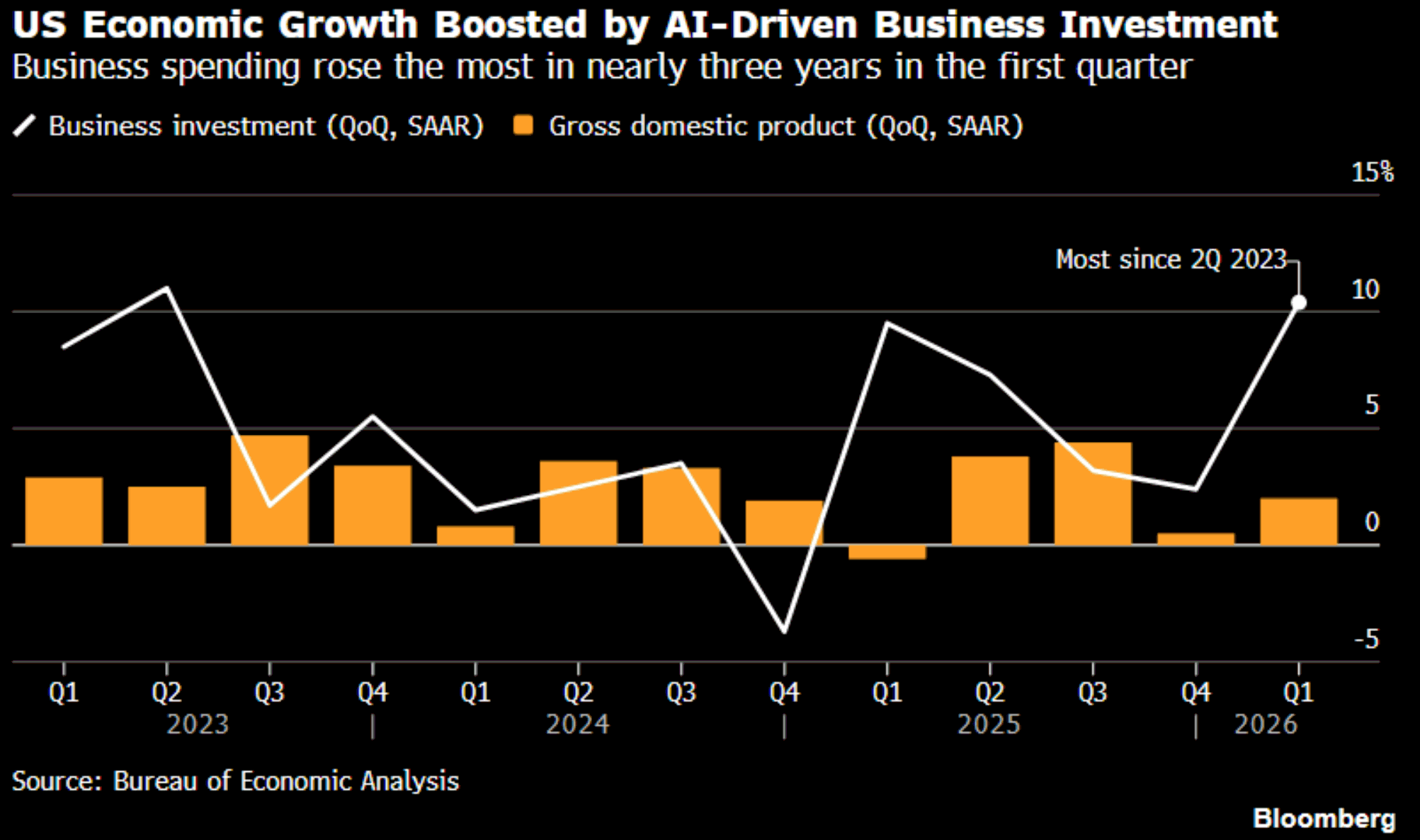
Chart of the Day: Q1 2026 GDP came in modestly positive while business investment surged to its strongest pace since Q2 2023 — Bloomberg framing the divergence as AI capex doing the heavy lifting. The gap between booming corporate investment and tepid headline growth is the same K-shape showing up in the expenditure accounts: capital is sprinting, the broader economy is walking. When the investment line runs at 4-5x the GDP bar, you’re watching one narrow channel carry the cycle.
Market Intelligence Brief (MIB) Ver. 17.77
For professional investors only. Not investment advice.
© 2026 RecessionALERT.com

Comments are closed.