
Iran peace deal erases Wednesday’s stagflation trade — Trump cancels strikes, announces imminent signing; Dow +1.86%, WTI -4.43%, VIX -12%. Semiconductors surge: KLAC +12.86%, SNDK +14.46%, LRCX +12.53% as JP Morgan calls KLAC a triple-earner by 2030. SpaceX prices at $135/share, raises $75B, debuts Friday as SPCX. PPI hits 6.5% YoY while claims rise to 229K — Fed trapped entering next week’s Warsh FOMC. US-China deal declared “done,” rare earths resume, but Beijing calls it only a framework.
TABLE OF CONTENTS
A. EXECUTIVE SUMMARY
B. MARKET DATA
C. HIGH-IMPACT STORIES (6)
D. MODERATE-IMPACT STORIES (5)
E. ECONOMY WATCH (6)
F. EARNINGS WATCH (1)
G. WHAT’S NEXT
H. CHART OF THE DAY
A. EXECUTIVE SUMMARY -> TOP
Iran-US peace deal signals and a historic semiconductor surge combined to reverse Wednesday’s stagflation trade in full — the S&P 500 gained 1.75%, the Nasdaq surged 3.29%, and VIX collapsed 12% to 19.45 as the acute geopolitical risk premium evaporated. The critical macro implication is that today’s oil move (-4.43% WTI) is not merely a commodity trade: if the Hormuz reopens, it mechanically deflates the 6.5% YoY PPI and 4.2% CPI headline readings dominated by energy — potentially rehabilitating the rate-cut narrative that Goldman abandoned June 7. But Thursday’s companion data — PPI double the consensus and jobless claims at a 4-month high — ensure that the Fed’s June 16-17 FOMC under Chair Warsh faces the dual-mandate trap regardless of geopolitical resolution: inflation data argues against cuts while softening labor argues against hikes. Breadth confirmed the move was genuine: 9 of 11 sectors advanced, and DJ Transports’ +3.21% surge — outpacing even the Nasdaq — priced a supply-chain normalization that extends well beyond semiconductor AI capex.
• Iran peace deal: Trump cancels strikes, announces imminent signing — Dow +1.86% (50,848) back above 50,000, WTI -4.43% to $86.04/bbl, VIX -12% to 19.45 as the Hormuz supply-risk premium fully deflates
• Semiconductor explosion: SOX +8%, KLAC +12.86%, SNDK +14.46%, LRCX +12.53%, MU +11.66%, AMAT +11.14% — JP Morgan calls KLAC a triple-earner by 2030; BofA highlights LRCX and AMAT as primary AI capex beneficiaries; Wednesday’s -9% weekly slide reframed as a crowded-position flush
• SpaceX IPO priced: $135/share, $75B raised, $1.77T valuation (7th-largest US company), 2x oversubscribed with $150B+ in demand — Nasdaq debut Friday under SPCX; completes the Anthropic/OpenAI/SpaceX AI frontier-tech pipeline in 11 days
• Fed trapped: PPI May +1.1% MoM (double 0.7% consensus), 6.5% YoY — highest since 2022; jobless claims 229K, highest since February; Polymarket hike odds 47% — dual-mandate conflict peaks before Chair Warsh’s inaugural June 16-17 FOMC and dot plot
• US-China trade: White House declares deal “done” — 30% US tariff baseline locked, rare earth shipments resume; but Beijing calls it a “first meeting framework,” creating interpretive divergence that threatens near-term supply chain optimism
• Corporate stress and credit: Freedom Forever (2nd-largest US solar installer) files Chapter 11 with $500M+ in debt; ORCL -8.53% on debt-funded data center expansion concerns; existing home sales hit strongest 2026 pace at 4.17M units (est. 4.07M)
1. Iran deal changes the inflation math — If Hormuz reopens, the 23.4% YoY gasoline driver of today’s 6.5% PPI and last week’s 4.2% CPI deflates mechanically over 2-3 prints, creating a credible path back to the rate-cut narrative that Goldman abandoned June 7. Two prior “ceasefires” in 96 hours counsel institutional skepticism, but the equity market is pricing meaningful deal probability — and a confirmed signing would be the single most deflationary event available in the current data environment.
2. AI infrastructure capital cycle reaches saturation scale — SpaceX ($75B equity), CoreWeave ($6.75B debt across three tranches Thursday), SMCI ($7B equity), and Oracle’s $40B planned FY2027 capital raise represent an AI financing cycle now operating in the hundreds of billions annually. Wednesday’s semiconductor selloff and Thursday’s +8% recovery confirm the underlying demand thesis is intact, but capital extraction from adjacent tech positions is an ongoing structural headwind — MSFT -1.86% and ORCL -8.53% on the same day semis surged 8% illustrates the rotation risk clearly.
3. Dual-mandate trap deepens before Warsh’s inaugural FOMC — PPI at 6.5% YoY argues against cuts; claims at 229K (highest since February) and Atlanta Fed GDPNow softening from 4.3% to 3.3% in three weeks argues against hikes. With Goldman’s rate-cut forecast withdrawn, Polymarket hike odds at 47%, and the June 16-17 dot plot representing Chair Warsh’s first public policy stance, the FOMC carries the most policy uncertainty of any meeting since the post-COVID tightening cycle began — and the outcome will reset rate-path expectations for the remainder of 2026.
 — Leading economic indicators. Accurate market forecasts. Apply for membership at join.recessionalert.com
B. MARKET DATA -> TOP
Iran’s signal that a peace deal is close triggered a sweeping risk-on reversal, lifting all major indices 1.75%–3.29% and collapsing VIX by 12% to 19.45. The semiconductor complex dominated: KLAC, LRCX, AMAT, MU, and SNDK each surged 11%–14% on AI capex demand and a JP Morgan upgrade highlighting chip equipment earnings power through 2030. Breadth was genuine — 9 of 11 sectors advanced — but Energy (-1.12%) paid the price for peace as WTI cratered 4.43% with Strait of Hormuz supply fears unwinding. Bond markets confirmed the de-escalation read: 10Y yields fell 8.9 bps, and gold’s 2.45% rebound from yesterday’s CPI-driven anomaly rounds out a coherent risk-on picture that stands in near-total contrast to Wednesday’s dual-shock session.
CLOSING PRICES – Thursday, June 11, 2026:
MAJOR INDICES
All six major indices advanced 1.4%–3.3%, with DJ Transportation’s 3.21% surge surpassing even the Nasdaq — transports pricing in a supply-chain normalization that tech cannot claim alone. Nasdaq’s 3.29% gain reflects a semiconductor-specific catalyst (KLAC +12.9%, SNDK +14.5%) rather than broad growth leadership; the Russell 2000’s 2.96% advance confirms domestic names joined the move. A Dow Theory bull confirmation emerges today for the first time in recent sessions: DJIA sits 1.4% below its 10-day high while DJTA breaks above its own 10-day high — both within the 2% confirmation band, a first-session signal reversing the prior non-confirmation. The NYSE Composite’s +1.44% modest lag behind headline indices signals the mega-cap semiconductor surge amplified S&P/Nasdaq more than it lifted the broader market.
| Index | Close | Change | %Move | Why It Moved |
|---|---|---|---|---|
| S&P 500 | 7,394.07 | +127.08 | +1.75% | Iran peace deal signal reversed Wednesday’s selloff; broad 9-of-11 sector advance led by a semiconductor surge of historic magnitude |
| Dow Jones | 50,848.38 | +929.60 | +1.86% | Blue-chip advance driven by industrial, financial, and healthcare names; energy component dragged but blue-chips absorbed it comfortably |
| DJ Transportation | 22,523.1 | +700.6 | +3.21% | Best-performing major index; logistics and carrier names rallied as Iran de-escalation eased Strait of Hormuz supply-chain disruption risk |
| Nasdaq 100 | 29,446.18 | +938.15 | +3.29% | Semiconductor equipment complex surged 11–14% on JP Morgan upgrade and AI capex demand; ORCL -8.5% a partial drag but could not offset semis’ momentum |
| Russell 2000 | 2,919.38 | +83.92 | +2.96% | Small-caps outperformed; domestic-oriented names less exposed to Iran conflict rallied broadly as the geopolitical overhang lifted |
| NYSE Composite | 23,412.90 | +332.07 | +1.44% | Broad participation across NYSE-listed equities; +1.44% lag vs headline indices reflects energy sector weight dragging on the composite |
VOLATILITY & TREASURIES
VIX’s 12% plunge alongside falling yields is a clean de-escalation signature — the geopolitical fear premium and the energy-driven inflation component unwound simultaneously. The 10Y fell 8.9 bps and the 2Y dropped 6.9 bps, with near-parallel compression rather than meaningful curve steepening or flattening — this is risk premium removal, not a recession-scare bond bid. DXY’s modest -0.28% decline confirms safe-haven demand is evaporating; bond markets are fully confirming the equity move, removing the non-participation concern that would signal skepticism about the Iran deal.
| Instrument | Level | Change | Why It Moved |
|---|---|---|---|
| VIX | 19.45 | -2.77 (-12.47%) | Iran deal signal removed the acute geopolitical fear spike; retreating from 22.22 yesterday back toward pre-escalation levels; options market deflating the crisis premium |
| 10-Year Treasury Yield | 4.452% | -8.9 bps | Fell sharply as oil’s 4%+ drop unwound the energy-driven inflation expectations embedded in Wednesday’s spike; geopolitical risk premium deflating |
| 2-Year Treasury Yield | 4.058% | -6.9 bps | Eased as acute inflation catalyst (oil spike) reversed; PPI data showed ongoing price pressure but market prioritized de-escalation signal over the data |
| US Dollar Index (DXY) | 99.66 | -0.28 (-0.28%) | Modest softening as geopolitical safe-haven demand faded; broader risk-on trade lifted non-dollar assets; not a structural dollar break |
COMMODITIES
Gold’s +2.45% rebound after yesterday’s -4.49% anomaly confirms Wednesday was a CPI-driven real-yield spike, not a safe-haven breakdown — the metal is normalizing with the risk environment. Silver’s +4.16% outperformance adds an industrial demand layer: with Iran supply fears easing and copper rising 2%, silver is catching both the precious metals recovery and the industrial growth signal. Bitcoin’s +2.68% tracked equities higher with no independent crypto catalyst — pure beta to the session’s macro relief trade.
| Asset | Price | Change | %Move | Why It Moved |
|---|---|---|---|---|
| Gold | $4,234.55/oz | +$101.25 | +2.45% | Rebounded from yesterday’s CPI-driven anomalous sell-off; dollar weakness (DXY -0.28%) and geopolitical normalization restored the safe-haven bid |
| Silver | $67.430/oz | +$2.690 | +4.16% | Outperformed gold on the industrial demand overlay; softer dollar and China demand optimism amplified the precious metals recovery |
| Copper | $6.3945/lb | +$0.1275 | +2.03% | Iran de-escalation eased supply-chain disruption concerns; dollar weakness and China demand optimism supported industrial metals broadly |
| Platinum | $1,726.70/oz | +$35.80 | +2.12% | Precious and industrial metal mix benefited from gold recovery and automotive catalyst demand signals; moved with the broader metals complex |
| Bitcoin | $63,506.0 | +$1,658.0 | +2.68% | Tracked equities higher on broad risk-on sentiment; no independent crypto-specific catalyst — pure beta to the session’s macro relief trade |
ENERGY
Oil crashed while equities soared — the textbook de-escalation trade: WTI and Brent fell 4.4–4.7% as Iran-UAE direct talks removed yesterday’s Strait of Hormuz supply premium. Yesterday’s rising-oil/falling-equities was a stagflation read; today’s reversal is growth-friendly and confirms the crude move was purely geopolitical, not demand-driven — the risk characterization flips completely in 24 hours. Natural gas fell 3.45% on a larger-than-expected 108 Bcf storage injection — a completely separate supply-side driver with no link to the oil narrative.
| Asset | Price | Change | %Move | Why It Moved |
|---|---|---|---|---|
| Crude Oil (WTI) | $86.04/bbl | -$3.99 | -4.43% | Iran-UAE direct talks raised peace deal probability, sharply reducing Strait of Hormuz supply-disruption risk; full reversal of Wednesday’s geopolitical premium |
| Crude Oil (Brent) | $88.69/bbl | -$4.41 | -4.74% | Global benchmark fell more than WTI given higher Hormuz exposure; WTI-Brent spread narrowing as regional disruption premium deflates |
| Natural Gas (Henry Hub) | $3.075/MMBtu | -$0.110 | -3.45% | EIA reported a larger-than-expected 108 Bcf storage injection for week ended June 5; ample supply overwhelmed hot weather demand forecasts |
| Natural Gas (Dutch TTF) | $16.87/MMBtu | -$0.04 | -0.21% | Minimal USD-adjusted move; European gas largely insulated from Hormuz dynamics; EUR/USD strength (+0.39%) partially offset the €/MWh decline |
S&P 500 SECTORS
Nine of 11 sectors advanced — a macro de-escalation sweep, not a rotation; Consumer Defensive (-0.18%) and Energy (-1.12%) declined as yesterday’s defensive bids unwound. The sharpest cross-horizon signal: Basic Materials is today’s top gainer (+4.33%) but the deepest monthly laggard (-6.93% 1M), signaling a short-covering bounce rather than a fundamental reversal. Energy leads YTD (+27.61%) but fell today as Iran peace signals eroded the Strait of Hormuz premium that built its entire year-to-date advantage.
| Sector | 1-Day | 1-Week | 1-Month | 3-Month | 6-Month | YTD | 12-Month |
|---|---|---|---|---|---|---|---|
| Basic Materials | +4.33% | -3.83% | -6.93% | -1.14% | +17.30% | +12.38% | +37.43% |
| Industrials | +3.58% | -0.60% | +0.92% | +8.08% | +17.21% | +15.61% | +26.37% |
| Technology | +3.15% | -5.61% | +3.07% | +25.23% | +16.51% | +19.98% | +41.97% |
| Consumer Cyclical | +2.35% | -1.65% | -3.23% | +3.98% | -3.68% | -4.44% | +4.65% |
| Financial | +1.43% | +0.86% | +2.38% | +9.58% | +2.13% | -0.69% | +11.38% |
| Healthcare | +1.27% | +1.19% | +3.92% | +3.04% | +2.34% | -0.40% | +13.37% |
| Utilities | +0.45% | -0.38% | -3.76% | -4.59% | +3.39% | +3.38% | +12.40% |
| Communication Services | +0.40% | -3.50% | -5.50% | +4.59% | +0.36% | +0.91% | +22.66% |
| Real Estate | +0.05% | +1.48% | +0.80% | +5.99% | +9.17% | +9.68% | +6.79% |
| Consumer Defensive | -0.18% | +3.63% | -1.28% | +0.08% | +8.43% | +8.63% | +5.52% |
| Energy | -1.12% | -2.64% | -2.35% | +0.46% | +26.00% | +27.61% | +35.43% |
TOP MEGA-CAP MOVERS:
GAINERS
| Company | Ticker | Close | Change | Why It Moved |
|---|---|---|---|---|
| SanDisk Corp | SNDK | $1,880.92 | +14.46% | Memory and NAND storage demand surge as AI data center buildout accelerates HBM and high-layer-count NAND investment; sector-wide upgrade catalyst lifted all chip names |
| KLA Corp | KLAC | $2,410.26 | +12.86% | JP Morgan upgrade highlighted KLAC’s potential to triple earnings by 2030 driven by HBM fab upgrades, leading-edge logic (3nm/2nm), and advanced packaging demand |
| Lam Research Corp | LRCX | $362.12 | +12.53% | BofA named Lam Research a top beneficiary of AI-driven fab upgrade cycle; NAND high-layer count and HBM production ramp demand for Lam’s etch and deposition tools |
| Micron Technology | MU | $995.87 | +11.66% | AI memory demand catalyst; Micron’s HBM and DRAM recovery narrative reinforced by hyperscaler AI capex signals and analyst-driven sector upgrade momentum |
| Applied Materials | AMAT | $552.40 | +11.14% | Lifted by sector-wide JP Morgan/BofA upgrade themes; advanced packaging and leading-edge logic investments driving materials demand for Applied’s deposition tools |
DECLINERS
| Company | Ticker | Close | Change | Why It Moved |
|---|---|---|---|---|
| Oracle Corp | ORCL | $184.10 | -8.53% | Announced further debt financing to fund data center expansion despite flat revenue growth; investors penalized balance-sheet deterioration as AI infrastructure cost concerns broadened |
| Exxon Mobil Corp | XOM | $146.60 | -2.67% | WTI crude fell 4.43% as Iran de-escalation reduced supply disruption risk; integrated oil majors pressured across the board as energy sector’s Hormuz premium unwound |
| Chevron Corp | CVX | $185.82 | -2.10% | Same Iran de-escalation driver as XOM; Brent’s -4.74% decline hit both integrated majors despite the broader market rally |
| Microsoft Corp | MSFT | $389.98 | -1.86% | Lagged the tech rally; rotation into higher-beta semiconductor names; ORCL’s debt-funded AI capex concern raised questions about software companies’ data center spending efficiency |
| Coca-Cola Co | KO | $82.53 | -1.27% | Defensive consumer staple unwound as risk-on sentiment prevailed; Wednesday’s safety bid reversed entirely with Iran fears easing |
— Institutional-grade intelligence for serious investors. Apply for membership at join.recessionalert.comC. HIGH-IMPACT STORIES -> TOP
BULLISH
1. Trump Cancels Iran Strikes, Announces Imminent Peace Deal — Dow +1.71%, S&P +1.50%, WTI -4.43%, VIX -12.47%
The core facts:President Trump announced Thursday via Truth Social that he has “cancelled the scheduled strikes and bombings against Iran this evening,” citing that negotiations with Iranian leadership have reached the “highest level” and been approved. Trump stated: “The Naval Blockade will remain in full force and effect until this Transaction is finalized — Time and place of the signing to be announced shortly.” The announcement directly reversed Wednesday’s escalation — when Trump had threatened to attack Iran “VERY HARD TONIGHT” — and drove a comprehensive market reversal: the Dow Jones Industrial Average surged 1.71% (+930 points) to 50,774.83, recovering back above the 50,000 psychological level breached Wednesday; the S&P 500 advanced 1.50% to 7,375.68; the Nasdaq gained approximately 2.0%; the Russell 2000 outperformed with +3.02%. WTI crude tumbled 4.43% and Brent fell 4.74% as the Hormuz blockade risk premium deflated. The VIX declined 12.47%. Sector leadership flipped entirely from Wednesday: technology, industrials, and materials led; defensive staples and energy lagged. Iran-UAE direct talks and Iranian signals of diplomatic resolution underpinned the move.
Why it matters:Wednesday’s session delivered the textbook stagflation trade — defensive rotation, energy surge, growth selloff — on the back of hot CPI (4.2% YoY) and Iran re-escalation. Thursday erased the geopolitical half of that trade in a single session. The Dow’s recovery above 50,000 is mechanically significant for systematic strategies that use round-number thresholds as triggers. More importantly, if the Hormuz peace deal is signed — Trump says the Strait reopens upon finalization — it collapses the energy-driven component of headline inflation (gasoline was +23.4% YoY in May CPI and 40.5% YoY, the primary driver of the 4.2% headline). A Hormuz reopening would not merely reduce oil prices; it would remove the structural supply shock that has driven energy’s 23.5% YoY contribution to CPI, mechanically deflating headline inflation over the subsequent 2-3 CPI prints. That path — de-escalation → oil normalization → headline CPI relief — could rehabilitate the rate-cut narrative that has been abandoned since Goldman withdrew its forecast June 7. The risk: Trump’s volatile sequencing (escalate → negotiate → escalate) has produced two “ceasefire” events in 96 hours, each partially reversing. Institutional investors are appropriately discounting deal certainty.
What to watch:Any formal Iran-US peace agreement signing — Trump said the time and place will be announced “shortly.” WTI crude for a sustained move below $85/bbl as confirmation that the Hormuz supply premium is being permanently priced out. June 16-17 FOMC — if WTI is below $90 at meeting time, the energy inflation trajectory shifts materially for the Committee’s dot-plot assumptions.
BULLISH
2. Semiconductor Sector +8% on AI Capex Reversal — KLAC +12.86%, LRCX +12.53%, MU +11.66%, SNDK +14.46% as JP Morgan Calls KLAC a “Triple-Earner” by 2030
The core facts:The Philadelphia Semiconductor Index (SOX) surged approximately 8% Thursday — the strongest single-session gain since early 2025 — reversing the majority of Wednesday’s AI infrastructure selloff driven by Super Micro’s equity raise. Key movers: SanDisk (SNDK) +14.46%, KLA Corporation (KLAC) +12.86%, Lam Research (LRCX) +12.53%, Micron Technology (MU) +11.66%, Applied Materials (AMAT) +11.14%, Intel (INTC) +10.3%. The catalyst was a dual analyst upgrade event: JP Morgan released a comprehensive upgrade on KLA Corporation citing potential to triple earnings by 2030, driven by HBM memory fab upgrades, leading-edge logic (3nm/2nm) expansion, and advanced packaging demand; Bank of America simultaneously highlighted Lam Research and Applied Materials as primary beneficiaries of the AI-driven wafer fabrication equipment (WFE) cycle. The global WFE market outlook — revised three times upward to above $140 billion for 2026 — reinforces that the cycle is broadening beyond NVDA to its supplier ecosystem. Geopolitical de-escalation provided the additional catalyst as war-risk premium that had suppressed manufacturing and supply chain sentiment deflated sharply.
Why it matters:Wednesday’s semiconductor selloff was diagnosed as forced selling by institutional managers de-risking AI infrastructure exposure ahead of the SpaceX IPO — a liquidity extraction event, not a fundamental deterioration. Thursday’s reversal validates that thesis: once the IPO priced (confirming $150B+ demand without collapsing the market), crowded-position selling pressure dissipated. The JP Morgan call on KLAC is structurally significant: equipment makers are the “picks and shovels” layer of AI infrastructure, benefiting from both hyperscaler capex and the foundry expansion cycle regardless of which chip architecture wins. The $140B+ WFE market for 2026 means KLAC, LRCX, and AMAT are competing for the same capital that drove NVDA’s prior-cycle returns — but at an earlier stage, with HBM and advanced packaging still in early mass-production. For portfolio managers with technology overweights, the sector’s 8% recovery in one session reframes Wednesday’s -9% weekly loss as a crowded-trade flush rather than a structural deterioration. The AI capex cycle thesis — driven by hyperscaler data center buildout — remains intact.
What to watch:NVDA Q2 FY2027 earnings (August) as the next fundamental anchor confirming AI demand. KLAC, LRCX, and AMAT price action relative to Wednesday’s close — a sustained hold above pre-selloff levels would confirm the flush is complete rather than a bear-market bounce. Global WFE order trends (quarterly company updates) as the leading indicator for continued equipment demand.
BULLISH
3. SpaceX (SPCX) Prices at $135/Share — $75B Raised, $1.77T Valuation Makes It Seventh-Largest US Company; Nasdaq Debut Tomorrow
The core facts:SpaceX priced its initial public offering Thursday at $135 per share — the price at which it had set its roadshow — selling 555.6 million shares to raise $75 billion, the largest single-share-class equity raise in US capital markets history. At $135/share, SpaceX is valued at approximately $1.77 trillion, making it the seventh-largest company in the US by market cap — above Tesla’s approximately $1.6 trillion valuation. The deal received more than $150 billion in investor demand (approximately 2x oversubscribed), with BlackRock placing a single order of approximately $5 billion. The offering capped a historic AI/space IPO pipeline: Anthropic filed its S-1 on June 1, OpenAI filed June 8, and SpaceX priced June 11. SpaceX’s Nasdaq debut is scheduled for Friday June 12 under ticker SPCX. Powerlaw (PWRL), a company with SpaceX exposure, surged 14% on the pricing news Thursday.
Why it matters:The SpaceX IPO is the most significant structural market event of 2026 from a capital-allocation perspective. At $1.77 trillion, SpaceX enters the public market as a top-10 US company on day one — not a speculative small-cap story, but an index-inclusion event that will trigger systematic buying from passive index funds and force active managers to establish or benchmark-compare positions. The $150B in demand against $75B raised is the most direct available signal of institutional risk appetite: even amid a VIX spike (22.22 Wednesday), hot inflation (CPI 4.2%), and geopolitical uncertainty, $150B of institutional capital was willing to be locked up in a pre-revenue-profit space infrastructure company. The pipeline signal matters: Anthropic (S-1 June 1), OpenAI (S-1 June 8), SpaceX (priced June 11) represent the complete monetization of the AI/frontier-tech infrastructure cycle. That the SpaceX deal closed at full price — not discounted — validates the risk appetite despite the week’s volatility. The critical risk: $75B in new SpaceX stock entering the float mechanically extracts liquidity from other tech and AI names — the SMCI selloff Wednesday was attributed in part to pre-IPO positioning. How the broader AI infrastructure complex trades around SpaceX’s first week of active trading will determine whether the liquidity drain is complete or ongoing.
What to watch:SpaceX (SPCX) first-day trading June 12 — a sustained price above $135 signals strong demand absorption; a break below IPO price would signal position-flipping from IPO allocates and broader tech sentiment weakness. S&P 500 and Nasdaq 100 index-inclusion timeline (typically 6-12 months post-IPO) as the systematic-buying catalyst. Anthropic and OpenAI IPO timelines as the next AI-pipeline events that could similarly extract liquidity.
UNCERTAIN
4. White House Declares US-China Trade Deal “Done” — 30% US Tariff Baseline Locked, Rare Earth Shipments Resume, China Accepts Student Visas
The core facts:The White House announced Thursday that a trade framework agreement with China is finalized, with the deal characterized as “done.” Under the terms, the US maintains a 30% aggregate tariff rate on Chinese goods (comprised of the 20% “fentanyl tariff” and 10% “reciprocal” baseline) while China maintains a 10% baseline tariff on US goods. In exchange for the tariff framework, the US agreed to resume full acceptance of Chinese students at American universities, and China agreed to resume rare earth and rare earth compound shipments to the US — a critical supply chain input for semiconductor packaging, defense electronics, EV motors, and advanced manufacturing. Beijing characterized the announcement differently, describing it as a “first meeting framework” rather than a comprehensive deal — signaling negotiating asymmetry on the interpretation of the agreement’s scope and finality.
Why it matters:The rare earth resumption is the most immediately market-relevant provision. Rare earth supply chain disruption — which China uses as a retaliatory lever — was a material cost and supply risk for semiconductor manufacturers, defense contractors, and EV producers. Resumption removes that specific pressure. However, the 30% US tariff rate on Chinese goods remains: this is not a tariff reduction but a tariff freeze at an already-elevated level. Companies that import from China face the same cost structure as before the announcement — the “deal” institutionalizes tariffs rather than removing them. The interpretive divergence between “done” (White House) and “first meeting framework” (Beijing) is the key risk: if China views this as a starting point for further negotiation rather than a settled agreement, the “done” framing may generate market optimism that the underlying reality cannot sustain. For supply chains specifically: rare earth resumption is good, but $1.8T in annual North American trade remains uncertain (see USMCA non-renewal from Wednesday), and 30% China tariffs are a structural input cost that has been absorbed but not resolved.
What to watch:Whether rare earth shipments actually resume in volume within 30 days — the critical operational confirmation. Any Chinese statement upgrading the deal from “framework” to “final agreement.” USD/CNY and CNH offshore yuan rate as real-time trade deal confidence indicators. The July 1 USMCA review deadline as the next major North American trade policy trigger that could compound or offset this signal.
BEARISH
5. PPI May Surges 1.1% MoM — Double the 0.7% Consensus — Hitting 6.5% YoY, Highest Since Late 2022; Markets Absorb Shock on Iran Relief
The core facts:The Bureau of Labor Statistics reported Thursday that the Producer Price Index for Final Demand rose 1.1% in May on a monthly basis — double the 0.7% consensus estimate and the second consecutive monthly beat — while the 12-month rate reached 6.5%, the highest since late 2022. The primary driver was a 10.7% monthly energy surge, with gasoline wholesale prices up 23.4% MoM. Core PPI (excluding food and energy) rose 0.4% MoM and 4.9% YoY — in line with the core estimate, representing a favorable split: headline inflation is energy-driven, not broad-based. Despite the hot headline print, major equity indexes extended gains from session open — the Iran peace deal news dominated market action, and 10-year Treasury yields fell slightly following an above-average 10-year auction. CME FedWatch data shows markets pricing near-zero probability of any action at next week’s June 16-17 FOMC. However, market-implied probability of at least one 2026 rate hike now stands at approximately 50.5%, with Polymarket hike odds at 47% — the highest since the 2022 tightening cycle. Today’s PPI, combined with Wednesday’s CPI at 4.2% YoY, presents the first back-to-back month of major inflation data surprises in 2026.
Why it matters:The PPI’s directional message is clear regardless of the equity market’s muted reaction: wholesale inflation is running at a rate that, if sustained in the pipeline, will propagate into CPI readings over the next 1-3 months. The energy/core split is the analytically important detail — core PPI at 4.9% YoY is elevated but not accelerating; the headline is driven by gasoline at 23.4% MoM, which in turn reflects Hormuz blockade supply disruption. If the Iran peace deal materializes and Hormuz reopens, the energy-driven PPI spike reverses rapidly in the June-July data — making today’s 1.1% headline number a potential cyclical peak rather than a trend. However, if the deal fails (as the June 9 ceasefire did), June PPI will compound further. For the June 17 FOMC, the PPI report confirms the data-dependent Fed cannot cut — but does not unambiguously signal a hike either. The BEARISH classification reflects the policy pathway compression: the PPI locks out cuts and raises hike probability, creating a sustained restrictive posture that tightens financial conditions relative to what was priced a month ago.
What to watch:June 17 FOMC statement and Warsh’s press conference — the first dot-plot under the new Chair, which will reveal whether the Committee formally raises or maintains the 2026 rate-path median. June PPI (released mid-July) as the first post-Hormuz-deal read on whether energy deflation is flowing through the wholesale price pipeline. CME hike odds drifting above 55% as the signal that the market has fully priced the next tightening cycle.
BEARISH
6. Jobless Claims 229K — Highest Since February, Miss vs. 219K Expected; Hot PPI + Soft Labor = Fed Trapped Heading Into June 17 FOMC
The core facts:Initial jobless claims for the week ending June 6 rose to 229,000 — well above the 219,000 consensus estimate and above the prior 225,000 reading — the highest weekly claims print since February 2026. Continuing claims also increased to 1,795,000 versus the 1,780,000 estimate. The 4-week moving average rose to 219,000, confirming the trend is directionally deteriorating rather than representing a one-week anomaly. The claims miss arrived on the same morning as the hot PPI print (+1.1% MoM vs +0.7% expected), producing a simultaneous dual-bad-news event: inflation running materially hotter than expected while the labor market shows the first consistent signs of softening in the 2026 data sequence.
Why it matters:The Fed’s dual mandate — price stability and maximum employment — is being pulled in opposite directions simultaneously. Hot PPI (6.5% YoY) argues against cutting rates; softening jobless claims (229K, highest since February) argues against raising them. This is the textbook policy trap: the Fed must choose between acting on inflation (risking recession acceleration) or accommodating labor weakness (risking inflation entrenchment). With the June 17 FOMC now six days away, and this being the final labor market data point before the decision, Chairman Warsh’s inaugural press conference must address this tension explicitly. The 4-week moving average rising to 219K — the same level as the weekly consensus estimate — signals that even “consensus” expectations are being calibrated upward relative to the February baseline. The cumulative Atlanta Fed GDPNow deterioration (4.3% to 3.0% over three weeks) combined with rising claims traces the path from “soft landing” to “slowing” to — if claims continue — “contraction.” The labor market is not in recession territory, but the directional signal is unmistakably toward deterioration, not stabilization.
What to watch:June 17 FOMC statement — whether Warsh acknowledges the dual-mandate tension explicitly and signals how the Committee will prioritize. Next Thursday’s jobless claims print — a sustained print above 230K would signal the labor softening is trend rather than noise. The June non-farm payrolls report (released early July) as the definitive labor market data point for the July FOMC.
— Quantifying recession risk so you don’t have to guess. Apply for membership at join.recessionalert.comD. MODERATE-IMPACT STORIES -> TOP
BEARISH
7. OPEC Monthly Report Cuts 2026 Demand Growth to 970K bpd — Second Straight Downward Revision as Hormuz Crisis Suppresses Middle East Consumption
The core facts:OPEC’s June Monthly Oil Market Report — released Thursday — cut the 2026 global oil demand growth forecast to 970,000 barrels per day, down from 1.17 million bpd in the May report, marking the second consecutive monthly downward revision. Key drivers of the cut include a 60,000 bpd reduction to Indian demand growth and an estimated 40,000 bpd decline in Middle East consumption, with OPEC estimating March 2026 regional demand was 500,000 bpd below year-ago levels due to the Iran war’s economic disruption. OPEC+ crude output fell 190,000 bpd in May to 33.13 million bpd, primarily driven by Iranian export drops from the Hormuz blockade. The 2027 outlook is more constructive: a rebound to approximately +1.7 million bpd in demand growth is projected as the blockade is assumed to eventually resolve. The June report arrives as WTI and Brent were declining sharply on the Iran peace deal signal — though OPEC’s demand-cut forecast is structurally bearish regardless of the near-term price move.
Why it matters:OPEC’s sequential demand cuts describe a pattern that has historically preceded significant oil price corrections: two consecutive downward revisions in three months, anchored by a supply-constrained region whose own consumption is falling. The diagnostic irony is sharp — the same Hormuz blockade that has driven crude prices to $92+/bbl is simultaneously suppressing the Middle East demand that would otherwise support those prices. If Iran peace materializes, the supply shock (which supports high prices) and the demand destruction (which suppresses them) both reverse simultaneously, creating a cross-cutting price dynamic that makes directional energy positioning unusually difficult. For US E&P stocks specifically, the demand-cut is a near-term negative signal — lower demand growth trajectories compress the long-run oil price assumptions embedded in equity valuations — even as today’s WTI move is bullish on de-escalation. Energy sector managers need to separate the cyclical (peace-deal-driven WTI decline) from the structural (OPEC’s 2026 demand growth cut reflecting genuine economic weakness).
What to watch:OPEC’s July Monthly Oil Market Report — a third consecutive demand-growth cut would confirm a deteriorating structural demand thesis. WTI and Brent spot prices in the first 30 days post any Hormuz peace deal as the simultaneous supply-reopen and demand-rebound test.
UNCERTAIN
8. Super Micro (SMCI) Officially Prices $7B Equity and Equity-Linked Offering — AI Infrastructure Demand Confirmed, $12B Market Cap Dilution Absorbed
The core facts:Super Micro Computer (SMCI) officially priced its $7 billion equity and equity-linked financing package Thursday — the deal announced June 9 after market close consisting of a $5 billion underwritten offering and up to $2 billion in at-market sales to fund component procurement for $39 billion in AI server orders from more than 20 customers. The pricing closes the transaction that triggered a two-day, approximately 26% stock decline on June 10-11 as investors priced the dilutive impact of the capital raise. The formal pricing represents the deal’s confirmation: the offering absorbed by institutional book-runners despite significant selling pressure validates the demand signal — $39 billion in AI server backlog is real enough that institutional investors funded the dilutive raise rather than abandoning it.
Why it matters:The SMCI pricing is a structural signal for the AI infrastructure funding cycle: even a company that has lost approximately $12 billion in market cap over two days — and whose stock is trading at a fraction of its prior highs — can successfully raise $7 billion because the demand for AI server capacity is unambiguously real at the customer level ($39B backlog, 20+ customers). The UNCERTAIN classification reflects the two conflicting readings: bullish (demand is confirmed, funding secured, AI server build continues) and bearish (the dilution was severe, execution risk on $39B of backlog at a company with a complex financial history remains elevated, and the capital structure now includes $5B of fresh equity plus potential $2B ATM overhang). For the broader AI infrastructure complex — NVDA, AVGO, MRVL, AMAT — the SMCI pricing removes the incremental uncertainty of whether the deal would close and refocuses attention on the fundamental AI demand trajectory.
What to watch:SMCI’s next quarterly earnings and order execution update — the critical proof that the $39B backlog is being delivered on schedule. SMCI stock stabilization above the post-offering pricing level as confirmation that dilution has been fully absorbed by the market.
UNCERTAIN
9. CoreWeave Prices $1.25B + €2B Senior Notes, Plans Additional $3.5B Offering — AI Data Center Debt Surge Accelerates as Infrastructure Funding Cycle Deepens
The core facts:CoreWeave — the AI cloud infrastructure provider that completed its IPO earlier in 2026 — priced $1.25 billion in US dollar-denominated senior notes and €2 billion in euro-denominated senior notes Thursday, and simultaneously announced its intent to offer an additional $3.5 billion in senior notes. Combined with the concurrent offerings, CoreWeave is accessing approximately $6.75 billion in debt financing across three tranches in a single session — one of the largest AI-sector debt financing events since the current infrastructure cycle began. The financing is directed at expanding GPU cluster capacity, data center build-out, and long-term customer contract fulfillment. The transaction represents the debt-financing layer of the AI infrastructure cycle, complementing the equity channels that SpaceX ($75B), Anthropic, and OpenAI are simultaneously accessing in the IPO market.
Why it matters:CoreWeave’s multi-tranche debt raise is the clearest available signal that the AI infrastructure build-out has moved beyond equity financing into leveraged debt capital markets. When infrastructure companies access both USD and EUR debt simultaneously at scale, it signals (1) institutional lenders across two major credit markets have formed a consensus that AI infrastructure cash flows are credit-worthy, and (2) the build-out pace demands capital faster than equity markets alone can supply it. The UNCERTAIN classification reflects the dual read: bullish (deep and diversified financing signals genuine long-duration AI demand), bearish (the leveraged nature of AI infrastructure financing creates concentration risk in credit markets if AI monetization timelines slip). The $6.75B raised Thursday by CoreWeave, combined with Oracle’s planned $40B FY2027 capital raise and the SMCI $7B equity offering, suggests the AI infrastructure capital cycle is now operating in the hundreds of billions annually — a scale that was previously reserved for sovereign borrowers and established utility-scale infrastructure projects.
What to watch:High-yield credit spreads for AI infrastructure issuers as the signal of whether lenders are comfortable with the pace of AI debt issuance. CoreWeave’s revenue growth and utilization rates (next quarterly update) as the cash-flow validation of the debt thesis.
UNCERTAIN
10. Court Permits Enforcement of 10% Global Tariff During Pending Appeal — Importers Continue to Pay Despite May 7 CIT Ruling Finding Tariff Unlawful
The core facts:A US court ruled Thursday to permit continued enforcement of the Trump administration’s 10% global “balance-of-payments” tariff during the pendency of the government’s appeal — granting a stay of the May 7 Court of International Trade (CIT) ruling that had found the tariff unlawful under Section 122 of the Trade Act of 1974. The CIT had ruled on May 7 that the President exceeded statutory authority in imposing the 10% global tariff via Proclamation No. 110122. However, rather than an immediate suspension of collections, the appellate stay ensures the tariff continues to be collected from all importers while the legal challenge proceeds through the courts. The 10% global tariff affects imports from all countries not covered by specific bilateral tariff agreements, operating as a floor rate beneath the higher country-specific tariffs (e.g., 30% China, elevated rates on Canada and Mexico).
Why it matters:The UNCERTAIN classification reflects the asymmetric uncertainty of the legal outcome. For the near term: the stay means importers continue to pay the 10% global tariff, preserving the current cost structure and providing no near-term supply chain relief. For the medium term: if the government loses on appeal — and the Supreme Court has already limited some tariff authorities this cycle — a reversal could trigger refunds on previously collected tariff revenue, which the administration would strongly resist. The immediate market impact is neutral (status quo preserved), but the legal outcome has material implications: a final ruling striking down the 10% global tariff would constitute the most significant tariff rollback since the escalation cycle began and would structurally alter the cost basis for thousands of importers. Retailers, consumer goods manufacturers, and industrial component importers are most exposed. The USTR and administration are fighting both on the Iran geopolitical front and on the domestic judicial front simultaneously — legal uncertainty around tariff authority is an underappreciated risk in the current trade policy environment.
What to watch:The appellate briefing schedule and any Supreme Court emergency docket application from the government. Any district or circuit court ruling on the broader IEEPA tariff authority questions as the legal theory framework that governs the entire tariff architecture.
BULLISH
11. BofA Sets AMD Price Target $560, Maintains Buy — 18.6% Upside as AI Chip Cycle Broadens Beyond NVDA to Data Center CPU/GPU Architecture
The core facts:Bank of America maintained its Buy rating on Advanced Micro Devices (AMD) Thursday and set a price target of $560 — implying approximately 18.6% upside from current levels. The call arrived on a day when AMD participated in the broader semiconductor sector surge (+8%), with AMD advancing in sympathy with the KLAC/LRCX/MU complex. BofA’s thesis centers on AMD’s growing relevance in AI data center workloads — particularly the MI300X GPU series’ uptake in training and inference, Epyc CPU server market share gains against Intel, and AMD’s positioning as the primary alternative to NVIDIA in hyperscaler procurement. The $560 target reflects confidence that AMD’s AI GPU revenue can sustain multi-quarter double-digit growth even as the overall semiconductor equipment cycle broadens.
Why it matters:The BofA AMD call matters structurally because of what it signals about the AI chip cycle’s breadth. During Wednesday’s sector selloff, multiple analysts upgraded NVDA and INTC even as the broader AI infrastructure complex declined — demonstrating that the analyst community views AI hardware demand as fundamentally intact, with price dislocations as buying opportunities rather than fundamental deterioration. BofA’s AMD call extends that thesis to the “second chip” layer: companies that are not pure NVDA plays but benefit from the same hyperscaler capex cycle through diversified AI workloads. AMD’s MI300X has captured a growing share of inference workloads where full NVDA premium is harder to justify. For portfolio managers building AI exposure with diversification away from NVDA concentration, AMD at 18.6% implied upside with a BofA Buy provides a conviction entry signal from a major institutional voice.
What to watch:AMD Q2 FY2026 earnings (late July) — MI300X revenue growth and data center GPU segment guidance as the fundamental validation of the BofA thesis. AMD’s ability to sustain market share gains in hyperscaler procurement alongside NVDA Blackwell ramp.
— Separating signal from noise since 2007. Apply for membership at join.recessionalert.comE. ECONOMY WATCH -> TOP
Thursday’s data delivered a textbook stagflation split heading into the June 17 FOMC: headline PPI held at 1.1% MoM for the second consecutive month — 2x the 0.7% expected — driving the 12-month rate to 6.5%, the highest since November 2022, almost entirely on a 10.7% energy surge at the wholesale level. Core PPI told the opposite story, cooling to 4.9% YoY vs. 5.4% expected, confirming the inflation is energy-driven, not broad-based. Initial claims jumped to 229K (highest since February), cracking the labor market picture just as GDPNow tracked Q2 at 3.3% and existing home sales hit the strongest pace since December — leaving Chair Warsh’s inaugural dot plot next week as the only instrument capable of resolving a market that has priced nearly zero cuts and 47% odds of a hike.
PPI Final Demand May 2026: Headline Holds at 1.1% MoM for Second Consecutive Month (2x Expected), Drives 12-Month Rate to 6.5% — Highest Since November 2022; Core Cools to 4.9% YoY (BLS, June 11, 2026)
What they’re saying:Producer prices for final demand rose 1.1% in May on a seasonally adjusted basis — matching April’s pace and more than double the 0.7% consensus estimate. The 12-month rate accelerated to 6.5%, the highest since November 2022. Nearly 80% of the monthly advance came from goods prices (+2.8%), with energy up 10.7% at the wholesale level and gasoline surging 23.4%. Services added 0.6%, boosted partly by a 4.8% jump in portfolio management fees on May’s equity market strength. Core PPI (ex food and energy) rose just 0.4% MoM (vs. 0.5% expected) and 4.9% YoY — meaningfully below the 5.4% consensus.
The context:The headline/core split puts the Fed in a structurally difficult position ahead of the June 16–17 FOMC. Two consecutive 1.1% MoM prints — with 6.5% YoY — make further accommodation politically untenable. Yet the core beat argues against preemptive hiking when labor is simultaneously softening. Markets have repriced aggressively: Polymarket now shows 47% hike probability for 2026 and near-zero cut probability. El-Erian (Allianz) called the energy surge a “contained shock” and advocated “neither hikes nor cuts.” The same pattern drove yesterday’s CPI headline — geopolitics and energy are the inflation story, not domestic demand.
What to watch:June 16–17 FOMC meeting — Chair Warsh’s inaugural SEP and dot plot will be the primary market signal; any terminal rate projection above 4.0% would be hawkish. Michigan 5-Year Inflation Expectations (Fri Jun 12, prior 3.9%) — a move above 4.0% would harden the case for a hike.
Initial Jobless Claims Hit 229K — Highest Since February, Missing 219K Forecast as Labor Market Shows Early Cracks (DOL/Bloomberg, June 11, 2026)
What they’re saying:Initial jobless claims for the week ending June 6 rose to 229K — up from 225K the prior week and well above the 219K consensus, the highest reading since February. Continuing claims also increased to 1,795K versus the 1,780K expected, extending an upward trend from 1,771K the prior week. The 4-week moving average rose to 219K. The increase was partly attributed to seasonal volatility around the school year-end, though Bloomberg flagged the print as the highest since February.
The context:The miss adds a critical complication to the stagflation narrative heading into next week’s FOMC: just as wholesale inflation runs at 6.5% YoY, the labor market is showing early-stage softening. The Fed’s dual mandate — price stability and maximum employment — is increasingly in conflict. Historically, a sustained move in initial claims above 230–240K signals deteriorating labor conditions; at 229K, today’s print is approaching but not yet at that threshold. The 4-week moving average at 219K (the highest in months) is the more reliable trend signal to watch.
What to watch:Next week’s claims report (Jun 18, day after FOMC decision) — a sustained move above 230K would shift the narrative from “marginal softening” to “labor market deterioration.” 4-week moving average trajectory; June NFP (released first Friday of July).
Existing Home Sales Hit Strongest 2026 Pace in May — 4.17M Units (+3.2%), Highest Since December, Beating 4.07M Estimate (NAR, June 9, 2026)
What they’re saying:Existing home sales rose 3.2% in May to 4.17 million units (SAAR), beating the 4.07M consensus and marking the strongest reading since December 2025. Sales rose month-over-month in the Northeast, Midwest, and South; unchanged in the West. Median sales price: $429,300. Inventory: 4.5 months of supply. NAR Chief Economist Lawrence Yun attributed the strength to improved affordability versus a year ago and “pent-up demand from buyers who had been waiting on the sidelines.”
The context:The report defies the conventional view that rising mortgage rates (30-year fixed: 6.52%) suppress demand. Buyers have adjusted their expectations to the higher-rate environment and are re-entering the market. Inventory at 4.5 months remains below the 6-month neutral threshold, which continues to support prices. Alongside GDPNow’s 3.3% Q2 tracking, the housing data reinforces a picture of real economic resilience — complicating the recession narrative while also complicating the case for Fed rate cuts.
What to watch:Michigan Consumer Sentiment (Fri Jun 12, exp. 46, prior 44.8) for affordability signals; new home sales (Jun 23); a sustained inventory move above 5 months of supply would signal a demand turn.
Atlanta Fed GDPNow Tracks Q2 2026 at 3.3%, Countering Recession Fears Despite Energy Inflation Headwinds (Atlanta Fed, June 9, 2026)
What they’re saying:The Atlanta Fed’s GDPNow model revised its Q2 2026 real GDP growth estimate up to 3.3% as of June 9, from a prior 3.0%. The model had earlier pulled back from 3.8% as trade and manufacturing data softened, but recent service-sector and consumer spending inputs supported a partial recovery. The next update is scheduled for June 16, coinciding with the opening day of the FOMC meeting.
The context:The 3.3% tracking estimate stands in stark contrast to institutional recession probability forecasts — Goldman at 30%, Moody’s at ~49%, JPMorgan at 35% — which were largely calibrated on geopolitical and energy risks from earlier in the year. A Q2 tracking estimate above 3% suggests the US economy is absorbing the energy price shock without a significant demand contraction. For PMs, this is the most important data point in the current stagflation vs. growth debate: if GDPNow holds at or above 3% through the quarter, the recession camp loses a critical pillar, and the Fed faces the pressure of a hot-inflation, resilient-growth environment — not a policy-easing scenario.
What to watch:GDPNow update on June 16 (FOMC opening day); Q1 GDP final revision (late June); Q2 GDP advance estimate (late July 2026).
Freedom Forever, 2nd-Largest U.S. Residential Solar Installer, Files Chapter 11 with Over $500M in Debt (PV-Tech/NatLawReview, June 2026)
What they’re saying:Freedom Forever, the second-largest US residential solar installer with a 6.1% market share (Wood Mackenzie 2025 data), filed Chapter 11 in the US Bankruptcy Court for the District of Delaware this week. The company listed over $500M in debt, with total assets between $100M and $500M. Major creditors include solar financing firm Mosaic Funding IX ($100M+) and Chinese panel manufacturers JA Solar, Trina Solar, and Jinko Solar, along with US manufacturer Silfab Solar.
The context:The filing reflects broader stress in the US residential solar installation sector, where higher interest rates have squeezed the tax credit-backed financing structures that underpin customer acquisition. The creditor constellation — US solar financing (Mosaic), Chinese panel makers, and domestic manufacturers — signals potential supply-chain and financing contagion risks for the broader US residential solar buildout. Freedom Forever’s failure follows GoHealth’s Chapter 11 last week, suggesting credit stress is widening across sectors that relied on post-pandemic federal program expansion and easy financing. Watch SunRun (RUN) — the #1 residential solar installer — for sector read-through.
What to watch:Delaware bankruptcy court proceedings; Mosaic Funding IX contagion exposure; SunRun and solar ETF (TAN) performance; residential solar installation volumes for H2 2026.
BofA Institute: K-Shaped Consumer Divide Showing Early Signs of Narrowing, But Energy Prices — Not Improved Finances — Are Driving Convergence (BofA Institute, June 11, 2026)
What they’re saying:Bank of America Institute head Liz Everett Krisberg reports the K-shaped economy — the post-pandemic spending divergence between higher- and lower-income households — is beginning to narrow. Lower-income household spending growth came in at 1.1% YoY versus 2.9% for higher-income households, the smallest differential in six months. Lower-income households showed larger boosts in discretionary spending categories in recent data.
The context:The convergence carries a significant asterisk: the narrowing is primarily driven by the shared burden of rising energy prices — lower-income households allocate a proportionally larger share of consumption to gasoline, so the energy surge has mechanically shifted spending patterns toward parity. BofA explicitly notes that the underlying after-tax wage growth divergence remains intact, suggesting the structural K-shape persists. For PMs, this is a caution against misreading the narrowing as a consumer health positive — it is energy-price-driven pain convergence, not financial convergence. This matters for retailers targeting mid-to-lower income consumers (discount retail, dollar stores, off-price) entering H2 2026 as energy stays elevated.
What to watch:Michigan Consumer Sentiment (Fri Jun 12, prior 44.8); June consumer credit data; BofA Institute’s next Consumer Checkpoint; Q2 2026 retailer earnings commentary on spending trends by income cohort.
— Know the probability before the market prices in the risk. Apply for membership at join.recessionalert.comF. EARNINGS WATCH -> TOP
YESTERDAY AFTER THE BELL (Markets Reacted Today)
UNCERTAIN
12. Oracle Corp (ORCL): -8.53% | Record Cloud Backlog Meets $23.7B FCF Deficit — $40B FY2027 Capital Raise Plan Overshadows Beat
The Numbers:Q4 FY2026 revenue: $19.2B (+21% YoY), beat estimate of $19.10B. Non-GAAP EPS: $2.11 (+24% YoY), beat estimate of $1.96. GAAP EPS: $1.45, missed estimate of $1.50. FY2026 total revenue: $67.4B (+17%), cloud revenue: $34.0B (+39%). Q4 cloud: $9.9B (+47% YoY); Oracle Cloud Infrastructure (OCI): +93% YoY. Remaining Performance Obligations (RPO): $638B (+53% YoY). FY2026 free cash flow: negative $23.7B. FY2027 capital raise plan: approximately $40B through debt and equity, including a $20B at-the-market equity issuance. Released: AMC June 10, 2026.
The Problem/Win:The win is unambiguous: $638B in RPO (backlog), OCI growing +93% YoY, and cloud revenue doubling its prior pace confirm that Oracle has successfully positioned itself as the AI infrastructure platform of record for the enterprise market. Prepaid and customer-supplied hardware for large AI contracts alone total $75 billion — the operational AI pipeline is massive and real. The problem is equally clear: generating -$23.7B in free cash flow while simultaneously announcing a $40B capital raise to fund the infrastructure needed to deliver that backlog creates a financing-risk overhang that the market is pricing aggressively. GAAP EPS missed ($1.45 vs $1.50 est.), reinforcing investor focus on the cash-generation gap between what Oracle is booking (RPO) and what it is generating (FCF). The stock fell -7.12% AH on June 10 and an additional -8.53% in Thursday’s regular session — a two-day decline of approximately 15%.
The Ripple:Oracle’s financing model — spending $23.7B beyond its operating cash flows in a single fiscal year — is the most visible case study for the broader AI infrastructure cash burn question: can hyperscalers and AI cloud providers monetize the capital cycle fast enough to sustain it without permanent equity dilution? The negative FCF profile is shared to varying degrees by CoreWeave (raising $6.75B in debt today), SMCI (pricing $7B equity), and Amazon AWS (elevated capex). The Oracle result directly pressures enterprise software peers (SAP, Salesforce) on their AI infrastructure cost discipline, and tests whether large enterprise customers will accept the growing AI spending they have prepaid for.
What It Means:Oracle’s AI cloud thesis is intact — $638B in backlog is not speculative — but the execution risk has materially increased: delivering $638B in contracted revenue while running a -$23.7B FCF deficit and raising $40B in new capital requires flawless operational execution over multiple years. For portfolio managers, ORCL is now a high-conviction-but-high-execution-risk position; the FCF trajectory in FY2027 Q1-Q2 results will determine whether the discount is a buying opportunity or warranted.
What to watch:Oracle FY2027 Q1 earnings (September) — first data point on whether the $40B capital raise is translating into RPO conversion velocity and improving FCF trajectory. OCI revenue growth deceleration (currently +93% YoY) as the key signal that the AI hyperscaler tailwind is sustaining at scale.
TODAY BEFORE THE BELL (Markets Already Reacted)
No major earnings before the bell from companies with >$100B market cap.
TODAY AFTER THE BELL (Markets React Tomorrow)
No major earnings after the bell from companies with >$100B market cap. Adobe Inc (ADBE, $88.22B) and Lennar Corp (LEN, $23.32B) report AMC today but fall below the $100B market cap threshold for MIB coverage.
WEEK AHEAD PREVIEW:
Q1 2026 earnings season is essentially complete at approximately 99% of the S&P 500 reported. No mega-cap earnings are scheduled next week. The dominant event is the June 16-17 FOMC meeting — Chairman Warsh’s inaugural rate decision, press conference, and first dot-plot release. SpaceX (SPCX) begins Nasdaq trading Friday June 12, drawing significant institutional attention that may temporarily overshadow traditional earnings-focused positioning.
Q2 2026 earnings season begins mid-to-late July — the next major catalyst for individual company guidance and sector-level AI capex signals.
— US market commentary trusted by family offices and institutions. Apply for membership at join.recessionalert.comG. WHAT’S NEXT -> TOP
UPCOMING RELEASES:
| Date | Event | Why It Matters |
|---|---|---|
| Fri, Jun 12 | Michigan Consumer Sentiment — Preliminary (expected 46, prior 44.8) | First post-Iran-deal consumer confidence read; a sustained move above 46 would signal households are pricing in geopolitical relief. The 5-Year Inflation Expectations sub-component (prior 3.9%) is the critical watch: a move above 4% would harden the case for an FOMC hike and potentially move the dot-plot median at next week’s meeting. |
| Tue–Wed, Jun 16–17 | FOMC Meeting — Policy Decision + Chair Warsh’s Inaugural Press Conference + Summary of Economic Projections (Dot Plot) | The highest-stakes FOMC in years: Chair Warsh’s first dot plot will reveal the Committee’s terminal rate projection under a dual-mandate conflict (PPI 6.5% YoY vs. claims 229K). Markets price near-zero cut probability; Polymarket hike odds 47%. The dot plot’s 2026 median and Warsh’s press conference tone will reset the rate-path narrative for the remainder of the year. GDPNow’s Jun 16 update will arrive simultaneously as the first-day input. |
| Thu, Jun 18 | Initial Jobless Claims (prior 229K, 4-week avg 219K) | First labor market read post-FOMC; a sustained print above 230K would shift the narrative from “marginal softening” to “labor market deterioration” and reopen the rate-cut debate regardless of Warsh’s Wednesday signal. Released the day after the FOMC decision, making it the earliest market-moving data point to react to or challenge the Committee’s stance. |
KEY QUESTIONS:
1. Will the Iran-US peace deal be formally signed — and if so, how quickly does WTI sustain a move below $85/bbl as confirmation that the Hormuz supply premium is permanently priced out of energy and headline inflation?
2. Does Chair Warsh’s inaugural dot plot signal a hike, an extended hold, or an explicit acknowledgment of dual-mandate tension — and does his press conference frame the energy-driven PPI spike as transitory or structural?
3. Does SpaceX (SPCX) trade above its $135 IPO price on Friday’s debut, confirming institutional demand absorption — or does the $75B float introduction pressure adjacent AI infrastructure names (NVDA, AMAT, MSFT) through continued crowded-position rotation?
— US market commentary trusted by family offices and institutions. Apply for membership at join.recessionalert.comH. CHART OF THE DAY -> TOP
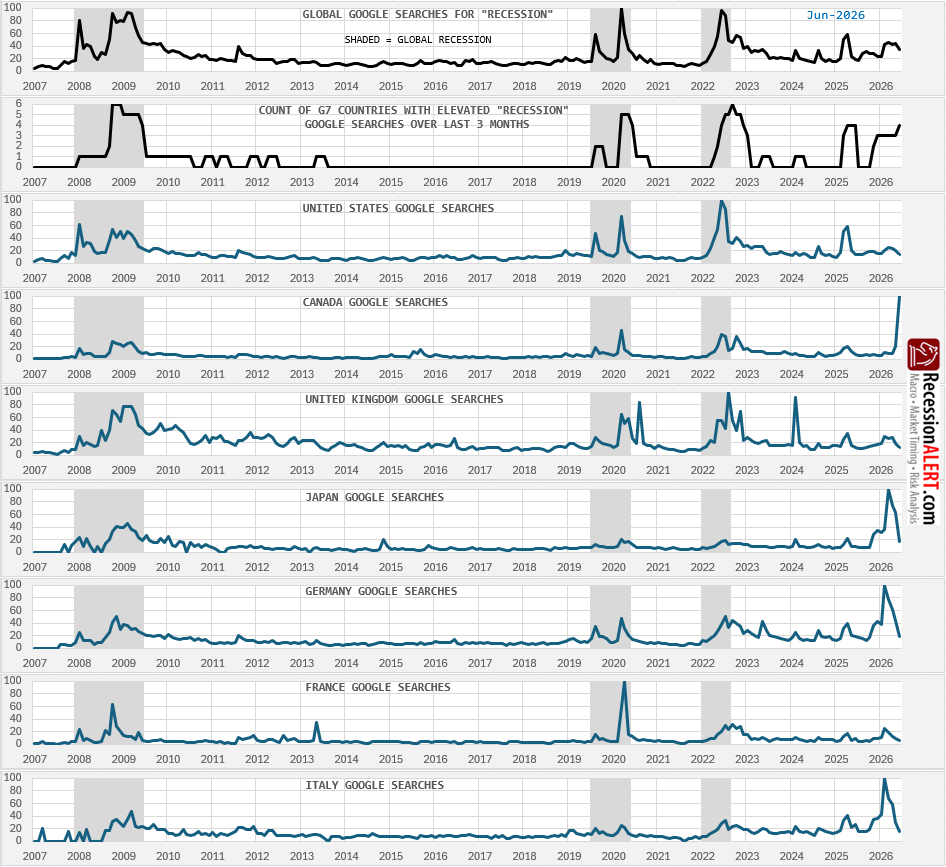
Two panels of the same chart disagree, and the disagreement is the story. The aggregate global “recession” search index reads ~30 — calm, mid-range, unremarkable. Beneath it, the G7 diffusion count sits at 3-4 on a rolling three-month window. That breadth has printed only three times in two decades: 2008-09, 2020, 2022-23 — each cresting at 5-6 at the worst, each preceding a global recession. The aggregate smooths a calendar month; the diffusion catches a cluster. The cluster is honest. The per-country panels resolve the contradiction. Japan, Germany, and Italy spiked together late-2025, the UK and France behind — search led, GDP followed. On May 29, StatCan made Canada the first confirmation: Q4 2025 -1.0% annualized, Q1 2026 -0.1%, on higher imports and a fifth consecutive quarterly capex decline of -0.7%. Capital Economics called it trade-induced — tariffs and the Iran-war oil shock landing on net importers first, exactly where the prior three clusters started. The US panel stays calm. S&P 500 firms harvest 40%+ of revenue offshore. The aggregate is the panel that lies to you.
Market Intelligence Brief (MIB) Ver. 18.40
For professional investors only. Not investment advice.
© 2026 RecessionALERT.com

Comments are closed.