
MARKET INTELLIGENCE BRIEF (MIB)
Monday, August 10, 2026
Oil ripped 5.2% after Iran demanded the US blockade lift before Hormuz reopens — Energy +3.61%, the S&P still closed flat. Yields and VIX rose together: an inflation scare, not a growth one, two days before CPI. Cleveland’s Hammack wants more than one hike. Chips led the downside — Nvidia -2.87% on $500B of financing, Intel -4.04% on a $15B raise — while TSMC’s July revenue hit a record. Palo Alto and CrowdStrike set records. Vertex jumped 6% on a rival’s failure.
TABLE OF CONTENTS
A. EXECUTIVE SUMMARY
B. MARKET DATA
C. HIGH-IMPACT STORIES (5)
D. MODERATE-IMPACT STORIES (8)
E. ECONOMY WATCH (1)
F. EARNINGS WATCH (1)
G. WHAT’S NEXT
H. CHART OF THE DAY
A. EXECUTIVE SUMMARY -> TOP
A 5% crude shock originating in Tehran’s hardened Hormuz precondition, not in any physical supply loss, left the S&P 500 effectively unchanged at 7,753.02 while repricing the inflation side of the ledger: the 10-year rose 4.5 basis points to 4.703% against the 2-year’s 3.5, and the VIX gained 3.76% on a flat tape. That combination — steeper long end, higher volatility, static equities — is an inflation-risk adjustment rather than a growth scare, and it landed the same morning Cleveland’s Hammack argued a single rate increase would not be enough, two days before July CPI. Beneath the index the market split along the discount rate: Energy (+3.61%) and Healthcare (+1.30%) led while Utilities (-1.29%) and Real Estate (-1.33%) were the only sectors to fall more than a percent, with Technology’s -0.93% reflecting a separate question about who funds the AI buildout.
• Crude jumped 5.23% (WTI $82.27) and Brent 5.10% ($87.81) after Iran made lifting the US naval blockade a precondition for reopening Hormuz, reversing last week’s 7% deal-optimism selloff — Energy +3.61%, Chevron +4.48%, ExxonMobil +4.41%.
• Semiconductors supplied every large decline of the session: Nvidia -2.87% on MOUs with six Wall Street firms to mobilise over $500B for AI infrastructure, Intel -4.04% on a $15B equity offering, with AMD -2.86%, Applied Materials -3.16% and KLA -2.71% following.
• TSMC’s July revenue rose 44.7% year on year to a record NT$467.58B (~$16B), running ahead of already-raised full-year guidance — the cleanest evidence that today’s chip weakness was about financing, not demand.
• Hammack said one 25bp move “probably doesn’t do a whole lot” and called the current 3.50%-3.75% range not meaningfully restrictive; a September hike remains the favoured outcome at 55.9% on CME FedWatch ahead of Wednesday’s CPI.
• Palo Alto (+5.82% to $385.04) and CrowdStrike (+5.05% to $225.25) hit record highs — the two largest mega-cap gainers — after Black Hat reframed autonomous AI agents as the primary enterprise attack vector and BTIG raised both targets.
• Healthcare finished second-strongest at +1.30% as Vertex rose roughly 6% on Sionna’s cystic fibrosis add-on failure (Sionna -92%, now below its cash balance), even as an executive order cut the routine childhood vaccine schedule from 18 diseases to 11 — Merck the most exposed name.
1. An inflation shock without a growth shock — The oil move arrived through the curve and through volatility rather than through the index. The 10-year outran the 2-year, the VIX rose on a flat tape, and the two most duration-sensitive sectors were the only ones to fall more than a percent — the signature of a market marking up its discount rate, not marking down growth. Nothing physical changed at Hormuz; what changed was the probability of a deal. Arriving alongside a district president arguing for multiple increases and two days before CPI, that means Friday’s 23,000-job contraction no longer reads as automatic policy relief. September is now a stagflationary choice rather than a straightforward one.
2. AI demand is settled; AI financing is not — Nvidia organising $500B of third-party capital for its own customers, Intel selling $15B of equity at $97.54, and Microsoft reserving over 300,000 units of 2027 TSMC capacity for its Maia 300 all landed in a single session, and all four largest mega-cap declines were chip names. TSMC’s record July says the wafers are moving. What the tape repriced was not whether the buildout happens but who pays for it and at what cost of capital — which is precisely why cybersecurity, a claim on AI spending that does not require that spending to clear its hurdle rate, set records on the same day.
3. The rerouting hedge has been removed — Sunday’s Houthi strike on Aramco’s Jizan refinery took out no incremental supply — the plant has been offline since July 27 — but it confirmed a second contested chokepoint running in parallel with Hormuz, which retires the assumption that constrained cargoes simply find another approach. Dutch TTF’s 10.82% jump on delayed Qatari LNG prices that directly. With roughly a fifth of global LNG having transited Hormuz, the widening TTF-to-Henry Hub spread pulls US cargoes offshore and lifts domestic power prices into an inflation print. The transmission into US portfolios runs through freight, war-risk insurance and electricity well before it runs through energy equities.
 — Leading economic indicators. Accurate market forecasts. Apply for membership at join.recessionalert.com
B. MARKET DATA -> TOP
Equities closed little changed as a Middle East-driven oil shock offset broader market direction: WTI and Brent both surged over 5% on Strait of Hormuz shipping disruptions and a Houthi strike on a Saudi refinery, propelling Energy (+3.61%) to the day’s top sector while the S&P 500 slipped 0.06% and the Dow eased 0.11%. Technology lagged (-0.93%) after Nvidia fell 2.87% on news of a $500 billion AI-infrastructure financing consortium with Apollo, Blackstone, and other Wall Street giants, dragging the broader semiconductor complex (Intel, AMD, Applied Materials) lower. Cybersecurity bucked the trend, with Palo Alto Networks (+5.82%) and CrowdStrike (+5.05%) hitting records on AI-threat demand from the Black Hat conference. Gold (+1.09%) and natural gas (+4.36%) both caught safe-haven and weather-driven bids as yields ticked modestly higher.
CLOSING PRICES – August 10, 2026:
MAJOR INDICES
The lone bright spot among headline indices was the NYSE Composite (+0.30%), while the S&P, Dow, Nasdaq, and Russell 2000 all slipped — a subtle sign breadth outside the largest-cap names held up better than the indices most exposed to Nvidia’s slide. Small-caps (Russell -0.50%) underperformed mega-caps, and Transports (-0.64%) lagged Industrials modestly, not enough to break Dow Theory confirmation.
| Index | Close | Change | %Move | Why It Moved |
|---|---|---|---|---|
| S&P 500 | 7,753.02 | -4.62 | -0.06% | Oil-driven Energy gains offset Nvidia-led tech weakness |
| Dow Jones | 53,975.63 | -61.30 | -0.11% | Blue-chips roughly flat as Energy gains offset tech drag |
| DJ Transportation | 21,368.0 | -138.1 | -0.64% | Underperformed on broader growth-sensitive softness |
| Nasdaq | 29,621.80 | -100.50 | -0.34% | Nvidia’s 2.87% slide on $500B AI financing news weighed on mega-cap tech |
| Russell 2000 | 3,019.19 | -15.30 | -0.50% | Small-caps lagged amid broader softness in growth-sensitive names |
| NYSE Composite | 24,667.89 | +72.65 | +0.30% | Broader market outperformed headline indices on Energy sector strength |
VOLATILITY & TREASURIES
VIX’s 3.76% pop alongside modestly higher yields — the 10Y added 4.5bps, the 2Y 3.5bps — reads as an inflation-risk flavor rather than growth fear, consistent with the day’s oil and natural gas spike. DXY’s mild 0.28% gain confirms a soft safe-haven bid rather than a broad risk-off move; equities barely budged.
| Instrument | Level | Change | Why It Moved |
|---|---|---|---|
| VIX | 15.46 | +0.56 (+3.76%) | Modest risk-off tied to Middle East oil shock |
| 10-Year Treasury Yield | 4.703% | +4.5 bps | Inflation-risk repricing amid oil/gas spike |
| 2-Year Treasury Yield | 4.239% | +3.5 bps | Tracked 10Y higher on inflation concern |
| US Dollar Index (DXY) | 99.81 | +0.27 (+0.28%) | Mild safe-haven bid |
COMMODITIES
Silver’s 3.81% surge outpaced gold’s more modest 1.09% gain, and copper (+0.63%) rose in step — a broad-based metals bid rather than a pure safe-haven trade. Bitcoin fell 1.61% even as equities were only marginally lower, a decoupling that points to crypto-specific selling rather than a read on broader risk sentiment.
| Asset | Price | Change | %Move | Why It Moved |
|---|---|---|---|---|
| Gold | $4,447.59/oz | +$47.89 | +1.09% | Safe-haven bid on Middle East tensions |
| Silver | $65.920/oz | +$2.421 | +3.81% | Outsized gain vs gold on broad metals bid |
| Copper | $6.6325/lb | +$0.0415 | +0.63% | Modest gain in step with broader metals |
| Platinum | $1,763.40/oz | +$3.80 | +0.22% | Little changed |
| Bitcoin | $64,115.0 | -$1,048.0 | -1.61% | Decoupled from equities on crypto-specific selling |
ENERGY
WTI and Brent surged in near-lockstep (+5.23%/+5.10%) on Strait of Hormuz shipping risk and a Houthi strike on a Saudi refinery — a global supply shock, not a regional one. Natural gas diverged in cause but not direction: Henry Hub’s 4.36% jump reflects hot-weather demand while Dutch TTF’s 10.8% spike reflects the same Hormuz LNG disruption plus a European heat wave. Oil rising against flat equities signals a supply-shock read, not demand-driven growth optimism.
| Asset | Price | Change | %Move | Why It Moved |
|---|---|---|---|---|
| Crude Oil (WTI) | $82.27/bbl | +$4.09 | +5.23% | Strait of Hormuz shipping risk, Houthi strike on Saudi refinery |
| Crude Oil (Brent) | $87.81/bbl | +$4.26 | +5.10% | Same global supply-shock drivers as WTI |
| Natural Gas (Henry Hub) | $2.778/MMBtu | +$0.116 | +4.36% | Hotter two-week weather forecasts lifting cooling demand |
| Natural Gas (Dutch TTF) | $20.85/MMBtu | +$2.04 | +10.82% | Hormuz-linked Qatari LNG delays plus European heat wave |
S&P 500 SECTORS
Energy’s 3.61% day extends its already-dominant YTD lead (+33.23%), the clearest case of a sector compounding its own trend. Rate-sensitive Real Estate and Utilities were the session’s laggards and are also negative on the week, confirming persistent weakness beneath the modestly lower headline indices. Technology’s -0.93% dip looks like a pause within a strong uptrend (+25.50% 6-month) rather than a reversal.
| Sector | 1-Day | 1-Week | 1-Month | 3-Month | 6-Month | YTD | 12-Month |
|---|---|---|---|---|---|---|---|
| Energy | +3.61% | +1.15% | +8.21% | +5.39% | +15.11% | +33.23% | +39.70% |
| Healthcare | +1.30% | +3.92% | +3.32% | +14.89% | +6.62% | +8.77% | +30.75% |
| Communication Services | +0.63% | -1.95% | -1.82% | -7.52% | +1.90% | +0.93% | +16.09% |
| Basic Materials | +0.58% | +8.27% | +8.71% | -0.86% | +1.75% | +17.25% | +38.66% |
| Consumer Cyclical | +0.24% | +0.57% | +2.96% | -0.96% | +1.33% | -0.50% | +6.42% |
| Financial | +0.11% | +0.47% | +3.23% | +11.85% | +6.95% | +8.39% | +18.02% |
| Industrials | -0.17% | +2.69% | +0.17% | +1.49% | +3.11% | +15.98% | +20.81% |
| Consumer Defensive | -0.41% | +0.02% | +0.81% | -1.41% | -5.16% | +7.89% | +4.21% |
| Technology | -0.93% | +4.27% | +1.24% | +5.46% | +25.50% | +23.47% | +32.16% |
| Utilities | -1.29% | -2.53% | -5.22% | -5.45% | -2.26% | +0.94% | +2.17% |
| Real Estate | -1.33% | -1.80% | -0.32% | +0.44% | +4.79% | +9.52% | +7.47% |
TOP MEGA-CAP MOVERS:
GAINERS
| Company | Ticker | Close | Change | Why It Moved |
|---|---|---|---|---|
| Palo Alto Networks Inc | PANW | $385.04 | +5.82% | Record high after Black Hat conference AI-threat demand; BTIG raised PT to $380 |
| CrowdStrike Holdings Inc | CRWD | $225.25 | +5.05% | Record high alongside PANW on AI agent security demand; BTIG PT raised to $237 |
| Chevron Corp | CVX | $194.91 | +4.48% | Tracked oil’s 5%+ surge on Middle East supply risk |
| ExxonMobil Holdings Corp | XOM | $159.79 | +4.41% | Tracked oil’s 5%+ surge on Middle East supply risk |
| Space Exploration Technologies Corp | SPCX | $138.74 | +4.23% | Technical rebound approaching first resistance near its IPO cost basis |
DECLINERS
| Company | Ticker | Close | Change | Why It Moved |
|---|---|---|---|---|
| Intel Corp | INTC | $97.54 | -4.04% | Semiconductor complex pressured by Nvidia’s AI-financing-news selloff |
| Applied Materials Inc | AMAT | $522.12 | -3.16% | Semiconductor complex pressured by Nvidia’s AI-financing-news selloff |
| NVIDIA Corp | NVDA | $217.54 | -2.87% | Fell on $500B AI-infrastructure financing consortium news with Apollo, Blackstone, and other Wall Street firms |
| Advanced Micro Devices Inc | AMD | $469.56 | -2.86% | Semiconductor complex pressured by Nvidia’s AI-financing-news selloff |
| KLA Corp | KLAC | $192.74 | -2.71% | Semiconductor complex pressured by Nvidia’s AI-financing-news selloff |
— Institutional-grade intelligence for serious investors. Apply for membership at join.recessionalert.comC. HIGH-IMPACT STORIES -> TOP
BEARISH
1. Oil Surges More Than 5% as Iran Hardens Its Terms for Reopening Hormuz — Energy Leads Every Sector and the Curve Reprices for Inflation
The core facts:WTI crude rose $4.09, or 5.23%, to $82.27 a barrel and Brent $4.26, or 5.10%, to $87.81. The trigger was a hardening of Iran’s position: a Foreign Ministry spokesman stated that “as long as the U.S. naval blockade continues, the necessary conditions for the reopening of the Strait of Hormuz do not exist,” and Foreign Minister Abbas Araghchi said Tehran is not currently in direct talks with Washington. That reverses the assumption behind last week’s selloff, when prices fell more than 7% after Treasury Secretary Scott Bessent told CNBC a deal granting freedom of movement for ships could come soon. No agreement has been announced and both positions have hardened. Bank of America’s commodities research put current transit at 5 to 10 vessels a day against roughly 140 before the war, with a resolution case of Brent $70-80. Energy was the day’s strongest S&P sector at +3.61%, extending a year-to-date lead of +33.23%, and Chevron (+4.48% to $194.91) and ExxonMobil (+4.41% to $159.79) were two of the five largest mega-cap gainers. The index did not follow: the S&P 500 fell 0.06% to 7,753.02. The 10-year Treasury yield rose 4.5 basis points to 4.703% against the 2-year’s 3.5 basis points to 4.239%, the VIX gained 3.76% to 15.46 and the dollar index 0.28% to 99.81.
Why it matters:The round trip inside a single week is the story, and nothing physical caused it. Not one additional barrel moved through the strait in either direction. What moved was the market’s estimate of the probability and the terms, and Iran has now attached an explicit precondition — lift the blockade first — that Washington has given no indication it will meet. That converts what the market had been treating as a timing question into a sequencing standoff, in which each side requires the other to move first. Friday’s report described a market that had decided reopening was the base case and only the date was unsettled; today it marked that confidence back down by five percent in a session. The transmission that matters for a US portfolio is not energy equities but the Treasury curve. The 10-year rose further than the 2-year, a one basis-point steepening driven by the long end, and volatility rose on a session when the index was essentially unchanged. Higher term premium, higher volatility and flat equities is the signature of an inflation-risk repricing rather than a growth scare, and the sector tape corroborates it precisely: Utilities at -1.29% and Real Estate at -1.33% were the only sectors to fall more than one percent, which is what a market marking up the discount rate looks like. An oil shock arriving two days before a CPI print, with a sitting district president arguing for multiple rate increases the same morning, is the specific combination that makes the September meeting live again. The constraint on reading this too darkly is that Energy’s +3.61% is a genuine offset within the index, and the sector’s year-to-date lead means a large cohort of US portfolios is positioned to benefit. But a market that cannot close green on its best-performing sector’s strongest day has priced the oil move as a cost rather than a windfall.
What to watch:Brent’s $87.81 close against Bank of America’s $70-80 resolution case — a sustained break above $90 would mean the market has stopped pricing a deal at all. Watch Wednesday’s July CPI, where consensus is +0.2% month-over-month on core; an oil shock landing immediately before the print is what would push the Fed toward reading inflation as broadening rather than transitory.
BEARISH
2. Houthis Strike Aramco’s Jizan Refinery in a Second-Chokepoint Escalation — and the Facility Was Already Offline
The core facts:On Sunday, August 9, the Iran-backed Houthi group claimed an attack on Saudi Aramco’s Jizan refinery on the Red Sea coast. Military spokesman Yahya Saree said the assault used a “large number of ballistic missiles and drones” and that the group “succeeded in targeting the Aramco refinery in Jizan with a drone, and the strike was precise.” Saudi authorities confirmed a fire at the facility and said it was extinguished, reporting no casualties there. Saree framed the action as retaliation for Saudi drone incursions over the Saada and Hajjah provinces; Houthi strikes across Yemen the same day killed at least 11 people, and the group also struck the Red Sea port of Mokha. The detail that governs the market read is operational: Jizan processes 400,000 barrels a day, but the refinery had been shut down following an earlier Houthi attack on July 27 and remained offline when it was struck again. The trigger date is Sunday, which falls inside this report’s window because the previous edition published Friday at 18:00 EST.
Why it matters:A 400,000 barrel-a-day facility taken offline a fortnight ago cannot be taken offline again, so this strike removed no incremental supply and today’s crude move is not a physical-loss trade. What the attack demonstrated instead is persistence and reach — the same target hit twice in two weeks, on Saudi soil, on the Red Sea coast, with the second strike claimed as precise. For a US portfolio the significance is the arrival of a second simultaneous chokepoint. Hormuz has been the market’s single organising frame since February, and the implicit hedge in that framing has always been rerouting: cargoes constrained at one approach find another. A Red Sea escalation running in parallel removes that assumption, because the western and southern approaches to Gulf crude and LNG are now both contested at once. That is why the freight and war-risk insurance layer matters more here than the barrel count does, and why the escalation reads through to shipping costs before it reads through to supply. The case for restraint is real and should be weighted. Saudi Arabia reported the fire extinguished with no casualties, the target was already non-operational, and the Houthis explicitly framed the strike as retaliation for a specific Saudi incursion rather than as the opening of a broader campaign — this may be tit-for-tat rather than escalation, and the group has conducted such exchanges before without a sustained follow-through. But a repeat strike on the same asset, publicised as precise, functions as a capability demonstration whether or not it was intended as one, and capability demonstrations are the mechanism by which risk premia get rebuilt in markets that had begun to discount them.
What to watch:Whether an operational Saudi export facility — Ras Tanura, Yanbu, or the East-West pipeline — is targeted next, which is the step that converts signalling into actual supply loss. Watch Red Sea war-risk insurance premia and Bab el-Mandeb transit counts, which price this escalation directly and ahead of the crude curve.
UNCERTAIN
3. Nvidia Signs MOUs With Six Wall Street Firms to Mobilise Over $500 Billion for AI Infrastructure — and the Stock Falls 2.87%
The core facts:Nvidia announced strategic partnerships with Apollo Global Management, BlackRock, Blackstone, Brookfield Asset Management, Goldman Sachs and KKR to establish AI compute infrastructure financing platforms intended to mobilise over $500 billion of third-party capital “over time.” These are memorandums of understanding — signed, but not closed transactions, and Nvidia’s own announcement frames them as an intent to establish the platforms rather than as funded vehicles. The stated purpose is to create dedicated pools of capital “at significant scale at attractive rates for Nvidia customers,” financing chips, power generation and data centres across Nvidia’s ecosystem, including frontier AI labs, enterprises and AI clouds. The market took the other side: Nvidia fell 2.87% to $217.54, and the semiconductor complex followed it down — Intel -4.04%, Applied Materials -3.16%, AMD -2.86% and KLA -2.71% were four of the five largest mega-cap decliners of the session. Technology fell 0.93% and the Nasdaq’s -0.34% was the weakest showing among the major indices. The arrangement has a precedent in Brookfield’s $100 billion AI-infrastructure programme with Nvidia announced in November 2025.
Why it matters:The reaction is the analysis. A supplier announcing half a trillion dollars of third-party financing for its own customers would conventionally read as demand validation, and the tape read it as very nearly the opposite. The reasoning is not difficult to reconstruct: if Nvidia’s customers could fund this buildout from their own balance sheets or through ordinary credit markets, Nvidia would not need to organise the capital pools on their behalf. Arranging the financing for your own demand is a statement about the cost of capital facing your buyers, and it moves the seller closer to a vendor-financing posture — a structure with a long and unhappy history in capital-goods cycles, where the supplier ends up carrying exposure to its customers’ economics rather than simply selling into them. That the four largest chip declines of the day landed on a single headline says the market generalised the concern to the complex rather than confining it to Nvidia. The case against that reading is substantial. These are MOUs with six of the largest pools of private capital in existence, structured as independent platforms rather than as Nvidia balance-sheet exposure, which is precisely the arrangement that keeps credit risk away from the chipmaker. Data centres and power generation are long-duration infrastructure assets, and financing long-duration infrastructure is what Apollo, Brookfield, KKR and BlackRock’s Global Infrastructure Partners exist to do. Matching infrastructure capital to infrastructure assets is not vendor financing; it is the removal of a funding bottleneck that has been the visible constraint on the buildout for a year. And TSMC’s July revenue, reported the same morning, says end demand is still accelerating. The honest reading is that both things are true at once — the demand is real, and the financing structure is a tell about which buyers can afford it unaided.
What to watch:Whether any of the six MOUs converts into a definitive, sized and funded platform with a named first borrower — that conversion is what separates an announcement from capital. Watch credit spreads on AI-cloud and data-centre issuers; if they widen while these platforms are being negotiated, the market’s suspicion about customer funding capacity is being confirmed.
BEARISH
4. Cleveland’s Hammack Says One Hike Will Not Be Enough — Yields Rise and a September Move Stays the Base Case at Roughly 55%
The core facts:Cleveland Fed President Beth Hammack said today that more than a single increase will be required to rein in broadening inflation, telling Yahoo Finance that “one 25 basis point move probably doesn’t do a whole lot for the economy” and that it would take “some number” of moves, while declining to prejudge the figure. She added that she does not consider the current 3.50%-3.75% range to be “meaningfully restricting” the economy. Hammack dissented at the July 28-29 FOMC meeting, preferring a 25 basis-point hike to the hold; Section E carries the commentary in full. The market-impact layer is what belongs here, and it cuts against the prevailing read. Friday’s negative payroll print cut September hike odds sharply, but it did not remove the hike — CME FedWatch put the probability of a September increase at 55.9% against 44.1% for no change, and Kalshi priced a 25 basis-point move at 54%. Today’s tape moved with the hawks rather than against them: the 10-year Treasury yield rose 4.5 basis points to 4.703% and the 2-year 3.5 basis points to 4.239%, while Utilities (-1.29%) and Real Estate (-1.33%) were the session’s weakest sectors and are also the two weakest on the week.
Why it matters:Friday’s report described a market that had removed a September hike from the near-term distribution after payrolls contracted 23,000. Two sessions later that conclusion needs qualifying in an important way: the odds fell, but they fell to a level where the hike remains the favoured outcome, and today they were reinforced from two directions simultaneously. Hammack supplied the argument and the oil shock supplied the mechanism. This is the specific configuration in which a negative payroll print stops functioning as policy relief. A committee weighing a labour market that is shedding jobs against an energy shock arriving two days before a CPI print is facing a genuinely stagflationary choice rather than a straightforward one, and Hammack’s framing — that the current range is not meaningfully restrictive — makes clear which side of that choice at least one district president has already taken. Her position carries more weight than ordinary hawkish commentary because it is backed by a live dissent on the record rather than by rhetoric alone. The sector tape corroborates the repricing more cleanly than the index level does: Utilities and Real Estate, the two most duration-sensitive sectors, produced the only declines beyond one percent, which is the signature of a market marking up its discount rate rather than marking down growth. The counterweight deserves equal weight. Hammack is one voice among nineteen and holds a minority position on a committee that voted to hold; the day’s move was concentrated in the long end, and a one basis-point steepening is a term-premium adjustment rather than a repriced policy path; and this market has repeatedly faded individual hawkish commentary through the cycle. September will be decided by Wednesday’s CPI and the next payroll report, not by an interview.
What to watch:Wednesday’s July CPI, where consensus is +0.2% month-over-month on core, lifting the annual rate to 2.5% — an upside surprise arriving alongside a 5% oil move is what would push September odds decisively above 60%. Watch the 2-year yield rather than the 10-year for the policy signal, since today’s move was concentrated in the long end and reflects inflation risk rather than a repriced Fed path.
UNCERTAIN
5. Intel Launches a $15 Billion Equity Offering to Fund AI Capacity — the Second Chip Giant to Reach for Outside Capital in One Session
The core facts:Intel announced a proposed $15 billion underwritten public offering of common stock, with a 30-day option for underwriters to purchase an additional $2.25 billion. The company said net proceeds are intended for general corporate purposes including capital expenditure and working capital, as it scales AI-related products and semiconductor manufacturing. Intel has raised its 2026 capital-spending forecast from $18 billion to roughly $20 billion, the majority of it factory tooling, and expects spending to increase meaningfully again in 2027. JPMorgan, Goldman Sachs, Morgan Stanley and Citigroup are joint book-running managers. Intel fell 4.04% to $97.54, the largest decline among the day’s mega-cap movers, and coverage of the session noted that AMD, Nvidia and Broadcom did not move in sympathy on the offering itself.
Why it matters:The size and the instrument are what make this a sector event rather than a company event. A $15 billion primary raise — $17.25 billion with the greenshoe — is a very large single equity issue by any standard, and Intel is deliberately choosing the most expensive form of capital available to a company of its size. It is not issuing debt against the cash flows the new capacity will generate; it is selling equity at $97.54 and accepting permanent dilution. Management does not make that choice when it believes the balance sheet can carry the programme, which makes the offering a statement about the absolute scale of the capital requirement rather than about the strength of demand behind it. The demand signal is genuinely good on its own terms: capex guided from $18 billion to $20 billion for 2026 and meaningfully higher again in 2027 describes a company building into orders rather than into hope. The difficulty is what the two facts say jointly, and the tape clearly registered it. Read alongside Nvidia’s $500 billion financing platforms announced the same morning, a pattern emerges in which the semiconductor complex is arranging enormous quantities of external capital within a single session, and in which the four largest mega-cap declines of the day were all chip names. AI compute is proving more capital-hungry than the industry’s own cash generation can fund, and the market has started pricing the cost of closing that gap rather than only the revenue waiting on the other side of it. The restraint here is arithmetic: a 4.04% decline is close to the mechanical dilution on a company of Intel’s size and is not by itself a verdict on strategy. Funding a foundry build with equity is defensible when the alternative is under-investing in the only capacity expansion that matters. But equity issued at $97.54 is permanent, and the returns on the tooling it buys will not be visible until 2028.
What to watch:Final pricing and whether the $2.25 billion over-allotment option is exercised in full — full exercise would signal demand well above the raise and take some of the sting out of the dilution. Watch whether other foundry and equipment names follow with their own raises, which is what would confirm a sector-wide funding cycle rather than an Intel-specific balance-sheet decision.
— Quantifying recession risk so you don’t have to guess. Apply for membership at join.recessionalert.comD. MODERATE-IMPACT STORIES -> TOP
BULLISH
6. TSMC’s July Revenue Rises 44.7% to a Record — the Cleanest Monthly Read on AI Demand Still Points Up
The core facts:Taiwan Semiconductor Manufacturing Company reported July revenue of NT$467.58 billion, roughly US$16 billion, up 44.7% year on year and 5.6% from June — a record month. Cumulative revenue for January through July reached NT$2,872.06 billion, up 37% on the same period in 2025. The July growth rate runs well ahead of TSMC’s own full-year guidance of slightly above 40% US-dollar revenue growth, a target the company had already raised after the second quarter. High-performance computing, the segment where AI revenue is booked, accounted for 66% of second-quarter revenue. TSMC entered the Fortune Global 500 top 100 for the first time this year at number 82, on annual revenue of $122.26 billion.
Why it matters:TSMC’s monthly disclosure is the highest-frequency hard datapoint anywhere in the AI complex, and the only one that originates with the sole leading-edge foundry rather than with a customer, an analyst or a forecast. Every AI accelerator that ships — Nvidia’s, AMD’s, Alphabet’s, Amazon’s, and Microsoft’s forthcoming Maia 300 — is fabricated here, which makes this figure closer to a physical measurement of the buildout than an estimate of it. A 44.7% July running ahead of full-year guidance that had itself already been raised says the acceleration is continuing into the second half rather than flattening. The read-through matters most for the precise question the tape asked today. Nvidia fell 2.87% on financing news and Intel 4.04% on a dilutive equity raise, and both moves reflect anxiety about how the buildout gets funded rather than whether it is occurring. TSMC’s number addresses the second question and answers it without ambiguity: the wafers are moving. That separation — real demand, contested financing — is the most useful frame available for the whole session, and it argues strongly against reading today’s semiconductor weakness as a demand signal. Two constraints belong on it. Monthly revenue is a shipment measure rather than an end-demand measure, and it would overstate the picture if customers are building inventory ahead of anticipated capacity constraints rather than deploying silicon into service. And a 66% concentration in high-performance computing means TSMC’s growth is now a leveraged expression of a single end market; the same monthly disclosure that confirms AI strength today would confirm AI weakness just as quickly if orders turned.
What to watch:The August monthly print in early September, and specifically whether the year-on-year rate holds above 40% — deceleration toward the guided rate would be the first evidence the second-half acceleration is fading. Watch TSMC’s next capital-expenditure commentary for whether it raises 2027 spending, which is the company’s own vote on the durability of demand.
UNCERTAIN
7. Microsoft Targets a September Maia 300 Unveil and Books Over 300,000 Units of TSMC Capacity for 2027
The core facts:The Information reports that Microsoft plans to unveil its next-generation Maia 300 AI accelerator as soon as September, and is in talks to secure TSMC manufacturing capacity for more than 300,000 units for delivery in 2027, with a longer-term ambition of more than one million units that is explicitly constrained by component supply and ongoing packaging negotiations. Microsoft believes the chip can run both its in-house models and OpenAI models at lower cost, is ramping internal usage through Azure AI Foundry and Copilot, and is pitching large external cloud customers. Anthropic is among the names Microsoft hopes to win, though Anthropic confirmed earlier this month that it is forming its own internal semiconductor team to design custom chips for its Claude models. The Maia 200 launched in January 2026. Microsoft has lagged Alphabet and Amazon in custom silicon.
Why it matters:Three hundred thousand units for 2027 delivery is the figure that makes this material rather than aspirational. Custom-silicon programmes are typically announced long before they displace any meaningful volume of merchant GPUs, and most never do; a capacity reservation at the only foundry capable of building the part is a materially different order of commitment from a product launch. It places Microsoft on the path Alphabet took with TPUs and Amazon with Trainium — the path that eventually converts a hyperscaler from a pure Nvidia customer into a partial substitute for one. This is the direct counterweight to Nvidia’s financing announcement, and the two landed on the same morning. Nvidia is arranging half a trillion dollars to help its customers buy its chips while those same customers build alternatives to them. Both facts describe one underlying condition: AI compute economics are tight enough that the largest buyers are attacking the cost line from every direction available to them, through cheaper financing on one side and vertical integration on the other. What keeps this uncertain is the distance between reserved capacity and deployed capacity, and the Anthropic detail illustrates the problem exactly. Microsoft is pitching Maia to a customer that has just begun designing its own silicon, which means the addressable market for merchant custom chips is being competed away at the same moment it is being created. Three hundred thousand units is also modest against Nvidia’s shipment volumes, and the million-unit ambition is qualified by supply constraints Microsoft does not control. A September unveil is a demonstration; 2027 delivery is when it becomes a profit-and-loss event for somebody.
What to watch:The September unveil and whether Microsoft names an external customer with a committed volume — internal Azure consumption is a cost saving, external adoption is a business. Watch TSMC’s advanced-packaging allocation commentary, since CoWoS capacity is the binding constraint that determines whether the million-unit ambition is reachable at all.
BULLISH
8. Palo Alto and CrowdStrike Hit Records as Black Hat Reframes AI Agents as the Primary Attack Vector
The core facts:Palo Alto Networks rose 5.82% to $385.04 and CrowdStrike 5.05% to $225.25, both to record highs and the two largest mega-cap gainers of a session in which the S&P 500 fell 0.06%. The catalyst was the Black Hat security conference in Las Vegas. BTIG raised its CrowdStrike price target to $237 and its Palo Alto target to $380, arguing that Palo Alto’s identity platform and its XSIAM and Chronosphere offerings are well positioned as AI agents proliferate across enterprise environments. BTIG’s analysts wrote that “the single most consistent theme across our conversations — partners, vendors, and customers alike — was that AI agents have fundamentally changed the threat landscape,” describing the overall security environment as “meaningfully worse” while noting that the rollout of AI-driven security tooling remains nascent.
Why it matters:Cybersecurity has spent two years being valued as an AI beneficiary in the abstract. Black Hat converted that abstraction into a specific and budgetable problem: autonomous agents operating with real credentials inside enterprise environments create an attack surface that existing identity and endpoint tooling was not designed for, and every enterprise deploying agents is now creating that surface faster than it can secure it. That is the rare category of technology spending that is non-discretionary and that scales with the adoption of the very thing causing it — security budgets rise as a function of AI deployment regardless of whether the AI deployment earns its return. In effect it is a claim on AI capital expenditure that does not depend on AI capital expenditure clearing its cost of capital, which is precisely the question weighing on Nvidia and Intel elsewhere in this report. Two names moving more than five percent in unison on a flat tape indicates the market repriced the category rather than the companies. The restraint is that this is a conference-driven move on sell-side price targets rather than on results, and BTIG’s own note concedes that AI-security product rollout remains nascent — the demand has been identified, the revenue has not yet been booked. Record highs set on an analyst reaction to a conference are among the most fragile, and both names now carry expectations their next reported quarter has to validate. The clearest illustration of that is arithmetic: Palo Alto’s new $380 target sits below Monday’s $385.04 close, meaning the stock has already run past the call that helped drive it there.
What to watch:Palo Alto’s and CrowdStrike’s next quarterly reports for whether AI-agent security appears as a named revenue driver with figures attached rather than as management commentary. Watch whether the move broadens to identity-specific vendors, which would confirm the market is pricing the agent-credential problem itself rather than the two largest platform names.
BULLISH
9. Netflix Closes Its Upfront With Ad Commitments Nearly Doubled and 2026 Ad Revenue Tracking Toward $3 Billion
The core facts:Netflix completed its 2026 US upfront for the 2026-27 season having nearly doubled advertising commitments year on year, with full-year 2026 advertising revenue targeted at $3 billion against roughly $1.5 billion in 2025. Advertising president Amy Reinhard said the upfront “proved that advertisers are more excited than ever to work with Netflix, where they can access the most engaged audiences, with an ad tech platform built to drive results.” Demand concentrated in Love Is Blind, Bridgerton, Emily in Paris, Nobody Wants This, Big Mistakes and Running Point, alongside upcoming feature films. Sponsorships for the 2027 FIFA Women’s World Cup sold out, with nearly all available in-game inventory also sold. Netflix is taking the upfront format international, with events planned for Mexico City, São Paulo, London, Tokyo and Paris. Communication Services rose 0.63%.
Why it matters:A second consecutive year of near-doubling moves Netflix’s advertising business out of the experimental column. Three billion dollars remains small against total company revenue, but the growth rate and — more importantly — the composition of the demand are what carry the signal. Upfront commitments are forward-booked, which converts advertising from a spot-market exposure into revenue with visibility, and the sold-out Women’s World Cup inventory demonstrates that Netflix can now command the premium live-sports pricing that historically protected linear television’s economics. That capability is the specific thing separating a streaming ad tier from a genuine television advertising business. The cross-sector read is the sharper point. Netflix booked a doubling of forward commitments inside the same window in which The Trade Desk fell 22% on a revenue miss and was cut by multiple firms, and a strategic buyer took DoubleVerify private at a 30% premium. Advertising dollars are not shrinking; they are consolidating into a small number of platforms holding proprietary audiences, and draining away from the independent trading layer that intermediates everything else. Netflix sits on the winning side of that migration. The restraint is that upfront commitments are not enforceable contracts — they are indications that get renegotiated when budgets tighten, and they have historically been revised down in weak years. A doubling from a small base is also arithmetically far easier than the doubling after it, and Netflix now competes directly with Amazon and YouTube for the same premium video budgets, both with greater reach and deeper first-party data.
What to watch:Whether Netflix begins disclosing advertising revenue as a reported line item — management has resisted, and disclosure would signal confidence the number withstands scrutiny. Watch the international upfronts in Mexico City, São Paulo, London, Tokyo and Paris for whether the near-doubling replicates outside the United States.
BEARISH
10. Natural Gas Breaks Higher on Two Continents — Henry Hub Adds 4.36% on Heat, Dutch TTF 10.8% on Hormuz LNG Delays
The core facts:Henry Hub natural gas rose $0.116, or 4.36%, to $2.778 per MMBtu on hotter two-week weather forecasts lifting cooling demand, with strong power-sector burn and rising LNG feedgas behind the move; the contract snapped a five-week losing streak. Dutch TTF jumped $2.04, or 10.82%, to $20.85 per MMBtu on Hormuz-linked delays to Qatari LNG cargoes compounded by a European heat wave. Bank of America’s commodities research identified global natural gas as one of three markets already showing severe shortage, alongside diesel and gasoline. Roughly a fifth of global LNG transited the Strait of Hormuz before the war. Utilities were the session’s second-weakest sector at -1.29%.
Why it matters:The two moves share a direction and almost nothing else, and separating them is what makes the day readable. Henry Hub is a weather trade inside a market that remains structurally well supplied — a 4.36% day off a five-week losing streak is a bounce rather than a regime change, and US gas at $2.778 is still cheap in absolute terms. Dutch TTF’s 10.82% is a supply trade, and it is the one with consequences for American assets. A fifth of global LNG moving through Hormuz means European gas is now hostage to the same chokepoint as crude, and the resulting gap between the two benchmarks — roughly seven and a half times — is the arbitrage that pulls US cargoes toward Europe. That export pull, not the weather, is the transmission mechanism into the domestic market. The portfolio implication runs through inflation rather than through energy equities. Electricity is the input that AI data-centre construction is most exposed to and the cost line utilities pass through to households, so a widening TTF premium that improves US export economics tightens domestic supply at the margin and pushes power prices up into a period when the market is already repricing inflation risk from crude and a Fed president is arguing for multiple rate increases. Utilities finishing as the second-weakest sector is consistent with that reading. The offsetting case is straightforward and should be respected: US storage remains comfortable, domestic production is at record levels, and Henry Hub’s absolute price is low enough that a 4.36% move is small in dollar terms. Europe is not the marginal input into US inflation, and a single hot two-week forecast is not a structural change.
What to watch:The TTF-to-Henry-Hub spread rather than either contract alone — a widening gap is what pulls US cargoes offshore and tightens domestic supply. Watch weekly feedgas deliveries to US export terminals and the EIA storage report, which measure the export pull directly.
BEARISH
11. An Executive Order Cuts the Routine Childhood Vaccine Schedule From 18 Diseases to 11 — Merck Is the Most Exposed Name
The core facts:President Trump signed an executive order today titled “Delivering Gold Standard Childhood Vaccine Recommendations for Americans,” directing federal health officials to recommend fewer routine childhood immunisations and to space the remaining shots across separate medical visits. The order calls for reducing the list of vaccines routinely recommended for all children from 18 diseases to 11, moving the remaining seven into a “shared clinical decision-making” category left to parents and physicians. It also pushes for single-dose administration in place of combination shots — most notably splitting the combined measles, mumps and rubella vaccine into three separate shots given at separate visits, though standalone versions of those vaccines are not currently available in the United States. The White House frames the action as aligning the US with peer nations, citing a January 2026 HHS assessment finding that American children were recommended 84 doses across 57 shots for 18 diseases by 2024, against 23 doses in 7 shots for 7 diseases in 1980. Healthcare was the day’s second-strongest sector at +1.30%.
Why it matters:Moving seven diseases from routinely recommended into shared clinical decision-making is a change in reimbursement architecture presented as a change in medical guidance. The routine schedule is what drives Vaccines for Children programme purchasing, insurer coverage mandates and school-entry requirements — the mechanisms that convert a recommendation into guaranteed, federally funded unit volume. Shared clinical decision-making removes that automaticity and makes uptake a function of individual physician conversations, which has historically produced materially lower coverage. The revenue at risk is not an entire vaccine franchise; it is specifically the portion whose volume was previously effectively mandatory, which is also the portion carrying the highest margin and the greatest forecasting visibility. Merck is the most directly exposed large-cap name, since it manufactures the MMR vaccine in the United States and the order targets combination products by name. The instruction to split MMR into three separate shots is unusual in directing a formulation that does not exist in this market — standalone measles, mumps and rubella vaccines are not commercially available in the US — so the operative near-term effect is not substitution but disruption, with no approved product able to satisfy the recommendation as written. Pfizer, GSK, Sanofi and Moderna all carry paediatric franchises running through the same reimbursement channel. Restraint is warranted on timing and durability. An executive order directs agencies; it does not itself amend the CDC immunisation schedule, ACIP recommendations, state school-entry laws or insurer coverage rules, each of which has its own process, and state requirements sit outside federal control entirely — New York State and New York City health departments have already endorsed the American Academy of Pediatrics schedule independently. That Healthcare finished as the day’s second-best sector shows the market did not treat this as a sector event. But childhood vaccines are annuity revenue with unusually high visibility, and re-rating an annuity requires only a change in its perceived durability, not a change in this year’s units.
What to watch:Whether the CDC formally revises the immunisation schedule and whether ACIP convenes to act on the order — that is the step converting political direction into reimbursement change. Watch for additional state health departments announcing they will retain the existing schedule, which would fragment the market and cap the revenue impact well below the headline.
BULLISH
12. Boeing Sells Wisk, Insitu and SkyGrid to Archer for a Near-20% Stake — the Autonomy Portfolio Leaves the Balance Sheet
The core facts:Boeing and Archer Aviation signed definitive agreements today for Archer to acquire Boeing’s Wisk Aero, Insitu and SkyGrid subsidiaries in an all-stock transaction. Boeing receives newly issued Archer Class A shares plus warrants, positioning it to hold a stake of nearly 20% and making it Archer’s largest outside shareholder. Boeing has separately agreed to invest up to $55 million in an upcoming Archer funding round and receives warrants to purchase up to $200 million of Archer stock in future. Archer absorbs Wisk’s autonomous eVTOL programme, Insitu’s uncrewed-aircraft and defence business and SkyGrid’s digital airspace-integration platform. Insitu is a profitable defence business generating over $200 million in annual revenue with operations across 35 countries, and the acquired units together account for nearly two million flight hours. Archer rose roughly 20%.
Why it matters:The seller is the story here, not the buyer. Boeing has spent the better part of a decade funding an autonomy and electric-aviation portfolio with no visible path to contributing to earnings inside a company whose actual problems are certification, production rate and cash generation in commercial aerospace and defence. Converting that portfolio into a near-20% equity stake in a pure-play accomplishes three things at once: it stops the ongoing development cash burn, it retains the strategic optionality through the shareholding, and it does so without a meaningful cash outlay, since Boeing invests $55 million while receiving stock. For a balance sheet under the scrutiny Boeing’s has been under, an all-stock divestiture that converts a cost centre into an appreciating asset is close to an ideal structure. The Insitu detail is the one most likely to be underweighted. A profitable defence business with over $200 million of revenue across 35 countries is not a venture asset, and Boeing is parting with it in exchange for paper in a company with no defence track record. That is either a deliberate narrowing of what Boeing considers core defence — large platforms and munitions — or an admission that Insitu could not compete for internal capital against those priorities. Both readings point the same direction about where management intends to spend. Investors should keep the scale in proportion. This is immaterial to Boeing’s near-term earnings; the stake is worth a fraction of one percent of its market capitalisation, and Archer remains a pre-revenue eVTOL developer whose 20% move reflects how transformational the deal is for the buyer rather than for the seller. The value to Boeing is the cash burn it stops, which is real but has not been quantified.
What to watch:Boeing’s next quarterly disclosure for the size of the research-and-development and cash-burn reduction this removes — that figure is the only thing making the transaction material to Boeing shareholders. Watch whether Boeing announces further non-core divestitures, which would confirm a deliberate portfolio-narrowing programme rather than an opportunistic one-off.
BULLISH
13. A Cystic Fibrosis Failure at Sionna Hands Vertex Its Franchise Back — Vertex Rises Roughly 6% on a Rival’s Data
The core facts:Sionna Therapeutics’ experimental cystic fibrosis drug SION-719 missed its primary endpoint in a Phase 2 trial, failing to show additive benefit when layered on top of Vertex Pharmaceuticals’ Trikafta. In the 15-patient study, SION-719 produced a change of -1.0 mmol/L in sweat chloride against a goal of a 10 mmol/L reduction in patients already taking Trikafta. Sionna shares fell roughly 92%, leaving the company valued below the $268 million in cash and equivalents it held at June 30. Vertex rose roughly 6% intraday, with analysts describing the result as a “clearing event” that made them more confident recommending the shares. Healthcare was the session’s second-strongest sector at +1.30%.
Why it matters:Vertex’s cystic fibrosis franchise is one of the most complete monopolies in large-cap pharmaceuticals, and the entire bear case on the stock has concerned the durability of that position rather than its current economics. Sionna represented the most credible near-term attempt to erode it — not by displacing Trikafta outright but by proving that a competitor’s molecule could add benefit on top of it, which is the wedge through which a rival regimen would eventually have been built. Missing by an order of magnitude, with a -1.0 mmol/L result against a 10 mmol/L target, does not read as a dosing or trial-design problem; it reads as a mechanism that does not work in this setting. That is why the sell side reached for the word “clearing.” What had been priced as a discount for competitive risk becomes recoverable value. The broader read for healthcare investors argues against generalising from this. Vertex gained roughly 6% on a competitor’s failure rather than on its own data: no drug worked better, no market expanded, and Vertex’s revenue trajectory is precisely unchanged. The value created is the removal of a probability-weighted threat, which is real but finite, and it says nothing about the pipeline-diversification question that constitutes the other half of the Vertex bear case. Concentration in a single indication is a strength on days when rivals fail and a liability when the franchise eventually faces its own patent and pricing pressures. The further caution is that a 15-patient Phase 2 is small, and one negative add-on study does not permanently close a field in which other mechanisms and better-powered trials remain in development. But a competitor now trading below its own cash balance is the market concluding that this particular threat is finished.
What to watch:Vertex’s next quarterly report for whether management raises long-term cystic fibrosis franchise guidance now that the most advanced add-on competitor has failed. Watch remaining CF programmes at other developers for read-across, since a second mechanism failure would move Vertex’s position from dominant to effectively unchallenged.
— Separating signal from noise since 2007. Apply for membership at join.recessionalert.comE. ECONOMY WATCH -> TOP
Monday brought little fresh economic data — last week’s releases are already reflected in Friday’s report, and the next scheduled indicators (NFIB and existing home sales Tuesday, CPI Wednesday, PPI and jobless claims Thursday) have yet to print. The session’s one notable signal came from the Fed: Cleveland’s Hammack, already on record dissenting toward tighter policy, said today it will take more than a single rate hike to tame inflation, extending the hawkish minority’s case ahead of a data-heavy back half of the week. Markets have modestly repriced hike odds higher (59% vs. 55% a week ago) but are not yet pricing her multi-hike scenario.
Cleveland Fed’s Hammack Says More Than One Rate Hike Will Be Needed to Tame Inflation (Yahoo Finance, August 10, 2026)
What they’re saying:In a Yahoo Finance interview, Cleveland Fed President Beth Hammack said she expects it will take more than a single 25-basis-point increase to bring down what she calls broadening inflation. “One 25 basis point move probably doesn’t do a whole lot for the economy,” she said, adding it’s “probably some number of [moves]” without specifying how many.
The context:Hammack dissented at the July FOMC meeting, preferring a quarter-point hike when the Committee instead held rates steady, and has said “now is the time… to start bringing more restraint into policy.” Today’s remarks extend that dissent into an explicit multi-hike call, adding to a small but vocal hawkish bloc (alongside St. Louis Fed’s Musalem) pushing back on market expectations for near-term easing. Polymarket’s implied odds of at least one 2026 hike have risen to 59%, up from 55% a week ago, though still short of pricing a multi-hike path.
What to watch:Hammack is scheduled to speak again Thursday, August 13; July CPI (Wednesday, August 12) and PPI (Thursday, August 13) will be the next data tests of the hawkish case.
— Know the probability before the market prices in the risk. Apply for membership at join.recessionalert.comF. EARNINGS WATCH -> TOP
YESTERDAY AFTER THE BELL (Markets Reacted Today)
UNCERTAIN
14. Berkshire Hathaway (BRK.B): -0.54% | Operating Profit Up 16% but Underwriting Deteriorates as the Cash Pile Finally Falls
The Numbers:Released Saturday, August 8, 2026, with markets reacting Monday. Operating earnings rose to $13.0 billion from $11.2 billion a year earlier, up 16%. Net earnings attributable to shareholders more than doubled to $25.7 billion from $12.4 billion, but $12.7 billion of that came from investment gains — nearly two and a half times the prior year’s $5.0 billion and roughly half the quarter’s net figure. Manufacturing, service and retailing earnings rose 24% to $4.47 billion; Berkshire Hathaway Energy climbed 27% to $891 million; BNSF added 6% to $1.56 billion. Insurance ran the other way: underwriting earnings fell 13% to $1.73 billion and insurance investment income 9% to $3.06 billion. Berkshire repurchased approximately $4.5 billion of its own shares during the quarter, and cash and equivalents fell to $365.5 billion at June 30 from a record $397.4 billion three months earlier. Berkshire does not issue guidance. BRK.B closed at $521.80.
The Problem/Win:The operating result was a clean beat and broadly based. Manufacturing, service and retailing up 24% and Berkshire Hathaway Energy up 27% are the strongest showings those segments have produced in several quarters, and BNSF’s 6% gain came against a freight backdrop that has been anything but helpful. The offsetting item is insurance, and it is the one that governs the stock’s reaction: underwriting earnings fell 13% and insurance investment income 9%, the two lines that have carried Berkshire’s earnings through the higher-rate period. Underwriting profit is inherently lumpy and a single quarter proves very little on its own, but the direction matters because rate-driven investment income is now declining from its peak at the same time.
The Ripple:The capital-allocation shift carries signalling value well beyond Berkshire itself. Cash fell $31.9 billion in a single quarter, and roughly $4.5 billion of that went to buybacks — the clearest evidence yet that the pile Berkshire spent years accumulating while it found nothing worth owning is no longer only growing. That cash position has functioned for years as a widely watched proxy for whether the most disciplined value buyer in the market sees anything attractively priced, and a $32 billion drawdown constitutes a partial answer even before the composition is known. Property and casualty peers will read the underwriting deceleration as a pricing-cycle datapoint rather than a Berkshire-specific one.
What It Means:The stock fell 0.54% on a 16% operating beat, which tells you the market weighted the insurance deterioration and the investment-gain composition of net earnings more heavily than the headline. Berkshire remains a leveraged claim on US nominal growth with an insurance overlay, and deploying the cash removes some of the downside optionality that has been part of the holding case.
What to watch:The next 13F filing for where the balance of the $31.9 billion went, since buybacks account for only $4.5 billion of the drawdown. Watch whether underwriting earnings decline for a second consecutive quarter, which would mark a genuine pricing-cycle turn rather than quarterly noise.
TODAY BEFORE THE BELL (Markets Already Reacted)
No major earnings before the bell from companies with >$100B market cap.
TODAY AFTER THE BELL (Markets React Tomorrow)
No major earnings after the bell from companies with >$100B market cap.
WEEK AHEAD PREVIEW:
Q2 2026 earnings season is in its final stretch, with 88% of the S&P 500 reported. The remaining calendar is thin at the top: no company above $100 billion in market capitalisation reports on Tuesday, August 11.
CoreWeave (CRWV) — AMC, Tuesday, August 11 — at $48.1 billion CoreWeave sits below this section’s usual $100 billion threshold but is included because it is the most direct read available on the session’s dominant question. Consensus looks for a loss of $1.21 a share on revenue of $2.56 billion. Key focus: contracted backlog conversion, data-centre capital expenditure and cost of capital — precisely the variables Nvidia’s $500 billion financing platforms are designed to address.
Cisco Systems (CSCO) — AMC, Wednesday, August 12 — Key focus: AI infrastructure order growth, campus networking demand and the security portfolio’s contribution following the Splunk integration. Cisco’s orders commentary is a useful independent cross-check on enterprise AI networking spend against the hyperscaler capital-expenditure narrative.
Applied Materials (AMAT) — AMC, Thursday, August 13 — -3.16% today. Key focus: wafer-fab equipment spending outlook for 2027, China export-control exposure and leading-edge foundry and logic orders. Applied fell with the semiconductor complex today and reports into a tape now questioning how AI capacity gets funded rather than whether it is needed; TSMC’s 44.7% July revenue growth is the bull case its order book has to corroborate.
Deere & Co (DE), carried forward from last week’s preview with a conflicting August 13-14 date, has confirmed its third-quarter call for Thursday, August 20 — outside this week’s window. The next FactSet Earnings Insight update is due August 14.
— US market commentary trusted by family offices and institutions. Apply for membership at join.recessionalert.comG. WHAT’S NEXT -> TOP
UPCOMING RELEASES:
| Date | Event | Why It Matters |
|---|---|---|
| Tue, Aug 11 | Existing Home Sales, July (expected 4.09M; -2.4% MoM) | The most rate-sensitive read in the calendar, arriving after a session in which Real Estate (-1.33%) was the weakest sector. A weak print alongside a rising 10-year would confirm housing is absorbing the term-premium move rather than the policy path. |
| Tue, Aug 11 | NFIB Small Business Optimism Index (expected 97.4) | The survey’s price and hiring components are the earliest evidence of whether an energy shock is being passed through to consumers. Small firms have the least capacity to absorb input costs, making this a leading read on the pass-through Hammack is worried about. |
| Tue, Aug 11 | NY Fed Household Debt & Credit, Q2 (prior $18.8T) | Delinquency transitions on credit cards and auto loans are the cleanest measure of consumer stress. With payrolls contracting and energy costs rising, deteriorating transition rates would strengthen the case that the labour market is the binding constraint on policy. |
| Tue, Aug 11 | ADP Weekly Employment Change (expected +15.0K) | The highest-frequency labour read available between monthly payrolls, and the first check on whether Friday’s -23,000 print was a distortion or the start of a trend. |
| Wed, Aug 12 | July CPI — headline expected -0.4% MoM / 3.5% YoY; core expected 0.0% MoM / 2.6% YoY | The single most important event of the week. A 5% oil move landing two days before the print means the market will read the core figure for evidence of broadening rather than the headline. An upside surprise on core is what would push September odds decisively above 60%; a benign print gives the majority that voted to hold its cover. |
| Wed, Aug 12 | Monthly Budget Statement, July (expected -$294.6B; prior -$120B) | Deficit trajectory feeds directly into Treasury issuance expectations and the long-end term premium — the part of the curve that did the moving today. |
| Thu, Aug 13 | July PPI — headline expected -0.3% MoM / 5.5% YoY; core expected +0.3% MoM / 4.2% YoY | Core PPI running at 4.2% year on year against core CPI near 2.6% is the margin-compression gap that eventually resolves in one direction or the other. It also feeds the PCE components the Committee actually targets. |
| Thu, Aug 13 | Initial and Continuing Jobless Claims (continuing expected 1,800K) | Continuing claims near 1.8 million measure how hard it is to find replacement work — the metric that distinguishes a labour market that is cooling from one that is deteriorating. |
| Thu, Aug 13 | Fed speakers: Hammack and Barkin | Hammack speaks again a day after CPI, giving the market its first read on whether the print hardened or softened the hawkish dissent. Barkin’s remarks show whether the multi-hike argument is spreading beyond a two-member bloc. |
| Thu, Aug 13 | 30-year and 15-year mortgage rates; Fed balance sheet | Mortgage rates translate today’s long-end move into household borrowing costs within days, and are the mechanism by which a term-premium adjustment becomes a real-economy event. |
KEY QUESTIONS:
1. Does Wednesday’s core CPI confirm the broadening inflation Hammack describes, or does a negative headline print give the majority that voted to hold enough cover to treat a 5% oil move as next quarter’s problem rather than this one’s?
2. Is the semiconductor complex’s simultaneous reach for outside capital — Nvidia’s $500B platforms, Intel’s $15B raise — a funding bottleneck finally being cleared, or evidence that AI buyers can no longer fund the buildout unaided?
3. With Hormuz and the Red Sea contested simultaneously, does the rerouting assumption that has capped the crude risk premium since February still hold — and what would a sustained Brent break above $90 do to the September path?
— US market commentary trusted by family offices and institutions. Apply for membership at join.recessionalert.comH. CHART OF THE DAY -> TOP
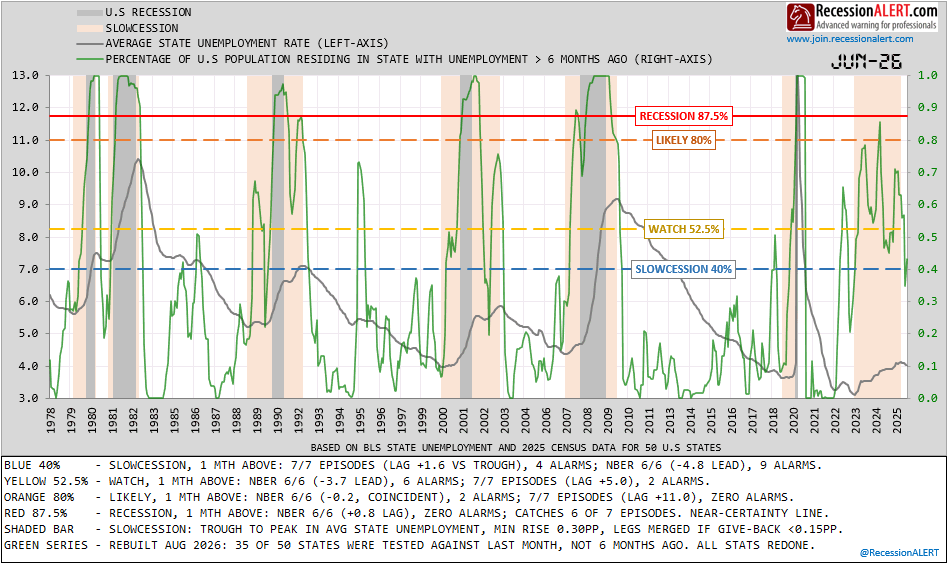
The national rate fell to 4.1% in July, and the green line has no way to agree. U-3 is a ratio of national aggregates, and BLS rebuilt those aggregates in January 2026 with an older population composition and lower net immigration — the St. Louis Fed traces 43% of the 0.9pp participation drop to that revision alone. A re-weighting moves national aggregates; it cannot move a count of states, because each state is measured against its own past and the weights divide out. So breadth holds at 43.2% — roughly 148 million people still living somewhere worse than six months ago, back above the 40% trigger after a single month beneath it, while July payrolls fell 23,000 and temporary layoffs rose 153,000 to 921,000. The episode behind that breadth reading is the shallowest of the seven: +1.02pp over 31 months, 0.033pp a month — a third slower than the next-slowest on record, against a median rise near +1.90pp. A downturn this diffuse never concentrates into the layoff event that forces a policy response, and it has yet to carry a recession with it, the first of the seven in 48 years not to. But February’s 4.12% peak is provisional by construction, unconfirmable until July’s data lands, and June’s 4.01% still sits 0.04pp above the 3.974% retreat that would close the episode. The record is not broken — it is unresolved.
What it means: cyclical and rate-sensitive exposure added on a healing labor market rests on a number that is not measuring healing. Breadth staying above 40% keeps that read unconfirmed; two clean months below it would settle it.
Market Intelligence Brief (MIB) Ver. 18.54
For professional investors only. Not investment advice.
© 2026 RecessionALERT.com

Comments are closed.