
US-Iran peace deal formalizes Hormuz reopening — WTI −4.2% to $81 unlocks the rate-path debate ahead of Wednesday’s Warsh FOMC. Computex 2026: PHLX Semi +7.9%, MU +11%, WDC +16%; HBM4 sold out through year-end. SPCX +19% Day 2 to $192; $2.5T market cap passes Apple. Fox acquires Roku for $22B; FOXA −16%. Empire State June 5.7 vs. 14.0 exp. — tariff front-running demand reversal confirmed. Housing 26th consecutive sub-50; 35% of builders cutting prices; Starts data due Tuesday.
TABLE OF CONTENTS
A. EXECUTIVE SUMMARY
B. MARKET DATA
C. HIGH-IMPACT STORIES (5)
D. MODERATE-IMPACT STORIES (5)
E. ECONOMY WATCH (5)
F. EARNINGS WATCH (0)
G. WHAT’S NEXT
H. CHART OF THE DAY
A. EXECUTIVE SUMMARY -> TOP
A US-Iran peace framework formalizing Strait of Hormuz reopening within 30 days shifted the dominant 2026 macro variable in a single session: WTI fell 4.2% to $81.32, mechanically unwinding the inflation overhang that has locked the Fed out of rate cuts for eight months and reopening the monetary easing debate ahead of Wednesday’s Warsh FOMC. The Nasdaq 100’s +3.06% surge was amplified by Computex 2026 AI memory announcements, driving the PHLX Semiconductor Index +7.9% — its best day since April 2025. Beneath the headline, breadth was narrow: NYSE gained only +0.33% vs. S&P’s +1.66%, and the DJIA/DJTA gap (+0.92% vs. −1.08%) confirmed mega-cap tech and aerospace captured the gains while transports sat out. Gold’s concurrent +2.25% to $4,334/oz — rising alongside VIX −8.4% — signals persistent safe-haven demand that hasn’t cleared on the Iran news.
• Iran peace deal + Fed repricing: US, Pakistan, and Iran confirmed Strait of Hormuz MoU signing in Switzerland on Friday; WTI −4.2% to $81.32; rate-hike probability for H2 2026 eased from 42–47% to ~30–35%; Wednesday’s Warsh FOMC dot-plot and inaugural press conference are the next live catalyst
• AI memory supercycle: PHLX Semi Index +7.9% (best session since April 2025); WDC +16.1%, MU +10.9%, MRVL +10.4%; HBM4 sold out through year-end per Micron executives; NVIDIA–SK Hynix multi-year supply cooperation signed; Computex 2026 validates AI infrastructure broadening beyond GPUs into memory and storage
• SPCX Day 2 +19% to $192: SpaceX market cap crosses $2.5 trillion, surpassing Apple as world’s largest public company; Musk projects $1 trillion annual revenue by 2030; Nasdaq-100 inclusion expected within weeks, triggering systematic passive buying at scale
• Fox acquires Roku for $22B; FOXA −16%: $8.3B new debt + 152M new shares; combined platform covers 100M+ CTV households; DOJ/FTC review is the primary deal risk; transaction expected to close 1H 2027
• Manufacturing data double miss: Empire State Manufacturing June 5.7 vs. 14.0 exp. (near-triple miss); Industrial Production May +0.1% vs. +0.3% exp.; tariff front-running demand reversal underway; import prices +4.2% YoY squeezing factory margins while volumes stall
• Housing structural contraction deepens: NAHB June 35 — 26th consecutive month below 50; 35% of builders cutting prices (up from 32%); mortgage rates at 6.6%; Tuesday Building Permits (exp. 1.41M) and Housing Starts (exp. 1.44M) are the critical hard-data companion
1. The Iran Deal as the 2026 Fed Unlock — Energy’s +23.5% YoY contribution to May’s 4.2% CPI was the single variable blocking any monetary easing in 2026. WTI at $81 — with a credible path to $75–78/bbl if Hormuz reopens on schedule — changes the H2 CPI arithmetic: if June and July prints land at 3.0–3.5%, the case for rate hikes evaporates and the easing debate reopens in Q3/Q4. That repricing is directly bullish for REITs, utilities, and homebuilders — the year’s worst performers — and directly bearish for energy names whose YTD outperformance (+24.13%) was built on the Hormuz premium. Warsh’s Wednesday dot-plot will be the first formal Fed read on this new energy reality, but it was finalized before today’s oil move — a hawkish median would only partially offset today’s market optimism.
2. AI Infrastructure Broadening Beyond GPUs — Computex 2026 confirmed that AI memory (HBM4, Micron) and AI-optimized persistent storage (WDC, STX) are as supply-constrained and structurally investable as GPU compute. WDC’s +16% re-rating on a $225B market cap company signals institutional consensus is still repricing upward; JPMorgan’s $650 price target implies further upside from current levels. The NVIDIA–SK Hynix multi-year supply agreement signals supply chain lock-ins at scale. For portfolio managers: the AI infrastructure trade is expanding from chip design into the full stack — memory, storage, and interconnect — a breadth expansion of the thesis, not a topping signal.
3. A Narrow Rally in a Stagflationary Backdrop — NYSE Composite +0.33% vs. S&P 500 +1.66% is the tell: today was a tech/AI + geopolitical-relief trade, not a broad economic re-rating. The simultaneous Empire State near-triple miss, flat industrial production, and housing’s 26th consecutive sub-50 reading confirm the macro backdrop remains stagflation-adjacent in manufacturing and housing. Energy’s margin relief from lower oil takes quarters to translate into capex and hiring decisions. Investors should read today’s risk premium compression as sector-specific — a rotation opportunity, not a signal that the broad economy has turned.
 — Leading economic indicators. Accurate market forecasts. Apply for membership at join.recessionalert.com
B. MARKET DATA -> TOP
A US-Iran peace deal formalizing Strait of Hormuz reopening drove a broad risk-on surge Monday, with the Nasdaq 100 +3.06% leading as Computex 2026 AI storage announcements and a wave of analyst upgrades sent the PHLX Semiconductor Index up nearly 8% — its largest single-session gain in over a year. The session was a narrow tech story beneath the surface: NYSE breadth gained only +0.33% while the headline indices surged, and DJIA/DJTA divergence (+0.92% vs −1.08%) confirmed that aerospace and mega-cap tech are the beneficiaries, not the broader economy. Energy collapsed −3.27% as WTI shed 4%+ on Iran supply return expectations, reversing its YTD leadership in a single session. Gold’s +2.25% advance to $4,334/oz alongside the risk-on tape is the day’s key anomaly — not all geopolitical premium has been extinguished.
CLOSING PRICES – Monday, June 15, 2026:
MAJOR INDICES
DJIA broke above its 10-session high today (51,671 vs prior ceiling of 51,562 set June 4), extending Dow Theory bull confirmation into its 3rd consecutive session. Simultaneously, DJIA/DJTA diverged by 2.0 percentage points (+0.92% vs −1.08%) — above the 1.5 threshold — flagging that aerospace and mega-cap tech drove the Dow while traditional transport sat out. RUT’s 10-session outperformance over S&P 500 (+2.69%) extends into a second session, confirming small-cap breadth is participating in the post-Iran-deal recovery even as mega-cap tech claimed the day’s headline.
| Index | Close | Change | %Move | Why It Moved |
|---|---|---|---|---|
| S&P 500 | 7,554.54 | +123.08 | +1.66% | Iran peace deal drove broad risk-on; AI/semis surge at Computex 2026 lifted index; VIX −8.4% confirmed fear repricing |
| Dow Jones | 51,671.83 | +469.57 | +0.92% | Blue-chip rally; DJIA hit new 10-session high; lower semi exposure vs Nasdaq kept Dow behind headline tech gains |
| DJ Transportation | 22,351.8 | −244.9 | −1.08% | Airlines/transports decoupled from industrial strength; Dow Theory DJIA/DJTA divergence (2.0-pt gap); possible Middle East airspace uncertainty despite Iran deal |
| Nasdaq 100 | 30,543.92 | +907.97 | +3.06% | AI memory/storage supercycle at Computex 2026; PHLX Semiconductor Index +7.9% — largest single-day gain since April 2025; MU, MRVL, WDC all surged 10%+ |
| Russell 2000 | 2,967.17 | +23.18 | +0.79% | Small-cap participation in risk-on rally; 10-session outperformance vs S&P 500 (+2.69%) extends into 2nd session; lagging large-cap tech but breadth constructive |
| NYSE Composite | 23,673.66 | +77.87 | +0.33% | Narrow breadth; +0.33% vs S&P’s +1.66% gap reflects mega-cap tech concentration; traditional industries and energy dragging on composite |
VOLATILITY & TREASURIES
VIX −8.4% and yields falling 1.5 bps in parallel is a textbook risk-on signature — equities up, vol down, bonds modestly bid — in contrast to Friday’s bond non-confirmation where yields rose despite an equity rally. The 10Y/2Y spread barely moved (10Y 4.468% minus 2Y 4.070% = 39.8 bps, essentially unchanged from Friday’s 39.4 bps), signaling no curve steepening or flattening impulse; the entire shift was a parallel relief-driven decline. DXY’s near-flat −0.07% is telling: Iran de-escalation should have weakened the safe-haven dollar more sharply, suggesting cross-currents from AI-driven capital inflows partially offset the geopolitical relief.
| Instrument | Level | Change | Why It Moved |
|---|---|---|---|
| VIX | 16.20 | −1.48 (−8.37%) | Geopolitical tail risk repriced on Iran peace deal; VIX at post-June 10 low as Strait of Hormuz closure risk removed |
| 10-Year Treasury Yield | 4.468% | −1.5 bps | Modest bond participation in risk-on; lower oil reducing near-term inflation expectations; bonds bidding lightly alongside equities |
| 2-Year Treasury Yield | 4.070% | −1.5 bps | Parallel shift with 10Y; rate path uncertainty persists but mild tailwind from oil-driven disinflation impulse |
| US Dollar Index (DXY) | 99.68 | −0.07 (−0.07%) | Near-flat; Iran de-escalation easing safe-haven dollar demand, offset by AI-driven US capital inflows; dollar notably resilient given risk-on magnitude |
COMMODITIES
The day’s sharpest commodity signal: gold, silver, and platinum rallied in unison (+2.25%, +3.04%, +3.55%) alongside a strong equity tape — a precious metals bid that tracks neither the “risk-off” nor “inflation” narrative cleanly, suggesting structural safe-haven demand (dollar diversification, central bank accumulation) persisting independently of the Iran catalyst. Copper’s muted +0.81% is more consistent with AI/electrification demand than a broad industrial recovery signal. Bitcoin +4.11% tracked the risk-on environment, consistent with its role as a risk asset today — no idiosyncratic crypto catalyst detected.
| Asset | Price | Change | %Move | Why It Moved |
|---|---|---|---|---|
| Gold | $4,334.30/oz | +$95.50 | +2.25% | Third consecutive advance; rising alongside equities — safe-haven demand persisting beyond Iran deal; structural dollar-diversification bid; new post-June-12 highs |
| Silver | $70.040/oz | +$2.066 | +3.04% | Precious metals complex rally with gold; industrial demand component from AI/electrification adds tailwind |
| Copper | $6.4973/lb | +$0.0523 | +0.81% | Muted industrial metals gain; AI/electrification demand narrative intact but not confirming a broader growth breakout |
| Platinum | $1,772.90/oz | +$60.70 | +3.55% | Precious metals complex surge; correlated with gold and silver rally; autocatalyst demand narrative supporting |
| Bitcoin | $66,550.0 | +$2,629.0 | +4.11% | Risk-on tracking; Iran peace deal and VIX compression reducing global tail risk; no idiosyncratic crypto catalyst |
ENERGY
WTI and Brent fell in near-lockstep (−4.19% and −4.23%) with no spread widening — confirming this is a global supply shock from Strait of Hormuz reopening, not a regional disruption. Falling crude alongside rising equities is a demand-favorable read: lower energy costs reduce corporate input expenses and ease consumer inflation pressure without implying growth fears. Henry Hub’s +1.15% gain decoupled entirely from crude — domestic US gas supply/demand dynamics are independent of the Iran catalyst. Dutch TTF’s −9.02% collapse reflects Europe pricing out its outsized geopolitical risk premium more aggressively than the US market did.
| Asset | Price | Change | %Move | Why It Moved |
|---|---|---|---|---|
| Crude Oil (WTI) | $81.32/bbl | −$3.56 | −4.19% | US-Iran peace deal formalizing Strait of Hormuz reopening within 30 days; Iran oil supply set to return to global markets; extends Friday’s decline |
| Crude Oil (Brent) | $83.64/bbl | −$3.69 | −4.23% | Same Iran supply catalyst; no WTI/Brent spread widening confirms global rather than regional supply impact |
| Natural Gas (Henry Hub) | $3.156/MMBtu | +$0.036 | +1.15% | Decoupled from crude; domestic US gas supply/demand dynamics independent of Strait of Hormuz; weather demand and LNG export demand supporting |
| Natural Gas (Dutch TTF) | $14.43/MMBtu | −$1.43 | −9.02% | Europe pricing out Middle East geopolitical risk premium more aggressively than US crude market; Iranian supply reopening reduces European LNG import competition |
S&P 500 SECTORS
The defining divergence: Energy is the YTD leader (+24.13%) but today’s worst sector (−3.27%), with the Iran peace deal collapsing the geopolitical risk premium that powered its entire 2026 outperformance in a single session. Technology extended structural dominance — today’s #2 sector AND the 12-month leader (+46.57%) as the Computex AI storage rally reinforced what its 3-month chart (+29.64%) already shows: entrenched, not opportunistic. Communication Services (+2.17% today) reversed a sharp recent slide (−5.04% 1M), suggesting a catch-up rotation. 7 of 11 sectors green, but Energy, Healthcare, Real Estate, and Consumer Defensive lagging signals hedging beneath the headline risk-on.
| Sector | 1-Day | 1-Week | 1-Month | 3-Month | 6-Month | YTD | 12-Month |
|---|---|---|---|---|---|---|---|
| Industrials | +3.63% | +5.30% | +4.55% | +12.01% | +18.09% | +20.31% | +31.48% |
| Technology | +3.39% | +2.77% | +4.02% | +29.64% | +21.46% | +24.68% | +46.57% |
| Communication Services | +2.17% | +1.55% | −5.04% | +7.01% | +3.73% | +3.52% | +27.08% |
| Basic Materials | +1.88% | +6.23% | −1.75% | +5.04% | +17.27% | +17.10% | +43.37% |
| Consumer Cyclical | +1.68% | +2.13% | −2.28% | +4.98% | −3.41% | −2.79% | +8.06% |
| Utilities | +0.63% | +2.79% | −1.39% | −4.34% | +4.52% | +5.07% | +12.59% |
| Financial | +0.47% | +3.44% | +4.43% | +10.66% | +1.14% | +1.09% | +13.24% |
| Healthcare | −0.41% | +0.97% | +2.91% | +1.86% | −0.51% | −0.99% | +11.92% |
| Consumer Defensive | −0.64% | +2.29% | −1.87% | −0.49% | +7.65% | +8.78% | +5.65% |
| Real Estate | −0.84% | +2.29% | +2.14% | +5.26% | +8.47% | +9.75% | +6.99% |
| Energy | −3.27% | −4.09% | −5.46% | −3.16% | +22.39% | +24.13% | +28.90% |
TOP MEGA-CAP MOVERS:
GAINERS
| Company | Ticker | Close | Change | Why It Moved |
|---|---|---|---|---|
| Space Exploration Technologies Corp | SPCX | $192.46 | +19.58% | Day 2 of Nasdaq trading; continued momentum from largest IPO in history; lifted entire Industrials sector; institutional accumulation phase |
| Western Digital Corp | WDC | $653.53 | +16.10% | Computex 2026 AI storage showcase (Ultrastar Data 3000 JBODs); JPMorgan PT raised to $650 (+$120); multiple Wall Street upgrades on AI HDD demand and pricing power |
| Micron Technology Inc | MU | $1,088.10 | +10.85% | AI memory trade back in focus ahead of June 24 earnings; HBM supply fully sold out through year; Computex 2026 AI memory demand narrative driving institutional buying |
| Marvell Technology Inc | MRVL | $308.85 | +10.42% | Stifel raised PT to $321 from $230 following CEO Matt Murphy’s Computex 2026 keynote on AI data center infrastructure; PHLX Semi Index +7.9% |
| Seagate Technology Holdings Plc | STX | $1,018.80 | +9.43% | Correlated with WDC on AI storage infrastructure bottleneck thesis; Computex 2026 storage demand tailwind; analyst upgrades across storage complex |
DECLINERS
| Company | Ticker | Close | Change | Why It Moved |
|---|---|---|---|---|
| Exxon Mobil Corp | XOM | $140.92 | −4.14% | WTI −4.19% on US-Iran Strait of Hormuz deal; Iran sanctions lift expected to add significant supply to global crude market |
| Chevron Corp | CVX | $180.40 | −3.64% | Same WTI supply shock; Energy sector −3.27% on day; Iran deal reversing sector’s YTD leadership in single session |
| Merck & Co Inc | MRK | $114.90 | −3.49% | Trump MFN drug pricing initiative; ongoing pharma tariff risk on branded drugs; Healthcare sector lagging broader market on policy headwinds |
| AbbVie Inc | ABBV | $221.59 | −2.70% | Same MFN drug pricing headwind; branded pharmaceutical tariff exposure; 3 of 5 top decliners today are Healthcare — sector-level policy pressure |
| Johnson & Johnson | JNJ | $235.66 | −2.16% | MFN drug pricing pressure; despite diversified MedTech business, branded drug exposure creating sector-wide headwind for large-cap pharma |
— Institutional-grade intelligence for serious investors. Apply for membership at join.recessionalert.comC. HIGH-IMPACT STORIES -> TOP
UNCERTAIN
1. US-Iran Peace Framework Confirmed — MoU Signing Set for Friday in Switzerland, Hormuz Reopening Within 30 Days; WTI Plunges 4.19% to $81.32
The core facts:Washington, Tehran, and Pakistani negotiators confirmed a landmark diplomatic breakthrough on June 15 to end the US-Iran conflict. A memorandum of understanding is scheduled for signing Friday in Switzerland. Key terms: the US lifts oil sanctions; Iran commits to reopening the Strait of Hormuz within 30 days (which has had an estimated 11–14.4 million bpd offline since April’s naval blockade); a 60-day ceasefire takes effect with Iran resuming crude exports immediately while nuclear negotiations continue as a separate track. WTI crude fell 4.19% to $81.32/bbl — its lowest level since the conflict began — and Brent dropped ~4.23% to ~$83.4/bbl, with Dutch TTF natural gas plunging ~9% as Europe aggressively priced out its geopolitical risk premium. The S&P 500 surged 1.65% to 7,554; the Dow set a new all-time record at 51,671.03 (+468 pts); the Nasdaq jumped 3.07%. The energy sector (XLE) fell 3.27%, reversing a portion of its YTD +24.13% leadership in a single session.
Why it matters:The Hormuz risk premium has been the primary sustained driver of elevated oil prices and the inflation overhang that locked the Fed out of rate cuts in 2026. WTI at $81 is approximately $12–15 below the pre-deal level. That path flows directly into the CPI pipeline: energy contributed +23.5% YoY to May CPI’s 4.2% headline. A credible, implemented deal removes the dominant upside risk to H2 2026 inflation forecasts, reopens the monetary easing debate, and simultaneously relieves consumer and corporate margin pressure. The UNCERTAIN classification reflects two layers of execution risk: (1) the MoU signing is still three days away and the US and Iran have historically released incompatible accounts of agreed terms — as was the case with the June 12 disputed MoU; (2) Iran must physically reopen Hormuz within 30 days while nuclear negotiations proceed separately on a fragile, separate track. Any breakdown in either restores the Hormuz premium immediately and reverses every asset move from today’s session.
What to watch:Friday’s signing ceremony in Switzerland — confirmed presence of senior US and Iranian officials is the critical validation. WTI sustaining below $82/bbl through and after the signing as market confirmation. Whether Iran delivers the 30-day Hormuz reopening on schedule, and whether the nuclear negotiating track progresses or deteriorates.
BULLISH
2. AI Memory & Storage Supercycle Ignites — Computex 2026 Drives PHLX Semiconductor Index +7.9% (Largest Single-Day Gain Since April 2025); WDC +16%, HBM4 Demand Sold Out Through Year-End
The core facts:Computex 2026 keynotes catalyzed the semiconductor sector’s largest single-day gain since April 2025. Key announcements driving the move: Micron unveiled HBM4 (next-generation high bandwidth memory), with executives confirming HBM supply is sold out through end of 2026 and projecting Q3 FY2026 revenues of $33.5B — up from $23.9B in Q2, an approximately 40% sequential increase; Western Digital showcased its Ultrastar Data 3000 AI-focused storage system, with CEO remarks on persistent storage as the next AI infrastructure bottleneck; NVIDIA and SK Hynix announced a multi-year AI memory cooperation agreement locking in supply chain integration at scale. Analyst actions followed: JPMorgan raised Western Digital’s price target to $650 from $530 (WDC closed +16.10% to $653.53, market cap ~$225B); Stifel raised Marvell Technology’s price target to $321 from $230. The PHLX Semiconductor Index (SOX) surged 7.9% — its largest single-day percentage gain since April 2025. NVIDIA, Broadcom, and Marvell each gained more than 3%.
Why it matters:Computex 2026’s AI memory theme validates the structural supply-constrained demand thesis that has driven semiconductor multiples throughout 2026: HBM sold out through year-end at Micron means pricing power and margin expansion are locked in for at least two more quarters. WDC’s +16% move on a $225B market cap company represents a broad re-rating of AI storage infrastructure — not just memory, but persistent storage for AI workloads — as an independently investable supercycle theme. JPMorgan’s $650 price target implies consensus is still re-rating upward. The NVIDIA-SK Hynix multi-year cooperation signals the next-generation AI stack is building out supply chain lock-ins at scale, reducing the risk that memory and storage become AI infrastructure bottlenecks. For portfolio managers: the AI infrastructure trade is expanding beyond GPU compute into memory, storage, and interconnect layers — a broadening of the investment thesis, not a peaking signal.
What to watch:Micron Q3 FY2026 earnings (late June 2026) as the first quantification of HBM4 demand in reported revenue. WDC sustaining above the $650 JPMorgan price target as confirmation of institutional conviction. Any SK Hynix or Samsung HBM4 capacity announcements that would signal supply easing and potentially compress memory pricing power.
BULLISH
3. SpaceX (SPCX) Day 2: +19% to $192 — Market Cap Crosses $2.5 Trillion; Musk Projects $1 Trillion in Annual Revenue by 2030
The core facts:SpaceX (SPCX) extended its historic IPO rally on Day 2 of Nasdaq trading, adding approximately +19% to close at ~$192.46 — bringing total two-day gains to roughly 43% above the $135 IPO price. The market cap crossed approximately $2.5 trillion, surpassing Apple as the world’s most valuable publicly traded company. Volume remained at historic levels. The Day 2 rally was anchored by CEO Elon Musk’s public projection of $1 trillion in SpaceX annual revenue by 2030 — a roughly 80–100x increase from the company’s current estimated $10–12B revenue base — driven by Starlink’s expanding global subscriber base, the Starship commercial launch vehicle revenue pipeline, and growing defense and government contracts. The Industrials sector climbed 3.63%, with SpaceX acting as the primary sector driver, lifting Northrop Grumman, Raytheon, and L3Harris alongside it.
Why it matters:A $2.5T market cap on Day 2 of trading represents the fastest market cap trajectory in US equity market history. The Day 2 continuation rally — rather than a post-IPO pullback — confirms that the $150B+ in IPO demand was not dominated by flip activity: institutional accumulation is continuing. The $1T revenue projection by 2030 creates a long-duration fundamental thesis that portfolio managers must price now, given that Nasdaq-100 inclusion (expected within weeks under Nasdaq’s rewritten eligibility rules) will trigger systematic passive buying at scale. For sector impact: the SpaceX halo lifted all defense and aerospace names on a sector-level re-rating, compounding the energy-cost relief from the Iran deal. Industrials’ 3.63% gain makes it the day’s second-best performing sector behind technology.
What to watch:Nasdaq-100 inclusion announcement timing — expected within weeks given Nasdaq’s rewritten criteria; the passive buying trigger when formally announced. SPCX trading above $200 as the next psychological milestone and catalyst for expanded retail participation. Starlink monthly subscriber count in the next quarterly filing as the first fundamental anchor for the $1T revenue projection.
UNCERTAIN
4. Fox Corp to Acquire Roku for $22 Billion — CTV Platform Consolidation Creates 100M-Household Advertising Giant; FOXA -16% on Leverage and Dilution
The core facts:Fox Corporation announced on June 15 a definitive agreement to acquire Roku, Inc. at $160.00 per share — a 28–34% premium to Roku’s pre-announcement close — in a combination of $96.00 per share in cash (~$14.2B total) and 0.9693 shares of Fox Class A common stock per Roku share, for a total enterprise value of approximately $22 billion. Fox will issue 152 million new Class A shares and take on $8.3 billion in new debt to fund the transaction. Post-close ownership: approximately 73% Fox shareholders, 27% Roku shareholders. Roku founder and CEO Anthony Wood will join the Fox Board of Directors and retain an ongoing role. The deal combines Fox Sports, Fox News, and Tubi (19M daily active users) with Roku’s connected TV platform, The Roku Channel, and direct relationships with more than 100 million global streaming households. Expected close: 1H 2027, pending regulatory approvals. Fox Class A (FOXA) fell 15–17%, the largest S&P 500 decliner of the day; Roku shares surged approximately 28–34% toward the deal price.
Why it matters:The deal is a transformational bet on connected TV as the dominant advertising medium. Roku’s 100M+ streaming household relationships combined with Tubi’s ad-supported content creates the largest single addressable CTV advertising inventory pool in the US — a defensible moat against Netflix, Amazon, and Disney. Fox’s strategic logic: own the distribution layer (Roku’s OS controls what appears on 100M screens) rather than compete purely on content in a winner-take-most streaming market. The -16% selloff in FOXA reflects legitimate investor concern: the $8.3B new debt burden substantially increases Fox’s leverage at a time when borrowing costs are elevated, and the combined entity must execute a multi-year technology and content integration at scale. The UNCERTAIN classification reflects the deal’s dual nature — structurally bullish for ad-supported streaming economics and CTV market structure, but immediately bearish for Fox equity holders absorbing the leverage, dilution, and integration risk.
What to watch:Regulatory review timeline — DOJ/FTC scrutiny of the combined CTV + content ownership model is the primary closing risk; the Paramount/WBD clearance precedent is bullish but the combined Fox/Roku content-distribution model is a distinct structure. Fox management’s first post-announcement investor call for the debt servicing plan, integration synergy targets, and Tubi/Roku revenue combination projections.
BULLISH
5. WTI Plunge Recalibrates FOMC Rate-Path Odds Ahead of Warsh’s Debut — Hike Probability Eases, Dollar Weakens; All Eyes on Wednesday Dot-Plot
The core facts:June 15’s 4.19% WTI crude decline — driven by the US-Iran peace framework — mechanically reduces the forward inflation trajectory that has sustained the Fed’s “higher for longer” calculus. CME FedWatch June 2026 FOMC meeting probabilities remain at 99.6% hold, but hike probability for later in 2026 recalibrated downward from the 42–47% range established Friday to approximately 30–35% as markets absorbed the oil decline’s implied impact on H2 2026 CPI forecasts. The dollar weakened to a 10-day low as lower rate expectations reduced carry-trade demand. The 2-year Treasury yield — which hit 4.14% on Friday (highest in over a year, 40bps above the top of the Fed’s 3.50–3.75% target range) — eased modestly. Gold rose 2.3% to $4,316/oz on dollar weakness and lower real yield expectations. Wednesday’s FOMC meeting (Warsh’s inaugural press conference plus the updated dot-plot/SEP) is now the market’s central focus: the key question is whether the Committee’s 2026 rate-path median rises above 3.75% or holds.
Why it matters:Oil was the single dominant variable blocking any possibility of rate cuts in 2026 — energy’s +23.5% YoY contribution to May CPI was the core reason the Fed could not ease. WTI falling from $85+ to $81 in one session, with a credible path to $75–78/bbl if Hormuz reopens, changes the CPI arithmetic for H2: if June and July CPI prints land at 3.0–3.5% due to energy normalization, the case for rate hikes evaporates and the easing cycle debate reopens in Q3 or Q4. That repricing is directly bullish for rate-sensitive equity sectors — REITs, utilities, homebuilders, and long-duration growth tech — that have been among the worst performers since the May CPI shock. The residual risk: Warsh’s dot-plot was finalized before June 15’s oil move and may not fully reflect today’s repricing — a hawkish median would partially offset today’s market optimism.
What to watch:Wednesday June 17 FOMC dot-plot — 2026 median rate projection (above 3.75% = hawkish signal) and whether the longer-run neutral rate estimate is revised upward. CME FedWatch hike odds for the July meeting as the first market reaction to Warsh’s inaugural press conference tone. WTI price trajectory in the days following — each $1 lower extends the H2 CPI relief estimate by approximately 0.08–0.10 percentage points.
— Quantifying recession risk so you don’t have to guess. Apply for membership at join.recessionalert.comD. MODERATE-IMPACT STORIES -> TOP
BEARISH
6. Empire State Manufacturing June 5.7 vs. 14.0 Expected — Near-Triple Miss Confirms Tariff Front-Running Is Over; New Orders at Near-Stall Speed
The core facts:The New York Federal Reserve’s Empire State Manufacturing Index for June came in at 5.7 — dramatically below the 14.0 consensus and down from 19.6 in May in a near-triple miss. New Orders nearly stalled at 3.5 (from 18.2 in May); supply availability hit its worst reading since June 2022 at -13.9, reflecting continued tariff-driven supply chain disruption; employment contracted at -7.8. May’s 19.6 reading had been widely attributed to manufacturers front-running tariff implementation deadlines by pulling forward orders before input prices rose. June’s sharp reversal confirms the demand was borrowed from future periods.
Why it matters:New Orders at 3.5 signals industrial demand is at near-stall speed in the New York district — a leading indicator for the national ISM Manufacturing print due July 1. The tariff front-running reversal creates a two-quarter earnings risk for industrial sector companies: Q1 benefited from pulled-forward demand; Q2 absorbs the payback. Materials, industrials, and machinery stocks face downward earnings estimate revisions if the June softness propagates nationally. The supply availability reading (-13.9, worst since June 2022) is particularly concerning — it signals the tariff-driven supply chain disruption remains active even as demand normalizes, creating the margin-squeezing combination of cost pressure and volume weakness simultaneously.
What to watch:July 1 ISM Manufacturing Index as the national confirmation or divergence. Industrial sector Q2 earnings calls (starting mid-July) for front-running payback language in volume guidance and margin commentary.
BEARISH
7. Industrial Production May +0.1% Miss — Manufacturing Output Stalls as Import Prices Surge +4.2% YoY; April’s Tariff-Driven Surge Reverses
The core facts:The Federal Reserve released May Industrial Production on June 15: total Industrial Production +0.1% MoM (vs. +0.3% expected); Manufacturing Production flat at 0.0% (vs. +0.2% expected); Capacity Utilization came in on-consensus at 76.2%. April’s industrial surge (+0.9%) was driven by tariff front-running; May’s flat manufacturing output is the hangover. Separately, May Import Prices rose +4.2% YoY — confirming that input cost inflation is accelerating even as output stalls, creating a factory-floor margin squeeze.
Why it matters:Flat manufacturing output combined with rising import prices (+4.2% YoY) is the stagflation dynamic at the factory floor: costs up, volumes flat, margins compressed. Capacity utilization at 76.2% — below the ~78% historical average for healthy utilization — signals excess manufacturing slack even as input costs rise. This is the market-unfriendly combination of cost-push without demand-pull. For earnings: Q2 FY2026 guidance from industrial bellwethers (Caterpillar, Deere, Emerson, Rockwell Automation) will be the first quantification of how much tariff input cost inflation is being absorbed versus passed through to customers. The industrial sector’s +3.63% gain today reflects Iran deal energy-cost relief, but today’s production data confirms the sector faces structural margin headwinds that oil-price relief alone cannot resolve.
What to watch:Q2 FY2026 earnings guidance from industrial bellwethers (CAT, DE, EMR) for margin commentary on tariff input cost absorption. June Industrial Production (released July 15) as the trend confirmation or reversal.
BEARISH
8. NAHB Housing Market Index June 35 — 26th Consecutive Sub-50 Reading, 35% of Builders Cutting Prices; Tuesday Housing Starts Data Critical
The core facts:The NAHB Housing Market Index for June came in at 35, slightly below the 36 consensus. Key subcomponents: buyer traffic at 25 (near historic lows); 35% of builders are actively cutting prices, up from 32% the prior month; mortgage rates remain elevated at approximately 6.6%. June marks the 26th consecutive month below 50 — the expansion/contraction dividing line — the longest sustained contraction in homebuilder confidence in the index’s modern history. Housing Starts and Building Permits data, which measure actual construction activity, are due Tuesday June 16. Consensus: Building Permits at 1.41M, Housing Starts at 1.44M.
Why it matters:The housing sector is trapped in a structural bind: 6.6% mortgage rates are pricing approximately 40–45% of would-be buyers out of the market relative to the pre-2022 rate environment. Builders cutting prices (35%, up from 32%) to attract buyers at current mortgage rates compresses gross margins on a sustained basis. For homebuilder stocks (D.R. Horton, Lennar, PulteGroup): the 26th consecutive sub-50 reading makes Tuesday’s Housing Starts/Permits the critical data point — a miss would confirm that even Iran-driven rate repricing has not yet translated into physical activity. The Iran peace deal and oil price decline create a potential future tailwind (lower inflation path → eventual mortgage rate relief), but that transmission takes quarters, not days. The upstream impact extends to lumber, concrete, and building materials sectors facing continued volume headwinds.
What to watch:Tuesday June 16 Building Permits (exp. 1.41M) and Housing Starts (exp. 1.44M) as the physical activity companion to today’s confidence reading. DHI, LEN, PHM stock reactions to Tuesday’s data as the sector’s real-time verdict on whether demand is recovering.
UNCERTAIN
9. Iran Deal Ignites Fuel-Cost Sector Rotation — Airlines +4–5%, Cruise Lines +4.5%; Energy Producers -3.5% as XLE Sheds a Portion of Its YTD +24% Lead
The core facts:The US-Iran peace framework sent a sharp bifurcated signal through fuel-cost-sensitive sectors on June 15. Beneficiaries of lower jet fuel and diesel prices: United Airlines (+5%), Delta Air Lines (+4%), Carnival Cruise Lines (+4.5%), Norwegian Cruise Lines (+4.5%). Losers from lower oil prices: Devon Energy (-3.5%+), APA Corporation (-3.5%+), ExxonMobil (-2.5%), Chevron (-2.5%). The Energy Select Sector ETF (XLE) declined approximately 3.27% — its worst single session in recent months — reversing a portion of its YTD +24.13% leadership, which was built substantially on the Hormuz supply premium.
Why it matters:The rotation is highly consequential for sector-relative positioning. The energy sector’s YTD leadership (+24.13% through Friday) was sustained primarily by the Hormuz geopolitical risk premium — a structural premium, not a fundamental demand story. A formal, implemented peace deal would unwind that premium and shift the YTD leadership calculus. For airlines: jet fuel is approximately 20–25% of total operating cost; a $4/bbl decline in WTI translates to roughly $0.10–0.12 per gallon in savings — approximately 4–6% effective margin expansion if sustained across Q3 2026. United and Delta have Q2 2026 earnings calls in mid-July that will be the first opportunity to quantify the fuel benefit. The UNCERTAIN classification reflects the rotation’s reversibility: if the Iran deal fails, the full energy premium restores immediately, airlines give back today’s gains, and energy names reclaim the YTD leadership. The oil/airline trade ratio is therefore one of the most direct real-time barometers of Iran deal execution credibility.
What to watch:Friday’s Switzerland MoU signing as the trigger for either sustained airline/cruise gains or a deal-failure reversal. UAL and DAL Q2 2026 earnings calls (mid-July) for the quantified fuel cost savings in guidance. ExxonMobil and Chevron daily moves through the signing as the energy sector’s real-time verdict on deal credibility.
BEARISH
10. USTR Section 301 Forced-Labor Tariffs on 60 Nations — 10–12.5% Rates on Supply Chains Without Domestic Import Bans; June 22 Appearance Deadline Imminent
The core facts:The USTR’s Section 301 forced-labor tariff action — imposing 10–12.5% additional duties across 60 economies — has critical procedural deadlines this week: the request-to-appear deadline for the public hearing is June 22 (this Sunday), with the public hearing itself July 7 and the full comment period open through July 6. The action uses a novel legal theory targeting the “absence of a foreign import prohibition” on forced-labor goods — meaning any trading partner that has not enacted domestic forced-labor import restrictions equivalent to US standards is subject to the tariff. The 60-nation scope extends tariff exposure to supply chains previously considered insulated from the existing US-China Section 301 framework, encompassing major sourcing countries including Vietnam, Bangladesh, Indonesia, Malaysia, and Cambodia. Legal analysts at White & Case note the novel legal theory is expected to draw immediate court challenges.
Why it matters:The June 22 request-to-appear deadline makes this week the de facto final mobilization window for importers and affected industries to formally engage the process before the July 7 hearing locks in the record. For supply chain-intensive S&P 500 sectors — consumer discretionary (apparel, footwear), technology hardware (components), and consumer staples sourcing from developing economies — the 10–12.5% rate compounds the existing tariff burden and creates a second wave of input cost inflation risk that would materialize in H2 2026 earnings. The “absence of prohibition” legal theory is the most legally novel and commercially consequential element: if upheld, it effectively requires all US trading partners to adopt forced-labor import restriction frameworks equivalent to the Uyghur Forced Labor Prevention Act — a compliance burden that most developing economies cannot immediately meet.
What to watch:July 7 public hearing — corporate testimony and government response will signal whether the USTR intends to implement the tariff structure broadly or narrow its scope after hearing. Court filings seeking injunctions within the July comment period as the primary implementation risk signal. Consumer discretionary and technology hardware sector stock reactions to any court-filing news.
— Separating signal from noise since 2007. Apply for membership at join.recessionalert.comE. ECONOMY WATCH -> TOP
Manufacturing sent a consistent softening signal Monday: the Empire State Index collapsed from 19.6 to 5.7 against a 14 consensus, Industrial Production grew just 0.1% (vs 0.3%), and manufacturing output was flat — with supply availability hitting its worst level since June 2022. NAHB builder confidence slipped to a 26th consecutive sub-50 reading of 35, with 35% of builders now cutting prices. The week’s offsetting signal: oil fell to its cheapest since the Iran conflict began as a formal peace deal nears, potentially easing the energy component (currently +23.5% YoY) that drove May CPI to 4.2%. Warsh opens his inaugural FOMC meeting Tuesday — the dot plot is expected to shift hawkish, stripping out cut projections and possibly introducing hike calls, though the oil drop complicates that calculus.
Empire State Manufacturing Index Plunges to 5.7 in June — Near-Triple Miss vs. 14 Consensus (NY Fed, June 15, 2026)
What they’re saying:The NY Fed’s Empire State Manufacturing Index fell sharply from 19.6 in May to 5.7 in June, missing the consensus estimate of 14.0 by nearly triple. New orders slipped to 3.5 (near stall), shipments printed at 8.6, and the supply availability index deteriorated to -13.9 — its lowest since June 2022 — signaling worsening tariff-driven input constraints. Prices paid remained elevated, and delivery times continued lengthening (11.9). Employment held positive for a fifth consecutive month (employee index 9.6), offering a narrow positive.
The context:May’s 19.6 print — the strongest since April 2022 — appears to have reflected tariff front-running: manufacturers stockpiling inputs ahead of expected escalation, creating an artificial demand spike that is now reversing. The deterioration in supply availability to multi-year lows is the more durable signal: tariff costs are not normalizing, they are accelerating. Regional surveys like Empire State are leading indicators for the national ISM report; a miss of this magnitude increases the downside risk to the July 1 ISM Manufacturing print.
What to watch:Philadelphia Fed Manufacturing Survey (Thursday, June 18) will indicate whether June’s softening is isolated to New York or a broader national trend. ISM Manufacturing (Wednesday, July 1) is the definitive read.
Industrial Production +0.1% in May, Manufacturing Output Flat — Both Miss as April Surge Reverses (Federal Reserve G.17, June 15, 2026)
What they’re saying:The Federal Reserve reported that US industrial production rose just 0.1% in May, missing the 0.3% consensus estimate, after an upwardly revised 0.9% surge in April. Manufacturing output was flat at 0.0%, versus a 0.2% expected gain. Capacity utilization was in-line at 76.2% (prior 76.1%), with no meaningful slack building or tightening. The May data reflect a broad-based deceleration across manufacturing sub-sectors.
The context:April’s strong print (+0.9%, revised from +0.7%) was partly artificial — manufacturers front-running tariff escalation drove outsized inventory accumulation that is now normalizing. Manufacturing output flat at 0.0% is a meaningful deceleration in an environment where import prices are +4.2% YoY, squeezing margins without the demand support that would normally justify inventory build. Capacity utilization at 76.2% remains well below the 79–80% range historically associated with price pressure, which limits the case for a rate hike but does not support a cut.
What to watch:May Retail Sales (Wednesday, June 17, exp. +0.5%) will reveal whether the demand side is also weakening. Import/Export Prices for May (Tuesday, June 16, exp. +0.9% for imports) will quantify continued tariff pass-through to input costs.
NAHB Builder Confidence Falls to 35 in June — 26th Consecutive Sub-50 Reading, 35% of Builders Cutting Prices (NAHB/Wells Fargo, June 15, 2026)
What they’re saying:The NAHB/Wells Fargo Housing Market Index fell two points to 35 in June, below the 36 consensus estimate and the 37 prior reading, marking the 26th consecutive monthly reading below 50 — the optimism/pessimism threshold. Sub-components: current sales conditions fell two points to 38; six-month sales expectations held at 45; traffic of prospective buyers held at 25. 35% of builders cut prices in June (up from 32% in May), with an average price reduction of 6%.
The context:Builder sentiment has been sub-50 for over two years, caught between 6.6% mortgage rates (MBA 30-year) and tariff-driven construction cost inflation. The rising share of builders cutting prices — now 35%, up from 32% — signals that demand erosion is deepening, not stabilizing. Traffic at 25 remains depressed, indicating affordability constraints are keeping buyers out even as builders concede on price. The forward indicator (six-month outlook at 45) is still below 50, suggesting no near-term recovery is expected.
What to watch:Tuesday, June 16: Housing Starts (exp. 1.44M, prior 1.465M) and Building Permits (exp. 1.41M, prior 1.423M) — hard data confirmation of the sentiment weakness. A third consecutive monthly decline in starts would escalate housing as a recession risk signal.
Oil Falls to Cheapest Since Iran Conflict Began as Formal US-Iran Peace Deal Imminent — Energy Disinflation Offers Fed Cover (NPR, June 14, 2026)
What they’re saying:Crude oil prices fell approximately 4% Monday, dropping to their lowest levels since the opening days of the US-Iran conflict, after Trump administration officials, Iranian counterparts, and Pakistani mediators confirmed a formal peace deal ending the war is set to be signed this week. Energy prices have been the primary driver of CPI acceleration: the energy component rose 23.5% year-over-year, pushing May CPI to a three-year high of 4.2%. National average gasoline remains roughly $1+ above pre-war levels but has been easing as ceasefire extensions were announced through April-June. Polymarket recession odds eased to 16% (prior 19%) on Thursday.
The context:A formalized peace deal would reopen the Strait of Hormuz, through which roughly 20% of global oil transits. Resolving the disruption would restore 2–3 million barrels per day of supply to global markets. Institutional forecasters have consistently cited energy costs as the primary driver of 2026 inflation forecasts above 4%; sustained oil normalization could pull headline CPI toward 3.0–3.2% by Q4 2026. This would reduce the case for Warsh to introduce rate hike projections in Wednesday’s dot plot, and meaningfully lower near-term recession probability. GDPNow sits at 3.3% for Q2 (June 9 estimate, next update June 16).
What to watch:Formal signing of the US-Iran peace deal (expected this week); WTI and Brent spot prices ahead of and after the signing; FOMC press conference (Wednesday, June 17, 2:30pm) — Warsh will be asked whether energy disinflation has been incorporated into the SEP projections.
Warsh Opens Inaugural FOMC Meeting Tuesday — Dot Plot Expected to Shift Hawkish, Removing 2026 Cut Projections (FXStreet/Chase, June 15, 2026)
What they’re saying:The Federal Reserve’s two-day FOMC meeting begins Tuesday, June 16 — Kevin Warsh’s first policy meeting since Senate confirmation in May 2026. A rate hold at 3.50–3.75% is universally expected (99.6% probability, CME/Atlanta Fed data). Market and economist focus is on the Summary of Economic Projections: analysts at Nordea, JPMorgan, and others anticipate Warsh will shift from Powell’s residual easing bias to a neutral stance — removing all 2026 cut projections and potentially introducing hike calls given sticky core PCE (~3.7%) and above-trend GDPNow (3.3%). Futures currently price 70.6% probability of zero cuts in 2026; ≥1 cut probability stands at 29.4% (up from 23% Thursday).
The context:Warsh’s public statements since nomination have emphasized tighter inflation discipline and a more narrowly focused central bank. A hawkish dot plot without cuts — particularly if hike probabilities emerge in the median — would likely pressure rate-sensitive sectors (homebuilders, REITs, utilities) and steepen the yield curve (2s10s currently 2.39%). The wildcard is Monday’s oil drop: if peace deal momentum has already reduced the energy CPI trajectory, Warsh may have room to hold without introducing new hike calls, producing a neutral rather than hawkish dot plot. The press conference tone matters as much as the dot plot itself for market calibration of the Warsh era.
What to watch:Wednesday June 17: FOMC statement (2:00pm ET), dot plot/SEP release, and Warsh’s inaugural press conference (2:30pm ET). Also Wednesday at 8:30am: Retail Sales (exp. +0.5%) — stronger-than-expected retail data would reinforce the case for a hawkish dot plot.
— Know the probability before the market prices in the risk. Apply for membership at join.recessionalert.comF. EARNINGS WATCH -> TOP
YESTERDAY AFTER THE BELL (Markets Reacted Today)
No major earnings yesterday after the bell from companies with >$100B market cap.
TODAY BEFORE THE BELL (Markets Already Reacted)
No major earnings before the bell from companies with >$100B market cap.
TODAY AFTER THE BELL (Markets React Tomorrow)
No major earnings after the bell from companies with >$100B market cap.
WEEK AHEAD PREVIEW:
Q1 2026 earnings season is effectively complete (~97%+ of S&P 500 companies reported). Q2 2026 earnings season does not begin until late July 2026. No mega-cap companies (>$100B market cap) are scheduled to report this week (June 16–19). Three reporters on the calendar — John Wiley & Sons (WLY, $2.2B), La-Z-Boy (LZB, $1.6B), and Vince Holding (VNCE, $66M) — are well below the $100B threshold and do not qualify for MIB coverage.
The week’s market-moving catalysts are macro rather than earnings-driven: FOMC Rate Decision and Warsh Inaugural Press Conference (Wednesday June 17), Retail Sales MoM (Wednesday), Housing Starts and Building Permits (Tuesday June 16), and the read-through from any Iran peace deal signing Friday in Switzerland. Intel (INTC) is the first major Q2 2026 reporter expected, with results anticipated in late July 2026.
— US market commentary trusted by family offices and institutions. Apply for membership at join.recessionalert.comG. WHAT’S NEXT -> TOP
UPCOMING RELEASES:
| Date | Event | Why It Matters |
|---|---|---|
| Tue, Jun 16 | Building Permits Prel (exp. 1.41M, prior 1.423M) | Hard-data companion to today’s NAHB 35 — a third consecutive decline would escalate housing as a recession signal; any upside surprise would test whether Iran-driven rate repricing is already filtering into permitting activity |
| Tue, Jun 16 | Housing Starts (exp. 1.44M, prior 1.465M) | Primary activity read for homebuilder earnings risk; a miss below 1.40M would confirm that affordability constraints and tariff-driven construction cost inflation are compounding; DHI, LEN, PHM react same day |
| Tue, Jun 16 | Import Prices MoM (exp. +0.9%, prior +1.9%) | Quantifies ongoing tariff pass-through to input costs; today’s flat manufacturing output + import prices already rising 4.2% YoY creates the factory-floor margin squeeze; a hotter print reinforces stagflation risk in the industrial sector |
| Tue, Jun 16 | Export Prices MoM (prior +3.3%) | Paired with import prices to gauge net tariff competitiveness impact; rising export prices may signal US goods becoming less competitive globally, adding a demand headwind to the existing supply-side cost squeeze |
| Wed, Jun 17 | Retail Sales MoM (exp. +0.5%) | Arrives at 8:30am ET, two hours before the FOMC decision — a stronger print reinforces the case for a hawkish Warsh dot-plot; a miss raises recession risk and complicates the Fed’s stagflation navigation; key input for Q2 GDP tracking |
| Wed, Jun 17 | Fed Interest Rate Decision (exp. hold at 3.50–3.75%) | 99.6% probability of hold; the decision itself is not the market event — the SEP and press conference are; a surprise hike (near-zero probability) would be the most disruptive single market event of 2026 |
| Wed, Jun 17 | FOMC Economic Projections / Dot Plot / SEP (2:00pm ET) | The primary market catalyst: does Warsh’s inaugural dot-plot introduce 2026 hike projections, or does today’s oil collapse give cover for a neutral stance? A 2026 median above 3.75% is the hawkish signal that would partially reverse today’s rate-sensitive sector gains |
| Wed, Jun 17 | Fed Press Conference — Warsh inaugural (2:30pm ET) | Warsh’s communication style and inflation doctrine will set market expectations for the next 12 months; the press conference tone matters as much as the dot-plot — a hawkish tone without hiking signals, or vice versa, creates significant positioning risk |
KEY QUESTIONS:
1. Will Friday’s Switzerland MoU signing produce matching public accounts from US and Iranian officials — or will incompatible statements, as seen on June 12, immediately restore the Hormuz risk premium and reverse today’s entire energy-to-rate repricing chain?
2. Does Warsh’s inaugural dot-plot introduce 2026 rate hike projections — which were finalized before today’s 4.2% oil decline — or does the energy disinflation path give the Committee room to hold a neutral stance and let the data evolve?
3. With HBM4 supply sold out through year-end and AI storage re-rated on Computex announcements, will Samsung or SK Hynix capacity expansion signals in coming weeks begin to compress the memory pricing power that drove today’s semiconductor supercycle re-rating?
— US market commentary trusted by family offices and institutions. Apply for membership at join.recessionalert.comH. CHART OF THE DAY -> TOP
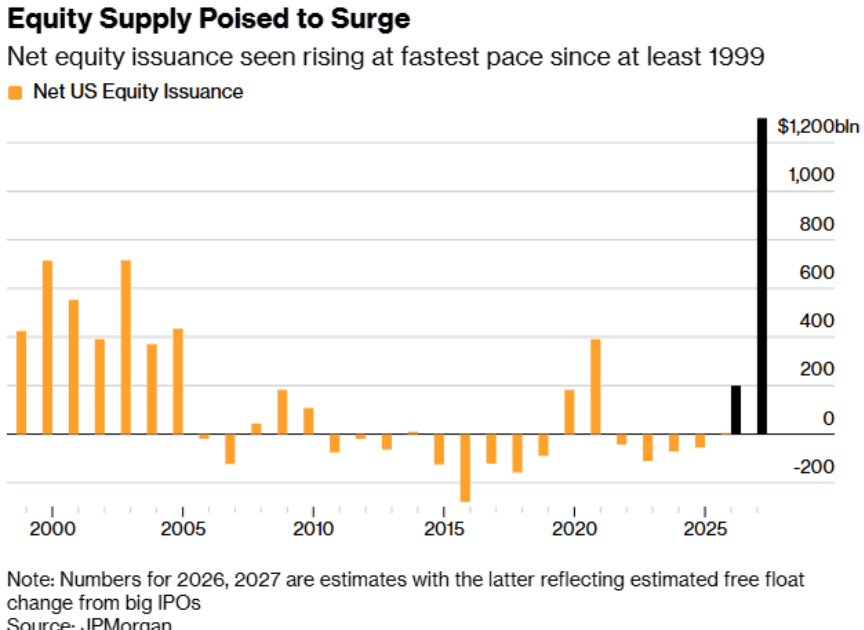
Twenty years of corporate America buying back its own stock built a tailwind nobody named. Since the mid-2000s, net US equity issuance ran negative — roughly $12 trillion in S&P 500 buybacks steadily retired the public float, while automatic passive and 401(k) flows chased an ever-shrinking pool. Fewer shares, same money: prices and multiples climbed on plumbing, not just earnings. That scarcity bid is now set to invert, hard. JPMorgan models net issuance near $1.2 trillion in 2027 — roughly twice the 2000 and 2003 peaks of about $650 billion, the fastest pace since at least 1999, and some $1.5 trillion of net new supply across 2026-27. The driver isn’t operating companies raising cash; the chart note says “free float change from big IPOs” — a decade of private capital converting to public float in one wave: 160-plus filings, over $120 billion in planned raises exceeding the prior two years combined, SpaceX’s roughly $75 billion debut the marquee name. A mega-IPO creates no new wealth; buyers must fund it from the same pool. The standing 401(k) bid must now swallow a flood — unless inflows accelerate to match. The floor turning into the ceiling.
Market Intelligence Brief (MIB) Ver. 18.40
For professional investors only. Not investment advice.
© 2026 RecessionALERT.com

Comments are closed.