
BofA declared semiconductors the most crowded trade in history — MRVL -9.78%, AMD -7.30%, INTC -8.45% — while the Dow hit its 17th record on Financials and Industrials rotation. Kevin Warsh opens his inaugural FOMC with a rate hold expected but a hawkish dot-plot likely; May housing starts collapsed -15.4% to 1.177M (weakest since 2020) and import prices surged to 6.7% YoY. WTI -5.09% on Iran peace deal repricing. SpaceX acquired Cursor for $60B, crossing a $2.8T valuation to overtake Amazon.
TABLE OF CONTENTS
A. EXECUTIVE SUMMARY
B. MARKET DATA
C. HIGH-IMPACT STORIES (5)
D. MODERATE-IMPACT STORIES (5)
E. ECONOMY WATCH (5)
F. EARNINGS WATCH (0)
G. WHAT’S NEXT
H. CHART OF THE DAY
A. EXECUTIVE SUMMARY -> TOP
MARKET SNAPSHOT
The Dow Jones Industrial Average closed at a record 52,002.94 (+0.64%) — its 17th all-time high of 2026 — while the Nasdaq 100 fell -1.89% as Bank of America’s June global fund manager survey, declaring semiconductors “the most crowded trade in history,” triggered institutional de-risking across the sector. Five chip mega-caps — MRVL (-9.78%), INTC (-8.45%), KLAC (-7.44%), AMD (-7.30%), MU (-6.18%) — drove Technology to -2.52%, inverting its 3-month leadership (+25.91%), compounded by pre-FOMC growth-multiple compression ahead of Kevin Warsh’s inaugural rate decision Wednesday. Critically, institutional capital did not leave equities: seven of 11 S&P 500 sectors gained, with Financials (+1.24%) and Industrials (+1.14%) absorbing the rotation — the widest Dow-Nasdaq spread in months. Bond markets confirmed the sector-specific read: 10-year yield eased 3 bps to 4.434% and a 20-year auction drew 73.2% foreign demand — gold near-flat, no safe-haven bid.
TODAY AT A GLANCE
• BofA “most crowded trade in history” triggers semiconductor rout: MRVL -9.78%, INTC -8.45%, KLAC -7.44%, AMD -7.30%, MU -6.18%; Technology sector -2.52%; estimated $1.3–1.4T in sector market-cap erosion over recent weeks as AI spending conviction frays ahead of FOMC.
• Kevin Warsh’s inaugural FOMC opens: Rate hold at 3.50–3.75% near-universally expected; Wednesday’s central unknown is whether Warsh publishes the dot-plot at all — he has expressed skepticism about forward-guidance tools — and if published, whether 2026 median rate projection rises above 3.75%, signaling hikes.
• Housing Starts catastrophic miss: May -15.4% to 1.177M SAAR (weakest since May 2020), 18% below consensus; Atlanta Fed GDPNow cut to 2.8% (from 3.3%); homebuilder stocks LEN, DHI, TOL under pressure — stagflationary signal as growth decelerates and inflation stays elevated.
• Import prices inflation shock: May +1.9% MoM (vs. +1.0% expected), YoY surging to 6.7% — highest since August 2022; capital goods +1.3%, nonfuel +0.8%; tariff-driven cost-push broadening beyond fuel, locking in hawkish FOMC posture and constraining Q3 rate-cut probability.
• SpaceX (SPCX) +4.83% to $201.80 after announcing a $60B all-stock acquisition of Anysphere (Cursor AI coding tool); valuation crosses $2.8T, overtaking Amazon; Nasdaq-100 inclusion expected within weeks — passive buying trigger at scale.
• NY Fed Services Index deepens to -10.1 (from -5.8 prior), compounding yesterday’s Empire State Manufacturing miss — NY-region economic deceleration broadening from factories into services, a 4–6 week leading indicator for national ISM Services.
KEY THEMES
1. Stagflation Trap Tightens on FOMC Eve — Housing starts at a 6-year low (GDPNow 2.8%) and import prices at a 4-year high (6.7% YoY) arrived simultaneously the day before Warsh’s inaugural decision. The Fed cannot ease without ignoring an inflation surge fed by tariff cost-push; it cannot tighten without crushing an already-broken housing market. Wednesday’s dot-plot is the first explicit Warsh statement on how he navigates this bind — and the asymmetric risk is hawkish: a 6.7% YoY import price print cannot be accommodated without eroding the Fed’s credibility.
2. Semiconductor Crowding Reversal Is Structural, Not Tactical — BofA’s 80% “most crowded trade in history” reading historically precedes 3–6 months of sector underperformance. The $1.3–1.4T in recent cap erosion and today’s sharp reversal of yesterday’s Computex 2026 rally (+7.9% SOX on June 15) confirm a market trading on narrative momentum with high reversion risk. The exception is differentiated AI infrastructure: Western Digital (WDC) +4.22% on Morgan Stanley’s 40–50% demand-vs-30–35%-supply HDD thesis shows that genuine structural demand deficits escape the de-risking wave; undifferentiated DRAM/NAND/GPU names do not.
3. Capital Rotation, Not Risk-Off — Institutional money is leaving tech but staying in equities: Dow record while Nasdaq declines; Financials and Industrials at multi-timeframe highs; 20-year Treasury auction drawing 73.2% foreign demand at 4.927%. This is portfolio repositioning ahead of a higher-for-longer rate regime under a hawkish new Fed chair — not a macro flight to safety. The Dow’s 17th record of 2026 with seven of 11 sectors green illustrates the breadth that single-index headlines obscure. JPMorgan’s +3.68% signals banks are being re-rated as higher-for-longer beneficiaries, not credit risk casualties.
 — Leading economic indicators. Accurate market forecasts. Apply for membership at join.recessionalert.com
B. MARKET DATA -> TOP
A semiconductor rout drove the session’s defining split — the Dow Jones set a fresh record high (+0.64%) powered by Financials and Industrials, while the Nasdaq 100 shed -1.89% as five chip mega-caps (MRVL, INTC, KLAC, AMD, MU) fell 6-10% on fading AI spending conviction and pre-FOMC growth-multiple compression ahead of Kevin Warsh’s inaugural Federal Reserve rate decision. Seven of 11 S&P 500 sectors gained, confirming a tech-specific selloff rather than market-wide risk-off. WTI crude fell another -5.09% on the continuing Iran-US peace MOU repricing, while Brent held near flat — most of the oil supply-risk discount already absorbed in prior sessions. Treasury yields eased modestly (-3 bps on the 10Y), bond markets pricing a rate hold rather than adding fresh inflation concern.
CLOSING PRICES – Tuesday, June 16, 2026:
MAJOR INDICES
Today’s 2.53% Dow-Nasdaq gap — Dow record (+0.64%) vs Nasdaq -1.89% — is the sharpest rotation signal in months, with blue-chip Financials and Industrials carrying the Dow to a new high as high-multiple chip stocks crater ahead of the FOMC. Dow Theory bull confirmation extends into its 3rd consecutive session, with DJIA pushing to a new 10-session high; DJTA, however, slipped -0.70% and sits 1.78% below its 10-session high — a fragile confirmation that warrants monitoring as the Dow-Transports divergence deepens.
| Index | Close | Change | %Move | Why It Moved |
|---|---|---|---|---|
| S&P 500 | 7,511.56 | -42.73 | -0.57% | Pre-FOMC sector rotation; Technology rout (-2.52%) partially offset by Financials (+1.24%) and Industrials (+1.14%) gains |
| Dow Jones | 52,002.94 | +331.91 | +0.64% | Record close; JPMorgan (+3.68%) and Visa (+2.87%) lead as rate stability under new Fed Chair Warsh benefits bank margins and blue-chip cyclicals |
| DJ Transportation | 22,194.5 | -156.9 | -0.70% | Rate uncertainty weighs on transport names; underperforms industrials even on a day of broad industrial sector strength |
| Nasdaq 100 | 29,968.13 | -575.79 | -1.89% | Semiconductor sector rout (MRVL -9.78%, AMD -7.30%, MU -6.18%); fading AI spending conviction + pre-FOMC multiple compression |
| Russell 2000 | 2,943.15 | -21.94 | -0.74% | Small-cap growth names pressured alongside Nasdaq; rate uncertainty dampens risk appetite for higher-beta domestics |
| NYSE Composite | 23,704.03 | +30.37 | +0.13% | Broad market breadth mildly positive (7 of 11 sectors green); cyclical gains offsetting tech drag at the index level |
VOLATILITY & TREASURIES
VIX’s modest +1.30% tick confirms sector anxiety, not macro fear — no spike, no contagion beyond tech. Bond non-participation supports the read: 10Y yields declined 3 bps alongside mild VIX upside, the signature of pre-FOMC safe-haven positioning rather than inflation-fear repricing. The 2Y-10Y spread holds at +38 bps (4.434% vs 4.054%), with the bond market pricing a Kevin Warsh rate hold and declining to add a new inflation risk premium.
| Instrument | Level | Change | Why It Moved |
|---|---|---|---|
| VIX | 16.41 | +0.21 (+1.30%) | Pre-FOMC positioning; mild fear tick on semiconductor selloff — contained, not a macro vol event |
| 10-Year Treasury Yield | 4.434% | -3.1 bps | Safe-haven bid ahead of Kevin Warsh’s first FOMC rate decision (expected hold Wednesday); yields ease as bond market prices rate stability |
| 2-Year Treasury Yield | 4.054% | -1.0 bps | Minimal movement; no rate cut priced in; 2Y anchored to near-term Fed policy hold expectations |
| US Dollar Index (DXY) | 99.54 | -0.09 (-0.09%) | Marginal USD softness; no safe-haven dollar demand on a sector-specific selloff; DXY holds sub-100 |
COMMODITIES
Platinum’s +2.08% outperformance against gold’s near-flat session (+0.03%) divides the precious metals on industrial vs safe-haven demand — automotive/industrial buyers drove platinum while gold found no traction despite the Nasdaq selloff. That gold failed to rally on a major tech drawdown confirms markets read today as sector rotation, not systemic risk. Bitcoin’s -0.81% decline tracks equities passively — no crypto-specific catalyst; digital assets behaving as a risk proxy.
| Asset | Price | Change | %Move | Why It Moved |
|---|---|---|---|---|
| Gold | $4,353.05/oz | +$1.45 | +0.03% | Near-flat; market does not read semiconductor rout as systemic risk — no safe-haven flight to gold |
| Silver | $70.128/oz | -$0.053 | -0.07% | Marginal industrial demand softening amid mixed growth signals; minimal move |
| Copper | $6.4807/lb | -$0.0153 | -0.23% | Minor pullback; mixed growth signals with semiconductor demand concerns offsetting broader industrial strength |
| Platinum | $1,809.75/oz | +$36.95 | +2.08% | Industrial demand recovery; automotive/catalyst sector bid; diverges from gold on real-economy vs safe-haven split |
| Bitcoin | $65,816.00 | -$538.00 | -0.81% | Mild risk-off tracking equities broadly; no crypto-specific catalyst — behaving as a risk proxy on a pre-FOMC session |
ENERGY
WTI’s -5.09% plunge while Brent moved just -0.06% reflects sequencing, not fundamentals: Brent had already absorbed most of the Iran peace MOU repricing in prior sessions, leaving WTI catching down today. Henry Hub +3.59% decouples entirely — summer cooling demand is the driver, not geopolitics. Falling oil on a mixed equity tape reads as demand-neutral for portfolios; no stagflationary signal in today’s crude decline.
| Asset | Price | Change | %Move | Why It Moved |
|---|---|---|---|---|
| Crude Oil (WTI) | $76.64/bbl | -$4.11 | -5.09% | Continuing Iran-US peace MOU repricing; Iranian supply return expectations accelerate US crude discount; WTI catches down to prior Brent adjustment |
| Crude Oil (Brent) | $79.41/bbl | -$0.05 | -0.06% | Near-flat; bulk of Iran deal supply-risk discount absorbed in prior sessions; WTI-Brent spread at $2.77 |
| Natural Gas (Henry Hub) | $3.260/MMBtu | +$0.113 | +3.59% | US summer cooling demand building; decoupled from crude Iran narrative — domestic supply-demand driver |
| Natural Gas (Dutch TTF) | $14.21/MMBtu | +$0.00 | 0.00% | Essentially unchanged; European gas markets stable; prior Iran deal repricing largely absorbed |
S&P 500 SECTORS
Today’s session inverted the 3-month hierarchy: Technology, the quarter’s structural leader (+25.91% 3M), became the session’s worst sector (-2.52%) as semiconductor AI-spend doubts collide with pre-FOMC multiple compression. The other inversion plays out in Energy — the YTD leader (+23.35%) is also the month’s worst sector (-7.32%), with WTI’s Iran-deal slide compressing margin expectations. Financials and Industrials fill the vacuum, extending consistent multi-timeframe strength across the 1D, 1W, 1M, and 3M horizons.
| Sector | 1-Day | 1-Week | 1-Month | 3-Month | 6-Month | YTD | 12-Month |
|---|---|---|---|---|---|---|---|
| Financial | +1.24% | +3.80% | +6.51% | +11.41% | +2.57% | +2.34% | +16.84% |
| Industrials | +1.14% | +5.43% | +8.17% | +12.80% | +20.76% | +21.72% | +34.34% |
| Basic Materials | +0.56% | +6.14% | +3.24% | +5.54% | +18.73% | +17.74% | +45.21% |
| Utilities | +0.37% | +2.15% | +1.72% | -3.91% | +5.46% | +5.45% | +13.69% |
| Communication Services | +0.34% | +1.84% | -3.78% | +6.69% | +4.98% | +3.88% | +28.69% |
| Consumer Defensive | +0.25% | +1.61% | -1.20% | +0.15% | +7.07% | +9.04% | +7.03% |
| Real Estate | +0.15% | +0.21% | +3.94% | +5.06% | +8.96% | +9.92% | +8.37% |
| Healthcare | -0.16% | -0.68% | +4.21% | +2.31% | -0.79% | -1.15% | +12.67% |
| Consumer Cyclical | -0.33% | +1.62% | -0.56% | +3.75% | -3.85% | -3.13% | +8.91% |
| Energy | -0.63% | -3.29% | -7.32% | -5.00% | +22.46% | +23.35% | +26.00% |
| Technology | -2.52% | +1.88% | +3.27% | +25.91% | +21.97% | +21.53% | +45.13% |
TOP MEGA-CAP MOVERS:
GAINERS
| Company | Ticker | Close | Change | Why It Moved |
|---|---|---|---|---|
| Space Exploration Technologies Corp | SPCX | $201.80 | +4.83% | SpaceX AI space infrastructure deal vaults valuation above $2.8T, overtaking Amazon; post-IPO momentum continues |
| Western Digital Corp | WDC | $681.08 | +4.22% | Morgan Stanley upgrade projects HDD demand growth 40-50%/yr vs 30-35% supply through 2028; lifts 2028 EPS estimates 70% above consensus |
| JPMorgan Chase & Co | JPM | $331.14 | +3.68% | Financials sector rally on rate stability; Kevin Warsh rate-hold expectation supports bank NIM; Financials leading all sectors today (+1.24%) |
| Visa Inc | V | $333.12 | +2.87% | Financials sector strength; consumer spending resilience thesis supported by stable rate environment ahead of FOMC |
| GE Aerospace | GE | $351.73 | +2.77% | Industrials sector leadership (+1.14%); defense/aerospace capex cycle intact; beneficiary of AI space infrastructure theme |
DECLINERS
| Company | Ticker | Close | Change | Why It Moved |
|---|---|---|---|---|
| Marvell Technology Inc | MRVL | $278.67 | -9.78% | AI chip demand doubts + Broadcom AI guidance miss overhang; pre-FOMC high-multiple compression in semiconductor names |
| Intel Corp | INTC | $117.05 | -8.45% | Reversal of June 12 BofA double-upgrade bounce (+6.48%); sector rotation punishes recovery names hardest in risk-off chip selloff |
| KLA Corp | KLAC | $237.33 | -7.44% | Semiconductor equipment selloff; CapEx uncertainty for chip foundries as AI demand outlook softens |
| Advanced Micro Devices | AMD | $507.29 | -7.30% | AI chip demand concerns; valuation compression on high-P/E growth name ahead of FOMC rate decision |
| Micron Technology | MU | $1,020.76 | -6.18% | Memory chip oversupply fears; AI GPU memory demand uncertainty compounds deepening memory chip crisis |
— Institutional-grade intelligence for serious investors. Apply for membership at join.recessionalert.comC. HIGH-IMPACT STORIES -> TOP
BEARISH
1. Semiconductor Sector Rout — BofA “Most Crowded Trade in History” Triggers Broad Chip Selloff; MRVL -9.78%, INTC -8.45%, AMD -7.30%; Technology -2.52%
The core facts:Technology was the session’s worst-performing sector on June 16, falling 2.52%, as the Philadelphia Semiconductor Index was hit with broad-based institutional selling across its largest constituents: Marvell Technology (MRVL) -9.78%, Intel (INTC) -8.45%, KLA Corporation (KLAC) -7.44%, Advanced Micro Devices (AMD) -7.30%, and Micron Technology (MU) -6.18%. The primary catalyst: Bank of America’s June 2026 global fund manager survey — released today — showed 80% of respondents now classify semiconductors as “the most crowded trade in history,” a designation that has historically preceded institutional de-risking at scale. Pre-FOMC growth-multiple compression compounded the selling, as fund managers rotated from high-multiple technology into Financials and Industrials ahead of Wednesday’s rate decision. The S&P 500 fell 0.57% to 7,511.35 and the Nasdaq Composite declined 1.15% to 26,376.34 as the semiconductor rout weighed on broad indices.
Why it matters:The BofA “most crowded trade in history” designation marks a structural inflection point for the semiconductor trade: when 80% of institutional fund managers agree a sector is overcrowded, the unwind risk is asymmetric to the downside. Yesterday’s Computex 2026 rally — SOX +7.9% on June 15, driven by Micron HBM4 sell-out confirmation and the NVIDIA-SK Hynix supply deal — makes the reversal particularly sharp, pointing to a sector trading on narrative momentum that is highly susceptible to sentiment reversion. The AI infrastructure investment thesis remains structurally intact (HBM sold out through year-end, AI capex multi-year), but the valuation premium embedded in semiconductor names has now been explicitly flagged by the majority of the institutional buy-side as unsustainable. The Broadcom guidance miss from June 4 seeded the doubt; today’s BofA survey formalized the consensus. Total semiconductor market cap erosion over recent weeks is estimated at $1.3–1.4 trillion — this is not a one-day event. Rate-sensitive tech multiples face the additional headwind of Wednesday’s FOMC dot-plot, which could further compress growth-equity discount rates if Warsh signals a hawkish trajectory.
What to watch:Wednesday’s FOMC dot-plot — a hawkish Warsh signal would apply additional multiple compression to growth-oriented semiconductor names. BofA’s “most crowded trade” percentage in subsequent monthly surveys as the sentiment reversal indicator; historically, readings above 80% precede 3–6 months of sector underperformance relative to the S&P 500.
UNCERTAIN
2. Kevin Warsh’s Inaugural FOMC Two-Day Meeting Opens — Hawkish Hold at 3.50–3.75% Expected; Dot-Plot Format and 2026 Rate Path Are Wednesday’s Central Unknown
The core facts:The Federal Open Market Committee commenced its two-day June policy meeting on June 16, 2026 — the first meeting chaired by Kevin Warsh, who succeeded Jerome Powell as Fed Chair earlier this year. The rate decision, updated Summary of Economic Projections (SEP), and Warsh’s inaugural press conference are all scheduled for Wednesday June 17 at 2:00 PM ET. A hold at 3.50–3.75% is near-universally expected; Bank of America’s June fund manager survey, released today, shows 55% of respondents anticipating a hawkish tone from Warsh. The meeting’s central uncertainty is not the rate decision itself but two structural variables: (1) whether Warsh publishes the quarterly dot-plot at all — Warsh has previously expressed skepticism about the forward-guidance function of the dot-plot as a policy tool, raising the possibility he withholds or reforms it; (2) if published, whether the 2026 median rate projection rises above the current 3.75% upper bound, effectively penciling in a hike rather than a hold. Pre-FOMC market positioning: rotation from high-multiple technology into Financials (+1.24%) and Industrials (+1.14%), mild VIX uptick, 10-year yield -5bps on growth-scare data (Housing Starts, Story 3).
Why it matters:This is not just a routine FOMC meeting — it is the policy framework reset under a new Fed Chair whose academic and prior Fed Board views lean structurally hawkish. Wednesday’s dot-plot will establish Warsh’s committee’s baseline 2026 rate trajectory, and markets will read it as the primary signal of whether the easing cycle that rate-sensitive sectors (REITs, utilities, homebuilders) are pricing for in H2 2026 is actually on the table. Two conflicting data inputs from today make Wednesday’s reaction function particularly complex: import prices surged to a 6.7% YoY rate (see Story 4 — arguing for a hawkish tilt), while housing starts collapsed to a five-year low (see Story 3 — arguing for caution). Oil’s continued decline to $76.05/bbl (WTI -5.82%) removed the dominant inflation tailwind but took time to work through the CPI pipeline. For institutional investors, the UNCERTAIN classification reflects genuinely asymmetric risk in both directions: a hawkish dot-plot that signals 2026 hikes would trigger a sharp risk-off move in rate-sensitive equities and tech; a dovish hold that maintains the 2025 dot-plot path would unlock a meaningful rally across sectors that have been suppressed by the inflation/rate overhang.
What to watch:Wednesday June 17 at 2:00 PM ET — the rate decision and whether Warsh publishes the dot-plot at all. If published: 2026 median rate projection relative to 3.75% (above = hawkish signal, below = dovish). Warsh’s press conference language at 2:30 PM — specifically whether he characterizes policy as “sufficiently restrictive” or signals willingness to move in either direction. CME FedWatch cut/hike odds within 30 minutes of the decision as the market’s real-time verdict on Warsh’s tone.
BEARISH
3. Housing Starts Catastrophic Miss — May Plunges -15.4% to 1.177M SAAR (Weakest Since May 2020), 18% Below Consensus; Atlanta Fed GDPNow Cut to 2.8%
The core facts:The Bureau of the Census reported May 2026 Housing Starts at 1.177M SAAR this morning — a -15.4% monthly collapse that came in 18% below the 1.430M consensus, marking the weakest print since May 2020’s COVID-era trough. Building Permits were marginally below expectations at 1.413M (vs. 1.420M expected). The Atlanta Fed’s GDPNow model immediately cut its Q2 2026 real GDP growth estimate from 3.3% to 2.8% following the release. The 10-year Treasury yield fell 2.7bps intraday on the data as a growth-scare flight to safety bid. Homebuilder stocks — Lennar (LEN), D.R. Horton (DHI), Toll Brothers (TOL) — sold off on the release. The report compounds last week’s NAHB Housing Market Index reading of 35 (26th consecutive sub-50 print, covered in yesterday’s MIB), confirming that builder pessimism has now translated into an outright physical construction collapse.
Why it matters:The 18% miss against consensus is not noise — it is one of the largest housing starts shortfalls in years, and it arrives at the worst possible moment: on the eve of Warsh’s inaugural FOMC meeting, forcing the committee to weigh today’s catastrophic growth signal against the morning’s hot import prices (6.7% YoY, Story 4). From an equity portfolio perspective: homebuilder stocks face immediate downward revision risk on volume-dependent earnings models; lumber, concrete, and building materials suppliers face demand headwinds extending through H2; and the single-family construction labor market faces a pullback signal. The GDPNow revision from 3.3% to 2.8% is particularly consequential because it reframes the macro narrative from “resilient growth + sticky inflation” (which supports Fed hawkishness) toward “slowing growth + cost-push inflation” — the stagflation quadrant that is the worst environment for equity multiples. The prior month’s NAHB confidence data was confirmed with a physical activity collapse today: builders weren’t just expressing pessimism, they were stopping construction. This is the housing market signaling that 6.6% mortgage rates have broken demand at the activity level, not just the sentiment level.
What to watch:Wednesday’s FOMC SEP — whether Warsh’s committee incorporates today’s housing shock into the 2026 GDP growth projections (a downward revision would be significant). DHI and LEN Q2 earnings calls (mid-July) for guidance on cancellation rates, new order volume, and whether the starts collapse is being felt in signed contracts. July Housing Starts (released mid-August) as confirmation of trend vs. one-month anomaly.
BEARISH
4. Import Prices Inflation Shock on FOMC Eve — May +1.9% MoM vs. +1.0% Expected; YoY Hits 6.7%, Highest Since August 2022; Tariff Cost-Push Compounds Iran Oil Relief
The core facts:The Bureau of Labor Statistics released May 2026 Import Prices this morning: +1.9% MoM — nearly double the +1.0% consensus — with the YoY rate jumping to 6.7%, the highest level since August 2022. The breakdown: fuel import prices surged 12.5% MoM; nonfuel imports +0.8%; capital goods +1.3%. The data arrived simultaneously with today’s catastrophic Housing Starts miss (Story 3), creating a simultaneous inflation shock and growth scare on the morning of the FOMC’s first deliberation day. Rate-sensitive equity sectors — REITs, utilities, homebuilders — sold off on the release before partially recovering on the growth-scare Treasury bid that accompanied the housing data.
Why it matters:Import prices at 6.7% YoY create a direct pipeline to domestic CPI through a 1-3 month lag. Today’s data exposes the structural bifurcation of the 2026 inflation problem: WTI crude fell -5.82% today (energy disinflation from the Iran deal), but tariff-driven manufactured goods import prices are surging (+0.8% nonfuel, +1.3% capital goods). The net result is a two-track inflation dynamic that makes the Fed’s easing calculus significantly more complex: oil price relief improves the energy CPI component, but the non-energy goods inflation — which is tariff-driven and structural, not cyclical — continues to build. Capital goods at +1.3% MoM signals that business investment costs are rising, compressing corporate margins on top-line growth. For equity investors, this data effectively constrains the probability of rate cuts in Q3: the easing cycle that rate-sensitive sectors are priced for requires non-energy goods inflation to cool, and today’s data shows the opposite. Warsh’s committee cannot ignore a 6.7% YoY import price reading — it will almost certainly be reflected in a hawkish SEP, regardless of oil’s recent decline.
What to watch:Wednesday’s FOMC dot-plot and SEP — whether Warsh’s committee references tariff-driven goods inflation as a sustained upside risk to the 2026 rate path. June CPI print (due mid-July) as the first consumer-level reading that captures May’s import price surge in final goods prices. Any tariff de-escalation announcements with key trading partners (Vietnam, Bangladesh, Cambodia) that would reduce the nonfuel import price trajectory.
BULLISH
5. SpaceX $60B All-Stock Acquisition of Anysphere (Cursor) — AI Coding Pivot Drives SPCX +4.83% to $201.80; Valuation Crosses $2.8 Trillion, Overtaking Amazon
The core facts:SpaceX (SPCX) filed an SEC Form 8-K on June 16, 2026 announcing a definitive agreement to acquire Anysphere Inc. — the developer behind Cursor, the leading AI-powered coding tool — in a $60 billion all-stock transaction. The Agreement and Plan of Merger was signed June 16. SpaceX will exchange SPCX shares for all outstanding Anysphere equity, with the deal expected to close Q3 2026 pending regulatory approval. The acquisition follows an option SpaceX secured in April 2026 giving it the right to either enter a $10 billion partnership or acquire the full company for $60 billion. Cursor is one of the most widely adopted AI developer tools, with a large professional user base at major technology companies. SPCX rallied +4.83% to close at $201.80, with intraday highs reaching $225.64 as the deal was absorbed by markets. The company’s valuation crossed approximately $2.8 trillion — overtaking Amazon and becoming the fifth-most-valuable US public company, four days after its record $75 billion Nasdaq IPO.
Why it matters:A $60 billion acquisition four days after a $75 billion IPO signals a strategic pivot no investor modeled at the time of the offering. SpaceX’s original investment thesis was launch vehicles, Starlink broadband, and eventual space infrastructure; Anysphere adds an entirely new revenue vector — AI developer productivity tools — that monetizes the software engineering professionals who will build every AI-native application over the next decade. Cursor’s user base represents the exact customer segment that every cloud provider and software vendor is competing for. The all-stock structure leverages SPCX’s newly minted public equity as acquisition currency while preserving cash for launch vehicle and satellite operations. For portfolio investors, the deal broadens the SpaceX thesis from hardware infrastructure (rockets, satellites) into software productivity — dramatically expanding the total addressable market that analysts must now model. The Nasdaq-100 inclusion timeline (expected within weeks under Nasdaq’s rewritten eligibility criteria) will trigger systematic passive buying at scale precisely as this AI software expansion is being digested — compressing the float against institutional demand.
What to watch:DOJ antitrust review — regulators will scrutinize a $2.8T space company acquiring a leading AI developer tool for horizontal expansion into software. SPCX sustaining above $200 as the institutional confidence threshold in the combined Starlink + Cursor strategy. Nasdaq-100 inclusion announcement timing — the passive buying trigger that will mechanically accelerate SPCX price discovery.
— Quantifying recession risk so you don’t have to guess. Apply for membership at join.recessionalert.comD. MODERATE-IMPACT STORIES -> TOP
BULLISH
6. Dow Jones Record Close 51,999.67 — 17th Record of 2026; Financials +1.24% and Industrials +1.14% Lead as Semis and Tech Retreat; Widest Dow-Nasdaq Spread in Months
The core facts:The Dow Jones Industrial Average closed at 51,999.67 on June 16 — up 328.64 points (+0.64%), its 17th record close of 2026, with an intraday all-time high at 52,190.29 (just 0.33 points short of the first close above 52,000). Session sector leadership: Financials +1.24% (day’s top sector) and Industrials +1.14% (second). Key individual movers: JPMorgan Chase (JPM) +3.68%, Visa (V) +2.87%, GE Aerospace (GEV) +2.77%. By contrast, the S&P 500 fell 0.57% to 7,511.35 and the Nasdaq Composite declined 1.15% to 26,376.34 — creating a 1.79-point Dow-vs-Nasdaq percentage spread, the widest intraday divergence between the two indices in months. Industrials ETF (XLI) hit a fresh record high, driven by defense, grid infrastructure, logistics, and aerospace names benefitting from continued Iran deal energy cost relief.
Why it matters:The Dow-Nasdaq divergence — Dow record while Nasdaq declines — is the most explicit cyclical-versus-technology rotation since the January 2026 tariff shock. Financials’ leadership is driven by Warsh rate-hold expectations: banks benefit from sustained 3.50–3.75% fed funds (net interest margin support) without the headwind of near-term cuts. Industrials leadership reflects Iran deal energy cost relief flowing into aerospace, logistics, and defense operating margins. Critically, institutional capital is not leaving equities — it is repositioning from growth/tech into value/cyclical. The Dow’s 17th record of 2026 while the Nasdaq is simultaneously negative illustrates the market broadening that single-index performance metrics obscure. For portfolio managers: this is durable evidence that the 2026 equity rally is not dependent on AI mega-cap technology — the rotation into Financials and Industrials provides an independent performance driver. JPMorgan’s 3.68% gain on a rate-hold session signals that banks are being re-rated as beneficiaries of higher-for-longer, not as credit risk casualties.
What to watch:Wednesday FOMC decision — a hawkish Warsh signal would reinforce the Financials and cyclical rotation; a dovish surprise could compress the Dow-Nasdaq spread. XLI (Industrials ETF) sustaining above its record close as confirmation of the rotation’s durability beyond single-session momentum.
BULLISH
7. Treasury Yields Fall Sharply Across the Curve; Strong 20-Year Bond Auction Posts 73.2% Foreign Demand — Intact Buyer Confidence Ahead of FOMC
The core facts:US Treasury yields declined meaningfully across the full curve on June 16: 2-year yield -7bps to 4.08%, 5-year -6bps to 4.21%, 10-year -5bps to 4.48%, 30-year -3bps to 4.97%. The primary driver: May Housing Starts’ catastrophic -15.4% miss triggered a flight-to-duration safety bid. Separately, the day’s 20-year Treasury bond auction priced at 4.927% — substantially below the prior auction’s 5.122% — with a bid-to-cover ratio of 2.75x (above the 2.65x average) and indirect (foreign central bank and institutional) bidder participation of 73.2%, well above the 64.9% average. The auction stopped through the when-issued rate by 1.0 basis point, signaling aggressive institutional demand. WTI crude’s continued decline to $76.05 (Iran deal follow-through) and reduced rate-hike bets contributed secondarily to the yield decline.
Why it matters:The 20-year auction’s 73.2% indirect bid (vs. 64.9% average) directly refutes the recurring “dollar displacement” and “US fiscal credibility” narratives that have periodically pressured long-end yields: foreign central banks are actively accumulating US duration ahead of an FOMC meeting, not retreating. For rate-sensitive equity sectors, the 10-year yield at 4.48% — declining from the 4.50%+ range — provides incremental mortgage rate relief: each 10bps decline in the 10-year translates to approximately 10–12bps in eventual 30-year mortgage rate adjustment. Homebuilders, REITs, and utilities receive a modest technical tailwind. The 2-year yield at 4.08% — down 7bps on the day — is particularly telling: short-term rate expectations are easing even as import prices were hot this morning, suggesting the bond market is weighting the housing collapse (growth) over the import price shock (inflation). This is the bond market’s stagflation read: growth declining faster than inflation is burning off, which argues for near-term yield support but does not resolve the equity multiple problem.
What to watch:Wednesday FOMC dot-plot — a hawkish Warsh signal could reverse today’s yield decline and push the 10-year back above 4.50%. 10-year yield holding below 4.50% as the technical threshold for sustained homebuilder and REIT sector relief. Foreign buyer participation in future Treasury auctions as the ongoing indicator of dollar-reserve demand.
BEARISH
8. FTC Prepares Major Lawsuit Against Amazon Advertising — Billions in Civil Penalties Potential; State AGs Investigating Ad Auction Transparency
The core facts:Bloomberg Law reported on June 16 that the Federal Trade Commission has drafted a potential complaint against Amazon targeting the company’s advertising business practices, with multiple state attorneys general jointly involved in the investigation. The FTC’s consumer protection unit is focused on whether Amazon adequately disclosed reserve pricing terms and auction mechanics to advertisers on its sponsored product placement platform — specifically whether the minimum bid thresholds and auction pricing methodology were properly disclosed to advertisers purchasing search advertising inventory. Potential civil penalties could reach billions of dollars. No formal lawsuit has been filed; the FTC may conclude the investigation through a lawsuit or settlement. Amazon shares were pressured late in the session following the Bloomberg report.
Why it matters:Amazon’s advertising segment is one of its highest-margin and fastest-growing businesses, generating approximately $56–58 billion annually — with operating margins materially above the company’s overall blended average. A penalty of “billions” against a $55B+ revenue segment is financially manageable, but the structural risk is behavioral remedies: if the FTC compels Amazon to disclose reserve pricing or restructure its auction mechanics, it could reduce the advertiser lock-in and premium pricing that drive the segment’s margin expansion. More broadly, this signals that FTC enforcement posture under the current administration extends from Amazon’s prior retail and Prime cases into digital advertising — a legal theory that would create spillover scrutiny risk for Meta’s and Google’s ad auction practices as well. State AG co-involvement amplifies both the enforcement probability and the remedy scope. For portfolio managers with digital advertising exposure across AMZN, META, and GOOGL: this case is the leading indicator of whether ad-tech business practices become a sustained regulatory overhang in 2026–2027.
What to watch:Whether the FTC files a formal complaint within the next 30–60 days, or pursues a negotiated settlement (the latter would be less disruptive to Amazon’s ad revenue model). Meta (META) and Alphabet (GOOGL) stock reactions to any court filing — as proxies for digital advertising regulatory contagion risk. Any injunctive relief motions that seek to alter Amazon’s current auction practices prior to trial.
BULLISH
9. Western Digital (WDC) Morgan Stanley Upgrade to Overweight, PT $650 — HDD Demand Growing 40–50% Annually vs. 30–35% Supply; 2028 EPS Est. 70% Above Consensus
The core facts:Morgan Stanley upgraded Western Digital (WDC) to Overweight on June 16, raising the price target to $650 from $530. The structural upgrade thesis: HDD demand growth is now projected at 40–50% annually through 2028, driven by AI data center persistent storage requirements, versus supply growth of only 30–35% over the same period. Morgan Stanley raised its 2028 EPS estimates 70% above the prior consensus to reflect this demand-supply gap locking in pricing power and margin expansion. WDC rose +4.22% to $681.08 on the day — already above the new $650 target on the upgrade day itself — a noteworthy divergence as WDC’s semiconductor-adjacent peers fell 7–10% in the same session. The stock has more than doubled YTD, with a current market cap of approximately $225 billion.
Why it matters:Today’s session delivered a textbook divergence: WDC +4.22% while MRVL -9.78%, AMD -7.30%, and MU -6.18%. This is the market differentiating between two types of AI storage infrastructure — commoditized memory (DRAM, NAND) subject to BofA’s “most crowded trade” de-risking, and persistent HDD storage where the demand-supply dynamic has fundamentally shifted in WDC’s favor. AI training runs require massive long-duration storage at scale; HDD capacity is in genuine structural supply deficit for the first time in years. The 40–50% demand vs. 30–35% supply asymmetry through 2028 means pricing power, margin expansion, and earnings growth are contractually visible — not dependent on AI inference adoption curves. Morgan Stanley’s 70% EPS estimate revision above consensus is the quantitative signal that the street has materially underestimated WDC’s earnings trajectory. For institutional investors seeking AI infrastructure exposure without semiconductor valuation risk or crowded-trade exposure: WDC is now the cleanest structural AI beneficiary in the storage layer.
What to watch:WDC’s next earnings call for first quantification of whether the 40–50% demand growth estimate is tracking against actual shipment orders. Seagate (STX) capacity announcements as the primary HDD supply-side signal that would ease or maintain the structural constraint. Institutional follow-through — WDC sustaining above the $650 MS target suggests broader buy-side conviction; a retreat to $600 would signal the upgrade day pop was sell-the-news.
BEARISH
10. NY Fed Services Activity Index Deepens to -10.1 in June — Worsens From -5.8; Compounds Empire State Manufacturing Miss; NY Region Slowdown Broadens From Factories to Services
The core facts:The New York Federal Reserve’s June 2026 Services Activity Index fell to -10.1, worsening from -5.8 in May and extending the region’s service sector contraction. The reading compounds Monday’s Empire State Manufacturing Index (5.7 vs. 14.0 expected — covered in yesterday’s MIB) — together the June NY Fed surveys paint a broad economic deceleration picture across the New York-New Jersey-Connecticut corridor. The NY region’s survey universe disproportionately captures financial services, professional services, and commercial real estate — sectors with outsized representation in the national financial system. Financial sector stocks did not sell off on the news, as the report was largely overshadowed by the morning’s major macro releases (Housing Starts, Import Prices).
Why it matters:Services activity contracting at -10.1 — worsening from -5.8 — in a region that represents financial services, legal, consulting, and commercial real estate firms creates a counter-signal to Financials’ strong session (+1.24%). Banks are being bought on the rate-hold narrative, but their core revenue-generating region’s activity index is in contracting territory and deteriorating. This divergence between financial sector stock performance and the underlying business activity environment is a signal worth monitoring: if financial services activity in the NY region continues to weaken, advisory fee revenue, commercial banking demand, and loan origination for the major Wall Street firms will face headwinds in Q2–Q3 earnings. The sequential worsening from -5.8 to -10.1 is the critical data point — it establishes a trend, not a one-month aberration. NY Fed services slowdowns have historically led national ISM Services readings by 4–6 weeks.
What to watch:ISM Non-Manufacturing/Services national print (due early July) as the national confirmation or divergence signal for the NY-region trend. JPMorgan, Goldman Sachs, and Morgan Stanley Q2 2026 earnings calls (mid-July) for explicit commentary on advisory pipeline, commercial banking loan demand, and fee revenue velocity in the current rate environment.
— Separating signal from noise since 2007. Apply for membership at join.recessionalert.comE. ECONOMY WATCH -> TOP
Housing and inflation struck simultaneously on the eve of Kevin Warsh’s inaugural FOMC: Starts collapsed -15.4% MoM to 1.177M SAAR — the weakest since May 2020, 18% below consensus — dragging Atlanta Fed GDPNow for Q2 to 2.8% (from 3.3% a week ago). Import Prices surged 1.9% MoM (6.7% YoY, highest since August 2022) as fuel spiked 12.5%, nearly doubling consensus and arriving as the data point most likely to lock in tomorrow’s hawkish dot plot. The NY Fed Services Index deepened to -10.1 (prior: -5.8). A well-bid 20-year auction (4.927% yield, 2.75x BTC, 73.2% foreign demand) provides the sole bullish offset — global investors remain willing to finance US debt at sub-5% levels — but the week closes on a stagflationary note: decelerating real activity against an import-price pipeline still running at 6.7% YoY.
Housing Starts Plunge 15.4% to 1.177M in May — Weakest Pace Since May 2020, 18% Below Consensus (Census Bureau, June 16, 2026)
What they’re saying:US housing starts collapsed to a seasonally adjusted annual rate of 1.177 million in May, down 15.4% month-over-month and 18% below the 1.43 million consensus estimate — the weakest reading since May 2020. Building permits also missed at 1.413M (exp. 1.42M), down 0.7% MoM from April’s 1.423M, suggesting no near-term recovery in the residential construction pipeline. The 10-year yield fell 2.7 basis points to 4.441% on the release.
The context:The collapse reflects the combined drag of 30-year mortgage rates near 6.6% and tariff-driven construction cost increases. Residential investment is a direct GDP component — the Atlanta Fed GDPNow model revised its Q2 2026 growth estimate down to 2.8% on today’s data, from 3.3% a week ago and 4.3% in May. NAHB builder confidence already sat at a 26-month low of 35 in June (35% of builders cutting prices), and the permit miss confirms that the pipeline is not recovering. The housing market is in a self-reinforcing affordability trap: high rates suppress starts, limit supply, keep prices elevated, and further depress affordability.
What to watch:June Housing Starts and Building Permits (expected mid-July). Tomorrow: Retail Sales MoM (exp. +0.5%) for consumer spending context, and FOMC press conference for any language on the housing channel and the rate path.
Import Prices Surge 1.9% in May — Nearly Double Consensus, YoY Leaps to 6.7% (Highest Since August 2022) (BLS, June 16, 2026)
What they’re saying:US import prices rose 1.9% month-over-month in May, nearly double the 1.0% consensus estimate. Year-over-year, import prices climbed 6.7% — the highest reading since August 2022. Fuel and lubricant imports spiked 12.5%, the single largest driver, but nonfuel imports still rose 0.8% and capital goods (computers, semiconductors, scientific equipment) climbed 1.3%, signaling that cost pressures are broadening beyond energy. Export prices also beat at +1.3% MoM (exp. +1.2%), with the YoY rate jumping to 11.2% from 8.8% prior.
The context:The data arrives one session before Kevin Warsh’s inaugural FOMC meeting, with CPI already running at 4.2% YoY (May 2026). Import price acceleration at 6.7% YoY means the pipeline of inflationary pressure remains structurally elevated. The fact that nonfuel import prices rose 0.8% and capital goods 1.3% suggests tariff pass-through is compounding the fuel shock — this is not a transitory energy story. US producers simultaneously raising export prices (11.2% YoY) signals the core goods disinflation of 2024–2025 has fully reversed. The combination all but locks in a hawkish dot plot and easing-bias removal at tomorrow’s FOMC.
What to watch:FOMC dot plot and SEP (June 17, 2:00 PM ET) for updated inflation projections. July CPI (expected ~July 10) for whether import price acceleration is transmitting to the consumer price index.
NY Fed Services Activity Index Falls to -10.1 in June — Deepening Contraction vs. -5.8 Prior (NY Fed, June 16, 2026)
What they’re saying:The Federal Reserve Bank of New York’s Business Activity Index for the regional services sector registered -10.1 in June, worsening from -5.8 in May. The index tracks business conditions across New York, New Jersey, and Connecticut — covering a significant share of US financial services and professional services activity. Any reading below zero reflects contraction; the June print represents a meaningful acceleration below prior month levels.
The context:The June deterioration follows yesterday’s Empire State Manufacturing Index miss (5.7 vs. 14 consensus) and adds a services-sector dimension to the regional slowdown picture. With services comprising approximately 78% of US GDP, a deepening NY-area contraction carries leading-indicator weight for national conditions. NY-area financial and professional services firms often reflect broader Wall Street and corporate spending trends. Combined with today’s housing collapse and slowing GDPNow, the regional data reinforces a picture of real economic deceleration heading into the FOMC meeting.
What to watch:National ISM Services PMI (early July) for confirmation of whether NY regional weakness is spreading. Philadelphia Fed Manufacturing and Services Surveys (June 18).
Atlanta Fed GDPNow Revised Down to 2.8% for Q2 2026 — Slips from 3.3% on Housing Starts Collapse (Atlanta Fed, June 16, 2026)
What they’re saying:The Atlanta Federal Reserve’s GDPNow model revised its Q2 2026 real GDP growth nowcast down to 2.8% annualized on June 16, from 3.3% on June 9 — a 0.5 percentage point decline driven primarily by today’s housing starts collapse. The model update reflects the direct contribution of residential construction to private fixed investment in the GDP accounts. GDPNow has declined from a high of 4.3% on May 21 to 2.8% today, a loss of 150 basis points in under four weeks.
The context:The 2.8% Q2 nowcast arrives on the eve of the FOMC meeting and frames the Fed’s stagflationary bind: import prices running at 6.7% YoY demand a hawkish response, while a real economy that has shed 150 bps of growth tracking since May limits how far Warsh can tighten. Q1 2026 GDP grew at 2.5%, so 2.8% Q2 would technically represent modest acceleration — but the directional trajectory is clearly decelerating and the miss on Housing Starts was large enough to prompt further downward revisions if Retail Sales or other June data disappoint.
What to watch:Next GDPNow update (expected June 18) incorporating Thursday data. Q2 advance GDP (late July) for official confirmation. Also Retail Sales tomorrow (exp. +0.5%) — a miss would trigger another GDPNow revision lower.
20-Year Treasury Auction Prices at 4.927% — 19.5 bps Below Prior Auction, Foreign Demand Surges to 73.2% of Awards (U.S. Treasury, June 16, 2026)
What they’re saying:The US Treasury sold $13 billion of 20-year bonds at a high yield of 4.927% on June 16 — 19.5 basis points below the prior auction’s 5.122% and 1.0 basis point through the when-issued rate at auction time. The bid-to-cover ratio came in at 2.75x vs. the recent average of 2.65x, indicating above-average demand. Indirect bidders (international buyers, including foreign central banks) captured 73.2% of awards vs. the 64.9% average; primary dealers took only 8.5% vs. the 10.8% average, squeezed out by foreign demand.
The context:The sharp drop in stop-out yield from the prior auction — combined with exceptional international participation — signals that global investors remain comfortable holding long-duration US debt at sub-5% levels even on the eve of a hawkish FOMC pivot. The surge in foreign demand (8.3 points above average) likely reflects easing geopolitical tensions (Iran peace deal progress reducing safe-haven competition from oil-backed alternatives) and the relative value of 4.927% nominal US Treasuries vs. global peers. The result is a positive signal for US deficit financing: the Treasury is on track to borrow $2+ trillion in FY2026, and robust international demand at these yield levels suggests the market can absorb supply without a further spike in long rates.
What to watch:Post-FOMC reaction in 20-year and 30-year yields (June 17) to confirm whether today’s demand reflects genuine conviction or pre-decision positioning. Next 20-year auction result for sustainability of the foreign demand trend.
— Know the probability before the market prices in the risk. Apply for membership at join.recessionalert.comF. EARNINGS WATCH -> TOP
YESTERDAY AFTER THE BELL (Markets Reacted Today)
No major earnings yesterday after the bell from companies with >$100B market cap.
TODAY BEFORE THE BELL (Markets Already Reacted)
No major earnings before the bell from companies with >$100B market cap.
TODAY AFTER THE BELL (Markets React Tomorrow)
No major earnings after the bell from companies with >$100B market cap. La-Z-Boy (LZB) reported AMC but does not meet the >$100B market cap selection threshold.
WEEK AHEAD PREVIEW:
Q1 2026 earnings season is effectively complete (~89%+ reported as of May 8). The Q2 2026 season opens approximately July 11, 2026. This week’s sole >$100B reporter is the insurance bellwether Progressive Corp.
Progressive Corp (PGR) — Wednesday June 17, BMO — $119.59B market cap — EPS consensus: $3.76 | Revenue consensus: $21.25B. Key focus: combined ratio trajectory (Q1 2026 came in at a healthy 86.4%) against rising repair costs and used vehicle price inflation — the core profitability watchpoint. Premium pricing power vs. claims frequency is the central metric, alongside policies-in-force growth (up 10% in 2025, including 14% direct auto) as the leading indicator of market share gains. With mortgage rates still elevated at ~6.6%, auto insurance demand remains structurally elevated as vehicle ownership stays high relative to housing formation — a tailwind for PGR’s direct auto book.
Beyond this week: Q2 2026 earnings season kicks off in earnest the week of July 11, beginning with major bank reports from JPMorgan, Goldman Sachs, and Wells Fargo.
— US market commentary trusted by family offices and institutions. Apply for membership at join.recessionalert.comG. WHAT’S NEXT -> TOP
UPCOMING RELEASES:
| Date | Event | Why It Matters |
|---|---|---|
| Wed, Jun 17 | Fed Interest Rate Decision (expected hold at 3.50–3.75%) — 2:00 PM ET | Hold is near-universally priced in; the market-moving question is whether Kevin Warsh publishes the quarterly dot-plot at all — he has expressed skepticism of forward guidance as a policy tool. If published and the 2026 median rate projection rises above 3.75%, it signals hikes and triggers sharp multiple compression in rate-sensitive equities. A dovish hold maintaining the prior dot-plot path would unlock a meaningful relief rally. |
| Wed, Jun 17 | FOMC SEP / Dot Plot (2:00 PM ET) + Warsh Inaugural Press Conference (2:30 PM ET) | The Summary of Economic Projections will incorporate today’s housing collapse and import price shock. Watch the 2026 GDP growth forecast (vs. GDPNow’s 2.8%) and the inflation PCE projection (vs. 6.7% YoY import prices). Warsh’s press conference sets the communication template for his tenure: whether he characterizes policy as “sufficiently restrictive,” signals data-dependency, or introduces a new forward-guidance framework. |
| Wed, Jun 17 | Retail Sales MoM (exp. +0.5%) / Ex Autos (exp. +0.5%) / Control Group (exp. +0.4%) | A miss on Retail Sales would trigger another GDPNow revision below 2.8%, deepening the stagflationary narrative heading into Warsh’s press conference. A beat would complicate the growth-scare read from today’s housing collapse and give Warsh political cover for a hawkish dot-plot. Control Group is the cleanest consumer spending signal — it feeds directly into PCE calculations. |
| Wed, Jun 17 | Pending Home Sales MoM (exp. +0.8%) | Forward-looking contracts signal the near-term direction of existing home sales. After today’s catastrophic starts miss (-15.4%), a pending home sales beat would suggest buyer demand persists despite construction collapse; a miss would deepen the housing recession narrative and increase downward pressure on homebuilder stocks (LEN, DHI, TOL). |
| Wed, Jun 17 | MBA 30-Year Mortgage Rate (prior 6.6%) | Any decline from 6.6% would provide marginal affordability relief for prospective buyers, though today’s housing starts data shows that 6.6% has already broken construction activity. A rise above 6.6% would add further pressure to homebuilder starts guidance. Context for FOMC rate-path expectations. |
KEY QUESTIONS:
1. Will Warsh publish the dot-plot Wednesday, and if so, does the 2026 median rate projection rise above 3.75% — signaling hikes and triggering a sharp risk-off repricing — or hold the prior path, unlocking a relief rally in rate-sensitive equities and compressed semiconductor multiples?
2. Does BofA’s 80% “most crowded trade in history” designation for semiconductors mark the start of a structural 3–6 month underperformance cycle, or does Wednesday’s FOMC outcome determine whether the AI infrastructure thesis re-anchors — with WDC-style differentiation surviving while undifferentiated memory and GPU names remain under pressure?
3. Can the consumer absorb the stagflation trap — housing at a 6-year low, import prices at a 4-year high, GDPNow at 2.8% — or will Wednesday’s Retail Sales print confirm that spending is beginning to buckle alongside construction, forcing a more dramatic Fed dilemma than the dot-plot can resolve?
— US market commentary trusted by family offices and institutions. Apply for membership at join.recessionalert.comH. CHART OF THE DAY -> TOP
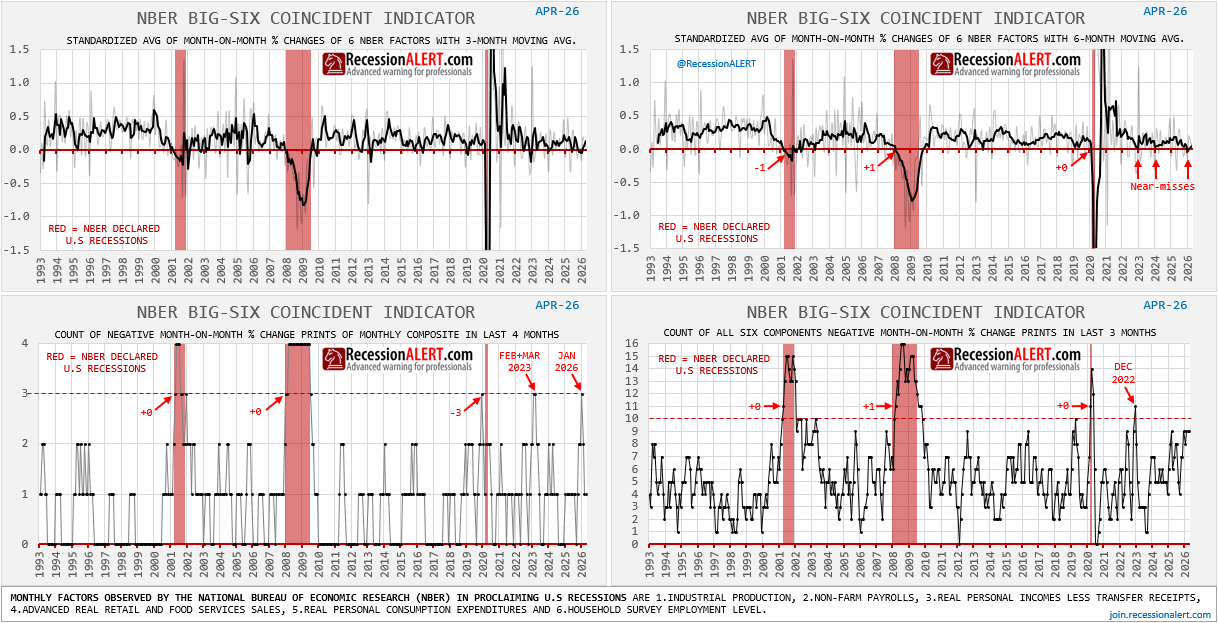
Beneath a coincident gauge fractionally above zero, the floor is quietly thinning. The NBER Big-Six — the exact series the committee uses to mark a turn — keeps its 3M and 6M readings green, yet the texture beneath has rotted: composite-negative months hit 3-of-4 in January, and component diffusion has climbed to ~9 of 18, toward its 10-line. The aggregate stays positive not because few factors are weak but because magnitude in the survivors — industrial production and consumer spending — masks a widening count of contracting ones, real income and household employment among them. That is breadth decaying ahead of depth, and it is why this warning trips and dissolves: 0-for-2 on the explicit thresholds, December 2022 and early 2023, the count rising while strong components held. So the question is not whether 9 becomes 10 — it is whether June’s live US-Iran oil shock supplies the synchronizing depth the last two scares lacked. Watch the May-June prints, panel 4 toward 10. And read the instrument for what it is: coincident, near-zero lead. By the time the Big-Six votes, you are not being warned the floor is gone — you are told your weight is already on it.
Market Intelligence Brief (MIB) Ver. 18.40
For professional investors only. Not investment advice.
© 2026 RecessionALERT.com

Comments are closed.