
MIB WEEKLY DIGEST
Week of Jun 8–12, 2026
Iran’s 14-point Hormuz draft MoU sent WTI from $91.78 to $84.24 by Friday, potentially deflating the energy surge that drove May CPI to a three-year high (4.2%) and locked out Fed cuts heading into Warsh’s June 17 inaugural FOMC — now with 47% hike odds priced in. SpaceX debuted as the largest IPO in US history ($75B raised, +19.3% at $161 Friday), while Intel’s Google foundry win and JPMorgan’s KLAC upgrade drove the semiconductor equipment complex +20–32% on the week. Oracle’s record $638B cloud backlog failed to prevent a 13.83% weekly loss as its –$23.7B FCF and $40B capital raise plan established a new valuation discipline: AI demand is confirmed, but cash-burn risk is now priced.
TABLE OF CONTENTS
A. WEEK AT A GLANCE
B. WEEK IN MARKETS
C. WEEK’S TOP STORIES (9)
D. WEEK IN THE ECONOMY (5)
E. WEEK IN EARNINGS (1)
F. NEXT WEEK SETUP
G. CHART OF THE WEEK
A. WEEK AT A GLANCE -> TOP
MARKET SNAPSHOT
The S&P 500’s +0.64% WoW gain masks a week of historic volatility: a Dow break below 50,000 on Wednesday (CPI 4.2% + US airstrikes on Iran) fully reversed to a Thursday surge (+1.75%) and Friday calm as a 14-point Hormuz draft MoU circulated. The Iran-US conflict oscillation drove every session’s direction — escalate, ceasefire, collapse, peace signal — and in doing so drove the energy inflation that reset the Fed policy framework: Goldman withdrew its cut forecast, 47% hike odds are now priced, and Warsh inherits a stagflation trap for his June 17 inaugural FOMC. The week’s clearest structural signal came not from the S&P headline but from breadth: Russell 2000 +3.97% and DJTA +3.12% both materially outpaced large-cap indices, confirming the bull market’s foundation is widening beyond AI mega-cap concentration.
THIS WEEK AT A GLANCE
• Biggest weekly swing sessions: Wednesday S&P –1.62% (dual shock: CPI 4.2% three-year high + US-Iran military strikes, Dow cracked 50,000) reversed entirely Thursday +1.75% (Iran peace signal, Nasdaq +3.29%, VIX –12%) — the most complete single-session reversal of a dual macro shock in 2026.
• Biggest weekly winner — KLAC +31.94%: JP Morgan “triple-earner by 2030” upgrade (HBM fab, 3nm/2nm logic, advanced packaging) plus a 10-for-1 stock split effective June 12; the week’s entire top-5 gainer list was semiconductor equipment or foundry names.
• Biggest weekly loser — ORCL –13.83%: Q4 FY2026 earnings revealed –$23.7B FCF and a $40B FY2027 capital raise plan; record $638B RPO and OCI +93% could not offset the financing shock in a 47%-hike-odds rate environment; established a new “prove the GAAP earnings” valuation discipline for AI cloud names.
• Standout commodity — WTI crude –6.65% WoW ($90.24 → $84.24): Iran conflict oscillation drove 4 distinct moves in 5 sessions; Friday’s 14-point Hormuz MoU draft was the week’s primary market-moving catalyst alongside the CPI print.
• Historic IPO — SpaceX (SPCX) +19.3% debut at $161, $2.1T valuation: $75B raised (largest in US history), 2x oversubscribed; S&P 500 profitability-criteria exclusion confirmed — earliest possible inclusion Q3-Q4 2027. The IPO’s $150B institutional demand extracted liquidity from AI mega-cap overweights all week, explaining the top-5 weekly decliners (ORCL, MSFT, PLTR, AAPL, IBM — all Technology sector names).
• Inflation inflection — CPI 4.2% (three-year high, Wed Jun 10) + PPI 6.5% YoY (double consensus, Thu Jun 11): Goldman withdrew its 2026 cut forecast; CME moved to zero cut probability; 47% hike odds locked in. Michigan 5-year inflation expectations fell 50bps to 3.4% Friday (largest single-month drop in years) — the only partial relief signal entering Warsh’s June 17 dot-plot.
KEY THEMES
1. Iran as the Inflation Pivot — The same narrative drove both the worst session and the best session of the week, and it’s the single variable capable of determining the second half of 2026: Hormuz supply disruption drove CPI’s 4.2% headline (gasoline +40.5% YoY), and a confirmed deal with Hormuz reopening would mechanically deflate June and July CPI over 60–90 days — potentially rehabilitating the rate-cut narrative that Goldman abandoned this week. Warsh’s June 17 dot-plot is the first signal of whether the Fed is treating Iran de-escalation as a transitory inflation relief or holding the stagflation posture regardless.
2. AI Capital Cycle at Saturation Scale — The week simultaneously confirmed AI demand at unprecedented scale (SpaceX $150B in orders, Intel Google/NVIDIA foundry wins, Oracle $638B RPO) and revealed that the financing of that demand now exceeds organic cash generation across every major AI infrastructure company (Oracle –$23.7B FCF, SMCI $7B dilution, CoreWeave $6.75B debt). The market’s new valuation discipline is explicit: GAAP-earnings validation is required, guidance raises alone do not hold multiples in a 4.5%+ rate environment. The semiconductor equipment layer — the picks-and-shovels tier with customer-committed demand — is the exception and the week’s clearest structural opportunity.
3. Breadth Widening Beneath Headline Volatility — The S&P’s +0.64% is the week’s most misleading number. Russell 2000 +3.97%, DJTA +3.12%, 10-of-11 sectors green Friday, Consumer Defensives leading three sessions as a stagflation hedge — all point to a bull market foundation that is widening beyond AI mega-cap concentration. Two Market History Signals fired simultaneously this week: DJTA outpaced DJIA by +2.46% WoW (Dow Theory threshold crossed, bullish) and Russell 2000 outpaced S&P 500 by +3.33% WoW (broad participation signal). Both point in the same direction: durable recovery broadening, not narrowing, even as the Iran/Fed narrative creates surface volatility.
 — Leading economic indicators. Accurate market forecasts. Apply for membership at join.recessionalert.com
B. WEEK IN MARKETS -> TOP
Iran dominated every session: Monday’s missile exchange (WTI to $93) through Wednesday’s US airstrikes and the Dow breaking below 50,000 (VIX 22), then Thursday’s peace-signal reversal (Nasdaq +3.3%, VIX –12%) and Friday’s 14-point draft MoU committing Hormuz reopening within 30 days. That oscillation produced the week’s most anomalous cross-asset read: on Wednesday, 4.2% CPI drove gold –4.49% alongside equities as real yields overrode every geopolitical safe-haven bid — the rate-hike signal dominated the war signal in a single session. The AI crowded-trade unwind ran in parallel: SpaceX’s $75B IPO extracted institutional liquidity from AI overweights all week, driving the semiconductor complex –9% mid-week before JPMorgan and BofA upgrades on Thursday anchored the AI capex thesis and produced an 8% single-session recovery. Breadth is the structural verdict: Russell 2000 (+3.97%) and DJTA (+3.12%) both meaningfully outpaced the S&P 500 (+0.64%) on the week.
FRIDAY CLOSE & WEEK-ON-WEEK CHANGE — Fri, Jun 12, 2026:
MAJOR INDICES
Two Market History Signals fired simultaneously this week. DJTA outpaced DJIA by +2.46 percentage points WoW — above the 2% Dow Theory divergence threshold — but here the split reads bullish: transports priced Iran de-escalation (lower fuel costs) while industrials absorbed Wednesday’s CPI shock before recovering. Russell 2000 extended the participation signal further, outpacing S&P 500 by +3.33% WoW — the clearest breadth confirmation available, with domestic small-caps pricing Iran geopolitical relief the most directly. Both history signals fired in the same direction: durable recovery broadening beyond mega-cap leadership, not narrow tech-only momentum.
| Index | Fri Close | WoW Change | WoW % | Why It Moved (Week) |
|---|---|---|---|---|
| S&P 500 | 7,431.40 | +47.56 | +0.64% | Iran oscillation (Wed dual shock –1.62%, Thu peace reversal +1.75%) netted a modest gain; SpaceX IPO liquidity drain kept AI mega-cap names under distribution pressure through mid-week. |
| Dow Jones | 51,202.29 | +335.51 | +0.66% | Blue-chip composition cushioned the AI selloff; cracked 50,000 Wednesday then recovered above Thursday-Friday; less semiconductor weighting provided partial insulation. |
| DJ Transportation | 22,596.7 | +683.1 | +3.12% | Iran de-escalation cut fuel cost outlook (WTI $90→$84) making logistics and transport the week’s clearest cyclical beneficiary; DJTA posted consecutive 10-session highs Thursday and Friday. |
| Nasdaq 100 | 29,635.95 | +678.35 | +2.34% | Semiconductor equipment surge Thursday-Friday (SOX +8%, KLAC +13%, SNDK +14%) more than offset mid-week AI selloff; SpaceX IPO crowding-out pressure cleared by week-end. |
| Russell 2000 | 2,944.82 | +112.47 | +3.97% | Domestic small-caps immune to Hormuz supply-chain risk outpaced all large-cap indices WoW; +3.33% outperformance vs S&P 500 signals broad market participation confirming the recovery. |
| NYSE Composite | 23,595.79 | +339.29 | +1.46% | Equal-weighted broad market outpaced cap-weighted S&P 500 (+1.46% vs +0.64%), confirming breadth widening beyond mega-cap concentration as Iran fears eased and cyclicals recovered. |
VOLATILITY & TREASURIES
Wednesday’s VIX-to-22 alongside rising 10Y and 2Y was the week’s clearest inflation-fear (not recession-fear) print — in recession scenarios bonds rally and yields fall; here both moved higher with equities lower, confirming policy-tightening fear drove the selloff, not growth collapse. The week’s most telling fixed-income signal came Thursday: when Nasdaq surged 3.3% on the Iran peace deal, the 10-year fell only 8.9 bps — bond markets declined to fully price the geopolitical narrative, holding May’s 4.2% CPI in the other hand. The 2-year at 4.087% Friday still sits 40 bps above the Fed’s policy ceiling, with 47% hike odds intact through all the drama.
| Instrument | Fri Level | WoW Change | Why It Moved (Week) |
|---|---|---|---|
| VIX | 17.69 | –3.88 (–17.99%) | Spiked to 22.22 Wednesday on CPI + Iran dual shock; collapsed on Thursday’s peace signal and Friday’s MoU draft; net WoW lower despite three sessions above 19. |
| 10-Year Treasury Yield | 4.481% | –5.1 bps | Iran de-escalation compressed inflation expectations embedded in yields; soft core CPI (0.2% MoM) provided partial relief; bond market declining to fully price the Iran deal keeps yields elevated. |
| 2-Year Treasury Yield | 4.087% | –6.4 bps | Short end eased slightly as Iran peace narrative outweighed hot PPI/CPI; still 40 bps above Fed’s policy ceiling, pricing near-50% hike probability into year-end. |
| US Dollar Index (DXY) | 99.78 | –0.28 (–0.28%) | Modest safe-haven unwind as Iran risk premium deflated; modestly lower yields weighed; no structural dollar break — net move negligible. |
COMMODITIES
Wednesday’s gold selloff alongside equities during active US-Iran military strikes is the week’s defining anomaly: hot CPI drove real yields sharply higher, which overwhelmed every geopolitical safe-haven bid — the rate-hike signal dominated the war signal in a single session. Thursday—Friday recovered (gold +2.45%, +2.95%) but net WoW gold is –2.71%, confirming real-yield pressure as the structural headwind even against the week’s extreme geopolitical backdrop. Copper’s +3.47% is the corrective signal: industrial metals held and ultimately rallied, sustained by AI infrastructure buildout and electrification demand that proved immune to the week’s macro volatility.
| Asset | Fri Price | WoW Change | WoW % | Why It Moved (Week) |
|---|---|---|---|---|
| Gold | $4,235.42/oz | –$118.13 | –2.71% | Wednesday’s CPI shock drove real yields higher, overriding the war safe-haven bid (–4.49% that session); Thursday—Friday Iran peace narrative restored $200+ of that loss; net WoW negative on rate-pressure dominance. |
| Silver | $68.050/oz | +$0.035 | +0.05% | Massive intraday swings (–4.62% Tuesday, –2.67% Wednesday, +4.16% Thursday, +6.33% Friday) netted essentially flat; dual precious-metal and industrial-demand role produced volatile but balanced outcome. |
| Copper | $6.4783/lb | +$0.2173 | +3.47% | Industrial demand held through the week’s macro turbulence, rising Friday +3.24% on Iran de-escalation; AI infrastructure and electrification buildout providing structural support independent of geopolitical noise. |
| Platinum | $1,718.80/oz | –$60.25 | –3.39% | Precious metals complex weakness from Wednesday’s real-yield spike; auto/industrial demand concerns; partial recovery Thursday—Friday insufficient to offset mid-week losses. |
| Bitcoin | $63,484 | +$2,015 | +3.28% | Pure risk-proxy week — tracked equity direction without independent catalyst; rose Thursday—Friday with the broad risk-on reversal; tracking semis, not leading them. |
ENERGY
Oil’s directional flip mid-week maps precisely to the Iran narrative: Wednesday’s WTI rising alongside collapsing equities was the stagflation signature — supply shock driving both higher oil and market fear simultaneously (a sequence that confirmed the Iran arc is the dominant inflation driver). Thursday—Friday reversed: WTI fell with equities rallying, the classic demand/growth-positive read. The same commodity cannot send both signals in one week without the underlying driver changing — and it did, from war-premium inflation to peace-deal deflation. WTI—Brent spread narrowed from $2.70 to $2.52 as the deal priced out the US-specific supply risk premium; Henry Hub decoupled entirely on a 108 Bcf storage injection.
| Asset | Fri Price | WoW Change | WoW % | Why It Moved (Week) |
|---|---|---|---|---|
| Crude Oil (WTI) | $84.24/bbl | –$6.00 | –6.65% | Iran conflict arc: re-escalation Monday ($91.25) → ceasefire Tuesday ($88.54) → US strikes Wednesday ($91.78) → peace signal Thursday ($86.04) → 14-point MoU Friday ($84.24); each move binary on conflict news, not demand fundamentals. |
| Crude Oil (Brent) | $86.76/bbl | –$6.18 | –6.65% | Same Iran arc; WTI—Brent spread tightened from $2.70 to $2.52 as the deal expectations removed global (not regional) supply premium; Brent led the decline from higher starting-week level. |
| Natural Gas (Henry Hub) | $3.135/MMBtu | –$0.087 | –2.70% | Independent of crude; domestic storage dynamics drove decline (108 Bcf injection Thursday above expectations); seasonal maintenance at LNG export terminals added pressure; no Hormuz connection. |
| Natural Gas (Dutch TTF) | $15.87/MMBtu | –$0.59 | –3.58% | European gas fell on Iran peace hopes; Hormuz reopening expected to restore LNG flows and reduce European supply risk premium; Friday alone –5.87% on MoU draft confirmation. |
S&P 500 SECTORS — WEEKLY ROTATION
Basic Materials’ +3.58% week-lead was a short-covering bounce off its worst 1-month stretch (–4.96%) — mean reversion, not a regime shift, as no fundamental demand catalyst changed for the sector. Technology’s +1.04% WoW is the week’s most misleading number: the top 5 weekly gainers AND top 5 weekly decliners in the movers tables below are all Technology names. Strip the semiconductor equipment complex (+21–32% for KLAC, SNDK, AMAT, LRCX) and the remaining tech names (MSFT, PLTR, AAPL, ORCL) dragged the sector lower — making Technology’s headline this week the broadest intra-sector dispersion of any sector this year, not a signal of directional conviction.
| Sector | 1-Week | 1-Month | 3-Month | 6-Month | YTD | 12-Month |
|---|---|---|---|---|---|---|
| Basic Materials | +3.58% | –4.96% | +4.25% | +18.00% | +14.94% | +41.43% |
| Consumer Defensive | +2.76% | –0.77% | +0.31% | +9.19% | +9.45% | +6.68% |
| Financial | +2.59% | +4.60% | +11.46% | +2.15% | +0.61% | +12.83% |
| Real Estate | +1.82% | +2.46% | +6.94% | +9.85% | +10.69% | +8.36% |
| Industrials | +1.40% | +1.64% | +9.17% | +15.36% | +16.12% | +26.82% |
| Technology | +1.04% | +2.49% | +27.10% | +16.73% | +20.58% | +43.04% |
| Consumer Cyclical | +0.94% | –4.20% | +4.65% | –4.87% | –4.37% | +5.71% |
| Healthcare | +0.87% | +3.11% | +3.22% | +0.80% | –0.59% | +13.33% |
| Utilities | +0.40% | –1.52% | –4.30% | +4.64% | +4.41% | +13.14% |
| Energy | +0.07% | –1.57% | +0.67% | +26.09% | +28.33% | +34.05% |
| Communication Services | –1.52% | –7.20% | +5.78% | +0.64% | +1.31% | +23.68% |
TOP WEEKLY MOVERS:
All five gainers share one catalyst cluster: Intel’s Monday foundry wins (Google 3M+ TPU order, NVIDIA 18A trials) ignited the semiconductor equipment complex, and Thursday’s JPMorgan/BofA upgrades — KLAC triple-earner by 2030, LRCX and AMAT as primary AI capex beneficiaries — locked in institutional conviction. KLAC at +105% half-year and +695% five-year is momentum continuation, not a counter-trend bounce. All five decliners share one mechanism: SpaceX’s $75B IPO forced managers to liquidate the most-overweight AI/tech positions all week — ORCL (FCF burn shock, –$23.7B FCF), MSFT (Xbox restructuring, –19% YTD), PLTR (technical breakdown, –28% YTD), AAPL (WWDC disappointment), IBM (quantum capex skepticism). The leaderboard is a capital displacement event — hardware foundry wins financed by AI software exits — not a fundamental sector split.
TOP 5 WEEKLY GAINERS
| Ticker | Week | YTD | Year | Why It Moved |
|---|---|---|---|---|
| KLAC | +31.94% | +109.48% | +190.90% | JP Morgan upgrade called KLAC a potential “triple-earner” by 2030 driven by HBM fab upgrades, 3nm/2nm logic, and advanced packaging demand; multiple analyst PT increases (Cantor $2,500, UBS $2,180, Barclays $2,250). 10-for-1 stock split also effective this week (shares began trading split-adjusted June 12). |
| SNDK | +26.98% | +734.15% | +4,694.43% | NAND flash shortage driven by AI data-center demand; 251% YoY revenue growth in Q3 2026 and $42B in multi-year supply contracts; BofA raised PT to $2,100; rode the semiconductor equipment upgrade wave with KLAC/AMAT/LRCX. |
| INTC | +25.61% | +237.59% | +499.76% | Monday: Google 3M+ TPU firm manufacturing order + NVIDIA 18A early trials (+11%); Friday: BofA double upgrade (Underperform→Buy) raising 2030 server CPU TAM to $170B, EPS power above $6/share. Two distinct catalysts four days apart. |
| AMAT | +25.22% | +120.73% | +224.14% | Record Q2 2026 results (revenue $7.91B, EPS $2.86, both beat); BofA named primary AI capex beneficiary of the fab upgrade cycle; Mizuho raised PT to $540; $500M Singapore campus expansion announced. |
| LRCX | +20.95% | +114.28% | +300.19% | BofA named primary AI capex beneficiary alongside AMAT; WFE market forecast revised to $140B+ for 2026; advanced packaging revenue growth exceeding 50% in 2026; multiple analyst PT raises (Cantor $425, UBS $375). Intel 18A foundry ramp benefits Lam’s etch and deposition tools directly. |
TOP 5 WEEKLY DECLINERS
| Ticker | Week | YTD | Year | Why It Moved |
|---|---|---|---|---|
| ORCL | –13.83% | –5.53% | –7.87% | Q4 FY2026 earnings (AMC June 10): GAAP EPS miss ($1.45 vs $1.50 est.), –$23.7B FCF, $40B FY2027 capital raise plan. Despite record $638B RPO and OCI +93% growth, the massive debt-funded AI capex overhang triggered a two-day ~15% selloff. Also awarded $395.8M government contract, insufficient to offset the financing shock. |
| MSFT | –6.22% | –19.21% | –18.40% | Xbox restructuring announced (major layoffs, –$500M revenue on $20B cumulative spend, 3% accountability margin); SpaceX IPO liquidity extraction from AI software overweights; AI governance compliance costs (Bowman kill-switch mandate). Down ~8% from Jun 9 all-time high through Friday. |
| PLTR | –5.56% | –27.99% | –5.33% | SpaceX IPO extracted liquidity from AI software plays; failed technical breakout above 200-day MA and descending triangle; UK government contract blocked; no fundamental catalyst — pure crowded-trade rotation toward hardware semis. |
| AAPL | –5.27% | +7.09% | +46.15% | WWDC 2026 (June 8): Siri AI revealed as Google Gemini reskin; stock set 52-week high $317.40 intraday then reversed to –1.87% close; EU DMA blocked Siri AI from European launch (450M users excluded); consecutive daily declines through the week on AI strategy disappointment. |
| IBM | –4.42% | –8.09% | –3.13% | $10B quantum computing bet announced June 8 drove stock lower on capital allocation skepticism; IBM down from its June 2 all-time high $329.23 through week-end; no positive fundamental catalyst offset the sector rotation away from legacy enterprise tech. |
— Institutional-grade intelligence for serious investors. Apply for membership at join.recessionalert.comC. WEEK’S TOP STORIES -> TOP
The week’s nine stories form three interlocking threads. The Iran arc (#1) and the CPI/Fed path reset (#2) are causally linked — Hormuz supply disruption drove the energy inflation that eliminated Fed cuts and elevated hike odds to 47%. The AI capital cycle runs through stories #3, #4, #6, and #8, simultaneously validating demand (Intel foundry wins, SpaceX oversubscription) and exposing financing stress (ORCL FCF burn, SMCI dilution). Apple’s WWDC (#5) stands alone as a mega-cap AI strategy failure with index-level weight. All threads converge on one question: whether Iran de-escalation deflates the energy-inflation driver enough to reopen the Fed easing path that Warsh’s June 17 dot-plot must address.
UNCERTAIN
1. Iran War to Draft Peace Deal: Petrochemical Strikes → US Military Response → 14-Point Hormuz MoU — WTI $93.67 to $84.24 in Five Sessions
The core facts:Monday: Israeli-Iranian overnight missile exchange; Mahshahr petrochemical complex struck; ~30 missiles fired at Israel; WTI surged to $93.67; OPEC+ approved +188K bpd July increase (“symbolic” given Hormuz); Trump claimed imminent ceasefire. Tuesday: Iran-Israel halted attacks; nuclear talks advancing; WTI –4.04% to $87.61; but Hormuz blockade persisted and an Iranian Apache helicopter downing complicated the truce. Wednesday: Ceasefire collapsed entirely; US struck Iranian air defense sites; Iran retaliated against US regional bases; Trump stated “we’re going to be attacking them very hard” and signaled civilian-infrastructure strikes; WTI +4.06% to $91.78; Dow broke below 50,000. Thursday: Trump cancelled strikes via Truth Social; announced imminent peace signing; Dow +1.86%, Nasdaq +3.29%, WTI –4.43% to $86.04, VIX –12.47%. Friday: Iran’s Mehr News Agency confirmed a 14-point draft MoU — Hormuz reopening within 30 days, oil sanctions lifted, ~$25B frozen assets released — but Trump and Iranian officials published incompatible accounts of deal terms. WTI fell to $84.24. The Strait of Hormuz remained under dual US-Iran blockade removing 11M+ bbl/day throughout the entire week.
Why it matters:The Hormuz supply disruption was the primary driver of May CPI’s 4.2% headline (gasoline +40.5% YoY, energy +23.5% YoY). Every session’s market direction — including the anomalous Wednesday gold selloff alongside equities — traced back to whether Iran deal signals were advancing or collapsing. A confirmed deal with Hormuz reopening would mechanically deflate June and July CPI over the following 60–90 days, potentially rehabilitating the rate-cut narrative that Goldman abandoned June 7. The execution risk remains extreme: two sides published incompatible deal terms, a fresh drone attack complicated the timeline, and the Strait remained physically blocked as of Friday close. UNCERTAIN classification reflects that the week ended with a peace signal but not a peace fact. (WTI –6.65% WoW — see Energy table in Section B above.)
What to watch:Formal signing ceremony with both sides present; WTI sustained below $85/bbl as supply-premium confirmation; Hormuz AIS vessel-tracking for corridor reopening within the 30-day window; whether the deal holds through Warsh’s June 17 FOMC.
BEARISH
2. May CPI 4.2% Three-Year High + PPI 6.5% Double Consensus — Goldman Withdraws Cut Forecast; 47% Hike Odds; Warsh Inherits the Stagflation Trap
The core facts:Wednesday June 10: BLS reported May CPI at 4.2% YoY (three-year high, third consecutive monthly acceleration), with energy accounting for >60% of the monthly gain (gasoline +40.5% YoY). Core CPI 0.2% MoM (below 0.3% consensus) — the only narrow relief. Goldman Sachs formally withdrew its 2026 rate-cut forecast and raised hike probability to 20%. CME FedWatch moved to zero probability of any 2026 cut. Thursday June 11: BLS reported May PPI +1.1% MoM (double the 0.7% consensus), 12-month rate 6.5% (highest since November 2022), driven by wholesale energy +10.7% MoM. Initial jobless claims 229K (highest since February, above 219K consensus). The dual PPI + claims data created the week’s policy trap: inflation too hot to cut, labor too soft to hike confidently. By Friday: Polymarket and Kalshi hike odds at 47%; 2-year Treasury at 4.087% (40 bps above the Fed’s policy ceiling); Michigan 5-year inflation expectations fell 50 bps to 3.4% — the only partial relief signal, giving Warsh analytical cover for a hawkish pause.
Why it matters:The CPI print eliminated any residual rate-cut possibility for 2026 and elevated hike probability to near coin-flip odds — the most significant monetary policy shift of the year. With FOMC blackout in force from Saturday June 7 through June 17, Warsh has had zero opportunity to communicate to markets; the June 17 dot-plot arrives as the first mandatory reset point for every duration position heading into H2 2026. The soft core CPI (0.2% MoM) and Friday’s Michigan 5-year expectations drop to 3.4% argue domestic inflation is more contained than the headline suggests — if Iran de-escalation removes the Hormuz energy driver, June CPI could drop sharply. But if the deal fails, the pipeline (PPI 6.5% YoY) flows through for at least two more monthly prints. (2Y at 4.087%, 10Y at 4.481% — see Vol & Treasuries table; Polymarket hike odds 53%→47% WoW — see Polymarket table in Section D.)
What to watch:June 17 FOMC dot-plot — any median above 3.75% formally marks the end of the easing cycle; Warsh’s inaugural press conference for the first explicit rate-path signal; June CPI (July 14) for whether Iran oil deflation flows through.
BULLISH
3. Intel Foundry Transformation Validated: Google 3M+ TPU Order + NVIDIA 18A Trials Monday; JPMorgan + BofA Upgrades Thursday; SOX +8% in Single Session
The core facts:Monday June 8: Google placed a firm order for >3 million TPUs to be manufactured by Intel’s foundry in 2028; NVIDIA is running early trials of Intel’s 18A process node for its next-generation Feynman GPU architecture (no firm contract yet). INTC +11.11%; KLAC +9.21%, AMAT +8.61%, MU +9.87% swept higher. Thursday June 11: JP Morgan upgraded KLA Corporation, citing potential to triple earnings by 2030 from HBM fab upgrades, 3nm/2nm logic, and advanced packaging demand; Bank of America simultaneously named Lam Research and Applied Materials as primary AI capex beneficiaries; the Philadelphia Semiconductor Index (SOX) surged ~8% — its single-session strongest gain since early 2025; Lam’s WFE market forecast raised above $140B for 2026. Friday June 12: BofA double-upgraded Intel directly from Underperform to Buy, raising 2030 server CPU TAM to $170B and EPS power above $6/share; INTC +6.48% Friday. Weekly totals: INTC +25.61%, KLAC +31.94%, AMAT +25.22%, LRCX +20.95%, SNDK +26.98%.
Why it matters:For three years, Intel Foundry Services has been the central investment thesis driving INTC’s ~250% YTD rally — manufacturing ambitions require commercial validation. Google placing a 3M+ TPU order and NVIDIA running 18A trials provides exactly that: the two most consequential AI hardware customers have committed real capital. The JPMorgan and BofA analyst upgrades Thursday are structurally significant: they establish semiconductor equipment as a multi-year secular growth story tied to AI capex, with the $140B+ global WFE market providing KLAC, LRCX, and AMAT returns analogous to NVDA’s prior-cycle trajectory. The week showed the underlying AI capex demand is intact — what the mid-week selloff revealed was a crowded-position flush, not a fundamental deterioration. (See top weekly gainers table in Section B above — all five gainers are semiconductor equipment/foundry names.)
What to watch:Any firm NVIDIA 18A manufacturing contract announcement (converting “early trials” to “signed order”); Intel Q2 FY2026 earnings (late July); NVDA Q2 FY2027 earnings (August) as the next major AI demand anchor.
BULLISH
4. SpaceX (SPCX) Prices $75B — Largest IPO in US History; Debuts +19.3% at $161 / $2.1T Valuation; S&P 500 Exclusion Removes Near-Term Passive Catalyst
The core facts:Tuesday: SpaceX confirmed $150B+ in institutional orders (2x oversubscribed) ahead of June 11 pricing. Thursday June 11: SpaceX priced at $135/share, raising $75 billion — the largest single equity raise in US capital markets history. BlackRock placed a single ~$5B order. Friday June 12: SPCX opened at $150, closed at $161.11 (+19.3%) on 360M+ shares; at $2.1T market cap, briefly made Elon Musk the world’s first trillionaire on combined Tesla+SPCX stake. S&P Dow Jones Indices confirmed no change to GAAP profitability criteria; earliest possible S&P 500 inclusion is Q3-Q4 2027 — removing the $200-400B passive-buying catalyst many investors had been pricing in. Nasdaq-100 has rewritten eligibility rules and expects to include SPCX on a faster timeline. The IPO closed alongside Anthropic (S-1 June 1), OpenAI (S-1 June 8), completing the AI/frontier-tech public-markets pipeline in 11 days.
Why it matters:$150B in demand against $75B raised — 2x oversubscribed amid CPI at 4.2%, VIX spiking to 22, and a hawkish FOMC week — confirms institutional risk appetite is intact for transformational infrastructure assets even under macro stress. The $75B extraction from existing institutional positions explains all five names in the weekly decliners table (ORCL, MSFT, PLTR, AAPL, IBM): portfolio managers liquidated AI overweights to fund SPCX allocations. The S&P 500 exclusion is a structural negative for the valuation thesis: passive index inflows anticipated at $200-400B do not arrive on any near-term timeline. The Anthropic/OpenAI pipeline means a sustained new-supply overhang on AI institutional allocations extends well into 2026-2027.
What to watch:Nasdaq-100 inclusion decision (weeks, not months); SPCX trading above $135 IPO price as demand-absorption confirmation; S&P 500 profitability milestones in SpaceX’s first four public quarters; Anthropic and OpenAI IPO timelines as the next supply-overhang events.
BEARISH
5. Apple WWDC 2026: Siri AI as Google Gemini Reskin Reversed a 52-Week Intraday High; EU DMA Then Blocked the Launch for 450M European Users; AAPL –5.27%
The core facts:Monday June 8 (WWDC): Apple unveiled iOS 27 headlined by a revamped Siri AI powered in part by Google Gemini — an explicit concession that Apple cannot build frontier AI at required pace internally. Shares rallied 3%+ to a 52-week high of $317.40 intraday, then reversed during the keynote to close –1.87% at $301.60 — a ~5% intraday swing peak to close. Barclays reiterated Underweight ($253 PT); UBS maintained Neutral. Tuesday June 9: Apple confirmed Siri AI will not be available in the EU at iOS 27 launch, citing the Digital Markets Act — approximately 450 million European users excluded. AAPL fell an additional –3.70% Tuesday. By Friday: AAPL at $291.08, –5.27% on the week from the prior Friday’s close.
Why it matters:The 52-week-high-to-reversal intraday pattern is the clearest possible market verdict: the sell-on-news reaction to WWDC was not forced by external macro factors but by the announcement’s content. The iPhone supercycle thesis — the primary bull case supporting Apple’s elevated multiple — requires Apple Intelligence to compel a global upgrade cycle. The EU ban structurally removes 25-30% of the premium smartphone market from that trigger. The two-day cumulative decline from the intraday high ($317.40) to Tuesday close ($290.38) represents ~$220B in market cap loss from the world’s largest company, with direct S&P 500 index-weight consequences. The longer-term risk: if Siri AI is perceived as a Google Gemini reskin rather than a proprietary intelligence layer, Apple’s premium moat in the market narrows structurally. (See weekly decliners table in Section B above.)
What to watch:Whether Apple pursues a DMA legal challenge or privacy-preserving interoperability framework — both measured in months. Analyst rating changes in the next 7-10 days. iPhone 17 pre-order data September as the first hard upgrade-cycle signal.
BEARISH
6. AI Capex Exceeds Cash Generation: Oracle –$23.7B FCF + $40B Capital Raise; SMCI $7B Dilutive Offering — Both on $39B+ in Confirmed AI Demand
The core facts:Wednesday June 10 AMC: Oracle (ORCL) reported Q4 FY2026 — record RPO $638B (+53% YoY), OCI +93% growth, non-GAAP EPS $2.11 (beat) — but GAAP EPS missed ($1.45 vs $1.50 est.), FY2026 free cash flow was negative $23.7 billion, and Oracle announced a ~$40 billion FY2027 capital raise plan including a $20B ATM equity issuance. ORCL fell –7.12% AH Wednesday, then –8.53% Thursday — a two-day cumulative ~15% decline on a quarter that reported record cloud metrics. Wednesday evening: Super Micro Computer (SMCI) announced $7 billion equity and equity-linked financing to fund component procurement for $39B in AI server backlog from 20+ customers. SMCI fell ~9.5% AH, then –17% Thursday — erasing ~$12B in market cap on demand confirmation. Simultaneously Thursday: CoreWeave priced $1.25B + €2B in senior notes and announced $3.5B additional offering — $6.75B in AI debt financing in a single session.
Why it matters:Oracle’s –$23.7B FCF against a $638B RPO is the sharpest illustration of the AI infrastructure financing paradox available: the demand is real and enormous, but the capital required to fulfill it exceeds organic cash generation by a massive margin. When even a $500B enterprise software company cannot self-fund its AI buildout from operations, equity and debt markets become the capital source — creating a sustained dilution overhang across the AI cloud infrastructure complex. SMCI’s separate $7B raise arrived the same night, compounding the “AI capex is dilutive” narrative into a sector-wide signal that drove the mid-week selloff (QCOM –6.92%, AVGO –5.12%, MRVL –5.35%). The broader implication: the AI infrastructure cycle has entered a phase where even confirmed demand cannot prevent significant stock punishment if execution requires equity dilution or FCF deterioration.
What to watch:Oracle Q1 FY2027 earnings (September) — first FCF trajectory signal; CoreWeave high-yield credit spreads as the leveraged AI infrastructure financing marker; SMCI execution against the $39B backlog in the next quarterly update.
UNCERTAIN
7. White House Declares US-China Trade Deal “Done” — 30% Tariff Baseline Locked, Rare Earth Shipments Resume; Beijing Calls It a “First Meeting Framework”
The core facts:Thursday June 11: The White House announced a finalized US-China trade framework: the US maintains a 30% aggregate tariff on Chinese goods (20% “fentanyl” + 10% “reciprocal”); China maintains a 10% baseline on US goods; US resumes full acceptance of Chinese students; China agrees to resume rare earth and rare earth compound shipments — critical for semiconductor packaging, defense electronics, EV motors, and advanced manufacturing. Pakistan and Qatar served as primary mediators. Beijing characterized the announcement differently — describing it as a “first meeting framework,” not a comprehensive final agreement. Wednesday context: Trump separately announced the US is “not looking to renew” the USMCA before the July 1 review milestone, threatening $1.8T in annual North American trade with Canada and Mexico with the most uncertainty since the trade architecture was established.
Why it matters:Rare earth resumption is the most immediately market-relevant provision: China’s rare earth retaliatory lever — a material cost and supply risk for semiconductor manufacturers and defense contractors — is ostensibly lifted. However, the 30% tariff rate on Chinese goods remains unchanged — this is a tariff freeze, not a rollback. The interpretive divergence between “done” (White House) and “first meeting framework” (Beijing) is the key risk: if China views this as a starting point for further negotiation, the supply-chain confidence markets priced Thursday may prove premature. The USMCA non-renewal threat, arriving the same week as the China framework, means two major trade architectures simultaneously face uncertainty — North American supply chains face regulatory ambiguity that capitals allocation decisions cannot ignore.
What to watch:Whether rare earth shipments actually resume in volume within 30 days; any Chinese statement upgrading from “framework” to “final agreement”; USD/CNY and CNH offshore yuan as real-time deal confidence indicators; July 1 USMCA review deadline as the next North American trade trigger.
BULLISH
8. Marvell Technology Joins S&P 500 on June 22 — MRVL +9% Monday; Forced Passive Buying at $247B Cap from ~$50 in 2024
The core facts:Monday June 8: S&P Dow Jones Indices announced Marvell Technology (MRVL) will join the S&P 500 effective before open on June 22, 2026, replacing Pool Corporation (POOL) and Campbell’s Company (CPB). MRVL surged ~9-10% Monday, trading around $288 at a ~$247B market cap — making it one of the largest additions to the index in 2026. MRVL was up approximately 210% year-to-date at the time of announcement, driven entirely by AI networking chip demand. The stock had traded below $50 entering 2024 — a $200B market cap creation in under two years entirely from AI infrastructure demand.
Why it matters:S&P 500 inclusion is a mechanical passive-demand event: every index fund, ETF, and index-benchmarked institutional mandate must build a MRVL position before June 22. At $247B, the required passive purchases represent a significant known demand event in a week that is simultaneously absorbing the SpaceX IPO. The timing signal is analytically rich: MRVL enters the S&P 500 in the same week it fell –7.61% Tuesday (as SpaceX IPO drained AI liquidity) — index-inclusion provides a structural demand floor that passive managers cannot ignore regardless of weekly volatility. More broadly, MRVL’s rise from <$50 to ~$290 validates that the AI semiconductor boom has created new index-eligible companies at the $200B+ scale that did not exist 24 months ago, reshaping S&P composition at an accelerating pace.
What to watch:MRVL price action through the June 22 addition date; other AI semiconductor names (KLAC post-split, SNDK) as potential future S&P rebalancing candidates as their market caps cross eligibility thresholds.
BULLISH
9. GSK Acquires Nuvalent for $10.6B at 40% Premium — NUVL +39%; Two FDA-Tracked NSCLC Assets in 2026 Approval Window Validate Oncology Buyout Valuations
The core facts:Tuesday June 9: GSK plc announced a $10.6 billion all-cash acquisition of Nuvalent (NUVL) at $124/share — a 40% premium to Monday’s close. The acquisition includes two late-stage NSCLC assets: zidesamtinib (ROS1 inhibitor) and neladalkib (ALK inhibitor), both under FDA review with potential 2026 approvals; plus Ris-Rez (B7-H3 antibody-drug conjugate). NUVL surged ~39%. GSK CEO Luke Miels’ largest acquisition in over a decade; expected to be accretive to core EPS in 2029 inclusive of synergies; deal expected to close Q3 2026.
Why it matters:A 40% all-cash premium for pre-commercial oncology assets sends a clear valuation signal across the biopharma M&A landscape: major pharma is willing to pay buyout-level premiums for best-in-class NSCLC assets while still in the regulatory pipeline, before commercial revenue is established. Three portfolio read-throughs: (1) the ROS1/ALK inhibitor class commands premiums before first approval, validating mid-cap oncology pipeline valuations broadly; (2) oncology M&A competition is active — multiple large-cap names are simultaneously deploying cash for targeted pipeline acquisitions; (3) US oncology names with similar FDA-tracked NSCLC or solid-tumor platforms (Blueprint Medicines, peers) become implicit acquisition targets at comparable multiples. For the broader healthcare sector: M&A is providing a floor for healthcare valuations at a moment when the sector’s YTD return is –0.59% — one of the weakest in the S&P.
What to watch:FDA review timelines for zidesamtinib and neladalkib in 2026; peer oncology M&A activity in the ALK/ROS1 inhibitor space; Blueprint Medicines (BPMC) and similar mid-cap oncology names for comparable premium re-rating.
— Separating signal from noise since 2007. Apply for membership at join.recessionalert.comD. WEEK IN THE ECONOMY -> TOP
The week delivered a textbook stagflation pulse: CPI 4.2% (three-year high) and PPI 6.5% YoY (2× consensus) arrived in the same 48 hours as jobless claims at a four-month high (229K) and NFIB price plans at 34% (4-year high). Core CPI’s 0.2% MoM confirms inflation is Hormuz-energy-driven — but NFIB’s small-business price intentions signal that energy costs are bleeding forward into domestic pricing pipelines for months ahead. Markets resolved the trap into an awkward equilibrium: Polymarket hike odds fell 6pp WoW (Iran de-escalation may deflate the energy-inflation trigger) while cut odds collapsed 25pp (the disinflation narrative is dead), leaving “extended hold” as the modal outcome. Michigan 5-year inflation expectations’ 50-basis-point drop to 3.4% — the largest single-month decline in years — confirms long-run anchoring remains intact, giving Warsh analytical cover to hold without being forced to hike. Wednesday’s FOMC dot-plot is the only instrument capable of resolving the ambiguity: whether Warsh signals a hike path or accepts Iran de-escalation as the transitory relief that keeps rates on hold through 2026.
POLYMARKET ODDS — WEEK-ON-WEEK SHIFT:
| Market | Last Friday | This Friday | Δ |
|---|---|---|---|
| US Recession by end-2026 | 19% | ~19% | 0 pp |
| Fed rate hike in 2026 | 53% | 47% | –6 pp |
| Fed rate cuts ≥1 in 2026 | 28% | ~3% | –25 pp |
BEARISH
May CPI 4.2% Three-Year High + May PPI 6.5% YoY Double Consensus — Energy Dominates Both; Core Data Offers Narrow Relief (BLS, Jun 10–11, 2026)
What they’re saying:CPI: Headline +4.2% YoY (0.5% MoM), highest since April 2023; energy +3.9% MoM (gasoline +40.5% YoY, energy +23.5% YoY). Core CPI: 0.2% MoM (below 0.3% consensus), 2.9% YoY — shelter slowed to 0.3% MoM; new vehicles, furniture, and pharmaceuticals posted first monthly price declines in 14 months. PPI: +1.1% MoM (double the 0.7% consensus, second consecutive month), 6.5% YoY (highest since November 2022); energy +10.7% MoM, gasoline +23.4% wholesale. Core PPI: 0.4% MoM, 4.9% YoY — below the 5.4% consensus.
The context:Both headline prints are Hormuz-driven: if the Iran draft MoU delivers Strait reopening within 30 days, the June–July CPI and PPI headlines mechanically deflate as the gasoline surge reverses. The soft core (CPI 0.2% MoM, PPI core 4.9% YoY below consensus) is the analytically important reading — domestic inflation is more contained than headlines suggest. But NFIB price plans at 34% (4-year high) argue energy costs are bleeding into small-business pricing intentions for months ahead, meaning core may not stay soft. Goldman Sachs withdrew its 2026 cut forecast during this data sequence; CME FedWatch moved to zero cut probability. (10Y at 4.481% Friday — see Vol & Treasuries table in Section B.)
What to watch:June CPI (July 14) as the first read showing whether Hormuz oil deflation flows through into the headline; core PCE (June 26) for the Fed’s preferred measure; June PPI (mid-July).
BEARISH
Goldman Sachs Withdraws All 2026 Rate-Cut Forecasts; Raises Hike Probability 20%; 72 of 102 Economists Now Project Rates Held Flat for All of 2026 (Multiple, Jun 7–12, 2026)
What they’re saying:Goldman Sachs formally withdrew its 2026 rate-cut forecast on June 7, raising near-term hike probability to 20%. A Reuters survey of 102 economists (conducted June 4–9) found 72 now project rates held flat at 3.50–3.75% for all of 2026 — the most unified “hold” consensus of the year. Mohamed El-Erian (Allianz) stated “neither hikes nor cuts” is appropriate given the Hormuz-energy-driven inflation dynamic. CME FedWatch moved to zero cut probability. Polymarket hike odds: 47% at Friday close, down from 53% last Friday (Hormuz de-escalation reducing near-term urgency) but still above the 50% threshold that signals near-coin-flip for the year.
The context:Goldman’s reversal closes the institutional debate: the disinflation narrative that had kept cuts on the table through mid-2026 is formally withdrawn by the bank that was most consistent in forecasting them. The 102-economist consensus at 72/102 for “hold flat all year” means the baseline rate path is now effectively locked — only a dramatic change in either inflation data (Hormuz deal delivers major oil price decline) or growth data (claims surge past 260K) would reopen the debate. For equity managers, the cut narrative is dead and cannot be resurrected by the June 17 FOMC meeting under any realistic outcome — rate-sensitive sector positioning (REITs, utilities, long-duration growth) must be sized for a rates-on-hold environment through at least year-end.
What to watch:June 17 FOMC dot-plot — median rate projection above 3.75% formally resets equity duration positioning; Warsh’s press conference language on Iran as “transitory” vs “structural” inflation as the signal for whether the hike probability rises or holds at 47%.
UNCERTAIN
Initial Jobless Claims 229K — Four-Month High + NFIB Price Plans 34% — Four-Year High: The Dual-Mandate Conflict in Two Data Points (DOL + NFIB, Jun 9–11, 2026)
What they’re saying:Initial claims for week ending June 6: 229K, highest since February, above 219K consensus; continuing claims 1,795K (above 1,780K est.); 4-week moving average 219K (rising trend confirmed). NFIB May: Optimism Index 95.3 (below 98.0 long-run average); net 34% of owners planning price increases (up 7pp from April, highest since July 2022); net 36% raised selling prices in May (highest since March 2023); Uncertainty Index 91 (vs 68 historical average); job openings 29%, down 5pp from April — the lowest since May 2020.
The context:Claims rising + NFIB price plans surging in the same week is the purest available expression of the dual-mandate conflict. For the Fed, this data argues simultaneously against cutting (small businesses raising prices at 4-year pace) and against hiking (labor market showing first consistent softening signals of 2026). NFIB’s job openings at a 6-year low is separately important: small businesses are hiring less even as they raise prices — the classic stagflationary configuration at the most granular labor-market level, one that historically precedes aggregate slowdowns by 1–2 months. UNCERTAIN classification reflects genuine analytical ambiguity: the data is bearish for growth and for Fed easing, but not unambiguously bearish for equities if the Iran deal can remove the energy inflation trigger.
What to watch:Next Thursday claims (June 18, day after FOMC) — sustained above 230K shifts narrative from marginal softening to labor deterioration; June NFIB (~July 8) for whether price intentions hold as gas prices decline post-Iran-deal.
BULLISH
Existing Home Sales 4.17M — Highest Since December Despite 4.55% Yields (NAR, Jun 9); Michigan Sentiment Beats 48.9 With 5-Year Expectations Plunging 50bps to 3.4% (UMich, Jun 12); GDPNow Q2 3.3%
What they’re saying:Existing home sales rose 3.2% MoM in May to 4.17M (SAAR), beating the 4.07M consensus — strongest since December 2025. Midwest led (+6.4%), median price $429,300, inventory 4.5 months. Michigan Consumer Sentiment preliminary June: 48.9, beating 46.0 consensus and up from 44.8 May — first increase in four months; 1-year inflation expectations eased 4.8→4.6%; 5-year expectations fell from 3.9% to 3.4% — the largest single-month drop in years, driven primarily by easing gasoline prices from Iran de-escalation. GDPNow Q2 estimate: 3.3% as of June 9, up from 3.0% (partial recovery from May’s 4.3% peak, still above trend).
The context:Three data points collectively argue the US economy is absorbing the stagflation shock without a demand collapse. Housing beating at 4.55%+ yields signals demand durability that rate levels alone cannot predict — buyers have adjusted to the higher-rate environment. The Michigan 5-year expectations drop to 3.4% is the most analytically Fed-important reading this week: long-run anchoring at 3.4% confirms the Fed’s 2% target is still credible in consumer expectations despite the 4.2% CPI headline, directly providing Warsh the analytical cover he needs to hold rates rather than hike at his June 17 inaugural meeting. GDPNow at 3.3% signals above-trend growth — which simultaneously argues the economy doesn’t need rate cuts, and can tolerate a hawkish hold posture.
What to watch:GDPNow June 16 update (FOMC opening day) as the real-time growth read entering the decision; July Michigan reading as first post-FOMC consumer confidence signal; Q2 GDP first estimate (late July).
BEARISH
GoHealth Chapter 11 ($917M in Liabilities) + Freedom Forever Chapter 11 ($500M+ Debt) — Medicare Advantage + Residential Solar Stress Signal Credit Stress Widening Beyond Rate-Sensitive Real Estate
What they’re saying:GoHealth (GOCO), one of the largest US Medicare Advantage enrollment platforms, filed Chapter 11 June 7 with assets $500M–$1B and liabilities $1B–$10B; prepackaged filing with 100% lender support; expected to emerge before the 2026 Annual Enrollment Period (October 15). Freedom Forever, the second-largest US residential solar installer (6.1% market share), filed Chapter 11 with $500M+ in debt; creditors include Mosaic Funding IX ($100M+), JA Solar, Trina Solar, and Jinko Solar.
The context:Two Chapter 11 filings from adjacent but distinct sectors (healthcare distribution + residential solar) share a common underlying driver: rate-sensitive financing structures that cannot service debt in the current 4.5%+ rate environment, combined with regulatory or demand shocks that removed top-line visibility. GoHealth’s collapse reflects broader Medicare Advantage structural stress — rising MA medical costs and CMS broker compensation rule changes — that is simultaneously compressing carrier margins at Humana, UnitedHealth, and CVS/Aetna. The combined message: credit stress is widening beyond purely rate-sensitive real estate into operating businesses across sectors that relied on 2020–2023 funding conditions. The six-consecutive-year rise in large corporate bankruptcies appears to be accelerating into sectors where federal program expansion created leverage that normalized rate environments cannot sustain.
What to watch:GoHealth emergence timeline before October AEP; Humana (HUM) and UnitedHealth (UNH) Q2 earnings (July) for updated MA medical cost guidance; SunRun (RUN) as the primary residential solar read-through; Q2 corporate bankruptcy rate for trend confirmation.
— Know the probability before the market prices in the risk. Apply for membership at join.recessionalert.comE. WEEK IN EARNINGS -> TOP
TOP EARNINGS OF THE WEEK
UNCERTAIN
1. Oracle (ORCL): –13.83% week | Record Backlog Meets $23.7B FCF Deficit — AI Cloud Demand Confirmed, Execution Risk Elevated
The Numbers:Q4 FY2026 (AMC Wednesday June 10): Revenue $19.2B (+21% YoY), beat $19.1B est. Non-GAAP EPS $2.11 (+24% YoY), beat $1.96 est. by 7.7%. GAAP EPS $1.45, missed $1.50 est. Cloud revenue $9.9B (+47% YoY); Oracle Cloud Infrastructure (OCI): +93% YoY; SaaS: +10% YoY. Remaining Performance Obligations (RPO): $638B (+53% YoY), including $75B prepaid or customer-supplied AI hardware. FY2026 free cash flow: negative $23.7B. FY2027 guidance: revenue $90B reaffirmed, non-GAAP EPS $8.05 raised; Q1 FY2027 cloud guidance +57–64%. Stock reaction: –7.12% AH Wednesday, –8.53% Thursday regular session, –13.83% week total.
The Problem/Win:The win is unambiguous: OCI at +93% growth, $638B RPO up 53%, and $75B in prepaid AI hardware represent genuine hyperscale competitive traction. Oracle has successfully positioned itself as the AI infrastructure platform for enterprise, competing directly with AWS and Azure at scale. The problem is equally clear: generating –$23.7B in free cash flow while announcing a $40B FY2027 capital raise plan sends the market a financing-risk signal that overwhelms even record cloud metrics. The GAAP EPS miss ($1.45 vs $1.50 est.) reflects the accelerating gap between adjusted profitability and GAAP reality as stock-based compensation and capex expand. A –15% two-day decline on a quarter with a guidance raise is the market’s verdict: “show me GAAP earnings,” not backlog.
The Ripple:OCI’s +93% growth is a competitive read-through to AWS, Azure, and Google Cloud — institutional AI workloads are distributing across multiple hyperscaler platforms. For AWS (AMZN) and Azure (MSFT), Oracle’s growth is market expansion, not market loss. However, ORCL’s selloff on a guidance raise sent a broader signal that was simultaneously absorbed by SMCI, QCOM, AVGO, and MRVL in the same 24-48 hours: the AI capex cycle has entered a “prove the GAAP earnings” phase where guidance raises without GAAP-beat confirmation cannot hold multiples. The –$23.7B FCF profile also adds to the CoreWeave debt raise and SMCI dilution as converging data points that AI infrastructure capital is now a leveraged, multi-player financing cycle, not a self-funding one.
What It Means:Oracle’s AI cloud demand is real — $638B in RPO is not speculative. But the –13.83% weekly loss on record metrics and raised guidance establishes a new valuation discipline for AI cloud names: GAAP-earnings validation is now required, not optional, in a 4.5%+ rate environment. This is a multiple-compression signal that extends to any AI infrastructure name carrying large non-GAAP/GAAP gaps alongside elevated capex.
What to watch:Oracle Q1 FY2027 earnings (September) — first FCF trajectory read; OCI revenue growth deceleration below 80% YoY as the key inflection watch; $40B capital raise execution and its GAAP dilution impact on FY2027 earnings per share.
WEEK AHEAD PREVIEW:
Q1 2026 earnings season is effectively complete (~99% of S&P 500 reported). The coming week’s focus shifts entirely to the June 16–17 FOMC — Warsh’s inaugural decision — with just one mega-cap earnings reporter in the window.
Progressive Corp (PGR) — BMO, Wednesday June 17 — Key focus: Q2 2026 combined ratio trajectory (Q1 came in at 86.0, below the company’s 88.5% long-run average, signaling strong underwriting discipline); premium rate adequacy vs. elevated claims inflation from energy and auto repair costs; policy-in-force growth sustainability (Q1 personal lines PIF +9% YoY). Reports on the same day as the FOMC rate decision — any guidance language on macro uncertainty or pricing power will be read against the day’s monetary policy backdrop. EPS est: $3.75 (non-GAAP), Revenue est: $21.69B.
No other mega-cap earnings are scheduled for the week of June 16–19. Q2 2026 earnings season begins in mid-to-late July 2026.
— US market commentary trusted by family offices and institutions. Apply for membership at join.recessionalert.comF. NEXT WEEK SETUP -> TOP
UPCOMING RELEASES:
| Date | Event | Why It Matters |
|---|---|---|
| Mon, Jun 15 | Capacity Utilization (exp. 76.2%, prior 76.1%) | Slack in industrial capacity matters for the inflation debate — utilization near 76% signals room before supply-side pressure emerges; any upside surprise would reinforce the stagflation narrative entering FOMC deliberations. |
| Mon, Jun 15 | Industrial Production MoM (exp. +0.2%, prior +0.7%) | A deceleration from April’s +0.7% would signal the manufacturing sector is absorbing the Iran energy shock; weakness here strengthens the hold case at the FOMC ahead of Wednesday’s decision. |
| Mon, Jun 15 | NAHB Housing Market Index (prior 37) | Builder sentiment at multi-year lows reflects the rate shock; any improvement or further deterioration frames the rate-sensitive sector’s health heading into Warsh’s first rate decision. |
| Tue, Jun 16 | Building Permits Prel (exp. 1.41M, prior 1.423M) | Forward-looking housing demand indicator; a decline from 1.423M would confirm the rate-sensitive sector continues to contract under elevated yields, adding to Warsh’s “growth softening” evidence the day before the FOMC decision. |
| Tue, Jun 16 | Housing Starts (exp. 1.44M, prior 1.465M) | Actual construction activity; a miss below 1.44M alongside the NAHB sub-40 reading would form a consistent housing contraction narrative arriving directly on FOMC Day 1. |
| Tue, Jun 16 | Import/Export Prices MoM (Import prior +1.9%, Export prior +3.3%) | Released on FOMC Day 1; import prices are the pipeline gauge for domestically imported inflation — any sustained elevation above the prior month’s already-hot prints arrives directly into FOMC deliberations. |
| Wed, Jun 17 | FOMC Rate Decision (exp. hold 3.50–3.75%) + SEP Dot Plot | Chair Warsh’s inaugural decision and first dot-plot: any median rate projection above 3.75% formally ends the easing cycle thesis and requires portfolio managers to reset duration exposure across fixed income and equity; the SEP’s longer-run neutral rate estimate is the secondary signal. |
| Wed, Jun 17 | Warsh Inaugural Fed Press Conference 2:30 PM | The market’s first live read of Warsh’s policy communication style and tolerance for above-target inflation; any acknowledgment that Iran de-escalation alters the H2 inflation trajectory would be dovish-at-the-margin and signal the Fed is not mechanically data-locked into hiking. |
| Wed, Jun 17 | Retail Sales MoM (exp. +0.5%, prior +0.5%) | The most important coincident growth read of the week; released before the FOMC statement — a miss would arrive alongside the rate hold as confirmation that rate-sensitive consumer spending is softening, stacking the stagflation signal on the day of the decision. |
WHAT TO WATCH NEXT WEEK:
1. Will Warsh’s dot-plot formalize a rate-hike path? If any committee member raises their median rate projection above 3.75%, it formally ends the easing-cycle thesis and triggers mandatory duration repositioning across institutional fixed-income and equity portfolios. The question is not whether the Fed holds on June 17 (near-certain) — it is whether the dot-plot signals that hiking is the next move and the hold is merely a delay.
2. Does Iran’s Hormuz draft deal survive execution into next week? The June 17 FOMC arrives with WTI at $84 and the 14-point MoU still unratified. If Warsh publicly acknowledges Iran de-escalation as a credible transitory inflation deflator — and WTI holds below $86 — it changes the H2 CPI trajectory estimates and reduces the probability of a September or November hike. If the deal fractures, WTI rebounds above $90 and the stagflation trap tightens with the dot-plot locked in.
3. Does Wednesday’s Retail Sales confirm consumer resilience or signal the first demand cracks? Michigan consumer sentiment at 48.9 has historically led actual spending cuts by 1–2 quarters; if June 17 Retail Sales misses (+0.5% expected), it arrives on the same afternoon as Warsh’s press conference as simultaneous confirmation that the stagflation trap is tightening from both sides — and would intensify market pressure on the Fed to eventually choose between its inflation mandate and its employment mandate.
4. Does SpaceX (SPCX) hold above its $135 IPO price through the FOMC week? If SPCX trades and closes above $135 through June 17–19, it confirms demand absorption is complete and the forced-selling cycle that drained AI overweights all last week is over — allowing the semiconductor equipment complex (KLAC, LRCX, AMAT) to stabilize at their post-upgrade levels without the SpaceX liquidity-extraction overhang.
— US market commentary trusted by family offices and institutions. Apply for membership at join.recessionalert.comG. CHART OF THE WEEK -> TOP
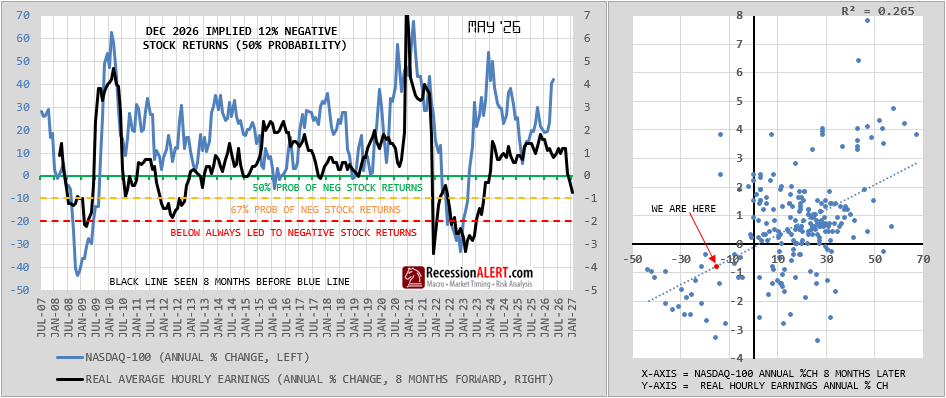
Chart of the Week: This week’s inflation data — CPI at a three-year high (4.2%) and PPI doubling consensus (6.5% YoY), both Hormuz-driven — is exactly the mechanism this chart describes: real wage erosion compressing household purchasing power, which flows through consumer demand into forward earnings estimates and lands in the Nasdaq-100’s realized return approximately eight months later. With real average hourly earnings at the zero line and a 47% rate-hike probability locked in heading into Warsh’s June 17 inaugural FOMC, the model is signaling yellow — not red yet, but the clock the chart describes is running.
MIB Weekly Digest Ver. 1.64
For professional investors only. Not investment advice.
© 2026 RecessionALERT.com

Comments are closed.