
MARKET INTELLIGENCE BRIEF (MIB)
Friday, August 14, 2026
A record intraday high evaporated: retail sales fell 0.6% and UMich sentiment crashed to 51.0 — yet Treasuries sold off, because inflation expectations rose. The 10Y hit 4.692% and GDPNow cut Q3 growth to 4.3%. AMD surged 6.50% on a record $4.75B bond deal while Broadcom sank 5.94% on hidden AI debt. Goldman began syndicating Nvidia’s $500B financing. The UAE accused Iran of piracy in Hormuz. And Canada is five days from a 50% tariff cliff.
TABLE OF CONTENTS
A. EXECUTIVE SUMMARY
B. MARKET DATA
C. HIGH-IMPACT STORIES (6)
D. MODERATE-IMPACT STORIES (7)
E. ECONOMY WATCH (5)
F. EARNINGS WATCH (1)
G. WHAT’S NEXT
H. CHART OF THE DAY
A. EXECUTIVE SUMMARY -> TOP
MARKET SNAPSHOT
Equities set a fresh intraday record and gave it back, the S&P 500 closing at 7,785.73, down 0.17%, after July retail sales fell 0.6% and preliminary August consumer sentiment collapsed to 51.0. The signal was in Treasuries, which sold off rather than rallied — the 10-year rose 5.1 basis points to 4.692% — because the same survey that showed the consumer weakening also showed year-ahead inflation expectations rising to 4.3%. That expectation has a physical basis in today’s news: the UAE formally accused Iran of piracy after two more ADNOC tankers were struck in Hormuz, and Russia rejected a Black Sea truce as Ukrainian grain exports fell 76% year-on-year. Breadth was narrow but not defensive — energy led at +1.19% and the Russell 2000 gained 0.56% while technology fell 0.46%, a domestically-oriented rotation onto an inflation tape rather than a flight to quality.
TODAY AT A GLANCE
• Retail sales fell 0.6% in July, the steepest drop in 14 months, with the GDP-relevant control group down 0.4% against a 0.3% expected gain — the Atlanta Fed’s GDPNow cut Q3 growth to 4.3% from a 6.2% peak on August 3.
• UMich sentiment sank to 51.0 versus 54.5 consensus, but year-ahead inflation expectations rose to 4.3% — a stagflationary pairing, not a clean growth scare, and the reason the 2-year closed higher at 4.173%.
• AMD rose 6.50% to $514.39 after pricing its largest-ever bond deal — $4.75 billion, roughly 25 basis points through talk — while Broadcom fell 5.94% to $392.99 on a BofA estimate that its AI financing vehicle could carry $370 billion of senior debt.
• Goldman Sachs began syndicating Nvidia’s $500 billion compute-infrastructure financing programme to insurers, asset managers and private-credit funds.
• USTR Greer said Canada must lift its retaliatory measures first, five days before 50% Section 338 duties hit roughly $20 billion of Canadian goods on Wednesday, August 19 — regardless of USMCA origin.
• Energy led every sector (+1.19% today, +5.56% on the week) as WTI rose 1.43% to about $81; Aramco is now handling September Asian cargoes one at a time because shipowners will not enter Hormuz.
KEY THEMES
1. Two Supply Shocks Are Overriding a Soft Demand Print — The energy channel (a fifteenth ADNOC tanker struck in Hormuz, now formally blamed on Iran; Aramco’s September Asian discount at a six-year low because it cannot guarantee vessels) and the food channel (Ukrainian grain exports down 76% at harvest peak, with Russia rejecting a Black Sea truce) are both constrained by shipping rather than production, which means neither eases when demand weakens. That is why the curve sold off on bad consumer data instead of rallying, and why the September 15-16 FOMC stays live as a hike meeting even as activity data deteriorates.
2. The Credit Market Has Taken Over the AI Trade — and It Is Discriminating — Goldman started placing Nvidia’s $500 billion financing with insurers and private credit the same session AMD’s record bond deal tightened through talk (+6.50%) and Broadcom lost 5.94% on a sell-side estimate of off-balance-sheet exposure the company has not quantified. What is being rewarded is disclosure: on-balance-sheet debt at a named spread versus a contingent backstop whose size an analyst has to guess. Once this paper reaches public markets, AI capex stops being an idiosyncratic equity story and becomes an investment-grade spread input that would reprice every infrastructure name simultaneously.
3. Washington’s Costs Converge on Wednesday — The Canadian tariff cliff, the FOMC minutes and a 20-year auction all land on August 19, into a fiscal picture Fitch (AA+ affirmed, debt-to-GDP 127% by 2027, deficit 7.4%) and BofA’s Hartnett ($50 trillion of debt by 2029 against $1.4 trillion of annual interest) both flagged this week. Add a tariff machine running on a weekly cadence — drones Thursday, polysilicon nine days earlier — and goods-price pressure and term premium are pushing the same direction. Treat China-input concentration and cross-border content as systematic risk factors, not company footnotes.
 — Leading economic indicators. Accurate market forecasts. Apply for membership at join.recessionalert.com
B. MARKET DATA -> TOP
US equities pulled back modestly from record highs after a preliminary University of Michigan consumer sentiment reading cratered to 51.0 (vs. 54.5 expected) while year-ahead inflation expectations climbed to 4.3%, unsettling growth-sensitive names even as small-caps bucked the retreat. Crude oil’s gain against a falling tape is the day’s sharper signal — a stagflationary tell rather than a demand story. Chipmakers split violently: AMD surged on a $4.75B AI-expansion bond sale and SanDisk extended its investor-day rally on 2028-2030 growth targets, while Broadcom sank on a VMware exploit disclosure and a $370B AI-debt financing estimate. Yields rose alongside softer risk appetite — an inflation-fear rather than growth-fear signature.
CLOSING PRICES – Friday, August 14, 2026:
MAJOR INDICES
Divergence was the story: Russell 2000 (+0.56%) outpaced the mega-cap-heavy Nasdaq 100 (-0.13%) and S&P 500 (-0.17%), as domestically-focused small-caps shrugged off the sentiment miss weighing on growth names. DJ Transportation’s -0.62% underperformance versus the Dow’s -0.20% kept the same-day gap under the 1.5% divergence threshold. Dow Theory bull confirmation remains in force — both DJIA and DJTA sit within 2% of their 10-session highs, now in its third consecutive session — while large-cap/small-cap and growth/broad relative performance stayed within neutral bands.
| Index | Close | Change | %Move | Why It Moved |
|---|---|---|---|---|
| S&P 500 | 7,785.73 | -13.26 | -0.17% | Pulled back from record highs on weak UMich sentiment print |
| Dow Jones | 53,732.41 | -107.58 | -0.20% | Broad-based pullback amid sentiment miss |
| DJ Transportation | 21,792.4 | -135.7 | -0.62% | Underperformed on softer growth read |
| Nasdaq 100 | 30,046.14 | -38.36 | -0.13% | AMD/SanDisk AI-capex gains offset Broadcom/Applied Materials weakness |
| Russell 2000 | 3,069.96 | +17.11 | +0.56% | Small-caps bucked the pullback; less exposed to mega-cap AI-debt jitters |
| NYSE Composite | 24,821.68 | +12.03 | +0.05% | Roughly flat, in line with broad market |
VOLATILITY & TREASURIES
VIX fell 2.6% even as both the 10Y (+5.1bps) and 2Y (+3.3bps) rose — an inflation-fear, not growth-fear, signature confirmed by UMich’s jump in year-ahead inflation expectations to 4.3%. The bond market’s refusal to rally despite weak sentiment data signals investors read the miss as an inflation story, not a recession warning. DXY’s mild -0.32% dip suggests limited safe-haven dollar demand.
| Instrument | Level | Change | Why It Moved |
|---|---|---|---|
| VIX | 14.25 | -0.38 (-2.60%) | Implied vol eased despite sentiment miss |
| 10-Year Treasury Yield | 4.692% | +5.1 bps | Rose on firmer year-ahead inflation expectations (UMich, 4.3%) |
| 2-Year Treasury Yield | 4.173% | +3.3 bps | Tracked the 10Y higher on inflation repricing |
| US Dollar Index (DXY) | 99.64 | -0.32 (-0.32%) | Softened slightly despite yield rise |
COMMODITIES
Platinum’s 1.44% gain outpaced the rest of the metals complex, while gold’s modest 0.24% rise and silver’s 0.24% dip point to a lukewarm safe-haven bid rather than a genuine flight to precious metals. Copper sat flat, confirming no industrial-demand signal either way. Bitcoin’s 0.79% decline broadly tracked the equity pullback rather than decoupling into its own narrative.
| Asset | Price | Change | %Move | Why It Moved |
|---|---|---|---|---|
| Gold | $4,430.90/oz | $10.50 | +0.24% | Modest safe-haven bid |
| Silver | $64.840/oz | -$0.153 | -0.24% | Underperformed gold on industrial-demand caution |
| Copper | $6.6093/lb | $0.0013 | +0.02% | Flat; no major mover |
| Platinum | $1,757.10/oz | $24.90 | +1.44% | Outperformed the broader metals complex |
| Bitcoin | $62,933.0 | -$498.0 | -0.79% | Tracked broader risk-off tone |
ENERGY
WTI and Brent rose in tandem (+1.43%/+1.71%) while equities fell — a supply-cost read rather than a demand/growth signal, reinforcing today’s inflation-fear theme. Natural gas decoupled entirely, with Henry Hub down 0.40% as Dutch TTF diverged higher (+1.04%), widening the transatlantic gap and pointing to European-specific tightness rather than a broad energy complex move.
| Asset | Price | Change | %Move | Why It Moved |
|---|---|---|---|---|
| Crude Oil (WTI) | $82.41/bbl | $1.16 | +1.43% | Gained against a falling equity tape |
| Crude Oil (Brent) | $88.56/bbl | $1.49 | +1.71% | Outpaced WTI slightly; spread near $6.15 |
| Natural Gas (Henry Hub) | $2.716/MMBtu | -$0.011 | -0.40% | Decoupled from crude on domestic supply |
| Natural Gas (Dutch TTF) | $20.62/MMBtu | $0.21 | +1.04% | European gas diverged higher from Henry Hub |
S&P 500 SECTORS
Energy (+1.19% today, +5.56% 1-week, +35.47% YTD) extended its leadership across every horizon, confirming crude’s stagflationary tape. Technology’s -0.46% dip is a rare pause in its +29.62% 6-month surge — the sentiment-driven session’s clearest casualty. Utilities (+0.35%) and Real Estate (+0.22%) gained despite rising yields, a genuine defensive rotation rather than a rate trade.
| Sector | 1-Day | 1-Week | 1-Month | 3-Month | 6-Month | YTD | 12-Month |
|---|---|---|---|---|---|---|---|
| Energy | +1.19% | +5.56% | +7.33% | +3.16% | +15.24% | +35.47% | +41.14% |
| Basic Materials | +0.60% | -1.09% | +8.71% | -3.32% | -1.89% | +15.30% | +32.04% |
| Utilities | +0.35% | +0.45% | -3.39% | -3.54% | -4.36% | +2.70% | +3.81% |
| Industrials | +0.23% | +0.92% | +3.49% | +1.86% | +4.36% | +17.23% | +20.06% |
| Real Estate | +0.22% | +0.30% | -1.44% | +3.55% | +5.44% | +11.33% | +9.04% |
| Communication Services | +0.08% | -0.82% | -3.05% | -8.90% | +2.87% | -0.53% | +11.65% |
| Consumer Defensive | -0.02% | +0.47% | -0.25% | -1.84% | -5.44% | +8.84% | +4.84% |
| Financial | -0.06% | +0.73% | +2.34% | +12.62% | +11.39% | +9.06% | +15.52% |
| Consumer Cyclical | -0.18% | -1.65% | +0.51% | -1.82% | +1.20% | -2.39% | +1.48% |
| Technology | -0.46% | +1.37% | +7.22% | +5.39% | +29.62% | +26.34% | +33.20% |
| Healthcare | -0.48% | +0.33% | +2.38% | +11.94% | +6.39% | +7.75% | +24.90% |
TOP MEGA-CAP MOVERS:
GAINERS
| Company | Ticker | Close | Change | Why It Moved |
|---|---|---|---|---|
| Sandisk Corp | SNDK | $1,641.11 | +7.39% | Extended investor-day rally on 2028-2030 growth targets and new AI-focused NAND roadmap with Kioxia |
| Advanced Micro Devices Inc | AMD | $514.39 | +6.50% | Priced a $4.75B bond offering to fund AI/data-center expansion; broader AI-capex tailwind from Super Micro, CoreWeave earnings beats |
| Micron Technology Inc | MU | $971.66 | +2.30% | Broader memory/NAND sector strength alongside SanDisk’s AI storage guidance |
| Texas Instruments Inc | TXN | $279.58 | +2.25% | Outperformed amid a mixed semis tape; no single dominant catalyst identified |
| GE Aerospace | GE | $368.38 | +2.15% | Resilient gain amid broader market pullback |
DECLINERS
| Company | Ticker | Close | Change | Why It Moved |
|---|---|---|---|---|
| Broadcom Inc | AVGO | $392.99 | -5.94% | VMware vCenter exploit disclosure plus a BofA estimate pegging AI chip-financing debt at up to $370B by 2029; profit-taking ahead of earnings |
| Applied Materials Inc | AMAT | $507.18 | -5.12% | Extended Thursday’s post-earnings slide on China sales concerns despite record Q3 revenue |
| Crowdstrike Holdings Inc | CRWD | $216.95 | -3.80% | Software/security names under broad profit-taking pressure |
| Oracle Corp | ORCL | $150.52 | -3.65% | Tech pullback amid AI-financing concerns |
| Palo Alto Networks Inc | PANW | $384.27 | -2.96% | Software sector weakness alongside peers |
— Institutional-grade intelligence for serious investors. Apply for membership at join.recessionalert.comC. HIGH-IMPACT STORIES -> TOP
UNCERTAIN
1. Two Soft Consumer Prints Knock the S&P Off a Record — and the Bond Market Refuses to Confirm the Dovish Read
The core facts:Today’s July retail sales and preliminary August consumer sentiment releases — both covered in full in Section E — pushed equities off a record high without producing the front-end rally that normally accompanies soft consumer data. The S&P 500 closed at 7,785.73, down 0.17%, after setting a fresh intraday all-time high early in the session; the Dow fell 0.20% and the Nasdaq 100 slipped 0.13%. The Russell 2000 went the other way, gaining 0.56%. Crucially, Treasuries sold off rather than rallied: the 10-year yield rose 5.1 basis points to 4.692% and the 2-year rose 3.3 basis points to 4.173%. The VIX fell 2.6% to 14.25. Despite the pullback, the S&P banked a third consecutive weekly advance.
Why it matters:The bond market’s reaction is the signal, and it contradicts the simple story. A genuine growth scare produces a bid for duration; today the front end and the long end both sold off, which means investors read the consumer data as an inflation problem rather than a demand problem — a reading the sentiment survey’s own internals support, since year-ahead inflation expectations rose even as the headline index collapsed. That combination is the definition of a stagflationary print, and it removes the usual cushion equity investors rely on when data disappoints: weak growth would ordinarily lower the discount rate, but here the discount rate went up. Note also the internal rotation. Small caps outperforming mega-caps by roughly three-quarters of a percent on a down day is the shape of a domestically-oriented bid, not a flight to quality, and it sits awkwardly beside rising yields. The honest summary of the session is that three markets — equities, rates and small caps — priced three different conclusions from the same two data points, and only one of them can be right.
What to watch:Watch whether the 10-year holds above 4.70% into next week. A yield that keeps climbing on soft activity data confirms the inflation-fear reading and puts the September 15-16 FOMC back in play as a live hike meeting; a yield that retraces toward 4.60% means today’s move was positioning, not repricing.
BEARISH
2. The UAE Formally Accuses Iran of Piracy After Two ADNOC Tankers Are Struck in Hormuz — the Fifteenth Such Attack on One Company’s Fleet
The core facts:Two tankers operated by ADNOC, Abu Dhabi’s state-owned oil company, were attacked by drones on Thursday evening while transiting the Strait of Hormuz. Today the UAE Foreign Ministry publicly attributed the attacks to Iran, describing the targeting of commercial shipping as “acts of piracy by Iran’s Revolutionary Guard Corps” and a flagrant violation of United Nations principles of freedom of navigation. No casualties were reported. ADNOC states that a total of fifteen of its vessels have now been attacked while transiting the Strait since the US-Israel war on Iran began in February. Iran did not immediately respond. WTI settled around $81 and Brent near $87, with crude rising against a falling equity tape.
Why it matters:The formal state-level attribution is the escalation, not the attack itself. Individual strikes on shipping have been running for six months and the market has largely absorbed them; a Gulf government publicly naming the IRGC and invoking the language of piracy converts a security nuisance into a diplomatic incident with a US-aligned producer whose territory hosts American naval posture. That matters for the shape of the risk rather than its size — it raises the probability of a state response, and any response tightens the waterway further. The commercial mechanism is already visible elsewhere in today’s news: when a national oil company cannot guarantee its own cargoes clear the Strait, buyers stop paying for reliability, and that shows up as wider discounts and ad hoc allocation rather than as a headline production cut. For US portfolios the transmission is not the barrel price alone but the persistence of an energy-cost floor underneath every inflation print, which is precisely the mechanism the consumer surveys are now registering.
What to watch:Watch for an Iranian response to the piracy accusation and for whether ADNOC suspends or reroutes transits. A sixteenth attack, or any UAE move to escalate beyond a statement, would mark the first time a Gulf state has been drawn into direct confrontation over the blockade.
UNCERTAIN
3. Goldman Begins Syndicating Nvidia’s $500 Billion AI Financing to Insurers and Private Credit — AI Capex Moves Onto the Credit Market’s Balance Sheet
The core facts:Goldman Sachs has begun approaching insurers, asset managers, banks and private-credit firms about participating in Nvidia’s compute-infrastructure financing programme, after securing a central role in the initiative. Nvidia announced the platform on August 10 alongside six partners — Apollo, BlackRock, Blackstone, Brookfield, Goldman Sachs and KKR — targeting mobilisation of more than $500 billion of third-party capital over time. Today’s development is Goldman’s mandate and the start of syndication, not the platform itself. Goldman is contributing junior capital and private credit through its asset-management arm while its bankers place debt into private-credit funds and, eventually, public debt markets. US insurers, money managers and banks are expected to form a significant share of the investor base, with asset managers likely to retain a sizeable portion. Goldman led Nvidia’s $25 billion bond sale in June 2025, a relationship cited as the reason it won the lead role.
Why it matters:This is the moment AI capital expenditure stops being funded out of hyperscaler operating cash flow and starts being funded by the credit market. The question the syndication actually asks is whether GPUs and the buildings around them are financeable collateral, and the answer is now being written by insurance companies and private-credit funds rather than by equity investors. Two features make this consequential beyond Nvidia. First, insurers buying long-dated paper against depreciating compute assets introduces a duration mismatch into a sector whose useful-life assumptions have never been tested through a full cycle. Second, once the debt reaches public markets, AI capex stops being an idiosyncratic equity story and becomes a credit-spread input — a repricing in that paper would transmit to every AI-infrastructure name simultaneously and to investment-grade spreads generally, which is a channel that did not exist twelve months ago. Read this alongside today’s Broadcom and AMD stories: all three are the same structural shift viewed from three different points on the capital stack, and the market is currently rewarding the cleanest balance sheet and punishing the most contingent one.
What to watch:Watch the terms on the first tranche to clear — specifically the spread over Treasuries and the assumed residual value on the compute assets. Those two numbers will tell you what the credit market actually believes about GPU depreciation, which no equity multiple currently discloses.
BEARISH
4. Broadcom Falls 5.94% as BofA Puts a $370 Billion Number on Its AI Financing Vehicle and a VMware Flaw Is Actively Exploited
The core facts:Broadcom closed at $392.99, down 5.94%, on two unrelated disclosures landing the same session. BofA analyst Tom Curcuruto estimated that Broadcom’s AI chip-financing vehicle could carry up to $370 billion of senior debt by mid-2029 at a 20-gigawatt scale, including roughly $150 billion of new issuance in 2027 alone. The vehicle rather than Broadcom itself would raise the debt, but Broadcom has agreed to backstop a portion of the customer lease obligations. Separately, security researchers confirmed that a VMware vCenter vulnerability allowing unauthenticated remote code execution is being actively exploited, identifying compromised systems tied to 361 IP addresses across 47 countries — days after Broadcom disclosed the flaw and shipped an emergency patch. VMware is a Broadcom subsidiary.
Why it matters:The financing estimate is the more durable of the two problems. Broadcom’s AI custom-silicon business has been valued on the assumption that its customers fund their own infrastructure; a backstop on lease obligations inside a vehicle that could carry $370 billion of senior debt converts a supplier relationship into contingent credit exposure that does not appear on the balance sheet investors are actually looking at. The market’s reaction — a near-6% drawdown in a mega-cap on an analyst estimate, not a company disclosure — indicates that this exposure was not previously priced, and it is a warning that the off-balance-sheet architecture now standard across AI infrastructure has not been underwritten by equity investors at all. The VMware exploit is more contained but arrives at an awkward moment: Broadcom’s software segment was the part of the story meant to provide recurring, defensible cash flow against the volatility of the silicon cycle, and an actively-exploited authentication bypass in the flagship product is a direct challenge to the enterprise renewal thesis that segment rests on.
What to watch:Watch Broadcom’s next earnings call for management’s own disclosure of the backstop’s size and structure. If the company declines to quantify it, expect the discount to persist regardless of how the silicon business performs.
BULLISH
5. AMD Rises 6.50% After Pricing Its Largest-Ever Bond Deal Through Talk — $4.75 Billion for AI Capacity, and the Order Book Wanted More
The core facts:AMD closed at $514.39, up 6.50%, after pricing a $4.75 billion investment-grade bond offering — its largest ever — to fund AI and data-center expansion. The deal came in four tranches: $1.25 billion of 4.600% notes due 2029, $1.5 billion of 5.000% notes due 2031, $1 billion of 5.250% notes due 2033 and $1 billion of 5.500% notes due 2036. Pricing tightened through initial talk, with the longest tenor coming roughly 25 basis points inside guidance at about 90 basis points over Treasuries. Bank of America, JPMorgan, Barclays and Wells Fargo led the transaction; settlement is expected August 17. Proceeds are earmarked for general corporate purposes, which may include repaying existing debt.
Why it matters:A stock rising 6.5% on the announcement of new debt is not the normal reaction, and the explanation sits in the execution rather than the amount. Tightening 25 basis points from initial talk on the long end means the order book was substantially oversubscribed, and a 2036 maturity clearing at roughly 90 over Treasuries prices AMD’s AI capacity build as an investment-grade industrial project rather than a speculative technology bet. That is a meaningful validation, and it lands the same day the market marked Broadcom down almost 6% over contingent AI financing exposure. The contrast is the analytical point: the credit market is not rejecting AI capex, it is discriminating sharply within it — rewarding on-balance-sheet debt with disclosed terms and a named issuer, and penalising off-balance-sheet structures whose size has to be estimated by a sell-side analyst. For equity investors that distinction is now worth several multiple points, and it will apply to every AI-infrastructure name that comes to market from here.
What to watch:Watch where the 2036 tranche trades in secondary after the August 17 settlement. Spread tightening from the 90 basis-point issue level would confirm genuine demand rather than syndicate support, and sets the benchmark for the next AI-capex issuer.
BEARISH
6. Greer Says Canada Must Lift Its Retaliation to Avoid New Duties — Five Days From a 50% Tariff Cliff on $20 Billion of Goods
The core facts:US Trade Representative Jamieson Greer said publicly today, speaking in Des Moines, that Canada will have to lift its retaliatory trade measures in order to avoid new tariffs, describing the incoming duties as “a response to Canadian retaliatory measures, like the kind of things that China would do.” He characterised this week’s talks with Canadian counterparts as constructive and said both President Trump and Prime Minister Carney would be given options following the discussions. Dominic LeBlanc and chief negotiator Janice Charette have met Greer repeatedly over the past three weeks, with negotiating activity intensifying since Section 338 of the Tariff Act of 1930 was invoked in July. Three proclamations signed July 20 impose an additional 50% tariff on roughly $20 billion of Canadian goods — motor vehicles, alcohol, dairy and consumer goods from wine to textiles — effective Wednesday, August 19, and applying regardless of USMCA origin. Energy, potash, fish, critical minerals and Section 232-covered goods are carved out. Canadian officials have told the US side that the August 19 date is a “cliff,” warning there would be no domestic appetite to continue negotiating if the tariffs take effect. No outcome from this week’s talks has been established.
Why it matters:The negotiating posture hardened today in a way the market has not priced. Up to now the talks have been described in procedural terms — meetings held, options prepared — and the tariff deadline has read as leverage. A public demand that the counterparty disarm first, delivered five days out and framed by comparing Canada’s conduct to China’s, is not a signal that a deal is close. The asymmetry matters more than the dollar amount: $20 billion of goods is small against total bilateral trade, but Section 338 overrides USMCA origin rules entirely, which means the tariff architecture the North American supply chain was rebuilt around no longer binds. Automotive is the transmission channel to watch — cross-border content moves multiple times before final assembly, and a 50% duty applied without origin relief compounds through each crossing rather than applying once. Canada’s stated position that the deadline ends the talks rather than pressuring them means the realistic outcomes have narrowed to a capitulation by one side or a genuine trade rupture with the largest US trading partner, four days before the fact.
What to watch:Wednesday, August 19 at 12:01 AM ET is the operative deadline. Watch for any Canadian move to suspend its counter-tariffs before then — that is the single condition Greer named, and its absence by Monday’s close would make the cliff the base case.
— Quantifying recession risk so you don’t have to guess. Apply for membership at join.recessionalert.comD. MODERATE-IMPACT STORIES -> TOP
UNCERTAIN
7. Trump Signs 100% Drone Tariffs Effective September 3 — the Second Sectoral Proclamation in Nine Days, and the Pattern Is the Story
The core facts:President Trump signed a proclamation Thursday imposing tariffs on unmanned aircraft systems and their parts and components on national-security grounds. Drones with a takeoff weight above 25 kilograms carrying national-security-relevant capabilities such as thermal cameras and docking stations face a 100% duty; smaller models face 25%. A separate tier applies 15% ad valorem to drones and components from the European Union, Japan, Liechtenstein, South Korea, Switzerland and Taiwan, and 10% to the United Kingdom. Most of the measures take effect Thursday, September 3. The stated objective is reducing US reliance on imports in an industry dominated by China. The action follows the August 6 polysilicon proclamation, making this the second sector-specific tariff action in nine days.
Why it matters:The individual proclamation is narrow; the cadence is not. Two sectoral actions in nine days, both targeting inputs where China holds dominant share, both structured as tiered rates with allied-country carve-outs, describes a policy machine running on a roughly weekly schedule rather than a series of one-off decisions. For portfolio construction that changes the question from “will this sector be tariffed” to “when is this sector’s turn,” and it argues for treating China-input concentration as a systematic risk factor rather than a company-specific footnote. The tiering itself is worth noting: setting 15% for the EU, Japan, Korea, Switzerland and Taiwan and 10% for the UK creates an explicit allied-preference structure inside what is nominally a national-security measure, which is a template likely to recur. The three-week gap between signature and the September 3 effective date also matters practically — it is a pre-buying window, and import volumes over the next fortnight will overstate underlying demand.
What to watch:Watch which sector draws the next proclamation, and on what interval. If a third sectoral action lands before the end of August, the weekly cadence is confirmed policy rather than coincidence.
UNCERTAIN
8. The FT Reveals JPMorgan Debanked Polymarket — While Keeping the Door Open to Underwriting Its IPO
The core facts:A Financial Times report today disclosed that JPMorgan ended its banking relationship with prediction-market platform Polymarket over regulatory concerns, telling the company to find a new partner in October 2025. The action itself is nearly a year old; the disclosure is today’s news. JPMorgan has retained some ties to Polymarket ahead of a possible underwriting role in a future IPO, and Polymarket has moved to an undisclosed alternative lender. Polymarket was banned by the CFTC from serving US customers following a 2022 enforcement action and returned to the US market in late 2025 as federal rules were loosened; a CFTC investigation into the company remains open. Intercontinental Exchange has invested a combined $1.6 billion across October 2025 and March 2026, and Polymarket is reportedly in early discussions to raise a further $1 billion at a valuation above $20 billion. Separately, New York State has sued rival Kalshi for more than $36 billion in damages over what it characterises as illegal gambling operations.
Why it matters:The interesting fact is the combination, not the debanking. A bank that severed deposit services over regulatory risk while positioning for the underwriting fee is telling you that it prices the compliance exposure and the franchise value separately — and that the second is winning. That is the clearest available read on how large US financial institutions actually assess prediction markets: too risky to bank, too valuable to abandon. For investors the exposure is mostly indirect and runs through ICE, whose $1.6 billion commitment now sits against an open CFTC investigation, a hostile state-level enforcement posture and a $36 billion damages claim against the sector’s other major venue. The federal-state conflict is the structural risk here. Federal rules loosened enough to let Polymarket back into the US market, but states are litigating the category as gambling, and the exchange operators’ valuations assume the federal reading prevails. Any state court result that sticks would reprice that assumption across the sector at once.
What to watch:Watch the New York action against Kalshi. A ruling that prediction contracts constitute gambling under state law would be the precedent every other state follows, and it would land directly on ICE’s carrying value.
BEARISH
9. Aramco Starts Handling September Asian Cargoes One by One as Shipowners Shun Hormuz — the World’s Swing Producer Cannot Guarantee Delivery
The core facts:Saudi Aramco is handling September crude allocations for some Asian contract customers on an ad hoc basis rather than through its normal monthly allocation process, according to a Reuters report. The change follows Middle East conflict disruption to Saudi exports and reflects buyers’ inability to be certain of securing vessels to lift their contracted volumes, with shipowners avoiding both Hormuz and the Red Sea. As context, Aramco set its September official selling price for Arab Light to Asia at $2.00 a barrel below the Oman/Dubai average — the lowest since June 2020 — versus a $1.50 discount the prior month, when the kingdom had already cut the price by the largest amount in more than two decades. Sources on the volume question conflict, and no volume cut has been established.
Why it matters:The Saudi monthly allocation formula has been the reference architecture of Asian crude pricing for decades, and its whole value is predictability — a buyer knows what it will receive and at what differential before the month begins. Handling cargoes individually because vessel availability is uncertain means the world’s swing producer can no longer guarantee delivery at any price, and the six-year-low discount is what it costs to compensate a buyer for bearing that uncertainty. Read carefully, this is a bearish price signal and a bullish supply-risk signal at the same time, which is why crude can rise on the day while Saudi differentials collapse: the discount reflects delivery risk, not weak demand. The transmission to US portfolios runs through freight and insurance rather than the barrel. When the binding constraint is hull availability rather than production, tanker rates and war-risk premia become the marginal cost of energy, and those costs propagate into refined product spreads with a lag — the same lag that shows up in consumer inflation expectations two or three months later.
What to watch:Watch Aramco’s October official selling price, due in early September. A further widening beyond the $2.00 discount would confirm that delivery risk is deepening rather than stabilising.
BULLISH
10. The Epic Remedy Phase Moves on Apple and Google in the Same Session — and Both Outcomes Are Behavioural, Not Structural
The core facts:Two remedy-phase developments in the long-running Epic Games litigation landed together. Judge James Donato ordered Google to modify Play Store search so that typing “app store” or the name of a specific rival store such as Aptoide leads directly to the relevant app listing rather than to a separate banner page, and instructed Google to implement the change within a week. Separately, Apple filed a proposal with the US District Court for the Northern District of California setting commissions on purchases made through App Store link-outs: 15% for standard apps, 5% for Small Business Program participants, and 10% for apps in the Video, News and Mini Apps Partner Programs as well as subscription renewals. In defending the proposal Apple noted that Google Play’s linked-out rates are 20% standard, 15% program and 10% subscription — rates Epic accepted.
Why it matters:The direction of travel is what matters, and it is favourable relative to what was feared. Both remedies are behavioural — change a search result, set a fee schedule — rather than structural, and neither compels either company to give up the economics of its store. Apple’s proposal is the more consequential of the two: a 15% headline link-out commission preserves roughly half the standard in-app take rate on transactions that were, until the injunction, expected to leave the ecosystem at zero. Anchoring the proposal explicitly against Google’s 20% is a deliberate negotiating move — it establishes a precedent Epic has already accepted and makes rejection harder to justify. For services-revenue modelling this is the first hard number attached to a risk that has been carried as an unquantified overhang for years, and it is materially better than the zero-commission outcome bears assumed. The Google order is narrower but points the same way: friction removal, not divestiture. Note this is a proposal, not an order — the court has not approved Apple’s schedule, and the rate is what remains contested.
What to watch:Watch whether the court accepts Apple’s 15% standard rate or reduces it. That single number sets the ceiling on link-out economics for the entire mobile ecosystem, and Google’s existing 20% is the benchmark it will be judged against.
BEARISH
11. Russia Rejects a Black Sea Shipping Truce as Ukrainian Grain Exports Fall 76% — a Food-Inflation Channel Opening Alongside the Energy One
The core facts:Russia’s Foreign Ministry today dismissed a Ukrainian proposal for a mutual halt to attacks on civilian targets in the Black Sea, made a day earlier through an intermediary. Spokeswoman Maria Zakharova said Moscow saw no grounds for “half-measures” that would offer a respite to Ukrainian forces, accused Kyiv of “brazen acts of terrorism” against shipping, and separately ruled out reviving the 2022-23 Black Sea grain deal, calling it one-sided. Ukrainian grain exports have fallen 76% year-on-year so far in August. Russian strikes drove shipowners away from Odesa just as Ukraine’s wheat harvest peaked; more than 90% of Ukraine’s farm exports leave through three deepwater Odesa ports.
Why it matters:A 76% collapse in exports from a top-tier global grain supplier, occurring at harvest peak and with the diplomatic off-ramp explicitly closed, opens a food-price channel that operates independently of the energy channel dominating the rest of today’s news. The mechanism is the same one visible in the Gulf — the constraint is vessels and ports rather than production — but the timing is worse, because harvested grain that cannot ship deteriorates rather than waiting in a tank. The concentration risk is stark: with more than 90% of farm exports moving through three ports, the entire flow is hostage to shipowner willingness to enter one waterway. For US investors the direct exposure is limited, but the second-order effect is not. Global grain prices feed food CPI with a lag of roughly one to two quarters, and this arrives in the same week that consumer inflation expectations moved higher rather than lower. Two separate supply-side inflation impulses — energy through Hormuz, food through the Black Sea — running simultaneously is precisely the configuration that makes a central bank reluctant to look through a soft demand print.
What to watch:Watch Chicago wheat and corn futures over the next fortnight. Sustained strength while the Odesa blockade holds would confirm the export collapse is being priced globally rather than absorbed by other suppliers.
BEARISH
12. Alaska’s Gasline Tax Bill Dies in the Legislature — the Largest Proposed US LNG Project Outside the Gulf Coast Loses Its Financing Premise
The core facts:Governor Mike Dunleavy’s compromise tax-concession bill for the proposed trans-Alaska natural gas pipeline collapsed in the special session. House Speaker Bryce Edgmon and Senate President Gary Stevens said leading members of both chambers will not meet to discuss the measure, which lacks support to advance in either body. “The votes just aren’t there,” Edgmon said. The bill would have sharply reduced property taxes on the pipeline operator and set a 2% tax rate on petroleum-producing S corporations, against rates of up to 9.4% that legislative leaders had previously proposed. Glenfarne, which owns 75% of the project and acts as lead developer, has said a tax break is necessary to finance the pipeline and did not comment on the latest proposal. Dunleavy is term-limited and leaves office in January; Stevens said the matter should pass to the next governor and legislature.
Why it matters:This reads as state politics and is actually a global supply story. In a year when the Hormuz blockade has removed a large share of seaborne LNG trade from the market, the largest proposed US export project outside the Gulf Coast has just lost the fiscal terms its developer said were a precondition for financing — and lost them to a legislature that will not reconvene on the question before a new governor takes office in January. That is not a delay measured in weeks. The structural point for energy investors is that the constraint on US LNG expansion is no longer permitting or demand; it is the willingness of host jurisdictions to concede the tax base a capital project of this scale requires, and Alaska’s legislature has now declined twice. Every month Alaska does not advance is a month in which incremental Asian LNG demand is met by Gulf Coast terminals whose capacity is already contracted, which supports realised pricing for existing US exporters even as it caps aggregate US export growth.
What to watch:Watch whether Glenfarne restates or abandons its year-end target for a final investment decision on phase one. Reaffirming that timeline without the tax legislation would indicate the concession was less essential than claimed.
BULLISH
13. Fox Is Double-Upgraded by JPMorgan and Wells Fargo in a Single Session on World Cup Economics and the Roku Deal
The core facts:Fox Corporation was upgraded to Overweight from Neutral by both JPMorgan and Wells Fargo on the same morning, with both firms raising price targets — JPMorgan to $82 from $70, Wells Fargo to $80 from $65. Shares rose approximately 5% to about $68.71. The upgrades cite FIFA World Cup economics, an improved political advertising outlook, continued advertising momentum, better distribution revenue and the pending acquisition of Roku. JPMorgan raised its fiscal 2027 and 2028 adjusted EBITDA estimates by 7% and 9% respectively following the company’s fourth-quarter results. Wells Fargo lifted its fiscal 2027 EBITDA estimate to $4.12 billion from $3.85 billion and now expects World Cup revenue of roughly $800 million against a previous estimate of more than $600 million.
Why it matters:Two firms moving the same large-cap the same morning is a coordinated re-rating rather than two independent opinions, and the substance is a revision to the forward earnings base rather than a change of view on the multiple. Both houses raised EBITDA estimates materially — 7% and 9% at JPMorgan, roughly 7% at Wells Fargo — which means the upgrade rests on numbers rather than sentiment. The World Cup revision is the specific driver worth isolating: a jump from above $600 million to about $800 million on a single event is a meaningful proportion of the estimate increase, and it is a one-year contribution that will not repeat, so the durable question is whether the political advertising and distribution improvements persist beyond it. The Roku acquisition is the structural element and the reason both firms narrowed what they had treated as a deal discount — it gives Fox a distribution surface it has not owned before, which changes the terminal value of the advertising business rather than just the next two years of it. For traditional media broadly, this is a reminder that the sector’s discount has been driven by distribution risk, and that closing that gap re-rates quickly when it happens.
What to watch:Watch for regulatory clearance on the Roku transaction. The deal discount both firms narrowed today reverses immediately if the acquisition draws an antitrust challenge.
— Separating signal from noise since 2007. Apply for membership at join.recessionalert.comE. ECONOMY WATCH -> TOP
Friday delivered a clean double miss: retail sales fell 0.6% in July — the steepest drop in 14 months — while University of Michigan sentiment sank to 51.0, ending two months of improvement even as one-year inflation expectations rose to 4.3%. The pullback dragged Atlanta Fed’s GDPNow Q3 estimate to 4.3% from 5.8% a week earlier and pared September hike odds to roughly 31% from 50% a month ago. Against that backdrop, Fitch affirmed the sovereign at AA+ but flagged debt-to-GDP climbing toward 127% by 2027, while BofA projects the debt load reaching $50 trillion by 2029. Consumers are retrenching and inflation expectations are creeping higher — a combination the Fed can’t fix with one lever.
July Retail Sales Fall 0.6%, Steepest Drop in 14 Months as Consumer Spending Cools (Census Bureau/CNBC, August 14, 2026)
What they’re saying:Retail and food services sales fell 0.6% in July to $763.6 billion, well below the roughly 0.1% gain economists expected and the largest monthly decline in 14 months. The core Retail Sales Control Group, which feeds directly into GDP calculations, fell 0.4% against a 0.3% expected gain, while sales excluding autos dropped 0.3% versus a 0.2% forecast rise. Year-over-year growth slowed to 5% from June’s 6.7% pace.
The context:The broad-based miss — control group, ex-autos, and headline all reversing prior-month gains — marks the first outright retail sales decline since last October. The data immediately repriced Fed expectations: the WSJ Dollar Index fell about 0.4%, the 2-year Treasury yield dropped below 4.10% (a two-month low), and CME FedWatch odds of a September hike fell to roughly 30.6% from 33.9% the prior day and 50% a month ago.
What to watch:August retail sales, due mid-September, to confirm whether the pullback persists; the September 15-16 FOMC meeting for how much weight officials give the miss.
University of Michigan Consumer Sentiment Sinks to 51.0, Ending Two-Month Rebound as Inflation Expectations Climb (University of Michigan, August 14, 2026)
What they’re saying:The preliminary August UMich Consumer Sentiment Index fell to 51.0, down roughly 8% from July’s final 55.2 and well short of the 54.5 consensus. Both sub-indices declined — Current Conditions to 51.8 from 54.8, and Expectations to 50.6 from 55.4 — while one-year inflation expectations rose to 4.3% from 4.2%; five-year expectations held steady at 3.3%.
The context:The decline snaps two consecutive months of improving sentiment and was broad-based across demographics, with the sharpest drops among Republicans, older consumers, lower-income households, and those without college degrees — reinforcing that the same morning’s retail sales pullback reflects genuine household caution rather than a one-month statistical blip.
What to watch:The final August UMich reading, due August 28 at 10:00 a.m. ET, will confirm whether the preliminary miss holds or reverses.
Atlanta Fed’s GDPNow Q3 Estimate Falls to 4.3%, Down From 6.2% Peak Two Weeks Ago (Federal Reserve Bank of Atlanta, August 14, 2026)
What they’re saying:The Atlanta Fed’s GDPNow model cut its Q3 2026 GDP growth estimate to 4.3%, down from 5.8% just eight days earlier and from a peak of 6.2% on August 3 — roughly a third of the projected growth has evaporated in under two weeks. The revision was driven by the nowcast for real personal consumption expenditures falling from 4.1% to 2.5%, and real gross private domestic investment easing from 17.9% to 15.2%.
The context:The sharp downward revision directly reflects today’s weak retail sales print and points to consumer spending — the largest component of GDP — losing momentum faster than headline growth figures had suggested.
What to watch:Further GDPNow revisions as August industrial production and housing data arrive; the BEA’s official Q3 GDP advance estimate is due in late October.
Fitch Affirms US at ‘AA+’ With Stable Outlook, Warns Debt-to-GDP Set to Hit 127% by 2027 (Fitch Ratings, August 13, 2026)
What they’re saying:Fitch Ratings affirmed the United States’ long-term sovereign rating at AA+ with a stable outlook, citing the size of the economy, high per-capita income, and the dollar’s reserve-currency status. The agency projects GDP growth of just 1.9% in 2026-2027 (down from 2.8% in 2025), inflation averaging 3.4% in 2026 — above the Fed’s 2% target — and the general government deficit widening to 7.4% of GDP, the highest among AA-rated sovereigns.
The context:Fitch expects debt-to-GDP to climb to 127% by 2027 from 114.5% at the end of last year, underscoring that the affirmation reflects near-term stability rather than an improving fiscal trajectory; a comparable Fitch downgrade in 2023 triggered a bout of Treasury market volatility.
What to watch:The 20-year bond auction on August 19 for signs of investor demand sensitivity to the fiscal outlook.
BofA’s Hartnett: US National Debt on Pace to Hit $50 Trillion by 2029 as It Nears $40 Trillion Milestone (Bank of America, August 14, 2026)
What they’re saying:Bank of America strategist Michael Hartnett projects US national debt will reach $50 trillion by mid-2029, up from roughly $39.9 trillion currently — an additional $10 trillion in under three years. Federal interest costs have climbed to approximately $1.4 trillion over the past 12 months and are expected to keep rising unless Treasury yields decline meaningfully.
The context:The projection reinforces Hartnett’s “Anything But Bonds” strategy and lands the same week Fitch flagged the same debt trajectory in its rating affirmation — mounting interest costs, not a near-term crisis, are the structural risk long-duration Treasury holders are pricing.
What to watch:Net long-term TIC flows and foreign bond investment data, due August 17, for signs of whether foreign demand is absorbing rising issuance.
— Know the probability before the market prices in the risk. Apply for membership at join.recessionalert.comF. EARNINGS WATCH -> TOP
YESTERDAY AFTER THE BELL (Markets Reacted Today)
UNCERTAIN
14. Applied Materials (AMAT): -5.12% | A Record Quarter and a Raised Outlook Sold Off Anyway, Because China Fell to 28% of Sales
The Numbers:Released: Thursday, August 13, AMC. Record fiscal Q3 revenue of $9.12 billion, up 25% year-over-year. Adjusted EPS of $3.50 beat the $3.40 consensus; GAAP EPS came in at $3.17. GAAP gross margin 50.3%; record operating income of $3.08 billion, or 33.7% of revenue. Q4 guidance of $10.25 billion revenue and $4.02 non-GAAP EPS, with calendar-2026 Semiconductor Systems revenue expectations raised. China accounted for approximately 28% of sales in the period, down from roughly 35% a year earlier. Shares fell about 5% in Thursday’s after-hours session and a further 5.12% in today’s regular session, closing at $507.18.
The Problem/Win:Every headline number was strong and the stock fell twice. The win is genuine — record revenue, record operating income, an adjusted EPS beat and a raised full-year Semiconductor Systems outlook, all driven by AI-related demand. The problem is the composition. China dropping from about 35% to about 28% of sales in twelve months quantifies the revenue that US export restrictions have removed, and it does so at a moment when the stock had already run more than 140% over the prior year. Against that setup, growth alone was not the bar; investors were looking for evidence that AI demand is replacing Chinese demand faster than the restrictions remove it, and a seven-point drop in China mix did not settle the question. The GAAP-versus-adjusted gap reinforced the caution — the adjusted beat is clean, the GAAP figure less so.
The Ripple:The reaction did not spread evenly through semicap or memory. AMAT’s second consecutive down session ran directly against a broadly firm AI-capex complex today, with AMD up 6.50% and Micron up 2.30%, while Broadcom fell 5.94% on unrelated financing and security concerns. That split is informative: the market is separating names whose AI exposure is incremental and unencumbered from names carrying either China-policy risk (AMAT) or contingent financing risk (AVGO), rather than trading the sector as a block.
What It Means:The rebalancing away from China structurally reduces AMAT’s export-control exposure even as total revenue climbs — a better business in two years, a worse print today. The two-session drawdown looks like multiple compression on a crowded position rather than a verdict on the AI cycle.
What to watch:Watch the China mix in the Q4 report against this quarter’s 28%. Stabilisation would indicate the export-control hit has been fully absorbed; a further decline means the revenue base is still shrinking underneath the AI growth.
TODAY BEFORE THE BELL (Markets Already Reacted)
No major earnings before the bell from companies with >$100B market cap.
TODAY AFTER THE BELL (Markets React Tomorrow)
No major earnings after the bell from companies with >$100B market cap.
WEEK AHEAD PREVIEW:
Q2 2026 earnings season is nearly complete at 88% of the S&P 500 reported, and the calendar thins sharply from here. The remaining names are concentrated in the retail and industrial reporters that close out the quarter, and both of next week’s mega-caps speak directly to the consumer question today’s data raised.
Home Depot (HD) — BMO, Tuesday, August 18 — the most consequential read on the US consumer on next week’s calendar, arriving days after July retail sales posted their first decline in nine months. Key focus: comparable-store sales and any change in the big-ticket discretionary trend, the split between professional and DIY demand, and whether management revises full-year guidance in light of the housing-turnover backdrop and elevated mortgage rates. Consensus stands at $4.73 EPS on $47.25 billion of revenue.
Deere & Co (DE) — BMO, Thursday, August 20 — the quarter’s cleanest read on North American agricultural capital spending, reporting into a grain market disrupted by the Black Sea export collapse. Key focus: large agriculture equipment order books and early commentary on the 2027 season, construction and forestry segment margins, and whether farmer income pressure is deferring replacement demand.
Note that Monday, August 17 carries no >$100B reporters; the week’s earnings risk is concentrated in Tuesday and Thursday. Q3 2026 earnings season begins in mid-October.
— US market commentary trusted by family offices and institutions. Apply for membership at join.recessionalert.comG. WHAT’S NEXT -> TOP
UPCOMING RELEASES:
| Date | Event | Why It Matters |
|---|---|---|
| Mon, Aug 17 | NY Empire State Manufacturing Index (Aug, prior 15.60) | First August activity read of any kind. A regional survey holding near 15 would argue today’s consumer softness has not spread to manufacturing; a sharp drop makes the GDPNow revision look like the start of a trend rather than a one-month consumption blip. |
| Mon, Aug 17 | NAHB Housing Market Index (Aug, prior 34) | Builder sentiment is the most rate-sensitive confidence measure available, and it is being read against a 10-year that rose today rather than fell. A print below 34 confirms that higher yields are reaching the real economy through housing regardless of what the Fed does in September. |
| Tue, Aug 18 | Housing Starts & Building Permits (Jul, prior 1.427M / 1.374M) | The week’s highest-impact hard data. Permits lead starts and feed residential investment in GDP, the component GDPNow has not yet marked down. A weak pair alongside today’s retail miss would extend the deceleration beyond consumption into investment. |
| Tue, Aug 18 | Industrial Production & Capacity Utilization (Jul, expected +0.3% / 76.3%) | Utilization is the cleanest read on whether tariff-driven input costs are being absorbed or passed through. A rise toward 76.3% with output up 0.3% supports the inflation-fear interpretation of today’s tape; a miss shifts the argument back toward genuine demand weakness. |
| Tue, Aug 18 | Pending Home Sales MoM (Jul, expected +1.5%, prior -5.4%) | Contract signings lead closings by roughly six weeks, making this the earliest signal of whether June’s 5.4% collapse was seasonal noise. A second negative print would mark housing as the first sector to break under the current yield structure. |
| Tue, Aug 18 | ADP Employment Change, weekly (prior 8.25K) | The highest-frequency labour signal available between payroll reports. With consumption decelerating, the question is whether hiring is following demand down — a materially weaker weekly print would reintroduce the growth-scare read the bond market rejected today. |
| Tue, Aug 18 | NY Fed Services Activity Index (Aug, prior 8.7) | Services carry the inflation persistence the Fed cares most about, and this is the first August datapoint on the sector. Firm activity with firm prices paid is the combination that keeps a September hike on the table. |
| Wed, Aug 19 | FOMC Minutes | The single most important event of the week. Markets need to know how much weight officials place on rising inflation expectations versus softening activity — precisely the conflict today’s data created — four weeks before the September 15-16 decision. |
| Wed, Aug 19 | 20-Year Bond Auction (prior yield 5.163%) | The first real test of long-end demand since Fitch flagged debt-to-GDP reaching 127% by 2027 and Hartnett projected $50 trillion of debt by 2029. A weak tail on the day the 10-year is already climbing would confirm term premium, not growth, is driving yields. |
| Wed, Aug 19 | 50% Section 338 tariffs on ~$20B of Canadian goods take effect (12:01 AM ET) | The duties override USMCA origin rules entirely, so cross-border automotive content is taxed at every crossing rather than once. Canada has told the US side the date is a cliff that ends negotiations rather than pressuring them, leaving capitulation or rupture as the only outcomes. |
KEY QUESTIONS:
1. Does the 10-year hold above 4.70% next week? A yield that keeps climbing on soft activity data confirms the inflation-fear reading and keeps the September 15-16 FOMC live as a hike meeting; a retrace toward 4.60% means today’s move was positioning rather than repricing.
2. Does Canada suspend its counter-tariffs before Wednesday, August 19 — the single condition Greer named publicly today? Absence of any move by Monday’s close makes the 50% cliff the base case, and the automotive supply chain the first place it shows up.
3. Does AMD’s 2036 tranche tighten inside its 90 basis-point issue spread after Monday’s August 17 settlement, and on what terms does the first Nvidia financing tranche clear? Those spreads, and the residual value assumed on compute assets, are the credit market’s actual verdict on AI capex.
— US market commentary trusted by family offices and institutions. Apply for membership at join.recessionalert.comH. CHART OF THE DAY -> TOP
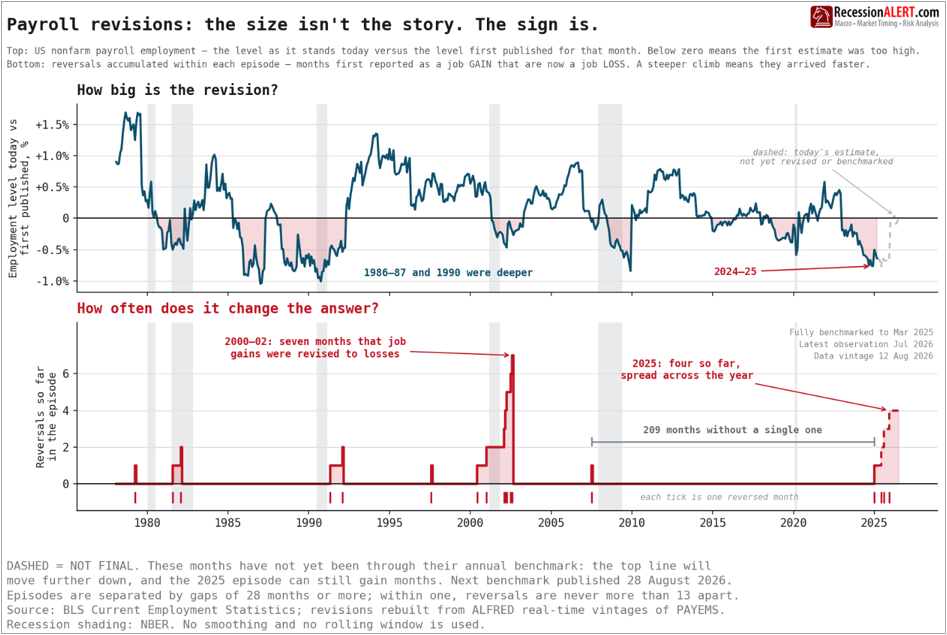
The revisions are big, and three earlier episodes were bigger: US employment now sits 0.6 to 0.8 percent below what was first reported, against 1.04 percent in 1987, 1.01 in 1990 and 0.92 in 1986 — the current stretch ranking in the deepest 6% of 571 months since 1978, rare and not unprecedented. Whether that is a lot depends on what you divide it by: a single 103,000 revision is 0.065% of American employment, or 110% of a typical month’s hiring, and both are correct. Then the question that matters — does any of it change the call? Almost never. A revision moves the level and the twelve-month peak it is measured against together, so the cycle picture barely shifts: across 47 years the most any revision has moved it is three-quarters of a point, in 2008-09, when nobody needed the help. Even the sign flips counted below ran seven in 2000-02 against four this cycle. And the dashed months have not been benchmarked, so read the flattening as arithmetic, not repair. The sign is the story — but the sign that carries it sits on the first print, not the revision. Two negative first prints back to back have preceded or accompanied recession two-thirds of the time, against roughly a third for a deep revision. This cycle has not produced a single pair.
What it means: don’t reprice growth off the 28 August benchmark — the signal is the sign on the first print, not the size of the correction. Three have printed negative since October but never two in a row — that pair is the test.
Market Intelligence Brief (MIB) Ver. 18.62
For professional investors only. Not investment advice.
© 2026 RecessionALERT.com

Comments are closed.