
MARKET INTELLIGENCE BRIEF (MIB)
Thursday, August 13, 2026
S&P 500 closes above 7,800 for the first time — flat July PPI knocked 2026 hike odds from 55% to under 35%. Hours later, Cleveland’s Hammack demanded an immediate hike, and said one won’t be enough. Silver Lake circles Workday at $43B; Ackman buys six AI-discounted franchises. SanDisk +13.67% on memory tightness; Cisco -8.40% on the same. Reddit joins the S&P 500 next Tuesday; Anthropic’s October IPO is being modelled at $2 trillion. Six days to the Canada tariff cliff.
TABLE OF CONTENTS
A. EXECUTIVE SUMMARY
B. MARKET DATA
C. HIGH-IMPACT STORIES (6)
D. MODERATE-IMPACT STORIES (6)
E. ECONOMY WATCH (5)
F. EARNINGS WATCH (3)
G. WHAT’S NEXT
H. CHART OF THE DAY
A. EXECUTIVE SUMMARY -> TOP
The S&P 500 closed at a record 7,799.19 (+0.65%), trading above 7,800 intraday for the first time, after a flat July PPI print pushed 2026 rate-hike odds from roughly 55% to under 35% — a repricing considerably larger than the surprise that produced it, which points to positioning being shed rather than conviction being formed. The bond market declined to fully ratify it: the 2-year fell 5.0 basis points to 4.149% while the 10-year gave up just 1.4, a bull-steepening that reprices policy without conceding a disinflationary regime change, and Cleveland’s Beth Hammack spent the same morning calling for an immediate hike and saying one would not be enough. Breadth was genuine — the Nasdaq (+1.15%), Russell 2000 (+0.27%) and NYSE Composite all closed near records, extending Dow Theory confirmation to a second session — but leadership was reversal, not trend: Communication Services topped the table at +1.45% while remaining the weakest sector over three months at -9.09%.
• Rates repriced hard on one print: headline PPI unchanged (consensus +0.2%), the annual rate down to 4.7% from 5.5%; 2Y -5.0bps to 4.149%, 10Y -1.4bps to 4.635%, VIX up just 0.55% to 14.63 into a record close. Fed funds hold at 3.50%-3.75%.
• The Fed said the opposite: Hammack demanded an immediate hike hours after the soft print and ruled out a single move as sufficient — an escalation from her August 10 remarks; Barkin separately called the economy a “mystery” of resilient growth and stuck inflation.
• Two allocators bought the AI-disruption discount on the same day: Silver Lake in talks to take Workday private near $43B (WDAY +18% to $206.45, three volatility halts), while Pershing Square disclosed six new positions — Netflix (+5.43%), Visa, Mastercard, S&P Global, ICE and Alcon.
• Memory cut both ways: SanDisk +13.67% to $1,528.11 on an Evercore reiteration into Investor Day and Micron +4.23%, while Cisco fell 8.40% after attributing a 210bps gross-margin decline partly to higher memory costs.
• Index and listing supply: Reddit (+11%) replaces AvalonBay in the S&P 500 before Tuesday’s open, forcing mechanical tracker buying; investors are modelling a $2 trillion-plus October IPO for Anthropic — a figure the company itself has not named.
• Consumer and trade risk building underneath: credit card balances hit a record $1.26T with 90+ day delinquencies at 12.8% versus 7.6% in late 2022; US-Canada negotiators met again six days from the August 19 Section 338 cliff imposing 50% tariffs on roughly $20B of autos, alcohol and dairy.
1. The AI-disruption discount is being bought, in size, by capital that does not have to explain itself quarterly — Silver Lake is attempting a roughly $43B take-private of a company down 15% year to date and more than 40% from its 2024 peak, de-rated on the thesis that seat-based software does not survive AI agents. Pershing Square spent the same disclosure making the same bet across payment networks, exchanges and streaming. Two allocators with entirely different time horizons independently concluding the discount has overshot is a stronger signal than either alone — and the read-across sits in large-cap application software and toll-like franchises, not in the AI beneficiaries themselves. It also settles a financing question: the market will underwrite a technology LBO above $40 billion.
2. The front end is pricing a Fed that is not speaking, and the long end is not going along — with Chair Warsh withholding forward guidance at two consecutive meetings, markets are pricing the data directly while individual policymakers say plainly contradictory things. The only Fed voice on the tape today demanded an immediate hike after the very print that removed twenty points of hike probability. The 10-year’s refusal to follow the 2-year is the cleaner tell: if the long end will not ratify the disinflation, the steepening is a growth-and-supply story and the equity rally rests on a thinner foundation than the record close suggests. A 14.63 VIX prices almost no cushion for the Fed declining to validate this into September 15-16.
3. Memory has stopped being a sector call and become a margin variable running through the whole hardware complex — the identical scarcity that re-rated SanDisk and Micron showed up as a 210 basis-point gross-margin hit at Cisco on the same tape. Owning one side is an implicit short of the other, and the exposure is not confined to semiconductors: every systems vendor buying NAND and DRAM as an input carries it. The related constraint is migrating too — IREN’s first 50MW delivery to Microsoft under a $9.7B contract and Meta’s national building-trades pact say the binding limit on AI buildout is now power and skilled labour, which show up as schedule risk rather than as a line in a bill of materials.
 — Leading economic indicators. Accurate market forecasts. Apply for membership at join.recessionalert.com
B. MARKET DATA -> TOP
Cooling inflation data reinforced bets the Fed will hold rates steady, sending the S&P 500 to a fresh record above 7,800 (+0.65%) alongside record highs for the Nasdaq 100 and Russell 2000 in a broad, tech-and-communications-led risk-on session. SanDisk rocketed +13.67% on a new AI-ready NAND flash unveiling with Kioxia and a raised price target, the day’s standout mover against Cisco’s -8.40% slide as it extended Wednesday’s after-hours drop on softer AI-infrastructure order guidance. Oil fell — Brent -2.23% on an IEA demand-cut forecast — even as equities rallied, a disinflationary signal reinforcing the rate-pause narrative rather than flagging growth concern. Treasury yields eased across the curve, with the 2-year outpacing the 10-year’s decline.
CLOSING PRICES – August 13, 2026:
MAJOR INDICES
Dow Theory’s bull confirmation extends into a second session — both DJIA and DJTA sit within 2% of their 10-session highs, with DJTA’s +1.50% actually setting a fresh high today, confirming Wednesday’s signal. The advance was broad rather than narrow: NDX (+1.15%) led, but the Russell 2000 (+0.27%) and NYSE Composite (+0.21%) also closed near records alongside the S&P’s fresh 7,800 milestone. Communication Services topped sector performance today (+1.45%) despite remaining the market’s weakest sector over 1-month (-5.60%) and 3-month (-9.09%) — a reversal worth watching for confirmation.
| Index | Close | Change | %Move | Why It Moved |
|---|---|---|---|---|
| S&P 500 | 7,799.19 | +50.69 | +0.65% | Fresh record close above 7,800 on cooling-inflation, Fed-pause optimism |
| Dow Jones | 53,839.99 | +69.72 | +0.13% | Modest gain; blue-chips lagged the broader tech-led rally |
| DJ Transportation | 21,928.1 | +323.3 | +1.50% | Set a fresh 10-session high, confirming Dow Theory bull signal |
| Nasdaq | 30,084.50 | +341.90 | +1.15% | Led the tape on Meta, Micron and Netflix strength |
| Russell 2000 | 3,053.63 | +8.15 | +0.27% | Closed near record highs; small-caps up over 23% YTD |
| NYSE Composite | 24,809.65 | +51.03 | +0.21% | Broad advance tracked the major indices higher |
VOLATILITY & TREASURIES
Yields eased broadly on cooling-inflation data reinforcing Fed pause bets, with the 2-year’s -5.0bps outpacing the 10-year’s -1.4bps — a modest bull-steepening consistent with reduced near-term hike risk rather than growth fear. VIX ticked up marginally (+0.55%) despite the rally, a negligible divergence. DXY slipped -0.06%, tracking the softer-yield backdrop rather than signaling a distinct dollar story.
| Instrument | Level | Change | Why It Moved |
|---|---|---|---|
| VIX | 14.63 | +0.08 (+0.55%) | Marginal uptick despite the equity rally |
| 10-Year Treasury Yield | 4.635% | -1.4 bps | Cooling-inflation data reinforced Fed pause bets |
| 2-Year Treasury Yield | 4.149% | -5.0 bps | Front-end rallied more than the long end, steepening the curve |
| US Dollar Index (DXY) | 99.95 | -0.07 (-0.06%) | Softer yields weighed modestly on the dollar |
COMMODITIES
Precious metals were largely directionless — gold +0.13%, silver +0.05%, platinum -0.08% — none confirming a safe-haven or industrial-demand thesis on an otherwise risk-on day. Copper’s flat -0.04% move likewise offers no growth signal. Bitcoin’s modest +0.25% gain tracked the broader tape rather than decoupling into its own narrative.
| Asset | Price | Change | %Move | Why It Moved |
|---|---|---|---|---|
| Gold | $4,412.75/oz | $+5.85 | +0.13% | Flat; no distinct safe-haven bid |
| Silver | $64.63/oz | $+0.032 | +0.05% | Tracked gold’s muted move |
| Copper | $6.59/lb | $-0.0028 | -0.04% | Essentially flat |
| Platinum | $1,722.75/oz | $-1.40 | -0.08% | Minor pullback |
| Bitcoin | $63,605 | $+160.00 | +0.25% | Modest gain, tracking the broader risk-on tape |
ENERGY
Brent fell -2.23% on an IEA forecast for a 1.6 million bbl/day demand decline this year, while WTI barely budged (-0.11%) — a spread widening that marks this as an international demand story, not a domestic supply or US-specific catalyst. Natural gas sat out the move (Henry Hub +0.07%, TTF -0.69%). Falling oil alongside rallying equities reads as a disinflationary tailwind, not a stagflation signal.
| Asset | Price | Change | %Move | Why It Moved |
|---|---|---|---|---|
| Crude Oil (WTI) | $81.09/bbl | $-0.09 | -0.11% | Barely moved despite Brent’s slide |
| Crude Oil (Brent) | $87.00/bbl | $-1.98 | -2.23% | IEA forecast a 1.6M bbl/day demand decline this year |
| Natural Gas (Henry Hub) | $2.733/MMBtu | $+0.002 | +0.07% | Flat |
| Natural Gas (Dutch TTF) | $20.48/MMBtu | $-0.14 | -0.69% | Modest decline, tracking the broader energy complex lower |
S&P 500 SECTORS
Communication Services led today (+1.45%) but remains the market’s clearest laggard over 1-month (-5.60%) and 3-month (-9.09%) — a reversal, not trend confirmation. Basic Materials, conversely, was today’s worst performer (-1.64%) despite a +6.20% 1-month gain, its own reversal in the opposite direction. Technology and Energy remain the steadiest multi-horizon leaders, both green across every window from 1-day through 12-month.
| Sector | 1-Day | 1-Week | 1-Month | 3-Month | 6-Month | YTD | 12-Month |
|---|---|---|---|---|---|---|---|
| Communication Services | +1.45% | -1.12% | -5.60% | -9.09% | +0.97% | -0.60% | +11.28% |
| Technology | +1.27% | +3.08% | +5.22% | +7.88% | +27.02% | +26.93% | +33.65% |
| Real Estate | +1.18% | +0.63% | +0.53% | +2.77% | +4.91% | +11.08% | +9.82% |
| Consumer Defensive | +0.86% | +0.59% | +2.55% | -1.34% | -4.04% | +8.87% | +4.42% |
| Financial | +0.52% | +0.60% | +2.52% | +13.40% | +9.60% | +9.14% | +16.23% |
| Consumer Cyclical | +0.16% | -0.15% | +0.66% | -2.00% | -0.45% | -2.21% | +2.97% |
| Utilities | -0.01% | +0.64% | -3.53% | -3.36% | -3.56% | +2.37% | +3.61% |
| Energy | -0.11% | +3.18% | +6.41% | +2.68% | +11.55% | +33.88% | +40.73% |
| Healthcare | -0.25% | +1.96% | +4.39% | +12.24% | +6.44% | +8.27% | +27.79% |
| Industrials | -0.53% | +2.58% | +2.68% | +2.38% | +2.52% | +16.91% | +20.38% |
| Basic Materials | -1.64% | +0.99% | +6.20% | -5.29% | -5.96% | +14.60% | +32.89% |
TOP MEGA-CAP MOVERS:
GAINERS
| Company | Ticker | Close | Change | Why It Moved |
|---|---|---|---|---|
| Sandisk Corp | SNDK | $1,528.11 | +13.67% | Unveiled AI-ready NAND flash tech with Kioxia; analyst reiterated Outperform, raised PT to $2,800 |
| Netflix Inc | NFLX | $78.24 | +5.43% | Nasdaq’s broad tech rally lifted mega-cap growth names |
| Palantir Technologies | PLTR | 179.01 | +4.66% | Continued momentum off its Q2 beat (revenue +93% YoY) amid the broad tech rally |
| Micron Technology | MU | $949.83 | +4.23% | Tracked the Nasdaq’s AI/semiconductor-led rally |
| Tesla Inc | TSLA | $339.96 | +3.80% | Reports of a multibillion-dollar Texas solar plant (“Project Crystal Sun”) lifted sentiment |
DECLINERS
| Company | Ticker | Close | Change | Why It Moved |
|---|---|---|---|---|
| Cisco Systems | CSCO | $113.47 | -8.40% | Extending Wednesday’s after-hours slide on FY2027 guidance showing AI-infrastructure orders declining to $7.5B despite a record quarter |
| SpaceX | SPCX | $141.29 | -3.33% | Giving back part of this week’s rebound; no fresh company-specific catalyst identified |
| Arista Networks | ANET | $203.62 | -3.27% | Pulling back after Tuesday’s record high on its strong Q2 print |
| Applied Materials | AMAT | $534.54 | -2.48% | Pre-earnings positioning ahead of tonight’s fiscal Q3 report |
| Amphenol Corp | APH | $165.75 | -2.48% | Tracking a broader pullback in electronics-connector/semi-equipment names; no fresh company-specific catalyst |
— Institutional-grade intelligence for serious investors. Apply for membership at join.recessionalert.comC. HIGH-IMPACT STORIES -> TOP
BULLISH
1. The Market Prices Out the 2026 Hike in a Single Morning — Odds Collapse From Roughly 55% to Under 35% and the S&P 500 Closes Above 7,800 for the First Time
The core facts:Following this morning’s July PPI release — covered in full in Section E — the implied probability of a Federal Reserve rate hike in 2026 fell from roughly 55% last week to under 35%. The front end led the move: the 2-year yield fell 5.0 basis points to 4.149% while the 10-year fell only 1.4 basis points to 4.635%, steepening the curve. The S&P 500 closed at a record 7,799.19, up 0.65%, after trading above 7,800 intraday for the first time; the Nasdaq added 1.15% to 30,084.50 and the Russell 2000 rose 0.27% to 3,053.63, also near record levels. The VIX barely responded, up 0.55% to 14.63. The dollar index eased 0.06% to 99.95. The federal funds target remains 3.50%-3.75%.
Why it matters:The repricing is considerably larger than the data surprise that produced it. A twenty-point shift in hike probability off a single wholesale-price print indicates that positioning, not conviction, was doing the work — the market had been carrying hike risk it was eager to shed and took the first credible excuse. The curve shape is the tell: with 2s rallying nearly four times as hard as 10s, the front end is repricing policy while the long end declines to ratify a disinflationary regime change. That is the same divergence that has capped every dovish rally since June. With the VIX at 14.63 into a record close, there is very little cushion priced for the outcome in which the Fed declines to validate this.
What to watch:The September 15-16 FOMC is the meeting every one of these probabilities refers to. Watch whether the 10-year can follow the 2-year below 4.60% — if the long end keeps refusing, the steepening is a growth-and-supply story rather than a Fed story, and the equity rally is resting on a weaker foundation than it appears.
UNCERTAIN
2. A Sitting Fed President Demands an Immediate Hike Hours After the Soft Print — and Says One Will Not Be Enough
The core facts:Cleveland Fed President Beth Hammack, speaking Thursday morning at the Dayton Area Chamber of Commerce in Ohio, called for the Federal Reserve to raise rates now and said explicitly that more than one increase would be required. Her remarks are covered in Section E. The timing is what makes this a market event rather than a data point: she spoke after the July PPI release, not before it, and told the audience she does not have confidence the softer inflation readings will continue or prove low enough to return inflation to the 2% target. Markets moved decisively the other way on the same morning — see Story 1. Hammack had said on August 10 that “some number” of hikes “may be needed,” declining to name an endpoint; three days later she is calling for immediate action and ruling out a single move as sufficient.
Why it matters:A hawk who does not soften on good news is a materially different signal from a hawk who has not yet been tested. The escalation — from conditional to immediate, and from unspecified to plural, delivered after a downside inflation surprise rather than before one — is what makes today’s remarks new information rather than a restatement of a known position. The gap between what the market inferred from one data print and what the loudest actual policymaker of the day said out loud is the risk that is not priced. It is also the cost of Chair Warsh’s decision to withhold forward guidance at two consecutive meetings: with no official signal to anchor to, markets are pricing the data directly while the Fed speaks through individual voices that plainly do not agree with one another.
What to watch:The Jackson Hole symposium in late August is the next scheduled platform on which the Board can either answer or ignore the Hammack position. Watch whether a second district president publicly endorses an immediate hike before then — one dissenter is noise, two is a bloc.
BULLISH
3. Silver Lake Opens Talks to Take Workday Private at Roughly $43 Billion — a Direct Bet Against the Market’s AI-Disruption Thesis for Software
The core facts:Reuters reported exclusively Thursday that Silver Lake has held discussions in recent months with Workday about taking the human-resources and financial-management software company private, in what would rank among the largest software buyouts ever attempted. Workday’s market value was approximately $43 billion before the report. The talks are ongoing with no guarantee of a transaction, and Silver Lake may bring in additional investors to finance it. Workday shares closed at $206.45, up roughly 18%, after rising as much as 25% intraday and triggering volatility circuit breakers three times; the close values the company near $51 billion. Silver Lake previously partnered with Saudi Arabia’s Public Investment Fund and Affinity Partners on the roughly $55 billion Electronic Arts take-private last year.
Why it matters:The setup matters more than any premium. Before Thursday, Workday was down roughly 15% year to date and more than 40% from its 2024 peak, de-rated on the thesis that seat-based enterprise software does not survive AI agents that reduce the headcount those seats are sold against. A take-private at this scale is patient capital taking the other side of that thesis in size, and it reads across to every large-cap application-software name trading at a comparable AI discount. It also answers a question that has been open since rates repriced: the financing market will underwrite technology leveraged buyouts above $40 billion. Note the same trade appearing from an entirely different kind of capital on the same day in Story 7.
What to watch:Whether a confirmed price or a competing bidder emerges — Reuters characterised the discussions as taking place “in recent months,” which is weaker than a deal in hand. Watch the read-across in application-software peers; a sustained re-rating there would confirm the market is revising the AI-disruption discount rather than trading a single-name event.
UNCERTAIN
4. Investors Model a $2 Trillion October Listing for Anthropic — Which Would Be the Largest IPO in History, and the Company Has Not Named a Number
The core facts:Reports Thursday put Anthropic on course for an October listing at a valuation of $2 trillion or more, which would exceed SpaceX’s June debut at roughly $1.77 trillion and rank as the largest initial public offering ever completed. One qualifier is load-bearing: per the Financial Times, senior Anthropic executives had not fixed a valuation target even in private conversations — the $2 trillion figure comes from investors building their own models in the absence of company guidance. Anthropic filed paperwork with the SEC in June and entered a quiet period. Roughly half a dozen backers expect annualised revenue between $100 billion and $120 billion before year-end, against the $47 billion annualised figure the company reported in May. Institutional investors committed nearly $100 billion during 2026, taking the private valuation to $965 billion.
Why it matters:A $2 trillion print would reprice every listed AI comparable on the day it happens, and it would do so on a revenue multiple derived from investor projections rather than company guidance. That distinction is the entire risk. The 2026 listing wave is transferring enormous quantities of private AI valuation into public benchmarks, and public portfolios will be marked against whatever number actually clears — a listing well below the modelled figure would be read as a verdict on the whole complex, not on one issuer. The reported headwinds are concrete: Anthropic’s flagship model is priced more than 2.5 times OpenAI’s while Chinese open-weight alternatives are available at a fraction of that cost, and the company is in a live dispute with the Defense Department, which has labelled it a supply-chain risk.
What to watch:The S-1 amendment carrying an actual price range, which would be expected ahead of an October window. That document, not investor modelling, produces the first hard number — and the gap between it and $2 trillion is the size of the sentiment correction.
UNCERTAIN
5. The Trade Court Upholds the End of the $800 De Minimis Exemption — on the Same Statute the Supreme Court Struck Down
The core facts:A unanimous three-judge panel of the US Court of International Trade ruled Thursday that the President acted lawfully in suspending the de minimis exemption, which had allowed imported packages valued at $800 or less to enter the United States duty-free. The panel held that the text of the International Emergency Economic Powers Act permits the President to cancel certain “privileges,” and that the de minimis statute itself describes duty-free treatment as a privilege. Customs and Border Protection has attributed more than $1 billion in duty payments to the suspension through the end of 2025. Congress separately eliminated the exemption in the tax and spending bill, effective next July. The ruling went against a small business that had challenged the revocation.
Why it matters:This is the administration’s first significant courtroom win on trade in a term defined by losses — the same court invalidated the 10% Section 122 global tariffs, and the Supreme Court ruled against the IEEPA tariffs, a decision now generating refunds large enough to appear in the Treasury’s monthly accounts. The reasoning is what makes it consequential: IEEPA survived here because cancelling a privilege is legally distinct from imposing a duty. That is a narrower authority than the one struck down, but it is durable, and with Congress codifying the change effective next July, the duty-free cross-border parcel channel is closing permanently rather than provisionally. Importers and direct-to-consumer platforms that built de minimis into landed-cost models must now assume duty on every parcel, and the cost lands on consumer-facing margins.
What to watch:Whether the plaintiffs appeal to the Federal Circuit. Separately, the Section 301 forced-labour regime faces a distinct 25-state challenge filed August 3 in the same court — today’s ruling does not resolve it, and conflating the two would misread the administration’s actual legal position.
BULLISH
6. SanDisk Rises 13.67% on an Evercore Reiteration Into Investor Day — and the Same Memory Tightness Shows Up as a Cost Line in Cisco’s Margin Guide
The core facts:SanDisk closed at $1,528.11, up 13.67% — the day’s largest mega-cap move and a fourth consecutive session of gains. The fresh catalyst was Evercore analyst Amit Daryanani reiterating an Outperform rating and a $2,800 price target ahead of the company’s Investor Day. The underlying product news was one day older: SanDisk and Kioxia unveiled ninth-generation 2Tb QLC 3D NAND on August 12, delivering a 4.8 Gb/s interface, a 33% speed improvement over the eighth generation and the industry’s highest QLC bit density, which had already lifted the stock 5.76% that session. Micron rose 4.23% Thursday and Technology led the sector table at +1.27%, with Samsung Electronics and SK Hynix rallying alongside.
Why it matters:Memory has become the cleanest expression of AI-infrastructure scarcity, and today it appeared on both sides of the ledger simultaneously. Cisco’s fiscal fourth quarter, released Wednesday after the close, attributed a 210 basis-point year-over-year decline in gross margin to a heavier hardware mix and higher memory costs — the specific reason its shares fell 8.40% today (Story 13). The identical tightness that re-rates SanDisk and Micron compresses margins at every systems vendor buying NAND and DRAM as an input. For portfolio construction the implication is structural: memory is no longer a semiconductor sub-sector call, it is a margin variable running through the entire hardware complex, and exposure to one side is an implicit short of the other.
What to watch:SanDisk’s Investor Day, where the capacity and pricing outlook will either validate the $2,800 target or reset it. Watch for the same memory-cost language appearing in other systems vendors’ gross-margin guidance — that is how the input squeeze propagates.
— Quantifying recession risk so you don’t have to guess. Apply for membership at join.recessionalert.comD. MODERATE-IMPACT STORIES -> TOP
BULLISH
7. Pershing Square Adds Six New Positions in Its Largest Overhaul in Years — and Every One Is a Franchise the Market Discounted on AI Fear
The core facts:Bill Ackman’s Pershing Square disclosed six new positions in its Q2 2026 report: Netflix, Visa, Mastercard, S&P Global, Intercontinental Exchange and Alcon. The Netflix stake stood at 3.15 million shares as of June 30, roughly 4.9% of the portfolio, acquired after the stock fell about 50% from its June 2025 all-time high and de-rated from 40 times to 21 times forward earnings; Ackman’s stated view is that Netflix has effectively won the streaming wars. The Alcon and Intercontinental Exchange positions were acquired after June 30 and therefore fall in the third quarter. Netflix closed up 5.43% Thursday. Pershing Square’s 2022 Netflix position committed more than $1 billion and was exited at a loss exceeding $400 million after the company reported its first subscriber decline in a decade.
Why it matters:The pattern is the story, not the re-entry. Four of the six — Visa, Mastercard, S&P Global and Intercontinental Exchange — are financial-infrastructure and exchange businesses; together with Netflix and Alcon they constitute a deliberate rotation out of AI beneficiaries and into toll-like franchises the market has marked down on AI-disruption fear. That is the identical trade Silver Lake is attempting at Workday (Story 3), disclosed on the same day by an entirely different kind of capital with an entirely different time horizon. Two large allocators independently concluding that the AI-disruption discount has overshot is a materially stronger signal than either position taken alone.
What to watch:Third-quarter filings from other large concentrated funds for the same rotation. If this trade is crowding, it will show first in payment networks and exchange operators, where the cash flows are the most durable and the AI discount is hardest to justify.
BULLISH
8. Reddit Joins the S&P 500 Effective August 18, Becoming Only the Second Pure Social-Media Name in the Index
The core facts:S&P Dow Jones Indices announced Thursday that Reddit will replace AvalonBay Communities in the S&P 500, effective prior to the opening of trading on Tuesday, August 18. Reddit shares rose approximately 11% on the announcement. The index seat opened because of a merger rather than a deletion on merit: S&P 500 constituent Equity Residential is acquiring AvalonBay, and on completion the combined company will be renamed Vivmark Residential and will remain in the index. Sun Communities joins the S&P MidCap 400 in the same announcement. Reddit becomes the second pure social-media company in the index after Meta.
Why it matters:Index inclusion forces mechanical buying from every S&P 500 tracker between now and the August 18 open, and that flow is the tradeable fact — it is price-insensitive demand arriving on a known date. The composition point is the more durable one: the index is absorbing another advertising-dependent, engagement-driven business at a moment when Communication Services is the weakest sector over three months at -9.09%. Reddit also brings a data-licensing revenue line tied directly to AI model-training demand, which increases the index’s sensitivity to the AI capex cycle in a place most investors do not track it.
What to watch:The August 18 open and the sessions immediately following — post-inclusion give-back is common once index demand is satisfied. Watch also that the Equity Residential/AvalonBay merger closes on schedule, since the Vivmark rename is the mechanism keeping the REIT seat filled.
UNCERTAIN
9. Wolfe Research Runs a Four-Name Healthcare Rotation in a Single Session — Out of Medical Devices, Into Large-Cap Pharma
The core facts:Wolfe Research upgraded Abbott to Outperform with a $130 price target, citing advances of the Volt PFA catheter in electrophysiology and a rebound in Libre continuous glucose monitors; upgraded AbbVie to Outperform from Peer Perform with a $300 target on attractive valuation, limited near-term loss-of-exclusivity exposure and a solid catalyst pipeline; and upgraded Biogen to Outperform from Peer Perform with a $300 target, citing litifilimab and felzartamab with clinical readouts expected over the coming year. In the same session it cut Stryker to Peer Perform from Outperform, flagging a challenging second-half setup following a March cyber incident. Healthcare finished the day at -0.25%, the third-weakest sector.
Why it matters:Four rating changes from one firm in one session, all pointing the same direction, constitute a single rotation call rather than four independent opinions — out of medical devices and into large-cap pharma and biotech. The rationale set is internally coherent: device names are being marked for execution risk and post-incident recovery, while pharma is being bought on valuation and near-term catalyst density rather than on growth. Healthcare has been one of the stronger three-month sectors at +12.24% while lagging today, and a sell-side rotation of this shape typically precedes visible repositioning in the sector’s internals rather than a directional sector call.
What to watch:The Biogen readouts on litifilimab and felzartamab over the coming year are the specific events this upgrade underwrites. On the other side, watch Stryker’s next quarterly guidance for whether the March cyber incident is still carried as a cost line.
UNCERTAIN
10. The FDA Grants Zoetis an Emergency Authorization for Screwworm in Dogs — but Only for Treatment, Not the Prevention Where the Revenue Sits
The core facts:The FDA issued an Emergency Use Authorization Thursday for Zoetis’s Simparica Trio — a monthly chewable combining sarolaner, moxidectin and pyrantel — to treat New World screwworm myiasis in dogs and puppies. The authorization is expressly limited to treatment; Simparica Trio is not authorized under this EUA for screwworm prevention. The product retains its existing full FDA approvals for heartworm prevention and for the treatment and control of fleas, ticks, roundworms and hookworms. The authorization is temporary by construction, remaining effective until revoked or until the underlying public-health emergency declaration is terminated. Recent screwworm outbreaks have prompted several states to require treatment of domestic animals moving across borders from infested areas. Zoetis is roughly a $70 billion company.
Why it matters:The limitation inverts the headline. Prevention is where the recurring monthly-chew revenue sits; treatment of an active infestation is episodic and bounded by the size of the outbreak. An emergency authorization is also not an approval — it carries no permanence and lapses with the underlying emergency declaration. The genuine value is optionality and positioning: Zoetis holds the only authorized canine treatment in an expanding outbreak, and state-level movement requirements create captive demand for as long as the emergency persists. That is a real but capped opportunity rather than a re-rating event, and the distinction is one the initial headlines did not draw.
What to watch:Whether Zoetis pursues a full approval or an expanded authorization covering prevention — that is the step which would convert this into recurring revenue. Watch also the geographic spread of state movement orders, which is the cleanest available demand proxy while the EUA stands.
UNCERTAIN
11. US and Canadian Negotiators Meet Again Six Days From the Section 338 Tariff Cliff, With No Outcome Established
The core facts:Canadian and American trade negotiators met again on Thursday as the August 19 deadline approached. USTR Jamieson Greer publicly characterised it as “just another day” at his office ahead of the meeting. The regime at stake: three Section 338 proclamations signed July 20 impose an additional 50% tariff on roughly $20 billion of Canadian imports — motor vehicles, alcoholic beverages and dairy — effective August 19, and they apply regardless of whether a good originates under USMCA. Carve-outs cover energy, potash, Section 232 goods, fish and certain critical minerals. Section 338 has taken Canada’s average US tariff rate to 6.27%. Ottawa rejected a sweetened US offer on Wednesday, and Canada’s lead negotiator has told Greer that the August 19 date risks collapsing the talks. No outcome from Thursday’s session has been established.
Why it matters:This is the highest-leverage scheduled event on the near-term calendar and it is six days away. The Section 338 design is what makes it dangerous: by overriding USMCA origin rules it strikes integrated North American automotive supply chains directly rather than at the margin, and vehicles are the largest covered category. Consumer Cyclical is already the weakest sector year to date at -2.21%, so an automotive input-cost shock would land on an impaired part of the market. A negotiating round held the day after a rejected offer, with no outcome reported, is a genuine coin-flip rather than a signal — and markets closing at records six days out are not pricing the downside branch.
What to watch:August 19 at 12:01 AM ET is the operative moment. Watch for any announcement of an extension or interim agreement before then, and watch auto suppliers and dealers, where the cost pass-through would be most direct.
BULLISH
12. IREN Hands Microsoft the First 50MW Under a $9.7 Billion Contract, and Meta Signs a National Labour Pact — the AI Buildout’s Constraint Moves From Chips to Power and Trades
The core facts:IREN delivered the first 50MW Horizon AI Cloud deployment to Microsoft under a five-year contract valued at $9.7 billion; IREN shares rose about 9% on the session. Separately on Thursday, Meta announced a formal partnership with North America’s Building Trades Unions to build a skilled-trades workforce pipeline for AI data-centre construction across the United States, making it the third major AI-infrastructure buyer to sign such an agreement after OpenAI and BlackRock. IREN itself is a small-capitalisation company; the significance here rests on the counterparty and the delivery milestone rather than the vendor.
Why it matters:The open question on AI capital expenditure is no longer whether commitments are being announced but whether they convert into operating capacity on schedule. A hyperscaler taking first delivery on a near-$10 billion multi-year compute lease is a direct observation on that conversion, and it arrives the same week Cisco reported $9.3 billion of fiscal 2026 AI-infrastructure orders, roughly 4.5 times the prior year (Story 13). The Meta labour agreement points at why conversion is the binding question: the constraint has migrated from chip supply to power and skilled trades, and three of the largest buyers independently locking in labour supply is a statement that they expect the buildout to run long enough to justify pipeline investment. It also puts a floor under construction-labour costs across the sector.
What to watch:Subsequent delivery tranches under the IREN contract, which are the clean test of schedule adherence. More broadly, watch whether power and labour constraints begin appearing as timing caveats rather than cost lines in the next round of hyperscaler capex guidance.
— Separating signal from noise since 2007. Apply for membership at join.recessionalert.comE. ECONOMY WATCH -> TOP
July PPI printed flat — cooler across headline, core, and year-over-year — while labor data split: initial claims rose to 209K (above consensus) even as continuing claims fell to a multi-week low. Cleveland’s Hammack treated the soft print with skepticism, questioning whether disinflation persists and reiterating that “now is the time” for further hikes, while Richmond’s Barkin called the economy’s resilience itself an unresolved mystery. Beneath the surface, household credit stress is building: card balances hit a record $1.26 trillion as delinquencies approach levels last seen in the Great Recession. Markets are pricing continued cooling; a hawkish Fed voice and a widening K-shaped consumer aren’t as convinced.
July PPI Holds Flat, Wholesale Inflation Cools to 4.7% as Core Prices Also Miss Estimates (CNBC, August 13, 2026)
What they’re saying:Headline producer prices were unchanged in July, below the Dow Jones consensus for a 0.2% increase, pulling the year-over-year rate down to 4.7% from 5.5% in June. Core PPI (ex-food and energy) rose just 0.2% against a 0.3% forecast, while the broader ex-food/energy/trade measure ticked up 0.4%.
The context:Treasury yields fell on the print, with the 2-year down more than 5bps to 4.145% and the 30-year down 3bps to 5.213%, as traders scaled back September hike odds. The release follows yesterday’s in-line July CPI (3.4%), giving the Fed a second straight month of cooling wholesale and consumer inflation readings even as officials remain split on whether the trend holds.
What to watch:August PPI/CPI prints in mid-September, and whether the softer core reading shifts the tone of upcoming FOMC commentary.
Initial Jobless Claims Rise to 209K, Topping Forecasts, as Continuing Claims Fall to 1.78 Million (Bloomberg/Kitco, August 13, 2026)
What they’re saying:Initial claims for the week ended August 8 rose to 209,000 from 200,000 the prior week, above the 202,000 consensus estimate. Continuing claims, reported with a one-week lag, fell by 22,000 to 1,777,000 — below the roughly 1.8 million forecast.
The context:The split reading — rising new filings against falling ongoing claims — points to a labor market that is neither deteriorating sharply nor tightening, broadly consistent with FOMC members’ “full employment” characterization even as the pace of hiring has cooled.
What to watch:The next nonfarm payrolls report and whether initial claims sustain a trend above 200K, a shift from the multi-month low set two weeks prior.
Cleveland Fed’s Hammack Questions Whether Inflation Slowdown Will Continue, Presses for Immediate Rate Hike (Bloomberg, August 13, 2026)
What they’re saying:Speaking today, Cleveland Fed President Beth Hammack said she lacks confidence that recent cooler inflation prints will persist or fall far enough to return inflation to the Fed’s 2% target, reiterating her view that “now is the time to act” on rates.
The context:Hammack has dissented at recent FOMC meetings in favor of hiking rates while the committee held steady; her comments today extend that hawkish stance into the heart of an inflation report most market participants read as dovish, underscoring a growing split on the committee over how much weight to give improving data.
What to watch:Hammack’s next scheduled FOMC vote and whether other regional presidents echo her skepticism ahead of the September meeting.
Richmond Fed’s Barkin Frames US Economy as a “Mystery” — Resilient Growth, Puzzling Labor Supply, Stubborn Inflation (Richmond Fed, August 13, 2026)
What they’re saying:In a speech today, Richmond Fed President Tom Barkin described four “mysteries” of the current economy: its resilience through years of shocks, a labor market where both job creation and the number of people looking for work have slowed in tandem, and inflation that remains stuck well above target after peaking at 7.2% in mid-2022.
The context:Barkin’s framing — resilience without a clear explanation — captures the Fed’s broader difficulty setting policy on data that is simultaneously reassuring (steady growth, low layoffs) and concerning (persistent inflation), a tension that leaves the committee without a clean directional signal.
What to watch:Whether upcoming labor force participation and JOLTS data resolve the “mystery” Barkin describes, or deepen it.
Credit Card Debt Hits Record $1.26 Trillion as Delinquencies Approach Great Recession-Era Levels (NY Fed/Marketplace, August 11, 2026)
What they’re saying:Credit card balances climbed to a record $1.26 trillion in the second quarter, up 1.7% from Q1, even as total household debt edged down slightly to $18.8 trillion. Late-stage (90+ day) credit card delinquency reached 12.8%, up sharply from 7.6% in late 2022, though the rate of new delinquencies has held roughly stable for nearly two years.
The context:The data illustrates a widening K-shaped consumer divide — higher-income households continue to spend and save normally while a growing share of lower-income borrowers carry balances they are struggling to pay down, a dynamic that has not yet shown up in aggregate consumer spending data but is a leading indicator worth monitoring.
What to watch:Q3 household debt data from the NY Fed (due November) and whether retail sales or credit metrics show broader spillover from stressed borrowers.
— Know the probability before the market prices in the risk. Apply for membership at join.recessionalert.comF. EARNINGS WATCH -> TOP
YESTERDAY AFTER THE BELL (Markets Reacted Today)
BEARISH
13. Cisco Systems (CSCO): -8.40% | A Record Quarter and a 4.5x AI Order Book, Undone by the Margin Guide
The Numbers:Released AMC, Wednesday, August 12, 2026. Fiscal Q4 2026 revenue of $17.3 billion, a record and up 18% year over year, with product revenue up 24% to $13.5 billion; non-GAAP EPS of $1.22, up 23%. Both exceeded the company’s own guidance ranges. Hyperscaler AI infrastructure orders were $4 billion in the quarter, taking the fiscal 2026 total to $9.3 billion, roughly 4.5 times fiscal 2025. Gross margin fell 210 basis points year over year to 66.3%, while operating expenses fell 370 basis points as a share of revenue, lifting operating margin to 35.9% from 34.3%. Fiscal 2027 guidance points to roughly 15% revenue growth, with CFO Mark Patterson guiding AI infrastructure revenue to $7.5 billion. Shares fell 4.6% after hours to $118.18 and closed Thursday at $113.47, down 8.40%.
The Problem/Win:The quarter was not the problem — the gross-margin outlook was. Management guided to continued pressure from a heavier hardware mix and higher memory costs, and that is what the tape traded. A second issue is arithmetic: fiscal 2026 AI infrastructure orders of $9.3 billion against fiscal 2027 AI infrastructure revenue guidance of $7.5 billion invites questions about conversion timing, and the orders-versus-revenue distinction received little attention in the reaction. Cisco had run up roughly 57% year to date into the print, which left no room for a mixed message.
The Ripple:The memory-cost line connects directly to the day’s best-performing mega-cap. SanDisk rose 13.67% and Micron 4.23% on precisely the NAND and DRAM tightness Cisco identified as a margin headwind — the same input scarcity marked as an asset on one side of the tape and a liability on the other (Story 6). Arista Networks fell 3.27% and Amphenol 2.48% across the systems and connector complex, even as the Nasdaq gained 1.15%.
What It Means:Cisco is now a hardware-mix story as much as an AI story, and the market has decided the margin trajectory matters more than the order book. AI-infrastructure exposure taken through systems vendors carries an input-cost short that pure-play memory names do not.
What to watch:Whether fiscal Q1 guidance in November holds the 15% revenue growth path while gross margin stabilises above 66%. Watch for the same memory-cost language appearing in other systems vendors’ margin guidance.
TODAY BEFORE THE BELL (Markets Already Reacted)
UNCERTAIN
14. Brookfield Corporation (BN): +0.94% | A Record $77 Billion Fundraising Quarter Alongside a Narrow Distributable-Earnings Miss
The Numbers:Released BMO, Thursday, August 13, 2026. Distributable earnings before realizations of $1.4 billion, or $0.61 per share, up 15% per share year over year but a shade below the $0.62 consensus (-2.31%). Total distributable earnings were $1.5 billion, or $0.66 per share, ahead of the $0.64 estimate (+2.98%). Revenue of $1.67 billion was in line. Net income was $703 million for the quarter and $3.7 billion over the last twelve months; distributable earnings before realizations were $5.7 billion over the same period. Brookfield raised a record $77 billion during the quarter, lifting fee-bearing capital 19% to $672 billion. Wealth Solutions generated $480 million of distributable earnings, up 23% year over year, with insurance assets topping $190 billion. Asset-management fee-related earnings rose 20%. Market capitalisation approximately $110.6 billion; shares closed up 0.94%.
The Problem/Win:The franchise metrics are unambiguous and the headline number is not. A record $77 billion raised in a single quarter, with fee-bearing capital up 19% to $672 billion, is the strongest available statement about institutional appetite for private capital; the two-cent shortfall on distributable earnings before realizations is a function of realisation timing rather than a franchise signal. Wealth Solutions is the segment doing the compounding, with distributable earnings up 23% and insurance assets now above $190 billion.
The Ripple:Financials rose 0.52% on the day and remain the strongest three-month sector at +13.40%. A record fundraising quarter from one of the largest alternative managers supports the reading that private-capital formation has not slowed with rates elevated — directly relevant to alternative-manager peers and to the exchange and financial-infrastructure names Pershing Square disclosed this quarter (Story 7).
What It Means:The distributable-earnings miss is the wrong number to trade. Fee-bearing capital is the annuity and it grew 19%; the earnings line follows as realisations normalise.
What to watch:Whether fee-bearing capital growth holds near 19% next quarter, and whether Wealth Solutions’ insurance assets extend past $200 billion — that segment is now the marginal earnings driver.
TODAY AFTER THE BELL (Markets React Tomorrow)
UNCERTAIN
15. Applied Materials (AMAT): -3.14% AH | Record Revenue and a $700 Million Guidance Beat, Sold Into a 200% Rally
The Numbers:Released AMC, Thursday, August 13, 2026. Fiscal Q3 2026 revenue of $9.12 billion, a record and up 25% year over year, against an $8.99 billion estimate (+1.33%). Non-GAAP EPS of $3.50 beat the $3.40 consensus (+2.86%) and rose 41% year over year; GAAP EPS of $3.17 missed the $3.44 estimate (-7.91%). Gross margin was 50.3%, with record operating income of $3.08 billion, or 33.7% of revenue on a GAAP basis. Record cash from operations of $3.04 billion, with $860 million returned to shareholders through $440 million of buybacks and $420 million of dividends. Fiscal Q4 guidance: revenue of approximately $10.25 billion ± $0.50 billion against a $9.54 billion consensus, and non-GAAP EPS of $4.02 ± $0.20 against $3.69. The company raised its Semiconductor Systems revenue expectations for calendar 2026, citing AI-driven demand. Shares closed the regular session down 2.48% at $534.54 on pre-earnings positioning, then fell a further 3.14% after hours to $517.78.
The Problem/Win:There is no operational problem in this report. Revenue guidance of $10.25 billion beat consensus by roughly $710 million at the midpoint, and even the low end of the range at $9.75 billion cleared consensus by $210 million — an unusually decisive guide. The problem is the setup: the stock had rallied roughly 200% into the print, and a GAAP EPS miss handed a crowded position a reason to take profit. Management characterised demand as “unprecedented,” which is precisely the kind of language that obliges the next quarter to confirm it.
The Ripple:The semiconductor-equipment read-through is positive and was not traded as such. A calendar-2026 Semiconductor Systems raise from the largest player in the space validates the capital-intensity assumptions underlying the entire AI-infrastructure complex, including the memory capacity expansions driving SanDisk and Micron higher today (Story 6). Applied’s own weakness during the session was positioning rather than news — it was the fourth-largest mega-cap decliner at -2.48% ahead of the release.
What It Means:A beat-and-raise that sells off is a positioning event, not a fundamentals event. The calendar-2026 Semiconductor Systems raise is the durable datapoint, and it argues the equipment cycle has further to run than the share-price reaction implies.
What to watch:Friday’s regular session is the market’s real verdict — an after-hours move on an AMC release is thin. Watch whether gross margin holds above 50% in the Q4 guide, since that is where memory-driven input costs would first appear.
WEEK AHEAD PREVIEW:
Q2 2026 earnings season is 88% complete and the mega-cap calendar thins sharply from here. No company above $100 billion in market capitalisation was confirmed to report before the bell on Friday, August 14; the next mega-cap prints arrive the following week.
Home Depot (HD) — BMO, Tuesday, August 18 — $340.7B market cap; consensus EPS $4.73 on revenue of $47.25 billion. Key focus: the print arrives with the company’s CEO on medical leave announced Wednesday, leaving the quarter without its usual narrator. Watch comparable sales, the pace of big-ticket discretionary demand against a Consumer Cyclical sector down 2.21% year to date, and any commentary on tariff pass-through in building products — particularly relevant with the Section 338 Canadian tariffs (Story 11) taking effect the day after.
Deere & Co (DE) — BMO, Thursday, August 20 — Key focus: full-year guidance for large agricultural equipment, North American farm-income assumptions, and the used-inventory position that has governed the last several prints. Deere is also a direct read on the industrial capital-spending cycle, with Industrials the weakest large sector on the day at -0.53%.
Note that Reddit’s addition to the S&P 500 (Story 8) takes effect before the open on Tuesday, August 18 — the same session as Home Depot’s report.
— US market commentary trusted by family offices and institutions. Apply for membership at join.recessionalert.comG. WHAT’S NEXT -> TOP
UPCOMING RELEASES:
| Date | Event | Why It Matters |
|---|---|---|
| Fri, Aug 14 | Retail Sales MoM (expected +0.1%, prior +0.2%) | The first hard read on consumption since credit card balances hit a record $1.26 trillion with 90+ day delinquencies at 12.8%. A miss would move the K-shaped consumer story from a leading indicator into the spending data itself. |
| Fri, Aug 14 | Retail Sales Control Group MoM (expected +0.3%, prior +0.5%) | The control group feeds directly into GDP consumption and is the cleanest signal in the release. A step down from +0.5% to +0.3% would trim Q3 tracking estimates. |
| Fri, Aug 14 | Retail Sales Ex Autos MoM (expected +0.2%, prior -0.2%) | Strips out the most volatile line at a moment when autos face a discrete tariff shock on August 19. The ex-autos read is the better gauge of underlying demand ahead of that event. |
| Fri, Aug 14 | Michigan Consumer Sentiment Prelim (expected 54.5, prior 55.2) | Sentiment is expected to deteriorate further from an already depressed base. Weak sentiment alongside record card balances is the combination that historically precedes a discretionary spending slowdown. |
| Fri, Aug 14 | Michigan Consumer Expectations Prelim (expected 55.2, prior 55.4) | The forward-looking half of the survey. Expectations holding while current conditions fall would argue households see the tariff and price pressure as transitory rather than structural. |
| Fri, Aug 14 | Michigan 5-Year Inflation Expectations Prelim (prior 3.3%) | The single most policy-relevant number of the day after today’s repricing. With the market pricing out hikes and Hammack demanding them, any move above 3.3% hands the hawks the argument that expectations are unanchored. |
| Wed, Aug 19 | Section 338 tariff deadline — additional 50% duty on roughly $20 billion of Canadian imports, effective 12:01 AM ET | Motor vehicles, alcoholic beverages and dairy are covered regardless of USMCA origin, striking integrated North American auto supply chains directly. Ottawa rejected a sweetened offer this week and no outcome has been established. Consumer Cyclical is already the weakest sector year to date at -2.21%. |
KEY QUESTIONS:
1. Can the 10-year follow the 2-year below 4.60%, or does the long end keep declining to ratify the disinflation trade — turning today’s steepening into a growth-and-supply story rather than a Fed story?
2. Does a second regional Fed president publicly endorse Hammack’s call for an immediate hike before the Jackson Hole symposium later this month? One dissenting voice is noise; two is a bloc the September 15-16 FOMC would have to answer.
3. Do US and Canadian negotiators produce an extension or interim agreement before Wednesday, or do 50% Section 338 duties land on auto supply chains with equities six days from record highs and nothing priced for the downside branch?
— US market commentary trusted by family offices and institutions. Apply for membership at join.recessionalert.comH. CHART OF THE DAY -> TOP
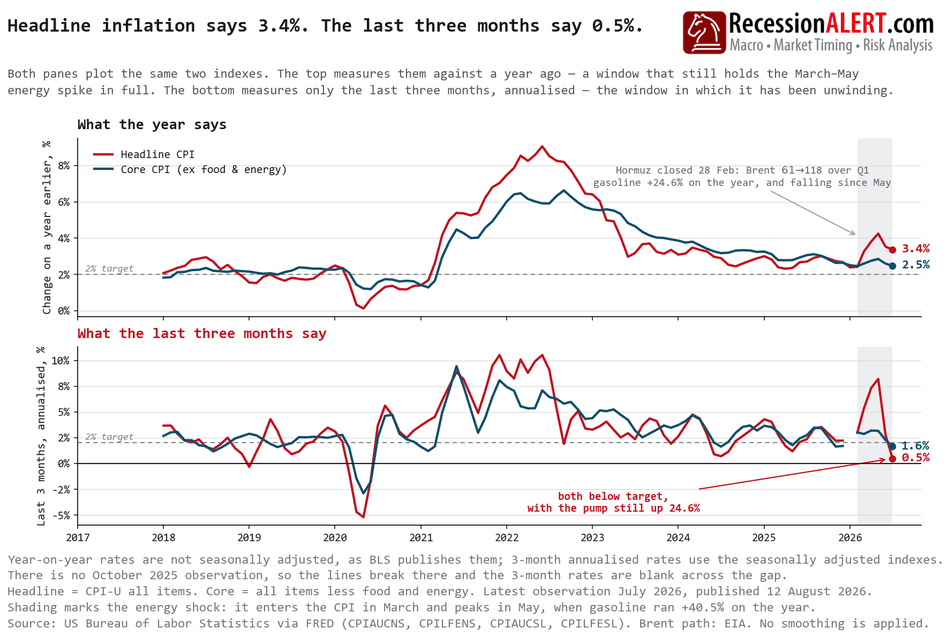
Gasoline is $4.04 a gallon. A year ago it was $3.14, and that gap is what separates a 3.4% headline print from a three-month rate of 0.5%. Hold the energy index dead flat at July’s level — no barrel moves, no pump price changes — and energy on a year earlier still climbs from +14.7% now to +18.6% in December and +19.2% in January, gasoline touching +34%, before lapping the shock and collapsing to roughly +5% in March 2027. Nothing rises; the base beneath it falls. That is why the two panes disagree: the twelve-month window spans August 2025 to July 2026 and contains the Hormuz shock in full, while the three-month window covers the months in which it has been unwinding — energy -1.5% in July, gasoline -2.9%, after -5.7% in June — annualising headline at 0.5% and core, the steadier half, at 1.64%, the softest since July 2024. The shock did reach core: airline fares ran from +7.1% year-on-year in February to +25.6% in July, and core still round-tripped, 2.47% to 2.82% in May and back to 2.47%, the return paid for by medical care services falling from 3.56% to 2.65% and core goods from 1.07% to 0.78%. The Fed can read the bottom pane — futures put roughly 64% on a hold on 15-16 September — and a household reads the receipt. The constraint is not the trend. It is the pump, and pumps unwind faster than labour markets repair.
What it means: front-end duration is the exposure — hawkish repricing into year-end will run on prints the base has already written, not on new information. That reverses only if a second energy leg or re-accelerating shelter moves core itself.
Market Intelligence Brief (MIB) Ver. 18.59
For professional investors only. Not investment advice.
© 2026 RecessionALERT.com

Comments are closed.