
MARKET INTELLIGENCE BRIEF (MIB)
Thursday, October 15, 2026
Producer prices jumped 1.3% in September, the hottest monthly print since March 2022, yet the 10-year yield fell 10.2 bps to 5.084%. The Dow gained 1.08% to retake 52,000 as the Russell 2000 rose 1.38%, while chips extended a rout nearing $2 trillion since last week — DELL -6.80%. CoreWeave’s credit gauge hit record default odds before Nvidia’s Huang defended it. Retail sales beat, but the control group rose just 0.1%. WTI jumped 2.63% on an 8.6M-barrel crude draw.
TABLE OF CONTENTS
A. EXECUTIVE SUMMARY
B. MARKET DATA
C. HIGH-IMPACT STORIES (6)
D. MODERATE-IMPACT STORIES (6)
E. ECONOMY WATCH (6)
F. EARNINGS WATCH (2)
G. WHAT’S NEXT
H. CHART OF THE DAY
A. EXECUTIVE SUMMARY -> TOP
The S&P 500 rose 0.33% and the Dow gained 1.08% to its first close above 52,000 since September 21, as a 10.2-bp drop in the 10-year yield to 5.084% overrode a 1.3% September PPI, the hottest monthly print since March 2022 and the second hot inflation report in two days. Bonds looked through the data rather than repricing the terminal rate: October hike odds touched about 34% before fading to about 27%, and commentary tied the long-end bid to safe-haven demand around the AI trade. That same AI anxiety is now hitting the hardware layer, with the semiconductor index down 3.3% intraday toward a $2 trillion loss since last week and CoreWeave’s credit gauge pricing roughly 60% default odds. Breadth favored rate-sensitive and defensive groups over tech: eight of 11 sectors rose, led by Healthcare (+1.97%), and the Russell 2000 gained 1.38% while the Nasdaq 100 slipped 0.05%, a rotation that rests on yields staying lower.
• PPI: Final-demand producer prices rose 1.3% in September against a 0.5% forecast, the largest monthly gain since March 2022, and core rose 0.7% against 0.3% expected. Goods prices jumped 2.6%, the most since the series began in December 2009, on a 10.8% surge in energy; the 12-month rate climbed to 6.3%, the highest since December 2022.
• Consumer: Retail sales rose 0.8% to $745.0 billion against a 0.3% forecast, but the control group that feeds GDP rose just 0.1% against 0.3% expected, and coverage tied the headline beat to gasoline station sales. GDPNow held at 3.6% for the third quarter.
• Factories and jobs: The Empire State index jumped to 25.5 against a 10.3 forecast, while the Philadelphia Fed gauge fell to 20.9 from 37.8, short of the 28.4 expected. Initial jobless claims edged up 1,000 to 199,000 and continuing claims fell 4,000 to 1.71 million.
• Semiconductors: The Philadelphia semiconductor index fell 3.3% in Thursday trading, putting chip stocks on course for a $2 trillion loss in market value since last week, per Reuters. The session’s five largest mega-cap decliners were all hardware names: DELL -6.80%, ANET -5.04%, AMAT -3.63%, CSCO -3.35% and LRCX -3.30%.
• AI credit vs. AI revenue: CoreWeave’s credit-risk gauge hit a record, pricing roughly 60% default odds, before Nvidia’s Jensen Huang said its “strength is improving every day”; CRWV closed up 5.94% at $69.69 and Oracle rose 3.00%. Anthropic told prospective investors its third-quarter revenue reached $16.8 billion with adjusted profitability, according to Bloomberg.
• Energy and geopolitics: WTI rose 2.63% after the EIA reported an 8.6 million barrel crude draw against an expected 288,000, while Brent slipped 0.25% on reports Washington is weighing easing shadow-fleet sanctions. The IEA will release over 20 million barrels of diesel, an Iranian admiral said the Strait of Hormuz “is closed,” and Ukraine resumed strikes on Russian refineries.
1. Bonds Are Pricing the Slowdown, Not the Spike — Two hot inflation reports in two days should have pushed yields higher; instead the 10-year fell 10.2 bps against 4.9 bps for the 2-year, a bull flattening that cut the 2s10s spread to 32.7 bps. The front end still prices a live minority chance of an October 27-28 hike, about 27% after a brief spike to 34%, while the falling long end implies investors increasingly see tighter policy slowing the economy; commentary also cited safe-haven buying tied to the AI trade. Chair Warsh’s remarks at 11:30 PM ET tonight, the last scheduled before the blackout begins Saturday, are the near-term test. The rally in small caps, transports and housing-linked names such as Home Depot (+4.31%) depends on that relief holding, with the 30-year mortgage rate still at 7.40% and the 10-year above 5%.
2. The AI Trade Is Repricing the Buildout, Not the Demand — Anthropic’s reported $16.8 billion quarter, roughly a $67 billion annual run rate with adjusted profitability, is among the strongest evidence yet that frontier-model demand is monetizing, and chips fell anyway. The selloff has moved from the financing layer, where CoreWeave and Oracle broke on Wednesday, into the equipment and networking suppliers whose order books depend on that financing, and CoreWeave’s record default pricing shows credit moving ahead of equity: Huang’s defense steadied the stock but not the debt. Lam Research and Texas Instruments on Wednesday, October 21, alongside Meta’s capex commentary the same day, are the next hard read on whether orders are holding.
3. Diesel Is the Inflation Channel the Fed Cannot Ignore — The IEA singled out diesel, US distillate stocks sit 12% below average, and Ukraine’s end to its pause on Russian refinery strikes threatens a large source of global diesel exports. Diesel carries freight and farm costs straight into producer prices, the channel behind September’s 1.3% PPI. Policy is pulling both ways: Treasury designated 26 targets in Iran’s oil-revenue network as Tehran claimed Hormuz is closed, while Washington weighs easing shadow-fleet restrictions to cut freight costs. With WTI near $98, energy keeps pressure on the inflation data the Fed is weighing, and gold’s 2.04% gain to $4,191.55 shows investors hedging both inflation and a policy mistake.
 — Leading economic indicators. Accurate market forecasts. Apply for membership at join.recessionalert.com
B. MARKET DATA -> TOP
A Treasury rally outweighed the hottest monthly producer-price print since March 2022: the 10-year yield fell 10.2 bps even as September PPI jumped 1.3%, and the S&P 500 recovered from early losses to close higher. Leadership ran away from technology — eight of eleven sectors rose, led by Healthcare, while the Dow and Russell 2000 each gained more than 1% and the Nasdaq 100 finished flat. The split ran through AI hardware, where Dell, Arista and the chip-equipment names extended a semiconductor selloff that Reuters tied to rate-hike bets and AI-buildout cost concerns. Crude split as well: WTI jumped on a large US inventory draw while Brent held flat on reports Washington is weighing easing shadow-fleet sanctions.
CLOSING PRICES – Thursday, October 15, 2026:
MAJOR INDICES
The advance was broad but bypassed mega-cap tech: the NYSE Composite (+0.84%) and Russell 2000 (+1.38%) outpaced a flat Nasdaq 100, and the Dow closed back above 52,000 for the first time since September 21. Dow Theory bull confirmation is now entrenched at six sessions, with both the industrials and transports closing above their 10-session highs. Over 10 sessions the S&P 500 has outrun the Nasdaq 100 by 2.9 points, a broadening rotation that extends into a second session.
| Index | Close | Change | %Move | Why It Moved |
|---|---|---|---|---|
| S&P 500 | 7,744.06 | +25.12 | +0.33% | Erased an intraday loss of as much as 0.6% as falling Treasury yields outweighed the hot September PPI and a semiconductor selloff |
| Dow Jones | 52,177.69 | +556.21 | +1.08% | Gains outside technology; first close above 52,000 since September 21 |
| DJ Transportation | 20,106.68 | +276.72 | +1.40% | No discrete same-day catalyst identified; highest close since September 17 |
| Nasdaq 100 | 29,935.59 | -15.22 | -0.05% | Semiconductor and AI-hardware selling offset gains elsewhere in the index |
| Russell 2000 | 2,767.27 | +37.74 | +1.38% | Small caps outpaced large caps on a day the 10-year yield fell 10.2 bps |
| NYSE Composite | 24,066.65 | +201.22 | +0.84% | Broad participation, with eight of eleven sectors higher |
VOLATILITY & TREASURIES
Bonds rallied into a hot inflation print, the reverse of the usual reaction, with the 10-year falling 10.2 bps against 4.9 bps for the 2-year — a bull flattening that cut the 2s10s spread to 32.7 bps from 38.0. Market commentary attributed the bid to safe-haven demand tied to AI-trade concerns; FedWatch odds of an October 27-28 hike rose to about 34% after the PPI before easing to about 27%. A weaker dollar and a lower VIX completed the rate-relief tape.
| Instrument | Level | Change | Why It Moved |
|---|---|---|---|
| VIX | 16.46 | -0.41 (-2.43%) | Eased as stocks recovered from early losses |
| 10-Year Treasury Yield | 5.084% | -10.2 bps | Fell despite the hottest monthly PPI since March 2022; commentary cited safe-haven buying tied to AI-trade concerns. Largest one-day drop since June 11 |
| 2-Year Treasury Yield | 4.757% | -4.9 bps | Fell less than the 10-year; October hike odds rose after the PPI, then eased back |
| US Dollar Index (DXY) | 102.02 | -0.54 (-0.52%) | Softened alongside lower Treasury yields |
COMMODITIES
Precious metals rebounded together, with silver (+3.04%) outpacing gold (+2.04%) and platinum following, recovering Wednesday’s CPI-driven drop as the dollar and yields fell. Copper went the other way (-1.43%), splitting the metals tape along safe-haven versus industrial lines on a day equities rose. Bitcoin’s modest gain moved with the recovery in risk assets.
| Asset | Price | Change | %Move | Why It Moved |
|---|---|---|---|---|
| Gold | $4,191.55/oz | $+83.65 | +2.04% | Rebounded from Wednesday’s CPI-driven drop on a weaker dollar and lower Treasury yields |
| Silver | $57.578/oz | $+1.701 | +3.04% | Outpaced gold in the precious-metals rebound |
| Copper | $6.5650/lb | $-0.0955 | -1.43% | No discrete same-day catalyst identified |
| Platinum | $1,635.50/oz | $+20.90 | +1.29% | Rose with gold and silver |
| Bitcoin | $82,398.00 | $+555.00 | +0.68% | Modest gain alongside the equity recovery; no discrete catalyst identified |
ENERGY
The crude benchmarks diverged: WTI rose 2.63% while Brent slipped 0.25%, narrowing the Brent-WTI settlement spread to about $7.95 from $10.97. Reuters tied WTI’s gain to an 8.6-million-barrel US crude draw and Brent’s flat settle to reports Washington is weighing easing shadow-fleet sanctions. Energy equities fell 1.25% despite WTI’s gain, a divergence no source explained; Henry Hub edged up after a 67 Bcf storage build and Dutch TTF was little changed.
| Asset | Price | Change | %Move | Why It Moved |
|---|---|---|---|---|
| Crude Oil (WTI) | $97.59/bbl | $+2.50 | +2.63% | EIA reported an 8.6-million-barrel crude draw for the week to October 9, against an expected 288,000-barrel draw; settled at $97.97, up $2.88 |
| Crude Oil (Brent) | $105.79/bbl | $-0.27 | -0.25% | Little changed as the US weighs easing sanctions on “shadow fleet” tankers, against Middle East supply risk; settled at $105.92, down $0.14 |
| Natural Gas (Henry Hub) | $3.233/MMBtu | $+0.035 | +1.09% | Thursday’s EIA report showed a 67 Bcf injection, leaving stocks 1.3% above the five-year average; the report does not by itself explain the gain |
| Natural Gas (Dutch TTF) | $28.434/MMBtu | $-0.049 | -0.17% | Little changed; no discrete catalyst identified |
S&P 500 SECTORS
Eight of 11 sectors rose, led by Healthcare (+1.97%), which also leads the week (+4.47%); only Energy (-1.25%), Technology (-0.37%) and Utilities (-0.11%) fell. Technology’s slip caps a -4.15% week for the year’s second-best sector (+25.32% YTD), while Consumer Defensive (+4.16%) has been the week’s other winner — rotation out of the 2026 leaders and into healthcare and staples.
| Sector | 1-Day | 1-Week | 1-Month | 3-Month | 6-Month | YTD | 12-Month |
|---|---|---|---|---|---|---|---|
| Healthcare | +1.97% | +4.47% | +3.79% | +5.98% | +14.70% | +11.15% | +19.73% |
| Basic Materials | +1.63% | +0.36% | -2.60% | +5.19% | -6.70% | +10.44% | +15.46% |
| Consumer Cyclical | +1.32% | +1.26% | +2.56% | -2.09% | -4.22% | -6.26% | -4.86% |
| Real Estate | +1.28% | +2.19% | -2.13% | -9.19% | -4.56% | +2.50% | +0.53% |
| Financial | +1.23% | +1.28% | -2.03% | -2.38% | +5.79% | +3.36% | +8.41% |
| Communication Services | +0.78% | +0.41% | +1.24% | +1.66% | -1.23% | +2.17% | +8.96% |
| Consumer Defensive | +0.74% | +4.16% | +5.25% | +2.58% | +4.70% | +10.95% | +9.82% |
| Industrials | +0.19% | -1.54% | -0.96% | -4.61% | -4.42% | +7.10% | +7.79% |
| Utilities | -0.11% | +1.06% | +1.37% | -7.68% | -10.75% | -2.85% | -8.65% |
| Technology | -0.37% | -4.15% | +2.27% | +7.47% | +19.58% | +25.32% | +25.00% |
| Energy | -1.25% | +1.80% | +2.92% | +11.79% | +10.75% | +43.19% | +48.51% |
TOP MEGA-CAP MOVERS:
GAINERS
| Company | Ticker | Close | Change | Why It Moved |
|---|---|---|---|---|
| Salesforce | CRM | $246.74 | +4.57% | No discrete same-day catalyst identified; rose against a lower Technology sector |
| Home Depot | HD | $308.24 | +4.31% | No discrete same-day catalyst identified |
| Eli Lilly | LLY | $1,251.61 | +3.55% | No discrete same-day catalyst identified; second straight gain after Wednesday’s +3.62%, with Healthcare the session’s strongest sector |
| Thermo Fisher Scientific | TMO | $696.49 | +3.46% | No discrete same-day catalyst identified; Guggenheim reiterated its Buy rating Thursday (reported by one outlet, not independently confirmed), ahead of October 21 earnings |
| Oracle | ORCL | $134.47 | +3.00% | No discrete same-day catalyst identified; partial rebound from Wednesday’s -8.83% drop |
DECLINERS
| Company | Ticker | Close | Change | Why It Moved |
|---|---|---|---|---|
| Dell Technologies | DELL | $473.39 | -6.80% | No new same-day catalyst identified; extended Wednesday’s selloff after Barclays’ October 14 downgrade to Equal Weight, amid the AI-hardware rout |
| Arista Networks | ANET | $185.58 | -5.04% | No discrete company-specific catalyst identified; fell with the semiconductor and AI-hardware selloff |
| Applied Materials | AMAT | $430.41 | -3.63% | No discrete company-specific catalyst identified; chip-equipment names fell with the semiconductor selloff that Reuters tied to rate-hike bets and AI-buildout cost concerns |
| Cisco Systems | CSCO | $109.83 | -3.35% | No discrete company-specific catalyst identified; fell with the AI-hardware selloff |
| Lam Research | LRCX | $277.46 | -3.30% | No discrete company-specific catalyst identified; fell with chip-equipment peers in the semiconductor selloff, ahead of October 21 earnings |
— Institutional-grade intelligence for serious investors. Apply for membership at join.recessionalert.comC. HIGH-IMPACT STORIES -> TOP
UNCERTAIN
1. Treasuries Rally Into the Hottest Producer-Price Print Since March 2022: the 10-Year Falls 10.2 bps to 5.084% as October Hike Odds Spike to About 34%, Then Fade
The core facts:September’s 1.3% jump in producer prices should have been a bond-bearish shock, coming one day after a 3.7% CPI. Instead the 10-year Treasury yield fell 10.2 bps to 5.084%, its largest one-day drop since June 11, and the 2-year fell 4.9 bps to 4.757%. The bull flattening cut the 2s10s spread to 32.7 bps from 38.0. CME FedWatch odds of a hike at the October 27-28 FOMC rose to about 34% after the 8:30 AM release, then eased to about 27%. The dollar index fell 0.52% to 102.02, and the S&P 500 erased an intraday loss of as much as 0.6% to close up 0.33% at 7,744.06.
Why it matters:The bond market looked through a second straight hot inflation report rather than repricing the terminal rate higher, and the long end did more of the work than the front end. Market commentary attributed the bid to safe-haven demand tied to concerns over the AI trade, which fits the same session’s semiconductor rout, but that link is commentary rather than an established driver. Either way the session separated two questions the Fed must answer: whether to hike again in October, which the front end still prices as a live minority outcome, and whether higher policy rates are slowing the economy, which a falling 10-year implies investors increasingly believe. For equities the relief was real: rate-sensitive small caps and transports led, while the 10-year still sits above 5%.
What to watch:Fed Chair Warsh’s moderated conversation at the IMF Annual Meetings in Bangkok, scheduled for 11:30 PM ET tonight, is the last scheduled Fed remarks before the pre-meeting blackout begins Saturday, October 17. A 10-year back above 5.15% would signal that today’s rally was positioning rather than a regime change.
BEARISH
2. Chip Rout Deepens Toward a $2 Trillion Wipeout as the Semiconductor Index Slides 3.3% Intraday; Dell, Arista, Applied Materials, Cisco and Lam Lead Mega-Cap Losses
The core facts:Reuters reported that US semiconductor stocks were on course to lose $2 trillion in market value since last week, with the Philadelphia SE Semiconductor index down 3.3% in Thursday trading, adding to a $1.64 trillion wipeout over the prior six sessions. Reuters tied the selling to rising bets on a rate hike and concerns over the cost of the AI buildout. All five of the session’s largest mega-cap decliners were hardware names: Dell Technologies fell 6.80%, Arista Networks 5.04%, Applied Materials 3.63%, Cisco 3.35% and Lam Research 3.30%. The Nasdaq 100 closed down 0.05% while the Dow gained 1.08%, and Technology fell 0.37% on the day and 4.15% over the past week.
Why it matters:The selloff has moved from the AI financing layer, where CoreWeave and Oracle broke on Wednesday, into the equipment and networking suppliers whose order books depend on that financing continuing. A $2 trillion drawdown in one industry inside a week is large enough to matter for index-level returns and for wealth effects, and it is happening while broader equities rise, which marks it as a repricing of AI capex expectations rather than a general risk-off move. The rate-hike channel matters too: long-duration growth stocks are the most exposed to a Fed still debating another increase. The broadening into healthcare, staples and small caps cushions the indices but does not offset the weight of semiconductors in the Nasdaq 100.
What to watch:Lam Research and Texas Instruments report after the close on Wednesday, October 21, and Western Digital on Thursday, October 22 — the first hard read on whether chip-equipment and storage orders are holding up against the selloff.
UNCERTAIN
3. CoreWeave’s Credit-Risk Gauge Hits a Record, Pricing Roughly 60% Default Odds, Before Nvidia’s Huang Says Its “Strength Is Improving Every Day”; the Stock Reverses to Close Up 5.94%
The core facts:Bloomberg reported Thursday morning that CoreWeave’s credit-risk gauge had hit a record, pricing roughly 60% odds of default. Later that morning Nvidia Chief Executive Jensen Huang, whose company is both a major supplier to CoreWeave and an investor in it, defended the AI cloud provider at an event in Stockholm: “CoreWeave’s strength is improving every day. I’m optimistic. Their cost of capital is actually decreasing.” CoreWeave shares, which had fallen 15.46% on Wednesday as its bonds traded above a 15% yield, recovered from an intraday drop to close up 5.94% at $69.69.
Why it matters:CoreWeave has become the market’s bellwether for debt-financed AI capacity, so a record default-risk reading is a direct measure of how far credit investors have moved against the AI buildout. Huang’s intervention steadied the equity but does not change the debt: a CEO’s reassurance is not a backstop, and the credit market had priced the risk before he spoke. The divergence matters for the wider complex, because AI capex is increasingly funded through bonds and private credit, and stress in the weakest borrower raises funding costs for the rest. Oracle, the other name hit hardest on Wednesday, rose 3.00% on Thursday, though no catalyst has been tied to its rebound.
What to watch:Whether CoreWeave’s credit-default pricing retreats from its record alongside the stock; a further widening while the equity holds would mark today’s bounce as a relief rally.
UNCERTAIN
4. WTI Jumps 2.63% on an 8.6-Million-Barrel Crude Draw as the IEA Orders More Than 20 Million Barrels of Diesel Released; Brent Holds Flat on Talk of Easing Shadow-Fleet Sanctions
The core facts:The EIA’s weekly report, shifted to Thursday by the holiday, showed US commercial crude inventories falling 8.6 million barrels to 415.6 million in the week to October 9, against an expected draw of about 288,000 barrels, leaving stocks 3% below the five-year average. Distillate inventories fell 2.5 million barrels to 12% below average. The IEA Governing Board said the same day that about 330 million barrels of the 400 million-barrel collective release have gone out, that total releases will exceed the original target, and that members will release “over 20 million barrels of diesel as soon as possible.” WTI settled up $2.88 at $97.97 and Brent down $0.14 at $105.92, as Reuters reported Washington is weighing letting legal oil move on previously sanctioned “shadow fleet” tankers. Energy stocks fell 1.25%, the session’s weakest sector.
Why it matters:Two policy responses are now aimed at the same pinch point. The IEA singled out diesel as its main concern, and US distillate stocks at 12% below normal show why: diesel is the fuel that feeds freight and farm costs straight into producer prices, the channel behind today’s 1.3% PPI. The shadow-fleet proposal targets freight costs rather than supply and remains a proposal, not a decision, but it is enough to cap Brent while the US draw lifts WTI, narrowing the Brent-WTI settlement spread to about $7.95 from $10.97. With WTI near $98, the inflation pressure the Fed is weighing is still building.
What to watch:Whether the Treasury formalises any shadow-fleet easing, and next Wednesday’s EIA report on October 21 for a second large crude and distillate draw; WTI’s $100 level is the obvious threshold.
BEARISH
5. Iran Says the Strait of Hormuz “Is Closed” as Ukraine Resumes Strikes on Russian Refineries and a Houthi Missile Hits Aden’s Presidential Palace
The core facts:Iranian Army Rear Admiral Habibollah Sayyari told reporters in Tehran early Thursday: “The Strait of Hormuz is closed; if it were not closed, oil would be passing through it.” Later Iran’s military, citing state television, said a “non-compliant oil tanker” had caught fire in the Gulf of Oman. Ukrainian drones set fire to a refinery in Russia’s Ryazan region overnight, confirmed by Russia’s Defense Ministry and the regional governor, and President Zelenskyy told the Financial Times that the pause in refinery strikes Trump had demanded was over: “We’re done.” Around midday the Houthis fired missiles at the Al-Maashiq presidential palace in Aden, killing four people according to Yemeni government military sources.
Why it matters:Three separate supply theatres escalated on the same day. Iran’s claim of closure has not been independently confirmed, but the statement itself raises insurance and freight costs for Gulf cargoes. The end of Ukraine’s pause matters more directly for the diesel shortage the IEA flagged today, because Russian refineries are a large source of global diesel exports; the White House’s diesel arrangement with Moscow also loses value if those plants are being hit. Brent’s flat close shows the market has absorbed months of Gulf headlines, which makes an actual supply interruption, rather than rhetoric, the risk equities are not priced for.
What to watch:Daily tanker transit counts through Hormuz and any operating update on the Ryazan refinery; a confirmed halt in Gulf traffic would put Brent’s $110 level in play.
BULLISH
6. Dow Closes Back Above 52,000 and the Russell 2000 Gains 1.38% as Eight of Eleven Sectors Rise, Led by Healthcare, While the Nasdaq 100 Finishes Flat
The core facts:The Dow Jones Industrial Average rose 556.21 points, or 1.08%, to 52,177.69, its first close above 52,000 since September 21. The Dow Jones Transportation Average gained 1.40% to its highest close since September 17, the Russell 2000 rose 1.38% and the NYSE Composite 0.84%, while the Nasdaq 100 slipped 0.05%. Eight of eleven sectors advanced, led by Healthcare (+1.97%), Basic Materials (+1.63%) and Consumer Cyclical (+1.32%); only Energy, Technology and Utilities fell. Healthcare has gained 4.47% over the past week and Consumer Defensive 4.16%, while Technology has lost 4.15%.
Why it matters:This is the rotation the market has been building toward all week, now visible in index levels rather than just sector tables. The gains came in exactly the segments that benefit most from lower long-term yields — small caps, transports and housing-linked consumer names such as Home Depot, up 4.31% — while the year’s leaders were sold. A rally that breadth carries while mega-cap technology stalls is healthier for the economy-sensitive parts of the market, but it rests on the 10-year’s rally holding; a renewed rise in yields would undercut the same groups that led today.
What to watch:Whether the Russell 2000 can hold above 2,750 through Friday’s industrial production report, and whether Healthcare’s leadership survives Intuitive Surgical’s results on Tuesday, October 20.
— Quantifying recession risk so you don’t have to guess. Apply for membership at join.recessionalert.comD. MODERATE-IMPACT STORIES -> TOP
BULLISH
7. Anthropic Tells Prospective Investors Its Third-Quarter Revenue Hit $16.8 Billion and It Was Profitable on an Adjusted Basis, Ahead of a Planned IPO
The core facts:Anthropic told prospective investors that its third-quarter revenue reached $16.8 billion and that it achieved profitability on an adjusted basis, according to people familiar with the matter cited by Bloomberg, which published the report at 6:22 PM ET on Wednesday. The figures were presented at the company’s San Francisco headquarters as part of its push toward a public listing. Anthropic is private and did not publish the figures itself.
Why it matters:The AI selloff rests on a single question: whether the revenue at the application layer will ever justify the capex below it. A $16.8 billion quarter, roughly a $67 billion annual run rate, with adjusted profitability, is one of the strongest data points yet that frontier-model demand is monetising, and it is the counter-argument to the credit stress at CoreWeave. It did not stop Thursday’s chip rout, which suggests investors are now discounting the cost and financing of the buildout rather than demand for the product. A successful IPO would also reprice the private-market valuations that sit behind much of the sector’s funding.
What to watch:A public IPO filing, which would put audited figures behind the reported numbers, and Meta’s capex commentary when it reports on Wednesday, October 21.
UNCERTAIN
8. Treasury Designates 26 Targets in Iran’s Shadow-Banking and Oil-Revenue Network, Including an Iraqi Bank and a Dubai Oil Intermediary; Bessent Says “The Noose Is Tightening”
The core facts:Under its “Operation Economic Outcast,” Treasury’s Office of Foreign Assets Control designated 16 individuals and 10 entities under Executive Order 13902 on Thursday. Targets include Iraq’s International Development Bank for Investment and Finance, the offshore banks Jazireh International Bank and Chabahar International Bank Overseas, Hong Kong-based EliteSphere Trading and several exchange houses, plus oil intermediary Sayyed Ruhollah Razavi and his companies, who Treasury says shipped millions of barrels a month for the National Iranian Oil Company before the US blockade halted Iran’s exports. The State Department separately designated Cuba’s Banco Internacional de Comercio. Secretary Bessent: “The noose is tightening around Iran’s economy, and not even Iran’s so-called allies can save it.”
Why it matters:With Iran’s oil exports already blockaded, Washington is moving up the chain to the banks and exchange houses that recycle its revenue, and naming an Iraqi bank widens the secondary-sanctions risk for regional lenders. The action came on the same day Tehran declared Hormuz closed, so it adds to the pressure rather than to any de-escalation. It sits awkwardly beside the reported plan to ease restrictions on shadow-fleet tankers: the US is tightening the financial net on Iran while considering loosening the shipping net elsewhere to cut freight costs.
What to watch:Iraq’s response to its bank’s designation and any wind-down disruption to Iraqi dollar flows, along with Iranian retaliation in the Gulf.
UNCERTAIN
9. Venture Global Signs Frame Agreements With GE Vernova, Baker Hughes and GE Grid Solutions Worth About $17.2 Billion if Every Order Proceeds
The core facts:Venture Global disclosed Thursday that its LNG subsidiary signed a Power Frame Agreement with GE Vernova and Baker Hughes for up to 16 power islands, and a Grid Frame Agreement with GE Grid Solutions for transformers and switchgear supporting up to 21 power-island projects. The agreements, signed October 9, are worth approximately $17.2 billion including reservation fees if all purchase orders proceed, with deliveries through 2034. Neither creates firm obligations on its own: binding commitments arise only through reservations and purchase orders, the first power-island order is expected by the end of 2026, and Venture Global may terminate orders in some circumstances. The equipment is for LNG export projects and LNG-adjacent data-center developments. GE Vernova fell 1.63% and Venture Global 5.80%.
Why it matters:The deal shows where the gas-turbine shortage is heading: buyers are reserving capacity years ahead and pairing LNG export power with data-center loads, which extends the order visibility for GE Vernova and Baker Hughes into the next decade. The non-binding structure is the caveat, and the market priced it as one, selling both GE Vernova and Venture Global on a day industrials rose. It is a signal of demand for power equipment, not yet revenue.
What to watch:The first definitive power-island purchase order, expected by year-end, which converts the first piece of the $17.2 billion into firm backlog.
UNCERTAIN
10. US Ambassador Says a Decision on Tariffs Over India’s Russian-Oil Purchases Is Expected Within About 10 Days, and the “Big Items” of a Trade Deal Are Done
The core facts:US Ambassador to India Sergio Gor told the Bloomberg New Economy Forum in New Delhi on Thursday that a decision on tariffs tied to India’s purchases of Russian oil is expected within the next 10 days or so, and that the big items of a US-India trade deal are done, leaving him confident an agreement will be reached.
Why it matters:India is one of the largest buyers of Russian crude, so a tariff decision on its purchases is effectively a decision about how much Russian oil keeps flowing to market at a time when the IEA is releasing emergency stocks and diesel is scarce. A punitive tariff would tighten supply further and support crude prices; a deal that trades oil concessions for market access would ease them. For US exporters, the trade deal is the larger long-run prize, but the oil decision carries the near-term market impact.
What to watch:The tariff decision, due around October 25, and whether India’s refiners cut Russian crude purchases ahead of it.
UNCERTAIN
11. SK Hynix Seeks US Approval to Ship More American Chipmaking Tools to Its Dalian NAND Plant in China, Tied to a Potential New US Factory
The core facts:Reuters reported late Wednesday, citing two people familiar with the matter, that SK Hynix is seeking US government approval to export more US-made chipmaking equipment to its NAND flash plant in Dalian, China, and has tied the request to a potential investment in a new US factory. No approval or denial has been reported, and no comment from SK Hynix or the US government has been published.
Why it matters:The request turns export controls into a bargaining chip for US manufacturing investment, a template other Asian chipmakers with China fabs would watch closely. For US equipment makers — Lam Research, Applied Materials and KLA, which fell with the semiconductor selloff on Thursday — an approval would reopen a slice of China tool sales that the controls have restricted. A denial would keep the restrictions intact but could cost the US factory.
What to watch:Lam Research’s China revenue mix and any export-licence commentary in its results after the close on Wednesday, October 21.
BULLISH
12. Precious Metals Rebound as Silver Rises 3.04% and Gold 2.04% to $4,191.55, Recovering Wednesday’s CPI-Driven Drop on a Weaker Dollar and Lower Yields
The core facts:Gold rose 2.04% to $4,191.55 an ounce and silver 3.04% to $57.578, with platinum up 1.29%, recovering the losses that followed Wednesday’s hot CPI report. The rebound came as the dollar index fell 0.52% and the 10-year Treasury yield dropped 10.2 bps. Copper moved the other way, falling 1.43% to $6.5650 a pound.
Why it matters:The split between precious and industrial metals mirrors the split in equities: investors bought the hedges and sold the cyclical AI-and-construction exposure. Gold rising on a day of hot producer prices and higher rate-hike odds shows that falling real yields and a weaker dollar outweighed the Fed risk, and that the metal remains the preferred hedge against both inflation and a policy mistake. For miners reporting next week, the price level near $4,200 supports margins.
What to watch:Newmont’s results after the close on Thursday, October 22, for realised gold prices and cost guidance at these levels.
— Separating signal from noise since 2007. Apply for membership at join.recessionalert.comE. ECONOMY WATCH -> TOP
Thursday’s data split prices from volumes. Producer prices jumped 1.3% in September, the largest monthly gain since March 2022, while retail sales rose 0.8% largely on gasoline, and the control group that feeds GDP managed only 0.1%. Labor held firm, with initial claims at 199,000, and Atlanta Fed GDPNow kept third-quarter growth at 3.6%, so the inflation shock is landing on an economy still running hot rather than one rolling over. Bonds rallied anyway, the 10-year falling 10.2 bps, leaving Williams’ view that policy is “not that far from neutral” to be tested at an October 27-28 meeting for which hike odds briefly rose to about 34%.
Producer Prices Jump 1.3% in September, the Largest Monthly Gain Since March 2022, as Energy Surges 10.8% (BLS, Oct 15)
What they’re saying:The Producer Price Index for final demand rose 1.3% in September against a 0.5% forecast, after 0.5% in August, and the 12-month rate climbed to 6.3%, the highest since December 2022. Goods prices rose 2.6%, the largest increase since the series began in December 2009, with energy up 10.8% and gasoline up 20.3%. Services prices rose 0.8%, nearly half of it from a 1.4% rise in trade margins.
The context:The pass-through is not confined to fuel: core PPI rose 0.7% against a 0.3% forecast, and prices excluding food, energy and trade services rose 0.5% on the month and 5.0% over 12 months. The report follows Wednesday’s 3.7% CPI and lands less than two weeks before the October 27-28 FOMC; CME FedWatch odds of an October rate hike rose to about 34% after the release before easing to about 27%. Treasuries rallied regardless, with the 10-year yield falling 10.2 bps to 5.084%, its largest one-day drop since June 11.
What to watch:September import prices on Friday, October 16 (forecast +0.8% m/m, prior +0.7%), the last read on imported cost pressure before the FOMC.
Retail Sales Rise 0.8% to $745.0 Billion, Beating the 0.3% Forecast, but the Control Group Gains Just 0.1% (Census Bureau, Oct 15)
What they’re saying:Advance retail and food services sales rose 0.8% in September to $745.0 billion, against a 0.3% forecast, and were up 6.3% from a year earlier; August was revised up to 1.3% from 1.1%. Sales excluding autos rose 0.9% against 0.5% expected, but the control group rose only 0.1% against a 0.3% forecast, after 1.2% in August.
The context:Coverage attributed the headline gain to gasoline station sales, in a month when the CPI gasoline index rose 9.1%, so the beat reflects price more than volume; the control group, which excludes gasoline, is the series that feeds GDP. Even so, the Atlanta Fed raised its third-quarter real consumer spending nowcast to 3.6% from 3.4%, offset by a smaller inventory contribution of 1.87 points after August business inventories rose 0.4% as expected, leaving GDPNow at 3.6%, unchanged after rounding.
What to watch:September industrial production on Friday, October 16 (forecast +0.4%, prior 0.0%), and the next GDPNow update on Tuesday, October 20.
Empire State Index Surges 18 Points to 25.5 While the Philadelphia Fed Gauge Cools to 20.9, Short of Forecasts (NY Fed / Philadelphia Fed, Oct 15)
What they’re saying:The New York Fed’s general business conditions index climbed to 25.5 in October against a 10.3 forecast, which Seeking Alpha described as the highest level in almost five years; new orders rose 21 points to 23.2, shipments rose 16 points to 13.1, and employment held at 10.3. The Philadelphia Fed’s manufacturing index fell to 20.9 from 37.8, below the 28.4 forecast but still in expansion.
The context:Current activity is strong and expectations are fading: the Empire six-month outlook fell eight points to 21.0. Price pressure eased slightly at the input stage, with prices paid dipping four points from a four-year high to 59.5, while prices received rose three points to 30.6. Both surveys remain well above zero, consistent with continued factory expansion despite a 10-year yield above 5%.
What to watch:September industrial production on Friday, October 16, for confirmation in the hard data.
Initial Jobless Claims Edge Up to 199,000, in Line With Forecasts, as Continuing Claims Fall to 1.71 Million (Labor Department, Oct 15)
What they’re saying:Seasonally adjusted initial claims were 199,000 in the week ending October 10, up 1,000 from an upwardly revised 198,000 and in line with the 200,000 forecast. The four-week average rose 250 to 198,500. Continuing claims fell 4,000 to 1,710,000 in the week ending October 3, and the insured unemployment rate held at 1.1%.
The context:With initial claims below 200,000 for a second week and the four-week average of continuing claims down to 1,708,750, layoffs remain scarce. A labor market this tight gives the Fed no employment-side reason to hold back as producer and consumer inflation reaccelerate.
What to watch:Initial jobless claims for the week ending October 17, due Thursday, October 22.
NY Fed’s Williams Still Sees Room for “One More Rate Hike” This Year but No Reason to Expect More in 2027 (Bloomberg, Oct 13)
What they’re saying:In a Bloomberg interview on Tuesday, New York Fed President John Williams said, “I haven’t changed my view that it may be appropriate to have one more rate hike,” and “I don’t think at this time I have any reason to believe that we would need to do more.” He added, “If the economy performs over the next year as I expect, we’re not that far from neutral,” and “I still believe there’s disinflationary forces at play.”
The context:Williams marks the less hawkish end of a split committee: Boston’s Collins said the same day it would be appropriate to raise rates “a bit further” before year-end. He spoke before Wednesday’s 3.7% CPI and Thursday’s 1.3% PPI, so his view that disinflationary forces are still at play has not yet been tested against either report. On AI, he said, “It is an unusual circumstance that we have one sub-sector of the economy that seems to be running at all cylinders.”
What to watch:The October 27-28 FOMC decision, and whether Williams’ “one more” hike comes at that meeting or in December.
30-Year Mortgage Rate Holds at 7.40%, More Than a Point Above Its Year-Ago Level of 6.27% (Freddie Mac, Oct 15)
What they’re saying:Freddie Mac’s Primary Mortgage Market Survey put the average 30-year fixed rate at 7.40%, unchanged from last week, and the 15-year fixed at 6.71%, down from 6.73%. A year ago the two rates were 6.27% and 5.52%.
The context:The pause follows a steady climb that the Mortgage Bankers Association’s measure put at 7.5% on Wednesday, its highest since November 2023, with applications falling. With the 10-year Treasury still above 5% at 5.084% after Thursday’s rally, borrowing costs remain the main constraint on a housing market where existing-home sales ran at a 3.99 million pace in September.
What to watch:The NAHB Housing Market Index on Monday, October 19 (prior 32), and September housing starts and building permits on Tuesday, October 20 (prior 1.275 million and 1.403 million).
— Know the probability before the market prices in the risk. Apply for membership at join.recessionalert.comF. EARNINGS WATCH -> TOP
YESTERDAY AFTER THE BELL (Markets Reacted Today)
No major earnings yesterday after the bell from companies with >$100B market cap.
TODAY BEFORE THE BELL (Markets Already Reacted)
UNCERTAIN
13. Charles Schwab (SCHW): -2.73% | Record Earnings and $190.4 Billion of Core Net New Assets, but Revenue Lands a Fraction Below Forecasts
The Numbers:Released: BMO. Adjusted EPS $1.69 against a $1.65 estimate (+2.12%), up 29% from $1.31; GAAP EPS $1.62. Net revenues a record $7.171 billion, up 17%, against a $7.18 billion estimate (-0.14%). Net interest revenue $3.476 billion, up 14%, with the net interest margin at 3.04% versus 2.88% a year earlier. Core net new assets $190.4 billion, up 38%, a 5.8% annualised growth rate; total client assets $13.33 trillion; 1.24 million new brokerage accounts. Adjusted pre-tax margin 54.8%. The company bought back 4.7 million shares for $0.5 billion and gave no financial outlook.
The Problem/Win:The win was asset gathering and margin: inflows ran 38% ahead of last year’s pace and transactional sweep cash rose $7.1 billion from the prior quarter to $492.8 billion, so the deposit-outflow worry that has weighed on Schwab in a high-rate world did not materialise. The stock still fell on a day financials rose. Revenue was essentially in line rather than ahead, and the release offered no outlook; no single cause for the decline has been reported.
The Ripple:The Financial sector rose 1.23%, so Schwab’s decline was company-specific. Interactive Brokers, at $38.98 billion below this section’s threshold, reports after today’s close and gives a second read on retail trading activity.
What It Means:Retail clients are still adding money and holding cash at Schwab despite a 5% 10-year yield, which supports net interest income into 2027. A beat that does not move the stock means investors had already priced the margin recovery.
What to watch:Schwab’s monthly activity report for October, for whether sweep cash keeps growing if the Fed hikes again on October 28.
UNCERTAIN
14. Prologis (PLD): -2.70% | EPS Beats by 10.7% and Core FFO Rises to $1.60, but 2026 Core FFO Guidance Is Only Narrowed
The Numbers:Released: BMO. Net earnings $0.86 per diluted share against a $0.78 estimate (+10.72%), up from $0.82; Core FFO $1.60 per share, up from $1.49. Revenue $2.21 billion against a $2.18 billion estimate (+1.37%). Period-end operating-portfolio occupancy 95.6%; 55.9 million square feet of leases commenced. 2026 guidance: Core FFO $6.25-$6.29 per share, narrowed within the $6.22-$6.30 range set after the second quarter; net earnings $4.05-$4.15 per share; cash same-store NOI growth 7.00%-7.50%.
The Problem/Win:Rent growth carried the quarter: rents on leases signed over the past four quarters ran 21.1% above the expiring cash rents, and same-store cash NOI guidance was raised to 7.00%-7.50%. The data-center pivot is now 5.8 gigawatts of power secured or in advanced stages, but there were no data-center starts in the third quarter. A narrowed rather than raised FFO range left little for the stock to work with.
The Ripple:Real Estate rose 1.28% on the day as yields fell, so Prologis lagged its sector; the reaction is a read on industrial REITs and on warehouse demand as a proxy for goods consumption.
What It Means:Logistics demand is holding at about 95% occupancy, consistent with a goods economy that is still running, but the guidance shows no acceleration. The data-center pipeline is the optionality, and it has not yet turned into starts.
What to watch:Whether Prologis announces its next data-center start before year-end, against 1.7 gigawatts of secured power.
TODAY AFTER THE BELL (Markets React Tomorrow)
No major earnings after the bell from companies with >$100B market cap.
WEEK AHEAD PREVIEW:
Q3 2026 earnings season moves into industrials, healthcare, consumer staples and the first mega-cap technology reports. Twenty-six companies worth more than $100 billion report over the next five sessions, twelve of them on Wednesday, October 21. No company above $100 billion reports on Friday, October 16, or Monday, October 19.
GE Aerospace (GE) — BMO, Tuesday, October 20 — EPS est. $2.00. Aftermarket services growth and engine delivery rates against supply-chain constraints.
RTX (RTX) — BMO, Tuesday, October 20 — EPS est. $1.78. Missile and munitions demand linked to the Gulf conflict, and commercial aftermarket at Pratt & Whitney and Collins.
Netflix (NFLX) — AMC, Tuesday, October 20 — EPS est. $0.82. Margin guidance after the cut of about 6% of staff, and advertising-tier momentum.
Intuitive Surgical (ISRG) — AMC, Tuesday, October 20 — EPS est. $2.65. Procedure growth and system placements as a test of the healthcare rotation.
Chubb (CB) — AMC, Tuesday, October 20 — EPS est. $6.79. Catastrophe losses and commercial pricing, after Progressive’s revenue miss.
Capital One (COF) — AMC, Tuesday, October 20 — EPS est. $5.50. Card credit quality and consumer spending trends, after September’s control-group retail sales rose only 0.1%.
Meta Platforms (META) — AMC, Wednesday, October 21 — EPS est. $6.67. Any change to 2026 AI capex plans, the first hyperscaler read since the AI-financing and chip selloff.
Tesla (TSLA) — AMC, Wednesday, October 21 — EPS est. $0.45. Automotive gross margin after third-quarter deliveries of 486,532 beat expectations, plus Robotaxi scale-up and the Optimus timeline.
Lam Research (LRCX) -3.30% — AMC, Wednesday, October 21 — EPS est. $2.18. Wafer-fab equipment outlook and China revenue mix, after Thursday’s semiconductor selloff and SK Hynix’s request to ship more US tools to China.
Philip Morris International (PM) — BMO, Wednesday, October 21 — EPS est. $2.29. Smoke-free volume growth and currency effects, after the company guided the quarter below consensus.
Texas Instruments (TXN) — AMC, Wednesday, October 21 — EPS est. $2.42. Whether analog price increases are flowing through, and automotive and industrial demand.
Thermo Fisher Scientific (TMO) +3.46% — BMO, Wednesday, October 21 — EPS est. $6.40. Life-science tools demand and pharma spending, with Healthcare leading the market.
IBM (IBM) — AMC, Wednesday, October 21 — EPS est. $2.86. Whether large enterprise deals delayed in the second quarter closed in the third, and software growth.
Abbott Laboratories (ABT) — BMO, Wednesday, October 21 — EPS est. $1.42. Medical-device growth and diagnostics trends.
NextEra Energy (NEE) — BMO, Wednesday, October 21 — EPS est. $1.18. Data-center power contracting and renewables backlog, with a 10-year yield above 5% weighing on utilities.
Danaher (DHR) — BMO, Wednesday, October 21 — EPS est. $1.92. Core revenue growth after the company cut its 2026 core growth forecast in July.
AT&T (T) — BMO, Wednesday, October 21 — EPS est. $0.60. Wireless subscriber trends amid SpaceX competition concerns, and the agreed $2 billion sale of AT&T Mexico.
CME Group (CME) — BMO, Wednesday, October 21 — EPS est. $2.98. Futures volumes in a quarter of Fed repricing and energy volatility. Market cap $104.08B, within 5% of the $100B threshold.
Procter & Gamble (PG) — BMO, Thursday, October 22 — EPS est. $1.88. Volume versus pricing as producer goods prices jump, with Consumer Defensive among the week’s strongest sectors.
Union Pacific (UNP) — BMO, Thursday, October 22 — EPS est. $3.47. Freight volumes and fuel-cost pass-through, with transports at their highest close since September 17.
Blackstone (BX) — BMO, Thursday, October 22 — EPS est. $1.29. Real-estate and private-credit fundraising and deployment with the 10-year above 5%, and exposure to AI data-center financing.
Valero Energy (VLO) — BMO, Thursday, October 22 — EPS est. $20.90. Refining margins and diesel output, with US distillate stocks 12% below their five-year average.
Lockheed Martin (LMT) — BMO, Thursday, October 22 — EPS est. $7.52. Munitions and missile-defense demand from the Gulf conflict, and F-35 delivery rates.
Spotify Technology (SPOT) — BMO, Thursday, October 22 — EPS est. $3.15. Subscriber growth and operating margin. Market cap $109.81B; trades as ordinary shares, not an ADR.
Western Digital (WDC) — AMC, Thursday, October 22 — EPS est. $4.08. Storage demand from AI data centers, the first hardware report after this week’s AI-hardware selloff.
Newmont (NEM) — AMC, Thursday, October 22 — EPS est. $2.06. Realised gold prices and cost guidance with gold near $4,200 an ounce.
Excluded as an ADR: SAP (SAP, $259.70B, AMC October 21). Below the threshold: Elevance Health ($92.91B, October 21) and CSX ($90.20B, October 21). Today’s Taiwan Semiconductor report ($2,189.99B, BMO) was excluded as an ADR. The next FactSet scorecard update is due Friday, October 16.
— US market commentary trusted by family offices and institutions. Apply for membership at join.recessionalert.comG. WHAT’S NEXT -> TOP
UPCOMING RELEASES:
| Date | Event | Why It Matters |
|---|---|---|
| Thu, Oct 15 | Fed Chair Warsh, moderated conversation at the IMF Annual Meetings (11:30 PM ET) | The last scheduled Fed remarks before the pre-meeting blackout begins Saturday, October 17. With October hike odds at about 27% after back-to-back hot CPI and PPI reports, any signal on the October 27-28 decision will move the front end. |
| Fri, Oct 16 | Import Prices MoM, Sep (expected +0.8%, prior +0.7%); Export Prices MoM (expected +1.0%, prior +0.6%) | The last read on imported cost pressure before the FOMC, following a 1.3% PPI in which energy rose 10.8%. A hot print would add to the case for an October hike. |
| Fri, Oct 16 | Industrial Production MoM, Sep (expected +0.4%, prior 0.0%) | Hard-data check on a split pair of factory surveys: Empire State jumped to 25.5 while the Philadelphia Fed fell to 20.9. Also a test of whether the Russell 2000 can hold above 2,750. |
| Fri, Oct 16 | Net Long-term TIC Flows, Aug (expected $75.2B, prior -$27.9B) | Foreign demand for US securities with the 10-year above 5%. A return to inflows after the prior month’s outflow would support Thursday’s long-end rally. |
| Mon, Oct 19 | NAHB Housing Market Index, Oct (prior 32) | Builder sentiment with the 30-year fixed at 7.40% and the MBA’s measure at 7.5%, its highest since November 2023. |
| Tue, Oct 20 | Housing Starts and Building Permits, Sep (prior 1.275M and 1.403M) | Measures how far 7%-plus mortgage rates are cutting into construction, after housing-linked names such as Home Depot (+4.31%) led Thursday’s rally on lower yields. |
| Tue, Oct 20 | Atlanta Fed GDPNow, Q3 (currently 3.6%) | Folds in the weak 0.1% retail control group, industrial production and housing data. A model still near 3.6% gives the Fed little growth-side reason to hold back. |
| Wed, Oct 21 | EIA Crude Oil and Gasoline Stocks, week of Oct 17 (API on Tue, Oct 20; prior API -11.1M) | After an 8.6 million barrel crude draw and distillate stocks 12% below average, a second large draw would put WTI’s $100 level in play. |
| Thu, Oct 22 | Initial Jobless Claims, week of Oct 17 (prior 199K) | Claims have held below 200,000 for two weeks. A third would confirm a labor market that gives the Fed no employment-side reason to pause. |
KEY QUESTIONS:
1. In tonight’s last scheduled remarks before the blackout, does Chair Warsh treat back-to-back hot CPI and PPI reports as grounds for an October 27-28 hike, or echo Williams’ view that “one more rate hike” may be all the cycle needs?
2. Is the chip selloff a lasting repricing of AI financing, as CoreWeave’s record default pricing suggests, or will Lam Research and Texas Instruments on Wednesday, October 21 show equipment orders holding up?
3. With WTI near $98, Iran claiming Hormuz is closed and Ukraine striking Russian refineries again, does Wednesday’s EIA report or a confirmed Gulf disruption push WTI through $100 and diesel further into the inflation data?
— US market commentary trusted by family offices and institutions. Apply for membership at join.recessionalert.comH. CHART OF THE DAY -> TOP
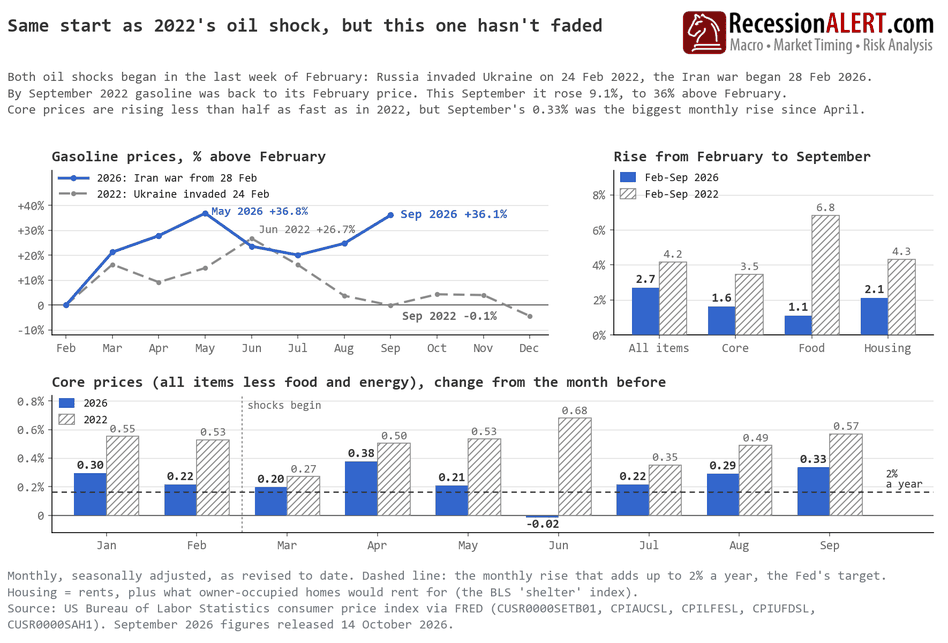
Two oil shocks, same start, and only one has let go. By September 2022 gasoline was back at its February price; this September it is 36% above it, just under its May high. Across all energy, both hits peaked at about 20% above February. Crude is the difference: Brent fell from $118 in March to below its pre-war price by July, then rebounded above $100 in September, and gasoline followed, jumping 9.1% — over half the month’s 0.6% rise in all prices. Outside energy the comparison flatters 2026: core prices, which exclude food and energy, rise at less than half 2022’s pace, but that gap predates both wars, and in each year core kept its pre-shock pace. Lately that pattern is breaking. Core’s pace over the last three months, 3.4% a year, is the fastest since August 2025, with shelter and goods firming. Food has not followed: it started far cooler than in 2022 and has slowed since, though record wholesale diesel, and the higher fuel costs reported in every Fed district, could yet reach the shelf. That leaves the Fed in the reverse of 2022’s position. Then the shock faded while it was still hiking, three points by September; now, one hike in from 3.75%, futures-implied odds of an October hike have jumped to roughly 47% from 22%. A shock that fades can be looked through — one that comes back after an intermission is far harder to call temporary.
What it means: Drivers should not count on the autumn relief they got in 2022; pump prices have eased only about 3% from their late-September high. For the economy, the strain is likeliest to show in spending by lower-income households, a group the Dallas Fed already reports turning cautious. For shares, rising odds of an October rate hike weigh most on growth and small-company stocks, the groups that fell about 2% on the report while healthcare rose. The case for calling this shock temporary returns only if pump prices fall back below $4 a gallon, last seen in mid-July.
Market Intelligence Brief (MIB) Ver. 19.79
For professional investors only. Not investment advice.
© 2026 RecessionALERT.com

Comments are closed.