
MARKET INTELLIGENCE BRIEF (MIB)
Friday, October 16, 2026
AI-financing fears sent the Nasdaq 100 down 2.50% to its lowest close since September 16 as CoreWeave sank 12% and the chip index fell for an eighth straight session, its longest streak since 2008. Software followed: PANW -7.63%, PLTR -7.22%, CRWD -7.02%. Brent touched $110 after a missile was intercepted near Saudi Arabia’s Yanbu hub. Import prices rose 1.1% in September, an 8.1% annual pace. Warsh gave no October signal and hold odds rose to 85.1%; the VIX jumped 21%.
TABLE OF CONTENTS
A. EXECUTIVE SUMMARY
B. MARKET DATA
C. HIGH-IMPACT STORIES (5)
D. MODERATE-IMPACT STORIES (8)
E. ECONOMY WATCH (5)
F. EARNINGS WATCH (0)
G. WHAT’S NEXT
H. CHART OF THE DAY
A. EXECUTIVE SUMMARY -> TOP
The AI trade’s stress moved from equity multiples into credit: CoreWeave’s bonds yielding above 15% and talk of a $500 billion cut to Anthropic’s expected IPO valuation sent the Nasdaq 100 down 2.50% to its lowest close since September 16. That repricing is harder to absorb with the 10-year at 5.090% and Brent at its highest settle since May 19, raising the cost of funding the buildout while September import prices run 8.1% above a year earlier. Rates were not the source of stress: the 2-year yield fell 4.2 bps as October hold odds rose to 85.1% after Fed Chair Warsh declined to pre-commit, so the VIX’s 21% jump reflected equities and oil, not the Fed. Breadth points to rotation rather than liquidation: six of 11 sectors rose and the NYSE Composite edged up 0.09%, as Energy (+2.59%), Consumer Defensive (+1.33%) and Utilities (+1.29%) absorbed flows out of Technology (-2.79%), now down 7.16% on the week.
• AI credit: CoreWeave sank 12%, about 25% over five sessions, after its bonds sold off this week and pushed yields above 15%. Reuters reported some Anthropic investors are discussing a valuation of about $1.5 trillion for its planned November IPO, against roughly $2 trillion previously expected. Broadcom fell 4.5% and the PHLX Semiconductor Index fell 3.8% in its eighth straight decline, its longest losing streak since 2008.
• Software and storage: Palo Alto (-7.63%), Palantir (-7.22%) and CrowdStrike (-7.02%) were the session’s three largest mega-cap decliners, with no company-specific catalyst identified, and Technology fell 2.79% to take its weekly loss to 7.16%. Seagate fell 7.50% and Western Digital fell 6.86% even as Wells Fargo, while cutting both targets, called the storage selloff overdone.
• Oil: Brent touched $110 and settled at $109.86, its highest since May 19, after a Saudi-led coalition intercepted a ballistic missile launched toward the Yanbu export hub; initial reports showed no damage. WTI rose 3.75%. Crude climbed through a 17 million barrel SPR exchange offer and an IEA fuel release, and Energy led all sectors at +2.59%.
• Inflation pipeline: September import prices rose 1.1% against a 0.8% forecast, lifting the annual rate to 8.1%, the largest since July 2022, with nonfuel import prices up 6.0% on the year. Industrial production rose 0.7% against 0.4% expected, and foreign investors bought a net $279.2 billion of long-term US securities in August, nearly four times forecasts.
• Fed: Chair Warsh said “I don’t prejudge meetings” in his last scheduled remarks before the blackout. The 2-year yield fell 4.2 bps to 4.715% while the 10-year held at 5.090%, October hold odds rose to 85.1% from 72.3%, and Barclays now expects 25 bp hikes in December and January. The VIX rose 21.39% to 19.98, its highest close since July 29.
• Credit and policy: A Figure Technology unit postponed a $346 million residential mortgage-backed deal and Freddie Mac was also reported delaying one, as investors demanded more yield, per Bloomberg. After the close, CMS proposed a Medicare Part D rule limiting pharmacy benefit manager remuneration, aimed at the PBM businesses inside CVS Health, Cigna and UnitedHealth.
1. AI Stress Has Moved From Multiples Into Credit — The week’s selloff is no longer only about valuations. CoreWeave’s bonds yielding above 15% are distressed-level pricing for a company building AI capacity, talk of a roughly $500 billion markdown to Anthropic’s expected IPO value carries the same verdict into private markets, and a postponed $346 million Figure mortgage bond shows rate turbulence pulling deals in consumer credit too. That matters for the index: per Reuters, the S&P 500’s roughly 12% gain this year has come mostly from AI-related technology while its median component is up only about 6%. The operating side is still committing capital, with Microsoft signing a 20-year deal for about 1,100 MW of new NiSource generation and SoftBank weighing an acquisition that could value Allied Universal at about $18 billion, so the market is questioning the financing more than the demand. Meta’s report after the close on Wednesday, October 21, is the first hyperscaler test of whether capital-spending plans hold.
2. Positioning, Not Fundamentals, Is Setting Prices — Cybersecurity companies are not the borrowers the AI-financing worry is about, yet Palo Alto, Palantir and CrowdStrike each fell more than 7%, and Palo Alto did so after growing fiscal fourth-quarter revenue 35% to $3.4 billion. Wells Fargo called the storage selloff overdone and Seagate still fell 7.50%. The money did not leave equities: six of 11 sectors rose, the NYSE Composite closed up 0.09%, and for the week the Dow gained 0.67% while the Nasdaq Composite fell 4.48%. That is a crowded-trade unwind inside technology, with Energy (+46.90% year to date), Consumer Defensive and Utilities absorbing the flows. The UK CMA’s proposal to give Microsoft’s business software, Copilot included, Strategic Market Status adds regulatory risk to the same AI-software layer, though no conduct requirements have yet been proposed.
3. The Inflation Pipeline Makes an October Hold a Pause, Not a Turn — Import prices up 8.1% on the year, with nonfuel goods up 6.0%, were the week’s third hot price report after consumer prices on Wednesday and producer prices on Thursday, and the nonfuel strength means oil is no longer the only source of pressure. Brent’s climb to its highest since May 19 through both an SPR exchange offer and an IEA fuel release says the policy supply levers are not capping crude, and a reported stall in US-Mexico talks would keep the 25% auto and 50% steel and aluminum tariffs in place. Growth gives no reason to ease either: industrial production rose 0.7% and GDPNow holds at 3.6%, though inventory building supplies roughly half of it. The front end priced out an immediate move, with October hold odds at 85.1%, but Barclays’ December and January hike calls show the path still points higher into the October 28 decision.
 — Leading economic indicators. Accurate market forecasts. Apply for membership at join.recessionalert.com
B. MARKET DATA -> TOP
An AI-financing scare spread from chips into software and met a crude spike: the Nasdaq 100 fell 2.50% while the Dow slipped only 0.34% and the NYSE Composite edged higher, a tech-only selloff rather than a broad liquidation. Reuters tied the rout to concerns that debt-laden AI infrastructure companies may struggle to repay borrowing as rates rise, with CoreWeave down 12% and its bonds yielding above 15%; cybersecurity names fell about 7% with no company-specific catalyst identified, and money rotated into energy, staples and utilities. Brent settled at its highest since May 19 on Middle East and Russian supply fears, while the VIX jumped 21% to its highest close since July 29 and the 2-year yield fell as odds of an October Fed hold rose.
CLOSING PRICES – Friday, October 16, 2026:
MAJOR INDICES
The damage was concentrated, not broad: the NYSE Composite closed up 0.09% and the Dow lost only 0.34%, while the Nasdaq 100 fell to its lowest close since September 16 and the Russell 2000 to its lowest since April 16. Dow Theory bull confirmation is entrenched at seven sessions, with both averages within 1.2% of their 10-session highs. Over 10 sessions the S&P 500 has outrun the Nasdaq 100 by 4.4 points, a broadening rotation now in its third session, and has outrun the Russell 2000 by 3.1 points, a large-over-small gap that emerges today.
| Index | Close | Change | %Move | Why It Moved |
|---|---|---|---|---|
| S&P 500 | 7,659.44 | -84.62 | -1.09% | AI-financing worries hit chips and software (Palo Alto, Palantir, CrowdStrike, AMD down 6-8%); six of 11 sectors still rose, led by Energy |
| Dow Jones | 52,002.41 | -175.28 | -0.34% | Cushioned by gains in energy, consumer staples and financials as money rotated out of tech |
| DJ Transportation | 19,879.83 | -226.85 | -1.13% | Fell with the broader tape on a day crude jumped more than 3%; no transport-specific catalyst identified |
| Nasdaq 100 | 29,187.55 | -748.04 | -2.50% | Chip index’s eighth straight decline (its longest losing streak since 2008, per Reuters) plus a software rout on AI-debt concerns; lowest close since September 16 |
| Russell 2000 | 2,721.37 | -45.90 | -1.66% | Small caps lagged as investors turned cautious into the weekend; lowest close since April 16 |
| NYSE Composite | 24,088.63 | +21.98 | +0.09% | Edged higher as energy, staples, utilities and financials offset tech; Reuters noted S&P 500 decliners roughly matched advancers |
VOLATILITY & TREASURIES
The VIX’s 21% jump came with a falling 2-year yield and a flat 10-year, a 4.8 bp bull steepening of the 2s10s curve to 37.5 bps. The front end priced less near-term Fed hike risk as October hold odds rose, even with Brent at its highest since May and September import prices up 1.1%. The dollar eased 0.27% and drew no haven bid.
| Instrument | Level | Change | Why It Moved |
|---|---|---|---|
| VIX | 19.98 | +3.52 (+21.39%) | Jumped on the tech selloff and oil spike heading into the weekend; highest close since July 29 |
| 10-Year Treasury Yield | 5.090% | +0.6 bps | Essentially flat; September import prices rose 1.1% (8.1% year on year, the largest 12-month rise since July 2022) |
| 2-Year Treasury Yield | 4.715% | -4.2 bps | Fell as CME FedWatch odds of an October hold rose to 85.1% from 72.3% (per Kiplinger); Barclays now expects hikes in December and January |
| US Dollar Index (DXY) | 101.78 | -0.28 (-0.27%) | Eased as front-end yields fell; on course for a weekly loss, per Reuters |
COMMODITIES
Precious metals barely moved against their prior settles despite a 21% VIX jump: gold rose 0.48% and silver was flat, so the day’s caution showed up in the 2-year yield rather than in bullion. Platinum’s 1.30% gain stood apart from flat copper. Bitcoin slipped 0.54%, tracking tech lower without a crypto-specific catalyst.
| Asset | Price | Change | %Move | Why It Moved |
|---|---|---|---|---|
| Gold | $4,189.92/oz | $+19.82 | +0.48% | Edged higher alongside a softer dollar; no discrete catalyst identified |
| Silver | $57.135/oz | $-0.021 | -0.04% | Flat against its prior settle; no discrete catalyst identified |
| Copper | $6.5658/lb | $+0.0093 | +0.14% | Little changed; no discrete catalyst identified |
| Platinum | $1,642.65/oz | $+21.15 | +1.30% | Outperformed the other metals; no discrete catalyst identified |
| Bitcoin | $81,637.00 | $-445.00 | -0.54% | Slipped with tech stocks; no crypto-specific catalyst identified |
ENERGY
WTI and Brent rose together, with the Brent-WTI spread steady near $8.10, and oil rallied while equities fell. Reuters tied the jump to Middle East and Russian supply fears: a missile intercepted near Saudi Arabia’s Yanbu export hub and a halted crude unit at Russia’s Ryazan refinery. Gas split across the Atlantic, with Henry Hub down 3.34% and Dutch TTF up 2.65% to its highest close in 128 sessions.
| Asset | Price | Change | %Move | Why It Moved |
|---|---|---|---|---|
| Crude Oil (WTI) | $101.64/bbl | $+3.67 | +3.75% | Middle East supply fears after a Saudi-led coalition intercepted a ballistic missile launched toward Yanbu (no damage reported); settled at $101.41; highest close since September 16 |
| Crude Oil (Brent) | $109.73/bbl | $+3.81 | +3.60% | Touched $110 and settled at $109.86, highest since May 19 (Reuters); Russia’s Ryazan refinery halted a crude unit, outweighing a US offer to exchange 17 million barrels from the strategic reserve |
| Natural Gas (Henry Hub) | $3.128/MMBtu | $-0.108 | -3.34% | Slumped on mixed weather forecasts and a warm NOAA outlook, per trade-press commentary; Thursday’s 67 Bcf storage build had come in below expectations |
| Natural Gas (Dutch TTF) | $29.178/MMBtu | $+0.753 | +2.65% | Rose with crude and a firmer euro; highest close in 128 sessions; no discrete catalyst identified |
S&P 500 SECTORS
Six of 11 sectors rose, but this was a rotation rather than a rally. Energy (+2.59%) extended a 46.90% YTD lead, while Technology (-2.79%) took its 1-week loss to 7.16%. Consumer Defensive (+1.33%) is the week’s best sector at +5.37%, and Utilities (+1.29%) joined it as defensives absorbed tech outflows. Healthcare (-0.68%) and Industrials (-0.44%) fell with tech.
| Sector | 1-Day | 1-Week | 1-Month | 3-Month | 6-Month | YTD | 12-Month |
|---|---|---|---|---|---|---|---|
| Energy | +2.59% | +4.47% | +5.02% | +14.52% | +17.33% | +46.90% | +52.23% |
| Consumer Defensive | +1.33% | +5.37% | +6.87% | +4.53% | +4.65% | +12.44% | +10.98% |
| Utilities | +1.29% | +1.59% | +1.66% | -5.97% | -9.33% | -1.59% | -8.62% |
| Basic Materials | +0.41% | -0.75% | -3.93% | +6.42% | -7.62% | +10.90% | +15.28% |
| Real Estate | +0.26% | +1.07% | -2.17% | -8.36% | -5.81% | +2.77% | -0.45% |
| Financial | +0.25% | +0.85% | -2.03% | -1.44% | +4.83% | +3.63% | +8.72% |
| Industrials | -0.44% | -2.49% | -2.11% | -3.92% | -6.69% | +6.62% | +7.57% |
| Healthcare | -0.68% | +2.20% | +2.09% | +6.80% | +12.17% | +10.42% | +18.48% |
| Consumer Cyclical | -1.16% | -1.52% | +0.21% | -2.95% | -7.28% | -7.34% | -6.13% |
| Communication Services | -2.22% | -1.27% | -1.37% | -1.38% | -4.22% | -0.09% | +5.22% |
| Technology | -2.79% | -7.16% | -2.85% | +4.42% | +14.29% | +21.82% | +20.42% |
TOP MEGA-CAP MOVERS:
GAINERS
| Company | Ticker | Close | Change | Why It Moved |
|---|---|---|---|---|
| RTX Corp | RTX | $193.92 | +3.73% | No discrete same-day catalyst identified; its $24.4B SM-6 Navy award dates to October 1, and Q3 results are due Tuesday, October 20. Commentary citing a rotation from tech into defense is unverified |
| Philip Morris International | PM | $205.20 | +2.65% | No discrete same-day catalyst identified; rebounded from Thursday’s reversal off a record intraday high, ahead of Q3 results on Wednesday, October 21 |
| Chevron | CVX | $224.99 | +2.59% | Tracked crude higher as Brent settled at its highest since May 19; Energy led all sectors |
| ExxonMobil | XOM | $178.98 | +2.46% | Tracked crude higher on Middle East and Russian supply fears |
| Coca-Cola | KO | $93.90 | +2.07% | Rose with the Consumer Defensive rotation out of tech; a Thursday report that KFC will switch its US soda supply to Coca-Cola from PepsiCo was also cited (unverified as a driver) |
DECLINERS
| Company | Ticker | Close | Change | Why It Moved |
|---|---|---|---|---|
| Palo Alto Networks | PANW | $342.00 | -7.63% | Cybersecurity sold off with software on AI-financing worries, alongside Zscaler and SentinelOne; no company-specific catalyst identified |
| Palantir Technologies | PLTR | $186.03 | -7.22% | Software rout on AI-financing worries unwound its breakout to a $213 record high; no company-specific catalyst identified |
| CrowdStrike | CRWD | $227.39 | -7.02% | Cybersecurity selloff alongside Palo Alto; no company-specific catalyst identified |
| Advanced Micro Devices | AMD | $528.75 | -5.95% | Chip selloff extended as the chip index fell 3.8% for an eighth straight session (per Reuters); no company-specific catalyst identified |
| Intel | INTC | $89.85 | -5.79% | Same semiconductor selloff on AI-financing and rate concerns; no company-specific catalyst identified |
— Institutional-grade intelligence for serious investors. Apply for membership at join.recessionalert.comC. HIGH-IMPACT STORIES -> TOP
BEARISH
1. AI-Financing Fears Deepen: CoreWeave Sinks 12%, the Chip Index Posts Its Eighth Straight Loss, and the Nasdaq 100 Falls 2.50% to Its Lowest Close Since September 16
The core facts:The Nasdaq 100 fell 2.50% to 29,187.55, its lowest close since September 16, while the S&P 500 lost 1.09% to 7,659.44 and the Dow slipped only 0.34% to 52,002.41. Reuters tied the selling to concerns that debt-laden AI infrastructure companies may not turn profits in time to repay their debts, particularly with borrowing costs expected to rise. CoreWeave slumped 12%, taking its five-session loss to about 25%, after its bonds sold off sharply this week and pushed yields above 15%. Broadcom fell 4.5% and the PHLX Semiconductor Index sank 3.8% in its eighth straight decline, its longest losing streak since 2008, per Reuters; AMD fell 5.95% and Intel 5.79%. Adding to the pressure, Reuters reported that some current and prospective Anthropic investors are discussing a valuation of about $1.5 trillion for its planned November IPO, against roughly $2 trillion previously expected. For the week the S&P 500 fell 1.95% and the Nasdaq Composite 4.48%, their deepest weekly declines since June, while the Dow gained 0.67%.
Why it matters:The AI trade’s stress has moved from equity multiples into credit pricing: a CoreWeave bond yielding above 15% is a market charging distressed-level rates to the companies building AI capacity, and investors discussing a $500 billion markdown in Anthropic’s expected IPO value carries the same verdict into private markets. That matters for the index because, per Reuters, the S&P 500’s roughly 12% gain this year has come mostly from AI-related technology while its median component is up only about 6%. With the 10-year Treasury at 5.090%, the cost of financing the buildout is rising just as investors question its returns, and the pressure now falls on whether the largest spenders hold their capital-expenditure plans.
What to watch:Meta Platforms’ third-quarter report after the close on Wednesday, October 21, the first hyperscaler update since the selloff began, for any change to its AI capital-spending outlook.
BEARISH
2. Software and Cybersecurity Stocks Crater as AI-Funding Jitters Spread: Palo Alto Falls 7.63%, Palantir 7.22% and CrowdStrike 7.02%
The core facts:The selloff spread from chips into software. Palo Alto Networks fell 7.63%, Palantir 7.22% and CrowdStrike 7.02%, the three largest declines among mega-caps, and SentinelOne lost 7.66% and Zscaler 5.92%. The First Trust NASDAQ Cybersecurity ETF fell 4.55%, extending a pullback from record highs set earlier this month. No company-specific catalyst was identified; Yahoo Finance attributed the move to questions about how AI spending gets funded. Technology was the weakest S&P 500 sector at -2.79%, taking its weekly loss to 7.16%, and Communication Services fell 2.22%. Money rotated rather than left: six of 11 sectors rose, led by Energy (+2.59%), Consumer Defensive (+1.33%) and Utilities (+1.29%), and the NYSE Composite closed up 0.09%.
Why it matters:Cybersecurity companies are not the borrowers the AI-financing worry is about, which makes their fall the clearest sign the market is de-rating the whole AI-linked growth complex rather than pricing specific credit risk. Palo Alto grew fiscal fourth-quarter revenue 35% to $3.4 billion, per Yahoo Finance, and still fell more than the Nasdaq 100, so fundamentals are not setting prices this week; positioning is. The rotation into energy, staples and utilities, with the NYSE Composite higher, points to a crowded-trade unwind inside technology rather than a broad liquidation.
What to watch:IBM’s report after the close on Wednesday, October 21, the week’s main read on enterprise software demand.
BEARISH
3. Brent Touches $110 and Settles at Its Highest Since May 19 After a Missile Is Intercepted Near Saudi Arabia’s Yanbu Export Hub
The core facts:Brent touched $110 a barrel for the first time since May and settled at $109.86, its highest since May 19, per Reuters; it closed at $109.73, up 3.60%, and WTI at $101.64, up 3.75%. A Saudi-led coalition said it intercepted and destroyed a ballistic missile launched toward the Red Sea port of Yanbu; consultants Rapidan Energy Group said initial reports showed no damage to Yanbu’s infrastructure. Russia’s Ryazan refinery suspended a primary crude distillation unit after Thursday’s drone attack, two industry sources told Reuters, and on Friday Ukrainian drones struck a facility in the Surgut district of Khanty-Mansi, identified by residents as Gazprom’s Surgut condensate plant, according to The Moscow Times; damage had not been assessed. The rally ran through new supply: the Department of Energy issued a request for proposals to exchange up to 17 million barrels from the Strategic Petroleum Reserve, and the International Energy Agency agreed on Thursday to release more than 20 million barrels of fuel. Brent rose 4.9% for the week and WTI 10.4%, per Reuters. Energy led all sectors at +2.59%, with Chevron up 2.59% and ExxonMobil 2.46%.
Why it matters:Yanbu is Saudi Arabia’s main route for moving crude around the Strait of Hormuz, where attacks have surged over the past 10 days, so a strike aimed at it threatens the bypass the market has been relying on. That crude climbed through both an emergency-reserve offer and an IEA fuel release shows the policy supply levers are no longer capping prices. Higher oil feeds straight into an inflation picture that already shows import prices up 8.1% from a year earlier, and, as U.S. Bank Wealth Management’s Rob Haworth told Reuters, high oil prices tend to weigh on the price-to-earnings multiples of stocks.
What to watch:Whether Brent holds above $110 on any further Gulf incident, and the OPEC+ meeting on November 1.
UNCERTAIN
4. Warsh Gives No Signal on October in His Last Remarks Before the Blackout; the 2-Year Yield Falls 4.2 bps and the VIX Jumps 21% to Its Highest Close Since July 29
The core facts:Fed Chair Kevin Warsh, speaking with IMF Managing Director Kristalina Georgieva at the IMF and World Bank meetings in Bangkok, said “I don’t prejudge meetings” and that the world had “broadly conformed” to the Fed’s expectations since September, according to Euronews. He described global rate increases as a “synchronous tightening” with “no free riders” and voiced optimism about US economic strength, per Reuters. It was his last scheduled appearance before the Fed’s quiet period begins Saturday, ahead of the October 28 decision. The 2-year Treasury yield fell 4.2 bps to 4.715% while the 10-year was flat at 5.090%, steepening the 2s10s curve by 4.8 bps to 37.5 bps. CME FedWatch odds of an October hold rose to 85.1% from 72.3% (per Kiplinger), and Barclays now expects 25 bp hikes in both December and January, per Reuters. The VIX rose 21.39% to 19.98, its highest close since July 29, and the dollar index eased 0.27%. September import prices, out the same morning, rose 1.1%, an 8.1% annual pace.
Why it matters:The market took Warsh’s refusal to pre-commit as no push for an immediate follow-up to September’s hike, and moved the next increase out to December and January rather than removing it. That reading leaves the tightening path intact after the week’s third hot price report, following consumer prices on Wednesday and producer prices on Thursday, so an October hold would be a pause rather than a turn. The combination of a rallying front end, a flat long end and a 21% VIX jump says Friday’s risk-off was about equities, AI financing and oil, not about rates.
What to watch:The FOMC decision at 2:00 PM ET on Wednesday, October 28, and whether October hold odds stay above 80% through the blackout as hike pricing for December builds.
UNCERTAIN
5. US-Mexico Tariff Talks Stall as Commerce Secretary Lutnick Resists Cutting Auto, Steel and Aluminum Duties, WSJ Reports
The core facts:The Wall Street Journal reported Thursday evening, citing people familiar with the negotiations, that US-Mexico trade talks stalled after Commerce Secretary Howard Lutnick objected to significant cuts to the 25% tariff on Mexican cars and the 50% tariffs on steel, aluminum and derived products, all imposed on national-security grounds. The two sides had been nearing a deal that would lower US tariffs in exchange for Mexican concessions. The talks are led by US Trade Representative Jamieson Greer and Economy Minister Marcelo Ebrard, and the Journal reported tension between Lutnick and Greer. Officials from both countries denied the talks had stalled, according to Mexico News Daily. On Friday, Mexico’s Economy Ministry clarified that its new five-year zero-tariff break on imported car-assembly parts applies only to automakers already producing in Mexico; industry data reviewed by Reuters points to 11 eligible carmakers, including GM, Ford, Stellantis and Toyota.
Why it matters:A bilateral deal is the gateway to renewing the USMCA, which is under review, so a stall keeps 25% and 50% national-security tariffs on the most integrated supply chain US automakers and metals users depend on. That lands while import prices are already rising at an 8.1% annual pace. Mexico’s decision to limit the parts break to established producers shuts out Chinese entrants, a step aligned with US concerns, which suggests Mexico is still positioning for a deal even as Washington’s own negotiators disagree.
What to watch:Any statement from USTR or Mexico’s Economy Ministry on a revised timeline, and GM’s third-quarter report on Tuesday, October 20, for its tariff-cost outlook.
— Quantifying recession risk so you don’t have to guess. Apply for membership at join.recessionalert.comD. MODERATE-IMPACT STORIES -> TOP
BEARISH
6. Mortgage-Bond Sales Put on Hold as Investors Demand More Yield; Figure Postpones a $346 Million RMBS
The core facts:A growing list of mortgage lenders is holding off on offerings of bonds backed by home and commercial-property loans as investors demand more compensation amid turbulence in rates markets, Bloomberg reported on Friday afternoon. A unit of Figure Technology Solutions postponed a $346 million residential mortgage-backed security it had planned to price on Thursday, after struggling to attract enough investor demand, according to people familiar with the matter. Bloomberg’s headline names Freddie Mac as also delaying a mortgage-bond deal; its size was not disclosed in the available text. The postponements came in a week the 10-year Treasury yield held above 5%, closing Friday at 5.090%.
Why it matters:Securitization is how non-bank lenders recycle capital into new mortgages; when spreads widen enough to pull deals, lenders must carry loans longer on warehouse lines or charge borrowers more, tightening mortgage credit in a housing market already facing 30-year rates of about 7.40%. It is also the second pocket of credit to show strain this week, after the selloff in CoreWeave’s bonds, which suggests the repricing is spreading beyond AI infrastructure into the plumbing of consumer credit.
What to watch:Whether Figure and Freddie Mac return to market next week, and Monday’s NAHB builder sentiment index for any sign the funding squeeze is reaching housing.
UNCERTAIN
7. CMS Proposes a Medicare Part D Rule Limiting PBM Remuneration and Requiring Price Transparency, With Disgorgement for Violations
The core facts:The Centers for Medicare & Medicaid Services placed a proposed rule on public inspection at 4:15 PM ET Friday implementing section 6224 of the Consolidated Appropriations Act, 2026, “Modernizing and Ensuring Pharmacy Benefit Manager Accountability”; it publishes in the Federal Register on October 20. The rule would set new and enhanced limits on the remuneration pharmacy benefit managers and their affiliates may receive for services tied to Part D drugs, require data reporting to plan sponsors and CMS, require pricing transparency for price-guarantee arrangements, require PBMs to disclose to sponsors the terms of certain agreements with drug manufacturers, and allow disgorgement of funds to CMS for remuneration violations. It also cuts the generic copay to $0 from $1 for about 6 million full-benefit dual-eligible enrollees from plan year 2028, and sets new provider-directory accuracy rules for Medicare Advantage from contract year 2028. Comments are due by 5:00 PM EST on December 15.
Why it matters:The largest Part D PBMs sit inside CVS Health, Cigna and UnitedHealth, so the rule goes to the profit pools of three of the biggest names in managed care. The statute was enacted earlier in the year, so the market-relevant content is in the detail: how tightly CMS defines permissible remuneration and how hard disgorgement bites. Because the rule was filed after the close, the sector has not yet traded on it.
What to watch:Monday’s trading in CVS, Cigna and UnitedHealth once the full text is digested, and the December 15 comment deadline.
BULLISH
8. EU Regulators Recommend Approval of Lilly’s Oral GLP-1 Pill Foundayo for Obesity and Type 2 Diabetes
The core facts:The European Medicines Agency’s human-medicines committee (CHMP) recommended approval of Eli Lilly’s Foundayo (orforglipron), a once-daily oral GLP-1 medicine, for weight management in adults with obesity, or overweight with at least one weight-related condition, and for type 2 diabetes. In two weight-management studies of 4,740 adults, patients lost roughly 5% to 11% of body weight at 72 weeks depending on dose, against about 2% to 2.5% on placebo. In four diabetes studies of 3,765 adults, Foundayo cut HbA1c by about 1.2 to 1.9 percentage points, against 0.4 to 0.8 for placebo, 0.8 for dapagliflozin and 1.2 to 1.5 for oral semaglutide. “The opinion adopted by the CHMP is an intermediary step on Foundayo’s path to patient access,” the EMA said; the European Commission now decides on authorization, and each member state sets pricing and reimbursement.
Why it matters:A pill removes the injection and cold-chain constraints that have limited GLP-1 supply and uptake, and it opens Europe to Lilly’s next-generation obesity franchise. The diabetes data put Foundayo at or above oral semaglutide on blood-sugar control, which matters for share in a market where Novo Nordisk’s oral product is the incumbent. The recommendation landed on a day Healthcare fell 0.68%, so it supports Lilly’s growth case without having moved the sector.
What to watch:The European Commission’s authorization decision, which normally follows a CHMP opinion within about two months.
UNCERTAIN
9. UK Competition Regulator Proposes “Strategic Market Status” for Microsoft’s Business Software, Putting Copilot, Security Bundling and Cloud Licensing in Scope
The core facts:The UK Competition and Markets Authority proposed designating Microsoft with Strategic Market Status in its business-software ecosystem, covering Word, Excel, Outlook, PowerPoint, Teams and Copilot plus its security, server and operating-system products. Its findings span PC operating systems, productivity suites, security software, server operating systems and relational databases. The CMA’s priority areas for possible intervention are whether customers can freely choose AI tools and rivals can compete fairly with Copilot, whether Microsoft’s bundling of security products restricts choice, and whether its licensing practices limit customers’ ability to choose which cloud hosts their software. “Organisations should be able to choose the products that work best for them, switch provider when they want to,” said CMA Chief Executive Sarah Cardell. The CMA will consult before a final decision, due by a February 2027 statutory deadline.
Why it matters:A designation would let the CMA impose conduct requirements on Microsoft’s most profitable franchise, and the roadmap aims squarely at Copilot, the product carrying Microsoft’s case for monetizing AI, and at licensing terms that steer customers toward Azure. No requirements have been proposed yet, so the near-term earnings effect is nil, but it adds regulatory risk to the AI-software layer on a day that layer was already being de-rated.
What to watch:The CMA’s final designation decision, due by February 2027, and whether its first proposed conduct requirements target Copilot.
UNCERTAIN
10. SoftBank Weighs an $18 Billion Acquisition of Security-Services Provider Allied Universal as Son Pushes Into AI-Powered Robots
The core facts:SoftBank Group is considering an acquisition of Allied Universal, a US security-services provider, in a deal that could value the company at about $18 billion, Bloomberg News reported on Friday, citing people familiar with the matter. Deliberations are preliminary and no final decisions have been made, including on price; SoftBank declined to comment, per Reuters. The deal would fit founder Masayoshi Son’s focus on AI-powered robots and on the infrastructure AI needs: Allied provides security staffing for businesses, venues and events and has a growing role in data-center development and operation, and SoftBank would eventually use robots to replace some security staff. SoftBank completed the final phase of its planned $30 billion investment in OpenAI this month.
Why it matters:It is a large bet on applying AI to a labor-intensive service business rather than on software or chips, and it shows one of the AI buildout’s biggest financiers still committing capital in the same week investors marked down AI credit and private valuations. A deal on this scale would also add to SoftBank’s leverage at a time when the market is questioning how AI spending gets funded.
What to watch:Whether SoftBank confirms talks, and how any deal would be financed.
BEARISH
11. Wells Fargo Slashes Seagate and Western Digital Targets While Calling the Storage Selloff Overdone; Both Stocks Fall About 7%
The core facts:Wells Fargo analyst Joseph Quatrochi cut his Seagate price target to $865 and his Western Digital target to $450, TipRanks reported on Friday, while arguing the selloff in storage stocks was overdone. He said Toshiba’s roughly $380 million hard-drive expansion in the Philippines was “misunderstood” and not yet proven, saw no medium-term threat to hard-drive demand exceeding supply, and expects both companies to reaffirm nearline shipment growth of about 25%, possibly about 30%, driven by higher-capacity drives. Seagate closed down 7.50% at $639.01 and Western Digital down 6.86% at $332.00, according to MarketBeat data. Before Friday both stocks were down 23% since the start of the quarter, against an 8% decline in the Philadelphia Semiconductor Index, per TipRanks.
Why it matters:Storage has been one of the clearest beneficiaries of AI data-center spending, and a bullish analyst cutting targets by 27% to 38% reflects multiple compression rather than a demand downgrade. The stocks fell anyway, joining chips and CoreWeave in a de-rating of AI hardware that is now running ahead of any change in reported demand.
What to watch:Western Digital’s results after the close on Thursday, October 22, and Seagate’s on October 27, for whether nearline growth guidance holds near 25%.
BULLISH
12. US Treasury Presses Beijing on Market Access for Mastercard, Visa and Citigroup in Bangkok Talks
The core facts:A Treasury delegation led by Deputy Secretary Francis Brooke pressed Chinese officials on market access for Mastercard, Visa and Citigroup in at least two bilateral meetings with the People’s Bank of China and China’s finance ministry on the sidelines of the G20 and IMF-World Bank meetings in Bangkok this week, a US Treasury official told CNBC on Friday. The official said regulatory approval was part of the agreement reached when President Xi Jinping made a state visit to Washington last month, and that the Bangkok meetings continued implementation. A pending approval would let Mastercard, which now processes yuan card payments through a joint venture with NetsUnion Clearing, operate independently; Citigroup is seeking a wholly owned securities licence for which it applied in late 2021. The talks follow China’s October 13 approval for Visa to begin preparing a wholly owned domestic card-clearing business. Citigroup and Mastercard declined to comment.
Why it matters:Independent clearing rights in China would open the world’s largest card-payments market to the US networks on their own terms after decades of exclusion, and a securities licence would give Citigroup onshore brokerage and underwriting. Eurasia Group’s Dan Wang called licensing a “limited concession,” but the follow-through suggests US-China relations remain on an implementation track ahead of the next Trump-Xi meeting.
What to watch:The Trump-Xi meeting at the APEC summit in Shenzhen in November, and any PBOC approval for Mastercard or a securities licence for Citigroup before it.
BULLISH
13. Microsoft Signs a 20-Year Power Agreement With NiSource for About 1,100 MW of New Generation and 600 MW of Battery Storage
The core facts:NiSource announced a 20-year agreement with Microsoft under which about 1,100 MW of new generation will be added to its GenCo-owned pool, plus 600 MW of battery storage under a long-term tolling agreement to be built by an affiliate of AGP Group, with Microsoft expected to begin taking service in 2028. NiSource expects total savings for its NIPSCO electric customers of about $1.75 billion, or as much as $140 per customer a year, adding to $1.4 billion previously disclosed from its data-center contracts. The agreement requires regulatory approvals. “Affordability is not separate from economic development,” said NiSource CEO Lloyd Yates, and Microsoft’s Jeff Riles said the company “has always been committed to paying our own way.”
Why it matters:A hyperscaler signing a two-decade power commitment in the same week AI financing came under pressure is evidence that data-center build plans are still moving forward at the utility level. The structure, in which the data-center customer funds new capacity and existing ratepayers are promised savings, is designed to defuse political backlash over power bills, the issue most likely to slow approvals for new AI load.
What to watch:Indiana regulators’ review of the agreement, and NextEra’s report on Wednesday, October 21, for its own data-center contracting pipeline.
— Separating signal from noise since 2007. Apply for membership at join.recessionalert.comE. ECONOMY WATCH -> TOP
The week closed with activity and prices both running hot, the mix that has Fed officials arguing for further hikes. Import prices rose 1.1% in September and 8.1% over the year, the steepest pace since 2022, with nonfuel goods up 6.0%, carrying Thursday’s 1.3% producer-price jump further down the pipeline. Output kept pace: industrial production rose 0.7%, and GDPNow holds third-quarter growth at 3.6%, though roughly half of that estimate comes from inventory building. The front end leaned the other way, with the 2-year yield down 4.2 bps as CME FedWatch odds of an October hold rose to 85.1% from 72.3%, so the hot data has not yet moved pricing for the October 27-28 meeting.
Import Prices Jump 1.1% in September; 8.1% Annual Pace Is the Steepest Since July 2022 (BLS, Oct 16)
What they’re saying:U.S. import prices rose 1.1% in September against a 0.8% consensus, lifting the 12-month rate to 8.1%, the largest since the year ended July 2022. Fuel import prices climbed 4.8% on the month and 34.5% on the year, while nonfuel import prices rose 0.7%, taking their annual gain to 6.0%, the largest since April 2022. Export prices rose 2.2% against a 1.0% forecast, an 11.6% annual pace, with agricultural exports up 2.6%, their largest monthly rise since November 2022.
The context:The nonfuel reading is the one that matters for policy: a 6.0% annual rise in imported goods outside energy means the oil shock is no longer the only source of pipeline pressure, following Thursday’s 1.3% producer-price jump and September’s 3.7% CPI. On the day, the 10-year yield was essentially flat at 5.090% (+0.6 bps) while the 2-year fell 4.2 bps to 4.715%, so the beat did not add to near-term hike pricing. Brent settled 3.6% higher at its highest since May 19, which keeps the fuel component under upward pressure into October.
What to watch:The Fed’s October 27-28 decision, the first since import, producer and consumer prices all accelerated in September; and whether Brent holds near $110, which would carry fuel import inflation into the October report.
Industrial Production Rises 0.7% in September, Beating 0.4% Forecast, as Utilities Output Jumps 3.5% (Federal Reserve, Oct 16)
What they’re saying:Industrial production increased 0.7% in September against a 0.4% consensus, after edging up 0.1% in August. Manufacturing output rose 0.3%, mining 0.2% and utilities 3.5%. Capacity utilization moved up to 76.9%, still 2.5 percentage points below its 1972-2025 average, and total output stood 2.2% above its year-earlier level. Prior months were revised higher, with August’s index raised to 103.3 from 103.1.
The context:Utilities supplied much of the headline beat, but a 0.3% manufacturing gain plus upward revisions confirms the factory strength flagged by Thursday’s 25.5 Empire State reading. Capacity utilization below its long-run average means factories are not yet a source of capacity-driven inflation, which tempers the read-through from strong output to the Fed’s hike calculus.
What to watch:The Atlanta Fed’s GDPNow update on Tuesday, October 20, which will fold in this report and Tuesday’s housing starts; capacity utilization approaching its long-run average would strengthen the inflation case for further hikes.
Foreign Investors Buy a Net $279.2 Billion of Long-Term U.S. Securities in August, Nearly Four Times Forecasts (U.S. Treasury, Oct 16)
What they’re saying:Treasury International Capital data show overall net foreign purchases of long-term U.S. securities of $279.2 billion in August after adjustments, against a $75.2 billion consensus and July’s net sales of $27.9 billion. The total net TIC inflow was $199.8 billion, of which $178.5 billion came from private investors and $21.3 billion from official institutions. Foreign residents cut their holdings of Treasury bills by $47.8 billion.
The context:The swing from July’s net selling to heavy August buying, led by private rather than official investors, shows foreign demand for U.S. long-term assets intact even as yields climbed. The data are two months old and predate September’s Fed hike, but the shift out of bills and into longer maturities matters for a market where the 10-year yield closed Friday at 5.090%.
What to watch:Whether the 10-year yield holds above 5%; sustained foreign buying at these levels would limit further upward pressure on long-term rates.
GDPNow Holds Q3 Growth Estimate at 3.6% as Consumer Spending Nowcast Rises to 3.6% (Atlanta Fed, Oct 15)
What they’re saying:The Atlanta Fed’s GDPNow model puts third-quarter real GDP growth at a 3.6% annualized rate as of October 15, unchanged from October 8 after rounding. After Thursday’s retail sales and inventories reports, the nowcast of third-quarter real consumer spending growth rose to 3.6% from 3.4%, partly offset by a dip in the estimated contribution of inventory investment to 1.87 percentage points from 1.96.
The context:A 3.6% pace is well above trend and gives the Fed no growth-side reason to pause tightening. The composition is the caveat: inventory building accounts for 1.87 points, roughly half of the estimate, a contribution that typically reverses in later quarters, while the consumer upgrade came despite a soft 0.1% retail sales control group.
What to watch:The next GDPNow update on Tuesday, October 20, after September housing starts and building permits.
Business Sales Rise 1.1% in August, Outpacing 0.4% Inventory Gain; Inventory-to-Sales Ratio Falls to 1.33 (Census Bureau, Oct 15)
What they’re saying:Combined manufacturers’ shipments and distributive trade sales rose 1.1% in August to $2,123.5 billion and were 10.2% above August 2025. Business inventories rose 0.4% to $2,818.8 billion, in line with forecasts, and were up 4.6% on the year. The inventories-to-sales ratio stood at 1.33, down from 1.40 a year earlier.
The context:Sales running well ahead of stockpiles leaves inventories lean, which supports continued restocking. The figures are not adjusted for price changes, so with producer prices accelerating, part of the 10.2% annual sales gain reflects inflation rather than volume.
What to watch:Tuesday’s GDPNow update, which tracks the inventory contribution to third-quarter growth.
— Know the probability before the market prices in the risk. Apply for membership at join.recessionalert.comF. EARNINGS WATCH -> TOP
YESTERDAY AFTER THE BELL (Markets Reacted Today)
No major earnings yesterday after the bell from companies with >$100B market cap.
TODAY BEFORE THE BELL (Markets Already Reacted)
No major earnings before the bell from companies with >$100B market cap.
TODAY AFTER THE BELL (Markets React Tomorrow)
No major earnings after the bell from companies with >$100B market cap.
WEEK AHEAD PREVIEW:
Q3 2026 earnings season is 9% complete and enters its first heavy week, with the first mega-cap technology reports arriving after this week’s AI-financing selloff. Twenty-seven companies worth more than $100 billion report over the next five sessions, twelve of them on Wednesday, October 21. No company above $100 billion reports on Monday, October 19.
GE Aerospace (GE) — BMO, Tuesday, October 20 — EPS est. $2.01. Aftermarket services growth and engine delivery rates against supply-chain constraints.
RTX (RTX) +3.73% — BMO, Tuesday, October 20 — EPS est. $1.78. Missile and munitions demand linked to the Gulf conflict, and commercial aftermarket at Pratt & Whitney and Collins.
Netflix (NFLX) -2.8% — AMC, Tuesday, October 20 — EPS est. $0.82. Margin guidance after the cut of about 6% of staff, advertising-tier momentum, and content strategy under newly appointed chief content officer Peter Rice.
Intuitive Surgical (ISRG) — AMC, Tuesday, October 20 — EPS est. $2.65. Procedure growth and system placements.
Chubb (CB) — AMC, Tuesday, October 20 — EPS est. $6.79. Catastrophe losses and commercial pricing, after Progressive’s revenue miss.
Capital One (COF) — AMC, Tuesday, October 20 — EPS est. $5.50. Card credit quality and consumer spending trends, after September’s control-group retail sales rose only 0.1%.
Meta Platforms (META) — AMC, Wednesday, October 21 — EPS est. $6.58. Any change to AI capital-spending plans, the first hyperscaler read since the AI-financing selloff and the reported markdown in Anthropic’s IPO valuation.
Tesla (TSLA) — AMC, Wednesday, October 21 — EPS est. $0.45. Automotive gross margin after third-quarter deliveries of 486,532 beat expectations, plus Robotaxi scale-up and the Optimus timeline.
Lam Research (LRCX) — AMC, Wednesday, October 21 — EPS est. $2.18. Wafer-fab equipment outlook and China revenue mix, with the chip index on an eight-session losing streak.
Philip Morris International (PM) +2.65% — BMO, Wednesday, October 21 — EPS est. $2.30. Smoke-free volume growth and currency effects, after the company guided the quarter below consensus.
Thermo Fisher Scientific (TMO) — BMO, Wednesday, October 21 — EPS est. $6.40. Life-science tools demand and pharma spending.
Texas Instruments (TXN) — AMC, Wednesday, October 21 — EPS est. $2.42. Whether analog price increases are flowing through, and automotive and industrial demand.
IBM (IBM) — AMC, Wednesday, October 21 — EPS est. $2.86. Whether large enterprise deals delayed in the second quarter closed in the third, and software growth after this week’s software selloff.
Abbott Laboratories (ABT) — BMO, Wednesday, October 21 — EPS est. $1.42. Medical-device growth and diagnostics trends.
NextEra Energy (NEE) — BMO, Wednesday, October 21 — EPS est. $1.18. Data-center power contracting and renewables backlog, with the 10-year yield above 5%.
Danaher (DHR) — BMO, Wednesday, October 21 — EPS est. $1.92. Core revenue growth after the company cut its 2026 core growth forecast in July.
AT&T (T) — BMO, Wednesday, October 21 — EPS est. $0.60. Wireless subscriber trends amid SpaceX competition concerns, and the agreed $2 billion sale of AT&T Mexico.
CME Group (CME) — BMO, Wednesday, October 21 — EPS est. $2.98. Futures volumes in a quarter of Fed repricing and energy volatility. Market cap $105.67B, within 5% of the $100B threshold.
Procter & Gamble (PG) — BMO, Thursday, October 22 — EPS est. $1.88. Volume versus pricing as producer prices jump, with Consumer Defensive the week’s best-performing sector.
Union Pacific (UNP) — BMO, Thursday, October 22 — EPS est. $3.47. Freight volumes and fuel-cost pass-through with WTI above $100, plus the pending Norfolk Southern merger review.
Blackstone (BX) — BMO, Thursday, October 22 — EPS est. $1.28. Real-estate and private-credit fundraising and deployment with the 10-year above 5%, and exposure to AI data-center financing.
Valero Energy (VLO) — BMO, Thursday, October 22 — EPS est. $20.90. Refining margins and diesel output, with US distillate stocks 12% below their five-year average.
Lockheed Martin (LMT) — BMO, Thursday, October 22 — EPS est. $7.52. Munitions and missile-defense demand from the Gulf conflict, and F-35 delivery rates.
Spotify Technology (SPOT) — BMO, Thursday, October 22 — EPS est. $3.15. Subscriber growth and operating margin. Market cap $109.21B; trades as ordinary shares, not an ADR.
Newmont (NEM) — AMC, Thursday, October 22 — EPS est. $1.95. Realised gold prices and cost guidance with gold near $4,190 an ounce.
Western Digital (WDC) — AMC, Thursday, October 22 — EPS est. $4.08. Nearline shipment growth and AI data-center storage demand, after Wells Fargo cut its target to $450 and the stock fell about 7% on Friday.
American Express (AXP) — BMO, Friday, October 23 — EPS est. $4.58. Billed business growth against the second quarter’s 9% FX-adjusted pace, and whether the company holds its raised 10% full-year revenue growth guidance as rates and fuel prices climb.
Excluded as an ADR: SAP (SAP, $258.88B, AMC October 21). Below the threshold: Elevance Health ($92.88B, October 21) and CSX ($90.18B, October 21). The next FactSet scorecard update is due Friday, October 23.
— US market commentary trusted by family offices and institutions. Apply for membership at join.recessionalert.comG. WHAT’S NEXT -> TOP
UPCOMING RELEASES:
| Date | Event | Why It Matters |
|---|---|---|
| Mon, Oct 19 | NAHB Housing Market Index, Oct (expected 31, prior 32) | The first housing read since mortgage lenders began pulling bond deals, including Figure’s $346 million RMBS, as investors demanded more yield. With the MBA’s 30-year rate at 7.5% and the 10-year above 5%, a further drop would show the funding squeeze reaching builders. |
| Tue, Oct 20 | Housing Starts and Building Permits, Sep (expected 1.30M and 1.40M; prior 1.275M and 1.403M) | Measures whether higher mortgage rates and a tighter securitization market are cutting into construction. Permits are the forward-looking half. |
| Tue, Oct 20 | Atlanta Fed GDPNow, Q3 (currently 3.6%) | Folds in Friday’s 0.7% industrial production beat and September housing starts. Inventory building supplies 1.87 points of the current 3.6% estimate, so the composition matters as much as the headline. |
| Wed, Oct 21 | EIA Crude Oil and Gasoline Stocks (prior crude -8.557M, gasoline +3.518M; API on Tue, Oct 20, prior -11.1M) | With Brent at its highest settle since May 19 and attacks around the Strait of Hormuz surging, another large crude draw would add domestic tightness to Gulf supply risk. |
| Thu, Oct 22 | Initial Jobless Claims (expected 200K, prior 199K) | Claims near 200,000 would give the Fed no employment-side reason to step off its tightening path, six days before the October 28 decision. |
| Fri, Oct 23 | University of Michigan Consumer Sentiment, Final Oct (expected 46.3, prior 48.1) | How households are absorbing $100-plus oil and 8.1% import inflation, in the last release on next week’s calendar before the Fed’s October 27-28 meeting. |
KEY QUESTIONS:
1. Will Meta’s third-quarter report after the close on Wednesday, October 21, the first hyperscaler update since the selloff began, hold its AI capital-spending outlook, or confirm that rising borrowing costs are starting to slow the buildout?
2. With import, producer and consumer prices all accelerating in September and October hold odds at 85.1%, does the blackout leave markets comfortable with a pause on Wednesday, October 28, or does further oil-driven inflation pull hike pricing forward from December?
3. Can Saudi Arabia’s Yanbu route keep crude moving around a Strait of Hormuz under attack, or does another Gulf incident push Brent through $110 despite the 17 million barrel SPR exchange offer and the IEA’s fuel release?
— US market commentary trusted by family offices and institutions. Apply for membership at join.recessionalert.comH. CHART OF THE DAY -> TOP
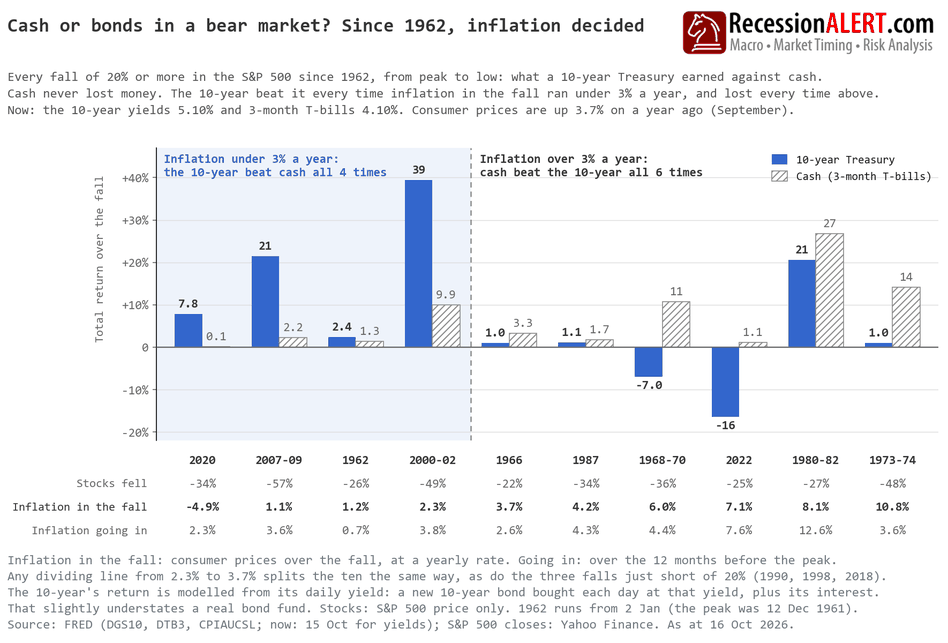
Two bear markets began with inflation at 3.6% and ended at opposite poles: in 1973-74 cash beat the 10-year Treasury by 13 points, in 2007-09 the 10-year beat cash by 19. The starting point decided nothing. What decided all ten falls since 1962 was inflation during the fall: under 3% a year the 10-year won every time, by 14 points on average; above it cash won every time, by nearly 10; and the three falls just short of 20% split the same way. The bond’s own yield did the work. It fell through every low-inflation fall, lifting the bond’s price, and rose through every inflationary one, sinking it. It rose even in 1980-82, when T-bill rates slid five points: short rates follow the Fed, but long rates answer to inflation, and with prices rising 8% a year lenders demanded higher yields. Average all ten and the 10-year’s edge over cash is three-hundredths of a point, a dead heat: the protection belongs not to the bond but to the kind of bear that arrives. Nor does today’s extra point of yield buy a cushion — in 2022 the 10-year paid 1.5 points more than cash and lost by 17.5. Consumer prices up 3.7% now say no more than 3.6% did in 1973. The bond hedge is not a reading taken at the top — it is a wager on how the fall ends.
What it means: For savers, T-bills at 4.1% sit just ahead of prices rising 3.7%. The 10-year’s 5.1% should beat cash through a downturn only if that downturn brings inflation back under 3%. Bonds held to cushion falling shares will likely do so only in a slump that keeps inflation low; in 1968-70 and 2022, shares and the 10-year fell together. Mortgage rates take their cue from the 10-year, so an inflationary downturn would bring borrowers little relief even if the Fed cuts. The signal to watch is inflation back below 3% a year, last seen in February.
Market Intelligence Brief (MIB) Ver. 19.84
For professional investors only. Not investment advice.
© 2026 RecessionALERT.com

Comments are closed.