
NextEra acquires Dominion Energy in a $66.8B deal to lock in AI data center power demand across Northern Virginia (D +9.4%, NEE -4.6%). The 10-year held a 52-week high at 4.623%, driving a 45% probability of a December rate hike with 2026 cuts fully priced out. Trump postponed the Iran strike; Brent surged +2.68% to $112 as Hormuz supply destruction continues. Seagate’s CEO warned AI capacity is years away — MU -6%, AMAT -5.3% as SOX slides pre-NVDA May 20.
TABLE OF CONTENTS
A. EXECUTIVE SUMMARY
B. MARKET DATA
C. HIGH-IMPACT STORIES (5)
D. MODERATE-IMPACT STORIES (5)
E. ECONOMY WATCH (5)
F. EARNINGS WATCH (0)
G. WHAT’S NEXT
H. CHART OF THE DAY
A. EXECUTIVE SUMMARY -> TOP
Monday’s defining trade was a Dow/Nasdaq split driven by two simultaneous macro forces: the 10-year Treasury extended to a 52-week high (4.623%), effectively eliminating Fed rate-cut expectations for 2026, while the WTI/Brent spread blew out to $7.72 as Trump’s Iran strike postponement reduced US domestic supply fear even as Hormuz disruption kept Brent surging +2.68%. Compounding the bond shock, TIC data confirmed foreign official institutions net-sold $14.9B in US long-term securities in March while Treasury Q2 borrowing needs came in $79B above plan — a triple supply-demand hit that confirms elevated long-end yields are structural, not transitory. Energy and consumer defensives rotated into leadership (+1.82% and +1.34%); technology bore the yield-driven duration re-pricing (-1.01%) alongside pre-NVDA earnings caution; 7 of 11 sectors closed green but the Russell 2000’s -0.65% versus the Nasdaq’s -0.45% confirmed rate-sensitive small caps as the session’s concentrated pain point.
• NextEra/Dominion $66.8B merger: NextEra acquires Dominion in a historic all-stock deal to capture AI data center power demand in Northern Virginia’s “Data Center Alley” — D +9.4%, NEE -4.6% on dilution; FERC and Virginia regulatory approval is a 12–18 month hurdle; sector peers CEG, SO, DUK, AEP now repricing for takeout optionality.
• Iran: Strike postponed, disruption continues: Trump paused a planned Tuesday strike after Gulf ally appeals (Saudi Arabia, Qatar, UAE); WTI fell -1.04% on reduced US supply fear while Brent surged +2.68% to $112.10 — cumulative Hormuz supply losses now at 782M barrels, with WTI/Brent spread blown out to $7.72 from $3.69 Friday.
• 10-Year at 4.623% (52-week high): CME FedWatch now prices a 40–45% probability of a December 2026 rate hike — up from near-zero two weeks ago — with 2026 cuts fully eliminated; REITs, utilities, and homebuilders face extended re-rating; small caps (Russell 2000 -0.65%) are the most rate-sensitive casualty.
• Seagate CEO triggers semiconductor selloff: JPMorgan Global Technology Conference comment that AI capacity buildout “would just take too long” sent MU -5.95%, AMAT -5.28%, SNDK -5.3%, STX -7%; SOX slides into NVDA’s May 20 AMC earnings — pre-NVDA weakness raises asymmetric downside risk on any guidance miss.
• Berkshire 13F Q1 2026: Buffett fully exited UNH and AMZN, tripled GOOGL (+203%), and initiated a new Delta Air Lines position; direct contrast with Bill Ackman’s complete GOOGL exit (MSFT buy) crystallizes the defining institutional AI-era positioning debate.
• Regeneron (REGN) -11.1%: Phase 3 fianlimab (anti-LAG-3) + cemiplimab melanoma trial failed to beat Keytruda statistically — $9B market cap wiped; LAG-3 drug class credibility damaged across Bristol Myers, Roche, and AstraZeneca pipelines; Merck’s Keytruda dominance further entrenched.
1. Yields as the Organizing Principle — The 10-year’s 52-week high is not a single-session event — it reflects three converging structural forces: April CPI confirming inflation’s persistence, sovereign buyers retreating (TIC: foreign officials net-sold $14.9B), and Treasury adding $79B to Q2 issuance. Every cross-asset move on Monday traces back to this repricing. The market is no longer hedging “yields peak soon” — it is pricing an active rate-hike scenario. Rotation from rate-sensitive defensives (REITs, utilities, long-duration growth) toward energy, financials, and inflation-linked assets is the defining portfolio trade in this environment.
2. Energy Bifurcation — Two Simultaneous Supply Stories — The WTI/Brent spread blowing to $7.72 (from $3.69 Friday) is the session’s most informative single data point. WTI fell on reduced US strike risk; Brent surged on Hormuz structural disruption that US shale cannot solve for European or Asian buyers. These are not the same trade: domestic energy names (XOM, CVX) and international supply plays carry distinct risk/reward profiles, and airlines, trucking, and manufacturers face a Brent-linked inflation cost that domestic shale cannot offset for them.
3. Utilities Repriced as AI Infrastructure — The NextEra/Dominion $66.8B deal redefines what utility stocks are. Dominion controls the franchise territory around the world’s highest concentration of hyperscale compute in Northern Virginia, where AWS, Microsoft, Google, and Meta hold multi-decade power purchase agreements. The acquisition signals that AI power demand is now a secular growth driver justifying control-premium M&A in a regulated sector. The 18-month regulatory timeline and 10-year yields at a 52-week high both compress deal economics — but the re-rating of utility peers (CEG, SO, DUK, AEP, ETR) for takeout optionality is now structurally underway.
 — Leading economic indicators. Accurate market forecasts. Apply for membership at join.recessionalert.com
B. MARKET DATA -> TOP
A session of grinding divergence Monday: the Dow edged +0.32% on energy strength while the Nasdaq slipped 0.45% under pressure from the 10-year Treasury yield hitting a 52-week high at 4.623%, effectively eliminating residual Fed rate-cut expectations for 2026. The session’s defining trade was the WTI/Brent spread blowing out to $7.72 — WTI fell 1.04% after Trump called off a planned military strike on Iran following Gulf ally appeals, while Brent surged 2.68% as Hormuz disruption remains a global supply problem US shale can partially buffer. Sector breadth was healthier than the headline suggests — 7 of 11 sectors closed green, with defensives (Consumer Defensive +1.34%, Real Estate +1.11%) and RTX Corp (+2.79%) joining energy as safe harbors; Technology (-1.01%) was the sole significant decliner as Micron and Applied Materials extended the semiconductor rout into a second session ahead of NVIDIA’s May 20 earnings.
CLOSING PRICES – Monday, May 18, 2026:
MAJOR INDICES
The Dow/Nasdaq split captures today’s rotation cleanly: energy-linked blue-chips gaining while rate-sensitive growth names retreated. Dow Theory bull confirmation extends into a second consecutive session — both DJIA (within 0.75% of its 10-session high) and DJTA (within 0.73%) holding their structural trend through Friday’s selloff and Monday’s chop. The breadth signal deepens: S&P 500 has now outpaced Russell 2000 by 4.42 percentage points over 10 sessions — up from 3.0% on Friday — with narrow mega-cap leadership extending into its second consecutive day.
| Index | Close | Change | %Move | Why It Moved |
|---|---|---|---|---|
| S&P 500 | 7,403.05 | -5.45 | -0.07% | 10Y at 52-week high (4.623%) pressured tech valuations; energy strength and Empire State Manufacturing beat (+19.6 vs 7.0) provided partial offset; net result near-flat |
| Dow Jones | 49,686.12 | +159.95 | +0.32% | Energy names (XOM +1.63%, CVX +2.63%) drove the Dow’s outperformance; blue-chip mix less exposed to yield-driven growth de-rating than Nasdaq; Industrial Production +0.7% also supportive |
| DJ Transportation | 20,216.7 | +82.5 | +0.41% | Extended gains for a second session; Empire State Manufacturing beat signals improving industrial demand; freight/transport names responding positively to domestic economic data |
| Nasdaq 100 | 28,994.37 | -130.83 | -0.45% | 10Y at 52-week high compresses growth multiples; NVDA -1.04% ahead of May 20 earnings weighed on semis complex; tech sector broadly cautious on yield/rate trajectory |
| Russell 2000 | 2,775.10 | -18.20 | -0.65% | Most rate-sensitive major index; 10Y at 52-week high hits small-cap borrowing costs hardest; higher-for-longer rate path disproportionately pressures smaller, more leveraged balance sheets |
| NYSE Composite | 22,900.57 | +101.14 | +0.44% | Broad market eked a gain; energy sector strength and positive economic data offset tech drag; breadth more positive than headline Nasdaq suggests |
VOLATILITY & TREASURIES
10Y at 4.623% (52-week high) alongside VIX falling 3.31% to 17.82 is the session’s most counterintuitive signal — markets treating the yield surge as reflation confirmation, not systemic risk. The curve continues steepening (10Y +2.2 bps vs 2Y +1.5 bps), extending Friday’s pattern as term premium accumulates without near-term rate-hike pricing. DXY’s slight -0.11% retreat confirms the safe-haven bid is receding as Trump’s Iran diplomatic overture provides marginal relief.
| Instrument | Level | Change | Why It Moved |
|---|---|---|---|
| VIX | 17.82 | -0.61 (-3.31%) | Fear gauge easing despite 10Y at 52-week high — market is treating rising yields as a growth/reflation signal; Iran diplomatic progress reduced geopolitical tail risk premium |
| 10-Year Treasury Yield | 4.623% | +2.2 bps | 52-week high; Fed rate cut expectations effectively eliminated for 2026; persistent oil prices and Empire State beat reinforcing higher-for-longer narrative; term premium expanding |
| 2-Year Treasury Yield | 4.090% | +1.5 bps | Smaller move than 10Y confirms steepening bias continues; near-term rate path not pricing imminent hikes — the market is adding long-end duration risk premium, not front-end rate risk |
| US Dollar Index (DXY) | 99.19 | -0.11 (-0.11%) | Slight safe-haven retreat as Iran diplomatic signals reduce immediate geopolitical risk premium; EUR/USD +0.27% gaining as European supply tension marginally eases |
COMMODITIES
Precious and industrial metals staged a partial recovery from Friday’s China-demand rout: silver led (+1.42%) on improving sentiment, gold bounced modestly (+0.31%) but remained constrained by continued yield pressure. Copper’s +0.58% aligns with the Empire State Manufacturing beat — an industrial demand confirmation. Platinum’s -0.28% underperformance relative to the metals group confirms the auto-sector demand overhang persisting. Bitcoin’s -2.63% continues tracking yield-sensitive risk assets cleanly.
| Asset | Price | Change | %Move | Why It Moved |
|---|---|---|---|---|
| Gold | $4,558.00/oz | +$14.18 | +0.31% | Partial bounce from Friday’s -3.02% rout; Hormuz geopolitical premium providing a floor; 10Y at 52-week high limiting upside for non-yielding safe haven |
| Silver | $77.444/oz | +$1.082 | +1.42% | Stronger bounce than gold following Friday’s extreme -10.51% selloff; industrial demand component recovering as China demand sentiment stabilises post-summit; solar demand narrative intact |
| Copper | $6.3155/lb | +$0.0367 | +0.58% | Empire State Manufacturing Index beat (+19.6 vs 7.0 estimate) signals improving industrial demand; mild recovery from Friday’s China-demand disappointment selloff |
| Platinum | $1,977.40/oz | -$5.65 | -0.28% | Lagging the metals recovery; auto sector uncertainty from ongoing tariff environment weighing on automotive catalyst demand; dollar softness provided insufficient tailwind |
| Bitcoin | $76,990.0 | -$2,082.0 | -2.63% | Continued risk-off pressure as 10Y at 52-week high raises opportunity cost of non-yielding assets; tracking yield-sensitive assets — risk-proxy behaviour consistent with prior sessions |
ENERGY
The WTI/Brent spread blowing out from $3.69 (Friday) to $7.72 today is the session’s most analytically significant data point: WTI fell 1.04% after Trump called off a planned Iran military strike following Gulf ally appeals — US domestic supply fear reduced — while Brent surged 2.68% as Hormuz closure continues pressuring international supply. This split is precisely the difference between a US shale-buffered domestic story and a global supply shock; both are true simultaneously, and the spread is the market pricing that distinction in real time.
| Asset | Price | Change | %Move | Why It Moved |
|---|---|---|---|---|
| Crude Oil (WTI) | $104.38/bbl | -$1.10 | -1.04% | Trump called off planned Iran military strike after Gulf ally (Saudi Arabia, Qatar, UAE) appeals; US domestic supply fear reduced; shale production providing a domestic buffer the international market lacks |
| Crude Oil (Brent) | $112.10/bbl | +$2.93 | +2.68% | International benchmark spiking as Hormuz closure continues; European and Asian buyers far more exposed than US to Middle East supply disruption; WTI/Brent spread blew out to $7.72 from $3.69 Friday |
| Natural Gas (Henry Hub) | $3.024/MMBtu | +$0.064 | +2.16% | Energy complex broadly firm on geopolitical risk premium; LNG export demand elevated as international buyers seek alternatives to Hormuz-linked supply; summer demand seasonality adding support |
| Natural Gas (Dutch TTF) | $17.16/MMBtu | -$0.09 | -0.52% | Slight European gas easing; Trump’s Iran diplomatic outreach providing marginal relief on European supply fears; decouples from Brent’s surge as gas market prices in some diplomatic progress |
S&P 500 SECTORS
7 of 11 sectors closed green — a sharp reversal from Friday’s 10-of-11 red — with Energy (+1.82%) and Consumer Defensive (+1.34%) leading a rotation away from growth. Technology (-1.01%) is the lone significant decliner despite leading all sectors over 3 months (+19.43%), confirming NVDA pre-earnings caution as the concentrated bearish driver. The surprise: Real Estate +1.11% and Utilities +0.27% gained despite 10Y at a 52-week high — suggesting Friday’s rate selloff in these sectors was sufficient to absorb Monday’s yield extension.
| Sector | 1-Day | 1-Week | 1-Month | 3-Month | 6-Month | YTD | 12-Month |
|---|---|---|---|---|---|---|---|
| Energy | +1.82% | +4.52% | +8.23% | +15.30% | +33.84% | +35.50% | +44.61% |
| Consumer Defensive | +1.34% | +3.14% | +4.01% | -1.47% | +13.12% | +11.85% | +9.76% |
| Real Estate | +1.11% | -1.81% | -1.87% | -0.78% | +5.74% | +6.94% | +5.62% |
| Financial | +0.96% | +0.39% | -1.66% | -1.36% | +0.87% | -2.96% | +8.21% |
| Communication Services | +0.35% | +1.48% | +4.01% | +13.14% | +14.93% | +8.34% | +39.62% |
| Utilities | +0.27% | -3.46% | -5.53% | -5.32% | +0.42% | +3.94% | +13.14% |
| Healthcare | +0.15% | +0.74% | -3.47% | -7.18% | -3.23% | -4.98% | +13.58% |
| Consumer Cyclical | -0.31% | -2.65% | -2.96% | +0.58% | -1.38% | -2.86% | +6.75% |
| Industrials | -0.38% | -2.76% | -1.90% | -1.76% | +15.37% | +12.11% | +24.75% |
| Basic Materials | -0.46% | -5.84% | -5.37% | -3.48% | +22.23% | +13.63% | +45.00% |
| Technology | -1.01% | -1.18% | +9.39% | +19.43% | +16.21% | +16.39% | +41.89% |
TOP MEGA-CAP MOVERS:
GAINERS
| Company | Ticker | Close | Change | Why It Moved |
|---|---|---|---|---|
| Netflix | NFLX | $89.65 | +3.02% | Defensive rotation into subscription-model entertainment; Communication Services sector outperforming as investors seek yield-insensitive cash flow profiles amid 10Y at 52-week high |
| T-Mobile US | TMUS | $190.65 | +2.93% | Telecom defensive bid; stable recurring revenue profile attractive in rising-yield environment; Communication Services sector leading the defensive rotation alongside Consumer Defensive |
| RTX Corp | RTX | $175.95 | +2.79% | Aerospace & defense benefiting directly from Middle East geopolitical tensions; Hormuz conflict and Iran uncertainty drive defense spending expectations higher |
| Chevron | CVX | $196.12 | +2.63% | Brent crude surged 2.68% on Hormuz supply disruption; international oil exposure directly benefits Chevron’s production revenue; energy sector the clear sector winner of the session |
| Costco Wholesale | COST | $1,076.47 | +2.62% | Consumer Defensive sector +1.34% as investors rotate into inflation-resistant staples; Costco’s membership model and pricing power seen as resilient in a higher-for-longer rate environment |
DECLINERS
| Company | Ticker | Close | Change | Why It Moved |
|---|---|---|---|---|
| Micron Technology | MU | $681.54 | -5.95% | Second consecutive session of heavy semiconductor selling; pre-NVIDIA May 20 earnings rotation continues; memory sector most exposed to China demand uncertainty from stalled Xi-Trump trade talks |
| Applied Materials | AMAT | $413.57 | -5.28% | Semiconductor equipment following the chipmaker selloff for a second day; AMAT’s significant China revenue exposure adds regulatory overhang on top of yield-driven growth multiple compression |
| GE Vernova | GEV | $1,012.25 | -3.52% | Specialty industrial machinery under pressure; rate-sensitive capital equipment spending outlook weighing as 10Y reaches 52-week high; energy transition capex plans face higher discount rates |
| Oracle | ORCL | $186.61 | -3.29% | Software/infrastructure under pressure from 10Y at 52-week high; high-multiple cloud/AI names most sensitive to duration repricing; tech sector broadly cautious ahead of NVDA earnings |
| Tesla | TSLA | $409.99 | -2.90% | China/tariff overhang from Xi-Trump summit failure lingering; Consumer Cyclical sector under pressure; Tesla’s China exposure remains a structural headwind in a trade-stalemate environment |
— Institutional-grade intelligence for serious investors. Apply for membership at join.recessionalert.comC. HIGH-IMPACT STORIES -> TOP
UNCERTAIN
1. NextEra Energy to Acquire Dominion Energy in $66.8B All-Stock Deal — AI/Data Center Power Surge Reshapes US Utility Landscape; D +9.4%, NEE -4.6%
The core facts:NextEra Energy announced a definitive agreement on May 18 to acquire Dominion Energy in a $66.8 billion all-stock transaction — one of the largest utility mergers in US history. NextEra shareholders will own 74.5% of the combined entity. The deal combines NextEra’s clean energy platform in Florida with Dominion’s service territory across Virginia, North Carolina, and South Carolina — serving 10 million utility customers across four of the country’s fastest-growing states. The strategic rationale is AI/data center power: Dominion’s Northern Virginia territory hosts the world’s highest concentration of hyperscale computing, commonly referred to as “Data Center Alley,” where AWS, Microsoft Azure, Google, and Meta have signed multi-decade power purchase agreements. The combined company projects adjusted EPS growth exceeding 9% through 2035. Transaction closing is expected in 12–18 months, subject to FERC, state regulators (Virginia, NC, SC), and antitrust review. Dominion (D) surged +9.4% on the acquisition premium; NextEra (NEE) fell -4.6% on dilution and regulatory-risk concerns.
Why it matters:This deal crystallizes the AI power demand infrastructure thesis at the utility level. Data centers require massive, reliable electricity — capacity is the binding constraint on AI expansion in Northern Virginia, and Dominion holds the franchise territory. NextEra’s acquisition gives the combined entity the balance sheet and renewable energy scale to supply that demand while retiring Dominion’s older coal and gas generation assets. For portfolio managers: (1) Dominion shareholders receive an embedded premium directly from the deal economics; (2) NextEra’s -4.6% decline reflects shareholder concern about dilution and the 18-month regulatory gauntlet — Virginia’s State Corporation Commission has historically scrutinized Dominion deals heavily; (3) This deal confirms the secular utility re-rating thesis: utilities were defensive income vehicles; they are now strategic AI infrastructure. Sector peers — CEG, SO, DUK, AEP, ETR — should reprice to reflect takeout optionality. The timing is notable: the deal arrives as 10-year yields are at 52-week highs, raising the combined entity’s financing costs and compressing the deal’s interest-rate economics.
What to watch:FERC review timeline and Virginia State Corporation Commission approval as the two critical regulatory hurdles with the longest lead times; NextEra’s first post-announcement earnings call for deal financing and dilution guidance; utility sector peer re-rating as the market prices in takeout premiums for CEG, SO, and DUK.
UNCERTAIN
2. Trump Cancels Planned Tuesday Iran Military Strike After Gulf Ally Appeals — WTI Closes +3% at $108.66, Brent +2% at $112.10; Hormuz Supply Destruction Structural
The core facts:President Trump announced via social media on May 18 that a military strike on Iran, planned for Tuesday May 19, had been postponed. Trump cited “serious negotiations” underway and confirmed that Gulf allies — Saudi Arabia, Qatar, and the UAE — requested a 2–3 day pause, indicating proximity to a deal. Trump simultaneously stated the US military should “be prepared to go forward with a full, large scale assault of Iran, on a moment’s notice, in the event that an acceptable Deal is not reached.” Despite the reduced near-term strike risk, oil prices closed firmly higher: WTI crude rose +3% to settle at $108.66/bbl, and Brent crude rose +2% to $112.10/bbl. The Strait of Hormuz supply disruption continues: cumulative crude supply losses have now breached 782 million barrels since the conflict began, with global emergency reserves at two-year lows and the IEA warning of undersupply through October 2026.
Why it matters:Markets correctly read that postponed does not mean resolved. The Hormuz blockade is not a strike decision — it is a physical supply disruption that will persist regardless of whether the US attacks or negotiates. Three scenarios carry distinct oil-price implications: (1) Successful deal in 2–3 days — short-term oil relief, but Hormuz physical reopening requires months of mine clearance and transit restoration; (2) Talks fail and strike resumes — severe near-term spike toward $130+ Brent; (3) Extended diplomatic limbo (most likely near term) — WTI holds $100–115, perpetuating energy inflation through the US summer driving season. At $108.66 WTI, US gasoline prices are embedding structural consumer inflation that will appear in June CPI (released July) and persist through the third quarter. Energy sector stocks surged on the day; airlines, trucking, and manufacturers face sustained cost headwinds with no near-term relief in sight. The compounding effect with 10Y yields at 52-week highs creates a simultaneous cost-of-energy and cost-of-capital squeeze on corporate margins that is difficult for earnings guidance to absorb.
What to watch:Any Trump social media announcement declaring talks “failed” or “in bad faith” as the trigger for a return to strike authorization; Hormuz commercial shipping tracker data for any resumption of tanker transits; June CPI (released July) as the first full-month read of $108+ WTI embedding in consumer prices.
BEARISH
3. 10-Year Treasury Holds 52-Week High at 4.61% — Rate-Hike Probability Reaches 40–45%; REITs, Utilities, and Homebuilders Face Extended Re-Rating
The core facts:The 10-year Treasury yield held at its 52-week high of approximately 4.61% on May 18, sustaining the multi-week surge from below 4.3% that accelerated through the Trump-Xi summit breakdown, the Warsh installation, and the ongoing oil-supply shock. The 30-year yield remains above 5.1%. CME FedWatch now prices 40–45% probability of at least one 25bps rate hike before year-end 2026 — up from under 3% probability just two weeks prior. The 2-year yield remains elevated with the yield curve modestly steepened, reflecting durable structural inflation expectations (long end) rather than near-term policy panic. Rate-sensitive sectors led the session’s underperformers as markets continue to reprice H2 2026 equity multiples for the higher-for-longer reality.
Why it matters:Rate-hike probability moving from 3% to 40–45% in two weeks is a durable repricing of H2 2026, not a noise event. Three equity categories are directly impaired: (1) REITs — dividend yields must now compete with a risk-free 4.6% 10Y; cap-rate compression reverses and property valuations face sustained downward pressure that has not yet fully reflected in REIT equity prices; (2) Utilities — DCF valuations compress mechanically as discount rates rise; the NextEra-Dominion deal announced today highlights sector M&A premiums but standalone utility multiples remain pressured by the rate environment; (3) Long-duration growth — every company valued on out-year cash flows faces a higher discount rate, and the Nasdaq’s -0.51% session is the early evidence. Simultaneously, the rate environment is creating winners: financials and banks benefit directly from a steeper yield curve and the prospect of wider net interest margins. Cyclicals with pricing power — energy, industrials, materials — are performing as inflation hedges. Portfolio rotation from rate-sensitive defensives toward inflation-beneficiaries is the defining equity positioning trade of the current environment.
What to watch:June 16–17 FOMC meeting and Warsh’s first dot plot as the definitive forward policy signal; 10Y for a sustained break above 4.75% as the secondary equity pain threshold for rate-sensitive sector repricing; any Warsh public statement before the June meeting explicitly acknowledging a rate-hike scenario as live.
BEARISH
4. TIC March 2026 Data: Foreign Official Institutions Net Sold $14.9B US Long-Term Securities; Treasury Q2 Borrowing $79B Above Forecast — Triple Supply-Demand Shock
The core facts:The Treasury International Capital (TIC) data for March 2026, released May 18, showed official foreign institutions — foreign central banks and sovereign wealth funds — were net sellers of $14.9 billion in US long-term securities. China and Japan, the two largest foreign holders of US Treasuries at approximately $700 billion and $1.2 trillion respectively, reduced their holdings. Simultaneously, the Treasury’s Q2 2026 borrowing needs stand at $189 billion — approximately $79 billion above the $110 billion estimated in February — reflecting revenue shortfalls and elevated defense and geopolitical spending. The result is a triple supply-demand shock: (1) more Treasury issuance than forecast; (2) fewer sovereign buyers; and (3) higher market-clearing yields required to attract domestic and private-sector demand.
Why it matters:Foreign official sector demand has historically been an automatic stabilizer for the US Treasury market — central banks and sovereign wealth funds bought Treasuries for reserve management purposes with relative insensitivity to yield levels. A shift from structural buyer to net seller removes the primary backstop that allowed the US to run persistent fiscal deficits without acute yield stress. The $79B above-plan Q2 borrowing need arrives precisely when the Fed is not expanding its balance sheet, domestic buyers face higher yields from money-market alternatives, and the Japan carry trade has partially unwound (reducing yen recycling into Treasuries). For US equity markets, this matters through two channels: (1) every 25bps of incremental 10Y yield elevation compresses equity multiples mechanically — especially for growth stocks, REITs, and long-duration assets; (2) the structural fiscal imbalance means the yield elevation is not temporary — it is durable and reinforced by each new auction that must find buyers at progressively higher yields. The TIC data confirms what the bond market has been pricing for two weeks: this is not a rate-shock that fades quickly.
What to watch:TIC data for April 2026 (released in June) for confirmation or reversal of the foreign official selling trend; upcoming 10Y and 30Y Treasury auctions (weeks of May 19 and May 26) for bid-to-cover ratios and foreign indirect bidder participation as the real-time sovereign demand signal; any political development affecting China-US financial flows.
BEARISH
5. Seagate CEO’s JPMorgan Conference Warning Triggers Semiconductor Sector Selloff — MU -6%, WDC -4.8%, SNDK -5.3%; SOX Slides Pre-NVDA Earnings
The core facts:Speaking at the JPMorgan Global Technology Conference on May 18, Seagate Technology CEO Dave Mosley stated that building new factory infrastructure to fulfill AI demand “would just take too long” — a candid admission that the memory and storage hardware industry lacks the near-term capacity to meet AI-driven requirements. The comment triggered immediate sector-wide selling: Micron Technology (MU, ~$150B market cap) fell approximately -6%, Western Digital (WDC) fell -4.8%, Sandisk (SNDK) fell -5.3%, and Seagate itself (STX) fell nearly -7%. The Philadelphia Semiconductor Index (SOX) declined broadly. The selloff arrives two sessions before Nvidia reports Q1 FY2027 earnings on Wednesday May 20 AMC — the most consequential AI earnings event of the quarter — at which point pre-earnings positioning and supply-chain commentary will be the market’s central focus.
Why it matters:The Seagate CEO’s remark crystallizes a supply constraint paradox: AI demand for high-bandwidth memory (HBM), NAND, and enterprise storage is growing faster than the industry’s capacity to satisfy it, but the solution — new fabs — requires 3–4 years of lead time. Investors had been pricing semiconductor hardware names on the assumption that capacity would follow demand; Mosley’s frank statement challenges that assumption with a reality check from an industry insider. For Micron specifically, the -6% decline creates compounding pre-NVDA exposure: if NVDA’s data center revenue guidance disappoints or its order patterns suggest any demand normalization, memory demand thesis and supply thesis collapse simultaneously. The semiconductor sector’s current weakness also raises the asymmetric downside risk profile for Wednesday’s NVDA report — names that have already sold off -6% this week face deeper losses on a miss than they would capture on a beat. The broader SOX decline is the market acknowledging that the AI trade’s hardware infrastructure leg requires validation from NVDA’s guidance, not just assumption.
What to watch:NVDA Q1 FY2027 earnings May 20 AMC — data center revenue guidance for FY2027, Blackwell GPU ramp confirmation, H20 China-specific GPU demand, and management commentary on HBM/memory capacity constraints as the definitive AI trade verification event; Philadelphia Semiconductor Index for whether the pre-NVDA selloff extends below the 20-day moving average, signaling a trend break independent of the NVDA result.
— Quantifying recession risk so you don’t have to guess. Apply for membership at join.recessionalert.comD. MODERATE-IMPACT STORIES -> TOP
UNCERTAIN
6. Berkshire Hathaway Q1 2026 13F: Full Exits of UNH and AMZN, GOOGL Stake Tripled, Delta New Buy — Portfolio Signals Defensive Repositioning and AI/Search Conviction
The core facts:Berkshire Hathaway’s Q1 2026 13F, filed late Friday May 15 after market close, disclosed significant portfolio restructuring effective as of March 31, 2026: complete exits of UnitedHealth Group (UNH, ~$250B market cap) and Amazon (AMZN, ~$2T market cap); a 203% increase in Alphabet Class A (GOOGL, ~$2T market cap); and a new position in Delta Air Lines (DAL). The portfolio was trimmed from approximately $274B to $263B, with holdings reduced from 40 to 26 positions — a concentration drive that removes smaller, higher-risk names. UNH declined on the Monday open following the disclosure; GOOGL saw buying interest. Berkshire’s GOOGL expansion directly contrasts with Bill Ackman’s complete GOOGL exit disclosed the same day (May 15), establishing the most prominent Buffett-versus-Ackman contrarian trade in years.
Why it matters:Berkshire’s 13F sends three distinct investment signals. First, the UNH exit: following the December 2025 CEO assassination and the DOJ investigation into Medicare Advantage billing practices, Buffett’s complete exit from the managed care sector’s largest name is a credibility signal about structural healthcare insurance risks — pressuring sector peers CI, CVS, and MOH. Second, the AMZN exit: despite Amazon’s strong AWS and logistics performance, the exit likely reflects valuation discipline and concentration reduction from Berkshire’s largest holdings. Third, the GOOGL tripling: in direct opposition to Ackman’s exit (Ackman sold GOOGL and bought MSFT), Buffett is betting on Alphabet’s ability to defend Search and monetize AI/Gemini capabilities. The split between Buffett (GOOGL) and Ackman (MSFT) crystallizes the defining AI-era institutional positioning debate: defensive AI infrastructure (Google Search, YouTube, Cloud) vs. enterprise AI integration (Azure, Copilot, OpenAI partnership). The new DAL position signals recovery conviction in travel demand at a time when fuel costs ($108+ WTI) create headwinds — Buffett may be betting that the Delta brand’s customer loyalty and premium pricing power can absorb fuel cost pressure.
What to watch:GOOGL vs. MSFT relative performance over the next 30 days as the market weighs Buffett vs. Ackman conviction; UNH for further decline as managed care structural concerns embed in valuations; Berkshire’s Q2 2026 13F (released August) for any additions to the GOOGL thesis or further portfolio concentration.
BULLISH
7. Netflix (NFLX) +3%: BofA Buy Reiteration — Ad-Supported Tier Hits 250M Monthly Viewers; 2026 Ad Revenue on Track to Double to ~$3B; NFL Partnership Extended Through 2029
The core facts:Netflix (NFLX, ~$180B market cap) rose +3% on May 18, bucking the -0.51% Nasdaq decline, after Bank of America analyst Jessica Reif Ehrlich reaffirmed a Buy rating and $125 price target. BofA’s note cited three structural catalysts: (1) the ad-supported tier has reached 250 million monthly active viewers, representing one of the largest connected-TV advertising audiences globally; (2) advertising revenue is tracking to approximately double from ~$1.5 billion in 2025 to an estimated ~$3 billion in 2026; (3) Netflix extended its NFL broadcast partnership through 2029, adding three additional playoff and regular-season games to its live sports slate.
Why it matters:Netflix’s outperformance in a down-tech tape is a sector rotation signal: high-quality consumer internet with durable monetization pathways is being repriced against rate-sensitive or AI-dependent tech. The ad-tier growth narrative is the most important evolution in streaming economics — it converts Netflix from a subscriber-growth story (eventually capped by household penetration) into an advertising platform story (scalable with engagement depth). At 250M monthly ad-tier viewers, Netflix is now one of the three largest US advertising platforms alongside Google and Meta. The NFL partnership extension adds live sports — the last major content category that drives real-time linear viewing, justifies premium CPM advertising, and attracts the male 18–49 demographic that Netflix has historically underindexed. For portfolio managers: the convergence of ad platform scale and live sports rights means Netflix’s revenue model is increasingly comparable to a diversified media conglomerate rather than a subscription service, justifying multiple expansion at a time when rate-sensitive pure-play tech is under pressure.
What to watch:Netflix’s next earnings call for ad revenue trajectory and ad-tier average revenue per user (ARPU) vs. subscription ARPU convergence; Comcast, Disney+, and Warner Bros. Discovery ad-streaming metrics for competitive landscape comparison.
BEARISH
8. Regeneron (REGN) -11.1% — Phase 3 Melanoma Trial Failure Damages LAG-3 Drug Class Credibility; $9B Market Cap Wiped, Litigation Investigation Initiated
The core facts:Regeneron Pharmaceuticals (REGN) fell -11.1% on May 18, closing at $621.00, after disclosing over the weekend (May 16) that its Phase 3 trial for fianlimab (anti-LAG-3 antibody) plus cemiplimab (Libtayo) failed to achieve statistical significance against Merck’s pembrolizumab (Keytruda) for first-line advanced melanoma. The trial enrolled over 1,500 patients. Despite a numerical progression-free survival advantage of 5.1 months (11.5 months vs. 6.4 months for Keytruda), the study missed the primary endpoint. The failure wiped approximately $9 billion in market value. BMO Capital Markets and Evercore analysts removed fianlimab from their valuation models, and securities law firm Levi & Korsinsky initiated an investigation into Regeneron’s officers and directors. Merck’s Keytruda — the $25B+ annual revenue standard of care — is reinforced as the dominant first-line melanoma therapy.
Why it matters:The fianlimab failure is the second major LAG-3 combination setback in oncology. LAG-3 (Lymphocyte Activation Gene-3) inhibition was one of the most actively pursued immuno-oncology mechanisms, with Bristol Myers Squibb (Opdualag), Roche, AstraZeneca, and Regeneron all holding significant LAG-3 pipeline assets. Failure against Keytruda in first-line melanoma raises questions about the entire mechanism’s ability to improve on PD-1 monotherapy in the setting where Keytruda is most entrenched. The broader implication is a negative read on any biotech pipeline heavily weighted toward LAG-3 monotherapy or combination therapy. For Merck, this result is reinforcing: each failed competitor program strengthens Keytruda’s revenue defensibility and increases the clinical and statistical bar for any future head-to-head challenger. The Levi & Korsinsky investigation adds litigation overhang to Regeneron’s near-term risk profile and may depress institutional holders from adding before the outcome is clearer.
What to watch:Regeneron’s remaining pipeline catalysts outside LAG-3 as the basis for any valuation recovery thesis; Bristol Myers Squibb for any Opdualag commercial update that addresses whether the class-wide credibility damage affects its approved position; MRK Keytruda market share in melanoma and broader oncology for confirmation of strengthening competitive moat.
BEARISH
9. West Marine Files Chapter 11 (May 17): $800M Debt Load, 200 Stores Open During Restructuring; 2026 US Large-Company Bankruptcies Tracking at 16-Year High
The core facts:West Marine, the national marine retail chain with approximately 200 stores across 34 states, filed Chapter 11 bankruptcy protection on May 17 in the US Bankruptcy Court for the District of Delaware. The company attributed the filing to an $800 million debt load accumulated through leveraged buyouts, compounded by supply chain disruptions, severe weather events, and shifting consumer spending patterns. Secured lenders agreed to provide cash collateral and new financing to fund operations during restructuring; the company plans to close an unspecified number of underperforming locations while maintaining 200 stores open for customers. S&P Global reports that US large-company bankruptcy filings in 2026 are tracking at their highest pace since 2010.
Why it matters:West Marine’s bankruptcy has direct read-through effects for the marine and outdoor sector. Brunswick Corporation (BC), the dominant marine engine and boat manufacturer, loses a significant specialty retail distribution partner — dealers selling Mercury Marine, Navico, and Brunswick boat brands will face reduced consumer foot traffic at the retail level. Independent marine dealers are already under fuel cost pressure at $4.50+ national average gasoline prices. More broadly, the West Marine filing signals deterioration in discretionary consumer spending for mid-to-high ticket outdoor recreation purchases (boats, marine electronics, safety equipment) — a category that boomed during COVID-19 and is now normalizing into a higher-rate, higher-energy-cost environment. The acceleration of 2026 large-company bankruptcies to a 16-year high confirms a structural theme: the wave of LBO-laden retail and consumer companies that levered up at near-zero rates in 2020–2022 are now facing a reckoning as refinancing costs have doubled or tripled.
What to watch:Brunswick (BC) for any guidance revision on dealer channel revenue given West Marine’s store closure plans; high-yield consumer retail credit spreads for evidence of acceleration in distress among other LBO-laden specialty retail chains; US consumer discretionary spending data in May–June for confirmation of outdoor recreation category normalization.
UNCERTAIN
10. NAHB Housing Market Index May 37 (Beats 35 Est.) — But 25th Consecutive Sub-50 Reading; 10Y Yield Surge Will Widen Mortgage Spreads 4–6 Weeks Out
The core facts:The NAHB/Wells Fargo Housing Market Index rose three points to 37 in May, beating the consensus estimate of 35 and marking the first improvement in two months. Sub-index breakdown: current sales conditions 40 (+3), sales expectations for the next six months 45 (+3), and traffic of prospective buyers 25 (+3). Despite the beat, builder stress indicators deepened: 32% of builders cut prices in May (average price reduction 6%, up from 5% in April), and 61% of builders used sales incentives — the 14th consecutive month at or above 60%. The May reading marks the 25th consecutive month below the 50-point threshold that separates expansion from contraction.
Why it matters:The HMI beat creates a short-term sentiment tailwind for homebuilder equities (DHI, LEN, TOL, PHM, NVR), but the structural headwind is building with a measurable lag. The 10-year Treasury yield at 4.61% will pass through to 30-year mortgage rates — currently approximately 7.1% — in approximately 4–6 weeks via the historical 60–70% passthrough relationship. This means homebuilder order rates and cancellation rates for June–July will worsen even as today’s HMI shows slight improvement. Builders using incentives and price cuts to maintain sales velocity face margin pressure from two simultaneous directions: incentive costs rising as mortgage rates go higher, and material costs still elevated from tariff-driven supply chain disruptions. Housing supply chain names (lumber, Home Depot, Lowe’s) face the same lag-adjusted headwind — the HMI improvement today does not translate to demand resilience in six weeks. The 25 consecutive sub-50 readings underscore that the structural affordability gap (median home price vs. median household income at levels last seen in 2006) is not resolved by a 3-point beat against a weak estimate.
What to watch:June HMI (released June 16) for the first reading incorporating the 10Y yield passthrough effect on mortgage rates; DHI, LEN, and PHM net order cancellation rates in their next quarterly reports as the most granular indicator of buyer demand destruction; 30-year fixed mortgage rate for a move above 7.5% as the historically critical consumer demand suppression level.
— Separating signal from noise since 2007. Apply for membership at join.recessionalert.comE. ECONOMY WATCH -> TOP
The week’s dominant tension is a dramatic Fed regime shift: April CPI forced traders to price a 45% December hike probability — from near-zero a month prior — while the 10-year yield hit a one-year high of 4.60%, compressing valuations across rate-sensitive sectors. Soft data offered tentative relief (NY Fed Services climbed 8.2 points to -5.8; NAHB beat at 37) but both remain deeply negative, providing no buffer for housing or consumer discretionary. The Treasury’s funding gap compounds the picture: sovereign buyers are net sellers of US long-term debt while Q2 borrowing needs run $79B above plan. Watch FOMC Minutes (May 20) for the new chair’s first institutional signal on the hike debate.
Markets Now Price 45% Probability of December Rate Hike as Fed Cut Narrative Collapses (CME FedWatch/CNBC, May 15)
What they’re saying:Market-implied probability of a December 2026 Federal Reserve rate hike surged to 45% as of May 15, up from near-zero just one month earlier, per CME FedWatch data. Markets have fully priced out any rate cuts through end-2027, with the probability of a hike rising to 51% by December, 60% by January 2027, and 71% by March 2027. The anticipated move — if it occurs — would lift the federal funds rate from 3.50–3.75% to 3.75–4.00%. Catalyst: April CPI coming in above consensus across multiple measures.
The context:This repricing represents the starkest shift in Fed expectations since late 2023 — a full reversal from the “three cuts in 2026” narrative priced as recently as April. April CPI printed 3.8% YoY (up from 3.3%), driven by energy (+17.9% YoY) and still-elevated shelter, while real wages turned negative (-0.5% MoM). New Fed Chair Warsh now faces a credentialing challenge: validate hawkish market pricing at his June 16–17 FOMC debut, or risk losing the inflation fight early. The probability of a hike does not currently reflect a consensus expectation — but a 45% market-implied probability is market-moving and requires monitoring.
What to watch:FOMC Minutes (May 20) for any dissent patterns or language signaling openness to resuming hikes; Chair Warsh’s first public remarks on monetary policy; June 16–17 FOMC as the first decision point under the new chair.
10-Year Treasury Hits One-Year High; Sovereign Buyers Retreat as US Borrowing Needs Surge $79B Above Plan (Treasury/CNBC, May 15–18)
What they’re saying:The 10-year Treasury yield surged 14 basis points on May 15 to 4.595%, its highest level since February 2025, with yields remaining near that high through the week. March TIC data released May 18 shows foreign official institutions (central banks, sovereign wealth funds) were net sellers of $14.9B in US long-term securities while private investors bought $111.4B — overall net capital inflows totaled $150.7B, down from $182.7B in February. Separately, the Treasury disclosed Q2 borrowing needs of $189B — $79B more than its February forecast — citing weaker-than-expected cash flows.
The context:The convergence of three developments — a supply surge (more Treasury issuance), weakening sovereign demand (China and Japan reducing holdings), and a rate shock (hot CPI repricing hikes) — creates a structurally challenging backdrop for US bond markets. The buyer base is shifting from patient sovereign holders to hedge funds and other tactical investors, a composition change that historically increases yield volatility. For the real economy, a sustained 10-year above 4.5% lifts mortgage rates, corporate borrowing costs, and discount rates across equity valuations, particularly for growth and rate-sensitive sectors.
What to watch:20-Year Bond Auction (May 20) for demand signals and bid-to-cover ratio; April TIC data (released ~June 18) for confirmation of the sovereign pullback trend; 10-year yield relative to 4.60% resistance level.
West Marine Files Chapter 11 With $500M–$1B in Liabilities; National Marine Retail Chain Collapses (National Law Review, May 17)
What they’re saying:West Marine, Inc. — a national marine and boating retail chain with approximately 260 stores and headquartered in Fort Lauderdale, FL — filed for Chapter 11 bankruptcy on May 17 along with multiple affiliate entities. Assets and liabilities each fall in the $500M–$1B range. The filing was made in the Delaware bankruptcy court and covers the full corporate family.
The context:West Marine’s collapse reflects the squeeze on consumer discretionary specialty retail: elevated interest costs on its leveraged balance sheet combined with softening demand for big-ticket recreational merchandise in a high-rate, inflation-pressured environment. The filing adds to the elevated pace of 2026 retail bankruptcies — S&P Global had flagged large-company filings tracking at the highest level since 2010. Marine/outdoor retail peers face the same demand headwinds, and vendor/supplier community stress (unpaid receivables) is likely in the weeks following the filing.
What to watch:Liquidation vs. reorganization outcome; impact on marine suppliers and vendors; whether recreational/outdoor specialty retailers show similar balance sheet stress in coming weeks.
NAHB Housing Market Index Edges Up to 37 in May, Beats Expectations But Marks 25th Consecutive Below-50 Reading (NAHB, May 18)
What they’re saying:The NAHB/Wells Fargo Housing Market Index rose 3 points to 37 in May, above the consensus estimate of 35 and prior month’s 34. All three components improved: current sales conditions to 40 (+3), six-month sales expectations to 45 (+3), and buyer traffic to 25 (+3). Regional performance was led by the Midwest (+6 to 45) and Northeast (+5 to 44), while the South gained 2 points to 36 and the West edged up 1 point to 27. Builder price reductions declined to 32% from 36%, though 61% of builders continued using sales incentives — the 14th consecutive month at or above 60%.
The context:May’s reading marks the 25th consecutive month below 50, meaning homebuilders have not reported majority-optimistic conditions in over two years. The modest beat offers encouragement — particularly in the Midwest and Northeast — but structural headwinds are intensifying rather than easing: the 10-year Treasury yield hit a one-year high this week, which historically translates into higher 30-year mortgage rates with a 4–6 week lag. Material cost uncertainty from tariffs remains an additional margin pressure. The average price reduction among builders who cut prices rose to 6% from 5%, suggesting discounting is becoming deeper even as it becomes less widespread.
What to watch:Pending Home Sales for April (May 19, consensus +1.0% MoM); April Housing Starts and Building Permits (May 21); 30-year mortgage rate trajectory as 10-year yields remain elevated.
NY Fed Business Leaders Survey: Services Activity Climbs to -5.8 in May, Least Negative Since January 2025 (NY Fed, May 18)
What they’re saying:The Federal Reserve Bank of New York’s May Business Leaders Survey showed the services sector activity index climbed 8.2 points to -5.8, its highest reading since January 2025. While activity remained in contraction territory (below zero), the pace of decline eased significantly. Employment edged slightly higher during the month while wage growth slowed noticeably. However, the business climate index remained deeply negative at -46.9, and respondents reported steep increases in input costs alongside still-elevated selling prices. Firms expressed somewhat greater optimism about conditions over the next six months.
The context:The NY Fed region’s services sector has remained in contraction for over a year, so this improvement is directionally positive but the level (-5.8) still signals ongoing weakness. The inflationary signal is the more concerning element: persistent input cost increases and elevated selling prices in the NY services sector are consistent with the April CPI shock and reinforce the case for the Fed to hold or lean hawkish. The combination of slowing wages and rising input costs compresses margins for service businesses, a dynamic that historically precedes soft payroll readings in the region. A business climate index of -46.9 indicates that business owners view current conditions as substantially worse than normal — a significant overhang on hiring and capex intentions.
What to watch:May ISM Services index (released June 3) for national confirmation of the trend; NY Fed June Business Leaders Survey for whether the improvement is sustained; regional payroll data for any early signs of labor softening.
— Know the probability before the market prices in the risk. Apply for membership at join.recessionalert.comF. EARNINGS WATCH -> TOP
YESTERDAY AFTER THE BELL (Markets Reacted Today)
No major earnings yesterday after the bell from US-domiciled companies with >$100B market cap.
TODAY BEFORE THE BELL (Markets Already Reacted)
No major earnings before the bell from US-domiciled companies with >$100B market cap. (Baidu Inc ADR reported BMO — excluded: ADR and below $100B market cap threshold.)
TODAY AFTER THE BELL (Markets React Tomorrow)
No major earnings after the bell from US-domiciled companies with >$100B market cap.
WEEK AHEAD PREVIEW:
Q1 2026 earnings season is in its final stretch (~89% reported), with six mega-cap names reporting this week. The most consequential is NVIDIA on Wednesday — the single most important AI earnings event of the quarter that will either validate or stress-test the entire AI infrastructure investment thesis.
Home Depot (HD) — BMO Tuesday May 19 — $298.62B — Already reported: Q1 2026 adj. EPS $3.43 (beat $3.41 est., +0.70%); Revenue $41.77B (beat $41.59B est., +0.43%); GAAP EPS $3.30 (slightly below GAAP est. of $3.32). Key focus: comparable store sales trend and FY2026 guidance update against the backdrop of rising mortgage rates and persistent housing affordability stress.
NVIDIA Corp (NVDA) — AMC Wednesday May 20 — ~$5.5T — The quarter’s most critical AI earnings event. Key focus: data center revenue guidance for Q2 FY2027 and full-year FY2027 outlook; Blackwell GPU ramp trajectory and supply allocation; H20 China-specific GPU demand status post-export controls; management commentary on HBM/memory capacity constraints (directly informed by today’s Seagate CEO warning); any signal from hyperscaler customers on capex commitment and order depth.
Analog Devices (ADI) — BMO Wednesday May 20 — ~$115B — Key focus: industrial and automotive semiconductor demand recovery; Q3 FY2026 guidance sensitivity to tariff-driven supply chain disruptions; whether the industrial cycle is stabilizing or deteriorating.
TJX Companies (TJX) — BMO Wednesday May 20 — ~$130B — Key focus: comparable store sales trajectory and evidence of consumer trade-down into off-price retail as higher energy costs and mortgage rates compress discretionary spending; guidance for FY2027 on merchandise margin trends.
Lowe’s Companies (LOW) — BMO Wednesday May 20 — ~$140B — Key focus: comparable store sales split between Pro and DIY channels; FY2026 guidance given housing market headwinds from rising mortgage rates; the contrast with Home Depot’s results as the two-company read on US home improvement demand.
Intuit (INTU) — AMC Wednesday May 20 — ~$170B — Key focus: TurboTax 2026 tax-filing season wrap-up (volume and paid units); progress on AI-powered Intuit Assist features in TurboTax and QuickBooks; FY2026 full-year guidance given the expanding AI monetization roadmap.
NVDA’s report on Wednesday dominates the week — given the semiconductor sector’s pre-earnings weakness today, the risk-reward is asymmetric: a strong beat and raised guidance could trigger a broad relief rally across AI-adjacent names, while a miss or cautious guidance could accelerate the sector rotation that began this week.
— US market commentary trusted by family offices and institutions. Apply for membership at join.recessionalert.comG. WHAT’S NEXT -> TOP
UPCOMING RELEASES:
| Date | Event | Why It Matters |
|---|---|---|
| Tue, May 19 | Fed Waller Speech | First Fed communication of the week after the 10-year’s 52-week high and the market’s 45% December rate-hike pricing; any acknowledgment that a rate hike is a live scenario would validate current bond market stress and pressure growth equities further. |
| Tue, May 19 | Pending Home Sales — Apr (expected +1.0% MoM, prior +1.5%; YoY expected -1.1%) | Pending sales lead closed sales by 30–60 days, making April’s reading the first forward signal of spring housing demand. A miss would confirm that the 10-year’s move above 4.5% is already suppressing buyer activity; a beat would be a short-lived tailwind given the 4–6 week mortgage rate passthrough lag still ahead. |
| Wed, May 20 | FOMC Minutes — May 7 Meeting HIGH | The May 7 meeting was Chair Warsh’s first FOMC — the minutes are the first window into the new leadership’s policy language, dissent patterns, and framework priorities. Any member discussion of rate-hike conditions — even as a tail risk — would be a major market signal given the CME’s 45% December hike probability. Watch for language on inflation persistence, labor market assessment, and any reference to the April CPI shock. |
| Wed, May 20 | 20-Year Bond Auction (prior yield 4.883%) | The first major Treasury auction since TIC data revealed foreign officials are net-selling US long-term securities. Bid-to-cover ratio and the foreign indirect bidder participation rate are the critical metrics — a weak auction would confirm the triple supply-demand shock narrative and push 10-year yields higher; a strong result would temporarily relieve bond market pressure. |
| Wed, May 20 | EIA Crude Oil Stocks Change | With WTI at $104 and Brent at $112, the weekly inventory print is a near-term price catalyst. A larger-than-expected drawdown would reinforce Hormuz supply disruption concerns and push Brent higher; a surprise build would provide temporary relief on energy inflation fears heading into the summer driving season. |
KEY QUESTIONS:
1. Will Wednesday’s FOMC Minutes contain any language — or dissent — indicating the May 7 committee discussed a rate-hike scenario, lending formal credibility to the 45% December hike probability now priced into markets?
2. Does Trump’s 2–3 day Iran negotiation window produce a deal, a strike authorization, or an extended diplomatic limbo — and does any outcome materially alter Hormuz supply disruption or Brent’s trajectory above $110?
3. Can NVIDIA’s May 20 AMC earnings deliver data center revenue guidance strong enough to reverse the SOX’s pre-earnings selloff, or does Seagate’s capacity constraint warning create a ceiling on any upside surprise?
— US market commentary trusted by family offices and institutions. Apply for membership at join.recessionalert.comH. CHART OF THE DAY -> TOP
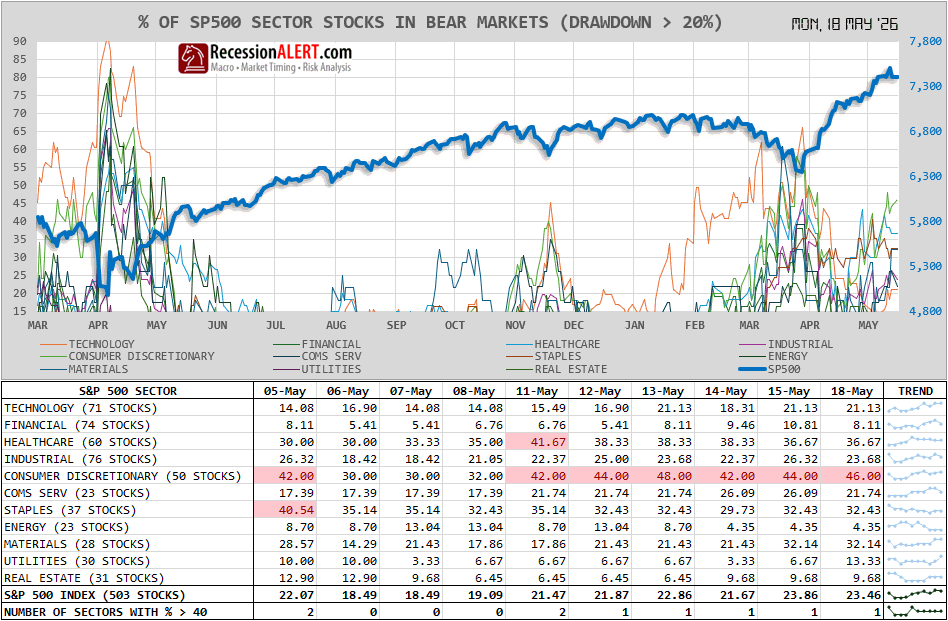
Chart of the Day: The S&P 500 prints new all-time highs while 23% of its components sit in bear markets — a textbook narrowing tape. Consumer Discretionary leads the damage at 46%, consistent with the K-shaped consumer stress visible elsewhere; Healthcare (37%), Staples (32%) and Materials (32%) round out the carnage. Even Technology deteriorated from 14% to 21% over the past two weeks despite the AI bid. Only Energy (4%), Financial (8%) and Real Estate (10%) remain structurally healthy. Index-level price hides this completely. When breadth fails to confirm new highs and defensive sectors break first, that is not what traditional late-cycle bull markets look like.
Market Intelligence Brief (MIB) Ver. 18.18
For professional investors only. Not investment advice.
© 2026 RecessionALERT.com

Comments are closed.