
Iran’s Hormuz draft deal sent WTI -4% to $84, staging the broadest equity recovery since last week’s CPI shock — S&P +0.50%, 10 of 11 sectors green. SpaceX (SPCX) debuted +19.3% at $161, raising $75B at a $2.1T valuation. The 2-year hit 4.14% — 40 bps above the Fed ceiling — as markets price 47% hike odds ahead of Warsh’s inaugural FOMC. Michigan sentiment beat at 48.9; 5-year inflation expectations dropped 50 bps to 3.4%, giving Warsh cover to hold.
TABLE OF CONTENTS
A. EXECUTIVE SUMMARY
B. MARKET DATA
C. HIGH-IMPACT STORIES (5)
D. MODERATE-IMPACT STORIES (5)
E. ECONOMY WATCH (4)
F. EARNINGS WATCH (0)
G. WHAT’S NEXT
H. CHART OF THE DAY
A. EXECUTIVE SUMMARY -> TOP
Equities staged a near-total reversal of last week’s stagflation shock as Iran’s 14-point Hormuz draft MoU deflated the conflict risk premium that had been the primary inflation driver since escalation — S&P 500 +0.50%, Dow +0.70%, with small-caps (Russell 2000 +0.81%) and the NYSE Composite (+0.78%) both outpacing large-cap indices in the broadest single-session recovery in weeks. The Iran de-escalation story matters beyond the price action: a Hormuz reopening mechanically attacks the energy component (+23.5% YoY) that is driving CPI’s 4.2% headline, potentially compressing June and July CPI prints and partially rehabilitating a rate-cut narrative that markets have now entirely abandoned. SpaceX’s $75 billion offering was absorbed through an orderly tech-to-cyclicals rotation — mega-cap AI names acted as the source of funds, while industrials and consumer defensives (the direct beneficiaries of lower energy costs) served as the destination — confirming institutional risk appetite is intact despite a VIX that, even after its 9% plunge to 17.69, still sits above pre-escalation levels. The session’s key structural signal: bond markets declined to confirm the equity rally, with both the 10-year (+2 bps to 4.481%) and 2-year (+1.7 bps to 4.087%) edging higher — bond traders are holding May’s 4.2% CPI in one hand and Iran optimism in the other, declining to fully price either scenario until the FOMC dot-plot lands Wednesday.
• Iran Hormuz Draft Deal: A 14-point MoU circulated by Mehr News Agency (Strait reopening within 30 days, oil sanctions lifted, ~$25B frozen assets released) sent WTI -4% to $84 — an 8-week low — while Trump’s “Iran war has ended” claim and a simultaneous public dispute over deal terms keep execution risk high; UNCERTAIN classification reflects the two-sides-with-incompatible-accounts problem
• SpaceX (SPCX) +19.3% Historic Debut: Nasdaq debut at $161 (vs. $135 IPO price) on 360M+ shares of volume; $75B raised — largest single equity raise in US history; $2.1T market cap briefly made Musk world’s first trillionaire; S&P 500 exclusion (earliest possible inclusion: Q3-Q4 2027) removes the $200-400B passive inflow catalyst the market had been pricing
• Treasury Market Hawkish Signal: 2-year yield at 4.14% — a one-year high and 40 bps above the Fed’s 3.50-3.75% ceiling — as CME FedWatch shows zero cut probability and Polymarket/Kalshi price 47% odds of at least one 2026 hike; Warsh’s inaugural FOMC begins Monday, June 16; dot-plot is the reset event for every duration position
• Michigan Sentiment Beat + Expectations Collapse: Preliminary June reading 48.9 (vs. 46.0 est., 44.8 prior) — first increase in four months — while 5-year inflation expectations plunged 50 bps to 3.4% in the largest single-month drop in years; long-run anchoring intact provides Warsh analytical cover for a hawkish pause rather than a hike signal
• Intel (INTC) +9% — BofA Double Upgrade: Bank of America jumped from Underperform directly to Buy, raising PT to $135 and 2030 server CPU TAM from $125B to $170B on agentic AI demand; AMD and ARM also lifted; Q2 FY2026 earnings (late July) are the fundamental validation event
• Economy Watch — Stagflation Configuration: Federal deficit $1.2T in first 8 months of FY2026, on pace for $2T full year; NFIB small business prices rising at fastest clip since March 2023 with job openings at 6-year low; CPI at 4.2% (3x Fed target) with PPI at 6.5% YoY — the upstream pipeline pressure has not eased
1. Iran as the Inflation Pivot — The Hormuz deal is the single most important variable for the second half: it directly attacks the energy component (+23.5% YoY) driving CPI’s 4.2% headline, creates the oil-normalization path Warsh needs to justify a hold rather than a hike, and reverses the risk premium suppressing equities and consumer sentiment since escalation. The critical execution risk — two sides publishing incompatible accounts of deal terms, a fresh drone attack complicating the timeline — is exactly why bond markets are refusing to fully confirm today’s equity rally. If the deal fails, WTI rebounds above $90, the CPI trajectory re-accelerates, and the 47% hike probability rapidly becomes consensus.
2. SpaceX’s $75B Capital Displacement Effect — The largest single equity raise in US history required institutional managers concentrated in AI and mega-cap tech to liquidate overweights to generate SPCX allocation capacity — visibly explaining today’s rotation: AI infrastructure names (NVDA, MSFT, GOOGL, semis) underperformed while industrials and consumer defensives outperformed. This forced selling cycle may now be complete; NVDA and the broader AI infrastructure complex’s technical recovery in the June 16-20 week is the confirmation signal. The $2.1T valuation also creates a structural change in the index landscape: S&P 500 exclusion for at least 12 months means passive index flows that many investors had anticipated as a valuation catalyst simply do not arrive on the timeline priced into SPCX at $161.
3. Warsh Inherits the Stagflation Trap — The Fed convenes Monday with a framework that offers no clean exit: inflation at more than double the 2% target (CPI 4.2%, PPI 6.5%), a 2-year yield 40 bps above the policy ceiling, and the bond market pricing near coin-flip hike odds — but also the weakest consumer sentiment in decades (48.9 absolute), a $39T national debt, a labor market softening (jobless claims at a 4-month high), and a real-time geopolitical variable (Iran deal) that could materially change the H2 2026 inflation trajectory within 60 days. The June 17 dot-plot is not just the rate signal for the July meeting — it is the market’s mandatory reset point for every duration position heading into the second half, and the first full test of Warsh’s policy framework under live fire.
 — Leading economic indicators. Accurate market forecasts. Apply for membership at join.recessionalert.com
B. MARKET DATA -> TOP
Equities staged a near-total reversal of last week’s stagflation shock as Trump claimed the Iran war had ended and Mehr News Agency confirmed a 14-point draft deal including Strait of Hormuz reopening — WTI collapsed 4%, VIX fell 9%, and 10 of 11 sectors advanced in the broadest single-session recovery in weeks. SpaceX’s historic market debut (+19.34%) and a Bank of America double upgrade on Intel amplified Industrials and semiconductors, while small-caps (Russell 2000 +0.81%) and cyclicals (Basic Materials +2.28%, Financials +1.32%) confirmed the risk-on character was broad-based, not tech-only. The session’s key anomaly: 10-year yields edged up 2 bps despite the equity rally — bond traders are pricing Iran optimism while keeping May’s 4.2% CPI in the other hand, declining to fully confirm the recovery.
CLOSING PRICES – Friday, June 12, 2026:
MAJOR INDICES
The rally was broad — Russell 2000 (+0.81%) and NYSE Composite (+0.78%) outpaced the S&P 500 (+0.50%), confirming widespread risk-on participation rather than narrow mega-cap leadership. Dow Theory bull confirmation extends into a second session: both DJIA and DJTA are within 2% of their 10-session highs, with transports posting a fresh 10-session high today. A new breadth signal emerges: Russell 2000 has now outpaced the S&P 500 by 2.78% over the past 10 sessions — broad market participation that typically signals durable recovery, not just a relief bounce.
| Index | Close | Change | %Move | Why It Moved |
|---|---|---|---|---|
| S&P 500 | 7,431.40 | +37.10 | +0.50% | Iran deal draft + SpaceX IPO debut + Intel BofA upgrade; 10 of 11 sectors advanced in broadest session since before June 5 shock week |
| Dow Jones Industrial Avg. | 51,202.29 | +353.54 | +0.70% | Iran de-escalation + UMich consumer sentiment beat; blue-chip breadth led by Financials and Industrials; stagflation risk premium unwound |
| DJ Transportation Avg. | 22,596.7 | +73.0 | +0.32% | New 10-session high; Industrials sector up; Iran-driven energy cost relief positive for transport companies’ operating margins |
| Nasdaq 100 | 29,635.95 | +189.77 | +0.64% | SpaceX debut and Intel BofA double upgrade lifted semis; large-cap tech paced below broader market breadth as rotation favored cyclicals |
| Russell 2000 | 2,944.82 | +23.79 | +0.81% | Small-caps led as geopolitical uncertainty eased and June UMich consumer sentiment improved; domestic-facing names outpaced globally-exposed mega-caps |
| NYSE Composite | 23,595.79 | +182.89 | +0.78% | Widest breadth session in weeks; 10 of 11 sectors advanced; Iran deal catalyst stack drove broadest participation since pre-escalation |
VOLATILITY & TREASURIES
VIX’s 9% plunge to 17.69 confirms the options market aggressively repriced geopolitical tail risk as the Iran deal draft circulated. But the bond market is declining to fully confirm: both the 10-year (+2.0 bps) and 2-year (+1.7 bps) edged higher despite the equity rally — bond non-participation reads as May’s 4.2% CPI still anchoring inflation expectations and preventing a clean flight to duration. The yield curve remains inverted (4.481% vs 4.087%), a structural note of caution beneath the day’s relief trade.
| Instrument | Level | Change | Why It Moved |
|---|---|---|---|
| VIX | 17.69 | -1.76 (-9.05%) | Iran 14-point draft deal + Trump “war ended” claim slashed options hedges; VIX fell to post-escalation low as geopolitical tail risk repriced |
| 10-Year Treasury Yield | 4.481% | +2.0 bps | Bonds sold slightly despite equity rally; market cautious on Iran deal durability; May CPI 4.2% sticky inflation anchor holding yields elevated |
| 2-Year Treasury Yield | 4.087% | +1.7 bps | Short-end marginally higher; near-term rate cut expectations unchanged despite risk-on environment; Fed path repricing minimal |
| US Dollar Index (DXY) | 99.78 | -0.07 (-0.07%) | Essentially flat; risk appetite didn’t trigger dollar selling; Iran de-escalation broadly USD-neutral as commodity and equity moves offset |
COMMODITIES
Precious metals surged in unison — gold +2.95%, silver +6.33%, platinum +3.19% — as Iran de-escalation allowed recovery from June 10’s unusual safe-haven selloff when the CPI shock drove real yields up sharply. Copper’s +3.24% gain confirmed the risk-on tilt has an industrial demand component (AI infrastructure, electrification), not just safe-haven mechanics. Bitcoin (+0.11%) was nearly flat, tracking equities rather than leading — a risk proxy day, not a crypto-specific narrative.
| Asset | Price | Change | %Move | Why It Moved |
|---|---|---|---|---|
| Gold | $4,235.42/oz | +$121.42 | +2.95% | Short-covering recovery from June 10’s CPI-driven selloff; Iran de-escalation and Trump “war ended” claim restored safe-haven floor after unusual geopolitical bid failure |
| Silver | $68.050/oz | +$4.049 | +6.33% | Precious metals sweep led by Iran de-escalation recovery; silver’s dual industrial (AI/electronics demand) and safe-haven role amplified the move vs gold |
| Copper | $6.4783/lb | +$0.2033 | +3.24% | Broad industrial metals rally; global supply chain risk reduced on Iran de-escalation; sustained AI infrastructure and electrification demand at structural highs |
| Platinum | $1,718.80/oz | +$53.10 | +3.19% | Precious metals broad recovery; industrial/auto demand component benefiting from lower energy cost outlook; risk-on amplified precious metals sweep |
| Bitcoin | $63,484 | +$71 | +0.11% | Nearly flat; tracking equities in muted risk-on day; no crypto-specific catalyst — pure risk proxy behaviour |
ENERGY
WTI crude fell 4% on Iran deal expectations while energy sector shares rose +0.56% — the market is pricing Iran sanctions relief as a net positive for energy companies (expanded market access, production normalization) rather than a margin headwind. The WTI-Brent spread held tight at ~$2.52, confirming a global supply story rather than regional disruption. Natural gas (+1.55%) moved independently on summer storage demand, not Iran dynamics — a clean split that separates the geopolitical crude story from seasonal gas fundamentals.
| Asset | Price | Change | %Move | Why It Moved |
|---|---|---|---|---|
| Crude Oil (WTI) | $84.24/bbl | -$3.47 | -3.96% | Iran’s Mehr News Agency confirmed 14-point draft deal including oil sanctions lift + Strait of Hormuz reopening within 30 days; WTI fell to 8-week low |
| Crude Oil (Brent) | $86.76/bbl | -$3.62 | -4.01% | Same Iran deal driver as WTI; tight $2.52 WTI-Brent spread confirms global supply-expectation story rather than regional disruption |
| Natural Gas (Henry Hub) | $3.135/MMBtu | +$0.048 | +1.55% | Modest seasonal bid on summer cooling demand outlook; independent of Iran dynamics — domestic natural gas driven by weather/storage, not geopolitics |
| Natural Gas (Dutch TTF) | $15.87/MMBtu | -$0.99 | -5.87% | European gas prices falling on Iran deal hopes; Strait of Hormuz reopening expected to restore LNG/pipeline flows, reducing European supply risk premium |
S&P 500 SECTORS
10 of 11 sectors advanced — a near-total breadth sweep confirming this was a macro/sentiment-driven reversal of the June 10 shock, not rotation. Basic Materials led (+2.28%) despite being the month’s most beaten-down cyclical (-4.96% 1M), signalling short-covering rather than fundamental re-rating. Healthcare (-0.20%) was the lone holdout — the sector that led defensive flows during last week’s crisis is now seeing mild profit-taking as risk appetite returns. Energy sector stocks rose +0.56% while crude fell 4%, a notable decoupling that signals the market is pricing Iran sanctions relief as a net positive for energy company fundamentals.
| Sector | 1-Day | 1-Week | 1-Month | 3-Month | 6-Month | YTD | 12-Month |
|---|---|---|---|---|---|---|---|
| Basic Materials | +2.28% | +3.58% | -4.96% | +4.25% | +18.00% | +14.94% | +41.43% |
| Financial | +1.32% | +2.59% | +4.60% | +11.46% | +2.15% | +0.61% | +12.83% |
| Utilities | +0.99% | +0.40% | -1.52% | -4.30% | +4.64% | +4.41% | +13.14% |
| Real Estate | +0.90% | +1.82% | +2.46% | +6.94% | +9.85% | +10.69% | +8.36% |
| Consumer Defensive | +0.72% | +2.76% | -0.77% | +0.31% | +9.19% | +9.45% | +6.68% |
| Energy | +0.56% | +0.07% | -1.57% | +0.67% | +26.09% | +28.33% | +34.05% |
| Technology | +0.45% | +1.04% | +2.49% | +27.10% | +16.73% | +20.58% | +43.04% |
| Industrials | +0.44% | +1.40% | +1.64% | +9.17% | +15.36% | +16.12% | +26.82% |
| Communication Services | +0.37% | -1.52% | -7.20% | +5.78% | +0.64% | +1.31% | +23.68% |
| Consumer Cyclical | +0.05% | +0.94% | -4.20% | +4.65% | -4.87% | -4.37% | +5.71% |
| Healthcare | -0.20% | +0.87% | +3.11% | +3.22% | +0.80% | -0.59% | +13.33% |
TOP MEGA-CAP MOVERS:
GAINERS
| Company | Ticker | Close | Change | Why It Moved |
|---|---|---|---|---|
| Space Exploration Technologies Corp | SPCX | $161.11 | +19.34% | SpaceX’s historic Nasdaq market debut; the $2.1T Aerospace & Defense giant opened to massive institutional demand; IPO-day surge lifted Industrials and aerospace-adjacent names |
| Seagate Technology Holdings | STX | $931.04 | +7.25% | Storage semiconductor complex rallied with semis; Iran de-escalation reduced supply chain risk premium; SpaceX debut boosted tech-adjacent hardware names |
| Intel Corp | INTC | $124.54 | +6.48% | Bank of America double upgrade; analyst Vivek Arya raised 2030 server CPU TAM estimate to $170B (from $125B) and models Intel earnings power at $6+/share by 2030 |
| KLA Corp | KLAC | $254.54 | +5.55% | Semiconductor equipment complex rallied on Intel upgrade halo; Iran de-escalation supports global chip supply chain normalization thesis |
| SanDisk Corp | SNDK | $1,979.04 | +5.18% | Storage/memory sector recovery alongside STX; AI data center storage demand narrative re-engaged as geopolitical uncertainty eased |
DECLINERS
| Company | Ticker | Close | Change | Why It Moved |
|---|---|---|---|---|
| Eli Lilly & Co | LLY | $1,133.00 | -2.41% | Healthcare profit-taking as risk appetite returned; no specific catalyst — sector rotation from defensive healthcare into cyclicals and SpaceX/semis on the Iran deal |
| Palantir Technologies | PLTR | $127.99 | -2.36% | AI software names underperformed as capital rotated into hardware/semis on the Intel upgrade; SpaceX debut also drew institutional flows away from AI software plays |
| Apple Inc | AAPL | $291.08 | -1.54% | Modest rotation selling; no specific catalyst — capital moving toward semis and SpaceX; Apple’s consumer-facing model less directly leveraged to Iran de-escalation narrative |
| Micron Technology | MU | $980.91 | -1.50% | Mixed semi session — DRAM/NAND names lagged despite broader equipment rally; storage subsector outperformed (STX, SNDK) while memory names underperformed |
| Merck & Co Inc | MRK | $119.05 | -1.42% | Healthcare sector pressure alongside LLY; no specific catalyst — defensive sector rotation out as geopolitical risk premium declined |
— Institutional-grade intelligence for serious investors. Apply for membership at join.recessionalert.comC. HIGH-IMPACT STORIES -> TOP
UNCERTAIN
1. US-Iran 14-Point MoU Circulated — Hormuz Reopening Within 30 Days in Exchange for Sanctions Relief; WTI Falls 4% to $84 as Trump and Iran Dispute Deal Terms
The core facts:Iran’s Mehr News Agency and Pakistani officials confirmed a 14-point draft memorandum of understanding in which Iran would reopen the Strait of Hormuz within 30 days in exchange for the US lifting oil sanctions and releasing approximately $25 billion in frozen Iranian assets, with a moratorium on nuclear enrichment also included. President Trump stated on June 12 that the “Iran war has ended.” However, Trump separately denied Iran’s account of specific deal terms, describing Iranian officials as “dishonorable people” after a fresh drone attack complicated the timeline. Pakistan and Qatar are serving as primary mediators, with the UAE releasing $10 billion for Iran as part of the broader framework. WTI crude fell 4.43% to $84.24/bbl — an eight-week low — while Brent dropped 4.01% to $86.76 as markets began pricing out the Hormuz risk premium. The divergence between Trump’s “war has ended” framing and the public dispute over deal terms underscores the gap between market pricing and execution reality.
Why it matters:The Hormuz risk premium has been the primary driver sustaining WTI above $90 since the conflict escalated, and its deflation now flows directly into the inflation pipeline: May CPI’s 4.2% headline was driven by energy (+23.5% YoY, +3.9% MoM), and a Hormuz reopening would mechanically reduce that contribution within 60–90 days across June and July CPI prints. That path — de-escalation → oil normalization → headline CPI relief — could partially rehabilitate the rate-cut narrative that markets abandoned after the May CPI shock. The Fed’s June 17 dot-plot deliberations are directly affected: Warsh cannot cut given current data, but a credible Hormuz reopening changes the inflation trajectory for H2 2026 estimates. The UNCERTAIN classification reflects the critical execution risk: the interpretive dispute between US and Iran (each publishing incompatible accounts of deal terms) and the fresh drone attack suggest two sides with different understandings of what was agreed. If the deal fails, WTI rebounds above $90 and the inflationary energy shock re-accelerates.
What to watch:Any formal signing ceremony with both sides present — Trump said time and place will be announced shortly. WTI crude for a sustained hold below $85/bbl as market confirmation that the supply risk premium is being permanently priced out. Whether Iran resumes full Hormuz shipping within the 30-day window, or conditions reopening on specific US actions that remain disputed.
BULLISH
2. SpaceX (SPCX) Opens at $150, Closes +19.3% at $161 in Historic Nasdaq Debut — $2.1T Valuation; S&P 500 Exclusion Removes Near-Term Passive Buying Catalyst
The core facts:SpaceX (SPCX) opened at $150/share — $15 above its $135 IPO price — and closed at approximately $161, a first-day gain of +19.3%, on volume exceeding 360 million shares in the opening hours alone (surpassing the combined dollar volume of SPY and QQQ ETFs). At the close, SpaceX was valued at approximately $2.1 trillion, briefly making Elon Musk the world’s first trillionaire on a combined Tesla + SpaceX stake. The debut followed June 11’s pricing at $135/share on $150B+ in investor demand (~2x oversubscribed), raising $75 billion — the largest single equity raise in US capital markets history. S&P Dow Jones Indices reaffirmed on June 4 that it will not change profitability criteria to accommodate SpaceX; the company must meet GAAP profitability requirements over trailing four quarters and a 12-month public trading history before S&P 500 inclusion — earliest possible: Q3-Q4 2027. Nasdaq-100 has rewritten eligibility rules and is expected to include SpaceX on a faster timeline.
Why it matters:A $2.1T company entering public markets on day one is a capital-allocation event without precedent. The $150B+ in demand against $75B raised — 2x oversubscribed despite CPI at 4.2%, an elevated VIX, and a hawkish FOMC week — confirms institutional risk appetite is intact for transformational infrastructure assets. The S&P 500 exclusion is a meaningful structural negative: it removes the estimated $200–400B of systematic passive buying from index rebalancing that the market was pricing into SpaceX’s valuation expansion thesis. Investors who bought SPCX expecting near-term index inclusion as a valuation catalyst must now wait a minimum of 12 months. Nasdaq-100 inclusion provides a shorter-term passive flow catalyst at a smaller scale. The $75B new float extraction from existing tech and AI names created the sector rotation dynamic visible in today’s session: mega-cap tech and AI semiconductors acted as the primary source of funds for institutional SPCX allocations, while the indices still closed positive.
What to watch:Nasdaq-100 inclusion decision — expected within weeks given Nasdaq’s rewritten criteria; the systematic buying trigger once announced. S&P 500 profitability milestones in SpaceX’s first four public quarters. SPCX trading above $135 IPO price at the end of the first week as confirmation that demand absorption is stable and IPO allocatees are not position-flipping.
BEARISH
3. 2-Year Treasury Hits 4.14% — Highest in Over a Year, 40bps Above Fed’s Policy Ceiling; Markets Price 47% Odds of 2026 Rate Hike as Warsh’s Inaugural FOMC Begins Monday; Cut Probability Falls to Zero
The core facts:The 2-year Treasury yield closed at 4.14% on June 12 — the highest level in over one year and approximately 40 basis points above the top of the Fed’s current 3.50%–3.75% target range — as markets priced the cumulative inflationary impact of May’s data sequence: CPI at 4.2% YoY (third consecutive monthly acceleration), PPI at 6.5% YoY (double the consensus, highest since late 2022), and jobless claims at 229K (highest since February). CME FedWatch shows zero probability of a rate cut at any 2026 meeting; Polymarket and Kalshi both place approximately 47% odds of at least one RATE HIKE by year-end. Rate cut expectations, which were consensus earlier in 2026, have been fully extinguished. The hawkish repricing arrives three trading days before the June 16–17 FOMC meeting — Chair Warsh’s inaugural decision — where the market overwhelmingly expects a hold at 3.50%–3.75%.
Why it matters:When the 2-year yield surpasses the policy rate ceiling by 40bps, the bond market is signaling that the current target range is materially inadequate for controlling inflation. The inversion of market expectations — from a broadly anticipated 2026 easing cycle to near-coin-flip hike odds — is the most significant shift in the monetary policy outlook of the year. Warsh inherits a framework where the stagflation trap is now the baseline pricing scenario: inflation too hot to cut (CPI 4.2%, PPI 6.5%) and labor softening too early to hike (claims at highest since February, GDPNow deteriorating to 3.0% from 4.3%). For equities, the 47% hike probability permanently re-rates P/E multiples downward relative to the prior consensus of eventual cuts: rate-sensitive sectors (REITs, utilities, long-duration growth tech) face sustained pressure. The June 17 dot-plot is the key catalyst — if Warsh signals the Committee’s rate-path median is revised upward, it formally marks the end of the post-2023 easing cycle thesis and requires portfolio managers to reset duration exposure across the entire fixed income and equity landscape.
What to watch:June 17 FOMC statement and Warsh’s inaugural press conference — specifically the dot-plot’s 2026 median rate (above 3.75% = hawkish signal) and whether the SEP raises the longer-run neutral rate estimate. CME hike odds drift above 55% as the signal that bond markets are formally pricing a tightening move at the July meeting. 10-year yield break above 4.75% as the equity-market re-rating threshold.
BULLISH
4. DOJ Clears Paramount Skydance’s $110B Acquisition of Warner Bros. Discovery — Creating the Largest US Media Company; Deal to Close Q3 2026
The core facts:The US Department of Justice cleared Paramount Skydance’s acquisition of Warner Bros. Discovery on June 12, removing the final major regulatory hurdle for the $110 billion transaction. Paramount Skydance (the combined company formed after Skydance’s 2024 acquisition of Paramount) will pay $31.00 per share in cash for all outstanding WBD shares. WBD shareholders approved the deal in a special meeting on April 23, 2026; Australian and New Zealand regulators cleared it in early June; the DOJ approval today completes the regulatory sequence. The combined entity unites Paramount Pictures, CBS, BET, MTV, Nickelodeon, and Paramount+ with Warner Bros., HBO, Max (HBO Max), CNN, and DC Studios — creating the largest US entertainment company by content IP value. Deal expected to close in Q3 2026.
Why it matters:The DOJ clearance removes the regulatory binary that had been suppressing WBD’s price below the $31 deal value, with the spread narrowing to near-zero on today’s approval. Beyond the arbitrage: the creation of a combined Paramount/WBD entity is a defensive consolidation response to streaming’s winner-take-most economics. The combined library — Paramount Pictures, HBO originals, CBS network, CNN, and DC Studios IP — creates a content moat that competing at scale against Netflix’s ~300M subscribers, Amazon Prime Video, and Disney+ would have been near-impossible for either company independently. For the broader media sector: consolidation reduces pricing fragmentation in ad-supported streaming, which is structurally bullish for CPM rates and advertising revenue across all streamers. The combined entity’s leverage structure (the $110B deal is debt-financed) is the primary execution risk — credit markets will be closely watched as the combined company’s pro-forma debt load becomes public.
What to watch:Q3 2026 closing timeline — any supplemental regulatory condition or condition precedent that could delay the close. The combined entity’s first post-merger subscriber count and debt-to-EBITDA ratio as the financial execution anchors. Netflix and Disney subscriber trends in H2 2026 as the competitive response indicator.
UNCERTAIN
5. Michigan Consumer Sentiment Beats at 48.9 — First Increase in Four Months — 5-Year Inflation Expectations Plunge from 3.9% to 3.4%, Largest Monthly Drop in Years; Gives Warsh Cover for Hawkish Pause
The core facts:The University of Michigan’s preliminary June Consumer Sentiment Index rose to 48.9, beating the 46.0 consensus and the 44.8 prior — a 9.1% monthly gain and the first increase after four consecutive monthly declines stretching back to February. Improvement was broad-based across age, education, and political affiliation. The policy-critical reading: 5-year inflation expectations fell sharply from 3.9% to 3.4% — a 50-basis-point single-month decline described as the largest in years. One-year expectations also eased from 4.8% to 4.6%. The primary driver of improvement was easing gas prices from the Iran de-escalation narrative, which reduced household energy pressure at the pump ahead of the formal deal announcement.
Why it matters:The 5-year inflation expectations component is the most Fed-relevant reading in this report. The FOMC June 17 decision arrives just two business days after this reading, and the Fed’s dual-mandate framework incorporates long-term inflation expectations as the primary signal for whether price pressures are becoming entrenched. A drop from 3.9% to 3.4% argues that consumers expect the current inflation surge to be transitory — driven by the Hormuz energy shock — rather than structural. That framing gives Chair Warsh the analytical cover to hold rates at the June meeting without the market interpreting a pause as capitulation to hot CPI+PPI data. For rate-sensitive equities (utilities, REITs, long-duration growth): the expectations drop provides a marginal positive — hike odds at the margin are reduced by this print. The UNCERTAIN classification reflects the dual read: bullish for the inflation-expectations narrative, but the absolute 48.9 reading remains historically depressed (still 13% below January’s level, nearly 20% below year-ago), and the improvement is entirely driven by gas prices — a variable that reverses immediately if the Iran deal fails.
What to watch:The June 17 FOMC dot-plot — whether the Committee’s long-run PCE inflation forecast is revised in light of the expectations drop. The July Michigan reading as the first post-FOMC read on whether gas price relief is translating into sustained sentiment recovery. If Iran deal fails and gas prices rebound, the 5-yr expectations likely reverse sharply in July.
— Quantifying recession risk so you don’t have to guess. Apply for membership at join.recessionalert.comD. MODERATE-IMPACT STORIES -> TOP
BULLISH
6. Bank of America Double-Upgrades Intel to Buy from Underperform — $170B Server CPU TAM by 2030, $6+ EPS Power; INTC +9%
The core facts:Bank of America analyst Vivek Arya issued a rare double-upgrade on Intel (INTC) — jumping from Underperform to Buy directly, skipping Hold — and raised his price target from $96 to $135. The note raised BofA’s 2030 server CPU Total Addressable Market estimate from $125 billion to $170 billion, arguing that “agentic AI is a powerful demand accelerant that expands the CPU opportunity and lifts both x86 incumbents and ARM challengers.” BofA now models Intel earnings power above $6/share by 2030 (from prior $3–4), with Intel’s data center and AI business reaching $43.7 billion on approximately a 25% share of the $170B server CPU market. The upgrade note also lifted AMD and Arm (ARM), framing a rising-tide thesis for the entire processor architecture layer. INTC closed approximately +9%, to $124.54 per the Phase 1 data.
Why it matters:A double upgrade — from Underperform to Buy in one move — is an exceptionally rare signal of institutional conviction change. The underlying thesis reframes the AI compute cycle: agentic AI (autonomous agents performing multi-step reasoning tasks) creates exponential CPU demand growth beyond what was modeled for standard inference, extending well beyond NVDA’s GPU dominance into the CPU architecture layer that Intel and AMD control. Intel’s IFS (Intel Foundry Services) 18A process node provides a second growth vector — if competitive yields are achieved, Intel becomes both a chip designer and a foundry competitor to TSMC for advanced packaging and leading-edge logic. At $135 price target, INTC offers 18%+ upside from today’s close. For portfolio managers: the note creates a quality entry signal backed by a major institutional voice, with the Q2 FY2026 earnings call (late July) as the near-term fundamental anchor.
What to watch:Intel Q2 FY2026 earnings (late July) — data center and AI segment revenue as the fundamental validation of the BofA TAM thesis. Any IFS 18A customer design-win announcement as the foundry thesis catalyst. AMD MI300X revenue trajectory in Q2 as the competing AI GPU data point that contextualizes the CPU-vs-GPU demand split.
UNCERTAIN
7. Precious Metals Rally Across the Board — Gold +2.95% to $4,235, Silver +6.33% to $68.05, Platinum +3.19% to $1,718 — Iran De-Escalation Reprices Real Asset Floor
The core facts:Gold surged 2.95% to $4,235/oz, silver outperformed with a +6.33% gain to $68.05/oz, and platinum rose 3.19% to $1,718.80/oz on June 12 — recovering from the anomalous June 10 selloff, when the CPI shock drove real yields sharply higher and traditional safe-haven assets sold off in tandem with equities. The Iran de-escalation narrative drove the repricing: lower energy prices reduce headline CPI expectations for upcoming prints, which reduces the real yield penalty on non-yielding assets like gold and silver. Silver’s outsized move (+6.33% versus gold’s +2.95%) reflects its dual monetary and industrial role — AI electronics, EV battery systems, solar panels, and electrification infrastructure all create structural industrial silver demand that amplifies the monetary safe-haven bid.
Why it matters:The June 10 gold selloff was analytically anomalous — hot CPI should have driven the real yield premium on gold higher (more inflation → eventual Fed action → lower real yield → gold up), but instead triggered cross-asset forced selling across all positions. Thursday’s equity recovery and Friday’s precious metals rally are consistent with the repositioning thesis: once the Iran peace narrative replaced the acute risk-off spiral, safe-haven assets returned to functioning as inflation hedges. Silver at $68/oz is testing resistance levels not seen since the early 2000s silver boom; a sustained close above $70/oz would trigger systematic momentum buyers and could extend the move significantly. For portfolio managers: the precious metals complex at current levels prices both the Iran peace scenario (lower oil → lower headline CPI → monetary stimulus eventually) and the Iran failure scenario (oil stays elevated → safe-haven bid remains elevated), making it a natural macro hedge vehicle in an environment where the Iran outcome is still unresolved.
What to watch:Gold’s ability to sustain above $4,200/oz as confirmation that the real yield/inflation narrative has repriced in metals’ favor. Silver close above $70/oz as the technical momentum trigger. June 17 FOMC — if Warsh’s dot-plot signals a hawkish hold with an upward-revised rate path, real yields re-rise and metals face renewed headwinds.
BEARISH
8. Fed Vice Chair Bowman Mandates AI “Kill Switches” and Human Oversight at Systemically Important Banks — Cross-Agency Guidance Creates Compliance Burden for JPM, BAC, GS, MS, WFC
The core facts:Federal Reserve Vice Chair for Supervision Michelle Bowman announced ramped-up regulatory scrutiny of AI model usage at systemically important banks (SIBs), specifically mandating that AI models deployed in any customer-facing or risk-management capacity include “kill switches” — emergency override mechanisms allowing human operators to immediately disable AI decision-making — along with explicit human-oversight protocols. The guidance was delivered in coordination with cross-agency bank regulators and applies to AI models used in trading, credit decisions, fraud detection, and regulatory compliance. The specific targeting of vendor AI risk indicates the focus is on third-party LLM deployments (Microsoft Copilot, Google Vertex, Salesforce Einstein) integrated into core banking operations, not solely internal-build AI systems.
Why it matters:Kill-switch and human-oversight requirements are compliance costs that fall heaviest on the banks most advanced in AI deployment — JPMorgan, Bank of America, Goldman Sachs, Morgan Stanley, and Wells Fargo have all disclosed multi-billion dollar AI investment programs. The burden is twofold: engineering overhead to retrofit kill-switch functionality into existing AI pipelines, and process overhead from mandatory human review steps that reduce the efficiency gains AI was deployed to achieve. For AI software vendors (Microsoft, Salesforce, Google): the guidance creates a barrier to expanding banking AI contracts — new enterprise deployments now require architectural kill-switch compliance that adds sales cycle friction and implementation cost. The longer-term concern is regulatory precedent: if the Fed’s SIB guidance becomes the template for Basel-framework AI governance globally, similar requirements propagate to European and Asian banking regulators, creating a worldwide compliance regime for institutional AI deployment.
What to watch:The formal guidance document for specific technical standards — the kill-switch specification will determine the magnitude of implementation cost. Any Basel Committee response extending the framework to global SIBs. Large bank Q2 earnings calls (July) for commentary on AI compliance spend in H2 2026.
UNCERTAIN
9. SpaceX Offering Drives Mega-Cap Tech Selloff as Capital Rotates to Consumer Defensives and Industrials — AI Infrastructure Complex Used as “Source of Funds” for $75B SPCX Allocation
The core facts:Despite the S&P 500 closing up 0.50% and the Dow up 0.70% on June 12, the session’s internal market dynamics were sharply bifurcated: mega-cap technology and AI semiconductor names acted as the primary “source of funds” to absorb SpaceX’s $75 billion offering, with institutional portfolio managers reducing overweight positions in names such as NVDA, MSFT, GOOGL, META, and the broader semiconductor complex to fund SPCX allocations. Capital rotated into consumer defensives and industrials — sectors that benefit directly from the Iran de-escalation (lower energy costs improve consumer margin and reduce industrial input costs). The SpaceX offering’s $150B+ in total demand required institutions already concentrated in tech overweights to generate liquidity through their largest, most liquid holdings.
Why it matters:The sector rotation validates the AI infrastructure complex as a crowded institutional trade — managers with maximal tech overweights had no choice but to sell to fund the SPCX allocation. This is a liquidity-driven, not fundamentals-driven, event. The implications are two-sided: bearish in the short term for AI infrastructure names that absorbed the selling, but bullish as a confirming signal that SpaceX’s full IPO demand was absorbed without breaking the broader market — the S&P finished positive, not down. The forced liquidation cycle may now be complete: the “source of funds” pressure that hit SMCI (-26% last week) and the semiconductor complex over the prior five trading days should dissipate now that SPCX is fully in circulation and no further placement risk exists. The sector rotation also explains why consumer discretionary and industrials led on a day when the headline narratives (Iran peace + SpaceX debut) were both directionally positive for risk assets.
What to watch:AI infrastructure names (NVDA, AMAT, LRCX, MU) technical recovery in the week of June 16–20 as confirmation that the forced-selling cycle has completed and the crowded-trade flush is over. SPCX trading stabilization above $135 IPO price in the first two weeks as the signal that demand absorption is complete.
BULLISH
10. FDA Clears DexCom Stelo as First OTC Continuous Glucose Monitor for Children — Expands $28B DexCom’s TAM to Pediatric Non-Insulin Market; DXCM +5.2%
The core facts:The FDA cleared DexCom’s Stelo Glucose Biosensor System as the first over-the-counter continuous glucose monitor approved for children (2 years and older, non-insulin users) on June 12 — extending the adult OTC clearance DexCom received in March 2024. The Stelo wearable sensor pairs with a smartphone app to measure glucose every 15 minutes for up to 15 days per sensor, sold without a prescription at CVS, Walgreens, and major pharmacy chains. Non-insulin users — including Type 2 diabetics managing glucose through diet, exercise, and oral medication — represent approximately 30% of the US diabetes population; the pediatric subset is growing as Type 2 diabetes rates in children have accelerated. DexCom’s market cap stands at approximately $28 billion; shares rose approximately +5.2% on the announcement.
Why it matters:The pediatric OTC clearance opens a market segment where DexCom has no current OTC competition — Abbott (ABT), DexCom’s primary CGM rival with the FreeStyle Libre line, does not have pediatric OTC clearance. The addressable market expansion is modest relative to DexCom’s core adult insulin-user business (the higher-frequency, higher-margin revenue segment), but the regulatory milestone demonstrates FDA confidence in the Stelo system’s safety profile and positions DexCom for broader pharmacy-channel volume growth. More structurally, the clearance creates a pediatric CGM category in the OTC market that did not previously exist — generating category-creation economics where DexCom is the first and only player for a period. For healthcare sector investors: the clearance reinforces the CGM subsector’s regulatory momentum; Abbott, Medtronic, and other CGM players now face FDA scrutiny and competitive pressure to achieve similar pediatric OTC clearances, which could take 18–24 months given the regulatory precedent-setting involved.
What to watch:DexCom’s next quarterly earnings for Stelo OTC sales volumes in both adult and new pediatric channels. Abbott’s FreeStyle Libre pediatric OTC clearance application timeline as the competitive response. CGM penetration rates in non-insulin users (currently low single-digits) as the leading indicator for whether the OTC pharmacy market achieves scale adoption.
— Separating signal from noise since 2007. Apply for membership at join.recessionalert.comE. ECONOMY WATCH -> TOP
This week’s data delivered a split verdict ahead of Warsh’s inaugural FOMC: headline CPI accelerated to 4.2% — a three-year high fueled by Iran-conflict energy costs — while Michigan 5-year inflation expectations fell sharply from 3.9% to 3.4%, suggesting consumer price anxiety may have peaked. Neither counts as reassurance. NFIB data showed small businesses raising prices at the fastest pace since March 2023 while simultaneously pulling back on hiring, and the federal deficit hit $1.2 trillion through eight fiscal months — on pace for a record $2 trillion full year. The complete inflation data picture lands four days before Warsh’s inaugural press conference; whether the dot plot acknowledges hike risk or holds neutral will define the rate path through year-end.
Michigan Consumer Sentiment Rises to 48.9 in June — First Increase Since February as Gas Prices Ease (University of Michigan, June 12, 2026)
What they’re saying:The preliminary University of Michigan Consumer Sentiment Index rose to 48.9 in June — beating the 46.0 consensus and marking the first increase since February — from a multi-decade low of 44.8 in May. All sub-indices beat: Current Conditions rose to 48.4 (vs. 46.2 expected) and Consumer Expectations jumped to 49.3 (vs. 44.3 expected). The driver: easing gasoline prices, which provided the most relief to lower-income households that spend the largest share of their budgets on fuel. One-year inflation expectations eased to 4.6% from 4.8%; five-year expectations fell sharply to 3.4% from 3.9%.
The context:Despite the broad beat, headline sentiment remains 13% below January’s level and 19% below a year ago, underscoring that consumers remain structurally burdened by elevated inflation and Iran-war energy costs. The gas-price tailwind is fragile — any renewed supply disruption reverses it instantly. Far more consequential for the Fed is the 5-year inflation expectations drop: at 3.4%, long-run price anchoring is not de-anchoring, a precondition for Warsh to hold rather than hike. The 0.5 percentage-point single-month drop is the largest since the post-pandemic normalization period and directly softens the case for a dot-plot rate-hike signal at next week’s FOMC.
What to watch:Whether gasoline prices sustain through June and July — if Iran tensions escalate, the gas-driven sentiment floor collapses. Warsh’s June 17 press conference for any acknowledgment that falling inflation expectations weigh against a hawkish dot-plot shift. Final Michigan Sentiment for June (late July).
CPI Accelerates to 4.2% in May — Three-Year High as Iran-Driven Energy Surge Marks Third Consecutive Monthly Rise (BLS, June 10, 2026)
What they’re saying:The Consumer Price Index rose 0.5% in May on a seasonally adjusted basis, lifting the 12-month rate to 4.2% — the highest since April 2023 and a third consecutive monthly acceleration from 3.8% in April. Energy prices drove the headline: a 3.9% monthly surge pushed the 12-month energy reading to +23.5%, reflecting the oil supply shock from the Iran conflict. Core CPI (ex food and energy) rose a more modest 0.2% for the month and 2.9% over the year, remaining relatively contained. The headline print was in line with consensus expectations.
The context:Headline inflation is now more than double the Fed’s 2% target, and the third consecutive monthly acceleration has pushed several Wall Street strategists — including Morgan Stanley — to raise rate-hike scenarios as non-negligible. The energy-driven nature of the spike offers the Fed some cover: commodity shocks are transitory if the conflict de-escalates. But the NFIB data released the same week showed small businesses raising prices at the fastest clip since March 2023, raising the risk that energy-led inflation bleeds into core readings through supply-chain cost pass-through. Yesterday’s PPI print (+1.1% MoM, +6.5% YoY) — the hottest producer reading since November 2022 — adds upstream pipeline pressure to the same concern. Core PCE, the Fed’s preferred measure, is due with the next major data cycle.
What to watch:Import/export price indexes for May (June 16, alongside FOMC Day 1); Warsh’s dot plot and press conference June 17 for any signal on tolerance for above-target inflation; next CPI for June (July 14); Core PCE (June 26).
NFIB: Small Business Optimism Falls to 95.3 — Prices Rising at Fastest Pace Since March 2023, Job Openings Lowest Since May 2020 (NFIB, June 10, 2026)
What they’re saying:The NFIB Small Business Optimism Index dipped 0.6 points to 95.3 in May, remaining below its 52-year average of 98.0. The Uncertainty Index surged to 91 — 23 points above its 68 historical average. A net 36% of business owners raised average selling prices in May (up 6 points from April), the highest reading since March 2023. Inflation was cited as the single most important business problem by 18% of respondents — the highest since December 2024. Concurrently, a seasonally adjusted 29% of owners reported job openings they could not fill, down 5 points from April and the lowest level since May 2020.
The context:The price-increase signal is a leading indicator for core CPI: small businesses, which account for roughly half of US private employment, have less pricing power than large corporates and typically push through price increases only when underlying costs are genuinely elevated. A net 36% is approaching the levels that historically presaged CPI core acceleration. The simultaneous drop in job openings to a six-year low is the offsetting signal — if small businesses are pulling back on hiring, wage pressure may ease and provide a natural inflation damper. The combination — raising prices but not adding workers — is a classic stagflationary configuration at the small-business level.
What to watch:June NFIB report (release ~July 8) for whether price-increase intentions hold or ease as gas prices decline; next core CPI print on July 14 for any pass-through from small-business pricing to consumer prices.
US Budget Deficit Hits $1.2 Trillion in First Eight Months of FY2026 — On Pace for Record $2 Trillion Full-Year Gap as Medicare Insolvency Looms (CRFB/Treasury, June 10, 2026)
What they’re saying:The federal government borrowed $1.2 trillion in the first eight months of fiscal year 2026 (October 2025 through May 2026), including $293 billion in May alone, according to Treasury data analyzed by the Committee for a Responsible Federal Budget. At this pace, FY2026 is on track to post a $2 trillion deficit — double the bipartisan 3%-of-GDP fiscal target. CRFB President Maya MacGuineas warned the “borrowing train continues unabated,” flagging Social Security’s retirement fund insolvency within six years and the Medicare hospital fund facing insolvency within approximately six months. Total national debt stands at $39.21 trillion as of June 10.
The context:A $2 trillion deficit in a near-full-employment economy is historically anomalous — deficits of this scale have typically appeared during recessions or wartime, not mid-cycle expansions. The fiscal trajectory adds direct supply pressure to Treasury markets already absorbing elevated issuance: the 10-year yield sat at 4.55% on June 10, and any hawkish Warsh signal next week would compound the move higher. The Medicare hospital fund’s near-term insolvency timeline is the more urgent flash point — any emergency Congressional action to extend solvency would likely add spending rather than reduce it, further widening the deficit. Bond-market vigilantes are watching; a sustained rise above 4.75–5.00% on the 10-year would begin to tighten financial conditions independently of the Fed.
What to watch:Treasury’s next quarterly refunding announcement for any increase in coupon-bearing issuance; CBO June budget and economic outlook update; Congressional response to Medicare hospital fund solvency deadline; 10-year yield reaction to Warsh’s June 17 press conference.
— Know the probability before the market prices in the risk. Apply for membership at join.recessionalert.comF. EARNINGS WATCH -> TOP
YESTERDAY AFTER THE BELL (Markets Reacted Today)
No major earnings yesterday after the bell from companies with >$100B market cap. Adobe (ADBE, ~$88B) and Lennar (LEN, ~$23B) reported AMC on June 11 but are below the $100B threshold.
TODAY BEFORE THE BELL (Markets Already Reacted)
No major earnings before the bell from companies with >$100B market cap.
TODAY AFTER THE BELL (Markets React Tomorrow)
No major earnings after the bell from companies with >$100B market cap.
WEEK AHEAD PREVIEW:
Q1 2026 earnings season is effectively complete (~99% of S&P 500 reported). The coming week’s focus shifts entirely to the June 16–17 FOMC — Warsh’s inaugural decision — with just one mega-cap earnings reporter in the window.
Progressive Corp (PGR) — BMO, Wednesday June 17 — Key focus: Q2 2026 combined ratio trajectory (Q1 came in at 86.0, below the company’s 88.5% long-run average, signaling strong underwriting discipline); premium rate adequacy vs. elevated claims inflation from energy and auto repair costs; policy-in-force growth sustainability (Q1 personal lines PIF +9% YoY). Reports on the same day as the FOMC rate decision — any guidance language on macro uncertainty or pricing power will be read against the day’s monetary policy backdrop. EPS est: $3.75 (non-GAAP), Revenue est: $21.69B.
No other mega-cap earnings are scheduled for the week of June 16–19. Q2 2026 earnings season begins in mid-to-late July 2026.
— US market commentary trusted by family offices and institutions. Apply for membership at join.recessionalert.comG. WHAT’S NEXT -> TOP
UPCOMING RELEASES:
| Date | Event | Why It Matters |
|---|---|---|
| Mon, Jun 15 | Capacity Utilization (exp. 76.2%, prior 76.1%) | Slack in industrial capacity matters for the inflation debate — utilization near 76% signals room before supply-side pressure emerges; any upside surprise would reinforce the stagflation narrative |
| Mon, Jun 15 | Industrial Production MoM (exp. +0.2%, prior +0.7%) | A deceleration from April’s +0.7% would signal the manufacturing sector is absorbing the Iran energy shock; weakness here strengthens the hold case at the FOMC |
| Mon, Jun 15 | NAHB Housing Market Index (prior 37) | Builder sentiment at multi-year lows reflects the rate shock; any improvement or further deterioration frames the rate-sensitive sector’s health heading into Warsh’s first rate decision |
| Tue, Jun 16 | Building Permits Prel (exp. 1.41M, prior 1.423M) | Forward-looking housing demand indicator; a decline from 1.423M would confirm the rate-sensitive sector continues to contract under elevated yields, adding to Warsh’s “growth softening” evidence |
| Tue, Jun 16 | Housing Starts (exp. 1.44M, prior 1.465M) | Actual construction activity; a miss below 1.44M alongside the NAHB sub-40 reading would form a consistent housing contraction narrative the day before the FOMC decision |
| Tue, Jun 16 | Import/Export Prices MoM (Import prior +1.9%, Export prior +3.3%) | Released alongside FOMC Day 1; import prices are the pipeline gauge for domestically imported inflation — any sustained elevation above the prior month’s already-hot prints would arrive directly into Fed deliberations |
| Wed, Jun 17 | FOMC Rate Decision (exp. hold at 3.50–3.75%) + Economic Projections / Dot Plot | Chair Warsh’s inaugural decision: the dot-plot’s 2026 median rate is the reset signal — any revision above 3.75% formally marks the end of the easing cycle thesis and requires portfolio managers to re-set duration exposure; the SEP’s longer-run neutral rate estimate is the secondary signal |
| Wed, Jun 17 | Fed Press Conference 2:30 PM — Warsh inaugural | The market’s first live read of Warsh’s policy communication style and tolerance for above-target inflation; any acknowledgment that the Iran deal could alter the H2 trajectory would be dovish-at-the-margin and signal the Fed is not mechanically data-locked into hiking |
| Wed, Jun 17 | Retail Sales MoM (exp. +0.5%, prior +0.5%) | The most important coincident growth read of the week; released before the FOMC statement but too late to change the decision — a miss would arrive alongside the rate hold as confirmation that rate-sensitive consumer spending is softening, adding weight to the “stagflation trap” narrative |
KEY QUESTIONS:
1. Will Iran’s Hormuz deal survive execution? The two sides have published incompatible accounts of deal terms, and a fresh drone attack has already complicated the timeline — if the MoU collapses, WTI rebounds above $90, the CPI trajectory re-accelerates, and the 47% hike odds that are currently balanced against the deal’s inflation relief quickly become the base case.
2. Does Warsh’s inaugural dot-plot formally signal a rate hike path? A median 2026 dot above 3.75% ends the easing cycle thesis and forces a broad portfolio reset — the June 17 SEP is not just a rate signal but the mandatory reset point for every duration position heading into H2 2026, with the 10-year’s reaction to the press conference the real-time verdict on whether Warsh’s framework is more hawkish than the market is currently pricing.
3. Is consumer spending decoupling from sentiment, or is Wednesday’s retail sales report the first hard sign of retrenchment? Michigan sentiment at 48.9 — nearly 20% below a year ago — has historically led actual spending cuts by 1-2 quarters; a Retail Sales miss on June 17, arriving alongside Warsh’s press conference, would stack the “growth softening” signal directly against the inflation data and force the stagflation framing into every Fed comment.
— US market commentary trusted by family offices and institutions. Apply for membership at join.recessionalert.comH. CHART OF THE DAY -> TOP
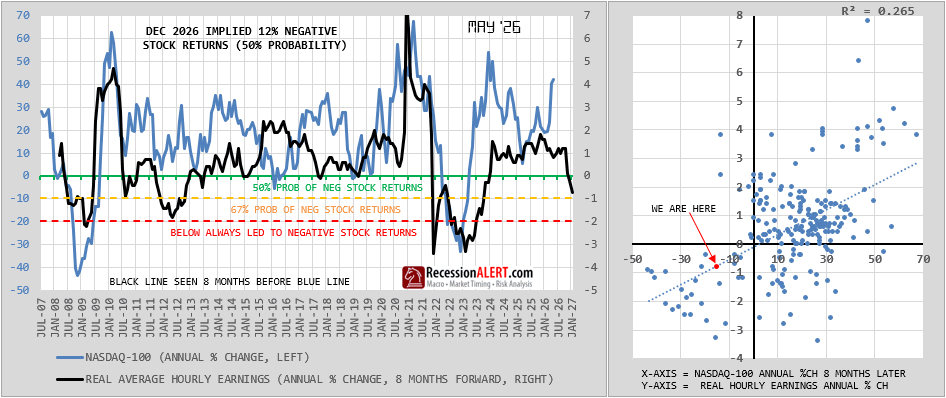
Real average hourly earnings — what the median paycheck actually buys, and the eight-month leading edge of NASDAQ-100 returns — has rolled back to the zero line, and the signal it governs just armed. That threshold is a coin flip: 50% probability of negative returns eight months out, with the chart projecting the index roughly -12% by December 2026. Read it as a yellow flag, not a red one. The kill zone sits lower — past -1 (67% odds) and especially below -2, where no reading has ever failed to precede losses. R²=0.265 is loose in aggregate, but the fit tightens precisely where it bites: the downside. The mechanism explains why. Negative real wages erode household demand first; consumer-facing revenue fades next; forward earnings follow them down; and only then does the multiple-rich NASDAQ-100, leaning hardest on those out-year estimates, reprice — about eight months from paycheck to print. First-order pain for households, second-order for the megacaps. The clock has started; the wallet, not the tape, is keeping time.
Market Intelligence Brief (MIB) Ver. 18.40
For professional investors only. Not investment advice.
© 2026 RecessionALERT.com

Comments are closed.