
WTI surged 3.1% to $98.40 as Trump declared the US-Iran ceasefire ‘on life support’ — Aramco warns Hormuz disruption could extend to year-end. A 90-day US-China tariff pause sent QCOM +8.4% to an ATH ahead of the Trump-Xi Beijing summit May 13–15. Goldman pushed its first Fed cut to December 2026, assigning 44% odds to a hike by April 2027. CPI tomorrow (+3.7% exp.) is the week’s pivot. Lower-income consumers are in discretionary contraction; UMich sentiment is at a 74-year low.
TABLE OF CONTENTS
A. EXECUTIVE SUMMARY
B. MARKET DATA
C. HIGH-IMPACT STORIES (5)
D. MODERATE-IMPACT STORIES (5)
E. ECONOMY WATCH (6)
F. EARNINGS WATCH (1)
G. WHAT’S NEXT
H. CHART OF THE DAY
A. EXECUTIVE SUMMARY -> TOP
Today’s split tape pitted an Iran ceasefire collapse — WTI crude +3.1% to $98.40/bbl on ten consecutive weeks of Hormuz near-closure — against a semiconductor rally on the 90-day US-China tariff pause, leaving the S&P 500 barely positive at +0.19%. The contradiction between headline equities and underlying risk gauges was acute: VIX surged 6.9% on a near-flat tape while 2-year yields climbed 6.1 bps to 3.954%, as bond and options markets repriced the energy-inflation trajectory rather than celebrating the trade détente. Goldman Sachs crystallized the Wall Street rate consensus, pushing its first Fed cut to December 2026 and assigning a 44% probability to a hike by April 2027 — the CME’s current two-cut pricing is now structurally untenable. Six of 11 sectors closed lower; Energy (+2.28%) and Basic Materials (+2.01%) led while Communication Services plunged 2.05% — profit-taking on Alphabet from last week’s all-time high — confirming this was a commodity and policy shock, not a broad risk-on session.
• Iran ceasefire “on life support” — WTI $98.40/bbl (+3.1%) as Trump rejected Tehran’s counter-proposal outright; Saudi Aramco warns Hormuz disruption could last until year-end with OPEC output at a 26-year low
• US-China 90-day tariff pause effective today ahead of the Trump-Xi Beijing summit May 13–15; QCOM +8.4% to all-time high (data center win + tariff relief), MU +6.5%, INTC +3.6%, TSLA +3.9%
• Goldman delays first Fed cut to December 2026, assigns 44% probability to a rate hike by April 2027 — BofA, JPMorgan, HSBC, and RBC all forecast zero 2026 cuts, while CME FedWatch still prices two
• April CPI tomorrow (exp. +3.7% YoY) is the week’s critical pivot — alongside the NY Fed Q1 Household Debt Report; a core print above 3.8% would likely eliminate even Goldman’s December cut and directly catalyze a repricing of rate-sensitive assets
• K-shaped consumer bifurcation accelerating — lower-income households cutting entertainment, dining, and apparel in double digits YoY; University of Michigan sentiment at a 74-year low; auto delinquencies 7.7%, credit card delinquencies 8.7%
• Musk v. Altman trial (Week 3): Nadella testified he feared Microsoft becoming “the next IBM” — while Alphabet disclosed its first-ever yen bond for AI capex, underscoring the rising capital burden on hyperscalers even as semiconductors surged
1. The Hormuz Oil Shock Is Entering Its Structural Phase — Ten consecutive weeks of near-closure, OPEC at a 26-year production low, and Aramco’s year-end normalization warning mark the shift from acute crisis to persistent supply constraint. WTI at $98 sustains 10-year yields at 4.40%+, suppresses Fed easing, compresses housing affordability, and is approaching the $100/bbl threshold historically associated with US recession risk. The DJ Transportation Average’s 0.77% decline on a flat headline tape is the Dow Theory warning: energy cost pressure is already flowing through to logistics and transport operating structures before any demand slowdown materializes.
2. The Tariff Pause Is Recovered Earnings Visibility, Not a Trade Settlement — The 90-day truce restores guidance precision for semiconductor, electronics, and EV supply chains by removing a known headwind — but creates a hard binary expiry in August 2026. China’s rare earth export restrictions (80%+ of global refining capacity) remain intact and represent the leverage Beijing retains regardless of the pause. The AI chip re-rating (QCOM, MU, INTC) reflects recovered visibility; durable upside requires the Trump-Xi summit to produce a structural framework, not just a pause extension.
3. The Fed’s Rate Regime Has Structurally Shifted — Goldman’s 44% hike probability, BofA’s first cut pushed to 2H 2027, and CME FedWatch still pricing two 2026 cuts create a positioning landmine. When the market reprices to zero cuts — the likely catalyst being tomorrow’s CPI — rate-sensitive assets (REITs, utilities, homebuilders, long-duration growth) face structural repricing, not a temporary setback. Kevin Warsh inherits this on Day 1: his first FOMC meeting June 16–17 will be the initial test of whether the incoming Chair leans hawkish or attempts to guide toward the market’s now-isolated dovish pricing.
 — Leading economic indicators. Accurate market forecasts. Apply for membership at join.recessionalert.com
B. MARKET DATA -> TOP
A US-Iran ceasefire collapse — Trump declaring Tehran’s counter-proposal “unacceptable” while the Strait of Hormuz remains near-closed — drove WTI crude up 3.1% to $98.40, while a concurrent AI chip rally on a 90-day US-China tariff pause kept the S&P 500 barely positive at +0.19%. The session was a split tape: Energy (+2.28%) and Basic Materials (+2.01%) led on supply-disruption premium while Communication Services plunged 2.05% on Alphabet profit-taking from last week’s all-time high — six of 11 sectors declined. The defining anomaly: VIX spiked 6.9% to 18.37 on a near-flat equity tape while 2Y yields climbed 6.1 bps — options and bond markets are bracing for oil-driven inflation escalation, not pricing a risk-on session.
CLOSING PRICES – May 11, 2026:
MAJOR INDICES
The DJ Transportation Average’s 0.77% decline against flat industrials is an early Dow Theory caution flag — transports are absorbing oil-cost pressure that headline indices are not yet reflecting. Over the past 10 sessions, the Nasdaq 100 has outperformed the S&P 500 by 4.0 percentage points, concentrated tech/growth leadership persisting into a third consecutive session, suggesting the rally’s breadth remains structurally narrow. Small-cap’s modest +0.39% gain offers slight reassurance, but broad participation has not been confirmed.
| Index | Close | Change | %Move | Why It Moved |
|---|---|---|---|---|
| S&P 500 | 7,412.87 | +13.94 | +0.19% | AI chip rally (QCOM, MU, INTC) offset Communication Services and consumer selling; split tape with 5 of 11 sectors positive |
| Dow Jones | 49,704.34 | +95.18 | +0.19% | Energy and materials strength counteracted by Financial, Consumer Defensive, and Communication Services weakness |
| DJ Transportation | 20,042.9 | −155.8 | −0.77% | Oil price surge (+3.1%) raising fuel costs for airlines, trucking, and logistics; energy cost absorption weighing on transport operators |
| Nasdaq 100 | 29,320.66 | +85.66 | +0.29% | AI semiconductor names led: QCOM +8.4% (earnings + data center + tariff pause), MU +6.5%, INTC +3.6%; partially offset by Alphabet drag |
| Russell 2000 | 2,872.44 | +11.23 | +0.39% | US-China 90-day tariff pause boosted domestic small-cap sentiment; modest breadth improvement on trade optimism |
| NYSE Composite | 22,970.77 | +28.62 | +0.12% | Broad market near-flat; oil and semis strength offset by consumer staples, communication services, and financial selling |
VOLATILITY & TREASURIES
The VIX surging 6.9% on a near-flat equity tape is the session’s most telling signal — options traders pricing in oil-driven inflation risk, not complacency. Rising yields (2Y +6.1 bps to 3.954%; 10Y +4.7 bps to 4.411%) confirm the market is repricing near-term inflation expectations, not growth risk. The dollar’s near-flat close (+0.06%) is the puzzle: no safe-haven bid despite a Middle East supply crisis suggests FX markets are weighing dollar-negative inflation expectations against geopolitical demand for US assets.
| Instrument | Level | Change | Why It Moved |
|---|---|---|---|
| VIX | 18.37 | +1.18 (+6.86%) | Options traders pricing oil-driven inflation escalation risk; 6.9% spike on a near-flat equity tape signals anxiety beneath the surface |
| 10-Year Treasury Yield | 4.411% | +4.7 bps | Oil-driven inflation expectations pushing yields higher; Iran supply shock repricing near-term rate path |
| 2-Year Treasury Yield | 3.954% | +6.1 bps | Front end led yields higher; near-term inflation expectations dominant as oil spike threatens to re-accelerate CPI |
| US Dollar Index (DXY) | 97.95 | +0.06 (+0.06%) | Near flat; geopolitical safe-haven demand offset by dollar-negative inflation expectations from oil price surge |
COMMODITIES
Silver’s 7.1% surge towers over gold’s 0.28% gain — a sharp divergence separating the precious metals complex today. With copper climbing 2.95% on AI-infrastructure demand and Middle East sulphuric acid supply disruption, silver’s industrial component is firing alongside its precious metal bid. Platinum’s 4.37% gain reinforces the industrial-precious hybrid theme. Bitcoin’s 1.45% rise tracked equities broadly, offering no idiosyncratic crypto signal.
| Asset | Price | Change | %Move | Why It Moved |
|---|---|---|---|---|
| Gold | $4,743.74/oz | +$13.04 | +0.28% | Modest safe-haven bid despite Iran geopolitical crisis; restrained by stable dollar and risk-on semiconductor sector bid |
| Silver | $86.618/oz | +$5.753 | +7.11% | Dual catalyst: AI/semis and grid infrastructure industrial demand surge amplified by precious metals safe-haven component |
| Copper | $6.4825/lb | +$0.1860 | +2.95% | AI infrastructure and power grid modernization demand; Middle East disruption of sulphuric acid shipments constraining copper refining capacity |
| Platinum | $2,149.20/oz | +$89.90 | +4.37% | Industrial and auto-catalyst demand rising alongside the broader metals complex; supply chain concerns from Middle East logistics disruption |
| Bitcoin | $81,852 | +$1,170 | +1.45% | Modest risk-on tracking of equity sentiment; no idiosyncratic crypto catalyst; well within recent range |
ENERGY
WTI and Brent moved in near-lockstep — no material spread widening — confirming this is a global supply shock, not a regional disruption; the Strait of Hormuz closure hits all seaborne crude equally. Natural gas climbing 6.0% independently of crude adds a second energy pressure vector, driven by a smaller-than-expected 63 Bcf storage injection tightening seasonal balances. Rising oil alongside a marginally positive equity market reads as demand resilience, though the margin is thin — any further crude surge risks flipping the narrative to stagflationary cost pressure.
| Asset | Price | Change | %Move | Why It Moved |
|---|---|---|---|---|
| Crude Oil (WTI) | $98.40/bbl | +$2.98 | +3.12% | US-Iran ceasefire “on life support”; Trump rejected Iran counter-proposal as “unacceptable”; Strait of Hormuz near-closed, reigniting energy disruption fears |
| Crude Oil (Brent) | $104.37/bbl | +$3.08 | +3.04% | Same geopolitical driver as WTI; near-lockstep move confirms global supply shock; Hormuz closure affecting two-thirds of world seaborne crude |
| Natural Gas (Henry Hub) | $2.923/MMBtu | +$0.166 | +6.02% | Smaller-than-expected 63 Bcf storage injection tightened seasonal balances; storage build below five-year average norms signals tighter supply |
| Natural Gas (Dutch TTF) | $15.96/MMBtu | +$0.71 | +4.68% | Following Henry Hub higher; European gas markets pricing broader energy disruption risk premium from Hormuz crisis |
S&P 500 SECTORS
Energy’s 2.28% surge sharply reverses its −3.69% weekly slide as the Iran supply shock dominates. The contrast with Communication Services (−2.05% today despite being up +9.07% over one month) marks a sharp intraday rotation out of recent tech-adjacent winners. Healthcare continues its structural deterioration — down 6.94% over three months and 5.65% YTD — with no sector catalyst in sight. Six of 11 sectors closed lower, confirming this was a commodity story, not a broad risk-on session.
| Sector | 1-Day | 1-Week | 1-Month | 3-Month | 6-Month | YTD | 12-Month |
|---|---|---|---|---|---|---|---|
| Energy | +2.28% | −3.69% | −0.48% | +10.43% | +31.59% | +29.80% | +43.98% |
| Basic Materials | +2.01% | +7.27% | +1.71% | +1.65% | +34.85% | +20.70% | +55.73% |
| Industrials | +0.86% | +2.47% | +2.62% | +1.63% | +17.40% | +15.27% | +33.85% |
| Utilities | +0.74% | −2.08% | −3.07% | +3.32% | +3.72% | +6.84% | +16.83% |
| Technology | +0.68% | +7.05% | +19.25% | +17.77% | +16.12% | +17.76% | +54.48% |
| Real Estate | −0.06% | +1.40% | +3.80% | +3.81% | +8.06% | +8.92% | +8.36% |
| Financial | −0.27% | +0.46% | +1.33% | −4.54% | +1.57% | −3.35% | +11.22% |
| Healthcare | −0.38% | −1.00% | −2.30% | −6.94% | +0.03% | −5.65% | +10.58% |
| Consumer Cyclical | −0.79% | +1.29% | +6.26% | +1.62% | −0.64% | −0.25% | +17.12% |
| Consumer Defensive | −0.88% | −0.03% | +0.88% | −3.75% | +11.67% | +8.44% | +6.21% |
| Communication Services | −2.05% | +0.06% | +9.07% | +6.68% | +12.34% | +6.76% | +44.45% |
TOP MEGA-CAP MOVERS:
GAINERS
| Company | Ticker | Close | Change | Why It Moved |
|---|---|---|---|---|
| Qualcomm | QCOM | $237.53 | +8.42% | Q2 earnings beat; CEO announced data center processors shipping to major hyperscaler by end-2026; 90-day US-China tariff pause restoring Android refresh confidence; multiple analyst upgrades (Baird $300, Tigress $280) |
| Philip Morris International | PM | $182.11 | +6.50% | Q1 2026 earnings beat (EPS $1.96 vs. $1.83 consensus); defensive positioning as Iran geopolitical uncertainty rises; international tobacco revenue resilient to US tariff exposure |
| Micron Technology | MU | $795.33 | +6.50% | AI semiconductor demand rally; sector momentum from QCOM catalyst and 90-day US-China tariff pause reducing chip supply chain uncertainty |
| Tesla | TSLA | $445.08 | +3.91% | US-China tariff pause benefiting EV supply chain and battery materials procurement; AI/tech momentum spillover bucking the Consumer Cyclical sector |
| Intel Corp | INTC | $129.44 | +3.62% | Semis sector rally lifted Intel alongside QCOM and MU; tariff pause reducing near-term supply chain headwinds for chip manufacturing |
DECLINERS
| Company | Ticker | Close | Change | Why It Moved |
|---|---|---|---|---|
| PepsiCo | PEP | $149.41 | −3.37% | Consumer Defensive sector rotation out (sector −0.88%); investors shifting from defensive staples into energy and commodity plays on the Iran supply shock |
| Alphabet | GOOGL | $388.64 | −3.03% | Profit-taking after hitting all-time high ($400.80) on May 8; both GOOGL and GOOG pulling back together, dragging Communication Services sector −2.05% |
| Wells Fargo | WFC | $73.58 | −2.72% | Continuing post-Q1 earnings weakness (April 14 results soft); rising yields not offsetting NII and credit quality investor skepticism |
| IBM | IBM | $223.55 | −2.70% | Legacy IT services rotation out as investors move into semiconductor/AI-direct plays; IBM’s hybrid cloud model viewed as indirect AI beneficiary relative to chip names surging today |
| Alphabet (Class C) | GOOG | $386.71 | −2.60% | Same driver as GOOGL; both share classes declining together confirms profit-taking from ATH rather than class-specific institutional selling |
— Institutional-grade intelligence for serious investors. Apply for membership at join.recessionalert.comC. HIGH-IMPACT STORIES -> TOP
BEARISH
1. Iran Ceasefire “On Life Support” — Trump Rejects Tehran Counter-Proposal as WTI Hits $98.40, Saudi Aramco Warns Disruption Could Last Months
The core facts:President Trump declared Iran’s counter-proposal “TOTALLY UNACCEPTABLE” on May 11, describing the ceasefire as now on “massive life support.” Tehran’s counter demanded sovereignty recognition over the Strait of Hormuz, compensation for war damages, release of frozen assets, full sanctions relief, and an end to all fighting including Lebanon — terms the US rejected outright. The Strait of Hormuz has been near-closed for 10 consecutive weeks; Saudi Aramco’s CEO warned publicly on May 11 that oil markets may not normalize until year-end. A Reuters survey released the same day showed OPEC output at a 26-year low due to Hormuz-related supply disruption. WTI crude surged 3.1% to $98.40/bbl; Brent +3.0% to $104.37/bbl. The Energy sector advanced +2.28% while the DJ Transportation Average fell -0.77% on fuel cost absorption pressure.
Why it matters:Each rejected negotiating round compounds the cumulative economic damage from the Hormuz disruption. Saudi Aramco’s year-end normalization warning is the single most consequential data point for macro pricing today: it signals that the market should abandon any near-term resolution assumption and model in a structurally elevated energy environment. The transmission chain is now clearly established — WTI at $98-100 → retail gas at $4.52 → consumer purchasing power erosion → Q2 discretionary spending risk → S&P 500 earnings growth revision from the current +27.1% blended trajectory. OPEC at a 26-year production low means even a partial Hormuz reopening would face an entirely depleted production buffer — so the supply response to any deal would be slower than markets expect. The DJ Transports falling on a day when the headline S&P was barely positive is the Dow Theory warning shot: energy-cost pressure is already flowing through to the operating cost structures of America’s logistics, airline, and trucking economy before any demand slowdown materializes.
What to watch:Any formal Iranian response to a revised US proposal; WTI sustained above $100/bbl (the psychological and historical threshold associated with US recession risk); DJ Transportation Average vs. S&P 500 spread as the cleanest leading indicator of energy-cost transmission into the real economy.
BULLISH
2. US-China 90-Day Tariff Pause Takes Effect Ahead of Trump-Xi Beijing Summit — Semiconductors Surge as Supply Chain Overhang Lifts
The core facts:A 90-day US-China tariff pause was announced and became effective surrounding the Trump-Xi Beijing summit confirmed for May 13-15 — the first US presidential state visit to China since 2017. The pause sharply reduces US tariff rates on Chinese imports (down from the 145% peak to approximately 30%) and Chinese retaliatory duties on US goods (down to approximately 10%). Technology and semiconductor supply chain names were the session’s biggest beneficiaries: QCOM +8.4%, MU +6.5%, INTC +3.6%, TSLA +3.9%. The Russell 2000 gained +0.39% as domestic small-caps priced in broader supply chain cost relief. Trade, Taiwan, Iran-related energy markets, and rare earth exports are on the summit agenda in Beijing.
Why it matters:The tariff pause removes the critical supply chain overhang that had been suppressing earnings guidance visibility across semiconductor, consumer electronics, and EV sectors since April. Qualcomm derives 60%+ of handset revenues from Android devices sold in China; Micron’s China-based HBM customers and TSMC’s downstream customers faced double-digit tariff exposure that was compressing Q3 guidance assumptions. Today’s re-rating reflects restored earnings visibility — not new revenue, but the removal of a known earnings headwind. The summit context is strategically decisive: a 90-day pause is a negotiating mechanism, not a structural settlement. The binary risk arrives in August 2026 when the clock expires. If the Trump-Xi summit fails to produce a durable framework, tariffs snap back and the equity re-rating reverses with them. The rare earth agenda item at the summit represents China’s most potent remaining leverage — China controls 80%+ of global rare earth refining capacity, and any restriction would hit US defense, semiconductor, and EV production simultaneously. For equity investors: the 90-day window supports the semiconductor trade, but position sizing should account for the August binary.
What to watch:Trump-Xi summit outcomes May 13-15 for signals on a durable trade framework extension; any announcement on rare earth export restrictions (the leverage point China retains independent of the tariff truce); August 2026 as the tariff pause expiry date and the next binary catalyst for the technology sector.
BEARISH
3. Goldman Sachs Delays First Fed Cut to December 2026; Wall Street Consensus Crystallizes Around No 2026 Easing — Goldman Assigns 44% Probability to Rate Hike by April 2027
The core facts:Goldman Sachs on May 11 pushed its first Fed rate cut forecast to December 2026 (delayed from Q3 2026), citing persistent energy-driven core PCE inflation near 3%. Goldman simultaneously assigned a 44% probability to a Fed rate hike by April 2027 — a near-coin-flip on further tightening. The broader Wall Street consensus is now firmly anchored: BNP Paribas, HSBC, JPMorgan, and RBC all forecast zero rate cuts in 2026; BofA (updated May 8) projects first cut in July 2027; Morgan Stanley sees January 2027. Goldman’s December 2026 forecast is the most optimistic of the major banks. CME FedWatch still prices two cuts in 2026 — a significant gap vs. the bank consensus. The 10-year Treasury yield rose +4.7 bps to 4.411%; the 2-year +6.1 bps to 3.954%, with the short end leading as near-term inflation expectations repriced.
Why it matters:Goldman’s update is not the first higher-for-longer call — it is the bank-consensus consolidation point that makes the CME FedWatch pricing of two 2026 cuts untenable. The market position that will unwind is mechanical: when the last two expected cuts are priced out of the short end, 2-year yields move higher, 10-year duration risk premium expands, and every long-duration equity sector reprices. REITs, homebuilders, and utilities — all valued on discount rates tied to the risk-free rate — face a structurally higher cost of capital for longer. The 44% hike probability from Goldman is the more alarming number: a near-coin-flip on tightening means options markets must price in two-sided rate risk rather than an asymmetric easing path, which structurally widens credit spreads and compresses equity risk premiums for growth assets. The Warsh confirmation — with Senate cloture vote underway this week — introduces an additional policy reaction function uncertainty: a new Fed chair who has acknowledged rate adjustments may be needed “with urgency” could either accelerate the December cut or, under political pressure, deliver it prematurely against the inflation data backdrop.
What to watch:CME FedWatch June 16-17 FOMC implied probability for 2026 cuts — when this converges toward zero (current bank consensus), expect immediate repricing in REITs, utilities, and rate-sensitive financials; Tuesday’s CPI (May 12) as the next hard inflation data point; Warsh’s first formal public statement as Fed Chair-designate for any signal on the June 16-17 FOMC inclination.
UNCERTAIN
4. Communication Services Crashes 2.05% — Alphabet Discloses First-Ever Yen Bond for AI Capex as Hyperscaler Rotation Reverses Last Week’s Sector Gains
The core facts:Communication Services was the S&P 500’s worst-performing sector on May 11, declining 2.05% — a sharp reversal from its 1-month +9.07% run and the sector’s worst single-day performance in recent weeks. Alphabet (GOOGL) fell approximately 1.57% from last week’s all-time high of $400.80. The specific new disclosure: Alphabet announced it will issue yen-denominated bonds for the first time, tapping Japanese credit markets to fund AI infrastructure expansion — a first in the company’s history. Amazon simultaneously accessed foreign credit markets for AI capex. Microsoft declined alongside the broader hyperscaler complex. The session saw a sharp intraday rotation: semiconductors advanced strongly (QCOM +8.4%, MU +6.5%) while AI hyperscalers — the sector that had driven the prior week’s record close — gave back ground.
Why it matters:Alphabet’s first-ever yen bond issuance is a structural signal about the scale of the AI capital expenditure cycle: companies committing $50-80B/year in AI infrastructure have exhausted low-cost domestic credit capacity and are now tapping international markets to fund the buildout at acceptable financing rates. This is a double-edged data point. The bullish read: AI capex is expanding beyond what domestic credit markets can absorb, validating the AI supercycle thesis and signaling conviction in multi-year infrastructure returns. The bearish read: yen-denominated debt introduces cross-currency risk; foreign capital market access signals the AI investment burden is large enough to require global balance sheet mobilization, which compresses near-term free cash flow multiples even if long-run AI revenues materialize. The market’s immediate rotation instinct — sell hyperscalers who bear the capex burden, buy semiconductors who collect the capex spending — is the textbook response to this arithmetic. The sector rotation from Communication Services into Technology/Semiconductors is the clearest signal of where institutional positioning moved today.
What to watch:Alphabet Q2 2026 earnings (late July) for AI capex guidance and FCF trajectory; whether Amazon, Microsoft, or Meta follow Alphabet into foreign-currency bond markets (would confirm systemic AI capex financing shift); yen/dollar rate movement as a cross-currency risk variable for Alphabet’s new yen-denominated debt obligations.
UNCERTAIN
5. Trump Endorses Federal Gas Tax Suspension — White House and Congressional Republicans Introduce Bills to Cut 18.4¢/Gallon as Iran War Drives Gas to $4.52
The core facts:President Trump publicly endorsed suspending the federal gasoline tax in a CBS News interview on May 11, stating: “we’re going to take off the gas tax for a period of time.” Energy Secretary Chris Wright confirmed the administration is “open” to the measure. Senator Josh Hawley (R-MO) announced he will introduce suspension legislation Monday; Representatives Anna Paulina Luna (R-FL) and Jeff Van Drew (R-NJ) filed parallel bills. The federal gas tax stands at 18.4 cents per gallon; suspension requires Congressional action, not an executive order. US average gasoline is $4.52 per gallon per AAA — up from approximately $3 before the Iran conflict. The relief math: 18.4 cents on a 12-gallon fill-up reduces consumer cost by approximately $2.21 per tank (~4% at current prices).
Why it matters:The administration’s pivot to consumer energy relief via a gas tax holiday is an explicit admission that $4.52 gasoline is a political and macroeconomic crisis. The fiscal arithmetic is significant: the federal gas tax funds the Highway Trust Fund (approximately $35-40B/year); a sustained suspension would create an immediate highway infrastructure funding shortfall that must be filled by borrowing, alternative funding, or project delays — adding directly to the already-alarming $2.1T FY2026 deficit trajectory. The relief is consumer-sentiment-positive but economically marginal: a 4% reduction on a price that has risen 50%+ since the Hormuz closure does not meaningfully restore household purchasing power. For equity markets, the primary beneficiaries would be consumer discretionary names with high lower-income exposure (restaurants, value retail, travel) — but only if the legislation passes quickly, which is uncertain. The irony: the tax suspension could be mildly inflationary by returning purchasing power to consumers at precisely the moment the Fed is holding rates to contain energy-driven inflation, creating a fiscal/monetary policy conflict. Highway and infrastructure stocks face a direct headwind if Highway Trust Fund revenue declines materially.
What to watch:Senate vote count — 51 votes required for passage; Congressional Budget Office revenue impact scoring (likely $35-40B annualized addition to the deficit); homebuilder and infrastructure ETF reaction if Highway Trust Fund funding appears structurally threatened.
— Quantifying recession risk so you don’t have to guess. Apply for membership at join.recessionalert.comD. MODERATE-IMPACT STORIES -> TOP
BULLISH
6. Qualcomm Surges 9% to All-Time High — Hyperscaler Data Center Win, Multiple Analyst Upgrades to $225-$300, and Tariff Pause Converge in Single Session
The core facts:Qualcomm (QCOM) hit an all-time intraday high of $247.90 on May 11, gaining approximately +9% — the best single-session performance in the S&P 500 and Nasdaq 100. Three independent catalysts converged: (1) CEO Cristiano Amon confirmed on QCOM’s Q2 FY2026 earnings call that the company will ship next-generation data center processors to “a large hyperscaler” before year-end 2026, citing “pull-in demand” that signals earlier-than-expected customer adoption; (2) multiple fresh analyst upgrades: Baird raised its price target to $300 (from $250), Tigress to $280, Benchmark to $225 — all citing the data center addressable market expansion beyond mobile; and (3) the US-China 90-day tariff pause directly removes the headwind on QCOM’s China-based Android handset business, which represents the majority of its mobile revenue. The June 24 Investor Day remains the next scheduled disclosure event for data center roadmap specifics.
Why it matters:Three simultaneous independent catalysts in a single session represent a qualitatively different event from typical analyst-upgrade rallies. The data center hyperscaler win is the transformative element: it reframes QCOM from a smartphone chip duopolist (with Mediatek) and automotive chip supplier into a three-vector AI silicon play — edge AI (device-level inference), automotive AI (driver assistance systems), and data center inference (hyperscaler workloads). Analyst targets ranging from $225 to $300 imply 15-55% additional upside from recent levels. The tariff pause removes the last credible bearish argument (China revenue vulnerability), effectively closing the primary short thesis. The broader market read-through: if Qualcomm can credibly enter data center inference — with existing hyperscaler relationships and an energy-efficient ARM architecture advantage — NVIDIA’s AI inference chip dominance faces meaningful competitive pressure for the first time from a company with both design capability and customer access.
What to watch:QCOM Investor Day June 24 for specific data center revenue timelines, customer naming, and production capacity commitments; Q3 FY2026 earnings (late July) for first data center inference revenue booking; any hyperscaler procurement announcement referencing QCOM silicon in AI infrastructure.
BEARISH
7. Existing Home Sales Disappoint — April Prints 4.02M vs. 4.05M Consensus; NAHB Builder Confidence at Lowest Since September 2025
The core facts:April 2026 existing home sales printed 4.02M annualized units (NAR, released May 11) — a miss vs. the 4.05M consensus, representing a near-flat +0.2% gain from March’s seven-month low. Inventory rose 5.8% to 1.47M units (4.4-month supply). Median sale price: $417,700 (+0.9% YoY). NAR Chief Economist Lawrence Yun described the spring homebuying season as “lackluster,” projecting no year-over-year improvement through April. Separately, the NAHB/Wells Fargo Housing Market Index fell to 34 in April — the lowest since September 2025, below the 37 consensus and down from 38 in March — signaling builder caution on the combination of elevated mortgage rates, higher material costs, and softening buyer traffic.
Why it matters:The dual disappointment — existing home sales miss and NAHB at a multi-month low — on the same session confirms that the Iran war’s energy shock has materially impaired housing affordability through the mortgage rate channel: WTI at $98+ is sustaining 10-year yields at 4.40%+, which directly lifts 30-year mortgage rates and prices additional first-time buyers out of the market. The 4.4-month inventory increase alongside weak sales is a meaningful structural signal — rising supply and weak demand simultaneously indicates softening price pressure ahead, not a supply-driven affordability recovery. For portfolio managers, the read-through hits three asset classes: homebuilder equities (Toll, DR Horton, Lennar face forward guidance revision risk), mortgage REITs (origination volume compression and funding cost pressure), and regional banks with large residential mortgage pipelines. The NAHB at 34 is the more alarming indicator: the index is well below 50 (the contraction threshold) and approaching levels historically associated with housing sector downturns. The spring selling season is the industry’s highest-revenue period; a “lackluster” spring implies full-year housing start and revenue guidance revisions are coming across the sector.
What to watch:Housing starts and building permits (May 19) for the leading indicator of builder activity; homebuilder earnings (Toll Brothers, DR Horton in late May/June) for explicit guidance revisions; 30-year mortgage rate trajectory — any sustained decline below 6.8% would be the primary catalyst for demand recovery.
BEARISH
8. K-Shaped Consumer Divide Deepens — Energy and Tariff Inflation Drives Lower-Income Households to Cut Discretionary Spend; Off-Price Retail Emerges as Defensive Play
The core facts:Multiple reports published May 10-11 document an accelerating bifurcation in US consumer behavior. A Deloitte Consumer Spending Report (April-May 2026) and Fortune analysis (May 10, by Heather Long) confirm that lower-income households (earning under $75K) have cut entertainment, dining, apparel, and beauty spending by double-digit percentages year-over-year, driven by real wage erosion from energy and tariff price pressures. Higher-income households (earning over $100K) are maintaining discretionary spend levels. University of Michigan consumer sentiment printed 48.2 — a 74-year record low — with one-third of respondents citing gas prices as the primary stress factor. Leslie’s, Ross Stores, and Zumiez shares declined on May 11 as markets reassessed lower-income consumer durability heading into summer. CEO surveys published this week project inflation at 3.7% over the next year. The NY Fed Q1 2026 Household Debt report releases Tuesday, May 12, as the next hard data read.
Why it matters:The K-shaped consumer economy creates a structural modeling problem for S&P 500 earnings: aggregate consumer spending data looks tolerable because high-income households are holding up, but the lower-income cohort that drives volume at fast-casual restaurants, value retail, home improvement, and entertainment is already in measurable contraction. Companies like McDonald’s, Dollar General, Target, and Domino’s face the specific risk of volume compression that will not show up in aggregate retail sales until the data catches up with the anecdotal and survey signals. The defensive positioning implication is clear: TJX, Ross Stores, and Ollie’s Bargain Outlet benefit as consumers trade down from full-price to off-price retail — a pattern consistent with early recessionary consumer psychology even when GDP remains technically positive. The Tuesday NY Fed Household Debt report is the highest-priority near-term data release in this context: rising credit card delinquency rates or auto loan stress would convert the sentiment signal into a hard-data confirmation of consumer financial deterioration.
What to watch:NY Fed Q1 Household Debt report (May 12) for credit card and auto loan delinquency rates — a sustained move above 3.5% in credit card delinquencies is the clearest early recession signal; April Retail Sales (May 15) for month-level category breakdown distinguishing lower-income vs. higher-income spending; McDonald’s and Dollar General Q1 earnings for same-store traffic data.
BEARISH
9. General Motors Cuts 500-600 Salaried IT Workers — Pivoting to AI Talent as EV Losses and High Interest Rates Force Cost Discipline
The core facts:General Motors announced May 11 it is cutting 500-600 salaried IT workers, primarily in Austin, TX, and Warren, MI. Affected functions include identity access management, platform security, quality and warranty IT, software and services, and the Teamcenter group within software engineering. GM stated it is simultaneously planning to hire AI-capable technology talent, repositioning the IT department toward generative AI integration and autonomous vehicle software development. The cuts reflect cost discipline amid ongoing EV losses (estimated $5-6B EV segment losses in 2025) and elevated interest rate pressure on auto financing demand. This is the latest in a series of GM workforce reductions over the past 18 months across salaried and technology functions.
Why it matters:GM’s decision to systematically cut traditional IT while simultaneously hiring AI-capable talent is the most operationally concrete example yet of how AI-driven workforce transformation is executing across Fortune 500 companies — moving from CEO strategic statements to actual headcount action. For GM equity specifically, each increment of cost reduction from the salaried function is margin-positive at a time when the EV segment losses remain a material drag. The broader auto sector signal: GM’s continued EV cost discipline — rather than accelerating investment to capture market share — suggests the industry is converging on a “selective investment” strategy that prioritizes margin sustainability over EV adoption acceleration. This is bullish for ICE-margin durability and bearish for earlier EV transition timeline assumptions. The AI labor substitution pattern (identity access management, quality assurance, legacy software maintenance out; generative AI implementation in) is directly observable across the S&P 500 technology services and IT consulting sector — companies like Accenture, IBM, and Cognizant face structural demand erosion for traditional IT services as enterprise clients like GM self-provision AI-enabled replacements.
What to watch:GM Q2 2026 earnings (late July) for EV segment loss trajectory update and any quantified AI cost reduction target; Ford and Stellantis announcements for parallel IT restructuring (would signal industry-wide AI substitution acceleration); IT consulting sector (Accenture, IBM) for enterprise spending commentary on traditional IT services demand.
UNCERTAIN
10. Microsoft CEO Nadella Testifies in Musk v. Altman Trial — Feared Becoming “the Next IBM,” Never Got Clarity on Altman Firing
The core facts:Microsoft CEO Satya Nadella took the stand May 11 as week three of the Elon Musk vs. Sam Altman trial began. Nadella testified he was never informed in advance of OpenAI’s November 2023 decision to fire Altman, was pulled from a meeting when the news broke, and was never given a full explanation for the board’s decision. An internal Microsoft email from April 2022 — entered into evidence — showed Nadella writing that he worried Microsoft could become “the next IBM” in its OpenAI partnership: an innovation follower rather than leader. Nadella denied demanding Altman’s reinstatement despite Microsoft’s multi-billion dollar investment stake and deep Azure/Copilot/Office 365 integration with OpenAI models. Elon Musk never contacted Nadella with concerns about Microsoft’s investment terms. Sam Altman is expected to testify later this week; the advisory jury verdict is anticipated the week of May 18.
Why it matters:The Musk v. Altman trial is the most consequential AI governance proceeding in history — its outcome will establish precedents for nonprofit-to-for-profit AI conversions, board accountability in AI ventures, and investor rights against charitable mission claims. Nadella’s “next IBM” email is the trial’s most strategically revealing disclosure: it confirms that Microsoft’s $10B+ OpenAI commitment was driven not by technological dominance but by existential fear of AI displacement — which colors the entire strategic rationale and valuation case for the partnership. If the court finds that OpenAI’s for-profit conversion violated its nonprofit charter (Musk’s core claim), the resulting restructuring could disrupt Microsoft’s Azure AI revenue pipeline — now one of Azure’s fastest-growing segments and a primary driver of Microsoft’s premium multiple. The IBM admission also underscores that Nadella lacked governance visibility into his most strategically important partnership, which raises due-diligence questions about Microsoft’s risk management framework around its largest AI dependency. For AI sector investors, the trial outcome will determine whether nonprofit governance constraints remain viable for transformational AI companies — with structural implications for Anthropic, the OpenAI organizational structure post-conversion, and any future AI company seeking hybrid nonprofit/commercial structures.
What to watch:Sam Altman’s testimony this week for his characterization of Microsoft’s role and influence in OpenAI’s governance; advisory jury verdict the week of May 18 for any finding on nonprofit mission breach; Microsoft Q1 FY2027 earnings (late October) for Azure AI revenue disclosure — the first earnings report that could quantify OpenAI dependence vs. Microsoft-native AI capability.
— Separating signal from noise since 2007. Apply for membership at join.recessionalert.comE. ECONOMY WATCH -> TOP
The week opens with Wall Street’s rate-cut timeline in full retreat: Bank of America eliminated all 2026 cuts (pushing the first to 2H 2027) while Goldman Sachs delayed its first move to December 2026, both citing the Iran war’s energy shock and tariff passthrough keeping trend inflation stubbornly above 3%. Incoming Fed Chair Warsh — expected to be confirmed by Friday — inherits the same “transitory vs. persistent” dilemma that broke the Fed’s credibility in 2021. On the ground, the consumer divide is widening: UMich sentiment sits near historic lows while high earners keep spending and lower-income households cut discretionary. Tuesday’s April CPI (consensus +3.7% YoY) is the first hard test of where inflation actually lands.
Existing Home Sales Edge Up 0.2% in April to 4.02M — Below Expectations as Inventory Builds (NAR, May 11, 2026)
What they’re saying:April existing home sales rose 0.2% month-over-month to a 4.02 million annualized rate, missing the 4.05 million consensus estimate but recovering from a 3.6% decline in March. Sales were flat year-over-year. Housing inventory climbed 5.8% from March to 1.47 million units — a 4.4-month supply — while the median existing-home price reached $417,700, up 0.9% from a year ago, marking the 34th consecutive month of year-over-year price gains.
The context:The modest miss reflects a housing market still constrained by affordability pressures despite some easing: mortgage rates are lower than a year ago and income growth is outpacing home price appreciation, per NAR Chief Economist Lawrence Yun. Regional divergence is notable — Midwest and South expanded, while the West declined. Rising inventory is a structurally positive signal, but the spring buying season remains “lackluster” against the backdrop of historically low consumer confidence and geopolitical uncertainty.
What to watch:Thursday May 14 — April retail sales (a broader read on consumer spending momentum). Friday May 15 — UMich preliminary May consumer sentiment (final arbiter of buyer psychology heading into summer). Any move in mortgage rates following Tuesday’s CPI print will directly shape the next month’s housing demand.
Senate Set to Confirm Kevin Warsh as Fed Chair This Week — Powell’s Term Expires May 15 (Roll Call / CNBC, May 11, 2026)
What they’re saying:The full Senate is expected to confirm Kevin Warsh as Federal Reserve Chair this week, with the first procedural cloture vote Monday evening. Warsh needs two separate confirmation votes — one to join the Board, one to serve as Chair — but Republicans’ 53-seat majority makes passage near-certain. Powell’s term as Chair expires Friday May 15, creating a hard deadline. The Banking Committee advanced Warsh 13-11 along strict party lines in late April — the first fully partisan Fed Chair vote in committee history.
The context:Warsh has signaled he wants to rebuild the Fed’s forecasting architecture after the institution’s “transitory” inflation misjudgment in 2021 — when model-reliance led to a catastrophic policy delay. He inherits a Fed holding rates at 3.50%–3.75% with four dissents at the April meeting (the most since 1992) and an immediate credibility test: how to frame the Iran war energy shock and tariff passthrough heading into Tuesday’s April CPI print. Markets are pricing two cuts in 2026; both Goldman and BofA have pushed their own cut timelines well beyond that.
What to watch:Senate confirmation vote timing (any delay or procedural complications). Warsh’s first public statement as Chair-designate — likely to signal his near-term policy framing. June 16-17 FOMC meeting is his first as chair; markets will look for any shift in forward guidance language.
Goldman Sachs Cuts Recession Odds to 25%, Delays First Fed Rate Cut to December 2026 (May 11, 2026)
What they’re saying:Goldman Sachs lowered its 12-month U.S. recession probability to 25% from 30%, citing a steady labor market — April payrolls came in at +115K against a 62K consensus — that is offsetting persistent inflationary headwinds from the Iran war energy shock and tariffs. Simultaneously, Goldman pushed its first Fed rate cut to December 2026, a significant delay from prior forecasts, reflecting the view that the Fed cannot move until inflation shows a clearer downward trajectory. The bank’s stance: recession is not the base case, but the path to cuts is longer than markets had priced.
The context:Goldman’s moves illustrate the central macro tension of 2026: resilient hard data (jobs, GDP at 2.0% Q1) coexisting with persistent soft data stress (Michigan sentiment at multi-decade lows) and dual supply shocks (Iran war oil +40% above pre-war, tariff passthrough accelerating). The Polymarket recession market sits at 22% — roughly in line with Goldman but well below Moody’s (49%) and JPMorgan (35%). The divergence among forecasters is itself a signal of elevated uncertainty about how the shocks resolve.
What to watch:Tuesday April CPI (exp. +3.7% YoY) — a print above 3.8% would almost certainly push Goldman’s first cut call beyond December. Thursday April retail sales — the key hard data test of whether consumer spending is holding up despite sentiment collapse. GDPNow Q2 next update May 14 (currently 3.7%).
Bank of America Removes All 2026 Fed Rate Cuts — Delays First Move to Second Half 2027 (BofA Global Research, May 8, 2026)
What they’re saying:In a May 8 investor note, Bank of America Global Research stated “We no longer expect the Fed to cut rates this year,” extending its prior forecast of a late-2026 cut to 2H 2027. BofA cited three converging pressures: (1) “trend inflation has not shown clear signs of dipping below 3%”; (2) ongoing energy cost pass-through from the Iran war; and (3) AI-driven increases in computer hardware and software costs. The strong April NFP print (+115K vs. 65K expected) further weakened the argument for near-term easing. BofA’s call is the most hawkish of any major Wall Street bank.
The context:BofA’s forecast now stands in sharp contrast to CME FedWatch pricing, which still implies two 25-bp cuts in 2026 (April and September). If BofA is correct, rate-sensitive sectors (utilities, REITs, small caps) face a prolonged headwind, and mortgage rates will stay elevated through next year. Core CPI is expected to peak at 3.2% in Q2 2026 and retreat only slowly to 2.8% by year-end per BofA’s model — well above the Fed’s 2% target and reinforcing the case for extended policy hold. JPMorgan similarly expects the Fed to hold steady throughout 2026.
What to watch:Tuesday April CPI — the single most important near-term data point for validating or challenging BofA’s hawkish call. Any core CPI print above 0.3% MoM reinforces the “no cuts in 2026” scenario. Wednesday April PPI (exp. +0.4% MoM) as a leading indicator of future CPI direction.
Iran War + Tariff Shock Gives the Fed an Inflation Deja Vu — Warsh Inherits the “Transitory” Dilemma (Axios, May 11, 2026)
What they’re saying:With oil prices up more than 40% from pre-conflict levels and tariff passthrough accelerating, the Federal Reserve faces the same structural question it answered wrongly in 2021: is this inflation transitory (an energy and trade shock that will pass) or persistent (a structural repricing that requires tightening)? The Fed’s 2021 error — dismissing inflation as transitory due to overreliance on models — cost it credibility and forced an aggressive hiking cycle. Warsh has explicitly signaled he wants to dismantle the Fed’s forecasting architecture to prevent a repeat. His first test arrives Tuesday with April CPI.
The context:The parallels are striking: in 2021, the Fed held rates at zero as inflation rose, dismissing it as supply-chain transitory. In 2026, the Fed is holding at 3.50%–3.75% as oil and tariff inflation rises, with internal debate visible through four April FOMC dissents — the most since 1992. The complicating factor: unlike 2021’s demand-driven inflation, today’s shock is supply-driven (oil, tariffs). Supply shocks historically support a “look through” stance — but only if inflation expectations remain anchored. NY Fed April survey showed 1-year expectations at 3.6%, the second straight monthly increase and the highest short-term reading in over a year, raising the risk that looking through becomes a mistake.
What to watch:Tuesday April CPI and Wednesday April PPI — together these will frame the “transitory vs. persistent” narrative for Warsh’s first FOMC meeting June 16-17. Fed Williams speech Tuesday will be the last public Fed commentary before Warsh assumes the Chair. Minneapolis Fed GDPNow update May 14 provides the growth side of the equation.
K-Shaped Consumer Divide Deepens — Lower-Income Americans’ Wages Losing Ground to Inflation (Fortune / Heather Long, May 10, 2026)
What they’re saying:With consumer sentiment near all-time lows, economists are flagging a deepening K-shaped divide in household finances. High earners ($150K+) continue to book vacations and sustain discretionary spending, masking stress concentrated in the lower half of the income distribution. One in four consumers report being “quite concerned” about managing long-term finances, and pullbacks are visible in entertainment, dining, apparel, and beauty. The key driver: real wages for lower-income households are losing ground to inflation driven by energy costs and tariff passthrough, leaving nominal pay gains inadequate to maintain purchasing power.
The context:Consumer spending accounts for roughly 70% of US GDP, making the health of lower-income households structurally significant despite their relatively smaller individual spending. Three of the four lowest UMich consumer sentiment readings in the survey’s 74-year history have occurred in the past nine months — a pattern more consistent with recessionary psychology than a soft landing. The aggregate spending data still looks resilient because high earners dominate the headline figures, but the BofA consumer checkpoint and Deloitte “State of the US Consumer” surveys reveal a bottom-tier consumer who is already in contraction mode. If energy prices remain elevated through summer, low-income real wage erosion accelerates.
What to watch:Thursday April retail sales — will confirm whether aggregate spending is holding or beginning to crack. Tuesday NY Fed Q1 Household Debt report — specifically auto and credit card delinquency rates as the leading edge of lower-income stress. Friday May UMich preliminary sentiment reading — another print near 48 would be historically extreme and materially bearish for discretionary equities.
— Know the probability before the market prices in the risk. Apply for membership at join.recessionalert.comF. EARNINGS WATCH -> TOP
YESTERDAY AFTER THE BELL (Markets Reacted Today)
No major earnings yesterday after the bell from companies with >$100B market cap.
TODAY BEFORE THE BELL (Markets Already Reacted)
UNCERTAIN
11. Constellation Energy (CEG): -1.24% | Strong Beat on Both Metrics Fails to Impress as Nuclear Outage Days Rise and Market Awaits Calpine Integration Clarity
The Numbers:Released: BMO. Q1 2026 adjusted EPS: $2.74 vs. $2.54 est. (+7.67% beat). Revenue: $11.12B vs. $8.46B est. (+31.50% beat — driven primarily by the Calpine acquisition adding generation capacity). GAAP net income: $1.59B vs. $118M a year prior. Full-year 2026 adjusted EPS guidance: $11.00-$12.00/share — affirmed. Nuclear fleet output: 44,666 GWh. Nuclear capacity factor: 92.3% (vs. 94.1% Q1 2025) due to 99 planned refueling outage days (vs. 88 in Q1 2025).
The Problem/Win:The headline numbers are unambiguously strong — a 31.50% revenue beat and 7.67% EPS beat with guidance maintained. The Calpine acquisition is already demonstrating scale benefits in the revenue line. However, the market’s -1.24% reaction reflects two concerns: (1) the nuclear capacity factor decline from 94.1% to 92.3% on more planned outage days (99 vs. 88) suggests fleet maintenance intensity is rising as the fleet ages; and (2) investors are pricing some uncertainty around whether the Calpine integration synergies will sustain the elevated revenue base or whether Q1’s beat reflects one-time acquisition accounting effects. The nuclear production tax credit portfolio is providing meaningful EPS support, but this credit is policy-dependent and creates earnings sensitivity to any legislative change.
The Ripple:Utilities sector was mixed on the day. Nuclear power peers Vistra (VST) and NRG Energy were watched closely; the data center power demand theme (CEG’s nuclear fleet powers hyperscaler AI data centers under long-term contracts) continues to support the long-term investment thesis. The CEG miss-despite-beat pattern is consistent with recent utility sector behavior: strong reported numbers are being discounted by markets pricing in the higher-for-longer rate environment and its negative effect on utility valuations.
What It Means:CEG is executing operationally — the Calpine integration is scale-accretive and guidance is intact — but the -1.24% reaction signals the market is weighing higher discount rates (from the Goldman/higher-for-longer rate environment) against the earnings beat. Nuclear utilities with long-term power purchase agreements for AI data centers are structurally well-positioned, but the stock will remain rate-sensitive until the Fed cut cycle begins.
What to watch:Q2 2026 earnings (August) for nuclear capacity factor recovery and Calpine synergy quantification; any hyperscaler announcement of new long-term nuclear power purchase agreements with CEG; legislative risk to the nuclear production tax credit (which is providing meaningful EPS support) in the context of the gas tax suspension and deficit expansion debate.
TODAY AFTER THE BELL (Markets React Tomorrow)
No major earnings after the bell from companies with >$100B market cap.
WEEK AHEAD PREVIEW:
Q1 2026 earnings season is effectively complete with 89% of S&P 500 companies reported. No US-domiciled companies with >$100B market cap are confirmed for the remaining days of this week — Tuesday May 12 from the earnings calendar shows only ADRs and sub-$100B names. The macro data calendar this week dominates: CPI (Tuesday May 12), PPI (Wednesday May 13), and the Trump-Xi Beijing summit (Thursday-Friday May 14-15) are the three highest-impact scheduled events. The next marquee earnings event for institutional investors is NVIDIA’s Q1 FY2027 on Wednesday, May 20 AMC — the most anticipated single earnings report of the year given NVIDIA’s role as the primary arbiter of AI infrastructure demand and HBM memory consumption.
NVIDIA (NVDA) — AMC, Wednesday May 20 — Key focus: Q1 AI GPU shipment volumes and H100/H200/Blackwell demand trajectory; hyperscaler capex pull-through validation; any update on export restrictions to China following the 90-day tariff truce; data center revenue growth guidance for Q2 FY2027. Given MU’s +38% weekly gain on AI memory demand and QCOM’s data center entry, Nvidia’s results will serve as the definitive read-through on whether AI infrastructure spend is accelerating, sustaining, or plateauing entering summer 2026.
Q2 2026 earnings season begins in earnest mid-July, with the major banks (JPMorgan, Citigroup, Wells Fargo) reporting in the second week of July and mega-cap tech and semiconductors following in late July.
— US market commentary trusted by family offices and institutions. Apply for membership at join.recessionalert.comG. WHAT’S NEXT -> TOP
UPCOMING RELEASES:
| Date | Event | Why It Matters |
|---|---|---|
| Tue, May 12 | April CPI (exp. +3.7% YoY; core exp. +2.7% YoY / +0.4% MoM) | The week’s highest-priority data point. A core print above 3.8% would almost certainly push Goldman’s December 2026 cut forecast into 2027, catalyzing a structural repricing of REITs, utilities, homebuilders, and long-duration growth. A below-consensus print is the only near-term catalyst for a rate-sensitive sector relief rally. |
| Tue, May 12 | NY Fed Q1 2026 Household Debt Report | Will confirm whether lower-income consumer stress has moved from sentiment signal to hard-data deterioration. Credit card delinquencies above 3.5% and auto loan delinquencies above 8% would be the clearest early-recession financial signal, converting the University of Michigan’s 74-year-low sentiment reading into measurable balance sheet distress. |
| Wed, May 13 | April PPI (exp. +0.5% MoM / +4.9% YoY); Trump-Xi Beijing Summit begins (Day 1 of 3) | PPI is the leading indicator for future CPI; a hot print would reinforce the zero-cuts consensus and extend the yield curve pressure. Simultaneously, the Trump-Xi summit opening sets the tone for whether the 90-day tariff pause will be extended into a durable framework — any announcement on rare earth export restrictions or August expiry extension would be an immediate tech sector catalyst. |
| Thu, May 14 | April Retail Sales (exp. ~+0.2% MoM) | The hard-data test of whether consumer spending is holding against energy and tariff headwinds. A miss — particularly in discretionary categories (restaurants, apparel, electronics) — would validate the K-shaped bifurcation signal and raise the probability of downward S&P 500 earnings revisions for consumer-facing sectors in H2 2026. |
| Fri, May 15 | UMich Preliminary May Consumer Sentiment; Powell Fed term expires / Warsh formally takes over | A UMich print near or below 48 would be historically extreme — only three readings in the survey’s 74-year history have been lower, all in 2022. The 5-year inflation expectation component is equally critical: a break above 3.5% closes the Fed’s “look through” option on energy inflation. Warsh’s first day as Fed Chair also arrives Friday, making any immediate public statement on the rate path highly market-moving. |
| Tue, May 19 | April Housing Starts & Building Permits | Following the NAHB Housing Market Index’s drop to 34 (lowest since September 2025) and April existing home sales missing consensus, this is the leading indicator of builder activity. A decline in permits would signal further contraction in homebuilder guidance and confirm that the spring selling season damage is extending into forward construction pipelines. |
KEY QUESTIONS:
1. Will Tuesday’s April CPI print above 3.8% — eliminating Goldman’s December 2026 cut as the last Wall Street forecast and triggering a structural repricing of rate-sensitive assets (REITs, utilities, homebuilders) as the market finally converges to the zero-cuts consensus?
2. Can the Trump-Xi Beijing summit (May 13–15) produce a durable trade framework that removes the August 2026 tariff-snap-back binary risk, or will it deliver only a pause extension — preserving China’s rare earth leverage and leaving the semiconductor sector exposed to another cliff event in three months?
3. With WTI at $98.40 approaching the $100 threshold historically associated with US recession risk, how will incoming Fed Chair Warsh frame the energy-inflation dilemma at his June 16–17 FOMC debut — and does his first public statement as Chair-designate signal a break from Powell’s patient “wait and see” posture?
— US market commentary trusted by family offices and institutions. Apply for membership at join.recessionalert.comH. CHART OF THE DAY -> TOP
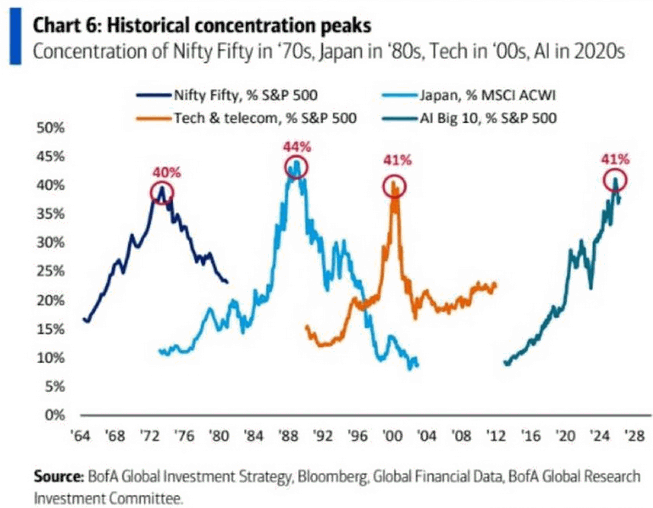
Chart of the Day: Four peaks, four eras, the same gravitational ceiling near 40–44%. The pattern isn’t a timing tool — Japan stretched for years before its top — but it marks where concentration stops being trend and starts being terminal phase. The AI cohort’s distinction is genuine: real earnings, real cash flow. The wrinkle is circularity. Hyperscaler capex, OpenAI and Anthropic spending commitments, and chip demand increasingly feed each other within the same ten names. That’s the real bubble tell to watch, not the percentage itself. Concentration alone doesn’t crash markets. Concentration plus financing reflexivity does. Position size, not direction, is the honest call here.
Market Intelligence Brief (MIB) Ver. 17.93
For professional investors only. Not investment advice.
© 2026 RecessionALERT.com

Comments are closed.