
April NFP exploded to +115K vs. 65K expected, vaulting the S&P 500 to a new ATH and cementing Fed-on-hold through 2027 — but Michigan Sentiment crashed to a 74-year record low of 48.2 as $4.55 gasoline hammers household confidence. Apple and Intel struck a preliminary chip-manufacturing deal backed by a 10% White House equity stake in Intel. Micron crossed $800B, eclipsing JPMorgan. Iran diplomacy inched forward but active military exchanges continue — Hormuz remains the inflation wildcard. Warsh Senate vote: next week.
TABLE OF CONTENTS
A. EXECUTIVE SUMMARY
B. MARKET DATA
C. HIGH-IMPACT STORIES (5)
D. MODERATE-IMPACT STORIES (5)
E. ECONOMY WATCH (6)
F. EARNINGS WATCH (1)
G. WHAT’S NEXT
H. CHART OF THE DAY
A. EXECUTIVE SUMMARY -> TOP
April’s blowout NFP — 115,000 jobs vs. 65,000 expected, wages below forecast at +0.2% MoM — delivered the textbook Goldilocks outcome and vaulted the S&P 500 to a new all-time high, cementing the “Fed on hold through 2027” consensus underpinning record equity multiples. Beneath the headline, the Iran conflict’s policy shadow dominated cross-asset pricing: Treasuries rallied alongside equities as safe-haven flows absorbed the Hormuz risk premium, VIX edged higher despite index gains, and the bond market signaled this is not a clean risk-on session. The advance was built on a narrow foundation: Nasdaq 100 surged +2.35% while the NYSE Composite fell -0.30%, confirming tech and AI semiconductors as the session’s only genuine beneficiaries. Energy (-0.61%), Healthcare (-0.68%), and Industrials finished flat-to-down — the record close masks a session where most stocks ended lower, leaving the index vulnerable to any catalyst that disrupts the AI/tech concentration trade.
• April NFP +115K vs. 65K consensus; unemployment 4.3%; wages +0.2% MoM — S&P 500 closes at new ATH (7,398.87); markets price Fed on hold through 2027; Atlanta Fed GDPNow Q2 revised up to 3.7%.
• Michigan Consumer Sentiment crashes to 48.2 — a 74-year record low, below the starting point of every recession in the survey’s history; $4.55/gallon gasoline (Iran Hormuz premium) and tariff fears cited by two-thirds of respondents; Whirlpool separately confirms appliance demand has “reached recession-level lows.”
• Apple and Intel reach preliminary chip-manufacturing agreement brokered with White House involvement; US government takes 10% equity stake in Intel — Intel +25% on the week, +100% in the past month; deal reduces Apple’s near-total TSMC dependence on advanced-node chip production.
• Micron (MU) crosses $800B market cap, eclipsing JPMorgan Chase — best week in two decades (+38%); AI memory shortage driving historic HBM re-rating; AMD +26% on week; semiconductor sector dominates session performance.
• Warsh Fed chair confirmation vote set for week of May 11; Powell’s term expires May 15 — Senate Banking Committee approved 13-11 on party lines (first-ever partisan Fed chair committee vote); markets confront a collision between today’s NFP-validated “hold through 2027” consensus and a new chair who may cut in June.
• Iran: Trump pauses “Project Freedom” as one-page peace memo circulates in Tehran; simultaneous active military exchange continues — ~13M bbl/day shut-in or damaged; Polymarket prices 84.5% against a deal before May 14-15 Trump-Xi Beijing summit; both WTI and Brent near $100 with consumer gas at $4.55.
1. Goldilocks on the Surface, Structural Fractures Below — The NFP’s Goldilocks print validates the “Fed on hold forever” multiple that underpins the S&P’s record level — but Michigan Sentiment at a 74-year low, Whirlpool’s recession-level appliance demand, and a consumer paying $4.55/gallon signal the household sector is cracking beneath the headline. The S&P is priced for AI-fueled earnings growth (+27.1% blended); if the sentiment-to-spending transmission firms up, Q2 consumer discretionary earnings become the trip wire that reprices the entire market.
2. The US Semiconductor Renaissance Acquires Its Commercial Anchor — Apple’s preliminary foundry deal with Intel, backstopped by a 10% White House equity stake, transforms domestic semiconductor manufacturing from a policy aspiration into a commercially validated industrial strategy. Micron at $800B (eclipsing JPMorgan) and AMD’s multi-decade best week confirm that AI memory is now valued at software-platform premiums — creating a concentration risk: a single hyperscaler AI capex reduction would compress these multiples with no broad market support beneath the narrow tech peak.
3. Twin Binaries — Iran and Warsh — Reset the Macro Equation Heading Into Next Week — Two unresolved binary events define the weekend and next week’s portfolio landscape: Iran’s formal response to the one-page peace memo (which determines whether 13M bbl/day returns and consumer energy relief materializes, clearing the inflation overhang that drives Michigan Sentiment’s 74-year low); and Warsh’s Senate confirmation (which determines whether the NFP-validated “hold through 2027” consensus collides with a new chair willing to cut in June). Either binary resolving adversely reprices the current cross-asset equilibrium.
 — Leading economic indicators. Accurate market forecasts. Apply for membership at join.recessionalert.com
B. MARKET DATA -> TOP
A blowout April jobs report — +115,000 vs. 65,000 expected, with unemployment steady at 4.3% — ignited a tech-led surge that lifted the S&P 500 to a new record, but the rally’s narrowness was unmistakable: the NYSE Composite fell -0.30% as the Dow barely moved (+0.02%) while the Nasdaq 100 surged +2.35%. The jobs-driven rally ran directly into Iran conflict escalation, with investors simultaneously buying Treasuries for safety (10Y -3.4 bps), nudging VIX higher despite equity gains — a rare simultaneous signal of geopolitical fear beneath a headline rally. Technology dominated as the only clear beneficiary of the macro setup; Energy (-0.61%) and Healthcare (-0.68%) declined, confirming the session was a tech/semis story rather than a broad risk-on advance. The QCOM/GEV split — Daiwa-upgraded Qualcomm +5.18% against BNP-downgraded GE Vernova -6.55% — captures the day’s bifurcation in a single cross-sector pair.
CLOSING PRICES – May 8, 2026:
MAJOR INDICES
The Nasdaq 100’s +2.35% surge contrasted sharply with the Dow’s near-flat +0.02% and the NYSE Composite’s -0.30% decline — a split that reveals a narrow tech-driven advance masking broad market weakness. Concentrated tech/growth leadership emerges today for the first time in the current 10-session lookback: NDX outperforms SP500 by 3.80% over the past 10 sessions, its largest spread in the window, confirming mega-cap tech is pulling the headline indices higher while the average NYSE-listed stock ends the day fractionally lower. Small-cap participation (+0.71%) was real but insufficient to offset the breadth deficit — outside of tech and semis, this was a flat-to-down session.
| Index | Close | Change | %Move | Why It Moved |
|---|---|---|---|---|
| S&P 500 | 7,398.87 | +61.76 | +0.84% | April jobs beat (+115K vs. 65K expected, unemployment 4.3%) drove risk appetite; intraday all-time high |
| Dow Jones | 49,609.04 | +12.07 | +0.02% | Industrial/energy heavyweights offset tech gains; CAT -3.37%, GEV -6.55% capped the blue-chip index |
| DJ Transportation | 20,199.8 | +18.1 | +0.09% | Marginal gain; Iran conflict risk capped upside for logistics and transport exposure |
| Nasdaq 100 | 29,234.99 | +671.05 | +2.35% | QCOM +5.18% (Daiwa upgrade) anchored semis surge; jobs beat boosted AI/tech spending outlook |
| Russell 2000 | 2,859.88 | +20.25 | +0.71% | Jobs beat lifted domestic demand signal; small-caps outperformed the broader NYSE universe |
| NYSE Composite | 22,942.15 | -69.15 | -0.30% | Broad market fell despite S&P record; Iran escalation and energy/industrial weakness masked by narrow tech surge |
VOLATILITY & TREASURIES
VIX edged up +0.10 despite equity gains — a geopolitical risk premium from the Iran conflict that a pure jobs rally would not generate. Treasuries rallied alongside equities (10Y -3.4 bps, 2Y -3.2 bps), a rare dual-buying signal: bonds are absorbing Iran-driven safe-haven flows while stocks respond to the jobs beat. The bond market is not confirming the risk-on read — dollar mildly weaker (-0.22%) confirms bonds, not the dollar, are the preferred safe-haven vehicle today.
| Instrument | Level | Change | Why It Moved |
|---|---|---|---|
| VIX | 17.18 | +0.10 (+0.59%) | Rose despite equity rally; Iran conflict sustaining a geopolitical risk premium in options pricing |
| 10-Year Treasury Yield | 4.359% | -3.4 bps | Safe-haven bid from Iran conflict overrode the jobs beat’s inflationary impulse; bonds rallied with equities |
| 2-Year Treasury Yield | 3.887% | -3.2 bps | Followed 10Y lower; Fed rate path expectations unmoved — unemployment at 4.3% not inflationary enough to reprice near-term cuts |
| US Dollar Index (DXY) | 97.85 | -0.21 (-0.22%) | Mild dollar softening as bond market absorbed safe-haven flows; EUR/USD +0.54% as euro strengthened |
COMMODITIES
Silver outpaced gold (+0.92% vs. +0.32%) while copper surged +1.74% — the industrial signal from the jobs beat overwhelmed the safe-haven premium, suggesting the market reads today’s event as a demand/growth story, not a geopolitical flight. Gold’s muted gain despite Iran conflict escalation confirms the risk is geopolitical rather than macro-inflationary; a genuine inflation scare would have gold running harder. Bitcoin’s +0.47% tracked equity risk-on without decoupling, confirming no crypto-specific catalyst.
| Asset | Price | Change | %Move | Why It Moved |
|---|---|---|---|---|
| Gold | $4,726.14/oz | +$15.24 | +0.32% | Iran conflict sustains safe-haven demand; muted gain despite geopolitical escalation suggests no macro-inflation fear |
| Silver | $80.915/oz | +$0.735 | +0.92% | Outpaced gold on dual industrial demand (copper +1.74%) and safe-haven appeal; jobs beat the stronger driver here |
| Copper | $6.2833/lb | +$0.1073 | +1.74% | Jobs beat bolstered US industrial demand outlook; strongest commodity mover of the session |
| Platinum | $2,065.75/oz | +$3.45 | +0.17% | Modest gain tracking the broader precious metals complex |
| Bitcoin | $80,212 | +$379 | +0.47% | Slight gain tracking equity risk-on from jobs; no crypto-specific catalyst or Iran-driven flight to BTC |
ENERGY
WTI dipped (-0.24%) while Brent held flat (+0.26%), compressing the WTI/Brent spread to ~$5.74 — US supply-side pressure (domestic production and inventory dynamics) offsetting Iran-driven global risk premium. TTF surging +1.87% while Henry Hub fell -0.72% confirms the Iran escalation’s gas supply fear is a European story, not a US domestic one. The energy sector declining despite Brent near $100 signals macro demand skepticism: investors are fading the YTD energy trade on geopolitical noise rather than buying it.
| Asset | Price | Change | %Move | Why It Moved |
|---|---|---|---|---|
| Crude Oil (WTI) | $94.58/bbl | -$0.23 | -0.24% | US domestic supply dynamics offset Iran conflict risk; slight softening despite geopolitical backdrop |
| Crude Oil (Brent) | $100.32/bbl | +$0.26 | +0.26% | Global benchmark held at $100 on Iran conflict supply risk; marginal WTI/Brent spread compression to ~$5.74 |
| Natural Gas (Henry Hub) | $2.749/MMBtu | -$0.020 | -0.72% | Domestic gas softened on mild demand outlook; decoupled from European TTF’s Iran-driven gains |
| Natural Gas (Dutch TTF) | $15.25/MMBtu | +$0.28 | +1.87% | Iran conflict supply risk premium drove European gas higher; EUR/USD strength (+0.54%) added to dollar-converted gain |
S&P 500 SECTORS
Technology’s +2.26% today confirms multi-horizon structural dominance — the sector leads simultaneously across 1D, 1W (+6.25%), 1M (+19.22%), 3M, and 12M (+54.73%), making this momentum rather than rotation. Energy’s -0.61% extends a brutal week (-5.03%), unwinding the YTD leader (+26.91%) despite Brent near $100 — macro demand skepticism overriding the geopolitical bid. Healthcare’s -0.68% deepens a structural skid that is now self-reinforcing: -7.14% over 3M, -5.29% YTD — not tactical rotation, but sustained sector-level stress.
| Sector | 1-Day | 1-Week | 1-Month | 3-Month | 6-Month | YTD | 12-Month |
|---|---|---|---|---|---|---|---|
| Technology | +2.26% | +6.25% | +19.22% | +18.90% | +13.01% | +16.96% | +54.73% |
| Basic Materials | +1.61% | +3.43% | +0.65% | +2.54% | +31.68% | +18.32% | +53.07% |
| Consumer Cyclical | +0.34% | +1.66% | +7.43% | +2.30% | -2.04% | +0.57% | +19.79% |
| Real Estate | +0.29% | +0.72% | +4.12% | +4.31% | +7.50% | +8.97% | +8.05% |
| Consumer Defensive | +0.09% | -0.03% | +0.53% | -3.83% | +12.03% | +9.41% | +6.53% |
| Industrials | -0.05% | +0.38% | +1.53% | +1.43% | +15.25% | +14.34% | +34.78% |
| Communication Services | -0.10% | +1.66% | +11.07% | +10.07% | +13.98% | +8.98% | +48.35% |
| Financial | -0.11% | -0.25% | +0.89% | -4.41% | +1.57% | -3.09% | +12.27% |
| Utilities | -0.52% | -3.21% | -3.91% | +3.54% | +3.54% | +7.12% | +16.72% |
| Energy | -0.61% | -5.03% | -2.58% | +9.20% | +29.33% | +26.91% | +42.38% |
| Healthcare | -0.68% | -0.70% | -3.11% | -7.14% | +0.40% | -5.29% | +10.12% |
TOP MEGA-CAP MOVERS:
GAINERS
| Company | Ticker | Close | Change | Why It Moved |
|---|---|---|---|---|
| Qualcomm | QCOM | $202.55 | +5.18% | Daiwa upgrade to Outperform with $225 target; Q2 2026 earnings beat; Snapdragon mid-range platform launch (May 7) |
| Tesla | TSLA | $411.79 | +3.28% | Jobs beat boosted consumer sentiment; 19% monthly rebound continues on autonomous driving / robotics narrative |
| International Business Machines | IBM | $231.31 | +2.47% | Tech sector outperformance on jobs day; IT services benefiting from enterprise AI adoption tailwind |
| Palantir Technologies | PLTR | $137.05 | +2.44% | AI/data software demand; broad tech sector leadership on jobs-driven risk appetite |
| Mastercard | MA | $500.94 | +1.84% | Jobs beat directly supports consumer spending outlook; payments network a direct beneficiary of labor market strength |
DECLINERS
| Company | Ticker | Close | Change | Why It Moved |
|---|---|---|---|---|
| GE Vernova | GEV | $1,045.63 | -6.55% | BNP Paribas downgrade to Neutral: gas turbine capacity fully contracted through 2030 limits upside; wind segment losses widening on tariffs |
| Applied Materials | AMAT | $410.64 | -4.19% | China export restriction headwind; sector rotation from equipment into fabless semis (QCOM +5.18%); China revenue declining |
| Lam Research | LRCX | $286.52 | -3.58% | Same China export restriction overhang as AMAT; China revenue expected to fall below 30% of total in 2026 |
| Caterpillar | CAT | $895.69 | -3.37% | Iran conflict weighed on industrial heavyweights; pullback from near 52-week high despite record Q1 backlog ($63B) |
| Advanced Micro Devices | AMD | $408.46 | -3.07% | Intraday gain reversed after briefly crossing $700B market cap; profit-taking amid China AI chip sales restriction headwinds |
— Institutional-grade intelligence for serious investors. Apply for membership at join.recessionalert.comC. HIGH-IMPACT STORIES -> TOP
BULLISH
1. April Nonfarm Payrolls Surge to 115,000 — Nearly Double Consensus — as “Goldilocks” Print Pushes S&P 500 to All-Time High and Drives 10Y Yield Down 4 bps
The core facts:The BLS released the April 2026 Employment Situation at 8:30 AM ET: 115,000 nonfarm payrolls vs. the 55,000 Dow Jones consensus — nearly double expectations. March was revised to 185,000. Unemployment held at 4.3%. Average hourly earnings came in below forecast at +0.2% MoM and +3.6% YoY vs. estimates of +0.3% and +3.8%. Sector composition showed hiring concentrated in healthcare (+37K), transportation and warehousing (+30K), and retail trade (+22K), while federal government (-9K), information (-13K), and manufacturing (-2K) continued to decline. Market reaction: S&P 500 +0.5% (new all-time high), Nasdaq +0.6% (record close), DJIA +0.5%; 10-year yield fell 4 bps to 4.35%; 2-year fell 3 bps to 3.89%; US dollar index -0.3% to 97.90. The Federal Reserve is now broadly expected to hold interest rates unchanged into 2027.
Why it matters:The April NFP landed in the exact analytical sweet spot — above the recession threshold (40K) while below the hike-lock scenario (120K), with wage growth undershooting to eliminate any remaining rate-hike catalyst. This is a textbook Goldilocks outcome: equities and bonds rallied simultaneously, validating the “Fed on hold forever” consensus that now underpins record equity multiples. The interpretation crystallized at hold-through-2027 — a stability baseline that directly supports elevated P/E ratios across the S&P 500. The April miss from March’s 185K to 115K does confirm a deceleration trend (181K January, 178K March, 115K April), but the composition is telling: the contracting sectors (federal government, information, manufacturing) reflect AI displacement and fiscal consolidation, not cyclical demand weakness. The healthcare-transport-retail hiring axis is consistent with a service-sector economy holding up even as white-collar and manufacturing shed jobs. This structural bifurcation is the US labor market’s defining feature heading into Q2 2026, and it creates an unusual equilibrium — headline payrolls look soft, underlying consumer spending capacity remains firm, and wage pressures are contained enough to satisfy the Fed without triggering deflation anxiety.
What to watch:May NFP (June 5, 8:30 AM ET) — a print below 80K would crack the “hold forever” consensus and restart the recession debate; April CPI (May 12) for confirmation that the soft +0.2% hourly earnings read is passing through to consumer prices; the Warsh Fed chair transition (see C5) introduces a new policy variable that could override the data consensus entirely at the June 16-17 FOMC.
BEARISH
2. Michigan Consumer Sentiment Crashes to 48.2 — Lowest Reading in the Survey’s 74-Year History — as $4.55 Gas and Iran War Fears Decimate Household Outlook
The core facts:The preliminary May 2026 University of Michigan Consumer Sentiment index printed 48.2 — the lowest reading ever recorded since the survey began in 1952, below every recession starting point in the survey’s 74-year history. The consensus estimate was 49.5. Current conditions collapsed to 47.8 (vs. 52.0 expected). One-third of respondents cited gas prices as the primary source of pessimism; one-third cited tariff concerns. National average gasoline is at $4.55 per gallon, driven by the Iran Strait of Hormuz disruption premium. Whirlpool CFO Roxanne Warner separately confirmed this week that appliance demand has “reached recession-level lows,” with the company’s stock falling 20% on its Q1 earnings miss. Stock markets held positive following the release, with the S&P 500 maintaining its gains from the earlier NFP print.
Why it matters:The divergence between consumer sentiment (74-year low) and the S&P 500 (all-time high) is one of the most extreme on record, and the analytical tension matters for portfolio construction. Two mechanisms explain the gap: equity portfolios are concentrated in higher-income households who benefit directly from asset price inflation, while the households driving 70% of US consumption are bearing the full brunt of $4.55 gasoline, elevated food costs, and tariff pass-through. The critical question is whether this sentiment deterioration bleeds into actual spending — Whirlpool’s “recession-level” appliance demand is the first concrete confirmation that it already is for durable goods. The transmission mechanism to corporate earnings is straightforward: any major consumer-facing company that guides Q2 revenues lower citing demand weakness (as Whirlpool already has) reprices the S&P 500’s 27.1% blended earnings growth trajectory. The S&P is priced for AI-fueled growth and Fed stability; it is not priced for a consumer spending cliff driven by energy costs and confidence collapse. One-third of respondents citing tariff concerns independently of gas prices signals the sentiment damage is broad-based, not just energy-driven.
What to watch:April Retail Sales (May 15) for the first hard data on whether record-low sentiment is translating to an actual spending pullback; Q2 2026 consumer discretionary earnings (July) for volume and traffic trend disclosures; Michigan Consumer Sentiment June preliminary (first Friday of June) for whether the survey stabilizes or accelerates lower.
UNCERTAIN
3. Iran Reviews US One-Page Peace Memo as Trump Pauses “Project Freedom” — Simultaneous Diplomatic Progress and Active Military Exchange Leave Energy Markets in Suspended Animation
The core facts:On May 8, following Pakistan-mediated diplomacy, Tehran is formally reviewing Washington’s one-page proposal for a short-term memorandum to end active hostilities. The framework features a nuclear enrichment moratorium, partial sanctions relief, Strait of Hormuz reopening, and a pause of US “Project Freedom” operations — the Navy’s merchant vessel escort mission through Hormuz. President Trump confirmed he has paused Project Freedom to create conditions for a deal, citing “great progress toward a complete and final agreement.” Senator Marco Rubio told colleagues a formal Iranian response was expected Friday. However, a fresh military exchange occurred simultaneously on May 8, and Iran has refused any wider peace deal that excludes a halt to Israel’s fight with Hezbollah in Lebanon — a gap the US has not agreed to close. Approximately 13 million barrels per day of crude and refined products remain shut-in or damaged. Polymarket prices 84.5% against a deal before the May 14-15 Trump-Xi Beijing summit.
Why it matters:The Iran binary remains the dominant macro variable underlying energy prices, consumer sentiment, and Fed policy optionality simultaneously. Today’s dual signal — diplomatic progress (Project Freedom paused, one-page memo circulating) alongside ongoing active military exchange — is the conflict’s defining pattern: negotiations and combat operating in parallel. WTI near $100 and gas at $4.55 are the direct economic transmission of Hormuz disruption, and they are the primary driver of the Michigan Consumer Sentiment’s 74-year low. A formalized ceasefire memo would: (1) unlock the 13M bbl/day of shut-in production; (2) collapse WTI by an estimated 20-30%; (3) eliminate the inflation premium suppressing consumer confidence; and (4) re-rate the Fed’s inflation trajectory in a dovish direction — opening rate-cut optionality that the market has already priced out. Each failure to close the deal adds cumulatively to consumer distress, corporate input costs, and Fed policy constraints. The May 14-15 Trump-Xi summit introduces an implicit deadline: Trump’s diplomatic bandwidth shifts to Beijing, potentially reducing Iran deal urgency and momentum through mid-month.
What to watch:Iran’s formal response to the one-page memo over the weekend (May 9-11) — an affirmative response would push WTI below $90 immediately; WTI sustained below $90 signals the market is pricing deal closure; Strait of Hormuz daily commercial transit volume for any increase in ship movement as a leading signal of de-escalation; the May 14-15 Beijing summit as a competing diplomatic priority.
BULLISH
4. Apple and Intel Reach Preliminary Chip-Making Agreement — White House Takes 10% Intel Stake in Historic US Semiconductor Manufacturing Pivot
The core facts:The Wall Street Journal reported May 8 that Apple and Intel have reached a preliminary agreement under which Intel’s foundry division would manufacture chips for Apple’s internally-designed processors — potentially the A21 chip for the iPhone 19 or future M-series Mac chips. The deal was brokered with significant White House involvement: President Trump personally advocated for the partnership to Apple CEO Tim Cook in a White House meeting, and the US government has announced a 10% equity stake in Intel as part of its domestic semiconductor manufacturing commitment. Intel joins Microsoft, Amazon, and Tesla as major Intel foundry customers. The deal reduces Apple’s near-total dependence on TSMC for advanced node chip production. Intel has surged more than 100% over the past month and +25% on the week, including Friday’s response to the WSJ report.
Why it matters:The Apple-Intel agreement is the most consequential commercial endorsement of the US government’s semiconductor manufacturing bet. Apple is the most demanding chip manufacturing customer in consumer technology — its partnership validates that Intel’s process technology has reached the quality threshold required to compete with TSMC on leading-edge nodes. The 10% government equity stake creates a quasi-sovereign guarantee: Intel now has explicit US government backing, de-risking the multi-hundred-billion capital investment required to build foundry capacity at scale. The strategic implications are broad: (1) TSMC’s US revenue concentration risk increases as Apple diversifies its supply chain; (2) US semiconductor supply chain sovereignty — a multi-year policy objective — acquires its most visible commercial anchor; (3) Apple’s equity story gains a new optionality vector as domestic chip production reduces geopolitical supply chain vulnerability. For S&P 500 investors, the deal validates the “US semiconductor renaissance” thesis that has driven Intel’s double in a month, and signals that the AI capex build cycle has a domestic manufacturing ambition that extends beyond TSMC’s Taiwan-concentrated facilities.
What to watch:Formal Apple-Intel foundry agreement terms and production timeline (preliminary only today — specifics on node, volume, and first delivery will be the next catalyst); TSMC’s response and any signals from other major customers (Qualcomm, AMD, Broadcom) about supply chain diversification intentions; Intel Q2 2026 earnings (late July) for first foundry revenue pipeline guidance including the Apple relationship.
UNCERTAIN
5. Warsh Fed Chair Confirmation Vote Set for Week of May 11 — Markets Enter the Weekend Confronting an Imminent Federal Reserve Leadership Transition as Powell’s Term Expires May 15
The core facts:The full US Senate is expected to vote on Kevin Warsh’s Federal Reserve chair nomination during the week of May 11, with Jerome Powell’s term expiring May 15. The path to confirmation is clear: the Senate Banking Committee advanced Warsh 13-11 (April 29 — the first fully partisan Fed chair committee vote in modern history), Senator Thom Tillis lifted his hold after the DOJ dropped its investigation of Powell, and Republicans hold a 53-seat majority requiring only a simple majority. With 53 Republican votes, confirmation is virtually certain. Warsh vowed at his confirmation hearing he would “not be Trump’s sock puppet,” but acknowledged rate adjustments may be needed with “urgency.” President Trump has stated publicly he wants Warsh to cut rates at the June 16-17 FOMC meeting. Markets currently price Fed on hold through 2027, following today’s Goldilocks NFP.
Why it matters:Markets go into next week’s session pricing an imminent leadership transition at the world’s most powerful central bank — and the collision between today’s NFP-driven “hold through 2027” consensus and a new Fed chair who might cut in June is the defining institutional tension. If Warsh is confirmed by May 15, he chairs the June 16-17 FOMC meeting. Rate-sensitive sectors — REITs, homebuilders, utilities, long-duration growth — are exposed on both sides: a hawkish Warsh (consistent with his inflation-fighting reputation and the 2026 dissent bloc) would accelerate yield normalization beyond what today’s NFP-driven yield drop implies; a Warsh accommodating Trump’s cut-in-June demand would re-spark inflation expectations just as Hammack’s dissent was beginning to anchor hawkish policy credibility. The unprecedented partisan confirmation — a 53-47 vote versus the 98-1 and 90+ majority votes of prior chairs — introduces structural uncertainty about Fed institutional credibility. No prior chair has been confirmed along party lines; the precedent undermines the Fed’s political independence framework in ways that may affect the bond market’s term premium over the medium term.
What to watch:Senate floor vote timing week of May 11; Warsh’s first public statement as Chair-designate for signals on his June policy inclination — whether he frames the decision as data-dependent (consistent with hold) or urgency-driven (consistent with Trump’s cut preference); FOMC June 16-17 meeting as the first decision under the new chair and the definitive test of Fed independence.
— Quantifying recession risk so you don’t have to guess. Apply for membership at join.recessionalert.comD. MODERATE-IMPACT STORIES -> TOP
BULLISH
6. Daiwa Upgrades Qualcomm to Outperform with $225 Target — Bets AI Data Center Pivot Is Underpriced as QCOM Surges 6%
The core facts:Daiwa Capital Markets upgraded Qualcomm (QCOM) to Outperform from Neutral on May 8, raising its price target to $225 from $140. Analyst Louis Miscioscia argues Qualcomm’s identity is shifting from smartphone chipset supplier to broader AI infrastructure participant — specifically AI edge computing, automotive AI, and emerging data center inference workloads. Daiwa cites QCOM’s low valuation relative to AI-positioned semiconductor peers and flags the June 24 Investor Day as the catalyst for a detailed data center roadmap. QCOM surged approximately 6% on May 8 on the upgrade. The stock has gained 70% in the past month following its strong Q2 FY2026 earnings report (April 29): revenue $10.6B, non-GAAP EPS $2.65, with record automotive revenues.
Why it matters:The Daiwa upgrade is a sector re-rating signal: QCOM has been AI-adjacent (AI phones, automotive AI chips) but not AI-center in the way Nvidia, Broadcom, or the memory plays are. If Daiwa’s thesis is correct that QCOM’s AI inference potential in data centers is systematically undervalued by the market, it triggers a repositioning by institutional investors who have concentrated AI semiconductor exposure in pure-play data center names. QCOM’s 70% monthly move before the upgrade suggests early institutional accumulation has been occurring — the Daiwa call provides a publicly articulable thesis for the trade. The automotive revenue record in Q2 is strategically significant: automakers are the next major AI inference deployment vertical after data centers, and QCOM is competitively positioned against NVIDIA’s emerging automotive ambitions with Snapdragon Ride. The June 24 Investor Day is the binary event: if QCOM outlines a credible data center inference roadmap with revenue timelines, the AI premium expands; if it remains primarily a smartphone and automotive play, the 70% monthly run compresses on profit-taking.
What to watch:QCOM Investor Day June 24 for data center roadmap and first revenue guidance for inference workloads; Q3 FY2026 earnings (late July) for early data center inference traction; any additional analyst upgrades in the near term as a confirmation signal that institutional repositioning is broadening.
UNCERTAIN
7. Trump Sets July 4 EU Trade Ultimatum as US Trade Court Strikes Down 10% Global Tariffs — Administration Signals Fast-Track Replacement Plan
The core facts:May 8 delivered two simultaneous tariff developments. First: President Trump set a July 4 deadline for the European Parliament to ratify the EU-US trade framework — originally negotiated at his Scotland golf course — threatening “much higher” tariffs on EU goods (currently 15% on most imports) if the deal is not approved. Trump cited EU non-compliance with existing terms, specifically flagging auto tariffs (25%) as a potential escalation lever alongside pharmaceuticals and semiconductors. Second: the US Court of International Trade ruled 2-1 that Trump’s 10% across-the-board global surcharge — imposed under the never-before-used Section 122 of the Trade Act of 1974 after the Supreme Court struck down earlier broader tariffs in February — is “invalid and unauthorized by law.” The ruling’s direct application is limited to three named plaintiffs (Washington state, Burlap & Barrel, Basic Fun!). The 10% tariffs are scheduled to expire July 24 regardless. The administration is developing fast-track replacement tariffs through new Section 232/301 investigations into overcapacity and forced labor.
Why it matters:The EU deadline and the trade court ruling point in opposite directions with the same mid-summer convergence point: both July 4 and July 24 (tariff expiry) create a tariff-cliff scenario where multiple enforcement mechanisms resolve simultaneously. The trade court ruling is structurally constrained — the three-plaintiff scope and the approaching expiry date limit immediate market relief — but the two consecutive court defeats (Supreme Court February, trade court May 8) narrow the administration’s unilateral tariff authority in ways that affect business planning confidence. The July 4 EU deadline introduces specific sector risk: pharmaceuticals and semiconductors are both in scope of the EU framework, sectors where US importers have limited short-term substitution options. The administration’s fast-track replacement investigation strategy signals continued trade pressure regardless of legal setbacks, but the mechanism is slower and more constrained than the Section 122 emergency authority, meaning the uncertainty period extends rather than resolves.
What to watch:EU Parliament ratification progress through June 30; Commerce Department announcement on replacement tariff investigation scope (will define the new enforcement mechanism); any trade court ruling expansion beyond the three named plaintiffs via injunction.
UNCERTAIN
8. Market Breadth Narrows to Tech-Only on Record Session — NYSE Composite Falls -0.30% While S&P 500 and Nasdaq Hit All-Time Highs; VIX Edges Higher
The core facts:May 8’s session produced a historically notable breadth divergence: the S&P 500 and Nasdaq Composite both closed at all-time highs (S&P +0.5%, Nasdaq +0.6%), while the NYSE Composite — which tracks all common stocks on the New York Stock Exchange including small and mid-caps — fell -0.30%. The VIX (CBOE Volatility Index) edged higher by approximately +0.59% despite the equity index gains. European natural gas (TTF) surged +1.87% on Iran supply-risk concerns while US Henry Hub fell -0.72%. GE Vernova and Caterpillar were among the worst-performing mega-cap names on the session, weighed by continued Industrials sector weakness. The divergence confirms the session’s rally was driven almost entirely by large-cap technology and AI semiconductor names — the sectors most directly benefiting from the Apple-Intel deal and the post-NFP tech multiple re-rating.
Why it matters:A negative NYSE Composite on an S&P all-time-high session is a classic breadth warning for active managers. Historically, record closes achieved with narrow participation — where the equal-weighted S&P or broader market indices diverge negatively — have preceded corrections when the narrow leadership group encounters a specific negative catalyst. In today’s case, the AI/tech complex is carrying the entire index weight. If any single negative catalyst hits the semiconductor trade (Nvidia guidance miss, export restriction expansion, iPhone demand data) or the Iran peace deal collapses (reigniting inflation and rate-hike fears), the market has no broad-based support underneath the narrow tech peak. The VIX edging higher on a record-high day is the volatility market’s message: option sellers are not convinced by the headline gains. For multi-asset portfolios, the dual signal of TTF +1.87% (energy inflation pressure in Europe) and Henry Hub -0.72% (domestic gas soft) reflects the same Iran binary that has been driving divergences across asset classes all week — the US is partially insulated from Hormuz disruption through domestic production, but the global energy risk premium remains elevated.
What to watch:NYSE Composite vs. S&P 500 divergence over the coming sessions — if the gap widens further (NYSE negative while S&P continues higher), the breadth warning strengthens; any reversal in semiconductor names would expose the lack of broad market support; VIX sustained above 20 would signal institutional hedging is accelerating.
BULLISH
9. Micron Crosses $800B Market Cap — Surpasses JPMorgan in Historic AI Memory Re-Rating as AMD and Intel Post Best Weekly Performances in Decades
The core facts:Micron Technology (MU) surpassed $800 billion in market capitalization on May 8 — exceeding JPMorgan Chase for the first time in history — capping a +38% weekly gain described as the company’s best week in two decades and an +84% one-month surge. MU is now up approximately 750% over the past 12 months. AMD added +26% on the week, touching a new 52-week high. Intel surged +25% on the week (including the Apple-Intel deal catalyst), more than doubling in the past month. The collective semiconductor re-rating reflects a global AI memory shortage, with HBM (High Bandwidth Memory) demand from AI server buildouts exceeding supply capacity. AMD’s Q1 FY2026 earnings (reported earlier this week) delivered a blowout result with strong AI GPU demand, catalyzing the week’s sector-wide rally.
Why it matters:MU crossing $800B and eclipsing JPMorgan is the headline milestone, but the underlying story is structural: AI server architecture requires dramatically more high-bandwidth memory than traditional servers, and MU is the primary US-domiciled HBM supplier. The global memory shortage is not a cyclical inventory correction — it is a demand step-change driven by the AI infrastructure buildout cycle that hyperscalers (Microsoft, Amazon, Google, Meta) have committed to sustain through 2027. At $800B, MU’s market cap exceeds that of every major US bank, reflecting the market’s judgment that AI memory is a more valuable franchise over the next decade than consumer or commercial banking. For portfolio managers, the sector re-rating creates a positioning question: the companies delivering AI memory growth are now priced at premiums historically associated with dominant software platforms, not cyclical semiconductor manufacturers. A single AI capex reduction announcement from any hyperscaler would immediately compress these multiples.
What to watch:Micron Q3 FY2026 earnings (June) for updated HBM shipment volume and pricing data; any hyperscaler commentary on AI capex trajectory (Microsoft, Amazon, Google, Meta all report in late July) for the demand-side validation; NVIDIA Q1 FY2027 earnings (May 20 AMC) for the AI GPU demand pipeline that drives HBM consumption.
BEARISH
10. FY2026 Federal Deficit on Track for $2.1 Trillion — More Than 6% of GDP — as Treasury Refunding Documents Confirm Structural Borrowing Surge; Dimon Flags “Bond Crisis” Risk
The core facts:Treasury’s May Quarterly Refunding Announcement (QRA) confirmed FY2026 borrowing requirements of approximately $2.1 trillion — up from $1.8 trillion in FY2025 — representing more than 6% of US GDP. Cumulative borrowing through March 2026 stood at approximately $1.2 trillion. The Treasury will need to finance the remaining $900 billion through bond auctions over the next two quarters, requiring sustained demand from foreign central banks, domestic institutions, and the Federal Reserve (in its current non-QE stance) at a time when the Fed’s balance sheet is still being reduced via quantitative tightening. JPMorgan Chase CEO Jamie Dimon has flagged the trajectory as carrying “bond crisis” risk if foreign demand weakens. The 10-year Treasury yield today fell 4 bps to 4.35% on Goldilocks NFP data, temporarily masking the supply pressure.
Why it matters:At $2.1 trillion (>6% of GDP), the FY2026 deficit is running at a level historically associated with wartime or severe recession spending — neither of which characterizes the current expansion. The structural concern is that deficit spending at this scale, when combined with QT, forces the private market to absorb a historically large supply of Treasuries without the Fed as a buyer. Bond auctions with weak bid-to-cover ratios or elevated tail risk directly push 10Y yields higher — and the 10Y yield is the discount rate for every long-duration asset in the equity market, from AI infrastructure plays to REITs. Today’s 4 bps yield decline is NFP-driven and temporary; the Treasury supply calendar resets next week. Dimon’s “bond crisis” framing — even as a tail risk — from the CEO of the world’s largest bank by assets is a signal that institutional investors are actively monitoring auction results for demand deterioration. The Warsh confirmation (see C5) adds a new variable: a Fed chair willing to cut rates at the administration’s request could complicate the Treasury’s ability to issue long-duration debt at acceptable yields, as markets price in an inflationary policy pivot.
What to watch:Treasury 10Y and 30Y auction results over the next several weeks for bid-to-cover ratios and yield spreads (weak auctions = direct upward pressure on the 10Y); any foreign central bank reduction in Treasury holdings (TIC data, released monthly); 10Y yield sustained above 4.60% would signal fiscal premium is repricing into yields.
— Separating signal from noise since 2007. Apply for membership at join.recessionalert.comE. ECONOMY WATCH -> TOP
April’s 115K payroll beat (vs. 62K consensus) and GDPNow holding at 3.7% for Q2 offered a resilient labor-market read — but today’s data package delivered an unmistakably mixed signal. Michigan Consumer Sentiment hit 48.2, a fresh record low below the entry level of every recession since 1978, while Goolsbee explicitly stated inflation has trended higher for three consecutive months, narrowing the Fed’s room to cut; markets now price just one 25-bp cut for all of 2026. The $2.1T FY2026 deficit trajectory and a historic Q1 inventory buildup — now at risk of a demand air-pocket in Q2 — provide the structural overhang; next week’s CPI print (May 13) is the clearest near-term catalyst for either validating or breaking the hold narrative.
April Nonfarm Payrolls: +115K Beats 62K Consensus; Unemployment Holds at 4.3% (BLS, May 8, 2026)
What they’re saying:The U.S. economy added 115,000 nonfarm payrolls in April, nearly doubling the 62,000 consensus estimate and defying fears of a tariff-driven labor market slowdown. Healthcare led with +37,000, followed by transportation and warehousing (+30K) and retail trade (+22K). Average hourly earnings rose just 0.2% MoM and 3.6% YoY — both below the 0.3%/3.8% consensus — providing a mild disinflationary offset to the headline beat.
The context:Federal government employment fell -9K, continuing DOGE-related workforce reductions, while information (-13K) and manufacturing (-2K) shed jobs. The unemployment rate held at 4.3%, consistent with Goolsbee’s characterization of a labor market that is “stable without being good.” Following the BLS release, the Atlanta Fed’s GDPNow model nudged Q2 2026 growth to 3.7%, upgrading private domestic investment from 8.6% to 9.2%.
What to watch:ADP Employment Change weekly (May 12); JOLTS job openings (next release) for leading hiring/quit rate trends; Michigan Consumer Sentiment final for May (May 29).
Michigan Consumer Sentiment Hits Record Low 48.2 in May Preliminary Read — Below Every Prior Recession Entry (UMich, May 8, 2026)
What they’re saying:The University of Michigan’s preliminary May reading came in at 48.2, down from 49.8 in April’s final read and below the 49.5 consensus — a fresh record low. The current conditions index collapsed to 47.8 (vs. 52 expected; prior 52.5), a ~9% decline, driven by surging concerns over personal finances and major purchase conditions. Consumer expectations edged to 48.5, slightly above the 48.1 estimate. One-year inflation expectations slipped to 4.5% (prior 4.7%); five-year fell to 3.4% (prior 3.5%).
The context:The 48.2 reading is below the index’s level at the start of all six recessions since its inception — a historically significant psychological threshold. One-third of respondents cited gas prices and another third cited tariffs as the primary source of economic concern. The disconnect between payroll resilience and consumer psychology at recession-entry levels is a well-documented leading indicator: soft data has historically led hard data by 3–6 months.
What to watch:Michigan Consumer Sentiment final for May (May 29); Conference Board Consumer Confidence for May; retail sales April (May 15) as the demand-reality check against soft-data deterioration.
Fed Faces Diminishing Case for Rate Cuts as Stable Jobs and Persistent Inflation Lock In Prolonged Hold (May 8, 2026)
What they’re saying:Chicago Fed President Austan Goolsbee, responding to the April jobs report, stated: “We’ve been above the 2% Fed target for five years now. We stopped making progress last year, and now the last three months, it’s going up instead of down.” With payrolls stabilizing and inflation north of 3%, analysts note the FOMC is increasingly comfortable maintaining its current posture for a prolonged period. Markets have pared 2026 rate-cut expectations to a single 25-bp move, with Polymarket pricing just a 44.4% chance of any cut at all.
The context:The April FOMC meeting split 8-4, an unusually high level of dissent, reflecting internal fracture on the policy path; Hammack’s formal dissent statement was published Thursday. Goolsbee, Waller, Bowman, and Daly are all participating in the Hoover Institution Monetary Policy Conference panel today, with the evening session (7:30 PM) still scheduled. The full Senate is expected to vote on Kevin Warsh’s Fed chair nomination the week of May 11 — Warsh’s policy stance, viewed as potentially more hawkish than Powell, is a further uncertainty for the rate path.
What to watch:Kevin Warsh Senate confirmation vote (week of May 11); CPI April (May 13) — the next key trigger for Fed optionality; Fed Waller, Bowman, Daly, Goolsbee remarks at Hoover Institution panel (tonight, 7:30 PM ET).
U.S. FY2026 Deficit on Track for $2.1 Trillion — Double the Non-Crisis Threshold at 6%+ of GDP (Treasury QRD / CRFB, May 2026)
What they’re saying:Treasury’s Quarterly Refunding Documents estimate FY2026 will require $2.1 trillion in borrowing — more than $166 billion per month — up from $1.8 trillion in FY2025. The cumulative deficit through March reached $1.2 trillion, with a $249 billion shortfall in March alone. At more than 6% of GDP, the deficit is double the 3% threshold economists consider sustainable. CRFB president Maya MacGuineas: “$2 trillion deficits used to be unheard of, and then they only occurred during major recessions — it’s beyond scary that $2 trillion deficits are now the norm.”
The context:The structural deficit trajectory raises long-end yield risk independent of Fed rate decisions. JPMorgan CEO Jamie Dimon has flagged the risk of a “bond crisis” if fiscal imbalances persist — a risk amplified by a hawkish Fed unwilling to provide rate relief. With the 10Y already elevated and the Fed on hold, Treasury must absorb escalating auction supply into a market with no central bank backstop, creating a self-reinforcing upside yield pressure.
What to watch:April Monthly Budget Statement (May 12, prior -$164.1B); 10-Year Note Auction (May 12, prior 4.282%); 30-Year Bond Auction (May 13, prior 4.876%); 10Y yield as a real-time barometer of bond market fiscal tolerance.
GDPNow Q2 2026 Holds at 3.7% Post-Jobs Report; Private Investment Revised Up to 9.2% (Atlanta Fed, May 8, 2026)
What they’re saying:The Atlanta Fed’s GDPNow model maintained its Q2 2026 real GDP growth estimate at 3.7% following today’s BLS data, up from 3.5% on May 1. The revision was driven by an upgrade in private domestic investment growth from 8.6% to 9.2%, partially offset by a trim to personal consumption expenditure growth (2.7%→2.6%). The model reflects strengthening business investment as firms digest first-quarter tariff front-running and reorient capital spending.
The context:The 3.7% Q2 reading provides a meaningful counterweight to bearish sentiment narratives. A resilient labor market and elevated private investment suggest the economy entered Q2 with momentum, even as soft-data indicators (Michigan Sentiment at record lows) signal fragility ahead. The divergence between real-activity trackers and consumer confidence remains the central macro tension; if Q2 hard data holds, the bear case loses a key pillar.
What to watch:Retail sales April (May 15) as the PCE consumption directional check; CPI April (May 13) for the inflation trajectory feeding into real growth estimates; GDPNow next update following retail data.
March Wholesale Inventories +1.3% MoM — Capstone of Historic Q1 Tariff Front-Running Buildup (Census Bureau, May 8, 2026)
What they’re saying:U.S. wholesale inventories climbed 1.3% in March (vs. 1.4% expected; prior 0.8% revised up), bringing end-of-month inventory levels to $908 billion. The March figure caps a historic Q1 2026 buildup: businesses added an estimated $172 billion to inventories in Q1 — one of the largest quarterly increases on record — as companies rushed to front-load imports ahead of April tariff escalation. Q1 imports surged at a 38% annualized rate over the same period.
The context:The inventory surge artificially boosted Q1 activity metrics, but now creates a demand air-pocket risk heading into Q2: firms sitting on elevated stockpiles are likely to slow new orders and reduce production. April’s manufacturing payrolls already fell -2K and information employment shed -13K — early signals of a demand pullback beginning to materialize. If consumer demand fails to absorb the inventory overhang, destocking could amplify economic deceleration in H2 2026.
What to watch:Business Inventories April (May 15); ISM Manufacturing PMI for May (June 1) for order/inventory balance; retail sales April (May 15) as the primary demand litmus test against the Q1 supply build.
— Know the probability before the market prices in the risk. Apply for membership at join.recessionalert.comF. EARNINGS WATCH -> TOP
YESTERDAY AFTER THE BELL (Markets Reacted Today)
BULLISH
11. Gilead Sciences (GILD): AH: n/a | HIV Portfolio Drives Q1 Beat — Revenue $6.96B, EPS $2.03
The Numbers:Released: AMC May 7, 2026. Revenue: $6.96B vs. ~$6.89B est. (+4.4% YoY). Adjusted EPS: $2.03 vs. ~$1.91 est. (+6.3% beat). HIV products: $5.03B (+10% YoY, primary growth driver). Trodelvy oncology: $402M (+37% YoY). Veklury (COVID-19 antiviral): $144M (-52% YoY, as expected). Adjusted operating margin: 46.9% (+3.6pp YoY). FY2026 revenue guidance: ~$30.2B (in line with consensus).
The Problem/Win:HIV portfolio durability is the clear win — the +10% YoY growth to $5.03B reflects continued uptake of Biktarvy and Descovy, alongside early commercial ramp of Lenacapavir (trade name Yeztugo). Full-year Lenacapavir revenue trajectory of ~$800M for 2026 is on track per management. The FDA BIC/LEN combination NDA (a once-weekly HIV regimen) has a PDUFA date of August 27, 2026 — a near-term binary catalyst for the stock. Trodelvy’s 37% growth confirms the oncology segment is genuinely contributing to diversification away from HIV concentration. The Veklury decline is non-structural (post-pandemic volume normalization).
The Ripple:GILD’s beat reinforces the 2026 narrative that large-cap pharma companies with diversified specialty portfolios are outperforming consensus estimates. The HIV franchise durability is directly relevant for AbbVie (ABBV) and competitors in the virology space. Trodelvy’s oncology acceleration is a data point for the broader ADC (antibody-drug conjugate) market where multiple large-cap pharma names are investing.
What It Means:Gilead’s Q1 validates its HIV franchise as a durable cash engine while the oncology build provides medium-term growth optionality. The August 27 BIC/LEN PDUFA creates a catalyst-dense Q3 for the stock, with once-weekly dosing representing a meaningful patient compliance and competitive moat advantage.
What to watch:FDA PDUFA decision August 27 for the BIC/LEN once-weekly HIV combination — approval would be a step-change catalyst; Q2 2026 Lenacapavir revenue run-rate for confirmation of the ~$800M full-year trajectory.
TODAY BEFORE THE BELL (Markets Already Reacted)
No major earnings before the bell from companies with >$100B market cap. Today’s reporters (Toyota ADR, Sony ADR, Enbridge) are excluded by MIB selection criteria — ADRs and non-US-domiciled companies do not meet our US-focused portfolio relevance threshold.
TODAY AFTER THE BELL (Markets React Tomorrow)
No major earnings after the bell from companies with >$100B market cap.
WEEK AHEAD PREVIEW:
Q1 2026 earnings season is nearing completion with 89% of the S&P 500 reported and blended growth at a record-setting +27.1% YoY. The upcoming week brings a notable nuclear power name and three critical technology earnings that will set the tone for the AI capex theme through the summer.
Constellation Energy (CEG) — BMO, Monday May 11 — Consensus EPS $2.56 (+19.6% YoY), Revenue $8.21B (+20.9% YoY). Key focus: Calpine integration EBITDA tracking ($2.02B consensus); data center nuclear PPA pipeline and new long-term contract announcements from hyperscaler customers; nuclear fleet availability rates.
Cisco Systems (CSCO) — AMC, Wednesday May 13 — Consensus EPS ~$1.03 (+8% YoY), Revenue ~$15.5B (+10% YoY). Key focus: AI networking order pipeline and enterprise switching velocity; Splunk integration ARR contribution and cybersecurity cross-sell momentum; any commentary on hyperscaler network spending acceleration following the week’s Apple-Intel and semiconductor headlines.
Applied Materials (AMAT) — AMC, Wednesday May 14 — Consensus EPS ~$2.66 (+11% YoY), Revenue ~$7.7B (+8% YoY). Key focus: China revenue guidance under Hua Hong Semiconductor export restrictions and evolving Commerce Department enforcement posture; leading-edge AI chip fab demand from TSMC, Samsung, and — given this week’s Apple-Intel deal — Intel foundry capacity ramp requirements; FY2026 China revenue mix trajectory.
NVIDIA (NVDA) — AMC, Wednesday May 20 — Quarter’s most anticipated event. Key focus: Blackwell Data Center revenue and H100-to-Blackwell transition trajectory; China H20 chip export impact on revenue; FY2027 guidance framework amid hyperscaler capex commitments; any commentary on competitive dynamics following the week’s Intel foundry announcement and AMD’s blowout Q1.
— US market commentary trusted by family offices and institutions. Apply for membership at join.recessionalert.comG. WHAT’S NEXT -> TOP
UPCOMING RELEASES:
| Date | Event | Why It Matters |
|---|---|---|
| Mon, May 11 | Existing Home Sales (exp. 4.05M) | Housing demand gauge at 4.3% mortgage rates; a miss below 3.8M would confirm rate-sensitive sectors remain depressed despite yield softening. Also the first major data point after today’s NFP to test whether Goldilocks translates to real economic activity. |
| Week of May 11 | Warsh Senate Confirmation Vote (Powell term expires May 15) | The first partisan Fed chair confirmation in modern history. Warsh chairs the June 16-17 FOMC if confirmed before May 15. His first public signals as Chair-designate — hawkish (yield normalization) or accommodating Trump’s rate-cut request (inflation re-pricing) — directly reprice rate-sensitive sectors and challenge the “hold through 2027” consensus validated by today’s NFP. |
| Tue, May 12 | CPI MoM (exp. +0.6%) / Core CPI MoM (exp. +0.4%) | The most market-moving release of the week. Today’s NFP landed Goldilocks partly because wages came in soft (+0.2% MoM vs. +0.3% expected). If CPI confirms the disinflationary signal, the “Fed on hold” equity premium survives intact. A hot CPI print (+0.7% or above) forces markets to reprice the June and July FOMC, compressing the long-duration multiples that drove today’s tech rally. April CPI is the definitive test of whether the Iran energy premium is passing through to broader prices. |
| Tue, May 12 | ADP Employment Change (Weekly) / Total Household Debt Q1 | ADP weekly provides an early read on May labor conditions ahead of next month’s NFP; any sharp deceleration would crack the “jobs are stable” narrative. Q1 Household Debt tracks whether consumers are funding spending via credit as confidence collapses — rising delinquencies alongside Michigan’s 74-year low sentiment would confirm spending risk is real, not just psychological. |
| Tue, May 12 | Fed Williams Speech | First major Fed communication following both today’s Goldilocks NFP and the Michigan record-low sentiment. Williams is a core FOMC member; any signals on the June meeting or the Warsh transition will move rate markets. Watch for explicit language on the inflation vs. growth trade-off given the unprecedented divergence between hard data (jobs, GDPNow 3.7%) and soft data (sentiment at 74-year low). |
| Wed, May 13 | PPI MoM (exp. +0.4%) / Core PPI MoM (exp. +0.1%) | Producer prices lead consumer prices by 1-3 months; a hot PPI immediately following CPI would signal the Iran energy premium is working its way through the supply chain and arriving in consumer prices through Q2. Core PPI at +0.1% expected suggests the pipeline is contained — any upside surprise reinforces the case that the Fed cannot cut, regardless of Warsh’s political inclinations. |
KEY QUESTIONS:
1. Will Iran formally accept the one-page peace memo this weekend, unlocking 13M bbl/day of Hormuz supply and collapsing WTI by an estimated 20-30% before the May 14-15 Trump-Xi summit redirects US diplomatic bandwidth to Beijing? A deal would eliminate the $4.55/gallon gasoline premium driving Michigan Sentiment’s 74-year low and reopen Fed rate-cut optionality the market has already priced out.
2. Will Tuesday’s CPI print (exp. +0.6% MoM) confirm the NFP’s soft wage signal — or will a hot reading above +0.7% force markets to abandon the “Fed on hold through 2027” consensus that is currently underwriting record S&P 500 multiples and the tech/semiconductor concentration trade?
3. What will a confirmed Warsh signal about his June 16-17 FOMC intentions — and does the first partisan Fed chair confirmation in history begin to reprice the bond market’s term premium, pressuring the 10Y yield higher and compressing the long-duration equity multiples that drove today’s narrow rally?
— US market commentary trusted by family offices and institutions. Apply for membership at join.recessionalert.comH. CHART OF THE DAY -> TOP
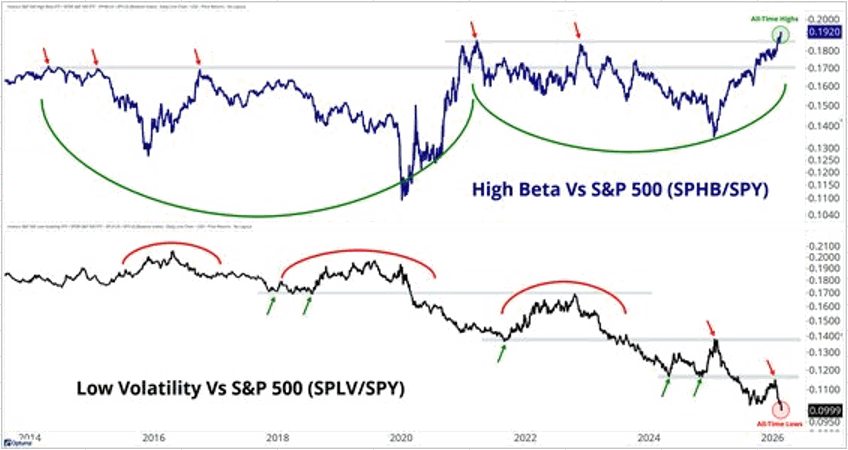
Chart of the Day: High beta and low volatility have hit mirror-image extremes — SPHB/SPY at all-time highs, SPLV/SPY at all-time lows. The AI stampede is doing the heavy lifting: capex-heavy hyperscalers and semiconductor names dominate high-beta cohorts, while staples, utilities and healthcare get left for dead. Every prior SPHB/SPY peak since 2014 marked a pause or reversal; this one cleared them all decisively. The symmetry isn’t coincidence — it’s the late-cycle signature of investors abandoning ballast for beta on a single thematic bet. When these ratios diverge this aggressively, mean reversion historically follows, and the deeper the stretch, the sharper the snap-back.
Market Intelligence Brief (MIB) Ver. 17.91
For professional investors only. Not investment advice.
© 2026 RecessionALERT.com

Comments are closed.