
Iran accused US forces of ceasefire violations, reversing Wednesday’s record rally — WTI +2.71% to $97.66, S&P 500 –0.38%, 10-of-11 sectors red. Q1 nonfarm productivity hit +0.8% (biggest miss since 2023) with ULC at +2.3% and real wages turning negative. Hammack called the FOMC’s rate-cut signal “misleading,” formalizing the 4-dissenter bloc — hike optionality is live. Challenger April cuts +38% MoM with AI driving 26%, collapsing Friday’s NFP consensus to ~60K. Boeing CEO joins Trump’s China delegation; 600-aircraft deal speculation lifts BA.
TABLE OF CONTENTS
A. EXECUTIVE SUMMARY
B. MARKET DATA
C. HIGH-IMPACT STORIES (5)
D. MODERATE-IMPACT STORIES (5)
E. ECONOMY WATCH (6)
F. EARNINGS WATCH (4)
G. WHAT’S NEXT
H. CHART OF THE DAY
A. EXECUTIVE SUMMARY -> TOP
Iran’s formal accusation that US naval operations under “Operation Project Freedom” constituted a ceasefire breach transformed a would-be relief rally into a macro risk-off selloff — but the market’s response architecture is the real signal. Rising yields (+3.2 bps on 10Y to 4.387%) alongside falling equities confirms bond markets are pricing inflation persistence rather than recession, denying Treasuries their safe-haven role. Thursday’s productivity miss (Q1 nonfarm +0.8%, worst since 2023) and Hammack’s extraordinary characterization of the FOMC’s own statement as “misleading” on rate cuts mean the geopolitical headline compounds pre-existing structural policy uncertainty rather than creating it. Ten of 11 sectors closed red — a macro flush, not a rotation — with Energy (–1.76%) paradoxically selling off as WTI surged, while Nasdaq’s –0.12% versus the Russell’s –1.61% confirms the market is consolidating around quality and geopolitical insulation that broad cyclicals cannot match.
• Iran claims US violated ceasefire; WTI closes +2.71% to $97.66, reversing Wednesday’s 9% oil crash; S&P 500 retreats –0.38% from record 7,365 close as 10-of-11 sectors fall in geopolitical risk-off flush
• QCOM +5.18% on record Q2 automotive chip revenue (+38% YoY to $1.3B); GEV –6.55% as AI infrastructure trade reverses — Industrials worst sector (–1.88%)
• BLS Q1 nonfarm productivity +0.8% (biggest miss since 2023); unit labor costs +2.3%; real hourly compensation –0.5% — stagflation data compounds Fed dilemma directly ahead of Friday NFP
• Cleveland Fed Hammack calls FOMC rate-cut signal “misleading”; 4-member dissent bloc (largest since 1992) puts rate-hike optionality explicitly on the table; markets price ~25% hike probability
• Challenger April cuts +38% MoM to 83,387 — AI driving 26% of all layoffs for second consecutive month — pushing Friday’s NFP consensus to ~60K; 8:30 AM ET binary risk event
• Boeing (BA) bucks the selloff; CEO Ortberg joins Trump’s China delegation with 600-aircraft deal speculation for May 14–15 Trump-Xi summit in Beijing
1. The Iran Binary Owns the Market — For the second consecutive session, Iran ceasefire dynamics drove oil, yields, and equity sentiment simultaneously. Wednesday’s peace optimism produced a 9% WTI crash and S&P record; Thursday’s violation claim reversed both. The market is effectively a single-factor model priced on Hormuz supply expectations — and it will remain so until a verified ceasefire or confirmed breakdown forces a durable regime change.
2. Stagflation Data Is Structural, Not Transient — Thursday’s productivity miss (+0.8%), elevated ULC (+2.3%), negative real wages (–0.5%), NY Fed 1-year inflation expectations at 3.6%, and Hammack’s rate-hike signal converge on one conclusion: the 2% inflation path is structurally longer than rate-cut pricing implies. This data layer was accumulating before Iran — the conflict has simply extended the runway for it to matter and hardened the case against near-term easing.
3. Friday’s NFP Is the Week’s Binary Catalyst — With consensus at ~60K, payrolls are a two-way risk: sub-40K triggers recession narrative (bonds rally, cut odds revive, equities face growth-shock selling); above-120K validates stagflation and pushes hike probability materially higher. There is no plausible Goldilocks interpretation — any print lands against a backdrop of simultaneous productivity deterioration, elevated labor costs, and a fractured FOMC that has already signaled the next move is not predetermined.
 — Leading economic indicators. Accurate market forecasts. Apply for membership at join.recessionalert.com
B. MARKET DATA -> TOP
US-Iran war ceasefire talks dominated Thursday — early deal optimism lifted equities and pushed oil lower, but Iran’s afternoon claim that the US and regional allies had violated the ceasefire reversed both: WTI crude closed +2.71% above $97 while equities gave back all gains. Tech was the day’s lone shelter — Nasdaq barely fell (–0.12%) while small-caps (–1.61%) took the worst of the geopolitical risk-off. Ten of 11 sectors closed in the red; Energy stocks paradoxically fell –1.76% despite crude’s rally, reflecting week-long profit-taking in a sector still up 30% over six months. Yields rose alongside falling stocks, confirming the market’s primary fear is energy-driven inflation persistence rather than growth collapse.
CLOSING PRICES – May 7, 2026:
MAJOR INDICES
Nasdaq’s near-flat –0.12% against Russell’s –1.61% is the starkest breadth signal — growth tech absorbed the Iran shock while small-caps bore the full risk-off brunt. Dow Theory non-confirmation remains entrenched: DJIA is within 0.63% of its 10-session high (yesterday’s 49,910) while DJTA sits 7.9% below its own — transport weakness persistently refusing to confirm industrial strength. For a third consecutive session, NDX has outpaced the S&P 500 by more than 3 percentage points over the rolling 10-session window, confirming narrow tech leadership.
| Index | Close | Change | %Move | Why It Moved |
|---|---|---|---|---|
| S&P 500 | 7,337.10 | –28.02 | –0.38% | Iran ceasefire violation claim reversed early rally; broad risk-off; small-caps led declines |
| Dow Jones | 49,596.60 | –313.99 | –0.63% | Industrials dragged (GEV –6.55%, CAT –3.37%); Iran uncertainty clouded global demand outlook |
| DJ Transportation | 20,181.7 | –184.6 | –0.91% | Shipping/logistics exposed to Strait of Hormuz disruption risk; broader industrial sector pressure |
| Nasdaq 100 | 28,563.95 | –35.22 | –0.12% | Tech resilient; QCOM +5.18% on record Q2 automotive chip revenue; growth mega-caps outperformed |
| Russell 2000 | 2,840.38 | –46.39 | –1.61% | Small-caps hardest hit; most sensitive to geopolitical uncertainty and rising yields |
| NYSE Composite | 23,011.30 | –273.09 | –1.17% | Broadest market measure; full breadth of risk-off session reflected; underperformed headline indices |
VOLATILITY & TREASURIES
VIX fell –1.78% even as equities closed lower — the sell-off was orderly, not panicked. Both yields rose (10Y +3.2 bps, 2Y +3.9 bps) without bonds catching any safe-haven bid, signaling that energy-price inflation fears are offsetting recession-protection demand in Treasuries — a notably different signal than a typical risk-off day. DXY’s near-flat close (+0.08%) confirms the dollar is not acting as a safe haven, either.
| Instrument | Level | Change | Why It Moved |
|---|---|---|---|
| VIX | 17.08 | –0.31 (–1.78%) | Fell despite equity decline; sell-off was orderly; Iran risk partially priced heading into session |
| 10-Year Treasury Yield | 4.387% | +3.2 bps | Bond market declined to provide safe-haven bid; energy-driven inflation expectations keep yields elevated |
| 2-Year Treasury Yield | 3.911% | +3.9 bps | Short end rising faster than 10Y; market pricing stickier near-term rates; Fed cut odds receding |
| US Dollar Index (DXY) | 98.07 | +0.08 (+0.08%) | Barely moved; no traditional safe-haven dollar demand; Iran uncertainty balanced by ceasefire deal hopes |
COMMODITIES
Silver surged +2.09% while gold barely moved (+0.04%) — precious metals splitting on different signals: no pure fear bid in gold, but industrial demand plus geopolitical premium lifting silver. Bitcoin’s –2.02% tracked equities in lock-step, confirming it remains a risk asset today rather than a safe-haven store of value. Copper’s –0.99% decline adds the global growth caution note — industrial demand expectations fraying at the edges.
| Asset | Price | Change | %Move | Why It Moved |
|---|---|---|---|---|
| Gold | $4,696.00/oz | +$1.70 | +0.04% | Minimal safe-haven bid; geopolitical fears balanced by declining VIX and ceasefire deal hopes |
| Silver | $78.915/oz | +$1.612 | +2.09% | Geopolitical premium plus industrial demand expectations; sharply outperformed gold on the day |
| Copper | $6.1250/lb | –$0.0615 | –0.99% | Industrial metals fell on risk-off conditions; global growth demand uncertainty weighing |
| Platinum | $2,033.35/oz | –$29.25 | –1.42% | Auto sector uncertainty; EV transition headwinds; broader precious metals complex weakness |
| Bitcoin | $79,825.0 | –$1,646.0 | –2.02% | Tracked equity risk-off tone in lock-step; behaving as risk asset, not store of value |
ENERGY
WTI’s +2.71% sharply outpaced Brent’s +0.28% — regional Hormuz anxiety rather than uniform global disruption. Oil rising while equities fell is the supply shock read, not a demand story — a stagflationary transmission risk if sustained. Henry Hub followed crude (+1.90%); Dutch TTF’s –0.73% decline signals European gas supply is on a different trajectory, decoupling from the US-Middle East crude risk.
| Asset | Price | Change | %Move | Why It Moved |
|---|---|---|---|---|
| Crude Oil (WTI) | $97.66/bbl | +$2.58 | +2.71% | Iran accused US/allies of ceasefire violations; Strait of Hormuz supply risk reignited after earlier session decline on deal hopes |
| Crude Oil (Brent) | $103.59/bbl | +$0.29 | +0.28% | Same Iran dynamics but more muted; European benchmark partially pricing residual ceasefire deal scenario |
| Natural Gas (Henry Hub) | $2.782/MMBtu | +$0.052 | +1.90% | Followed crude higher on general US energy supply risk; summer demand building |
| Natural Gas (Dutch TTF) | $14.97/MMBtu | –$0.11 | –0.73% | European gas decoupled from crude; LNG supply improving in Europe; not directly exposed to Hormuz disruption |
S&P 500 SECTORS
Ten of 11 sectors closed red — a macro flush, not a rotation. The lone holdout: Communication Services (+0.10%). Energy’s –1.76% against WTI crude’s +2.71% surge is the session’s sharpest structural signal — a week of profit-taking in a sector up 30.71% in six months continues even as the underlying commodity catches a geopolitical bid. Technology’s –0.30% is the quiet relative winner beneath the broad damage.
| Sector | 1-Day | 1-Week | 1-Month | 3-Month | 6-Month | YTD | 12-Month |
|---|---|---|---|---|---|---|---|
| Communication Services | +0.10% | +1.81% | +11.99% | +9.05% | +15.65% | +9.09% | +46.20% |
| Technology | –0.30% | +5.36% | +16.75% | +21.25% | +10.64% | +14.31% | +52.39% |
| Consumer Cyclical | –0.37% | +1.68% | +9.01% | +2.18% | –1.30% | +0.22% | +20.09% |
| Consumer Defensive | –0.45% | –0.26% | +1.30% | –2.47% | +11.88% | +9.31% | +6.62% |
| Real Estate | –0.66% | +0.22% | +4.61% | +5.55% | +7.23% | +8.58% | +7.67% |
| Financial | –0.73% | –0.51% | +1.29% | –2.28% | +2.32% | –2.92% | +13.12% |
| Healthcare | –0.78% | –0.40% | –2.46% | –4.58% | +1.56% | –4.66% | +11.62% |
| Utilities | –1.68% | –3.37% | –2.48% | +4.86% | +4.49% | +7.68% | +17.66% |
| Energy | –1.76% | –5.67% | –2.90% | +11.87% | +30.71% | +27.64% | +43.55% |
| Basic Materials | –1.86% | +1.26% | –0.97% | +3.91% | +31.37% | +16.44% | +49.39% |
| Industrials | –1.88% | –0.39% | +2.64% | +4.77% | +16.13% | +14.40% | +35.51% |
TOP MEGA-CAP MOVERS:
GAINERS
| Company | Ticker | Close | Change | Why It Moved |
|---|---|---|---|---|
| Qualcomm Inc | QCOM | $202.55 | +5.18% | Post-earnings momentum; record Q2 automotive chip revenue (+38% YoY to $1.326B); annualized auto revenue exceeded $5B for first time; AI edge processing outlook |
| Tesla Inc | TSLA | $411.79 | +3.28% | Early Iran deal optimism drove broad risk-on; EV cost advantage narrative vs elevated oil; Consumer Cyclical sector held relatively |
| International Business Machines Corp | IBM | $231.31 | +2.47% | Enterprise AI and hybrid cloud adoption cycle; positive analyst sentiment; tech sector resilience on the day |
| Palantir Technologies Inc | PLTR | $137.05 | +2.44% | Defense AI analytics narrative; ongoing Iran war driving government contract expectations; AI government sector momentum |
| Mastercard Incorporated | MA | $500.94 | +1.84% | Consumer spending data holding; payments network resilience; relative defensive play within Financials |
DECLINERS
| Company | Ticker | Close | Change | Why It Moved |
|---|---|---|---|---|
| GE Vernova Inc | GEV | $1,045.63 | –6.55% | Profit-taking after 71% YTD surge and ATH at $1,181.95 (Apr 23); rising yields weigh on infrastructure valuations; Industrials sector –1.88% |
| Applied Materials Inc | AMAT | $410.64 | –4.19% | Pre-earnings anxiety (Q2 report due May 14); regulatory overhang from Feb’s $252.5M China export penalty; semiconductor equipment sector sold broadly |
| Lam Research Corp | LRCX | $286.52 | –3.58% | Same China export uncertainty and pre-earnings pressure as AMAT; semiconductor equipment names broadly de-risked |
| Caterpillar Inc | CAT | $895.69 | –3.37% | Industrials sector worst performer (–1.88%); Iran ceasefire uncertainty clouding global infrastructure and construction demand outlook |
| Advanced Micro Devices Inc | AMD | $408.46 | –3.07% | Semiconductor sector pressure; China export uncertainty; position trimming alongside AMAT/LRCX in the semi complex |
— Institutional-grade intelligence for serious investors. Apply for membership at join.recessionalert.comC. HIGH-IMPACT STORIES -> TOP
BEARISH
1. Iran Accuses US of Violating Ceasefire — Targets Hormuz Ships; WTI Rebounds to $97.66 as Markets Reverse Yesterday’s Record Rally
The core facts:Iran’s top negotiator Mohammad Bagher Ghalibaf formally accused the United States on Thursday of violating the fragile four-week ceasefire by conducting naval operations in the Strait of Hormuz under “Operation Project Freedom” — a US Navy initiative to escort merchant vessels through the waterway. Iranian state media reported explosions on Qeshm Island attributed to drone interceptions, while Tehran threatened military retaliation. US-Iranian forces traded fire in the Strait, with the Iranian military describing the exchange as a direct ceasefire breach. The accusations reversed yesterday’s peace-deal optimism that had driven WTI crude down 9% to $92: on Thursday WTI surged 2.71% to $97.66, recovering more than one-third of Wednesday’s collapse. The S&P 500 fell approximately 0.4% from its record 7,365 close, with 10 of 11 S&P 500 sectors declining; the Industrials sector (-1.88%) and Energy sector (rebounding) traded as polar opposites of Wednesday’s pattern. President Trump told reporters a final deal is “still possible.”
Why it matters:The Iran ceasefire-violation narrative is the single most important variable for US financial markets right now because it simultaneously controls three macro regimes: (1) Oil price trajectory — at $97.66, WTI is still 32%+ above pre-crisis levels; a return toward $100 reignites the inflation premium the market had begun pricing out; (2) Fed policy path — yesterday’s 10Y yield drop to 4.37% on oil-crash optimism has partially reversed to 4.387% today; sustained Hormuz re-disruption removes any remaining near-term rate-cut optionality; (3) Risk appetite — the S&P 500’s retreat from record 7,365 on a ceasefire dispute is a live demonstration that yesterday’s record was priced on peace, not fundamentals. The pattern now established is an oil-driven binary: ceasefire progress → WTI drops → inflation premium exits → risk-on; ceasefire breakdown → WTI spikes → inflation premium returns → risk-off. Portfolio managers cannot navigate this without explicit geopolitical exposure management. The asymmetric risk is that “nearing a deal” has now been demonstrated to mean very little — Iran’s negotiating posture remains unpredictable, and simultaneous military exchange alongside diplomatic contact is the established pattern in this conflict.
What to watch:Iran’s formal military and diplomatic response over the next 24-48 hours — an official ceasefire reaffirmation from both Washington and Tehran would resume Wednesday’s oil-crash narrative; a military escalation would push WTI above $100. Monitor Hormuz daily ship transit counts (S&P Global Market Intelligence) as the real-time barometer of reopening progress; WTI sustained above $100 is the threshold at which the inflation-premium narrative fully re-engages.
BEARISH
2. BLS: Q1 2026 Nonfarm Productivity +0.8% — Biggest Miss Since 2023 — as Unit Labor Costs Hold at +2.3%, Stagflation Signal Compounds Fed Dilemma
The core facts:The Bureau of Labor Statistics’ preliminary Q1 2026 nonfarm productivity report released Thursday showed output per hour increased just 0.8% — well below the 1.4% consensus estimate and the largest miss since 2023. Unit labor costs rose 2.3% in Q1, reflecting 3.1% hourly compensation growth that outpaced productivity gains. Real hourly compensation fell 0.5% after inflation adjustment. Manufacturing sector productivity was stronger at +3.6%, but the dominant nonfarm measure’s sharp deceleration is what feeds directly into Fed policy models. Q4 2025 productivity had been revised to 1.5%, making the Q1 deceleration to 0.8% a meaningful sequential deterioration.
Why it matters:The productivity miss creates a structurally bearish feedback loop for the Fed’s policy options. When productivity keeps pace with wage growth, unit labor cost inflation is benign; when productivity slows while wages remain elevated, ULC becomes a self-sustaining inflation input — the Fed cannot ease without validating wage-driven price pressure. At +2.3%, ULC is running faster than any reading consistent with the Fed’s 2% PCE target on a sustained basis, even if below the +2.6% estimate. More analytically important: the miss directly undermines the “AI productivity dividend” narrative that has supported equity valuations at record levels. If productivity growth is decelerating even as AI infrastructure investment accelerates — NVIDIA at $5T, $350B+ annual hyperscaler capex — then the market’s pricing of AI as a near-term productivity multiplier is being challenged by the actual data. The data lands alongside the FOMC’s 4-member hawkish dissent bloc, today’s 1-year consumer inflation expectations at 3.6%, and Friday’s binary NFP event — the collective weight of these signals is that the 2% inflation path is structurally longer than rate-cut-pricing implies.
What to watch:Friday’s April NFP for the labor demand side of the productivity equation; April CPI (May 12) and April PCE (May 30) for confirmation that the ULC elevation is passing through to consumer prices — any consecutive monthly CPI print above 0.3% MoM given today’s productivity data would materially increase hike probability.
BEARISH
3. Hammack: Fed’s Rate-Cut Signal Was “Misleading” — 4-Member FOMC Dissent Bloc (Largest Since 1992) Signals Rate Hike Optionality Is Live
The core facts:Cleveland Fed President Beth Hammack, in remarks published Thursday, said the April FOMC policy statement’s language was “a little bit misleading” in implying the next rate move would be a cut. She reiterated her formal dissent from the April 29 FOMC 8-4 vote — the largest dissent count since 1992 — explaining she no longer believes it is “appropriate to signal a rate cut bias” given elevated inflation risks and increased economic uncertainty. Hammack framed the next move as explicitly symmetrical: “up or down.” The 4-member dissent bloc — Hammack, Kashkari, Logan, and Governor Miran (who dissented the other direction, for a cut) — reflects a fractured committee. Combined with Wednesday’s hawkish pivots from Musalem (centrist) and Goolsbee (historically dovish), Thursday’s Hammack statement completes a three-day run of FOMC speakers pushing back against the market’s rate-cut narrative. Markets currently price approximately 25% probability of at least one 2026 rate hike.
Why it matters:Hammack’s characterization of the FOMC’s own statement as “misleading” is extraordinary language from a sitting regional Fed president — officials rarely publicly contradict the committee’s formal communications. That a dissenter is actively correcting the market’s interpretation of the remaining majority’s language signals the policy disagreement is deep, public, and unlikely to resolve at the June meeting. The practical market impact is asymmetric and structural: every rate-sensitive equity sector carries valuation models that assume the next move is a cut. REITs (VNQ), utilities (XLU), homebuilders (XHB), and long-duration growth stocks are particularly exposed if the terminal rate debate shifts from “when do cuts begin” to “is the next move a hike.” The 4-dissenter bloc also provides Powell’s successor — taking office this month — with institutional cover to maintain the hold-or-hike posture through year-end without appearing to break from Fed precedent. Critically, the Hammack/Musalem/Goolsbee convergence on hawkish positioning is occurring simultaneously with the productivity miss and elevated ULC — the data and the commentary are aligned on the same side, making the “higher for longer” scenario the current consensus among the FOMC’s most-heard voices.
What to watch:June FOMC meeting (June 17-18) — whether the dissent bloc grows to 5+ members and whether the statement removes the easing bias language Hammack objected to; April CPI on May 12 as the next critical data point that will determine whether the rate-hike scenario remains live or recedes.
UNCERTAIN
4. Tomorrow’s April Jobs Report: Consensus Collapses to ~60K from 178K Prior — Challenger Cuts Surge 38% as Binary Market Risk Hits Friday 8:30 AM ET
The core facts:The Bureau of Labor Statistics releases the April 2026 Nonfarm Payrolls report at 8:30 AM ET on Friday, May 8. Wall Street consensus has collapsed to approximately 55,000–70,000 new jobs — down sharply from March’s 178,000 print, representing one of the largest month-over-month consensus declines in recent memory. Bank of America forecasts 80,000; TD Cowen and other firms are below 60,000; the wide dispersion reflects deep disagreement over how much the Iran conflict’s supply chain disruptions, tariff enforcement, and AI-driven displacement weighed on April hiring. Challenger Gray & Christmas released its April 2026 planned job cuts data Thursday showing 83,387 layoffs — a 38% month-over-month increase, the highest monthly total since November 2024, with AI cited as the driver of 26% of all cuts. Hiring plans collapsed 69% from March. Average hourly earnings consensus is approximately +0.2% MoM; unemployment rate expected at 4.3%. ADP’s private payroll count of +109,000 (released Wednesday) provides a confounding crosswind on the upside.
Why it matters:Friday’s NFP is the single highest-impact macro catalyst of the week — and arguably the month — because it resolves a critical policy fork: (1) A print below 40,000, consistent with the most pessimistic forecasts, would trigger a recession-narrative market move: Treasuries rally sharply, rate-hike probability falls to near-zero, equities face downward pressure on growth fears even as the Fed-cut story revives; (2) A print above 120,000, consistent with ADP’s +109K and the optimistic camp’s tariff-disruption skepticism, locks in “no 2026 cuts” as base case and may push hike probability from 25% toward 35-40%, with yields spiking and rate-sensitive equities repricing lower. The interaction with Thursday’s data creates a compounding scenario: a “strong” NFP (80K-120K) on top of the productivity miss, elevated ULC, Hammack’s dissent, and rising inflation expectations does not produce the benign “Goldilocks” interpretation — instead it validates the stagflation narrative where the economy is strong enough to keep labor costs elevated but not productive enough to justify price stability. Average hourly earnings is the secondary read: any +0.3%+ MoM print on a strong headline reverses the market’s brief relief rally from Thursday and directly supports the hike scenario Hammack introduced.
What to watch:BLS release Friday May 8 at 8:30 AM ET — three numbers simultaneously: headline payrolls (below 40K triggers recession narrative; above 120K locks in no-cut/possible-hike), unemployment rate (4.4%+ combined with weak payrolls approaches Sahm Rule proximity), and average hourly earnings (any +0.3%+ MoM print keeps the rate-hike scenario alive regardless of the headline).
BEARISH
5. AI Infrastructure Trade Violently Reverses — GE Vernova -6.55%, Industrials -1.88% (Worst S&P 500 Sector) as Iran Risk Returns and Yields Creep Higher
The core facts:The S&P 500 Industrials sector fell 1.88% Thursday — the worst-performing sector of the day and a stark reversal of Wednesday’s +2.7% sector-leading gain. GE Vernova (GEV), the AI power infrastructure company up 71% year-to-date after hitting an all-time high of $1,181.95 on April 23, fell 6.55% — the largest decline among mega-cap stocks and the sharpest single-day drop since the Iran conflict began. The driver was two-fold: the 10-year Treasury yield rose 3.2 basis points to 4.387% as ceasefire optimism faded, and the BLS productivity miss added to the “higher for longer” rate narrative. Long-duration infrastructure assets with elevated multiples are acutely sensitive to even modest yield increases. The Materials sector also surrendered most of Wednesday’s +2.1% gain. The pattern is an exact inversion of Wednesday’s session: Industrials and Materials led on Iran optimism; Industrials and Materials gave it back on Iran pessimism.
Why it matters:GEV’s -6.55% on a +3.2 bps yield move reveals the leverage embedded in the AI infrastructure trade: the stock’s 71% YTD gain was built on two simultaneous assumptions — (1) hyperscalers will sustain $350B+ annual AI infrastructure capex through 2027, and (2) interest rates will trend lower, expanding the terminal multiple at which the order backlog is valued. Thursday’s session challenged both simultaneously: the Iran disruption reignites inflation (keeping rates higher), which directly compresses the present value of GEV’s long-dated revenue stream. For portfolio managers who rotated into Industrials yesterday on the AI infrastructure and peace-deal convergence thesis, Thursday’s reversal is a forced reassessment: what appeared to be a “broadening of the market’s earnings base” Wednesday was effectively a concentrated geopolitical options position. The Industrials sector is now in a regime of violent ±2% daily swings driven by a single binary variable — the Iran peace deal probability — making it a macro event vehicle rather than a fundamental allocation. The AI infrastructure capex cycle’s fundamentals remain intact; the risk is entirely about the discount rate at which that capex is valued.
What to watch:10-year Treasury yield — a sustained break above 4.45% would trigger systematic de-rating of long-duration infrastructure assets and additional GEV/Industrials multiple compression; any confirmed Iran ceasefire would rapidly reverse Thursday’s dynamic; GEV Q2 2026 earnings (late July) for data center order backlog and the first quantification of geopolitical impact on commercial aerospace demand.
— Quantifying recession risk so you don’t have to guess. Apply for membership at join.recessionalert.comD. MODERATE-IMPACT STORIES -> TOP
BEARISH
6. NY Fed April Survey: 1-Year Inflation Expectations Rise to 3.6% — Household Financial Conditions “Deteriorated Sharply”
The core facts:The Federal Reserve Bank of New York’s April 2026 Survey of Consumer Expectations, released Thursday, showed median 1-year inflation expectations increased 0.2 percentage points to 3.6% — the highest level since the post-COVID inflation surge. Three-year expectations held steady at 3.1% and five-year expectations remained at 3.0%. Importantly, the survey indicated that household financial conditions “deteriorated sharply” in April, with respondents reporting declining income growth expectations alongside rising household spending growth expectations — a combination suggesting cost-of-living pressure is broadening across income cohorts.
Why it matters:The NY Fed SCE is one of the Fed’s most carefully monitored inflation expectations datasets — committee attention focuses on the 3-year horizon as the key “anchoring” indicator. Thursday’s data is a mixed but ultimately bearish signal: the 3-year stability at 3.1% means medium-term anchoring has not broken, but the 1-year rise to 3.6% reflects near-term energy and tariff pass-through that is faster and higher than the Fed’s projections. The critical threshold to watch is 3Y expectations at 3.5% — Fed research indicates a structural de-anchoring dynamic above that level that historically requires more aggressive rate action to correct. The “sharply deteriorated” financial conditions language is a separate concern: if households are simultaneously borrowing more (March consumer credit +$24.86B), experiencing declining real wages (real hourly compensation -0.5% per Thursday’s BLS data), and facing cost-of-living pressure, the consumption outlook for Q2 2026 has downside risk that GDPNow’s current 3.7% Q2 estimate has not captured. For rate-sensitive equity sectors — REITs, utilities, homebuilders — the 1-year expectations data reinforces the case that the Fed’s next move is not a cut.
What to watch:Friday’s Michigan Consumer Sentiment preliminary print for May — specifically the 5-year inflation expectations component (consensus 3.4%); a move above 3.5% on the Michigan 5-year measure would immediately trigger explicit Fed commentary on the anchoring risk. Next NY Fed SCE (June 9 expected) for whether 3-year expectations begin drifting above 3.1%.
UNCERTAIN
7. March Consumer Credit Surges $24.86B — Nearly Doubles $12.5B Consensus; Tariff Front-Loading or Structural Consumer Stress?
The core facts:The Federal Reserve’s G.19 consumer credit report for March 2026, released Thursday, showed total consumer credit outstanding increased $24.86 billion — nearly double the $12.5 billion Wall Street consensus and the largest single-month surge in 2026. The increase was concentrated in revolving credit (credit cards), with non-revolving credit (auto loans, student loans) contributing a smaller share. The March data coincides with the peak period of tariff-announcement front-loading, when consumers and businesses were accelerating purchases of electronics, appliances, and other goods ahead of anticipated price increases from new import levies. Credit card delinquency rates, reported by major banks in Q1 2026 earnings, are already running elevated versus 2024 levels.
Why it matters:The $24.86 billion surge is the analytical ambiguity story of the quarter. If March’s credit acceleration was primarily tariff front-loading — consumers making pull-forward purchases ahead of price increases — then April credit growth should decline sharply as the demand impulse exhausts and the cumulative debt load reflects a timing distortion rather than structural stress. If the surge reflects consumers using credit to maintain spending in the face of declining real wages (real hourly compensation fell 0.5% in Q1 per Thursday’s BLS data), April credit will remain elevated while spending decelerates — the early signal of a debt-driven consumption slowdown heading into Q2. The stakes are high: front-loading implies a benign Q2 consumption handoff (demand pulled forward, inventory digested, spending normalizes); structural borrowing implies a Q2 consumption cliff as households hit credit limits and delinquency rates climb. At 6.45% mortgage rates, 3.75% fed funds, and credit card rates above 21%, the cost of maintaining consumption via credit is historically expensive. The ambiguity will not resolve until April’s G.19 data (released approximately June 4).
What to watch:April G.19 consumer credit release (~June 4) — below $10B confirms front-loading thesis; above $20B confirms structural borrowing. Major bank Q2 2026 earnings (July) for credit card delinquency trajectory and charge-off guidance — JPM, BAC, and C will be the first indicators.
BEARISH
8. Challenger April Job Cuts: 83,387 Positions (+38% MoM) — AI Displacement Claims 26% of All Cuts for Second Consecutive Month
The core facts:Challenger Gray & Christmas released its April 2026 planned layoff report Thursday, showing US employers announced 83,387 job cuts — a 38% increase from March 2026 and the highest monthly total since November 2024. Technology sector year-to-date cuts reached 85,411, up 33% year-over-year. The most analytically significant finding: companies cited artificial intelligence as the reason for 26% of all planned cuts in April — the second consecutive month at that level — representing approximately 21,700 AI-attributable job eliminations in the month. Hiring plans collapsed 69% from the prior month, signaling that the deceleration in labor demand is front-end, not just trailing-indicator.
Why it matters:The Challenger data is the leading-indicator foundation for the NFP consensus collapse to ~60K from March’s 178K. The 38% month-over-month surge in planned cuts — simultaneous with hiring plans down 69% — is not the pattern of a labor market still operating at trend; it is the pattern of one undergoing rapid composition change. The AI displacement figure is a structurally distinct concern: at 26% of cuts attributed to AI for two consecutive months, a pattern is solidifying. Companies across technology, financial services, and professional services are simultaneously (1) increasing AI infrastructure capex and (2) reducing headcount attributable to AI substitution. The net effect is a productivity-headcount divergence that will eventually appear in earnings margins — the earnings benefit comes, but the timing lag means the consumer spending base that drives 70% of US GDP weakens before the margin expansion materializes. The 69% hiring-plan collapse is the more forward-looking signal: it suggests Q2 2026 labor market data will weaken further before rebounding, consistent with a payroll trajectory that trends toward 40-60K range through Q2 if the Challenger signal is directionally accurate.
What to watch:Friday’s April NFP at 8:30 AM ET for the government confirmation of the Challenger signal; May Challenger report (early June) for whether the 26% AI-displacement rate continues — a third consecutive month at that level would represent a structural inflection, not a transitory spike.
BEARISH
9. AMAT -4.19%, LRCX -3.58% — Semiconductor Equipment Complex Reprices China Revenue Risk Ahead of Applied Materials’ May 14 Earnings
The core facts:Applied Materials (AMAT, market cap ~$135B) fell 4.19% Thursday and Lam Research (LRCX) declined 3.58% in a convergent selloff driven by two reinforcing pressures: China revenue concentration risk and pre-earnings repositioning ahead of AMAT’s Q2 FY2026 report scheduled for May 14. AMAT derives approximately 30% of revenue ($2.1B last quarter) from Chinese customers; LRCX derives approximately 35%. The US Commerce Department has directed chip equipment manufacturers to cease deliveries of certain advanced fabrication tools to Hua Hong Semiconductor — China’s No. 2 chipmaker — with AMAT, LRCX, and KLA named among the affected suppliers. AMD (-3.07%) declined alongside the semiconductor equipment names, reflecting broader China-tech exposure anxiety.
Why it matters:The semiconductor equipment selloff is the sector’s China revenue discount being repriced in real-time ahead of the first major management commentary. Unlike chip designers (NVIDIA, AMD) whose AI revenue is almost entirely domestic, equipment makers depend critically on Chinese fabs upgrading legacy node capacity — a business US export controls are progressively restricting. The practical arithmetic: if AMAT’s China revenue declines from 30% to 20% of mix (consistent with the Hua Hong restrictions expanding), the implied revenue impact is approximately $840M annually — meaningful at a $30B+ revenue base, but the market is pricing the trajectory risk, not just the current impact. Each successive Commerce Department action broadens the list of restricted end-users, and the enforcement posture has tightened materially since AMAT’s February $252.5M China export penalty. AMAT’s May 14 earnings call will be the first opportunity for management to quantify the Hua Hong impact, provide China revenue guidance for FY2026, and answer analyst questions about the scope of Commerce Department letters received. The pre-earnings selloff reflects investors de-risking the China revenue uncertainty before the guidance clarification.
What to watch:AMAT Q2 FY2026 earnings on May 14 — China revenue guidance and management’s characterization of the Hua Hong restriction scope; any expansion of Commerce Department export controls to additional Chinese chipmakers (SMIC, CXMT) would represent a further compounding negative for the entire equipment complex.
BULLISH
10. Boeing CEO Joins Trump’s China Delegation — 600-Aircraft Deal Speculation Lifts BA as Ortberg Signals “Big Number” Order Framework Emerging
The core facts:Boeing CEO Kelly Ortberg will join President Trump’s delegation to China for the Trump-Xi Jinping summit scheduled for May 14-15 in Beijing, confirmed by CNBC and multiple outlets on Thursday. Ortberg has signaled in recent earnings calls that Chinese airlines could place what he termed “a big number” of Boeing aircraft orders — a potential framework involving approximately 500 Boeing 737 MAX aircraft and 100 widebody jets that at list prices represents approximately $60-80 billion in commercial aviation commitments. Boeing shares rose on the news Thursday, bucking the broader market selloff. Ortberg stated that Boeing and Chinese airlines have “worked through concerns” over spare parts access — one of the key operational disputes that had stalled the commercial relationship since the 737 MAX certification gap. Any deal is “100% dependent on US-China relations,” Ortberg noted, making the summit outcome the decisive variable.
Why it matters:A large-scale Boeing-China order would be transformational at multiple levels. For Boeing specifically: the order book has been structurally depleted relative to Airbus over the past decade due to the 737 MAX crisis and China delivery pause; a 600-aircraft order would represent one of the largest commercial aviation contracts in history and significantly alter Boeing’s free cash flow trajectory and supply chain demand for the next 5-8 years, benefiting the US aerospace manufacturing ecosystem (Spirit AeroSystems, Howmet, Collins Aerospace, and hundreds of tier-2 suppliers). For the broader market: if the Trump-Xi summit produces tangible commercial agreements across aerospace, agriculture, and manufacturing, it confirms that US-China trade has a managed de-escalation mechanism operating in parallel to the Iran-driven geopolitical risk — a positive signal for risk assets most exposed to trade-war scenarios. The binary risk is explicit and acknowledged by Ortberg: a diplomatic breakdown at the summit removes the deal from the table immediately and eliminates the positive market signal.
What to watch:Trump-Xi summit May 14-15 in Beijing — specifically whether a commercial aircraft framework agreement is formally announced; Boeing’s Q2 2026 earnings (late July) for order backlog update reflecting the China relationship normalization status and first delivery guidance for reinstated Chinese airline orders.
— Separating signal from noise since 2007. Apply for membership at join.recessionalert.comE. ECONOMY WATCH -> TOP
This week’s data delivered a stagflation signal masked by a resilient labor surface: initial claims beat at 200K (vs. 205K consensus) while Q1 nonfarm productivity slumped to 0.8% (vs. 1.4% expected), leaving unit labor costs elevated at 2.3% even as real wages turned negative at -0.5%. Inflation expectations are re-anchoring higher — the NY Fed’s 3-year gauge hit its highest level since July 2022 at 3.2%, reinforcing Fed Hammack’s declaration that rates will be “on hold for quite some time” and her dissent against the FOMC’s rate-cut signaling language. Tomorrow’s April payrolls report (consensus 60K, prior 178K) will determine whether the claims resilience holds or whether Challenger’s 83K AI-driven April cuts are already feeding into the headline.
Initial Claims Fall to 200K, Below Consensus, as Continuing Claims Also Surprise to the Downside (DOL, May 7, 2026)
What they’re saying:Initial jobless claims for the week ending May 2 came in at 200K, beating the 205K consensus and rising modestly from 190K the prior week. Continuing claims for the week ending April 25 were 1,766K — also below the 1,800K estimate — and the 4-week moving average declined to 203.25K, signaling underlying stability despite the week-over-week uptick in initial filings.
The context:Claims at 200K remain historically tight and well below the 260K+ threshold typically associated with labor market deterioration. The dual beat — both initial and continuing — provides a constructive backdrop ahead of Friday’s April nonfarm payrolls report (consensus 60K, prior 178K). However, the uptick from 190K to 200K keeps the trend-watchers alert, particularly given Challenger’s 83K April job cut announcements reported simultaneously today.
What to watch:Friday May 8 April Nonfarm Payrolls (consensus 60K, prior 178K), Unemployment Rate (exp. 4.3%), and Average Hourly Earnings YoY (exp. 3.8%). A sub-50K print would confirm that Challenger’s AI-layoff surge is beginning to hit official employment counts.
Q1 Nonfarm Productivity Slumps to 0.8%, Largest Miss Since 2023; Real Wages Turn Negative (BLS, May 7, 2026)
What they’re saying:The BLS preliminary Q1 2026 productivity report showed nonfarm business output-per-hour rising just 0.8% annualized — sharply below the 1.4% consensus — as output grew 1.5% but hours worked climbed 0.7%. Unit labor costs rose 2.3% (vs. 2.6% expected), and real hourly compensation turned negative at -0.5%. Year-over-year productivity growth remained solid at 2.9%, largely due to base effects from weak Q1 2025 data.
The context:A productivity miss paired with elevated unit labor costs — even if below consensus — keeps the stagflation risk live. The Fed’s dual mandate is already strained by Iran-war commodity price pressures; negative real wage growth compounds the consumer spending risk heading into H2 2026. Manufacturing productivity was the bright spot at +3.6% (durable manufacturing +5.3%), suggesting AI and capex investment are translating into factory efficiency even as the broader economy struggles to absorb labor costs. GDPNow Q2 tracking at 3.7% (as of May 5) frames the macro rebound optimistically, but the productivity miss raises questions about quality of that growth.
What to watch:Q2 2026 productivity revision (August); unit labor cost trend into Q2 — a sustained reading above 2.5% would force the Fed to acknowledge a wage-price dynamic despite their current “well positioned” stance.
April Challenger Job Cuts Surge 38% to 83,387; AI Displaces Workers at Record Pace, Accounts for 26% of All Cuts (Challenger, Gray & Christmas, May 7, 2026)
What they’re saying:US employers announced 83,387 job cuts in April — up 38% from March’s 60,620 and the highest monthly total in three months — though down 21% year-over-year. Artificial intelligence was cited as the primary reason for 21,490 cuts (26% of total), the second consecutive month AI led all layoff causes. Technology led all sectors with 33,361 April cuts, bringing year-to-date sector totals to 85,411 — a 33% increase from the same period in 2025. Separately, hiring plans collapsed 69% in April to just 10,049, down 38% from April 2025.
The context:The Challenger data historically leads official payrolls by 4–8 weeks. With tomorrow’s April NFP consensus at just 60K (vs. prior 178K), the surge in announced cuts may already be feeding into the headline. The AI displacement story is accelerating — 49,135 AI-cited cuts year-to-date — and hiring plans near zero suggest corporate confidence in near-term demand has deteriorated sharply. The 21% YoY improvement in total cuts is largely a base-effect artifact from 2025’s tech-sector purge rather than a structural improvement.
What to watch:April NFP private payrolls (Friday; consensus 73K, prior 186K); May Challenger report (June 4) for continuation of AI-displacement trend; tech sector earnings guidance for headcount commentary.
NY Fed: 3-Year Inflation Expectations Hit Highest Since July 2022 at 3.2%; Household Finances Seen Deteriorating Sharply (NY Fed SCE, May 7, 2026)
What they’re saying:The New York Fed’s April Survey of Consumer Expectations showed 1-year inflation expectations rising to 3.6% (from 3.4% in March), while the 3-year gauge jumped to 3.2% — the highest since July 2022 — from 3.0% prior. Five-year expectations held at 3.0%. Household financial conditions “deteriorated sharply,” with respondents projecting slower income growth, rising unemployment probability, and greater difficulty finding new jobs. Spending expectations, however, rose despite the pessimism, likely reflecting tariff front-loading.
The context:The de-anchoring of medium-term inflation expectations is the most consequential signal in this report. The Fed targets 2% PCE inflation; with 3-year expectations at 3.2% and the Iran-war commodity shock still feeding through, the FOMC faces an increasingly credibility problem. Long-run (5-year) stability at 3.0% prevents a 1970s-style spiral narrative — but 3.0% is itself 50 bps above target and has not declined despite five months of rate hold. The deterioration in financial-condition perceptions aligns with consumer confidence surveys cratering to multi-year lows in April.
What to watch:Michigan 5-Year Inflation Expectations Prel (Friday May 8, prior 3.5%); May NY Fed SCE (published June 9) for whether the de-anchoring is broadening; Fed speakers for explicit acknowledgment of expectations drift.
Fed’s Hammack: Rates ‘On Hold for Quite Some Time’; Dissented Against FOMC Rate-Cut Signaling at April Meeting (Cleveland Fed, May 7, 2026)
What they’re saying:Cleveland Fed President Beth Hammack stated Thursday that she expects interest rates to remain “on hold for quite some time,” and that the Fed’s next move could be up or down — a notably neutral framing that contrasts with recent Fed communications implying cuts remain the base case. Hammack, who dissented at the most recent FOMC meeting against language signaling a rate-cut bias, cited five consecutive years of above-target inflation and warned that the Iran war conflict could make “pricing pressures more persistent.”
The context:Hammack’s dissent at the April meeting was one of four FOMC members who opposed forward-guidance language implying the next rate move would be a cut — the largest dissent bloc since 2022. Her remarks today formalize a bifurcated Fed: a dovish majority still signaling eventual easing vs. a hawkish minority increasingly concerned that inflation at 3%+ with a conflict-driven commodity shock justifies rate hike optionality. For markets pricing one rate cut in 2026 (Polymarket: 44.7% odds of ≥1 cut), Hammack’s framing — “neutral on direction” — is hawkish relative to consensus. Powell’s term expires in May 2026, adding leadership transition uncertainty to the policy equation.
What to watch:Friday Fed speeches (Bowman, Daly, Goolsbee, Waller — all 7:30 PM); May FOMC meeting minutes for dissent bloc composition; Powell succession signals from the White House.
Consumer Credit Surges $24.86B in March — Nearly Double Consensus — Signaling Resilience or Rising Debt Reliance (Federal Reserve G.19, May 7, 2026)
What they’re saying:The Federal Reserve’s G.19 Consumer Credit release showed total consumer credit expanding by $24.86 billion in March — nearly double the $12.5 billion consensus — at a 5.8% annualized rate. The surge was broad-based across revolving (credit card) and non-revolving (auto, student) credit categories. The March print is the largest monthly expansion since late 2024 and follows a period of below-trend credit growth in Q1 2026.
The context:The signal is genuinely ambiguous. Optimistic interpretation: consumers are confident and spending aggressively, consistent with the Q2 GDPNow tracker at 3.7%. Pessimistic interpretation: front-loading purchases ahead of tariff-driven price increases is driving households deeper into high-interest debt at a time when real wages fell 0.5% in Q1. The household debt-to-income ratio bears watching — with delinquency rates already elevated on credit cards, a $24.86B single-month surge could presage a stress event if economic conditions soften further in H2.
What to watch:NY Fed Quarterly Household Debt & Credit Report (Q1 2026, expected mid-May) for delinquency rate trajectory; April G.19 consumer credit release (June 2026) to determine whether March was a one-time tariff-front-loading spike or a trend acceleration.
— Know the probability before the market prices in the risk. Apply for membership at join.recessionalert.comF. EARNINGS WATCH -> TOP
YESTERDAY AFTER THE BELL (Markets Reacted Today)
UNCERTAIN
11. AppLovin Corporation (APP): -1.94% | Beat-and-Raise Meets Sell-the-News in Broadly Declining Market
The Numbers:Q1 2026: Revenue $1.84B vs $1.77B est (+4.0% beat); +59% YoY. Adj EPS $3.56 vs $3.46 est (+2.9% beat). Adj EBITDA $1.56B, margin 85%. Net income doubled to $1.21B; free cash flow $1.29B supporting $1B buyback. Q2 2026 guidance: revenue $1.915B–$1.945B vs $1.83B est (~5.7% above consensus). Released AMC May 6. AH reaction: +2.28% (May 6 extended session). Regular session May 7: -1.94%.
The Problem/Win:The beat was unambiguous: AXON AI advertising platform delivering 59% YoY revenue growth with an 85% EBITDA margin is a best-in-class software efficiency profile. The Q2 guide 5.7% above consensus signals management confidence in demand continuation. The problem is entirely exogenous: Thursday’s session saw 10 of 11 S&P 500 sectors in the red, Iran ceasefire optimism reversed, and multiple Wall Street analyst price target raises (triggered by Wednesday’s beat) introduced natural sell-the-news selling pressure as investors who bought the rumor exit on the confirmation. The SEC data collection probe remains an active governance overhang with no resolution timeline.
The Ripple:Advertising technology complex broadly positive on the Q1 read-through — APP’s 59% growth and 85% EBITDA margin sets a high performance bar for digital advertising peers. Analyst price target raises Thursday from multiple firms. Trade Desk, Magnite, and digital advertising allocators seen as indirect beneficiaries of the AXON platform demand signal.
What It Means:APP’s -1.94% in a broadly declining market does not reflect the fundamental quality of the Q1 print — the sell-the-news dynamic and geopolitical macro headwind explain the session’s performance. The $1B buyback and 85% EBITDA margin confirm the business model’s cash generation engine is intact; the SEC probe and macro selloff are the near-term overhangs that explain the multiple discount versus the earnings trajectory.
What to watch:SEC data collection investigation resolution timeline — any formal action or dismissal would catalyze a re-rating; Q3 2026 guidance at the Q2 earnings call for confirmation of the AXON platform demand sustained above $2B quarterly.
TODAY BEFORE THE BELL (Markets Already Reacted)
BULLISH
12. McDonald’s Corporation (MCD): -0.14% | Narrow Beat Holds Flat in Broadly Declining Market — Loyalty Program Reaches $38B TTM
The Numbers:Q1 2026: Revenue $6.52B vs $6.47B est (+0.8% beat); +9% YoY. Adj EPS $2.83 vs $2.74 est (+3.3% beat). GAAP EPS $2.78. Global same-store sales +3.8% (US +3.9%, International Operated Markets +3.9%, International Developmental Licensed Markets +3.4%). Loyalty program: $9B quarterly systemwide sales, $38B TTM. Released BMO May 7.
The Problem/Win:The win is consistent execution in a “challenging environment” per CEO Chris Kempczyk’s language — same-store sales +3.8% broadly in line or ahead of consensus driven by customers spending more per visit (average check increasing), not just traffic growth. The loyalty program reaching $38B TTM (from $34B systemwide) demonstrates digital engagement is converting to recurring revenue. The stock’s -0.14% session performance in a market where 10 of 11 sectors declined is genuine relative outperformance — defensive consumer staples holding flat against a broadly red tape validates the brand’s resilience.
The Ripple:QSR and casual dining sector broadly stable on the MCD read-through — consumer willingness to maintain frequency at value-oriented dining is a positive signal for YUM Brands, Restaurant Brands International, and sector peers. Confirms Q1 consumer spending held more resilient than some pessimistic forecasts implied, at least in the restaurant vertical.
What It Means:McDonald’s continues to execute at the franchise level despite macro headwinds, confirming value-positioned brands have pricing power that sustains through geopolitical uncertainty cycles. The Q1 print reduces near-term earnings risk for the stock, which had fallen from record highs to a 15-month low ahead of this report — the beat-and-hold validates the long-term brand durability thesis even if it doesn’t reignite a re-rating rally in the current macro environment.
BULLISH
13. Howmet Aerospace Inc. (HWM): +6.28% | Blowout Beat + Massive Guidance Raise; CEO Flags Iran Conflict as Demand Headwind Risk
The Numbers:Q1 2026: Revenue $2.31B vs $2.24B est (+3.3% beat); +19% YoY. Adj EPS $1.22 vs $1.11 est (+10.3% beat). GAAP EPS $1.44 vs $1.11 GAAP est (+30.2%). Adj EBITDA $740M (+32% YoY), EBITDA margin 32.0%. Free cash flow $359M. Share repurchases: $300M in Q1, $150M additional in April. Full-year 2026 Adj EPS guidance raised to $4.88–$5.00 from $4.35–$4.55 (vs $4.64 consensus — guidance midpoint raised $0.47/share above prior consensus). Full-year revenue guidance raised to $9.575B–$9.725B from $9.0B–$9.2B (vs $9.38B consensus). Released BMO May 7.
The Problem/Win:The win is comprehensive: Engine Products segment +29% YoY driven by commercial aerospace, defense aerospace (+10%), and gas turbines (+39%). The guidance raise is the standout — a $0.47/share midpoint increase above prior consensus signals management confidence in demand continuity across defense and commercial aerospace. The nuanced risk: CEO acknowledged the Iran conflict “could hit demand momentum” — engine spares demand is elevated partly because of military aviation activity, but a prolonged Iran conflict could disrupt commercial flight patterns and eventually reduce commercial aerospace MRO revenue. This introduces a forward tail risk even in the context of a blowout quarter.
The Ripple:Defense aerospace engine supply chain confirmed robust — positive read-through for TransDigm (TDG), Spirit AeroSystems (SPR), and Collins Aerospace (RTX subsidiary). Gas turbines +39% YoY is the secondary signal: data center and grid infrastructure power demand is pulling through to aerospace-grade turbine manufacturers, confirming the AI-to-power-infrastructure thematic across multiple industrial verticals. +6.28% outperformance on a broadly declining day underscores the quality of the beat.
What It Means:HWM’s Q1 confirms the defense aerospace and gas turbine supply chains are running at capacity with pricing power intact — the guidance raise suggests demand visibility extends well into H2 2026. The Iran-conflict demand caveat is the only cloud; it is a legitimate risk but does not change the near-term earnings trajectory given the 90-day backlog already in place.
What to watch:Q2 2026 earnings (late July) for the first quantification of whether the Iran conflict is affecting commercial aerospace engine spares demand as Ortberg flagged; any escalation in export restrictions on aerospace components could reduce the defense revenue tailwind.
TODAY AFTER THE BELL (Markets React Tomorrow)
BULLISH
14. Gilead Sciences Inc. (GILD): AH: n/a | Revenue Beats $7.0B vs $6.89B Est; HIV Portfolio +10%, Lenacapavir/Yeztugo Ramp Continues
The Numbers:Q1 2026: Total revenues $7.0B vs $6.89B–$6.92B est (+4% YoY beat). Biktarvy (HIV flagship): $3.4B (+7% YoY). Total HIV product sales: $5.0B (+10% YoY). Lenacapavir/Yeztugo (twice-yearly injectable HIV prevention): strong early uptake; full-year 2026 revenue projection ~$800M (from $150M in 2025). Adj EPS est $1.91; GAAP EPS est $1.50 (actuals pending full disclosure integration at time of filing). Released AMC May 7; after-hours market reaction not captured at press time.
The Problem/Win:The win is the revenue beat and Lenacapavir’s accelerating ramp — going from $150M in all of 2025 to a $800M run-rate in 2026 represents a significant HIV prevention franchise inflection. Biktarvy at $3.4B (+7%) confirms the treatment franchise remains intact despite biosimilar competitive pressures on older agents. HIV products collectively at $5.0B (+10% YoY) are the core growth engine. The FDA NDA for the BIC/LEN combination tablet (priority review, PDUFA August 27, 2026) is the next major catalyst — approval would create the first fixed-dose regimen combining Biktarvy’s active agent with lenacapavir, potentially extending HIV treatment leadership through the next product cycle.
The Ripple:HIV treatment and prevention landscape broadly positive — GILD’s Lenacapavir ramp validates the market potential for long-acting injectable prevention agents, a category that could expand the total addressable market significantly if cost and access barriers are addressed. Oncology pipeline (ARTISTRY-1/ARTISTRY-2 trials for BIC/LEN in virologically suppressed patients) adds another potential approval catalyst.
What It Means:Gilead’s Q1 confirms the HIV franchise is in a growth phase driven by both the Lenacapavir prevention ramp and continued Biktarvy treatment dominance. The revenue beat removes near-term earnings risk and positions the August 27 BIC/LEN NDA decision as the primary catalyst for the next re-rating opportunity.
What to watch:FDA PDUFA date August 27, 2026 for BIC/LEN fixed-dose combination approval — approval would validate the next-generation HIV treatment franchise and create a new multi-year growth driver; Q2 2026 Lenacapavir/Yeztugo revenue for confirmation of the $800M full-year trajectory.
WEEK AHEAD PREVIEW:
Q1 2026 earnings season continues at 63% reported with a historically strong 84% EPS beat rate. Friday May 8 brings no qualifying US mega-cap earnings reporters — all three names in the earnings calendar (Toyota ADR, Sony ADR, Enbridge) are foreign-domiciled and excluded by MIB selection criteria. The macro calendar dominates Friday: April NFP at 8:30 AM ET and Michigan Consumer Sentiment preliminary at 10:00 AM ET.
Cisco Systems (CSCO) — AMC, Wednesday May 13 — Est. EPS ~$1.03 (+8% YoY), Rev ~$15.5B (+10% YoY). Key focus: AI networking infrastructure order pipeline and backlog growth; hyperscaler data center connectivity demand (Ethernet switching for GPU clusters); enterprise spending recovery; and management commentary on the Splunk integration’s contribution to ARR growth.
Applied Materials (AMAT) — AMC, Wednesday May 14 — Est. EPS ~$2.66 (+11% YoY), Rev ~$7.7B (+8% YoY). Key focus: China revenue guidance under the Hua Hong export restrictions (currently 30% of revenue); advanced etch and deposition tool demand for leading-edge AI chip fabs; commentary on the February $252.5M export control penalty scope and any additional Commerce Department actions; and fiscal year 2026 free cash flow guidance.
NVIDIA Corporation (NVDA) — AMC, Wednesday May 20 — the quarter’s single most anticipated earnings event. Key focus: Blackwell GPU Data Center revenue (consensus now significantly elevated post-AMD’s +57% AI chip growth in Q1); co-packaged optics deployment timeline (per the Corning partnership announced this week); China export restriction impact on H20 chip sales; and FY2027 full-year guidance framework. NVDA’s May 20 report is the effective capstone of Q1 2026 earnings season and will reset AI infrastructure positioning for the remainder of 2026.
— US market commentary trusted by family offices and institutions. Apply for membership at join.recessionalert.comG. WHAT’S NEXT -> TOP
UPCOMING RELEASES:
| Date | Event | Why It Matters |
|---|---|---|
| Fri, May 8 | April Nonfarm Payrolls (consensus ~60K, prior 178K) — 8:30 AM ET | Week’s binary catalyst: sub-40K triggers recession narrative and revives rate-cut pricing; above-120K validates stagflation and pushes hike probability toward 35-40%. No Goldilocks range given simultaneous productivity miss and elevated ULC. |
| Fri, May 8 | April Unemployment Rate (exp. 4.3%, prior 4.3%) — 8:30 AM ET | Sahm Rule proximity: a 4.4%+ print combined with weak payrolls would trigger recession-indicator flags. Holds at 4.3% = status quo; upside surprise reinforces growth concerns over inflation concerns. |
| Fri, May 8 | April Avg Hourly Earnings MoM (exp. +0.3%, prior +0.2%) & YoY (exp. 3.8%, prior 3.5%) — 8:30 AM ET | Secondary rate-path read; the most critical sub-component given Thursday’s productivity miss. Any MoM print ≥+0.3% on a strong payrolls headline directly supports Hammack’s hike scenario. YoY acceleration to 3.8% from 3.5% confirms wage pressure is not offset by productivity gains. |
| Fri, May 8 | Michigan Consumer Sentiment Prel May (exp. 49.5, prior 49.8) — 10:00 AM ET; incl. 5-Year Inflation Expectations (prior 3.5%) | The 5-year inflation expectations sub-component is the primary Fed watch item: a move above 3.5% would immediately trigger explicit Fed commentary on anchoring risk and materially increase the probability the June FOMC statement removes rate-cut bias language. |
| Fri, May 8 | Fed Speeches: Bowman, Daly, Goolsbee, Waller — 7:30 PM ET | Four Fed speakers in a single post-NFP afternoon slot is exceptional. With the dissent bloc formalized and the jobs print just hours old, every speaker’s framing of the next move (cut vs. hold vs. hike) will directly move rate futures and rate-sensitive equities into the weekend. |
KEY QUESTIONS:
1. Does Friday’s April NFP confirm the Challenger/AI-layoff signal (~60K consensus), or does ADP’s 109K print indicate a divergence that keeps stagflation — not recession — as the dominant macro regime?
2. Will Hammack’s 4-member dissent bloc grow at the June 17–18 FOMC if May 12 CPI runs hot alongside Thursday’s productivity miss and elevated ULC — and at what point does hike probability cross 50%?
3. Can Iran ceasefire talks be salvaged ahead of the May 14–15 Trump-Xi summit, or will sustained WTI above $97 make the Fed’s inflation fight structurally longer — eliminating 2026 rate cuts as a viable base case?
— US market commentary trusted by family offices and institutions. Apply for membership at join.recessionalert.comH. CHART OF THE DAY -> TOP
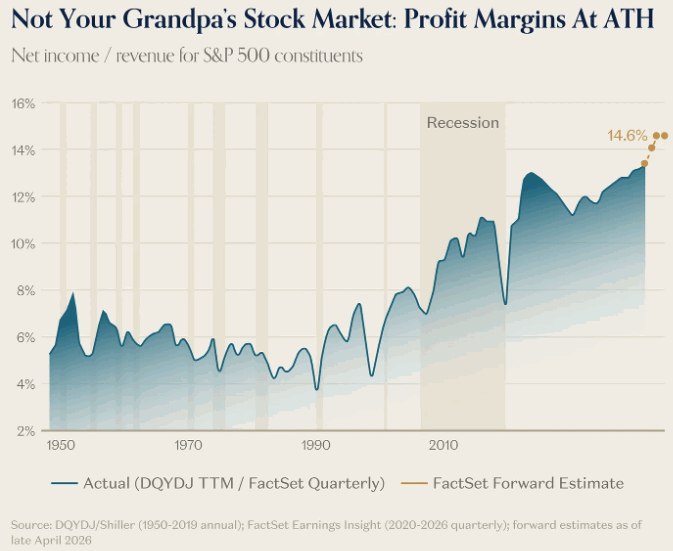
Chart of the Day: No wonder the stock market is on a tear. But profit margins are finance’s most mean-reverting series — they revert because they invite competition, regulation, and labor to claw back. At 14.6%, S&P margins now run roughly triple their post-war norm. The dotted forward estimates extrapolate further upward, embedding an assumption no prior generation could defend: that record-high profitability persists alongside record-high multiples. Two stretched springs, one chart. The fragility isn’t the level itself. It’s that nothing in today’s price reflects the asymmetry of what happens when both spring back together.
Market Intelligence Brief (MIB) Ver. 17.91
For professional investors only. Not investment advice.
© 2026 RecessionALERT.com

Comments are closed.