
MIB WEEKLY DIGEST
Week of May 4–8, 2026
Iran peace optimism crashed WTI 9% Wednesday before ceasefire violations partially reversed it — oil fell –7.73% WoW, consumer gas near $4.55. Into that geopolitical tape, AMD’s Q1 Data Center revenue (+57% YoY) and the preliminary Apple–Intel foundry deal ignited AI semiconductors: Micron crossed $800B, INTC surged 25%, Nasdaq 100 +5.50% while the NYSE Composite fell –0.43%. April NFP exploded to +115K (vs. 65K consensus), cementing Fed on hold through 2027 — but Michigan Consumer Sentiment crashed to a 74-year record low, and a simultaneous hawkish Fed pivot by Musalem, Goolsbee, and Hammack put rate hike optionality explicitly on the table.
TABLE OF CONTENTS
A. WEEK AT A GLANCE
B. WEEK IN MARKETS
C. WEEK’S TOP STORIES (10)
D. WEEK IN THE ECONOMY (5)
E. WEEK IN EARNINGS (3)
F. NEXT WEEK SETUP
G. CHART OF THE WEEK
A. WEEK AT A GLANCE -> TOP
The S&P 500 rose +2.33% and the Nasdaq 100 surged +5.50% to new all-time records — but the NYSE Composite fell –0.43%, the widest Nasdaq/broad-market split of the year, confirming that five AI semiconductor names (MU, SNDK, AMD, INTC, QCOM) carried the headline indices while the average stock declined. The week’s dominant catalyst was the Iran Strait of Hormuz peace memo: oil crashed 9% Wednesday on deal optimism before partially reversing Thursday on ceasefire-violation claims, leaving WTI –7.73% on net as markets priced partial Hormuz normalization. The April NFP’s +115K Goldilocks beat drove Friday’s S&P record while simultaneously Michigan Consumer Sentiment crashed to a 74-year record low — hard data resilience and household distress have never diverged this sharply in the current cycle.
• S&P 500 +2.33% to record 7,398.87; Nasdaq 100 +5.50% to ATH — but NYSE Composite fell –0.43%; DJTA –1.93% as the Dow Theory non-confirmation that persisted all five sessions named the real market structure: AI semis dominated, everything else was flat to down.
• WTI fell –7.73% WoW in the most volatile oil week of the year — Iran peace memo Wednesday crashed crude 9% to $92; Thursday’s ceasefire-violation claim sent it +2.71% back to $97; net –7.73% as markets partially priced Hormuz normalization. Consumer gas near $4.55 with no signed deal.
• AI chip sweep: MU +37.73% WoW crossing $800B; SNDK +31.62% on Q3 blowout; AMD +26.25% on Q1 Data Center +57%; INTC +25.40% on Apple–Intel foundry deal; QCOM +23.77% on record automotive revenues — all five top weekly gainers from one sector, one theme.
• April NFP +115K vs. 65K consensus, wages +0.2% MoM (below +0.3% expected) — Goldilocks — simultaneously Michigan Sentiment crashed to 48.2, a 74-year record low below the entry level of every recession since 1978.
• Hawkish Fed pivot: Musalem + Goolsbee + Hammack simultaneously flagged rate-hike scenarios — Polymarket hike probability jumped ~5% → ~25% WoW; Warsh confirmation vote set for week of May 11; Powell’s era ends May 15.
• Corporate oil-shock casualties mounted — Spirit Airlines liquidated (first major US carrier collapse in 25 years, 17K jobs); Amazon Supply Chain Services launched (UPS –10%, FedEx –9%), applying the AWS playbook to the $1.5T logistics market.
1. The AI Semiconductor Renaissance Has a Commercial Anchor — AMD’s Q1 Data Center blowout, Apple–Intel’s preliminary foundry deal (backed by a White House 10% equity stake), NVIDIA’s $3.2B Corning optical partnership, and Micron crossing $800B (eclipsing JPMorgan) collectively moved AI infrastructure investment from narrative into commercial and physical reality. Five semiconductor names topped the weekly gainers table; Technology led simultaneously across 1W/1M/3M/YTD/12M — textbook regime leadership. The single-name dominance caveat applies: strip MU, SNDK, AMD, INTC, and QCOM, and the sector’s weekly gain is fractional. The concentration that made this week extraordinary is the same concentration that makes a reversal sharp.
2. The Stagflation Bind Tightened, Not Loosened — Iran peace optimism sent crude –7.73% and equity markets celebrated with records. But the underlying data delivered simultaneous price pressure across both ISM surveys (Services Prices 70.7%, Manufacturing 84.6%), a productivity miss (+0.8% vs. +1.4% expected) with negative real wages (–0.5%), NY Fed 1-year inflation expectations at 3.6% (highest since 2022), and Michigan Sentiment at a 74-year low. The Fed’s hawkish pivot by three officials on the same week crude fell confirms the inflation concern is structural — services, wages, tariffs — and would persist even if Hormuz fully reopens. The oil drop is relief; it is not resolution.
3. Two Unresolved Binaries Own the Macro Equation Heading Into Next Week — The week ended with the S&P 500 at a record, a 74-year consumer sentiment low, 25% Polymarket hike probability, and a peace memo awaiting Tehran’s formal response — simultaneous extremes in opposite directions. Neither the Iran ceasefire (Polymarket 84.5% against a deal before May 14–15) nor the Warsh policy stance (first partisan Fed confirmation in history) has resolved. Tuesday’s CPI (exp. +0.6% MoM) is the first real data test of whether the Goldilocks NFP’s soft wages signal holds. Until these three events resolve — Iran deal, Warsh first statement, CPI — the record indices are priced on a fragile set of simultaneous assumptions that have not yet been tested simultaneously.
 — Leading economic indicators. Accurate market forecasts. Apply for membership at join.recessionalert.com
B. WEEK IN MARKETS -> TOP
The week’s dominant driver was the Iran Strait of Hormuz peace memo — oil’s gyrations defined every cross-asset session, swinging from $105 Monday to $92 Wednesday on deal optimism, rebounding to $97 Thursday on ceasefire-violation claims, settling near $95 Friday for a net –7.73% WoW decline. Into that geopolitical tape, AMD’s Q1 Data Center blowout (+57% YoY, Q2 guide 20% above consensus) and the preliminary Apple–Intel foundry agreement locked semiconductors into dominant weekly leadership: Nasdaq 100 surged +5.50% while the NYSE Composite fell –0.43% — the widest Nasdaq/broad-market split of the year and a clear signal that a shrinking group of AI chip names is carrying the headline indices. The April NFP’s +115K beat then produced Friday’s new S&P all-time high while simultaneously surfacing the week’s defining structural tension: Michigan Consumer Sentiment crashed to a 74-year record low, confirming the oil-driven stagflation bind between hard-data resilience and household distress.
FRIDAY CLOSE & WEEK-ON-WEEK CHANGE — Fri, May 8, 2026:
MAJOR INDICES
Two Market History Signals fired simultaneously this week. Dow Theory: DJIA gained +0.22% WoW while DJTA fell –1.93% — a 2.15-point weekly divergence above the 2% threshold, and the non-confirmation was entrenched across all five sessions as oil-cost exposure crushed freight and logistics (Spirit Airlines liquidation, $4.51/gallon jet fuel). Growth vs. Broad: NDX outpaced the S&P 500 by 3.17 percentage points WoW, confirming concentrated tech/growth leadership — a market advance narrow enough that the NYSE Composite actually fell on the week while the Nasdaq set records.
| Index | Fri Close | WoW Change | WoW % | Why It Moved (Week) |
|---|---|---|---|---|
| S&P 500 | 7,398.87 | +168.76 | +2.33% | AMD blowout + Apple-Intel deal ignited semis; Friday NFP beat (+115K vs. 65K) drove record close. Heavy tech weighting masked NYSE-level breadth deterioration. |
| Dow Jones | 49,609.04 | +110.02 | +0.22% | Blue-chip industrial composition lagged tech-heavy indices; Iran oil cost burden and hawkish Fed weighed on cyclicals; essentially flat WoW. |
| DJ Transportation | 20,199.8 | –398.4 | –1.93% | Spirit Airlines liquidation + $4.51/gallon jet fuel + Hormuz freight uncertainty crushed logistics all week. Persistent Dow Theory non-confirmation; DJTA 16–18% below its 10-session peak throughout. |
| Nasdaq 100 | 29,234.99 | +1,524.63 | +5.50% | Semiconductor sweep (MU +38%, SNDK +32%, AMD +26%, INTC +25%) + NFP-driven record close Friday. Apple-Intel deal, NVIDIA $5T, AMD Q1 blowout all stacked into the week. |
| Russell 2000 | 2,859.88 | +49.16 | +1.75% | Touched record Tuesday on Iran relief + jobs signal but gave back some gains Thursday; ended modestly positive. Underperformed NDX by 3.75 pp — small-caps did not sustain leadership. |
| NYSE Composite | 22,942.15 | –99.00 | –0.43% | The broad market fell despite S&P/Nasdaq records — the starkest breadth warning of the week. Iran, hawkish Fed, Energy sector selloff, and Healthcare structural decline outweighed tech’s gains across the average NYSE stock. |
VOLATILITY & TREASURIES
The week’s cross-asset signal was structurally ambiguous: VIX rose +1.12% WoW despite equity index gains — options markets are not endorsing the narrow Nasdaq advance. The 10Y yield fell just –1.2 bps on net (essentially flat), masking violent intra-week swings (+6 bps Monday, –6.8 bps Wednesday on Iran relief, +3.2 bps Thursday). Bonds and stocks rallied simultaneously Friday on Goldilocks NFP, but the bond market declined to serve as a safe haven on risk-off sessions — yields rose alongside falling equities Monday and Thursday, the classic cost-push inflation signature. The Fed’s hawkish pivot (Musalem, Goolsbee, Hammack all signaling rate-hike optionality) reinforced the “no cuts” regime that prevented yields from rallying further on growth fears.
| Instrument | Fri Level | WoW Change | Why It Moved (Week) |
|---|---|---|---|
| VIX | 17.18 | +0.19 (+1.12%) | Rose despite equity records — Iran conflict sustaining a geopolitical risk premium options markets refuse to release. The narrow Nasdaq advance left the average stock unprotected. |
| 10-Year Treasury Yield | 4.359% | –1.2 bps | Essentially flat WoW behind violent intra-week swings: +6 bps Monday (Iran cost-push), –6.8 bps Wednesday (peace optimism), +3.2 bps Thursday (violation claims), –3.4 bps Friday (Goldilocks NFP). Iran’s inflation shadow prevented yields from falling further on growth caution. |
| 2-Year Treasury Yield | 3.887% | +0.7 bps | Short end marginally higher as three Fed officials pivoted hawkish simultaneously; “rate hike optionality” is now live language. The 2Y-10Y curve held near 47–49 bps all week — no recession signal. |
| US Dollar Index (DXY) | 97.85 | –0.38 (–0.39%) | Mild risk-on dollar softening on the week; DXY never acted as a true safe haven even on Iran escalation sessions — bonds absorbed the geopolitical premium instead. |
COMMODITIES
Gold (+2.17%) and copper (+5.41%) both gained significantly on the week — an unusual combination that names the week’s dual character: gold retained a geopolitical premium (Iran deal unsigned through Friday, Polymarket pricing 84.5% against a deal before the May 14–15 Beijing summit), while copper surged on the Apple–Intel US chip manufacturing deal and AI infrastructure reshoring — domestic semiconductor fabrication is copper-intensive and the market priced the capex cycle weeks in advance. Silver (+6.65%) outpacing gold throughout confirmed the industrial-demand signal was dominant. Bitcoin’s +2.91% tracked equity risk-on without decoupling — no independent crypto catalyst.
| Asset | Fri Price | WoW Change | WoW % | Why It Moved (Week) |
|---|---|---|---|---|
| Gold | $4,726.14/oz | +$100.14 | +2.17% | Retained geopolitical premium through Friday — Iran deal unsigned, ceasefire violations Thursday. Fell Monday on peace-talk optimism but recovered as each optimistic signal remained unconfirmed. |
| Silver | $80.915/oz | +$5.042 | +6.65% | Outpaced gold all week on dual industrial demand (AI infrastructure + photovoltaics) and precious metal safe-haven. Wednesday surge (+5.78%) on Iran deal optimism + DXY weakness was the week’s single biggest silver session. |
| Copper | $6.2833/lb | +$0.3228 | +5.41% | Apple–Intel US chip manufacturing agreement (announced Tuesday as talks, confirmed Friday as deal) priced copper-intensive domestic fab expansion; industrial demand signal reinforced by AI capex cycle confidence. |
| Platinum | $2,065.75/oz | +$65.05 | +3.25% | Broad precious metals complex strength; industrial demand optimism; DXY softness added lift. Wednesday surge largest single session. |
| Bitcoin | $80,212 | +$2,265 | +2.91% | Tracked equity risk-on in lockstep; no independent crypto catalyst. Thursday risk-off sent it –2%, Friday NFP-driven recovery. BTC is a beta amplifier this week, not a safe haven. |
ENERGY
WTI and Brent both fell ~7.7–7.8% WoW — nearly identical declines that confirm this was a global supply-expectation repricing, not a US-specific story. The key cross-asset signal: oil fell as equities rose across the week — markets are reading the potential Hormuz normalization as a demand-benign supply unlock, not a growth collapse. Iran peace deal optimism drove Wednesday’s 9% WTI crash; Thursday’s ceasefire violation claims partially reversed it (+2.71%); Friday settled near $95 as the deal remained unsigned. Dutch TTF’s –2.99% decline tracked crude but less aggressively — European structural gas tightness cushioned the drop, and the TTF-Henry Hub premium persists at ~$12.50, reflecting ongoing LNG demand from Europe that is separate from the Hormuz crude story.
| Asset | Fri Price | WoW Change | WoW % | Why It Moved (Week) |
|---|---|---|---|---|
| Crude Oil (WTI) | $94.58/bbl | –$7.92 | –7.73% | Iran peace deal optimism collapsed WTI 9% Wednesday; Thursday ceasefire-violation claims reversed part of the move (+2.71%); net decline on the week as markets priced Hormuz normalization probability rising even without a signed deal. |
| Crude Oil (Brent) | $100.32/bbl | –$8.49 | –7.80% | Same global supply-normalization driver as WTI; Brent declined nearly identically, confirming no US-specific split. Brent-WTI spread compressed from $6.31 to $5.74 — no regional divergence this week. |
| Natural Gas (Henry Hub) | $2.749/MMBtu | –$0.040 | –1.43% | Domestic gas decoupled from the Iranian supply shock throughout the week; mild seasonal demand easing. Henry Hub’s small net decline confirms US gas is on its own domestic storage dynamic, insulated from the Hormuz geopolitical premium. |
| Natural Gas (Dutch TTF) | $15.25/MMBtu | –$0.47 | –2.99% | European gas priced out Iran war premium on peace deal optimism but held the $12.50 premium over Henry Hub — structural European supply tightness (LNG demand, storage rebuild) is a separate, durable driver from the crude geopolitical story. |
S&P 500 SECTORS — WEEKLY ROTATION
Technology’s +6.25% 1W is not mere short-term noise — it simultaneously leads 1M (+19.22%), 3M (+18.90%), YTD (+16.96%), and 12M (+54.73%), the textbook regime-leadership pattern. But the single-name dominance check is critical here: four of this week’s five top mega-cap gainers (MU, SNDK, AMD, INTC) are Technology/Semiconductor names. Strip those four and the sector’s weekly gain would be fractional — the “tech leadership” signal is real but highly concentrated in AI memory and foundry rather than the full sector. Energy’s –5.03% 1W after leading YTD (+26.91%) is a profit-taking signal at the top of multi-horizon leadership, amplified by XOM (–5.36%) and CVX (–4.73%) both landing in the weekly decliners table. Healthcare’s –0.70% 1W extending a –7.14% 3M and –5.29% YTD is structural laggard 3M-deepening — not a tactical wobble.
| Sector | 1-Week | 1-Month | 3-Month | 6-Month | YTD | 12-Month |
|---|---|---|---|---|---|---|
| Technology | +6.25% | +19.22% | +18.90% | +13.01% | +16.96% | +54.73% |
| Basic Materials | +3.43% | +0.65% | +2.54% | +31.68% | +18.32% | +53.07% |
| Consumer Cyclical | +1.66% | +7.43% | +2.30% | –2.04% | +0.57% | +19.79% |
| Communication Services | +1.66% | +11.07% | +10.07% | +13.98% | +8.98% | +48.35% |
| Real Estate | +0.72% | +4.12% | +4.31% | +7.50% | +8.97% | +8.05% |
| Industrials | +0.38% | +1.53% | +1.43% | +15.25% | +14.34% | +34.78% |
| Consumer Defensive | –0.03% | +0.53% | –3.83% | +12.03% | +9.41% | +6.53% |
| Financial | –0.25% | +0.89% | –4.41% | +1.57% | –3.09% | +12.27% |
| Healthcare | –0.70% | –3.11% | –7.14% | +0.40% | –5.29% | +10.12% |
| Utilities | –3.21% | –3.91% | +3.54% | +3.54% | +7.12% | +16.72% |
| Energy | –5.03% | –2.58% | +9.20% | +29.33% | +26.91% | +42.38% |
TOP WEEKLY MOVERS:
The gainers leaderboard this week is a single-theme sweep: all five names are Technology/Semiconductor, meaning the weekly rotation table’s +6.25% tech gain and the movers table tell identical stories — AI memory and foundry are the only game in town. On the decliners side, XOM and CVX reflect the energy sector’s Iran peace-deal-driven selloff (the YTD leaders being sold as oil crashes), while WFC’s –6.40% deepens the financial sector’s structural underperformance (–18.84% YTD). NFLX’s –4.96% continues post-earnings rotation away from entertainment and into AI. PLTR’s –4.35% is a sell-the-news reaction to a blowout Q1 at extreme valuation — counter-trend despite 3Y of +1,680% returns.
TOP 5 WEEKLY GAINERS
| Ticker | Week | YTD | Year | Why It Moved |
|---|---|---|---|---|
| MU | +37.73% | +161.66% | +777.05% | AMD’s Q1 Data Center blowout validated the HBM demand cycle; DA Davidson set a Street-high $1,000 target citing HBM sold out through 2026; DRAM spot prices soared 57% in April; MU crossed $800B market cap eclipsing JPMorgan — best week in two decades. |
| SNDK | +31.62% | +558.16% | +4161.70% | Q3 FY2026 blowout earnings: revenue +250% YoY to $5.95B, gross margin expanded 5,570 bps to 78.4%; Q4 guide $8B obliterated $6.49B consensus; $6B buyback; Mizuho raised target to $1,625. AI memory supercycle driving extraordinary unit economics. |
| AMD | +26.25% | +112.55% | +347.58% | Q1 FY2026 blowout: Data Center revenue $5.8B (+57% YoY), total revenue $10.25B (+38%), Q2 guide $11.2B trounced $10.5B consensus. Meta 6GW MI450 deal validated hyperscaler diversification. Wave of analyst upgrades (Bernstein, Goldman, Baird). |
| INTC | +25.40% | +238.54% | +494.86% | Bloomberg (Tue) and WSJ (Fri) reported Apple-Intel preliminary chip-manufacturing agreement, brokered with White House involvement; US government announced 10% equity stake in Intel. Stock doubled in a month. Q1 results also beat ($13.6B revenue +7% YoY, EPS vs $0.01 est). |
| QCOM | +23.77% | +28.09% | +50.99% | Q2 FY2026 record automotive chip revenue (+38% YoY to $1.326B, annualized >$5B for the first time); Daiwa upgrade to Outperform/$225 on AI data center inference pivot thesis; $20B buyback; Snap XR chip partnership. |
TOP 5 WEEKLY DECLINERS
| Ticker | Week | YTD | Year | Why It Moved |
|---|---|---|---|---|
| WFC | –6.40% | –18.84% | +3.18% | Financial sector YTD laggard deepened losses; energy credit exposure concerns amid oil volatility; hawkish Fed pivot raised loan-book risk repricing fears. No specific positive catalyst to offset sector-level pressure; bearish options activity throughout the week. |
| XOM | –5.36% | +20.13% | +36.30% | Iran peace deal optimism crashed WTI 9% Wednesday — energy names sold despite Q1 EPS beat ($1.16 vs. $0.98 est). CEO flagged 750K bopd offline if Hormuz stays closed all Q2. Energy sector’s –5.03% WoW; YTD leaders being sold as oil normalizes. |
| NFLX | –4.96% | –6.69% | –23.55% | Post-Q1 sell-the-news: missed Q2 revenue guidance ($12.5B vs. $12.6B est); CEO Greg Peters and CFO Spencer Neumann sold stock mid-week. Continued rotation from entertainment into AI/tech. Down ~32% from 52-week high with no near-term re-rating catalyst. |
| CVX | –4.73% | +19.17% | +32.53% | Same Iran peace-deal energy-sector selloff as XOM; Q1 EPS +44.9% beat but revenue missed. CEO flagged Middle East production risk (7–10% full-year growth target contingent on shipping lanes). Goldman raised target to $216 but market sold the whole energy sector. |
| PLTR | –4.35% | –22.48% | +15.65% | Q1 blowout (revenue +85% YoY, FY guidance raised to +71%) met with “sell-the-news”: US commercial sales of $595M missed estimates; RBC renewed bearish stance at extreme valuation (~59x forward revenue). Declined –6.93% Tuesday despite the beat. |
— Institutional-grade intelligence for serious investors. Apply for membership at join.recessionalert.comC. WEEK’S TOP STORIES -> TOP
The week bifurcated into two persistent narrative threads. The Iran geopolitical arc — stories #1, #6, #7, and #8 — dominated every session: oil’s violent swings set the tape, downstream casualties accumulated (Spirit Airlines, the logistics sector), and stagflationary persistence locked out Fed cuts. The AI semiconductor renaissance arc — stories #2, #3, and #10 — ran in parallel: AMD validated the GPU demand cycle, Apple–Intel formalized US foundry manufacturing, and NVIDIA anchored the deployment buildout. These two arcs converged on Friday’s defining tensions — the NFP’s Goldilocks print (#4) and the hawkish Fed pivot (#5) — which together reset the macro equation heading into next week.
UNCERTAIN
1. Iran/Hormuz War Saga: UAE Missile Defense → First Commercial Transits → Peace Memo → Ceasefire Violation Claims — WTI –7.73% WoW on Net Normalization Pricing
The core facts:Monday: UAE activated its missile defense system for the first time since ceasefire talks began; US forces destroyed six Iranian patrol boats; Trump rejected Iran’s 14-point peace proposal while simultaneously calling talks “very positive.” Tuesday: Project Freedom delivered two US-escorted commercial ships through Hormuz — the first transits since the conflict began — crashing WTI –3.65% to $102. Wednesday: Reports emerged that the US and Iran were nearing a one-page agreement (nuclear moratorium + Hormuz framework); WTI crashed –9% to $92, S&P 500 closed at a record 7,365. Thursday: Iran formally accused the US and regional allies of ceasefire violations, sending WTI back +2.71% to $97.66; 10 of 11 S&P sectors closed red. Friday: Trump paused Project Freedom as Tehran formally reviewed the one-page memo; simultaneous active military exchanges continued. Net WoW: WTI –7.73%, Brent –7.80%. Polymarket priced 84.5% against a deal before the May 14–15 Trump–Xi Beijing summit. Hormuz throughput remains at 4–13 ships/day versus 120+ pre-crisis.
Why it matters:Oil’s net –7.73% WoW decline reflects the Hormuz normalization premium partially pricing out — but 13 million barrels per day remain shut-in and no deal is signed. Every session this week oscillated between optimism and escalation, producing 2026’s defining cross-asset pattern: oil falling while equities rose (demand-benign supply unlock), then reversing when the deal stalled. The peace premium remains the single largest reallocation opportunity in markets: a signed agreement collapses WTI by an estimated $20–30/barrel overnight, reopens Fed rate-cut optionality, restores airline and industrial margins, and collapses the oil risk premium embedded in every downstream sector. With Polymarket still pricing the deal at only a 15.5% probability before mid-May, this premium is still largely in place and this week’s oil move is advance pricing, not resolution. (WTI –7.73% WoW — see Energy table in Section B; Energy sector –5.03% WoW — see sector rotation table in Section B.)
What to watch:Iran’s formal response to the one-page memo over the weekend (May 9–11); WTI sustained below $90 signals high deal probability; May 14–15 Trump–Xi Beijing summit as the competing diplomatic priority that may reduce Iran deal urgency mid-month.
BULLISH
2. AMD Q1 FY2026 Blowout: Data Center +57% YoY, Q2 Guide 20% Above Consensus — AI GPU Supercycle Independently Confirmed
The core facts:AMD reported Q1 FY2026 results Tuesday AMC: revenue $10.25B (+38% YoY) vs. $9.89B estimate; Data Center segment $5.8B (+57% YoY) vs. $5.56B estimate; adjusted EPS $1.37 vs. $1.28 estimate. Q2 guidance midpoint $11.2B vs. $10.52B consensus — a 20% guide beat. Gross margin held above the 55% floor guidance. CEO Lisa Su doubled the server CPU total addressable market forecast to over $120B by 2030 on agentic AI demand. Meta’s 6GW MI450 GPU commitment and OpenAI’s 1GW Instinct MI450 agreement provided multi-year revenue visibility. AMD surged +18.6% Wednesday (markets react to AMC print), adding +26.25% on the full week. Morgan Stanley and a wave of other analysts immediately raised price targets; the Philadelphia Semiconductor Index (SOX) gained over 2% on AMD’s results alone. NVIDIA added +5.8% in sympathy on Wednesday.
Why it matters:AMD’s result is the second independent validation of the AI GPU demand cycle after NVIDIA’s Q4 FY2026 print — two competing chip architectures delivering simultaneous blowouts confirms this is structural demand, not single-vendor narrative. The Q2 guide beat of nearly 20% forced analysts to revise FY2026 estimates materially higher across the entire AI chip ecosystem. More consequentially, AMD’s EPYC server CPU data (server CPU TAM doubled to $120B; CPU-to-GPU ratio approaching 1:1 in AI data centers) confirms that the AI rack buildout is lifting AMD’s entire silicon portfolio, not just GPUs. For portfolio managers, AMD’s result sets a high expectations bar for NVIDIA’s May 20 report — a critical inflection that will either confirm or complicate the AI capex cycle narrative for the remainder of 2026.
What to watch:NVIDIA Q1 FY2027 report AMC May 20 — the AI chip complex’s capstone earnings event of the season; AMD Q2 data center revenue confirmation of the $6.5B+ implied trajectory; hyperscaler AI capex guidance (Microsoft, Amazon, Google, Meta report late July) for the demand-side validation.
BULLISH
3. US Semiconductor Renaissance Acquires Its Commercial Anchor: Apple–Intel Foundry Deal + White House 10% Equity Stake + Micron Crosses $800B
The core facts:Tuesday: Bloomberg reported Apple held early-stage talks with Intel and Samsung on US chip manufacturing as an alternative to TSMC, igniting INTC +13% and the broader semiconductor complex. Friday: The Wall Street Journal confirmed a preliminary agreement between Apple and Intel, brokered with White House involvement; the US government announced a 10% equity stake in Intel as part of its domestic semiconductor manufacturing commitment. Intel more than doubled in a month, and +25% on the week. Simultaneously, Micron Technology crossed $800 billion in market capitalization on Friday — eclipsing JPMorgan Chase for the first time in history — capping a +38% weekly gain described as its best week in two decades. DA Davidson set a Street-high $1,000 price target, citing HBM (High-Bandwidth Memory) sold out through 2026. Sandisk (SNDK) reported Q3 FY2026 blowout earnings (revenue +250% YoY to $5.95B, gross margin +5,570 bps to 78.4%) with Q4 guidance that obliterated consensus by 23%.
Why it matters:The Apple–Intel deal transforms US domestic semiconductor manufacturing from a policy aspiration into a commercially validated industrial strategy. Apple is the world’s largest silicon buyer — its foundry partnership with Intel validates Intel’s 18A process node in a way no other customer can replicate, and the 10% government equity stake creates a quasi-sovereign backing for the multi-hundred-billion capex required to build foundry capacity at scale. The concurrent Micron re-rating to $800B (surpassing JPMorgan) signals the market is valuing AI memory at software-platform premiums, not cyclical semiconductor multiples — a structural repricing that may not sustain if any hyperscaler reduces AI capex guidance. The collective INTC/MU/SNDK/AMD/QCOM move this week represents the largest single-week semiconductor market cap creation in history.
What to watch:Formal Apple–Intel foundry agreement terms and first delivery timeline (preliminary only); TSMC’s strategic response and any customer supply-chain diversification signals; Intel Q2 2026 earnings (late July) for foundry revenue pipeline including the Apple relationship; Micron Q3 FY2026 (June) for HBM shipment volume and pricing confirmation.
UNCERTAIN
4. April NFP +115K vs. 65K Consensus — New S&P ATH — Simultaneously, Michigan Consumer Sentiment Crashes to a 74-Year Record Low
The core facts:Friday 8:30 AM ET: The Bureau of Labor Statistics reported April 2026 nonfarm payrolls at +115,000 — nearly double the 65,000 consensus and defying the Challenger Gray & Christmas April cut surge (+38% MoM, 83,387 layoffs) that had collapsed the consensus from 178K. Healthcare led (+37K), followed by transportation and warehousing (+30K). Average hourly earnings +0.2% MoM and +3.6% YoY — both below the +0.3%/+3.8% consensus — providing a Goldilocks wage disinflation offset. Unemployment held at 4.3%. The S&P 500 closed at a new all-time high (7,398.87), with Atlanta Fed GDPNow holding at 3.7% for Q2. Friday 10:00 AM ET: The University of Michigan’s preliminary May Consumer Sentiment index printed 48.2 — below the 49.5 consensus, below April’s 49.8 final, and below the index’s level at the start of every recession since 1978. $4.55/gallon gasoline (Hormuz premium) and tariffs were cited by two-thirds of respondents.
Why it matters:The NFP/Michigan juxtaposition is this week’s defining structural tension. The jobs beat cements “Fed on hold through 2027” as the consensus and underpins the record multiple expansion visible in the Nasdaq’s +5.50% WoW performance. The Michigan crash is the soft-data canary: consumer sentiment at a 74-year low — below the entry level of every recession in the survey’s history — signals that the household sector is breaking beneath the headline even as the economy’s hard data holds. Soft data has historically led hard data by 3–6 months. If the sentiment-to-spending transmission firms up, Q2 consumer discretionary earnings become the trip wire that reprices the current record-multiple equilibrium. For portfolio managers: the NFP validates the AI/tech concentration trade short-term; the Michigan data flags the risk that the trade’s foundation — sustained consumer spending — is deteriorating at the household level.
What to watch:Tuesday May 12 CPI (exp. +0.6% MoM) — whether the NFP’s soft wages disinflation signal is confirmed or contradicted; Michigan Consumer Sentiment final for May (May 29) and May Conference Board for trend confirmation; April retail sales (May 15) as the demand-reality check against the soft-data deterioration.
BEARISH
5. Hawkish Fed Pivot: Musalem + Goolsbee + Hammack Simultaneously Flag Rate-Hike Optionality — Warsh Confirmation Imminent as Powell’s Term Expires May 15
The core facts:Wednesday: St. Louis Fed President Alberto Musalem (centrist) flagged “plausible scenarios” requiring rates to move higher — not just on hold. Chicago Fed President Austan Goolsbee — historically the FOMC’s most dovish voice — called the Iran war “an increasingly inflationary shock” and warned explicitly against rate cuts until inflation is clearly returning to 2%. Both spoke on the same day; their convergence was the week’s most analytically significant policy signal. Thursday: Cleveland Fed President Beth Hammack said rates should remain “on hold for quite some time,” called the FOMC’s own rate-cut signaling language “misleading,” and formalized the 4-member dissent bloc — the largest since 1992. Markets repriced hike probability to ~25%. Friday: The full Senate set a confirmation vote for Kevin Warsh’s Fed chair nomination for the week of May 11, with Powell’s term expiring May 15. The Senate Banking Committee advanced Warsh 13–11 on party lines — the first fully partisan Fed chair committee vote in modern history.
Why it matters:The simultaneous hawkish pivot from Musalem and Goolsbee — a centrist and the FOMC’s most persistent cut advocate — signals a broad committee shift, not individual dissent. When the most dovish voice on the committee aligns with centrists on the hawkish side, the policy direction is moving. The introduction of rate-hike “scenarios” by name is the disruptive element: markets had priced one cut for 2026 as the base case; hike optionality reprices every rate-sensitive sector (REITs, utilities, homebuilders, long-duration growth) simultaneously. More consequentially, this hawkish pivot is occurring even as oil prices fell –7.73% this week — which normally would be dovish. The fact that officials are pivoting hawkish despite crude’s decline signals the inflation concern is structural (services at 70.7% Prices Paid, wages running 4.4%, ISM Manufacturing at 84.6%) rather than purely energy-driven. Warsh’s imminent confirmation adds the institutional wildcard: the first partisan confirmation in Fed history introduces credibility uncertainty regardless of his policy stance.
What to watch:Warsh Senate floor vote week of May 11; Warsh’s first public statement as Chair-designate for June FOMC signals; May 12 CPI as the data trigger that accelerates or moderates hike probability; June 16–17 FOMC as the first decision under the new chair.
BEARISH
6. Spirit Airlines Liquidates — First Major US Carrier Collapse in 25 Years; American Airlines Warns of 2026 Full-Year Loss as $4.51/Gallon Jet Fuel Kills Thin Margins
The core facts:Spirit Airlines ceased all operations Saturday May 2 (markets reacted Monday May 4), filing Chapter 7 liquidation after a $500 million federal rescue collapsed. Jet fuel at $4.51/gallon — more than double Spirit’s turnaround plan’s $2.24/gallon assumption — added $360M+ in unplanned annual costs, making the rescue economics untenable. 17,000 employees are affected. This is the first complete US airline liquidation in 25 years. Monday: American Airlines warned of a potential 2026 full-year loss citing a projected $4 billion fuel cost surge. Air Canada suspended its 2026 guidance entirely. DJ Transportation (DJTA) fell –4.82% Monday alone — the week’s sharpest single-session index move — as the sector absorbed the reality that $100+ oil at the pump kills thin-margin operations throughout transportation.
Why it matters:Spirit Airlines is the canary in the coal mine for what sustained $100+ WTI does to thin-margin US corporations: a business model built on normalized energy costs becomes structurally non-viable when fuel doubles. The failed federal rescue signals the government’s unwillingness to backstop energy-shock corporate casualties at scale — other fuel-intensive industries (trucking, chemicals, shipping) absorb this conclusion directly. The 17,000 jobs lost represent the first visible employment consequence of the Iran oil war to hit the official labor market — the leading edge of a trend that ISM Manufacturing Employment (46.4%, in contraction) and the Challenger April layoff surge (+38% MoM, AI cited at 26%) are flagging for broader sectors. The DJTA’s persistent Dow Theory non-confirmation — present all five sessions this week — is the price signal for exactly this corporate oil-shock damage.
What to watch:Whether Frontier, Allegiant, or any other ultra-low-cost carrier files for Chapter 11 in Q2 2026; American Airlines Q2 earnings guidance for a cleaner read on how much fuel cost management can offset; Hormuz reopening as the single catalyst that restores airline sector viability.
BEARISH
7. Amazon Launches Supply Chain Services for All Businesses — UPS –10%, FedEx –9%, FWRD –20% as the AWS Playbook Arrives in Logistics
The core facts:Monday: Amazon launched “Amazon Supply Chain Services,” opening its full end-to-end logistics network — 80,000+ trailers, 24,000+ intermodal containers, fulfillment, and parcel delivery — to any business, regardless of whether they sell on Amazon’s marketplace. Early enterprise adopters include Procter & Gamble, 3M, and Lands’ End. The service directly challenges UPS and FedEx in the business-to-business shipping market — the highest-margin segment for traditional carriers. Market reaction: UPS –9.97%, FedEx –9.1%, Forward Air (FWRD) –20.3%, GXO Logistics –11%, Old Dominion Freight –5%. The Industrials sector fell –1.02% Monday, driven primarily by the transportation sub-sector rout.
Why it matters:Amazon is applying the AWS playbook — build internal infrastructure to world-class standard, then open it as a paid service — to the $1.5 trillion global B2B shipping market. The B2B shipping segment is precisely where UPS and FedEx generate their healthiest margins: denser delivery routes, more predictable volumes, superior unit economics versus residential. Amazon’s entry at scale, with P&G and 3M as launch customers, removes the “proof of concept” phase — the competitive threat is immediate and structural, not aspirational. For UPS, which was already navigating post-Teamsters labor cost inflation and declining package volumes, a single-day –10% decline reflects a genuine long-term revenue at risk repricing. The ripple extends across contract logistics: freight brokers, regional carriers, and 3PLs all face a recalibration with a competitor holding arguably the world’s most sophisticated supply chain infrastructure.
What to watch:UPS and FedEx Q2 2026 earnings (July) for any disclosure of meaningful B2B contract losses; Amazon’s pricing strategy for the new service — aggressive undercutting accelerates share shift; any major enterprise customer announcement from Amazon’s supply chain client list.
BEARISH
8. ISM Services Prices Paid 70.7% — Highest Since 2022; New Orders Plunge 7.1pp — Stagflation Signal Entrenches Across Both ISM Surveys
The core facts:Tuesday: ISM Services PMI for April held at 53.6% (22nd consecutive expansion month), but Prices Paid held at 70.7% — unchanged and the highest since 2022. Companies cited fuel, gasoline, diesel, copper, aluminum, lumber, and freight costs (both Iran war-driven and tariff-related). Business Activity surged +2.0pp to 55.9% while New Orders plunged 7.1pp to 53.5% — the largest single-month new-order decline in over a year. This New Orders collapse signals the demand pipeline is thinning even as firms work down existing backlogs. Combined with ISM Manufacturing’s prior-week Prices Paid at 84.6% — a 4-year high — both ISM surveys now show cost-push inflation above 70%, the broadest price-pressure reading since the 2021–22 supply chain crisis.
Why it matters:Services represent roughly 80% of US GDP. When services New Orders collapse 7.1 points while Prices Paid remain locked above 70, the classic stagflationary pattern is forming: firms are working down backlogs (hence high Business Activity) but fresh order flow is drying up, while input costs prevent price relief. The Fed’s worst-case scenario — demand softening before prices do — is now visible in the data. For fixed-income investors, ISM Services Prices Paid above 70 eliminates any remaining argument for 2026 rate cuts even if the labor market softens; for equity investors, the New Orders trajectory is a 1–2 quarter leading indicator of services-sector payroll contraction. The ISM’s data reinforced the hawkish pivot from Goolsbee and Musalem on Wednesday and is the empirical foundation for why three Fed officials now openly discuss rate-hike scenarios.
What to watch:May ISM Services Prices Paid (released early June) — a reading below 67 would signal Hormuz relief is transmitting into services cost reduction; above 70 locks in the “no 2026 cuts” scenario for the full year; also watch May New Orders for confirmation the demand trough is deepening.
UNCERTAIN
9. Berkshire’s Abel Rules Out Breakup, Signals Patience on $397B Cash Hoard — Record Reserve Is Itself a Market Signal
The core facts:Monday (reacting to Saturday’s release): Greg Abel’s first Berkshire Hathaway annual meeting as CEO delivered a broadly reassuring debut. Abel ruled out breaking up the conglomerate, cited AI as a “major tailwind” for Berkshire Hathaway Energy’s grid infrastructure (data center power demand), and signaled continued patience on the record $397 billion cash hoard (up from $373B at year-end). Q1 2026 operating earnings: $11.35 billion, +18% YoY — but $210 million below the $11.56 billion consensus. Insurance underwriting profits surged 29%; BNSF contributed $1.38B; BHE added $1.11B. BRK.B fell –1.01% Monday despite the strong YoY growth. Abel joined the list of institutional voices with “no compelling large-scale deployment opportunity at current valuations.”
Why it matters:Berkshire’s $397 billion cash position — the largest corporate cash reserve in history — growing again from $373B is itself a market signal: the world’s most celebrated long-term capital allocator sees no compelling large-scale deployment opportunity at S&P 500 near 7,200 in a $100+ oil, 3.5–3.75% rate environment. This is the same conclusion Berkshire reached under Buffett in 2023–24 before the market pulled back and created entry points. Abel’s patience is historically defensible; the signal is that current asset prices offer insufficient margin of safety for an allocator who can wait. For portfolio managers, Berkshire’s cash posture is not a prediction — it is a directional bias from an allocator with extraordinary track record and no obligation to deploy capital before the opportunity is compelling.
What to watch:Any major acquisition announcement from Abel in Q2 2026 — a deal above $20B would signal valuations have reached his deployment threshold and is the single most bullish event available for BRK.B shareholders; BHE power purchase agreement disclosures for the scale of AI-driven utility growth that Abel flagged.
BULLISH
10. NVIDIA Reclaims $5 Trillion Market Cap — $3.2B Corning Optical Manufacturing Partnership Removes Next AI Infrastructure Bottleneck
The core facts:Wednesday: NVIDIA surged approximately 5.8%, pushing its market capitalization above $5 trillion — reclaiming the world’s most valuable public company position. Simultaneously, NVIDIA announced a long-term manufacturing partnership with Corning: $3.2 billion committed to build three new US factories in North Carolina and Texas, expanding optical manufacturing capacity tenfold and fiber production by 50%, creating 3,000+ US jobs. The technology: co-packaged optics dramatically increases AI data center bandwidth while reducing energy consumption — the critical bottleneck for next-generation Blackwell GPU deployments at 100,000+ chip cluster scale. Corning shares surged approximately +14.6% to a record high. NVIDIA took a $500M equity stake in Corning as part of the partnership.
Why it matters:The Corning deal is analytically more important than the $5T milestone. Co-packaged optics solves the bandwidth and energy efficiency wall that would otherwise constrain GPU cluster scaling beyond 100K-chip configurations — a constraint that was becoming the primary physical bottleneck for every hyperscaler’s AI buildout roadmap. By committing $3.2B and taking an equity stake in Corning, NVIDIA is proactively removing the next bottleneck before it constrains revenue, confirming that AI infrastructure investment is accelerating into physical deployment — factories, fiber, optical hardware — beyond chips and software. The deal also reinforces the US manufacturing narrative that Apple–Intel anchored: NVIDIA’s US factory commitment creates domestic supply chain sovereignty at the optical infrastructure layer. For the week’s earnings story (Industrials +2.37% Wednesday on AI deployment rotation), the Corning deal is the concrete confirmation that the earnings base is broadening beyond mega-cap tech to capital goods suppliers.
What to watch:NVIDIA Q1 FY2027 earnings AMC May 20 — Blackwell demand and co-packaged optics deployment timeline as the quarter’s capstone event; Corning Q2 2026 for initial revenue contribution from the NVIDIA agreement; hyperscaler commentary on AI cluster size expansion at 100K+ GPU configurations.
— Separating signal from noise since 2007. Apply for membership at join.recessionalert.comD. WEEK IN THE ECONOMY -> TOP
The week delivered a textbook stagflation pulse: inflation building in both ISM surveys simultaneously (Services Prices Paid 70.7%, Manufacturing 84.6% — the broadest cost-pressure readings since 2021–22) while growth signals split sharply between resilient hard data and cratering soft data. The April NFP’s +115K beat and GDPNow’s 3.7% Q2 read are the hard layer; Michigan Sentiment at a 74-year low, ISM Services New Orders plunging 7.1pp, and Q1 productivity missing at +0.8% (worst since 2023) are the forward-warning layer. Markets read the divergence correctly: the 10Y yield was essentially flat WoW (–1.2 bps), refusing to rally on growth caution or sell off on inflation — a paralyzed bond market that reflects genuine policy uncertainty. The Fed’s hawkish pivot (Musalem, Goolsbee, Hammack all simultaneously moving to the right) pushes hike probability to ~25% (Polymarket) even as cut odds remain at 44.4% — the distribution is bimodal, not settled. Tuesday’s CPI (exp. +0.6% MoM) will be the first real data test of whether the stagflation pulse is accelerating or whether April’s soft wages (+0.2% MoM) signal a structural disinflation channel that keeps the “hold through 2027” consensus intact.
POLYMARKET ODDS — WEEK-ON-WEEK SHIFT:
| Market | Last Friday (May 1) | This Friday (May 8) | Δ |
|---|---|---|---|
| US Recession by end-2026 | 24% | ~20%* | –4 pp |
| Fed rate hike in 2026 | ~5%* | ~25% | +20 pp |
| Fed rate cuts ≥1 in 2026 | ~41%* | 44.4% | +3 pp |
* Approximate — not directly stated in the May 1 or May 8 daily MIB; derived from closest available data points during the week. The hike probability surge reflects the simultaneous hawkish pivots by Musalem, Goolsbee, and Hammack Wed–Thu; the bimodal distribution (cuts 44.4% + hikes 25% + hold ~31%) reflects genuine policy uncertainty rather than a settled rate path.
BULLISH
April Nonfarm Payrolls: +115K vs. 65K Consensus; Unemployment 4.3%; Wages +0.2% MoM — Goldilocks Print Drives S&P ATH (BLS, Fri May 8)
What they’re saying:The BLS reported +115,000 nonfarm payrolls in April — nearly double the 65,000 consensus, defying the Challenger Gray & Christmas surge (83,387 April cuts, 26% AI-attributed) that had collapsed the consensus from 178,000. Healthcare led (+37K), transportation/warehousing (+30K), retail trade (+22K). Federal government employment –9K (DOGE reductions), information –13K, manufacturing –2K. Average hourly earnings +0.2% MoM and +3.6% YoY — both below the +0.3%/+3.8% consensus. Unemployment held at 4.3%. Atlanta Fed GDPNow upgraded Q2 to 3.7%, private domestic investment nowcast to 9.2%.
The context:The Goldilocks configuration — jobs above consensus, wages below — is the specific print the market most needed: sufficient labor demand to confirm the soft landing thesis, insufficient wage pressure to force the Fed’s hand toward hikes. The NFP validated the JOLTS hiring surge (+655K in March) and pushed back against the most pessimistic tariff-disruption models. The composition is weaker than the headline: healthcare and transport growth are defensive/cyclical, while information and manufacturing shed jobs — the labor market is bifurcating along the same lines as the broader economy. Wages below consensus are the most consequential single number, as they maintain the “no immediate hike” window even for hawkish Fed officials.
What to watch:May NFP (June 6) for whether April’s recovery was a bounce or the start of sustained payroll resilience; April ADP weekly (May 12) for early May labor conditions; May Challenger report (June 4) for AI-displacement continuation at 26%.
BEARISH
ISM Services April: Prices Paid 70.7% — Highest Since 2022; New Orders Plunge 7.1pp as Demand Pipeline Thins (ISM, Tue May 5)
What they’re saying:The ISM Services PMI held at 53.6% in April (22nd consecutive expansion month, –0.4pp from March). Business Activity surged +2pp to 55.9% while New Orders collapsed –7.1pp to 53.5% — the largest single-month decline in over a year. Prices Paid held at 70.7%, unchanged and the highest since 2022. Employment rebounded to 48.0% from 45.2% but remains in contraction. Companies cited fuel, diesel, aluminum, lumber, and freight costs as primary price drivers.
The context:The Business Activity / New Orders split is the dangerous signal: firms are working down existing backlogs (Business Activity high) while fresh order flow dries up — the pre-recessionary pattern of running on momentum before the pipeline exhausts. Services represent ~80% of US GDP; a sustained New Orders trough translates directly into payroll contraction within 1–2 quarters. Combined with ISM Manufacturing Prices at 84.6%, both sectors now print above 70% on prices — the broadest cost-push inflation signature since the 2021–22 supply chain crisis. The 10Y yield fell just –1.2 bps WoW despite this data, confirming that stagflation dynamics are preventing the traditional rate-rally that growth concerns would normally trigger (see Vol & Treasuries table in Section B).
What to watch:May ISM Services PMI (June 3) — a Prices Paid reading below 67 signals Hormuz relief transmitting to services costs; above 70 locks in “no 2026 cuts” for the full year. Watch New Orders for May — if the 7.1pp drop persists, payroll contraction in services-heavy sectors follows within two quarters.
BEARISH
Fed’s Hawkish Pivot: Musalem Flags Hike Scenarios, Goolsbee Calls Iran War “An Inflationary Shock,” Hammack Calls Rate-Cut Signal “Misleading” (Federal Reserve, Wed–Thu May 6–7)
What they’re saying:Wednesday: Centrist Alberto Musalem said inflation is running “meaningfully above” the 2% target and flagged “plausible scenarios” requiring rates to move higher. Historically dovish Austan Goolsbee called the Iran war “an increasingly inflationary shock,” warned the Fed’s “more dominant problem right now is likely inflation,” and stated explicitly against rate cuts until inflation clearly returns to 2%. The NY Fed’s Global Supply Chain Pressure Index hit its highest level since July 2022. Thursday: Beth Hammack characterized the FOMC’s own rate-cut signaling language as “misleading,” said rates should remain on hold “for quite some time,” and formalized her dissent — part of the largest 4-member FOMC dissent bloc since 1992. Polymarket hike probability moved from ~5% (start of week) to ~25% by Friday.
The context:The analytical significance is not any individual speech — it is that Musalem (centrist) and Goolsbee (most persistent cut advocate) are saying the same thing on the same day. When the most dovish voice on the committee aligns with centrists on the hawkish side, the committee direction has shifted. This pivot is occurring even as WTI fell –7.73% this week, which normally would be dovish — the fact that officials are turning hawkish despite crude’s decline signals the inflation concern is structural (services 70.7%, wages 4.4%, ISM Manufacturing 84.6%), not purely energy-driven. The Polymarket cut-odds paradox: cuts ≥1 rose to 44.4% (Goldilocks NFP) while hike odds rose to 25% (hawkish pivot) — the market is pricing a bimodal distribution, not a settled path. (Polymarket cut-odds shift +3 pp WoW — see Polymarket table above.)
What to watch:Tuesday May 12 CPI (exp. +0.6% MoM, Core +0.4%) — the data test that either validates or challenges the hawkish pivot; any FOMC speaker softening Musalem’s rate-hike language would provide rate-sensitive equity relief. June 16–17 FOMC as the first decision under Warsh.
BEARISH
Michigan Consumer Sentiment Preliminary May: 48.2 — 74-Year Record Low, Below Every Prior Recession Entry; $4.55/Gallon Gasoline Named by Two-Thirds of Respondents (UMich, Fri May 8)
What they’re saying:The University of Michigan’s preliminary May 2026 reading came in at 48.2 — below the 49.5 consensus, below April’s 49.8 final, and below the survey’s level at the start of every US recession since its inception in 1952. Current conditions index collapsed to 47.8 (vs. 52 expected), driven by personal finance and major purchase conditions concerns. One-year inflation expectations eased slightly to 4.5% (from 4.7%); five-year declined to 3.4% (from 3.5%). Gasoline prices ($4.55/gallon) were cited as the primary concern by one-third of respondents; tariffs by another third. Whirlpool separately confirmed this week that appliance demand has “reached recession-level lows.”
The context:A reading below the survey’s level at the start of every prior recession is a historically significant psychological threshold — not a mechanical recession indicator, but an empirical signal that consumer psychology has already crossed the line where spending decisions change. The 5-year inflation expectations decline to 3.4% (from 3.5%) provides a narrow relief: anchoring has not broken at the long-run horizon. The energy channel is the dominant driver — $4.55/gallon gasoline is the Iran Hormuz premium in consumer household terms, and a signed peace deal that collapses WTI $20–30 would immediately reverse the gasoline price that is driving two-thirds of sentiment destruction. Michigan at 48.2 coexisting with NFP at +115K is this week’s hardest data interpretation challenge — soft data leads hard data by 3–6 months historically.
What to watch:Michigan Consumer Sentiment final for May (May 29); Conference Board Consumer Confidence for May; April retail sales (May 15) as the demand-reality check against the soft-data deterioration — if spending holds despite confidence collapse, the hard/soft divergence persists; if spending confirms confidence, Q2 GDP and earnings estimates face downward revision.
BEARISH
Q1 Nonfarm Productivity +0.8% — Biggest Miss Since 2023; Real Hourly Compensation Turns Negative at –0.5% (BLS, Thu May 7)
What they’re saying:BLS preliminary Q1 2026 nonfarm productivity: +0.8% annualized vs. +1.4% consensus — the largest single-quarter miss since 2023. Output grew 1.5% but hours worked climbed 0.7%, compressing the output-per-hour gain. Unit labor costs rose +2.3% (vs. +2.6% expected), providing marginal relief on the cost side but remaining above target-consistent levels. Real hourly compensation turned negative at –0.5% — workers are losing purchasing power in real terms despite nominal wage growth. YoY productivity at +2.9% remains solid but is a base-effect artifact from weak Q1 2025 data rather than a structural acceleration.
The context:A productivity miss paired with negative real compensation is the worst-of-both-worlds configuration for Fed policy: the economy is not getting more efficient (limiting the sustainable pace of non-inflationary growth) while workers are being squeezed by inflation exceeding nominal wage gains. This directly reinforces the ISM Services New Orders deterioration — firms building backlogs rather than growing efficiently, while the consumer faces negative real income. The productivity miss also strengthens the hawkish pivot case: if productivity is not improving, labor costs (at +2.3% ULC) are structurally inflationary above target, and the Fed cannot accommodate growth weakness without reigniting wage-driven inflation. Manufacturing productivity of +3.6% (durable manufacturing +5.3%) is the one bright spot — AI and capex investment are translating into factory efficiency, but it is too small a fraction of GDP to offset services productivity weakness.
What to watch:Q2 2026 productivity revision (August) and preliminary (November) — if AI-driven efficiency gains are real, they should appear in the Q2 and Q3 productivity prints; April CPI (May 12) for whether the ULC elevation is passing through to consumer prices in April’s data.
— Know the probability before the market prices in the risk. Apply for membership at join.recessionalert.comE. WEEK IN EARNINGS -> TOP
TOP EARNINGS OF THE WEEK
BULLISH
1. Advanced Micro Devices (AMD): +18.6% session | Data Center $5.8B (+57% YoY), Q2 Guide $11.2B Crushes $10.5B Consensus
The Numbers:Q1 FY2026 (reported AMC May 5): Revenue $10.25B vs. $9.89B est (+3.6% beat); +38% YoY. Data Center segment: $5.8B vs. $5.56B est (+57% YoY, +7% beat on the most-watched line). Client (PC/laptop): $1.4B (+85% YoY). Gaming: $300M (–30% YoY — expected decline). Embedded: $900M (recovering). Adj. EPS $1.37 vs. $1.28 est (+7.0% beat). Gross margin held above the 55% floor guidance. Q2 2026 guidance: $10.9B–$11.5B (midpoint $11.2B vs. $10.52B consensus — a 6.5% guide beat). Released AMC May 5, markets reacted +18.6% Wednesday May 6.
The Problem/Win:The segment-level detail tells the more important story: AMD’s Data Center revenue growing 57% YoY at $5.8B confirms that the MI450 GPU deployment at Meta (6GW commitment) and OpenAI (1GW, first deliveries H2 2026) is converting from announced deal to real, scaled revenue. The Q2 guide midpoint of $11.2B at nearly 20% above prior consensus forces every analyst model higher on both AMD and the broader AI chip ecosystem. The server CPU story is separately bullish: CEO Lisa Su doubled the server CPU TAM forecast to $120B by 2030, citing CPU-to-GPU rack ratios approaching 1:1 in AI data centers — meaning AMD’s EPYC CPU is benefiting from the same AI rack demand as its GPU business, giving AMD two parallel growth levers. The one nuance: gaming revenue at –30% YoY confirms AMD’s console cycle exposure is a drag, though negligible at scale relative to Data Center.
The Ripple:NVIDIA gained +5.8% in sympathy Wednesday — two competing chip architectures delivering blowouts confirms structural AI demand, not share cannibalization. Arista Networks’ simultaneous Q1 result (revenue +35% YoY, AI networking target doubled to $3.5B) reinforced the full AI infrastructure stack. The SOX gained over 2% Wednesday on AMD’s print alone. Note: AMD’s macro AI cycle story is covered as Section C story #2; the E entry focuses on the financial-print specifics — segment math, gross margin discipline, and Q2 guide that daily C/D coverage did not surface.
What It Means:AMD is executing a credible #2 AI chip strategy — not displacing NVIDIA but expanding the total addressable market with a competing architecture that hyperscalers use for workload diversification. At $10.25B Q1 revenue with a $11.2B Q2 midpoint guide, AMD is tracking toward $42–43B in annualized revenue — a business that 18 months ago was considered structurally challenged in AI.
What to watch:NVIDIA Q1 FY2027 earnings AMC May 20 as the confirmatory read on AI chip demand; AMD Q2 Data Center revenue (implied ~$6.5B+) as confirmation the guide is achievable; gross margin trajectory above or below the 55% floor as the margin-expansion thesis test.
BULLISH
2. Walt Disney (DIS): +7.54% | Streaming Income +88% to $582M, First 10%+ Operating Margin — Structural Streaming Profitability Milestone Reached
The Numbers:Q2 FY2026 (BMO May 6): Revenue $25.17B vs. $24.87B est (+1.2% beat, +7% YoY). Adj. EPS $1.57 vs. $1.49 est (+5.4% beat). Streaming (Disney+/Hulu) revenue: $5.49B (+13% YoY). Streaming operating income: $582M (+88% YoY) — 10.6% operating margin, crossing the 10% threshold for the first time. Experiences (parks/cruises): $9.5B (+7% YoY). FY2026 adj. EPS growth guidance ~12%. Share repurchase target raised to $8B (from $7B). Stock +7.54% on the day.
The Problem/Win:The 10.6% streaming operating margin is the week’s most structurally important earnings milestone for the media sector. Streaming revenue growing +13% while operating income grows +88% is an inflecting unit-economics curve — every incremental streaming dollar is now flowing predominantly to the bottom line. This resolves the central bear case on DIS that had weighed on the stock: streaming losses dragging overall margins. With the structural loss-making phase behind it, Disney now holds two high-quality cash engines (streaming + parks/cruises) alongside its premium IP library. The $8B buyback raise signals management confidence in FCF durability. The only modest weakness: domestic park attendance declined 1% (offset by strong international performance), consistent with consumer pressure from $4.55/gallon gasoline.
The Ripple:Disney’s streaming margin milestone is the most important read-through for the media sector since Netflix demonstrated mature streaming margins. The result directly strengthens the bull case for Paramount, Warner Bros. Discovery, and any remaining streaming-challenged media company: the margin trajectory from loss to 10%+ is demonstrably achievable at Disney’s content investment level. For portfolio managers, DIS’s result removes the last major bear thesis (streaming losses) and restores the fundamental value story.
What It Means:Disney has successfully completed its transition from loss-making streamer to profitable streaming operation. At 12% FY2026 adj. EPS growth with accelerating streaming margins and $8B in annual buybacks, DIS is now a capital-return story with a streaming growth layer — a profile that warrants re-rating toward media peers who reached this milestone earlier.
What to watch:Q3 FY2026 streaming margin trajectory — can 10%+ sustain without content investment cuts? International parks attendance for any Hormuz/geopolitical travel impact in Q3; domestic park traffic recovery as gasoline prices normalize.
BULLISH
3. CVS Health (CVS): +7.65% | Medical Benefit Ratio Improves 270 bps to 84.6% — Managed Care Bear Case Resolved, FY2026 Guidance Raised
The Numbers:Q1 2026 (BMO May 6): Total revenues $100.43B vs. $94.99B est (+5.7% beat, +6.2% YoY). Adj. EPS $2.57 vs. $2.18 est (+17.7% beat). GAAP EPS $2.30 (+63% YoY). Insurance segment revenue: $35.97B (+3% YoY). Medical Benefit Ratio (MBR): 84.6% vs. 86.3% expected and 87.3% prior year — a 270 basis point improvement. FY2026 guidance raised: Adj. EPS $7.30–$7.50 (from $7.00–$7.20); Revenue ≥$405B (from ≥$400B).
The Problem/Win:The MBR measures medical expenses as a percentage of insurance premiums — at 84.6%, CVS retained 15.4 cents of every premium dollar versus only 12.7 cents the prior year. The 270 bps improvement versus consensus of 86.3% is the most consequential single metric in the report: it resolves the central bear thesis on CVS that has weighed on the stock through 2025–26 (elevated medical costs driven by Medicaid redeterminations and Medicare Advantage utilization). Government business improvement was the primary driver. The +17.7% EPS beat is the largest of any mega-cap reporter this week, reflecting the leverage of MBR improvement on a $100B+ revenue base — each percentage point of MBR improvement drops roughly $360M directly to operating income at CVS’s scale.
The Ripple:CVS’s MBR inflection is the most consequential managed care read-through of the earnings season. UnitedHealth (UNH), Cigna (CI), Humana (HUM), and Centene (CNC) all face the same MBR pressure dynamic — CVS’s strong Q1 suggests the worst of the utilization surge may have passed, benefiting the entire sector. Managed care peers gained in sympathy following the CVS result. Healthcare sector remained structurally challenged this week (–7.14% 3M in the rotation table), but CVS provided a specific data point that the insurer sub-sector has stabilized.
What It Means:CVS’s vertical integration strategy (pharmacy + insurance + MinuteClinic) is delivering operational efficiency ahead of schedule — a structural re-rating argument for a stock that had been severely discounted on MBR concerns. At $100B+ revenue with improving margins and a raised FY guidance, CVS is now positioned as a healthcare value play with a catalyst-dense H2 (UNH peer confirmation expected).
What to watch:UnitedHealth Q1 results as the sector-wide MBR confirmation (or contradiction); CVS Q2 MBR — a reading at or below 84% confirms the structural improvement is sustained; Medicaid redetermination completion timelines for the government business tailwind.
WEEK AHEAD PREVIEW:
Q1 2026 earnings season is nearing completion with 89% of the S&P 500 reported and blended growth at a record-setting +27.1% YoY. The upcoming week brings a notable nuclear power name and three critical technology earnings that will set the tone for the AI capex theme through the summer.
Constellation Energy (CEG) — BMO, Monday May 11 — Consensus EPS $2.56 (+19.6% YoY), Revenue $8.21B (+20.9% YoY). Key focus: Calpine integration EBITDA tracking; data center nuclear power purchase agreement pipeline and new long-term contract announcements from hyperscaler customers; nuclear fleet availability rates. The AI-to-nuclear power link is a structural growth vector that will determine whether CEG sustains its 2026 re-rating.
Cisco Systems (CSCO) — AMC, Wednesday May 13 — Consensus EPS ~$1.03 (+8% YoY), Revenue ~$15.5B (+10% YoY). Key focus: AI networking order pipeline and enterprise switching velocity; Splunk integration ARR contribution and cybersecurity cross-sell; any commentary on hyperscaler network spending acceleration following the week’s Apple–Intel and AMD headlines.
Applied Materials (AMAT) — AMC, Wednesday May 14 — Consensus EPS ~$2.66 (+11% YoY), Revenue ~$7.7B (+8% YoY). Key focus: China revenue guidance under the Hua Hong Semiconductor export restrictions; leading-edge AI chip fab demand from TSMC, Samsung, and — given this week’s Apple–Intel deal — Intel foundry capacity ramp requirements; FY2026 China revenue mix trajectory.
NVIDIA (NVDA) — AMC, Wednesday May 20 — The quarter’s most anticipated event. Key focus: Blackwell Data Center revenue and H100-to-Blackwell transition trajectory; China H20 chip export impact; FY2027 guidance framework amid hyperscaler capex commitments; commentary on competitive dynamics following AMD’s blowout Q1 and the Apple–Intel foundry announcement.
— US market commentary trusted by family offices and institutions. Apply for membership at join.recessionalert.comF. NEXT WEEK SETUP -> TOP
UPCOMING RELEASES:
| Date | Event | Why It Matters |
|---|---|---|
| Mon, May 11 | Existing Home Sales (exp. 4.05M) | Housing demand gauge at current mortgage rates (~6.4%); a miss below 3.8M would confirm rate-sensitive sectors remain depressed despite yield softening. Also the first major data point after Friday’s NFP to test whether Goldilocks translates to real economic activity. |
| Week of May 11 | Warsh Senate Confirmation Vote (Powell term expires May 15) | The first partisan Fed chair confirmation in modern history. Warsh chairs the June 16–17 FOMC if confirmed before May 15. His first public signals as Chair-designate — hawkish (yield normalization) or accommodating Trump’s rate-cut request (inflation re-pricing) — directly reprice rate-sensitive sectors and challenge the “hold through 2027” consensus validated by Friday’s NFP. |
| Tue, May 12 | CPI MoM (exp. +0.6%) / Core CPI MoM (exp. +0.4%) | The most market-moving release of the week. Friday’s NFP landed Goldilocks partly because wages came in soft (+0.2% MoM vs. +0.3% expected). If CPI confirms the disinflationary signal, the “Fed on hold” equity premium survives intact. A hot CPI print (+0.7% or above) forces markets to reprice the June and July FOMC, compressing the long-duration multiples that drove last week’s tech rally. April CPI is the definitive test of whether the Iran energy premium is passing through to broader prices. |
| Tue, May 12 | ADP Employment Change (Weekly) / Total Household Debt Q1 | ADP weekly provides an early read on May labor conditions ahead of next month’s NFP; any sharp deceleration would crack the “jobs are stable” narrative. Q1 Household Debt tracks whether consumers are funding spending via credit as confidence collapses — rising delinquencies alongside Michigan’s 74-year low sentiment would confirm spending risk is real, not just psychological. |
| Tue, May 12 | Fed Williams Speech | First major Fed communication following Friday’s Goldilocks NFP and Michigan record-low sentiment. Williams is a core FOMC member; any signals on the June meeting or the Warsh transition will move rate markets. Watch for explicit language on the inflation vs. growth trade-off given the unprecedented divergence between hard data (jobs, GDPNow 3.7%) and soft data (sentiment at 74-year low). |
| Wed, May 13 | PPI MoM (exp. +0.4%) / Core PPI MoM (exp. +0.1%) | Producer prices lead consumer prices by 1–3 months; a hot PPI immediately following CPI would signal the Iran energy premium is working through the supply chain and arriving in consumer prices through Q2. Core PPI at +0.1% expected suggests the pipeline is contained — any upside surprise reinforces the case that the Fed cannot cut regardless of Warsh’s political inclinations. |
WHAT TO WATCH NEXT WEEK:
1. Will Iran formally accept the one-page peace memo this weekend? A signed agreement collapses WTI by an estimated $20–30/barrel overnight, eliminates the $4.55/gallon gasoline premium driving Michigan Sentiment’s 74-year low, and reopens Fed rate-cut optionality that markets have already priced out. But the May 14–15 Trump–Xi Beijing summit creates a competing diplomatic priority — if Hormuz resolution is deferred while US attention shifts to China, the oil premium persists and the inflation overhang deepens heading into June.
2. Can Tuesday’s CPI (+0.6% MoM expected) confirm the NFP’s soft wage signal? This is the week’s highest-stakes data release. If CPI arrives at or below +0.5%, the “hold through 2027” equity premium survives intact and the Nasdaq’s 5.50% WoW gain is fundamentally supported. A hot print above +0.7% — arriving on the same day Warsh’s confirmation vote may settle — forces simultaneous repricing of the June FOMC and the long-duration multiples that drove last week’s tech concentration trade.
3. What will a confirmed Warsh signal about the June 16–17 FOMC? Markets are priced for data-dependent continuity (“hold through 2027” consensus validated by Friday’s NFP). If Warsh signals “urgency” toward accommodation — responding to Trump’s explicit cut request — rate-sensitive sectors (REITs, utilities, homebuilders) rally sharply while long-duration growth tech faces a multiple rerating. If Warsh signals hawkish continuity — consistent with the Hammack dissent bloc he is inheriting — the 25% hike probability on Polymarket may accelerate, and the first partisan confirmation begins repricing the bond market’s term premium independent of any rate decision.
— US market commentary trusted by family offices and institutions. Apply for membership at join.recessionalert.comG. CHART OF THE WEEK -> TOP
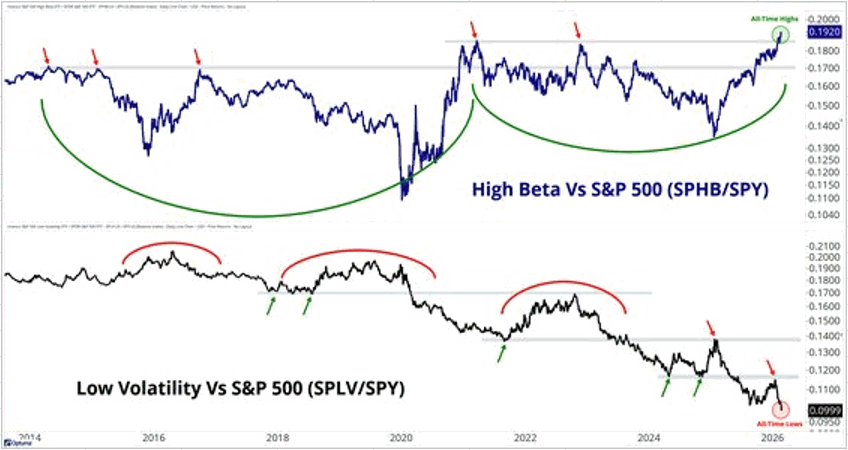
Chart of the Week: The SPHB/SPLV ratio — high-beta vs. low-volatility — at mirror-image all-time extremes is the week’s defining market structure in a single chart: the AI semiconductor stampede (Nasdaq +5.50%, NYSE Composite –0.43% WoW) sent MU, AMD, INTC, SNDK, and QCOM to historic highs while defensives — utilities (–3.21% WoW), healthcare (–0.70%) — were abandoned. Every prior SPHB/SPY peak since 2014 preceded a pause or reversal; this week’s advance cleared them all decisively on the concentrated weight of five semiconductor names. That symmetry is not coincidence — it is 2026’s late-cycle signature of investors abandoning ballast for beta on a single thematic bet, and the deeper the stretch, the sharper any snap-back.
MIB Weekly Digest Ver. 1.50
For professional investors only. Not investment advice.
© 2026 RecessionALERT.com

Comments are closed.