
MIB WEEKLY DIGEST
Week of Apr 27–May 1, 2026
The Strait of Hormuz blockade sent WTI crude +7.94% on the week and gasoline to a 4-year high of $4.30/gal, while the most divided FOMC vote since 1992 (8-4) collapsed rate-cut probability from 59% to ~22.5% and confirmed stagflation as the Fed’s base-case bind. Against that macro backdrop, the four hyperscalers reported Q1 earnings: Alphabet’s Cloud +63% YoY drove the Nasdaq Composite to its first-ever 25,000 close (+10% single session), while Meta’s $145B capex raise without revenue proof was punished −8.65% — the week the AI market demanded proof of ROI. Eli Lilly added a GLP-1 exclamation point: Mounjaro $8.66B (+125% YoY), full-year guidance raised to $82–85B, and the FDA proposed banning compounded GLP-1 competition.
TABLE OF CONTENTS
A. WEEK AT A GLANCE
B. WEEK IN MARKETS
C. WEEK’S TOP STORIES (12)
D. WEEK IN THE ECONOMY (5)
E. WEEK IN EARNINGS (5)
F. NEXT WEEK SETUP
G. CHART OF THE WEEK
A. WEEK AT A GLANCE -> TOP
The S&P 500 (+0.91% WoW) and Nasdaq 100 (+1.49%) hit records for the fifth consecutive week, powered by a four-hyperscaler earnings blowout that pushed the Nasdaq Composite above 25,000 for the first time in history — while the Dow Jones (+0.55%) lagged and DJ Transportation (−1.41%) fell, sustaining an 8-session non-confirmation that refused to endorse the mega-cap rally. The week’s defining collision: record corporate earnings quality (GOOGL Cloud +63% YoY, AMZN AWS +28%, CAT record $62.7B backlog) meeting the most contested FOMC vote since 1992 (8-4 split, rate-cut probability collapsed 36.5 pp to ~22.5%) and the deepest oil supply shock in modern history (WTI +7.94% WoW, Brent intraday $126). Beneath the headline records, 10Y yields rose +6.6 bps WoW alongside equities — the inflation-fear signature confirming markets priced the energy shock as stagflation, not growth.
• S&P 500 ATH 7,230 and Nasdaq 25,000 first-ever close — best April for major indices since 2020; S&P +1.02% single session Thursday as GOOGL (+10%), CAT (+9.88%), LLY (+9.80%), QCOM (+15%) swept earnings day.
• INTC +20.69% WoW — week’s top mega-cap gainer as the AI/CPU renaissance thesis compounded through five sessions; MU (+9.16%) and LLY (+8.98%) completed the gainers podium driven by AI memory demand and GLP-1 dominance respectively.
• GOOGL +10% Thursday / META −8.65% same session — the week’s defining AI bifurcation: Cloud +63% revenue growth rewarded; $145B capex raise without equivalent revenue proof punished. The “show me the money” era arrived at the highest-stakes possible moment.
• WTI +7.94% WoW / Brent intraday $126 Wednesday as Trump confirmed months-long Iran naval blockade; UAE exited OPEC after 60 years Friday; US gasoline hit $4.30/gal (4-year high); IEA called it “the largest oil supply disruption in history.”
• FOMC 8-4 historic split — most divided vote since 1992 (two-directional dissent); rate-cut probability collapsed from 59% to ~22.5% in a single week; Kevin Warsh advanced 13-11 through Senate Banking on strict party lines.
• Stagflation data suite landed in one week: Core PCE 3.2% YoY, GDP +2.0% (composition fragile), ECI +0.9% (3-quarter high), ISM Prices Paid 84.6% (4-year high), Employment 46.4% (deepest 2026 contraction) — versus jobless claims 189K (55-year low) as the sole bullish outlier.
1. AI Capex Enters the “Show Me the Revenue” Era — After years of rewarding hyperscaler AI spending on faith, this week drew the market’s first clear bifurcation: GOOGL (Cloud +63% YoY, capex raised and rewarded with +10%) vs. META (capex raised $10B to $145B without equivalent revenue proof, punished −8.65%). The threshold was crossed at the highest-stakes possible moment — the same week $725B in combined 2026 capex was confirmed across all four hyperscalers. The implication extends across every AI-heavy company: demonstrated revenue ROI is now the prerequisite for multiple expansion, not just the destination.
2. The Stagflation Bind Is Now Empirically Confirmed, Not Forecast — One week delivered PCE 3.5% headline, Core PCE 3.2%, ECI re-acceleration to +0.9%, ISM Prices Paid 84.6%, and ISM Employment contraction to 46.4% — all while jobless claims hit a 55-year low of 189K. The Fed cannot cut (inflation too high) and cannot hike (growth fragile, employment uncertainty rising). This is not a tail risk scenario; it is the current data state that the incoming Warsh Fed will inherit on May 15 alongside a fractured 8-4 committee without consensus on direction.
3. Hormuz Is No Longer a Geopolitical Spike — It Is a Structural Supply Constraint — The IEA confirmed full Hormuz reopening would not restore Middle East output to pre-war levels for up to two years; the UAE’s exit from OPEC after 60 years added a second structural dimension. Energy is no longer a cyclical trade — it is a fundamental portfolio allocation decision with a supply/demand framework that persists whether the Iran conflict resolves in weeks or years, and with the UAE’s unconstrained production expansion creating an asymmetric medium-term downside risk that the current $100+ price level does not yet reflect.
 — Leading economic indicators. Accurate market forecasts. Apply for membership at join.recessionalert.com
B. WEEK IN MARKETS -> TOP
The week pitted AI earnings blowouts against the most contested FOMC vote since 1992 — and earnings won, narrowly. GOOGL’s Cloud revenue +63% and AMZN’s AWS +28% (15-quarter high) drove S&P 500 and Nasdaq 100 to fresh records, while the Fed’s 8-4 split crystallized “higher for longer” as an inescapable reality: rate-cut probability collapsed from 59% to ~22.5% across the week as PCE (3.5%), ECI (+0.9%), and ISM Prices Paid (84.6%) confirmed the stagflation thesis. The Iran War’s Strait of Hormuz blockade sent WTI +7.94% WoW and Brent intraday to $126 — simultaneously the week’s biggest macro threat and its biggest earnings tailwind for energy names. The AI capex bifurcation was the defining market signal: GOOGL rewarded for Cloud ROI; META punished for spending $145B without it. Bond non-participation (10Y +6.6 bps alongside equity ATHs) kept the stagflation overlay intact beneath the record headline.
FRIDAY CLOSE & WEEK-ON-WEEK CHANGE — Fri, May 1, 2026:
MAJOR INDICES
S&P 500 and Nasdaq 100 hit records while the DJ Transportation ended −1.41% WoW — a 1.96-pp DJIA/DJTA spread that missed the 2% Dow Theory formal trigger but reinforced the 8-session non-confirmation flagged throughout the week. Russell 2000 exactly matched the S&P’s +0.91% gain, a breadth positive; but the NYSE Composite’s +0.46% and multiple sessions of negative market-wide breadth confirm the weekly record concentrated in AI earnings names, not the broad industrial economy.
| Index | Fri Close | WoW Change | WoW % | Why It Moved (Week) |
|---|---|---|---|---|
| S&P 500 | 7,230.11 | +65.10 | +0.91% | Hyperscaler earnings wave drove ATH 7,209 Thu and 7,230 Fri; breadth narrow throughout — Dow and NYSE barely positive while GOOGL, CAT, LLY, AAPL carried the cap-weighted index. |
| Dow Jones | 49,499.02 | +268.31 | +0.55% | CAT +9.88% (record backlog) and LLY +9.80% earnings lifted the price-weighted index Thu; AMGN −5.20% Fri and five consecutive down sessions for industrials partially offset. |
| DJ Transportation | 20,598.20 | −293.80 | −1.41% | WTI +7.94% WoW crushed airline and logistics operating margins; 8-session Dow Theory non-confirmation held — transports refused to validate the DJIA’s near-record territory throughout the week. |
| Nasdaq 100 | 27,710.36 | +406.69 | +1.49% | AI earnings drove record 27,710; GOOGL +10% Thu and AAPL +3.24% Fri powered the index even as MSFT (−3.93%), NVDA (−4.64%), and META (−8.65%) sold off on capex ROI debate. |
| Russell 2000 | 2,810.72 | +25.32 | +0.91% | Exactly matched S&P 500’s WoW gain — Thursday’s broad earnings sweep (CAT, LLY, QCOM, BMY, MO all beat) lifted sentiment across cap sizes; no persistent small-cap leadership signal. |
| NYSE Composite | 23,041.15 | +106.60 | +0.46% | Broad-market gauge barely positive; multiple sessions (Mon, Tue, Wed) where NYSE Composite fell even as S&P/NDX hit records — confirms AI earnings concentration, not market-wide advance. |
VOLATILITY & TREASURIES
VIX falling −9.10% WoW while 10Y yields rose +6.6 bps and 2Y rose +9.7 bps is the week’s clearest inflation-fear signature: bond investors priced cost-push pressure, not recession — in a recession scare, yields fall. The 2Y rising more than the 10Y flattened the curve from ~52 bps to ~49 bps, directly reflecting the FOMC’s 8-4 hawkish lean and the rate-cut probability collapse from 59% (Mon) to ~22.5% (Thu) after the FOMC held and PCE/ECI data confirmed the stagflation read.
| Instrument | Fri Level | WoW Change | Why It Moved (Week) |
|---|---|---|---|
| VIX | 16.99 | −1.70 (−9.10%) | Earnings season drove fear compression from 18.69 (Mon) to 16.99 (Fri); mid-week spike to 18.78 (Wed) on FOMC 8-4 split + WTI +8.26% shock reversed as broad earnings clarity arrived Thu-Fri. |
| 10-Year Treasury Yield | 4.371% | +6.6 bps | FOMC 8-4 split and GDP/PCE/ECI data pushed 10Y to 4.42% Wed (one-month high) before partial retreat; rising yields alongside equity ATHs = inflation-fear premium, not growth signal. |
| 2-Year Treasury Yield | 3.880% | +9.7 bps | Front-end rose more than the long-end as rate-cut probability collapsed from 59% to ~22.5% — curve flattening from ~52 to ~49 bps reflects FOMC hawkish lean, not recession signal. |
| US Dollar Index (DXY) | 98.23 | −0.29 (−0.29%) | Marginally weaker WoW; Apr 30 risk-on earnings wave pushed DXY to 98.06 before partial Iran-conflict safe-haven recovery Fri; dollar near historically depressed levels throughout. |
COMMODITIES
Gold fell −2.04% WoW even as the Hormuz supply shock would normally trigger a safe-haven bid — the FOMC’s “higher for longer” confirmation crowded out precious metals through rising real rates. Copper declined −1.15% on growth uncertainty; Bitcoin rose +0.35% tracking equities as a risk proxy. The gold/copper split (both lower) confirmed no reflation read: markets treated the Iran shock as a supply-driven inflation event, not a demand/growth signal. The Apr 30 brief gold recovery (+1.52% that session) on DXY weakness was intra-week noise against the dominant real-rate headwind.
| Asset | Fri Price | WoW Change | WoW % | Why It Moved (Week) |
|---|---|---|---|---|
| Gold | $4,626.00/oz | −$96.44 | −2.04% | FOMC “higher for longer” crushed gold’s zero-yield appeal as rising real rates dominated the safe-haven bid the Hormuz supply shock would normally generate; gold/oil divergence is the stagflation tell — markets price the Iran shock as inflation, not crisis. |
| Silver | $75.873/oz | +$0.056 | +0.07% | Essentially flat WoW; precious-metal headwinds (rising rates) offset by industrial and photovoltaic demand support; decoupled from gold’s larger loss mid-week. |
| Copper | $5.9605/lb | −$0.0695 | −1.15% | Global growth uncertainty from stagflation data and OpenAI revenue miss Tue raised doubts about AI data-center buildout pace; CAT/GDP earnings recovery Thu partially offset. |
| Platinum | $2,000.70/oz | −$18.65 | −0.92% | Auto-sector demand headwinds from elevated fuel costs and ISM Employment contraction; precious metals broadly under real-rate pressure across the week. |
| Bitcoin | $77,947 | +$274 | +0.35% | Marginally positive tracking equities as risk proxy; no independent crypto catalyst; +2.20% Fri on Apple AI cycle confirmation; tracking sentiment rather than acting as inflation hedge. |
ENERGY
WTI’s +7.94% WoW dramatically outpaced Brent’s +2.46%, narrowing the WTI-Brent spread from $11.24 to $6.31 — the Iran War supply shock converging the benchmarks as the regional US discount erodes under Hormuz tightness. The intra-week arc oscillated: WTI surged alongside falling equities Wed (stagflationary read) before pulling back Thu-Fri as earnings-driven risk appetite briefly trumped supply-shock fear. Henry Hub’s separate +10.63% WoW surge — US producers cutting output to 12-week lows — was a domestic supply story unrelated to Hormuz and signals a potential US gas cycle inflection.
| Asset | Fri Price | WoW Change | WoW % | Why It Moved (Week) |
|---|---|---|---|---|
| Crude Oil (WTI) | $102.50/bbl | +$7.54 | +7.94% | Iran War/Hormuz blockade structural supply shock: Trump confirmed months-long blockade Wed, WTI hit $108.18 session high. Partial Fri pullback (−2.45%) on demand-fear and UAE OPEC exit creating medium-term supply uncertainty. |
| Crude Oil (Brent) | $108.81/bbl | +$2.61 | +2.46% | Global benchmark rose more modestly as it started from an already-elevated $106 base; intraday high of $126 Thu (Brent) before retracing; WTI-Brent spread narrowed from $11.24 to $6.31 as the Iran shock converged both benchmarks. |
| Natural Gas (Henry Hub) | $2.789/MMBtu | +$0.268 | +10.63% | US producers cutting output to 12-week lows drove domestic supply tightening independent of Hormuz; US natural gas is a separate domestic supply/demand dynamic, not responding to the geopolitical crude bid. |
| Natural Gas (Dutch TTF) | $15.72/MMBtu | +$0.437 | +2.86% | European gas partially tracked crude higher on Hormuz LNG re-routing risk; EU more exposed to Middle East supply disruption than the US; $12.93 WoW premium to Henry Hub reflects that asymmetry. |
S&P 500 SECTORS — WEEKLY ROTATION
Communication Services led WoW (+4.04%) almost entirely on a single-name dominance: GOOGL’s Cloud blowout drove a +10% session Apr 30 while META (same sector) fell −9.82% WoW on capex overhang — strip GOOGL/GOOG and Communication Services is likely the week’s worst sector. Technology placed near-last (+0.08%) despite Nasdaq records: INTC and MU gains were offset by MSFT (−3.93%), NVDA (−4.64%), and KLAC (−10.79%) on the AI capex ROI debate. Basic Materials’ −2.80% 1W reversal against its +23.85% 6-month lead signals mean-reversion profit-taking, not structural deterioration.
| Sector | 1-Week | 1-Month | 3-Month | 6-Month | YTD | 12-Month |
|---|---|---|---|---|---|---|
| Communication Services | +4.04% | +14.98% | +3.38% | +8.84% | +7.14% | +48.19% |
| Energy | +3.30% | +0.98% | +18.23% | +34.84% | +33.63% | +50.74% |
| Consumer Defensive | +1.15% | +3.48% | +1.96% | +11.60% | +9.46% | +6.73% |
| Financial | +0.95% | +5.46% | −2.38% | +2.72% | −2.72% | +14.30% |
| Real Estate | +0.69% | +7.67% | +5.26% | +7.32% | +8.17% | +7.58% |
| Healthcare | +0.41% | −1.21% | −5.36% | +1.92% | −4.64% | +7.15% |
| Industrials | +0.32% | +6.18% | +5.68% | +13.05% | +13.74% | +37.14% |
| Utilities | +0.22% | +2.12% | +7.57% | +5.93% | +10.75% | +23.07% |
| Consumer Cyclical | +0.13% | +8.86% | −2.39% | −2.74% | −1.11% | +19.40% |
| Technology | +0.08% | +17.40% | +10.92% | +2.60% | +10.02% | +49.56% |
| Basic Materials | −2.80% | +0.33% | +2.43% | +23.85% | +14.35% | +47.65% |
TOP WEEKLY MOVERS:
GOOGL alone drove Communication Services to the week’s top sector (+4.04% WoW in the rotation table) — META, in the same sector, was −9.82% WoW, a single-name story in both directions simultaneously. CAT at #5 mirrors that pattern in Industrials: the sector gained only +0.32% WoW while CAT’s record $62.7B backlog earnings drove the individual stock +7.09% — the sector barely reflected the single-name event. Both KLAC (−10.79%) and AMAT (−6.70%) hit by the same semiconductor-equipment dual catalyst (China export controls + elevated buy-side expectations), dragging the broader Tech sector to near-flat despite INTC and MU gains.
TOP 5 WEEKLY GAINERS
| Ticker | Week | YTD | Year | Why It Moved |
|---|---|---|---|---|
| INTC | +20.69% | +169.97% | +398.60% | Q1 2026 blowout (revenue +7% YoY, Data Center & AI +22%, Q2 guide above consensus) reported Apr 23 AMC established an AI/CPU renaissance narrative; multiple Wall Street upgrades (Evercore ISI, Citi, KeyBanc). Continuation gains Mon (+2.97%) and Wed (+11.92%) extended the April earnings-driven run through the week. |
| GOOGL | +11.99% | +23.22% | +139.11% | Q1 2026 earnings reported Apr 29 AMC: revenue $109.9B (+22% YoY), Google Cloud +63% YoY — first quarter where enterprise AI solutions were cited as primary Cloud growth driver. GOOGL had its best April since 2004 (~+34% month); J.P. Morgan raised PT to $460. Market cap approached $5T, challenging Nvidia for world’s most valuable company. |
| MU | +9.16% | +89.98% | +597.20% | AI memory supercycle: fiscal Q2 revenue $23.86B (+196% YoY) with 2026 HBM capacity fully sold out; DA Davidson initiated Buy ($1,000 PT). Intel and hyperscaler earnings confirming sustained AI infrastructure buildout extended the memory demand narrative through the week. |
| LLY | +8.98% | −10.36% | +21.31% | Q1 2026 earnings Apr 30 BMO: revenue $19.8B (+56% YoY), Mounjaro $8.66B (+125% YoY) — $1.4B beat vs. consensus. FDA proposed excluding semaglutide and tirzepatide from compounding list (May 1), protecting brand-name market share. Full-year guidance raised to $82–85B. |
| CAT | +7.09% | +55.30% | +183.37% | Q1 2026 earnings Apr 30 BMO: EPS $5.54 vs $4.65 est. (+19.24% beat), revenue $17.42B (+22% YoY). Record order backlog $62.7B (+79% YoY) with AI data center construction explicitly cited as a demand driver alongside infrastructure and mining. +9.88% single session Apr 30; weekly gain extends the full earnings-week arc. |
TOP 5 WEEKLY DECLINERS
| Ticker | Week | YTD | Year | Why It Moved |
|---|---|---|---|---|
| KLAC | −10.79% | +42.07% | +155.25% | Q3 FY2026 earnings beat on revenue ($3.42B) and EPS ($9.40) with $7B buyback — but fell ~9% AH on buy-side expectations set materially above street consensus. China export control risk (Commerce Dept restricting products/services to certain Chinese customers) added a structural headwind throughout the week. |
| ARM | −10.06% | +93.19% | +83.00% | TSMC fully divested its ARM Holdings stake (1.11M shares at $207.65, $231M total proceeds) on Apr 29, removing a key institutional holder signal. Monday gap-down ~8% on profit-taking after 50%+ rally from April lows; pre-earnings uncertainty ahead of May 6 fiscal Q4 report kept pressure on the stock. |
| META | −9.82% | −7.78% | +6.38% | Q1 2026 earnings Apr 29 AMC beat (revenue $56.3B, +33% YoY) but raised 2026 capex guidance to $125–145B (from $115–135B) without equivalent revenue clarity — triggering the market’s “show me the money” inflection. −4.4% AH Apr 29, −8.65% regular session Apr 30. Internet disruptions in Iran also dragged user metrics. |
| GEV | −7.50% | +62.64% | +178.05% | Profit-taking from April 23 all-time high ($1,149.53) after Q1 2026 EBITDA blowout (+87% YoY). Industrials weakness on Friday’s ISM Manufacturing Employment contraction (46.4%) and broad cyclical rotation added to the retracement. The −7.50% WoW is a high-base mean-reversion; +62.64% YTD remains. |
| AMAT | −6.70% | +51.40% | +161.20% | AI capex skepticism from Tuesday’s OpenAI revenue miss (AMAT −5.87% Tue) was the primary catalyst; U.S. Commerce Dept orders pausing chip equipment sales to Hua Hong (Apr 28) added China export control risk. Despite Erste Group upgrade and Bank of America PT raise to $465, the stock faced elevated expectations after April’s strong run. |
— Institutional-grade intelligence for serious investors. Apply for membership at join.recessionalert.comC. WEEK’S TOP STORIES -> TOP
Three threads wove the week’s 12 stories. The largest — stories #1, #2, #7, #8 — is a stagflation-bind arc: Hormuz drove oil up, the FOMC fractured 8-4 trying to respond, EU tariffs added a fourth cost-push source, and ISM Prices at 84.6% confirmed the factory-floor landing. The second — stories #3, #9, #10, #12 — is the AI monetization reckoning: GOOGL and AMZN rewarded for Cloud ROI, META punished without it, Intel and QCOM validating hardware diversification, the Pentagon opening the defense TAM. Stories #4, #5, #6, and #11 are standalone structural inflections — GLP-1 moat widened, physical AI infrastructure confirmed, OPEC fracturing, macro holding-but-fragile — each a multi-year reset, none causally linked to the others.
BEARISH
1. Hormuz Saga: Pakistan Talks Cancelled → Iran Proposal Rejected → Months-Long Blockade Confirmed → Brent Intraday $126 → UAE Exits OPEC — Energy Shock Deepens All Week
The core facts:The Strait of Hormuz — through which ~20% of global oil trade transits — remained blocked throughout the week, with the situation escalating on every trading day. Monday: Trump cancelled Pakistan envoys, Iran rejected reopening. Tuesday: Trump explicitly rejected Iran’s latest Hormuz reopening proposal; WTI briefly crossed $100/bbl for the first time. Wednesday: Trump confirmed in a WSJ report the naval blockade would continue for “months” and the US Navy was ordered to intercept vessels attempting passage; WTI surged 8.26% to $108.18, Brent hit $126 intraday before settling at $114. Thursday–Friday: UAE announced exit from OPEC+ effective May 1, stripping the cartel of its second-largest producer (~3.2–3.5 mb/d) and adding a structural wildcard. National gasoline average reached $4.30/gal (4-year high). IEA called the disruption “the largest oil-supply disruption in history.” WTI closed the week at $102.50 (+7.94% WoW), Brent at $108.81 (+2.46% WoW).
Why it matters:The Hormuz blockade is not a spike — it is now a structural supply deficit. The IEA’s confirmation that even a full Hormuz reopening would not restore Middle East output to pre-war levels for up to two years transforms the energy calculus: this is not a geopolitical premium that resolves in weeks. At $4.30/gallon, US households are absorbing an estimated $190B annualized incremental energy cost vs. year-ago levels. Every $10/bbl in crude adds ~25 bps to headline PCE — locking the Fed’s inflation problem in place regardless of whether it cuts or holds. The UAE exit from OPEC after 60 years adds a second dimension: near-term tightness (Hormuz) vs. medium-term supply surge (UAE production expanding unconstrained toward 5 mb/d). Portfolio managers must hold both scenarios simultaneously. (Brent +2.46% WoW — see Energy table in Section B; Energy sector +3.30% WoW — see sector rotation table in Section B; no energy names in the weekly gainers top 5, suggesting the sector move was broad-based, not single-name driven — see weekly movers table.)
What to watch:Any direct US-Iran diplomatic contact — a phone call between Trump and Iranian leadership would be the most immediate de-escalation signal, and could collapse Brent 15–20% within a session. Saudi Arabia’s production response to UAE exit. EIA weekly crude inventory reports. Whether gasoline sustains above $4.50/gal, which would qualitatively shift the Fed’s near-term optionality.
BEARISH
2. FOMC 8-4 Historic Fracture — Most Divided Vote Since 1992 → Powell Stays as Governor → Rate-Cut Odds Collapse 59% → 22.5% → Warsh Advances 13-11
The core facts:Wednesday’s FOMC voted 8-4 to hold the federal funds rate at 3.50%–3.75% — the most dissents since October 1992. The split was two-directional: Governor Miran voted for a 25 bps cut, while Governors Hammack, Kashkari, and Logan voted to hold but opposed retaining any easing bias in the statement. The FOMC upgraded inflation language from “somewhat elevated” to “elevated,” citing Middle East energy prices. Powell explicitly acknowledged oil-driven PCE overshoot risk (~+0.6pp to headline PCE). The same day, Powell announced he would remain on the Fed Board of Governors after his chairmanship ends May 15, stating political attacks “left him no choice.” Thursday, the Senate Banking Committee advanced Kevin Warsh’s nomination 13-11 on a strict party-line vote (first fully partisan Fed chair vote in committee history), with full Senate confirmation expected the week of May 11. Rate-cut probability (≥1 cut in 2026) collapsed from 59% (Monday) to ~22.5% (Thursday) on the FOMC decision and PCE/ECI data that followed.
Why it matters:A two-directional dissent is historically unprecedented and signals the committee cannot agree on direction — not just pace. The “Fed put” that backstopped equity markets through 2024–2025 is effectively withdrawn. The 36.5 percentage-point collapse in rate-cut probability in a single week is a structural reset of equity discount-rate assumptions: sectors priced for multiple 2026 cuts — REITs, small-cap growth, long-duration bond proxies — face a fundamental re-rating. Powell’s decision to stay as a voting governor through 2028 provides an institutional counterweight but also creates a publicly-framed Fed independence battle that historically elevates term premiums. Warsh’s incoming “regime change” preferences (trimmed-mean inflation gauge, aggressive balance-sheet reduction) add another layer of policy uncertainty into a fractured committee. (10Y +6.6 bps WoW, 2Y +9.7 bps WoW — see Vol & Treasuries table in Section B.)
What to watch:Warsh full Senate confirmation vote (week of May 11) and his first public statements on the rate path — any explicit confirmation or rejection of the hawkish dissenters’ stance on removing the easing bias will immediately reprice the rate curve. Watch 10Y for a break above 4.5% as Warsh’s balance-sheet-reduction posture gets priced.
UNCERTAIN
3. Hyperscaler AI Earnings Bifurcation — $725B Combined Capex Confirmed → GOOGL Rewarded for Cloud ROI (+10%), META Punished for Spend Without It (−9.82% WoW), Nasdaq 25,000 ATH
The core facts:All four hyperscalers reported Q1 2026 results Wed–Thu AMC. Combined 2026 capex guidance: ~$725B (Amazon $200B, Microsoft ~$190B, Alphabet $180–190B raised, Meta $125–145B raised) — up 77% from 2025’s $410B and the largest single-year private investment in computing infrastructure in history. Market reactions diverged sharply: Alphabet +10% Thu (+12% WoW; Cloud +63% YoY, AI enterprise monetization confirmed); Amazon +4% AH (AWS +28% YoW, 15-quarter high, EPS +70.6% beat); Microsoft −2% AH (Azure +40% but $190B capex raise triggered margin-compression concern); Meta −8.65% Thu ($145B capex raise without clear revenue roadmap). The S&P 500 hit a new ATH of 7,209 Thu and 7,230 Fri; the Nasdaq 100 hit 27,710 (record); the Nasdaq Composite crossed 25,000 for the first time in history.
Why it matters:After years of rewarding AI capex on faith, markets drew a clear line this week: Alphabet, which paired $180–190B capex with Cloud +63% YoY revenue, was rewarded; Meta, whose $145B capex came without an equivalent revenue proof, was punished. This is the most important AI market signal in 18 months — it will reset how every capex-heavy tech company communicates spend plans going forward. The week also confirmed the AI infrastructure buildout is physically real: Caterpillar’s record $62.7B backlog (partially data-center construction driven) and Quanta Services’ $48.5B backlog (power grid for AI data centers) validated the downstream physical economy consequences of the $725B number. For semiconductor supply chains, the debate became: AI capex is increasing — but is it going to NVDA chips, cloud custom silicon, or memory? KLAC and AMAT’s declines on the same week suggest “capex fear without ROI proof” is now a genuine multiple-compression risk for equipment names too.
What to watch:NVDA earnings (~May 28) — the definitive read on whether $725B in combined hyperscaler capex is translating into GPU demand acceleration or custom-silicon displacement. META Q2 commentary on AI revenue contribution. MSFT Azure Q4 growth guidance (street expects 42–44%) needed to justify the $190B capex.
BULLISH
4. Eli Lilly GLP-1 Dominance: Mounjaro $8.66B (+125% YoY), Revenue $19.8B (+56%) → FDA Proposes Excluding Semaglutide/Tirzepatide From Compounding — Moat Widened on Two Fronts
The core facts:Eli Lilly reported Q1 2026 BMO Thursday: total revenue $19.80B vs. $17.82B estimate (+11.1% surprise; +56% YoY). Mounjaro worldwide revenue $8.66B (+125% YoY) — a $1.4B beat vs. consensus. Zepbound US revenue $4.16B (+79% YoY). Full-year 2026 guidance raised to $82–85B revenue, $35.50–37.00 adj. EPS. LLY surged +9.80% on the session. The following day (Friday), the FDA proposed excluding the active ingredients in Mounjaro/Zepbound (tirzepatide) and Wegovy/Ozempic (semaglutide) from the list of substances that outsourcing compounding facilities can use for bulk manufacturing — effectively banning large-scale compounded GLP-1 competition unless the brand-name drugs return to the shortage list.
Why it matters:LLY’s GLP-1 revenue trajectory is tracking toward what may be the largest single-drug category revenue ramp in pharmaceutical history. Mounjaro at $8.66B quarterly puts it on a $35B+ annualized run rate — outpacing even the most optimistic sell-side models from six months ago. The FDA’s compounding exclusion proposal, arriving the same week as the earnings blowout, is a regulatory tailwind that removes a 40–60% price-discounted competitor from the market. Combined, these two events eliminate both the demand risk (strong volumes confirmed) and the competitive discount risk (compounders to be excluded) simultaneously. LLY’s YTD had been −10.36% entering the week — the week’s events repositioned it as a net beneficiary regardless of macro backdrop. (LLY also appears in the weekly gainers table at +8.98% WoW — see weekly movers table.)
What to watch:FDA compounding exclusion public comment period (60–90 days); any legal challenges from telehealth compounders. Novo Nordisk’s response on Wegovy supply and pricing. LLY Q2 guidance in July will test whether the $8.66B Mounjaro quarter is sustainable or a one-time inventory beat.
BULLISH
5. Caterpillar Record $62.7B Backlog + Quanta Services $48.5B — AI Power Infrastructure Super-Cycle Is Physical and Accelerating
The core facts:Caterpillar reported Q1 2026 BMO Thursday: revenue $17.42B (+22% YoY; +5.38% beat), EPS $5.54 (+19.24% beat). Construction Industries segment +38% to $7.2B. Record order backlog $62.7B — up $27.7B YoY (+79%) and $11.5B sequentially — providing multi-year revenue visibility. Management explicitly cited data center construction as a key demand driver. CAT surged +9.88%. On the same day, Quanta Services reported: Q1 revenue $7.87B (+26% YoY; +12.47% beat), adj. EPS $2.68 (+31.50% beat), record backlog $48.5B, book-to-bill ratio 1.6x (new orders arriving 60% faster than the company can complete them). Quanta management cited “daily inbound opportunities in data centers, transmission, and generation” — AI hyperscalers needing tens of gigawatts of new power generation and transmission capacity. PWR surged +15.78%.
Why it matters:The $725B in hyperscaler capex is not just a chip story — it is a physical infrastructure story, and CAT and Quanta are the companies that build it. CAT’s record backlog with data-center construction explicitly cited confirms that AI compute demand is generating real, multi-year capital equipment orders across the industrial economy. Quanta’s 1.6x book-to-bill and $48.5B backlog across transmission, distribution, and generation work means the power grid buildout needed to feed AI data centers is now the most backlogged infrastructure segment in the US. For portfolio managers, these two prints validate the thesis that AI’s economic consequences extend well beyond semiconductors into construction, power, and industrial equipment — sectors with lower multiples and longer-duration earnings visibility than tech.
What to watch:CAT Q2 revenue guidance — whether the $62.7B backlog converts at the guided pace. Quanta’s book-to-bill ratio in Q2 (a decline from 1.6x would signal demand moderation). Peer industrial infrastructure names (Deere, Eaton, Parker-Hannifin) for confirmation of the data-center construction demand signal.
UNCERTAIN
6. UAE Exits OPEC+ After 60 Years — Cartel Loses Second-Largest Producer; Near-Term Tightness vs. Medium-Term Supply Surge Creates Bifurcated Energy Outlook
The core facts:The United Arab Emirates announced Tuesday and officially withdrew from OPEC+ effective May 1, ending 60 years of membership. The UAE — OPEC’s second- or third-largest producer — has set a target of 5 million barrels per day of production capacity by 2027, a level that OPEC’s quota system would have constrained. Russia publicly reaffirmed its OPEC+ commitment on Wednesday, providing partial stabilization against a broader cartel disintegration. President Trump praised the UAE’s exit as “a good thing.”
Why it matters:The UAE’s exit creates a structurally bifurcated energy investment thesis: in the near term (while Hormuz remains blocked), losing a major OPEC+ producer to independent policy adds volatility and removes Saudi Arabia’s enforcement mechanism; in the medium term (once Hormuz reopens and the UAE ramps unconstrained toward 5 mb/d), the cartel’s long-term pricing power is materially diminished. An unshackled UAE could add 1+ mb/d of incremental supply once the war resolves — potentially collapsing the geopolitical premium that currently supports $100+ oil. ExxonMobil’s CEO warned the same day that markets had “not yet felt the full impact of the war on prices.” The near-term vs. long-term energy trade is now more complex than it has been in decades.
What to watch:Saudi Arabia’s production response — whether Riyadh attempts price defense through further cuts or cedes to a production-expansion dynamic. Any other Gulf producer signaling OPEC+ exit. WTI price action in the week following the UAE’s formal May 1 exit date for market pricing reaction.
BEARISH
7. Trump Imposes 25% EU Auto Tariffs, Voiding 2025 Trade Framework — EU Retaliation Across Agriculture and Tech Remains Unpriced
The core facts:President Trump announced on Friday a 25% tariff on European Union automobiles and trucks, effective the following week — directly violating the 15% tariff cap established in the US-EU trade framework agreement reached in summer 2025. EU trade officials declared the action “unacceptable” and vowed to “respond with the utmost firmness.” No specific retaliatory measures were announced immediately. The same day, Trump removed existing Scotch whisky tariffs “in honor of King Charles” following the British royal state visit — a contrasting bilateral concession that crystallized the administration’s transactional, asymmetric approach to trade policy: relief for diplomatically close allies, escalation for perceived adversaries.
Why it matters:The EU-US bilateral trade corridor is the world’s largest. A 25% tariff on EU vehicles directly raises import prices on BMW, Mercedes-Benz, Volkswagen, and Stellantis models, pressures EU automaker margins, and raises input costs for US manufacturers with EU component sourcing. More critically, the announcement voids the summer 2025 framework — the US is now signaling unilateral renegotiation of deals it perceives as insufficient, with no predictable ceiling on escalation. EU retaliation that targets US agricultural exports (soybeans, pork, corn), cloud services, or financial products would trigger cross-sector contagion that markets have not yet priced. The Scotch whisky relief on the same day confirms the operating system: bilateral diplomacy determines tariff outcomes, not multilateral agreements.
What to watch:EU Council emergency trade session and formal retaliatory measure timeline — EU targeting US agriculture would be the highest-probability transmission channel into US corporate earnings. Whether EU targets cloud services or digital taxes would add a new technology-sector risk dimension. Broader UK-US bilateral trade deal progress as potential precedent for de-escalation.
BEARISH
8. ISM Manufacturing Stagflation Split: Prices Paid 84.6% (4-Year High) / Employment 46.4% (Deepest Contraction of 2026) — Factory-Floor Stagflation Crystallized
The core facts:Friday’s April ISM Manufacturing PMI held at 52.7% (matching March, above the 50 expansion threshold) but the headline masked two extreme sub-index readings. The Prices Paid index jumped 6.3 points to 84.6% — the highest since April 2022 and driven by tariff-related import cost surges — while the Employment Index fell 2.3 points to 46.4%, the deepest manufacturing job-loss reading of 2026. The Atlanta Fed trimmed its Q2 GDPNow estimate to 3.5% from 3.7% following the release.
Why it matters:An 84.6% Prices Paid reading with a 46.4% Employment reading in the same release is the cleanest single-day stagflation data point of 2026: factories are paying near-record input prices while simultaneously cutting headcount. Combined with the week’s Q1 PCE (+3.5% headline, +3.2% core) and ECI (+0.9% — highest quarterly wage acceleration in three quarters), the ISM data closes the last remaining argument for near-term Fed easing. The incoming Warsh Fed inherits a committee that cannot agree on direction against a data backdrop that precludes cuts (inflation) and precludes hikes (employment contracting). This is the structural bind Ray Dalio and Moody’s were warning about — now confirmed empirically in a single data release.
What to watch:May ISM Manufacturing Prices Paid (released June 1) — if it sustains above 80%, tariff-driven manufacturing inflation is embedding. ISM Services PMI (May 5) for whether price pressures are spreading to the larger services economy. May NFP for whether the ISM Employment contraction translates into payroll losses.
BULLISH
9. Intel/Semiconductor AI-CPU Renaissance: INTC +20.69% WoW — 18-Session PHLX Semi Streak, Multiple Upgrades, Agentic-AI Demand Validates CPU as Second Leg of AI Trade
The core facts:Intel’s Q1 2026 blowout (reported Apr 23 AMC; +23.6% on Apr 24) continued to compound throughout the week — +2.97% Mon, +11.92% Wed (additional agentic-AI CPU shortage commentary), finishing as the week’s top mega-cap gainer at +20.69% WoW. The PHLX Semiconductor index ran for 18 consecutive positive sessions through Monday before any consolidation. Multiple Wall Street upgrades followed: Evercore ISI raised PT to $111 (Outperform), Citi raised to $95 (Buy), KeyBanc upgraded. The core thesis: agentic-AI workloads are driving CPU shortages — confirming that the CPU is not a melting ice cube but an indispensable complement to GPU architectures in the AI stack. AMD benefited from the Intel halo throughout the week (+4.07% Wed, +5.11% Thu).
Why it matters:Intel’s data center beat (+22% YoY in DC&AI) established a second growth narrative in semiconductors beyond Nvidia accelerators. The “CPU renaissance” thesis argues that agentic AI — AI that must execute sequential reasoning tasks rather than purely parallel compute — drives CPU demand as a complement to GPU stacks, not a substitute. If this holds, the total addressable market for the AI compute build-out is larger than a GPU-only model suggests — benefiting Intel, AMD, and the broader host-CPU ecosystem. For portfolio managers who had written off Intel as structurally impaired, the week’s re-rating (INTC +169.97% YTD as of Friday) represents the most dramatic conviction reversal in the Mag-7-adjacent space this cycle. (INTC +20.69% WoW — weekly top gainer; see weekly movers table.)
What to watch:AMD early-May earnings — the key confirmation or refutation of the CPU thesis for data center. Intel Q2 data center guidance — whether DC&AI revenue maintains 20%+ YoY growth in the next print confirms the structural case. PHLX Semi streak resumption vs. mean reversion after any consolidation.
BULLISH
10. Pentagon Clears Eight AI Companies for Highest-Classified Military Networks — AWS, GOOGL, MSFT, NVDA, OpenAI, SpaceX, ORCL, Reflection; Anthropic Excluded for Refusing to Remove Guardrails
The core facts:The Department of Defense announced Friday it has signed agreements with eight companies — Amazon Web Services, Google (Alphabet), Microsoft, Nvidia, OpenAI, SpaceX, Oracle, and Reflection — to deploy their AI on classified military networks rated Impact Level 6 (secret) and Level 7 (highest classification). The applications cover data analysis, intelligence processing, and battlefield decision-making support. Anthropic was explicitly excluded after refusing to remove AI safety guardrails that prevent use for domestic surveillance and autonomous weapons. Oracle surged +6.47% as OpenAI’s primary cloud infrastructure partner; Intel, Micron, and Palantir also gained on the AI defense demand read.
Why it matters:This is the largest single expansion of AI’s commercial role in US defense in history. For the named companies, Pentagon classified contracts represent long-duration, budget-mandated revenue streams that are recession-proof and geopolitically sticky. The US defense budget exceeds $900B annually, and AI infrastructure is now an explicit, approved expenditure category at the highest security levels. Anthropic’s exclusion for maintaining safety guardrails sets a precedent that will ripple through the sector’s regulatory framing for years: DoD has now explicitly signaled that operational capability trumps AI governance constraints when selecting military AI partners. This bifurcation — safety-constrained vs. defense-cleared AI — will increasingly shape enterprise and government procurement decisions in 2026–2027.
What to watch:First DoD budget line items disclosing AI contract values — when dollar amounts are disclosed, the revenue read-through for AWS, GOOGL, MSFT, and ORCL will be significant. Whether Anthropic reverses its guardrail position to regain DoD access, and how that affects its commercial and regulatory standing.
UNCERTAIN
11. Q1 GDP +2.0% (Beats GDPNow; Misses Consensus) / Jobless Claims 189K (55-Year Low) — Growth Intact But Built on Transient Factors
The core facts:Thursday’s BEA Q1 2026 advance GDP estimate: +2.0% SAAR — dramatically beating the Atlanta Fed’s final GDPNow tracking estimate of 1.2% (110 bps below), but slightly missing the 2.3% Wall Street consensus. Growth was driven by private investment (including a core capital goods surge of +3.29%, best since June 2020), consumer spending (+1.6% real), and government outlays boosted by defense spending and the reversal of Q4’s federal government shutdown drag. The GDP Price Index rose +4.5% QoQ (above +3.8% expected). Simultaneously, initial jobless claims for the week ending April 25 plunged to 189,000 — the lowest since November 1969 (55 years), shattering the 215,000 consensus.
Why it matters:The GDP/claims combination is genuinely mixed: the 1.2% GDPNow vs. 2.0% actual beat is constructive (the economy is holding better than real-time trackers suggested), but the GDP composition is fragile — a significant share of the Q4-to-Q1 rebound reflects the reversal of federal shutdown effects and elevated defense outlays linked to the Iran conflict, not organic private-sector acceleration. Strip those transient factors and underlying growth is considerably softer. Jobless claims at a 55-year low is the cleanest bullish outlier — the labor market is not yet breaking. But ISM Manufacturing Employment at 46.4% (contraction) the same week signals a forward-looking deterioration that claims data have not yet captured. The Atlanta Fed’s Q2 GDPNow debut at 3.7% is an optimistic starting point that should be treated with caution given the same model’s 110-bps undershoot on Q1.
What to watch:April NFP (released Saturday May 2, consensus ~73K vs. March’s 178K) — the first hard labor market read that will either confirm the ISM Employment signal or show the manufacturing-specific weakness is not spreading. Q1 GDP first revision (late May).
BULLISH
12. Qualcomm Automotive Revenue Record $1.3B (+38% YoY) — Diversification Beyond Smartphones Executing on Plan; +15% Thu on Earnings Beat
The core facts:Qualcomm reported Q2 FY2026 results Wednesday AMC: non-GAAP EPS $2.65 (beat), revenue $10.6B (in-line). Automotive segment reached a record $1.3B (+38% YoY) — the clearest demonstration yet that Qualcomm’s diversification beyond handsets is generating real revenue scale. IoT revenue +9%; handsets steady. Q3 guidance: revenue $9.2–10B. QCOM surged +15% Thursday on the automotive record and in-line results — one of the largest single-day reactions in QCOM’s recent history. For context, QCOM had also reported earlier in the week on Monday that the OpenAI smartphone chip partnership (with MediaTek) targeting 300–400M annual units by 2028 would use Qualcomm as co-designer.
Why it matters:Qualcomm’s automotive segment at $1.3B quarterly (+38% YoY) is tracking toward becoming its second-largest revenue segment within two years. AI at the edge — in-car compute, ADAS, infotainment — is driving design wins across major OEMs at a pace that validates QCOM’s multi-year diversification thesis. The week also saw QCOM emerge as a co-designer of the OpenAI-powered smartphone chip, potentially targeting one of the largest addressable market expansions in smartphone history. For investors who held QCOM through years of handset-cycle doubt, the week crystallized the transformation: QCOM is now plausibly valued as an AI-at-the-edge platform, not a smartphone commodity supplier.
What to watch:Whether QCOM automotive reaches 20% of total revenue by FY2027 — that threshold would re-rate the stock toward an AI diversified hardware multiple. Any official confirmation from Qualcomm or OpenAI on the smartphone chip partnership timeline.
— Separating signal from noise since 2007. Apply for membership at join.recessionalert.comD. WEEK IN THE ECONOMY -> TOP
The week crystallized a stagflation pulse the Fed can no longer call transitory: Q1 GDP +2.0% (below consensus, composition propped by defense spending and shutdown reversal) alongside Core PCE at 3.2% YoY, ECI wages re-accelerating to +0.9%, and ISM Prices Paid surging to 84.6% — a 4-year high. The energy shock is the transmission channel; Powell explicitly estimated the Brent surge would add ~0.6pp to April headline PCE. Markets priced it as inflation-first: 10Y rose +6.6 bps WoW alongside equity ATHs (yields up + equities up = inflation signal, not recession), the FOMC fractured 8-4, and rate-cut probability collapsed 36.5 pp to ~22.5% across the week (see Polymarket table above). The sole clean bullish outlier — jobless claims at 189K (55-year low) — confirms the labor market is not yet breaking, delivering the textbook stagflation bind: too hot to cut, too uncertain to hike. Tuesday’s ISM Services PMI (prior Services Prices 70.7%) will determine whether the cost-push wave has fully crossed to the broader economy.
POLYMARKET ODDS — WEEK-ON-WEEK SHIFT:
| Market | Last Friday (Apr 24) | This Friday (May 1) | Δ |
|---|---|---|---|
| US Recession by end-2026 | 26% | 24% | −2 pp |
| Fed rate hike in 2026 | ~3% | ~15% | +12 pp |
| Fed rate cuts ≥1 in 2026 | 59% | ~22.5% | −36.5 pp |
UNCERTAIN
FOMC Votes 8-4 to Hold — Most Divided Since 1992; Two-Way Dissent Eliminates Forward Guidance (Federal Reserve, April 29, 2026)
What they’re saying:The FOMC voted 8-4 to hold the federal funds rate at 3.50%–3.75% for the third consecutive meeting — the most dissents since 1992. Three hawkish dissenters (Hammack, Kashkari, Logan) opposed retaining any easing bias; one dovish dissenter (Miran) demanded a 25 bps cut. The statement upgraded inflation language from “somewhat elevated” to “elevated,” explicitly citing Middle East energy prices. Chair Powell stated cuts are “not on the agenda” as long as the economy continues to grow, and confirmed he will remain on the Board of Governors through 2028. CME FedWatch moved to 77.5% probability of no rate cuts through year-end 2026.
The context:A two-directional dissent — one member demanding immediate cuts, three demanding tighter guidance — is historically unusual and signals a committee at a genuine crossroads. For the rate path, this eliminates the predictable Fed backstop that supported equity multiples through 2024–2025. With Kevin Warsh expected to take the chair on May 15, the incoming leadership inherits not just a stagflation data backdrop but a fractured committee with no consensus on direction. Warsh’s “regime change” preferences (trimmed-mean inflation gauge, aggressive balance-sheet reduction) add policy uncertainty on top of the FOMC split. (Rate-cut probability −36.5 pp WoW — see Polymarket table above; 10Y yields +6.6 bps WoW — see Vol & Treasuries table in Section B.)
What to watch:Warsh full Senate confirmation (week of May 11) and his inaugural rate-path statements — any explicit alignment with the three hawkish dissenters would immediately price in balance-sheet runoff acceleration. Watch 5Y5Y forward inflation breakeven for any further unanchoring signal beyond the FOMC’s own inflation language upgrade.
BEARISH
Q1 GDP +2.0% / Core PCE 3.2% / GDP Price Index +4.5% / ECI +0.9% — Stagflation Data Suite Confirms the Bind (BEA / BLS, April 30, 2026)
What they’re saying:Thursday’s BEA advance Q1 GDP: +2.0% SAAR (below 2.3% consensus; beat the Atlanta Fed’s final 1.2% GDPNow). Growth composition: private investment (core capex +3.29%, best since June 2020), consumer spending (+1.6% real), and government outlays (defense and shutdown reversal). GDP Price Index +4.5% QoQ (above +3.8% estimate). Core PCE March: +3.2% YoY / +0.3% MoM (in-line). Headline PCE: +3.5% YoY. Employment Cost Index Q1: +0.9% QoQ (beats +0.8% estimate; accelerates from +0.7% in Q4 2025 — highest quarterly wage cost growth in three quarters).
The context:The GDP composition is the critical caveat: a significant share of the Q1 rebound reflects the reversal of Q4’s federal government shutdown drag and elevated defense outlays linked to the Iran conflict. Strip those transient factors and organic private-sector growth was considerably softer. The ECI’s acceleration to +0.9% is the most troubling element: labor costs re-accelerating while manufacturing employment contracts (ISM Employment 46.4%) sets up a second-round inflation dynamic — exactly the scenario that prevented the Volcker Fed from easing in 1980–81. The PCE’s +3.5% headline and +3.2% core confirm inflation is running 120 bps above the Fed’s 2% target without any near-term convergence trajectory.
What to watch:April PCE (released May 30) — the first read on whether the Brent surge (+0.6pp estimated by Powell) is showing up in headline; if April PCE exceeds 4.0% headline, rate-hike probability will accelerate. Q1 GDP first revision (late May) for whether the defense/shutdown-reversal factors look as transient as assumed.
BEARISH
ISM Manufacturing Prices Paid 84.6% (4-Year High) / Employment 46.4% — Factory-Floor Stagflation Crystallized (ISM, May 1, 2026)
What they’re saying:The April ISM Manufacturing PMI held at 52.7% (matching March; fourth consecutive month in expansion), but the sub-indices told a sharply different story. Prices Paid jumped 6.3 points to 84.6% — the highest since April 2022, driven by tariff-related import cost surges. Employment Index fell 2.3 points to 46.4% — the deepest manufacturing job-loss reading of 2026, well below the 49.0 estimate. New Orders edged up to 54.1 from 53.5 (expansion). The Atlanta Fed trimmed its Q2 2026 GDPNow to 3.5% from 3.7% immediately following the release.
The context:The Prices Paid / Employment split is the starkest single-release stagflation data point of 2026. Fed research has quantified tariff pass-through at 3.1% on core goods PCE prices through late 2025; ISM Prices at 84.6% approaching their 2021 record highs implies that wave is re-accelerating into spring 2026. Simultaneously, manufacturing employment contracting for the third consecutive month signals factories are absorbing cost shocks through headcount reductions, not revenue recovery — the sequence that precedes broader labor market deterioration. The incoming Warsh Fed will confront this data on day one: ISM Prices too hot to cut; ISM Employment too weak to hike.
What to watch:ISM Services PMI (May 5, consensus 54.0) — specifically the Services Prices sub-index (prior 70.7%); if Services Prices approach manufacturing’s 84.6%, cost-push inflation has fully crossed the economy and the Fed’s last remaining cut optionality is removed. May ISM Manufacturing Employment for whether the contraction is deepening or stabilizing.
BULLISH
Initial Jobless Claims Plunge to 189K — Lowest Since 1969, Demolishing 215K Forecast; Labor Market Not Yet Breaking (DOL, April 30, 2026)
What they’re saying:Initial jobless claims fell 26,000 to 189,000 for the week ending April 25 — the lowest level in more than 55 years (since November 1969) — shattering the 215,000 forecast. The 4-week moving average also declined to 207,500, confirming the drop is not a one-week aberration. Continuing claims: 1,785K vs. 1,820K expected. A sub-200K reading has occurred fewer than a dozen times in the past decade.
The context:Claims at 189K is the week’s cleanest bullish outlier against an otherwise stagflationary data stack. For the Fed, a labor market this tight complicates any argument for early rate cuts — particularly against 3.5% PCE and 84.6% ISM Prices. The “low-hire, low-fire” dynamic that has characterized 2026 — where employers are neither shedding workers aggressively nor adding them — is sustaining the labor market without generating the demand-side growth momentum that would justify continued Fed optimism. The tension: ISM Manufacturing Employment at 46.4% (contraction) vs. claims at a 55-year low suggests manufacturers are cutting hours and freezing hiring rather than initiating mass layoffs — a leading indicator that often precedes formal payroll contraction by one to two quarters.
What to watch:April NFP (released Saturday May 2, consensus ~73K vs. March’s 178K) — the first hard payroll read to confirm or refute whether the ISM Employment contraction is spreading into actual layoffs. JOLTS Job Openings Mar (May 5) for the demand side of the labor equation.
BEARISH
Recession Odds Structurally Elevated: Goldman 30%, Moody’s 48.6%, Wilmington Trust 45% — GDP Miss Provides No Relief to Institutional Models (Multiple Sources, Week of Apr 27, 2026)
What they’re saying:Despite the S&P 500 reaching all-time highs and Q1 GDP printing +2.0%, institutional recession probability models showed no relief across the week. Goldman Sachs holds its 12-month US recession probability at 30% (raised from 25% on re-priced oil and lower GDP trajectory). Moody’s Analytics ML model sits at 48.6% — chief economist Zandi stated this is “historically the highest the model has registered without a recession following.” Wilmington Trust: 45%. EY-Parthenon: 40%. Prediction markets remain below institutional models: Polymarket 24% (down 2pp WoW), Kalshi ~33%.
The context:The institutional/prediction-market divergence — Goldman/Moody’s at 30–48.6% vs. Polymarket at 24% — reflects a structural disagreement between bottom-up models (which see deteriorating data) and market-derived probabilities (which see record equity prices). Historically, when institutional models and prediction markets have diverged by 20+ percentage points, the institutional side has been “early rather than wrong.” The Q1 GDP composition — propped by defense spending and shutdown reversal — did nothing to reduce Goldman’s or Moody’s estimates. The week’s stagflation data suite (PCE 3.5%, ECI +0.9%, ISM Prices 84.6%, Employment 46.4%) adds inputs that point in the same direction as the institutional models.
What to watch:Goldman and Moody’s probability updates following May 2 employment data — a miss below 100K NFP would likely push Goldman above 35% and Moody’s above 50%. May CPI (May 13) for whether energy pass-through is accelerating; Polymarket recession odds as the leading-indicator gap to watch.
— Know the probability before the market prices in the risk. Apply for membership at join.recessionalert.comE. WEEK IN EARNINGS -> TOP
TOP EARNINGS OF THE WEEK
BULLISH
1. Alphabet (GOOGL): +12% WoW | Q1 Revenue +22% YoY, Google Cloud +63% YoY — AI Monetization Arrives
The Numbers:Q1 2026 revenue $109.9B (+22% YoY; +2.7% beat vs. ~$107B est.); 11th consecutive double-digit revenue growth quarter. Net income $62.6B (+81% YoY). EPS $5.11. Google Cloud revenue $20.0B (+63% YoY) — first quarter where enterprise AI solutions cited as primary Cloud growth driver. Gemini Enterprise paid MAUs +40% QoQ. YouTube advertising $9.88B. Capex guidance raised to $180–190B (from $175–185B). Released: AMC April 29.
The Problem/Win:Cloud +63% at $20B quarterly revenue is the most definitive AI-monetization print of the hyperscaler cycle — not just spending on AI infrastructure but actual enterprise revenue growth driven explicitly by AI workloads. The 81% net income surge confirms operating leverage is real, not a financial engineering artifact. Gemini Enterprise MAU growth of 40% QoQ is the leading indicator that AI adoption conversion rates are accelerating. The raised capex guidance, unlike META’s punished raise, was rewarded because it was paired with commensurate revenue acceleration: investors can see the ROI.
The Ripple:GOOGL reclaimed the narrative in the cloud AI race, directly contrasting with Microsoft’s Azure +40% (strong but smaller) and positioning Google Cloud as the fastest-growing major enterprise cloud platform. Alphabet’s market cap surged toward $5T (closing within ~$320B of Nvidia’s #1 position). The +10% session drove the Nasdaq 100 to its first-ever 25,000 close. J.P. Morgan raised PT to $460 (Overweight).
What It Means:GOOGL’s quarter is the single most important datapoint in the AI investment thesis: the first major quarter where AI infrastructure spending demonstrably converted into enterprise revenue at scale. At 63% Cloud growth and 40% Gemini enterprise MAU growth, the monetization flywheel is turning faster than any prior consensus estimate.
What to watch:Q2 2026 Google Cloud growth guidance — sustaining above 50% YoY is the threshold to defend the current premium multiple. Google’s custom TPU expansion as an internal NVDA alternative for AI workloads.
BULLISH
2. Eli Lilly (LLY): +9.80% | Mounjaro $8.66B (+125% YoY) — GLP-1 Revenue Ramp Tracking Toward Largest in Pharma History
The Numbers:Q1 2026 revenue $19.80B (+56% YoY) vs. $17.82B estimate (+11.1% beat). EPS $8.26 vs. $6.97 estimate (+18.5% beat). Mounjaro worldwide $8.66B (+125% YoY) — $1.4B beat vs. consensus. Zepbound US $4.16B (+79% YoY). US GLP-1 combined unit volume +49% YoY. International Mounjaro +95% volume growth. FY2026 guidance raised: revenue $82–85B (from $80–83B), adj. EPS $35.50–$37.00. Released: BMO April 30.
The Problem/Win:Mounjaro’s $8.66B quarterly run rate puts it on pace for a $35B+ annualized franchise — a number that would make it the highest-revenue prescription drug in history within two years. The $1.4B beat vs. consensus is not a rounding error; it reflects genuine demand acceleration that the best sell-side models underestimated. The international geographic rollout is just beginning (Mounjaro +95% volume internationally), providing a second growth phase beyond the US market which has already absorbed significant saturation risk.
The Ripple:LLY’s print drove a healthcare sector +2.26% session on Apr 30 (a reversal from its structural −4.64% YTD trajectory). The FDA compounding exclusion proposal (May 1) added a regulatory moat dimension that the earnings alone didn’t capture — together the two events in a 36-hour window represent the strongest combined fundamental/regulatory week for GLP-1 names since the category launched. Novo Nordisk benefits from the same FDA compounding protection.
What It Means:LLY’s raised guidance to $82–85B in full-year revenue, with the FDA removing the compounded-drug competitive discount, positions Eli Lilly with both the demand confirmation (Mounjaro +125% YoY) and the regulatory protection needed to sustain premium pricing. The risk-adjusted case for LLY is compelling; the risk is Q2 guidance revealing whether $8.66B was a one-time inventory beat or the new baseline.
What to watch:Q2 Mounjaro revenue — whether the $8.66B quarterly level is sustained confirms the thesis; a sequential decline would raise inventory-pull questions. FDA compounding exclusion finalization timeline.
BULLISH
3. Amazon (AMZN): +4% AH | AWS +28% (15-Quarter Growth High) — EPS Crushes Estimates by 70.6%; Cloud Reacceleration Confirmed
The Numbers:Q1 2026 revenue $181.5B (+17% YoY) vs. $177.3B estimate (+2.4% beat). EPS $2.78 vs. $1.63 estimate (+70.6% beat — the largest EPS surprise among >$100B companies this quarter). AWS revenue $37.6B (+28% YoY, accelerating from +24% prior quarter) — fastest growth in 15 quarters. Q2 revenue guidance $194–199B. FY2026 capex $200B. Q1 backlog $364B (excludes $100B Anthropic deal). Released: AMC April 29.
The Problem/Win:The 70.6% EPS beat is the quarter’s most compelling number — it reflects both operating leverage in retail (margin expansion) and AWS margin acceleration as AI workloads scale on higher-value infrastructure. AWS reaccelerating to +28% from +24% eliminates any concern about cloud deceleration and validates the $200B capex commitment as demand-driven. The $364B backlog (plus the $100B Anthropic deal excluded from that figure) provides multi-year revenue visibility that Microsoft and Google don’t yet match at this scale.
The Ripple:AMZN’s AWS reacceleration frames the hyperscaler cloud race as genuinely competitive — Azure +40% (Microsoft) and Cloud +63% (Google) are faster in percentage terms, but AWS’s absolute scale ($37.6B quarterly) and reacceleration arc is the most compelling sequential trend. The 70.6% EPS beat also reinforces the retail segment’s operational recovery, providing diversification from the AI/cloud narrative.
What It Means:Amazon’s is the most balanced hyperscaler quarter: massive investment ($200B), accelerating revenue growth (AWS +28%), and explosive EPS leverage (+70.6%). The combination argues for AMZN as the cleanest large-cap AI beneficiary alongside GOOGL for investors seeking both AI revenue confirmation and fundamental earnings quality.
What to watch:Q2 AWS growth trajectory — whether +28% can sustain or whether it moderates as the base effect builds. Anthropic commercial milestones — the $100B deal excluded from backlog becomes the most watched line item in future quarters.
BEARISH
4. Meta Platforms (META): −9.82% WoW | Revenue +33% Beat, But $145B Capex Raise Without Revenue Clarity Triggered “Show Me the Money” Repricing
The Numbers:Q1 2026 revenue $56.31B (+33% YoY) vs. $55.56B estimate (+1.3% beat). Adjusted EPS $7.31 vs. $6.67 estimate (+9.6% beat). GAAP EPS $10.44 (includes $8.03B tax benefit from One Big Beautiful Bill Act). Family DAP: 3.56B (+4% YoY). Ad impressions +19%; avg. price per ad +12%. Capex guidance raised to $125–145B (from $115–135B) due to “higher component pricing and additional data center costs.” Q2 revenue guide $58–61B. Released: AMC April 29. Regular-session reaction: −8.65% Thursday.
The Problem/Win:The core tension: Meta beat on revenue and adjusted EPS, its ad AI targeting is demonstrably working (+19% impressions, +12% price), yet the market punished the stock −8.65% on the third consecutive quarter of capex escalation without a clear near-term revenue proof. Unlike Alphabet, which paired $180–190B capex with Cloud +63% YoY revenue, Meta’s $145B capex is primarily defensive (recommendation algorithms, Llama open-source) and monetization from Meta AI remains unquantified in the financials. The $8.03B GAAP tax benefit from the One Big Beautiful Bill Act also inflated GAAP EPS, masking underlying earnings quality relative to the adjusted figure.
The Ripple:META’s −8.65% session was the primary drag on the Nasdaq and Technology sector on Apr 30, even as GOOGL surged +10% the same day — the bifurcation within Communication Services (META is in the same sector as GOOGL) was striking. The combined hyperscaler $725B capex signal is a positive for NVDA, AVGO, and AI infrastructure suppliers; the META-specific punishment signals investors will increasingly differentiate between capex with proven ROI and capex on faith.
What It Means:META’s quarter marks the inflection point where the market shifted from “reward all AI spending” to “reward AI spending with proven returns.” Until Meta can demonstrate that $145B in capex generates commensurate advertising or Meta AI revenue, the stock will face multiple compression on any future capex announcement.
What to watch:Q2 Meta AI monthly active users and any monetization announcement; Llama API revenue disclosure; Ray-Ban Meta AI engagement metrics. Any capex deceleration signal would be the most powerful positive catalyst for META.
BULLISH
5. Apple (AAPL): +3.24% | Record $111.2B Revenue (+17% YoY), Services All-Time Record $30.98B, China +28% — $100B Buyback Added
The Numbers:Q2 FY2026 revenue $111.18B (+17% YoY) vs. $109.66B estimate (+1.4% beat). EPS $2.01 vs. $1.95 estimate (+3.1% beat). Services $30.98B (all-time record). iPhone $56.99B (record March quarter). Mac $8.4B, iPad $6.91B (both beat). Gross margin 49.3% vs. 48.4% estimate (significant beat). Greater China revenue $20.5B (+28% YoY). New $100B share buyback authorized; dividend raised to $0.27/share. Released: AMC April 30.
The Problem/Win:Apple delivered a broad-based beat: revenue, EPS, Services, Mac, iPad, and gross margin all topped estimates. The gross margin beat (49.3% vs. 48.4% est.) is the most important number — it implies either better-than-expected supply chain management or favorable Services mix shift, and it directly informs free cash flow quality for sustaining the $100B buyback. The China +28% recovery is strategically critical: a market investors had largely written off for two years is now re-engaging with the iPhone 17 cycle, potentially adding several hundred million dollars in incremental revenue. The $100B buyback is the largest single authorization in Apple’s history and provides a durable price floor.
The Ripple:Apple’s +3.24% session on Fri capped the week’s mega-cap earnings sweep (GOOGL, AMZN, CAT, LLY, AAPL all meaningful beats), confirming the breadth of Q1 corporate performance. The China recovery is a positive read-through for other US consumer tech with China exposure. The iPhone record March quarter validates the AI device upgrade cycle thesis, partially pre-empting the competitive narrative from the OpenAI-Qualcomm smartphone partnership announced earlier in the week.
What It Means:Apple completed the week’s earnings story: the hardware device cycle is intact, Services are compounding, and China is recovering. At a $3.97T market cap, the $100B buyback (~2.5% of market cap) provides meaningful support while management signals confidence in cash generation durability at elevated gross margins.
What to watch:Q3 FY2026 revenue guidance — if management implies mid-to-high teens growth, the iPhone 17 cycle is intact; any caution on guidance signals the China recovery is fragile. Apple Intelligence feature adoption metrics as a Services growth catalyst.
WEEK AHEAD PREVIEW:
Q1 2026 earnings season has crossed 63% of the S&P 500 reported. The coming week is lighter in mega-cap volume but includes several noteworthy events led by Berkshire Hathaway’s first full earnings cycle under Greg Abel as CEO.
Berkshire Hathaway (BRK-B) — BMO Saturday May 2 (markets react Monday May 4) — Key focus: Greg Abel’s first full earnings cycle as CEO; whether the $373.3B cash hoard was deployed in Q1 or maintained; insurance underwriting profitability in a relatively benign catastrophe quarter; any commentary on the macro environment and tariff/oil-cost impact on Berkshire’s industrial and consumer subsidiaries. Annual shareholders meeting Saturday in Omaha. Revenue est. $95.1B (+6%), EPS est. $4.82.
Palantir Technologies (PLTR) — AMC Monday May 4 — Key focus: AIP (AI Platform) commercial customer count and contract velocity; US government contract momentum (US gov revenue grew 55% YoY in 2025); full-year 2026 revenue guidance (analysts expect ~74% growth to $1.54B). Pentagon’s mass AI clearance announcement Friday — which explicitly named Palantir as a cleared vendor — makes this earnings report particularly watched. Options market pricing a ~10.55% move in either direction.
Vertex Pharmaceuticals (VRTX) — AMC Monday May 4 — Key focus: JOURNAVX (suzetrigine) prescription trajectory; Casgevy (sickle cell / beta thalassemia cell therapy) launch metrics; any pipeline update on APOL1-mediated kidney disease. Revenue est. $2.99B, adj. EPS est. ~$4.24.
— US market commentary trusted by family offices and institutions. Apply for membership at join.recessionalert.comF. NEXT WEEK SETUP -> TOP
UPCOMING RELEASES:
| Date | Event | Why It Matters |
|---|---|---|
| Mon, May 4 | Factory Orders Mar (exp. +0.9% ex-transport; MoM prior 0%) | First manufacturing demand read following the tariff escalation wave; a miss against the +0.9% expectation would confirm factories are managing inventory drawdowns, not generating new demand — consistent with ISM Employment’s 46.4% contraction signal. |
| Mon, May 4 | Total Vehicle Sales Apr (prior 16.3M) | Consumer discretionary spending canary under Iran-driven energy inflation; with gasoline at $4.30/gal and Conference Board confidence at 92.8, softening vehicle sales would confirm K-shaped stress spreading to big-ticket purchases. |
| Tue, May 5 | ISM Services PMI Apr (exp. 54.0, prior 54.0; Prices prior 70.7%; Employment prior 45.2%) | HIGH. Critical test of whether manufacturing’s 84.6% price explosion has spread to the broader services economy (~80% of US GDP). Services Prices above 70% would close the last remaining argument for Fed easing. Services Employment (prior 45.2%) watched alongside manufacturing’s 46.4% for evidence of synchronized labor-market deterioration. |
| Tue, May 5 | JOLTS Job Openings Mar (prior 6.882M) | HIGH. Labor demand signal for Q1-end; a sustained decline in openings alongside ISM Manufacturing Employment in contraction (46.4%) would confirm the hiring pipeline is hollowing — the leading signal before payroll contractions show up in NFP. |
| Tue, May 5 | Balance of Trade Mar (prior −$57.3B) | First trade balance read fully post-tariff-escalation for March; directional signal on whether tariffs are compressing the goods deficit or accelerating pre-tariff import front-loading. A wider deficit would indicate businesses pulled imports forward before implementation, temporarily boosting Q1 GDP while setting up a Q2 drag. |
| Tue, May 5 | Total Household Debt Q1 (NY Fed, prior $18.8T) | Official delinquency snapshot for Q1 — confirms or moderates TransUnion’s K-shaped delinquency data (4.8% overall, >20% credit card in lowest-income ZIP codes). A new record above $18.8T with rising delinquency transitions would accelerate charge-off guidance revisions for bank consumer lending portfolios in Q2 earnings. |
| Tue, May 5 | New Home Sales Mar (prior 0.587M) | Housing demand at current mortgage rate levels (~6.8–7%); a soft print confirms higher-for-longer is suppressing housing activity even as rate-cut probabilities sit near zero following the FOMC’s 8-4 dissent. |
| Wk of May 11 | Kevin Warsh Senate Confirmation Vote (expected) | Warsh’s first public statements on the rate path will immediately reprice markets — the base assumption is hawkish, but his opening posture on the stagflation bind (ISM Prices 84.6% vs. Employment 46.4%) and whether he endorses or rejects the three-hawk dissent framework will set the Fed credibility tone for H2 2026. |
WHAT TO WATCH NEXT WEEK:
1. Does ISM Services confirm the stagflation has crossed the full economy? Manufacturing’s Prices Paid hit 84.6% this week while Employment contracted to 46.4%. If Services Prices (currently 70.7%) rise alongside Employment contraction (currently 45.2%), the cost-push wave has fully absorbed both sectors simultaneously — locking the incoming Warsh Fed into a structural bind with no clean policy path before it has even held its first meeting. That scenario would likely force a public acknowledgment from Warsh that tightening (not just holding) is a realistic 2026 option.
2. Will April NFP confirm or contradict the ISM Employment deterioration? The consensus for April NFP (released Saturday May 2) is ~73K — less than half of March’s 178K. If payrolls come in below 100K, the labor market is in genuine deceleration rather than “low-hire, low-fire” stasis, and the recession models at Goldman (30%), Moody’s (48.6%), and Wilmington (45%) face immediate upward revision. That would be the data that forces the FOMC into visible discomfort: hot PCE preventing cuts, softening payrolls preventing hikes.
3. How does Warsh’s confirmation posture land on the stagflation/rate-path debate? The Senate Banking vote passed 13-11 on party lines — the most partisan Fed chair vote in committee history. Warsh’s confirmation is near-certain, but his first public statements will define how aggressively he aligns with the three hawkish dissenters (Hammack, Kashkari, Logan) who sought to remove the easing bias entirely. A Warsh statement that frames “no hikes for now but no cuts either” lands very differently from one that signals balance-sheet runoff acceleration — the 10Y yield and duration assets will react within hours of any public remarks.
4. Can Palantir’s earnings quantify the DoD AI contract TAM opened by the Pentagon clearance? Friday’s announcement cleared Palantir for Impact Level 6/7 classified military networks — the highest-tier DoD AI deployment. PLTR reports Monday AMC with options pricing a ~10.55% move. Any dollar disclosure on classified contract pipeline value, or raised FY2026 guidance that implies acceleration beyond the current ~74% growth consensus, would be the first financial quantification of the defense AI TAM opened by this week’s Pentagon action.
— US market commentary trusted by family offices and institutions. Apply for membership at join.recessionalert.comG. CHART OF THE WEEK -> TOP
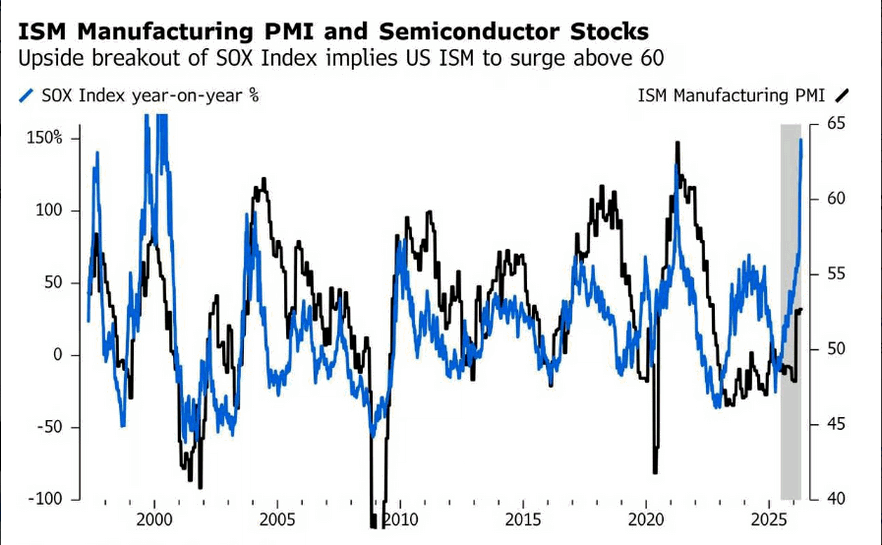
Chart of the Week: The week that delivered Nasdaq 25,000 ATH records alongside ISM Manufacturing Prices at 84.6% and Employment at 46.4% — both at extremes in opposite directions — is exactly the divergence this SOX/ISM chart captures: semiconductor stocks pricing an AI demand supercycle while factory-floor employment contracts under tariff-driven cost pressure. Historical convergence between the two lines arrives through either a chip-sector correction or a genuine manufacturing renaissance; this week’s hyperscaler earnings blowouts briefly argued for the latter, but Friday’s ISM data argued back with equal force — and the resolution is the defining macro question heading into May.
MIB Weekly Digest Ver. 1.48
For professional investors only. Not investment advice.
© 2026 RecessionALERT.com

Comments are closed.