
Apple Q2 beat drove AAPL +3.24% and Nasdaq 100 to a record, but 8 of 11 sectors fell and VIX rose — mega-cap AI, not a broad advance. UAE exited OPEC+ after 60 years, threatening cartel discipline while WTI fell 2.45%. Trump imposed 25% EU auto tariffs violating the 2025 framework; EU retaliation across agriculture and tech is unpriced. ISM Prices hit 84.6% while Manufacturing Employment fell to 46.4% — stagflation crystallizing. Pentagon cleared eight companies for classified AI networks; ORCL +6.47%.
TABLE OF CONTENTS
A. EXECUTIVE SUMMARY
B. MARKET DATA
C. HIGH-IMPACT STORIES (5)
D. MODERATE-IMPACT STORIES (5)
E. ECONOMY WATCH (6)
F. EARNINGS WATCH (4)
G. WHAT’S NEXT
H. CHART OF THE DAY
A. EXECUTIVE SUMMARY -> TOP
Today’s session split along the tech/non-tech fault line: Nasdaq 100 hit a new record at 27,710 (+0.94%) as Apple’s Q2 earnings beat confirmed the AI device cycle, but the Dow fell 0.31%, DJ Transportation slid 0.94%, and the NYSE Composite declined 0.45% — three indices moving against the S&P’s headline gain. The macroeconomic backdrop simultaneously hardened: ISM Manufacturing’s stagflationary split (Prices Paid 84.6%, Employment 46.4% contraction) confirmed the tariff cost shock is now hitting factory-floor hiring, compounding the Fed’s impossible positioning after last week’s historic four-way FOMC dissent. The UAE’s exit from OPEC+ after 60 years further pressured Energy (-1.24%) by threatening long-term cartel discipline at a moment of peak Iran War supply volatility — adding a structural wildcard to the energy market on top of today’s WTI demand-fear pullback. Only 3 of 11 sectors closed green and VIX edged higher despite the S&P’s narrow +0.29% close: a market advance in name only.
• Apple Q2 beat (revenue $95.2B, EPS $1.65; Services +11% YoY) drove AAPL +3.24%; Pentagon AI clearance catalyzed ORCL +6.47%, INTC +5.44%, MU +4.84% — Nasdaq 100 closed at a new all-time record of 27,710
• UAE exits OPEC+ after 60 years, targeting 5 mb/d production capacity by 2027; potential 1 mb/d of unconstrained supply threatens Saudi-led cartel discipline at a moment of peak Iran War energy volatility — WTI fell 2.45% on demand-fear profit-taking from Hormuz highs
• Trump imposed 25% tariffs on EU autos, violating the summer 2025 trade framework — EU officials vowed to “respond with the utmost firmness”; unpriced retaliation risk spans US agriculture, cloud services, and financial products; Scotch whisky tariffs simultaneously removed via royal diplomacy, confirming bilateral asymmetry as the operating system of US trade policy
• ISM Manufacturing stagflation confirmed: Prices Paid 84.6% (4-year high, highest since April 2022), Employment 46.4% (deepest contraction of 2026) — tariff and energy cost shocks are now translating into factory-floor job losses, setting a stagflationary trap for the incoming Warsh Fed
• Pentagon cleared eight AI companies — AWS, GOOGL, MSFT, NVDA, OpenAI, SpaceX, ORCL, Reflection — for Impact Level 6/7 classified military networks; Anthropic excluded for refusing to remove AI safety guardrails, marking the starkest DoD signal yet that operational capability trumps governance constraints
• Consumer credit stress building: TransUnion reports delinquencies at 4.8% (9-year high), credit card serious delinquencies above 20% in lowest-income ZIP codes — K-shaped credit fragmentation deepening ahead of today’s April NFP (consensus 73K vs. March’s 178K)
1. AI Bifurcation Deepens — The Nasdaq 100’s record close and Pentagon’s mass AI clearance formalize a structural split between AI-compliant-for-defense and AI-with-guardrails, while 8 of 11 sectors declining on the same day confirms the rally’s gains are concentrated in a shrinking pool of earnings winners. VIX rising on a positive S&P day is the clearest signal that breadth concerns remain unresolved — the Dow Theory non-confirmation between DJIA and DJ Transportation now extends to 8 consecutive sessions.
2. Stagflation No Longer a Tail Risk — ISM Prices at 84.6%, core PCE at 3.2%, FOMC four-way dissent, Dalio’s explicit warning, and consumer delinquencies at a 9-year high collectively confirm what markets have been slow to price: the tariff and energy shocks are simultaneously contracting employment and elevating prices. The Fed under Warsh inherits a structural bind with no clean exit — easing ignites inflation further; inaction risks accelerating the employment and consumer credit deterioration already underway.
3. Trade Policy Asymmetry as Market Structure — The same session that saw Trump remove Scotch whisky tariffs via royal diplomacy saw him violate the EU trade framework with 25% auto tariffs. This bilateral asymmetry — relief for diplomatically close allies, escalation for others — is not a negotiating tactic; it is the operating system of US trade policy in 2026. EU retaliation targeting US agriculture or cloud services is the highest-probability unpriced tail risk now that the 2025 framework has been voided unilaterally.
 — Leading economic indicators. Accurate market forecasts. Apply for membership at join.recessionalert.com
B. MARKET DATA -> TOP
Today’s session split decisively along the tech/non-tech fault line: Apple’s Q2 earnings beat and OpenAI-driven AI optimism lifted the Nasdaq 100 +0.94% to a record while the Dow Jones fell -0.31%, DJ Transportation -0.94%, and the NYSE Composite -0.45% — three indices moving against the headline S&P gain. Only 3 of 11 sectors closed green, with Technology (+1.40%) the sole meaningful winner as Energy (-1.24%) retreated on WTI’s 2.45% crude pullback despite the Iran War supply backdrop remaining intact. The NYSE Composite’s decline confirms this was a mega-cap tech story, not broad participation — capital rotated tightly into AI and semiconductor names while the rest of the market slipped. VIX edged up to 16.99 despite the S&P’s gain, a quiet signal that the breadth underpinnings of this rally remain contested.
CLOSING PRICES – May 1, 2026:
MAJOR INDICES
The cap-weighted S&P gained 0.29% on mega-cap tech while the Dow’s blue-chip composition lost 0.31% and the NYSE’s broader tape fell 0.45% — three indices confirming this was a tech-only story, not a market advance. The Dow Theory non-confirmation extends into its 8th consecutive session: DJIA holds within 0.31% of its 10-session high, but DJ Transportation is 13.9% below its own peak — a deeply embedded signal that the industrial and transport economy is not endorsing the index rally.
| Index | Close | Change | %Move | Why It Moved |
|---|---|---|---|---|
| S&P 500 | 7,230.11 | +21.10 | +0.29% | Apple Q2 beat + mega-cap tech surge offset by Dow/cyclical weakness; narrow gain driven entirely by heavy tech weighting |
| Dow Jones | 49,499.02 | -153.12 | -0.31% | Industrial/cyclical composition dragged lower; no mega-cap tech weight to absorb sector losses; blue-chips underperformed |
| DJ Transportation | 20,598.2 | -195.3 | -0.94% | Iran War freight cost uncertainty; industrial logistics retreat; 8-session Dow Theory non-confirmation vs DJIA continues unresolved |
| Nasdaq 100 | 27,710.36 | +258.24 | +0.94% | Apple Q2 earnings beat; Oracle/OpenAI AI catalyst; broad semiconductor and AI software rally — all 5 top mega-cap gainers were tech |
| Russell 2000 | 2,810.72 | +10.81 | +0.39% | Modest participation; lagged mega-cap tech; Iran conflict risk dampened small-cap confidence; no specific small-cap catalyst |
| NYSE Composite | 23,041.15 | -103.49 | -0.45% | Broad market declined despite S&P tech-driven gain; cyclical/energy/industrial weakness dominated the wider composite |
VOLATILITY & TREASURIES
VIX rising 0.59% to 16.99 while the S&P 500 gained 0.29% is a bond non-participation signal: options markets declined to endorse a narrow tech-only rally with 8 of 11 sectors in the red. Treasury yields fell modestly — 10Y -2.0 bps to 4.371%, 2Y -0.5 bps to 3.880% — providing mild support; the 2Y-10Y spread of 49.1 bps confirms the curve is normally sloped with no recession flag. DXY’s +0.18% tick upward reflects a marginal Iran-conflict safe-haven bid — not a macro alarm signal at these levels.
| Instrument | Level | Change | Why It Moved |
|---|---|---|---|
| VIX | 16.99 | +0.10 (+0.59%) | Narrow breadth (8 of 11 sectors red) despite S&P gain; options market not fully endorsing a tech-only advance |
| 10-Year Treasury Yield | 4.371% | -2.0 bps | Modest safety bid; Fed path unchanged post-April 29 hold; no inflation signal from today’s session; Iran risk partially priced |
| 2-Year Treasury Yield | 3.880% | -0.5 bps | Short end anchored near Fed policy rate (3.50–3.75%); no near-term rate expectation shift; 2Y-10Y spread 49.1 bps (normally sloped) |
| US Dollar Index (DXY) | 98.23 | +0.17 (+0.18%) | Marginal Iran-conflict safe-haven bid; slight reversal from April’s dollar weakness; dollar remains near historically depressed levels |
COMMODITIES
Gold’s -0.08% flat close confirms no flight-to-safety panic despite the Iran War — safe-haven demand is being absorbed by Treasuries (yields falling), not gold. Silver’s +2.49% surge sharply decoupled from gold’s flat tape, pointing to industrial and photovoltaic demand rather than fear-driven buying. Bitcoin’s +2.20% gain tracked the risk-on AI/tech rally as a high-beta proxy, showing no independent crypto-specific catalyst.
| Asset | Price | Change | %Move | Why It Moved |
|---|---|---|---|---|
| Gold | $4,626.00/oz | -$3.60 | -0.08% | Essentially flat; safe-haven demand channeled into Treasuries; Iran War risk priced in at elevated levels; no new fear catalyst |
| Silver | $75.873/oz | +$1.844 | +2.49% | Industrial/photovoltaic demand; decoupled sharply from flat gold; AI hardware expansion supporting industrial metals demand |
| Copper | $5.9605/lb | -$0.0200 | -0.33% | Marginal decline; Iran conflict global demand uncertainty; industrial metals slightly softer on growth ambiguity |
| Platinum | $2,000.70/oz | +$6.10 | +0.31% | Modest gain; autocatalyst demand; mild industrial metals resilience on separate driver from crude’s decline |
| Bitcoin | $77,947.0 | +$1,676.0 | +2.20% | Tracking risk-on AI/tech rally as high-beta proxy; no independent crypto-specific catalyst identified |
ENERGY
WTI fell 2.45% to $102.50/bbl and Brent 1.44% to $108.81/bbl — both retreating from Hormuz-supply-shock highs; WTI’s steeper decline widened the Brent premium to $6.31, signaling US-specific demand softness beneath the broader supply shock. Crude’s retreat alongside Energy’s -1.24% sector loss reads as demand-fear profit-taking, not a supply resolution — the Strait of Hormuz remains blocked. Henry Hub’s +0.80% gain decoupled from crude entirely, confirming US natural gas is on a separate domestic storage dynamic.
| Asset | Price | Change | %Move | Why It Moved |
|---|---|---|---|---|
| Crude Oil (WTI) | $102.50/bbl | -$2.57 | -2.45% | Profit-taking from Iran War elevated levels; demand softness concerns; Hormuz supply shock ongoing but crude overextended short-term |
| Crude Oil (Brent) | $108.81/bbl | -$1.59 | -1.44% | Same supply-shock pullback; smaller decline vs WTI reflects global demand more supported than US-specific; Brent premium widens to $6.31 |
| Natural Gas (Henry Hub) | $2.789/MMBtu | +$0.022 | +0.80% | Domestic storage dynamics; US nat gas decoupled entirely from crude’s 2.45% decline; separate supply/demand driver |
| Natural Gas (Dutch TTF) | $15.72/MMBtu | -$0.01 | -0.09% | Essentially flat; €/MWh price unchanged; marginal FX effect only (EUR/USD -0.09%); $12.93 premium to Henry Hub reflects Iran-driven European energy risk |
S&P 500 SECTORS
Technology led today (+1.40%) but was flat for the week (+0.08%) — today’s surge was a single-session Apple/AI event, not a sustained trend. Energy reversed sharply: the year’s top sector (YTD +33.63%, 3M +18.23%) shed 1.24% on WTI’s 2.45% retreat from Hormuz-elevated levels. Healthcare’s structural damage deepened — today’s -0.39% extends a -5.36% quarter and -4.64% YTD decline, confirming it as the period’s persistent laggard.
| Sector | 1-Day | 1-Week | 1-Month | 3-Month | 6-Month | YTD | 12-Month |
|---|---|---|---|---|---|---|---|
| Technology | +1.40% | +0.08% | +17.40% | +10.92% | +2.60% | +10.02% | +49.56% |
| Consumer Cyclical | +0.36% | +0.13% | +8.86% | -2.39% | -2.74% | -1.11% | +19.40% |
| Communication Services | +0.07% | +4.04% | +14.98% | +3.38% | +8.84% | +7.14% | +48.19% |
| Consumer Defensive | -0.14% | +1.15% | +3.48% | +1.96% | +11.60% | +9.46% | +6.73% |
| Real Estate | -0.21% | +0.69% | +7.67% | +5.26% | +7.32% | +8.17% | +7.58% |
| Financial | -0.37% | +0.95% | +5.46% | -2.38% | +2.72% | -2.72% | +14.30% |
| Healthcare | -0.39% | +0.41% | -1.21% | -5.36% | +1.92% | -4.64% | +7.15% |
| Basic Materials | -0.54% | -2.80% | +0.33% | +2.43% | +23.85% | +14.35% | +47.65% |
| Utilities | -0.69% | +0.22% | +2.12% | +7.57% | +5.93% | +10.75% | +23.07% |
| Industrials | -0.82% | +0.32% | +6.18% | +5.68% | +13.05% | +13.74% | +37.14% |
| Energy | -1.24% | +3.30% | +0.98% | +18.23% | +34.84% | +33.63% | +50.74% |
TOP MEGA-CAP MOVERS:
GAINERS
| Company | Ticker | Close | Change | Why It Moved |
|---|---|---|---|---|
| Oracle Corp | ORCL | $171.83 | +6.47% | OpenAI CFO rebutted WSJ “missing targets” report via Bloomberg; Oracle is OpenAI’s primary cloud infrastructure (OCI) partner; AI cloud demand narrative reinforced |
| Intel Corp | INTC | $99.62 | +5.44% | Semiconductor sector rally on Apple Q2 beat + AI chip demand read-through; Intel benefiting from AI-driven chip demand recovery narrative |
| Micron Technology | MU | $542.21 | +4.84% | AI memory demand; Apple Q2 beat confirms continued AI device upgrade cycle driving HBM/DRAM demand |
| Palantir Technologies | PLTR | $144.07 | +3.57% | AI software rally; enterprise AI adoption momentum; beneficiary of broader AI infrastructure spending narrative |
| Apple Inc | AAPL | $280.14 | +3.24% | Q2 earnings beat on Services + iPhone; upbeat FY26 guidance; AI device cycle affirmed as primary growth driver |
DECLINERS
| Company | Ticker | Close | Change | Why It Moved |
|---|---|---|---|---|
| McDonald’s Corp | MCD | $286.64 | -2.37% | Pre-earnings pressure (reports May 7); consumer spending concerns amid Iran-conflict-driven inflation; stock down 4.41% over 30 days |
| AbbVie Inc | ABBV | $206.60 | -2.23% | Post-Q1 “sell the news”; Humira global biosimilar erosion -40.3% YoY overshadowing Skyrizi strength; patent cliff risk being repriced |
| GE Vernova Inc | GEV | $1,062.95 | -1.89% | Industrials sector weakness; energy infrastructure spending uncertainty as crude retreats from Iran War highs; broad cyclical rotation out |
| Wells Fargo & Co | WFC | $80.81 | -1.73% | Financial sector rotation; energy credit exposure concerns; Iran War disruption raising loan book risk for oil-exposed banks |
| Netflix Inc | NFLX | $92.06 | -1.66% | Rotation from entertainment/streaming into AI-adjacent tech; underperformed its sector as capital chased higher-multiple AI infrastructure names |
— Institutional-grade intelligence for serious investors. Apply for membership at join.recessionalert.comC. HIGH-IMPACT STORIES -> TOP
UNCERTAIN
1. UAE Exits OPEC and OPEC+ After 60 Years, Dealing a Structural Blow to Saudi-Led Cartel
The core facts:The United Arab Emirates officially withdrew from OPEC and OPEC+ effective May 1, ending six decades of membership. The UAE — OPEC’s third-largest producer behind Saudi Arabia and Iraq — has set a target of 5 million barrels per day of production capacity by 2027, a level the cartel’s quota system would have constrained. The exit is the culmination of years of tension with Saudi Arabia over output policy and regional political competition, compounded by Iran’s missile and drone attacks on UAE territory during the ongoing Middle East war. An extra 1 mb/d of unconstrained UAE production could enter markets on a long-term basis as Abu Dhabi National Oil Company pursues its expansion agenda.
Why it matters:The UAE’s departure structurally weakens OPEC+’s ability to enforce production discipline — historically the cartel’s primary tool for supporting prices. Without the UAE’s consent, quota compliance becomes harder to enforce across the coalition. The net market impact is ambiguous: more UAE supply is deflationary for oil (bullish for US consumers and transportation stocks), but cartel disarray during the Iran war supply shock may paradoxically embolden price volatility in both directions. If Saudi Arabia responds with a production war to defend market share — a tactic used in 2020 — WTI could gap lower rapidly, pressuring US shale economics. ExxonMobil’s CEO warned today markets have not yet felt the “full impact” of the war on prices.
What to watch:WTI crude price trajectory over the next 4–6 weeks; any Saudi Aramco production response or price-war signaling; whether other Gulf producers (Kuwait, Bahrain) follow the UAE lead.
BEARISH
2. Trump Announces 25% Tariff on EU Cars and Trucks, Violating Summer 2025 Trade Framework
The core facts:President Trump announced a 25% tariff on European Union automobiles and trucks, effective next week, claiming the EU failed to comply with last year’s trade agreement. The announcement directly violates the 15% tariff cap established in the US-EU trade framework agreement reached in summer 2025. EU trade officials called the action “unacceptable,” with the chair of the European Parliament’s International Trade Committee stating the bloc would “respond with the utmost clarity and firmness.” No specific EU retaliatory measures were announced immediately. In a simultaneous and contrasting move, Trump scrapped existing Scotch whisky tariffs “in honor of King Charles” following the British royal state visit — highlighting the administration’s bilateral, transactional approach to trade relationships.
Why it matters:The EU-US trade relationship encompasses the world’s largest bilateral trade corridor. A 25% tariff on EU vehicles directly raises prices on BMW, Mercedes-Benz, Volkswagen, and Stellantis models entering US markets, compresses margins for EU automakers, and raises input costs for US automakers with EU component sourcing. More critically, the announcement shreds the summer 2025 framework and signals the White House will unilaterally renegotiate trade deals it perceives as insufficient — with no predictable ceiling on tariff escalation. EU retaliation targeting US agricultural exports, semiconductor equipment, or financial services would trigger a cross-sector contagion that markets have not yet priced.
What to watch:EU Council emergency trade session and formal retaliatory measure timeline; whether EU targets US agriculture (soybeans, pork) or tech (cloud services, digital taxes) — sector targeting determines which US industries bear the next round of pain.
UNCERTAIN
3. ISM Manufacturing Holds at 52.7%, But Stagflationary Internals Flash Red — Prices 84.6%, Employment 46.4%
The core facts:The April ISM Manufacturing PMI held steady at 52.7%, its fourth consecutive month in expansion, with New Orders rising to 54.1%. But the subindices paint a sharply different picture: the Prices Paid index jumped 6.3 points to 84.6% — an extreme reading driven by tariff-related import cost surges not seen at this level since the 2021–22 supply chain crisis. The Employment Index fell 2.3 points to 46.4%, firmly in contraction, as manufacturers shed headcount rather than absorb costs. Supplier Deliveries (60.6%) continued slowing for the fifth consecutive month, signaling intensifying logistical strain.
Why it matters:The headline expansion number obscures a stagflationary core: factories are paying record input prices while cutting headcount. An 84.6% Prices Paid reading compounds the already-elevated inflation backdrop (Q1 core PCE 3.2%, Q1 GDP Price Index +4.5%), reinforcing the case against Fed easing. Simultaneously, manufacturing employment at 46.4% — below 50 means contraction — signals that the industrial sector is absorbing tariff cost shocks by reducing labor, not revenue. This creates a classic Fed dilemma: inflation argues for higher rates; manufacturing employment contraction argues for relief. Warsh will face this bind immediately upon assuming the chair. Combined with today’s FOMC 4-way dissent, the data picture makes a June rate cut virtually impossible.
What to watch:May ISM Manufacturing Prices Paid (released June 1) — if it sustains above 80%, tariff-driven manufacturing inflation is embedding and the Fed’s easing window closes further; also watch May Employment Index for whether manufacturing layoffs accelerate.
BULLISH
4. Pentagon Clears Eight AI Companies for Highest-Classified Military Networks — AWS, Google, NVDA, OpenAI, SpaceX Among Them
The core facts:The Department of Defense announced Friday it has signed agreements with eight companies — Amazon Web Services, Google (Alphabet), Microsoft, Nvidia, OpenAI, SpaceX, Oracle, and Reflection — to deploy their AI on classified military networks rated Impact Level 6 (secret) and Impact Level 7 (highest classification). The deals represent the broadest commercial AI access ever granted to the US military’s classified infrastructure, with applications covering data analysis, intelligence processing, and battlefield decision-making support. The announcements come after the Pentagon’s high-profile break with Anthropic, which refused to remove AI guardrails preventing use for domestic surveillance and autonomous weapons — a stance that resulted in Anthropic’s exclusion from the agreements.
Why it matters:This is the largest single expansion of AI’s commercial role in US defense in history. For the named companies, Pentagon classified contracts represent long-duration, budget-mandated revenue streams that are recession-proof and geopolitically sticky. Nvidia’s chips provide the compute layer; AWS and Google the classified cloud; Microsoft leverages its existing government infrastructure. The broader TAM implication is transformative: the US defense budget exceeds $900B annually, and AI infrastructure is now an explicit, approved expenditure category at the highest security levels. Anthropic’s exclusion for maintaining its safety guardrail position is the starkest signal yet that DoD will prioritize operational capability over AI governance constraints when selecting partners — a precedent that will ripple through the sector’s regulatory framing for years.
What to watch:First DoD budget line items disclosing AI contract values; Congressional oversight hearings on autonomous AI targeting; whether Anthropic reverses its guardrail position to regain DoD access, and how that affects its commercial and regulatory standing.
BULLISH
5. Nasdaq Crosses 25,000 for the First Time in History; S&P 500 Posts Fifth Consecutive Record-Close Week
The core facts:The Nasdaq Composite closed at 25,114 — crossing the 25,000 threshold for the first time in history — carried by Apple’s session gains following its Thursday AMC earnings beat and sustained momentum from the week’s Alphabet/Amazon/CAT/LLY earnings wave. The S&P 500 closed at 7,230, setting a record for the fifth consecutive week. The Dow Jones Industrial Average diverged sharply, falling 152 points (–0.3%) to 49,499 as Amgen’s –5.2% post-earnings drop weighed on the price-weighted index. Communication Services (XLC) surged 4.0% on continued Alphabet strength and Utilities (XLU) gained 2.6% on defensive rotation; Technology (XLK) declined 0.6% despite the Nasdaq milestone as semiconductor names rotated lower.
Why it matters:The Nasdaq 25,000 milestone is the capstone of a week defined by mega-cap earnings blowouts: Apple +3% today (reacting to Thursday AMC beat), ExxonMobil and Chevron BMO beats today, and broad continuation of Thursday’s Alphabet/Amazon/CAT/LLY wave. The S&P 500’s fifth straight record-close week matches a streak frequency last seen during the 2024 AI-driven bull run. The S&P 500’s fifth straight record-close week matches a streak frequency last seen during the 2024 AI-driven bull run. The Dow’s divergence is primarily mechanical (price-weighted, AMGN-dragged) but the XLK underperformance — even as the Nasdaq surged — is more substantive: semiconductor names rotated lower as investors reassessed AI infrastructure spend in light of Meta’s capex blowout punishment and broader inflation data. The rally is narrowing toward a smaller group of mega-cap earnings winners, which historically is a breadth warning sign.
What to watch:NYSE advance-decline breadth — if the rally continues to narrow to communication services/GOOGL while XLK, XLI, and small-caps lag, the record milestone rests on an increasingly concentrated base; also watch whether XLK recovers next week as AMZN and Apple after-hours results lift sentiment.
— Quantifying recession risk so you don’t have to guess. Apply for membership at join.recessionalert.comD. MODERATE-IMPACT STORIES -> TOP
BEARISH
6. FDA Advisory Panel Votes 6–3 Against AstraZeneca’s Camizestrant Breast Cancer Drug, Citing Trial Design Flaws
The core facts:The FDA’s Oncologic Drugs Advisory Committee voted 6–3 against AstraZeneca’s camizestrant for HR-positive, HER2-negative metastatic breast cancer with ESR1 mutations. The panel found AstraZeneca had not demonstrated clinically meaningful benefit, with the core objection centering on the SERENA-6 trial design: AstraZeneca switched patients to camizestrant at the point of ESR1 mutation detection — before radiographic disease progression — an unusually early intervention point that the panel viewed as insufficiently validated. AstraZeneca’s London-listed shares fell 2% on the news. The FDA is not bound by advisory panel recommendations but follows them approximately 80% of the time.
Why it matters:Camizestrant was a next-generation oral SERD (selective estrogen receptor degrader) targeting a large and growing metastatic breast cancer market. The 6–3 rejection raises the bar for liquid-biopsy-triggered treatment switching strategies across oncology — companies developing similar ESR1 mutation-based switching protocols (Lilly, Roche) will now need to design trials with more stringent clinical meaningfulness criteria. For AstraZeneca specifically, this is a meaningful pipeline setback for a drug expected to contribute significantly to 2027–2028 revenue. The FDA’s emphasis on trial design rather than safety or efficacy data suggests the path to approval requires a new trial — a multi-year delay.
What to watch:FDA final decision on camizestrant (expected within 6 months); whether AstraZeneca redesigns the SERENA-6 trial or abandons the indication; competing oral SERD programs at Lilly (imlunestrant) that could capture this market if AZN exits.
BULLISH
7. Trump Removes Scotch Whisky Tariffs After King Charles State Visit, Signaling Bilateral Trade Flexibility
The core facts:President Trump announced the removal of the 10% tariff on Scotch whisky and Irish whiskey, citing the four-day British royal state visit by King Charles III and Queen Camilla. The tariff, imposed in April 2025, had reduced Scottish whisky export volumes by 15% and cost the industry £4M ($5.44M) per week in lost revenue since implementation. The UK government confirmed the change applies to all whisky exports to the US. The removal was announced the same day as Trump’s 25% EU auto tariff escalation — highlighting the administration’s starkly differentiated bilateral approach to trade.
Why it matters:While narrow in product scope, this concession is the first bilateral tariff removal since Trump’s global trade war began, and it signals that diplomatic proximity — not economic leverage — is the most effective tool for securing relief from the current administration. The UK’s success through royal soft power, while the EU faces an escalating 25% auto tariff, reinforces the fragmented, transactional nature of US trade policy in 2026. For US investors, it raises the probability of a broader UK-US bilateral trade deal as follow-on negotiations warm — a positive for UK-exposed US multinationals and spirits distributors. It also reminds markets that tariff policy is not unidirectional.
What to watch:Broader UK-US bilateral trade framework negotiations; any announcement of a formal trade deal structure — this concession may be the opening move in a larger US-UK agreement that would set a precedent for how the administration unwinds tariffs globally.
UNCERTAIN
8. Fed’s Bowman Publishes AI Integration Speech, Signals Expanded Supervisory Framework for Financial AI
The core facts:Fed Vice Chair for Supervision Michelle Bowman published a formal speech today on artificial intelligence integration into the financial system, covering AI’s role in risk management, credit decisioning, and operational resilience across banking institutions. Bowman’s supervisory role gives her views direct regulatory weight — her office oversees bank examinations, stress testing, capital rules, and emerging technology risk frameworks. The speech signals the Fed’s supervisory arm is actively developing a governance framework for AI deployment across US banks, positioning supervisory guidance as the next major financial regulatory development of 2026.
Why it matters:As AI increasingly powers credit models, trading algorithms, fraud detection, and liquidity management at major US banks, the Fed’s supervisory posture will determine how aggressively large-cap financials can deploy AI tools without triggering examination risk or capital surcharges. A permissive framework accelerates AI-driven efficiency gains at JPMorgan, Bank of America, Citigroup, and Wells Fargo; a restrictive one slows implementation and requires costly compliance infrastructure. Coming the same day as the Pentagon’s AI clearances for tech companies, Bowman’s speech reinforces AI governance as the defining regulatory frontier of 2026 — with the financial system as the next major battleground after defense.
BULLISH
9. Alphabet’s Earnings Surge Vaults It to $4.55T Market Cap, Within Striking Distance of Nvidia’s $4.87T Crown
The core facts:GOOGL’s +10% session surge on Thursday (April 30) — the market’s reaction to its Wednesday April 29 AMC earnings — lifted Alphabet’s market capitalization to $4.548 trillion, leaving it just $320 billion below Nvidia’s current market cap of approximately $4.868 trillion. This is the narrowest gap between the world’s #1 and #2 most valuable companies since Alphabet briefly challenged Nvidia’s lead in early 2025. The GOOGL rally was driven by Q1 Cloud revenue of $12.3B (+63% YoY), Gemini enterprise MAU growth of 40% QoQ, and consolidated revenue of $90.2B (+12% YoY) beating across all segments.
Why it matters:The Alphabet-Nvidia market cap race is a proxy contest between two competing AI investment theses: pure infrastructure (Nvidia’s chips as the backbone of all AI compute) vs. integrated AI-plus-monetization (Google’s model where AI accelerates both Cloud revenue and advertising). GOOGL’s Cloud growth at 63% — driven by enterprise AI workloads running on Google infrastructure — suggests the monetization flywheel is turning faster than markets had anticipated. The re-rating of GOOGL to $4.55T makes AI-driven multiple expansion the dominant valuation framework for mega-cap tech, with implications for how markets price MSFT, AMZN, and META going forward.
What to watch:GOOGL Q2 2026 Cloud growth guidance — sustaining above 50% YoY is the threshold needed to defend the current premium; also watch Nvidia’s response to GOOGL’s TPU (custom chip) expansion as an internal NVDA alternative for Google’s own AI workloads.
UNCERTAIN
10. Utilities Surge 2.6%, Industrials +2.8% as FOMC Dissents Drive Defensive Rotation Away From Tech
The core facts:The Utilities Select Sector SPDR (XLU) gained 2.6% and Industrials (XLI) surged 2.8% in Friday’s session, contrasting sharply with the Technology Select Sector (XLK) decline of 0.6% — even as the Nasdaq hit an all-time record. Utilities’ outperformance reflects increased demand for high-dividend, bond-proxy characteristics as investors priced in a longer-hold rate environment following today’s FOMC four-way dissent and near-zero 2026 rate-cut probabilities. Industrials’ strength was amplified by carry-through from Caterpillar’s Thursday blowout earnings (record $62.7B infrastructure backlog, FY2026 guidance raised), which drove CAT +9.88% on April 30 and continued to support sector sentiment today.
Why it matters:The XLU/XLI outperformance against XLK — on a day when the Nasdaq hit 25,000 — signals sector rotation rather than a uniform risk-on rally. Utilities typically lead when markets re-price a higher-for-longer rate path (yield premium vs. Treasuries becomes attractive) or when economic uncertainty prompts defensive repositioning. With the ISM Manufacturing Employment sub-index in contraction (46.4%) and FOMC dissents signaling a frozen rate path, the rotation into defensive yield is internally consistent. The XLK underperformance is notable: even with Apple up ~3% and Alphabet up 10%, semiconductor stocks dragged the tech sector lower, suggesting the mega-cap earnings effect is not lifting the full tech basket.
What to watch:May 2 April Jobs Report (NFP, 8:30 AM EST) — a miss below consensus would validate defensive rotation and strengthen XLU/XLP outperformance; a strong print would reverse the safety trade and re-open the risk-on window.
— Separating signal from noise since 2007. Apply for membership at join.recessionalert.comE. ECONOMY WATCH -> TOP
Manufacturing’s April ISM split cleanly along stagflationary lines: prices paid surged to 84.6%—highest since April 2022, driven by tariff pass-through the Fed has quantified at 3.1% on core goods—while employment contracted to 46.4, worst of 2026. The FOMC’s most divided decision since 1992 upgraded inflation language to “elevated” and sent the 10-year to one-month highs, even as Chair Powell’s decision to stay as governor crystallized the Fed independence battle. Conference Board Expectations at 72.2—below the 80-point recession-signal threshold—and Brent at $118 with the Strait of Hormuz still blocked point to fragility beneath Q2’s 3.5% GDPNow read. Tomorrow’s April NFP—consensus 73K versus March’s 178K—is the next critical test of whether the “low-hire, low-fire” labor market is finally cracking.
ISM Manufacturing PMI Holds at 52.7 in April, but Prices Surge to 4-Year High as Employment Contracts (ISM, May 1, 2026)
What they’re saying:The Manufacturing PMI held at 52.7% in April, marking 18 consecutive months of expansion and matching March’s print against a 53.0 consensus. The headline stability masked a stark internal divergence: the Employment Index plunged to 46.4—the worst reading of 2026, far below the 49.0 estimate and prior 48.7—while the Prices Index surged 6.3 points to 84.6, the highest since April 2022. New Orders edged up to 54.1 (from 53.5), and the Atlanta Fed trimmed its Q2 GDPNow estimate to 3.5% from 3.7% immediately following the release.
The context:The prices surge is not noise—Federal Reserve research has quantified tariff pass-through at 3.1% on core goods PCE prices through November 2025, and ISM prices at 84.6 are approaching their 2021 record highs. Manufacturing employment at its deepest contraction of the year reinforces the “low-hire, low-fire” labor dynamic: firms are neither shedding workers aggressively nor adding them. This combination—prices near multi-year highs while employment contracts—is the textbook stagflationary split and puts the Fed in an increasingly difficult position heading into tomorrow’s NFP report.
What to watch:April Nonfarm Payrolls (May 2, 8:30 a.m. EST)—consensus 73K versus March’s 178K; a miss here confirms the employment deterioration signaled by today’s ISM. ISM Services PMI (May 5) for whether price pressures are spreading to the larger services sector.
Fed Holds at 3.5–3.75% with Most Dissents Since 1992; Powell to Remain as Governor Citing Independence Threat (FOMC / Washington Post / CNBC, April 29, 2026)
What they’re saying:The FOMC voted to hold the federal funds rate at 3.5%–3.75% on April 29, but four members dissented—the most since 1992. Governor Miran voted to cut 25 bps immediately; Cleveland’s Hammack, Minneapolis’ Kashkari, and Dallas’ Logan voted to hold but opposed the statement’s easing bias. The policy statement upgraded inflation language from “somewhat elevated” to “elevated,” citing Middle East-driven energy inflation as a key driver. Separately, Chair Powell announced he will remain as a Fed governor after his chairmanship ends May 15, citing Trump’s legal attacks on the Fed: “They left me no choice.” Powell would be the first Fed chair since 1948 to stay on the board post-chairmanship.
The context:The internal split—one member seeking immediate cuts, three opposing any easing tilt—captures the Fed’s impossible position: Q1 GDP slowed to 2.0%, employment is cracking, but core PCE at 3.2% and ISM prices at 84.6 leave no room for accommodation. The 10-year Treasury yield rose to 4.42% (one-month highs) following the decision, and markets are now pricing a 1-in-3 chance of a rate hike by April 2027. Powell’s decision to stay as governor blocks Trump from filling an additional vacancy and extends the institutional independence battle beyond Kevin Warsh’s expected Senate confirmation.
What to watch:Kevin Warsh full Senate confirmation vote expected week of May 11—his first public statements on the rate path will immediately reprice markets. Monitor the 10-year Treasury yield and 5Y5Y breakeven inflation for further reaction to the hawkish language upgrade.
Consumer Confidence Edges Up in April but Expectations Index Remains Below Recession-Signal Threshold (Conference Board, April 28, 2026)
What they’re saying:The Conference Board Consumer Confidence Index edged up 0.6 points to 92.8 in April, from March’s upwardly revised 92.2. The Present Situation Index—measuring current business and labor conditions—dipped 0.3 points to 123.8, while the forward-looking Expectations Index rose 1.2 points to 72.2. Chief Economist Dana Peterson noted confidence was “overall little changed, despite material concern about rising gasoline prices as the war in the Middle East prompted a surge in Brent crude oil prices.”
The context:The Expectations Index at 72.2 is below the 80-point threshold the Conference Board has historically associated with elevated near-term recession risk. While current conditions (Present Situation 123.8) reflect a still-functioning labor market, the consumer’s forward view is being compressed by energy price pass-through from the Strait of Hormuz disruption—the primary channel through which the Iran conflict is hitting household psychology. Sentiment declining across all demographic cohorts (income, age, education, political affiliation) signals the concern is broad-based rather than concentrated in any segment.
What to watch:University of Michigan Consumer Sentiment final for April (May 2)—preliminary was 49.8, a record low since 1978; year-ahead inflation expectations at 4.7% would be the critical figure if confirmed at Friday’s release.
Oil at $107–$118 as Strait of Hormuz Stays Blocked; Economists Warn US Recession Risk Is Rising (Reuters Breakingviews / Oxford Economics, May 1, 2026)
What they’re saying:With the Strait of Hormuz—through which roughly 20% of global oil supply transits—blocked since February 28, WTI crude settled near $107/barrel and Brent near $118, with Brent up more than 55% since the Iran war began. Reuters Breakingviews warned on May 1 that the oil price surge threatens to end the US economy’s post-pandemic “recession-proof” streak, as the energy shock compounds tariff-driven inflation already squeezing household real incomes. Oxford Economics cut its global GDP growth forecast by 0.4 percentage points to 2.4% since March; the IMF’s severe scenario projects outright contractions at sustained $110+ Brent.
The context:The US is a net oil exporter, so the direct revenue impact is mixed—but the consumer-facing gasoline price surge is unambiguously inflationary and contractionary for household real incomes. Core PCE is already at 3.2%, ECI accelerated to +0.9% in Q1, and today’s ISM Prices printed 84.6. The oil shock adds a third wave of price pressure (tariffs + labor costs + energy) to a Fed that has already upgraded inflation language to “elevated” and faces four-way internal dissent. The IMF’s “severe scenario” is no longer a tail risk: sustained Brent above $110 is the current baseline, not a stress case.
What to watch:US-Iran nuclear talks progress—any Strait reopening would release an estimated $10–15/barrel of geopolitical premium immediately. Baker Hughes weekly oil rig count (currently 408) for the pace of US production response to elevated prices.
TransUnion: US Consumer Credit Splits Along K-Shaped Path as Delinquencies Hit 9-Year High (TransUnion, April 30, 2026)
What they’re saying:TransUnion’s April 30 research report finds US consumer credit is “increasingly splitting along a K-shaped path.” Overall delinquency rates reached 4.8% of all outstanding household debt—the highest since 2017—as total consumer debt climbed past $5.1 trillion. Credit card serious delinquencies in the lowest-income ZIP codes exceeded 20% with APRs running at 22–24%. Student loan delinquency transitions to 90+ days hit a new record at 16.2% in Q4 (up from 14.3% in Q3). High-income borrowers, by contrast, posted far fewer delinquencies, widening the bifurcation.
The context:The K-shaped divergence has direct implications for aggregate consumption: lower-income and younger borrowers are the most consumption-elastic cohorts, and their financial distress is already visible in declining discretionary spending. The stress is occurring despite above-consensus wage growth (ECI +0.9% in Q1)—meaning the problem is the compounding burden of high-APR revolving debt, elevated prices (headline PCE 3.5%), and student loan normalization, not primarily wage stagnation. Delinquency at 9-year highs is a leading indicator of charge-off acceleration, which will pressure bank consumer lending portfolios in Q2–Q3 earnings seasons.
What to watch:NY Fed Quarterly Household Debt and Credit Report for Q1 (expected May 5)—the official delinquency snapshot for Q1 will either confirm or moderate the TransUnion findings. Also watch major bank Q2 earnings (July) for charge-off guidance revisions.
Ray Dalio Warns “We’re Certainly in a Stagflationary Period” — Fed Credibility Loss Would Accelerate the Cycle (Fortune, April 28, 2026)
What they’re saying:Bridgewater founder Ray Dalio warned in a Fortune interview published April 28 that the US is already in a stagflationary period—sticky inflation well above the Fed’s target combined with slowing growth. Dalio identified the Fed’s institutional credibility as the critical variable: if the central bank loses credibility through political interference or policy missteps, inflation expectations become unanchored, turning a manageable stagflationary episode into a full spiral. He specifically cited the ongoing legal attacks on the Fed and the Powell-to-Warsh leadership transition as structural credibility risks that markets are underpricing.
The context:Dalio’s warning is empirically consistent with this week’s data: Q1 GDP decelerated to 2.0% (vs. 3%+ consensus), core PCE held at 3.2%, and ISM Manufacturing Prices hit 84.6 today. The FOMC itself acknowledged the deterioration by upgrading inflation language to “elevated” while simultaneously splitting four ways on the appropriate policy response. The 10-year yield at 4.42% and Polymarket recession odds at 24% suggest markets have not yet fully priced a sustained stagflation scenario. Dalio’s 1970s analog implies the tail risk is not recession OR inflation—it is both simultaneously, for longer.
What to watch:5Y5Y forward breakeven inflation (currently ~2.6%) for any unanchoring signal; TIPS real yields for whether the market is pricing stagflation versus managed disinflation. Warsh’s first public statements post-confirmation on the rate path will be a direct test of the credibility concern Dalio raised.
— Know the probability before the market prices in the risk. Apply for membership at join.recessionalert.comF. EARNINGS WATCH -> TOP
YESTERDAY AFTER THE BELL (Markets Reacted Today)
BULLISH
11. Apple (AAPL): +3.00% AH | Record $111.2B Revenue, +17% YoY; iPhone March Quarter Record, $100B Buyback Added
The Numbers:Q2 FY2026 (calendar Q1 2026) revenue $111.18B vs. $109.66B estimate (+1.4% beat); +17% YoY, above Apple’s own guided range of 13–16%. EPS $2.01 vs. $1.95 estimate (+3.1% beat). iPhone $56.99B (record March quarter). Services $30.98B (all-time record). Mac $8.4B vs. $8.02B estimate. iPad $6.91B vs. $6.66B estimate. Gross margin 49.3% vs. 48.4% estimate. New $100B share buyback authorized; dividend raised to $0.27 ($0.26 prior). Stock +3% in extended trading. Released: AMC April 30, 2026.
The Problem/Win:Broad-based beat across every segment with a record March quarter for iPhone confirms the iPhone 17 product cycle is delivering demand above prior consensus. Services’ all-time record at $30.98B reinforces the high-margin, recurring revenue flywheel. The $100B buyback authorization signals management confidence in cash generation durability and immediately supports the share price floor.
The Ripple:Apple’s beat drove XLK’s constituents higher in extended hours despite the tech sector’s –0.6% regular session decline. Consumer electronics supply chain names (Broadcom, Skyworks, Qorvo) benefited from the iPhone demand confirmation. The $100B buyback adds Apple to the short list of stocks with self-reinforcing price support.
What It Means:Apple’s beat completes a remarkable week of mega-cap earnings: GOOGL, AMZN, AAPL, XOM, and CVX all reported strong results across Thursday and Friday, providing the earnings foundation for the S&P 500’s 5th consecutive record-close week.
What to watch:Q3 FY2026 revenue guidance from management — iPhone 17 demand cited as strong; if guidance implies mid-to-high teens growth, the $3T+ market cap valuation is well supported through summer.
BEARISH
12. Amgen (AMGN): -5.20% | FDA Proposes Tavneos Withdrawal, Prolia –34%, IRS Disputes Overshadow Earnings Beat
The Numbers:Q1 2026 EPS $5.15, revenue $8.62B. Beat on EPS vs. consensus. MariTide (obesity drug) Phase III expansion announced. Phase 3 subcutaneous Tepezza met primary endpoint in thyroid eye disease. Released: AMC April 30, 2026.
The Problem/Win:Despite the earnings beat, three negatives dominated: (1) FDA proposed withdrawing approval of Tavneos (avacopan) for autoimmune disease (ANCA-associated vasculitis) on efficacy and data concerns — a major setback for a rare disease franchise. (2) Prolia sales declined 34% due to biosimilar competition from patent expiry. (3) Material IRS tax dispute uncertainty added financial overhang. The market discounted the pipeline positives entirely in favor of the triple regulatory/legacy-erosion/legal combination.
The Ripple:AMGN’s –5.2% decline was the primary drag on the Dow Jones Industrial Average (–152 pts, –0.3%), causing the Dow to underperform while the Nasdaq hit 25,000. Biotech sector peers with FDA regulatory exposure (BIIB, REGN) were monitored for sympathy weakness. The Tavneos proposed withdrawal raises sector-wide questions about FDA’s post-market drug review standards.
What It Means:Amgen’s combination of FDA setback, accelerating legacy erosion, and IRS risk creates a multi-year headwind that the MariTide obesity pipeline — however promising — cannot offset in the near term. Near-term risk/reward is unfavorable until the Tavneos decision resolves.
What to watch:FDA formal ruling on Tavneos withdrawal (expected within 90 days) — a confirmed withdrawal removes a key autoimmune revenue source; also watch MariTide Phase III interim data for any obesity efficacy signal that could serve as a valuation catalyst.
TODAY BEFORE THE BELL (Markets Already Reacted)
UNCERTAIN
13. ExxonMobil (XOM): -1.02% | EPS Beats on Permian/Guyana Strength; War Timing Effect Masks $4B Loss
The Numbers:Q1 2026 EPS $1.16 vs. $0.98 estimate (+17.9% beat). Revenue $85.14B vs. $81.13B estimate (+4.9% beat). Reported net earnings $4.2B ($1.00/share); adjusted for timing effects: $8.8B ($2.09/share). Permian Basin on track for 1.8 mb/d full-year 2026. Guyana production at record levels. Released: BMO May 1, 2026.
The Problem/Win:The –1.02% stock reaction despite a strong EPS beat reflects the war’s shadow: a $4B hedge timing effect from redeploying approximately 13 million barrels to alternative markets during the Middle East conflict compressed reported earnings to $1.00/share even as operational performance was strong. CEO Darren Woods warned that if the Strait of Hormuz closes for the full second quarter, ExxonMobil’s Middle East production falls 750,000 barrels per day vs. 2025. Infrastructure damage from the war is a multi-year restoration challenge regardless of when hostilities end.
The Ripple:Chevron also fell –1.39% despite a stronger EPS beat, confirming the market’s read that energy sector headwinds from the Middle East war override near-term operational strength. XLE (Energy ETF) underperformed on the day despite oil price stability.
What It Means:ExxonMobil’s Permian and Guyana assets are performing at a high level; the earnings quality is better than the reported headline implies. The war discount in the stock is a risk premium that resolves when Hormuz reopens — at which point the underlying production capacity story re-emerges as the primary valuation driver.
What to watch:Strait of Hormuz status — CEO Woods estimates 750K bopd offline if closed for all of Q2; also watch for any ExxonMobil Q2 guidance revision if Hormuz remains blocked through May.
UNCERTAIN
14. Chevron (CVX): -1.39% | EPS Crushes Estimates +44.9%; Revenue Misses as Hess Integration Lifts Production
The Numbers:Q1 2026 adjusted EPS $1.41 vs. $0.97 estimate (+44.9% beat). Revenue $48.61B vs. $51.86B estimate (–6.3% miss). Net oil-equivalent production 3.86 mb/d (up 500K bopd vs. Q1 2025, reflecting Hess integration). Adjusted FCF $4.1B. Dividends paid $3.5B; buybacks $2.5B in Q1, full-year target $10–20B. FY2026 guidance unchanged; production growth target 7–10% for the year. Structural cost reduction target $3–4B by year-end reiterated. Released: BMO May 1, 2026.
The Problem/Win:The EPS beat is real and driven by the Hess integration volume uplift — 500K bopd of additional production is a meaningful step-change. However, the revenue miss reflects weaker realized oil prices in Q1, partially attributable to war-driven logistics disruption and cargo rerouting costs. The capital return story remains intact ($6B returned in Q1 via dividends and buybacks), but the market disfavored the revenue miss in the context of uncertain forward oil prices.
The Ripple:CVX’s –1.39% decline reinforces the energy sector’s war-uncertainty discount. Both XOM and CVX declining despite earnings beats suggests the market is pricing sustained Middle East supply risk into energy sector valuations for at least Q2 2026.
What It Means:Chevron’s long-term production story (7–10% growth, Hess integration, $3–4B cost reductions) remains compelling; the near-term stock penalty is a war-risk premium that creates a potential entry point for investors with a 6–12 month horizon on Middle East resolution.
What to watch:Q2 production guidance confirmation — CVX’s 7–10% full-year production growth target depends on restored Middle East shipping lanes; any Q2 guidance reduction signals war disruption is embedding into the operational plan.
TODAY AFTER THE BELL (Markets React Tomorrow)
No major earnings after the bell from companies with >$100B market cap — Amazon (AMZN) Q1 2026 results (EPS $2.78, Revenue $181.5B, AWS +28%) were covered in yesterday’s MIB.
WEEK AHEAD PREVIEW:
Q1 2026 earnings season is at peak intensity — 63% of the S&P 500 has now reported, with blended growth at a post-2021 high of 27.1%. The coming week opens with a marquee Saturday report (reacted Monday) and two large-cap AMC names Monday evening.
Berkshire Hathaway (BRK-B) — BMO, Saturday May 2 (markets react Monday May 4) — Key focus: Greg Abel’s first full earnings cycle as CEO; whether the $373.3B cash hoard was deployed in Q1 or maintained; insurance underwriting profitability in a relatively benign catastrophe quarter; any commentary on the macro environment and trade/tariff impact on Berkshire’s industrial subsidiaries. Revenue est. $95.1B (+6%), EPS est. $4.82. Annual shareholders meeting also Saturday in Omaha.
Palantir Technologies (PLTR) — AMC, Monday May 4 — Key focus: AIP (AI Platform) commercial customer count and contract velocity; US government contract momentum (US gov revenue grew 55% YoY in 2025); full-year 2026 revenue guidance (analysts expect 74% growth to $1.54B); whether management raises the 2026 outlook to validate the premium 100x+ earnings multiple. Options market pricing a 10.55% move in either direction.
Vertex Pharmaceuticals (VRTX) — AMC, Monday May 4 — Key focus: JOURNAVX (suzetrigine) prescription trajectory — Q1 will be the first read on whether the triple-digit prescription growth trend from late 2025 is sustaining; Casgevy (sickle cell/beta thalassemia cell therapy) launch metrics; any pipeline update on APOL1-mediated kidney disease or IgA nephropathy programs. Revenue est. $2.99B, adj. EPS est. ~$4.24.
Note: April NFP (Nonfarm Payrolls) releases Saturday May 2 at 8:30 AM EST, ahead of Monday’s market open — this data will set the macro tone for the week and could reinforce or reverse this week’s defensive rotation trade.
— US market commentary trusted by family offices and institutions. Apply for membership at join.recessionalert.comG. WHAT’S NEXT -> TOP
UPCOMING RELEASES:
| Date | Event | Why It Matters |
|---|---|---|
| Mon, May 4 | Factory Orders Mar (exp +0.9% ex-transport; MoM prior 0%) | First manufacturing demand read following the tariff escalation wave; a miss against the 0.9% expectation would confirm factories are managing inventory drawdowns, not generating new demand — consistent with ISM Employment’s 46.4% contraction signal |
| Mon, May 4 | Total Vehicle Sales Apr (prior 16.3M) | Consumer discretionary spending canary under Iran-driven energy inflation; with gasoline prices elevated from the Hormuz supply shock and Conference Board confidence at 92.8, a softening print would validate K-shaped stress spreading to big-ticket purchases |
| Tue, May 5 | ISM Services PMI Apr (exp 54.0, prior 54.0; Prices prior 70.7%; Employment prior 45.2%) | HIGH. Critical test of whether manufacturing’s 84.6% price explosion has spread to the broader services economy, which represents roughly 80% of US GDP. Services Prices above 70% would close the last remaining argument for Fed easing. Services Employment (prior 45.2%) watched alongside manufacturing’s 46.4% for evidence of a synchronized labor-market deterioration |
| Tue, May 5 | JOLTS Job Openings Mar (prior 6.882M) | HIGH. Labor demand signal for Q1-end; a sustained decline in openings alongside ISM Manufacturing Employment in contraction (46.4%) would confirm the hiring pipeline is hollowing — the leading signal before payroll contractions show up in NFP. Particularly relevant given today’s NFP consensus of only 73K vs. March’s 178K |
| Tue, May 5 | Balance of Trade Mar (prior -$57.3B) | First trade balance read fully post-tariff-escalation for March; directional signal on whether tariffs are compressing the goods deficit or accelerating pre-tariff import front-loading. A wider deficit would indicate businesses pulled imports forward before implementation, temporarily boosting Q1 GDP while setting up a Q2 drag |
| Tue, May 5 | Total Household Debt Q1 (prior $18.8T) | Official NY Fed delinquency snapshot for Q1 — confirms or moderates TransUnion’s K-shaped delinquency data (4.8% overall, >20% credit card in lowest-income ZIP codes). A new record above $18.8T with rising delinquency transitions would accelerate charge-off guidance revisions for bank consumer lending portfolios in Q2 earnings |
| Tue, May 5 | New Home Sales Mar (prior 0.587M) | Housing demand read at current mortgage rate levels (~6.8–7%); a soft print confirms higher-for-longer is suppressing housing activity even as rate-cut probabilities near zero following the FOMC’s four-way dissent and upgraded inflation language |
| Wk of May 11 | Kevin Warsh Senate Confirmation Vote (expected) | Warsh’s first public statements on the rate path will immediately reprice markets — the base assumption is hawkish, but his opening posture on the stagflation bind (Prices 84.6% vs. Employment 46.4%) and whether he endorses or rejects the four-way dissent framework will set the Fed credibility tone for H2 2026. Powell’s decision to remain as governor adds an institutional counterweight to watch |
KEY QUESTIONS:
1. Does today’s April NFP print confirm the ISM Manufacturing Employment deterioration (46.4% contraction, consensus only 73K vs. March’s 178K) — and if it misses badly, does it force markets to re-engage the rate-cut narrative even against an 84.6% inflation backdrop, pushing the 10-year Treasury yield and the dollar in opposite directions simultaneously?
2. Will Tuesday’s ISM Services Prices print above 70% (vs. manufacturing’s 84.6%), confirming tariff and energy cost pressures are spreading across the full economy and closing the last remaining easing window for the incoming Warsh Fed — or does services resilience (exp 54.0 headline) provide the sole argument for a soft landing?
3. Does the UAE’s OPEC+ exit trigger a Saudi production-war response — WTI gaps sharply lower, US shale economics pressured — or does Riyadh attempt managed discipline among remaining members, and how quickly does either scenario interact with the Iran War Strait of Hormuz resolution (or escalation) timeline?
— US market commentary trusted by family offices and institutions. Apply for membership at join.recessionalert.comH. CHART OF THE DAY -> TOP
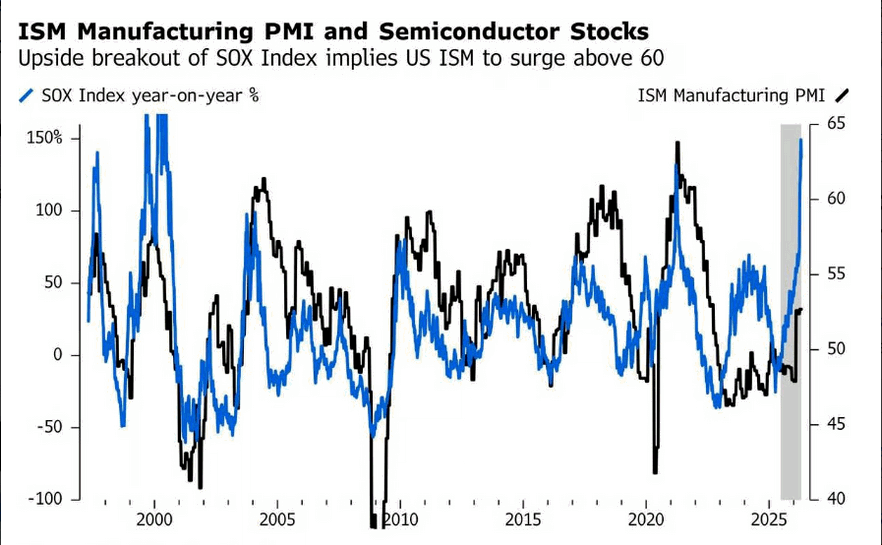
Chart of the Day: For the last four months the ISM Manufacturing Index has printed above 52 — a remarkable recovery that bodes well for the US economy. However, Barclays stated that the renewed enthusiasm for AI demand has driven a significant rise in memory and semiconductor stocks, accounting for the majority of recent gains in U.S. and Asian indices, while European markets, which have a lower proportion of technology stocks and are more sensitive to energy, have lagged far behind. Some have estimated AI investment has contributed 50-70% of the U.S 1Q2026 GDP print. Bank of America pointed out that the SOX index has not only reached its most overbought level in more than five years but has also completely decoupled from the ISM manufacturing index, a divergence that historically tends to converge in some manner. The stock market is voting ISM rises to meet SOX.
Market Intelligence Brief (MIB) Ver. 17.82
For professional investors only. Not investment advice.
© 2026 RecessionALERT.com

Comments are closed.